Properties of
Coordination Compounds
Dr.Christoph UP 2014
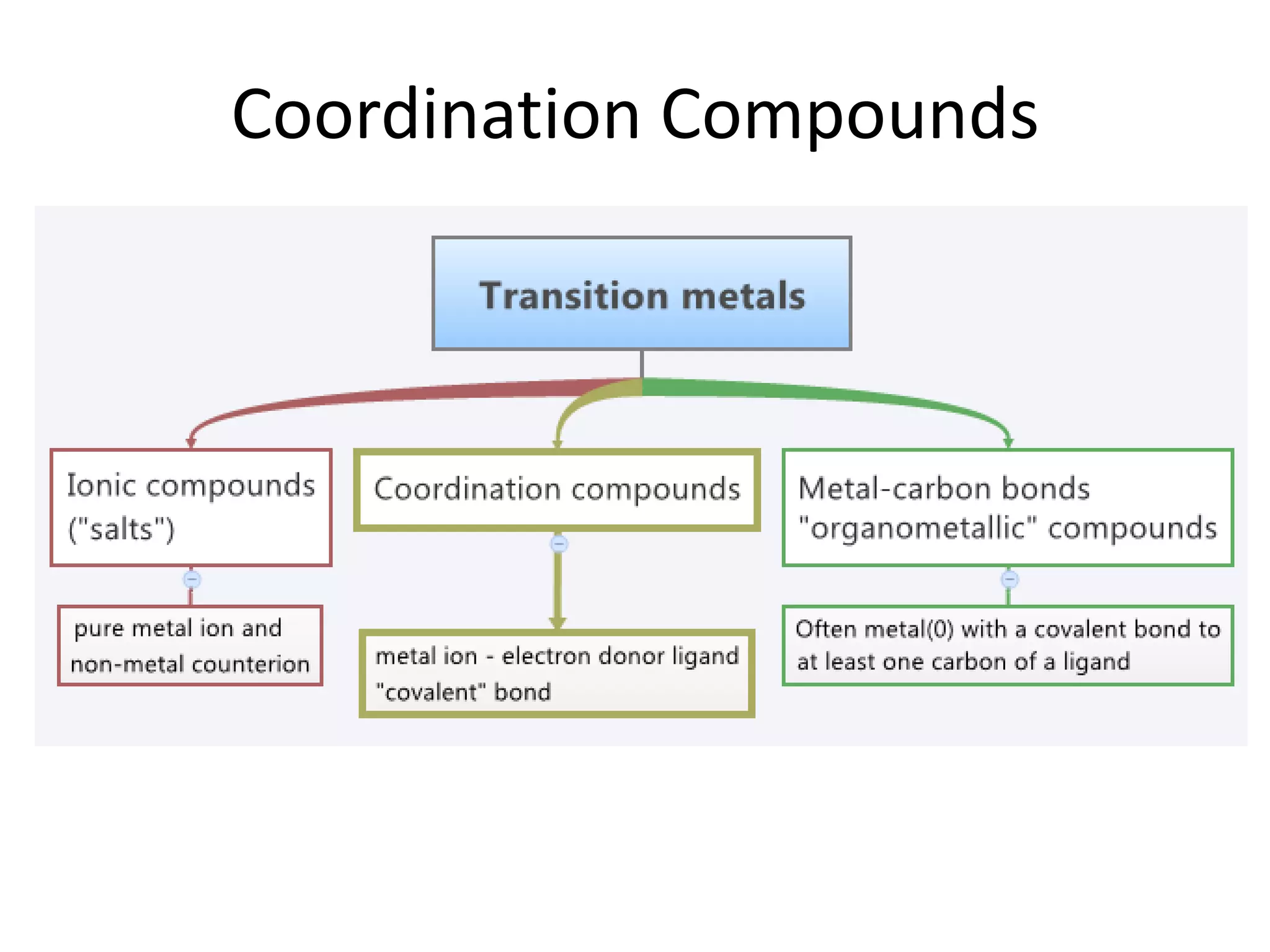
Coordination Compounds
Example
A) [Cr(NH3)3Cl3]
B) [Cr(NH3)6]Cl3
C) Na3[Cr(CN)6]
D) Na3[CrCl6]
Which of these compounds will form
a precipitation with AgNO3 ?
Review: CFT
Applications of Crystal Field Theory
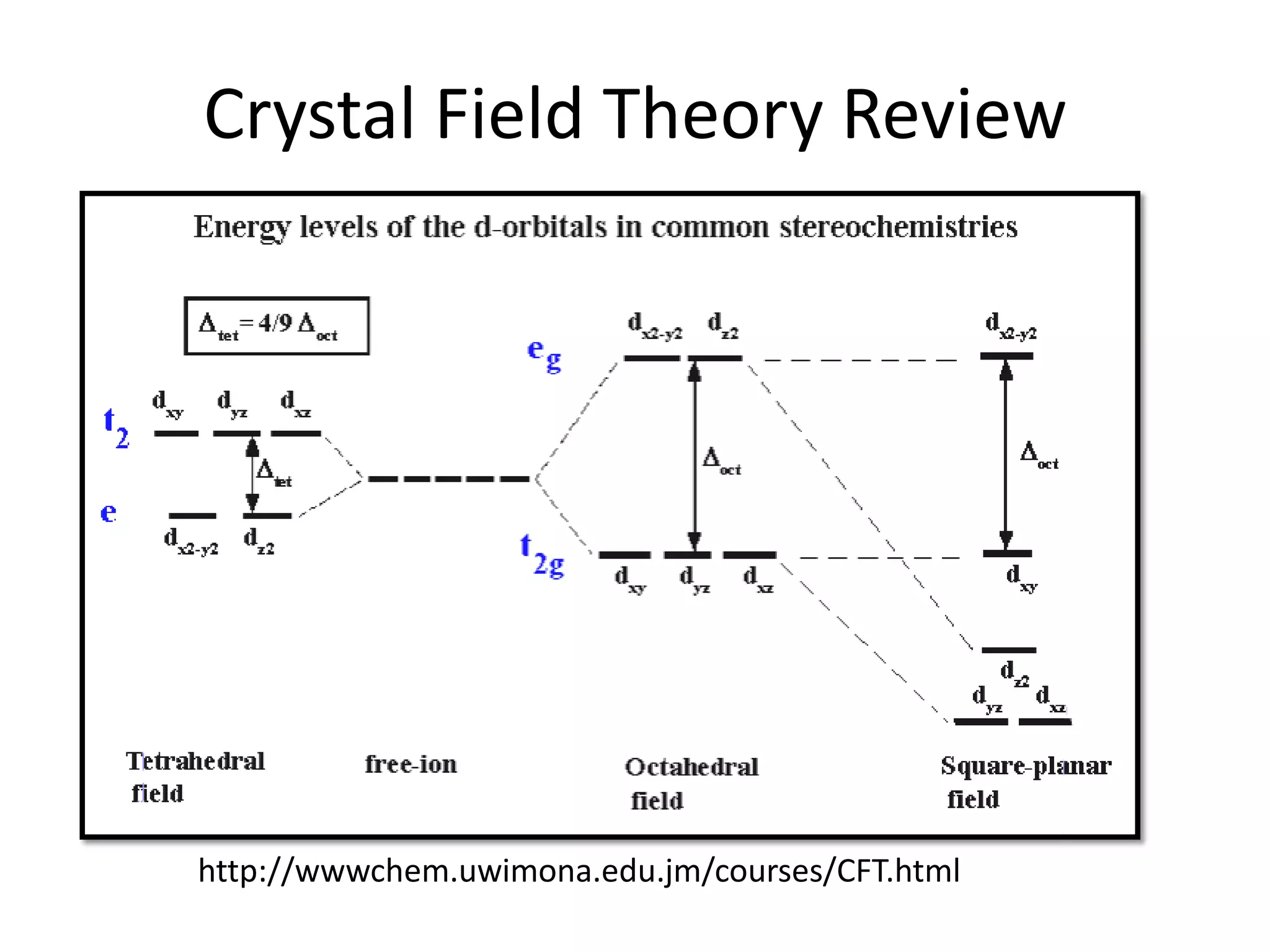
Crystal Field Theory Review
http://wwwchem.uwimona.edu.jm/courses/CFT.html
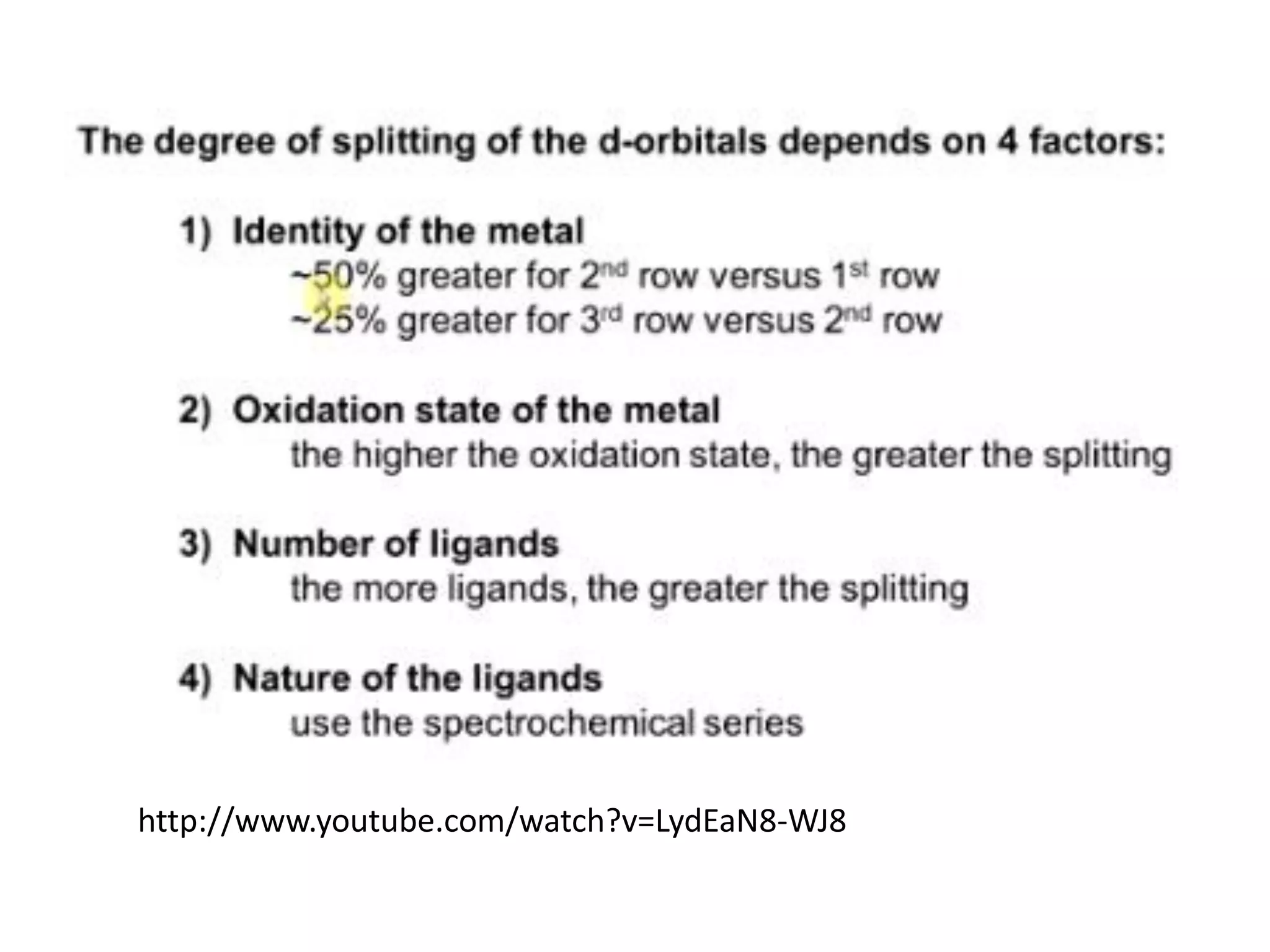
http://www.youtube.com/watch?v=LydEaN8-WJ8
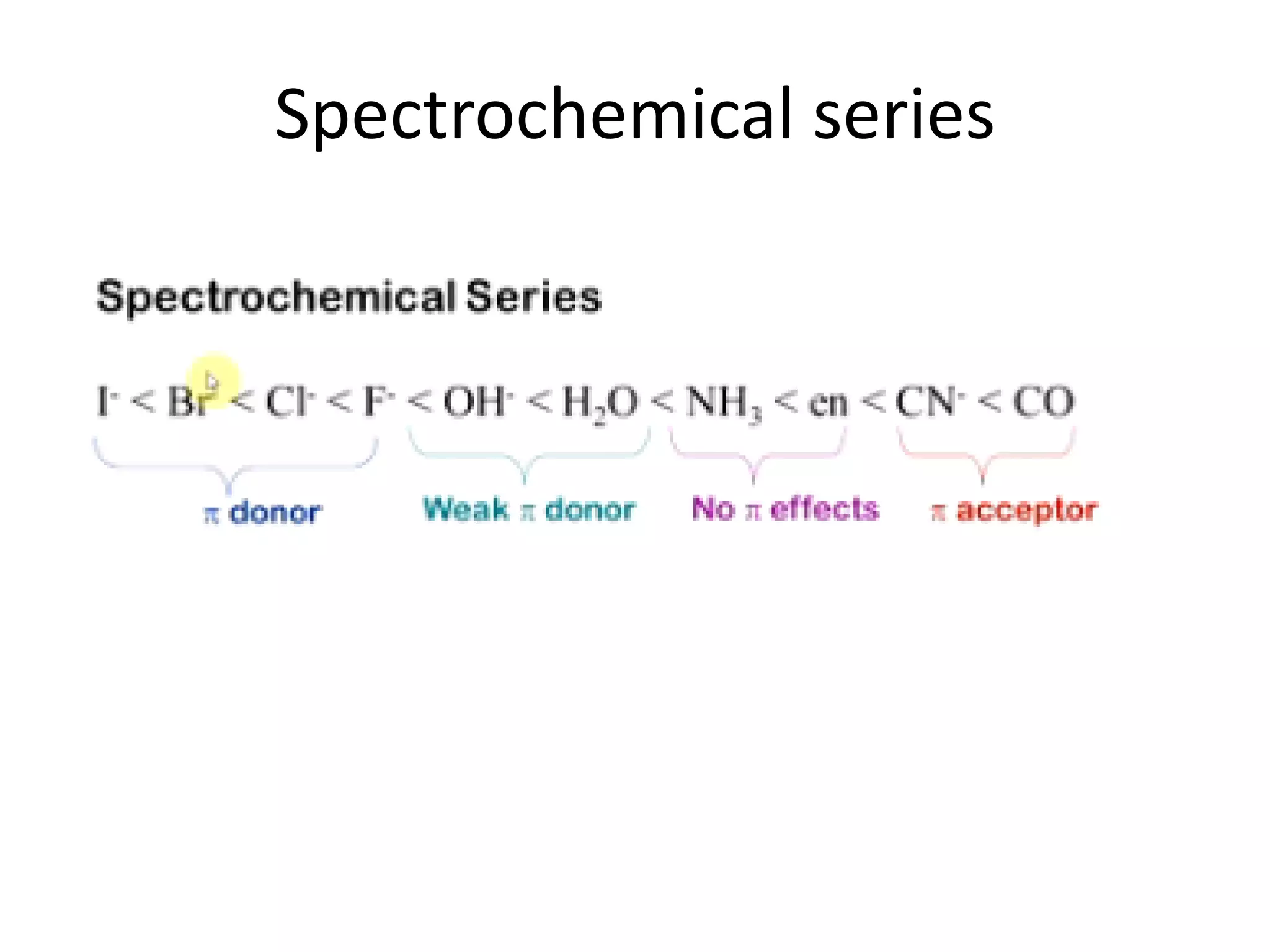
Spectrochemical series
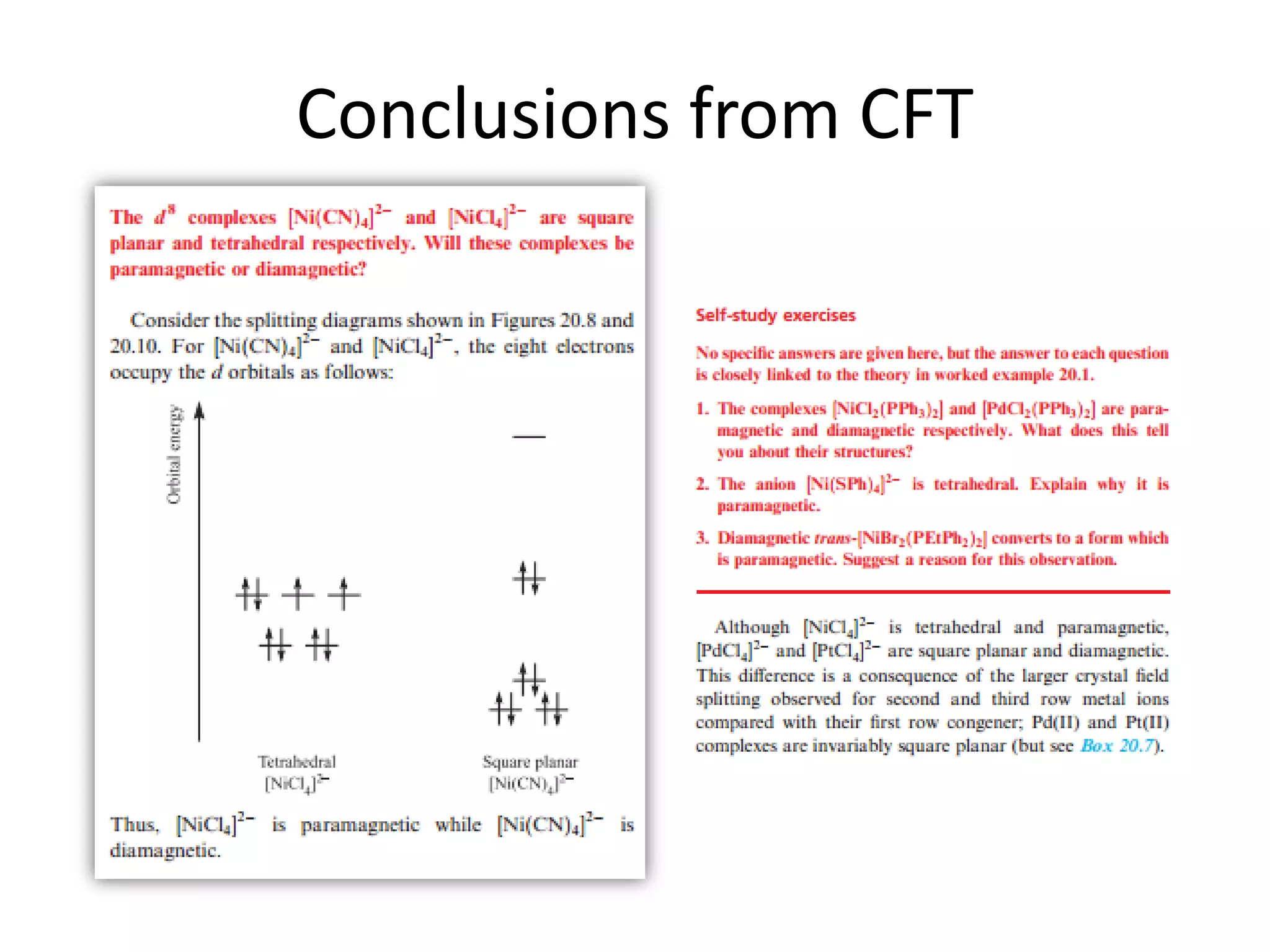
Conclusions from CFT
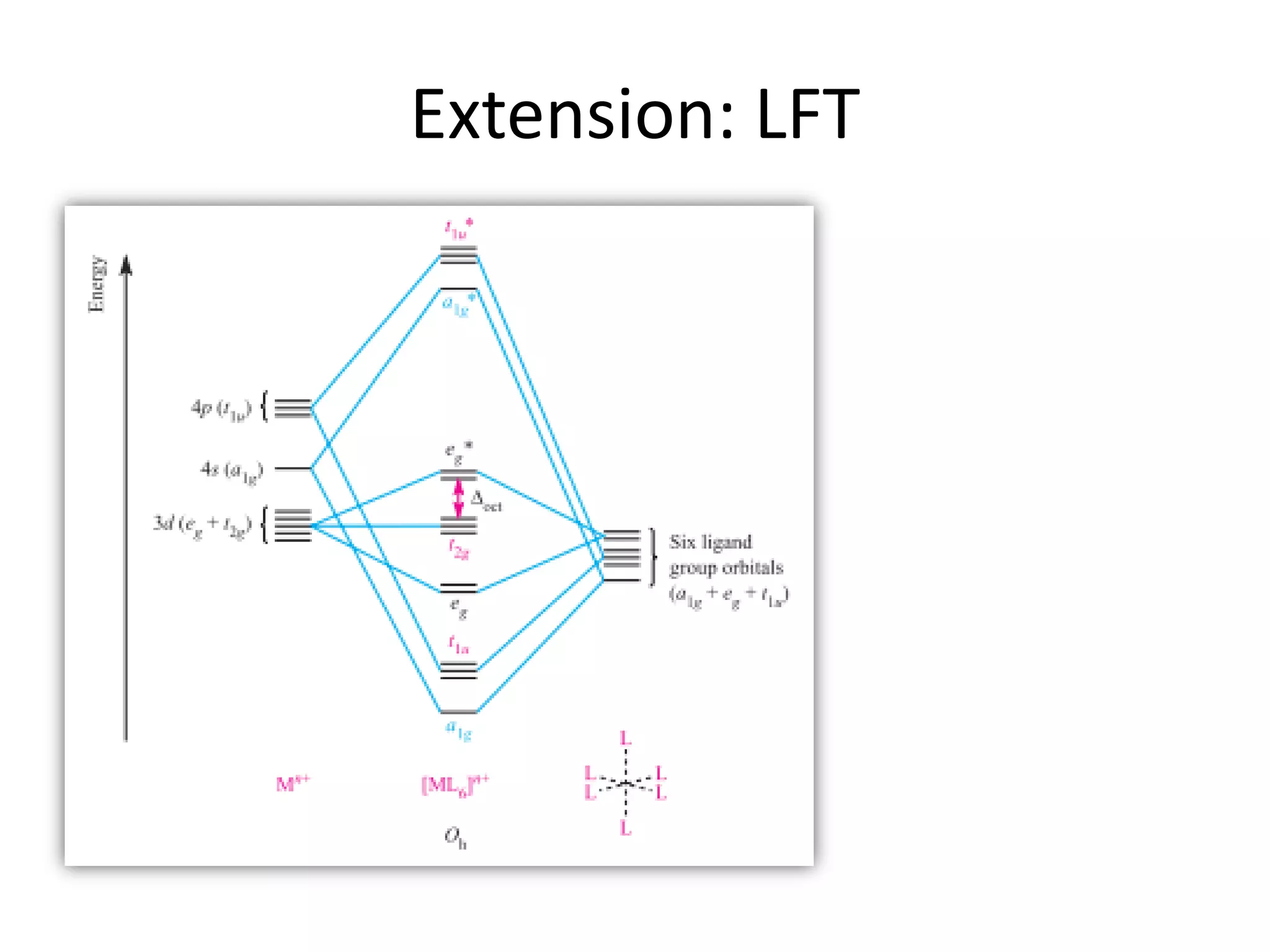
Extension: LFT
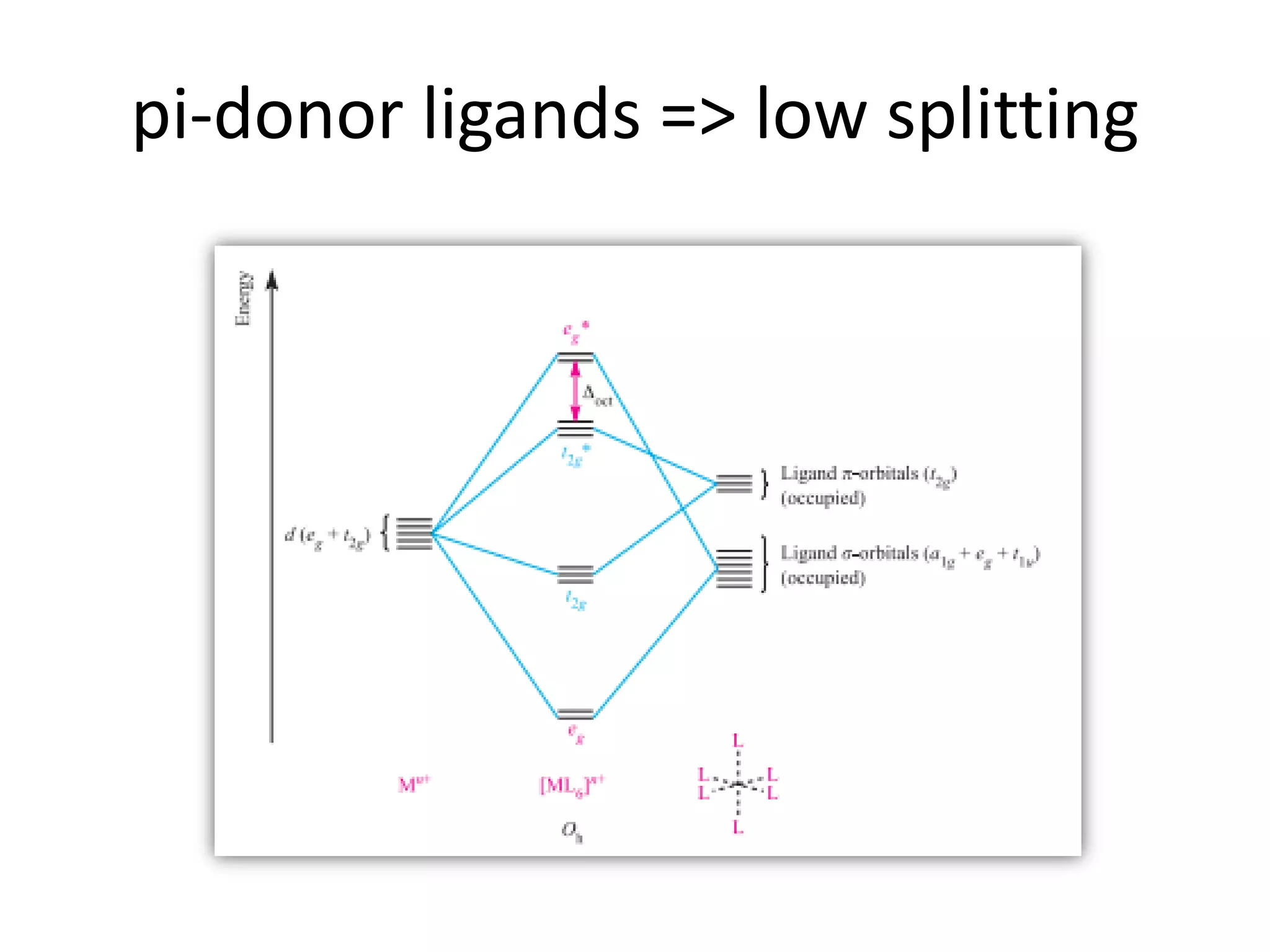
pi-donor ligands => low splitting
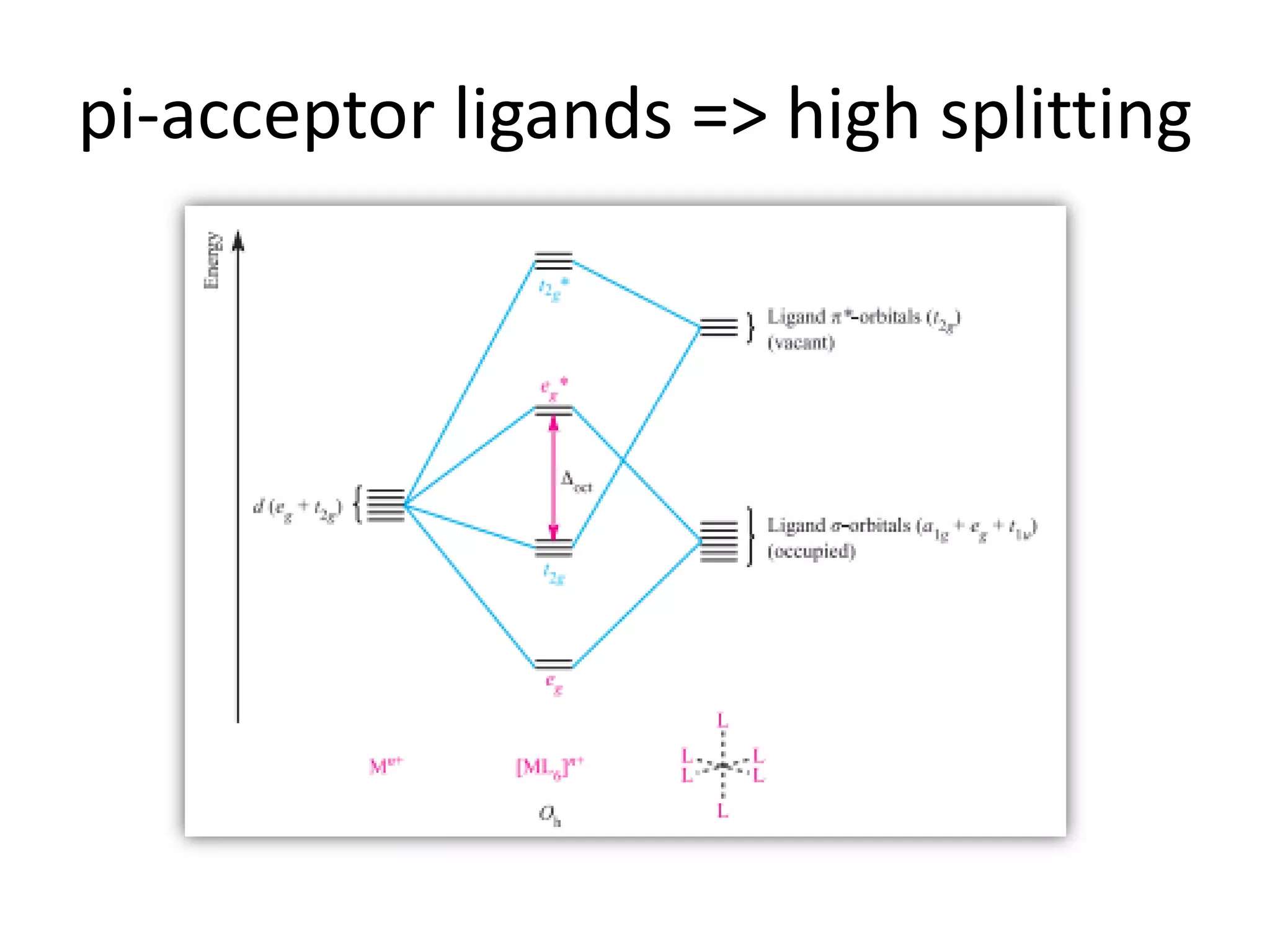
pi-acceptor ligands => high splitting
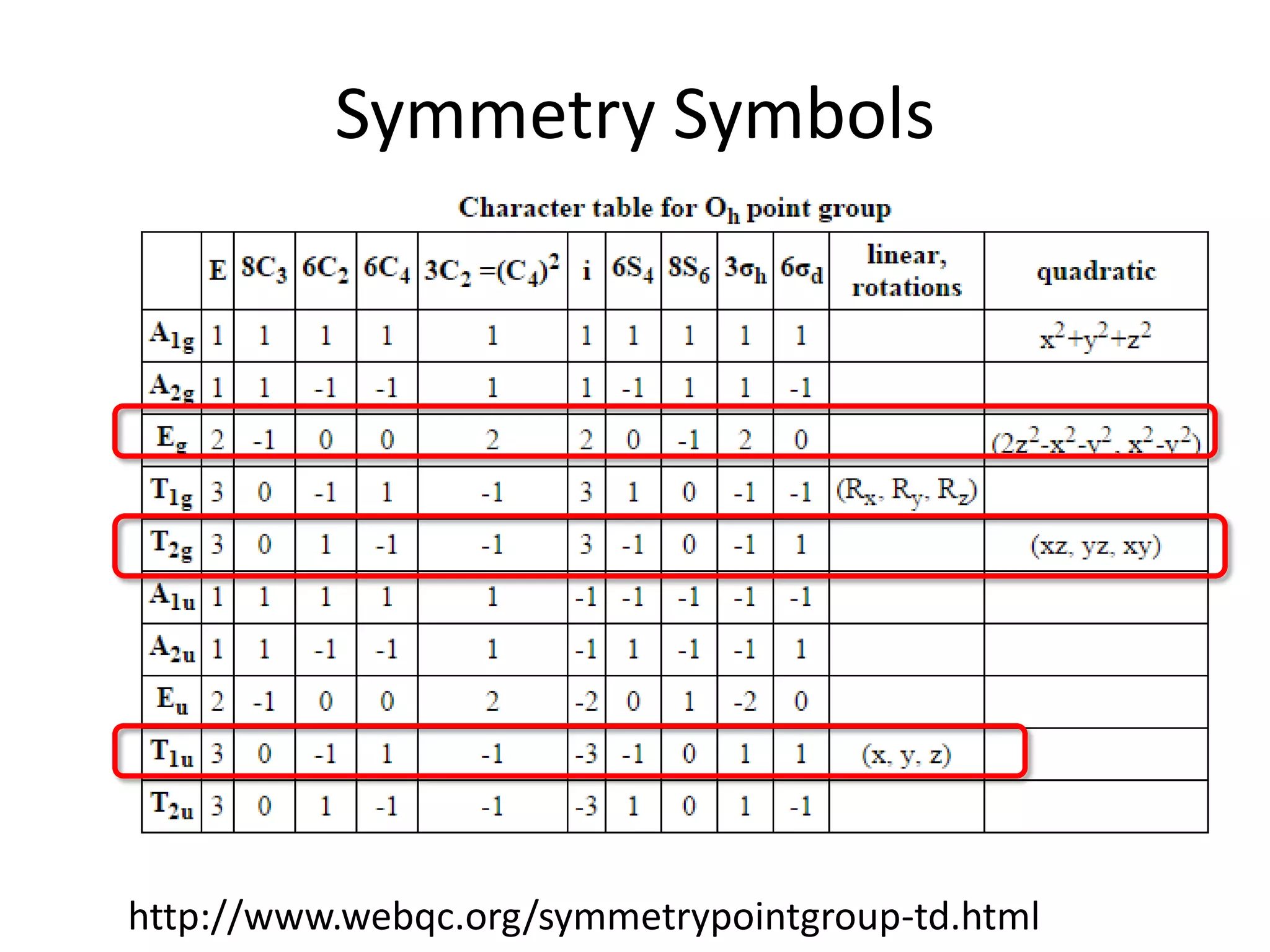
Symmetry Symbols
http://www.webqc.org/symmetrypointgroup-td.html
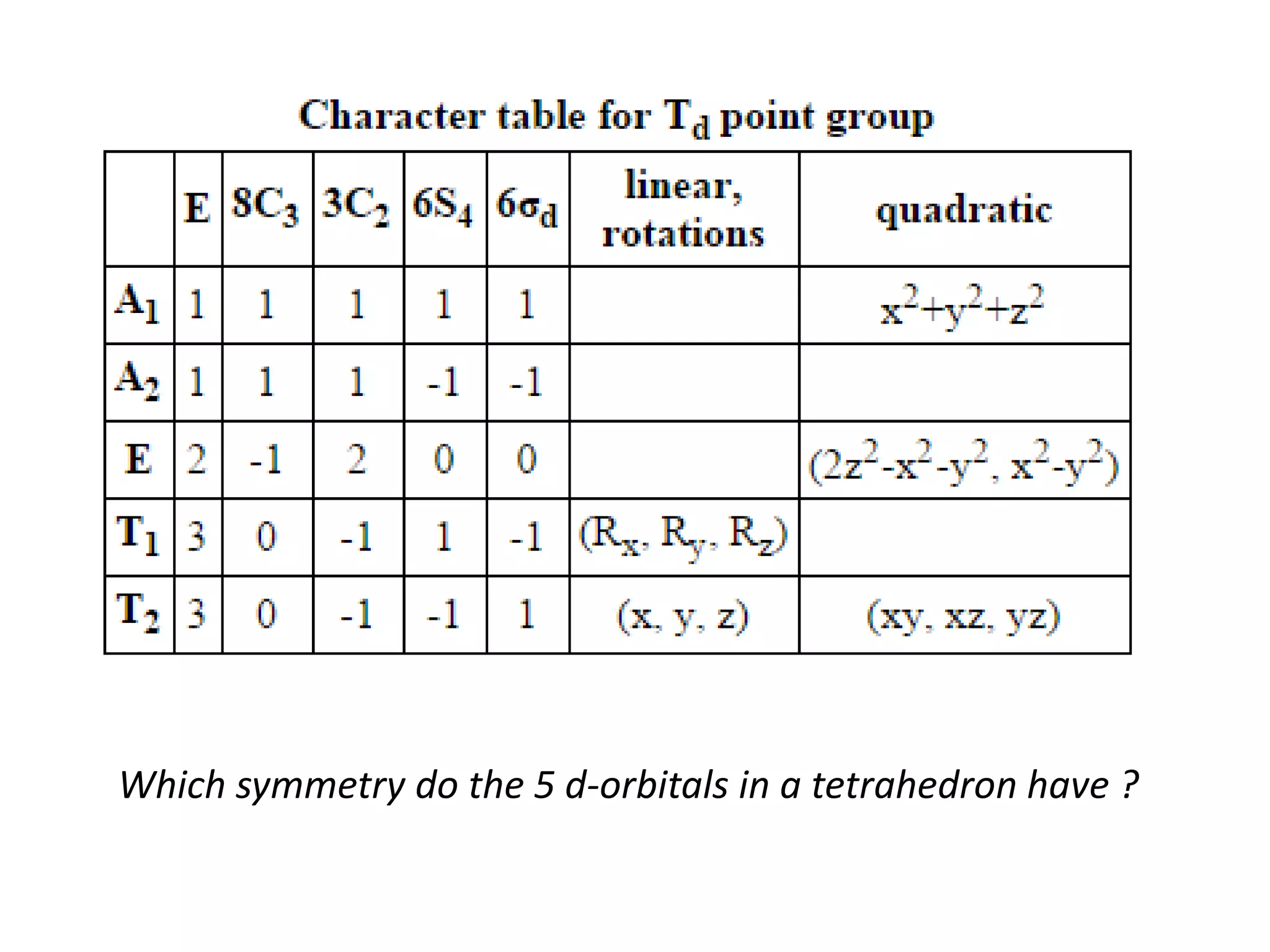
Which symmetry do the 5 d-orbitals in a tetrahedron have ?
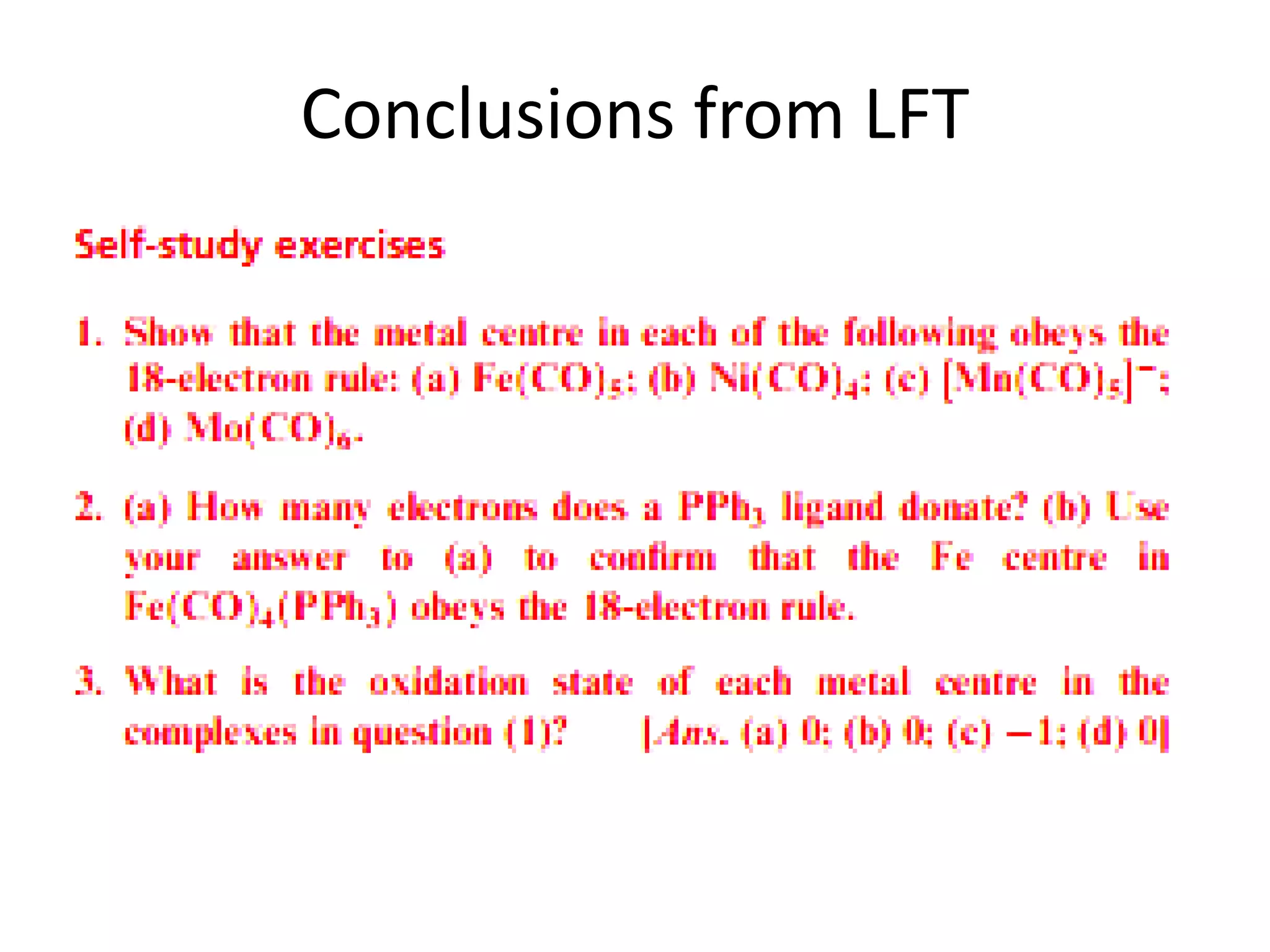
Conclusions from LFT
(1) Find the configuration (as tx
2gey
g / ext2
y), the number of
unpaired electrons and the LFSE (in terms of ∆o / ∆t and P)
(2) Which of the following complexes has higher LFSE:
(h) [MnF6]3- i) [NiBr4]2- j) [Fe(CN)6]4-
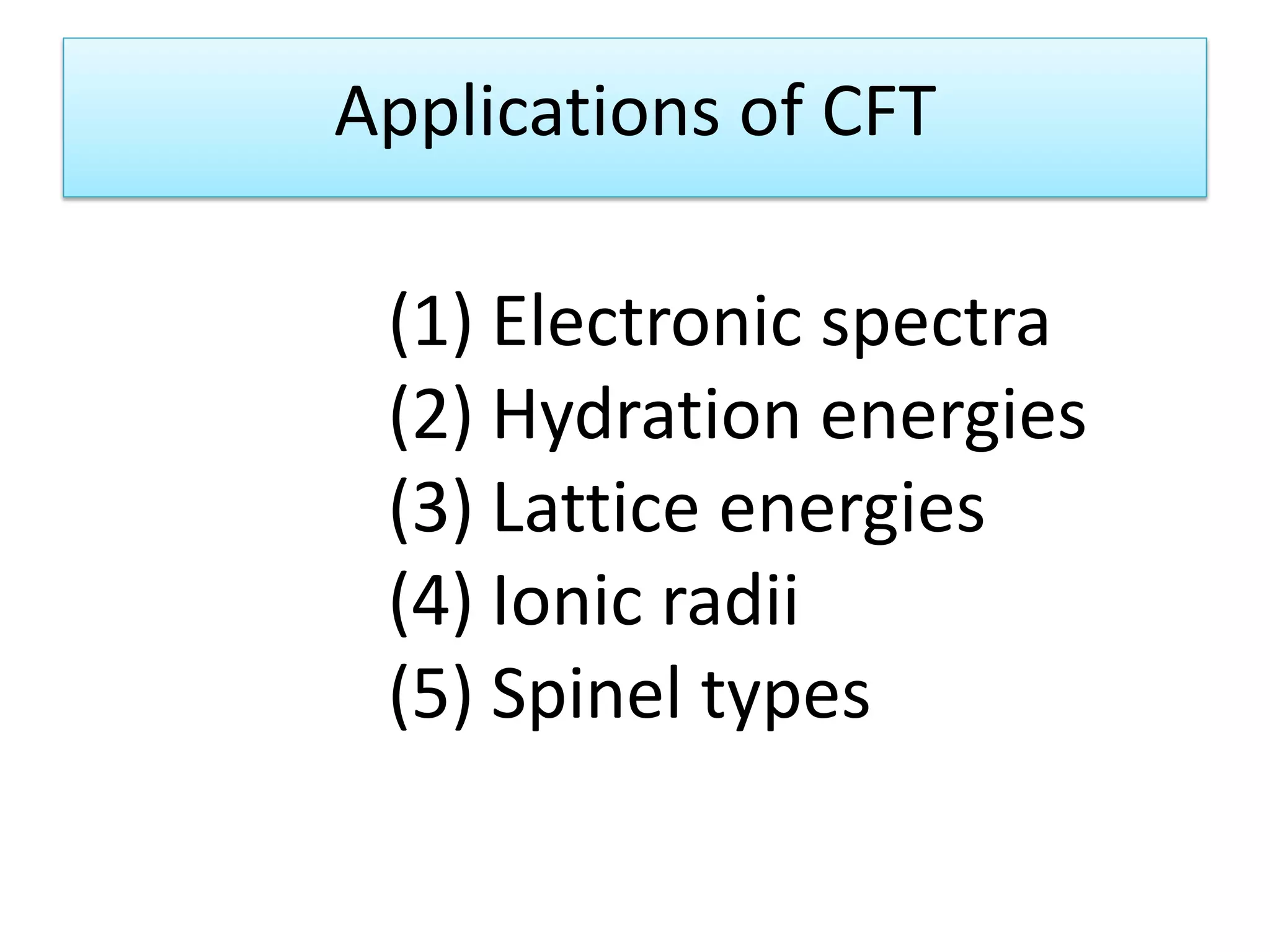
Applications of CFT
(1) Electronic spectra
(2) Hydration energies
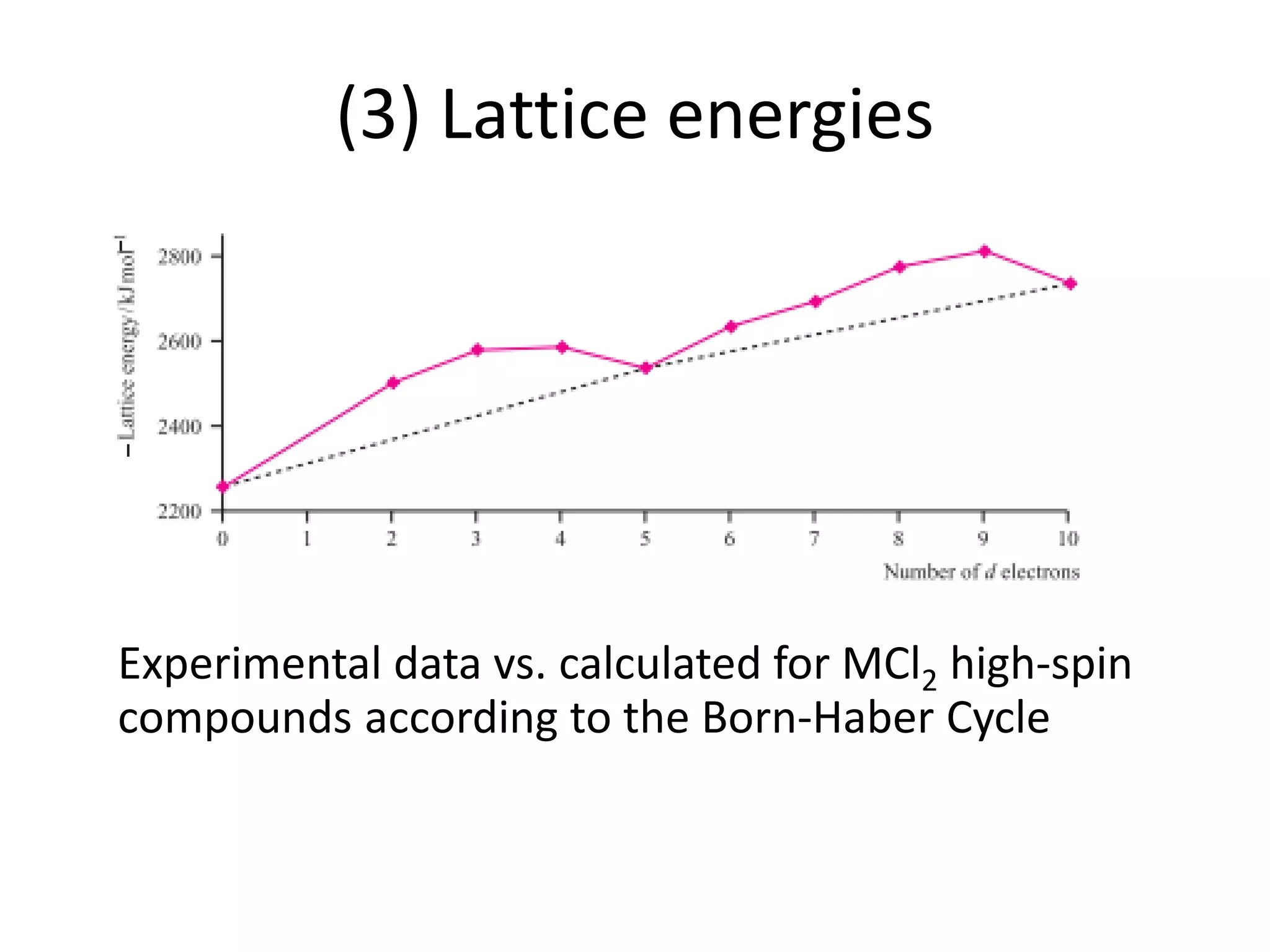
(3) Lattice energies
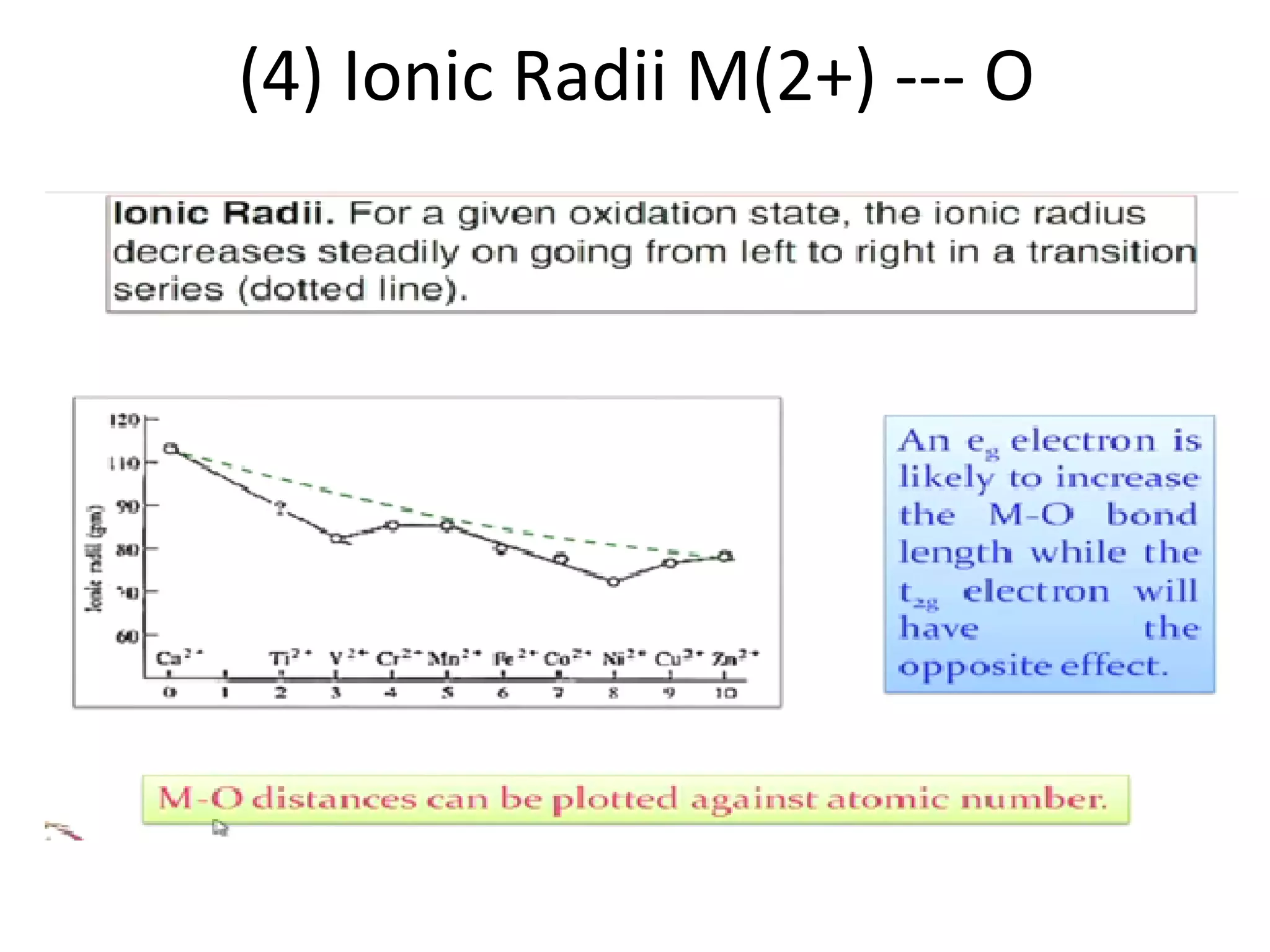
(4) Ionic radii
(5) Spinel types
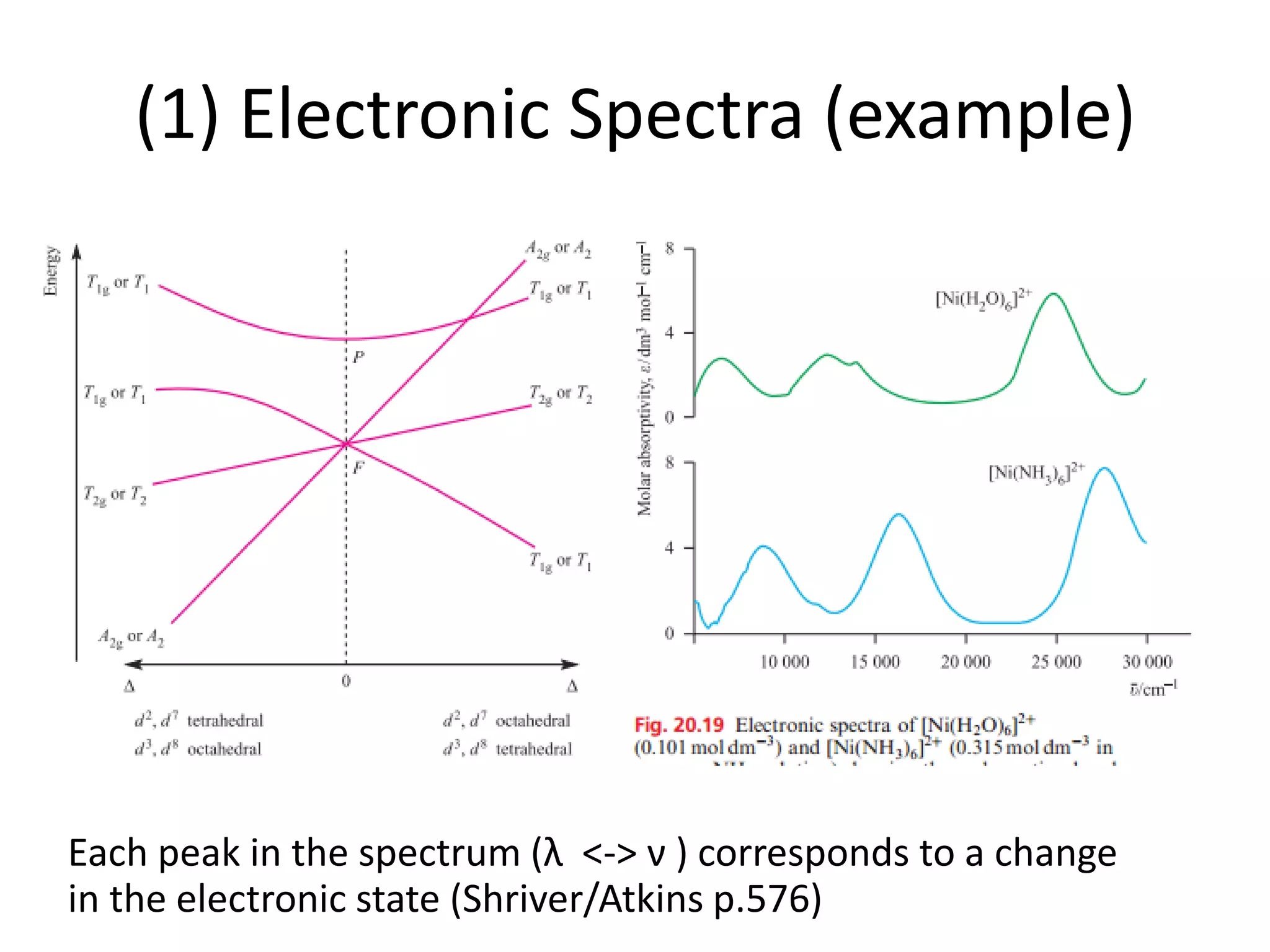
(1) Electronic Spectra (example)
Each peak in the spectrum (λ <-> ν ) corresponds to a change
in the electronic state (Shriver/Atkins p.576)
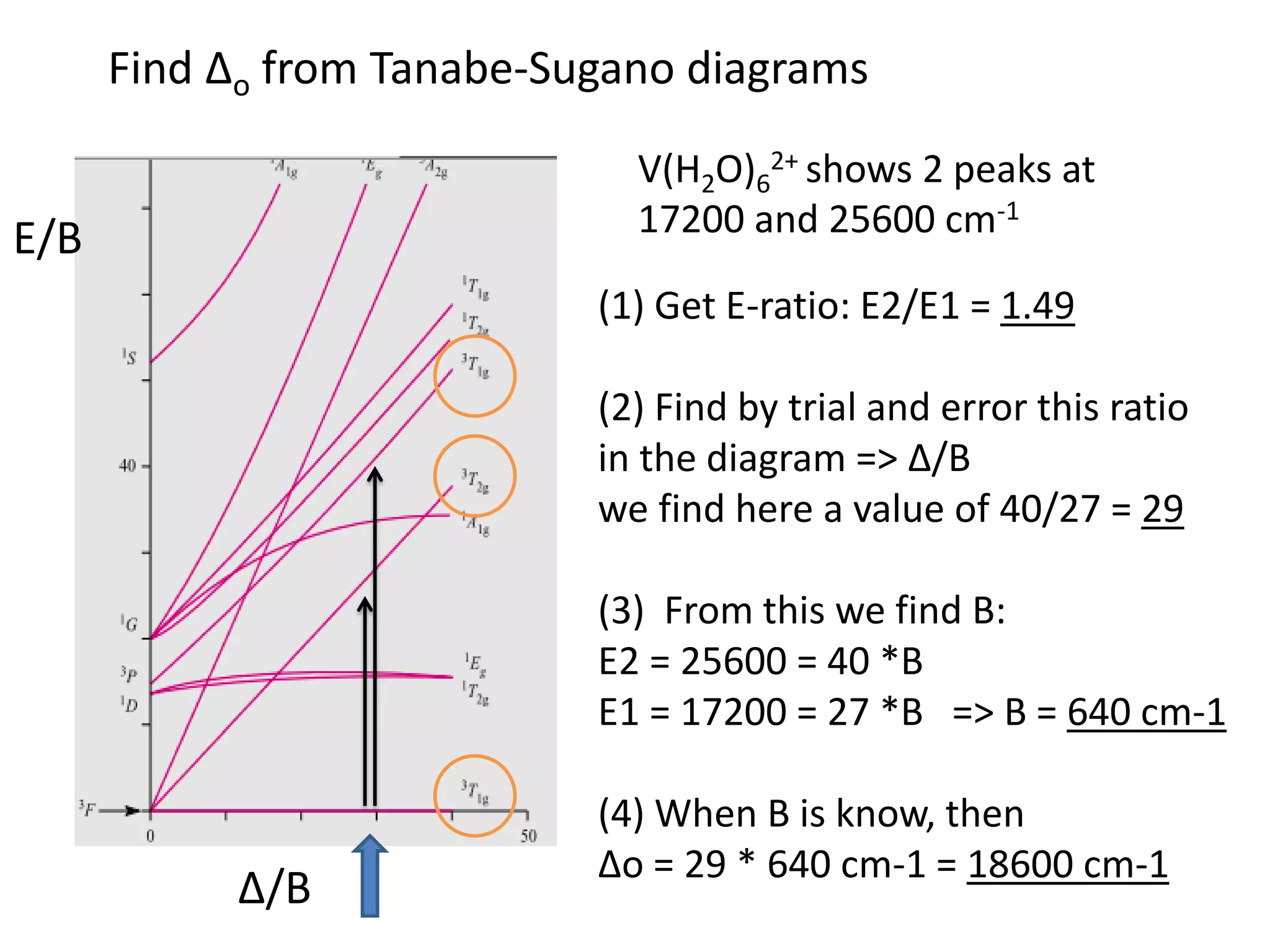
Find ∆o from Tanabe-Sugano diagrams
∆/B
E/B
V(H2O)6
2+ shows 2 peaks at
17200 and 25600 cm-1
(1) Get E-ratio: E2/E1 = 1.49
(2) Find by trial and error this ratio
in the diagram => ∆/B
we find here a value of 40/27 = 29
(3) From this we find B:
E2 = 25600 = 40 *B
E1 = 17200 = 27 *B => B = 640 cm-1
(4) When B is know, then
∆o = 29 * 640 cm-1 = 18600 cm-1
http://www.chem.uky.edu/courses/che610/JPS_Spring_2007/
PS2_2007key.pdf
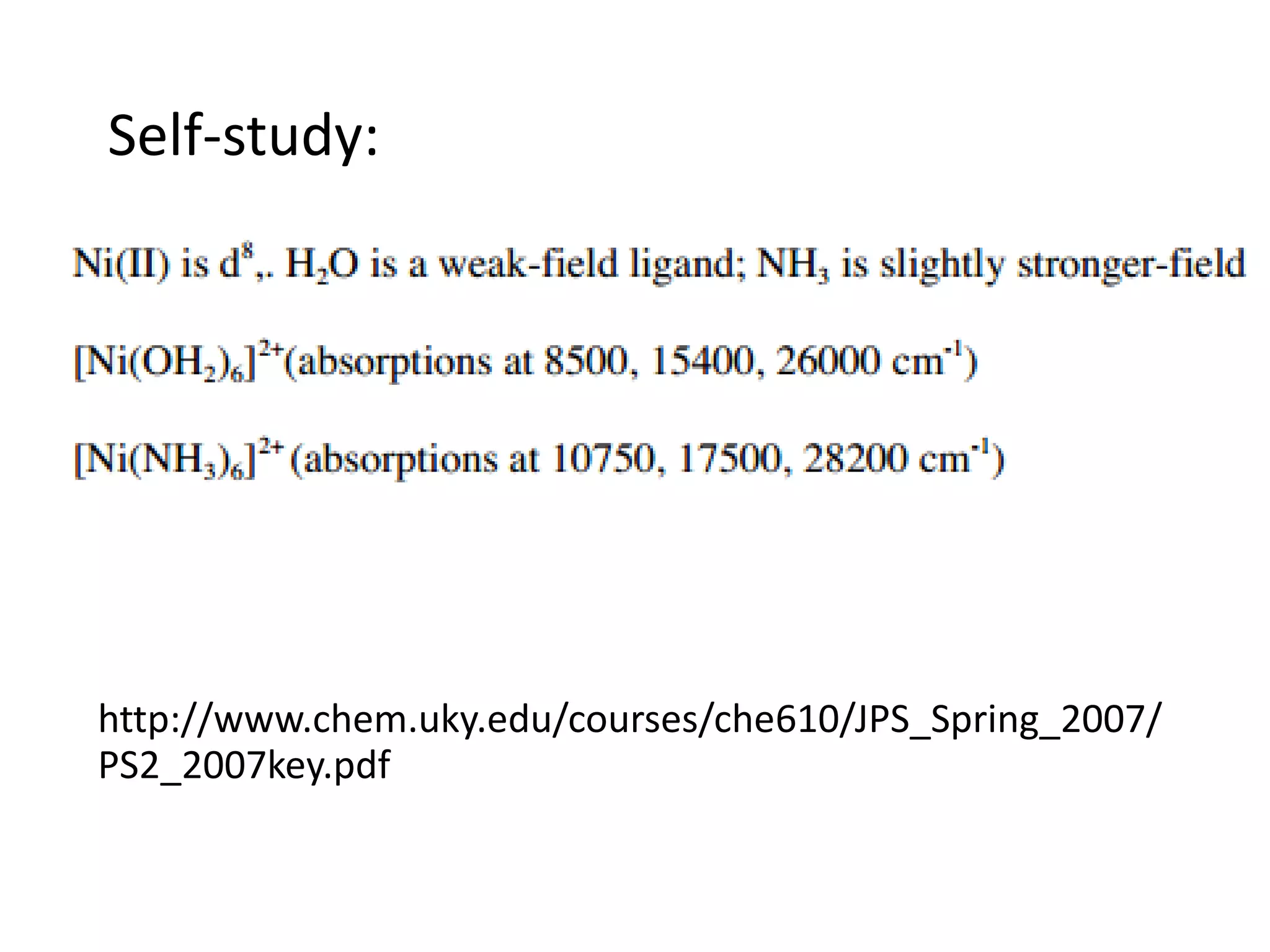
Self-study:
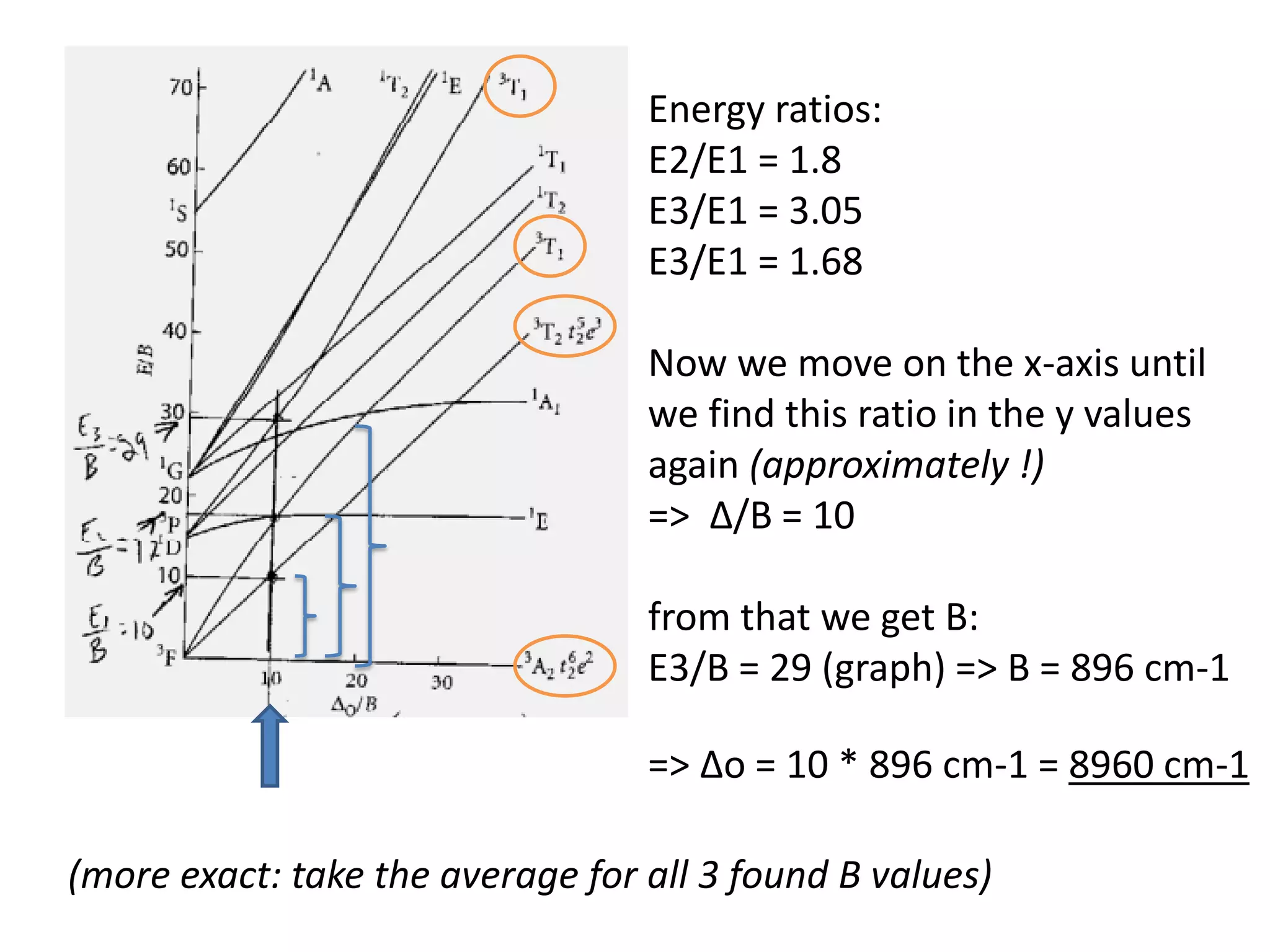
Energy ratios:
E2/E1 = 1.8
E3/E1 = 3.05
E3/E1 = 1.68
Now we move on the x-axis until
we find this ratio in the y values
again (approximately !)
=> ∆/B = 10
from that we get B:
E3/B = 29 (graph) => B = 896 cm-1
=> ∆o = 10 * 896 cm-1 = 8960 cm-1
(more exact: take the average for all 3 found B values)
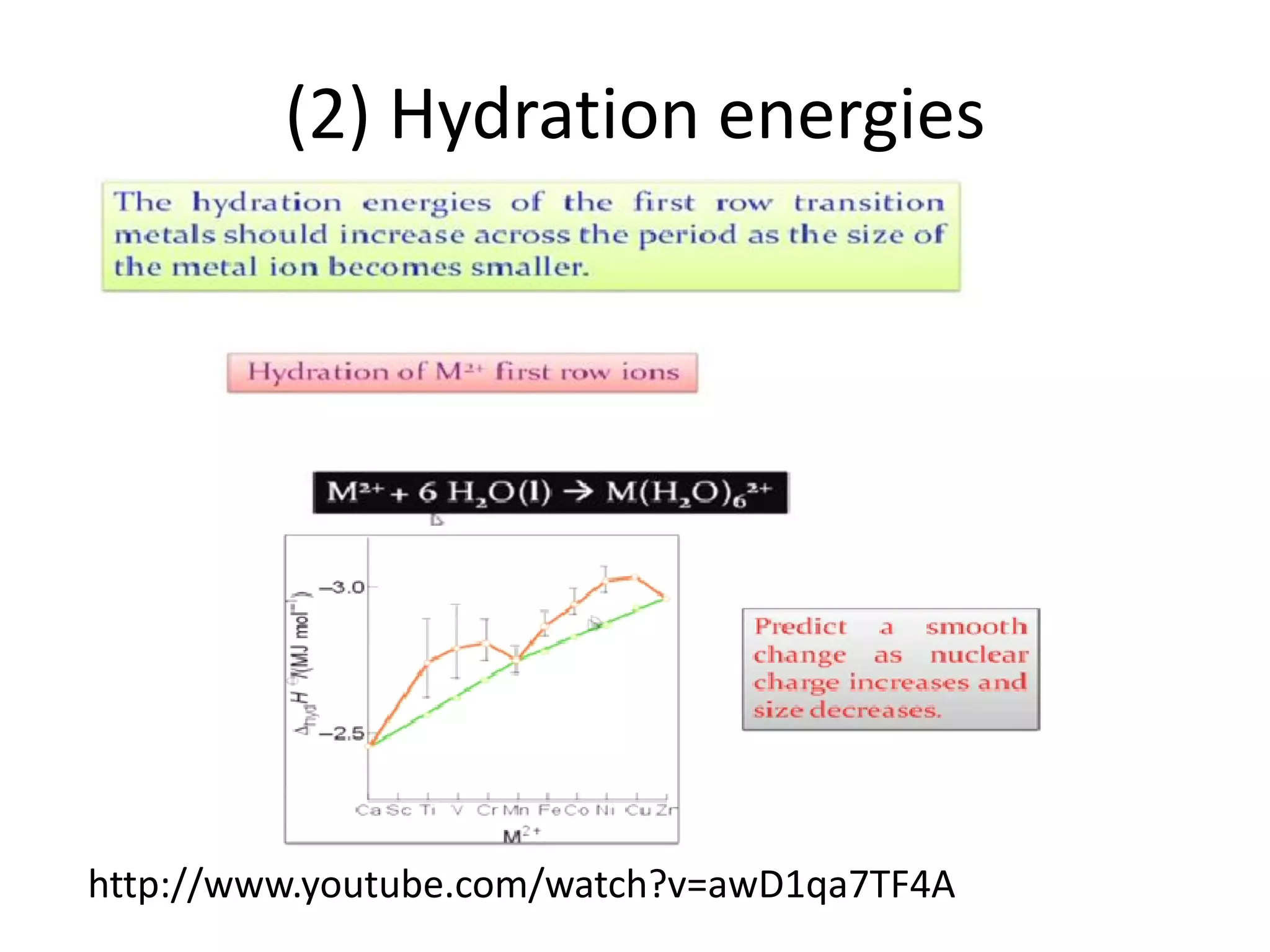
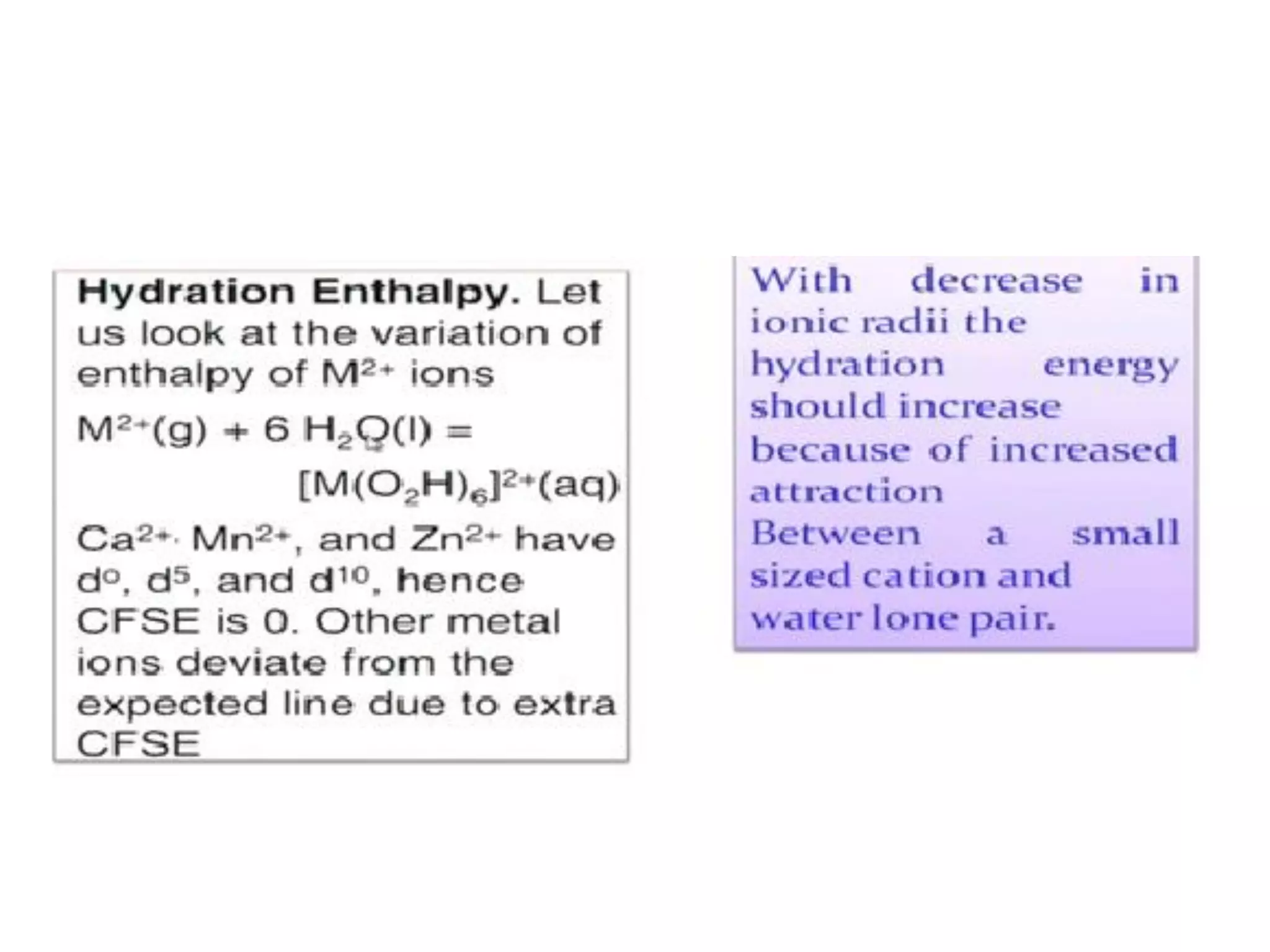
(2) Hydration energies
http://www.youtube.com/watch?v=awD1qa7TF4A
(3) Lattice energies
Experimental data vs. calculated for MCl2 high-spin
compounds according to the Born-Haber Cycle
(4) Ionic Radii M(2+) --- O
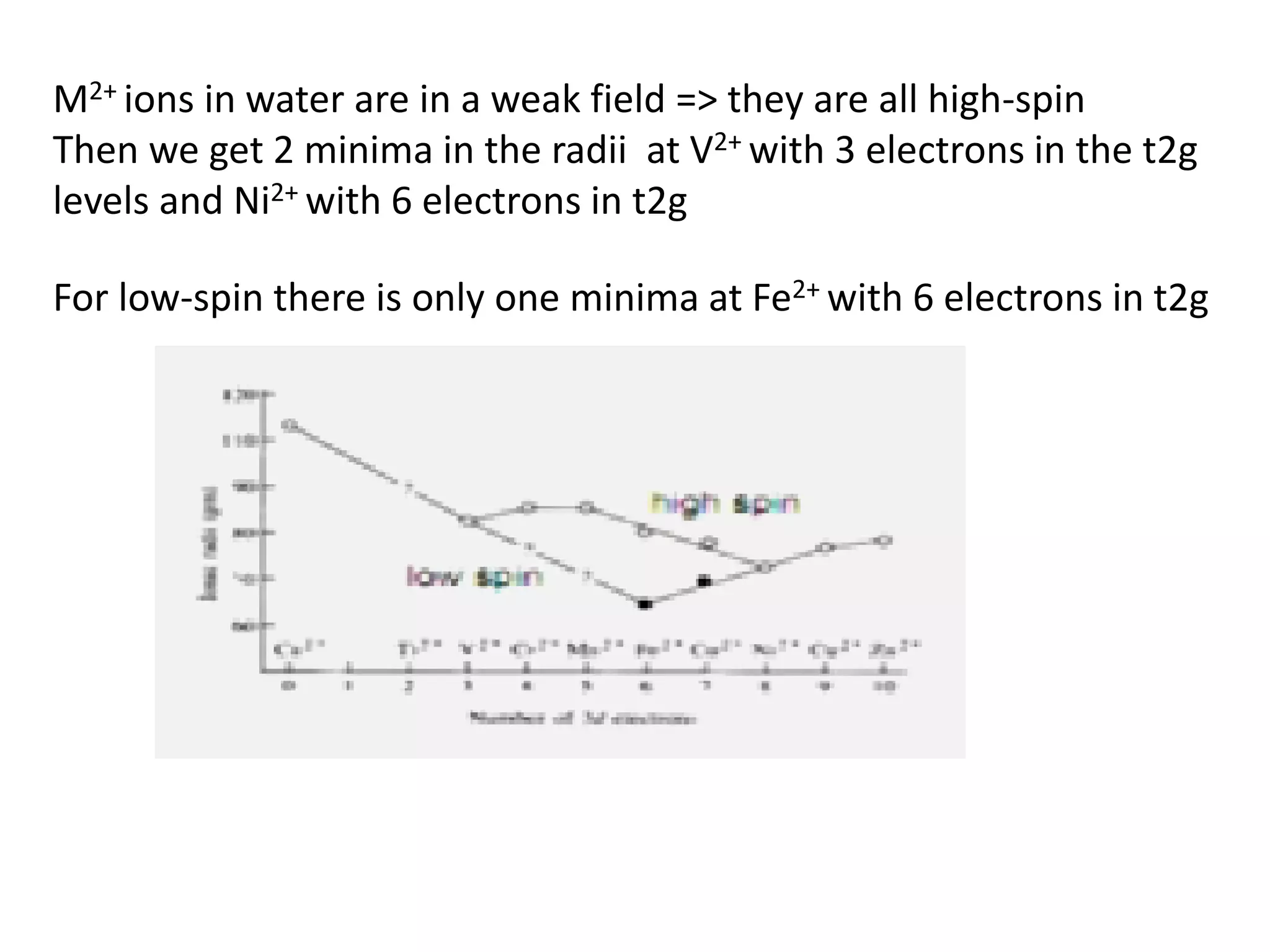
M2+ ions in water are in a weak field => they are all high-spin
Then we get 2 minima in the radii at V2+ with 3 electrons in the t2g
levels and Ni2+ with 6 electrons in t2g
For low-spin there is only one minima at Fe2+ with 6 electrons in t2g
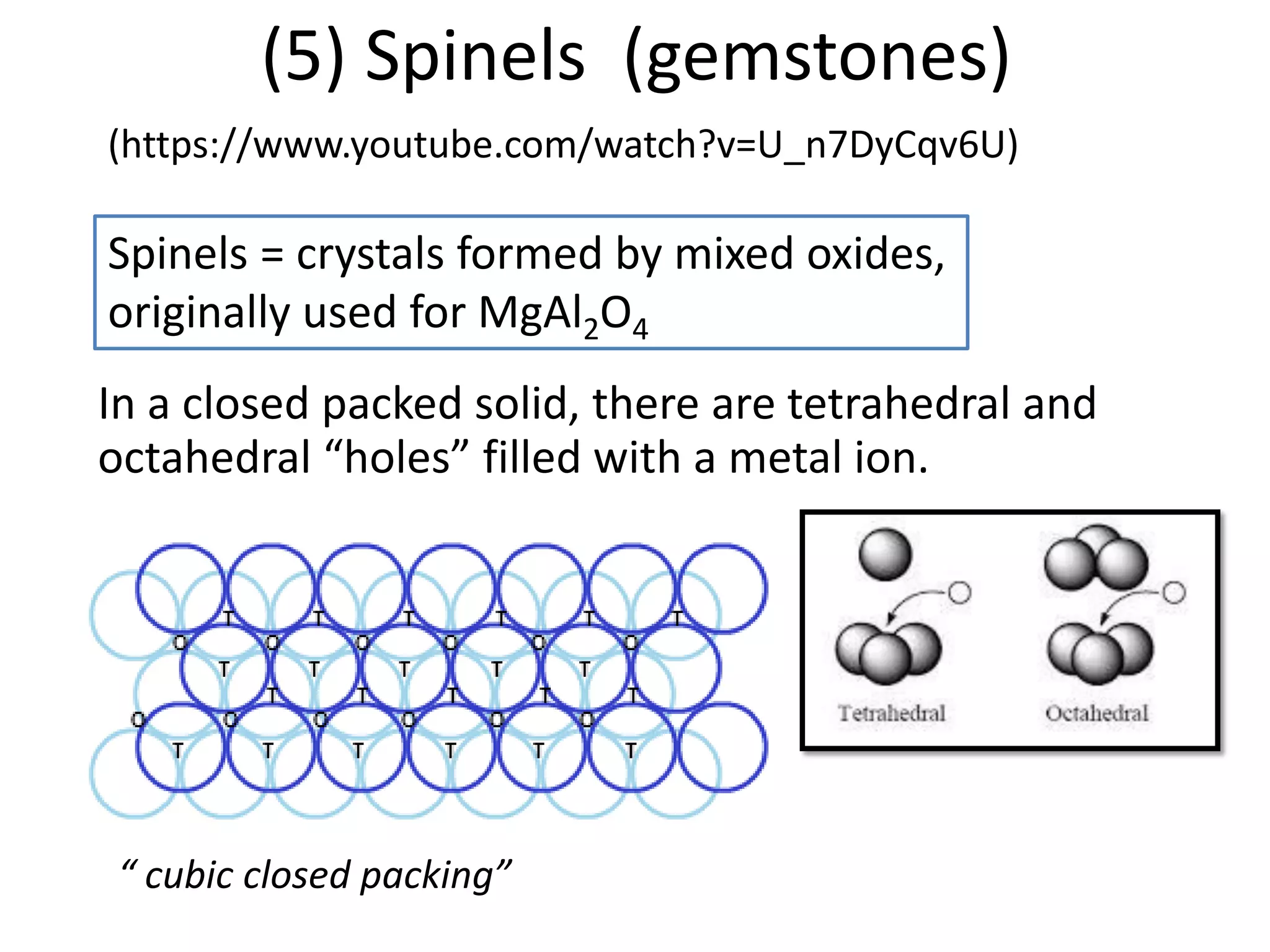
(5) Spinels (gemstones)
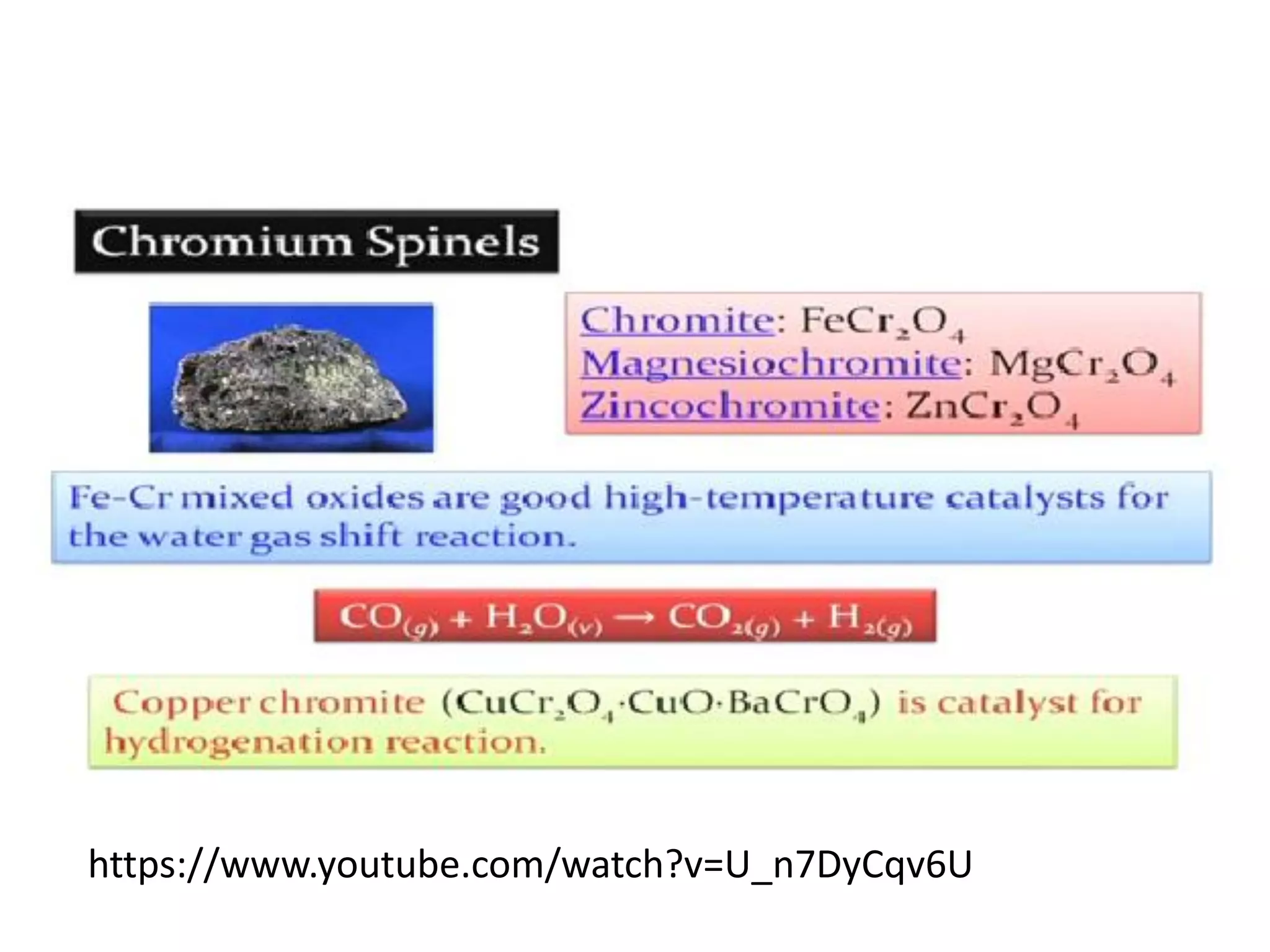
Spinels = crystals formed by mixed oxides,
originally used for MgAl2O4
In a closed packed solid, there are tetrahedral and
octahedral “holes” filled with a metal ion.
“ cubic closed packing”
(https://www.youtube.com/watch?v=U_n7DyCqv6U)
Example
What is the oxidation number of Fe in Fe3O4 ?
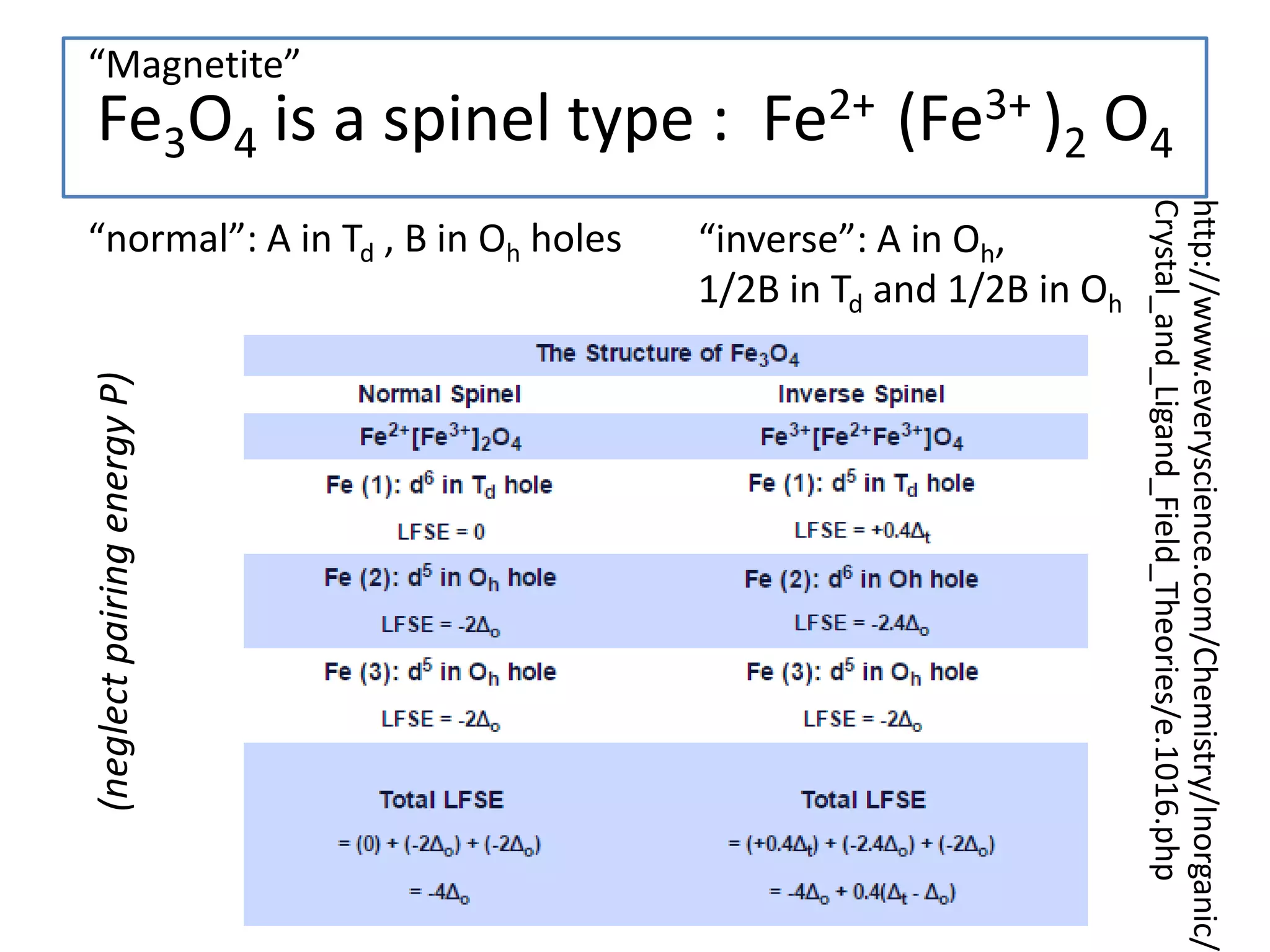
“normal”: A in Td , B in Oh holes
Fe3O4 is a spinel type : Fe2+ (Fe3+ )2 O4
“inverse”: A in Oh,
1/2B in Td and 1/2B in Oh
(neglectpairingenergyP)
http://www.everyscience.com/Chemistry/Inorganic/
Crystal_and_Ligand_Field_Theories/e.1016.php
“Magnetite”
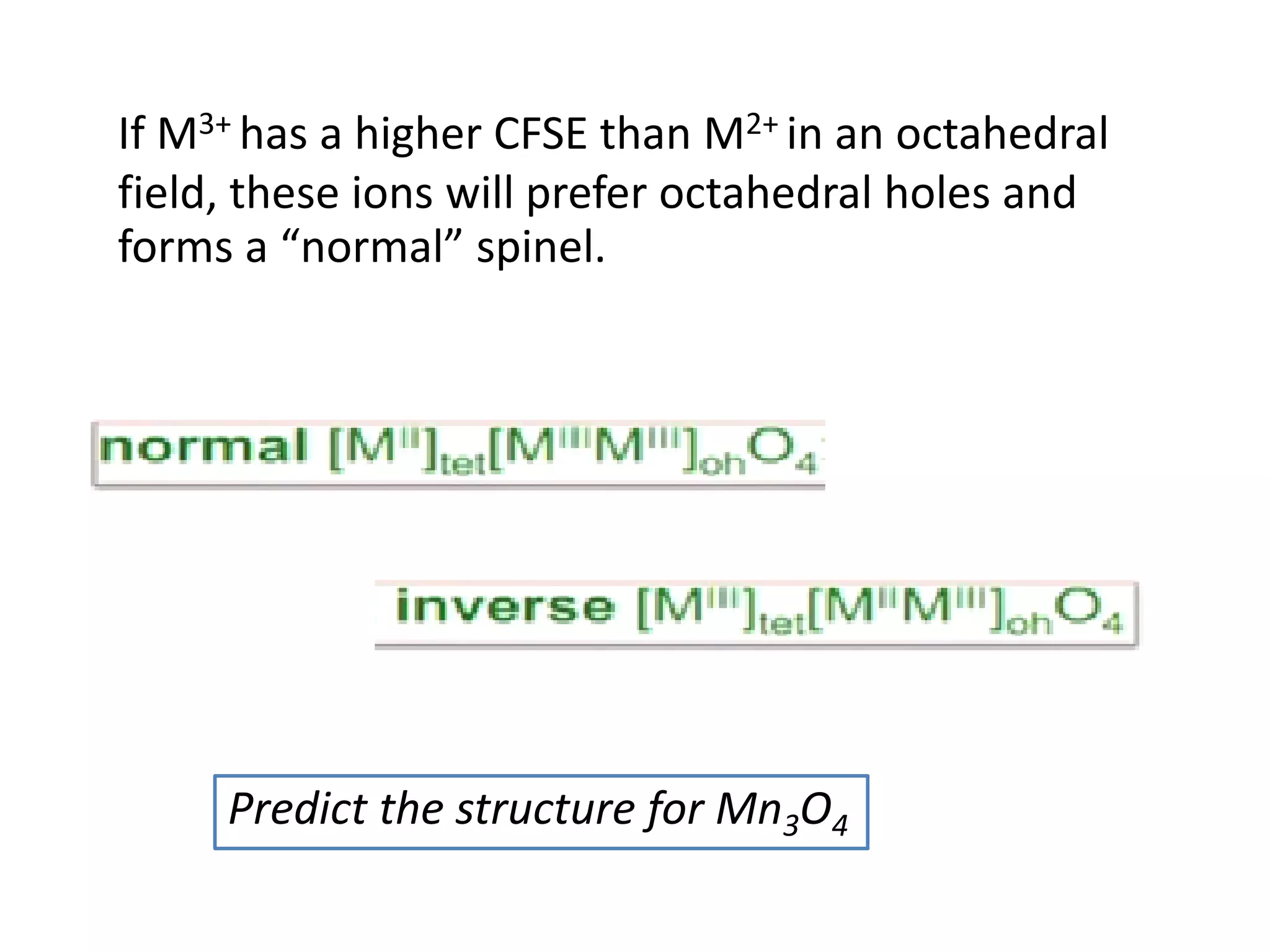
If M3+ has a higher CFSE than M2+ in an octahedral
field, these ions will prefer octahedral holes and
forms a “normal” spinel.
Predict the structure for Mn3O4
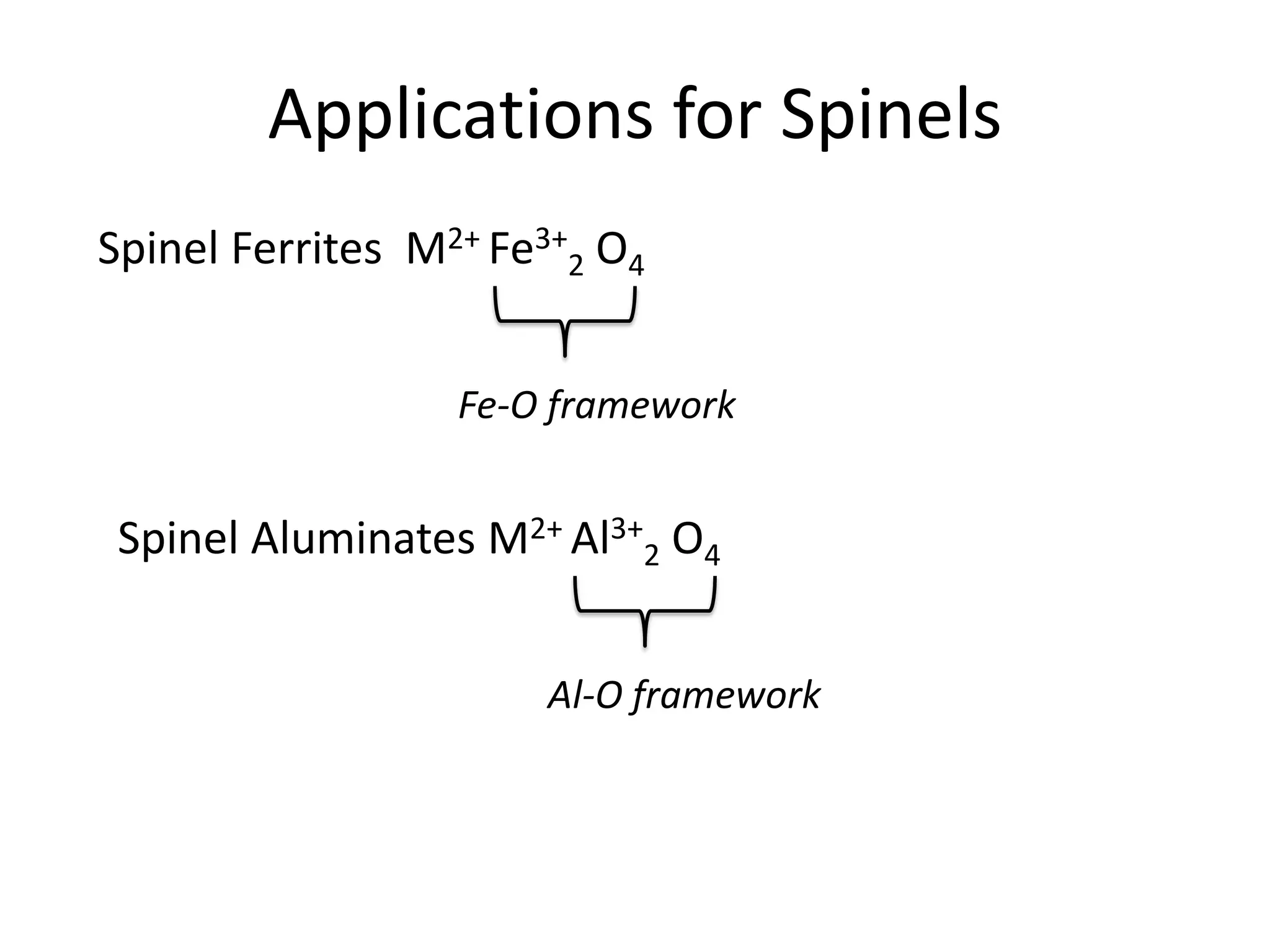
Applications for Spinels
Spinel Ferrites M2+ Fe3+
2 O4
Fe-O framework
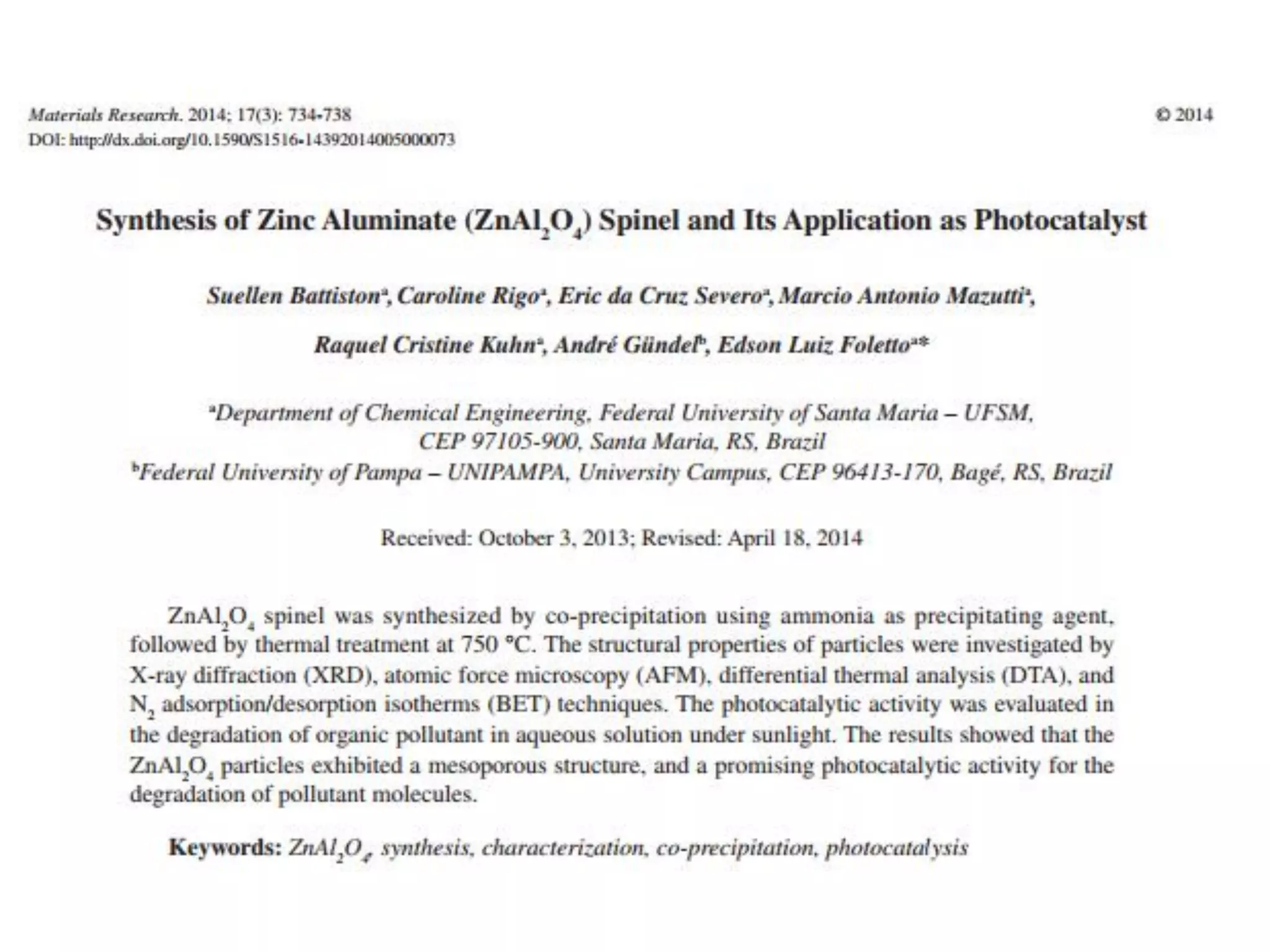
Spinel Aluminates M2+ Al3+
2 O4
Al-O framework
https://www.youtube.com/watch?v=U_n7DyCqv6U
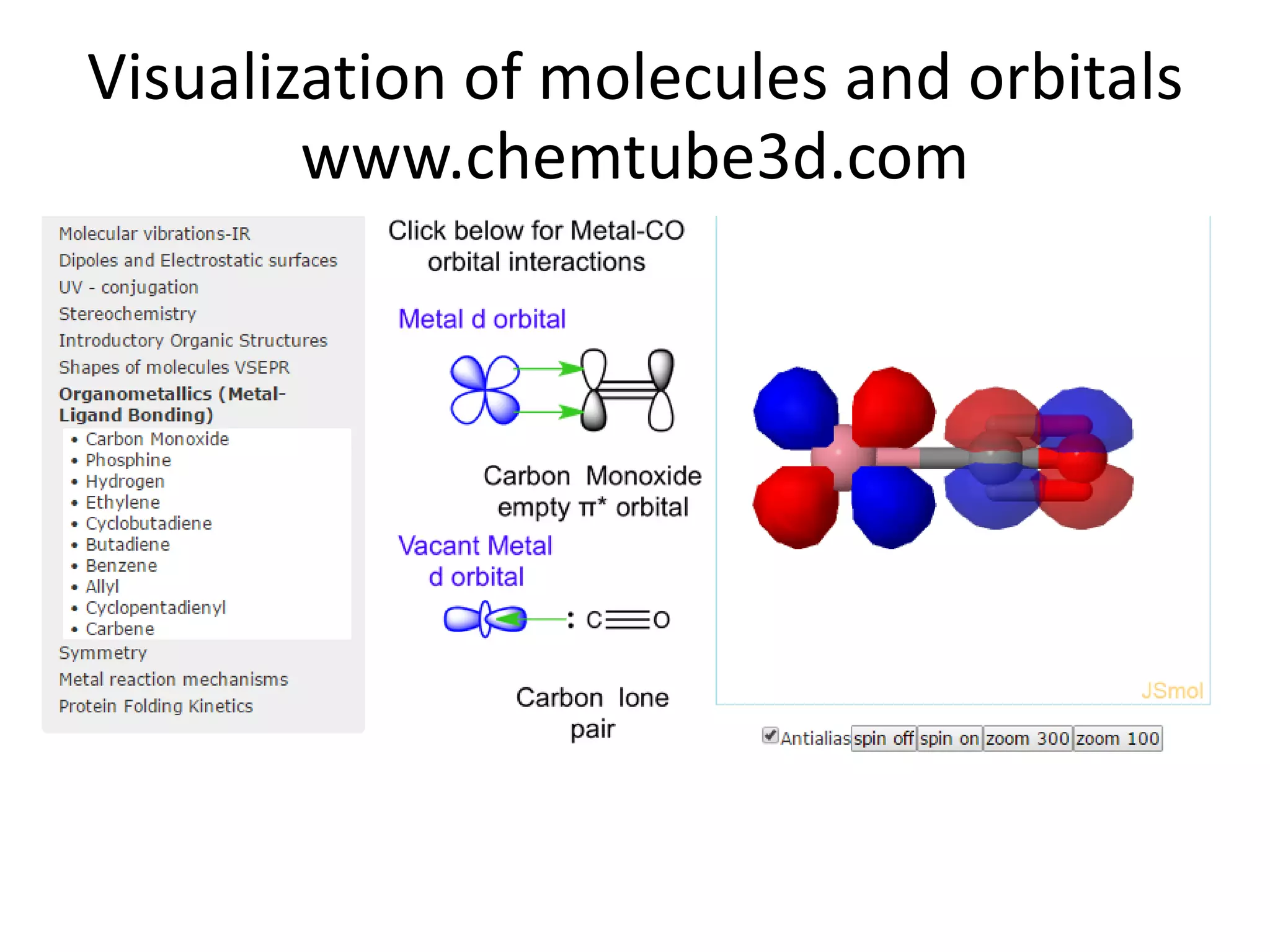
Visualization of molecules and orbitals
www.chemtube3d.com
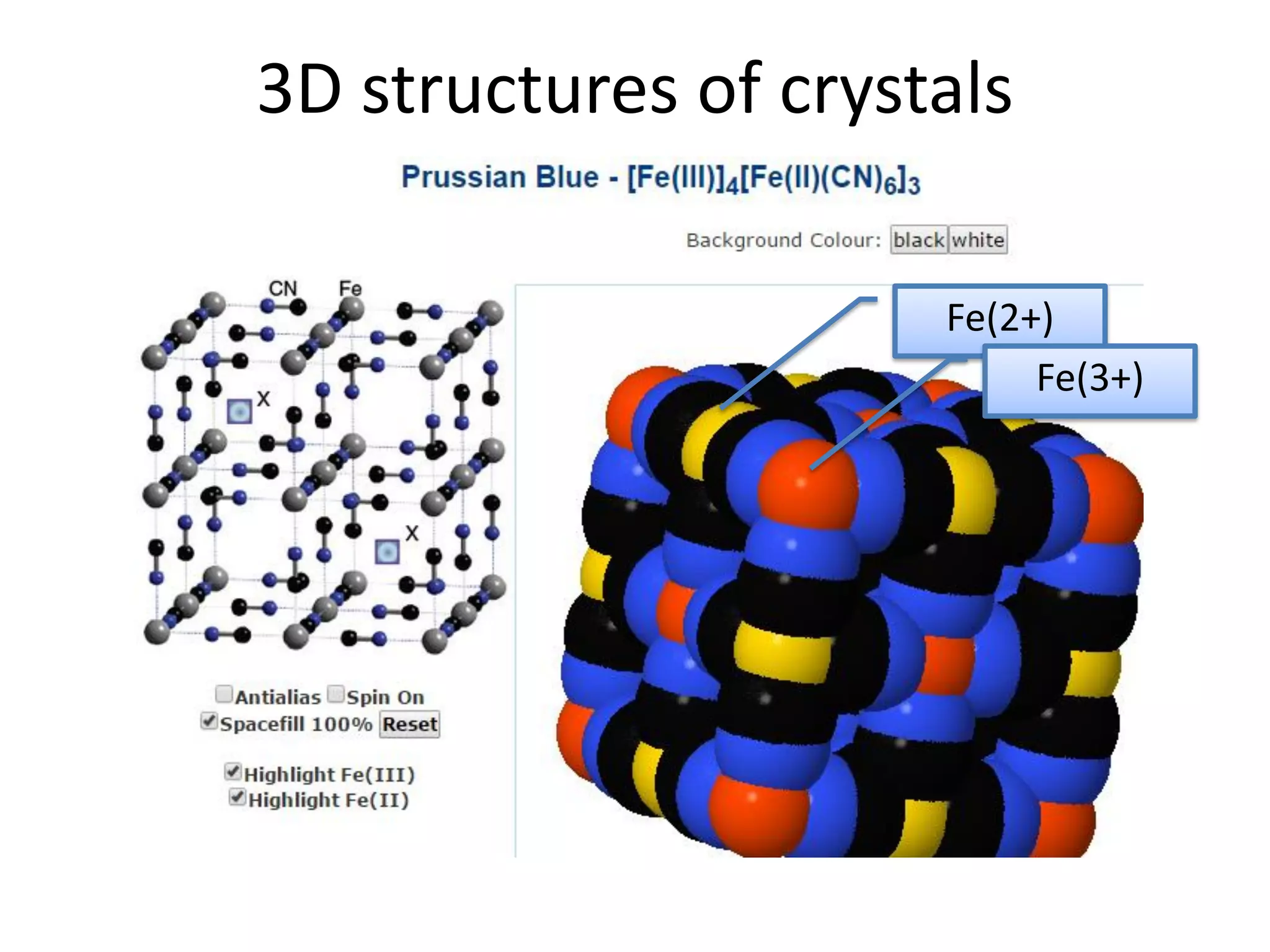
3D structures of crystals
Fe(2+)
Fe(3+)
Magnetism
(extensive explanations:
https://www.youtube.com/watch?v=U_n7DyCqv6U)
https://www.youtube.com/watch?v=U_n7DyCqv6U
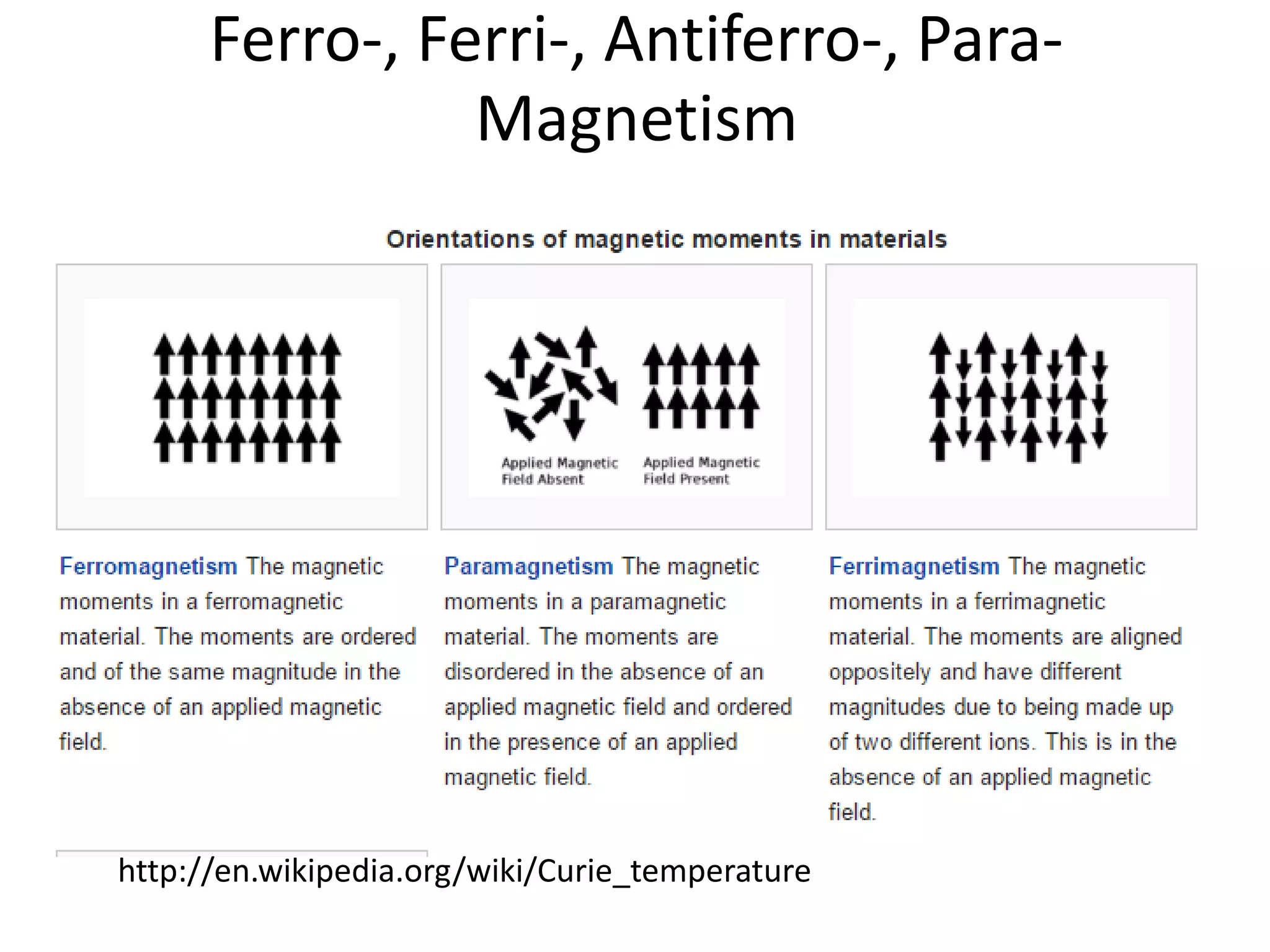
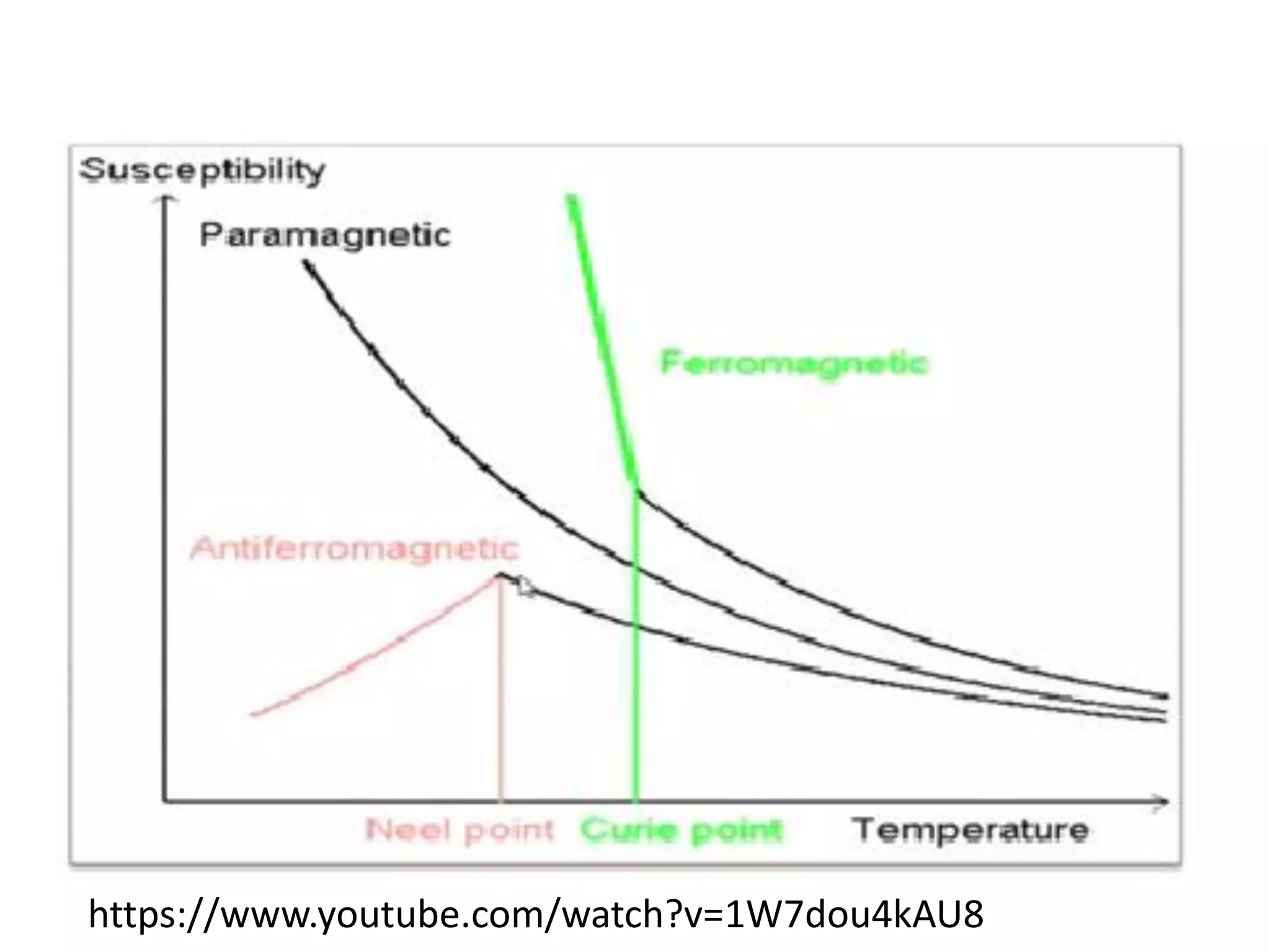
Ferro-, Ferri-, Antiferro-, Para-
Magnetism
http://en.wikipedia.org/wiki/Curie_temperature
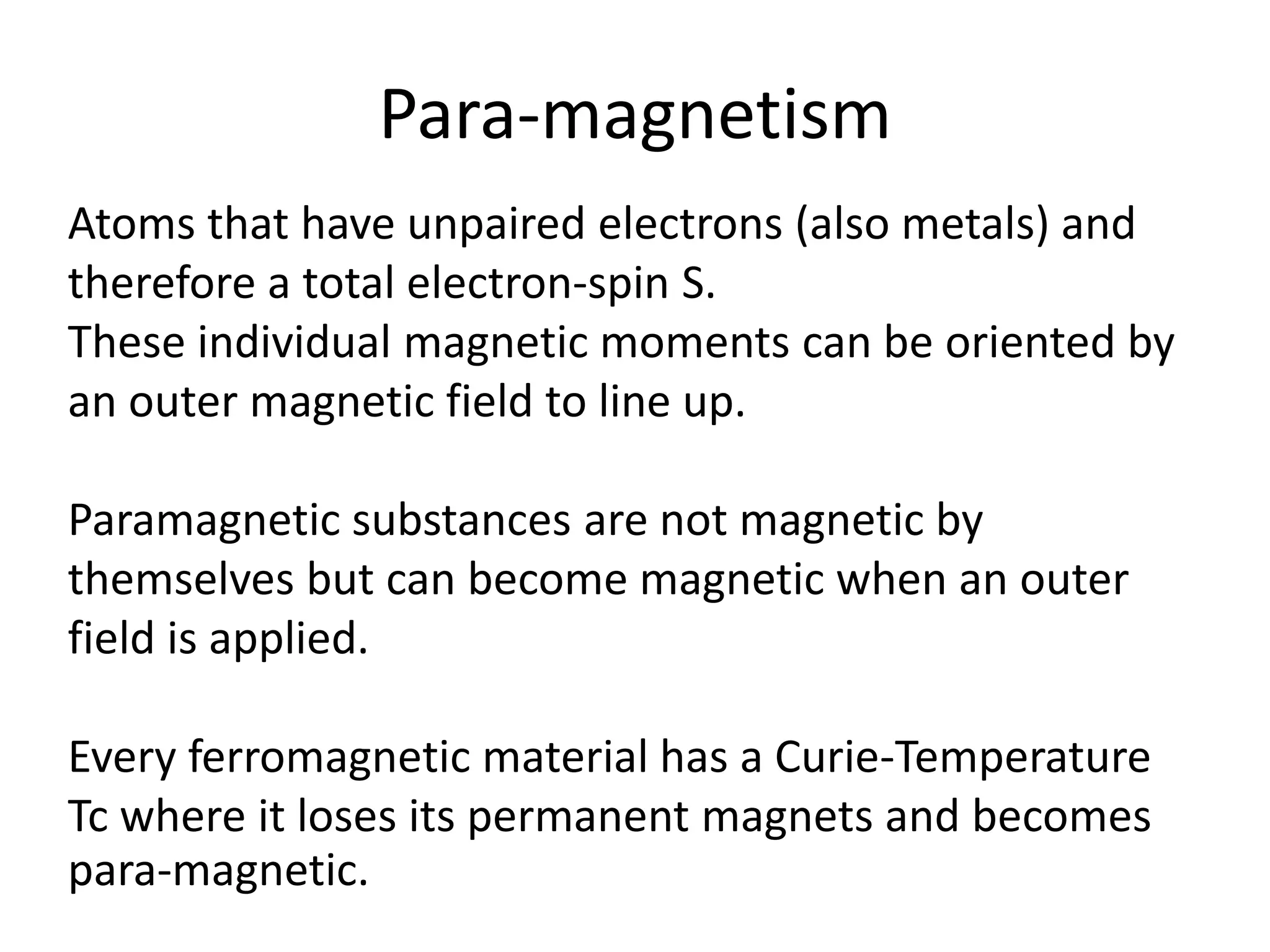
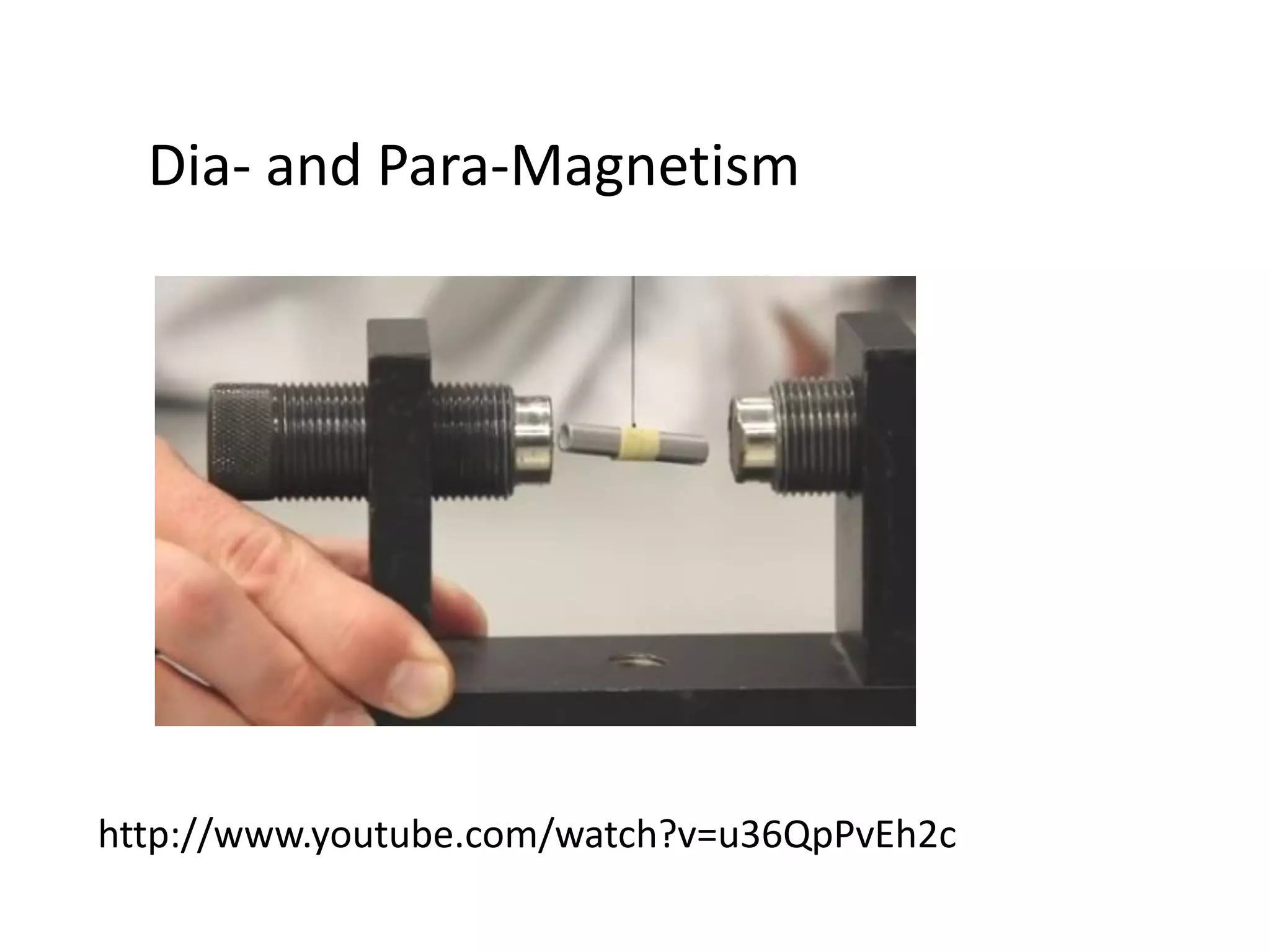
Para-magnetism
Atoms that have unpaired electrons (also metals) and
therefore a total electron-spin S.
These individual magnetic moments can be oriented by
an outer magnetic field to line up.
Paramagnetic substances are not magnetic by
themselves but can become magnetic when an outer
field is applied.
Every ferromagnetic material has a Curie-Temperature
Tc where it loses its permanent magnets and becomes
para-magnetic.
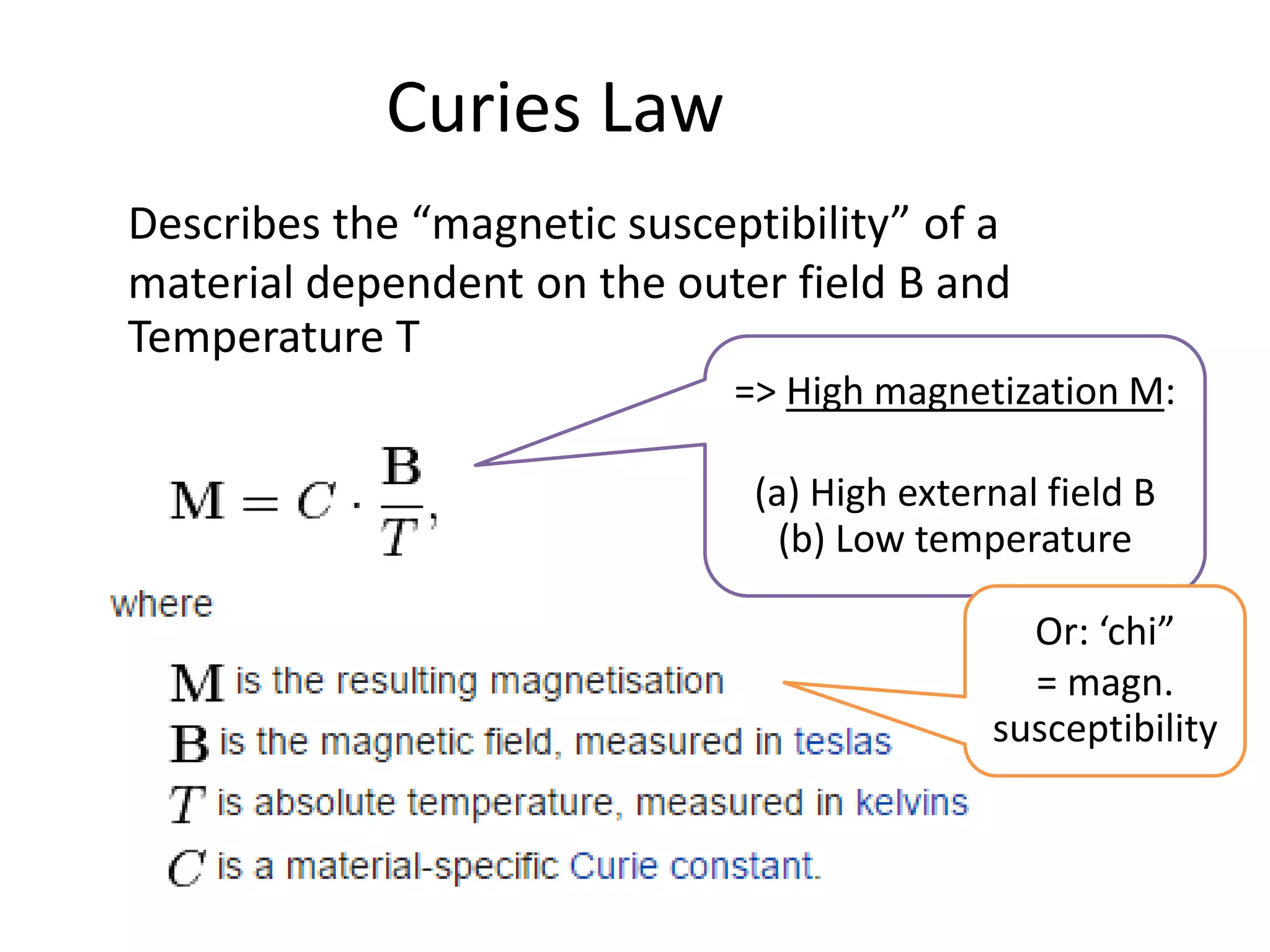
Curies Law
Describes the “magnetic susceptibility” of a
material dependent on the outer field B and
Temperature T
=> High magnetization M:
(a) High external field B
(b) Low temperature
Or: ‘chi”
= magn.
susceptibility
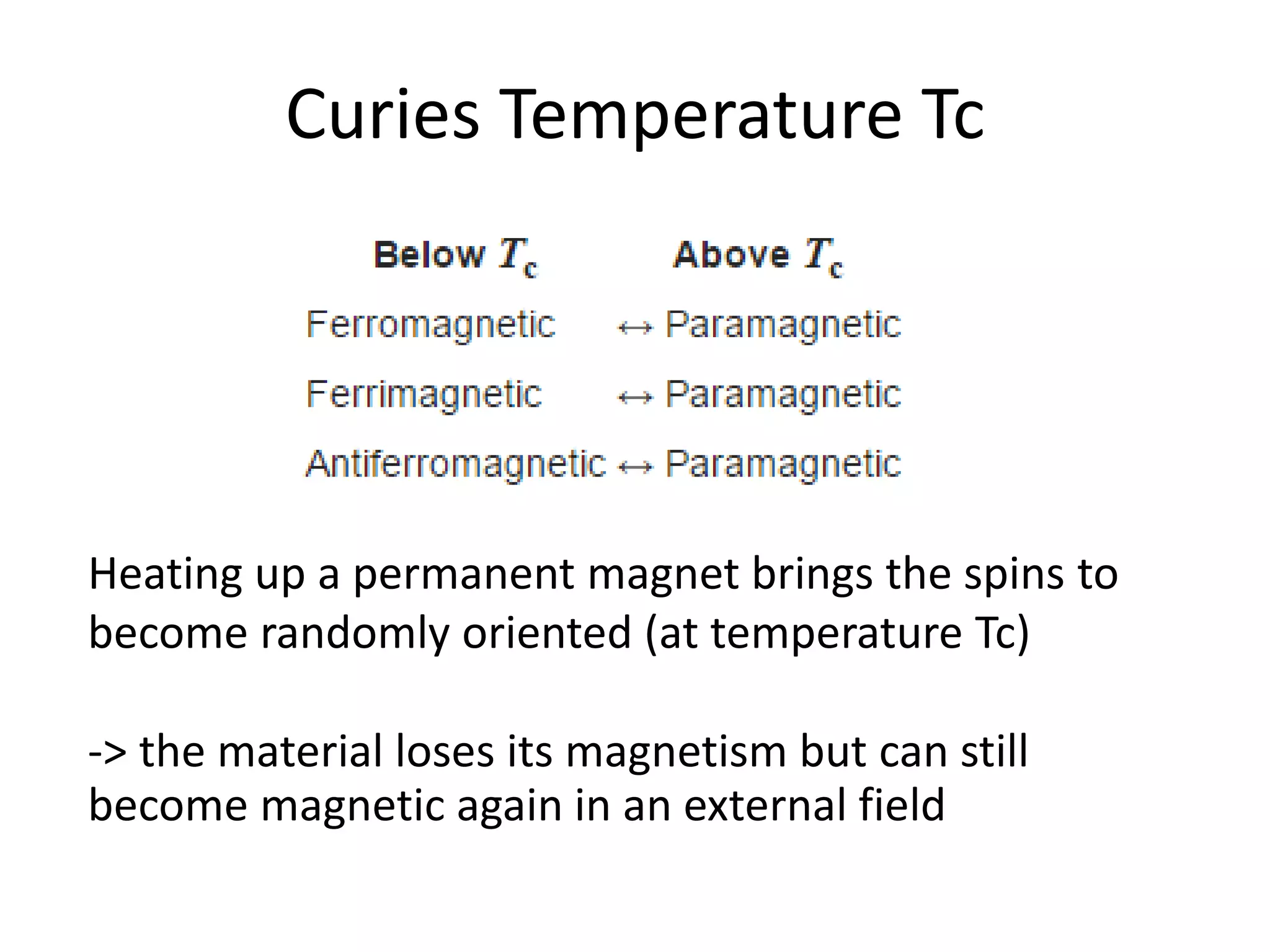
Curies Temperature Tc
Heating up a permanent magnet brings the spins to
become randomly oriented (at temperature Tc)
-> the material loses its magnetism but can still
become magnetic again in an external field
https://www.youtube.com/watch?v=1W7dou4kAU8
http://www.youtube.com/watch?v=u36QpPvEh2c
Dia- and Para-Magnetism
Magnetic Properties
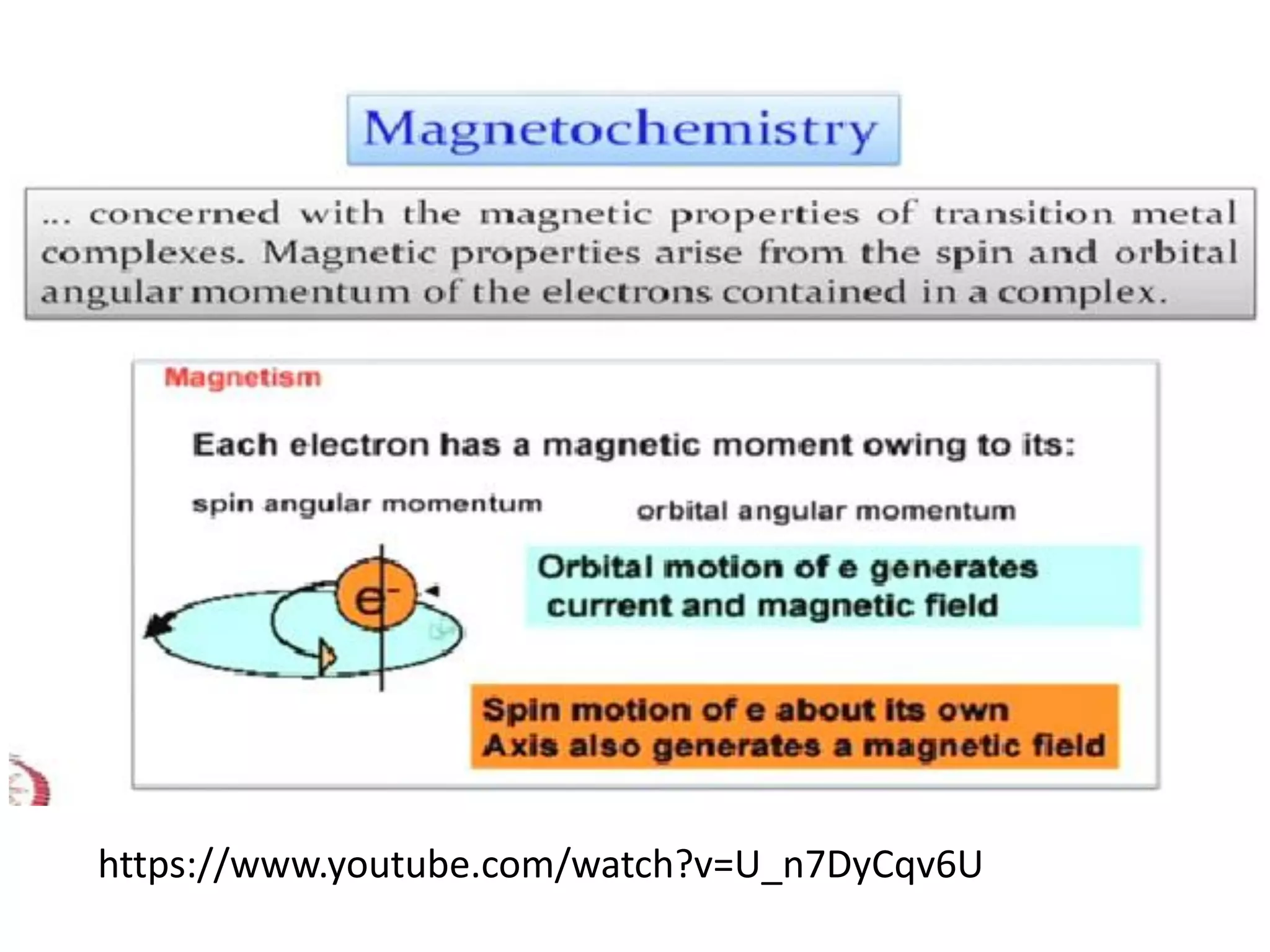
Paramagnetism arises from unpaired electrons.
Each electron has a magnetic moment with
one component associated with the spin
angular momentum of the electron and
(except when the quantum number l ¼0) a
second component associated with the orbital
angular momentum.
(p.579)
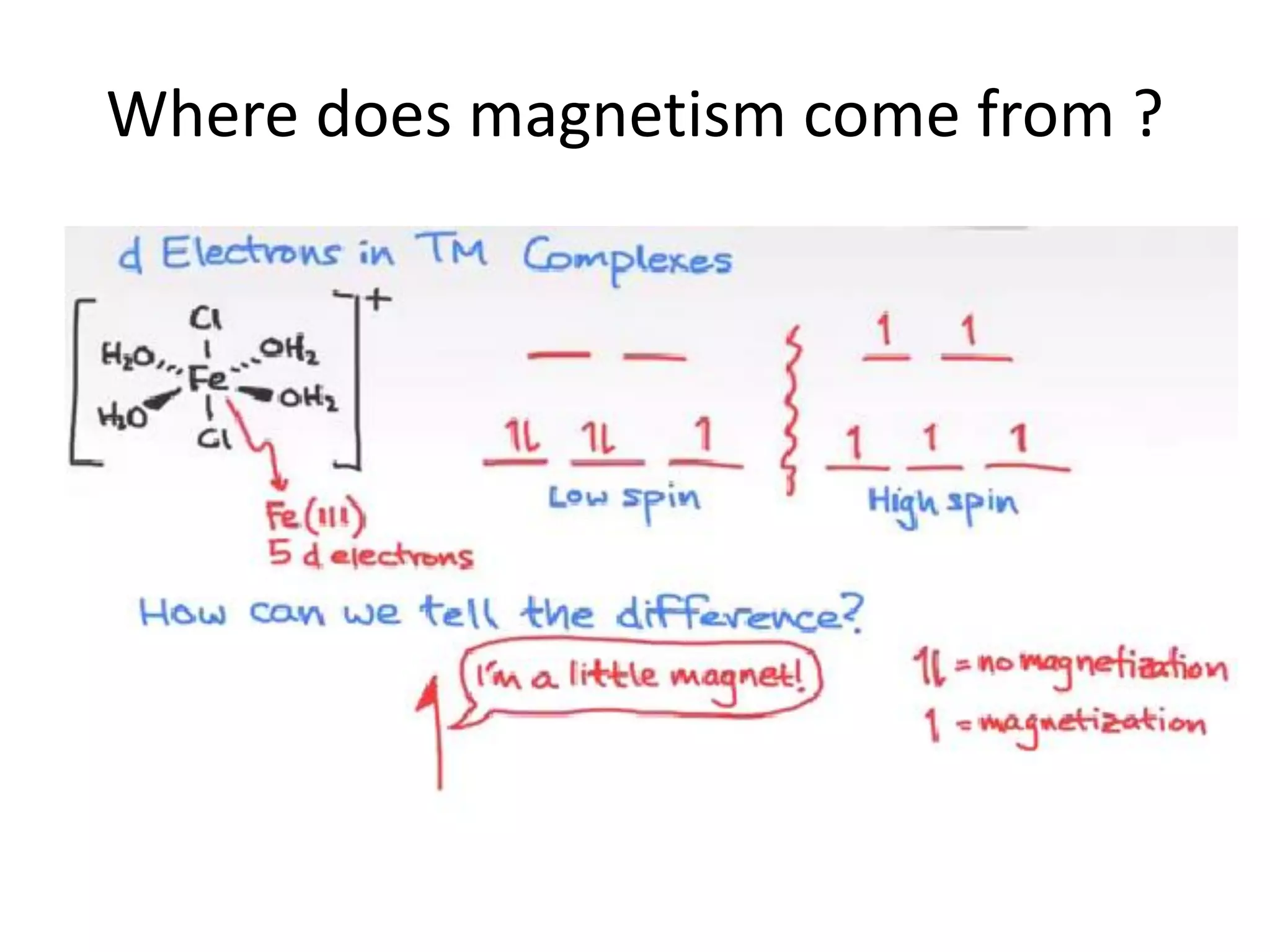
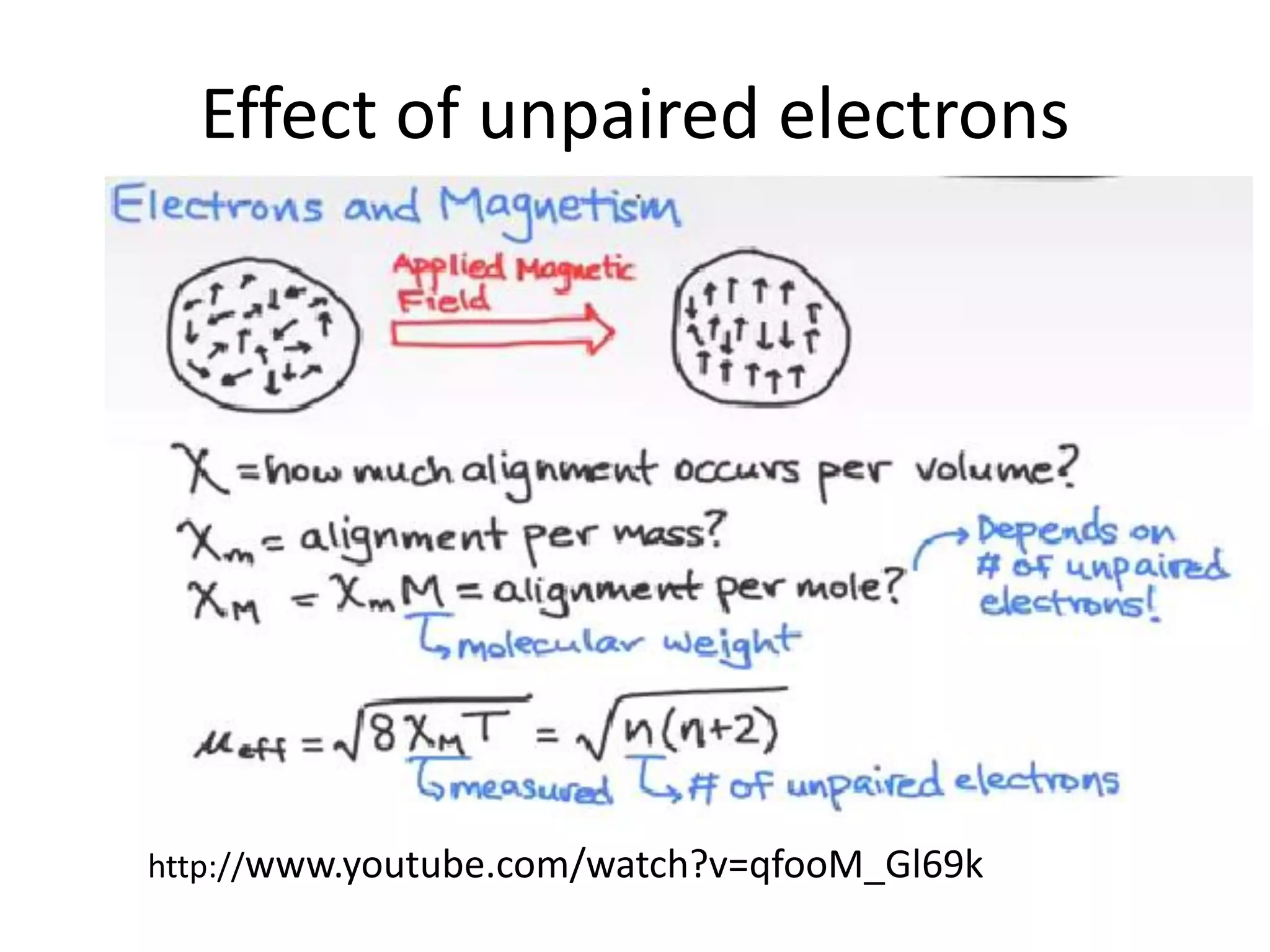
Where does magnetism come from ?
Effect of unpaired electrons
http://www.youtube.com/watch?v=qfooM_Gl69k
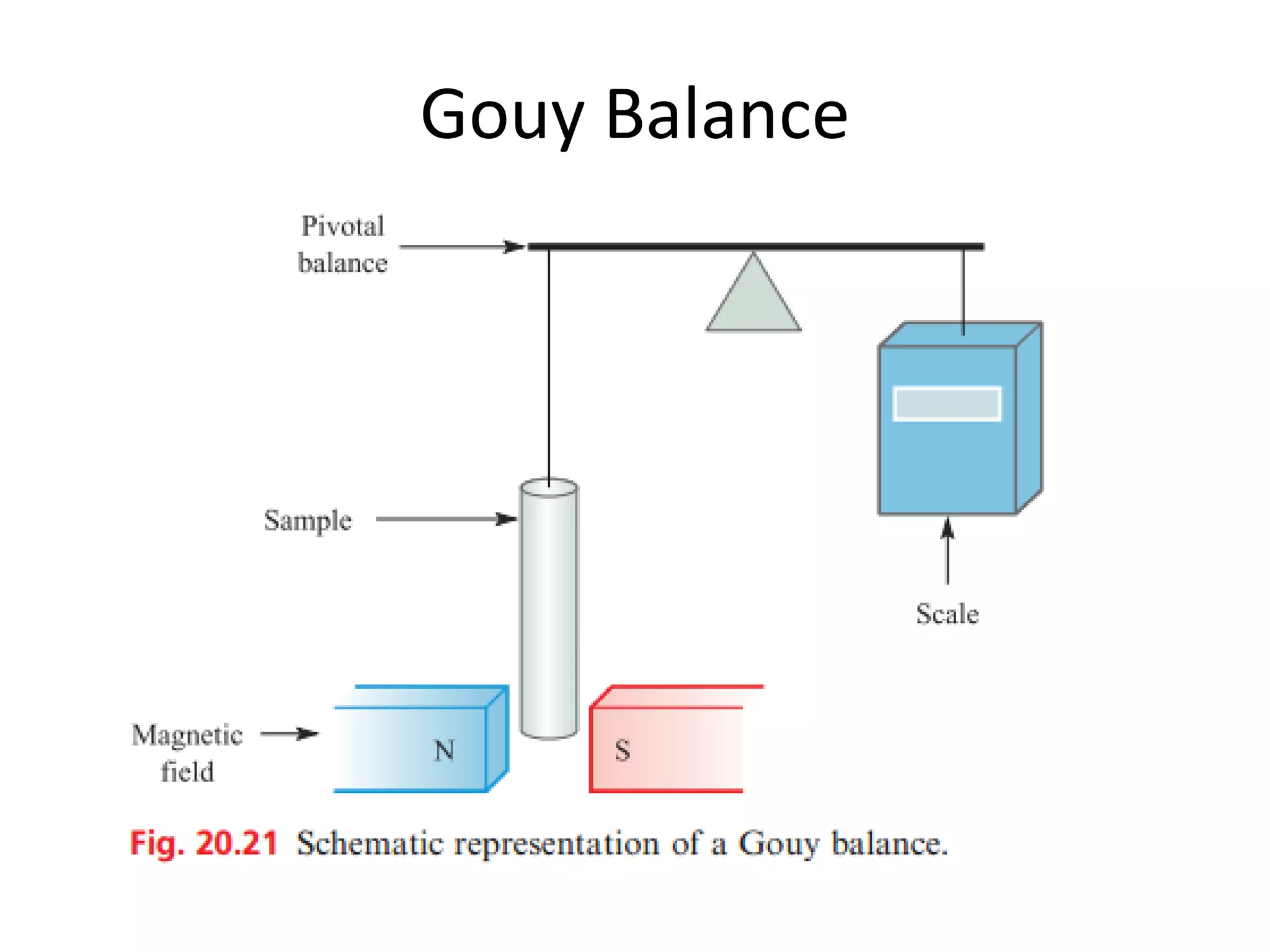
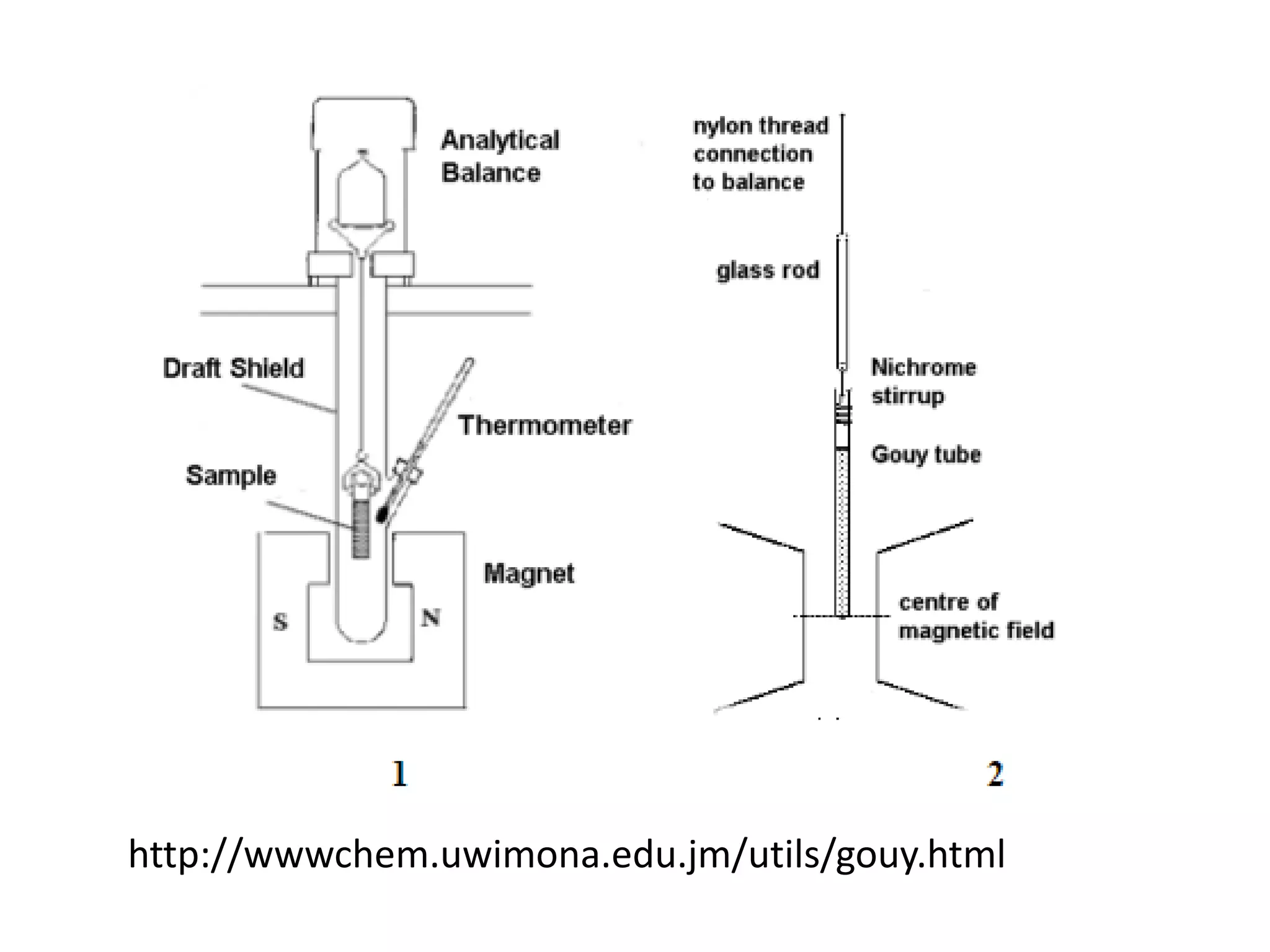
Gouy Balance
http://wwwchem.uwimona.edu.jm/utils/gouy.html
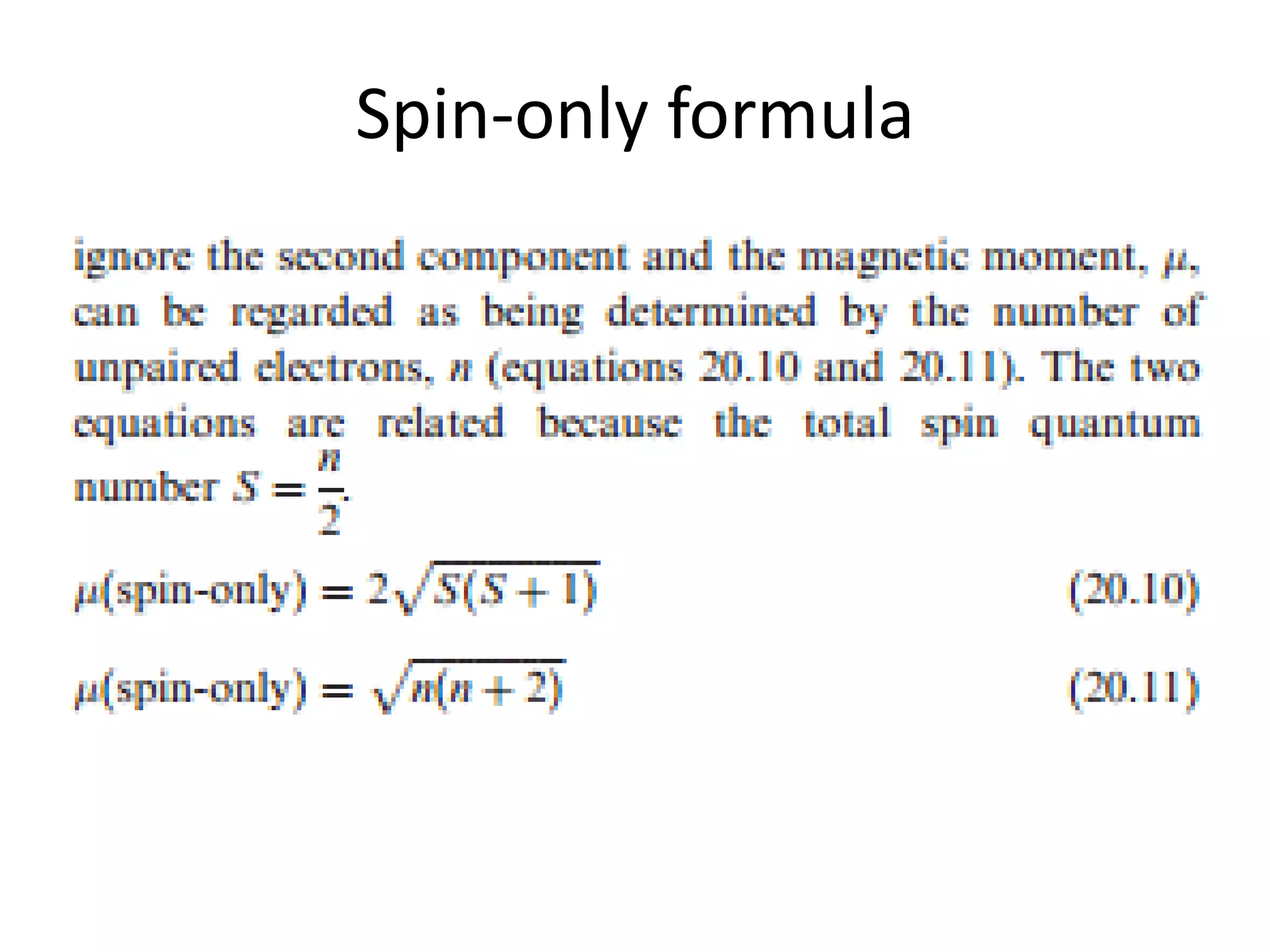
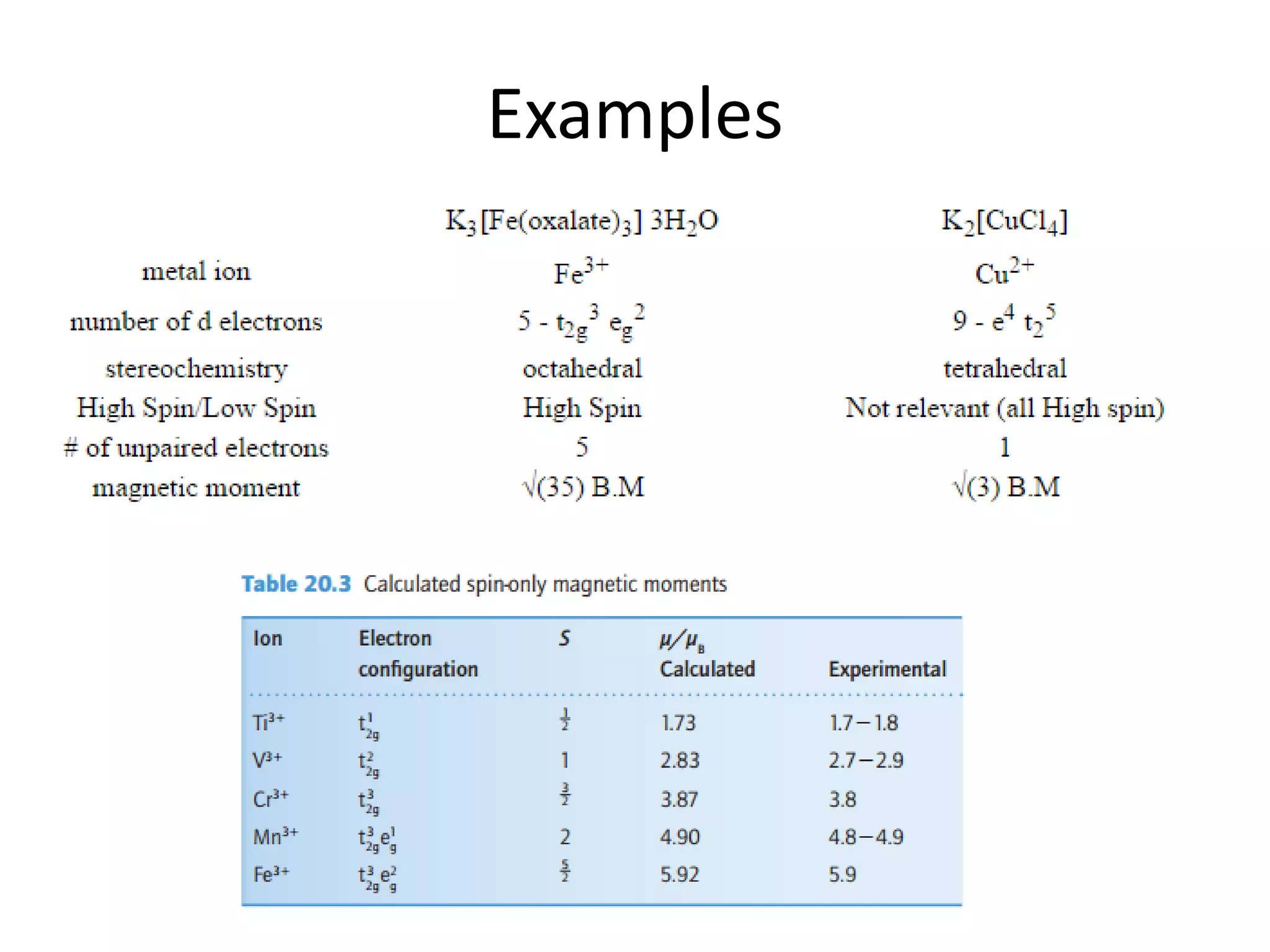
Spin-only formula
Examples
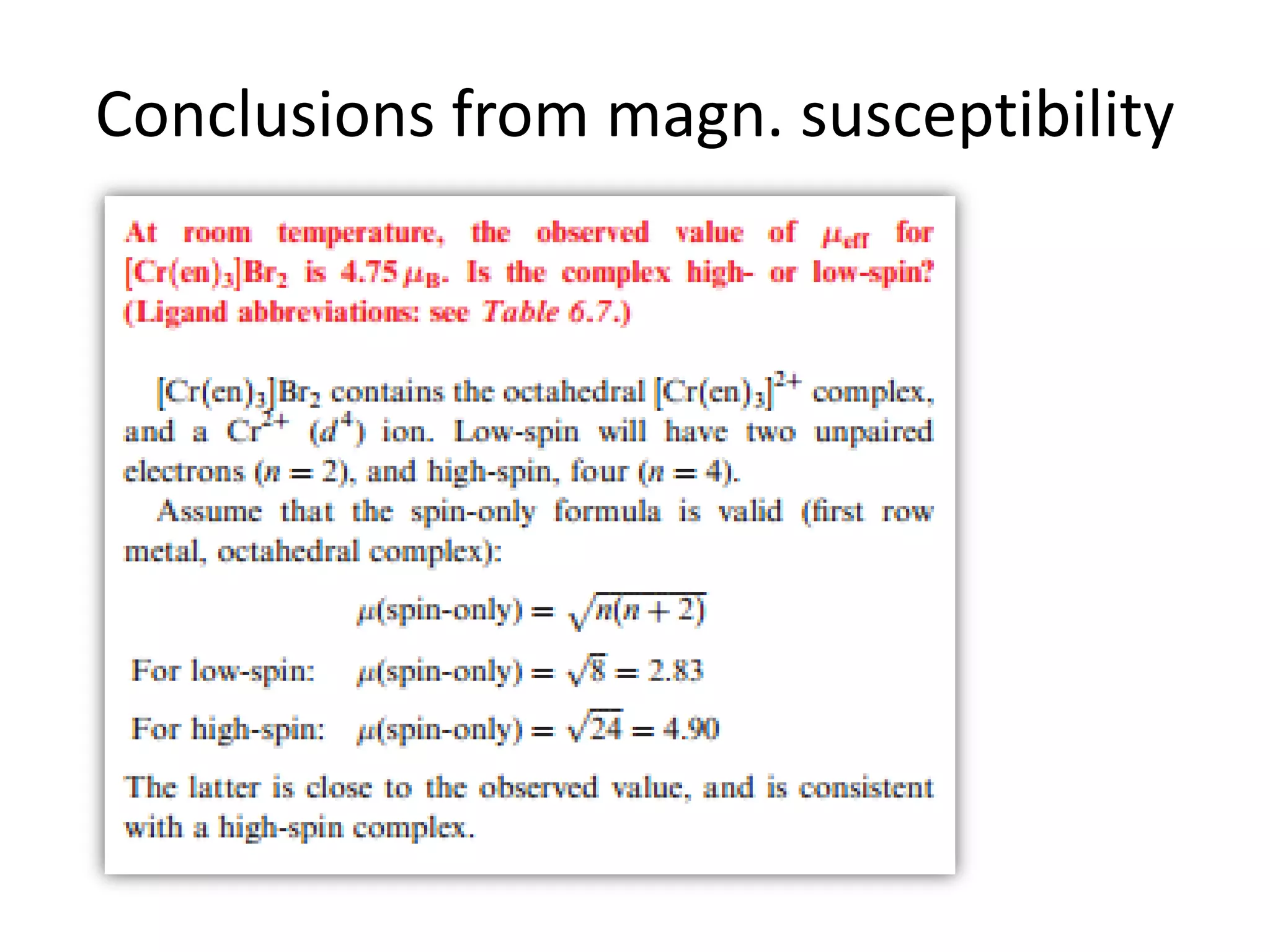
Conclusions from magn. susceptibility
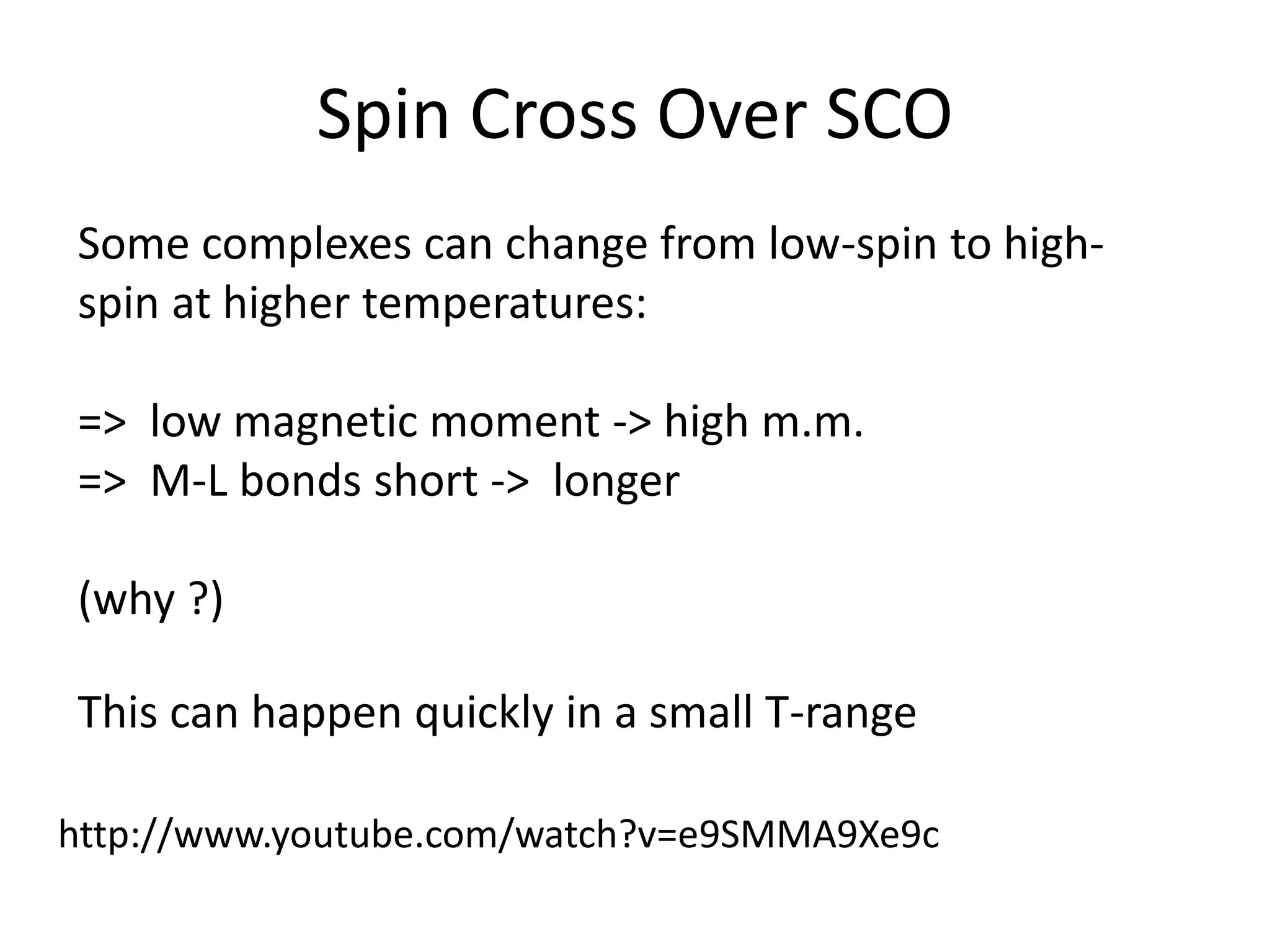
Spin Cross Over SCO
Some complexes can change from low-spin to high-
spin at higher temperatures:
=> low magnetic moment -> high m.m.
=> M-L bonds short -> longer
(why ?)
This can happen quickly in a small T-range
http://www.youtube.com/watch?v=e9SMMA9Xe9c
SCO applications
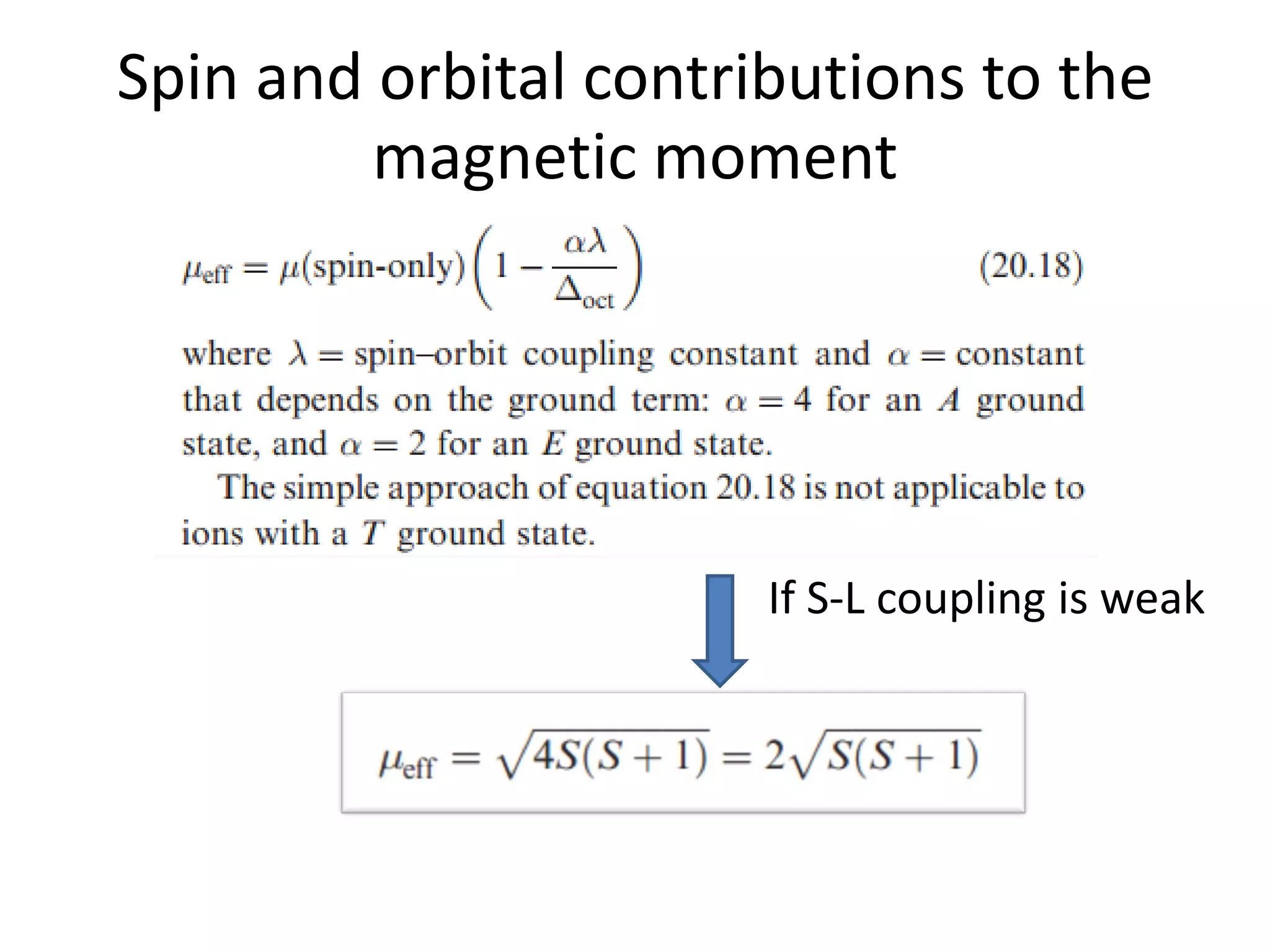
Spin and orbital contributions to the
magnetic moment
If S-L coupling is weak
Deviations from spin-only formula
Example:
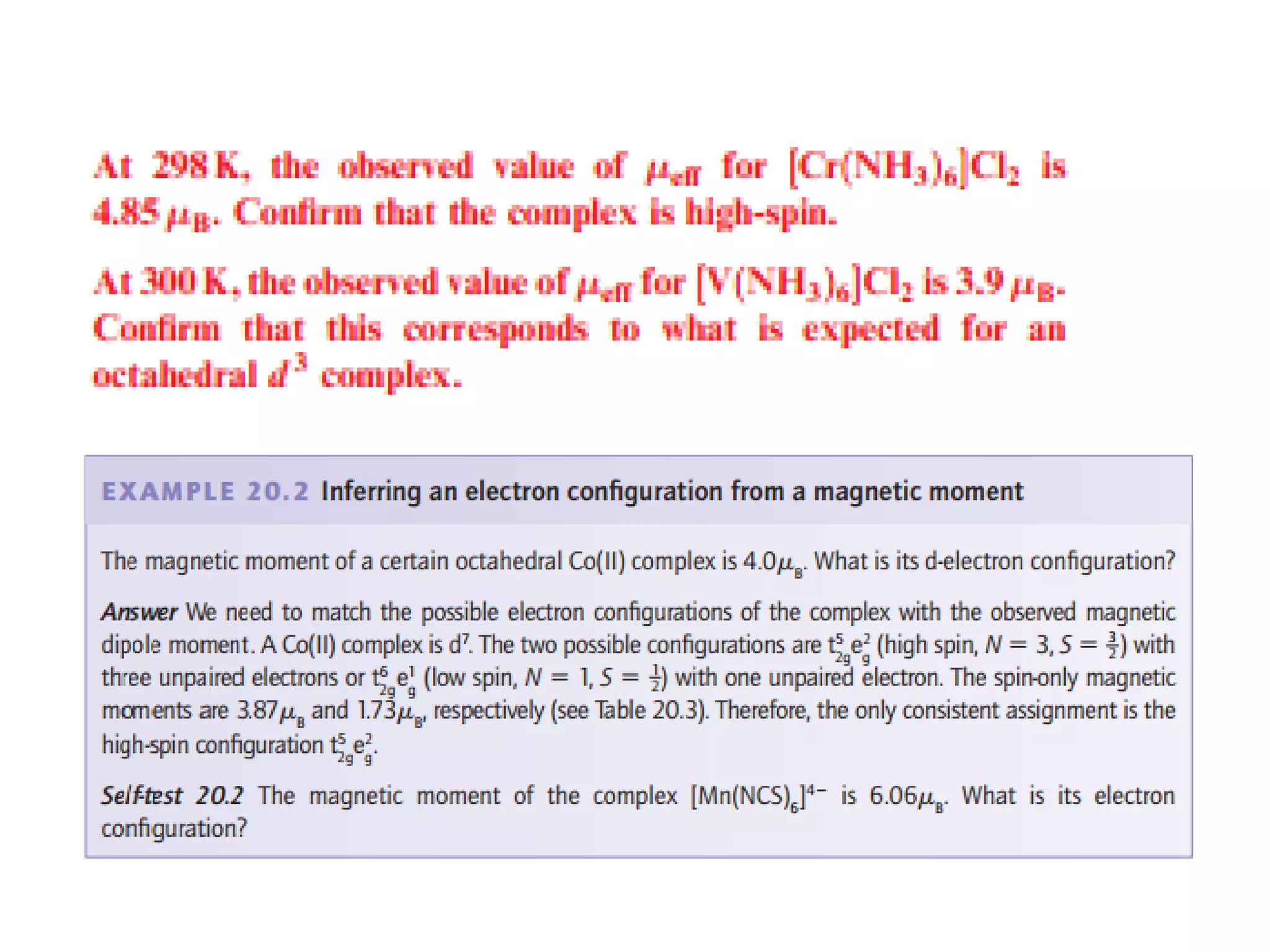
[Fe(CN)6]3- has μ = 2.3μB
which is between low- and high-spin calculated
(check this out)
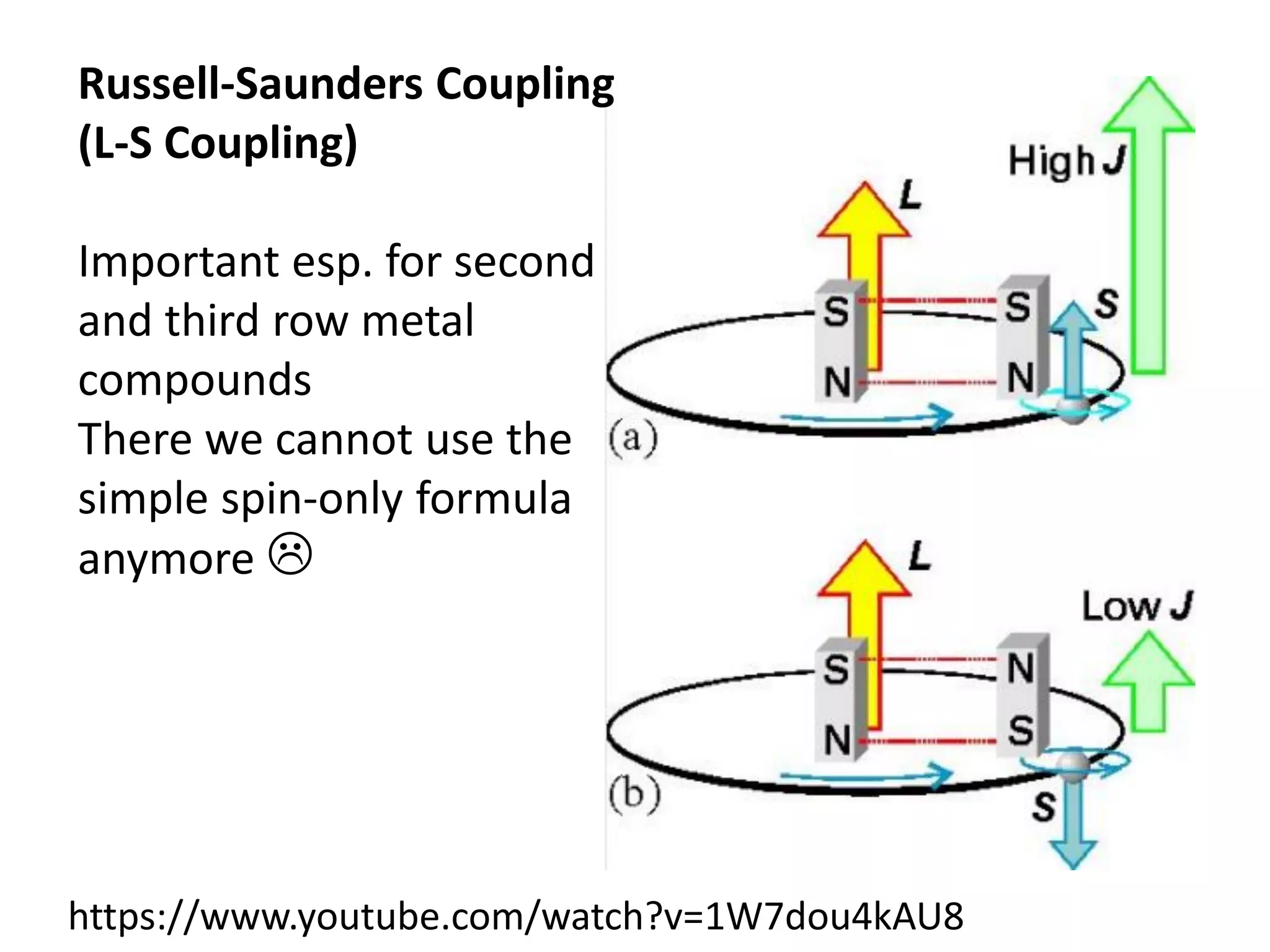
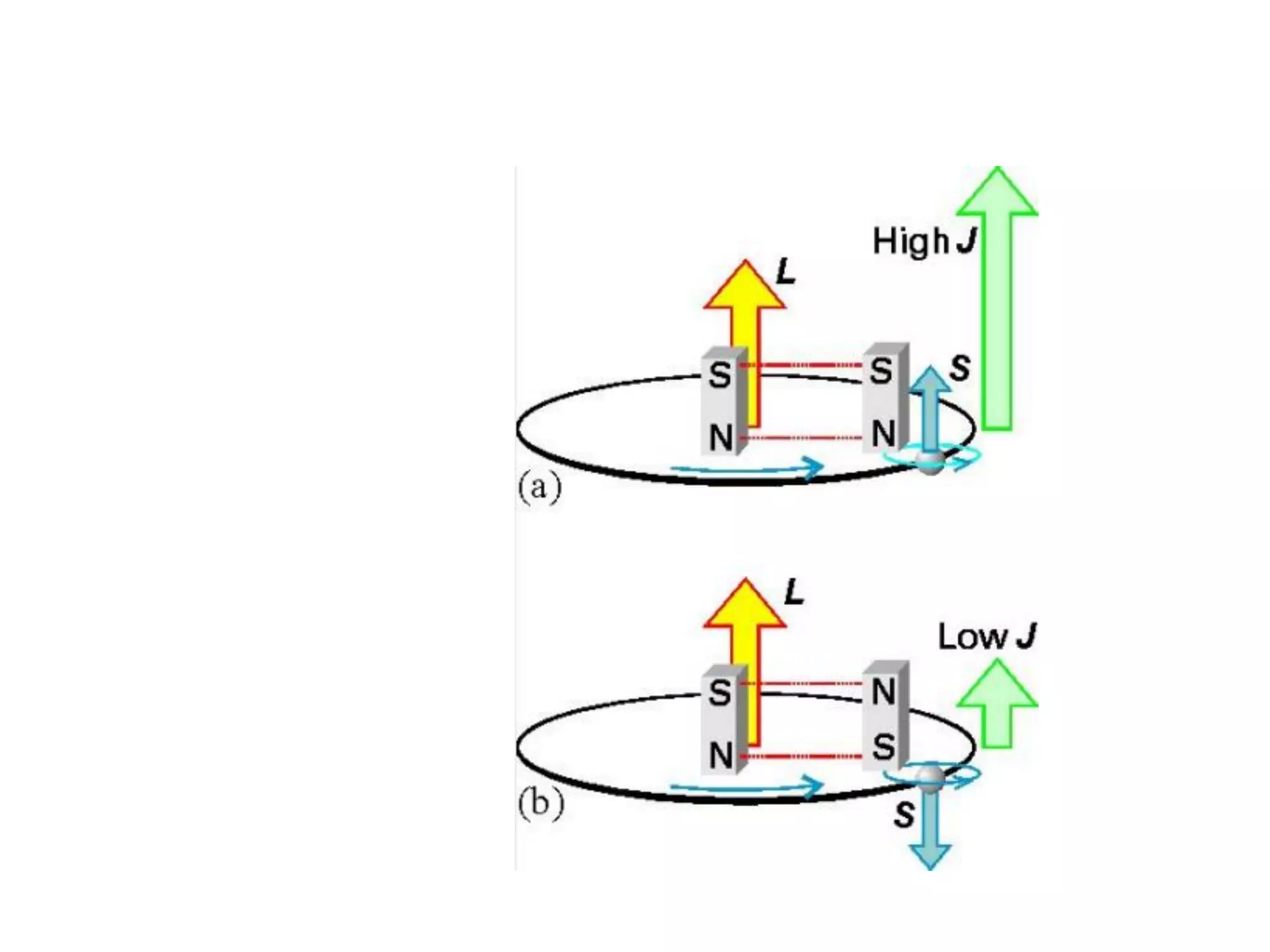
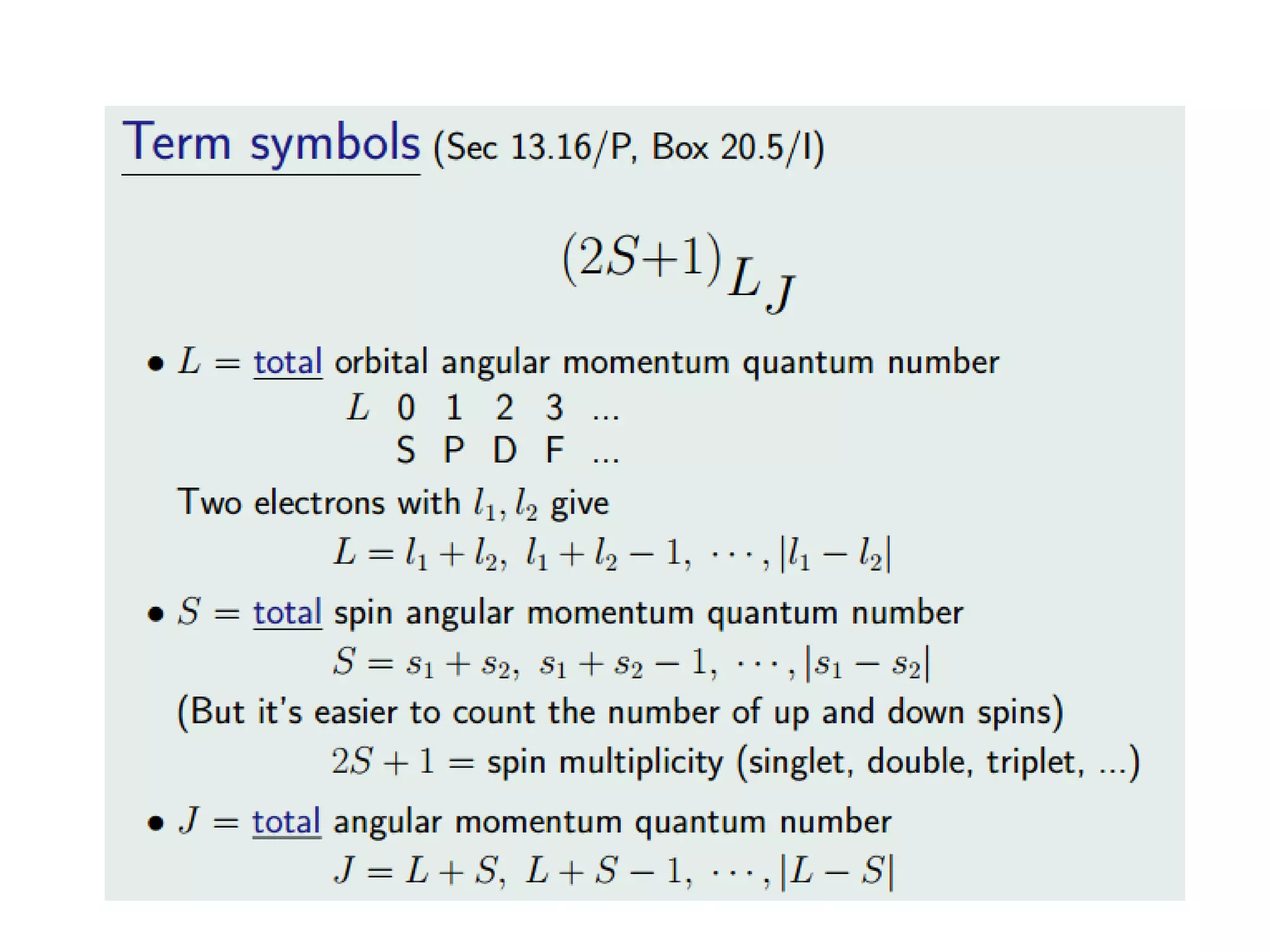
Russell-Saunders Coupling
(L-S Coupling)
Important esp. for second
and third row metal
compounds
There we cannot use the
simple spin-only formula
anymore 
https://www.youtube.com/watch?v=1W7dou4kAU8
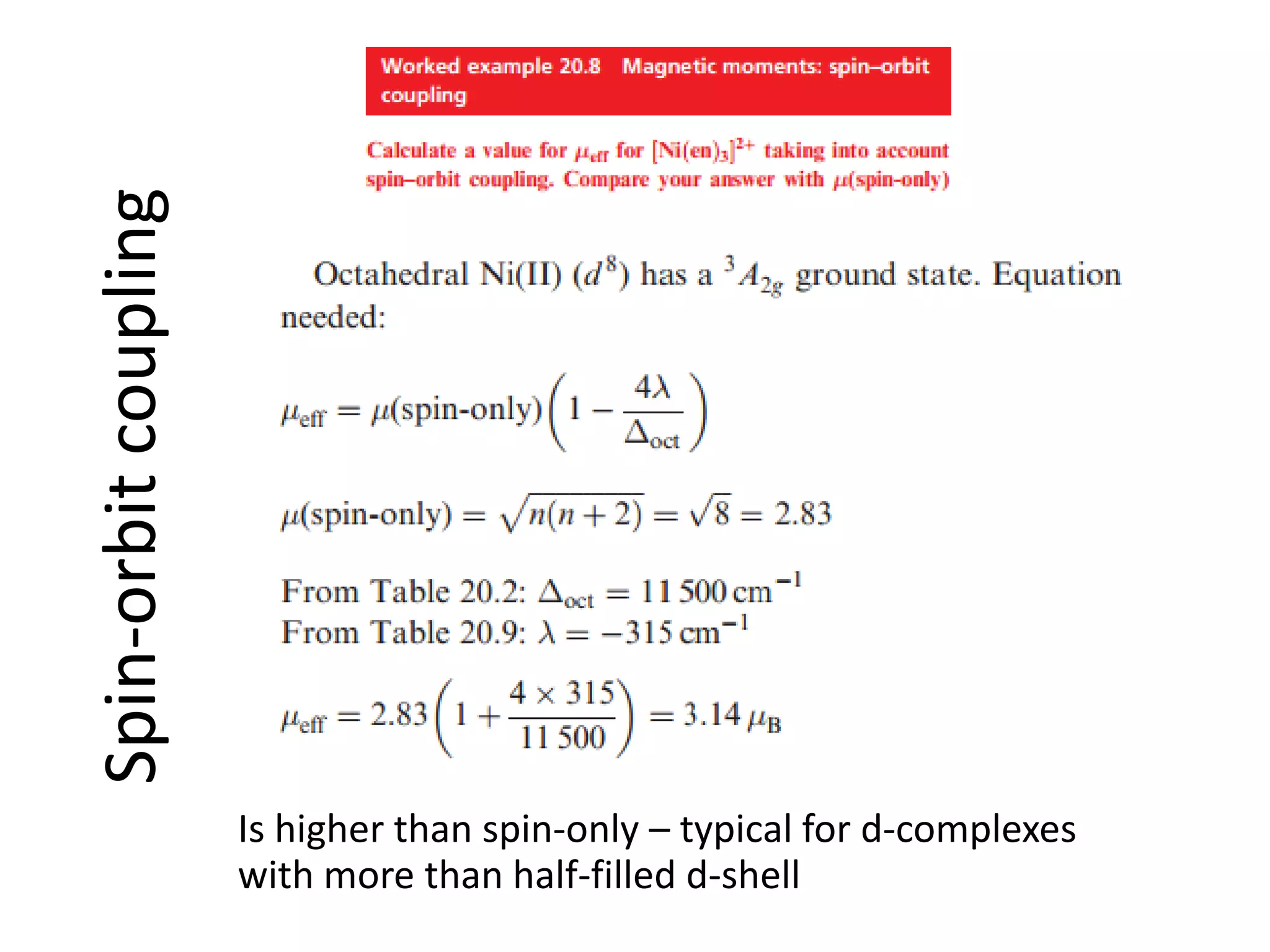
Spin-orbitcoupling
Is higher than spin-only – typical for d-complexes
with more than half-filled d-shell
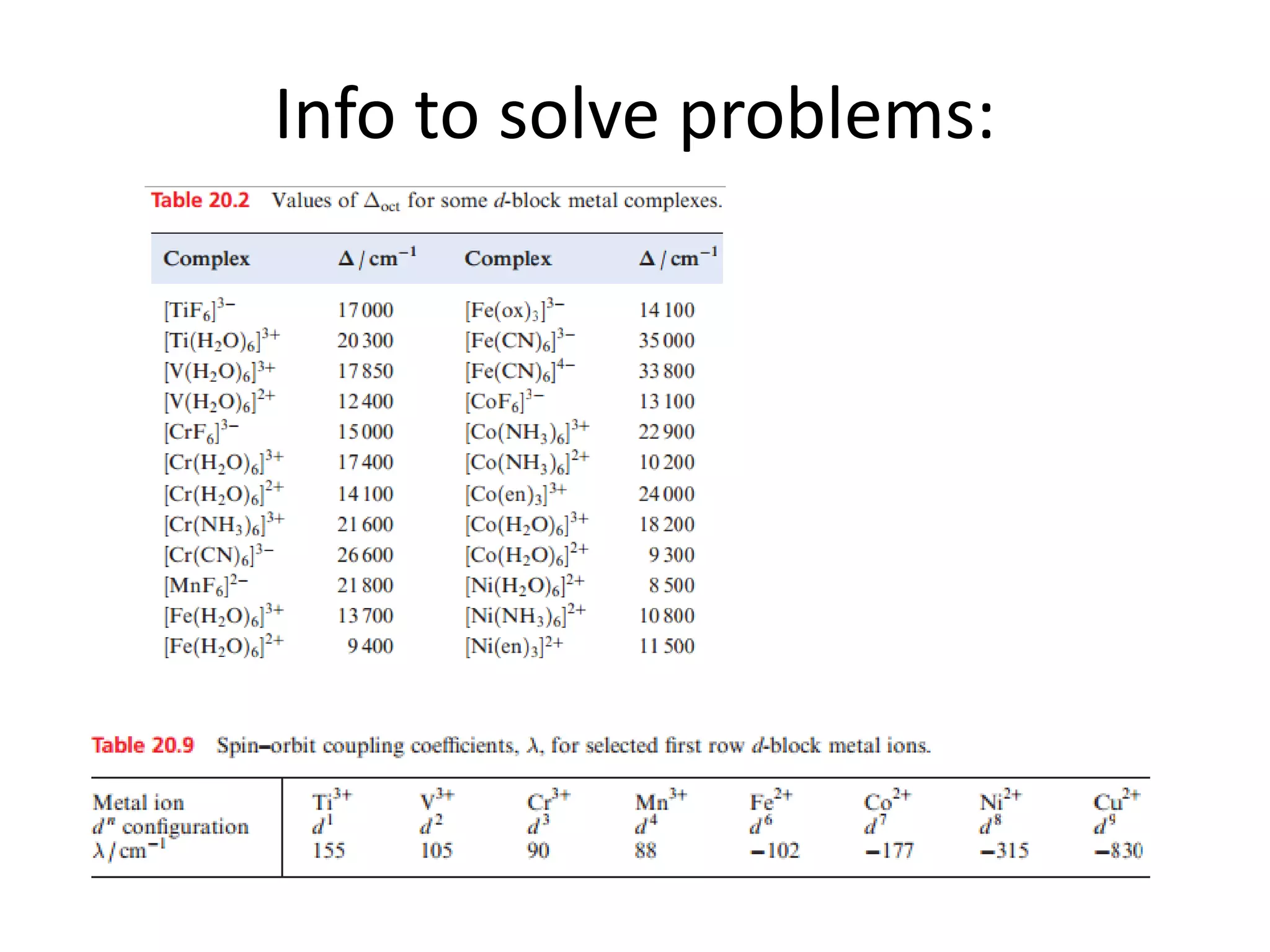
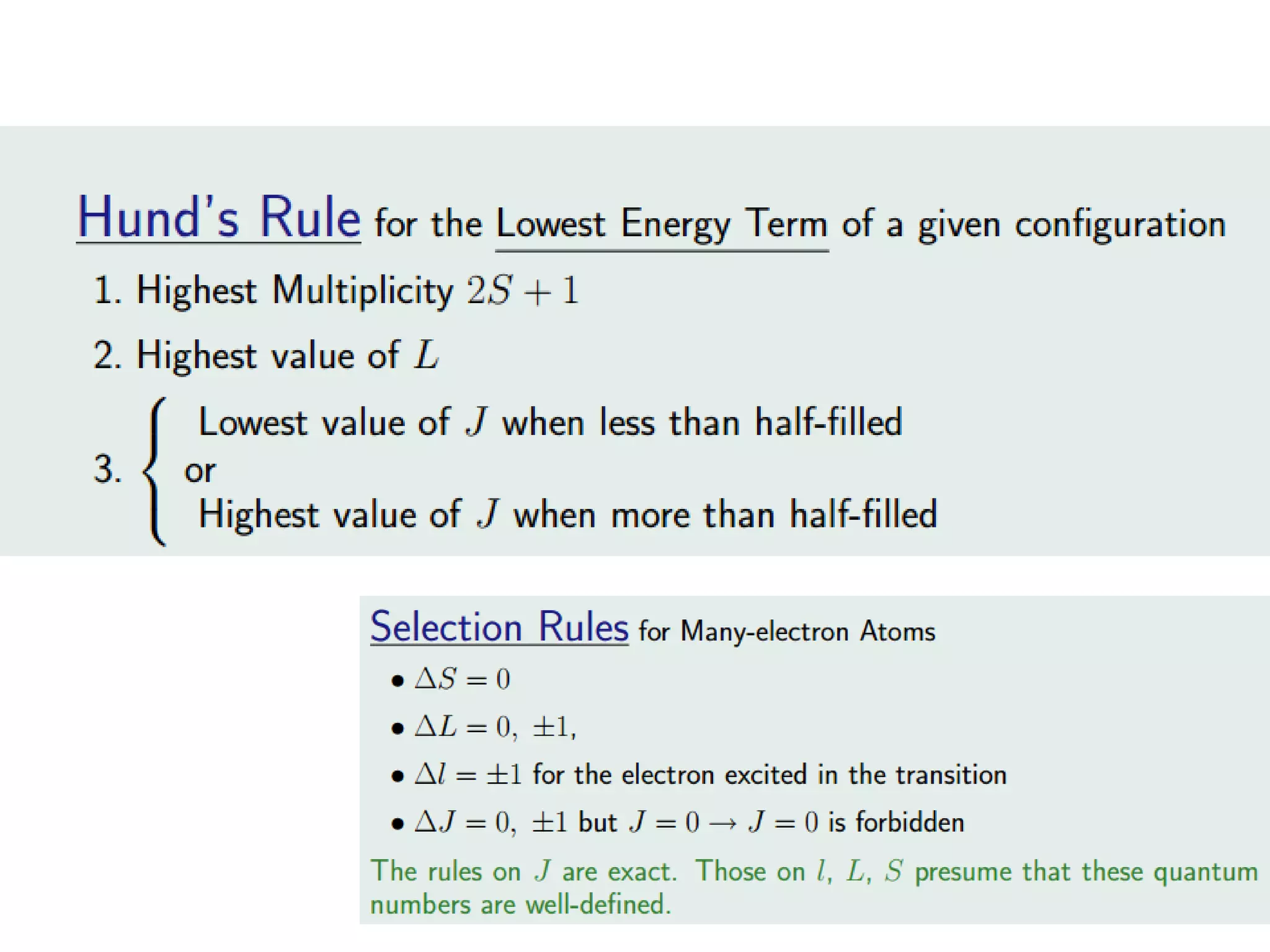
Info to solve problems:
Spin-Orbit coupling
Russell-Saunders Coupling
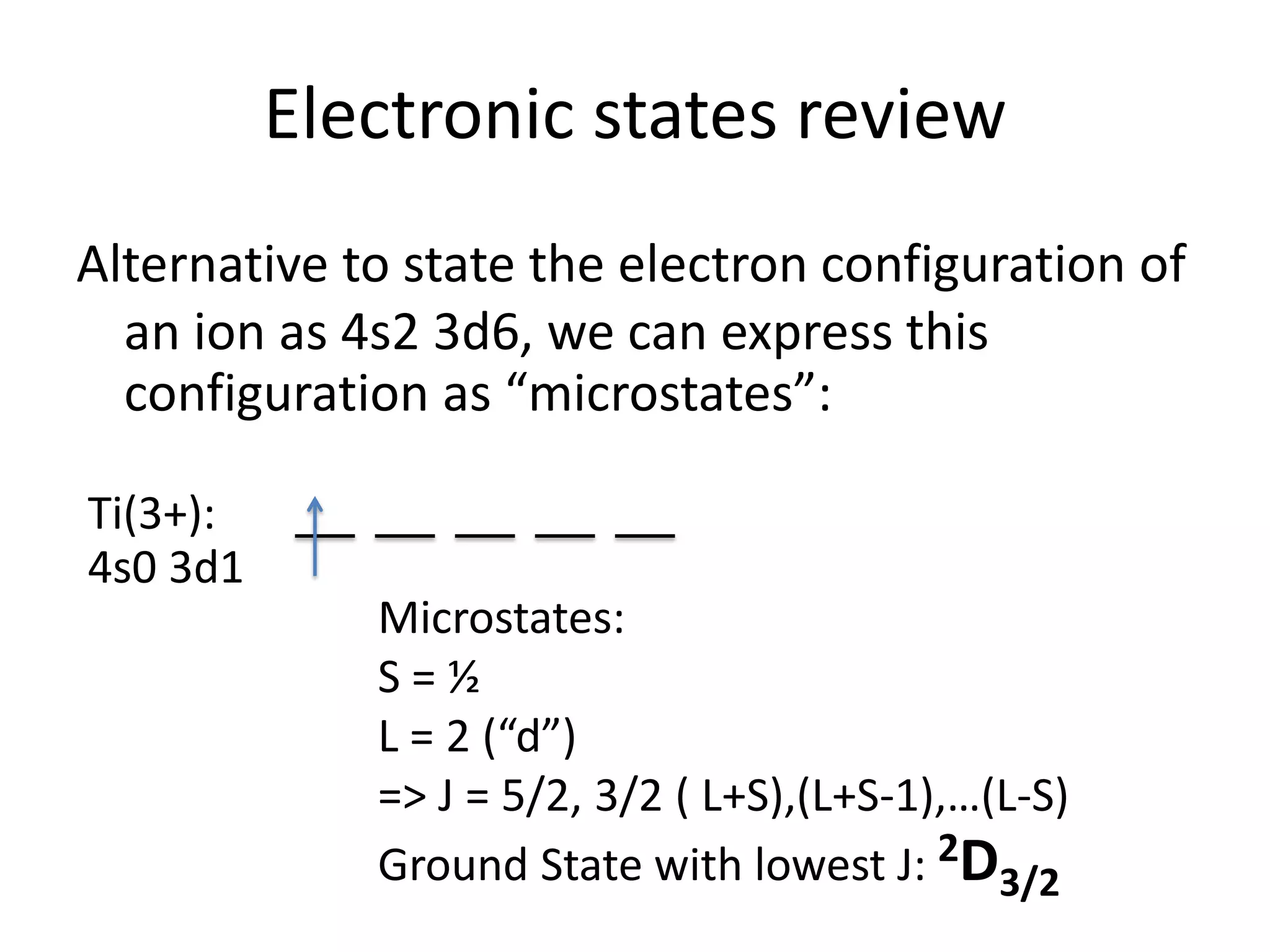
Electronic states review
Alternative to state the electron configuration of
an ion as 4s2 3d6, we can express this
configuration as “microstates”:
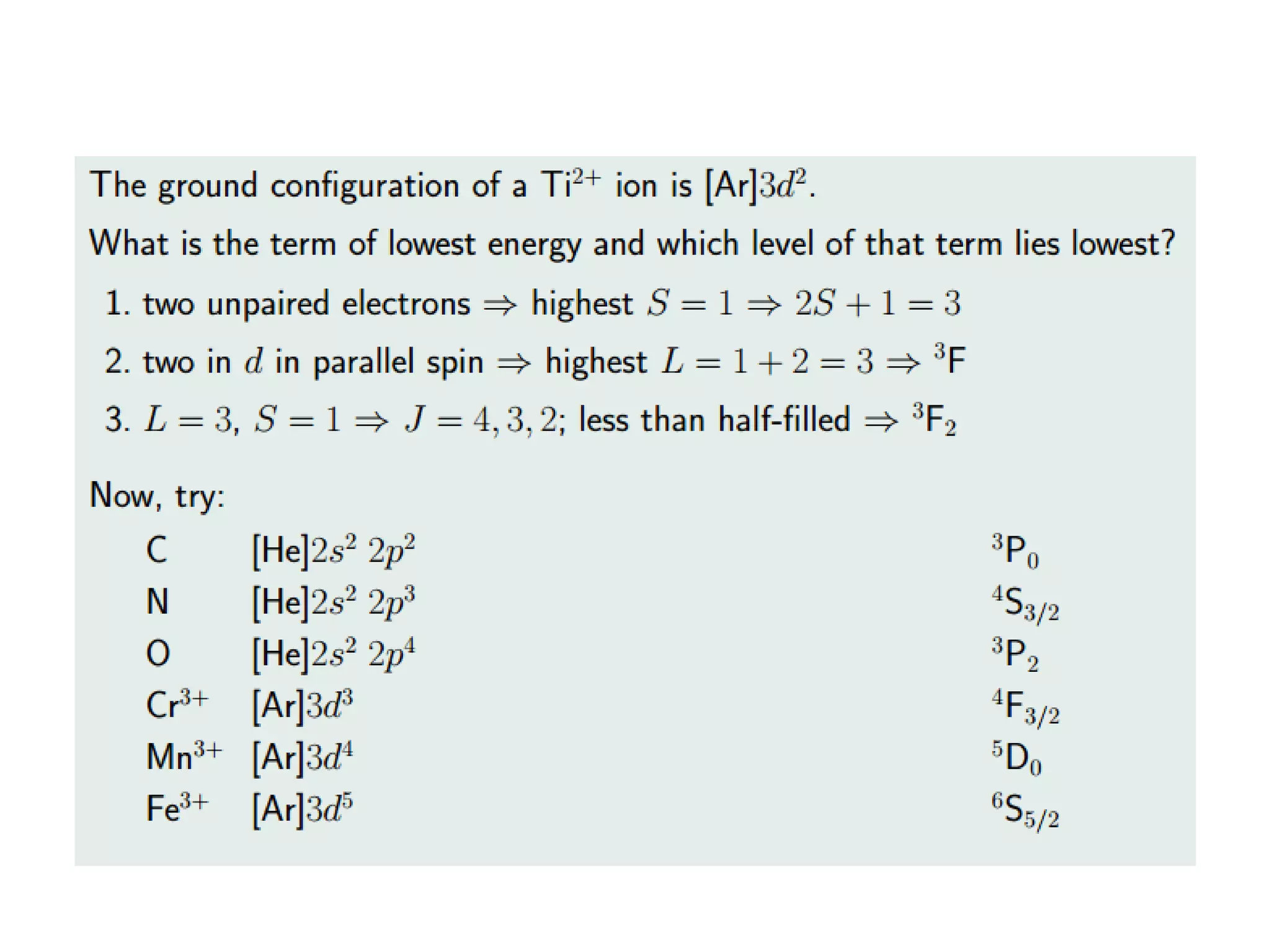
Ti(3+):
4s0 3d1
Microstates:
S = ½
L = 2 (“d”)
=> J = 5/2, 3/2 ( L+S),(L+S-1),…(L-S)
Ground State with lowest J: 2D3/2
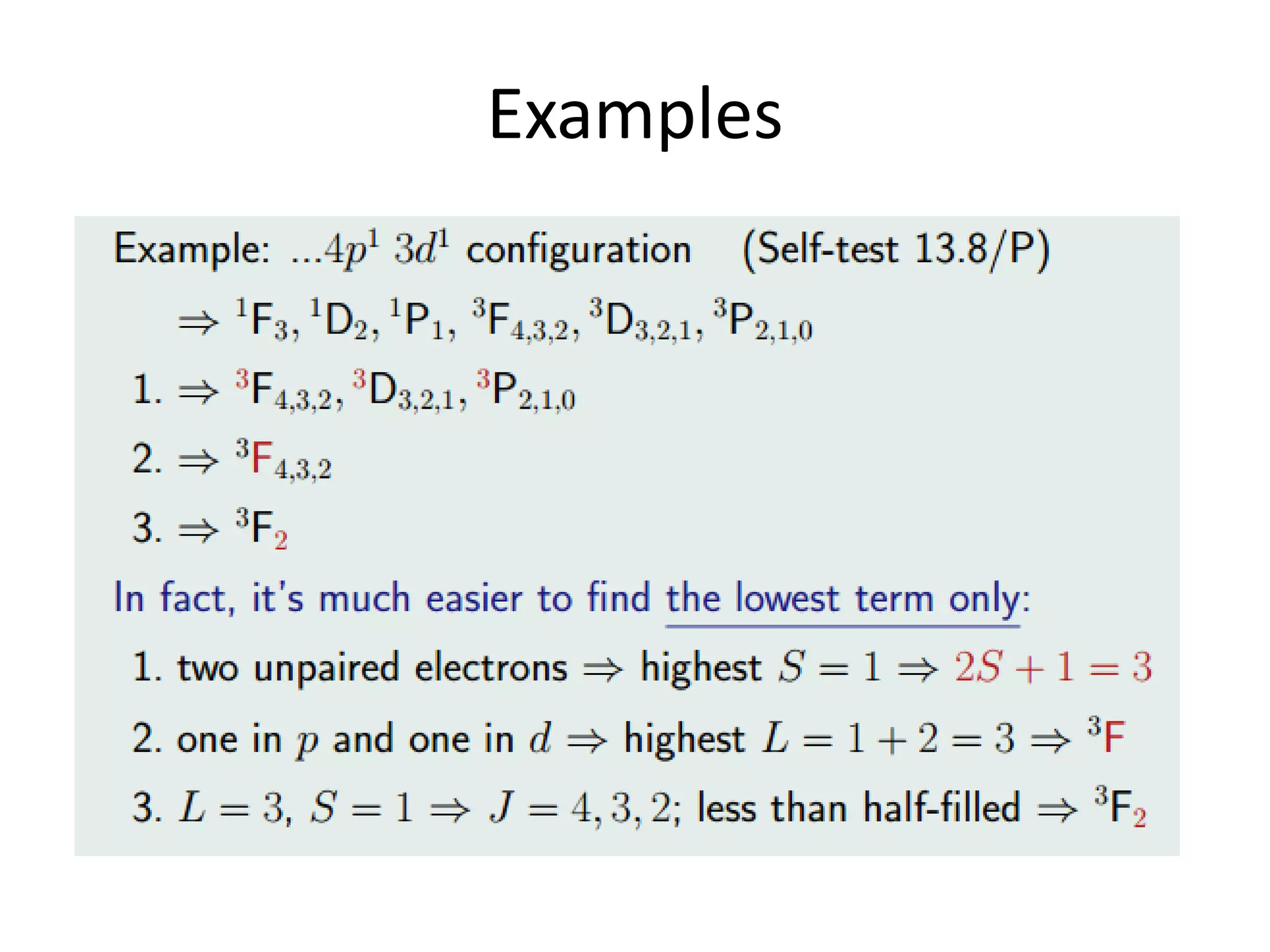
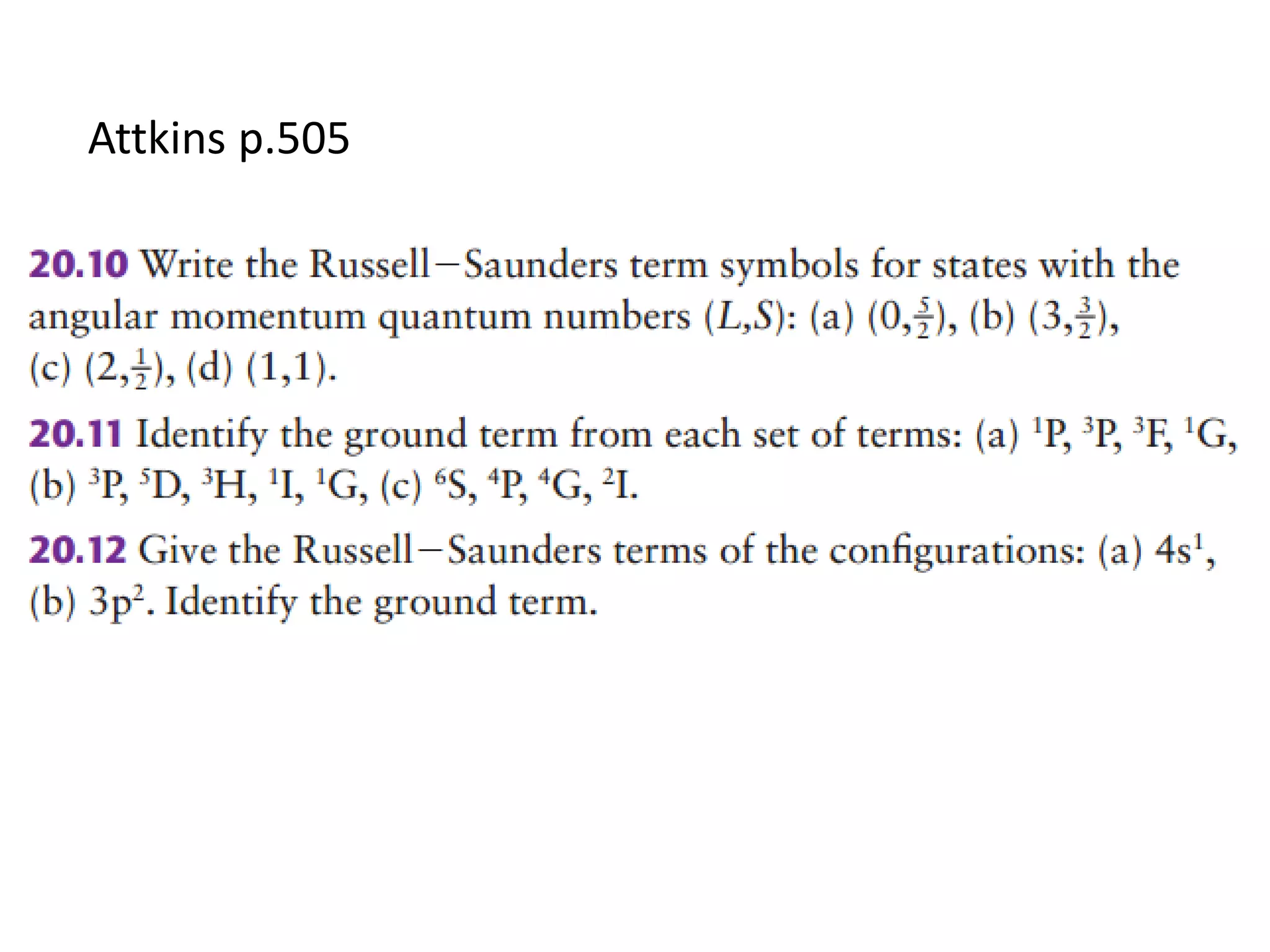
Examples
Attkins p.505
Stability of coordination
compounds
http://wwwchem.uwimona.edu.jm/courses/IC10Kstability.html
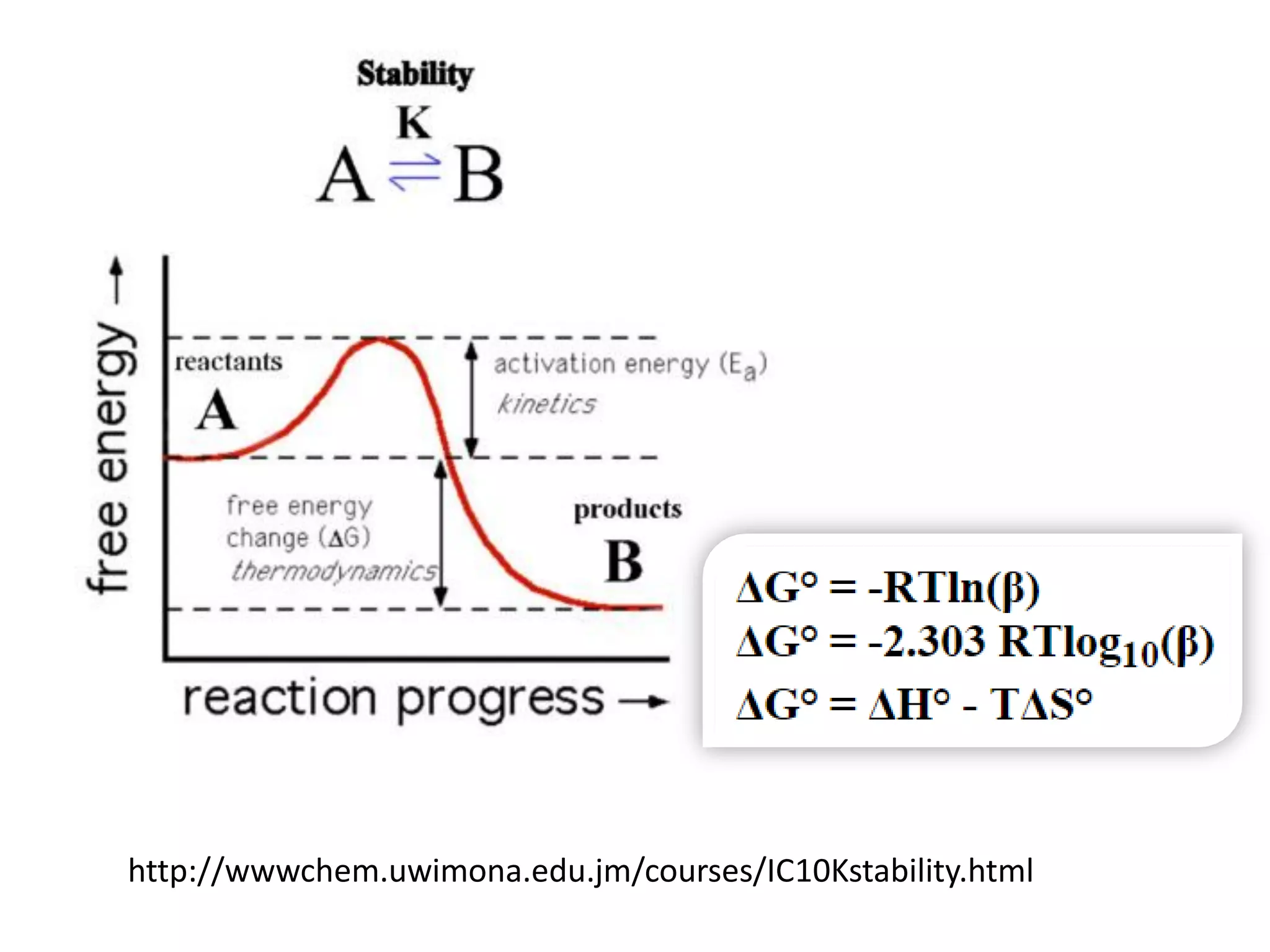
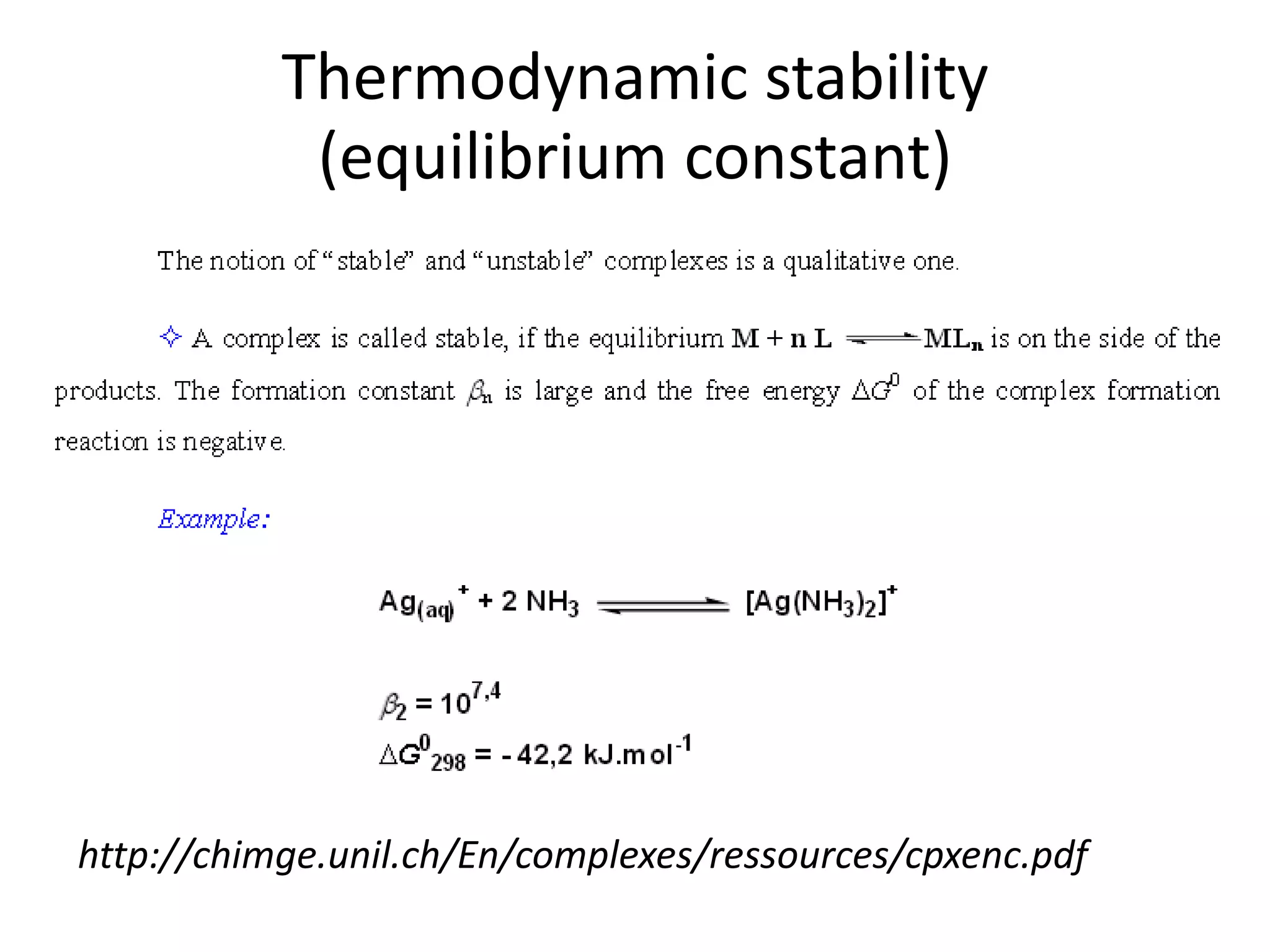
Thermodynamic stability
(equilibrium constant)
http://chimge.unil.ch/En/complexes/ressources/cpxenc.pdf
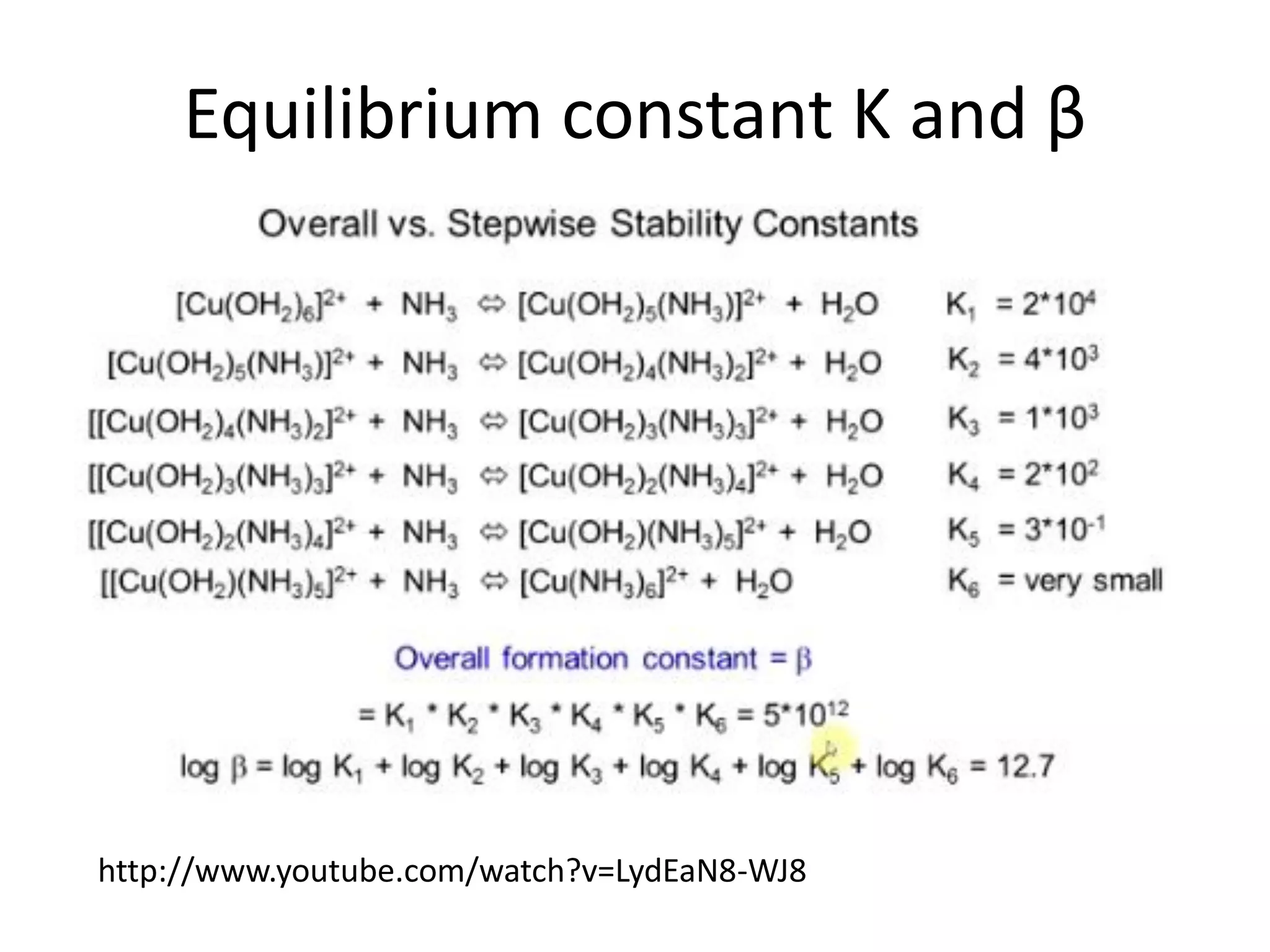
Equilibrium constant K and β
http://www.youtube.com/watch?v=LydEaN8-WJ8
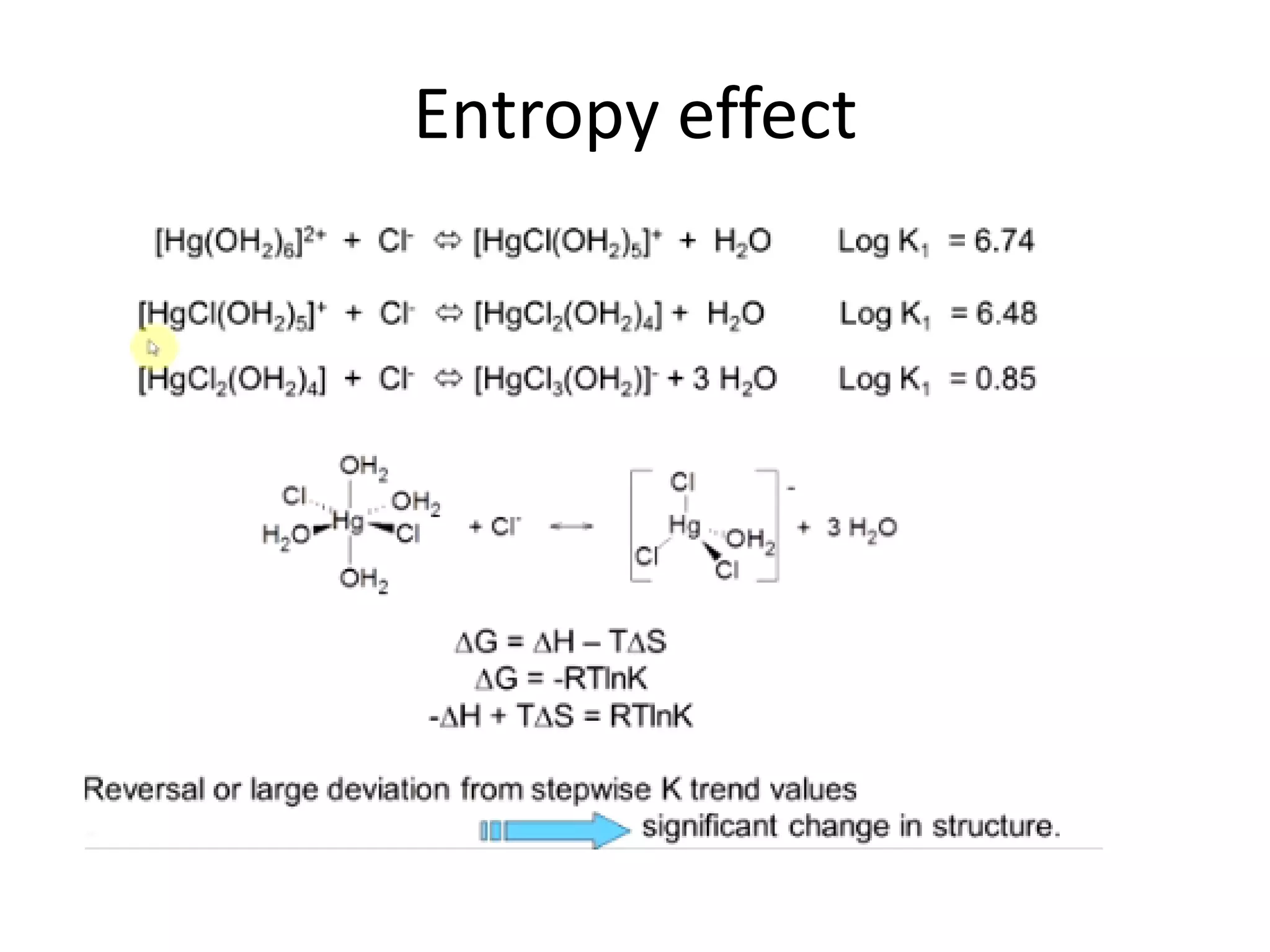
Entropy effect
Example 1
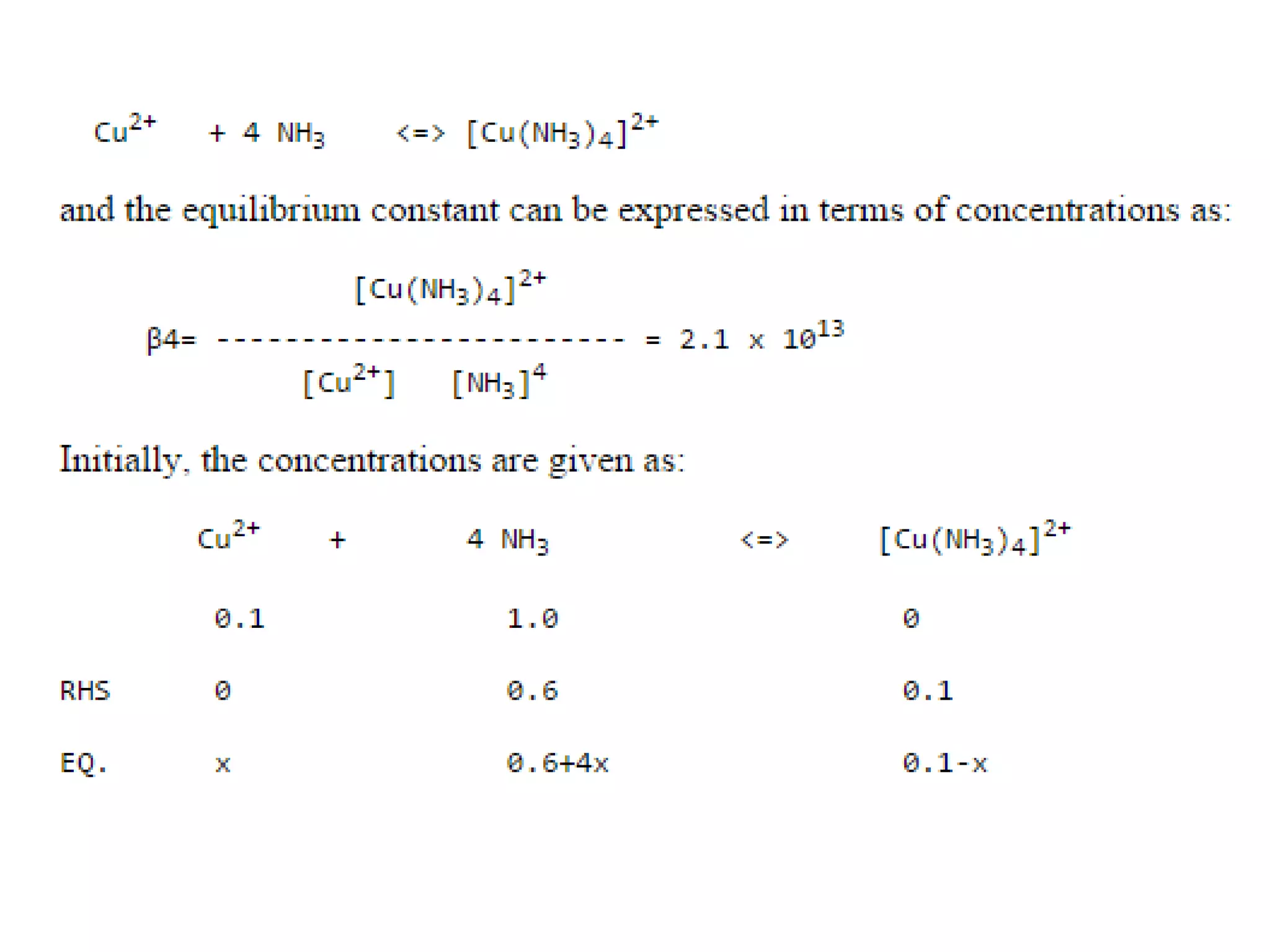
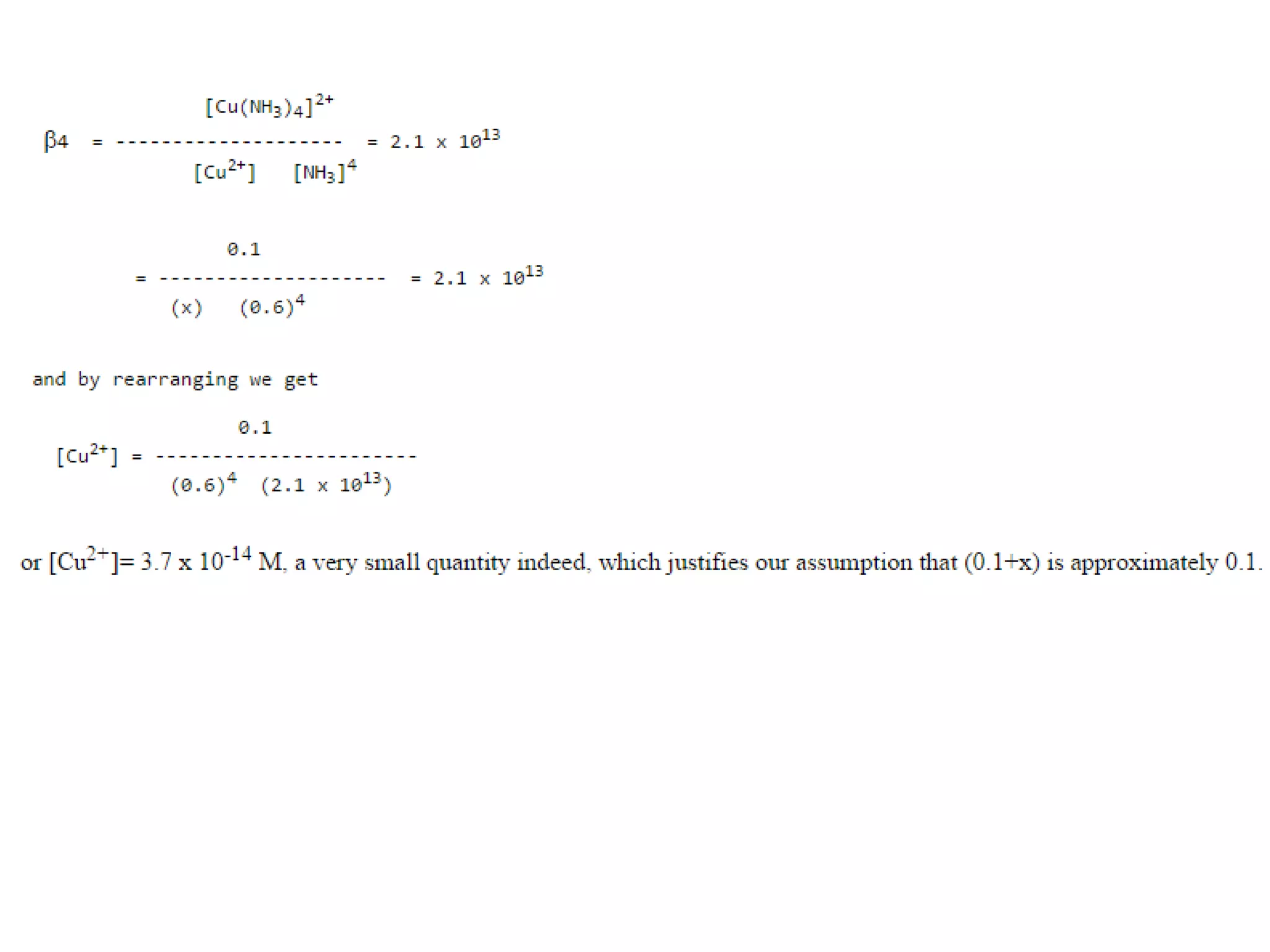
Assume that in the reaction of Cu2+ with ammonia,
the only complex ion to form is the tetra-ammine
species, [Cu(NH3)4]2+.
Given a solution where the initial [Cu2+] is 0.10M,
and the initial [NH3] is 1.0M and that β4 = 2.1 x 10¹³,
calculate the equilibrium concentration of the
Cu2+ ion.
http://wwwchem.uwimona.edu.jm/courses/IC10K1.html
Examples
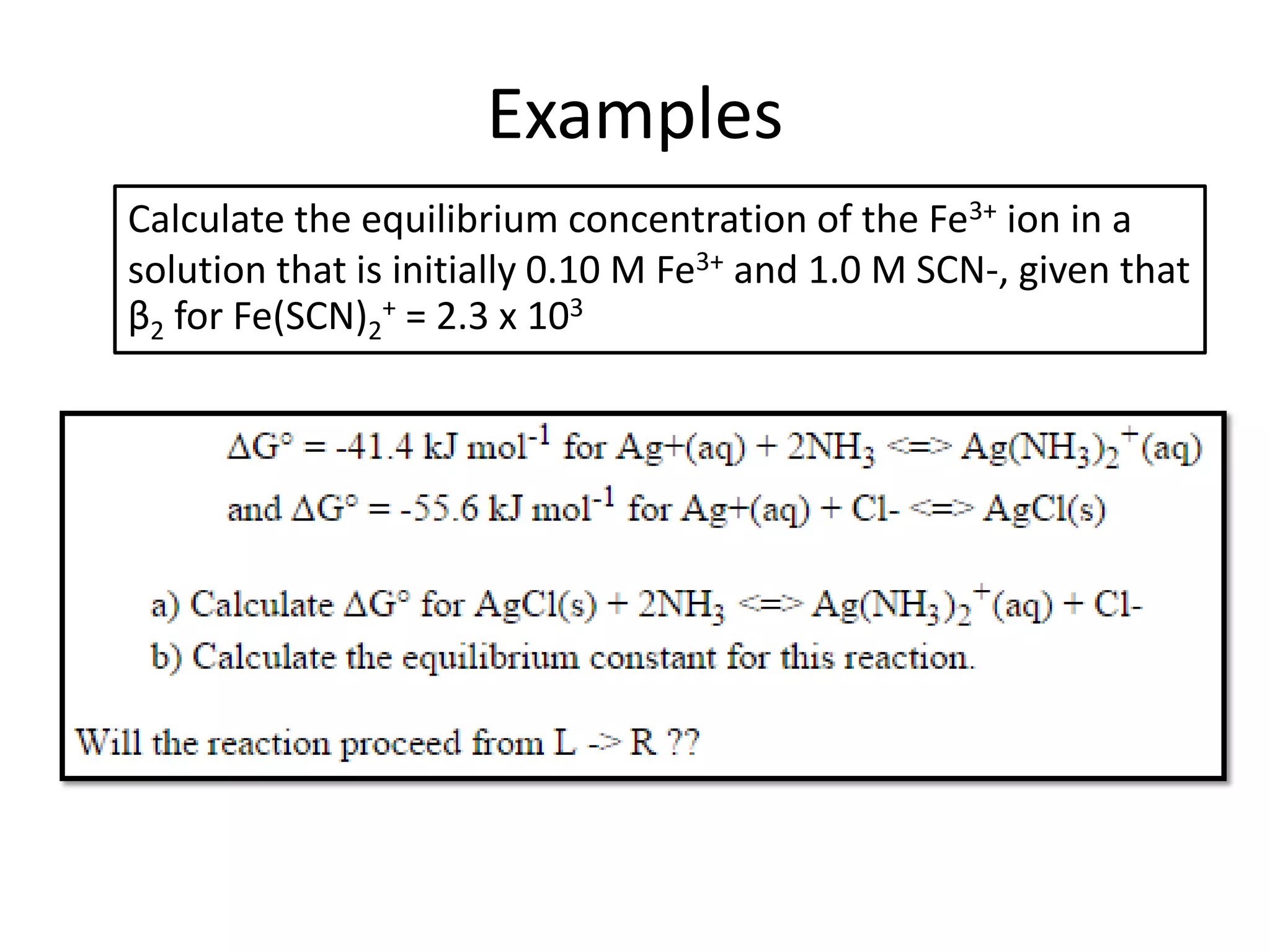
Calculate the equilibrium concentration of the Fe3+ ion in a
solution that is initially 0.10 M Fe3+ and 1.0 M SCN-, given that
β2 for Fe(SCN)2
+ = 2.3 x 10³
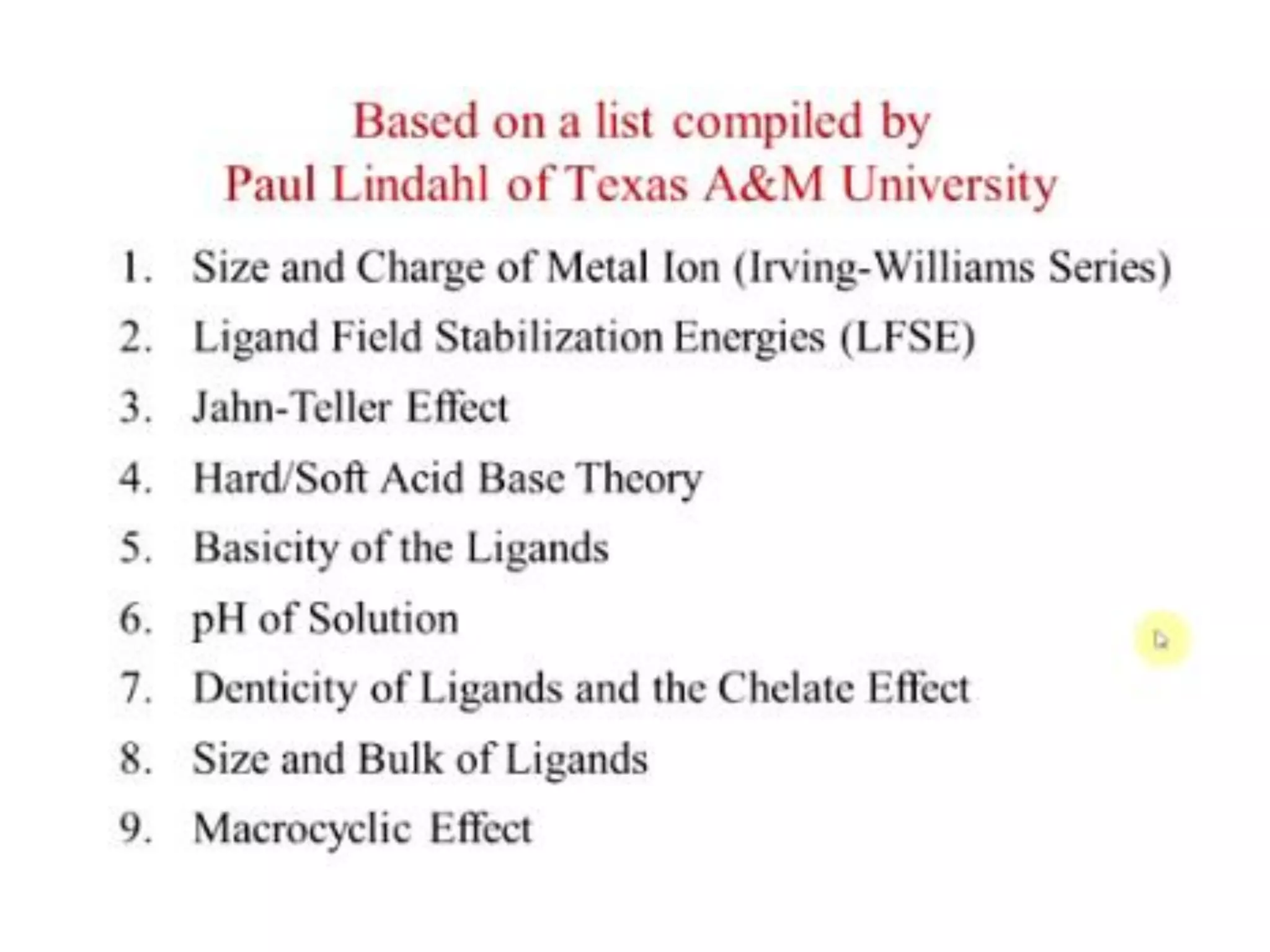
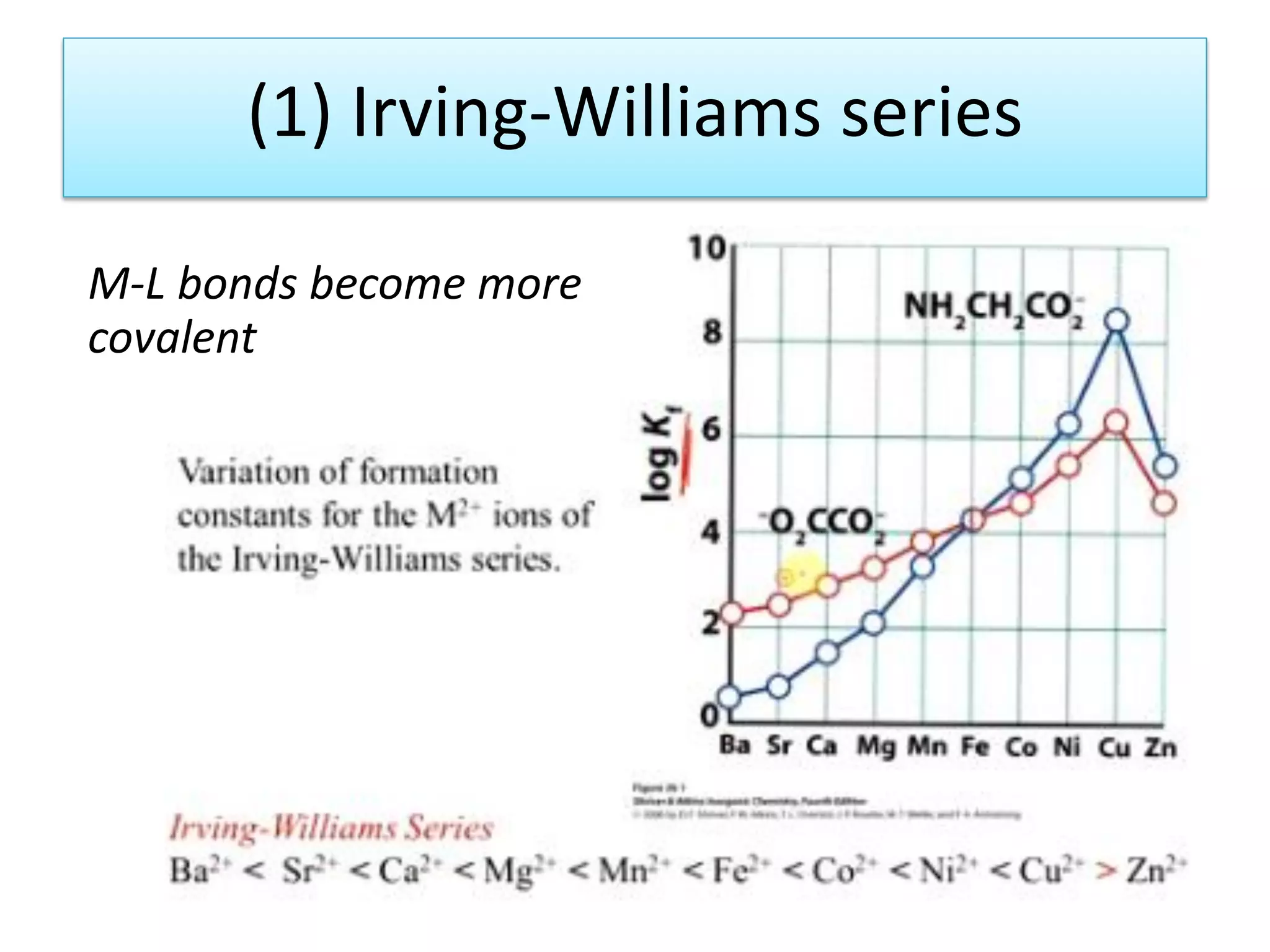
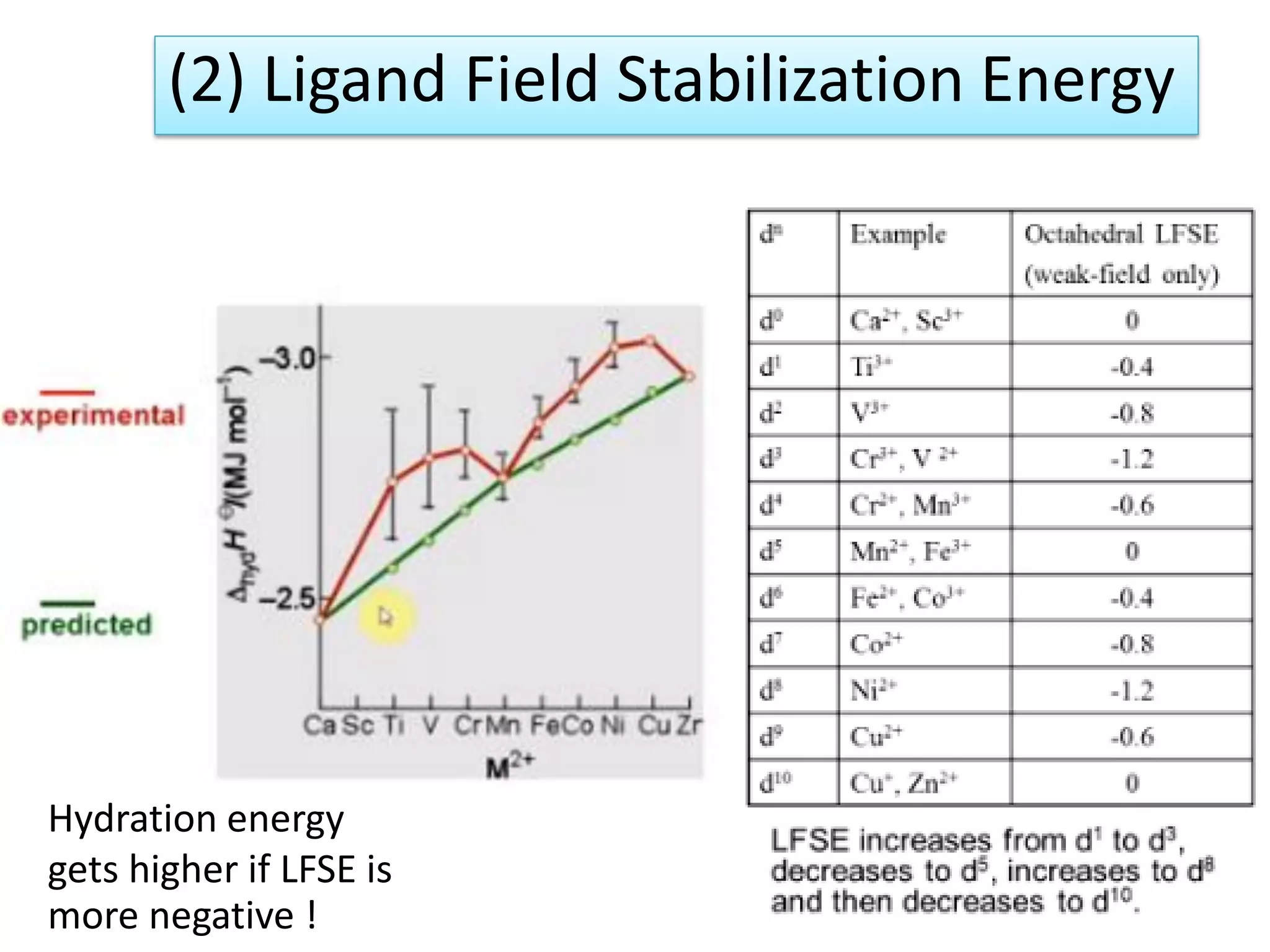
(1) Irving-Williams series
M-L bonds become more
covalent
Hydration energy
gets higher if LFSE is
more negative !
(2) Ligand Field Stabilization Energy
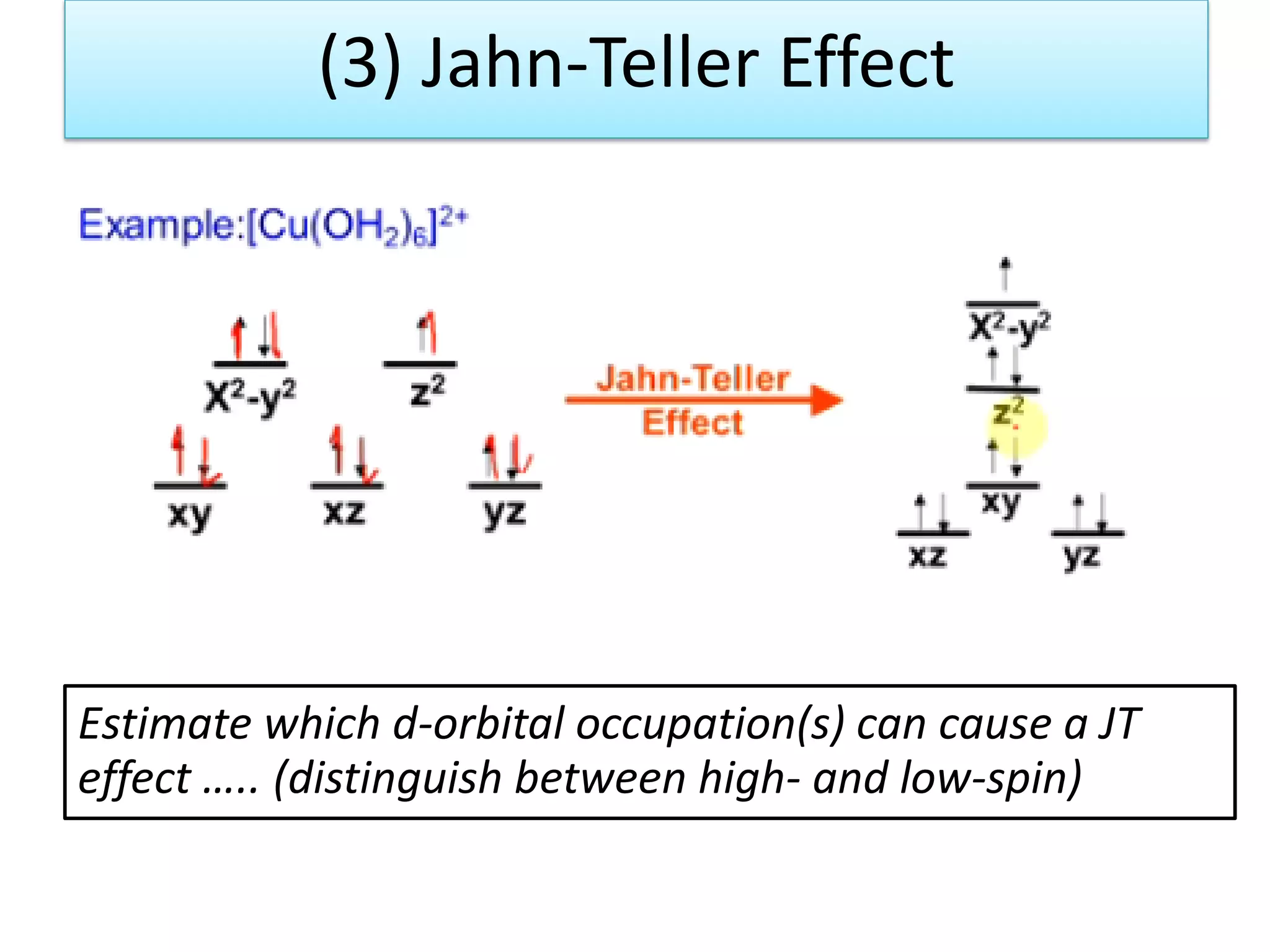
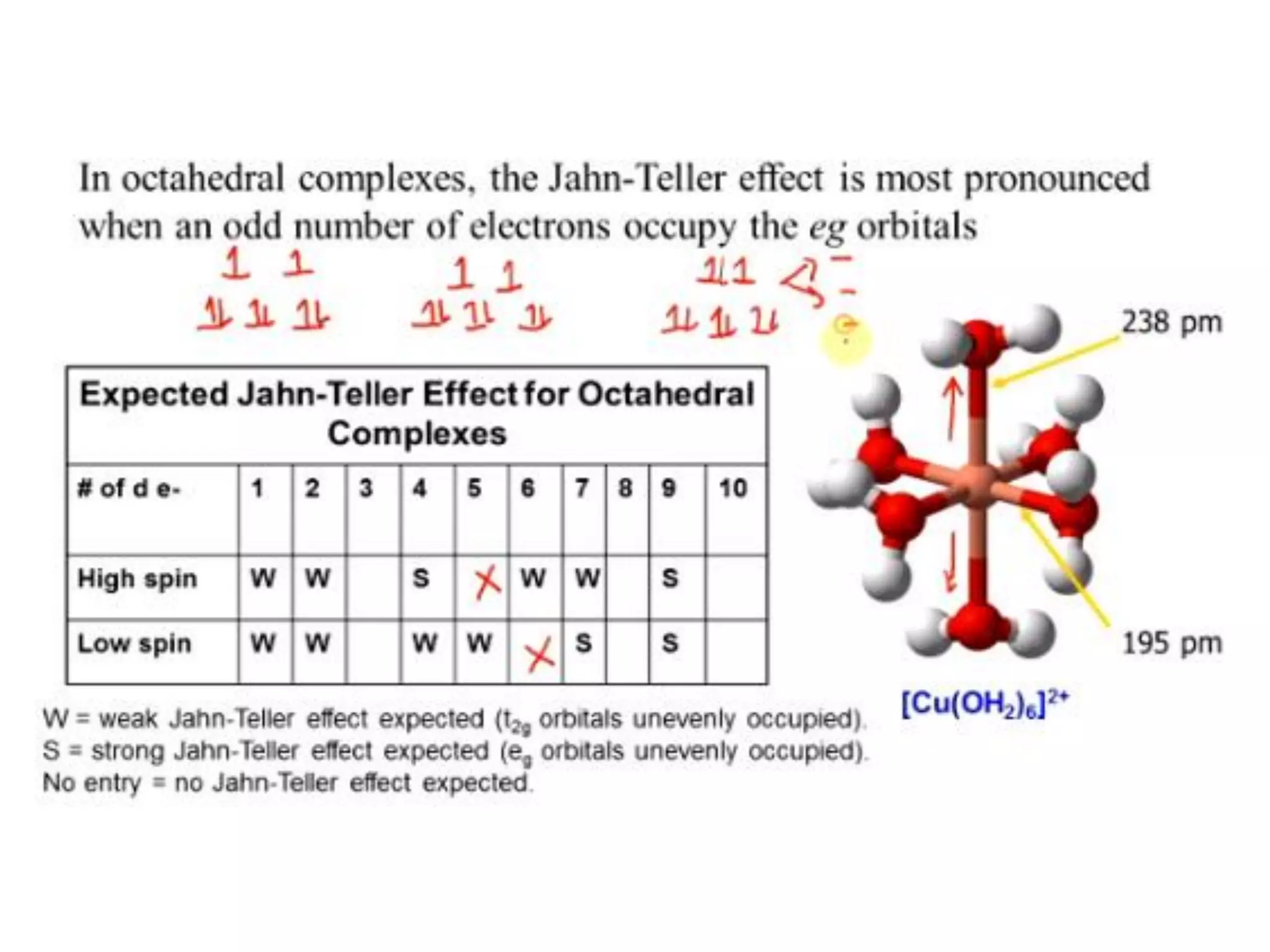
(3) Jahn-Teller Effect
Estimate which d-orbital occupation(s) can cause a JT
effect ….. (distinguish between high- and low-spin)
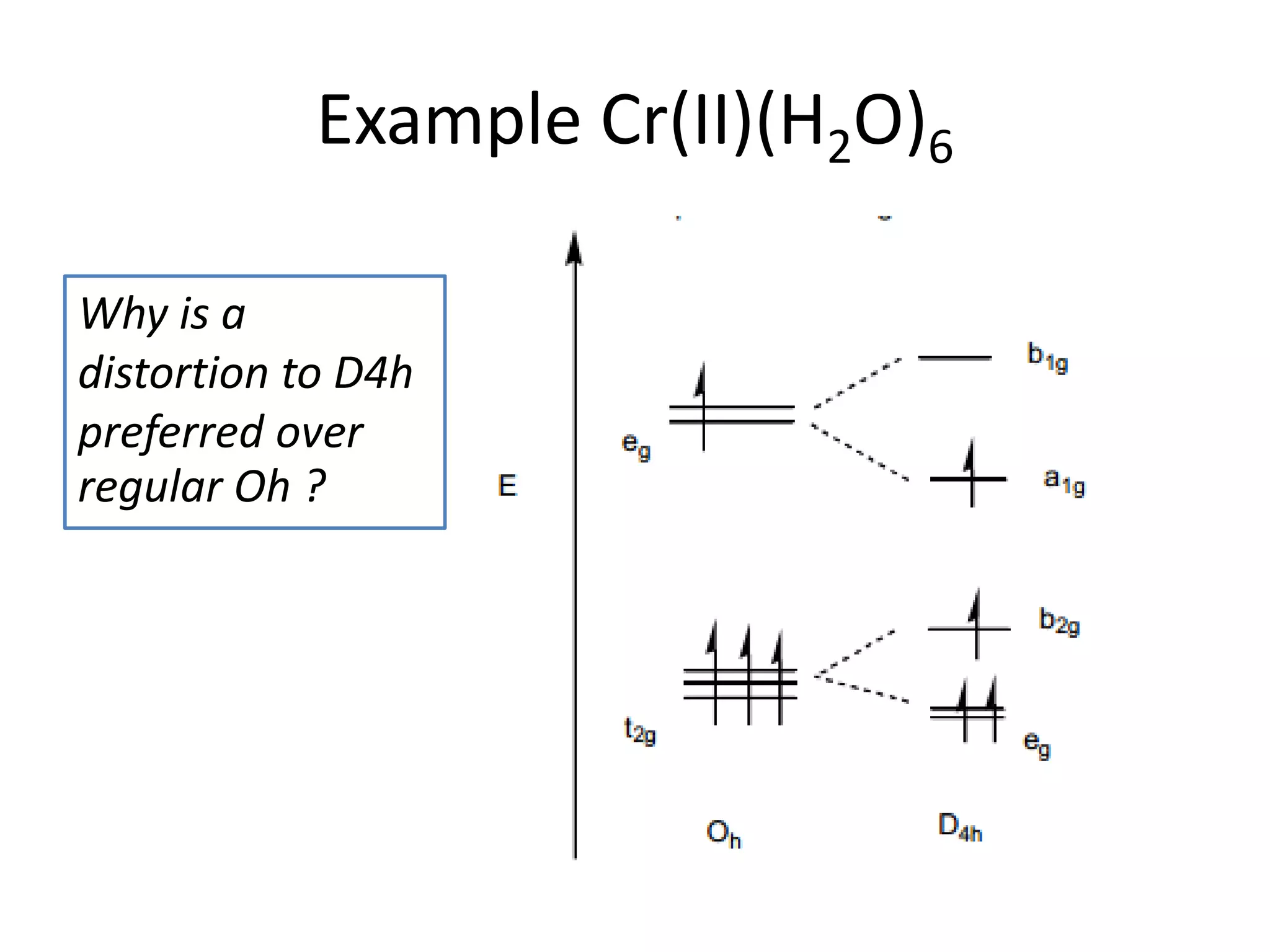
Example Cr(II)(H2O)6
Why is a
distortion to D4h
preferred over
regular Oh ?
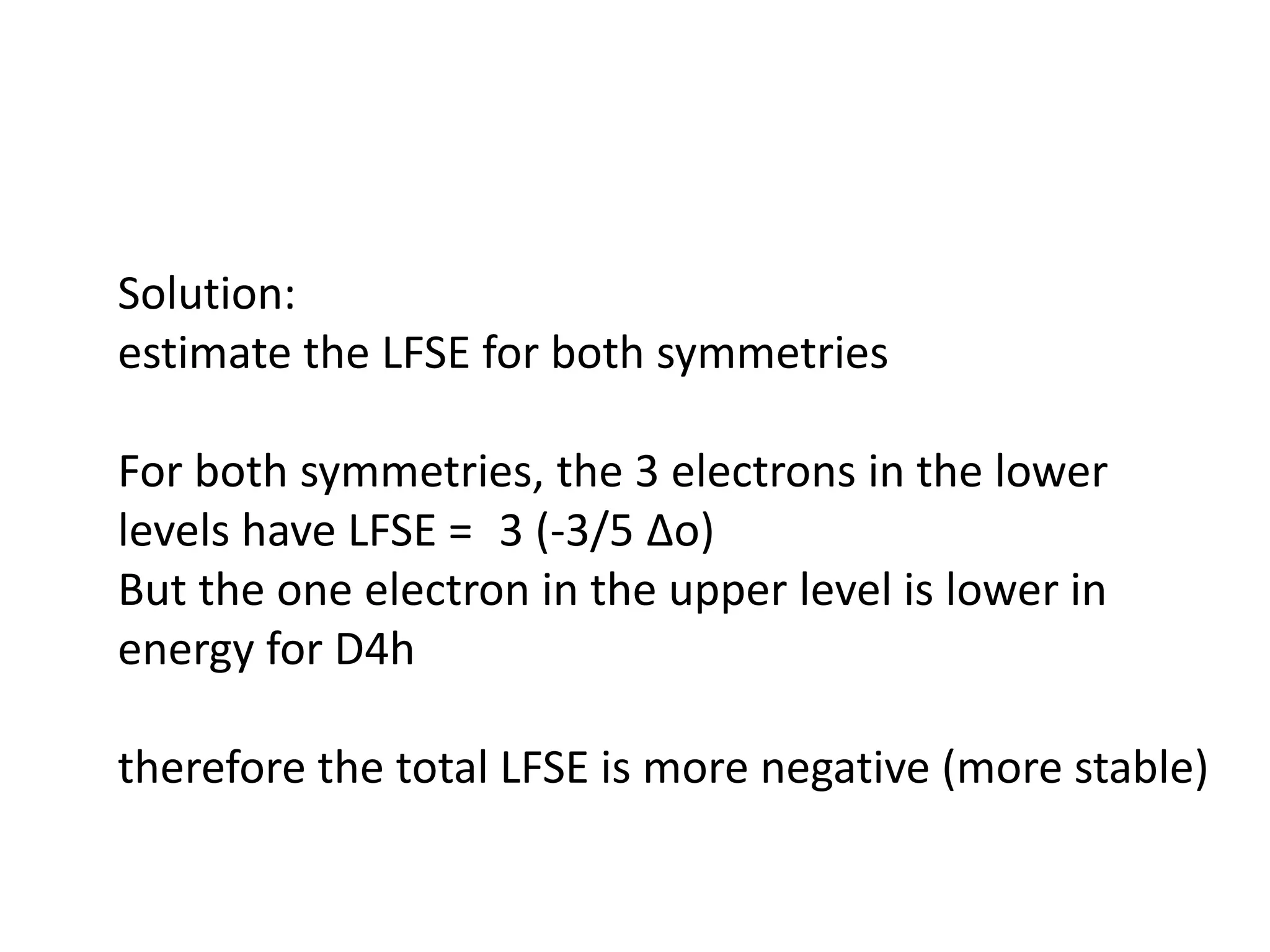
Solution:
estimate the LFSE for both symmetries
For both symmetries, the 3 electrons in the lower
levels have LFSE = 3 (-3/5 ∆o)
But the one electron in the upper level is lower in
energy for D4h
therefore the total LFSE is more negative (more stable)
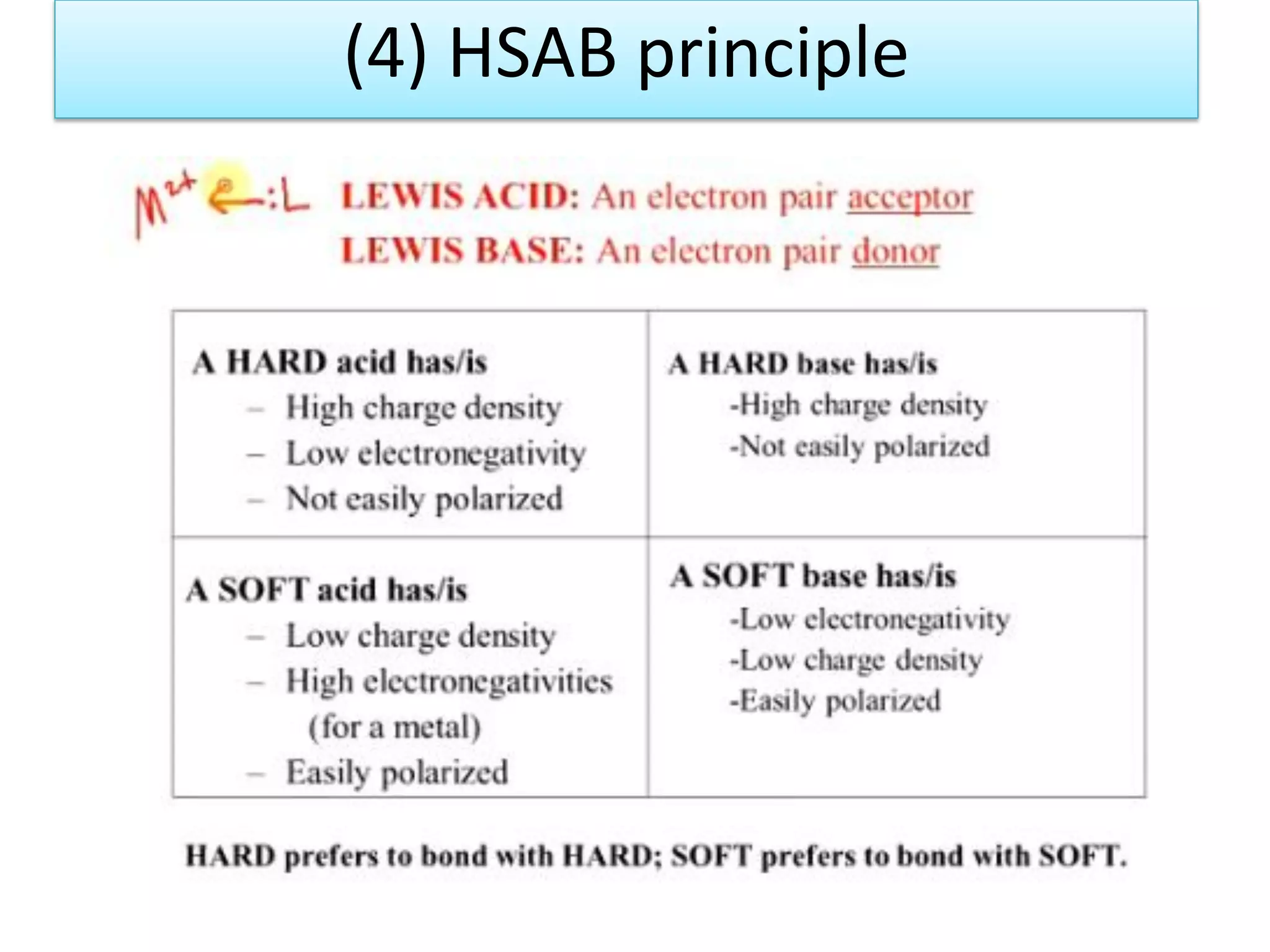
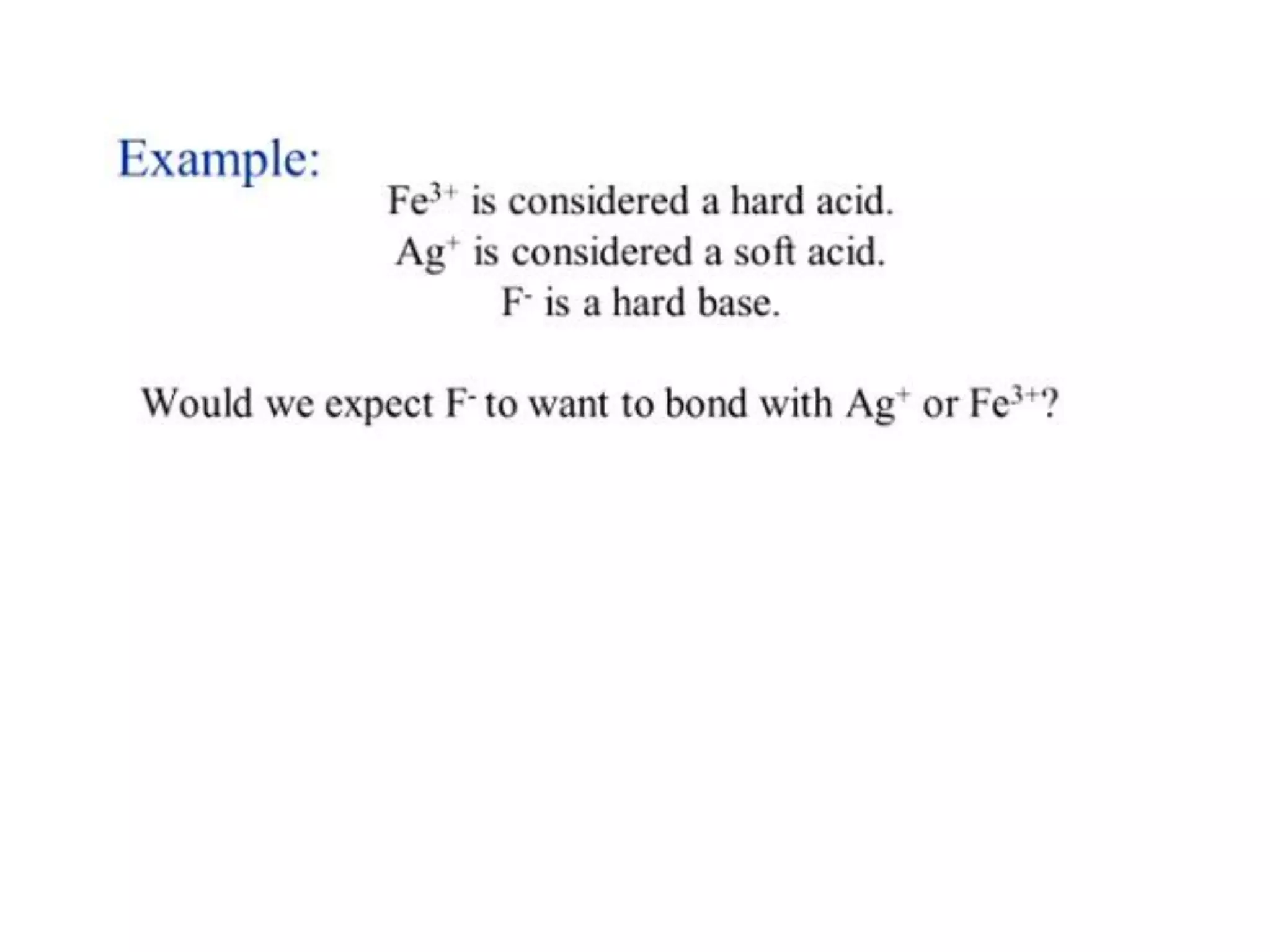
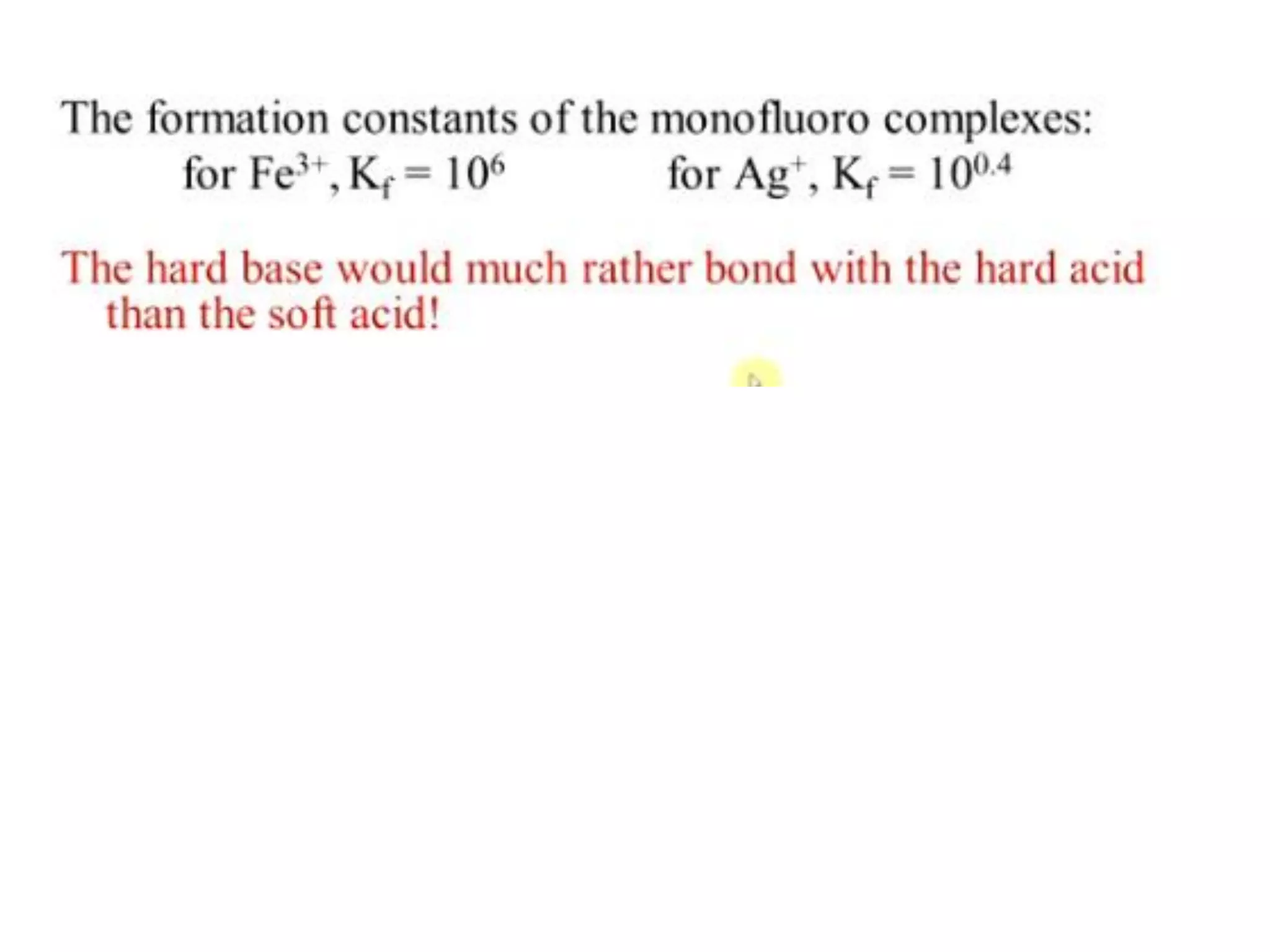
(4) HSAB principle
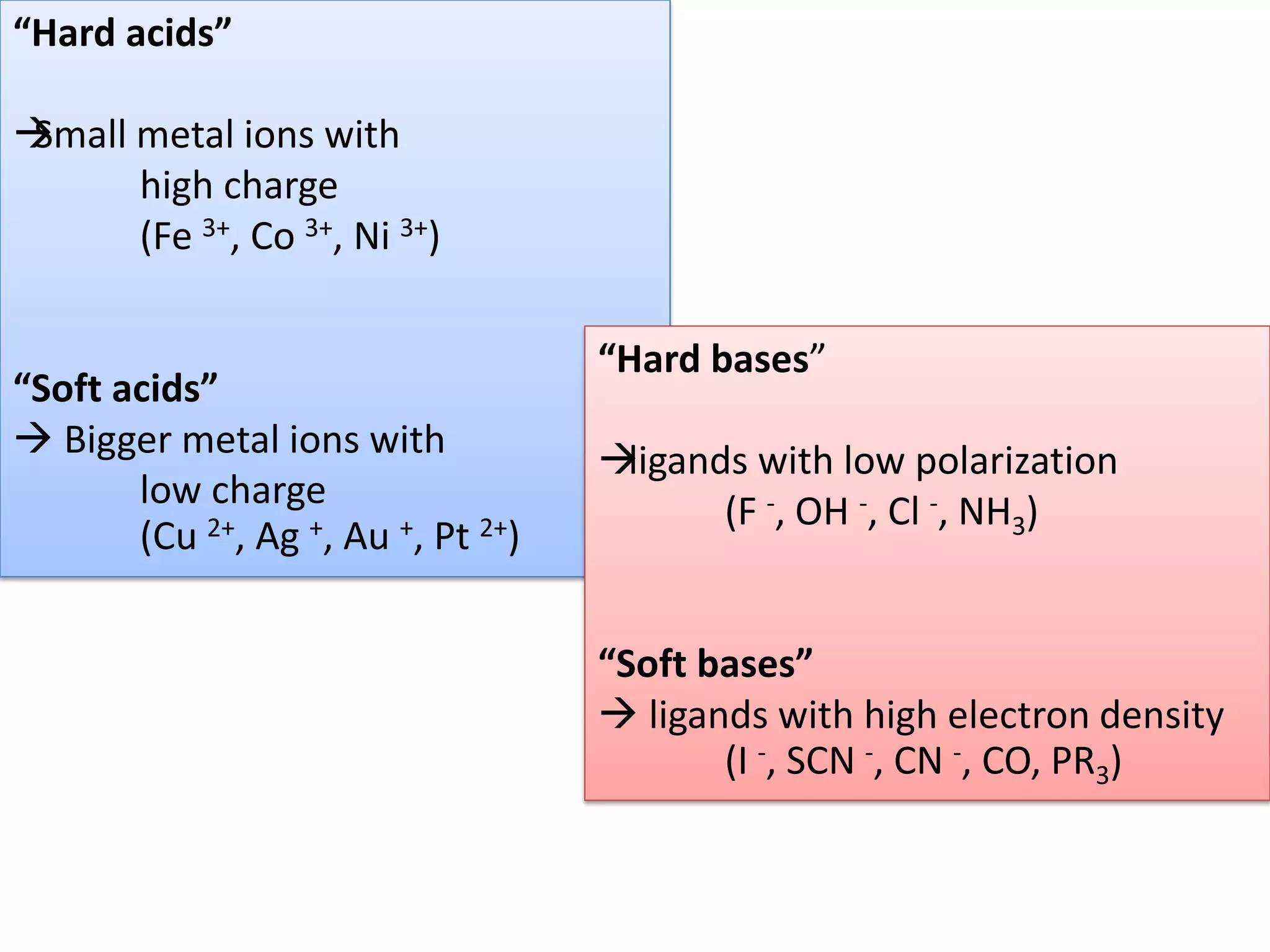
“Hard acids”
Small metal ions with
high charge
(Fe 3+, Co 3+, Ni 3+)
“Soft acids”
 Bigger metal ions with
low charge
(Cu 2+, Ag +, Au +, Pt 2+)
“Hard bases”
ligands with low polarization
(F -, OH -, Cl -, NH3)
“Soft bases”
 ligands with high electron density
(I -, SCN -, CN -, CO, PR3)
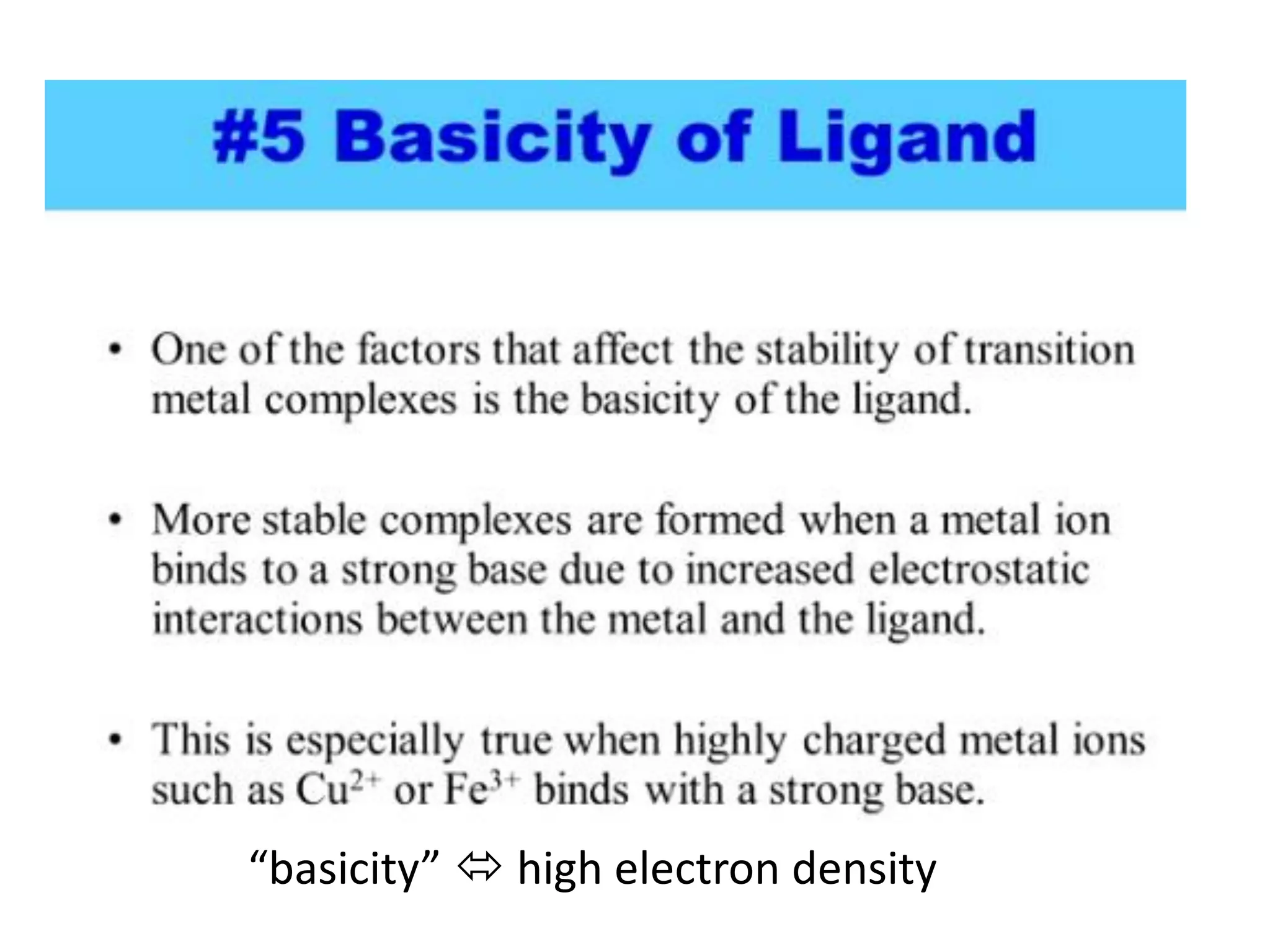
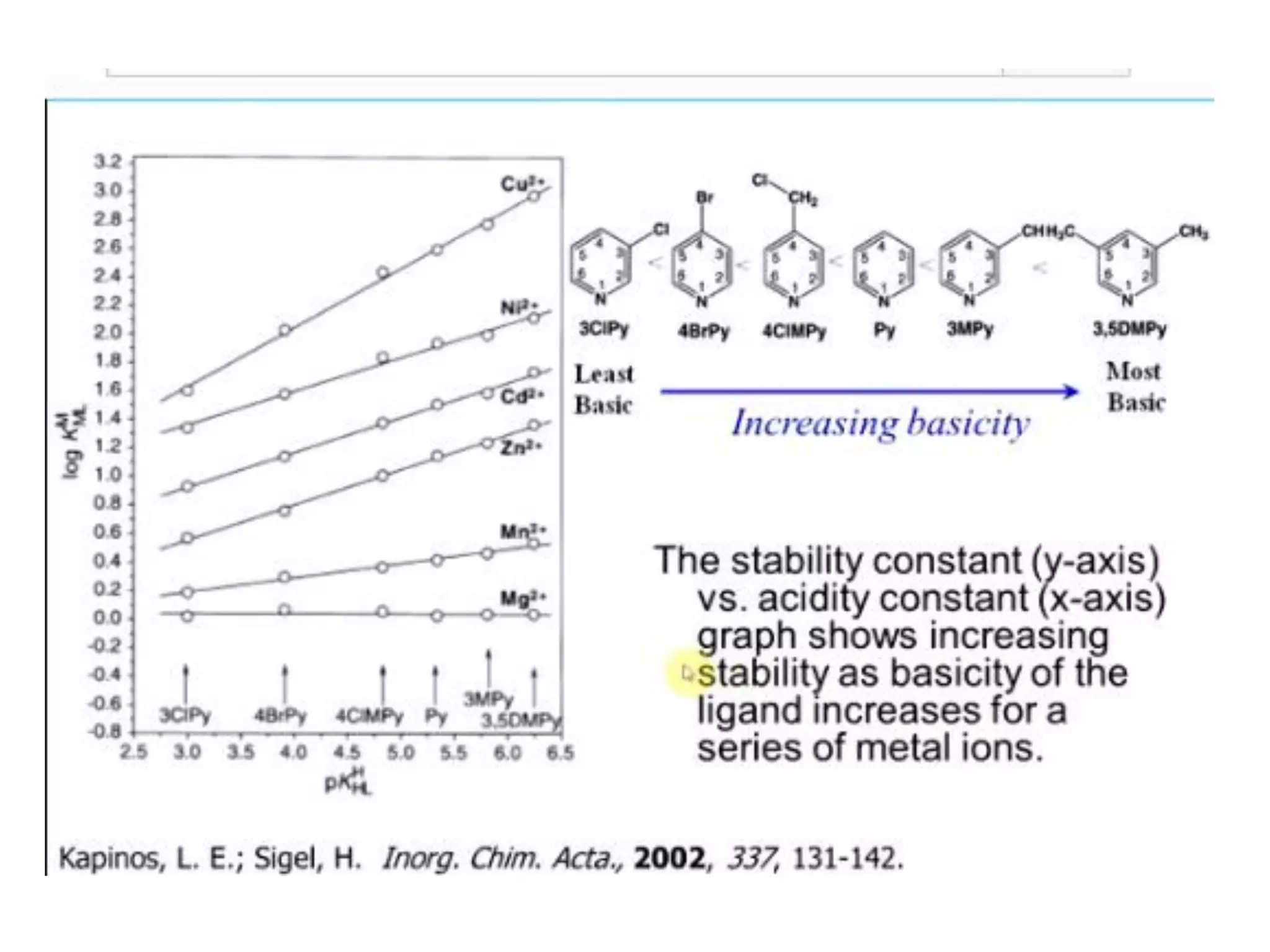
“basicity”  high electron density
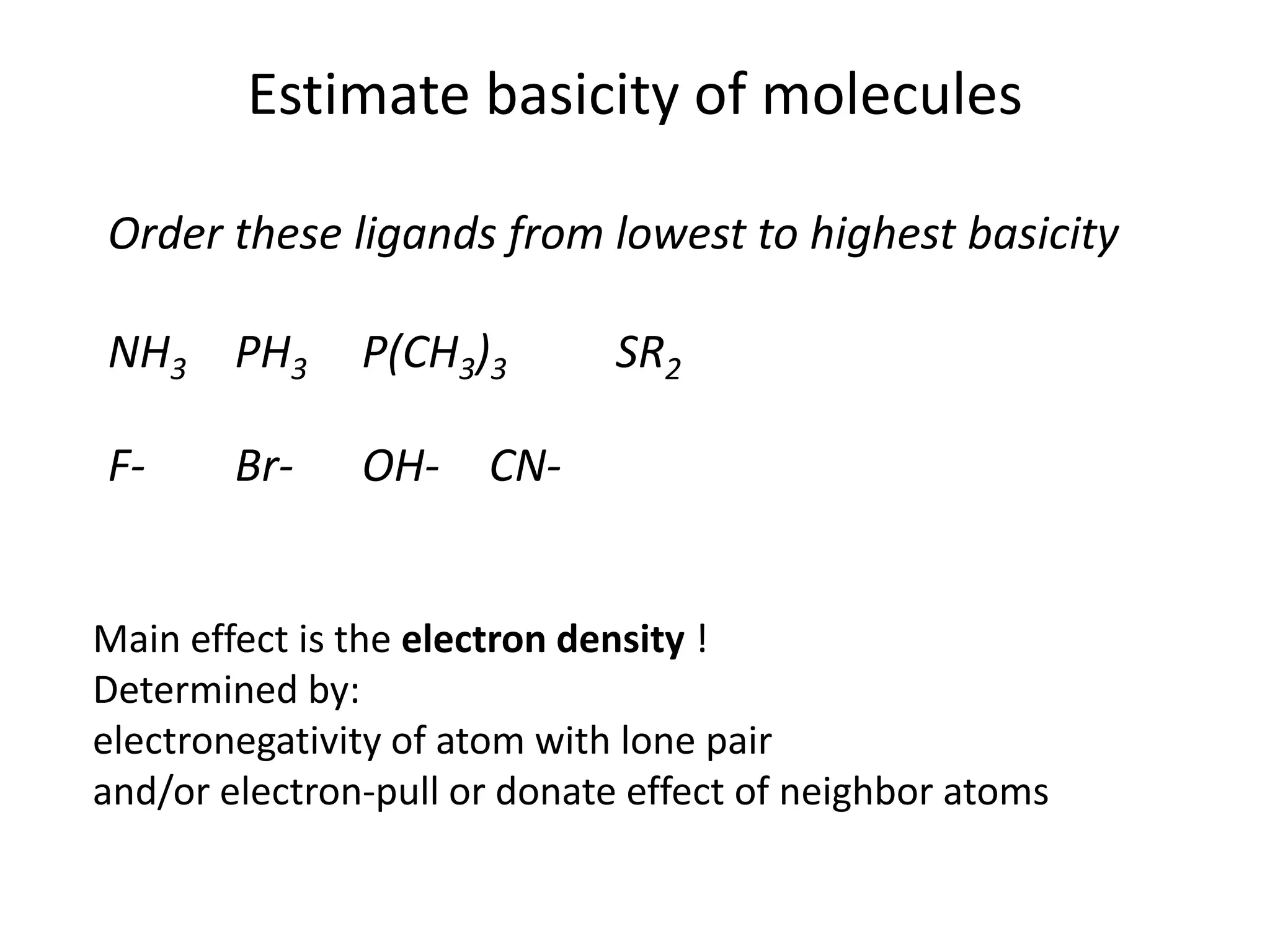
Estimate basicity of molecules
Order these ligands from lowest to highest basicity
NH3 PH3 P(CH3)3 SR2
F- Br- OH- CN-
Main effect is the electron density !
Determined by:
electronegativity of atom with lone pair
and/or electron-pull or donate effect of neighbor atoms
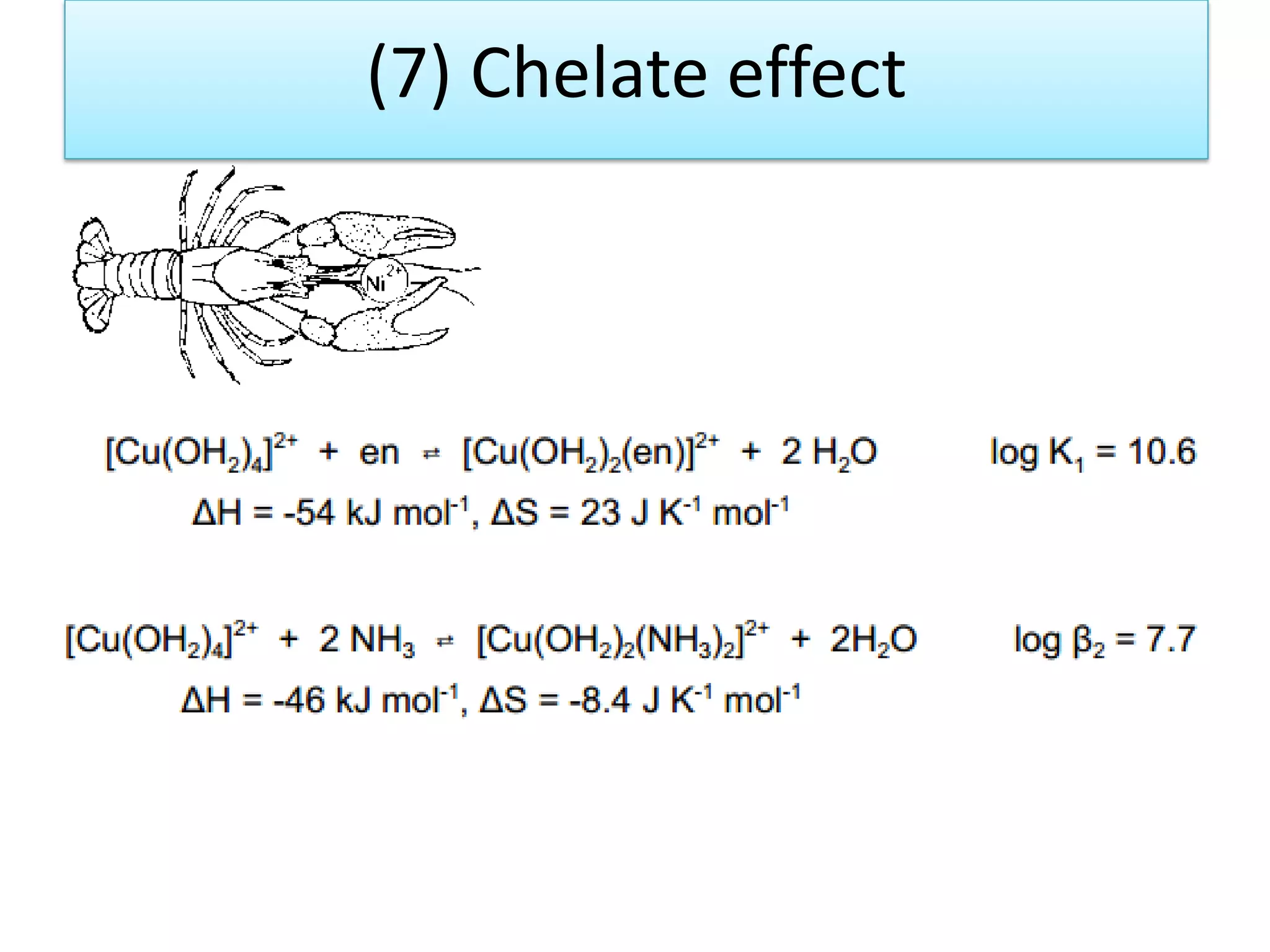
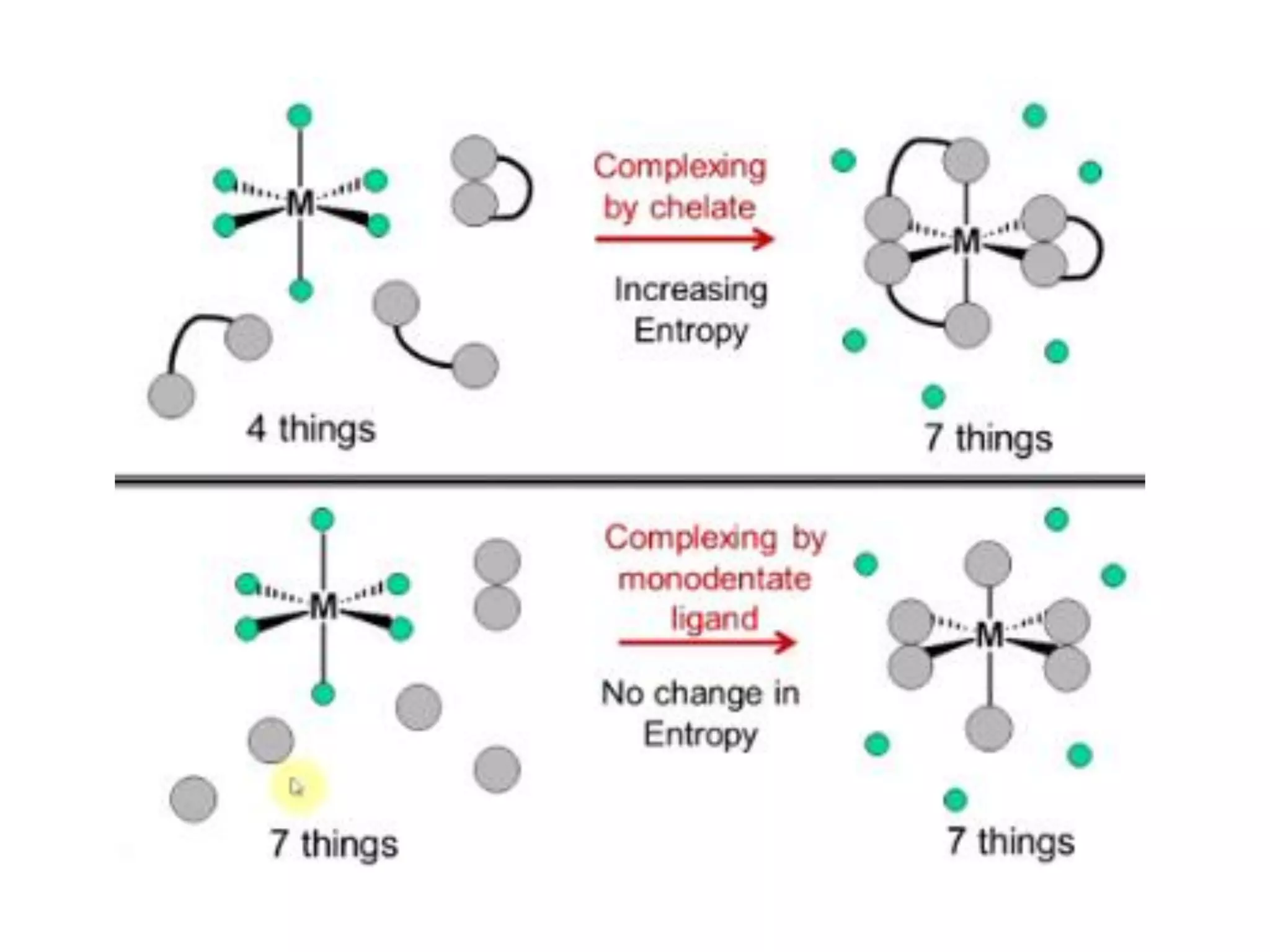
(7) Chelate effect
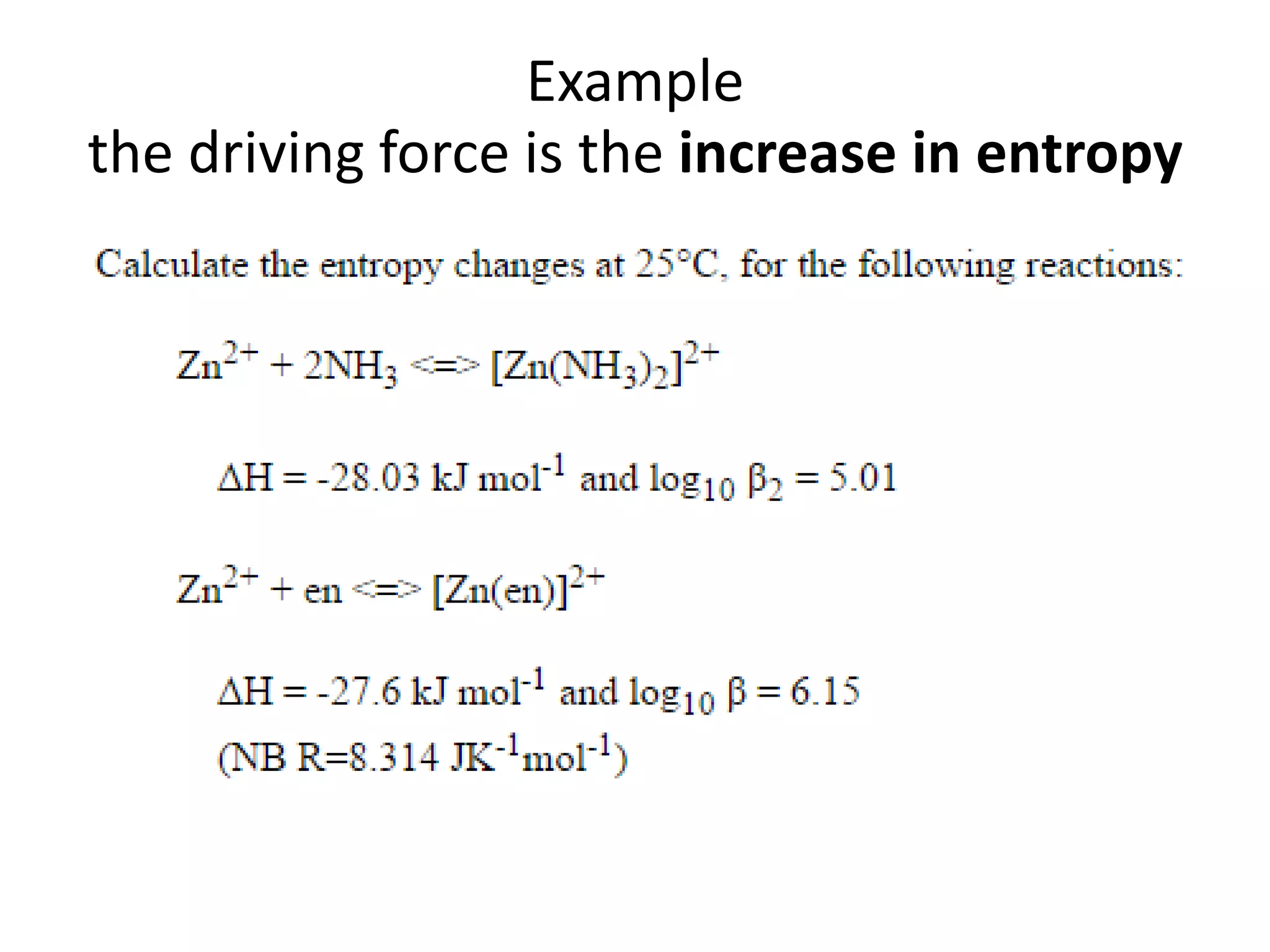
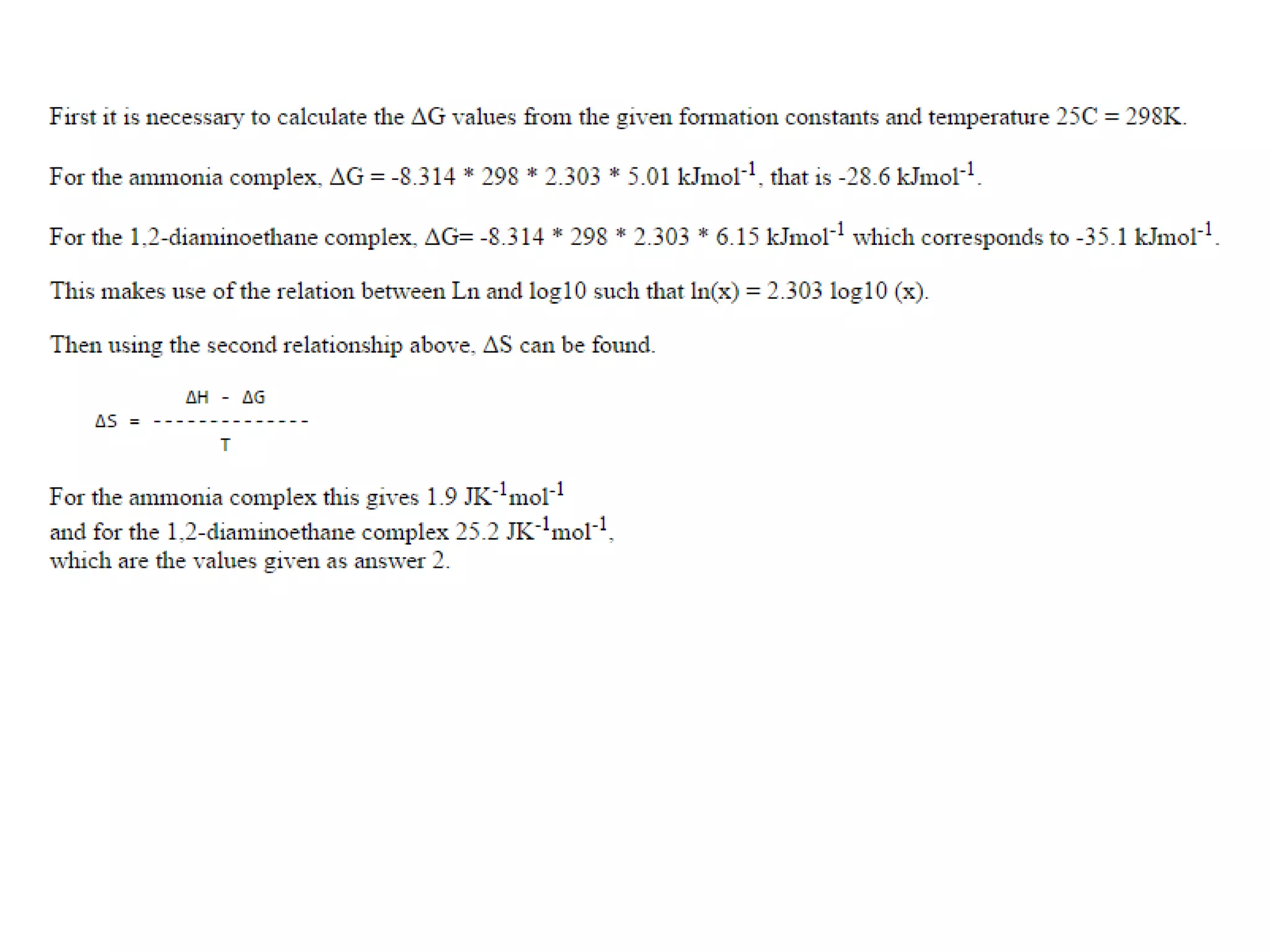
Example
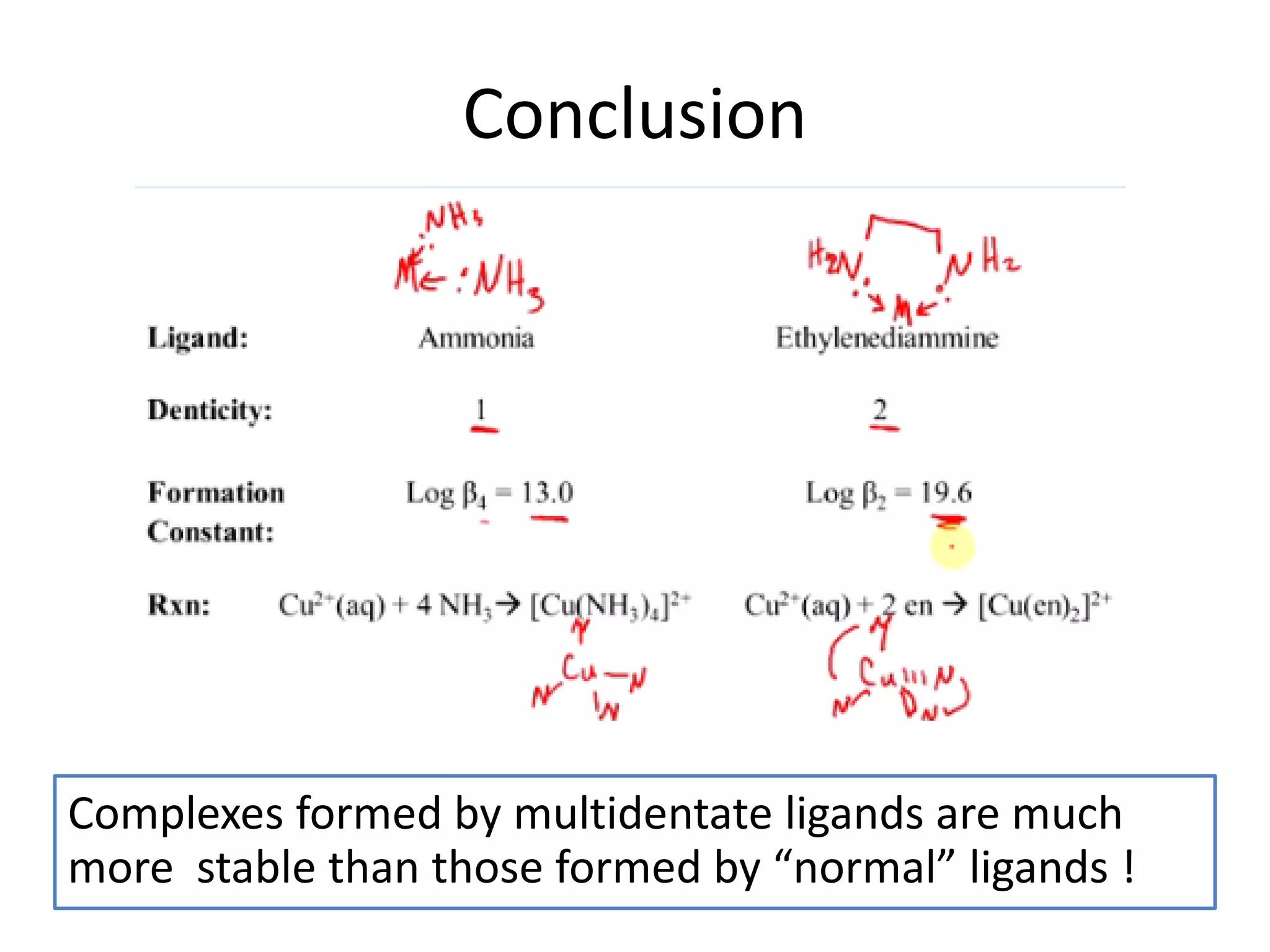
the driving force is the increase in entropy
Conclusion
Complexes formed by multidentate ligands are much
more stable than those formed by “normal” ligands !
(8) Bulk and Size of Ligands
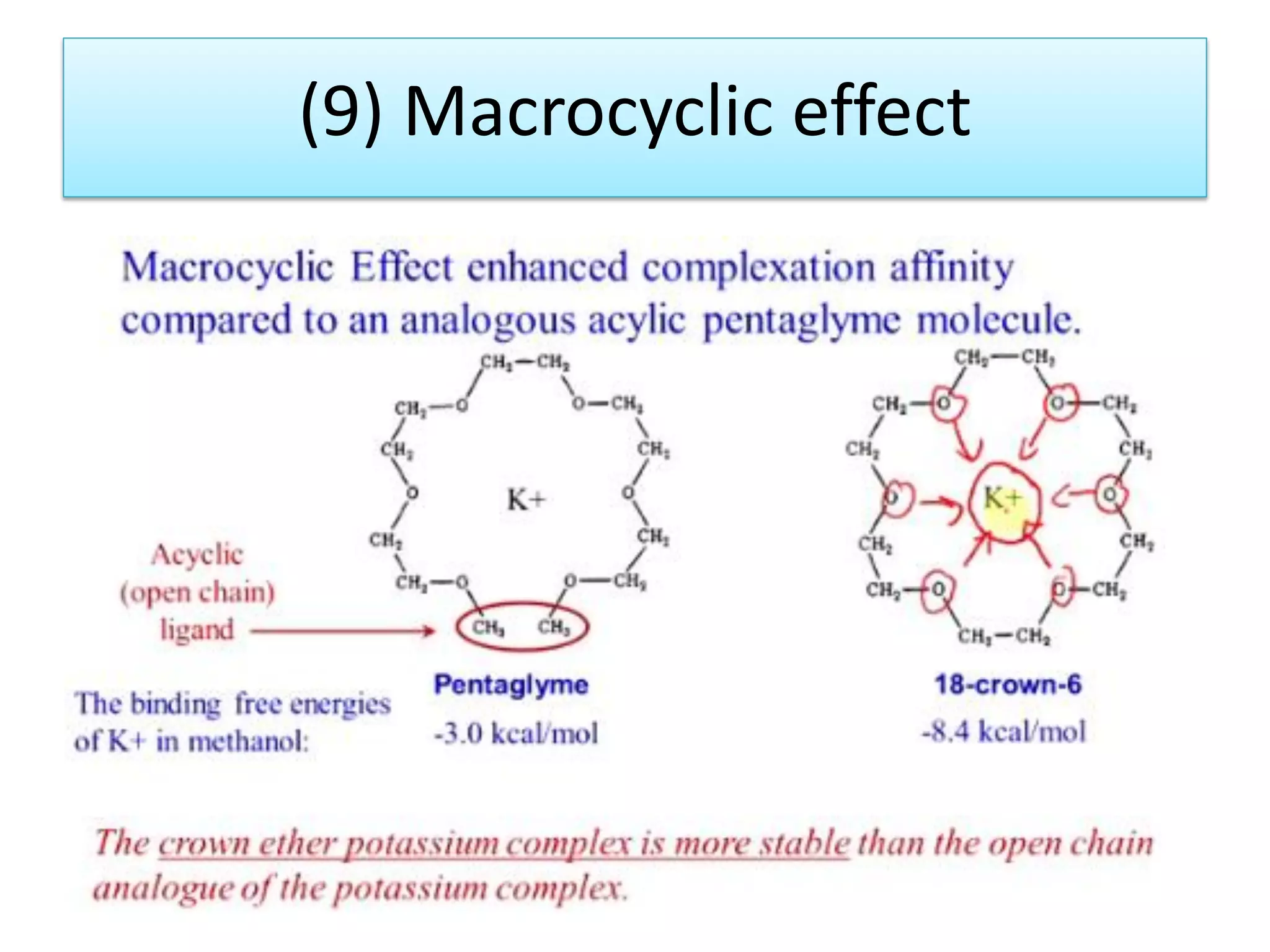
(9) Macrocyclic effect

Properties of coordination complexes Complete