Inorganic Materials (2)
Doping and Band Structure
Perovskite / Rocksalt crystals
Transition metal oxides
DOPING OF SEMICONDUCTORS
Insulator and Semiconductor
The probability to find and electron in the conductor band
can be calculated as:
(For semiconductors, r.t. energy is enough to promote
electrons into the conduction band)
Exercise
What would be the energy gap E at room temperature where
the probability to find the electrons to 10% at the conduction
band ?
(R = 8.314 J / (mol·K) / 25oC = 273 + 25 = 298 K)
e E/RT = 1/P – 1 with P = 0.1
E/RT = ln (9) = 2.2
E = 298 K * 8.314 J/(mol K) * 2.2 = 5.45 kJ/mol
(for P= 0.5: E = 0)
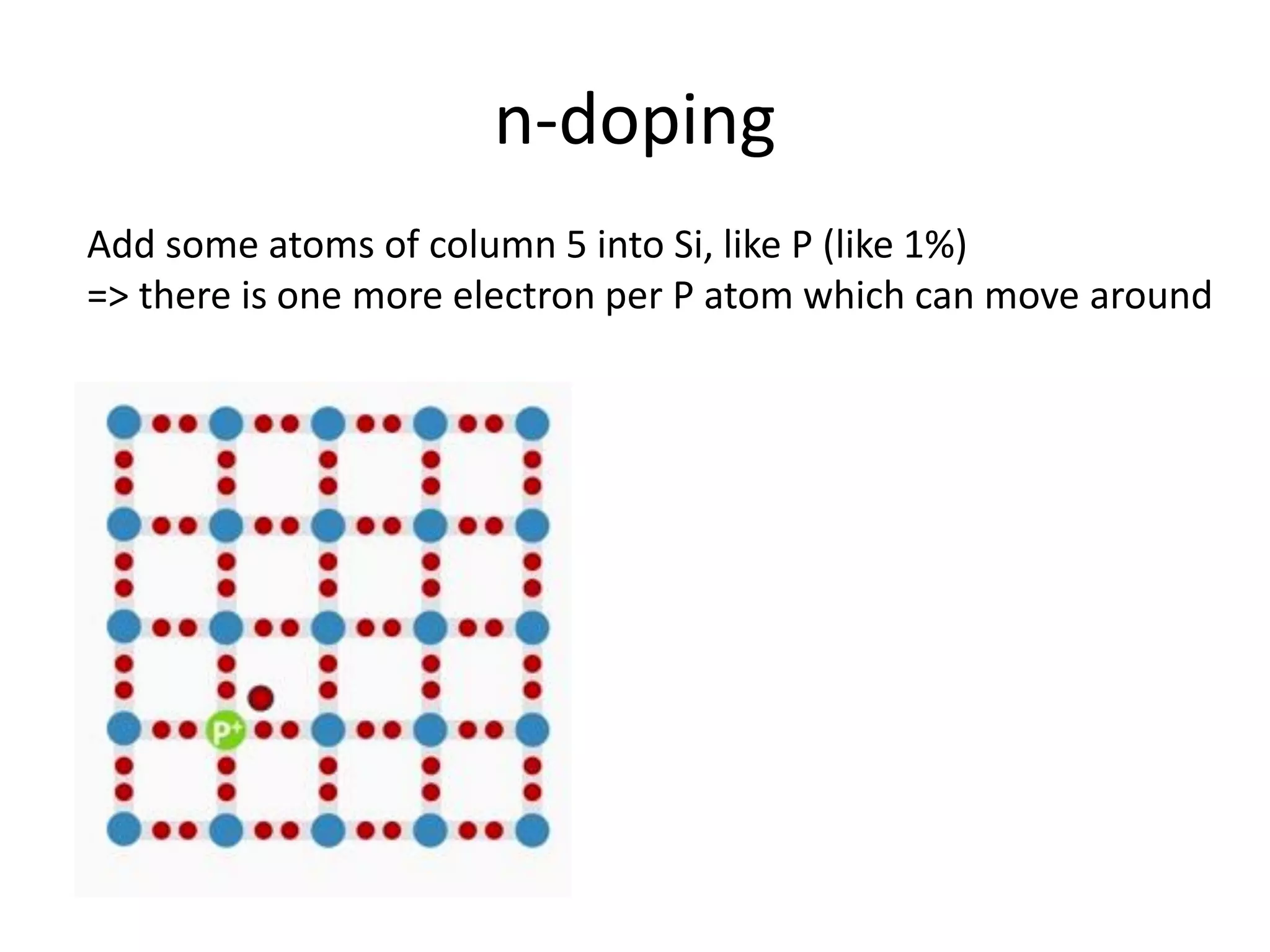
n-doping
Add some atoms of column 5 into Si, like P (like 1%)
=> there is one more electron per P atom which can move around
n(egative)-doping
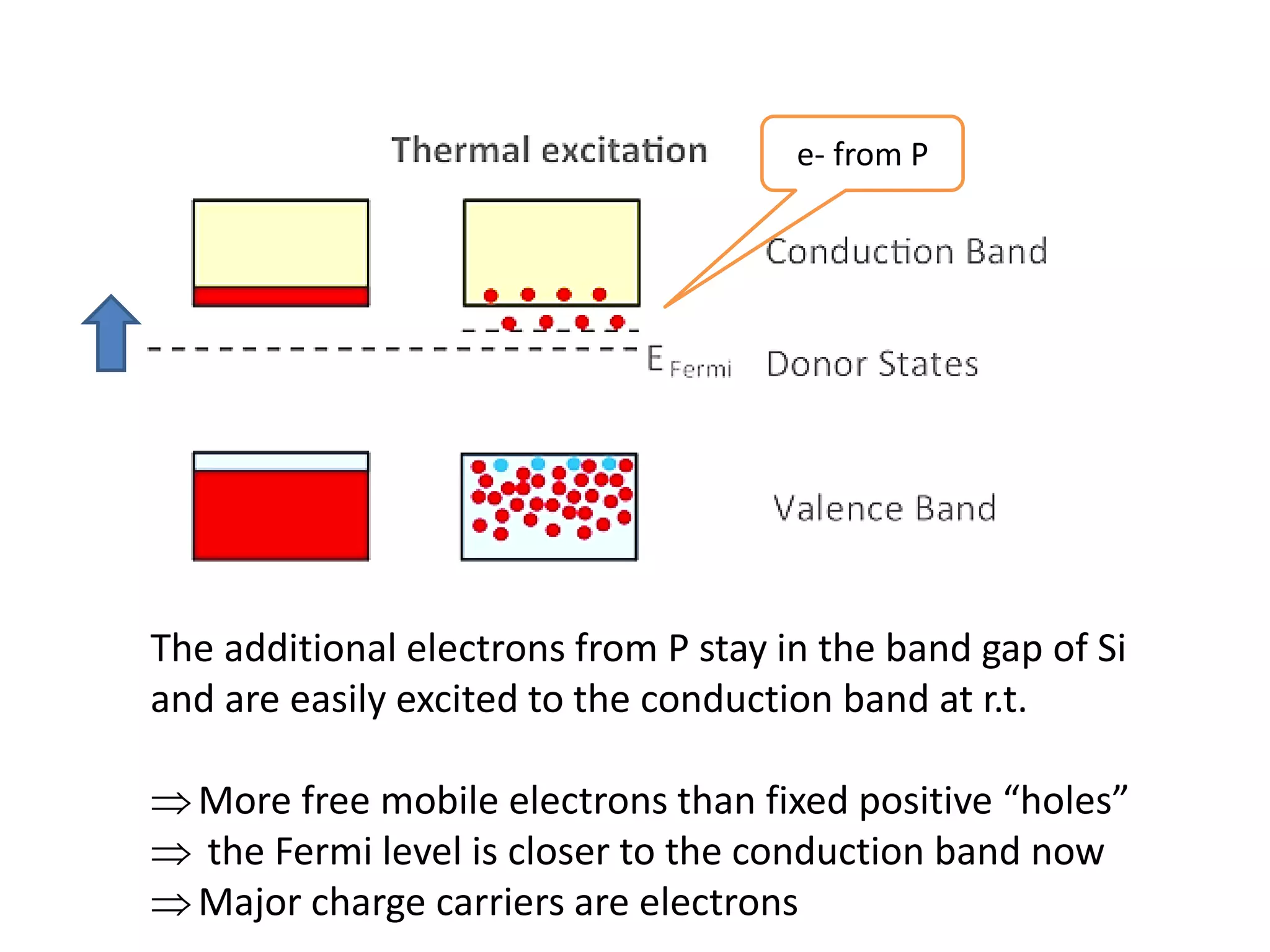
e- from P
The additional electrons from P stay in the band gap of Si
and are easily excited to the conduction band at r.t.
More free mobile electrons than fixed positive “holes”
 the Fermi level is closer to the conduction band now
Major charge carriers are electrons
p-doping
Element like B with only 3 electrons
In one bond 1 electron is missing
Instead of an electron moving around,
the positive charge (“hole”) of this
bond moves around, leaving behind
negative charged B anions
https://www.youtube.com/watch?v=XK0pMVwI7Ig
p(ositive)-doping
The B atoms create electron-acceptor states which are below the Fermi
Energy. Now it is easy for electrons from the valence band to go into this
acceptor state.
 We create mobile positive holes in the valence band
 Major charge carriers are the holes
Summary
https://chem.libretexts.org/Textbook_Maps/General_Chemistry_Textbook_Maps/M
ap%3A_Chem1_(Lower)/09._Chemical_Bonding_and_Molecular_Structure/9.11%3A
_Bonding_in_Semiconductors
Example:
https://is.muni.cz/el/1431/podzim2017/C7780/um/L4_band_theory.pdf
LED
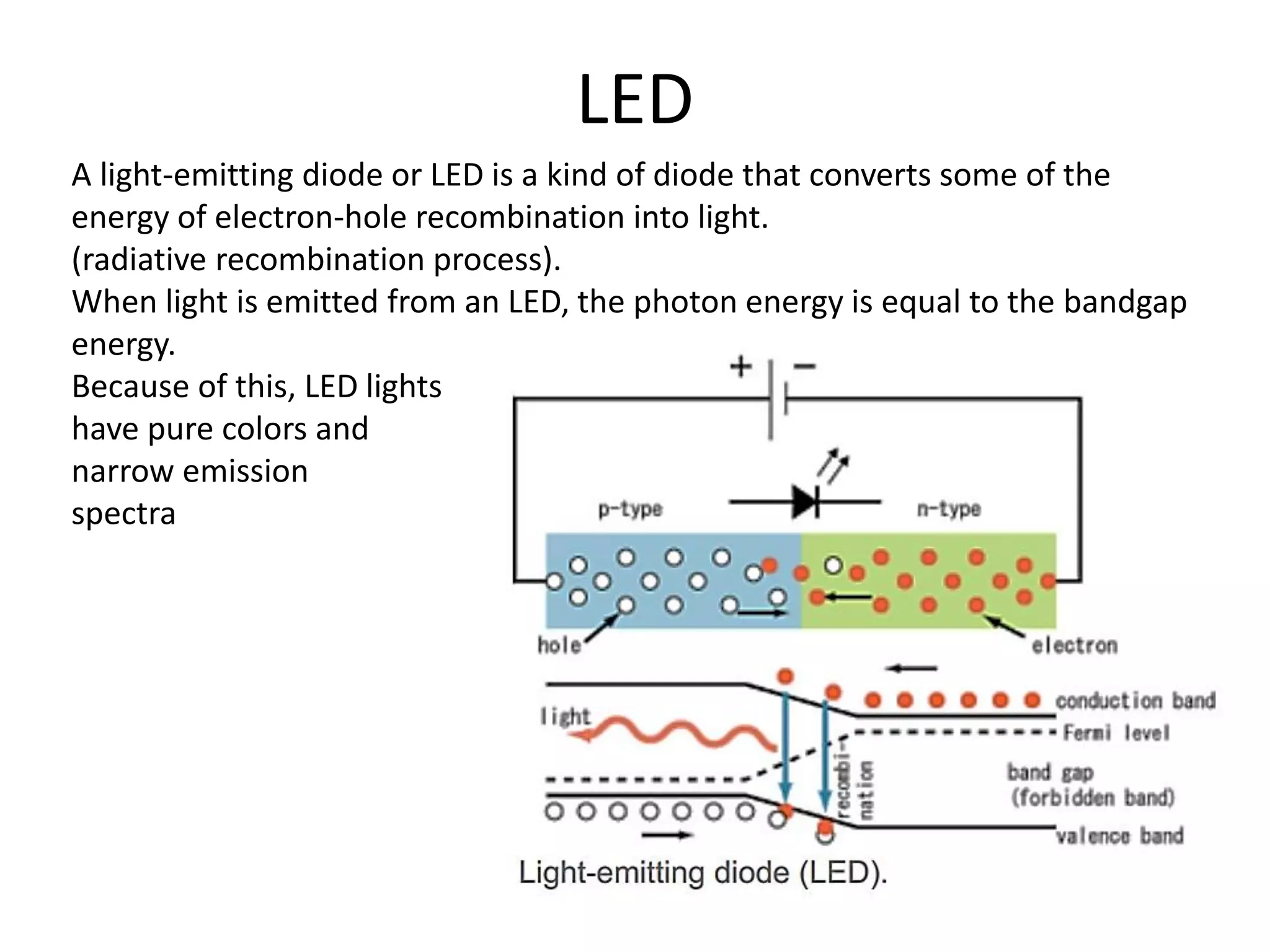
A light-emitting diode or LED is a kind of diode that converts some of the
energy of electron-hole recombination into light.
(radiative recombination process).
When light is emitted from an LED, the photon energy is equal to the bandgap
energy.
Because of this, LED lights
have pure colors and
narrow emission
spectra
RELATION MO DIAGRAM - BANDS
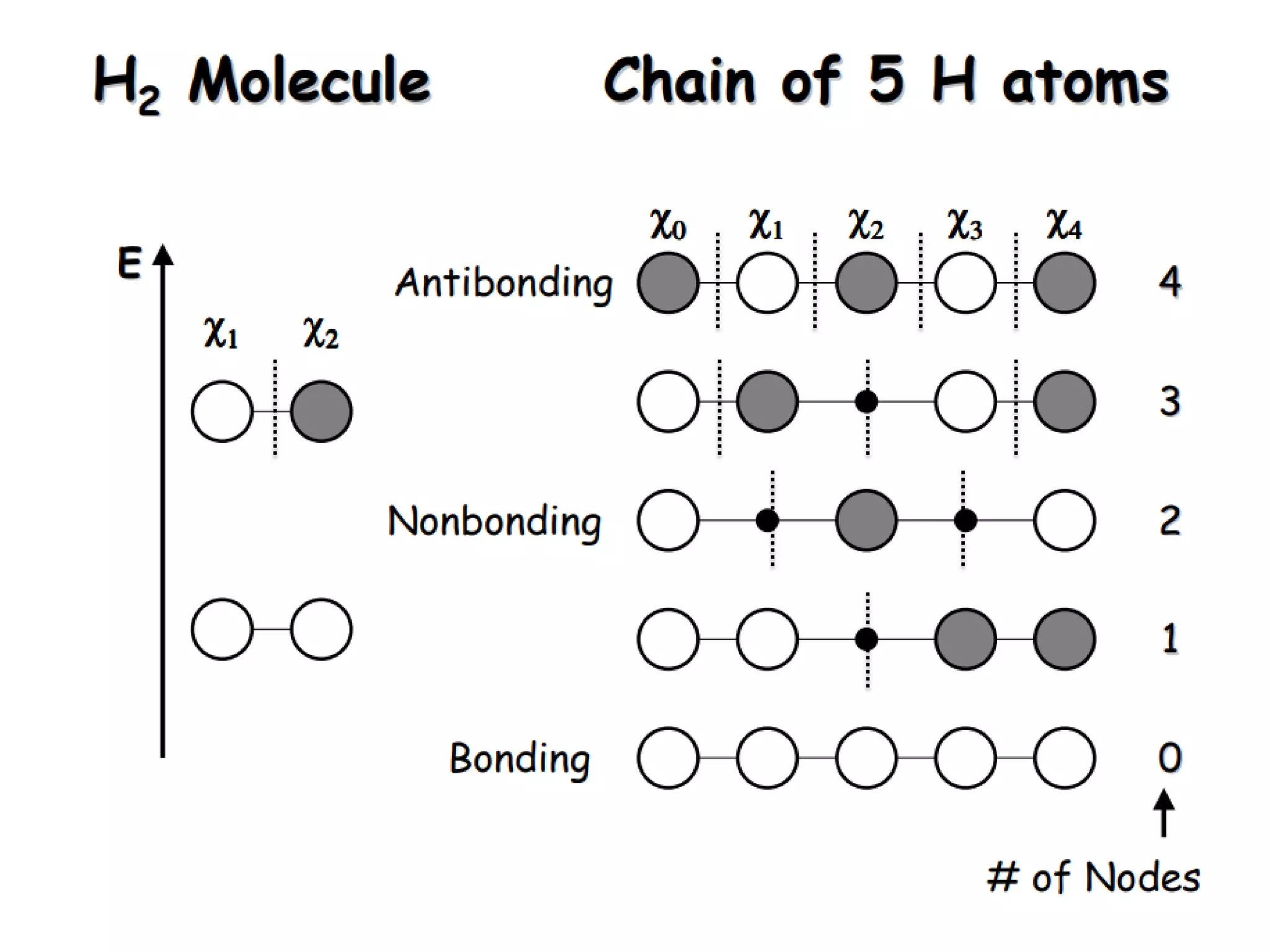
Extend MO theory
Simple model: a string of 5 H-atoms
2 H-atoms can be
combined
to form 2 orbitals,
with no node and
with 1 node
For 5 H atoms we get 5 combinations
with 0, 1, 2, 3 and 4 nodes
Nodes:
0
1
2
3
4
Draw the missing 4 MO’s for H5
And find if they are :
bonding, non-bonding or
anti-bonding
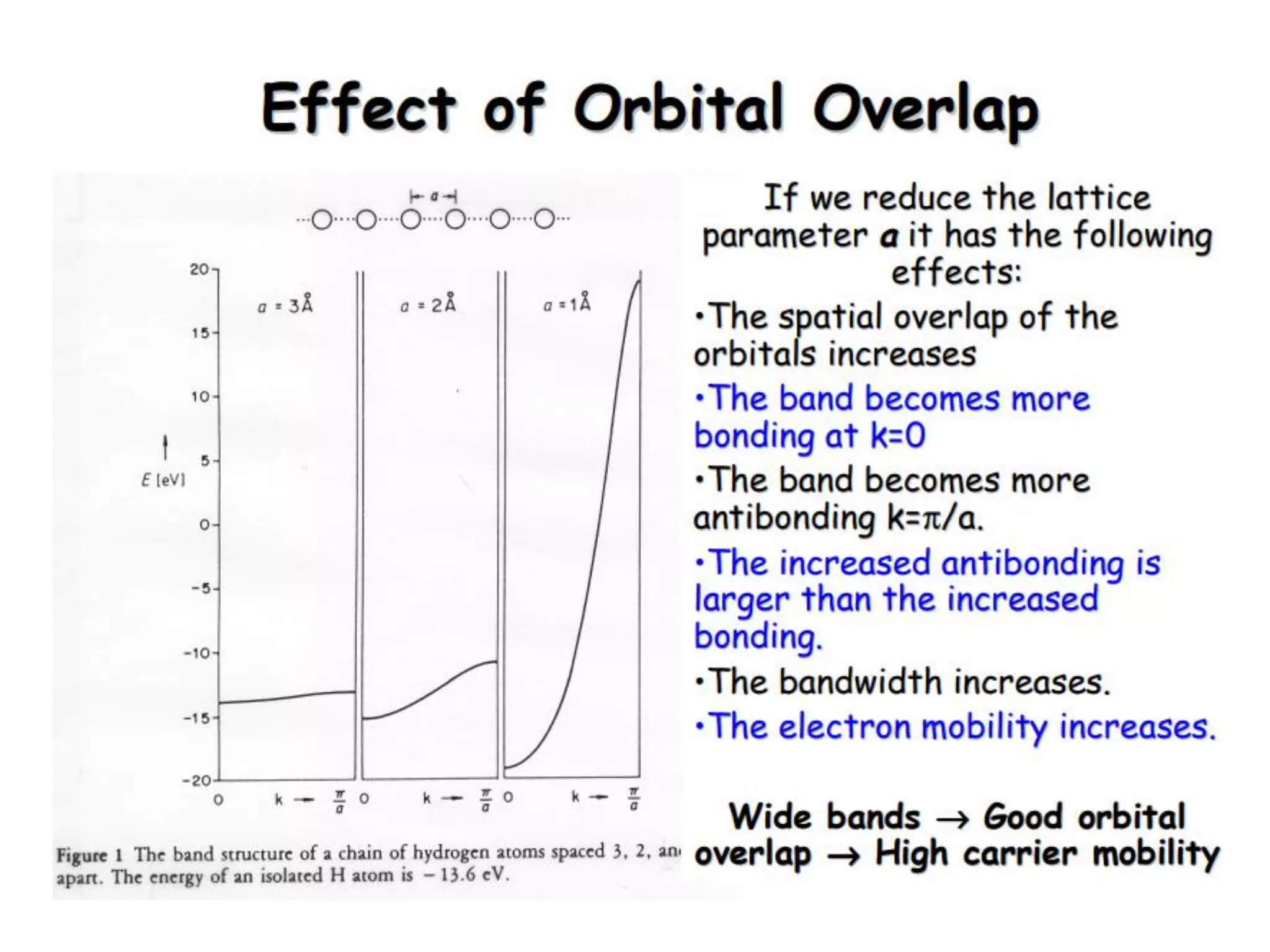
Vector k
We can define a wavenumber for the
electrons that move in a crystal:
k = 2π/λ = 2πp/h
k is proportional to the number of the
nodes n in a molecular orbital
In a linear system with N unit cells
separated by distance a:
(MO with n nodes) λ = 2 Na/n
and k = π n / Na
At the bottom of a bond with λ = infinite: k = 0
and at the top of band with the MO having N nodes: k = π/a and λ = 2a
https://en.wikibooks.org/wiki/Introduction_to_Inorganic_Chemistry/Metals_and_Alloys:_
Structure,_Bonding,_Electronic_and_Magnetic_Properties
H2 in unit cell
Unit cell
with 2 el
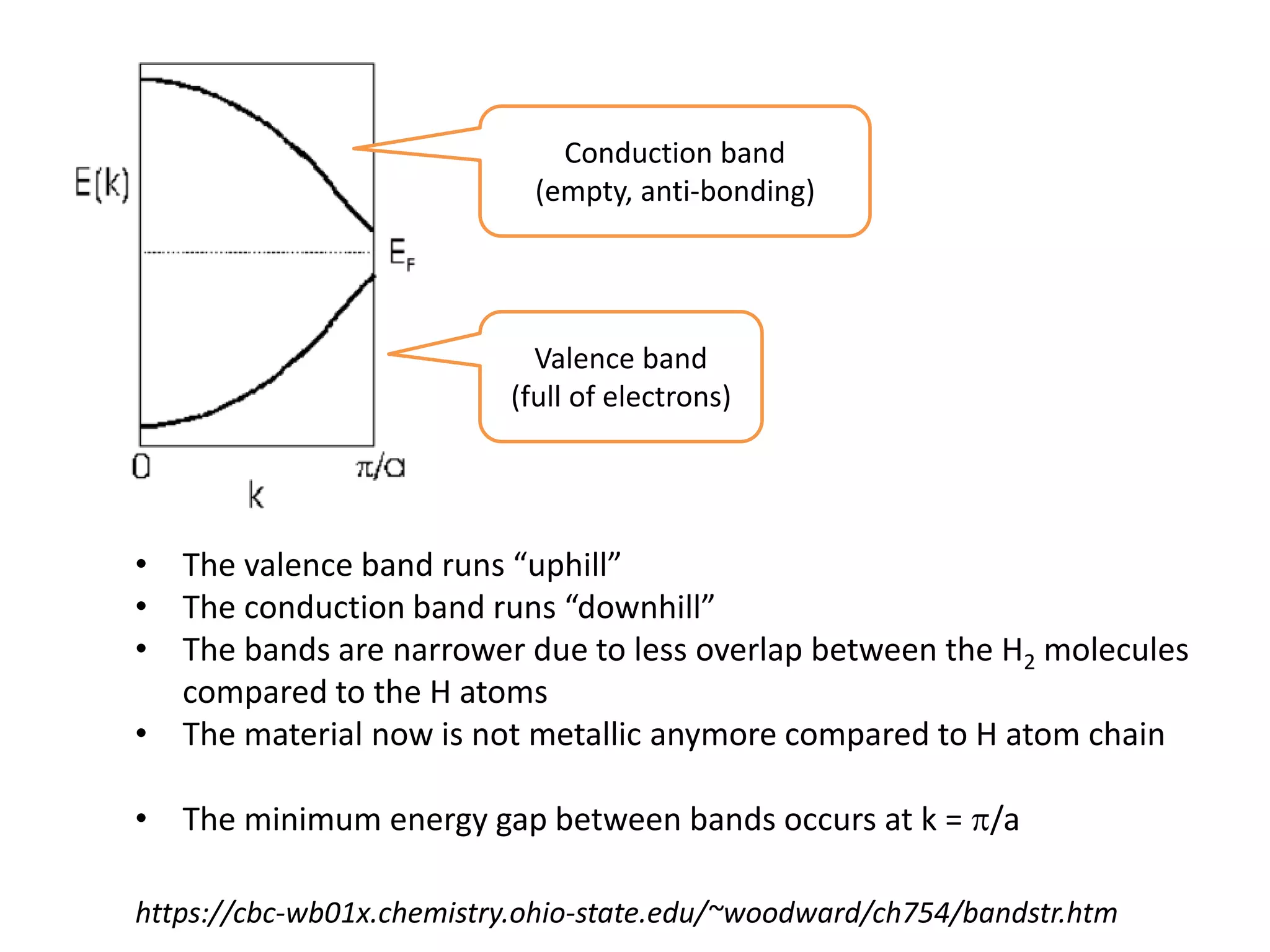
• The valence band runs “uphill”
• The conduction band runs “downhill”
• The bands are narrower due to less overlap between the H2 molecules
compared to the H atoms
• The material now is not metallic anymore compared to H atom chain
• The minimum energy gap between bands occurs at k = /a
Valence band
(full of electrons)
Conduction band
(empty, anti-bonding)
https://cbc-wb01x.chemistry.ohio-state.edu/~woodward/ch754/bandstr.htm
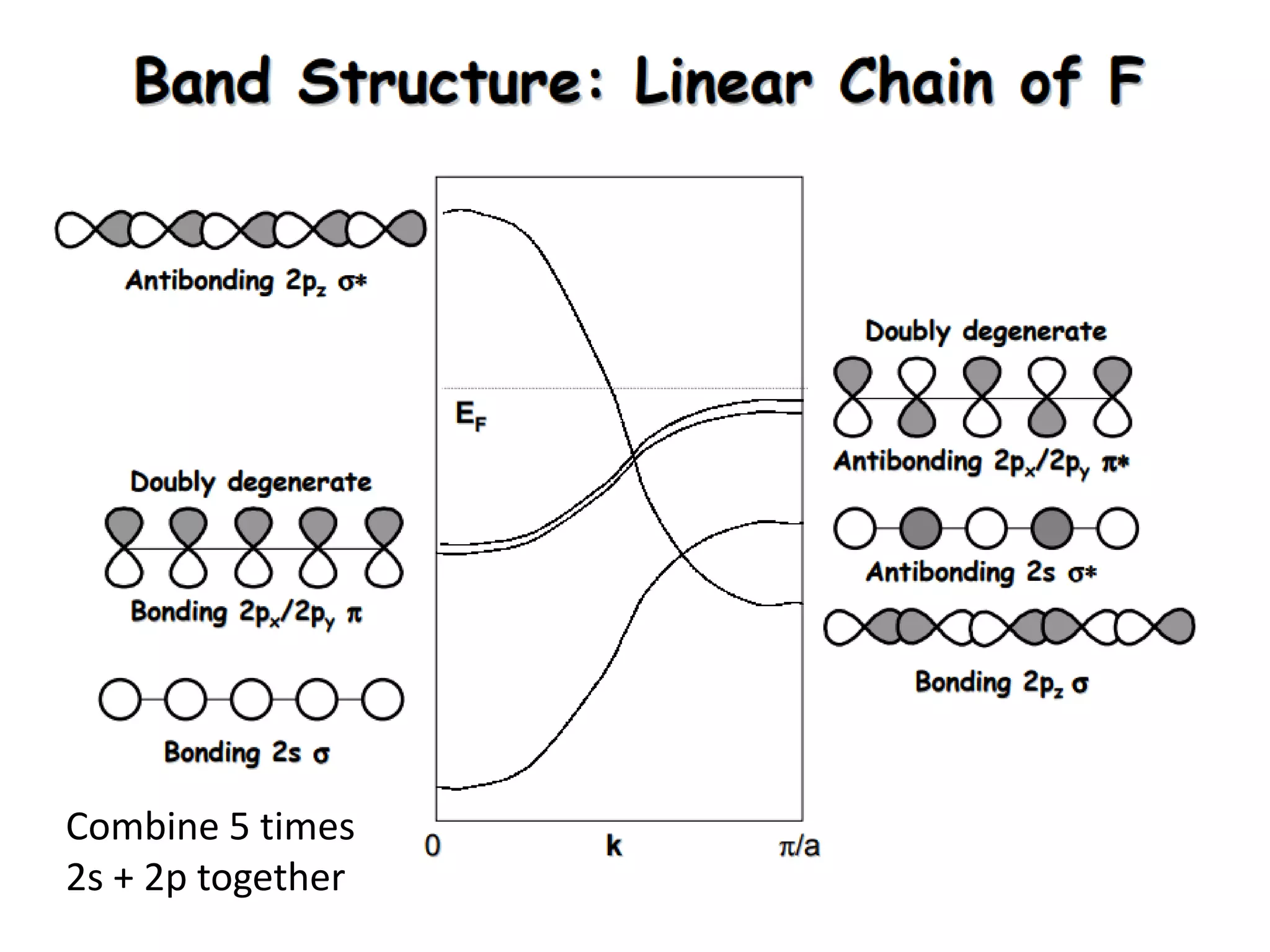
Combine 5 times
2s + 2p together
DOS – Density 0f States
The density of states is defined as the number of orbitals per unit of energy
within a band.
Because of the parabolic relation between E and k, the density of states for
a 1D metallic crystal is highest near the bottom and top of the energy band
where the slope of the E vs. k curve is closest to zero.
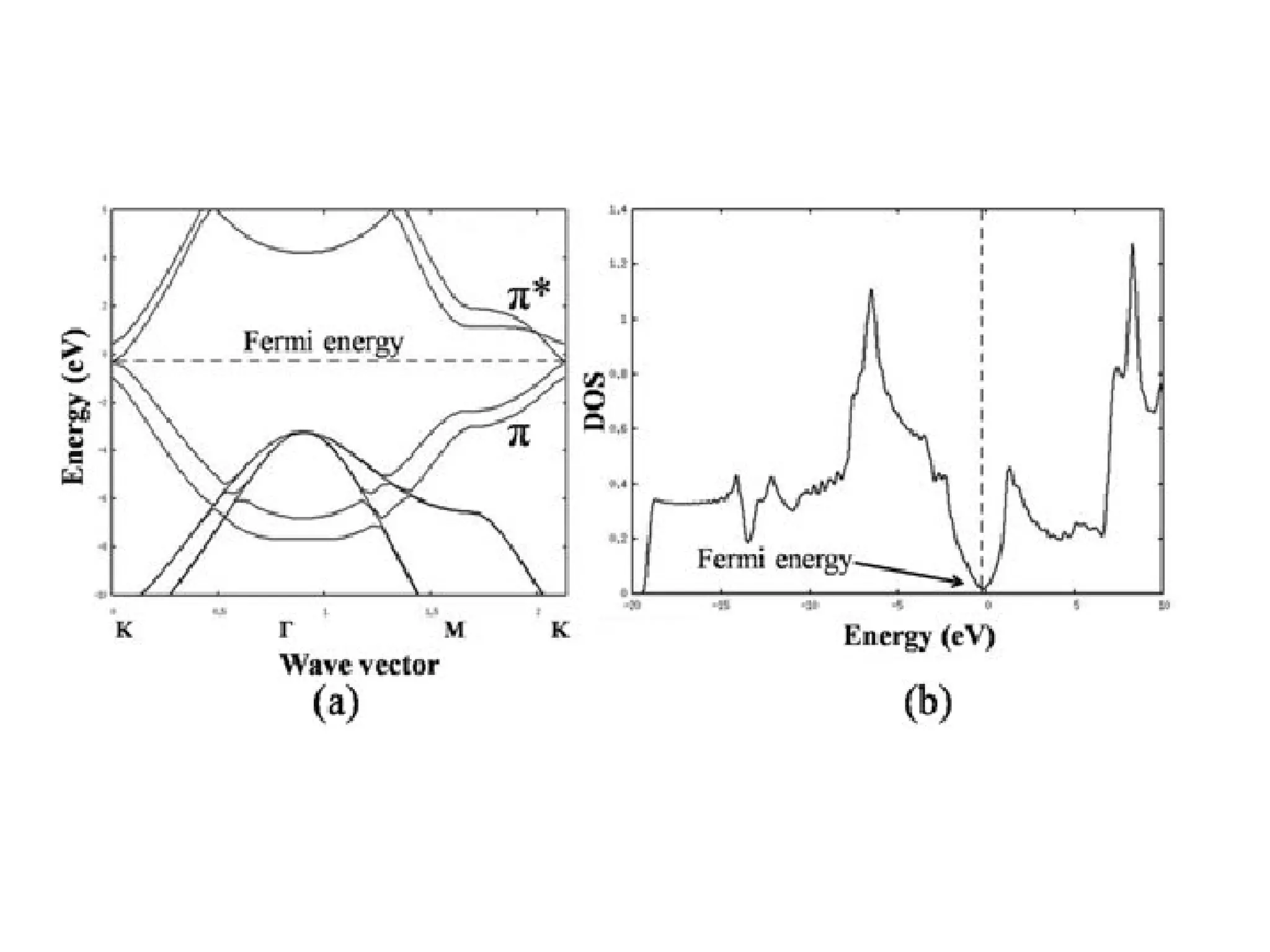
Compare Graphite - Diamond
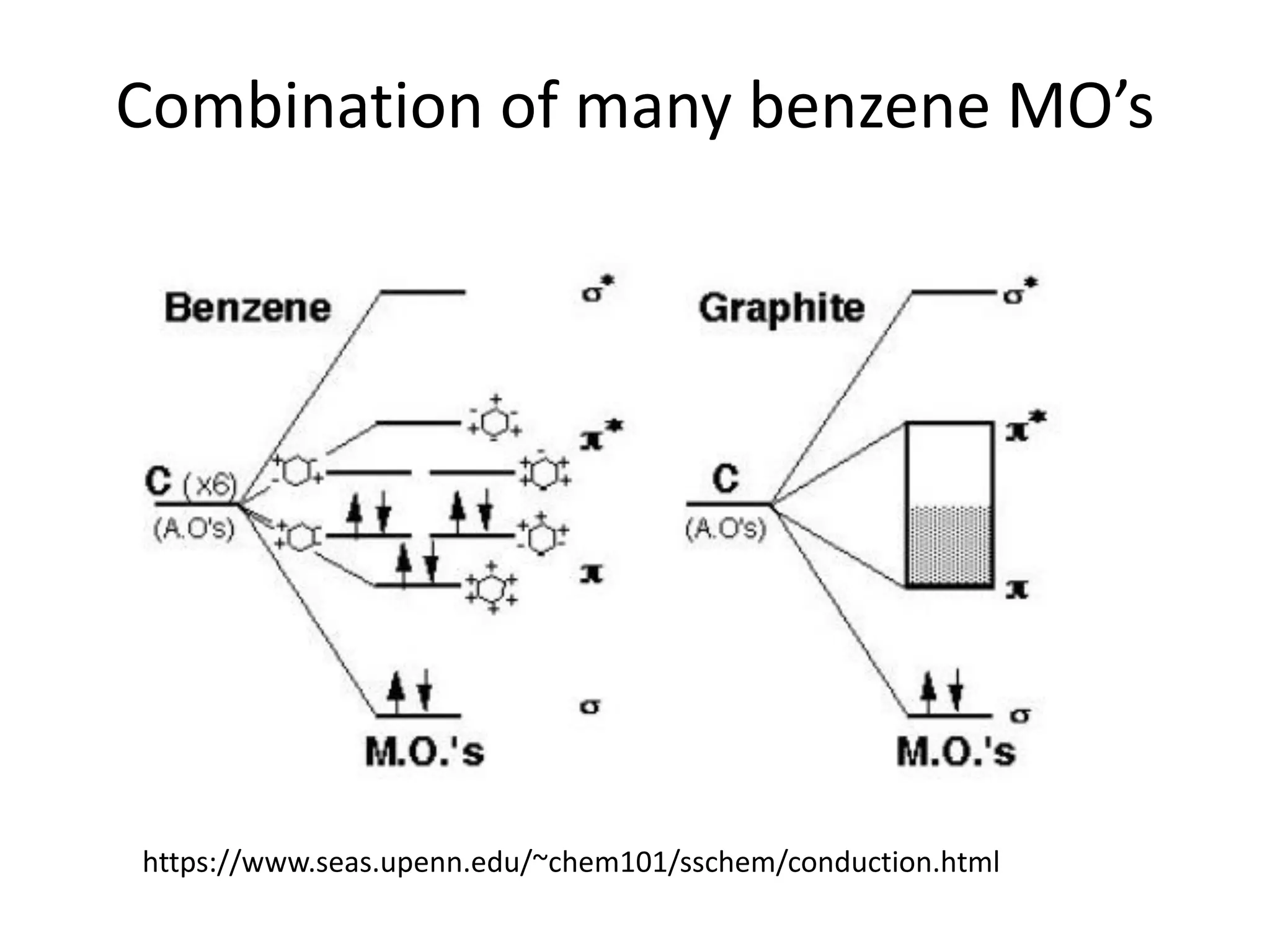
Graphite similar to benzene
Combination of many benzene MO’s
https://www.seas.upenn.edu/~chem101/sschem/conduction.html
Diamond structure
only  bonds
https://www.seas.upenn.edu/~chem101/sschem/conduction.html
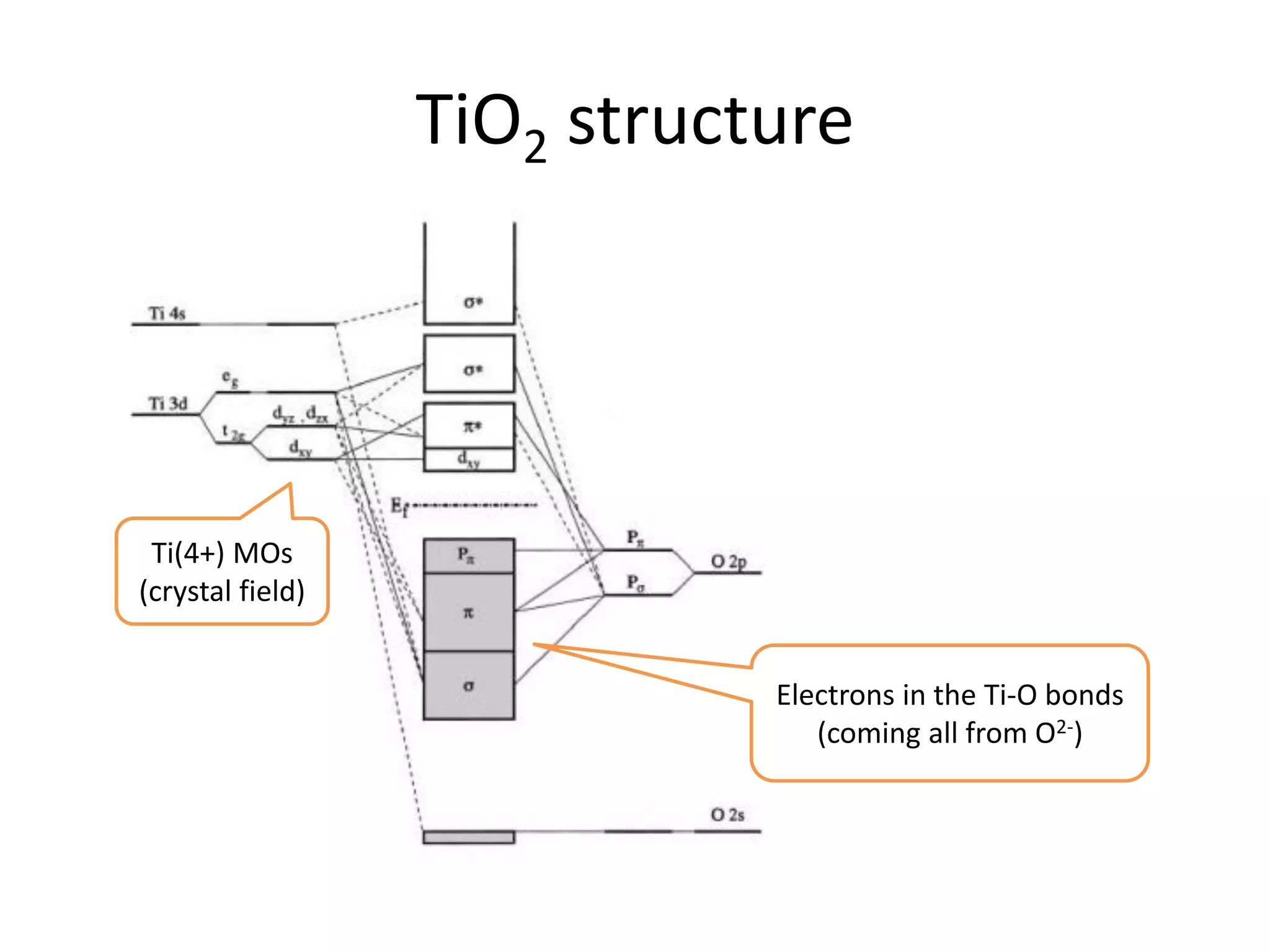
TiO2 structure
Ti(4+) MOs
(crystal field)
Electrons in the Ti-O bonds
(coming all from O2-)
https://cbc-wb01x.chemistry.ohio-
state.edu/~woodward/ch754/lect2003/bandstr1_lect17.pdf
Photocatalysis TiO2
Light energy promotes electrons in antibonding orbitals,
leaving a positive charged “hole” in the lower orbitals
TM OXIDES
Rocksalt Structure
Metal monoxides MO
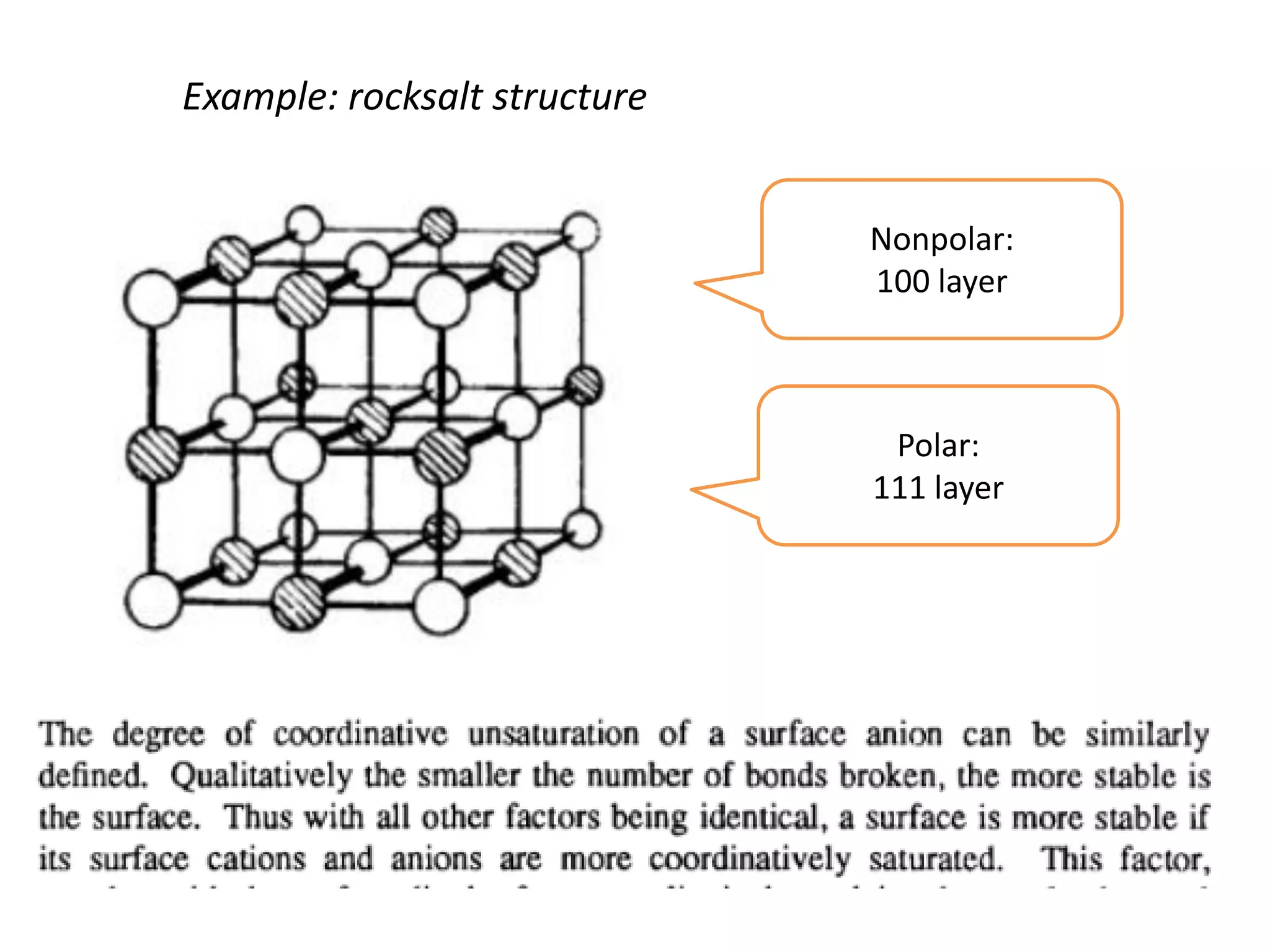
Example: rocksalt structure
Nonpolar:
100 layer
Polar:
111 layer
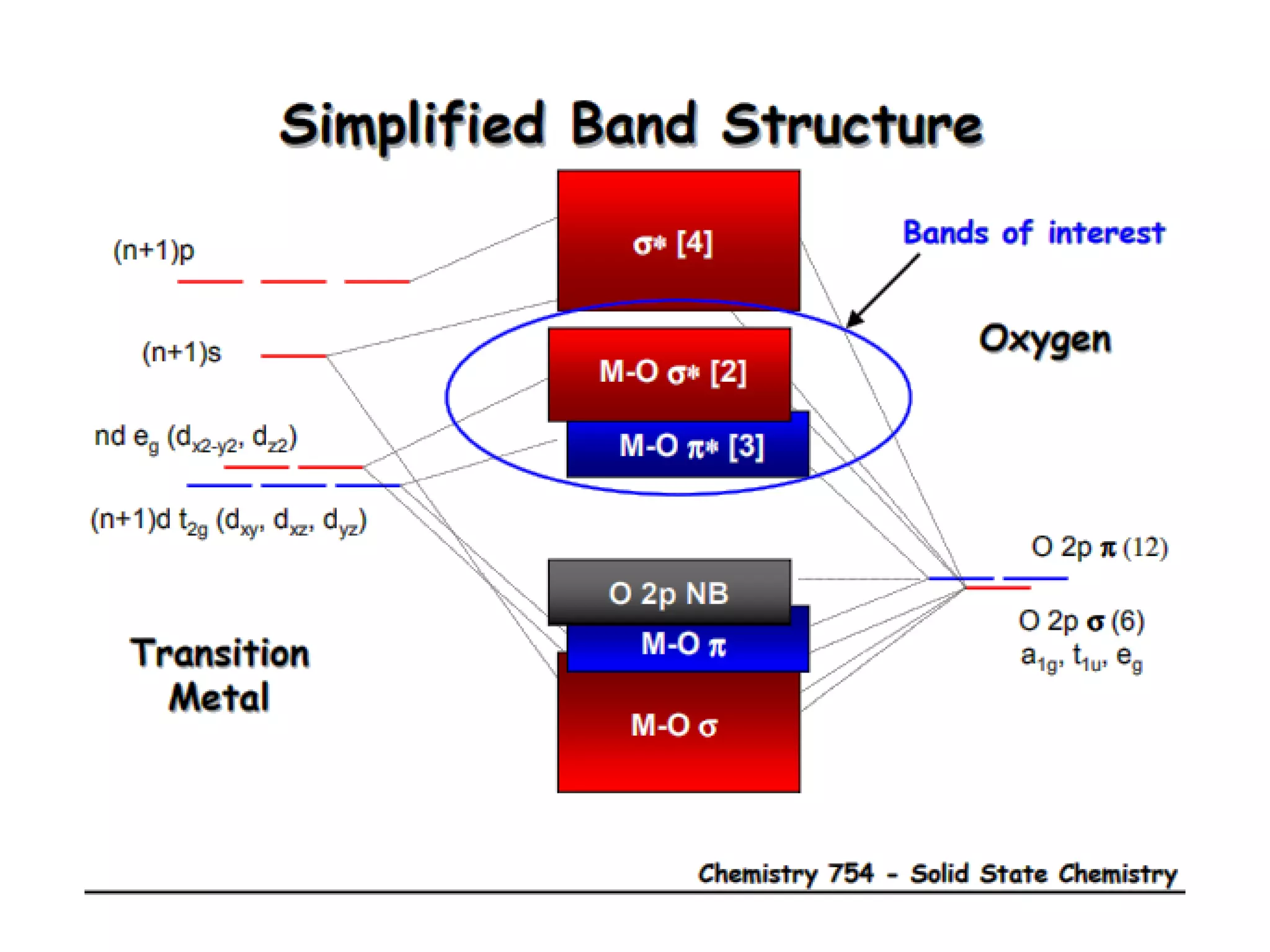
M-O *
M-O *
Perovskite Structure ABO3
https://cbc-wb01x.chemistry.ohio-
state.edu/~woodward/ch754/lect2003/perovskites_lect24.pdf
Example CaMnO3
Fill the electrons for CaMnO3 into this diagram
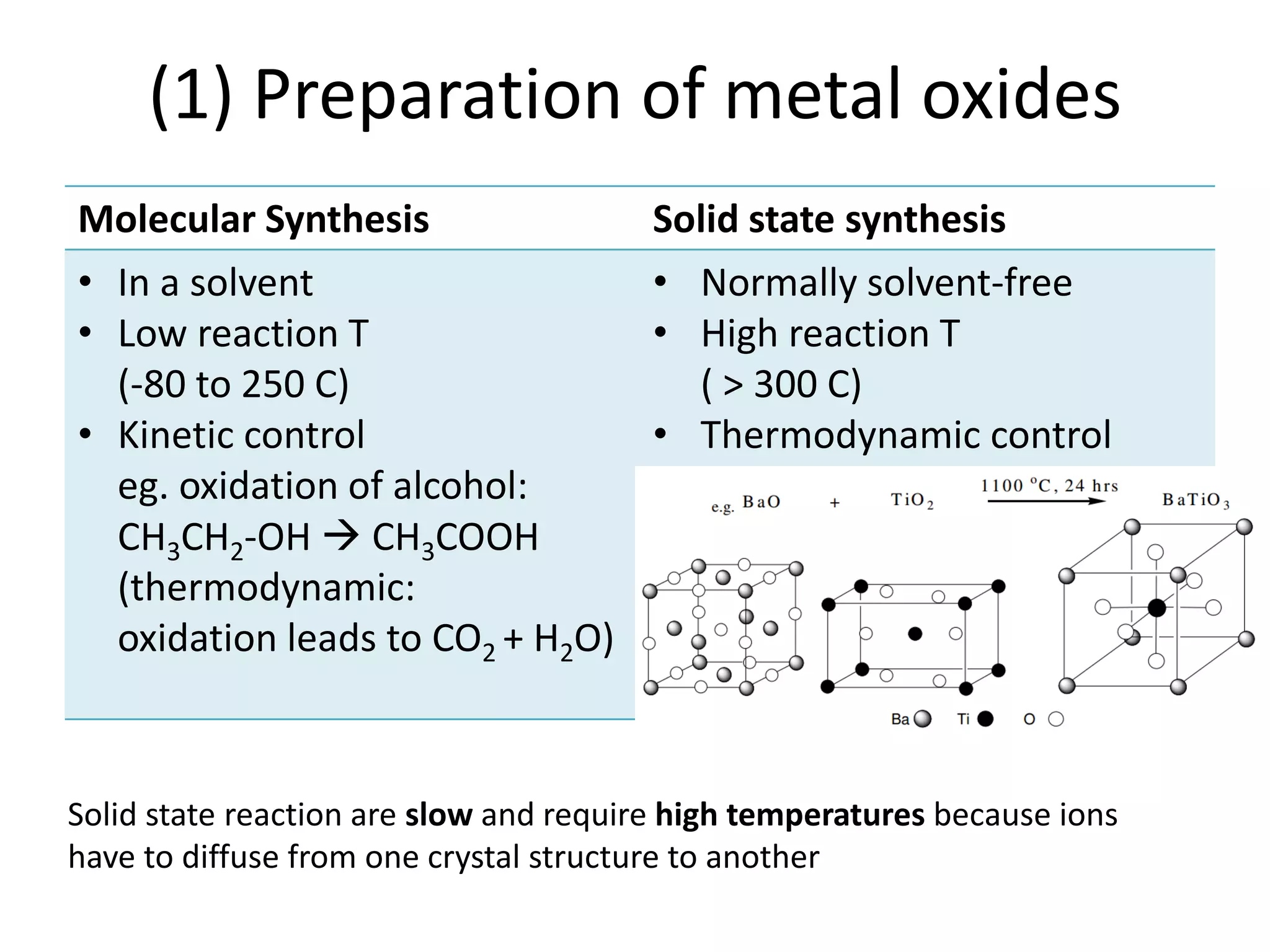
(1) Preparation of metal oxides
Molecular Synthesis Solid state synthesis
• In a solvent
• Low reaction T
(-80 to 250 C)
• Kinetic control
eg. oxidation of alcohol:
CH3CH2-OH  CH3COOH
(thermodynamic:
oxidation leads to CO2 + H2O)
• Normally solvent-free
• High reaction T
( > 300 C)
• Thermodynamic control
Solid state reaction are slow and require high temperatures because ions
have to diffuse from one crystal structure to another
Liquid to solid preparation – hydrothermal methods
Similar to reaction – crystallization methods in molecular reactions:
The zeolites framework is made up of SiO2 tetrahedra with the occasional
substitution of Al for Si. To compensate the charge difference (Si(+4), Al(+3))
sodium cations are accommodated on the inner surface of the framework.
Modification of solids by ion exchange or intercalatation
The existence of complex oxide phases that demonstrate good ionic
conductivity associated with the ability to vary the oxidation state of a
d-metal ion has led to the development of materials for use as the
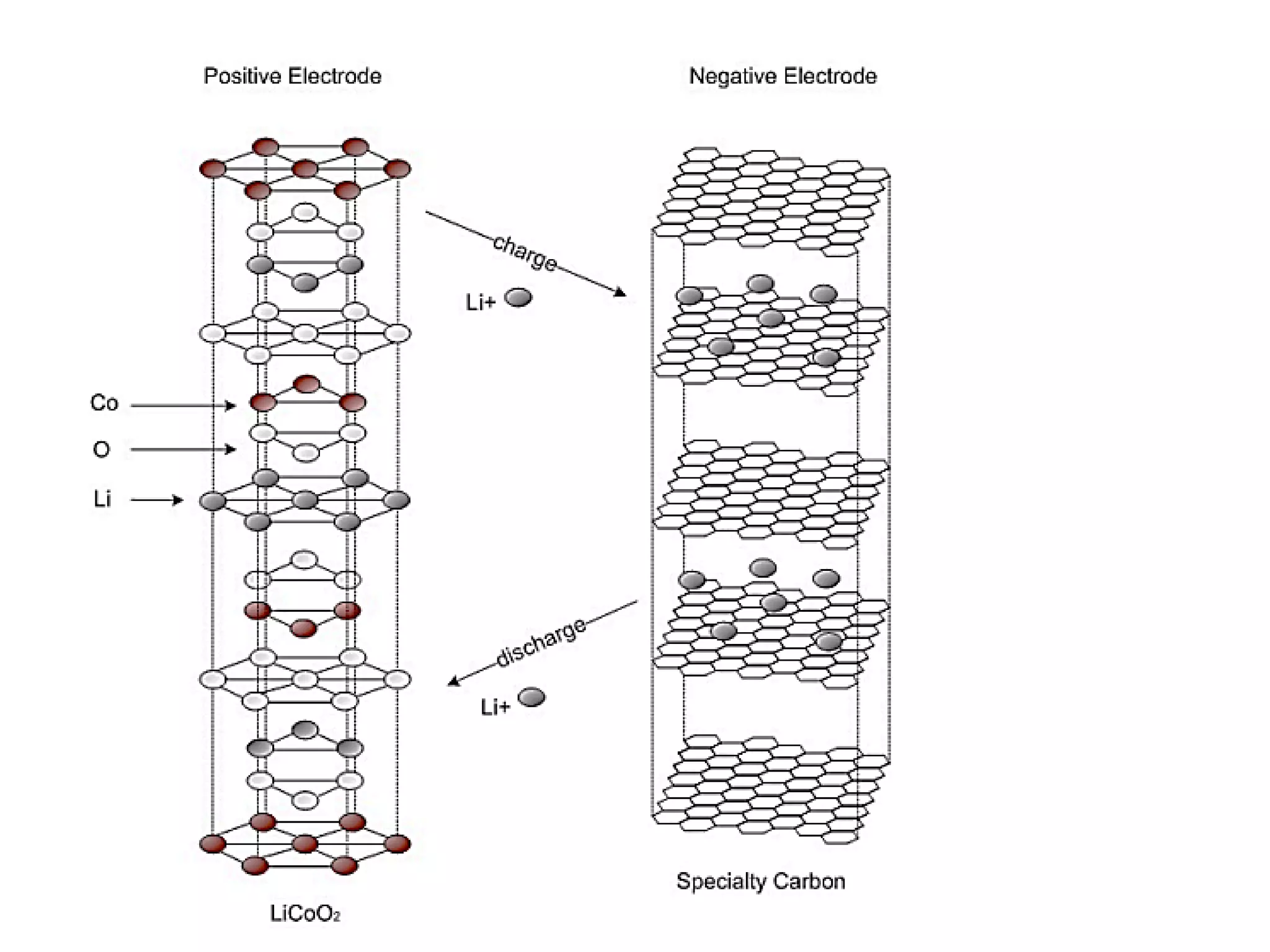
cathode in rechargeable batteries
Charging a battery happens by removing mobile Li(+)
ions:
LiCoO2  Li(+) + CoO2 + e(-)
(what is the ox.no. of Co in each case ?)
Discharging is the opposite effect.
For practical reasons, Li atoms are intercalated into
graphite:
Example Li-ion batteries
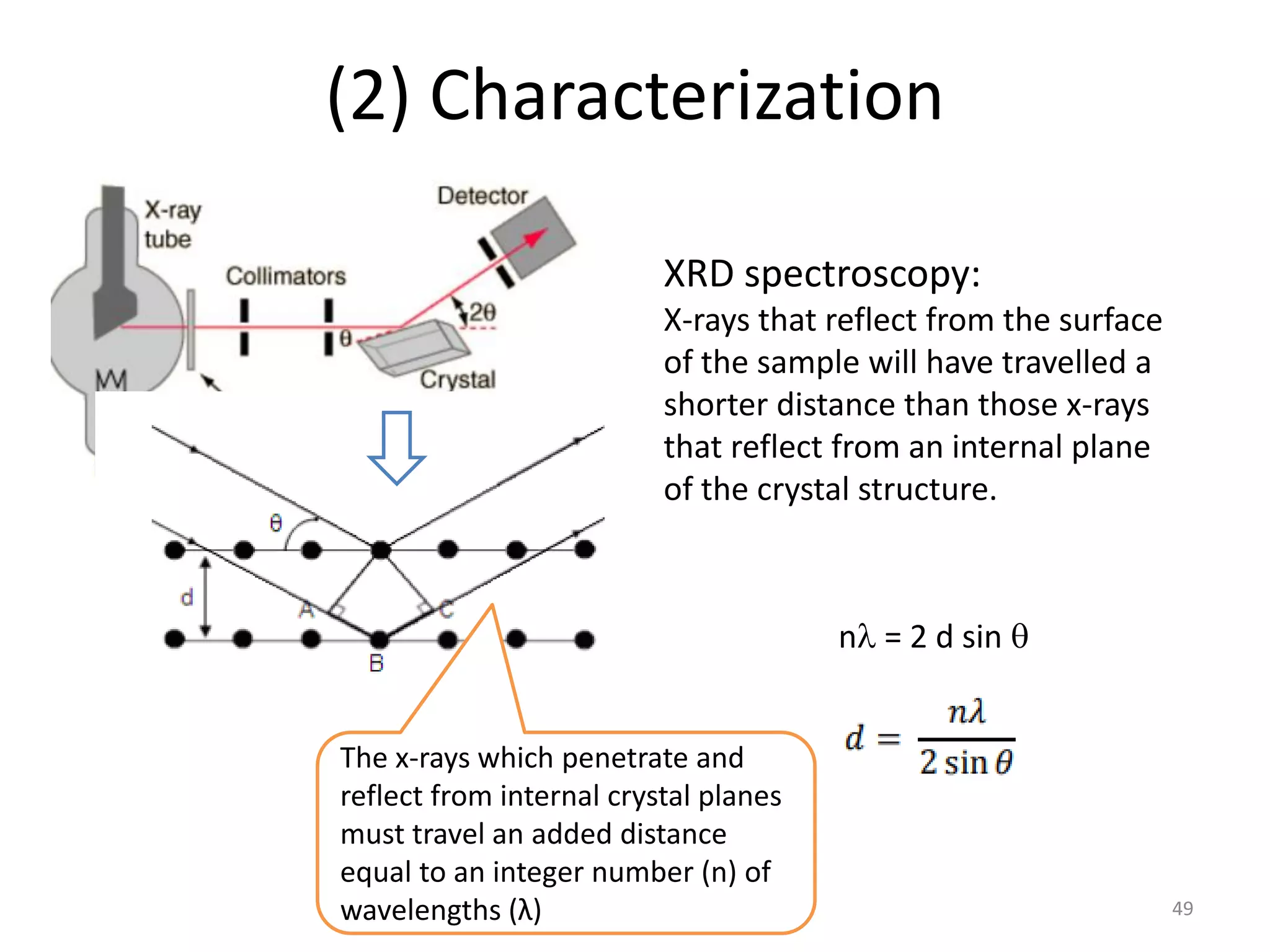
(2) Characterization
49
XRD spectroscopy:
X-rays that reflect from the surface
of the sample will have travelled a
shorter distance than those x-rays
that reflect from an internal plane
of the crystal structure.
The x-rays which penetrate and
reflect from internal crystal planes
must travel an added distance
equal to an integer number (n) of
wavelengths (λ)
n = 2 d sin 
50
Each crystal plane gives a signal in the spectrum
= “fingerprint” for a crystal substance
Estimate particle size from peak broadening 
and reflection angle 
Electron Microscopy
SEM TEM
= Scanning EM
• Record scattered electrons
• Scans the sample surface
• Produces 3D image indirectly
• Resolution 0.4 nm
= Transmission EM
• Record transmitted electrons
• Electrons goes through the sample
• Gives a 2D image directly
• Resolution 0.05 nm
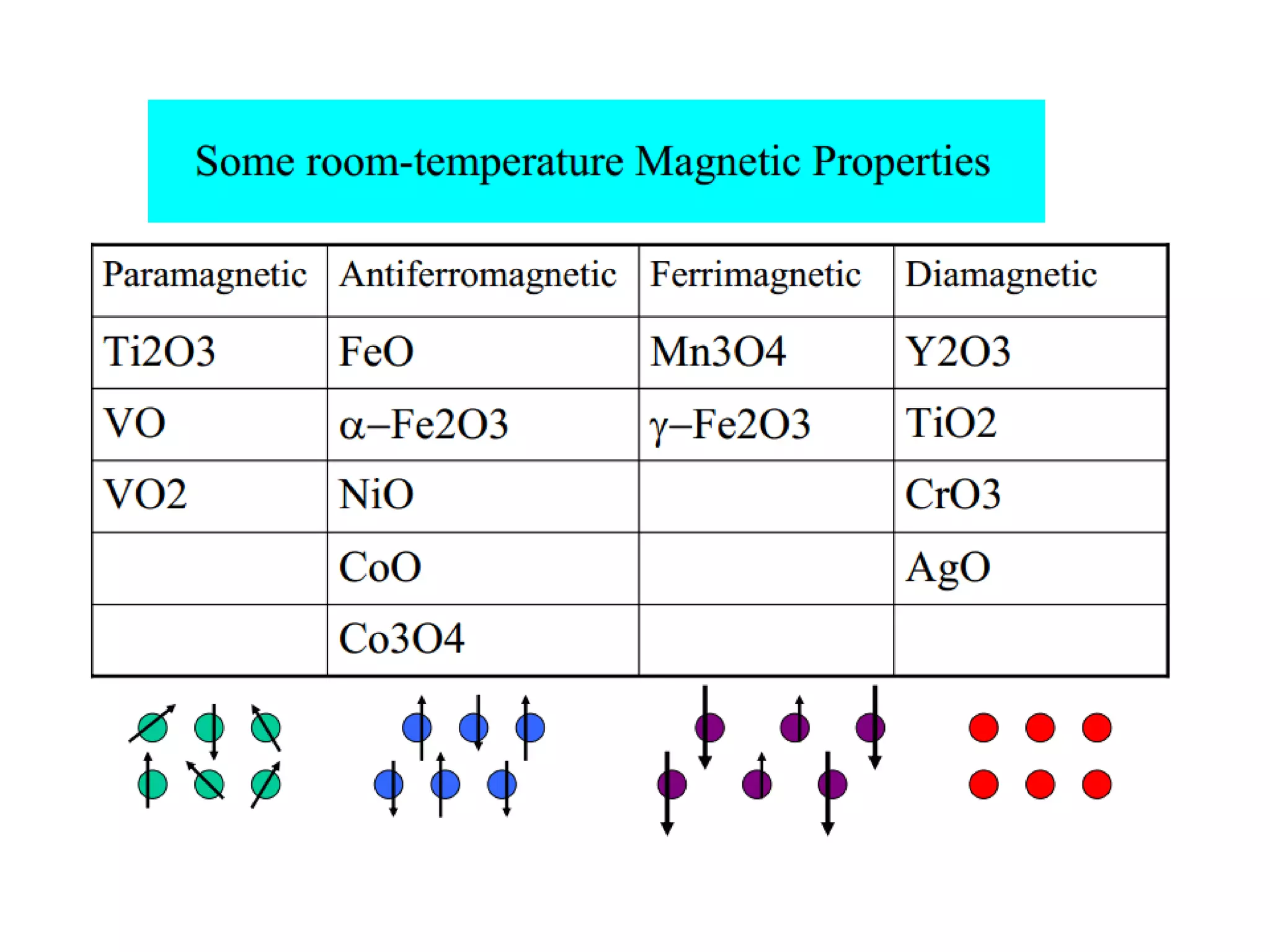
(3) Magnetic Properties
Above the Curie-Temperature, a ferromagnet
becomes paramagnetic
Paramagnetism
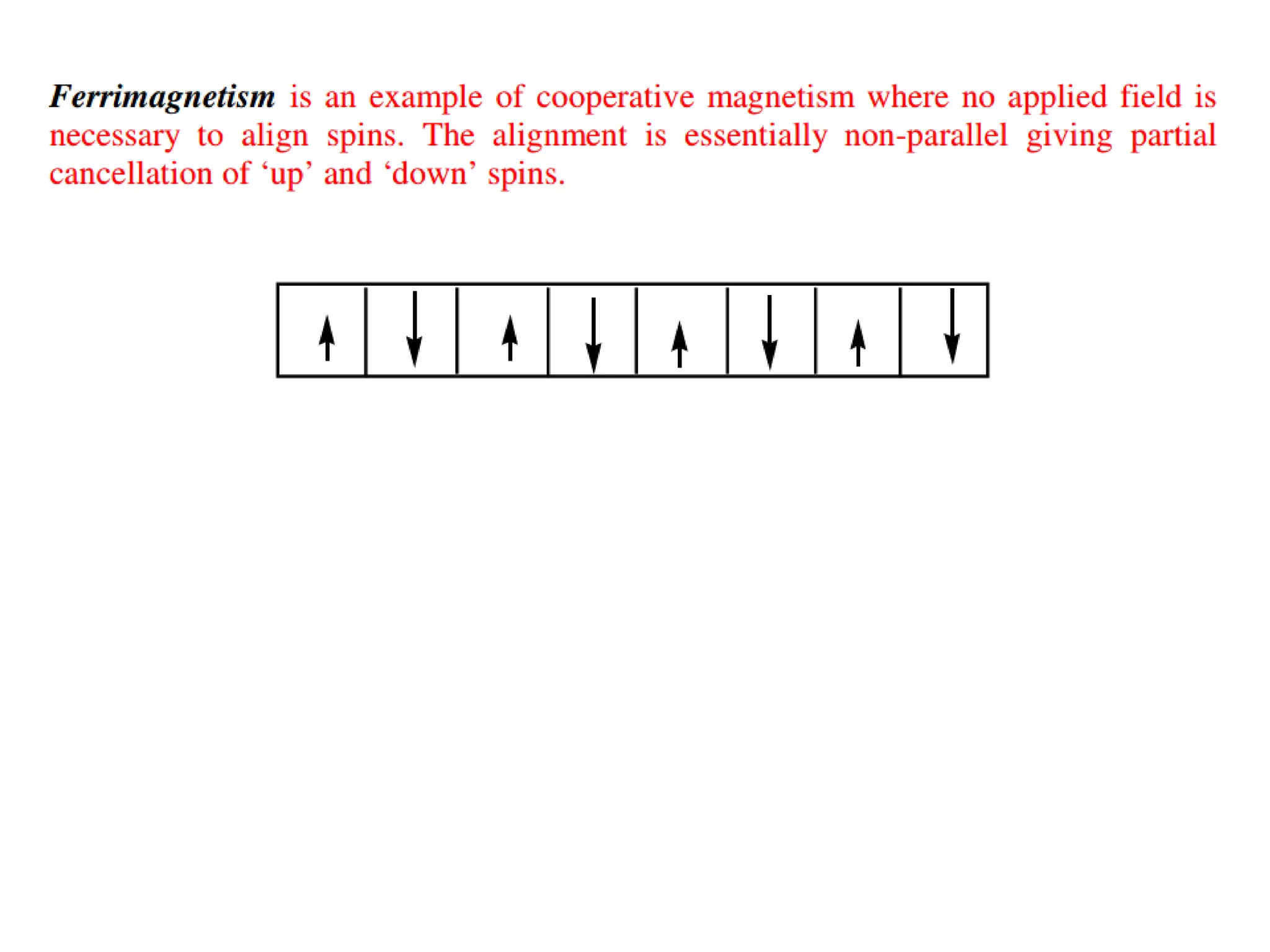
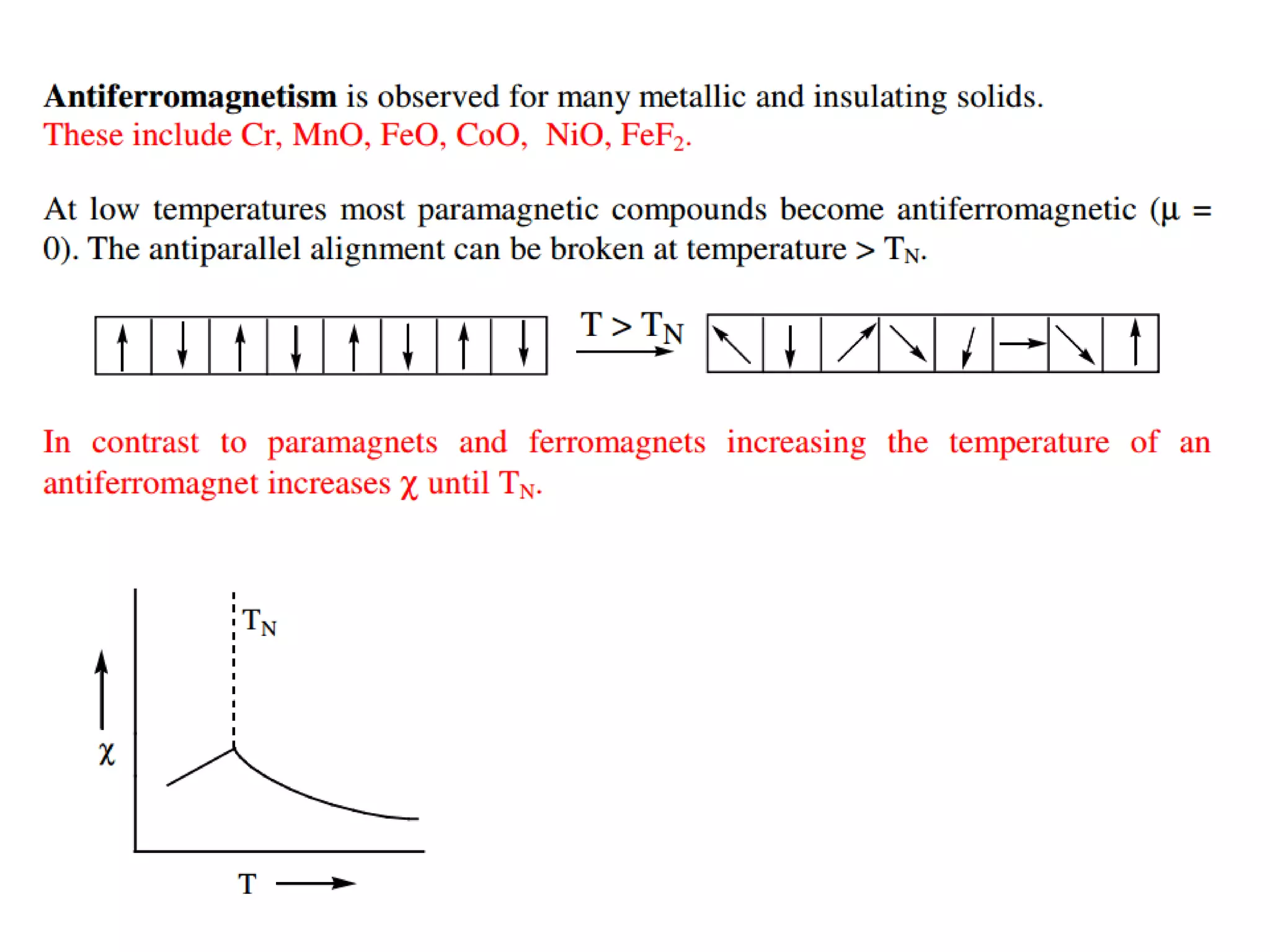
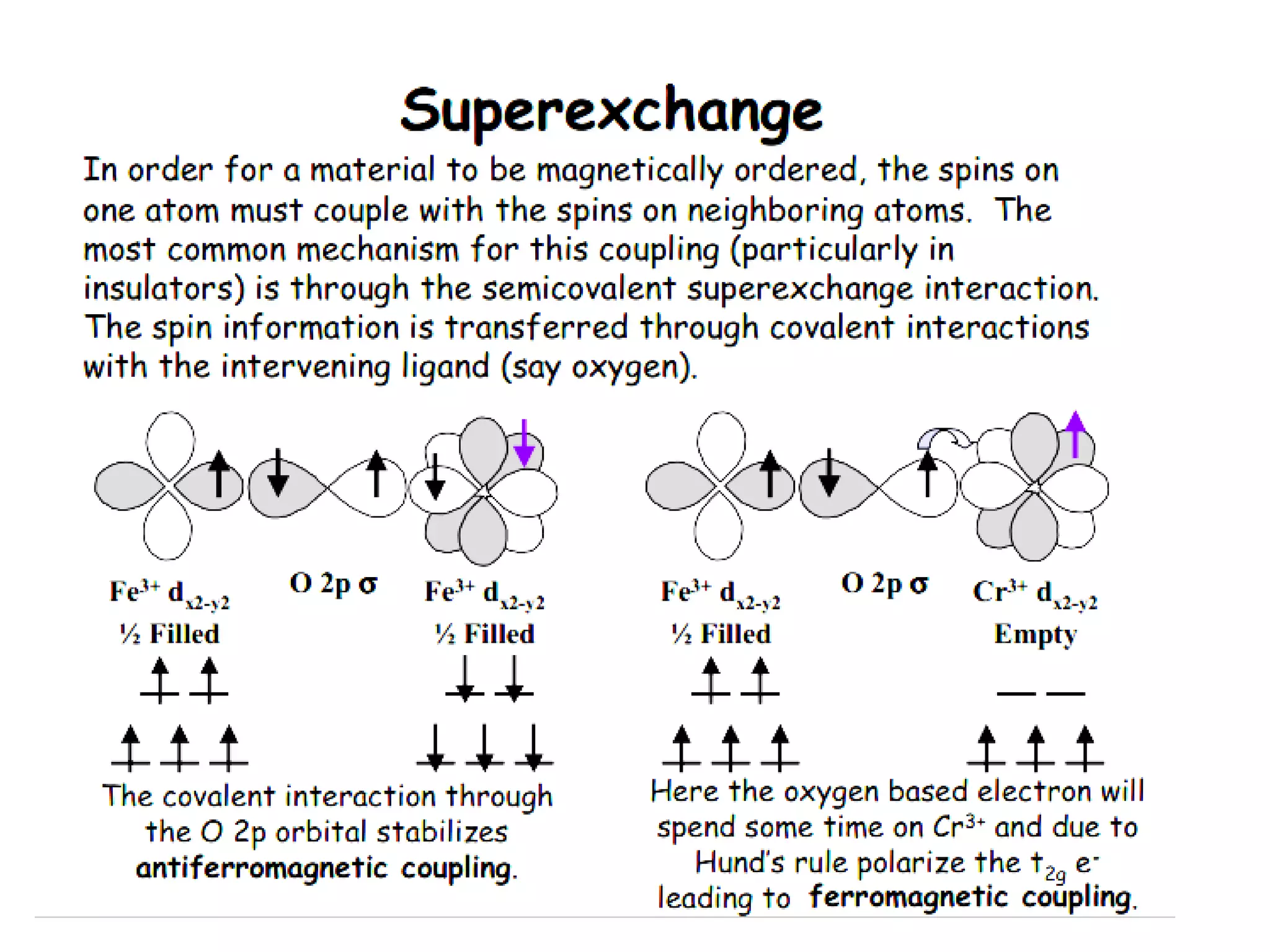
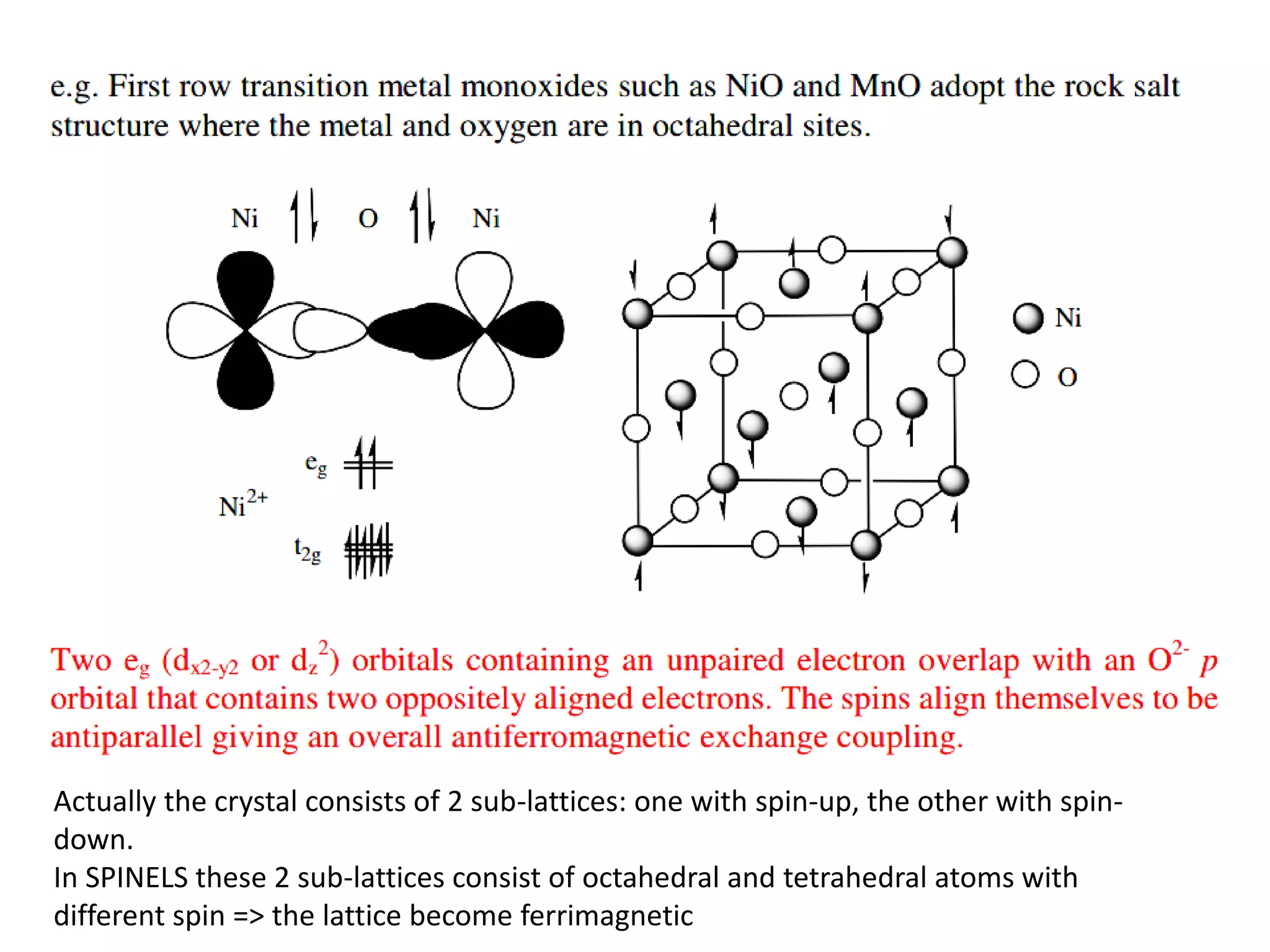
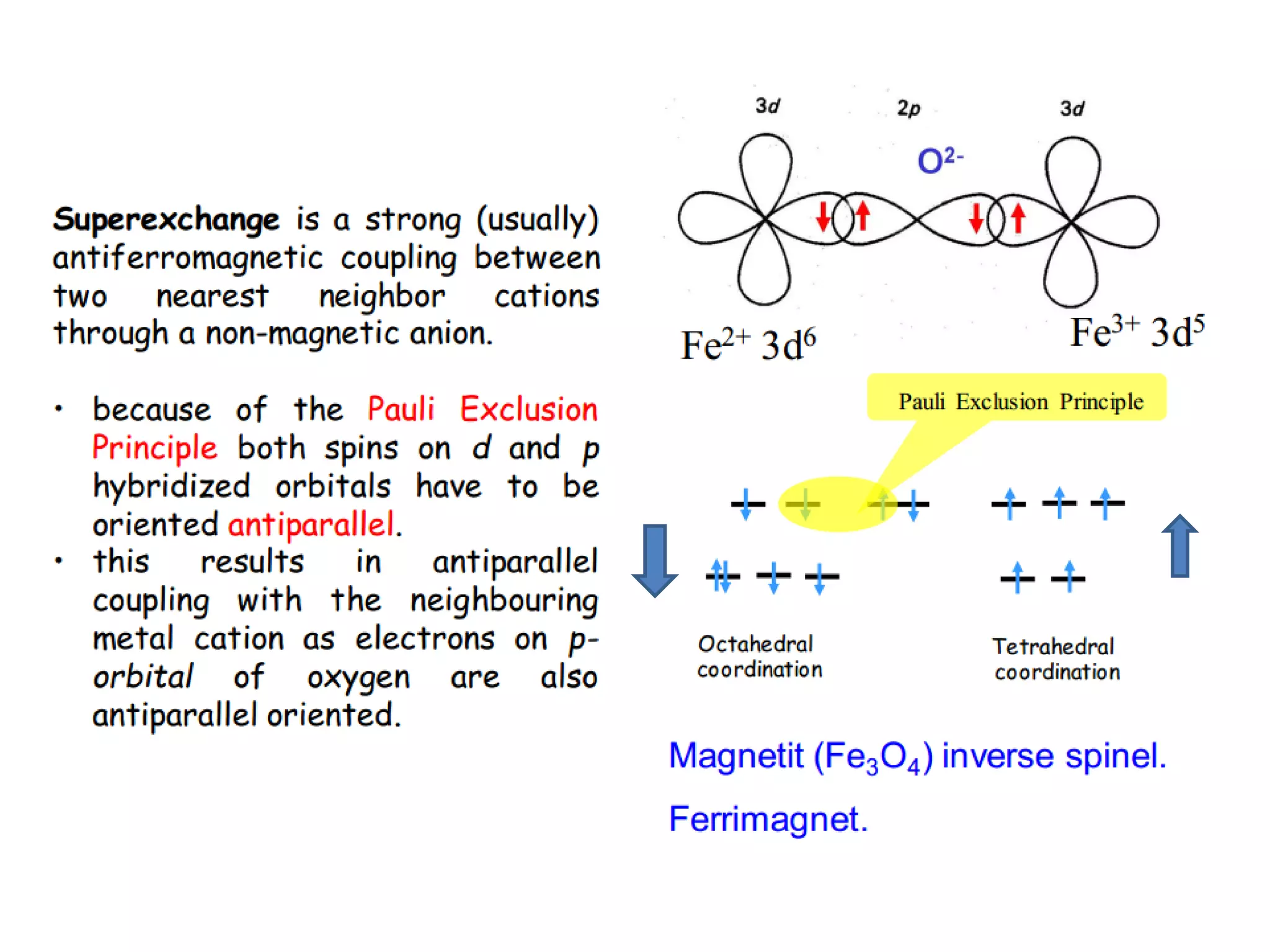
Actually the crystal consists of 2 sub-lattices: one with spin-up, the other with spin-
down.
In SPINELS these 2 sub-lattices consist of octahedral and tetrahedral atoms with
different spin => the lattice become ferrimagnetic
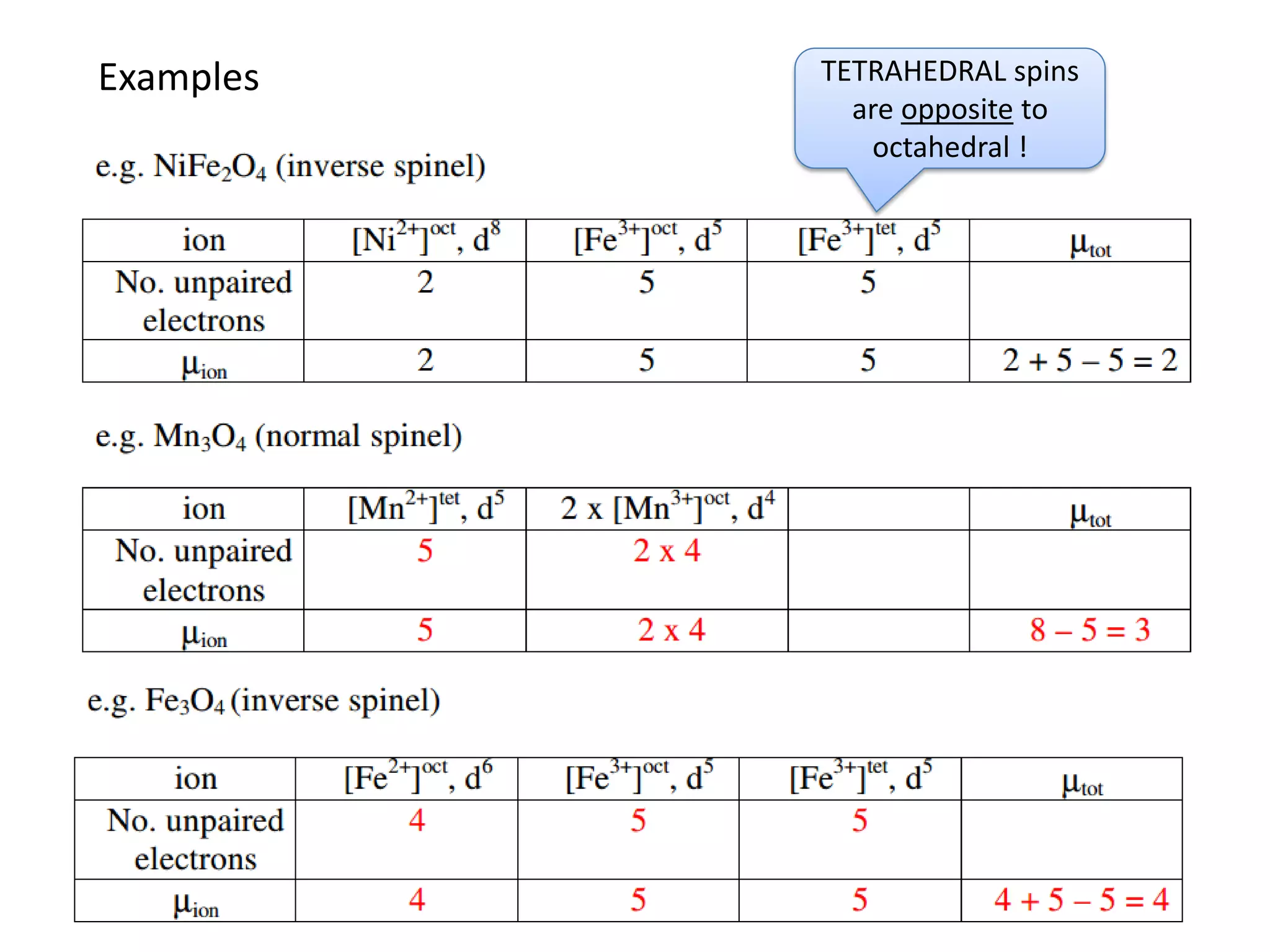
Estimate magnetic moments in ferrimagnetic Spinels AB2O4
Due to coupling between octahedral and between tetrahedral
atoms, magnetic moments are added and correspond to
  S in the sum
(instead of   S(S+1) )
Examples TETRAHEDRAL spins
are opposite to
octahedral !

Inorganic materials Part 2/2

  • 1.
    Inorganic Materials (2) Dopingand Band Structure Perovskite / Rocksalt crystals Transition metal oxides
  • 2.
  • 3.
    Insulator and Semiconductor Theprobability to find and electron in the conductor band can be calculated as: (For semiconductors, r.t. energy is enough to promote electrons into the conduction band)
  • 4.
    Exercise What would bethe energy gap E at room temperature where the probability to find the electrons to 10% at the conduction band ? (R = 8.314 J / (mol·K) / 25oC = 273 + 25 = 298 K) e E/RT = 1/P – 1 with P = 0.1 E/RT = ln (9) = 2.2 E = 298 K * 8.314 J/(mol K) * 2.2 = 5.45 kJ/mol (for P= 0.5: E = 0)
  • 5.
    n-doping Add some atomsof column 5 into Si, like P (like 1%) => there is one more electron per P atom which can move around
  • 6.
  • 7.
    e- from P Theadditional electrons from P stay in the band gap of Si and are easily excited to the conduction band at r.t. More free mobile electrons than fixed positive “holes”  the Fermi level is closer to the conduction band now Major charge carriers are electrons
  • 8.
    p-doping Element like Bwith only 3 electrons In one bond 1 electron is missing Instead of an electron moving around, the positive charge (“hole”) of this bond moves around, leaving behind negative charged B anions https://www.youtube.com/watch?v=XK0pMVwI7Ig
  • 9.
  • 10.
    The B atomscreate electron-acceptor states which are below the Fermi Energy. Now it is easy for electrons from the valence band to go into this acceptor state.  We create mobile positive holes in the valence band  Major charge carriers are the holes
  • 11.
  • 12.
  • 13.
    LED A light-emitting diodeor LED is a kind of diode that converts some of the energy of electron-hole recombination into light. (radiative recombination process). When light is emitted from an LED, the photon energy is equal to the bandgap energy. Because of this, LED lights have pure colors and narrow emission spectra
  • 14.
  • 15.
    Extend MO theory Simplemodel: a string of 5 H-atoms 2 H-atoms can be combined to form 2 orbitals, with no node and with 1 node For 5 H atoms we get 5 combinations with 0, 1, 2, 3 and 4 nodes Nodes: 0 1 2 3 4 Draw the missing 4 MO’s for H5 And find if they are : bonding, non-bonding or anti-bonding
  • 18.
    Vector k We candefine a wavenumber for the electrons that move in a crystal: k = 2π/λ = 2πp/h k is proportional to the number of the nodes n in a molecular orbital In a linear system with N unit cells separated by distance a: (MO with n nodes) λ = 2 Na/n and k = π n / Na At the bottom of a bond with λ = infinite: k = 0 and at the top of band with the MO having N nodes: k = π/a and λ = 2a https://en.wikibooks.org/wiki/Introduction_to_Inorganic_Chemistry/Metals_and_Alloys:_ Structure,_Bonding,_Electronic_and_Magnetic_Properties
  • 21.
    H2 in unitcell Unit cell with 2 el
  • 22.
    • The valenceband runs “uphill” • The conduction band runs “downhill” • The bands are narrower due to less overlap between the H2 molecules compared to the H atoms • The material now is not metallic anymore compared to H atom chain • The minimum energy gap between bands occurs at k = /a Valence band (full of electrons) Conduction band (empty, anti-bonding) https://cbc-wb01x.chemistry.ohio-state.edu/~woodward/ch754/bandstr.htm
  • 23.
    Combine 5 times 2s+ 2p together
  • 24.
    DOS – Density0f States The density of states is defined as the number of orbitals per unit of energy within a band. Because of the parabolic relation between E and k, the density of states for a 1D metallic crystal is highest near the bottom and top of the energy band where the slope of the E vs. k curve is closest to zero.
  • 25.
  • 26.
  • 27.
    Combination of manybenzene MO’s https://www.seas.upenn.edu/~chem101/sschem/conduction.html
  • 29.
    Diamond structure only bonds https://www.seas.upenn.edu/~chem101/sschem/conduction.html
  • 30.
    TiO2 structure Ti(4+) MOs (crystalfield) Electrons in the Ti-O bonds (coming all from O2-)
  • 31.
  • 32.
    Photocatalysis TiO2 Light energypromotes electrons in antibonding orbitals, leaving a positive charged “hole” in the lower orbitals
  • 33.
  • 34.
  • 36.
  • 37.
  • 40.
  • 41.
  • 42.
    Example CaMnO3 Fill theelectrons for CaMnO3 into this diagram
  • 43.
    (1) Preparation ofmetal oxides Molecular Synthesis Solid state synthesis • In a solvent • Low reaction T (-80 to 250 C) • Kinetic control eg. oxidation of alcohol: CH3CH2-OH  CH3COOH (thermodynamic: oxidation leads to CO2 + H2O) • Normally solvent-free • High reaction T ( > 300 C) • Thermodynamic control Solid state reaction are slow and require high temperatures because ions have to diffuse from one crystal structure to another
  • 45.
    Liquid to solidpreparation – hydrothermal methods Similar to reaction – crystallization methods in molecular reactions: The zeolites framework is made up of SiO2 tetrahedra with the occasional substitution of Al for Si. To compensate the charge difference (Si(+4), Al(+3)) sodium cations are accommodated on the inner surface of the framework.
  • 46.
    Modification of solidsby ion exchange or intercalatation
  • 47.
    The existence ofcomplex oxide phases that demonstrate good ionic conductivity associated with the ability to vary the oxidation state of a d-metal ion has led to the development of materials for use as the cathode in rechargeable batteries Charging a battery happens by removing mobile Li(+) ions: LiCoO2  Li(+) + CoO2 + e(-) (what is the ox.no. of Co in each case ?) Discharging is the opposite effect. For practical reasons, Li atoms are intercalated into graphite: Example Li-ion batteries
  • 49.
    (2) Characterization 49 XRD spectroscopy: X-raysthat reflect from the surface of the sample will have travelled a shorter distance than those x-rays that reflect from an internal plane of the crystal structure. The x-rays which penetrate and reflect from internal crystal planes must travel an added distance equal to an integer number (n) of wavelengths (λ) n = 2 d sin 
  • 50.
    50 Each crystal planegives a signal in the spectrum = “fingerprint” for a crystal substance Estimate particle size from peak broadening  and reflection angle 
  • 51.
    Electron Microscopy SEM TEM =Scanning EM • Record scattered electrons • Scans the sample surface • Produces 3D image indirectly • Resolution 0.4 nm = Transmission EM • Record transmitted electrons • Electrons goes through the sample • Gives a 2D image directly • Resolution 0.05 nm
  • 52.
  • 54.
    Above the Curie-Temperature,a ferromagnet becomes paramagnetic
  • 55.
  • 59.
    Actually the crystalconsists of 2 sub-lattices: one with spin-up, the other with spin- down. In SPINELS these 2 sub-lattices consist of octahedral and tetrahedral atoms with different spin => the lattice become ferrimagnetic
  • 60.
    Estimate magnetic momentsin ferrimagnetic Spinels AB2O4 Due to coupling between octahedral and between tetrahedral atoms, magnetic moments are added and correspond to   S in the sum (instead of   S(S+1) )
  • 62.
    Examples TETRAHEDRAL spins areopposite to octahedral !