FRONTIER
MOLECULAR
ORBITAL
THEORY
APPLICATIONS
CHEM- 311
UNIVERSITY OF GUJRAT
APPLICATIONS
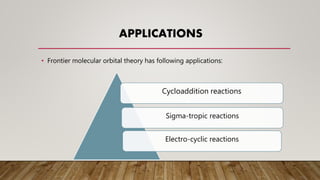
• Frontier molecular orbital theory has following applications:
Cycloaddition reactions
Sigma-tropic reactions
Electro-cyclic reactions
A. CYCLO-ADDITION REACTIONS
• A cycloaddition is a reaction that simultaneously forms at least two new bonds, and in
doing so, converts two or more open-chain molecules into rings.
• These reactions can be predicted by the Woodward–Hoffmann rules and thus are closely
approximated by FMO Theory.
• Ex: The famous Diels-Alder reaction ,
where a diene of 4pi electrons reacts
with a dienophile of 2 pi electrons is
[4+2] cycloaddition.
The dimerization of ethylene is
a combination of two olefin
units and have a [2+2]
cycloaddition.
FMO APPROACH FOR CYCLOADDITION REACTIONS
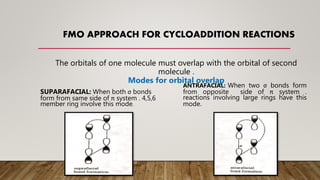
The orbitals of one molecule must overlap with the orbital of second
molecule .
Modes for orbital overlap
SUPARAFACIAL: When both σ bonds
form from same side of π system . 4,5,6
member ring involve this mode.
ANTRAFACIAL: When two σ bonds form
from opposite side of π system .
reactions involving large rings have this
mode.
[4,2] CYCLOADDITION
REACTIONS
Frontier orbital analysis of these reactions
show that overlap of in-phase orbital to form
the two new sigma bonds require suparafacial
orbital overlap .
There are bonding interaction at the termini.
The [Π2a + Π2S] addition is thermally or
symmetry allowed.
Ex:
[2,2] CYCLOADDITION
REACTIONS
These reactions does not occur under thermal
conditions but take place under photochemical
conditions.
The reason isUnder thermal conditions , suprafacial overlap is
not allowed . Antraafacial is allowed ,but not
possible due to small size ring.
Under photochemical conditions , suparafacial
bond formation is allowed because excited state
HOMO have symmetry opposite to ground state
HOMO.
B. SIGMA-TROPIC REACTIONS
• A sigma tropic rearrangement is a reaction in which a sigma bond is broken and new sigma
bind is formed , pi electrons rearrange.
• Word tropic is from Greek word “tropos”, which means change.
• These results can be predicted with FMO theory by observing the interaction between the
HOMO and LUMO of the species.
• Following points must be noted:
 No. of pi bond does not change , same should be for both products and reactants.
 The pi bond that breaks is bonded to an allylic carbon.
 The sigma bond that cleaves can be in the middle of pi system.
 A specific numbering system is used to describe a sigma-tropic rearrangement.
TYPES OF REARRANGEMENTS
A [ 2,3 ]
sigma-tropic
rearrangement:
A [ 1,5 ] sigma-
tropic
rearrangement:
A [ 1,3 ] sigma-
tropic
rearrangement:
A [ 3,3 ]
sigma-tropic
rearrangement:
• h
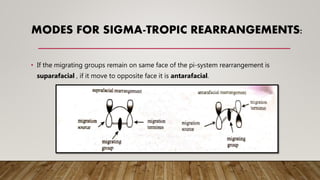
MODES FOR SIGMA-TROPIC REARRANGEMENTS:
• If the migrating groups remain on same face of the pi-system rearrangement is
suparafacial , if it move to opposite face it is antarafacial.
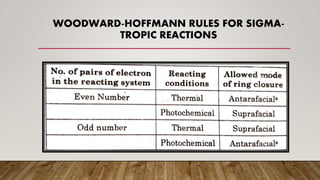
WOODWARD-HOFFMANN RULES FOR SIGMA-
TROPIC REACTIONS
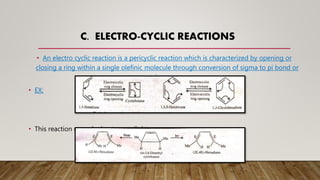
C. ELECTRO-CYCLIC REACTIONS
• An electro cyclic reaction is a pericyclic reaction which is characterized by opening or
closing a ring within a single olefinic molecule through conversion of sigma to pi bond or
vice versa.
• EX;
• This reaction occur by heat or sunlight.
FMOAPPROACHFORELECTRO-CYCLICREACTIONS:
• For electro-cyclic ring closure the HOMO of the acyclic polyene while for electro-cyclic ring
opening the LUMO of cyclo-alkene is considered.
 During cyclization, two terminal p-orbitals of the polyene HOMO overlap in phase in order to have bonding
interactions in favour of C-C sigma bond.
 During ring opening, the HOMO of C-C sigma bond of cyclo-alkene interacts with the LUMO of alkene part of
the compound so that bonding interaction is maintained in the newly formed pi bond.
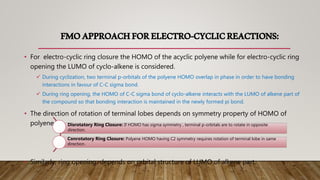
• The direction of rotation of terminal lobes depends on symmetry property of HOMO of
polyene.
• Similarly, ring opening depends on orbital structure of LUMO of alkene part.
Disrotatory Ring Closure: If HOMO has sigma symmetry , terminal p-orbitals are to rotate in opposite
direction.
Conrotatory Ring Closure: Polyene HOMO having C2 symmetry requires rotation of terminal lobe in same
direction.
LIMITATIONS
• It should be recognized that the frontier orbital theory has its limitations.
The application of
theory requires
complex calculations to
determine the,
Orbital energies &
locations
In case of molecules with
many functional groups or
electron delocalization, the
HOMO orbital are not
localized to a particular
site but often span a large
portion of a molecule,
making the interpretation
more difficult.
There are many examples
where the reactivity is not
controlled by frontier
orbitals.
For example, if the HOMO
in the aromatic system, is
less likely to react as Nu
or a base because this will
lead to the loss of
resonance stabilization.
In many cases, the
reactivity is determined
by strong electrostatic
forces rather than by
frontier orbitals.
REFERENCES
1.Fukui, Kenichi; Yonezawa, Teijiro; Shingu, Haruo (1952). "A Molecular Orbital
Theory of Reactivity in Aromatic Hydrocarbons". The Journal of Chemical
Physics. 20 (4): 722. Bibcode:1952JChPh..20..722F. doi:10.1063/1.1700523.
2.^ Jump up to:a b c d Fleming, Ian (1978). Frontier Orbitals and Organic Chemical
Reactions. London: Wiley. pp. 24–109. ISBN 0-471-01819-8.
3.^ Miller, Bernard (2004). Advanced Organic Chemistry: Reactions and
Mechanisms. Upper Saddle River, NJ: Pearsons. pp. 53–54. ISBN 0-13-065588-
0.

Frontier Molecular Orbital Theory

  • 1.
  • 2.
    APPLICATIONS • Frontier molecularorbital theory has following applications: Cycloaddition reactions Sigma-tropic reactions Electro-cyclic reactions
  • 3.
    A. CYCLO-ADDITION REACTIONS •A cycloaddition is a reaction that simultaneously forms at least two new bonds, and in doing so, converts two or more open-chain molecules into rings. • These reactions can be predicted by the Woodward–Hoffmann rules and thus are closely approximated by FMO Theory. • Ex: The famous Diels-Alder reaction , where a diene of 4pi electrons reacts with a dienophile of 2 pi electrons is [4+2] cycloaddition. The dimerization of ethylene is a combination of two olefin units and have a [2+2] cycloaddition.
  • 4.
    FMO APPROACH FORCYCLOADDITION REACTIONS The orbitals of one molecule must overlap with the orbital of second molecule . Modes for orbital overlap SUPARAFACIAL: When both σ bonds form from same side of π system . 4,5,6 member ring involve this mode. ANTRAFACIAL: When two σ bonds form from opposite side of π system . reactions involving large rings have this mode.
  • 5.
    [4,2] CYCLOADDITION REACTIONS Frontier orbitalanalysis of these reactions show that overlap of in-phase orbital to form the two new sigma bonds require suparafacial orbital overlap . There are bonding interaction at the termini. The [Π2a + Π2S] addition is thermally or symmetry allowed. Ex:
  • 6.
    [2,2] CYCLOADDITION REACTIONS These reactionsdoes not occur under thermal conditions but take place under photochemical conditions. The reason isUnder thermal conditions , suprafacial overlap is not allowed . Antraafacial is allowed ,but not possible due to small size ring. Under photochemical conditions , suparafacial bond formation is allowed because excited state HOMO have symmetry opposite to ground state HOMO.
  • 7.
    B. SIGMA-TROPIC REACTIONS •A sigma tropic rearrangement is a reaction in which a sigma bond is broken and new sigma bind is formed , pi electrons rearrange. • Word tropic is from Greek word “tropos”, which means change. • These results can be predicted with FMO theory by observing the interaction between the HOMO and LUMO of the species. • Following points must be noted:  No. of pi bond does not change , same should be for both products and reactants.  The pi bond that breaks is bonded to an allylic carbon.  The sigma bond that cleaves can be in the middle of pi system.  A specific numbering system is used to describe a sigma-tropic rearrangement.
  • 8.
    TYPES OF REARRANGEMENTS A[ 2,3 ] sigma-tropic rearrangement: A [ 1,5 ] sigma- tropic rearrangement: A [ 1,3 ] sigma- tropic rearrangement: A [ 3,3 ] sigma-tropic rearrangement: • h
  • 9.
    MODES FOR SIGMA-TROPICREARRANGEMENTS: • If the migrating groups remain on same face of the pi-system rearrangement is suparafacial , if it move to opposite face it is antarafacial.
  • 10.
    WOODWARD-HOFFMANN RULES FORSIGMA- TROPIC REACTIONS
  • 11.
    C. ELECTRO-CYCLIC REACTIONS •An electro cyclic reaction is a pericyclic reaction which is characterized by opening or closing a ring within a single olefinic molecule through conversion of sigma to pi bond or vice versa. • EX; • This reaction occur by heat or sunlight.
  • 12.
    FMOAPPROACHFORELECTRO-CYCLICREACTIONS: • For electro-cyclicring closure the HOMO of the acyclic polyene while for electro-cyclic ring opening the LUMO of cyclo-alkene is considered.  During cyclization, two terminal p-orbitals of the polyene HOMO overlap in phase in order to have bonding interactions in favour of C-C sigma bond.  During ring opening, the HOMO of C-C sigma bond of cyclo-alkene interacts with the LUMO of alkene part of the compound so that bonding interaction is maintained in the newly formed pi bond. • The direction of rotation of terminal lobes depends on symmetry property of HOMO of polyene. • Similarly, ring opening depends on orbital structure of LUMO of alkene part. Disrotatory Ring Closure: If HOMO has sigma symmetry , terminal p-orbitals are to rotate in opposite direction. Conrotatory Ring Closure: Polyene HOMO having C2 symmetry requires rotation of terminal lobe in same direction.
  • 13.
    LIMITATIONS • It shouldbe recognized that the frontier orbital theory has its limitations. The application of theory requires complex calculations to determine the, Orbital energies & locations In case of molecules with many functional groups or electron delocalization, the HOMO orbital are not localized to a particular site but often span a large portion of a molecule, making the interpretation more difficult. There are many examples where the reactivity is not controlled by frontier orbitals. For example, if the HOMO in the aromatic system, is less likely to react as Nu or a base because this will lead to the loss of resonance stabilization. In many cases, the reactivity is determined by strong electrostatic forces rather than by frontier orbitals.
  • 14.
    REFERENCES 1.Fukui, Kenichi; Yonezawa,Teijiro; Shingu, Haruo (1952). "A Molecular Orbital Theory of Reactivity in Aromatic Hydrocarbons". The Journal of Chemical Physics. 20 (4): 722. Bibcode:1952JChPh..20..722F. doi:10.1063/1.1700523. 2.^ Jump up to:a b c d Fleming, Ian (1978). Frontier Orbitals and Organic Chemical Reactions. London: Wiley. pp. 24–109. ISBN 0-471-01819-8. 3.^ Miller, Bernard (2004). Advanced Organic Chemistry: Reactions and Mechanisms. Upper Saddle River, NJ: Pearsons. pp. 53–54. ISBN 0-13-065588- 0.