GILMAN REAGENT
Presented to :- Dr. Dharminder Sharma
Presented By :- Manish Kumar
Roll No. 4857
M.Sc. Chemistry(4th sem)
Practical code :- CH-526
Date :- 17 June, 2021
Introduction:
• Gilman reagent also known as organocopper reagents.
• Organocopper reagents are prepared by transmetallating the
organomagnesium, organolithium or organozinc reagent with copper(I) salts.
• reactivity of organocuprates with electrophiles follows the order:
RCOCl > R-CHO > R-OTs > R-I > R-Br > R-Cl > RCOR > R-CO2R' R-CN > RCH=CH2
R = alkyl, aryl or heteroaryl and can have remote functionaliyt such as
ethers, aetal or ketals
The Common Reaction Of Gilman Reagent:
1) Reactions with Acid Chlorides 2) Coupling Reactions
3) Conjugate Addition 4) Reactions with Aldehydes and Ketones
5) Reactions with Epoxides
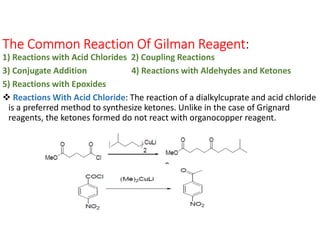
 Reactions With Acid Chloride: The reaction of a dialkylcuprate and acid chloride
is a preferred method to synthesize ketones. Unlike in the case of Grignard
reagents, the ketones formed do not react with organocopper reagent.
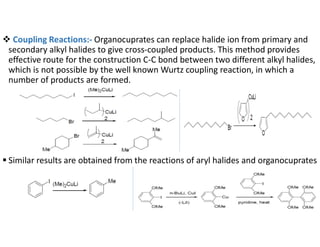
 Coupling Reactions:- Organocuprates can replace halide ion from primary and
secondary alkyl halides to give cross-coupled products. This method provides
effective route for the construction C-C bond between two different alkyl halides,
which is not possible by the well known Wurtz coupling reaction, in which a
number of products are formed.
 Similar results are obtained from the reactions of aryl halides and organocuprates
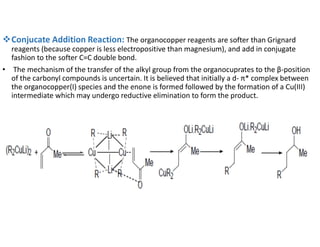
Conjucate Addition Reaction: The organocopper reagents are softer than Grignard
reagents (because copper is less electropositive than magnesium), and add in conjugate
fashion to the softer C=C double bond.
• The mechanism of the transfer of the alkyl group from the organocuprates to the β-position
of the carbonyl compounds is uncertain. It is believed that initially a d- π* complex between
the organocopper(I) species and the enone is formed followed by the formation of a Cu(III)
intermediate which may undergo reductive elimination to form the product.
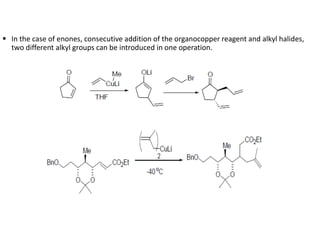
 In the case of enones, consecutive addition of the organocopper reagent and alkyl halides,
two different alkyl groups can be introduced in one operation.
Reactions With Aldehyde And Ketone: Organocuprates react with aldehydes to give
alcohols in high yield (Scheme 8). In the presence of chlorotrimethylsilane, the corresponding
siliylenol ethers can be obtained.
Reactions With Epoxide: The epoxide is attacked by organocopper reagents at the least
substituted carbon atom giving the corresponding alcohol.
 In disubstituted epoxide inversion of configuration occurs in the ring carbon because reaction
is SN2 reaction.
O H
H
O
H
H
H
Ph Ph Ph
Ph
CH3
CuLi
H2
O/H+
High Order Cuprates: Cuprates are useful but there are a few problems associated with
them. To overcome these limitations, Lipshutz developed higher order mixed cuprates,
R2Cu(CN)Li2, by the reaction of organolithium reagent with cuprous cyanide.
2R-Li + CuCN R2Cu(CN)Li2
 Higher order cuprates show greater reactivity compared Gilman reagents with alkyl halides,
even secondary halides. For example, (S)-2-bromooctane reacts with EtMeCu(CN)Li at 0 oC to
give (R)-3-methylnonane in 72% yield
Thank you

Gilman Reagent

  • 1.
    GILMAN REAGENT Presented to:- Dr. Dharminder Sharma Presented By :- Manish Kumar Roll No. 4857 M.Sc. Chemistry(4th sem) Practical code :- CH-526 Date :- 17 June, 2021
  • 2.
    Introduction: • Gilman reagentalso known as organocopper reagents. • Organocopper reagents are prepared by transmetallating the organomagnesium, organolithium or organozinc reagent with copper(I) salts. • reactivity of organocuprates with electrophiles follows the order: RCOCl > R-CHO > R-OTs > R-I > R-Br > R-Cl > RCOR > R-CO2R' R-CN > RCH=CH2 R = alkyl, aryl or heteroaryl and can have remote functionaliyt such as ethers, aetal or ketals
  • 3.
    The Common ReactionOf Gilman Reagent: 1) Reactions with Acid Chlorides 2) Coupling Reactions 3) Conjugate Addition 4) Reactions with Aldehydes and Ketones 5) Reactions with Epoxides  Reactions With Acid Chloride: The reaction of a dialkylcuprate and acid chloride is a preferred method to synthesize ketones. Unlike in the case of Grignard reagents, the ketones formed do not react with organocopper reagent.
  • 4.
     Coupling Reactions:-Organocuprates can replace halide ion from primary and secondary alkyl halides to give cross-coupled products. This method provides effective route for the construction C-C bond between two different alkyl halides, which is not possible by the well known Wurtz coupling reaction, in which a number of products are formed.  Similar results are obtained from the reactions of aryl halides and organocuprates
  • 5.
    Conjucate Addition Reaction:The organocopper reagents are softer than Grignard reagents (because copper is less electropositive than magnesium), and add in conjugate fashion to the softer C=C double bond. • The mechanism of the transfer of the alkyl group from the organocuprates to the β-position of the carbonyl compounds is uncertain. It is believed that initially a d- π* complex between the organocopper(I) species and the enone is formed followed by the formation of a Cu(III) intermediate which may undergo reductive elimination to form the product.
  • 6.
     In thecase of enones, consecutive addition of the organocopper reagent and alkyl halides, two different alkyl groups can be introduced in one operation.
  • 7.
    Reactions With AldehydeAnd Ketone: Organocuprates react with aldehydes to give alcohols in high yield (Scheme 8). In the presence of chlorotrimethylsilane, the corresponding siliylenol ethers can be obtained.
  • 8.
    Reactions With Epoxide:The epoxide is attacked by organocopper reagents at the least substituted carbon atom giving the corresponding alcohol.  In disubstituted epoxide inversion of configuration occurs in the ring carbon because reaction is SN2 reaction. O H H O H H H Ph Ph Ph Ph CH3 CuLi H2 O/H+
  • 9.
    High Order Cuprates:Cuprates are useful but there are a few problems associated with them. To overcome these limitations, Lipshutz developed higher order mixed cuprates, R2Cu(CN)Li2, by the reaction of organolithium reagent with cuprous cyanide. 2R-Li + CuCN R2Cu(CN)Li2  Higher order cuprates show greater reactivity compared Gilman reagents with alkyl halides, even secondary halides. For example, (S)-2-bromooctane reacts with EtMeCu(CN)Li at 0 oC to give (R)-3-methylnonane in 72% yield
  • 10.