Coordination Compounds: Chemistry and Application
Introduction
Coordination compounds are metal ions surrounded by ligands. Ligands are either anions or molecules
that can donate electrons into the d-orbitals of the metal ion and form a bond. Examples of common
ligands are chloride ion, cyanide ion, ammonia, ethylenediamine, and ethylenediaminetetraacetate ion
(EDTA). The metal ions that form coordination compounds are from a group of metals known as transition
metals. These metals have more than one oxidation state. This property allows the transition metals to act
as Lewis acids.
Coordination chemistry plays an important role in the purification of metals. Many metals are not
found in the pure state in nature. For example, gold ore can be treated with cyanides to form [Au(CN)2]-
which is soluble in water. Impurities remain behind and after treatment with zinc, pure gold is obtained.
Pure nickel and silver are also isolated by first converting the metal
into coordination compounds. The formation of insoluble
coordination compounds aids in the determination of the amount of
metal present in a mixture. Distinctively colored coordination
compounds that form with various metals can be used to identify the
presence of a metal in a mixture. For example, iron may be identified
by the formation of a reddish coordination compound with potassium
thiocyanate (remember qualitative analysis experiment in chem. 201).
Ethylenediaminetetraacetate (EDTA), shown in Fig. 1, is very
effective in forming a water-soluble coordination compound with
lead. This process can be used to treat lead poisoning.
Chemical Foundations
Donor Atom The donor atom is the atom of the ligand that binds to
the metal ion. If one donor atom is present, as in ammonia, the ligand
is referred to as monodentate. If two donor atoms are present, as in
ethylenediamine (H2NCH2CH2NH2), the ligand is bidentate. If more
than two donor atoms are present, the ligand is polydentate. EDTA is
a polydentate ligand because it contains six donor atoms (see Fig. 2).
If EDTA4-
combines with Ca2+
, the resulting complex is [Ca(EDTA)]2-
.
Bidentate and polydentate ligands have a much greater affinity for
binding than monodentate ligands even with the same donor atom due
to entropic differences (i.e., less overall entropy is lost upon the
binding of a smaller number of molecules with the same number of
water molecules released). For example, ethylenediamine forms a
complex with Ni2+
more readily than ammonia:
[Ni(H2O)6]2+
+ 6 NH3 [Ni(NH3)6]2+
+ 6 H2O Keq = 4 × 10⁸
[Ni(H2O)6]2+
+ 3 en [Ni(en)3]2+
+ 6 H2O Keq = 2 × 10¹⁸
Chelating Agent The word “chelate” is derived from a Greek word meaning “claw”. Ligands are
referred to chelating agents because they surround and hold the metal ion like a claw.
Coordination Number The coordination number refers to the number of atoms in a ligand bonded to
the metal ion. The most common coordination numbers are 4 and 6. In the case of the
CH2
H2C N
N
H2C
CH2
H2C
CH2
-
O
O
O-
O
O-
O
O-
O
Fig. 1 EDTA4–
(ethylenediaminetetraacetate ion)
Fig. 2 Metal-EDTA complex
2
tetramminecopper(II), [Cu(NH3)4]2+
, there are four nitrogen atoms from the NH3 molecules each bonded to
Cu2+
. Hexachloroplatinate(IV), [PtCl6]2-
, is an example of an anion with a coordination number of six.
Oxidation Numbers of Coordination Complexes The net charge on the coordination complex results
from the difference between the charge of the metal ion and the anion. For example, [PtCl6]2-
is a complex
ion formed from one Pt4+
and six Cl-
, which results in a net charge of 2-. In a case where the ligand does
not carry a formal charge, such as NH3, an ammonia complex carries the charge of the metal ion, for
example [Cu(NH3)4]2+
has a charge of 2+, which is the oxidation number of copper.
Geometry of Coordination Compounds Coordination compounds with a coordination number of 2
are linear. If the coordination number is 4, the coordination complex is either square planar or tetrahedral.
When the coordination number is 6, the complex is octahedral. See Appendix A for the geometries of
coordination compounds.
Crystal Field Theory Crystal field theory assumes that the interaction between the metal ion and the
ligand is electrostatic. The ligands are able to split the energies of the transition metal d orbitals into lower
and higher energy states (Fig. 3). Visible light will excite an electron from a lower energy d orbital to a
higher energy d orbital. This accounts for many of the properties of coordination compounds, such as color
and magnetic properties. The color of coordination compounds depends on both the metal and the ligand.
Ligands can be arranged in order of their increasing energy gap between the lower and higher energy d
orbitals; this arrangement of the ligands is known as the spectrochemical series.
Fig. 3 d-orbital splitting in an octahedral structure
In a tetrahedral structure, the splitting energy (∆o) is smaller than that of the octahedral structure (as
there are only four ligands as compared to six ligands in the octahedral). Furthermore, the splitting is
reversed, i.e. the dxy, dyx, and dxz orbitals are higher in energy than the dx2
-y2
and dz2
.
Spectrochemical Series Based on data for a wide variety of complexes, it is possible to list ligands in
order of increasing field strength (i.e. splitting energy, ∆o) in the spectrochemical series as follows:
I-
< Br-
< S2-
< SCN-
< Cl-
< N3
-
, F-
< urea, OH-
< ox, O2-
< H2O < NCS-
< pyridine, NH3 <
ethylenediamine < NO2
-
< CH3
-
, C6H5
-
< CN-
< CO.
It is possible to arrange the metals according to a spectrochemical series as well. The approximate
order is:
Mn2+
< Ni2+
< Co2+
< Fe2+
< V2+
< Fe3+
< Cr3+
< V3+
< Co3+
< Mn3+
< Mo3+
< Rh3+
< Ru3+
< Pd4+
< Ir3+
< Pt4+
3
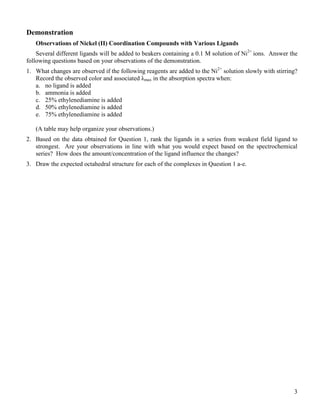
Demonstration
Observations of Nickel (II) Coordination Compounds with Various Ligands
Several different ligands will be added to beakers containing a 0.1 M solution of Ni2+
ions. Answer the
following questions based on your observations of the demonstration.
1. What changes are observed if the following reagents are added to the Ni2+
solution slowly with stirring?
Record the observed color and associated λmax in the absorption spectra when:
a. no ligand is added
b. ammonia is added
c. 25% ethylenediamine is added
d. 50% ethylenediamine is added
e. 75% ethylenediamine is added
(A table may help organize your observations.)
2. Based on the data obtained for Question 1, rank the ligands in a series from weakest field ligand to
strongest. Are your observations in line with what you would expect based on the spectrochemical
series? How does the amount/concentration of the ligand influence the changes?
3. Draw the expected octahedral structure for each of the complexes in Question 1 a-e.
4
Experiment
Ligand Coordination of Transition Metal Ions
Introduction
This lab will explore several aspects of coordination compounds and crystal field theory. The colors of
many transition metal complexes can be explained by crystal field theory. The d orbitals of an isolated
metal ion all have the same energy. When ligands bind to a metal ion in a particular configuration (e.g.,
octahedral, tetrahedral, square planer; see Appendix A), the orientation of the metal ligand bond relative to
the different d orbitals splits the orbitals according to their energy levels. The magnitude of the difference
in energy between the d orbitals varies depending on the metal ion and the nature of the ligands. Electrons
in the lower d orbitals can be promoted to a higher energy orbital with the absorption of the appropriate
wavelength of light according to the equation E = hc/λ. If the d orbitals are empty or full (d0
, d10
), then no
electron can be promoted between the orbitals; hence, these ions are often colorless (e.g., Cd2+
). The higher
the energy difference between the d orbitals, the shorter the wavelength of light then corresponds to the
energy absorbed.
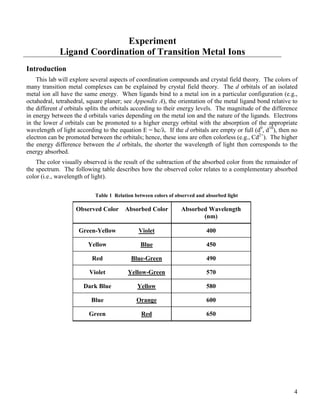
The color visually observed is the result of the subtraction of the absorbed color from the remainder of
the spectrum. The following table describes how the observed color relates to a complementary absorbed
color (i.e., wavelength of light).
Table 1 Relation between colors of observed and absorbed light
Observed Color Absorbed Color Absorbed Wavelength
(nm)
Green-Yellow Violet 400
Yellow Blue 450
Red Blue-Green 490
Violet Yellow-Green 570
Dark Blue Yellow 580
Blue Orange 600
Green Red 650
5
Name: ______________________________, Class: CHEM 203, Section:_________
Semester: _____________________
__________________________________________________________________________
Pre-Laboratory Questions
1. How many electrons are in the d orbitals of the following metal ions: V2+
, Co4+
and Fe3+
?
Ion # d-Electrons
V2+
Co4+
Fe3+
2. Assume an octahedral geometry for both complexes, draw the following: (Use your chemistry
textbook as a reference to answer this question.)
a) the low-spin electron configuration for a complex containing Mn2+
b) the high-spin electron configuration for a complex containing Fe2+
.
3. The absorbance maxima observed for the following cobalt complexes ([Co(NH3)6]3+
λmax = 470 nm,
[Co(NH3)5Cl]2+
λmax = 560 nm, [Co(NH3)4Cl2]+
λmax = 630 nm, and [Co(NH3)3Cl3] λmax = 680 nm)
can be identified with transitions involving d-electrons.
a) Should the spectrochemical series apply for these complexes? Why or why not? (HINT: Think
of the criteria needed for these complexes to be fairly compared.)
b) Is the trend in wavelength the same as you would predict using the spectrochemical series? Hint:
Take this problem step-by-step.
6
Experimental Procedure, Data & Observations
You will use a well plate to mix various ligands (structures shown in Appendix B) with several different
metal ions to produce the complexes shown below. (See Appendix C for a template that can be placed
under the well plate as a guide):
[Ti(H2O)6]3+
[Ti(EDTA)]-
[TiCl4]-
[Ni(H2O)6]2+
[Ni(EDTA)]2-
[NiCl4]2-
[Ni(NH3)6]2+
[Ni(en)3]2+
[Ni(im)6]2+
[Co(H2O)6]2+
[Co(EDTA)]2-
[CoCl4]2-
[Ni(en)2(H2O)2]2+
[Ni(im)4(H2O)2]2+
[Zn(H2O)6]2+
[Zn(EDTA)]2-
[Ni(en)1(H2O)4]2+
[Ni(im)2(H2O)4]2+
Part A: Spectrophotometer Calibration
Follow the procedure in handout given to you by your Professor to calibrate the Ocean Optics
spectrophotometer. Use water as a blank sample for zeroing the spectrophotometer. Set the wavelength
range from 425 to 700 nm.
Part B: Ti3+
ion complexes
Place 0.5 mL of 0.1 M Ti2(SO4)3 into 3 wells of a well-plate. Then add the designated amounts of
reagent or water to the corresponding well. Make a visual observation and determine the absorbed
wavelength by transferring each solution to a cuvette and placing each into the spectrophotometer.
Well
Num.
Reagent
mL of
Reagent
mL of
Water
Complex
Ion
Observed
Color
λmax Long
λmax
∆o
kJ/mol
A1 - 1.5 [Ti(H2O)6]3+
A2 0.1 M EDTA 1.5 - [Ti(EDTA)]-
A3 Satd. NaCl 1.5 - [TiCl4]-
Handle all cuvettes by the rim, and wipe the outside of the cuvette with a dry paper towel before
placing into the spectrophotometer.
7
Part C: Ni2+
ion complexes
Put 0.5 mL of a 0.1 M Ni(NO3)2 solution into 10 wells of a well plate. In a hood, add the amounts of
reagent and/or water to the corresponding well then individually make a visual observation and determine
the λmax. Use the longest wavelength peak (Long λmax) to determine the splitting energy ∆o in kJ/mol.
(Remember, from Chem 201, that Ephoton = h).
Well
Num.
Reagent
mL of
Reagent
mL of
Water
Complex
Ion
Observed
Color
λmax Long
λmax
∆o
kJ/mol
B1 - 1.5 [Ni(H2O)6]2+
B2 0.1 M EDTA 1.5 - [Ni(EDTA)]2-
B3 Satd. NaCl 1.5 - [NiCl4]2-
B4 0.3 mL aq.
NH3
1.5 -
[Ni(NH3)6]2+
B5 0.1 M en 1.5 - [Ni(en)3]2+
C5 0.1 M en 1.0 0.5 [Ni(en)2(H2O)2]2+
D5 0.1 M en 0.5 1.0 [Ni(en)1(H2O)4]2+
B6 0.2 M im 1.5 - [Ni(im)6]2+
C6 0.2 M im 1.0 0.5 [Ni(im)4(H2O)2]2+
D6 0.2 M im 0.5 1.0 [Ni(im)2(H2O)4]2+
Note: en = ethylenediamine; im = imidazole
Part D: Co2+
ion complexes
Add the designated amounts of reagent or water to 3 wells containing 0.5 mL 0.1 M aq. CoSO4 and
make a visual observation in addition to recording λmax.
Well
Num.
Reagent
mL of
Reagent
mL of
Water
Complex
Ion
Observed
Color
λmax Long
λmax
∆o
kJ/mol
C1 - 1.5 [Co(H2O)6]2+
C2 0.1 M EDTA 1.5 - [Co(EDTA)]2-
C3 Satd. NaCl 1.5 - [CoCl4]2-
8
Part E: Zn2+
ion complexes
Put 0.5 mL of a 0.1 M ZnSO4 solution into 2 wells of a well plate. Add the amounts of reagent or water
to the corresponding well and make a visual observation.
Well
Num.
Reagent
mL of
Reagent
mL of
Water
Complex
Ion
Observed Color
D1 - 1.5 [Zn(H2O)6]2+
D2 0.1 M EDTA 1.5 - [Zn(EDTA)]2-
Conclusions and Discussion
1. Draw the low-spin electron configurations for Ti3+
, Co2+
, Ni2+
, and Zn2+
.
2. For the nickel ion series involving water and ligands containing nitrogen donor atoms, address the
following questions:
a. Based on the corresponding λmax, do the ligands, ammonia, ethylenediamine, and water,
follow the spectrochemical series? Explain.
b. Imidazole is another ligand containing nitrogen donor atoms. Based on your results, where
does imidazole lie in the spectrochemical series relative to ammonia, ethylenediamine and
water?
9
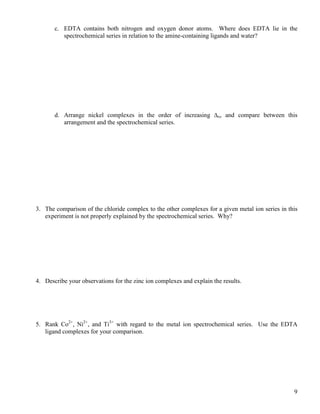
c. EDTA contains both nitrogen and oxygen donor atoms. Where does EDTA lie in the
spectrochemical series in relation to the amine-containing ligands and water?
d. Arrange nickel complexes in the order of increasing ∆o, and compare between this
arrangement and the spectrochemical series.
3. The comparison of the chloride complex to the other complexes for a given metal ion series in this
experiment is not properly explained by the spectrochemical series. Why?
4. Describe your observations for the zinc ion complexes and explain the results.
5. Rank Co2+
, Ni2+
, and Ti3+
with regard to the metal ion spectrochemical series. Use the EDTA
ligand complexes for your comparison.
10
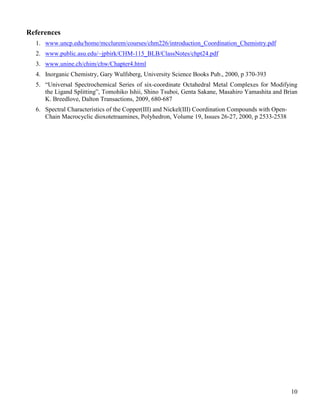
References
1. www.uncp.edu/home/mcclurem/courses/chm226/introduction_Coordination_Chemistry.pdf
2. www.public.asu.edu/~jpbirk/CHM-115_BLB/ClassNotes/chpt24.pdf
3. www.unine.ch/chim/chw/Chapter4.html
4. Inorganic Chemistry, Gary Wulfsberg, University Science Books Pub., 2000, p 370-393
5. “Universal Spectrochemical Series of six-coordinate Octahedral Metal Complexes for Modifying
the Ligand Splitting”, Tomohiko Ishii, Shino Tsuboi, Genta Sakane, Masahiro Yamashita and Brian
K. Breedlove, Dalton Transactions, 2009, 680-687
6. Spectral Characteristics of the Copper(III) and Nickel(III) Coordination Compounds with Open-
Chain Macrocyclic dioxotetraamines, Polyhedron, Volume 19, Issues 26-27, 2000, p 2533-2538
11
Appendix A
Geometries of Coordination Compounds
A compound’s geometry (i.e., how the ligands are arranged around the metal atom) determines its
physical and chemical properties. For example, a tetrahedral compound will behave differently than a
square planar compound that contains the same metal atom and the same ligands.
Consider the complex ion, [CoCl4]2-
. Its coordination number is equal to 4; thus, the structure of
[CoCl4]2-
might be tetrahedral or square planar (see examples). Experimentally, [CoCl4]2-
has been shown
to have a tetrahedral structure. Linear and octahedral are the most common geometries for coordination
numbers 2 and 6, respectively.
Example Sketch
[CoCl4]2-
tetrahedral
CN = 4
ligands attached
at the corners of a
tetrahedron
Co
Cl
ClCl
Cl
[Ni(CN)4]2-
square planar
CN = 4
ligands attached
at the corners of a
square
Ni
CNNC
CNNC
[Ag(NH3)2]+
linear
CN = 2
ligands and metal
atom connected in
a straight line
AgH3N NH3
[PtCl6]2-
octahedral
CN = 6
ligands attached
at the corners of a
octahedron
Pt
Cl
ClCl
Cl
Cl Cl
12
CH2
H2C N
N
H2C
CH2
H2C
CH2
-
O
O
O-
O
O-
O
O-
O
Appendix B
Structures of Selected Ligands
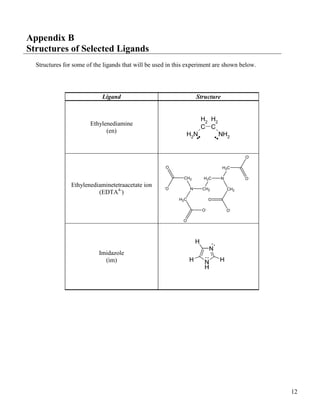
Structures for some of the ligands that will be used in this experiment are shown below.
Ligand Structure
Ethylenediamine
(en)
C
H2
C
H2
NH2
NH2
Ethylenediaminetetraacetate ion
(EDTA4-
)
Imidazole
(im)
13
Appendix C
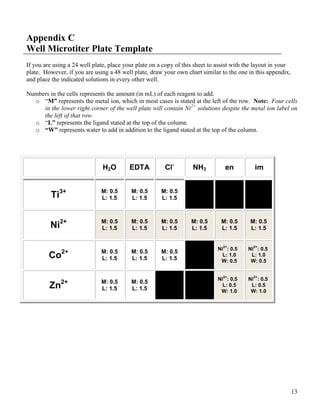
Well Microtiter Plate Template
If you are using a 24 well plate, place your plate on a copy of this sheet to assist with the layout in your
plate. However, if you are using a 48 well plate, draw your own chart similar to the one in this appendix,
and place the indicated solutions in every other well.
Numbers in the cells represents the amount (in mL) of each reagent to add.
o “M” represents the metal ion, which in most cases is stated at the left of the row. Note: Four cells
in the lower right corner of the well plate will contain Ni2+
solutions despite the metal ion label on
the left of that row.
o “L” represents the ligand stated at the top of the column.
o “W” represents water to add in addition to the ligand stated at the top of the column.
H2O EDTA Cl-
NH3 en im
Ti3+ M: 0.5
L: 1.5
M: 0.5
L: 1.5
M: 0.5
L: 1.5
Ni2+ M: 0.5
L: 1.5
M: 0.5
L: 1.5
M: 0.5
L: 1.5
M: 0.5
L: 1.5
M: 0.5
L: 1.5
M: 0.5
L: 1.5
Co2+ M: 0.5
L: 1.5
M: 0.5
L: 1.5
M: 0.5
L: 1.5
Ni
2+
: 0.5
L: 1.0
W: 0.5
Ni
2+
: 0.5
L: 1.0
W: 0.5
Zn2+ M: 0.5
L: 1.5
M: 0.5
L: 1.5
Ni
2+
: 0.5
L: 0.5
W: 1.0
Ni
2+
: 0.5
L: 0.5
W: 1.0
14
Instructions for Laboratory Assistant
Reagents:
4 X 100 mL 0.1M Ti3(SO4)2
4 X 100 mL 0.1 Ni(NO3)2
4 X 100 mL 0.1 CoSO4
4 X 100 mL 0.1 ZnSO4
4 X 100 mL 0.1 Na2EDTA
4 X 100 mL 0.1 Sat'd NaCl
4 X 100 mL 0.1 M Ethylenediamine (en)
4 X 100 0.2 M Imidazole
Supplies:
16 4 X 6 well plates
Also needed for demo:
1 small dropper bottle 100% ethylenediamine
Equipment (in room)
disposable pipets
cuvettes
ocean optics spectrophotometers
Students will wear gloves for this experiment. All sizes should be available.

Coordination compounds

  • 1.
    Coordination Compounds: Chemistryand Application Introduction Coordination compounds are metal ions surrounded by ligands. Ligands are either anions or molecules that can donate electrons into the d-orbitals of the metal ion and form a bond. Examples of common ligands are chloride ion, cyanide ion, ammonia, ethylenediamine, and ethylenediaminetetraacetate ion (EDTA). The metal ions that form coordination compounds are from a group of metals known as transition metals. These metals have more than one oxidation state. This property allows the transition metals to act as Lewis acids. Coordination chemistry plays an important role in the purification of metals. Many metals are not found in the pure state in nature. For example, gold ore can be treated with cyanides to form [Au(CN)2]- which is soluble in water. Impurities remain behind and after treatment with zinc, pure gold is obtained. Pure nickel and silver are also isolated by first converting the metal into coordination compounds. The formation of insoluble coordination compounds aids in the determination of the amount of metal present in a mixture. Distinctively colored coordination compounds that form with various metals can be used to identify the presence of a metal in a mixture. For example, iron may be identified by the formation of a reddish coordination compound with potassium thiocyanate (remember qualitative analysis experiment in chem. 201). Ethylenediaminetetraacetate (EDTA), shown in Fig. 1, is very effective in forming a water-soluble coordination compound with lead. This process can be used to treat lead poisoning. Chemical Foundations Donor Atom The donor atom is the atom of the ligand that binds to the metal ion. If one donor atom is present, as in ammonia, the ligand is referred to as monodentate. If two donor atoms are present, as in ethylenediamine (H2NCH2CH2NH2), the ligand is bidentate. If more than two donor atoms are present, the ligand is polydentate. EDTA is a polydentate ligand because it contains six donor atoms (see Fig. 2). If EDTA4- combines with Ca2+ , the resulting complex is [Ca(EDTA)]2- . Bidentate and polydentate ligands have a much greater affinity for binding than monodentate ligands even with the same donor atom due to entropic differences (i.e., less overall entropy is lost upon the binding of a smaller number of molecules with the same number of water molecules released). For example, ethylenediamine forms a complex with Ni2+ more readily than ammonia: [Ni(H2O)6]2+ + 6 NH3 [Ni(NH3)6]2+ + 6 H2O Keq = 4 × 10⁸ [Ni(H2O)6]2+ + 3 en [Ni(en)3]2+ + 6 H2O Keq = 2 × 10¹⁸ Chelating Agent The word “chelate” is derived from a Greek word meaning “claw”. Ligands are referred to chelating agents because they surround and hold the metal ion like a claw. Coordination Number The coordination number refers to the number of atoms in a ligand bonded to the metal ion. The most common coordination numbers are 4 and 6. In the case of the CH2 H2C N N H2C CH2 H2C CH2 - O O O- O O- O O- O Fig. 1 EDTA4– (ethylenediaminetetraacetate ion) Fig. 2 Metal-EDTA complex
  • 2.
    2 tetramminecopper(II), [Cu(NH3)4]2+ , thereare four nitrogen atoms from the NH3 molecules each bonded to Cu2+ . Hexachloroplatinate(IV), [PtCl6]2- , is an example of an anion with a coordination number of six. Oxidation Numbers of Coordination Complexes The net charge on the coordination complex results from the difference between the charge of the metal ion and the anion. For example, [PtCl6]2- is a complex ion formed from one Pt4+ and six Cl- , which results in a net charge of 2-. In a case where the ligand does not carry a formal charge, such as NH3, an ammonia complex carries the charge of the metal ion, for example [Cu(NH3)4]2+ has a charge of 2+, which is the oxidation number of copper. Geometry of Coordination Compounds Coordination compounds with a coordination number of 2 are linear. If the coordination number is 4, the coordination complex is either square planar or tetrahedral. When the coordination number is 6, the complex is octahedral. See Appendix A for the geometries of coordination compounds. Crystal Field Theory Crystal field theory assumes that the interaction between the metal ion and the ligand is electrostatic. The ligands are able to split the energies of the transition metal d orbitals into lower and higher energy states (Fig. 3). Visible light will excite an electron from a lower energy d orbital to a higher energy d orbital. This accounts for many of the properties of coordination compounds, such as color and magnetic properties. The color of coordination compounds depends on both the metal and the ligand. Ligands can be arranged in order of their increasing energy gap between the lower and higher energy d orbitals; this arrangement of the ligands is known as the spectrochemical series. Fig. 3 d-orbital splitting in an octahedral structure In a tetrahedral structure, the splitting energy (∆o) is smaller than that of the octahedral structure (as there are only four ligands as compared to six ligands in the octahedral). Furthermore, the splitting is reversed, i.e. the dxy, dyx, and dxz orbitals are higher in energy than the dx2 -y2 and dz2 . Spectrochemical Series Based on data for a wide variety of complexes, it is possible to list ligands in order of increasing field strength (i.e. splitting energy, ∆o) in the spectrochemical series as follows: I- < Br- < S2- < SCN- < Cl- < N3 - , F- < urea, OH- < ox, O2- < H2O < NCS- < pyridine, NH3 < ethylenediamine < NO2 - < CH3 - , C6H5 - < CN- < CO. It is possible to arrange the metals according to a spectrochemical series as well. The approximate order is: Mn2+ < Ni2+ < Co2+ < Fe2+ < V2+ < Fe3+ < Cr3+ < V3+ < Co3+ < Mn3+ < Mo3+ < Rh3+ < Ru3+ < Pd4+ < Ir3+ < Pt4+
  • 3.
    3 Demonstration Observations of Nickel(II) Coordination Compounds with Various Ligands Several different ligands will be added to beakers containing a 0.1 M solution of Ni2+ ions. Answer the following questions based on your observations of the demonstration. 1. What changes are observed if the following reagents are added to the Ni2+ solution slowly with stirring? Record the observed color and associated λmax in the absorption spectra when: a. no ligand is added b. ammonia is added c. 25% ethylenediamine is added d. 50% ethylenediamine is added e. 75% ethylenediamine is added (A table may help organize your observations.) 2. Based on the data obtained for Question 1, rank the ligands in a series from weakest field ligand to strongest. Are your observations in line with what you would expect based on the spectrochemical series? How does the amount/concentration of the ligand influence the changes? 3. Draw the expected octahedral structure for each of the complexes in Question 1 a-e.
  • 4.
    4 Experiment Ligand Coordination ofTransition Metal Ions Introduction This lab will explore several aspects of coordination compounds and crystal field theory. The colors of many transition metal complexes can be explained by crystal field theory. The d orbitals of an isolated metal ion all have the same energy. When ligands bind to a metal ion in a particular configuration (e.g., octahedral, tetrahedral, square planer; see Appendix A), the orientation of the metal ligand bond relative to the different d orbitals splits the orbitals according to their energy levels. The magnitude of the difference in energy between the d orbitals varies depending on the metal ion and the nature of the ligands. Electrons in the lower d orbitals can be promoted to a higher energy orbital with the absorption of the appropriate wavelength of light according to the equation E = hc/λ. If the d orbitals are empty or full (d0 , d10 ), then no electron can be promoted between the orbitals; hence, these ions are often colorless (e.g., Cd2+ ). The higher the energy difference between the d orbitals, the shorter the wavelength of light then corresponds to the energy absorbed. The color visually observed is the result of the subtraction of the absorbed color from the remainder of the spectrum. The following table describes how the observed color relates to a complementary absorbed color (i.e., wavelength of light). Table 1 Relation between colors of observed and absorbed light Observed Color Absorbed Color Absorbed Wavelength (nm) Green-Yellow Violet 400 Yellow Blue 450 Red Blue-Green 490 Violet Yellow-Green 570 Dark Blue Yellow 580 Blue Orange 600 Green Red 650
  • 5.
    5 Name: ______________________________, Class:CHEM 203, Section:_________ Semester: _____________________ __________________________________________________________________________ Pre-Laboratory Questions 1. How many electrons are in the d orbitals of the following metal ions: V2+ , Co4+ and Fe3+ ? Ion # d-Electrons V2+ Co4+ Fe3+ 2. Assume an octahedral geometry for both complexes, draw the following: (Use your chemistry textbook as a reference to answer this question.) a) the low-spin electron configuration for a complex containing Mn2+ b) the high-spin electron configuration for a complex containing Fe2+ . 3. The absorbance maxima observed for the following cobalt complexes ([Co(NH3)6]3+ λmax = 470 nm, [Co(NH3)5Cl]2+ λmax = 560 nm, [Co(NH3)4Cl2]+ λmax = 630 nm, and [Co(NH3)3Cl3] λmax = 680 nm) can be identified with transitions involving d-electrons. a) Should the spectrochemical series apply for these complexes? Why or why not? (HINT: Think of the criteria needed for these complexes to be fairly compared.) b) Is the trend in wavelength the same as you would predict using the spectrochemical series? Hint: Take this problem step-by-step.
  • 6.
    6 Experimental Procedure, Data& Observations You will use a well plate to mix various ligands (structures shown in Appendix B) with several different metal ions to produce the complexes shown below. (See Appendix C for a template that can be placed under the well plate as a guide): [Ti(H2O)6]3+ [Ti(EDTA)]- [TiCl4]- [Ni(H2O)6]2+ [Ni(EDTA)]2- [NiCl4]2- [Ni(NH3)6]2+ [Ni(en)3]2+ [Ni(im)6]2+ [Co(H2O)6]2+ [Co(EDTA)]2- [CoCl4]2- [Ni(en)2(H2O)2]2+ [Ni(im)4(H2O)2]2+ [Zn(H2O)6]2+ [Zn(EDTA)]2- [Ni(en)1(H2O)4]2+ [Ni(im)2(H2O)4]2+ Part A: Spectrophotometer Calibration Follow the procedure in handout given to you by your Professor to calibrate the Ocean Optics spectrophotometer. Use water as a blank sample for zeroing the spectrophotometer. Set the wavelength range from 425 to 700 nm. Part B: Ti3+ ion complexes Place 0.5 mL of 0.1 M Ti2(SO4)3 into 3 wells of a well-plate. Then add the designated amounts of reagent or water to the corresponding well. Make a visual observation and determine the absorbed wavelength by transferring each solution to a cuvette and placing each into the spectrophotometer. Well Num. Reagent mL of Reagent mL of Water Complex Ion Observed Color λmax Long λmax ∆o kJ/mol A1 - 1.5 [Ti(H2O)6]3+ A2 0.1 M EDTA 1.5 - [Ti(EDTA)]- A3 Satd. NaCl 1.5 - [TiCl4]- Handle all cuvettes by the rim, and wipe the outside of the cuvette with a dry paper towel before placing into the spectrophotometer.
  • 7.
    7 Part C: Ni2+ ioncomplexes Put 0.5 mL of a 0.1 M Ni(NO3)2 solution into 10 wells of a well plate. In a hood, add the amounts of reagent and/or water to the corresponding well then individually make a visual observation and determine the λmax. Use the longest wavelength peak (Long λmax) to determine the splitting energy ∆o in kJ/mol. (Remember, from Chem 201, that Ephoton = h). Well Num. Reagent mL of Reagent mL of Water Complex Ion Observed Color λmax Long λmax ∆o kJ/mol B1 - 1.5 [Ni(H2O)6]2+ B2 0.1 M EDTA 1.5 - [Ni(EDTA)]2- B3 Satd. NaCl 1.5 - [NiCl4]2- B4 0.3 mL aq. NH3 1.5 - [Ni(NH3)6]2+ B5 0.1 M en 1.5 - [Ni(en)3]2+ C5 0.1 M en 1.0 0.5 [Ni(en)2(H2O)2]2+ D5 0.1 M en 0.5 1.0 [Ni(en)1(H2O)4]2+ B6 0.2 M im 1.5 - [Ni(im)6]2+ C6 0.2 M im 1.0 0.5 [Ni(im)4(H2O)2]2+ D6 0.2 M im 0.5 1.0 [Ni(im)2(H2O)4]2+ Note: en = ethylenediamine; im = imidazole Part D: Co2+ ion complexes Add the designated amounts of reagent or water to 3 wells containing 0.5 mL 0.1 M aq. CoSO4 and make a visual observation in addition to recording λmax. Well Num. Reagent mL of Reagent mL of Water Complex Ion Observed Color λmax Long λmax ∆o kJ/mol C1 - 1.5 [Co(H2O)6]2+ C2 0.1 M EDTA 1.5 - [Co(EDTA)]2- C3 Satd. NaCl 1.5 - [CoCl4]2-
  • 8.
    8 Part E: Zn2+ ioncomplexes Put 0.5 mL of a 0.1 M ZnSO4 solution into 2 wells of a well plate. Add the amounts of reagent or water to the corresponding well and make a visual observation. Well Num. Reagent mL of Reagent mL of Water Complex Ion Observed Color D1 - 1.5 [Zn(H2O)6]2+ D2 0.1 M EDTA 1.5 - [Zn(EDTA)]2- Conclusions and Discussion 1. Draw the low-spin electron configurations for Ti3+ , Co2+ , Ni2+ , and Zn2+ . 2. For the nickel ion series involving water and ligands containing nitrogen donor atoms, address the following questions: a. Based on the corresponding λmax, do the ligands, ammonia, ethylenediamine, and water, follow the spectrochemical series? Explain. b. Imidazole is another ligand containing nitrogen donor atoms. Based on your results, where does imidazole lie in the spectrochemical series relative to ammonia, ethylenediamine and water?
  • 9.
    9 c. EDTA containsboth nitrogen and oxygen donor atoms. Where does EDTA lie in the spectrochemical series in relation to the amine-containing ligands and water? d. Arrange nickel complexes in the order of increasing ∆o, and compare between this arrangement and the spectrochemical series. 3. The comparison of the chloride complex to the other complexes for a given metal ion series in this experiment is not properly explained by the spectrochemical series. Why? 4. Describe your observations for the zinc ion complexes and explain the results. 5. Rank Co2+ , Ni2+ , and Ti3+ with regard to the metal ion spectrochemical series. Use the EDTA ligand complexes for your comparison.
  • 10.
    10 References 1. www.uncp.edu/home/mcclurem/courses/chm226/introduction_Coordination_Chemistry.pdf 2. www.public.asu.edu/~jpbirk/CHM-115_BLB/ClassNotes/chpt24.pdf 3.www.unine.ch/chim/chw/Chapter4.html 4. Inorganic Chemistry, Gary Wulfsberg, University Science Books Pub., 2000, p 370-393 5. “Universal Spectrochemical Series of six-coordinate Octahedral Metal Complexes for Modifying the Ligand Splitting”, Tomohiko Ishii, Shino Tsuboi, Genta Sakane, Masahiro Yamashita and Brian K. Breedlove, Dalton Transactions, 2009, 680-687 6. Spectral Characteristics of the Copper(III) and Nickel(III) Coordination Compounds with Open- Chain Macrocyclic dioxotetraamines, Polyhedron, Volume 19, Issues 26-27, 2000, p 2533-2538
  • 11.
    11 Appendix A Geometries ofCoordination Compounds A compound’s geometry (i.e., how the ligands are arranged around the metal atom) determines its physical and chemical properties. For example, a tetrahedral compound will behave differently than a square planar compound that contains the same metal atom and the same ligands. Consider the complex ion, [CoCl4]2- . Its coordination number is equal to 4; thus, the structure of [CoCl4]2- might be tetrahedral or square planar (see examples). Experimentally, [CoCl4]2- has been shown to have a tetrahedral structure. Linear and octahedral are the most common geometries for coordination numbers 2 and 6, respectively. Example Sketch [CoCl4]2- tetrahedral CN = 4 ligands attached at the corners of a tetrahedron Co Cl ClCl Cl [Ni(CN)4]2- square planar CN = 4 ligands attached at the corners of a square Ni CNNC CNNC [Ag(NH3)2]+ linear CN = 2 ligands and metal atom connected in a straight line AgH3N NH3 [PtCl6]2- octahedral CN = 6 ligands attached at the corners of a octahedron Pt Cl ClCl Cl Cl Cl
  • 12.
    12 CH2 H2C N N H2C CH2 H2C CH2 - O O O- O O- O O- O Appendix B Structuresof Selected Ligands Structures for some of the ligands that will be used in this experiment are shown below. Ligand Structure Ethylenediamine (en) C H2 C H2 NH2 NH2 Ethylenediaminetetraacetate ion (EDTA4- ) Imidazole (im)
  • 13.
    13 Appendix C Well MicrotiterPlate Template If you are using a 24 well plate, place your plate on a copy of this sheet to assist with the layout in your plate. However, if you are using a 48 well plate, draw your own chart similar to the one in this appendix, and place the indicated solutions in every other well. Numbers in the cells represents the amount (in mL) of each reagent to add. o “M” represents the metal ion, which in most cases is stated at the left of the row. Note: Four cells in the lower right corner of the well plate will contain Ni2+ solutions despite the metal ion label on the left of that row. o “L” represents the ligand stated at the top of the column. o “W” represents water to add in addition to the ligand stated at the top of the column. H2O EDTA Cl- NH3 en im Ti3+ M: 0.5 L: 1.5 M: 0.5 L: 1.5 M: 0.5 L: 1.5 Ni2+ M: 0.5 L: 1.5 M: 0.5 L: 1.5 M: 0.5 L: 1.5 M: 0.5 L: 1.5 M: 0.5 L: 1.5 M: 0.5 L: 1.5 Co2+ M: 0.5 L: 1.5 M: 0.5 L: 1.5 M: 0.5 L: 1.5 Ni 2+ : 0.5 L: 1.0 W: 0.5 Ni 2+ : 0.5 L: 1.0 W: 0.5 Zn2+ M: 0.5 L: 1.5 M: 0.5 L: 1.5 Ni 2+ : 0.5 L: 0.5 W: 1.0 Ni 2+ : 0.5 L: 0.5 W: 1.0
  • 14.
    14 Instructions for LaboratoryAssistant Reagents: 4 X 100 mL 0.1M Ti3(SO4)2 4 X 100 mL 0.1 Ni(NO3)2 4 X 100 mL 0.1 CoSO4 4 X 100 mL 0.1 ZnSO4 4 X 100 mL 0.1 Na2EDTA 4 X 100 mL 0.1 Sat'd NaCl 4 X 100 mL 0.1 M Ethylenediamine (en) 4 X 100 0.2 M Imidazole Supplies: 16 4 X 6 well plates Also needed for demo: 1 small dropper bottle 100% ethylenediamine Equipment (in room) disposable pipets cuvettes ocean optics spectrophotometers Students will wear gloves for this experiment. All sizes should be available.