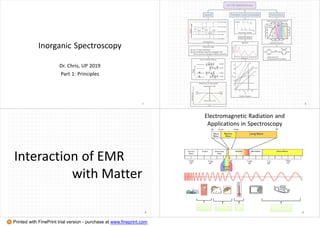
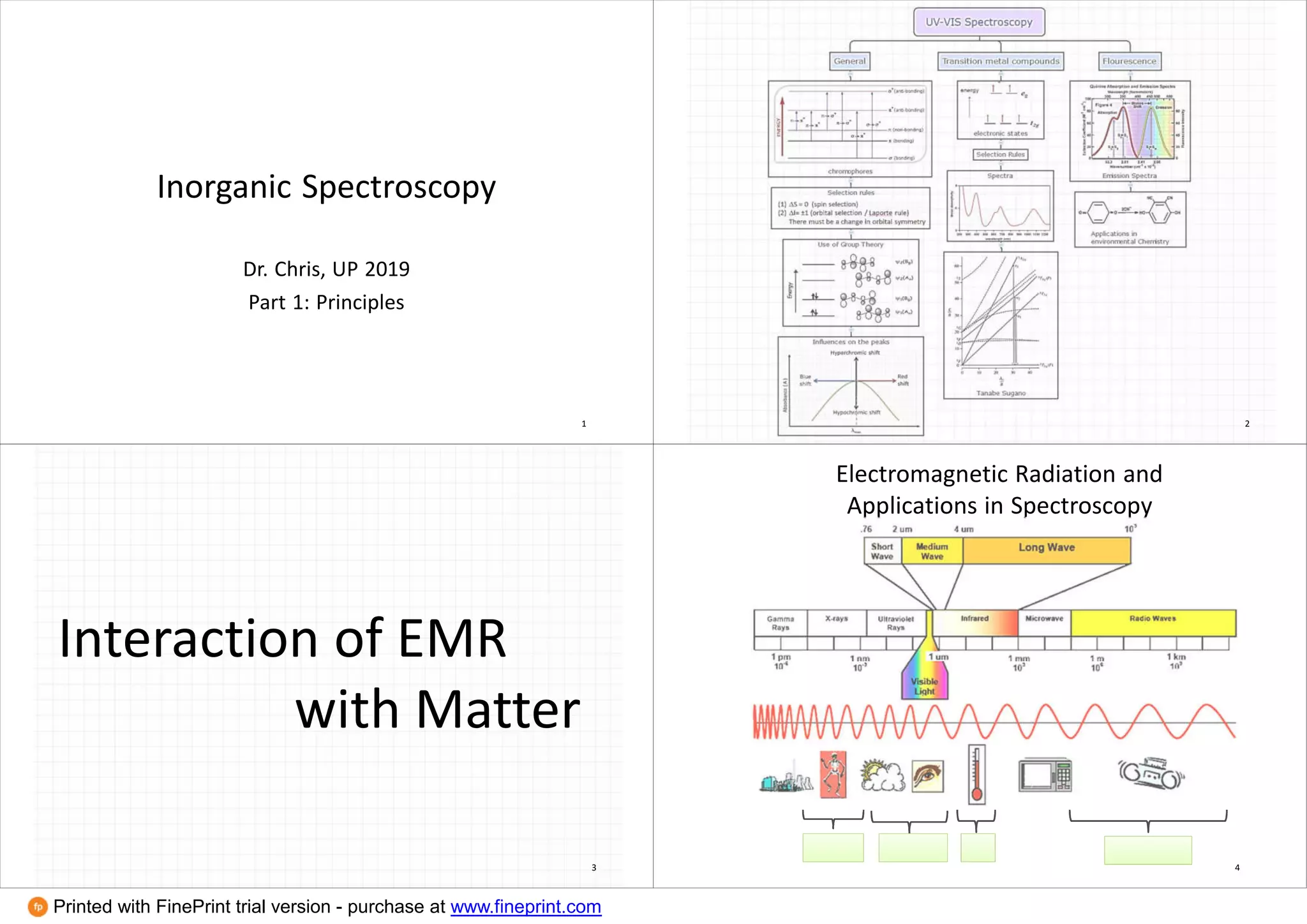
Inorganic Spectroscopy
Dr. Chris, UP 2019
Part 1: Principles
1 2
Interaction of EMR
with Matter
3
Electromagnetic Radiation and
Applications in Spectroscopy
4
Printed with FinePrint trial version - purchase at www.fineprint.com
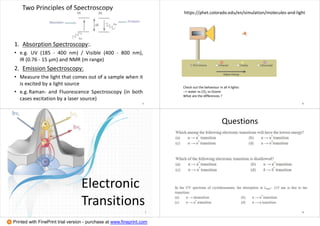
Two Principles of Spectroscopy
1. Absorption Spectroscopy:.
• e.g. UV (185 - 400 nm) / Visible (400 - 800 nm),
IR (0.76 - 15 μm) and NMR (m range)
2. Emission Spectroscopy:
• Measure the light that comes out of a sample when it
is excited by a light source
• e.g.Raman- and Fluorescence Spectroscopy (in both
cases excitation by a laser source)
5
https://phet.colorado.edu/en/simulation/molecules-and-light
6
Check out the behaviour in all 4 lights:
--> water vs CO2 vs Ozone
What are the differences ?
Electronic
Transitions
7
Questions
8
Printed with FinePrint trial version - purchase at www.fineprint.com
9
http://slideplayer.com/slide/9514618/
10
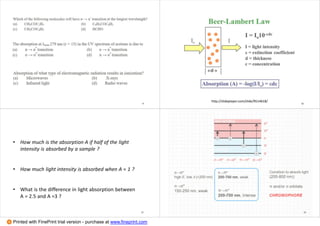
• How much is the absorption A if half of the light
intensity is absorbed by a sample ?
• How much light intensity is absorbed when A = 1 ?
• What is the difference in light absorption between
A = 2.5 and A =3 ?
11 12
Printed with FinePrint trial version - purchase at www.fineprint.com
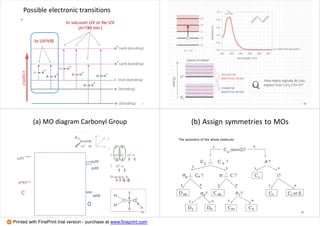
Possible electronic transitions
13 14
(a) MO diagram Carbonyl Group
15
(b) Assign symmetries to MOs
The symmetry of the whole molecule:
16
Printed with FinePrint trial version - purchase at www.fineprint.com
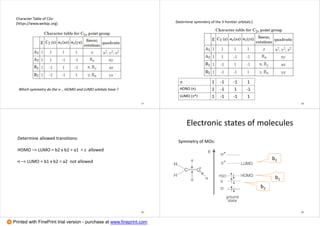
Character Table of C2v:
(https://www.webqc.org)
Which symmetry do the n- , HOMO and LUMO orbitals have ?
17
 1 -1 -1 1
HONO (n) 1 -1 1 -1
LUMO (*) 1 -1 -1 1
Determine symmetry of the 3 frontier orbitals:)
18
Determine allowed transitions:
HOMO –> LUMO = b2 x b2 = a1 = z allowed
n –> LUMO = b1 x b2 = a2 not allowed
19
Electronic states of molecules
b2
b1
b2
Symmetry of MOs:
20
Printed with FinePrint trial version - purchase at www.fineprint.com
State of the molecule:
b2 x b2 = A1
b2
b2
b1
b1 x b2 = A2Molecules with all
electrons paired are
always totally symmetric
Symmetry of the whole molecule:
21
Instead of saying:
One electron moved from b1 (HOMO) to b2 (LUMO)
[which is not allowed since b1 x b2 = a2]
We can also say:
The molecule changed its state from A1 (ground state)
to A2 (excited state)
or: A1 -> A2*
Electronic Transitions:
22
Example 2: Butadiene
23
Which transitions are allowed ?
(1) Determine the symmetry of the molecule
(2) Look up the character table
(3) Determine the characters for the HOMO and the two
LUMOs
(4) Multiply the characters for HOMO with each LUMOs
(5) Look up if these characters contain x,y or z
component
24
Printed with FinePrint trial version - purchase at www.fineprint.com
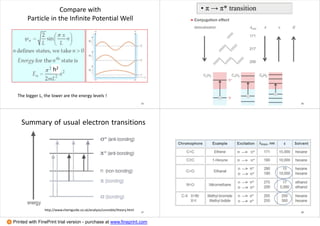
Compare with
Particle in the Infinite Potential Well
The bigger L, the lower are the energy levels !
h2
25
• π → π* transition
26
Summary of usual electron transitions
27
http://www.chemguide.co.uk/analysis/uvvisible/theory.html
28
Printed with FinePrint trial version - purchase at www.fineprint.com
http://sammypiccolo.com/australian-capital-
territory/solvent-effect-in-uv-spectroscopy-pdf.php
29
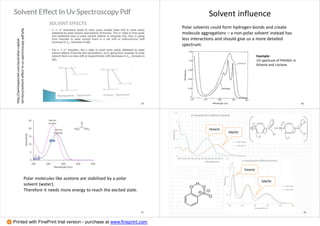
Solvent influence
30
Polar solvents could form hydrogen-bonds and create
molecule aggregations – a non-polar solvent instead has
less interactions and should give us a more detailed
spectrum:
Example:
UV spectrum of PHENOL in
Ethanol and I-octane
Polar molecules like acetone are stabilized by a polar
solvent (water).
Therefore it needs more energy to reach the excited state.
31 32
hexane
MeOH
hexane
MeOH
Printed with FinePrint trial version - purchase at www.fineprint.com
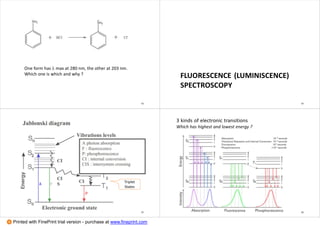
One form has  max at 280 nm, the other at 203 nm.
Which one is which and why ?
33
FLUORESCENCE (LUMINISCENCE)
SPECTROSCOPY
34
Triplet
States
35
3 kinds of electronic transitions
Which has highest and lowest energy ?
36
Printed with FinePrint trial version - purchase at www.fineprint.com
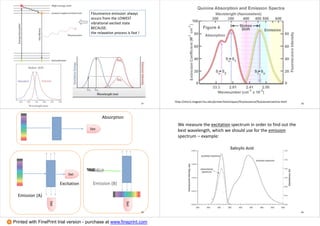
Flouresence emission always
occurs from the LOWEST
vibrational excited state
BECAUSE:
the relaxation process is fast !
37
http://micro.magnet.fsu.edu/primer/techniques/fluorescence/fluorescenceintro.html
38
Absorption
Emission (A)
Det
Det
Emission (B)
Det
Det
Excitation
39
We measure the excitation spectrum in order to find out the
best wavelength, which we should use for the emission
spectrum – example:
40
Printed with FinePrint trial version - purchase at www.fineprint.com
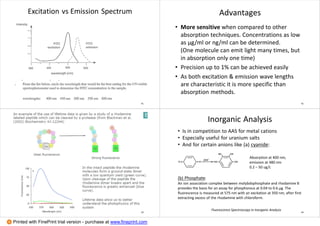
Excitation vs Emission Spectrum
41
Advantages
• More sensitive when compared to other
absorption techniques. Concentrations as low
as μg/ml or ng/ml can be determined.
(One molecule can emit light many times, but
in absorption only one time)
• Precision up to 1% can be achieved easily
• As both excitation & emission wave lengths
are characteristic it is more specific than
absorption methods.
42
43
Inorganic Analysis
• Is in competition to AAS for metal cations
• Especially useful for uranium salts
• And for certain anions like (a) cyanide:
Absorption at 400 nm,
emission at 480 nm
0.2 – 50 ug/L
(b) Phosphate:
An ion association complex between molybdophosphate and rhodamine B
provides the basis for an assay for phosphorous at 0.04 to 0.6 µg. The
fluorescence is measured at 575 nm with an excitation at 350 nm, after first
extracting excess of the rhodamine with chloroform.
Fluorescence Spectroscopy in Inorganic Analysis
44
Printed with FinePrint trial version - purchase at www.fineprint.com
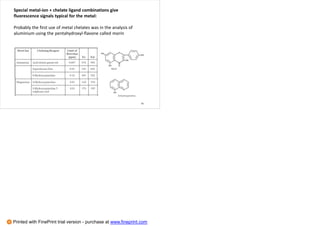
Special metal-ion + chelate ligand combinations give
fluorescence signals typical for the metal:
Probably the first use of metal chelates was in the analysis of
aluminium using the pentahydroxyl-flavone called morin
45
Printed with FinePrint trial version - purchase at www.fineprint.com

Inorganic spectroscopy 2019 part 1 compact

  • 1.
    Inorganic Spectroscopy Dr. Chris,UP 2019 Part 1: Principles 1 2 Interaction of EMR with Matter 3 Electromagnetic Radiation and Applications in Spectroscopy 4 Printed with FinePrint trial version - purchase at www.fineprint.com
  • 2.
    Two Principles ofSpectroscopy 1. Absorption Spectroscopy:. • e.g. UV (185 - 400 nm) / Visible (400 - 800 nm), IR (0.76 - 15 μm) and NMR (m range) 2. Emission Spectroscopy: • Measure the light that comes out of a sample when it is excited by a light source • e.g.Raman- and Fluorescence Spectroscopy (in both cases excitation by a laser source) 5 https://phet.colorado.edu/en/simulation/molecules-and-light 6 Check out the behaviour in all 4 lights: --> water vs CO2 vs Ozone What are the differences ? Electronic Transitions 7 Questions 8 Printed with FinePrint trial version - purchase at www.fineprint.com
  • 3.
    9 http://slideplayer.com/slide/9514618/ 10 • How muchis the absorption A if half of the light intensity is absorbed by a sample ? • How much light intensity is absorbed when A = 1 ? • What is the difference in light absorption between A = 2.5 and A =3 ? 11 12 Printed with FinePrint trial version - purchase at www.fineprint.com
  • 4.
    Possible electronic transitions 1314 (a) MO diagram Carbonyl Group 15 (b) Assign symmetries to MOs The symmetry of the whole molecule: 16 Printed with FinePrint trial version - purchase at www.fineprint.com
  • 5.
    Character Table ofC2v: (https://www.webqc.org) Which symmetry do the n- , HOMO and LUMO orbitals have ? 17  1 -1 -1 1 HONO (n) 1 -1 1 -1 LUMO (*) 1 -1 -1 1 Determine symmetry of the 3 frontier orbitals:) 18 Determine allowed transitions: HOMO –> LUMO = b2 x b2 = a1 = z allowed n –> LUMO = b1 x b2 = a2 not allowed 19 Electronic states of molecules b2 b1 b2 Symmetry of MOs: 20 Printed with FinePrint trial version - purchase at www.fineprint.com
  • 6.
    State of themolecule: b2 x b2 = A1 b2 b2 b1 b1 x b2 = A2Molecules with all electrons paired are always totally symmetric Symmetry of the whole molecule: 21 Instead of saying: One electron moved from b1 (HOMO) to b2 (LUMO) [which is not allowed since b1 x b2 = a2] We can also say: The molecule changed its state from A1 (ground state) to A2 (excited state) or: A1 -> A2* Electronic Transitions: 22 Example 2: Butadiene 23 Which transitions are allowed ? (1) Determine the symmetry of the molecule (2) Look up the character table (3) Determine the characters for the HOMO and the two LUMOs (4) Multiply the characters for HOMO with each LUMOs (5) Look up if these characters contain x,y or z component 24 Printed with FinePrint trial version - purchase at www.fineprint.com
  • 7.
    Compare with Particle inthe Infinite Potential Well The bigger L, the lower are the energy levels ! h2 25 • π → π* transition 26 Summary of usual electron transitions 27 http://www.chemguide.co.uk/analysis/uvvisible/theory.html 28 Printed with FinePrint trial version - purchase at www.fineprint.com
  • 8.
    http://sammypiccolo.com/australian-capital- territory/solvent-effect-in-uv-spectroscopy-pdf.php 29 Solvent influence 30 Polar solventscould form hydrogen-bonds and create molecule aggregations – a non-polar solvent instead has less interactions and should give us a more detailed spectrum: Example: UV spectrum of PHENOL in Ethanol and I-octane Polar molecules like acetone are stabilized by a polar solvent (water). Therefore it needs more energy to reach the excited state. 31 32 hexane MeOH hexane MeOH Printed with FinePrint trial version - purchase at www.fineprint.com
  • 9.
    One form has max at 280 nm, the other at 203 nm. Which one is which and why ? 33 FLUORESCENCE (LUMINISCENCE) SPECTROSCOPY 34 Triplet States 35 3 kinds of electronic transitions Which has highest and lowest energy ? 36 Printed with FinePrint trial version - purchase at www.fineprint.com
  • 10.
    Flouresence emission always occursfrom the LOWEST vibrational excited state BECAUSE: the relaxation process is fast ! 37 http://micro.magnet.fsu.edu/primer/techniques/fluorescence/fluorescenceintro.html 38 Absorption Emission (A) Det Det Emission (B) Det Det Excitation 39 We measure the excitation spectrum in order to find out the best wavelength, which we should use for the emission spectrum – example: 40 Printed with FinePrint trial version - purchase at www.fineprint.com
  • 11.
    Excitation vs EmissionSpectrum 41 Advantages • More sensitive when compared to other absorption techniques. Concentrations as low as μg/ml or ng/ml can be determined. (One molecule can emit light many times, but in absorption only one time) • Precision up to 1% can be achieved easily • As both excitation & emission wave lengths are characteristic it is more specific than absorption methods. 42 43 Inorganic Analysis • Is in competition to AAS for metal cations • Especially useful for uranium salts • And for certain anions like (a) cyanide: Absorption at 400 nm, emission at 480 nm 0.2 – 50 ug/L (b) Phosphate: An ion association complex between molybdophosphate and rhodamine B provides the basis for an assay for phosphorous at 0.04 to 0.6 µg. The fluorescence is measured at 575 nm with an excitation at 350 nm, after first extracting excess of the rhodamine with chloroform. Fluorescence Spectroscopy in Inorganic Analysis 44 Printed with FinePrint trial version - purchase at www.fineprint.com
  • 12.
    Special metal-ion +chelate ligand combinations give fluorescence signals typical for the metal: Probably the first use of metal chelates was in the analysis of aluminium using the pentahydroxyl-flavone called morin 45 Printed with FinePrint trial version - purchase at www.fineprint.com