Spectroscopic Methods in
Inorganic Chemistry
Dr.Chris UP August 2018
PART 2: IR of Organo-Metal compounds
M(CO)x
and RAMAN
1
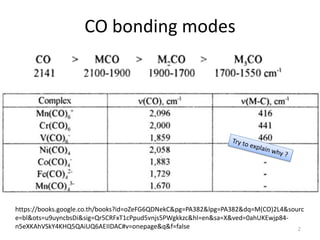
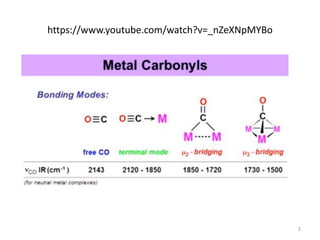
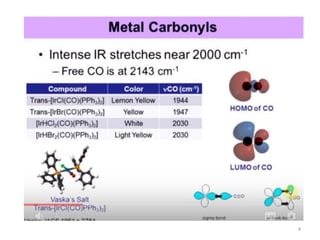
CO bonding modes
https://books.google.co.th/books?id=oZeFG6QDNekC&pg=PA382&lpg=PA382&dq=M(CO)2L4&sourc
e=bl&ots=u9uyncbsDi&sig=Qr5CRFxT1cPpud5vnjs5PWgkkzc&hl=en&sa=X&ved=0ahUKEwjp84-
n5eXKAhVSkY4KHQ5QAiUQ6AEIIDAC#v=onepage&q&f=false 2
https://www.youtube.com/watch?v=_nZeXNpMYBo
3
4
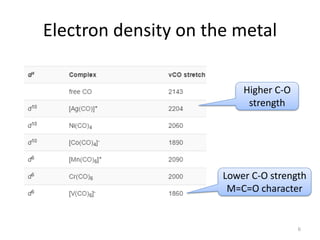
The C–O stretching wavenumbers are shifted to lower values when
there are changes in the extent of back-bonding in the compound.
Removing positive charge from the metal causes the shift of
electrons from the metal to the CO π∗ orbitals causes the CO
wavenumber values to decrease.
The highest excess of negative charge on the metal occurs in the
*V(CO)6 +− complex and so more back-bonding occurs than in the
other complexes.
The next highest excess of electron density is in Cr(CO)6 , and then
[Mn(CO)6 ]+.
5
Electron density on the metal
Higher C-O
strength
Lower C-O strength
M=C=O character
6
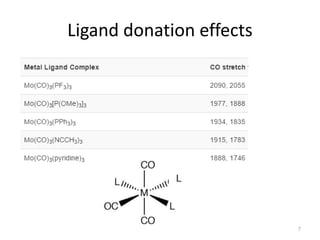
Ligand donation effects
7
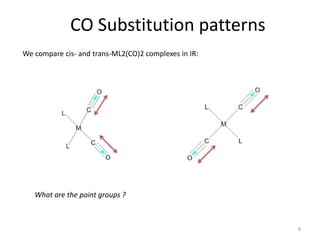
CO Substitution patterns
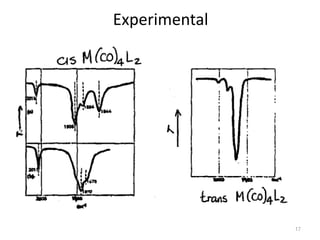
We compare cis- and trans-ML2(CO)2 complexes in IR:
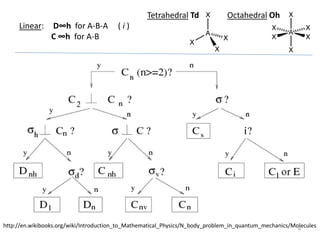
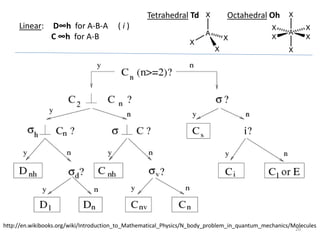
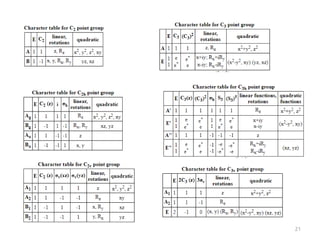
What are the point groups ?
8
Tetrahedral Td Octahedral Oh
Linear: D∞h for A-B-A ( i )
C ∞h for A-B
http://en.wikibooks.org/wiki/Introduction_to_Mathematical_Physics/N_body_problem_in_quantum_mechanics/Molecules
9
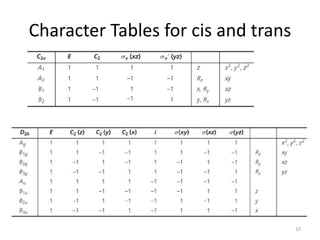
Character Tables for cis and trans
10
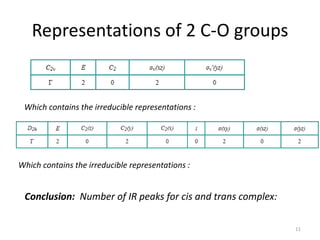
Representations of 2 C-O groups
Which contains the irreducible representations :
Conclusion: Number of IR peaks for cis and trans complex:
11
12
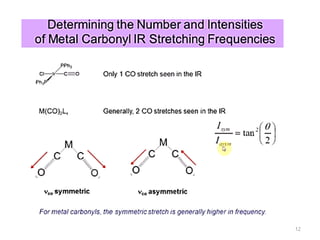
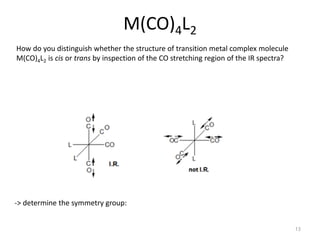
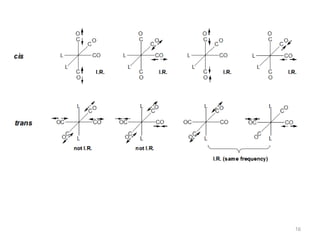
How do you distinguish whether the structure of transition metal complex molecule
M(CO)4L2 is cis or trans by inspection of the CO stretching region of the IR spectra?
-> determine the symmetry group:
M(CO)4L2
13
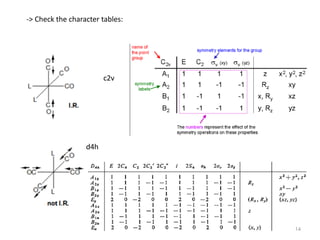
-> Check the character tables:
c2v
d4h
14
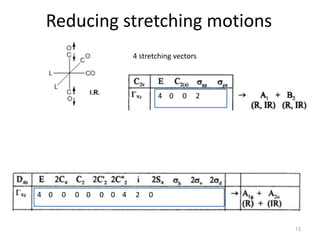
Reducing stretching motions
4 stretching vectors
4 0 0 2
4 0 0 0 0 0 0 4 2 0
15
16
Experimental
17
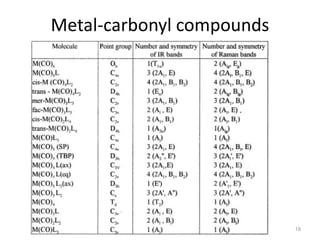
Metal-carbonyl compounds
18
Exercise
19
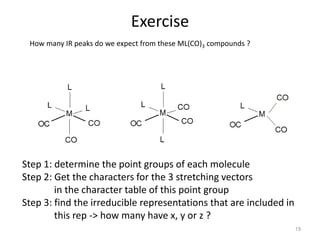
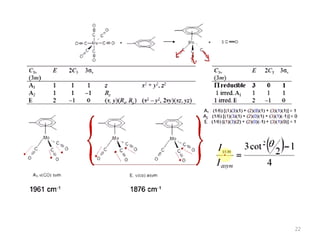
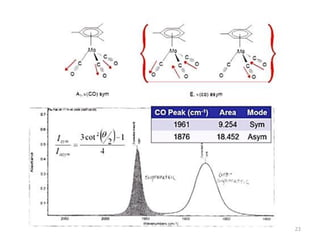
How many IR peaks do we expect from these ML(CO)3 compounds ?
Step 1: determine the point groups of each molecule
Step 2: Get the characters for the 3 stretching vectors
in the character table of this point group
Step 3: find the irreducible representations that are included in
this rep -> how many have x, y or z ?
Tetrahedral Td Octahedral Oh
Linear: D∞h for A-B-A ( i )
C ∞h for A-B
http://en.wikibooks.org/wiki/Introduction_to_Mathematical_Physics/N_body_problem_in_quantum_mechanics/Molecules
20
21
22
23
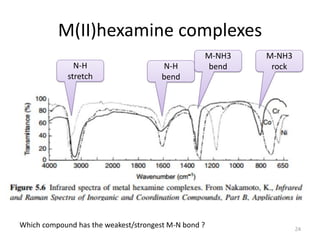
M(II)hexamine complexes
N-H
stretch
N-H
bend
M-NH3
bend
M-NH3
rock
24
Which compound has the weakest/strongest M-N bond ?
The spectra presented in Figure 5.6 show a trend in the wavenumber shifts for the
three hexamine complexes; the N–H bands shift to lower wavenumbers from Co to Cr
to Ni. This indicates that the N–H bond order (bond strength) decreases as the metal–
N bond order increases in the stability order mentioned
25
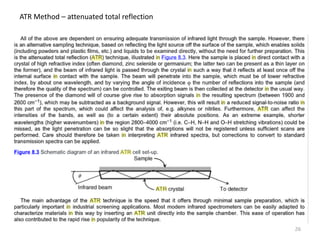
ATR Method – attenuated total reflection
26
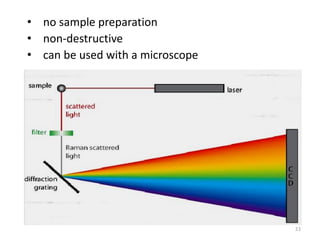
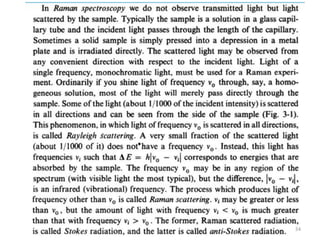
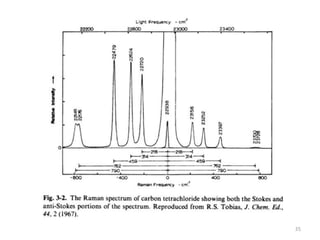
RAMAN
27
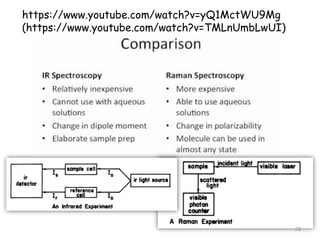
https://www.youtube.com/watch?v=yQ1MctWU9Mg
(https://www.youtube.com/watch?v=TMLnUmbLwUI)
28
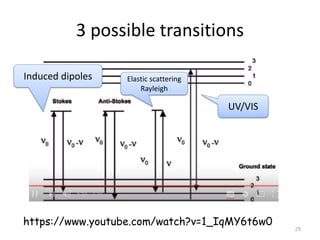
3 possible transitions
29
UV/VIS
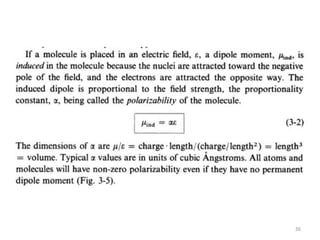
Induced dipoles
https://www.youtube.com/watch?v=1_IqMY6t6w0
Elastic scattering
Rayleigh
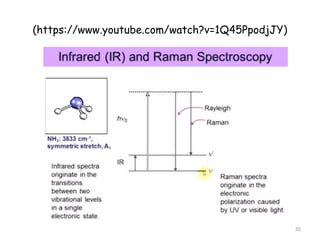
(https://www.youtube.com/watch?v=1Q45PpodjJY)
30
31
32
• no sample preparation
• non-destructive
• can be used with a microscope
33
34
35
36
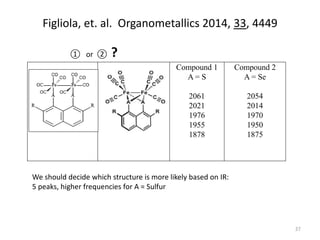
Figliola, et. al. Organometallics 2014, 33, 4449
Compound 1
A = S
2061
2021
1976
1955
1878
Compound 2
A = Se
2054
2014
1970
1950
1875
We should decide which structure is more likely based on IR:
5 peaks, higher frequencies for A = Sulfur
① or ② ?
37
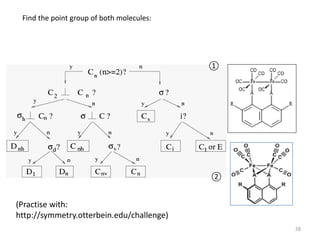
Find the point group of both molecules:
①
②
(Practise with:
http://symmetry.otterbein.edu/challenge)
38
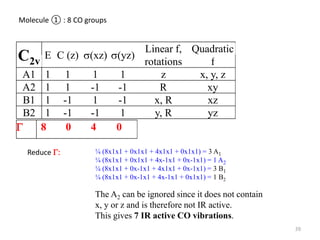
C2v
E C (z) s(xz) s(yz)
Linear f,
rotations
Quadratic
f
A1 1 1 1 1 z x, y, z
A2 1 1 -1 -1 R xy
B1 1 -1 1 -1 x, R xz
B2 1 -1 -1 1 y, R yz
G 8 0 4 0
Molecule ① : 8 CO groups
Reduce G: ¼ (8x1x1 + 0x1x1 + 4x1x1 + 0x1x1) = 3 A1
¼ (8x1x1 + 0x1x1 + 4x-1x1 + 0x-1x1) = 1 A2
¼ (8x1x1 + 0x-1x1 + 4x1x1 + 0x-1x1) = 3 B1
¼ (8x1x1 + 0x-1x1 + 4x-1x1 + 0x1x1) = 1 B2
The A2 can be ignored since it does not contain
x, y or z and is therefore not IR active.
This gives 7 IR active CO vibrations.
39
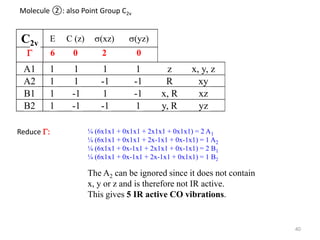
C2v
E C (z) s(xz) s(yz)
G 6 0 2 0
Molecule ②: also Point Group C2v
Reduce G: ¼ (6x1x1 + 0x1x1 + 2x1x1 + 0x1x1) = 2 A1
¼ (6x1x1 + 0x1x1 + 2x-1x1 + 0x-1x1) = 1 A2
¼ (6x1x1 + 0x-1x1 + 2x1x1 + 0x-1x1) = 2 B1
¼ (6x1x1 + 0x-1x1 + 2x-1x1 + 0x1x1) = 1 B2
The A2 can be ignored since it does not contain
x, y or z and is therefore not IR active.
This gives 5 IR active CO vibrations.
A1 1 1 1 1 z x, y, z
A2 1 1 -1 -1 R xy
B1 1 -1 1 -1 x, R xz
B2 1 -1 -1 1 y, R yz
40
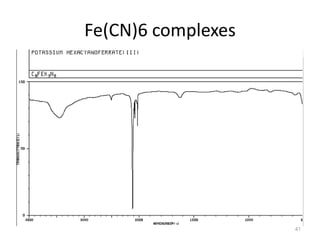
Fe(CN)6 complexes
41
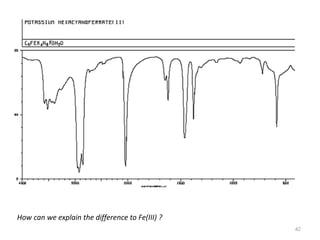
How can we explain the difference to Fe(III) ?
42
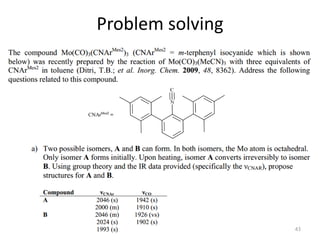
Problem solving
43
44
45

Spectroscopic methods IR part 2