BASIC DRILLING ENGINEERING
 WHY WE DRILL
 PROSPECT SELECTION
 HISTORICAL BACKGROUND
 MODIFICATION IN DRILLING
 TYPES OF DRILLING
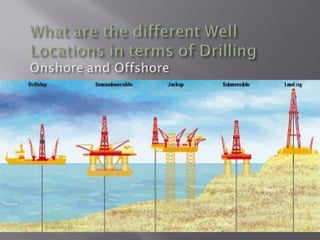
 WHAT ARE DIFFERENT WELL LOCATIONS IN TERMS OF
DRILLING
 CONVENTINAL DRILLING RIG COMPONENTS
 RIG COMPONENTS
 ADVANCEMENT IN ROTARY DRILLING
 MUD TYPES & THEIR USAGE
 WHAT WE CALL A SUCCESSFUL DRILLING OPERATION
 TO KNOW THE SUB-SURFACE
 TO GET WATER FROM UNDERNEATH
 TO GET THE BLACK GOLD ( OIL ) & GAS
 In case of Production wells, prospect selection is
identified by the need to maintain or increase
reservoir production
 Exploration wells require geological and
geophysical data gathering, processing and
evaluation
• Surface geological study
• Subsurface mapping
• Identification of structures e.g. anticlines, salt
domes, fault traps, sand bodies lenses
• Seismic Evaluation
 1808 PERCUSSION DRILLING BY CHINESE
FIRST COMMERCIAL WELL
 1859 CABLE TOOL PERCUSSION DRILLING
 1918 WORLD DEEPEST WELL BY CABLE
TOOL ( 7386 ft )
 1930 ROTARY DRILLING
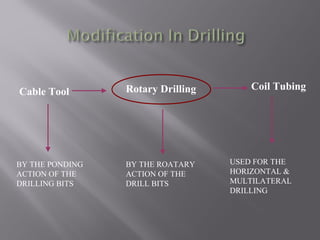
Rotary Drilling Coil Tubing
BY THE PONDING
ACTION OF THE
DRILLING BITS
BY THE ROATARY
ACTION OF THE
DRILL BITS
USED FOR THE
HORIZONTAL &
MULTILATERAL
DRILLING
Cable Tool
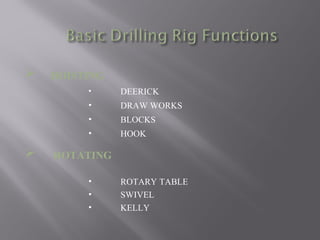
 HOISTING
• DEERICK
• DRAW WORKS
• BLOCKS
• HOOK
 ROTATING
• ROTARY TABLE
• SWIVEL
• KELLY
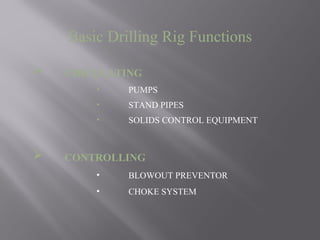
 CIRCULATING
• PUMPS
• STAND PIPES
• SOLIDS CONTROL EQUIPMENT
 CONTROLLING
• BLOWOUT PREVENTOR
• CHOKE SYSTEM
Basic Drilling Rig Functions
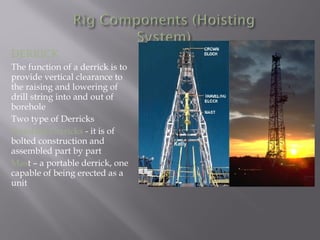
DERRICK
The function of a derrick is to
provide vertical clearance to
the raising and lowering of
drill string into and out of
borehole
Two type of Derricks
Standard Derricks - it is of
bolted construction and
assembled part by part
Mast – a portable derrick, one
capable of being erected as a
unit
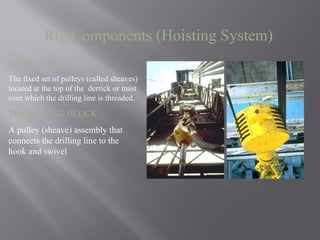
CROWN BLOCK
The fixed set of pulleys (called sheaves)
located at the top of the derrick or mast
over which the drilling line is threaded.
TRAVELLING BLOCK
A pulley (sheave) assembly that
connects the drilling line to the
hook and swivel
Rig Components (Hoisting System)
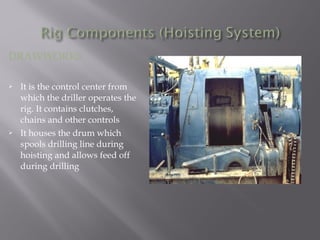
DRAWWORKS
 It is the control center from
which the driller operates the
rig. It contains clutches,
chains and other controls
 It houses the drum which
spools drilling line during
hoisting and allows feed off
during drilling
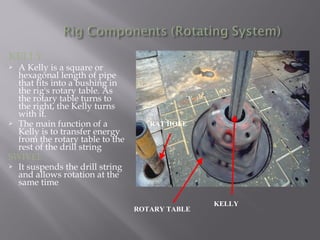
KELLY
 A Kelly is a square or
hexagonal length of pipe
that fits into a bushing in
the rig's rotary table. As
the rotary table turns to
the right, the Kelly turns
with it.
 The main function of a
Kelly is to transfer energy
from the rotary table to the
rest of the drill string
SWIVEL
 It suspends the drill string
and allows rotation at the
same time
KELLY
ROTARY TABLE
RAT HOLE
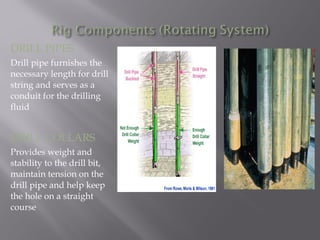
DRILL PIPES
Drill pipe furnishes the
necessary length for drill
string and serves as a
conduit for the drilling
fluid
DRILL COLLARS
Provides weight and
stability to the drill bit,
maintain tension on the
drill pipe and help keep
the hole on a straight
course
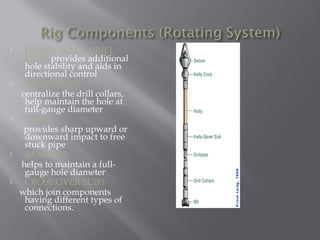
 HEAVY WALL DRILL
PIPES provides additional
hole stability and aids in
directional control
 STABILIZERS
centralize the drill collars,
help maintain the hole at
full-gauge diameter
 JARS
provides sharp upward or
downward impact to free
stuck pipe
 REAMERS
helps to maintain a full-
gauge hole diameter
 CROSS OVER SUBS
which join components
having different types of
connections.
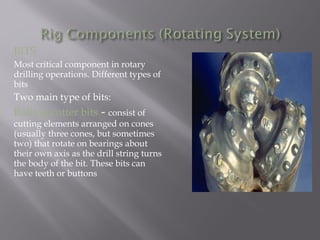
BITS
Most critical component in rotary
drilling operations. Different types of
bits
Two main type of bits:
Rolling cutter bits - consist of
cutting elements arranged on cones
(usually three cones, but sometimes
two) that rotate on bearings about
their own axis as the drill string turns
the body of the bit. These bits can
have teeth or buttons
 Fixed cutter bits - also
known as drag bits, consist
of stationary cutting
elements that are integral
with the body of the bit and
are rotated directly by the
turning of the drill string.
The principal types of fixed
cutter bits are
 natural diamond
 polycrystalline diamond
compact (PDC)
MUD PUMPS
 Their function is to circulate the drilling fluid at the desired
pressure and volume
 The pump normally used for this service is reciprocating piston,
double acting and duplex type
STANDPIPE
 A rigid metal conduit that provides the high-pressure pathway
for drilling mud to travel approximately one-third of the way up
the derrick where it connects to a flexible high-pressure hose
(Kelly hose)
 Many large rigs are fitted with dual standpipes so that downtime
is kept to a minimum if one standpipe requires repair
PRIME MOVRES
 These are used to supply
power to drilling operations.
These can be steam engines,
electric motors, internal
combustion engine
 The bulk of rig power is
consumed in two operations
namely circulation of fluid
and hoisting
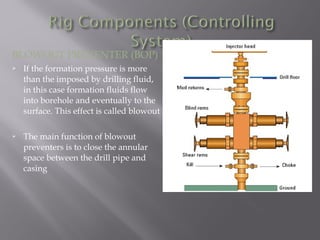
BLOWOUT PREVENTER (BOP)
 If the formation pressure is more
than the imposed by drilling fluid,
in this case formation fluids flow
into borehole and eventually to the
surface. This effect is called blowout
 The main function of blowout
preventers is to close the annular
space between the drill pipe and
casing
 DIRECTIONAL DRILLING
 HORIZONTAL DRILLING
 MULTILATERAL DRILLING
 COIL TUBING DRILLING
 Tools dropped while drilling
 Pipe stuck
 Increased size of hole
 Lost circulation problems
 Sloughing shale
Through which we get our desired
results without any accidents.

Basic drilling engineering

  • 2.
  • 3.
     WHY WEDRILL  PROSPECT SELECTION  HISTORICAL BACKGROUND  MODIFICATION IN DRILLING  TYPES OF DRILLING  WHAT ARE DIFFERENT WELL LOCATIONS IN TERMS OF DRILLING  CONVENTINAL DRILLING RIG COMPONENTS  RIG COMPONENTS  ADVANCEMENT IN ROTARY DRILLING  MUD TYPES & THEIR USAGE  WHAT WE CALL A SUCCESSFUL DRILLING OPERATION
  • 4.
     TO KNOWTHE SUB-SURFACE  TO GET WATER FROM UNDERNEATH  TO GET THE BLACK GOLD ( OIL ) & GAS
  • 5.
     In caseof Production wells, prospect selection is identified by the need to maintain or increase reservoir production  Exploration wells require geological and geophysical data gathering, processing and evaluation • Surface geological study • Subsurface mapping • Identification of structures e.g. anticlines, salt domes, fault traps, sand bodies lenses • Seismic Evaluation
  • 6.
     1808 PERCUSSIONDRILLING BY CHINESE FIRST COMMERCIAL WELL  1859 CABLE TOOL PERCUSSION DRILLING  1918 WORLD DEEPEST WELL BY CABLE TOOL ( 7386 ft )  1930 ROTARY DRILLING
  • 7.
    Rotary Drilling CoilTubing BY THE PONDING ACTION OF THE DRILLING BITS BY THE ROATARY ACTION OF THE DRILL BITS USED FOR THE HORIZONTAL & MULTILATERAL DRILLING Cable Tool
  • 9.
     HOISTING • DEERICK •DRAW WORKS • BLOCKS • HOOK  ROTATING • ROTARY TABLE • SWIVEL • KELLY
  • 10.
     CIRCULATING • PUMPS •STAND PIPES • SOLIDS CONTROL EQUIPMENT  CONTROLLING • BLOWOUT PREVENTOR • CHOKE SYSTEM Basic Drilling Rig Functions
  • 11.
    DERRICK The function ofa derrick is to provide vertical clearance to the raising and lowering of drill string into and out of borehole Two type of Derricks Standard Derricks - it is of bolted construction and assembled part by part Mast – a portable derrick, one capable of being erected as a unit
  • 12.
    CROWN BLOCK The fixedset of pulleys (called sheaves) located at the top of the derrick or mast over which the drilling line is threaded. TRAVELLING BLOCK A pulley (sheave) assembly that connects the drilling line to the hook and swivel Rig Components (Hoisting System)
  • 13.
    DRAWWORKS  It isthe control center from which the driller operates the rig. It contains clutches, chains and other controls  It houses the drum which spools drilling line during hoisting and allows feed off during drilling
  • 14.
    KELLY  A Kellyis a square or hexagonal length of pipe that fits into a bushing in the rig's rotary table. As the rotary table turns to the right, the Kelly turns with it.  The main function of a Kelly is to transfer energy from the rotary table to the rest of the drill string SWIVEL  It suspends the drill string and allows rotation at the same time KELLY ROTARY TABLE RAT HOLE
  • 15.
    DRILL PIPES Drill pipefurnishes the necessary length for drill string and serves as a conduit for the drilling fluid DRILL COLLARS Provides weight and stability to the drill bit, maintain tension on the drill pipe and help keep the hole on a straight course
  • 16.
     HEAVY WALLDRILL PIPES provides additional hole stability and aids in directional control  STABILIZERS centralize the drill collars, help maintain the hole at full-gauge diameter  JARS provides sharp upward or downward impact to free stuck pipe  REAMERS helps to maintain a full- gauge hole diameter  CROSS OVER SUBS which join components having different types of connections.
  • 17.
    BITS Most critical componentin rotary drilling operations. Different types of bits Two main type of bits: Rolling cutter bits - consist of cutting elements arranged on cones (usually three cones, but sometimes two) that rotate on bearings about their own axis as the drill string turns the body of the bit. These bits can have teeth or buttons
  • 18.
     Fixed cutterbits - also known as drag bits, consist of stationary cutting elements that are integral with the body of the bit and are rotated directly by the turning of the drill string. The principal types of fixed cutter bits are  natural diamond  polycrystalline diamond compact (PDC)
  • 20.
    MUD PUMPS  Theirfunction is to circulate the drilling fluid at the desired pressure and volume  The pump normally used for this service is reciprocating piston, double acting and duplex type STANDPIPE  A rigid metal conduit that provides the high-pressure pathway for drilling mud to travel approximately one-third of the way up the derrick where it connects to a flexible high-pressure hose (Kelly hose)  Many large rigs are fitted with dual standpipes so that downtime is kept to a minimum if one standpipe requires repair
  • 21.
    PRIME MOVRES  Theseare used to supply power to drilling operations. These can be steam engines, electric motors, internal combustion engine  The bulk of rig power is consumed in two operations namely circulation of fluid and hoisting
  • 22.
    BLOWOUT PREVENTER (BOP) If the formation pressure is more than the imposed by drilling fluid, in this case formation fluids flow into borehole and eventually to the surface. This effect is called blowout  The main function of blowout preventers is to close the annular space between the drill pipe and casing
  • 23.
     DIRECTIONAL DRILLING HORIZONTAL DRILLING  MULTILATERAL DRILLING  COIL TUBING DRILLING
  • 24.
     Tools droppedwhile drilling  Pipe stuck  Increased size of hole  Lost circulation problems  Sloughing shale
  • 25.
    Through which weget our desired results without any accidents.