1. What is Well Completion.
2. Setting Production Casing.
3. Installing the Tubing.
4. Installing the Christmas Tree
5. Types of Well Completion
6. Type of Flow
7. Perforating
8. Well Stimulation
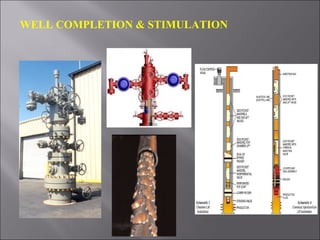
WELL COMPLETION & STIMULATION
What is Well Completion?



After careful interpretation and consideration on well
test data (coring, logging etc), a decision is made
whether to set production casing and complete the well
or to plug and abandon it.



Decision to abandon is made when the well is not
capable to produce oil or gas in commercial quantities.



However, sometimes wells that were plugged and
abandoned at one time in the past may be reopened and
produced if the price of oil or gas has become more
favorable.



“Completing a well” means installing equipment in the
well to allow a safe and controlled flow of petroleum
from the well.
Setting Production Casing



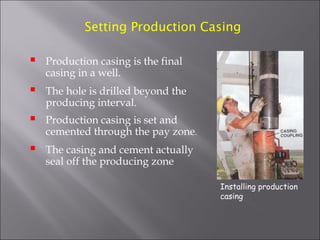
Production casing is the final
casing in a well.



The hole is drilled beyond the
producing interval.



Production casing is set and
cemented through the pay zone.



The casing and cement actually
seal off the producing zone
Installing production
casing
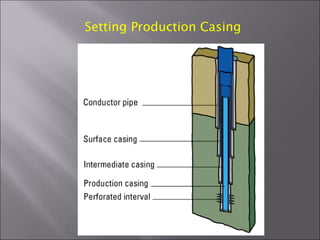
Setting Production Casing
Installing the Tubing



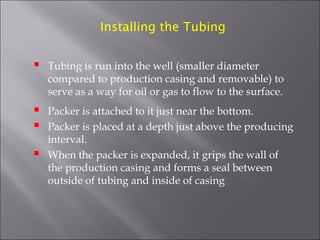
Tubing is run into the well (smaller diameter
compared to production casing and removable) to
serve as a way for oil or gas to flow to the surface.




Packer is attached to it just near the bottom.
Packer is placed at a depth just above the producing
interval.
When the packer is expanded, it grips the wall of
the production casing and forms a seal between
outside of tubing and inside of casing


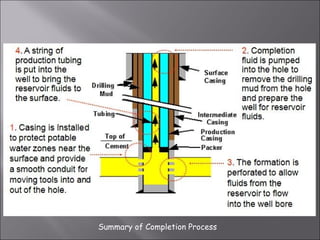
Summary of Completion Process
Installing the Christmas Tree



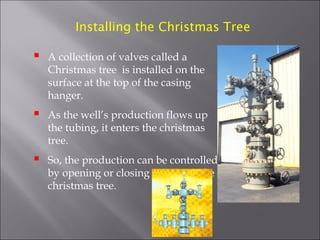
A collection of valves called a
Christmas tree is installed on the
surface at the top of the casing
hanger.



As the well’s production flows up
the tubing, it enters the christmas
tree.



So, the production can be controlled
by opening or closing valves on the
christmas tree.
Type of Well Completions



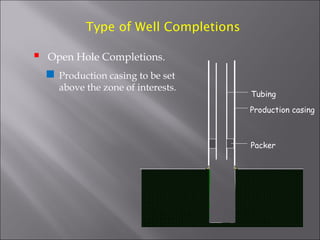
Open Hole Completions.

 Production casing to be set

above the zone of interests.

Tubing
Production casing

Packer
Type of Well Completions



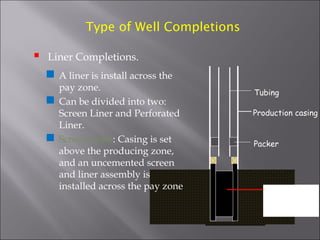
Liner Completions.

 A liner is install across the



pay zone.
Can be divided into two:
Screen Liner and Perforated
Liner.
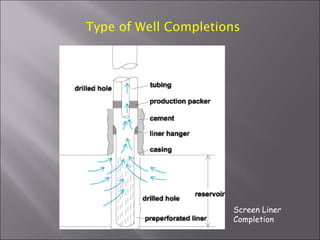
Screen Liner: Casing is set
above the producing zone,
and an uncemented screen
and liner assembly is
installed across the pay zone

Tubing
Production casing
Packer

Screen and
liner
assembly
Type of Well Completions

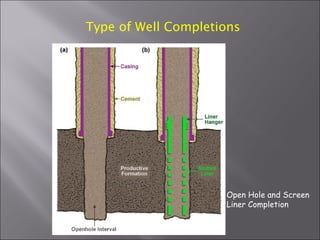
Open Hole and Screen
Liner Completion
Type of Well Completions

Screen Liner
Completion
Type of Well Completions

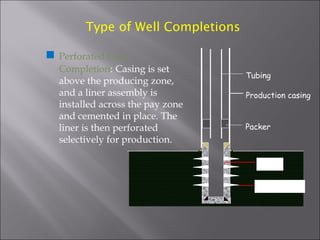
 Perforated Liner
Completion: Casing is set
above the producing zone,
and a liner assembly is
installed across the pay zone
and cemented in place. The
liner is then perforated
selectively for production.

Tubing
Production casing

Packer

Liner
Perforation
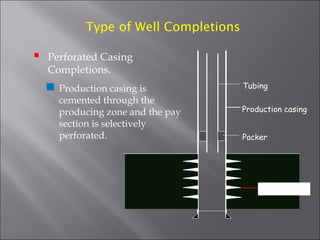
Type of Well Completions



Perforated Casing
Completions.

 Production casing is

cemented through the
producing zone and the pay
section is selectively
perforated.

Tubing
Production casing
Packer

Perforation
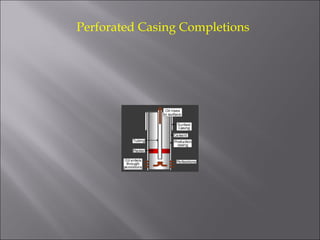
Perforated Casing Completions
Type of Flow



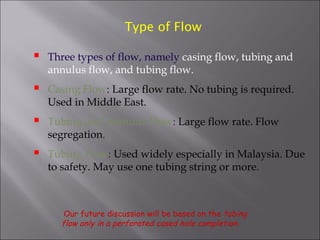
Three types of flow, namely casing flow, tubing and
annulus flow, and tubing flow.



Casing Flow: Large flow rate. No tubing is required.
Used in Middle East.



Tubing and Annulus Flow: Large flow rate. Flow
segregation.



Tubing Flow: Used widely especially in Malaysia. Due
to safety. May use one tubing string or more.

Our future discussion will be based on the tubing
flow only in a perforated cased hole completion .
Perforation



Since the pay zone is sealed off by the production
casing and cement, perforations must be made in order
for oil or gas to flow into the wellbore.


Hole made in the casing, cement, and formation,
through which formation fluids enter a wellbore.
Usually several perforation are made at a time.



Perforating incorporates shaped-charge explosives
which creating a jet of high-pressure, high-velocity
liquid – jet perforation.



It can be overbalance or underbalance perforation, and
wireline conveyed perforation (WCP) or tubing
conveyed perforation (TCP).
Perforation



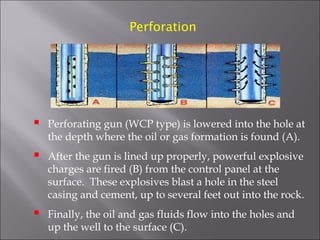
Perforating gun (WCP type) is lowered into the hole at
the depth where the oil or gas formation is found (A).



After the gun is lined up properly, powerful explosive
charges are fired (B) from the control panel at the
surface.  These explosives blast a hole in the steel
casing and cement, up to several feet out into the rock.



Finally, the oil and gas fluids flow into the holes and
up the well to the surface (C).
Well Stimulation



Sometime, petroleum exists in a formation but is
unable to flow readily into the well because the
formation has very low permeability.

Natural low permeability formation.
Formation damage around the wellbore caused by
invasion of perforation fluid and charge debris.



Acidizing or fracturing is a methods used to improve
the permeability near the wellbore.
Acidizing



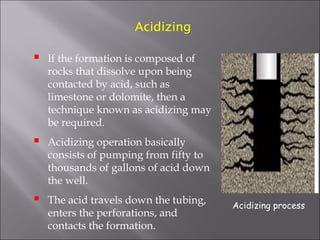
If the formation is composed of
rocks that dissolve upon being
contacted by acid, such as
limestone or dolomite, then a
technique known as acidizing may
be required.



Acidizing operation basically
consists of pumping from fifty to
thousands of gallons of acid down
the well.



The acid travels down the tubing,
enters the perforations, and
contacts the formation.

Acidizing process
Acidizing



Continued pumping forces the acid into the formation
where it produces channels.



Channels will provide a way for the formation’s oil or
gas to enter the well through the perforations.
The most common acid systems in use are:





Hydrochloric Acid: This is the most widely used acid in
treatments, with concentrations ranging between 7.5% and
28%, the most common is 15%. It will dissolves Calcium
Carbonate (CaCO3), Dolomite (CaMgCO3), Siderite (FeCO3),
and Iron Oxide (Fe2O3).
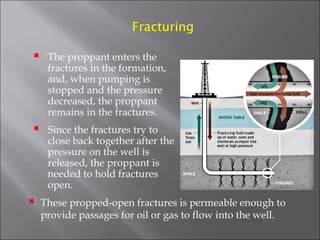
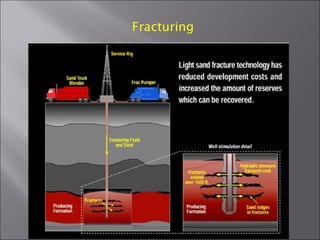
Fracturing



The proppant enters the
fractures in the formation,
and, when pumping is
stopped and the pressure
decreased, the proppant
remains in the fractures.



Since the fractures try to
close back together after the
pressure on the well is
released, the proppant is
needed to hold fractures
open.



These propped-open fractures is permeable enough to
provide passages for oil or gas to flow into the well.
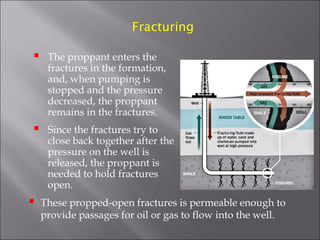
Fracturing



The proppant enters the
fractures in the formation,
and, when pumping is
stopped and the pressure
decreased, the proppant
remains in the fractures.



Since the fractures try to
close back together after the
pressure on the well is
released, the proppant is
needed to hold fractures
open.



These propped-open fractures is permeable enough to
provide passages for oil or gas to flow into the well.
Fracturing

Well completion and stimulation

  • 2.
    1. What isWell Completion. 2. Setting Production Casing. 3. Installing the Tubing. 4. Installing the Christmas Tree 5. Types of Well Completion 6. Type of Flow 7. Perforating 8. Well Stimulation
  • 3.
    WELL COMPLETION &STIMULATION
  • 4.
    What is WellCompletion?  After careful interpretation and consideration on well test data (coring, logging etc), a decision is made whether to set production casing and complete the well or to plug and abandon it.  Decision to abandon is made when the well is not capable to produce oil or gas in commercial quantities.  However, sometimes wells that were plugged and abandoned at one time in the past may be reopened and produced if the price of oil or gas has become more favorable.  “Completing a well” means installing equipment in the well to allow a safe and controlled flow of petroleum from the well.
  • 5.
    Setting Production Casing  Productioncasing is the final casing in a well.  The hole is drilled beyond the producing interval.  Production casing is set and cemented through the pay zone.  The casing and cement actually seal off the producing zone Installing production casing
  • 6.
  • 7.
    Installing the Tubing  Tubingis run into the well (smaller diameter compared to production casing and removable) to serve as a way for oil or gas to flow to the surface.   Packer is attached to it just near the bottom. Packer is placed at a depth just above the producing interval. When the packer is expanded, it grips the wall of the production casing and forms a seal between outside of tubing and inside of casing 
  • 8.
  • 9.
    Installing the ChristmasTree  A collection of valves called a Christmas tree is installed on the surface at the top of the casing hanger.  As the well’s production flows up the tubing, it enters the christmas tree.  So, the production can be controlled by opening or closing valves on the christmas tree.
  • 10.
    Type of WellCompletions  Open Hole Completions.  Production casing to be set above the zone of interests. Tubing Production casing Packer
  • 11.
    Type of WellCompletions  Liner Completions.  A liner is install across the   pay zone. Can be divided into two: Screen Liner and Perforated Liner. Screen Liner: Casing is set above the producing zone, and an uncemented screen and liner assembly is installed across the pay zone Tubing Production casing Packer Screen and liner assembly
  • 12.
    Type of WellCompletions Open Hole and Screen Liner Completion
  • 13.
    Type of WellCompletions Screen Liner Completion
  • 14.
    Type of WellCompletions  Perforated Liner Completion: Casing is set above the producing zone, and a liner assembly is installed across the pay zone and cemented in place. The liner is then perforated selectively for production. Tubing Production casing Packer Liner Perforation
  • 15.
    Type of WellCompletions  Perforated Casing Completions.  Production casing is cemented through the producing zone and the pay section is selectively perforated. Tubing Production casing Packer Perforation
  • 16.
  • 17.
    Type of Flow  Threetypes of flow, namely casing flow, tubing and annulus flow, and tubing flow.  Casing Flow: Large flow rate. No tubing is required. Used in Middle East.  Tubing and Annulus Flow: Large flow rate. Flow segregation.  Tubing Flow: Used widely especially in Malaysia. Due to safety. May use one tubing string or more. Our future discussion will be based on the tubing flow only in a perforated cased hole completion .
  • 18.
    Perforation  Since the payzone is sealed off by the production casing and cement, perforations must be made in order for oil or gas to flow into the wellbore.  Hole made in the casing, cement, and formation, through which formation fluids enter a wellbore. Usually several perforation are made at a time.  Perforating incorporates shaped-charge explosives which creating a jet of high-pressure, high-velocity liquid – jet perforation.  It can be overbalance or underbalance perforation, and wireline conveyed perforation (WCP) or tubing conveyed perforation (TCP).
  • 19.
    Perforation  Perforating gun (WCPtype) is lowered into the hole at the depth where the oil or gas formation is found (A).  After the gun is lined up properly, powerful explosive charges are fired (B) from the control panel at the surface.  These explosives blast a hole in the steel casing and cement, up to several feet out into the rock.  Finally, the oil and gas fluids flow into the holes and up the well to the surface (C).
  • 20.
    Well Stimulation  Sometime, petroleumexists in a formation but is unable to flow readily into the well because the formation has very low permeability. Natural low permeability formation. Formation damage around the wellbore caused by invasion of perforation fluid and charge debris.  Acidizing or fracturing is a methods used to improve the permeability near the wellbore.
  • 21.
    Acidizing  If the formationis composed of rocks that dissolve upon being contacted by acid, such as limestone or dolomite, then a technique known as acidizing may be required.  Acidizing operation basically consists of pumping from fifty to thousands of gallons of acid down the well.  The acid travels down the tubing, enters the perforations, and contacts the formation. Acidizing process
  • 22.
    Acidizing  Continued pumping forcesthe acid into the formation where it produces channels.  Channels will provide a way for the formation’s oil or gas to enter the well through the perforations. The most common acid systems in use are:   Hydrochloric Acid: This is the most widely used acid in treatments, with concentrations ranging between 7.5% and 28%, the most common is 15%. It will dissolves Calcium Carbonate (CaCO3), Dolomite (CaMgCO3), Siderite (FeCO3), and Iron Oxide (Fe2O3).
  • 23.
    Fracturing  The proppant entersthe fractures in the formation, and, when pumping is stopped and the pressure decreased, the proppant remains in the fractures.  Since the fractures try to close back together after the pressure on the well is released, the proppant is needed to hold fractures open.  These propped-open fractures is permeable enough to provide passages for oil or gas to flow into the well.
  • 24.
    Fracturing  The proppant entersthe fractures in the formation, and, when pumping is stopped and the pressure decreased, the proppant remains in the fractures.  Since the fractures try to close back together after the pressure on the well is released, the proppant is needed to hold fractures open.  These propped-open fractures is permeable enough to provide passages for oil or gas to flow into the well.
  • 25.