Resistivity LogResistivity Log
• Basics about the Resistivity:
• Resistivity measures the electric properties of the formation,
• Resistivity is measured as, R in Ohm-meter,
• Resistivity is the inverse of conductivity,
• The ability to conduct electric current depends upon:
• The Volume of water,
• The Temperature of the formation,
• The Salinity of the formation
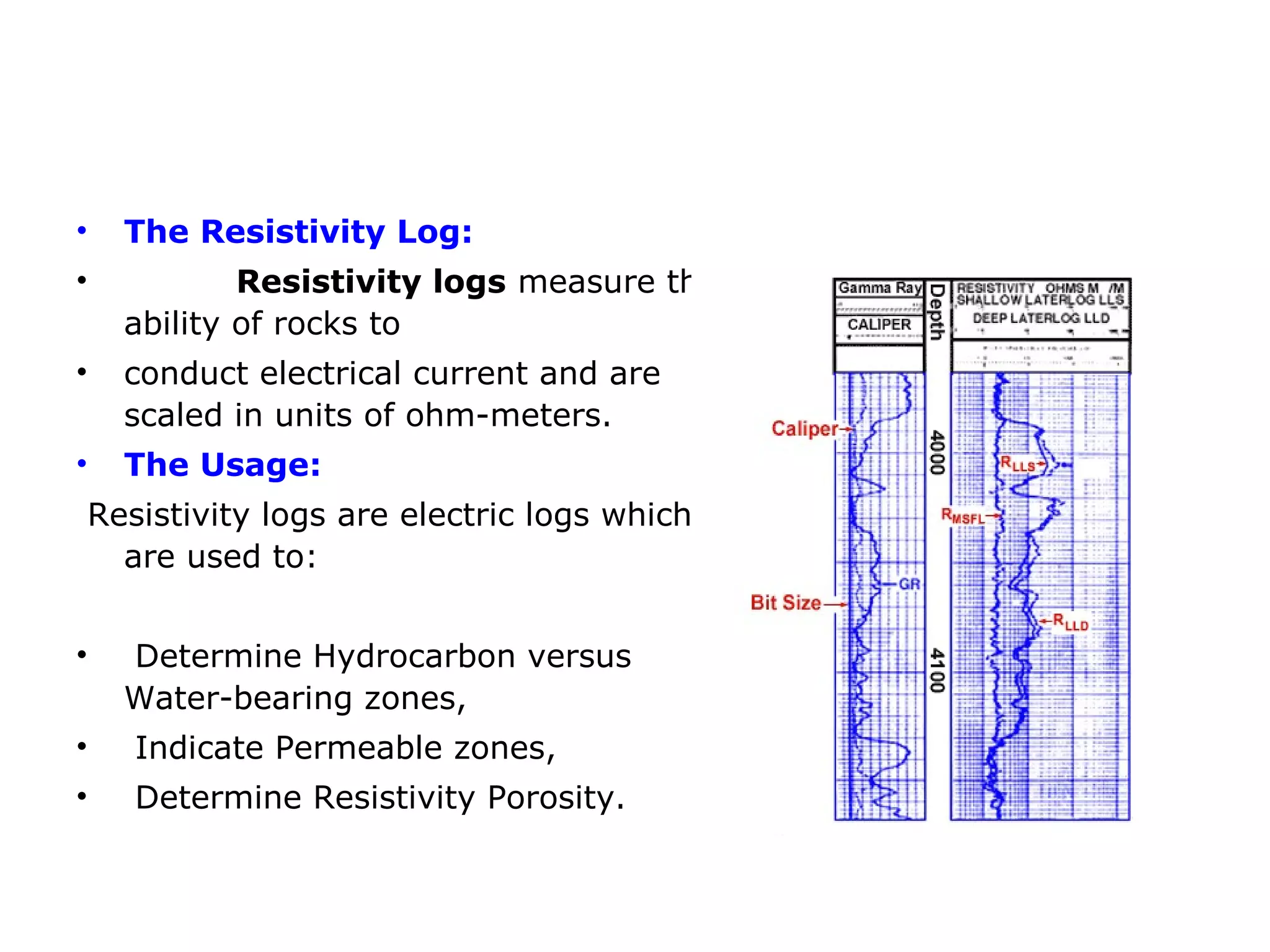
• The Resistivity Log:
• Resistivity logs measure the
ability of rocks to
• conduct electrical current and are
scaled in units of ohm-meters.
• The Usage:
Resistivity logs are electric logs which
are used to:
• Determine Hydrocarbon versus
Water-bearing zones,
• Indicate Permeable zones,
• Determine Resistivity Porosity.
Methodology
 Resistivity logging is a method of well logging that works by 
characterizing the rock or sediment in a borehole by 
measuring its electrical resistivity.
 Resistivity is a fundamental material property which 
represents how strongly a material opposes the flow of 
electric current.
 In these logs, resistivity is measured using 4 electrical 
probes to eliminate the resistance of the contact leads. The 
log must run in holes containing electrically conductive mud 
or water.
 Resistivity logging is sometimes used in mineral
exploration (especially exploration for iron and potassium)
and water-well drilling, but most commonly for formation
evaluation in oil- and gas-well drilling. Most rock materials are
essentially insulators, while their enclosed fluids
are conductors. Hydrocarbon fluids are an exception, because
they are almost infinitely resistive.
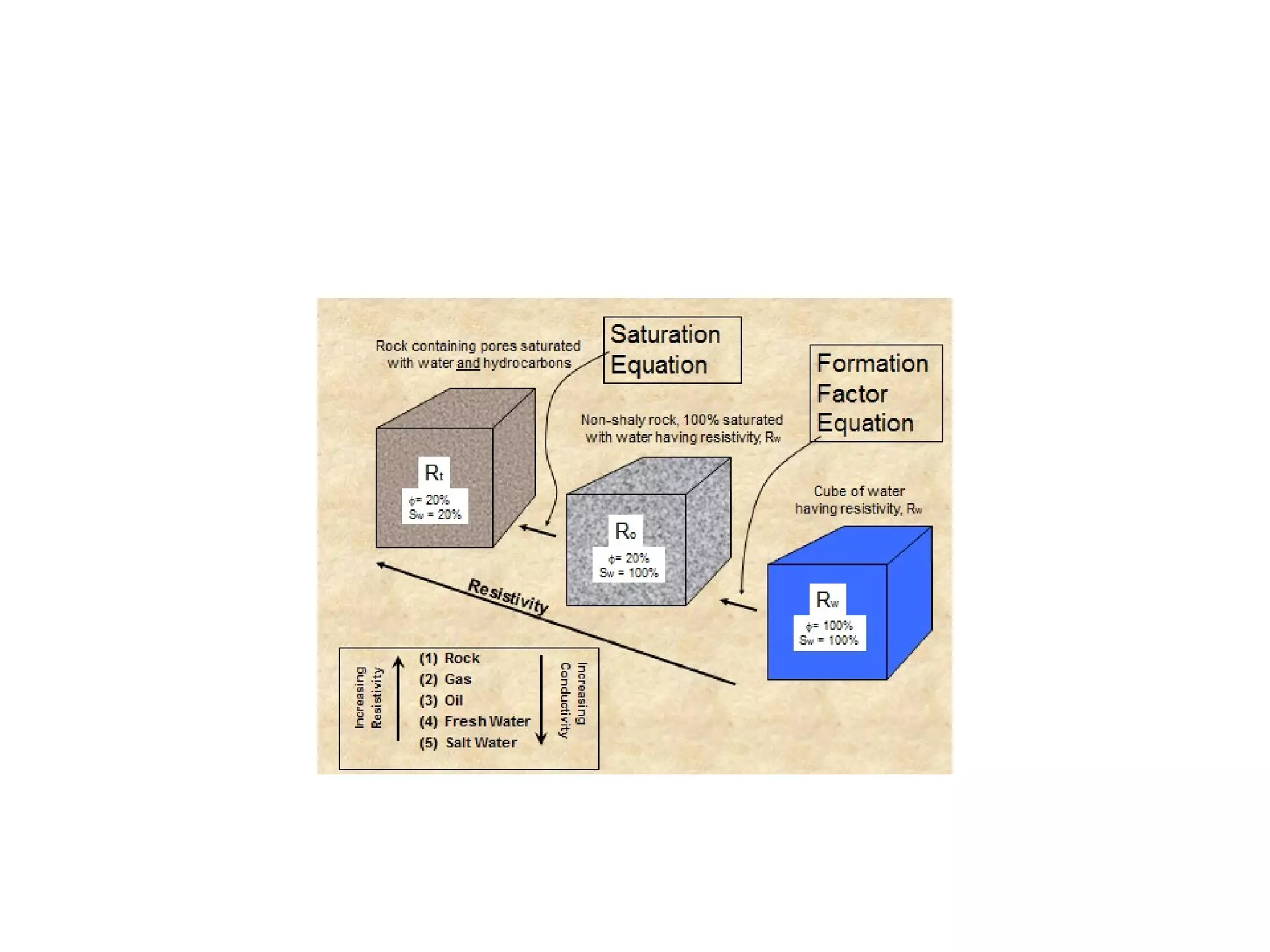
 When a formation is porous and contains salty water, the
overall resistivity will be low. When the formation contains
hydrocarbon, or contains very low porosity, its resistivity will
be high. High resistivity values may indicate a hydrocarbon
bearing formation.
 Usually while drilling, drilling fluids invade the formation,
changes in the resistivity are measured by the tool in the
invaded zone. For this reason, several resistivity tools with
different investigation lengths are used to measure the
formation resistivity.
 If water based mud is used and oil is displaced, "deeper"
resistivity logs will show lower conductivity than the invaded
zone. If oil based mud is used and water is displaced, deeper
logs will show higher conductivity than the invaded zone.
 This provides not only an indication of the fluids present, but
also, at least qualitatively, whether the formation is permeable
or not.
Factors affecting on resistivity logging
Pore geometry,
Resistivity of water
Porosity of the formation,
Pore geometry - tortuosity
Lithology of the formation
Degree of cementation, and
Type and amount of clay in the rock
Application of Resistivity logs
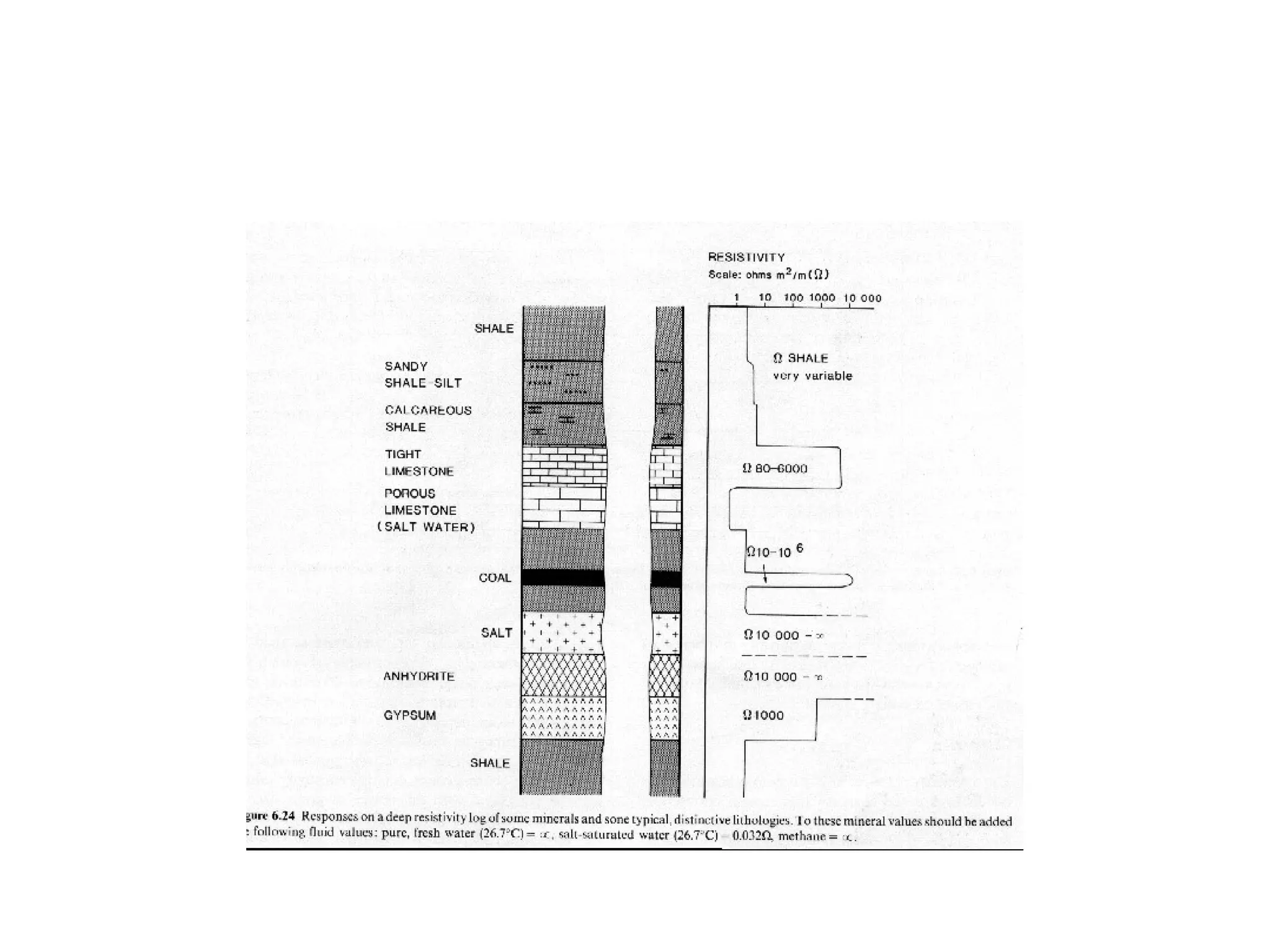
Lithology identification
Source Rock identification
Saturation determination
Locating of hydrocarbon bearing zones
Determination of shale volume
Localization of over-pressured zones
Correlation purposes
LOG INTERPRETATION OBJECTIVES
 The objective of log interpretation depends very much on the user.
Quantitative analysis of well logs provides the analyst with values for a
variety of primary parameters, such as:
 porosity
 water saturation, fluid type (oil/gas/water)
 lithology
 permeability
 From these, many corollary parameters can be derived by integration (and
other means) to arrive at values for:
 hydrocarbons-in-place
 reserves (the recoverable fraction of hydrocarbons in-place)
 mapping reservoir parameters
 users are interested in interpretation for:
 well-to-well correlation
 facies analysis
 regional structural and sedimentary history
 In quantitative log analysis, the objective is to define
 the type of reservoir (lithology)
 its storage capacity (porosity)
 its hydrocarbon type and content (saturation)
 its reducibility (permeability)
Thanks…Thanks…

Resistivity log

  • 2.
    Resistivity LogResistivity Log •Basics about the Resistivity: • Resistivity measures the electric properties of the formation, • Resistivity is measured as, R in Ohm-meter, • Resistivity is the inverse of conductivity, • The ability to conduct electric current depends upon: • The Volume of water, • The Temperature of the formation, • The Salinity of the formation
  • 3.
    • The ResistivityLog: • Resistivity logs measure the ability of rocks to • conduct electrical current and are scaled in units of ohm-meters. • The Usage: Resistivity logs are electric logs which are used to: • Determine Hydrocarbon versus Water-bearing zones, • Indicate Permeable zones, • Determine Resistivity Porosity.
  • 8.
    Methodology  Resistivity logging is a method of well logging that works by  characterizing the rock or sediment in a borehole by  measuring its electrical resistivity. Resistivity is a fundamental material property which  represents how strongly a material opposes the flow of  electric current.  In these logs, resistivity is measured using 4 electrical  probes to eliminate the resistance of the contact leads. The  log must run in holes containing electrically conductive mud  or water.
  • 9.
     Resistivity loggingis sometimes used in mineral exploration (especially exploration for iron and potassium) and water-well drilling, but most commonly for formation evaluation in oil- and gas-well drilling. Most rock materials are essentially insulators, while their enclosed fluids are conductors. Hydrocarbon fluids are an exception, because they are almost infinitely resistive.  When a formation is porous and contains salty water, the overall resistivity will be low. When the formation contains hydrocarbon, or contains very low porosity, its resistivity will be high. High resistivity values may indicate a hydrocarbon bearing formation.
  • 10.
     Usually whiledrilling, drilling fluids invade the formation, changes in the resistivity are measured by the tool in the invaded zone. For this reason, several resistivity tools with different investigation lengths are used to measure the formation resistivity.  If water based mud is used and oil is displaced, "deeper" resistivity logs will show lower conductivity than the invaded zone. If oil based mud is used and water is displaced, deeper logs will show higher conductivity than the invaded zone.  This provides not only an indication of the fluids present, but also, at least qualitatively, whether the formation is permeable or not.
  • 11.
    Factors affecting onresistivity logging Pore geometry, Resistivity of water Porosity of the formation, Pore geometry - tortuosity Lithology of the formation Degree of cementation, and Type and amount of clay in the rock
  • 12.
    Application of Resistivitylogs Lithology identification Source Rock identification Saturation determination Locating of hydrocarbon bearing zones Determination of shale volume Localization of over-pressured zones Correlation purposes
  • 13.
    LOG INTERPRETATION OBJECTIVES The objective of log interpretation depends very much on the user. Quantitative analysis of well logs provides the analyst with values for a variety of primary parameters, such as:  porosity  water saturation, fluid type (oil/gas/water)  lithology  permeability  From these, many corollary parameters can be derived by integration (and other means) to arrive at values for:  hydrocarbons-in-place  reserves (the recoverable fraction of hydrocarbons in-place)  mapping reservoir parameters
  • 14.
     users areinterested in interpretation for:  well-to-well correlation  facies analysis  regional structural and sedimentary history  In quantitative log analysis, the objective is to define  the type of reservoir (lithology)  its storage capacity (porosity)  its hydrocarbon type and content (saturation)  its reducibility (permeability)
  • 15.