Rig Design & Selection
BY: GROUP 3
Introduction
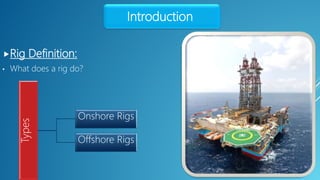
Rig Definition:
• What does a rig do?
Types
Onshore Rigs
Offshore Rigs
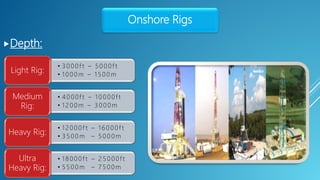
Depth:
Onshore Rigs
• 3 0 0 0 f t – 5 0 0 0 f t
• 1 0 0 0 m – 1 5 0 0 m
Light Rig:
• 4 0 0 0 f t – 1 0 0 0 0 f t
• 1 2 0 0 m – 3 0 0 0 m
Medium
Rig:
• 1 2 0 0 0 f t – 1 6 0 0 0 f t
• 3 5 0 0 m – 5 0 0 0 m
Heavy Rig:
• 1 8 0 0 0 f t – 2 5 0 0 0 f t
• 5 5 0 0 m – 7 5 0 0 m
Ultra
Heavy Rig:
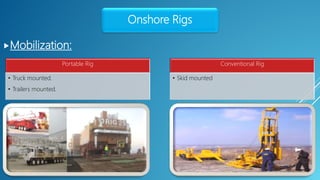
Mobilization:
Onshore Rigs
Portable Rig
• Truck mounted.
• Trailers mounted.
Conventional Rig
• Skid mounted
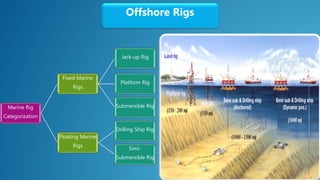
Marine Rig
Categorization
Fixed Marine
Rigs
Platform Rig
Jack-up Rig
Submersible Rig
Floating Marine
Rigs
Drilling Ship Rig
Simi-
Submersible Rig
Offshore Rigs
Fixed Rigs:
Offshore Rigs
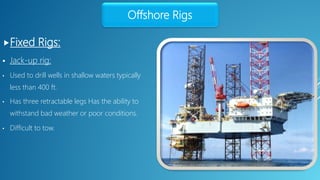
 Jack-up rig:
• Used to drill wells in shallow waters typically
less than 400 ft.
• Has three retractable legs Has the ability to
withstand bad weather or poor conditions.
• Difficult to tow.
Fixed Rigs:
Offshore Rigs
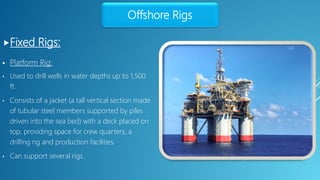
 Platform Rig:
• Used to drill wells in water depths up to 1,500
ft.
• Consists of a jacket (a tall vertical section made
of tubular steel members supported by piles
driven into the sea bed) with a deck placed on
top, providing space for crew quarters, a
drilling rig and production facilities.
• Can support several rigs.
Fixed Rigs:
Offshore Rigs
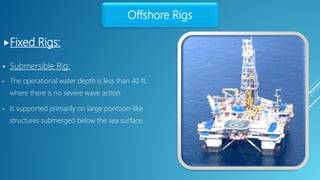
 Submersible Rig:
• The operational water depth is less than 40 ft.
where there is no severe wave action.
• Is supported primarily on large pontoon-like
structures submerged below the sea surface.
Floating Rigs:
Offshore Rigs
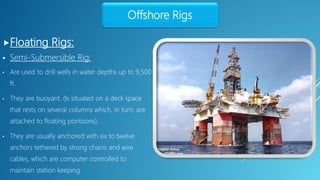
 Semi-Submersible Rig:
• Are used to drill wells in water depths up to 9,500
ft.
• They are buoyant. (Is situated on a deck space
that rests on several columns which, in turn, are
attached to floating pontoons).
• They are usually anchored with six to twelve
anchors tethered by strong chains and wire
cables, which are computer controlled to
maintain station keeping.
Floating Rigs:
Offshore Rigs
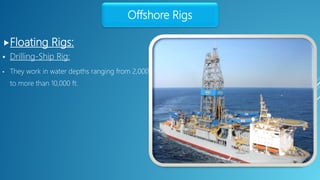
 Drilling-Ship Rig:
• They work in water depths ranging from 2,000
to more than 10,000 ft.
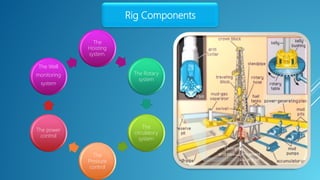
Rig Components
Rig Components
The
Hoisting
system.
The Rotary
system
The
circulatory
system
The
Pressure
control
The power
control
The Well
monitoring
system
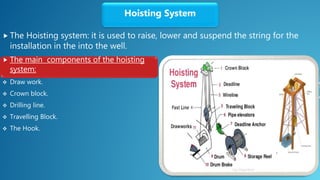
 The Hoisting system: it is used to raise, lower and suspend the string for the
installation in the into the well.
Hoisting System
 The main components of the hoisting
system:
 Draw work.
 Crown block.
 Drilling line.
 Travelling Block.
 The Hook.
 It is a set of equipment required to promote the rotation of the bit.
 It is divided into parts on above the ground and the other under the ground.
Rotary system
 The rotating system (Above the ground):
 1. Swivel
 2. Kelly ( Kelly Bushing & Master Bushing )
 3. Rotary Table
 4. Top Drive :
• 1. Saves time on connections and trips by allowing
drilling with 3 joints at a time
• 2.Top drive is not removed during trips.
• 3- it can rotate the drill string while pulling it
upwards.
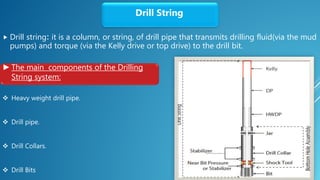
 Drill string: it is a column, or string, of drill pipe that transmits drilling fluid(via the mud
pumps) and torque (via the Kelly drive or top drive) to the drill bit.
Drill String
►The main components of the Drilling
String system:
 Heavy weight drill pipe.
 Drill pipe.
 Drill Collars.
 Drill Bits
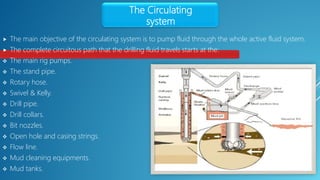
The Circulating
system
 The main objective of the circulating system is to pump fluid through the whole active fluid system.
 The complete circuitous path that the drilling fluid travels starts at the:
 The main rig pumps.
 The stand pipe.
 Rotary hose.
 Swivel & Kelly.
 Drill pipe.
 Drill collars.
 Bit nozzles.
 Open hole and casing strings.
 Flow line.
 Mud cleaning equipments.
 Mud tanks.
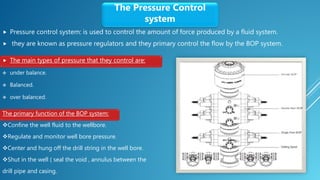
 Pressure control system: is used to control the amount of force produced by a fluid system.
 they are known as pressure regulators and they primary control the flow by the BOP system.
The Pressure Control
system
 The main types of pressure that they control are:
 under balance.
 Balanced.
 over balanced.
The primary function of the BOP system:
Confine the well fluid to the wellbore.
Regulate and monitor well bore pressure.
Center and hung off the drill string in the well bore.
Shut in the well ( seal the void , annulus between the
drill pipe and casing.
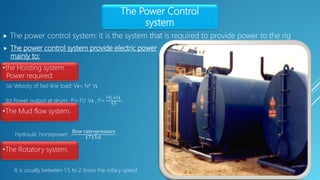
 The power control system provide electric power
mainly to:
The Power Control
system
 The power control system: it is the system that is required to provide power to the rig
•the Hoisting system.
Power required:
(a) Velocity of fast-line load: Vғ= N* Vɩ
(b) Power output at drum: P= FL* Vғ , P=
HL∗Vɩ
EF
•The Mud flow system.
Hydraulic horsepower:
flow rate∗pressure
1713.6
•The Rotatory system.
It is usually between 1.5 to 2 times the rotary speed
The total power requirement of the rig:
1. Drawworks
2. Mud Pumps
3. Rotary system
4. Auxiliary power
requirements for
lighting
5. Life support system
The Pressure Control
system
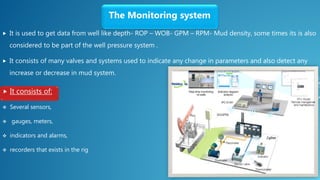
 It is used to get data from well like depth- ROP – WOB- GPM – RPM- Mud density, some times its is also
considered to be part of the well pressure system .
 It consists of many valves and systems used to indicate any change in parameters and also detect any
increase or decrease in mud system.
The Monitoring system
 It consists of:
 Several sensors,
 gauges, meters,
 indicators and alarms,
 recorders that exists in the rig

Rig types and components

  • 1.
    Rig Design &Selection BY: GROUP 3
  • 2.
    Introduction Rig Definition: • Whatdoes a rig do? Types Onshore Rigs Offshore Rigs
  • 3.
    Depth: Onshore Rigs • 30 0 0 f t – 5 0 0 0 f t • 1 0 0 0 m – 1 5 0 0 m Light Rig: • 4 0 0 0 f t – 1 0 0 0 0 f t • 1 2 0 0 m – 3 0 0 0 m Medium Rig: • 1 2 0 0 0 f t – 1 6 0 0 0 f t • 3 5 0 0 m – 5 0 0 0 m Heavy Rig: • 1 8 0 0 0 f t – 2 5 0 0 0 f t • 5 5 0 0 m – 7 5 0 0 m Ultra Heavy Rig:
  • 4.
    Mobilization: Onshore Rigs Portable Rig •Truck mounted. • Trailers mounted. Conventional Rig • Skid mounted
  • 5.
    Marine Rig Categorization Fixed Marine Rigs PlatformRig Jack-up Rig Submersible Rig Floating Marine Rigs Drilling Ship Rig Simi- Submersible Rig Offshore Rigs
  • 6.
    Fixed Rigs: Offshore Rigs Jack-up rig: • Used to drill wells in shallow waters typically less than 400 ft. • Has three retractable legs Has the ability to withstand bad weather or poor conditions. • Difficult to tow.
  • 7.
    Fixed Rigs: Offshore Rigs Platform Rig: • Used to drill wells in water depths up to 1,500 ft. • Consists of a jacket (a tall vertical section made of tubular steel members supported by piles driven into the sea bed) with a deck placed on top, providing space for crew quarters, a drilling rig and production facilities. • Can support several rigs.
  • 8.
    Fixed Rigs: Offshore Rigs Submersible Rig: • The operational water depth is less than 40 ft. where there is no severe wave action. • Is supported primarily on large pontoon-like structures submerged below the sea surface.
  • 9.
    Floating Rigs: Offshore Rigs Semi-Submersible Rig: • Are used to drill wells in water depths up to 9,500 ft. • They are buoyant. (Is situated on a deck space that rests on several columns which, in turn, are attached to floating pontoons). • They are usually anchored with six to twelve anchors tethered by strong chains and wire cables, which are computer controlled to maintain station keeping.
  • 10.
    Floating Rigs: Offshore Rigs Drilling-Ship Rig: • They work in water depths ranging from 2,000 to more than 10,000 ft.
  • 11.
  • 12.
  • 13.
     The Hoistingsystem: it is used to raise, lower and suspend the string for the installation in the into the well. Hoisting System  The main components of the hoisting system:  Draw work.  Crown block.  Drilling line.  Travelling Block.  The Hook.
  • 14.
     It isa set of equipment required to promote the rotation of the bit.  It is divided into parts on above the ground and the other under the ground. Rotary system  The rotating system (Above the ground):  1. Swivel  2. Kelly ( Kelly Bushing & Master Bushing )  3. Rotary Table  4. Top Drive : • 1. Saves time on connections and trips by allowing drilling with 3 joints at a time • 2.Top drive is not removed during trips. • 3- it can rotate the drill string while pulling it upwards.
  • 15.
     Drill string:it is a column, or string, of drill pipe that transmits drilling fluid(via the mud pumps) and torque (via the Kelly drive or top drive) to the drill bit. Drill String ►The main components of the Drilling String system:  Heavy weight drill pipe.  Drill pipe.  Drill Collars.  Drill Bits
  • 16.
    The Circulating system  Themain objective of the circulating system is to pump fluid through the whole active fluid system.  The complete circuitous path that the drilling fluid travels starts at the:  The main rig pumps.  The stand pipe.  Rotary hose.  Swivel & Kelly.  Drill pipe.  Drill collars.  Bit nozzles.  Open hole and casing strings.  Flow line.  Mud cleaning equipments.  Mud tanks.
  • 17.
     Pressure controlsystem: is used to control the amount of force produced by a fluid system.  they are known as pressure regulators and they primary control the flow by the BOP system. The Pressure Control system  The main types of pressure that they control are:  under balance.  Balanced.  over balanced. The primary function of the BOP system: Confine the well fluid to the wellbore. Regulate and monitor well bore pressure. Center and hung off the drill string in the well bore. Shut in the well ( seal the void , annulus between the drill pipe and casing.
  • 18.
     The powercontrol system provide electric power mainly to: The Power Control system  The power control system: it is the system that is required to provide power to the rig •the Hoisting system. Power required: (a) Velocity of fast-line load: Vғ= N* Vɩ (b) Power output at drum: P= FL* Vғ , P= HL∗Vɩ EF •The Mud flow system. Hydraulic horsepower: flow rate∗pressure 1713.6 •The Rotatory system. It is usually between 1.5 to 2 times the rotary speed
  • 19.
    The total powerrequirement of the rig: 1. Drawworks 2. Mud Pumps 3. Rotary system 4. Auxiliary power requirements for lighting 5. Life support system The Pressure Control system
  • 20.
     It isused to get data from well like depth- ROP – WOB- GPM – RPM- Mud density, some times its is also considered to be part of the well pressure system .  It consists of many valves and systems used to indicate any change in parameters and also detect any increase or decrease in mud system. The Monitoring system  It consists of:  Several sensors,  gauges, meters,  indicators and alarms,  recorders that exists in the rig