What is it?
CEMENT BOND LOG
(CBL)
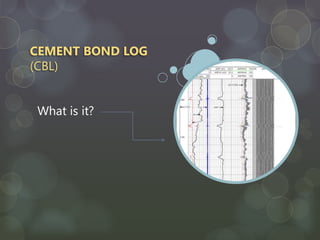
A cement bond log (CBL) is a type of log
that
measures the loss of acoustic energy as it
passes through casing.
A cement bond log documents an
evaluation of the integrity of cement work
performed on an oil well. In the process of
drilling and completing a well, cement is
injected through the wellbore and rises up
the annulus between the steel casing and
the formation.
A sonic tool is typically run on wireline by a service
company that detects the bond of the cement to the
casing and formation via a principle based
on resonance. Casing that is not bound has a higher
resonant vibration than that which is bound, causing
the imparted energy from the sonic signal to be
transferred to the formation. In this sense,
the amplitude of the waveform received is the basic
measurement that is evaluated.
CEMENT BOND LOG
(CBL)
What is it used for?
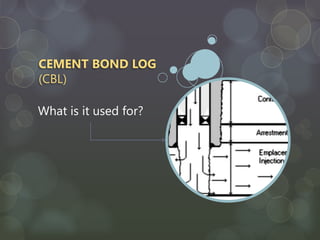
Cement bond logs are used to detect the
presence or absence of external cement
behind casing.
Proper cement placement between the well
casing and the formation is essential:
1. To support the casing (shear bond)
2. To prevent fluid from leaking to the
surface
3. For isolating producing zones from
water-bearing zones (hydraulic bond)
CEMENT BOND LOG
(CBL)
Concept of CBL:
Transmitter sends acoustic wave to casing/cement and
then receivers receive acoustic signal that transfer
through casing to cement and reflects to receivers.
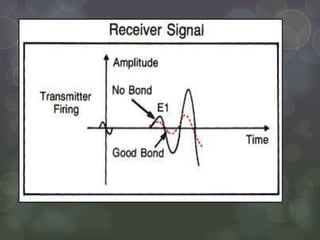
Acoustic wave at receivers is converted to amplitude
(mv).
Low amplitude represents good cement bond
between casing and hole; however, high amplitude
represents bad cement bond.
The concept likes when we knock pipe. If there is
something coverage around pipe, the reflection sound
will be attenuated, and vice versa.
CEMENT BOND LOG
(CBL)
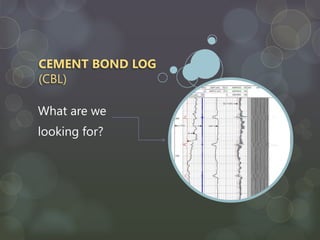
What are we
looking for?
Minimum interval of continuous 60% bonded
cement in a continuous confining shale.
Rule-of-Thumb: < 10mV on amplitude curve
for x-amount of feet.
For heavier casings, can sometimes accept
< 12mV or < 13mV but this is fairly RARE.
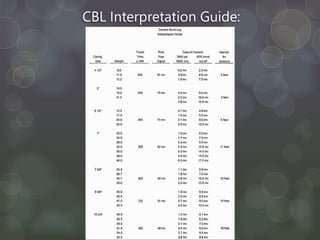
CBL Interpretation Guide:

Cement bond log

  • 2.
    What is it? CEMENTBOND LOG (CBL)
  • 3.
    A cement bondlog (CBL) is a type of log that measures the loss of acoustic energy as it passes through casing. A cement bond log documents an evaluation of the integrity of cement work performed on an oil well. In the process of drilling and completing a well, cement is injected through the wellbore and rises up the annulus between the steel casing and the formation.
  • 4.
    A sonic toolis typically run on wireline by a service company that detects the bond of the cement to the casing and formation via a principle based on resonance. Casing that is not bound has a higher resonant vibration than that which is bound, causing the imparted energy from the sonic signal to be transferred to the formation. In this sense, the amplitude of the waveform received is the basic measurement that is evaluated.
  • 5.
  • 6.
    Cement bond logsare used to detect the presence or absence of external cement behind casing. Proper cement placement between the well casing and the formation is essential: 1. To support the casing (shear bond) 2. To prevent fluid from leaking to the surface 3. For isolating producing zones from water-bearing zones (hydraulic bond)
  • 7.
  • 8.
    Transmitter sends acousticwave to casing/cement and then receivers receive acoustic signal that transfer through casing to cement and reflects to receivers. Acoustic wave at receivers is converted to amplitude (mv). Low amplitude represents good cement bond between casing and hole; however, high amplitude represents bad cement bond. The concept likes when we knock pipe. If there is something coverage around pipe, the reflection sound will be attenuated, and vice versa.
  • 10.
    CEMENT BOND LOG (CBL) Whatare we looking for?
  • 11.
    Minimum interval ofcontinuous 60% bonded cement in a continuous confining shale. Rule-of-Thumb: < 10mV on amplitude curve for x-amount of feet. For heavier casings, can sometimes accept < 12mV or < 13mV but this is fairly RARE.
  • 12.