Origin and Sources of GR
Gamma Rays are bursts of high-energy electromagnetic
waves that are emitted spontaneously by some radioactive
elements ( unlike Alpha and Beta rays of low energy )
Correlation curves (Lithology curves) :
Gamma Ray log measures natural radioactivity of formation
due to the radioactive material disintegration ( decay) :
– Potassium (K ) (isotope of atomic wt. 40)
– Uranium (U)
– Thorium (Th)
Indicates shale and clay present in sedimentary and igneous
rocks.
Properties of GR
GR emittion is not at constant rate
and speed, but at random, because
it is a natural phenomena. Thus,
logging speed should be slow to
reduce this effect.
GR tool GR sonde contains a detector to
measure Gamma radiation
originating in the volume of the
formation near the sonde.
 They are two types:
Geiger Mueller counters : used in
the pasts
Scintillation counters : now used
for this measurement; they are
much more efficient than the
Geiger Mueller counters used in
the past, and they offer good
formation detail.
Origin and Sources of GR, cont
Radioactive elements tends to
concentrate in shale and clays due to
their structure and origin.
Clean formation usually have very low
level of radioactivity, unless local
radioactive contaminants such as
volcanic ash or granite wash or organic
matter is present, or formation waters
contain dissolved radioactive salts.
Gamma Ray Log ; uses
•Gamma ray log is measurement of natural
radioactivity in formation verses depth.
•It measures the radiation emitting from naturally
occurring U, Th, and K.
•It is also known as shale log and as shale indicator.
•GR log reflects shale or clay content.
•Clean formations have low radioactivity level.
•Correlation between wells,
•Determination of bed boundaries, and sand count.
•Evaluation of shale content within a formation,
•Mineral analysis,
•GR log can be run in both open and cased hole
Gamma Ray Log Uses
 Generally, a gamma ray log indicates the amount of
shale present
 Low Natural Radioactivity
 Sandstone
 Limestones
 Dolomites
 Minimum reading at salt & anhydrite ( few API units)
 High Natural Radioactivity
 Shales, Mica , Feldspar, Volcanic, Gamma ray logs can be run in both
openhole and cased-hole environments.
Gamma Ray Log & NGS
*Standard gamma ray logs measure the
total natural radioactivity of a formation.
*Information from cased hole logs:
- Gamma Ray Log - same as open hole
log;
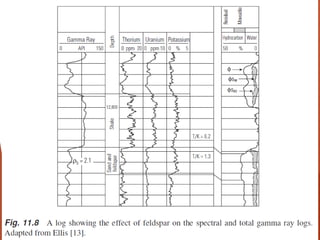
*Natural Gamma Ray Spectrometry Log
-used to identify clay types and clay
volumes, and is a better shale indicator
than GR;
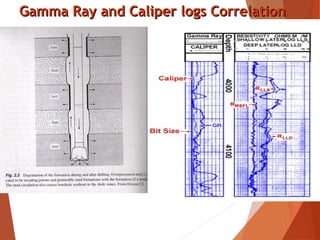
Gamma Ray and Caliper logs CorrelationGamma Ray and Caliper logs Correlation
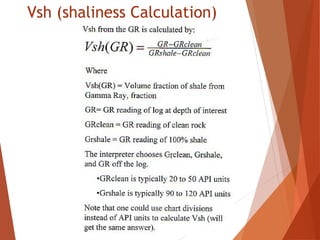
Vsh (shaliness Calculation)
THANKS
ALL OF YOU

Gama ray log

  • 2.
    Origin and Sourcesof GR Gamma Rays are bursts of high-energy electromagnetic waves that are emitted spontaneously by some radioactive elements ( unlike Alpha and Beta rays of low energy ) Correlation curves (Lithology curves) : Gamma Ray log measures natural radioactivity of formation due to the radioactive material disintegration ( decay) : – Potassium (K ) (isotope of atomic wt. 40) – Uranium (U) – Thorium (Th) Indicates shale and clay present in sedimentary and igneous rocks.
  • 3.
    Properties of GR GRemittion is not at constant rate and speed, but at random, because it is a natural phenomena. Thus, logging speed should be slow to reduce this effect.
  • 4.
    GR tool GRsonde contains a detector to measure Gamma radiation originating in the volume of the formation near the sonde.  They are two types: Geiger Mueller counters : used in the pasts Scintillation counters : now used for this measurement; they are much more efficient than the Geiger Mueller counters used in the past, and they offer good formation detail.
  • 5.
    Origin and Sourcesof GR, cont Radioactive elements tends to concentrate in shale and clays due to their structure and origin. Clean formation usually have very low level of radioactivity, unless local radioactive contaminants such as volcanic ash or granite wash or organic matter is present, or formation waters contain dissolved radioactive salts.
  • 6.
    Gamma Ray Log; uses •Gamma ray log is measurement of natural radioactivity in formation verses depth. •It measures the radiation emitting from naturally occurring U, Th, and K. •It is also known as shale log and as shale indicator. •GR log reflects shale or clay content. •Clean formations have low radioactivity level. •Correlation between wells, •Determination of bed boundaries, and sand count. •Evaluation of shale content within a formation, •Mineral analysis, •GR log can be run in both open and cased hole
  • 7.
    Gamma Ray LogUses  Generally, a gamma ray log indicates the amount of shale present  Low Natural Radioactivity  Sandstone  Limestones  Dolomites  Minimum reading at salt & anhydrite ( few API units)  High Natural Radioactivity  Shales, Mica , Feldspar, Volcanic, Gamma ray logs can be run in both openhole and cased-hole environments.
  • 8.
    Gamma Ray Log& NGS *Standard gamma ray logs measure the total natural radioactivity of a formation. *Information from cased hole logs: - Gamma Ray Log - same as open hole log; *Natural Gamma Ray Spectrometry Log -used to identify clay types and clay volumes, and is a better shale indicator than GR;
  • 10.
    Gamma Ray andCaliper logs CorrelationGamma Ray and Caliper logs Correlation
  • 11.
  • 12.