JJAAMMEESS AA.. 
CCRRAAIIGG
TTaabbllee ooff CCoonntteennttss 
Definitions 
Applications of Directional Drilling 
Deflection Tools 
Mud Motors 
Types of Well Profile
DDeeffiinniittiioonnss 
Directional drilling is the process of directing the 
wellbore along some trajectory to a predetermined 
target. 
Deviation control is the process of keeping the 
wellbore contained within some prescribed limits 
relative to inclination, horizontal excursion from the 
vertical, or both.
AApppplliiccaattiioonnss 
History 
Interests in controlled directional drilling began about 
1929 after new and later accurate means of measuring 
hole angle was introduced during the development of 
Seminole, Oklahoma field. 
In the early 1930’s the first controlled directional well 
was drilled in Huntington Beach, California. 
Controlled directional drilling was initially used in 
California for unethical purposes, that is, to 
intentionally cross property lines.
In 1933, during the development of the Signal Hill field 
in Long Beach, California, several wells were drilled 
under the Sunnyside Cemetery from locations across 
the streets surrounding the cemetery. 
In 1934, it was used to kill a wild well, Madeley No.1, 
near Conroe, Texas.
Typical offshore 
development platform 
with directional wells
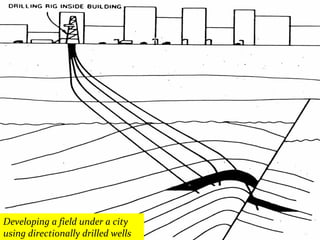
Developing a field under a city 
using directionally drilled wells
Drilling of directional 
wells where the reservoir is 
beneath a major surface 
obstruction
Sidetracking 
around a fish
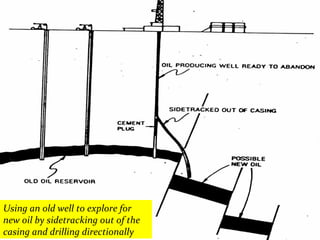
Using an old well to explore for 
new oil by sidetracking out of the 
casing and drilling directionally
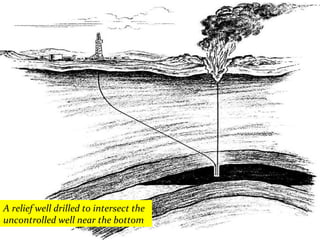
A relief well drilled to intersect the 
uncontrolled well near the bottom
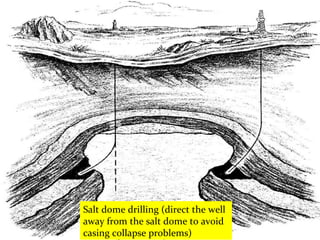
Salt dome drilling (direct the well 
away from the salt dome to avoid 
casing collapse problems)
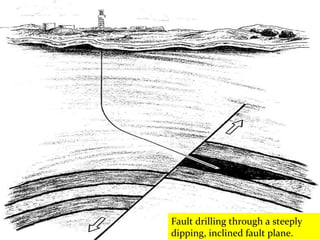
Fault drilling through a steeply 
dipping, inclined fault plane.
Other applications include: 
To reach multiple targets 
Horizontal drilling 
To reach thin reservoirs (using horizontal and 
multilateral drilling) 
To avoid gas or water coning problems
DDeefflleeccttiioonn TToooollss 
The wellbore can be deflected from its current 
position using any of the following: 
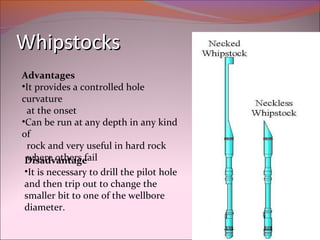
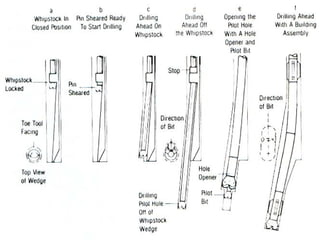
Whipstocks 
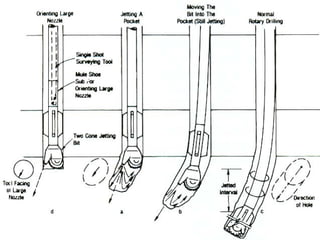
Jetting bit 
Bent subs with downhole motors
WWhhiippssttoocckkss 
Advantages 
•It provides a controlled hole 
curvature 
at the onset 
•Can be run at any depth in any kind 
of 
rock and very useful in hard rock 
Dwihseardev oatnhteargs efail 
•It is necessary to drill the pilot hole 
and then trip out to change the 
smaller bit to one of the wellbore 
diameter.
JJeettttiinngg bbiitt 
Advantages 
•Several attempts can be made to initiate deflection 
without 
pulling out of hole 
•A full gauge hole can be drilled from the beginning 
Disadvantage 
•The technique is limited to soft-medium formations 
•Severe dog-legs can occur if the jetting is not carefully 
controlled 
•On smaller rigs there may not be enough pump capacity to 
wash away the formation
BBeenntt ssuubbss wwiitthh ddoowwnnhhoollee mmoottoorrss 
The bent sub is run directly above the motor and its pin is 
offset at an angle of 1 – 3 degrees. 
Deflection of the wellbore occurs when drilling is carried 
out with no surface rotation to the drillstring. 
The drill bit is forced to follow the curve of the bent sub. 
The degree of curvature depends largely on the bent sub 
offset angle and the OD of the motor. 
When the required angles (inclination and/or azimuth) 
are obtained, this BHA is tripped out to be replaced with a 
rotary assembly.
SStteeeerraabbllee mmoottoorrss 
The motor is designed with an in-built bent housing 
below the motor section; usually the connecting rod 
housing. 
The bent housing angle is usually 0.25 – 1.5 degrees. 
The use of steerable motors with the correct drill bit and 
BHA reduces the number of round trips required to 
produce the desired inclination/azimuth. 
It can be used in either : 
Oriented mode (sliding) 
Rotary mode
Oriented (Sliding) mode 
•The drillstring remains 
stationary (rotary table or 
top-drive is locked) while the 
drill bit is rotated by the 
motor. 
•The course of the well is 
only changed when drilling 
in sliding mode as the drill 
bit will now follow the 
curvature of the motor bent 
housing. 
Rotary mode 
•Steerable motor becomes 
“locked” with respect to 
trajectory and the hole 
direction and inclination are 
maintained while drilling.
Bit offset: 
Steerable motor 
vs. PDM with bent 
sub
MMuudd MMoottoorrss 
There are two types of mud motors: 
Turbines 
Positive displacement motors (PDM)
TTuurrbbiinnee mmoottoorr 
The turbine motor consists of: 
A multistage blade-type rotor and stator sections. The 
number of rotor/stator sections can vary from 25 to 50. 
A thrust bearing section and a drive shaft. 
The rotor blades are connected to the drive shaft and 
are rotated by mud pumped under high pressure. 
The stator deflects the mud onto the rotor blades. 
Rotation of the rotor is transmitted to the drive shaft 
and drill bit.
Positive ddiissppllaacceemmeenntt mmoottoorrss ((PPDDMM)) 
A PDM consists of: 
Power section (rotor and stator) 
By-pass valve 
Universal joint 
Bearing assembly
Power section 
The PDM consists of a helical steel rotor fitted inside a 
spirally-shaped elastomer moulded stator. 
Mud flowing under pressure fills the cavities between 
the dissimilar shapes of the rotor and stator and under 
the pressure of mud, the rotor is displaced and begins 
to rotate. 
The rotor actually moves in an elliptical shape. This 
eccentric movement is converted to true circular 
motion by a universal joint assembly.
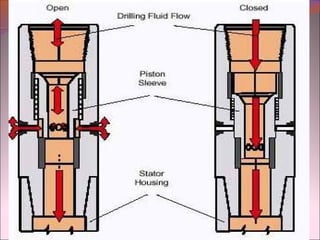
By-pass valve 
This valve allows the drilling fluid to by-pass the mud 
motor allowing the drillstring to fill during tripping in 
and drain when making a connection or pulling out of 
hole. 
The valve operates by a spring which holds a piston in 
the upper position. 
In this position, ports in the by-pass valve are open 
allowing mud to flow in or out of the drillstring. 
At 30% of recommended flow rate, the piston is forced 
down, closing the ports and directing flow through the 
mud motor.
Universal Joint: 
A Connecting Rod assembly is attached to the lower 
end of the rotor. 
It transmits the torque and rotational speed from the 
rotor to the drive shaft and bit. 
Universal joints convert the eccentric motion of the 
rotor into concentric motion at the drive shaft. 
Bearing and Drive Shaft Assembly 
The drive shaft is a rigidly-constructed hollow steel 
component. 
It is supported within the bearing housing by radial 
and axial thrust bearings
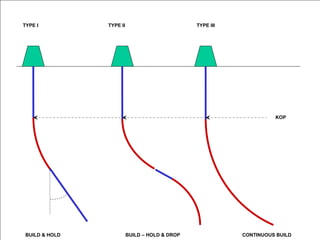
TTyyppeess ooff WWeellll PPrrooffiillee 
Type I 
Build and Hold 
Type 2 
Build, Hold and Drop. 
Returns to vertical after dropping – S-shape. 
Does not return to vertical after dropping – Modified S-shape. 
Type 3 
Continuous Build
KOP 
TYPE I TYPE II TYPE III 
BUILD & HOLD BUILD – HOLD & DROP CONTINUOUS BUILD
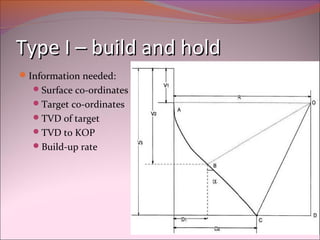
TTyyppee II –– bbuuiilldd aanndd hhoolldd 
Information needed: 
Surface co-ordinates 
Target co-ordinates 
TVD of target 
TVD to KOP 
Build-up rate
TTyyppee IIII –– bbuuiilldd,, hhoolldd aanndd ddrroopp 
Information needed: 
Surface co-ordinates 
Target co-ordinates 
TVD of target 
TVD to KOP 
TVD at end of drop-off 
(usually end of 
well) 
Build-up rate 
Drop-off rate 
Final angle of 
inclination through 
target. 
Because Type II have 2 curves, 
2 radii need to be calculated 
and compared with the total 
departure, D3. 
These quantities are then 
used to calculate the 
maximum possible 
inclination angle at end of 
build-up curve.
D3 > (R1 + R2) D3 < (R1 + R2)
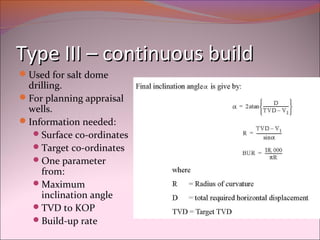
TTyyppee IIIIII –– ccoonnttiinnuuoouuss bbuuiilldd 
Used for salt dome 
drilling. 
For planning appraisal 
wells. 
Information needed: 
Surface co-ordinates 
Target co-ordinates 
One parameter 
from: 
Maximum 
inclination angle 
TVD to KOP 
Build-up rate
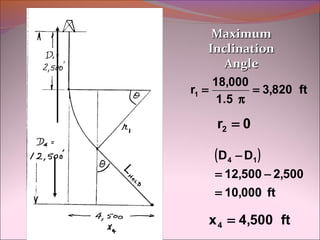
Design a directional well with the following 
restrictions: 
• Total horizontal departure = 4,500 ft 
• True vertical depth (TVD) = 12,500 ft 
• Depth to kickoff point (KOP) = 2,500 ft 
• Rate of build of hole angle = 1.5 deg/100 ft 
• Profile type: Type I well (build and hold)
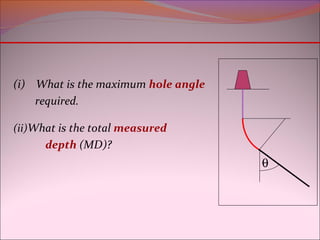
(i) What is the maximum hole angle 
required. 
(ii)What is the total measured 
depth (MD)? 
q
MMaaxxiimmuumm 
IInncclliinnaattiioonn 
AAnnggllee 
3,820 ft 
r 18,000 1 = 
= 
1.5 
p 
r2 = 0 
( ) 
D4 D1 
12,500 2,500 
= - 
10,000 ft 
= 
- 
x4 = 4,500 ft
46 
ù 
ú úû 
é 
2tan D D x (D D ) 2(r r )x 
é 
- - + - - + 
2 2 
ù 
2 tan 10,000 4,500 10,000 2(3,820)4,500 
ê êë 
- + - 
- 
= 
2(3,820) 4,500 
-1 
26.3 qmax = 
ú ú 
û 
ê ê 
ë 
+ - 
q = - 
1 2 4 
1 2 4 
2 
4 1 
2 
1 4 1 4 
max 2(r r ) x
47 
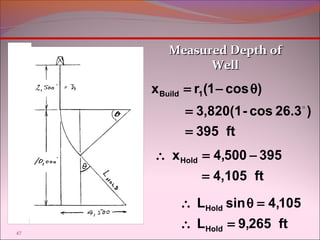
MMeeaassuurreedd DDeepptthh ooff 
WWeellll 
xBuild = r1(1 - cos q 
) 
3,820(1- cos 26.3 ) 
395 ft 
= 
= 
 
xHold 4,500 395 
 = - 
4,105 ft 
= 
L sin 4,105 
Hold 
 q = 
Hold 
L 9,265 ft 
 =
48 
MD = D1 +r1qrad +LHold 
26.3 3,820 2,500 + ÷ø 
= + æ p 
ö çè 
MD = 13,518 ft 
9,265 
180

Drilling Engineering - Directional Drilling

  • 1.
  • 2.
    TTaabbllee ooff CCoonntteennttss Definitions Applications of Directional Drilling Deflection Tools Mud Motors Types of Well Profile
  • 3.
    DDeeffiinniittiioonnss Directional drillingis the process of directing the wellbore along some trajectory to a predetermined target. Deviation control is the process of keeping the wellbore contained within some prescribed limits relative to inclination, horizontal excursion from the vertical, or both.
  • 4.
    AApppplliiccaattiioonnss History Interestsin controlled directional drilling began about 1929 after new and later accurate means of measuring hole angle was introduced during the development of Seminole, Oklahoma field. In the early 1930’s the first controlled directional well was drilled in Huntington Beach, California. Controlled directional drilling was initially used in California for unethical purposes, that is, to intentionally cross property lines.
  • 5.
    In 1933, duringthe development of the Signal Hill field in Long Beach, California, several wells were drilled under the Sunnyside Cemetery from locations across the streets surrounding the cemetery. In 1934, it was used to kill a wild well, Madeley No.1, near Conroe, Texas.
  • 6.
    Typical offshore developmentplatform with directional wells
  • 7.
    Developing a fieldunder a city using directionally drilled wells
  • 8.
    Drilling of directional wells where the reservoir is beneath a major surface obstruction
  • 9.
  • 10.
    Using an oldwell to explore for new oil by sidetracking out of the casing and drilling directionally
  • 11.
    A relief welldrilled to intersect the uncontrolled well near the bottom
  • 12.
    Salt dome drilling(direct the well away from the salt dome to avoid casing collapse problems)
  • 13.
    Fault drilling througha steeply dipping, inclined fault plane.
  • 14.
    Other applications include: To reach multiple targets Horizontal drilling To reach thin reservoirs (using horizontal and multilateral drilling) To avoid gas or water coning problems
  • 15.
    DDeefflleeccttiioonn TToooollss Thewellbore can be deflected from its current position using any of the following: Whipstocks Jetting bit Bent subs with downhole motors
  • 16.
    WWhhiippssttoocckkss Advantages •Itprovides a controlled hole curvature at the onset •Can be run at any depth in any kind of rock and very useful in hard rock Dwihseardev oatnhteargs efail •It is necessary to drill the pilot hole and then trip out to change the smaller bit to one of the wellbore diameter.
  • 18.
    JJeettttiinngg bbiitt Advantages •Several attempts can be made to initiate deflection without pulling out of hole •A full gauge hole can be drilled from the beginning Disadvantage •The technique is limited to soft-medium formations •Severe dog-legs can occur if the jetting is not carefully controlled •On smaller rigs there may not be enough pump capacity to wash away the formation
  • 20.
    BBeenntt ssuubbss wwiitthhddoowwnnhhoollee mmoottoorrss The bent sub is run directly above the motor and its pin is offset at an angle of 1 – 3 degrees. Deflection of the wellbore occurs when drilling is carried out with no surface rotation to the drillstring. The drill bit is forced to follow the curve of the bent sub. The degree of curvature depends largely on the bent sub offset angle and the OD of the motor. When the required angles (inclination and/or azimuth) are obtained, this BHA is tripped out to be replaced with a rotary assembly.
  • 22.
    SStteeeerraabbllee mmoottoorrss Themotor is designed with an in-built bent housing below the motor section; usually the connecting rod housing. The bent housing angle is usually 0.25 – 1.5 degrees. The use of steerable motors with the correct drill bit and BHA reduces the number of round trips required to produce the desired inclination/azimuth. It can be used in either : Oriented mode (sliding) Rotary mode
  • 23.
    Oriented (Sliding) mode •The drillstring remains stationary (rotary table or top-drive is locked) while the drill bit is rotated by the motor. •The course of the well is only changed when drilling in sliding mode as the drill bit will now follow the curvature of the motor bent housing. Rotary mode •Steerable motor becomes “locked” with respect to trajectory and the hole direction and inclination are maintained while drilling.
  • 24.
    Bit offset: Steerablemotor vs. PDM with bent sub
  • 25.
    MMuudd MMoottoorrss Thereare two types of mud motors: Turbines Positive displacement motors (PDM)
  • 26.
    TTuurrbbiinnee mmoottoorr Theturbine motor consists of: A multistage blade-type rotor and stator sections. The number of rotor/stator sections can vary from 25 to 50. A thrust bearing section and a drive shaft. The rotor blades are connected to the drive shaft and are rotated by mud pumped under high pressure. The stator deflects the mud onto the rotor blades. Rotation of the rotor is transmitted to the drive shaft and drill bit.
  • 28.
    Positive ddiissppllaacceemmeenntt mmoottoorrss((PPDDMM)) A PDM consists of: Power section (rotor and stator) By-pass valve Universal joint Bearing assembly
  • 29.
    Power section ThePDM consists of a helical steel rotor fitted inside a spirally-shaped elastomer moulded stator. Mud flowing under pressure fills the cavities between the dissimilar shapes of the rotor and stator and under the pressure of mud, the rotor is displaced and begins to rotate. The rotor actually moves in an elliptical shape. This eccentric movement is converted to true circular motion by a universal joint assembly.
  • 31.
    By-pass valve Thisvalve allows the drilling fluid to by-pass the mud motor allowing the drillstring to fill during tripping in and drain when making a connection or pulling out of hole. The valve operates by a spring which holds a piston in the upper position. In this position, ports in the by-pass valve are open allowing mud to flow in or out of the drillstring. At 30% of recommended flow rate, the piston is forced down, closing the ports and directing flow through the mud motor.
  • 33.
    Universal Joint: AConnecting Rod assembly is attached to the lower end of the rotor. It transmits the torque and rotational speed from the rotor to the drive shaft and bit. Universal joints convert the eccentric motion of the rotor into concentric motion at the drive shaft. Bearing and Drive Shaft Assembly The drive shaft is a rigidly-constructed hollow steel component. It is supported within the bearing housing by radial and axial thrust bearings
  • 34.
    TTyyppeess ooff WWeellllPPrrooffiillee Type I Build and Hold Type 2 Build, Hold and Drop. Returns to vertical after dropping – S-shape. Does not return to vertical after dropping – Modified S-shape. Type 3 Continuous Build
  • 35.
    KOP TYPE ITYPE II TYPE III BUILD & HOLD BUILD – HOLD & DROP CONTINUOUS BUILD
  • 36.
    TTyyppee II ––bbuuiilldd aanndd hhoolldd Information needed: Surface co-ordinates Target co-ordinates TVD of target TVD to KOP Build-up rate
  • 40.
    TTyyppee IIII ––bbuuiilldd,, hhoolldd aanndd ddrroopp Information needed: Surface co-ordinates Target co-ordinates TVD of target TVD to KOP TVD at end of drop-off (usually end of well) Build-up rate Drop-off rate Final angle of inclination through target. Because Type II have 2 curves, 2 radii need to be calculated and compared with the total departure, D3. These quantities are then used to calculate the maximum possible inclination angle at end of build-up curve.
  • 41.
    D3 > (R1+ R2) D3 < (R1 + R2)
  • 42.
    TTyyppee IIIIII ––ccoonnttiinnuuoouuss bbuuiilldd Used for salt dome drilling. For planning appraisal wells. Information needed: Surface co-ordinates Target co-ordinates One parameter from: Maximum inclination angle TVD to KOP Build-up rate
  • 43.
    Design a directionalwell with the following restrictions: • Total horizontal departure = 4,500 ft • True vertical depth (TVD) = 12,500 ft • Depth to kickoff point (KOP) = 2,500 ft • Rate of build of hole angle = 1.5 deg/100 ft • Profile type: Type I well (build and hold)
  • 44.
    (i) What isthe maximum hole angle required. (ii)What is the total measured depth (MD)? q
  • 45.
    MMaaxxiimmuumm IInncclliinnaattiioonn AAnnggllee 3,820 ft r 18,000 1 = = 1.5 p r2 = 0 ( ) D4 D1 12,500 2,500 = - 10,000 ft = - x4 = 4,500 ft
  • 46.
    46 ù úúû é 2tan D D x (D D ) 2(r r )x é - - + - - + 2 2 ù 2 tan 10,000 4,500 10,000 2(3,820)4,500 ê êë - + - - = 2(3,820) 4,500 -1 26.3 qmax = ú ú û ê ê ë + - q = - 1 2 4 1 2 4 2 4 1 2 1 4 1 4 max 2(r r ) x
  • 47.
    47 MMeeaassuurreedd DDeepptthhooff WWeellll xBuild = r1(1 - cos q ) 3,820(1- cos 26.3 ) 395 ft = =  xHold 4,500 395 = - 4,105 ft = L sin 4,105 Hold q = Hold L 9,265 ft =
  • 48.
    48 MD =D1 +r1qrad +LHold 26.3 3,820 2,500 + ÷ø = + æ p ö çè MD = 13,518 ft 9,265 180