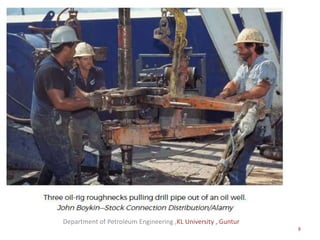

DRILL STRING
by:
Jarugula Bhavya
Sri
(14008012)
1
Department of Petroleum Engineering KL University , Guntur
Introduction
• The drill string constitutes the connection between the
rig and the drill bit.
• The main components of the drill string are:
(1) kelly
(2) drill pipe
(3) drill collar and
(4) drilling bit
• heavy-weight drill pipe, jars, stabilizers, reamers and
various subs (kelly sub, bit sub, shock sub, cross-over
sub, etc.)
2Department of Petroleum Engineering ,KL University , Guntur
The drill string provides multiple functions like:
1. Imposes required weight on the bit
2. Transmits rotary motion from the kelly to the drill bit
3. Provides a two way fluid conduit from the rig to the
drill bit
4. Medium to lower and raise the drill bit in the hole
5. Stabilizes the bottom hole assembly (BHA) and
minimizes vibrations
6. Permits pressure and formation fluid testing through
the drill string
7. Allows through-pipe running of formation evaluation
tools when they can not be run in the open hole
3
Department of Petroleum Engineering ,KL University , Guntur
Neutral point
• The neutral point occurs a at the depth where there
is no compression or tension in the pipe. You can
calculate it dividing the flotation force by the
nominal weight per foot of pipe.
• Long slender columns like DP, have low resistance to
bending and tend to fail by buckling if
-Force at bottom causes neutral point to move up.
4
Department of Petroleum Engineering ,KL University , Guntur
Calculation Of Neutral point
• Total length of the drill string is under tension due to its
own weight(partly counterbalanced by the buoyancy).
• Part of destruction force is obtained by a certain amount
of weight on bit (WOB) which forces the bit against the
rock.
• lower part of the drill string is set under compression.
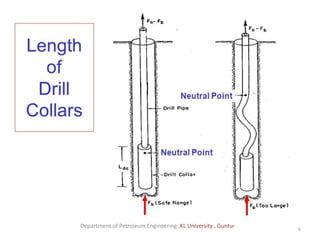
• Due to the geometrical shape of the drill string
(length/diameter ratio), it has a tendency to buckle. To
reduce this buckling tendency, it is aimed to design the
drill string in such a way that the neutral point is located
inside drilling collars
Department of Petroleum Engineering ,KL University , Guntur 5
Department of Petroleum Engineering ,KL University , Guntur
6
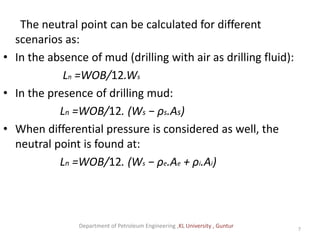
The neutral point can be calculated for different
scenarios as:
• In the absence of mud (drilling with air as drilling fluid):
Ln =WOB/12.Ws
• In the presence of drilling mud:
Ln =WOB/12. (Ws − ρs.As)
• When differential pressure is considered as well, the
neutral point is found at:
Ln =WOB/12. (Ws − ρe.Ae + ρi.Ai)
Department of Petroleum Engineering ,KL University , Guntur 7
8
Department of Petroleum Engineering ,KL University , Guntur
Selection Of Drill Pipes
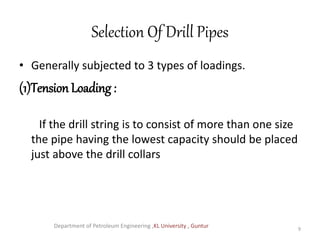
• Generally subjected to 3 types of loadings.
(1)Tension Loading :
If the drill string is to consist of more than one size
the pipe having the lowest capacity should be placed
just above the drill collars
Department of Petroleum Engineering ,KL University , Guntur 9
(2) Collapse Loading:
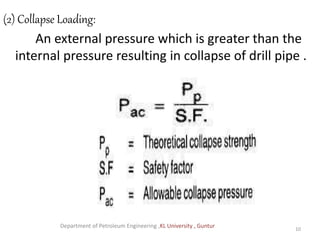
An external pressure which is greater than the
internal pressure resulting in collapse of drill pipe .
10
Department of Petroleum Engineering ,KL University , Guntur
(3) Torsional Strength:
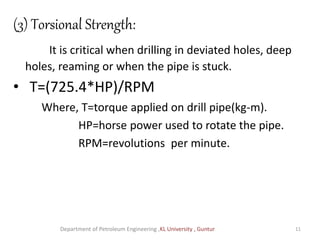
It is critical when drilling in deviated holes, deep
holes, reaming or when the pipe is stuck.
• T=(725.4*HP)/RPM
Where, T=torque applied on drill pipe(kg-m).
HP=horse power used to rotate the pipe.
RPM=revolutions per minute.
Department of Petroleum Engineering ,KL University , Guntur 11
ANY QUERIES…?
Department of Petroleum Engineering ,KL University , Guntur 12

Drill string

  • 1.
    DRILL STRING by: Jarugula Bhavya Sri (14008012) 1 Departmentof Petroleum Engineering KL University , Guntur
  • 2.
    Introduction • The drillstring constitutes the connection between the rig and the drill bit. • The main components of the drill string are: (1) kelly (2) drill pipe (3) drill collar and (4) drilling bit • heavy-weight drill pipe, jars, stabilizers, reamers and various subs (kelly sub, bit sub, shock sub, cross-over sub, etc.) 2Department of Petroleum Engineering ,KL University , Guntur
  • 3.
    The drill stringprovides multiple functions like: 1. Imposes required weight on the bit 2. Transmits rotary motion from the kelly to the drill bit 3. Provides a two way fluid conduit from the rig to the drill bit 4. Medium to lower and raise the drill bit in the hole 5. Stabilizes the bottom hole assembly (BHA) and minimizes vibrations 6. Permits pressure and formation fluid testing through the drill string 7. Allows through-pipe running of formation evaluation tools when they can not be run in the open hole 3 Department of Petroleum Engineering ,KL University , Guntur
  • 4.
    Neutral point • Theneutral point occurs a at the depth where there is no compression or tension in the pipe. You can calculate it dividing the flotation force by the nominal weight per foot of pipe. • Long slender columns like DP, have low resistance to bending and tend to fail by buckling if -Force at bottom causes neutral point to move up. 4 Department of Petroleum Engineering ,KL University , Guntur
  • 5.
    Calculation Of Neutralpoint • Total length of the drill string is under tension due to its own weight(partly counterbalanced by the buoyancy). • Part of destruction force is obtained by a certain amount of weight on bit (WOB) which forces the bit against the rock. • lower part of the drill string is set under compression. • Due to the geometrical shape of the drill string (length/diameter ratio), it has a tendency to buckle. To reduce this buckling tendency, it is aimed to design the drill string in such a way that the neutral point is located inside drilling collars Department of Petroleum Engineering ,KL University , Guntur 5
  • 6.
    Department of PetroleumEngineering ,KL University , Guntur 6
  • 7.
    The neutral pointcan be calculated for different scenarios as: • In the absence of mud (drilling with air as drilling fluid): Ln =WOB/12.Ws • In the presence of drilling mud: Ln =WOB/12. (Ws − ρs.As) • When differential pressure is considered as well, the neutral point is found at: Ln =WOB/12. (Ws − ρe.Ae + ρi.Ai) Department of Petroleum Engineering ,KL University , Guntur 7
  • 8.
    8 Department of PetroleumEngineering ,KL University , Guntur
  • 9.
    Selection Of DrillPipes • Generally subjected to 3 types of loadings. (1)Tension Loading : If the drill string is to consist of more than one size the pipe having the lowest capacity should be placed just above the drill collars Department of Petroleum Engineering ,KL University , Guntur 9
  • 10.
    (2) Collapse Loading: Anexternal pressure which is greater than the internal pressure resulting in collapse of drill pipe . 10 Department of Petroleum Engineering ,KL University , Guntur
  • 11.
    (3) Torsional Strength: Itis critical when drilling in deviated holes, deep holes, reaming or when the pipe is stuck. • T=(725.4*HP)/RPM Where, T=torque applied on drill pipe(kg-m). HP=horse power used to rotate the pipe. RPM=revolutions per minute. Department of Petroleum Engineering ,KL University , Guntur 11
  • 12.
    ANY QUERIES…? Department ofPetroleum Engineering ,KL University , Guntur 12