JAMES A. CRAIG
 
Cement Composition 
 
API Classes of Cement 
 
Cement Additives 
 
Density control 
 
Accelerators 
 
Retarders 
 
Viscosity control 
 
Types of Cementing 
 
Cementing Operation 
 
Cementing equipment 
 
Cementing process 
 
Performing a good cementing job
 
Cement is made of limestone and clay/or shale mixed in the right proportions 
 
Cement (oxides of Ca, Al, Fe, and Si) is heated in a rotary kiln to between 2,600 oF to 2,800 oF. 
 
The result from the kiln is called Clinker. 
 
Clinker is ground with a controlled amount of gypsum (CaSO4.2H2O) to make Portland cement. 
 
Gypsum retards setting time and increases ultimate strength.
Clinker
 
The classes used today are primarily Classes A, C, G, and H. 
 
Classes A, B, and C are used for surface casing job. 
 
Class A is used in some areas because it is very similar to construction cement and can be obtained locally. 
 
Classes A and C are already ground with an accelerator. 
 
Classes G and H are basic cements. 
 
Class G is a finer grind and requires more mix water resulting in a lower density. 
 
Class G is more common around the world. 
 
Classes E and F are used for deep wells under high temperature and pressure.
 
Cement additives will be sub-divided into these functional groups: 
 
Density control 
 
Accelerators 
 
Retarders 
 
Viscosity control 
 
Others
 
Density of cement should be high enough to prevent the high-pressured formations from entering the well. 
 
Density of cement should not be so high as to cause fracture of the weaker formations. 
 
Density of normal slurry (cement mixed with normal amount of water) is usually too high for formation strength. 
 
It is desirable to lower slurry density by: 
 
Lowering slurry density reduces cost.
 
Methods of lowering slurry density: 
 
Increase water/cement ratio 
 
Add low-specific-gravity solids 
 
Effect of high (excess) water/cement ratio: 
 
Increase thickening time 
 
Increase free water 
 
Reduces compressive strength 
 
Lowers resistance to sulfate attack 
 
Increases permeability of the set cement
 
Common low-specific-gravity solids in use are: 
 
Bentonite 
 
Diatomaceous earth 
 
Solid hydrocarbons 
 
Pozzolan 
 
Expanded perlite 
 
Bentonite 
 
Most common light-weight additive 
 
Ability to hydrate permits the use of high water concentration. 
 
High amount will reduce cement strength and thickening time. 
 
Cement strength retrogress with at high temperature above 230 oF.
 
Diatomaceous earth (Diacel D) 
 
Lower specific gravity than bentonite 
 
Permits higher water/cement ratios without resulting in free water. 
 
Like in bentonite, high amount will reduce cement strength and thickening time. 
 
More expensive than bentonite. 
 
Solid hydrocarbons 
 
Gilsonite (lustrous asphalt) and Kolite (crushed coal) 
 
Almost no effect on slurry thickening time. 
 
Higher cement compressive strengths than other types of low-density solids.
 
Pozzolans 
 
Siliceous and aluminous materials that react with lime and water to a form a calcium silicates that possesses cementitious properties. 
 
Natural pozzolans are volcanic ash 
 
Artificial pozzolans include glass, furnace slag and fly ash (residue from chimneys of coal-burning power plants. 
 
Only slight reduction in slurry density is achieved. 
 
Perlite 
 
Volcanic glass bubbles that has sometimes been used in geothermal wells because of its insulating properties. 
 
Considerably more expensive
 
If there is need for higher slurry density, additives that are used are: 
 
Hematite 
 
Reddish iron oxide ore (Fe2O3) 
 
Very common because of its high specific gravity (5.02) 
 
Barite 
 
Barium sulfate 
 
For smaller increases in density 
 
Requires more water to keep slurry pumpable 
 
Sand 
 
Additional water not needed to be added to the slurry 
 
Little effect on strength and pumpability of the cement
 
Accelerate cement hydration 
 
Decrease thickening time 
 
Applicable for shallow, low-temperature wells. 
 
They are inorganic compounds: 
 
Calcium chloride 
 
Sodium chloride 
 
Gypsum 
 
Little amount is needed. If in excess, it will retard the cement. 
 
In offshore drilling: NaCl, CaCl2, MgCl2in seawater act as accelerators.
 
Calcium chloride 
 
Used in concentration of up to 4% 
 
Anhydrous type is preferable because it absorbs moisture less readily 
 
Sodium chloride 
 
Best result is achieved at a concentration of 5% 
 
Saturated type are used in salt formations or reactive shale formations. 
 
Gypsum 
 
Special grade of gypsum hemihydrate cement is mixed with portland cement. 
 
Maximum working temperature is 140 oF for the regular grade, and 180 oF for the high-temperature grade.
 
Also called thinners or dispersants 
 
Increase the thickening time of cement 
 
Applicable for deeper, high temperature wells. 
 
Are typically organic compounds 
 
Lignins 
 
Borax 
 
Sodium chloride 
 
Cellulose derivatives
 
Lignins 
 
Calcium lignosulfonate 
 
Most common retarder 
 
Very low concentration is needed 
 
Organic acids can be added for high temperature jobs 
 
Borax 
 
Sodium tetraborate decahydrate 
 
Sodium chloride 
 
At high concentrations 
 
Cellulose derivatives 
 
CMHEC (carboxylmethyl hydroxyethyl cellulose) 
 
Commonly used 
 
Works with all portland cements
 
High slurry viscosity will: 
 
Increase pump horsepower 
 
Increase annular frictional pressure loss, which may lead to formation fracture. 
 
Common viscosity-control additives are: 
 
Organic deflocculants (e.g. calcium lignosulfonate) 
 
Sodium chloride 
 
Certain long-chain polymers
 
Silica flour –to form stronger, more stable, and less permeable cements at high temperature. 
 
Hydrazine–oxygen scavenger to control corrosion. 
 
Radioactive tracer –to determine where cement has been placed. 
 
Nylon–to make cement more impact resistant 
 
Paraformaldehydeand sodium chromate –to counter the contamination effect of organic deflocculants from drilling muds.
 
Primary cementing 
 
Casing cementing –cementing of casing to the borehole 
 
Liner cementing –cementing of liner. More complex than casing cementing 
 
Secondary/remedial cementing 
 
Plug cementing –to separate lower section of a well from upper section. Open hole or cased hole. 
 
Squeeze cementing –to plug off abandoned perforation, repair annular leaks, and plug severe lost circulation zones.
 
Cementing Equipment 
 
Cementing Process 
 
Performing a Good Cementing Job
 
Cement head
 
Guide shoe 
Guides the casing past irregularities in the borehole wall.
 
Centralizer 
They are placed on the outside of the casing to help hold the casing in the center of the hole.
 
Float collar 
Acts as a check valve to prevent cement from backing up into the casing.
 
Float shoe 
Serves the function of both a guide shoe and a float collar when no shoe joints are desired.
 
Cement basket 
Placed on the outside of the casing to help support the weight of the cement slurry at points where porous or weak formations are exposed.
 
Bottom plug
 
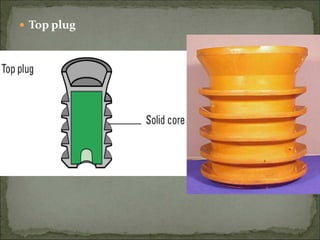
Top plug
 
Scratchers 
Placed on the outside of the casing to help remove mudcake from the borehole walls, either by reciprocating the casing or by rotating the casing.
 
Bottom rubber wiper plug is released to minimize cement contamination from drilling fluid. 
 
Spacer fluid (or mud preflush) may be pumped also. 
 
Desired volume of slurry is pumped 
 
Top wiper plug is released 
 
Drilling fluid displaces the top plug down the casing 
 
When bottom plug reaches the float collar, its diaphragm ruptures. 
 
The whole cement slurry has been fully displaced when the top plug bumps the bottom plug.
 
Cement excess 
* Note:care should be taken to ensure cement does not reach the subsea well or mudline.
 
Casing centralization 
 
Pipe movement 
 
Drilling fluid condition 
 
Hole condition 
 
Displacement velocity 
 
Spacer fluids 
 
Mud-cement density difference 
 
Directional wells
 
Centralization promotes a good cementing job 
 
Centralizers are used to keep the pipe in the center of the hole 
 
For a non-Newtonian fluid when pipe is not well centralized, the velocity on the narrow of the annulus is slower than the velocity on the wide (Popcorn theory). 
 
The point between the centralizers is the hardest to centralize
 
The degree of centralization is called % Standoff. 
 
100% -perfectly centralized 
 
0% -pipe touching wall 
 
A minimum standoff of 
70% is a good rule-of-thumb 
() ()%Standoff1100% bcCDRR + =−×−
 
Rule of thumb: 
 
1 centralizer per 2 joints in vertical wells. 
 
1 centralizer per 1 joint in directional wells 
 
2 centralizers per 1 joint in high angle or horizontal wells. 
 
Smaller hole clearance will require more centralizers
 
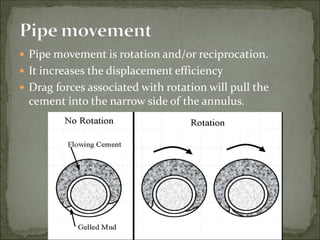
Pipe movement is rotation and/or reciprocation. 
 
It increases the displacement efficiency 
 
Drag forces associated with rotation will pull the cement into the narrow side of the annulus.
 
Reciprocation has a tendency to break the gel strengths of the mud in the narrow side of the annulus. 
 
The pipe should be reciprocated from the time the pipe reaches bottom until the cement plug bumps. 
 
Pipe sticking may be a problem 
 
Landing the casing if it starts to stick
 
Higher viscosity mud is harder to displace 
 
Viscosity of mud can be reduced prior to cementing by adding water (or thinners in a weighted mud). 
 
Move the casing 
 
The thicker the mud, the longer it should take to circulate.
 
A clean hole allows the ease of running casing and getting centralizers to bottom. 
 
Washouts are hard to cement 
 
If washouts are a problem, change the mud to try and minimize the washouts.
 
Which should be employed: turbulent, laminar or plug flow?
 
Laminar flow: 
 
Has the smallest displacement efficiency (75% and less). 
 
Laminar flow gives inadequate cementations and should be avoided when possible since it promotes channeling 
 
Plug flow: 
 
Lowest annular velocity (30 to 90 feet/min, depending upon cement properties). 
 
Very efficient 
 
Limited to cementations of small volumes and where the mud in the hole is of low density. 
 
Can be used when high displacement rate is possible because of ECD or hole size.
 
Turbulent flow: 
 
High displacement efficiencies. 
 
Applicable to large volume cementations 
 
Applicable where the mud and cement slurry weight are similar. 
 
Limited in use by excessive bottomhole circulating pressure. 
 
Can be limited by insufficient surface pump horsepower. 
 
Primarily chosen because it requires shortest of all cementation times.
 
Cement and mud are not compatible and should be kept separate. 
 
A spacer fluid is used to separate the cement and mud in the annulus. 
 
The spacer fluid should compatible with both cement and the mud 
 
The spacer volume should equal at least 500 ft in the annulus.
 
In water based muds (WBM), water is a very good spacer 
 
Water is thin and will easily go into turbulent flow 
 
Compatible with both cement and mud 
 
Cost effective 
 
In weighted muds, spacer may have to be weighted with barite.
 
Little effect on displacement efficiency 
 
The cement should be at least 0.5 ppg greater than mud density to prevent movement after the pump stops
 
Difficult to get adequate centralization 
 
Cuttings bed 
 
There may be cuttings 
beds on the bottom of 
the hole. 
 
They should be removed 
before cementing.
 
Free water 
 
Should be zero to 
minimize the possibility 
of a free water channel 
on the high side of 
the hole.
 
Data: 
 
Casing setting depth, HTVD= 3,000 ft 
 
Average hole size, Dh= 17-1/2 in. 
 
Casing ID, DCID= 12.615 in. 
 
Casing OD, DCOD = 13-3/8 in. 
 
Float collar (from shoe), HFC = 44 ft 
 
Pump factor, Fp= 0.112 bbl/stroke 
 
Casing program:LEAD (or FILLER)TAIL (or NEAT) 
Density (ppg)13.815.8 
Height (ft)2,0001,000 
Yield (ft3/sack)1.591.15 
Excess volume = 50%
Questions: 
 
How many sacks of LEAD cement will be required? 
 
How many sacks of TAIL cement will be required? 
 
How many barrels of mud will be required to bump plugs? 
 
How many strokes of pump will be required to bump plugs?
22Annular capacity,C183.35hCODADD− = 2217.513.375183.35− =30.6946 ft/ft= Determine number of sacks of LEAD: Excess# SacksyieldACh××=0.69462,0001.501.59××=1,311 sacks= 2Casing capacity,C183.35CIDCD= 212.615183.35=30.8679 ft/ft= 2Casing capacity,C1,029.4CIDCD= 212.6151,029.4=0.1545 bbl/ft=
Determine number of sacks of TAIL: Excess# Sacks (annular) yieldACh××=0.69461,0001.501.15××=906 sacks= # Sacks (casing) yieldAFCCH×=0.8679441.15×=33 sacks= # Sacks (total) (annular) (casing)=+90633=+939 sacks=
Determine barrels of mud to bump plugs: ()VolumeTVDFCCHHC=−×()3,000440.1545=−×456.7 bbls= Determine number of strokes to bump plugs: Volume# StrokesPF=456.70.112=4,078 strokes=

Drilling Engineering - Primary Cementing

  • 1.
  • 2.
     Cement Composition  API Classes of Cement  Cement Additives  Density control  Accelerators  Retarders  Viscosity control  Types of Cementing  Cementing Operation  Cementing equipment  Cementing process  Performing a good cementing job
  • 3.
     Cement ismade of limestone and clay/or shale mixed in the right proportions  Cement (oxides of Ca, Al, Fe, and Si) is heated in a rotary kiln to between 2,600 oF to 2,800 oF.  The result from the kiln is called Clinker.  Clinker is ground with a controlled amount of gypsum (CaSO4.2H2O) to make Portland cement.  Gypsum retards setting time and increases ultimate strength.
  • 4.
  • 6.
     The classesused today are primarily Classes A, C, G, and H.  Classes A, B, and C are used for surface casing job.  Class A is used in some areas because it is very similar to construction cement and can be obtained locally.  Classes A and C are already ground with an accelerator.  Classes G and H are basic cements.  Class G is a finer grind and requires more mix water resulting in a lower density.  Class G is more common around the world.  Classes E and F are used for deep wells under high temperature and pressure.
  • 7.
     Cement additiveswill be sub-divided into these functional groups:  Density control  Accelerators  Retarders  Viscosity control  Others
  • 8.
     Density ofcement should be high enough to prevent the high-pressured formations from entering the well.  Density of cement should not be so high as to cause fracture of the weaker formations.  Density of normal slurry (cement mixed with normal amount of water) is usually too high for formation strength.  It is desirable to lower slurry density by:  Lowering slurry density reduces cost.
  • 9.
     Methods oflowering slurry density:  Increase water/cement ratio  Add low-specific-gravity solids  Effect of high (excess) water/cement ratio:  Increase thickening time  Increase free water  Reduces compressive strength  Lowers resistance to sulfate attack  Increases permeability of the set cement
  • 10.
     Common low-specific-gravitysolids in use are:  Bentonite  Diatomaceous earth  Solid hydrocarbons  Pozzolan  Expanded perlite  Bentonite  Most common light-weight additive  Ability to hydrate permits the use of high water concentration.  High amount will reduce cement strength and thickening time.  Cement strength retrogress with at high temperature above 230 oF.
  • 11.
     Diatomaceous earth(Diacel D)  Lower specific gravity than bentonite  Permits higher water/cement ratios without resulting in free water.  Like in bentonite, high amount will reduce cement strength and thickening time.  More expensive than bentonite.  Solid hydrocarbons  Gilsonite (lustrous asphalt) and Kolite (crushed coal)  Almost no effect on slurry thickening time.  Higher cement compressive strengths than other types of low-density solids.
  • 12.
     Pozzolans  Siliceous and aluminous materials that react with lime and water to a form a calcium silicates that possesses cementitious properties.  Natural pozzolans are volcanic ash  Artificial pozzolans include glass, furnace slag and fly ash (residue from chimneys of coal-burning power plants.  Only slight reduction in slurry density is achieved.  Perlite  Volcanic glass bubbles that has sometimes been used in geothermal wells because of its insulating properties.  Considerably more expensive
  • 13.
     If thereis need for higher slurry density, additives that are used are:  Hematite  Reddish iron oxide ore (Fe2O3)  Very common because of its high specific gravity (5.02)  Barite  Barium sulfate  For smaller increases in density  Requires more water to keep slurry pumpable  Sand  Additional water not needed to be added to the slurry  Little effect on strength and pumpability of the cement
  • 14.
     Accelerate cementhydration  Decrease thickening time  Applicable for shallow, low-temperature wells.  They are inorganic compounds:  Calcium chloride  Sodium chloride  Gypsum  Little amount is needed. If in excess, it will retard the cement.  In offshore drilling: NaCl, CaCl2, MgCl2in seawater act as accelerators.
  • 15.
     Calcium chloride  Used in concentration of up to 4%  Anhydrous type is preferable because it absorbs moisture less readily  Sodium chloride  Best result is achieved at a concentration of 5%  Saturated type are used in salt formations or reactive shale formations.  Gypsum  Special grade of gypsum hemihydrate cement is mixed with portland cement.  Maximum working temperature is 140 oF for the regular grade, and 180 oF for the high-temperature grade.
  • 16.
     Also calledthinners or dispersants  Increase the thickening time of cement  Applicable for deeper, high temperature wells.  Are typically organic compounds  Lignins  Borax  Sodium chloride  Cellulose derivatives
  • 17.
     Lignins  Calcium lignosulfonate  Most common retarder  Very low concentration is needed  Organic acids can be added for high temperature jobs  Borax  Sodium tetraborate decahydrate  Sodium chloride  At high concentrations  Cellulose derivatives  CMHEC (carboxylmethyl hydroxyethyl cellulose)  Commonly used  Works with all portland cements
  • 18.
     High slurryviscosity will:  Increase pump horsepower  Increase annular frictional pressure loss, which may lead to formation fracture.  Common viscosity-control additives are:  Organic deflocculants (e.g. calcium lignosulfonate)  Sodium chloride  Certain long-chain polymers
  • 19.
     Silica flour–to form stronger, more stable, and less permeable cements at high temperature.  Hydrazine–oxygen scavenger to control corrosion.  Radioactive tracer –to determine where cement has been placed.  Nylon–to make cement more impact resistant  Paraformaldehydeand sodium chromate –to counter the contamination effect of organic deflocculants from drilling muds.
  • 20.
     Primary cementing  Casing cementing –cementing of casing to the borehole  Liner cementing –cementing of liner. More complex than casing cementing  Secondary/remedial cementing  Plug cementing –to separate lower section of a well from upper section. Open hole or cased hole.  Squeeze cementing –to plug off abandoned perforation, repair annular leaks, and plug severe lost circulation zones.
  • 21.
     Cementing Equipment  Cementing Process  Performing a Good Cementing Job
  • 22.
  • 23.
     Guide shoe Guides the casing past irregularities in the borehole wall.
  • 24.
     Centralizer Theyare placed on the outside of the casing to help hold the casing in the center of the hole.
  • 25.
     Float collar Acts as a check valve to prevent cement from backing up into the casing.
  • 26.
     Float shoe Serves the function of both a guide shoe and a float collar when no shoe joints are desired.
  • 27.
     Cement basket Placed on the outside of the casing to help support the weight of the cement slurry at points where porous or weak formations are exposed.
  • 28.
  • 29.
  • 30.
     Scratchers Placedon the outside of the casing to help remove mudcake from the borehole walls, either by reciprocating the casing or by rotating the casing.
  • 32.
     Bottom rubberwiper plug is released to minimize cement contamination from drilling fluid.  Spacer fluid (or mud preflush) may be pumped also.  Desired volume of slurry is pumped  Top wiper plug is released  Drilling fluid displaces the top plug down the casing  When bottom plug reaches the float collar, its diaphragm ruptures.  The whole cement slurry has been fully displaced when the top plug bumps the bottom plug.
  • 34.
     Cement excess * Note:care should be taken to ensure cement does not reach the subsea well or mudline.
  • 35.
     Casing centralization  Pipe movement  Drilling fluid condition  Hole condition  Displacement velocity  Spacer fluids  Mud-cement density difference  Directional wells
  • 36.
     Centralization promotesa good cementing job  Centralizers are used to keep the pipe in the center of the hole  For a non-Newtonian fluid when pipe is not well centralized, the velocity on the narrow of the annulus is slower than the velocity on the wide (Popcorn theory).  The point between the centralizers is the hardest to centralize
  • 37.
     The degreeof centralization is called % Standoff.  100% -perfectly centralized  0% -pipe touching wall  A minimum standoff of 70% is a good rule-of-thumb () ()%Standoff1100% bcCDRR + =−×−
  • 38.
     Rule ofthumb:  1 centralizer per 2 joints in vertical wells.  1 centralizer per 1 joint in directional wells  2 centralizers per 1 joint in high angle or horizontal wells.  Smaller hole clearance will require more centralizers
  • 39.
     Pipe movementis rotation and/or reciprocation.  It increases the displacement efficiency  Drag forces associated with rotation will pull the cement into the narrow side of the annulus.
  • 40.
     Reciprocation hasa tendency to break the gel strengths of the mud in the narrow side of the annulus.  The pipe should be reciprocated from the time the pipe reaches bottom until the cement plug bumps.  Pipe sticking may be a problem  Landing the casing if it starts to stick
  • 41.
     Higher viscositymud is harder to displace  Viscosity of mud can be reduced prior to cementing by adding water (or thinners in a weighted mud).  Move the casing  The thicker the mud, the longer it should take to circulate.
  • 42.
     A cleanhole allows the ease of running casing and getting centralizers to bottom.  Washouts are hard to cement  If washouts are a problem, change the mud to try and minimize the washouts.
  • 43.
     Which shouldbe employed: turbulent, laminar or plug flow?
  • 44.
     Laminar flow:  Has the smallest displacement efficiency (75% and less).  Laminar flow gives inadequate cementations and should be avoided when possible since it promotes channeling  Plug flow:  Lowest annular velocity (30 to 90 feet/min, depending upon cement properties).  Very efficient  Limited to cementations of small volumes and where the mud in the hole is of low density.  Can be used when high displacement rate is possible because of ECD or hole size.
  • 45.
     Turbulent flow:  High displacement efficiencies.  Applicable to large volume cementations  Applicable where the mud and cement slurry weight are similar.  Limited in use by excessive bottomhole circulating pressure.  Can be limited by insufficient surface pump horsepower.  Primarily chosen because it requires shortest of all cementation times.
  • 46.
     Cement andmud are not compatible and should be kept separate.  A spacer fluid is used to separate the cement and mud in the annulus.  The spacer fluid should compatible with both cement and the mud  The spacer volume should equal at least 500 ft in the annulus.
  • 47.
     In waterbased muds (WBM), water is a very good spacer  Water is thin and will easily go into turbulent flow  Compatible with both cement and mud  Cost effective  In weighted muds, spacer may have to be weighted with barite.
  • 48.
     Little effecton displacement efficiency  The cement should be at least 0.5 ppg greater than mud density to prevent movement after the pump stops
  • 49.
     Difficult toget adequate centralization  Cuttings bed  There may be cuttings beds on the bottom of the hole.  They should be removed before cementing.
  • 50.
     Free water  Should be zero to minimize the possibility of a free water channel on the high side of the hole.
  • 51.
     Data:  Casing setting depth, HTVD= 3,000 ft  Average hole size, Dh= 17-1/2 in.  Casing ID, DCID= 12.615 in.  Casing OD, DCOD = 13-3/8 in.  Float collar (from shoe), HFC = 44 ft  Pump factor, Fp= 0.112 bbl/stroke  Casing program:LEAD (or FILLER)TAIL (or NEAT) Density (ppg)13.815.8 Height (ft)2,0001,000 Yield (ft3/sack)1.591.15 Excess volume = 50%
  • 52.
    Questions:  Howmany sacks of LEAD cement will be required?  How many sacks of TAIL cement will be required?  How many barrels of mud will be required to bump plugs?  How many strokes of pump will be required to bump plugs?
  • 53.
    22Annular capacity,C183.35hCODADD− =2217.513.375183.35− =30.6946 ft/ft= Determine number of sacks of LEAD: Excess# SacksyieldACh××=0.69462,0001.501.59××=1,311 sacks= 2Casing capacity,C183.35CIDCD= 212.615183.35=30.8679 ft/ft= 2Casing capacity,C1,029.4CIDCD= 212.6151,029.4=0.1545 bbl/ft=
  • 54.
    Determine number ofsacks of TAIL: Excess# Sacks (annular) yieldACh××=0.69461,0001.501.15××=906 sacks= # Sacks (casing) yieldAFCCH×=0.8679441.15×=33 sacks= # Sacks (total) (annular) (casing)=+90633=+939 sacks=
  • 55.
    Determine barrels ofmud to bump plugs: ()VolumeTVDFCCHHC=−×()3,000440.1545=−×456.7 bbls= Determine number of strokes to bump plugs: Volume# StrokesPF=456.70.112=4,078 strokes=