ATOMS AND ELEMENTS Define Particle, Atom, Element, Compounds and Periodic table. Contents of Slide Presentation  Intro Atoms & Elements Atoms – What are atoms About an atom Atoms & Shells  Subatomic Particles Compounds and Chemical Elements Quick Quiz Atomic Number Atomic Number Calculations Mass Number Calculations Neutral Atom Copy right © Science-tutors Media 2008 www.sciencetutors.zoomshare.com
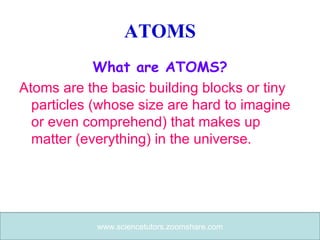
ATOMS What are ATOMS? Atoms are the basic building blocks or tiny particles (whose size are hard to imagine or even comprehend) that makes up matter (everything) in the universe. www.sciencetutors.zoomshare.com
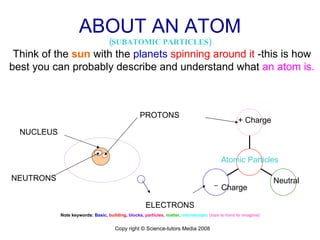
ABOUT AN ATOM (SUB ATOMIC PARTICLES) Note keywords:  Basic,  building ,  blocks,   particles,   matter,   microscopic   (size is hard to imagine) PROTONS NEUTRONS ELECTRONS Think of the  sun   with the  planets  spinning around it  -this is how best you can probably describe and understand what  an atom is. + Charge Charge Neutral Atomic Particles NUCLEUS Copy right © Science-tutors Media 2008 _
ATOMS AND SHELLS Electrons  stay in their  shells  as they  revolve round  the  nucleus  because a special force  (electrostatic force)  holds them there.  Protons   (+ve charge)  and  electrons   (- ve charge)  are attracted to each other.  SUBATOMIC PARTICLES  -  PROTONS ,  ELECTRONS  and  NEUTRONS Subatomic particles in all atoms are smaller than the atom itself.   Copy right © Science-tutors Media 2008
SUBATOMIC PARTICLES (MEMORY TIPS) An easy way to remember this is  P roton  and  P ositive   start with the letter  ‘ P’   Neutrons have no electrical charge.  An easy way to remember this is  N eutron  and  n o  electrical charge start with the letter  ‘N’ Orbiting or circling/moving around outside the nucleus are tiny little particles called electrons  Copy right © Science-tutors Media 2008
Compounds  &  Chemical Elements What are chemical elements? What are compounds? How are chemical elements different from compounds? All materials or matter that is composed of only  one type of atom  is called a chemical element or just an element. However,  compounds  are made when  atoms of different elements  are chemically joined or combined together.  Squashed together in the middle of the atom are protons and neutrons  Copy right © Science-tutors Media 2008 Compilation by Ivan Ukiwah
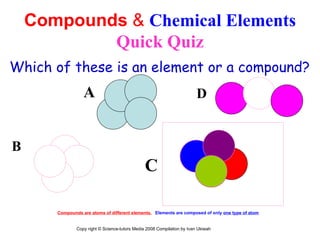
Compounds  &  Chemical Elements   Quick Quiz Which of these is an element or a compound? A B C D Compounds are atoms of different elements.   Elements are composed of only  one type of atom   Copy right © Science-tutors Media 2008 Compilation by Ivan Ukiwah
ATOMIC  NUMBER What is an atom's atomic number? What is an atom's mass number? Atomic Number is a unique number that identifies how many protons are present in one atom of an element. In science it is defined more precisely as the number of protons in the nucleus of an atom determines an element's atomic number.  Copy right © Science-tutors Media 2008 Compilation by Ivan Ukiwah
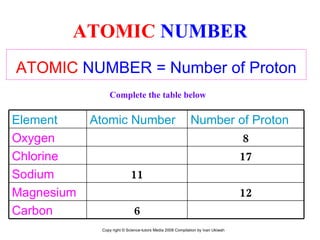
ATOMIC  NUMBER ATOMIC  NUMBER = Number of Proton Complete the table below Copy right © Science-tutors Media 2008 Compilation by Ivan Ukiwah Element Atomic Number Number of Proton Oxygen 8 Chlorine 17 Sodium 11 Magnesium 12 Carbon 6
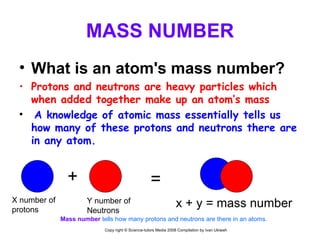
MASS NUMBER What is an atom's mass number? Protons and neutrons are heavy particles which when added together make up an atom’s mass A knowledge of atomic mass essentially tells us how many of these protons and neutrons there are in any atom. + X number of  protons Y number of  Neutrons = x + y = mass number Mass number   tells how many protons and neutrons are there in an atoms.  Copy right © Science-tutors Media 2008 Compilation by Ivan Ukiwah
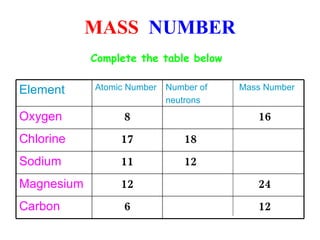
MASS  NUMBER Complete the table below  Element Atomic Number Number of  Mass Number neutrons Oxygen 8 16 Chlorine 17 18  Sodium 11 12  Magnesium 12 24 Carbon 6 12
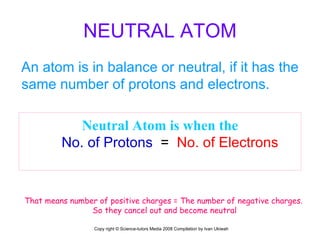
NEUTRAL ATOM An atom is in balance or neutral, if it has the same number of protons and electrons. Neutral Atom is when the No. of Protons   =  No. of Electrons   That means number of positive charges = The number of negative charges. So they cancel out and become neutral Copy right © Science-tutors Media 2008 Compilation by Ivan Ukiwah
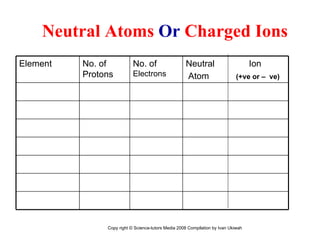
Neutral Atoms  Or  Charged Ions Copy right © Science-tutors Media 2008 Compilation by Ivan Ukiwah Element No. of Protons No. of  Electrons Neutral  Ion Atom  (+ve or –  ve)
ATOMS AND MOLECULES Learning Outcomes L   Define chemical reaction, molecule, and compound, and name the atoms reacting and molecule produced in a reaction. I  Use these names to construct a word equation showing the reaction. H  Create a model of a chemical reaction between atoms to form a molecule.
REACTION OF METALS IN AIR Objectives Metals can be heated in air to show signs of chemical reaction. To understand how metal oxides are formed.
METAL OXIDE Outcomes L   Describe how to make an oxide safely and use your observations to list the signs of a chemical reaction. I  Name and identify elements involved in chemical reactions. H  Write word equations and predict name of product.
REACTIONS OF METALLIC ELEMENTS Copy and answer questions What are metal oxides? How are metal oxides formed? Name the reactants and the product in the formation of metal oxides.
Learning Outcomes L   Plan a safe experiment to demonstrate the objective. I  Plan a safe and fair test for the experiment stated in the objective and write the work equation for the reaction. H  Critically evaluate the plan you have written in terms of safety and fair testing.
PRACTICAL REVIEW Discuss about chemical change, what elements and compounds were present?

ATOMS-ELEMENTS AND COMPOUNDS REVISION

  • 1.
    ATOMS AND ELEMENTSDefine Particle, Atom, Element, Compounds and Periodic table. Contents of Slide Presentation Intro Atoms & Elements Atoms – What are atoms About an atom Atoms & Shells Subatomic Particles Compounds and Chemical Elements Quick Quiz Atomic Number Atomic Number Calculations Mass Number Calculations Neutral Atom Copy right © Science-tutors Media 2008 www.sciencetutors.zoomshare.com
  • 2.
    ATOMS What areATOMS? Atoms are the basic building blocks or tiny particles (whose size are hard to imagine or even comprehend) that makes up matter (everything) in the universe. www.sciencetutors.zoomshare.com
  • 3.
    ABOUT AN ATOM(SUB ATOMIC PARTICLES) Note keywords: Basic, building , blocks, particles, matter, microscopic (size is hard to imagine) PROTONS NEUTRONS ELECTRONS Think of the sun with the planets spinning around it -this is how best you can probably describe and understand what an atom is. + Charge Charge Neutral Atomic Particles NUCLEUS Copy right © Science-tutors Media 2008 _
  • 4.
    ATOMS AND SHELLSElectrons stay in their shells as they revolve round the nucleus because a special force (electrostatic force) holds them there. Protons (+ve charge) and electrons (- ve charge) are attracted to each other. SUBATOMIC PARTICLES - PROTONS , ELECTRONS and NEUTRONS Subatomic particles in all atoms are smaller than the atom itself. Copy right © Science-tutors Media 2008
  • 5.
    SUBATOMIC PARTICLES (MEMORYTIPS) An easy way to remember this is P roton and P ositive start with the letter ‘ P’ Neutrons have no electrical charge. An easy way to remember this is N eutron and n o electrical charge start with the letter ‘N’ Orbiting or circling/moving around outside the nucleus are tiny little particles called electrons Copy right © Science-tutors Media 2008
  • 6.
    Compounds & Chemical Elements What are chemical elements? What are compounds? How are chemical elements different from compounds? All materials or matter that is composed of only one type of atom is called a chemical element or just an element. However, compounds are made when atoms of different elements are chemically joined or combined together. Squashed together in the middle of the atom are protons and neutrons Copy right © Science-tutors Media 2008 Compilation by Ivan Ukiwah
  • 7.
    Compounds & Chemical Elements Quick Quiz Which of these is an element or a compound? A B C D Compounds are atoms of different elements. Elements are composed of only one type of atom Copy right © Science-tutors Media 2008 Compilation by Ivan Ukiwah
  • 8.
    ATOMIC NUMBERWhat is an atom's atomic number? What is an atom's mass number? Atomic Number is a unique number that identifies how many protons are present in one atom of an element. In science it is defined more precisely as the number of protons in the nucleus of an atom determines an element's atomic number. Copy right © Science-tutors Media 2008 Compilation by Ivan Ukiwah
  • 9.
    ATOMIC NUMBERATOMIC NUMBER = Number of Proton Complete the table below Copy right © Science-tutors Media 2008 Compilation by Ivan Ukiwah Element Atomic Number Number of Proton Oxygen 8 Chlorine 17 Sodium 11 Magnesium 12 Carbon 6
  • 10.
    MASS NUMBER Whatis an atom's mass number? Protons and neutrons are heavy particles which when added together make up an atom’s mass A knowledge of atomic mass essentially tells us how many of these protons and neutrons there are in any atom. + X number of protons Y number of Neutrons = x + y = mass number Mass number tells how many protons and neutrons are there in an atoms. Copy right © Science-tutors Media 2008 Compilation by Ivan Ukiwah
  • 11.
    MASS NUMBERComplete the table below Element Atomic Number Number of Mass Number neutrons Oxygen 8 16 Chlorine 17 18 Sodium 11 12 Magnesium 12 24 Carbon 6 12
  • 12.
    NEUTRAL ATOM Anatom is in balance or neutral, if it has the same number of protons and electrons. Neutral Atom is when the No. of Protons = No. of Electrons That means number of positive charges = The number of negative charges. So they cancel out and become neutral Copy right © Science-tutors Media 2008 Compilation by Ivan Ukiwah
  • 13.
    Neutral Atoms Or Charged Ions Copy right © Science-tutors Media 2008 Compilation by Ivan Ukiwah Element No. of Protons No. of Electrons Neutral Ion Atom (+ve or – ve)
  • 14.
    ATOMS AND MOLECULESLearning Outcomes L Define chemical reaction, molecule, and compound, and name the atoms reacting and molecule produced in a reaction. I Use these names to construct a word equation showing the reaction. H Create a model of a chemical reaction between atoms to form a molecule.
  • 15.
    REACTION OF METALSIN AIR Objectives Metals can be heated in air to show signs of chemical reaction. To understand how metal oxides are formed.
  • 16.
    METAL OXIDE OutcomesL Describe how to make an oxide safely and use your observations to list the signs of a chemical reaction. I Name and identify elements involved in chemical reactions. H Write word equations and predict name of product.
  • 17.
    REACTIONS OF METALLICELEMENTS Copy and answer questions What are metal oxides? How are metal oxides formed? Name the reactants and the product in the formation of metal oxides.
  • 18.
    Learning Outcomes L Plan a safe experiment to demonstrate the objective. I Plan a safe and fair test for the experiment stated in the objective and write the work equation for the reaction. H Critically evaluate the plan you have written in terms of safety and fair testing.
  • 19.
    PRACTICAL REVIEW Discussabout chemical change, what elements and compounds were present?