WELCOME
TO THE WORLD OF
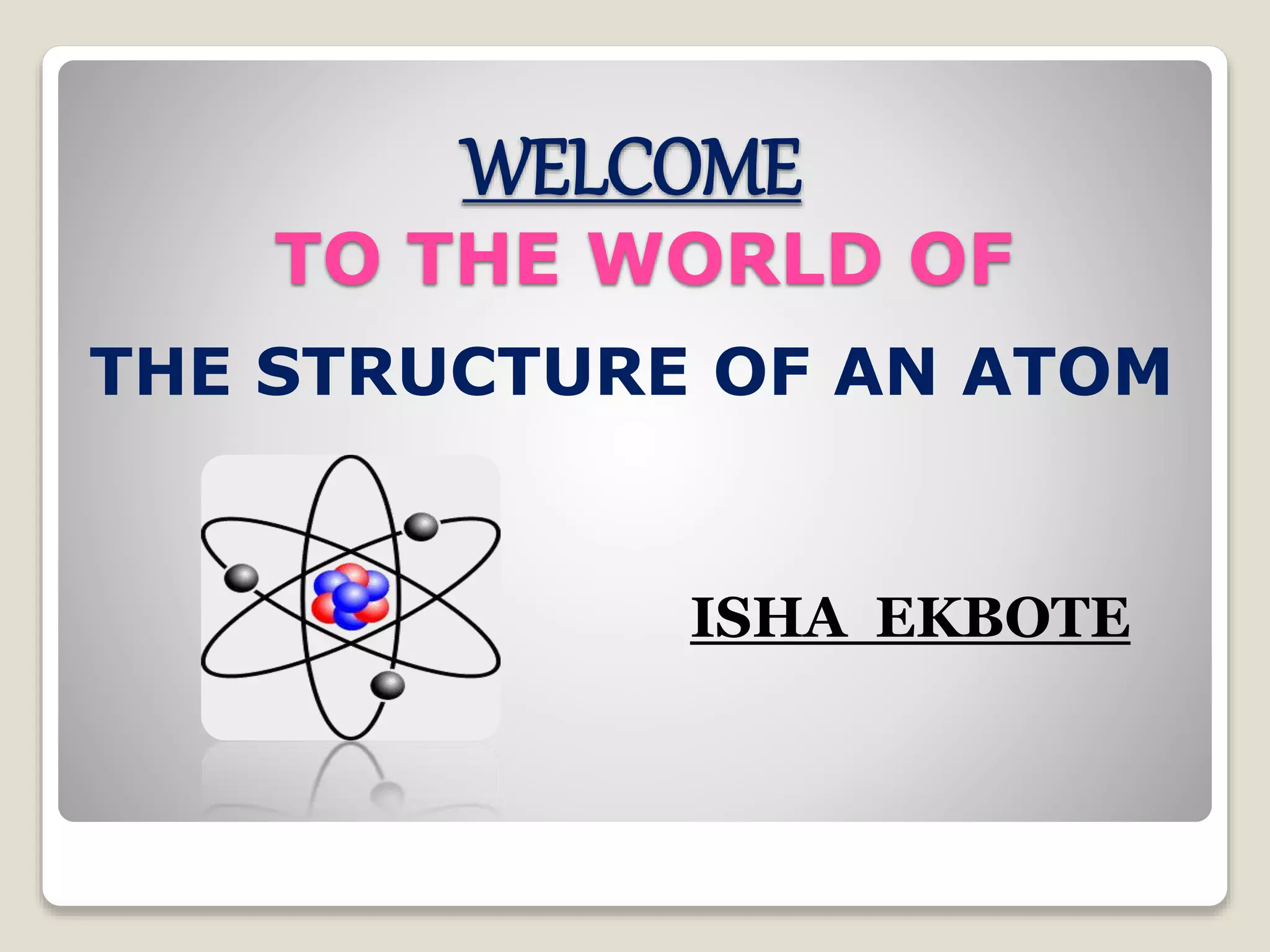
THE STRUCTURE OF AN ATOM
ISHA EKBOTE
THIS WORLD CONTAINS 5
CONTINENTS NAMELY:
 WHAT IS AN ATOM ?
 DISCOVERY OF AN ATOM
 THE PARTICLES OF AN ATOM
 ATOMIC NUMBER ; MASS NUMBER AND
WEIGHTS
 ISOTOPES
AN ATOM
 An atom is the smallest
particle of an element.
 Atoms come together to
make molecules or
particles .
 There are many different
types of atoms, each with
its own name , mass and
size.
 They themselves are
made up of 3 kinds of
particles , protons
(positively charged),
neutrons (have no
charge) and electorns
(negatively charged).
 In atoms the no. of
protons and no. of
elelctrons are equal.
DISCOVERY OF AN ATOM
 In 1803 John Dalton gave the first systematic
idea of the structure of the atom.
 He suggested that, atoms are small particles
and they are indivisible.
 Atoms cannot be created or destroyed.
 Atom is the smallest unit of matter that takes
part in a chemical reaction.
 In 1897, sir J.J.Thomson discovered electron.
 He carried out detailed and concluded that atom
is not the last and ultimate particle of
matter but consists of some fundamental
particles negative & positive charge.
 These particles were called as electrons and
protons respectively.
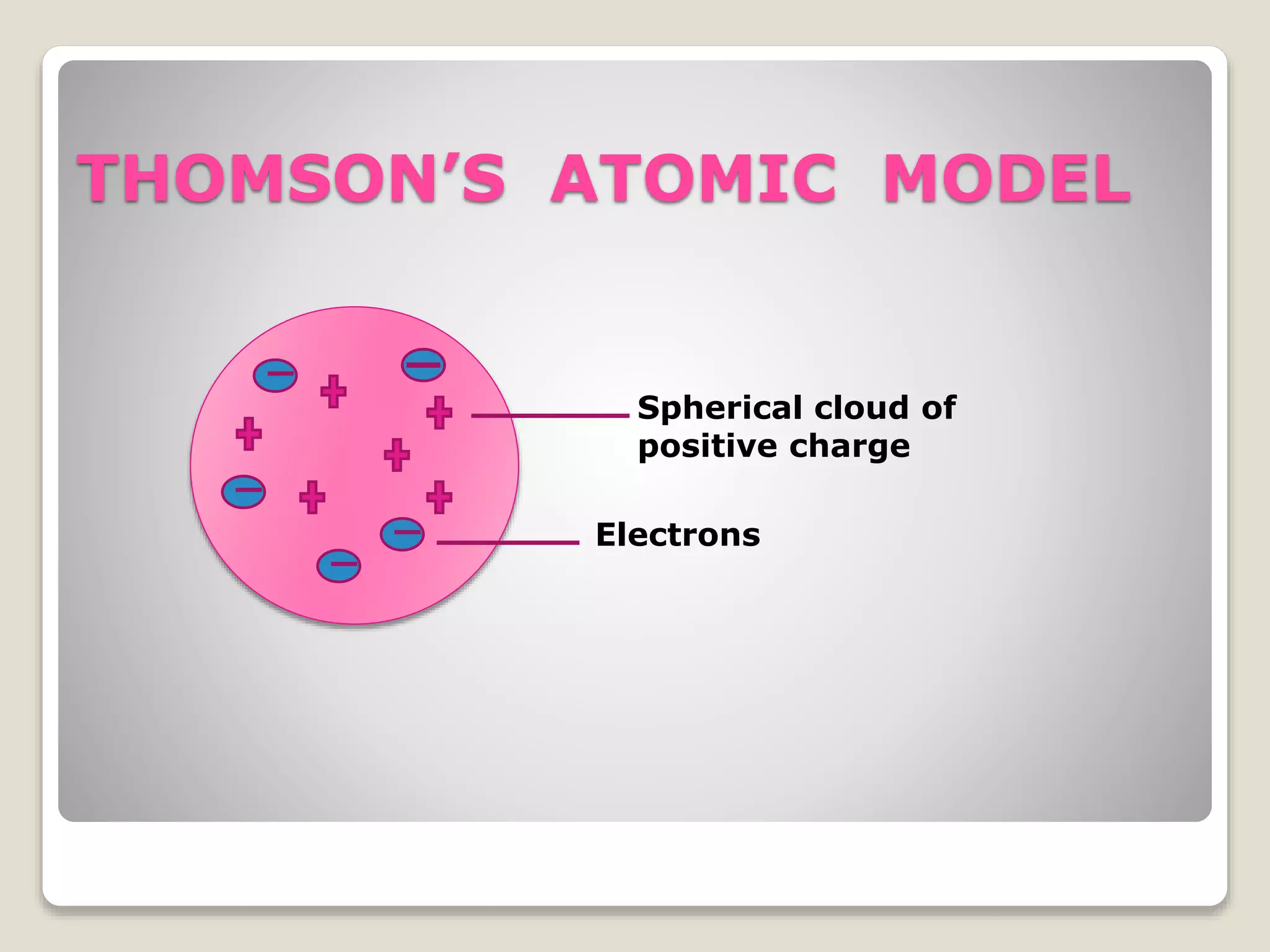
 According to Thomson’s model, atom was
supposed to be a homogeneous sphere
of positive charge, negatively charged
electrons are embedded in it.
 In 1911, Ernest Rutherford suggested that
atom is a hollow sphere and most of the
mass of the is concentrated in the of the
atom.
J.J. THOMSON
THOMSON’S ATOMIC MODEL
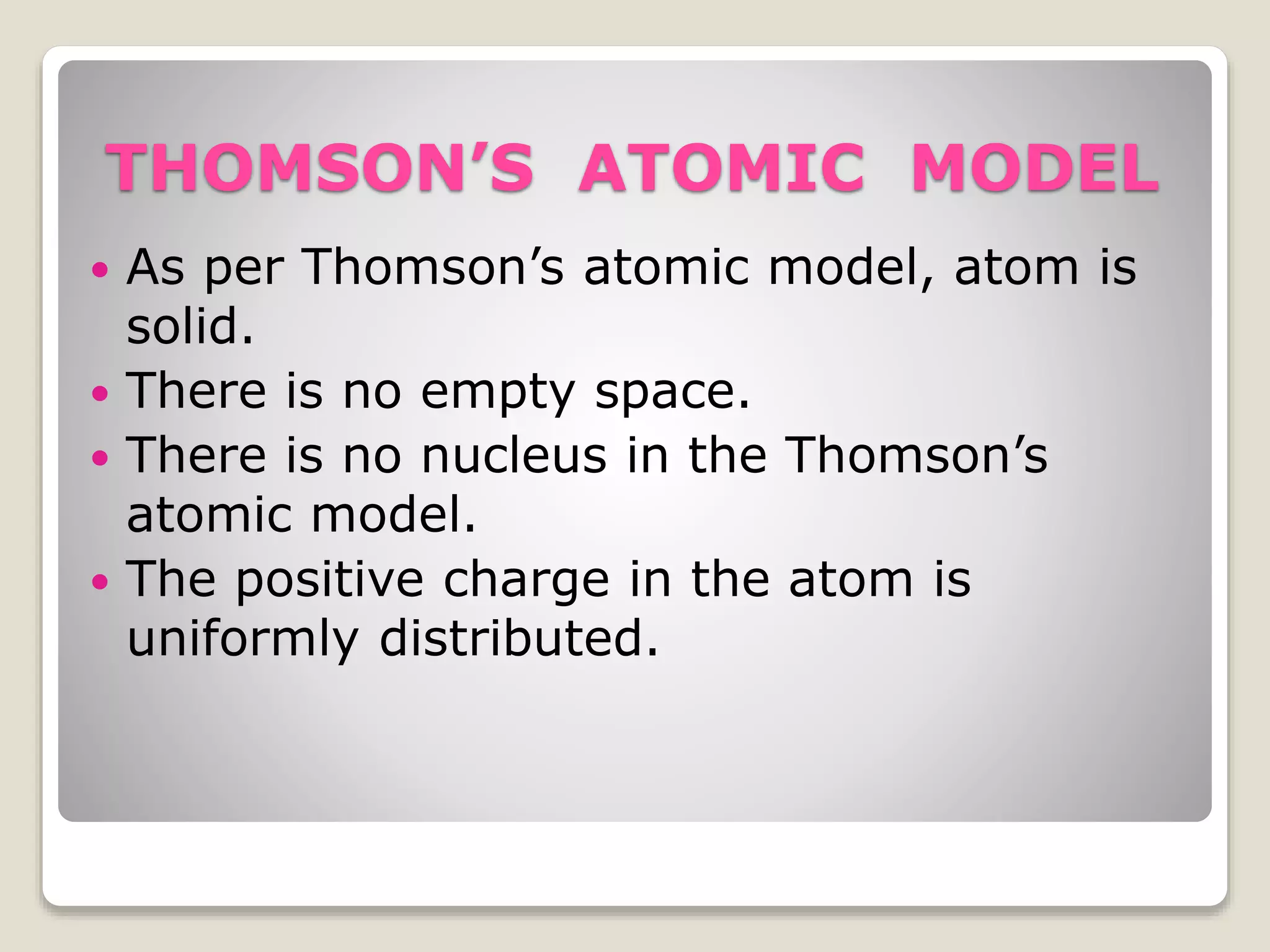
 As per Thomson’s atomic model, atom is
solid.
 There is no empty space.
 There is no nucleus in the Thomson’s
atomic model.
 The positive charge in the atom is
uniformly distributed.
THOMSON’S ATOMIC MODEL
Spherical cloud of
positive charge
Electrons
ERNEST RUTHERFORD
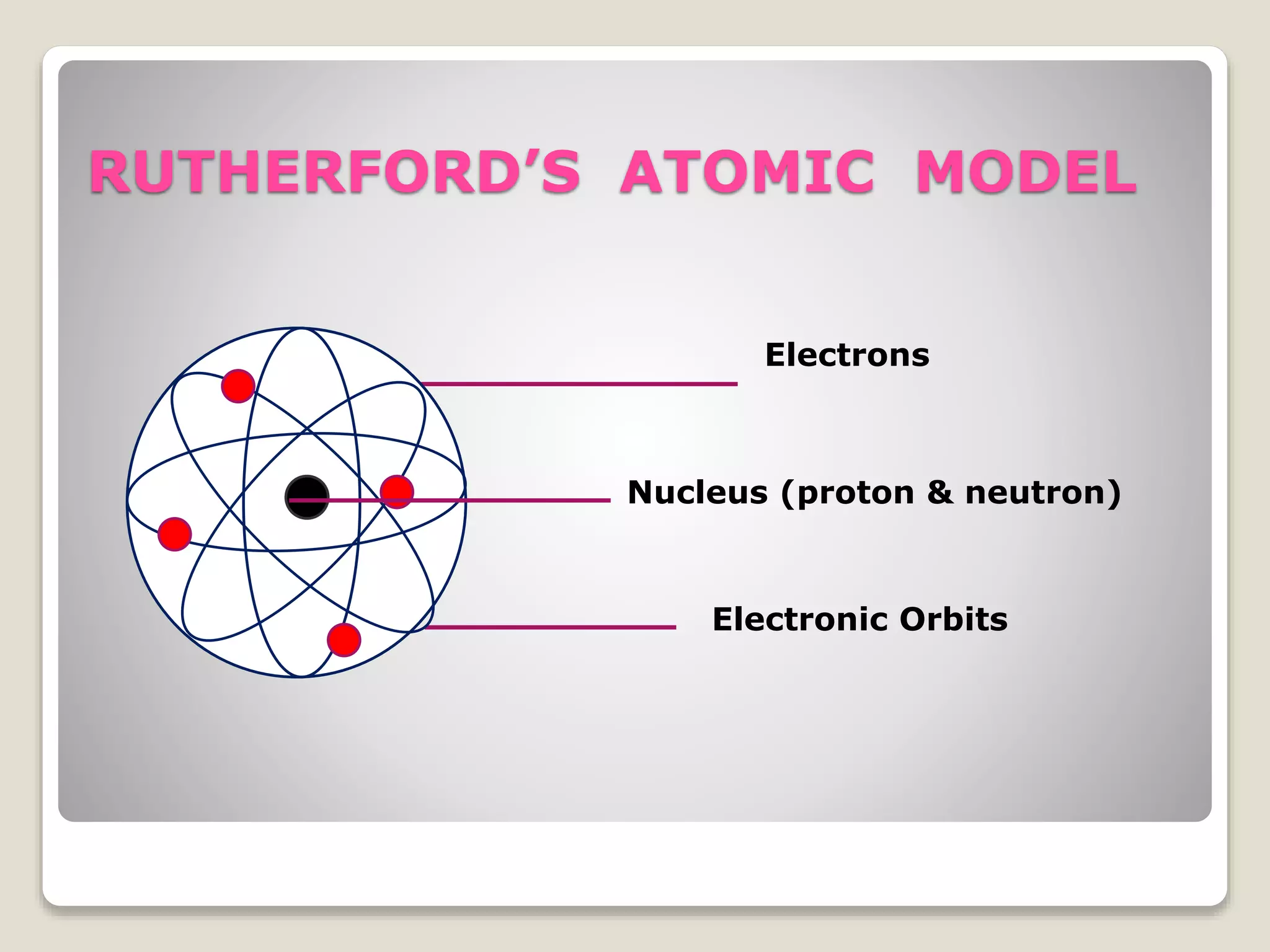
RUTHERFORD’S ATOMIC MODEL
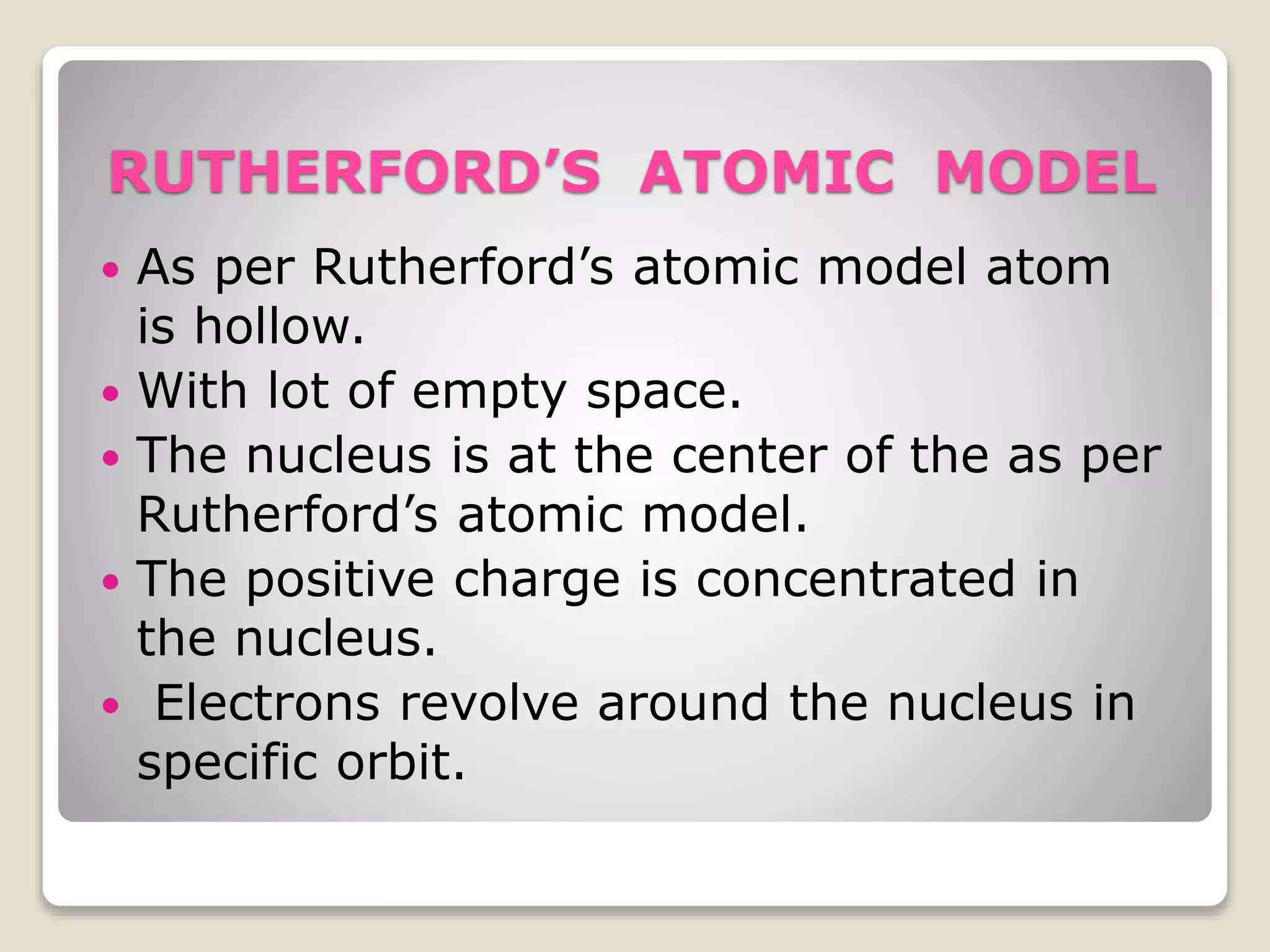
 As per Rutherford’s atomic model atom
is hollow.
 With lot of empty space.
 The nucleus is at the center of the as per
Rutherford’s atomic model.
 The positive charge is concentrated in
the nucleus.
 Electrons revolve around the nucleus in
specific orbit.
RUTHERFORD’S ATOMIC MODEL
Nucleus (proton & neutron)
Electrons
Electronic Orbits
NEILS BOHR
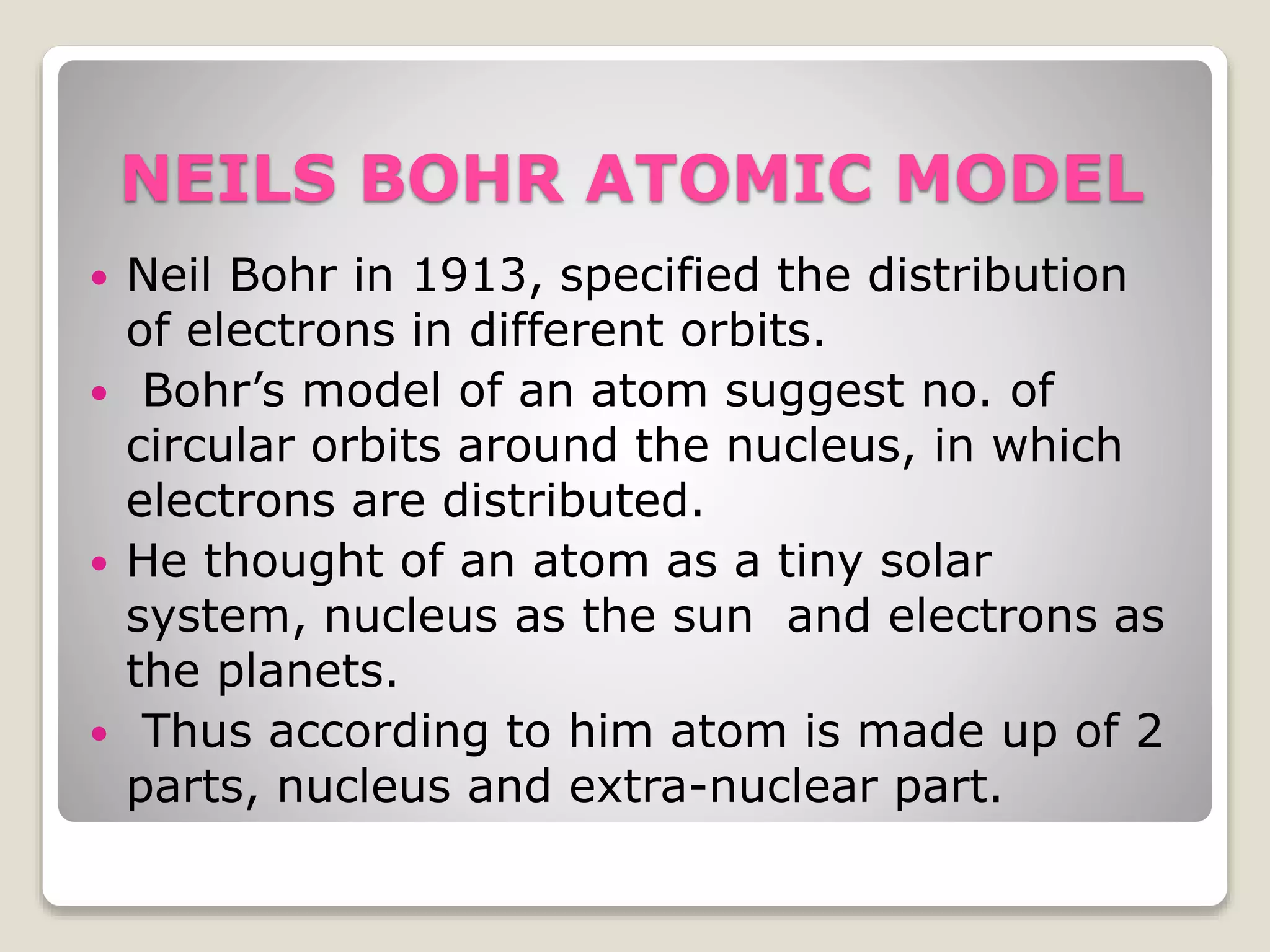
NEILS BOHR ATOMIC MODEL
 Neil Bohr in 1913, specified the distribution
of electrons in different orbits.
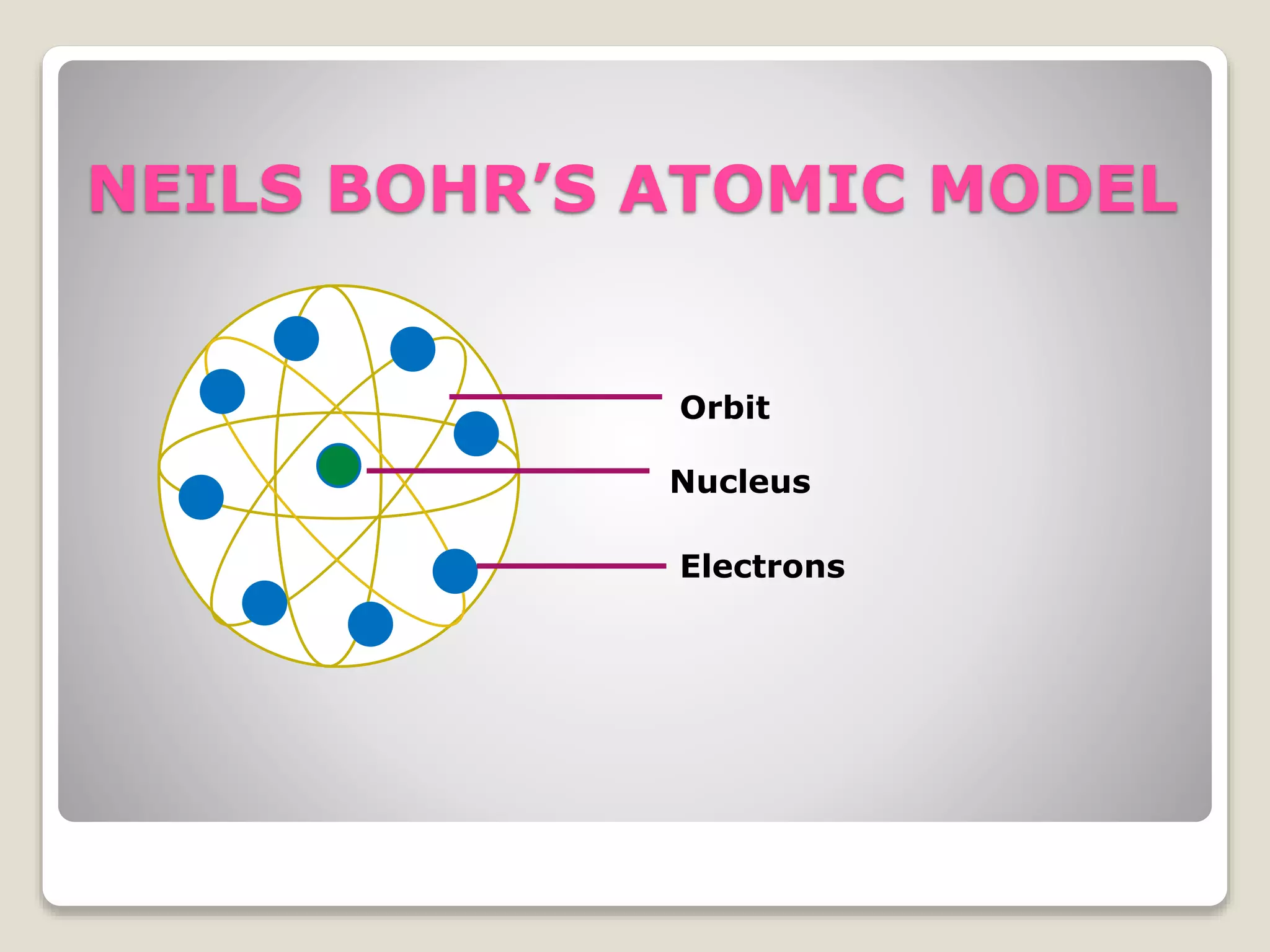
 Bohr’s model of an atom suggest no. of
circular orbits around the nucleus, in which
electrons are distributed.
 He thought of an atom as a tiny solar
system, nucleus as the sun and electrons as
the planets.
 Thus according to him atom is made up of 2
parts, nucleus and extra-nuclear part.
NEILS BOHR’S ATOMIC MODEL
Electrons
Orbit
Nucleus
THE PARTICLES OF AN ATOM
PROTONS
 The protons have a positive charge.
 Protons are represented by the (p+).
 Protons are situated in the nucleus of an
atom.
 The number of protons in the nucleus
determines what chemical element the
atom belongs to.
 The mass of proton is considered to 1 unit.
ELECTRONS
 Electrons have a negative charge.
 They are represented by the symbol (e-).
 Electrons revolve around the nucleus in
specific orbit.
 The mass of electron is negligible.
 The electrons in an atom are bound to the
atom by the electromagnetic force.
NEUTRONS
 Neutrons are neutral as they do not have
any charge.
 They are represented by the symbol(n).
 Neutrons are situated in the nucleus of an
atom.
 The mass of neutrons is nearly equal to the
mass of the protons.
 The number of neutrons determines what
isotope of the element it is.
ATOMIC NUMBER
&
ATOMIC MASS NUMBER
&
ATOMIC WEIGHTS
ATOMIC NUMBER
 The number of protons and electrons in an
atom is called the atomic number.
 The atomic number is represented by the
symbol(Z).
 All atoms of same element have same
atomic number.
 The atomic number uniquely identifies a
chemical element .
ATOMIC MASS NUMBER
 Atomic mass number (A) is equal to the
sum of the number of protons and
neutrons in the nucleus.
 Atomic mass number is represented by the
symbol (A).
 Isotopes same element have different
atomic number.
 The atomic number is always an integral
number.
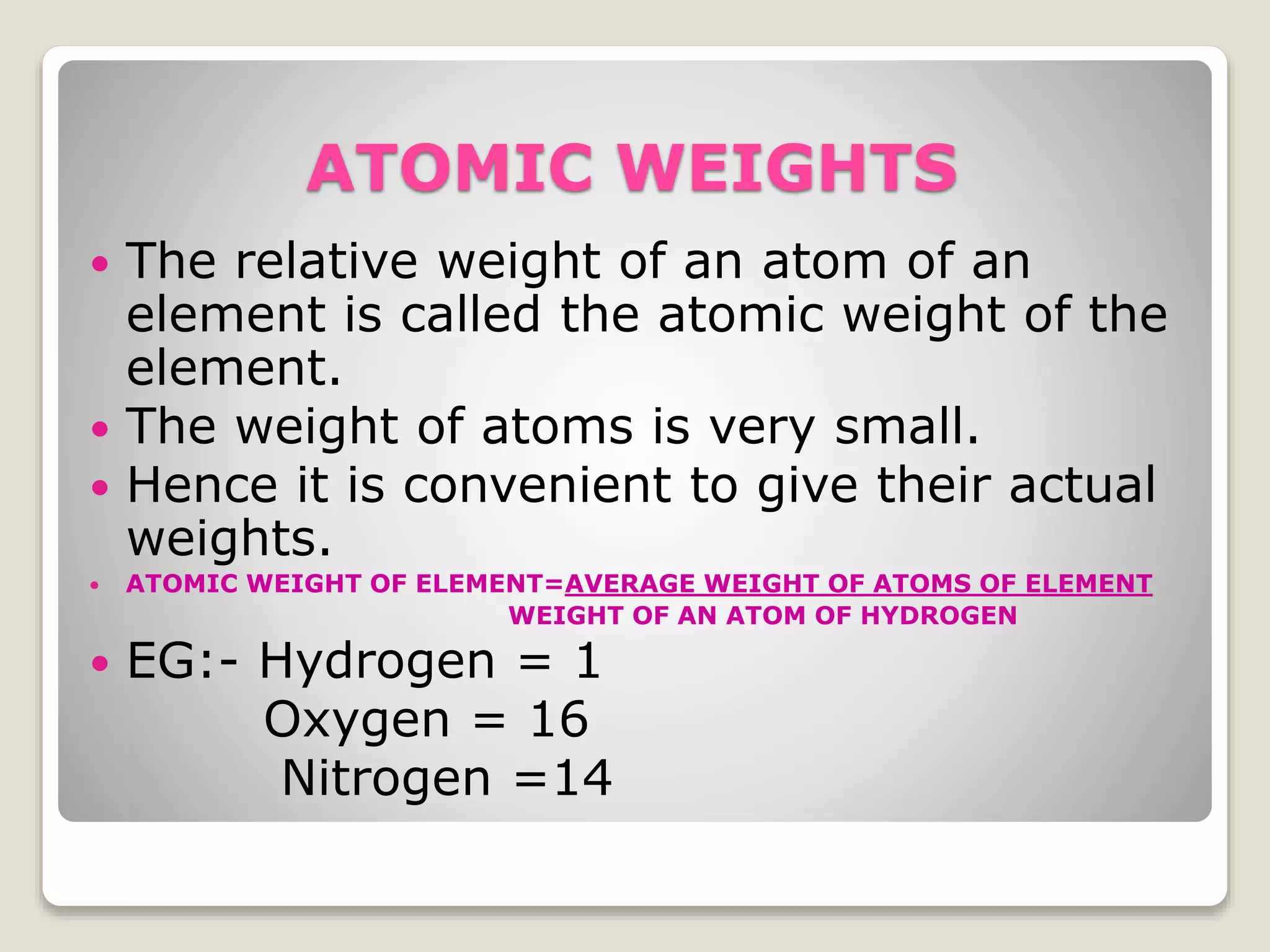
ATOMIC WEIGHTS
 The relative weight of an atom of an
element is called the atomic weight of the
element.
 The weight of atoms is very small.
 Hence it is convenient to give their actual
weights.
 ATOMIC WEIGHT OF ELEMENT=AVERAGE WEIGHT OF ATOMS OF ELEMENT
WEIGHT OF AN ATOM OF HYDROGEN
 EG:- Hydrogen = 1
Oxygen = 16
Nitrogen =14
ISOTOPES & IT’S PROERTIES
 Atoms of the same element having same
atomic no.& but different atomic mass no.
are called as isotopes of that element.
 Properties on isotopes:-
 Isotopes exhibit same chemical properties.
 Isotopes differ in physical constants and
weights.
 Isotopes occupy the same position in
periodic table.
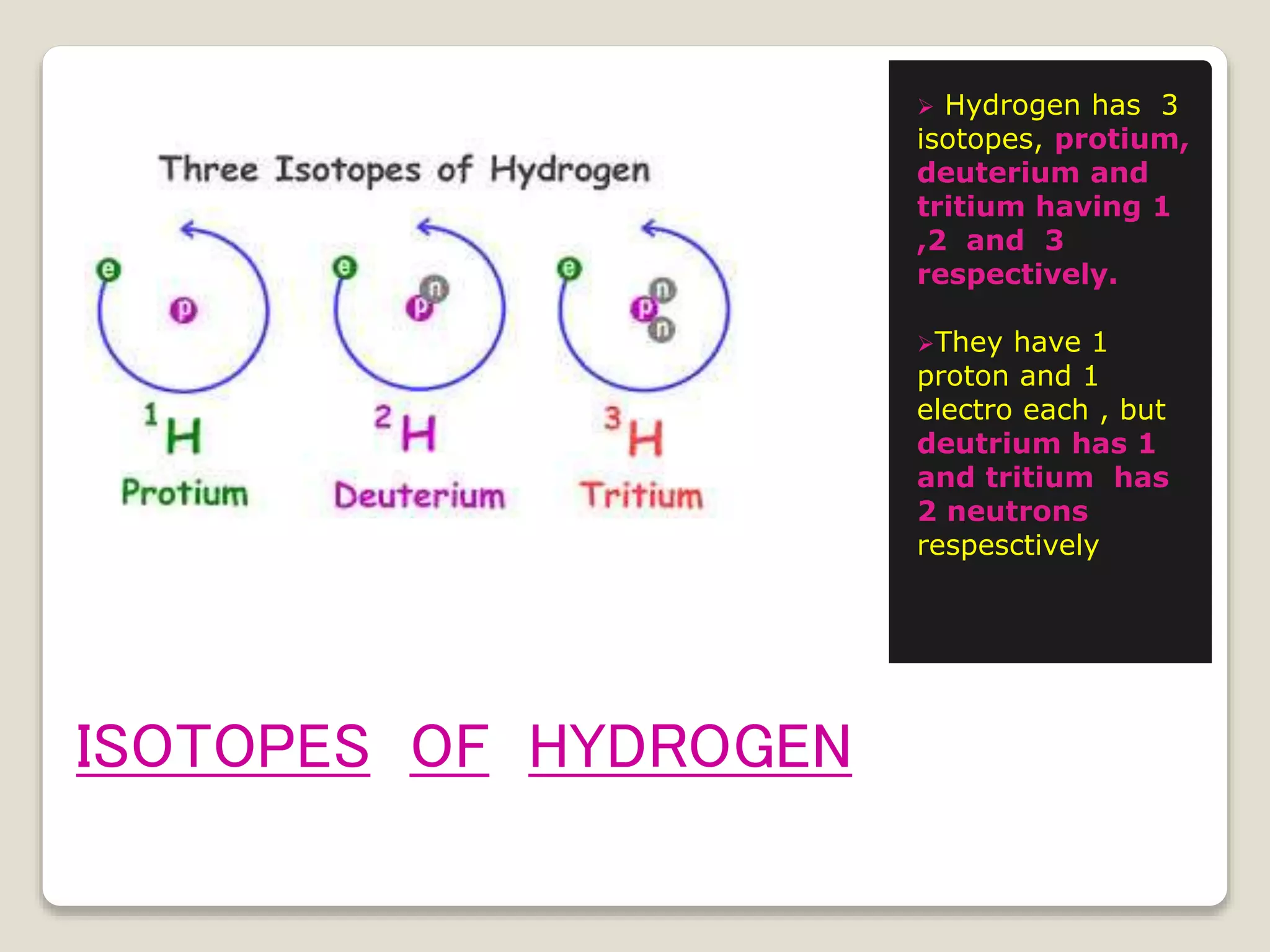
ISOTOPES OF HYDROGEN
 Hydrogen has 3
isotopes, protium,
deuterium and
tritium having 1
,2 and 3
respectively.
They have 1
proton and 1
electro each , but
deutrium has 1
and tritium has
2 neutrons
respesctively
THANK YOU

The Structure of an Atom

  • 1.
    WELCOME TO THE WORLDOF THE STRUCTURE OF AN ATOM ISHA EKBOTE
  • 2.
    THIS WORLD CONTAINS5 CONTINENTS NAMELY:  WHAT IS AN ATOM ?  DISCOVERY OF AN ATOM  THE PARTICLES OF AN ATOM  ATOMIC NUMBER ; MASS NUMBER AND WEIGHTS  ISOTOPES
  • 3.
    AN ATOM  Anatom is the smallest particle of an element.  Atoms come together to make molecules or particles .  There are many different types of atoms, each with its own name , mass and size.  They themselves are made up of 3 kinds of particles , protons (positively charged), neutrons (have no charge) and electorns (negatively charged).  In atoms the no. of protons and no. of elelctrons are equal.
  • 4.
    DISCOVERY OF ANATOM  In 1803 John Dalton gave the first systematic idea of the structure of the atom.  He suggested that, atoms are small particles and they are indivisible.  Atoms cannot be created or destroyed.  Atom is the smallest unit of matter that takes part in a chemical reaction.  In 1897, sir J.J.Thomson discovered electron.  He carried out detailed and concluded that atom is not the last and ultimate particle of matter but consists of some fundamental particles negative & positive charge.
  • 5.
     These particleswere called as electrons and protons respectively.  According to Thomson’s model, atom was supposed to be a homogeneous sphere of positive charge, negatively charged electrons are embedded in it.  In 1911, Ernest Rutherford suggested that atom is a hollow sphere and most of the mass of the is concentrated in the of the atom.
  • 6.
  • 7.
    THOMSON’S ATOMIC MODEL As per Thomson’s atomic model, atom is solid.  There is no empty space.  There is no nucleus in the Thomson’s atomic model.  The positive charge in the atom is uniformly distributed.
  • 8.
    THOMSON’S ATOMIC MODEL Sphericalcloud of positive charge Electrons
  • 9.
  • 10.
    RUTHERFORD’S ATOMIC MODEL As per Rutherford’s atomic model atom is hollow.  With lot of empty space.  The nucleus is at the center of the as per Rutherford’s atomic model.  The positive charge is concentrated in the nucleus.  Electrons revolve around the nucleus in specific orbit.
  • 11.
    RUTHERFORD’S ATOMIC MODEL Nucleus(proton & neutron) Electrons Electronic Orbits
  • 12.
  • 13.
    NEILS BOHR ATOMICMODEL  Neil Bohr in 1913, specified the distribution of electrons in different orbits.  Bohr’s model of an atom suggest no. of circular orbits around the nucleus, in which electrons are distributed.  He thought of an atom as a tiny solar system, nucleus as the sun and electrons as the planets.  Thus according to him atom is made up of 2 parts, nucleus and extra-nuclear part.
  • 14.
    NEILS BOHR’S ATOMICMODEL Electrons Orbit Nucleus
  • 15.
  • 16.
    PROTONS  The protonshave a positive charge.  Protons are represented by the (p+).  Protons are situated in the nucleus of an atom.  The number of protons in the nucleus determines what chemical element the atom belongs to.  The mass of proton is considered to 1 unit.
  • 17.
    ELECTRONS  Electrons havea negative charge.  They are represented by the symbol (e-).  Electrons revolve around the nucleus in specific orbit.  The mass of electron is negligible.  The electrons in an atom are bound to the atom by the electromagnetic force.
  • 18.
    NEUTRONS  Neutrons areneutral as they do not have any charge.  They are represented by the symbol(n).  Neutrons are situated in the nucleus of an atom.  The mass of neutrons is nearly equal to the mass of the protons.  The number of neutrons determines what isotope of the element it is.
  • 19.
    ATOMIC NUMBER & ATOMIC MASSNUMBER & ATOMIC WEIGHTS
  • 20.
    ATOMIC NUMBER  Thenumber of protons and electrons in an atom is called the atomic number.  The atomic number is represented by the symbol(Z).  All atoms of same element have same atomic number.  The atomic number uniquely identifies a chemical element .
  • 21.
    ATOMIC MASS NUMBER Atomic mass number (A) is equal to the sum of the number of protons and neutrons in the nucleus.  Atomic mass number is represented by the symbol (A).  Isotopes same element have different atomic number.  The atomic number is always an integral number.
  • 22.
    ATOMIC WEIGHTS  Therelative weight of an atom of an element is called the atomic weight of the element.  The weight of atoms is very small.  Hence it is convenient to give their actual weights.  ATOMIC WEIGHT OF ELEMENT=AVERAGE WEIGHT OF ATOMS OF ELEMENT WEIGHT OF AN ATOM OF HYDROGEN  EG:- Hydrogen = 1 Oxygen = 16 Nitrogen =14
  • 23.
    ISOTOPES & IT’SPROERTIES  Atoms of the same element having same atomic no.& but different atomic mass no. are called as isotopes of that element.  Properties on isotopes:-  Isotopes exhibit same chemical properties.  Isotopes differ in physical constants and weights.  Isotopes occupy the same position in periodic table.
  • 24.
    ISOTOPES OF HYDROGEN Hydrogen has 3 isotopes, protium, deuterium and tritium having 1 ,2 and 3 respectively. They have 1 proton and 1 electro each , but deutrium has 1 and tritium has 2 neutrons respesctively
  • 25.