Structure of AtomsThe History and Models of Atoms
Studying AtomsScientists have been studying atoms since the 1800s. If atoms are too small to be seen, how do we study them?Scientists use models to study atoms.Sometimes scientists can tell what things look like by studying how they act.Example: Wind
ModelsIn science, a model is an idea, a picture, or an object that is built to explain how something else looks or works.The model might not look exactly like the object it is built to describe, but it helps people understand the way the object acts.
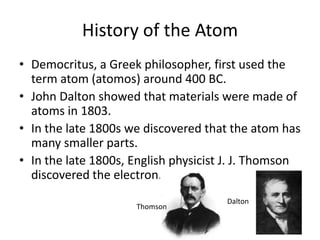
History of the AtomDemocritus, a Greek philosopher, first used the term atom (atomos) around 400 BC.John Dalton showed that materials were made of atoms in 1803.In the late 1800s we discovered that the atom has many smaller parts.In the late 1800s, English physicist J. J. Thomson discovered the electron.DaltonThomson
More History of the AtomIn 1901 Ernest Rutherford found discovered the nucleus, or center of the atom.In 1917 Niels Bohr, working as Ernest Rutherford’s student, discovered how electrons orbit the nucleus.His model of the atom is the current base for the modern atomic model.
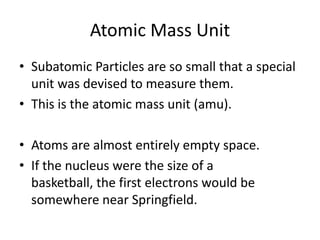
Atomic Mass UnitSubatomic Particles are so small that a special unit was devised to measure them.This is the atomic mass unit (amu).Atoms are almost entirely empty space.If the nucleus were the size of a basketball, the first electrons would be somewhere near Springfield.
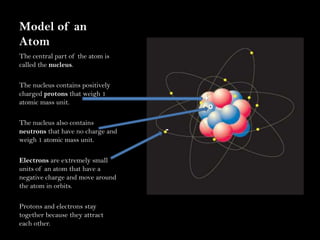
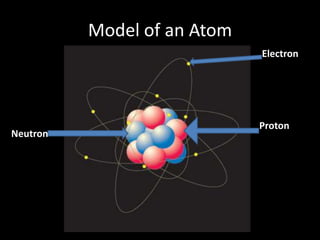
Model of an AtomThe central part of the atom is called the nucleus.The nucleus contains positively charged protons that weigh 1 atomic mass unit.The nucleus also contains neutrons that have no charge and weigh 1 atomic mass unit.Electrons are extremely small units of an atom that have a negative charge and move around the atom in orbits.Protons and electrons stay together because they attract each other.+O-
Model of an AtomElectronProtonNeutron
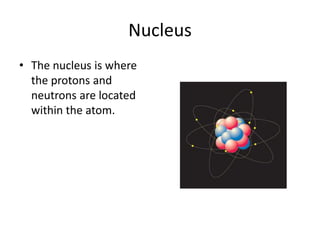
NucleusThe nucleus is where the protons and neutrons are located within the atom.
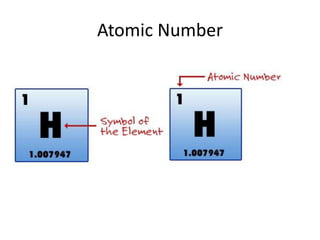
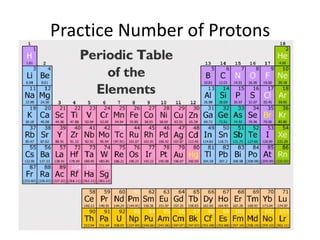
Atomic NumberThe atomic number of an atom is the number of protons it has.If an atom has 6 protons, it is carbon.It does not matter what else it has, if it has 6 protons then it is carbon.
Atomic Number
Practice Number of Protons
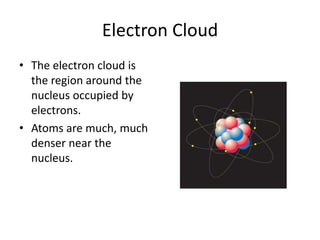
Electron CloudThe electron cloud is the region around the nucleus occupied by electrons.Atoms are much, much denser near the nucleus.
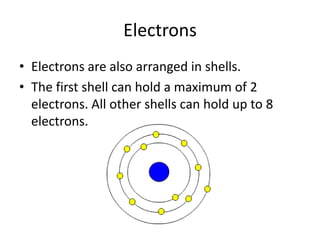
ElectronsElectrons are also arranged in shells.The first shell can hold a maximum of 2 electrons. All other shells can hold up to 8 electrons.
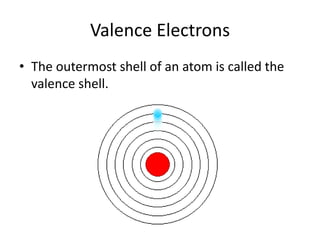
Valence ElectronsThe outermost shell of an atom is called the valence shell.
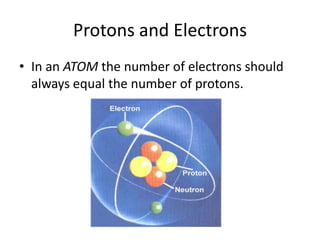
Protons and ElectronsIn an ATOM the number of electrons should always equal the number of protons.
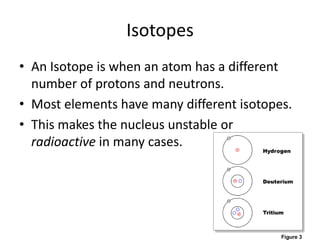
IsotopesAn Isotope is when an atom has a different number of protons and neutrons.Most elements have many different isotopes. This makes the nucleus unstable or radioactive in many cases.
Writing IsotopesTo describe an atom, write the name of the atom and then write the total number of protons and neutrons that are found in it’s nucleus.The total number of protons and neutrons in the nucleus is called the Mass Number.
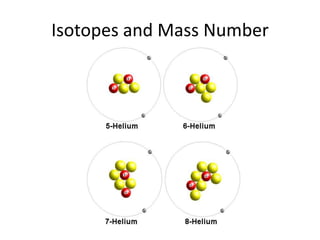
Isotopes and Mass Number
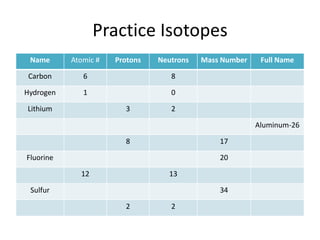
Practice Isotopes
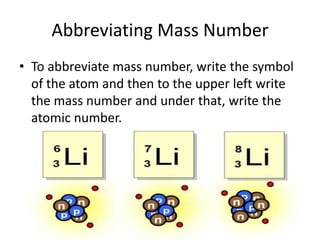
Abbreviating Mass NumberTo abbreviate mass number, write the symbol of the atom and then to the upper left write the mass number and under that, write the atomic number.

Structure of atoms10

  • 1.
    Structure of AtomsTheHistory and Models of Atoms
  • 2.
    Studying AtomsScientists havebeen studying atoms since the 1800s. If atoms are too small to be seen, how do we study them?Scientists use models to study atoms.Sometimes scientists can tell what things look like by studying how they act.Example: Wind
  • 3.
    ModelsIn science, amodel is an idea, a picture, or an object that is built to explain how something else looks or works.The model might not look exactly like the object it is built to describe, but it helps people understand the way the object acts.
  • 4.
    History of theAtomDemocritus, a Greek philosopher, first used the term atom (atomos) around 400 BC.John Dalton showed that materials were made of atoms in 1803.In the late 1800s we discovered that the atom has many smaller parts.In the late 1800s, English physicist J. J. Thomson discovered the electron.DaltonThomson
  • 5.
    More History ofthe AtomIn 1901 Ernest Rutherford found discovered the nucleus, or center of the atom.In 1917 Niels Bohr, working as Ernest Rutherford’s student, discovered how electrons orbit the nucleus.His model of the atom is the current base for the modern atomic model.
  • 6.
    Atomic Mass UnitSubatomicParticles are so small that a special unit was devised to measure them.This is the atomic mass unit (amu).Atoms are almost entirely empty space.If the nucleus were the size of a basketball, the first electrons would be somewhere near Springfield.
  • 7.
    Model of anAtomThe central part of the atom is called the nucleus.The nucleus contains positively charged protons that weigh 1 atomic mass unit.The nucleus also contains neutrons that have no charge and weigh 1 atomic mass unit.Electrons are extremely small units of an atom that have a negative charge and move around the atom in orbits.Protons and electrons stay together because they attract each other.+O-
  • 8.
    Model of anAtomElectronProtonNeutron
  • 9.
    NucleusThe nucleus iswhere the protons and neutrons are located within the atom.
  • 10.
    Atomic NumberThe atomicnumber of an atom is the number of protons it has.If an atom has 6 protons, it is carbon.It does not matter what else it has, if it has 6 protons then it is carbon.
  • 11.
  • 12.
  • 13.
    Electron CloudThe electroncloud is the region around the nucleus occupied by electrons.Atoms are much, much denser near the nucleus.
  • 14.
    ElectronsElectrons are alsoarranged in shells.The first shell can hold a maximum of 2 electrons. All other shells can hold up to 8 electrons.
  • 15.
    Valence ElectronsThe outermostshell of an atom is called the valence shell.
  • 16.
    Protons and ElectronsInan ATOM the number of electrons should always equal the number of protons.
  • 17.
    IsotopesAn Isotope iswhen an atom has a different number of protons and neutrons.Most elements have many different isotopes. This makes the nucleus unstable or radioactive in many cases.
  • 18.
    Writing IsotopesTo describean atom, write the name of the atom and then write the total number of protons and neutrons that are found in it’s nucleus.The total number of protons and neutrons in the nucleus is called the Mass Number.
  • 19.
  • 20.
  • 21.
    Abbreviating Mass NumberToabbreviate mass number, write the symbol of the atom and then to the upper left write the mass number and under that, write the atomic number.