© Boardworks Ltd 2007
1 of 50
2 of 50 © Boardworks Ltd 2007
© Boardworks Ltd 2007
3 of 50
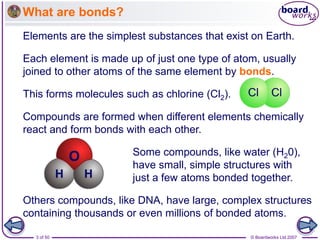
What are bonds?
Compounds are formed when different elements chemically
react and form bonds with each other.
Some compounds, like water (H20),
have small, simple structures with
just a few atoms bonded together.
Others compounds, like DNA, have large, complex structures
containing thousands or even millions of bonded atoms.
Elements are the simplest substances that exist on Earth.
Each element is made up of just one type of atom, usually
joined to other atoms of the same element by bonds.
This forms molecules such as chlorine (Cl2).
© Boardworks Ltd 2007
4 of 50
Why do atoms form bonds?
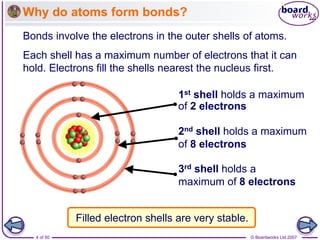
Bonds involve the electrons in the outer shells of atoms.
Filled electron shells are very stable.
1st shell holds a maximum
of 2 electrons
2nd shell holds a maximum
of 8 electrons
3rd shell holds a
maximum of 8 electrons
Each shell has a maximum number of electrons that it can
hold. Electrons fill the shells nearest the nucleus first.
© Boardworks Ltd 2007
5 of 50
Why do atoms form bonds?
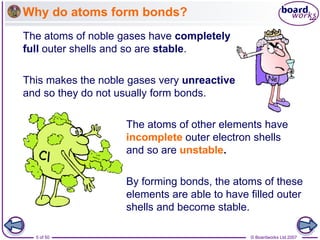
The atoms of noble gases have completely
full outer shells and so are stable.
The atoms of other elements have
incomplete outer electron shells
and so are unstable.
This makes the noble gases very unreactive
and so they do not usually form bonds.
By forming bonds, the atoms of these
elements are able to have filled outer
shells and become stable.
© Boardworks Ltd 2007
6 of 50
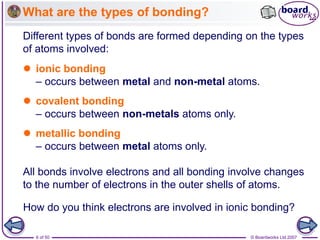
What are the types of bonding?
Different types of bonds are formed depending on the types
of atoms involved:
All bonds involve electrons and all bonding involve changes
to the number of electrons in the outer shells of atoms.
 ionic bonding
– occurs between metal and non-metal atoms.
 covalent bonding
– occurs between non-metals atoms only.
 metallic bonding
– occurs between metal atoms only.
How do you think electrons are involved in ionic bonding?
7 of 50 © Boardworks Ltd 2007
© Boardworks Ltd 2007
8 of 50
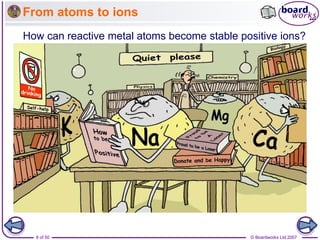
From atoms to ions
How can reactive metal atoms become stable positive ions?
© Boardworks Ltd 2007
9 of 50
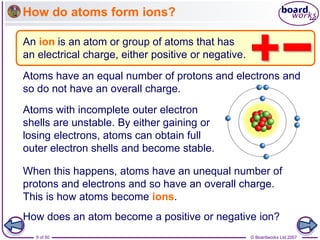
How do atoms form ions?
An ion is an atom or group of atoms that has
an electrical charge, either positive or negative.
Atoms have an equal number of protons and electrons and
so do not have an overall charge.
Atoms with incomplete outer electron
shells are unstable. By either gaining or
losing electrons, atoms can obtain full
outer electron shells and become stable.
When this happens, atoms have an unequal number of
protons and electrons and so have an overall charge.
This is how atoms become ions.
How does an atom become a positive or negative ion?
© Boardworks Ltd 2007
10 of 50
Positive and negative ions?
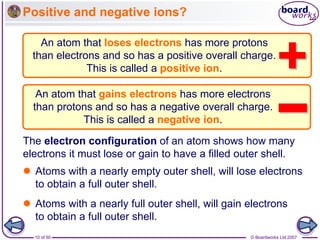
The electron configuration of an atom shows how many
electrons it must lose or gain to have a filled outer shell.
An atom that loses electrons has more protons
than electrons and so has a positive overall charge.
This is called a positive ion.
An atom that gains electrons has more electrons
than protons and so has a negative overall charge.
This is called a negative ion.
 Atoms with a nearly empty outer shell, will lose electrons
to obtain a full outer shell.
 Atoms with a nearly full outer shell, will gain electrons
to obtain a full outer shell.
© Boardworks Ltd 2007
11 of 50
How do atoms form positive ions?
An atom that loses one or more electrons
forms a positive ion.
Positive ions have a small ‘+’ symbol and a number by this
to indicate how many electrons have been lost.
This number is usually the same as the number of electrons
in the atom’s outer shell. For example:
Metal atoms, such as sodium, magnesium
and iron, form positive ions.
lithium ion [ 2 ]
lithium atom 2.1
aluminium atom 2.8.3 aluminium ion [ 2.8 ]
magnesium atom 2.8.2 magnesium ion [ 2.8 ] = Mg2+
= Li+
= Al3+
© Boardworks Ltd 2007
12 of 50
How is a sodium ion formed?
2.8.1
(partially full outer shell)
11 protons = +11
11 electrons = -11
Total charge = 0
Sodium atom:
11 protons = +11
10 electrons = -10
Total charge = +1
Sodium ion:
loses
1 electron
+
[2.8]
(full outer shell)
Na Na
© Boardworks Ltd 2007
13 of 50
How is a magnesium ion formed?
2.8.2
(partially full outer shell)
12 protons = +12
12 electrons = -12
Total charge = 0
Magnesium atom:
12 protons = +12
10 electrons = -10
Total charge = +2
Magnesium ion:
[2.8]2+
(full outer shell)
2+
Mg Mg
loses
2 electrons
© Boardworks Ltd 2007
14 of 50
How do atoms form negative ions?
Negative ions have a small ‘-’ symbol and a number by this
to indicate how many electrons have been gained to fill their
outer shell. For example:
An atom that gains one or more electrons
forms a negative ion.
The name of the ion is slightly different to the atom’s name.
Non-metal atoms, such as chlorine,
oxygen and nitrogen, form negative ions.
chlorine atom chloride ion [ 2.8.8 ] = Cl-
oxygen atom oxide ion [ 2.8 ]
nitrogen atom nitride ion [ 2.8 ]
2.8.7
2.6
2.5 = N3-
= O2-
© Boardworks Ltd 2007
15 of 50
How is a fluoride ion formed?
2.7
(partially full outer shell)
9 protons = +9
9 electrons = -9
Total charge = 0
Fluorine atom:
9 protons = +9
10 electrons = -10
Total charge = -1
Fluoride ion:
[2.8]-
(full outer shell)
-
F F
gains 1
electron
© Boardworks Ltd 2007
16 of 50
[2.8.8]2-
(full outer shell)
2.8.6
(partially full outer shell)
How is a sulfide ion formed?
16 protons = +16
16 electrons = -16
Total charge = 0
Sulfur atom:
16 protons = +16
18 electrons = -18
Total charge = -2
Sulfide ion:
2-
S S
gains 2
electrons
© Boardworks Ltd 2007
17 of 50
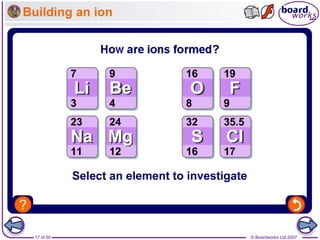
Building an ion
© Boardworks Ltd 2007
18 of 50
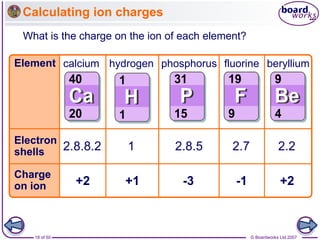
Calculating ion charges
What is the charge on the ion of each element?
+2 +2
+1 -3 -1
2.8.8.2 1 2.8.5 2.7 2.2
calcium hydrogen phosphorus fluorine beryllium
Element
Electron
shells
Charge
on ion
© Boardworks Ltd 2007
19 of 50
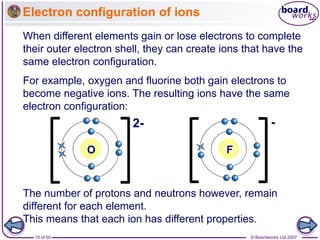
Electron configuration of ions
The number of protons and neutrons however, remain
different for each element.
This means that each ion has different properties.
For example, oxygen and fluorine both gain electrons to
become negative ions. The resulting ions have the same
electron configuration:
F
-
2-
O
When different elements gain or lose electrons to complete
their outer electron shell, they can create ions that have the
same electron configuration.
© Boardworks Ltd 2007
20 of 50
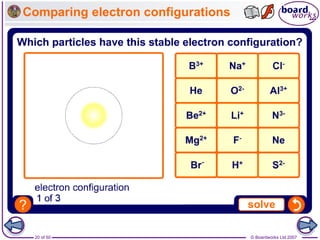
Comparing electron configurations
© Boardworks Ltd 2007
21 of 50
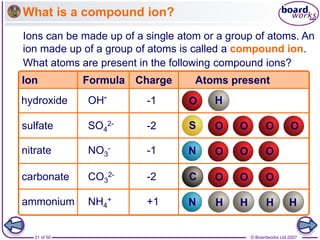
What is a compound ion?
Ions can be made up of a single atom or a group of atoms. An
ion made up of a group of atoms is called a compound ion.
hydroxide
sulfate
nitrate
carbonate
ammonium
-1
-2
-1
-2
+1
Ion Formula Charge Atoms present
NH4
+
CO3
2-
NO3
-
SO4
2-
OH-
O
O O
O
O
O O O
O
O
O
H
H H H
H
C
N
N
S
What atoms are present in the following compound ions?
© Boardworks Ltd 2007
22 of 50
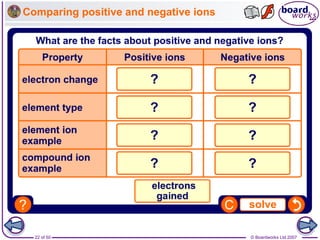
Comparing positive and negative ions
23 of 50 © Boardworks Ltd 2007
© Boardworks Ltd 2007
24 of 50
Ions and attraction
Why do some ions attract while others repel?
© Boardworks Ltd 2007
25 of 50
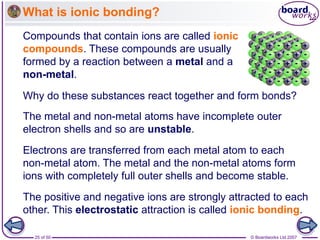
What is ionic bonding?
Compounds that contain ions are called ionic
compounds. These compounds are usually
formed by a reaction between a metal and a
non-metal.
Why do these substances react together and form bonds?
The metal and non-metal atoms have incomplete outer
electron shells and so are unstable.
Electrons are transferred from each metal atom to each
non-metal atom. The metal and the non-metal atoms form
ions with completely full outer shells and become stable.
The positive and negative ions are strongly attracted to each
other. This electrostatic attraction is called ionic bonding.
© Boardworks Ltd 2007
26 of 50
How are ionic bonds formed?
Sodium chloride is an ionic compound formed by the reaction
between the metal sodium and the non-metal chlorine.
Sodium has 1 electron
in its outer shell.
Chlorine has 7 electrons
in its outer shell.
2.8.7 [2.8.8]-
+
Cl Cl
-
2.8.1 [2.8]+
Na Na
By losing this electron,
it has a filled outer shell
and forms a positive ion.
By gaining an electron
from sodium, it has a
filled outer shell and
forms a negative ion.
© Boardworks Ltd 2007
27 of 50
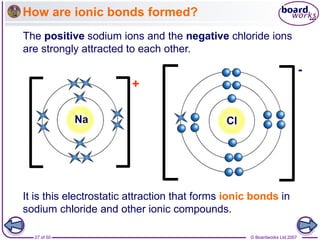
How are ionic bonds formed?
The positive sodium ions and the negative chloride ions
are strongly attracted to each other.
-
Cl
It is this electrostatic attraction that forms ionic bonds in
sodium chloride and other ionic compounds.
Na
+
© Boardworks Ltd 2007
28 of 50
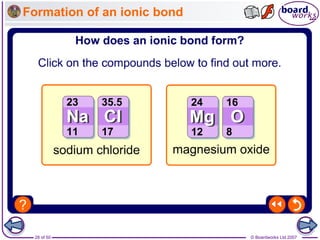
Formation of an ionic bond
© Boardworks Ltd 2007
29 of 50
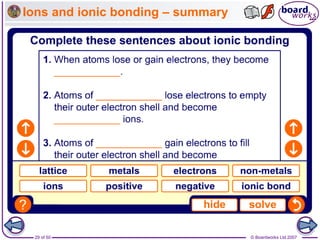
Ions and ionic bonding – summary
30 of 50 © Boardworks Ltd 2007
© Boardworks Ltd 2007
31 of 50
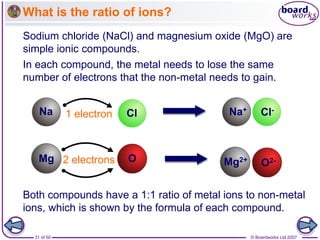
What is the ratio of ions?
Sodium chloride (NaCl) and magnesium oxide (MgO) are
simple ionic compounds.
Both compounds have a 1:1 ratio of metal ions to non-metal
ions, which is shown by the formula of each compound.
Na Cl Na+ Cl-
1 electron
Mg Mg2+
O O2-
2 electrons
In each compound, the metal needs to lose the same
number of electrons that the non-metal needs to gain.
© Boardworks Ltd 2007
32 of 50
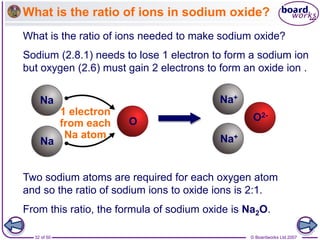
What is the ratio of ions in sodium oxide?
What is the ratio of ions needed to make sodium oxide?
Sodium (2.8.1) needs to lose 1 electron to form a sodium ion
but oxygen (2.6) must gain 2 electrons to form an oxide ion .
Na
Na
O O2-
Na+
Na+
1 electron
from each
Na atom
Two sodium atoms are required for each oxygen atom
and so the ratio of sodium ions to oxide ions is 2:1.
From this ratio, the formula of sodium oxide is Na2O.
© Boardworks Ltd 2007
33 of 50
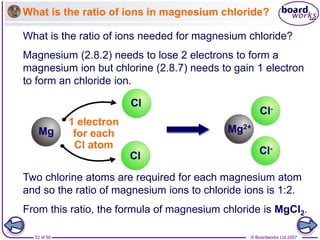
What is the ratio of ions in magnesium chloride?
What is the ratio of ions needed for magnesium chloride?
Magnesium (2.8.2) needs to lose 2 electrons to form a
magnesium ion but chlorine (2.8.7) needs to gain 1 electron
to form an chloride ion.
Mg
Cl
Mg2+
Cl
Cl-
Cl-
1 electron
for each
Cl atom
Two chlorine atoms are required for each magnesium atom
and so the ratio of magnesium ions to chloride ions is 1:2.
From this ratio, the formula of magnesium chloride is MgCl2.
© Boardworks Ltd 2007
34 of 50
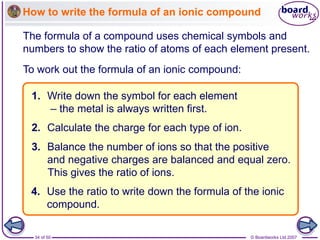
How to write the formula of an ionic compound
To work out the formula of an ionic compound:
1. Write down the symbol for each element
– the metal is always written first.
2. Calculate the charge for each type of ion.
3. Balance the number of ions so that the positive
and negative charges are balanced and equal zero.
This gives the ratio of ions.
4. Use the ratio to write down the formula of the ionic
compound.
The formula of a compound uses chemical symbols and
numbers to show the ratio of atoms of each element present.
© Boardworks Ltd 2007
35 of 50
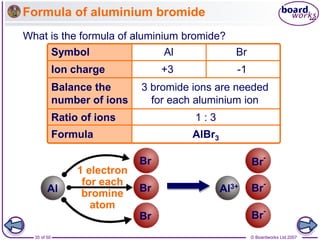
Formula of aluminium bromide
What is the formula of aluminium bromide?
Al Br
+3 -1
AlBr3
3 bromide ions are needed
for each aluminium ion
1 : 3
Symbol
Balance the
number of ions
Ion charge
Ratio of ions
Formula
Al
Br
Al3+
Br
Br
Br
-
Br
-
Br
-
1 electron
for each
bromine
atom
© Boardworks Ltd 2007
36 of 50
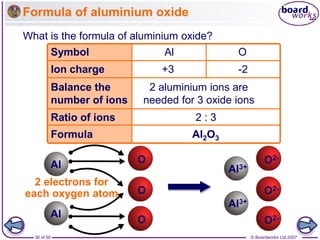
Formula of aluminium oxide
What is the formula of aluminium oxide?
Al O
+3 -2
Al2O3
2 aluminium ions are
needed for 3 oxide ions
2 : 3
Symbol
Balance the
number of ions
Ion charge
Ratio of ions
Formula
Al Al3+
Al
Al3+
O O2-
O O2-
O O2-
2 electrons for
each oxygen atom
© Boardworks Ltd 2007
37 of 50
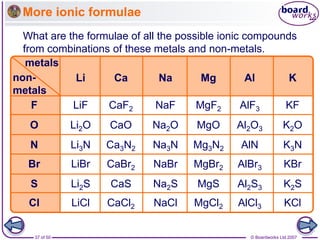
More ionic formulae
What are the formulae of all the possible ionic compounds
from combinations of these metals and non-metals.
metals
non-
metals
Li Ca Na Mg Al K
F
O
N
Br
S
Cl
LiF CaF2 NaF MgF2 AlF3 KF
Li2O CaO Na2O MgO Al2O3 K2O
Li3N Ca3N2 Na3N Mg3N2 AlN K3N
LiBr CaBr2 NaBr MgBr2 AlBr3 KBr
Li2S CaS Na2S MgS Al2S3 K2S
LiCl CaCl2 NaCl MgCl2 AlCl3 KCl
© Boardworks Ltd 2007
38 of 50
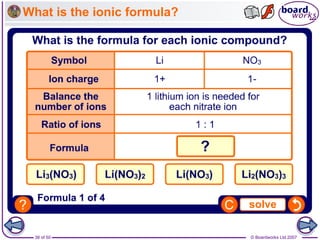
What is the ionic formula?
39 of 50 © Boardworks Ltd 2007
© Boardworks Ltd 2007
40 of 50
What is an ionic lattice?
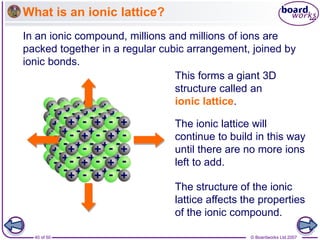
In an ionic compound, millions and millions of ions are
packed together in a regular cubic arrangement, joined by
ionic bonds.
The structure of the ionic
lattice affects the properties
of the ionic compound.
The ionic lattice will
continue to build in this way
until there are no more ions
left to add.
This forms a giant 3D
structure called an
ionic lattice.
© Boardworks Ltd 2007
41 of 50
Why do ionic compounds form crystals?
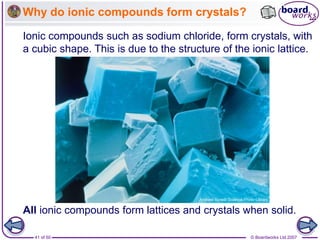
Ionic compounds such as sodium chloride, form crystals, with
a cubic shape. This is due to the structure of the ionic lattice.
All ionic compounds form lattices and crystals when solid.
© Boardworks Ltd 2007
42 of 50
Heating ionic compounds
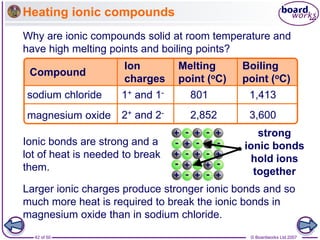
Why are ionic compounds solid at room temperature and
have high melting points and boiling points?
Larger ionic charges produce stronger ionic bonds and so
much more heat is required to break the ionic bonds in
magnesium oxide than in sodium chloride.
sodium chloride
magnesium oxide
Compound
Ion
charges
Melting
point (oC)
Boiling
point (oC)
1+ and 1-
2+ and 2-
801 1,413
2,852 3,600
strong
ionic bonds
hold ions
together
Ionic bonds are strong and a
lot of heat is needed to break
them.
© Boardworks Ltd 2007
43 of 50
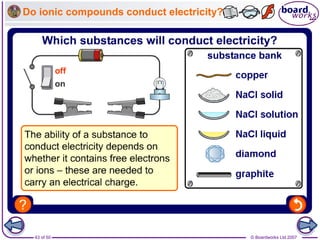
Do ionic compounds conduct electricity?
© Boardworks Ltd 2007
44 of 50
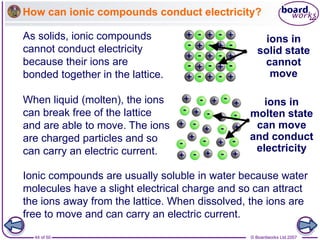
How can ionic compounds conduct electricity?
When liquid (molten), the ions
can break free of the lattice
and are able to move. The ions
are charged particles and so
can carry an electric current.
As solids, ionic compounds
cannot conduct electricity
because their ions are
bonded together in the lattice.
ions in
solid state
cannot
move
ions in
molten state
can move
and conduct
electricity
Ionic compounds are usually soluble in water because water
molecules have a slight electrical charge and so can attract
the ions away from the lattice. When dissolved, the ions are
free to move and can carry an electric current.
© Boardworks Ltd 2007
45 of 50
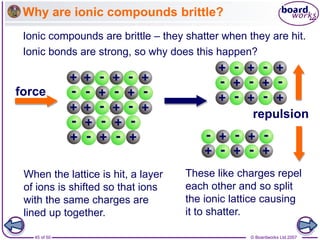
Why are ionic compounds brittle?
Ionic compounds are brittle – they shatter when they are hit.
When the lattice is hit, a layer
of ions is shifted so that ions
with the same charges are
lined up together.
These like charges repel
each other and so split
the ionic lattice causing
it to shatter.
repulsion
force
Ionic bonds are strong, so why does this happen?
© Boardworks Ltd 2007
46 of 50
True or false?
47 of 50 © Boardworks Ltd 2007
© Boardworks Ltd 2007
48 of 50
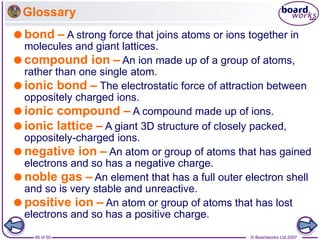
Glossary
bond – A strong force that joins atoms or ions together in
molecules and giant lattices.
compound ion – An ion made up of a group of atoms,
rather than one single atom.
ionic bond – The electrostatic force of attraction between
oppositely charged ions.
ionic compound – A compound made up of ions.
ionic lattice – A giant 3D structure of closely packed,
oppositely-charged ions.
negative ion – An atom or group of atoms that has gained
electrons and so has a negative charge.
noble gas – An element that has a full outer electron shell
and so is very stable and unreactive.
positive ion – An atom or group of atoms that has lost
electrons and so has a positive charge.
© Boardworks Ltd 2007
49 of 50
Anagrams
© Boardworks Ltd 2007
50 of 50
Multiple-choice quiz

09. ionic bonding

  • 1.
    © Boardworks Ltd2007 1 of 50
  • 2.
    2 of 50© Boardworks Ltd 2007
  • 3.
    © Boardworks Ltd2007 3 of 50 What are bonds? Compounds are formed when different elements chemically react and form bonds with each other. Some compounds, like water (H20), have small, simple structures with just a few atoms bonded together. Others compounds, like DNA, have large, complex structures containing thousands or even millions of bonded atoms. Elements are the simplest substances that exist on Earth. Each element is made up of just one type of atom, usually joined to other atoms of the same element by bonds. This forms molecules such as chlorine (Cl2).
  • 4.
    © Boardworks Ltd2007 4 of 50 Why do atoms form bonds? Bonds involve the electrons in the outer shells of atoms. Filled electron shells are very stable. 1st shell holds a maximum of 2 electrons 2nd shell holds a maximum of 8 electrons 3rd shell holds a maximum of 8 electrons Each shell has a maximum number of electrons that it can hold. Electrons fill the shells nearest the nucleus first.
  • 5.
    © Boardworks Ltd2007 5 of 50 Why do atoms form bonds? The atoms of noble gases have completely full outer shells and so are stable. The atoms of other elements have incomplete outer electron shells and so are unstable. This makes the noble gases very unreactive and so they do not usually form bonds. By forming bonds, the atoms of these elements are able to have filled outer shells and become stable.
  • 6.
    © Boardworks Ltd2007 6 of 50 What are the types of bonding? Different types of bonds are formed depending on the types of atoms involved: All bonds involve electrons and all bonding involve changes to the number of electrons in the outer shells of atoms.  ionic bonding – occurs between metal and non-metal atoms.  covalent bonding – occurs between non-metals atoms only.  metallic bonding – occurs between metal atoms only. How do you think electrons are involved in ionic bonding?
  • 7.
    7 of 50© Boardworks Ltd 2007
  • 8.
    © Boardworks Ltd2007 8 of 50 From atoms to ions How can reactive metal atoms become stable positive ions?
  • 9.
    © Boardworks Ltd2007 9 of 50 How do atoms form ions? An ion is an atom or group of atoms that has an electrical charge, either positive or negative. Atoms have an equal number of protons and electrons and so do not have an overall charge. Atoms with incomplete outer electron shells are unstable. By either gaining or losing electrons, atoms can obtain full outer electron shells and become stable. When this happens, atoms have an unequal number of protons and electrons and so have an overall charge. This is how atoms become ions. How does an atom become a positive or negative ion?
  • 10.
    © Boardworks Ltd2007 10 of 50 Positive and negative ions? The electron configuration of an atom shows how many electrons it must lose or gain to have a filled outer shell. An atom that loses electrons has more protons than electrons and so has a positive overall charge. This is called a positive ion. An atom that gains electrons has more electrons than protons and so has a negative overall charge. This is called a negative ion.  Atoms with a nearly empty outer shell, will lose electrons to obtain a full outer shell.  Atoms with a nearly full outer shell, will gain electrons to obtain a full outer shell.
  • 11.
    © Boardworks Ltd2007 11 of 50 How do atoms form positive ions? An atom that loses one or more electrons forms a positive ion. Positive ions have a small ‘+’ symbol and a number by this to indicate how many electrons have been lost. This number is usually the same as the number of electrons in the atom’s outer shell. For example: Metal atoms, such as sodium, magnesium and iron, form positive ions. lithium ion [ 2 ] lithium atom 2.1 aluminium atom 2.8.3 aluminium ion [ 2.8 ] magnesium atom 2.8.2 magnesium ion [ 2.8 ] = Mg2+ = Li+ = Al3+
  • 12.
    © Boardworks Ltd2007 12 of 50 How is a sodium ion formed? 2.8.1 (partially full outer shell) 11 protons = +11 11 electrons = -11 Total charge = 0 Sodium atom: 11 protons = +11 10 electrons = -10 Total charge = +1 Sodium ion: loses 1 electron + [2.8] (full outer shell) Na Na
  • 13.
    © Boardworks Ltd2007 13 of 50 How is a magnesium ion formed? 2.8.2 (partially full outer shell) 12 protons = +12 12 electrons = -12 Total charge = 0 Magnesium atom: 12 protons = +12 10 electrons = -10 Total charge = +2 Magnesium ion: [2.8]2+ (full outer shell) 2+ Mg Mg loses 2 electrons
  • 14.
    © Boardworks Ltd2007 14 of 50 How do atoms form negative ions? Negative ions have a small ‘-’ symbol and a number by this to indicate how many electrons have been gained to fill their outer shell. For example: An atom that gains one or more electrons forms a negative ion. The name of the ion is slightly different to the atom’s name. Non-metal atoms, such as chlorine, oxygen and nitrogen, form negative ions. chlorine atom chloride ion [ 2.8.8 ] = Cl- oxygen atom oxide ion [ 2.8 ] nitrogen atom nitride ion [ 2.8 ] 2.8.7 2.6 2.5 = N3- = O2-
  • 15.
    © Boardworks Ltd2007 15 of 50 How is a fluoride ion formed? 2.7 (partially full outer shell) 9 protons = +9 9 electrons = -9 Total charge = 0 Fluorine atom: 9 protons = +9 10 electrons = -10 Total charge = -1 Fluoride ion: [2.8]- (full outer shell) - F F gains 1 electron
  • 16.
    © Boardworks Ltd2007 16 of 50 [2.8.8]2- (full outer shell) 2.8.6 (partially full outer shell) How is a sulfide ion formed? 16 protons = +16 16 electrons = -16 Total charge = 0 Sulfur atom: 16 protons = +16 18 electrons = -18 Total charge = -2 Sulfide ion: 2- S S gains 2 electrons
  • 17.
    © Boardworks Ltd2007 17 of 50 Building an ion
  • 18.
    © Boardworks Ltd2007 18 of 50 Calculating ion charges What is the charge on the ion of each element? +2 +2 +1 -3 -1 2.8.8.2 1 2.8.5 2.7 2.2 calcium hydrogen phosphorus fluorine beryllium Element Electron shells Charge on ion
  • 19.
    © Boardworks Ltd2007 19 of 50 Electron configuration of ions The number of protons and neutrons however, remain different for each element. This means that each ion has different properties. For example, oxygen and fluorine both gain electrons to become negative ions. The resulting ions have the same electron configuration: F - 2- O When different elements gain or lose electrons to complete their outer electron shell, they can create ions that have the same electron configuration.
  • 20.
    © Boardworks Ltd2007 20 of 50 Comparing electron configurations
  • 21.
    © Boardworks Ltd2007 21 of 50 What is a compound ion? Ions can be made up of a single atom or a group of atoms. An ion made up of a group of atoms is called a compound ion. hydroxide sulfate nitrate carbonate ammonium -1 -2 -1 -2 +1 Ion Formula Charge Atoms present NH4 + CO3 2- NO3 - SO4 2- OH- O O O O O O O O O O O H H H H H C N N S What atoms are present in the following compound ions?
  • 22.
    © Boardworks Ltd2007 22 of 50 Comparing positive and negative ions
  • 23.
    23 of 50© Boardworks Ltd 2007
  • 24.
    © Boardworks Ltd2007 24 of 50 Ions and attraction Why do some ions attract while others repel?
  • 25.
    © Boardworks Ltd2007 25 of 50 What is ionic bonding? Compounds that contain ions are called ionic compounds. These compounds are usually formed by a reaction between a metal and a non-metal. Why do these substances react together and form bonds? The metal and non-metal atoms have incomplete outer electron shells and so are unstable. Electrons are transferred from each metal atom to each non-metal atom. The metal and the non-metal atoms form ions with completely full outer shells and become stable. The positive and negative ions are strongly attracted to each other. This electrostatic attraction is called ionic bonding.
  • 26.
    © Boardworks Ltd2007 26 of 50 How are ionic bonds formed? Sodium chloride is an ionic compound formed by the reaction between the metal sodium and the non-metal chlorine. Sodium has 1 electron in its outer shell. Chlorine has 7 electrons in its outer shell. 2.8.7 [2.8.8]- + Cl Cl - 2.8.1 [2.8]+ Na Na By losing this electron, it has a filled outer shell and forms a positive ion. By gaining an electron from sodium, it has a filled outer shell and forms a negative ion.
  • 27.
    © Boardworks Ltd2007 27 of 50 How are ionic bonds formed? The positive sodium ions and the negative chloride ions are strongly attracted to each other. - Cl It is this electrostatic attraction that forms ionic bonds in sodium chloride and other ionic compounds. Na +
  • 28.
    © Boardworks Ltd2007 28 of 50 Formation of an ionic bond
  • 29.
    © Boardworks Ltd2007 29 of 50 Ions and ionic bonding – summary
  • 30.
    30 of 50© Boardworks Ltd 2007
  • 31.
    © Boardworks Ltd2007 31 of 50 What is the ratio of ions? Sodium chloride (NaCl) and magnesium oxide (MgO) are simple ionic compounds. Both compounds have a 1:1 ratio of metal ions to non-metal ions, which is shown by the formula of each compound. Na Cl Na+ Cl- 1 electron Mg Mg2+ O O2- 2 electrons In each compound, the metal needs to lose the same number of electrons that the non-metal needs to gain.
  • 32.
    © Boardworks Ltd2007 32 of 50 What is the ratio of ions in sodium oxide? What is the ratio of ions needed to make sodium oxide? Sodium (2.8.1) needs to lose 1 electron to form a sodium ion but oxygen (2.6) must gain 2 electrons to form an oxide ion . Na Na O O2- Na+ Na+ 1 electron from each Na atom Two sodium atoms are required for each oxygen atom and so the ratio of sodium ions to oxide ions is 2:1. From this ratio, the formula of sodium oxide is Na2O.
  • 33.
    © Boardworks Ltd2007 33 of 50 What is the ratio of ions in magnesium chloride? What is the ratio of ions needed for magnesium chloride? Magnesium (2.8.2) needs to lose 2 electrons to form a magnesium ion but chlorine (2.8.7) needs to gain 1 electron to form an chloride ion. Mg Cl Mg2+ Cl Cl- Cl- 1 electron for each Cl atom Two chlorine atoms are required for each magnesium atom and so the ratio of magnesium ions to chloride ions is 1:2. From this ratio, the formula of magnesium chloride is MgCl2.
  • 34.
    © Boardworks Ltd2007 34 of 50 How to write the formula of an ionic compound To work out the formula of an ionic compound: 1. Write down the symbol for each element – the metal is always written first. 2. Calculate the charge for each type of ion. 3. Balance the number of ions so that the positive and negative charges are balanced and equal zero. This gives the ratio of ions. 4. Use the ratio to write down the formula of the ionic compound. The formula of a compound uses chemical symbols and numbers to show the ratio of atoms of each element present.
  • 35.
    © Boardworks Ltd2007 35 of 50 Formula of aluminium bromide What is the formula of aluminium bromide? Al Br +3 -1 AlBr3 3 bromide ions are needed for each aluminium ion 1 : 3 Symbol Balance the number of ions Ion charge Ratio of ions Formula Al Br Al3+ Br Br Br - Br - Br - 1 electron for each bromine atom
  • 36.
    © Boardworks Ltd2007 36 of 50 Formula of aluminium oxide What is the formula of aluminium oxide? Al O +3 -2 Al2O3 2 aluminium ions are needed for 3 oxide ions 2 : 3 Symbol Balance the number of ions Ion charge Ratio of ions Formula Al Al3+ Al Al3+ O O2- O O2- O O2- 2 electrons for each oxygen atom
  • 37.
    © Boardworks Ltd2007 37 of 50 More ionic formulae What are the formulae of all the possible ionic compounds from combinations of these metals and non-metals. metals non- metals Li Ca Na Mg Al K F O N Br S Cl LiF CaF2 NaF MgF2 AlF3 KF Li2O CaO Na2O MgO Al2O3 K2O Li3N Ca3N2 Na3N Mg3N2 AlN K3N LiBr CaBr2 NaBr MgBr2 AlBr3 KBr Li2S CaS Na2S MgS Al2S3 K2S LiCl CaCl2 NaCl MgCl2 AlCl3 KCl
  • 38.
    © Boardworks Ltd2007 38 of 50 What is the ionic formula?
  • 39.
    39 of 50© Boardworks Ltd 2007
  • 40.
    © Boardworks Ltd2007 40 of 50 What is an ionic lattice? In an ionic compound, millions and millions of ions are packed together in a regular cubic arrangement, joined by ionic bonds. The structure of the ionic lattice affects the properties of the ionic compound. The ionic lattice will continue to build in this way until there are no more ions left to add. This forms a giant 3D structure called an ionic lattice.
  • 41.
    © Boardworks Ltd2007 41 of 50 Why do ionic compounds form crystals? Ionic compounds such as sodium chloride, form crystals, with a cubic shape. This is due to the structure of the ionic lattice. All ionic compounds form lattices and crystals when solid.
  • 42.
    © Boardworks Ltd2007 42 of 50 Heating ionic compounds Why are ionic compounds solid at room temperature and have high melting points and boiling points? Larger ionic charges produce stronger ionic bonds and so much more heat is required to break the ionic bonds in magnesium oxide than in sodium chloride. sodium chloride magnesium oxide Compound Ion charges Melting point (oC) Boiling point (oC) 1+ and 1- 2+ and 2- 801 1,413 2,852 3,600 strong ionic bonds hold ions together Ionic bonds are strong and a lot of heat is needed to break them.
  • 43.
    © Boardworks Ltd2007 43 of 50 Do ionic compounds conduct electricity?
  • 44.
    © Boardworks Ltd2007 44 of 50 How can ionic compounds conduct electricity? When liquid (molten), the ions can break free of the lattice and are able to move. The ions are charged particles and so can carry an electric current. As solids, ionic compounds cannot conduct electricity because their ions are bonded together in the lattice. ions in solid state cannot move ions in molten state can move and conduct electricity Ionic compounds are usually soluble in water because water molecules have a slight electrical charge and so can attract the ions away from the lattice. When dissolved, the ions are free to move and can carry an electric current.
  • 45.
    © Boardworks Ltd2007 45 of 50 Why are ionic compounds brittle? Ionic compounds are brittle – they shatter when they are hit. When the lattice is hit, a layer of ions is shifted so that ions with the same charges are lined up together. These like charges repel each other and so split the ionic lattice causing it to shatter. repulsion force Ionic bonds are strong, so why does this happen?
  • 46.
    © Boardworks Ltd2007 46 of 50 True or false?
  • 47.
    47 of 50© Boardworks Ltd 2007
  • 48.
    © Boardworks Ltd2007 48 of 50 Glossary bond – A strong force that joins atoms or ions together in molecules and giant lattices. compound ion – An ion made up of a group of atoms, rather than one single atom. ionic bond – The electrostatic force of attraction between oppositely charged ions. ionic compound – A compound made up of ions. ionic lattice – A giant 3D structure of closely packed, oppositely-charged ions. negative ion – An atom or group of atoms that has gained electrons and so has a negative charge. noble gas – An element that has a full outer electron shell and so is very stable and unreactive. positive ion – An atom or group of atoms that has lost electrons and so has a positive charge.
  • 49.
    © Boardworks Ltd2007 49 of 50 Anagrams
  • 50.
    © Boardworks Ltd2007 50 of 50 Multiple-choice quiz

Editor's Notes

  • #2 Boardworks GCSE Additional Science: Chemistry Ionic Bonding
  • #3 Boardworks GCSE Additional Science: Chemistry Ionic Bonding
  • #4 Boardworks GCSE Additional Science: Chemistry Ionic Bonding
  • #5 Boardworks GCSE Additional Science: Chemistry Ionic Bonding
  • #6 Boardworks GCSE Additional Science: Chemistry Ionic Bonding
  • #7 Boardworks GCSE Additional Science: Chemistry Ionic Bonding
  • #8 Boardworks GCSE Additional Science: Chemistry Ionic Bonding
  • #9 Boardworks GCSE Additional Science: Chemistry Ionic Bonding
  • #10 Boardworks GCSE Additional Science: Chemistry Ionic Bonding
  • #11 Boardworks GCSE Additional Science: Chemistry Ionic Bonding
  • #12 Boardworks GCSE Additional Science: Chemistry Ionic Bonding
  • #13 Boardworks GCSE Additional Science: Chemistry Ionic Bonding
  • #14 Boardworks GCSE Additional Science: Chemistry Ionic Bonding
  • #15 Boardworks GCSE Additional Science: Chemistry Ionic Bonding
  • #16 Boardworks GCSE Additional Science: Chemistry Ionic Bonding
  • #17 Boardworks GCSE Additional Science: Chemistry Ionic Bonding
  • #18 Boardworks GCSE Additional Science: Chemistry Ionic Bonding
  • #19 Boardworks GCSE Additional Science: Chemistry Ionic Bonding
  • #20 Boardworks GCSE Additional Science: Chemistry Ionic Bonding
  • #21 Boardworks GCSE Additional Science: Chemistry Ionic Bonding
  • #22 Boardworks GCSE Additional Science: Chemistry Ionic Bonding
  • #23 Boardworks GCSE Additional Science: Chemistry Ionic Bonding
  • #24 Boardworks GCSE Additional Science: Chemistry Ionic Bonding
  • #25 Boardworks GCSE Additional Science: Chemistry Ionic Bonding
  • #26 Boardworks GCSE Additional Science: Chemistry Ionic Bonding
  • #27 Boardworks GCSE Additional Science: Chemistry Ionic Bonding
  • #28 Boardworks GCSE Additional Science: Chemistry Ionic Bonding
  • #29 Boardworks GCSE Additional Science: Chemistry Ionic Bonding
  • #30 Boardworks GCSE Additional Science: Chemistry Ionic Bonding
  • #31 Boardworks GCSE Additional Science: Chemistry Ionic Bonding
  • #32 Boardworks GCSE Additional Science: Chemistry Ionic Bonding
  • #33 Boardworks GCSE Additional Science: Chemistry Ionic Bonding
  • #34 Boardworks GCSE Additional Science: Chemistry Ionic Bonding
  • #35 Boardworks GCSE Additional Science: Chemistry Ionic Bonding
  • #36 Boardworks GCSE Additional Science: Chemistry Ionic Bonding
  • #37 Boardworks GCSE Additional Science: Chemistry Ionic Bonding
  • #38 Boardworks GCSE Additional Science: Chemistry Ionic Bonding
  • #39 Boardworks GCSE Additional Science: Chemistry Ionic Bonding
  • #40 Boardworks GCSE Additional Science: Chemistry Ionic Bonding
  • #41 Boardworks GCSE Additional Science: Chemistry Ionic Bonding
  • #42 Boardworks GCSE Additional Science: Chemistry Ionic Bonding
  • #43 Boardworks GCSE Additional Science: Chemistry Ionic Bonding
  • #44 Boardworks GCSE Additional Science: Chemistry Ionic Bonding
  • #45 Boardworks GCSE Additional Science: Chemistry Ionic Bonding
  • #46 Boardworks GCSE Additional Science: Chemistry Ionic Bonding
  • #47 Boardworks GCSE Additional Science: Chemistry Ionic Bonding
  • #48 Boardworks GCSE Additional Science: Chemistry Ionic Bonding
  • #49 Boardworks GCSE Additional Science: Chemistry Ionic Bonding
  • #50 Boardworks GCSE Additional Science: Chemistry Ionic Bonding
  • #51 Boardworks GCSE Additional Science: Chemistry Ionic Bonding