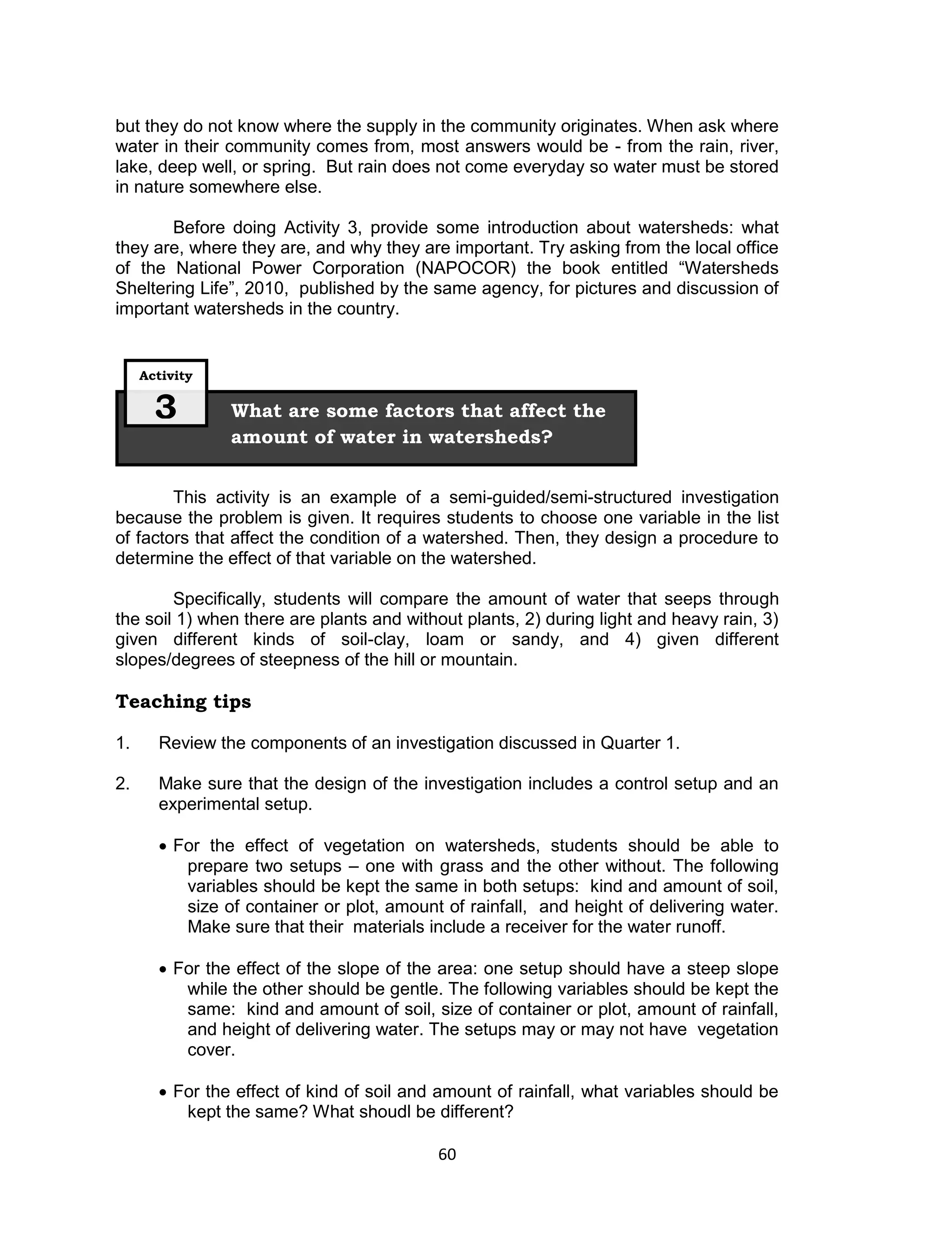
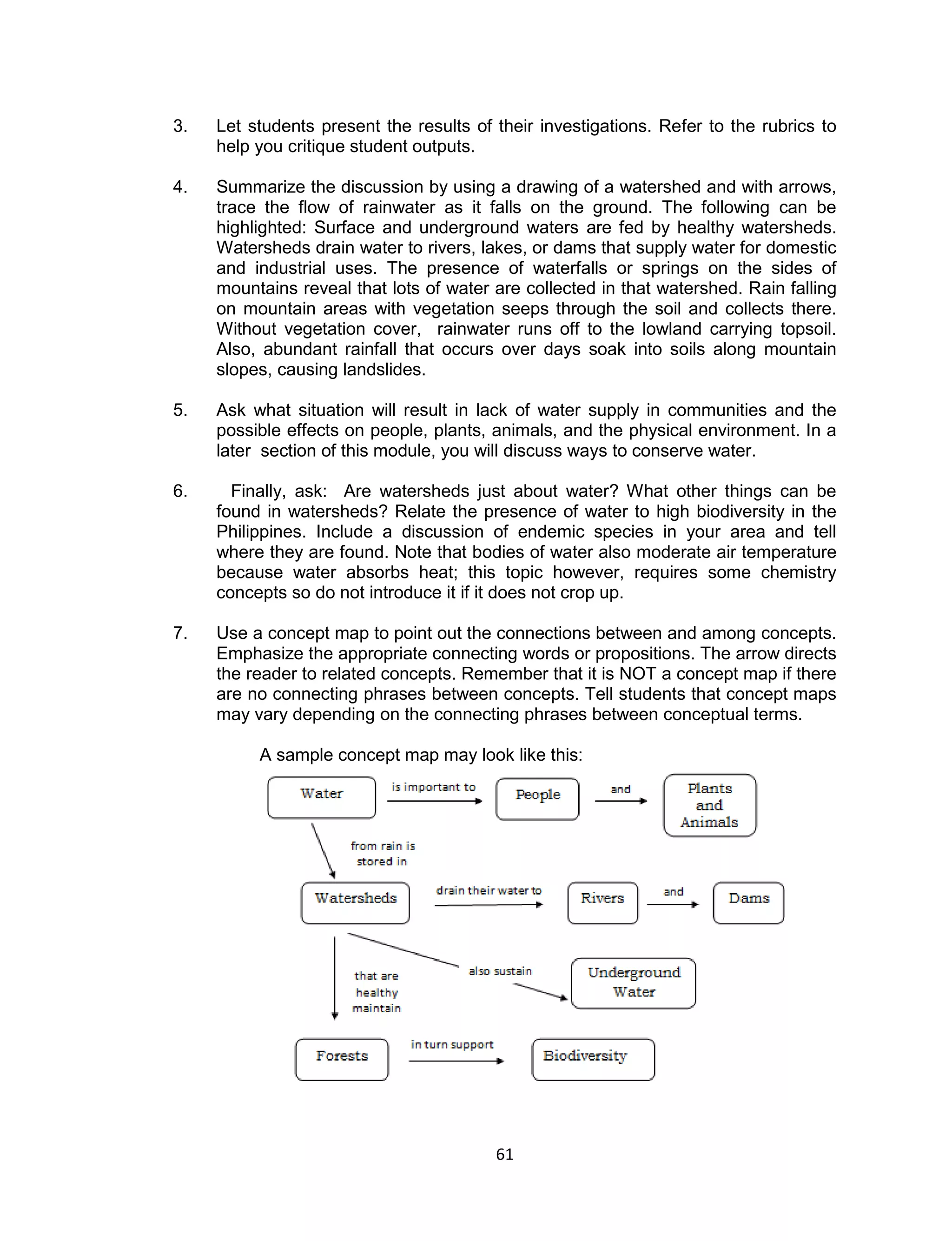
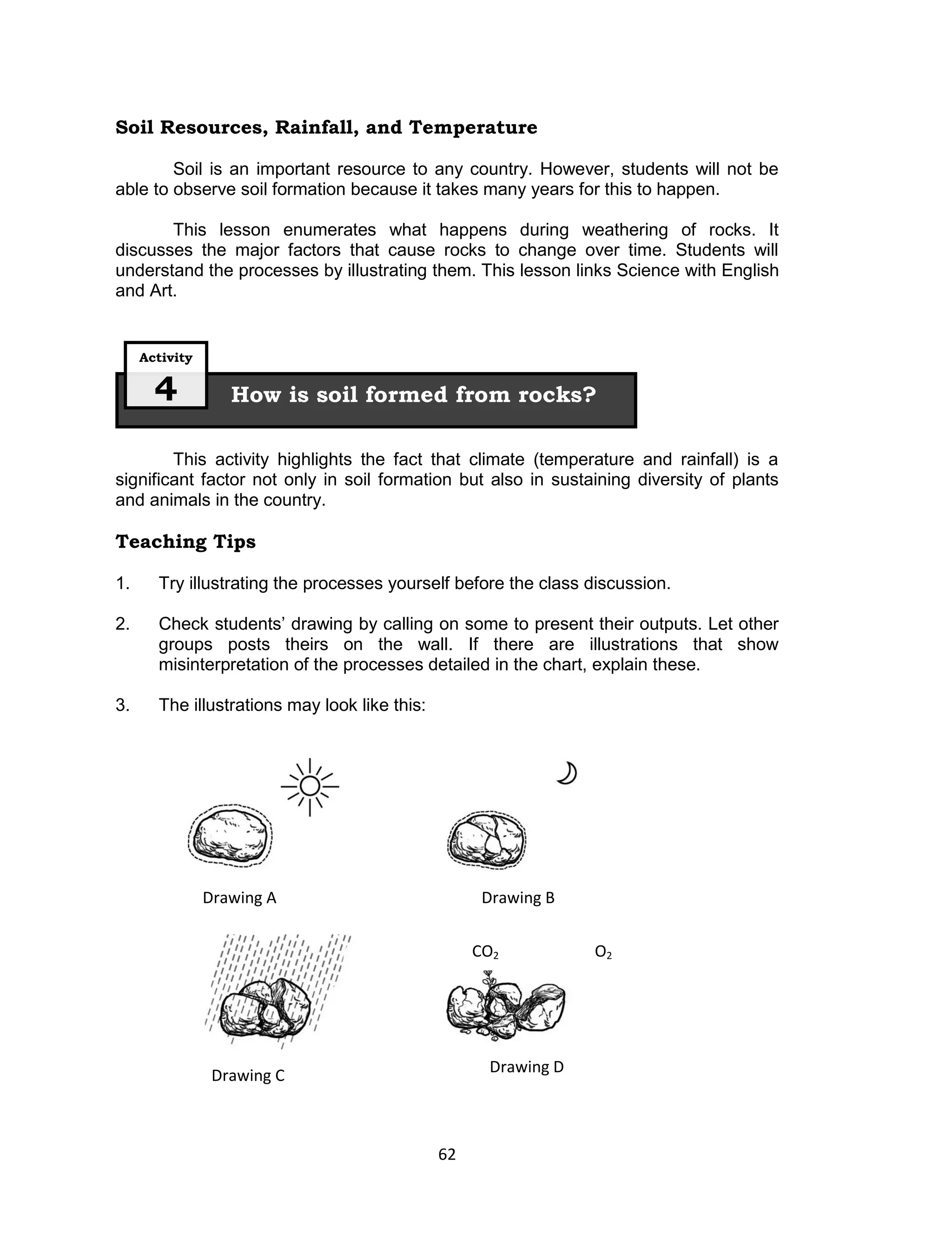
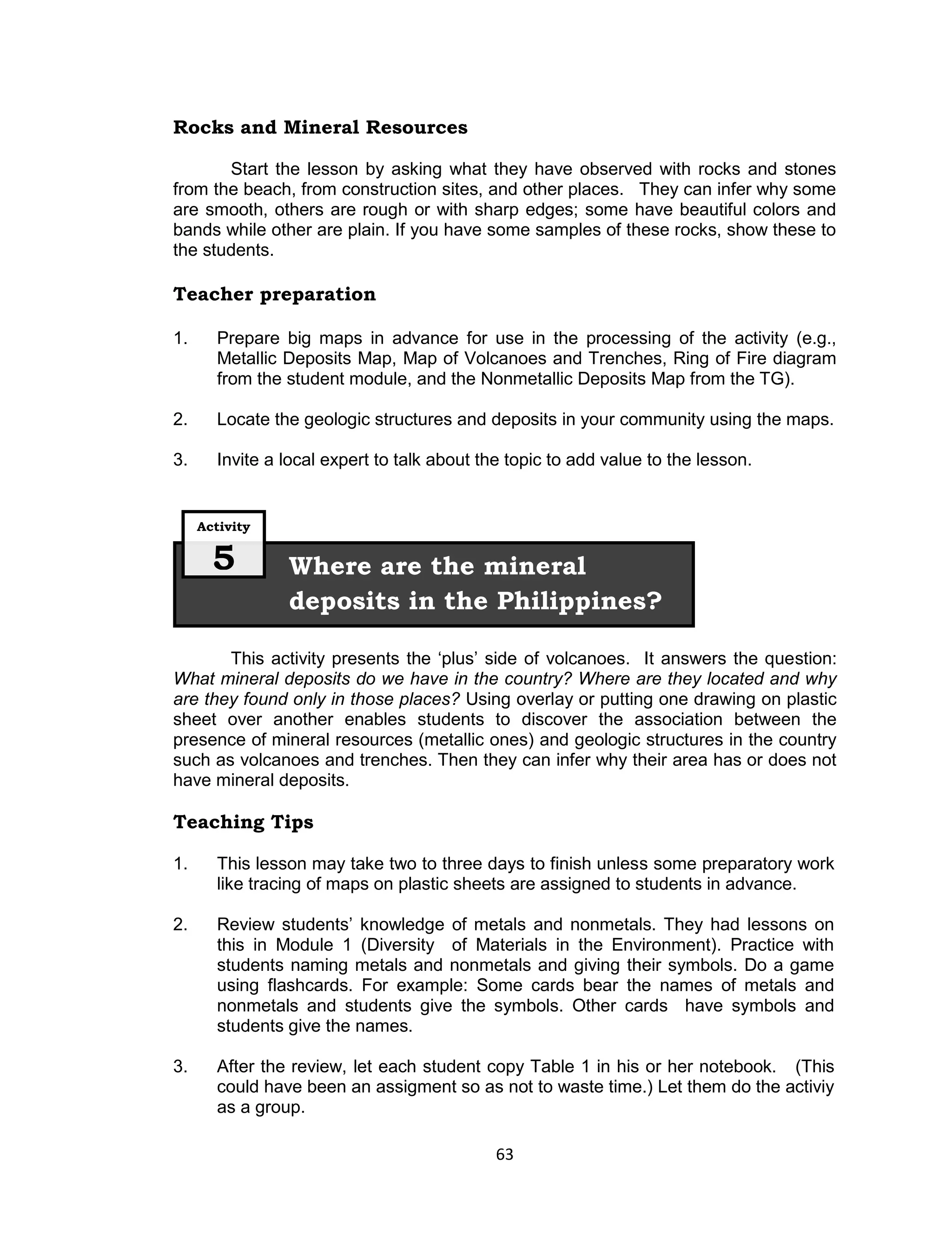
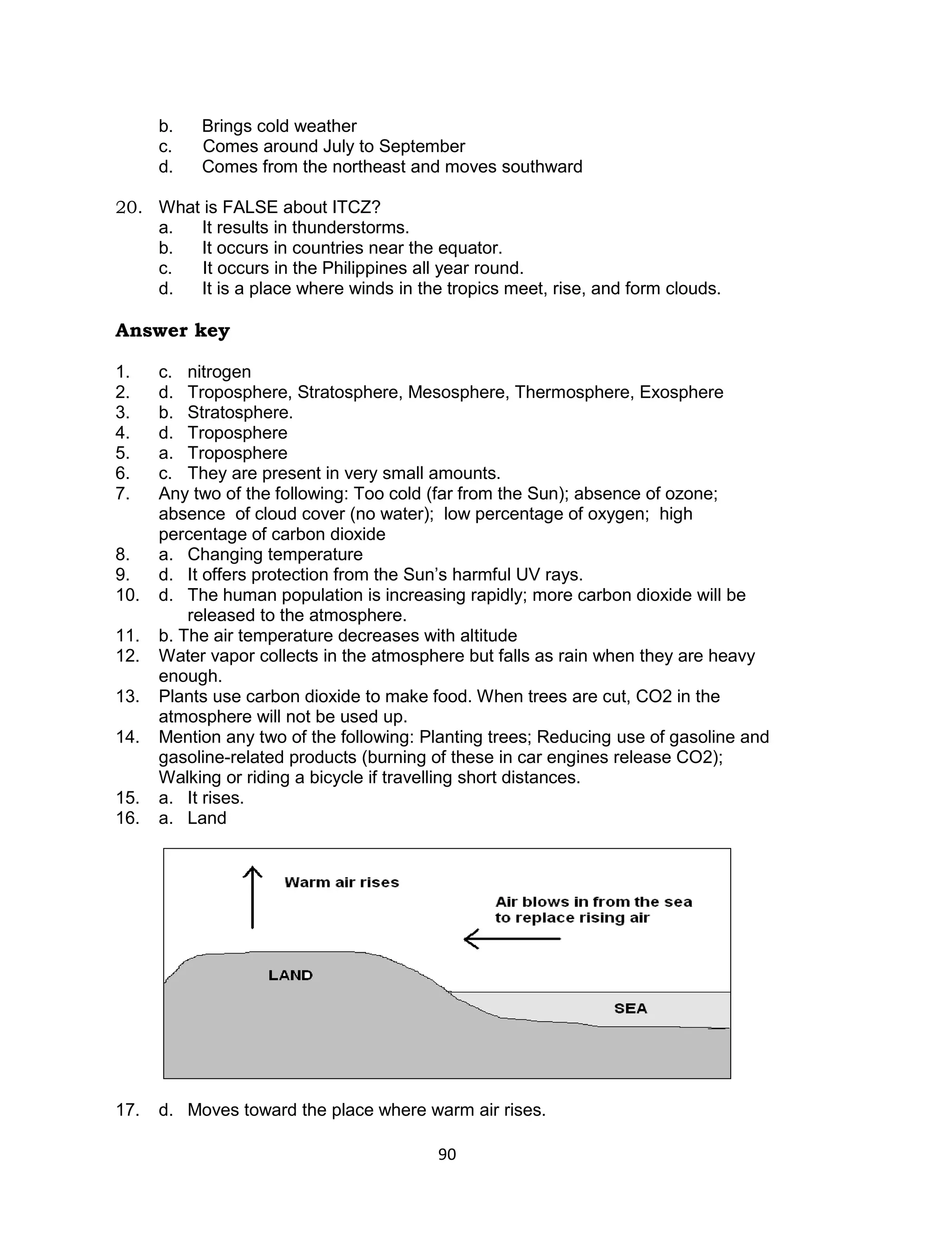
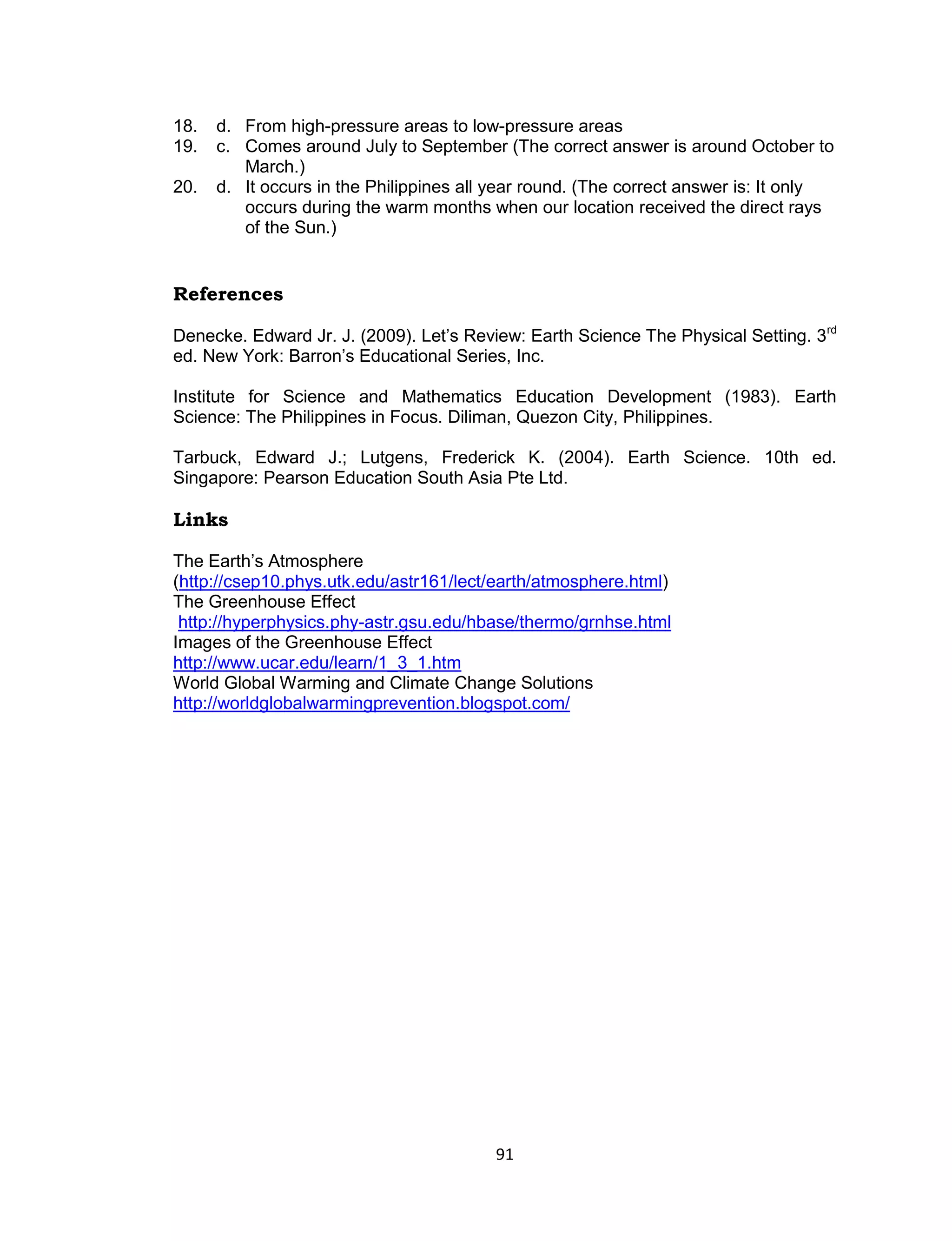
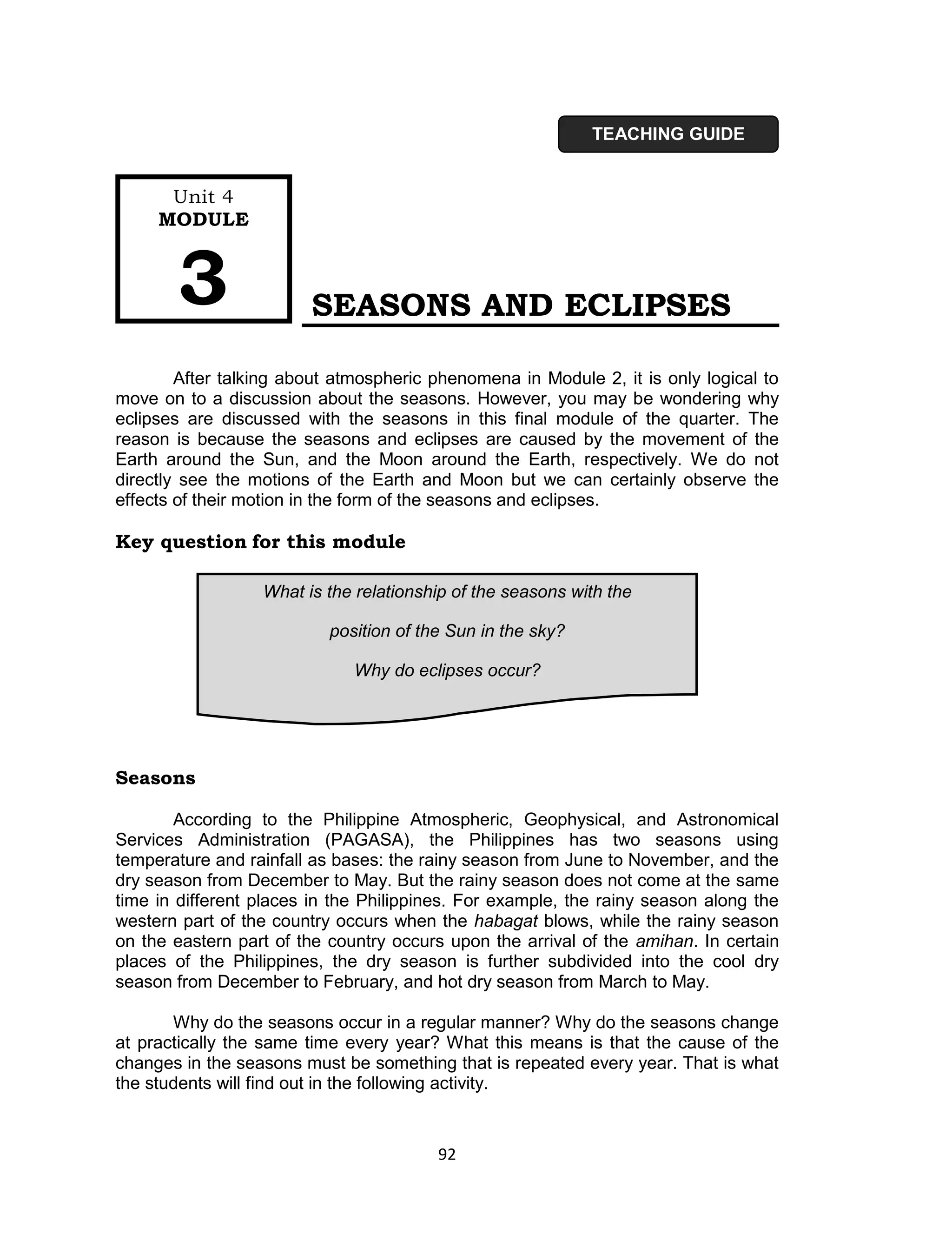
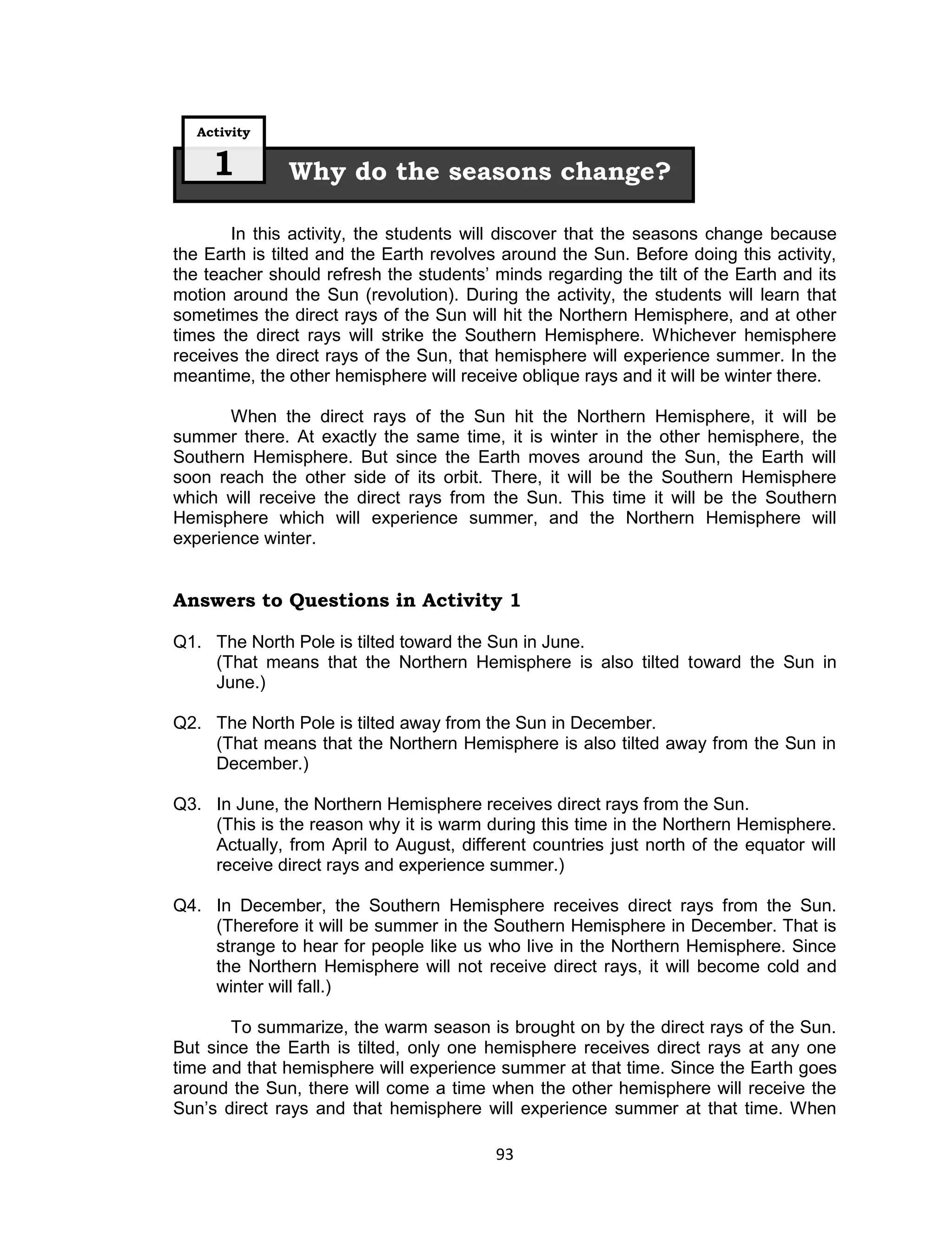
UNIT 3: Energy in Motion
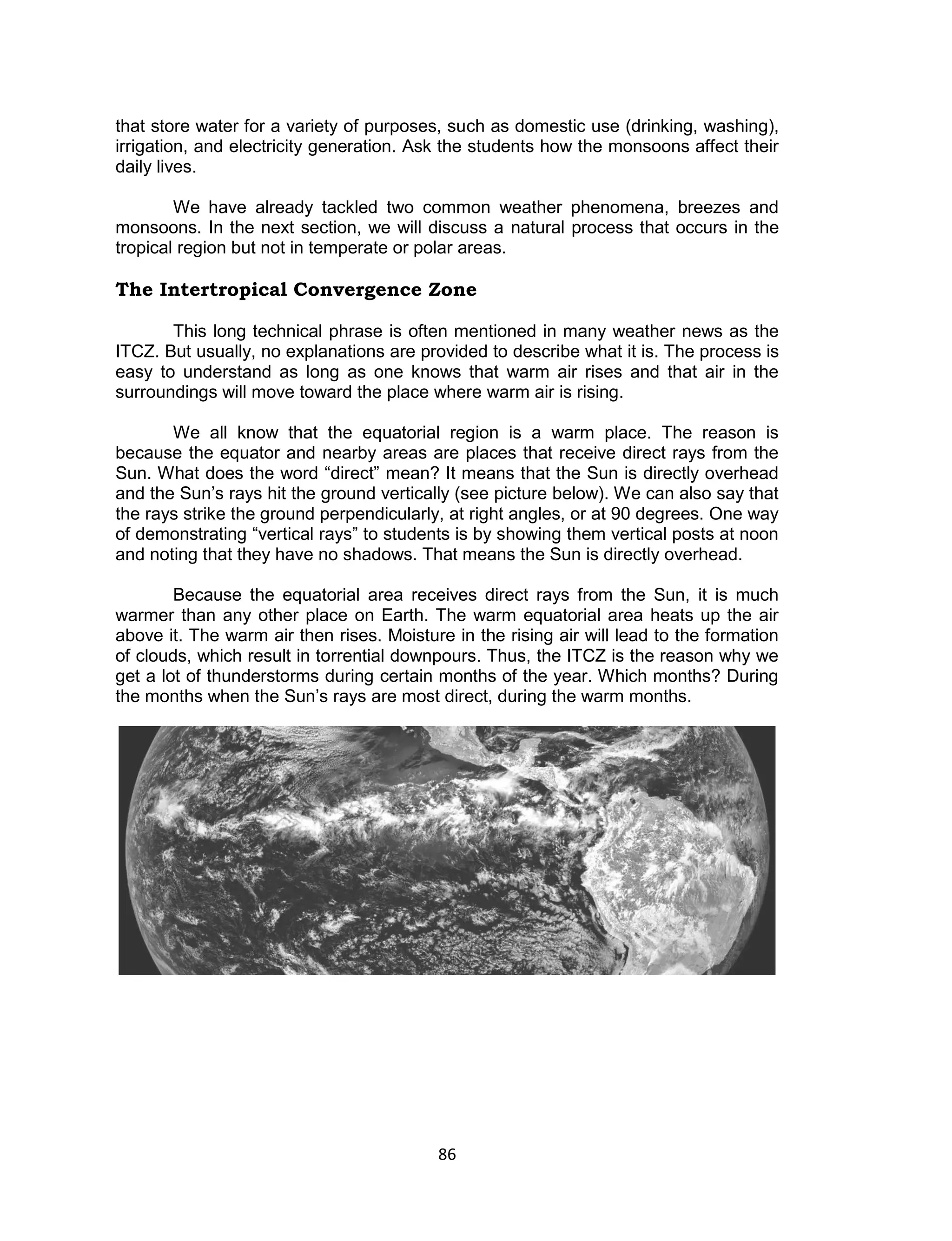
Overview

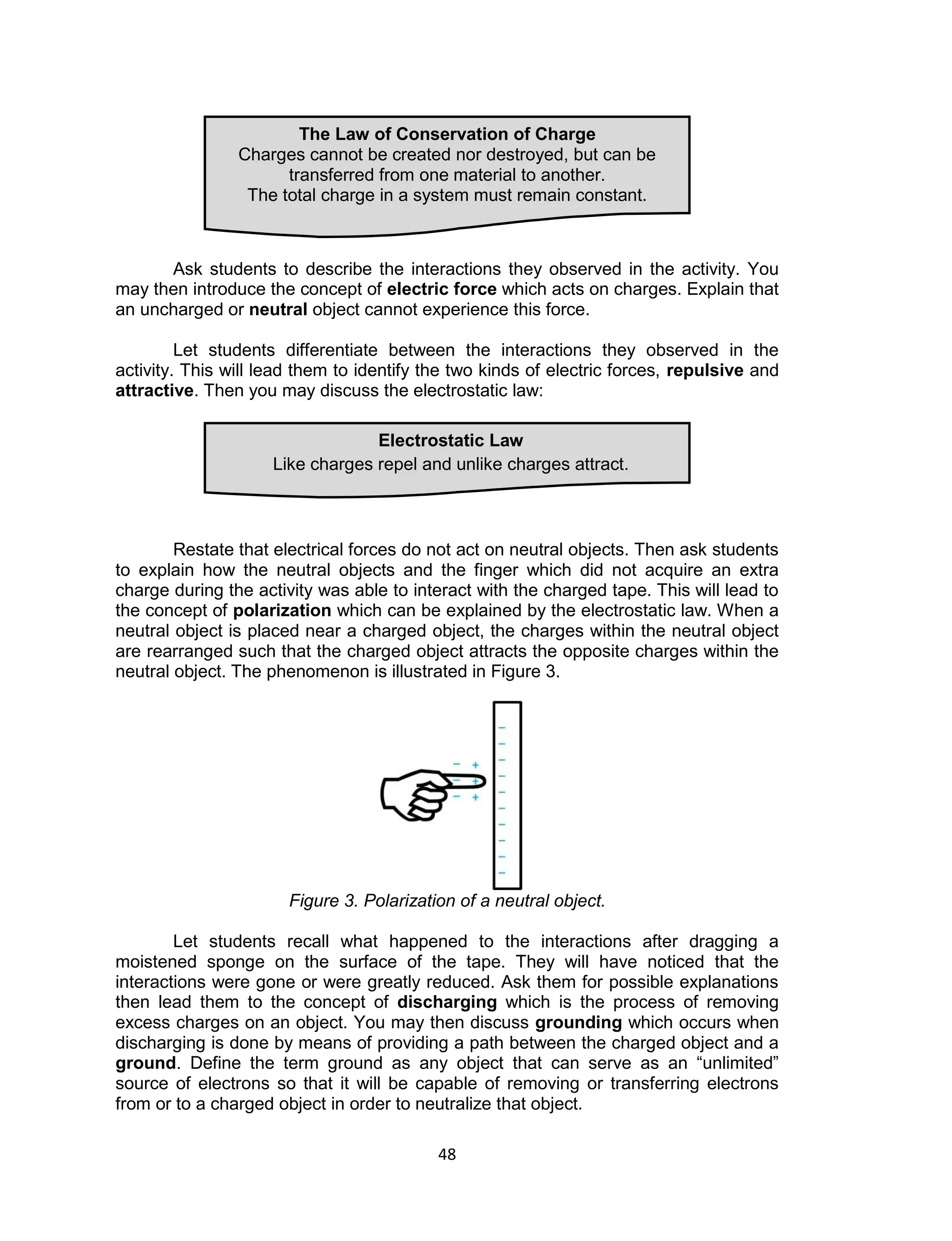
        The topics covered in Grade 7 deal with the relationship between motion and
energy. At the end of the quarter, students should be able to realize that energy
exists in different forms, energy transfers from one body to another, and that motion
is the concrete manifestation that a body possesses energy.

       Among the many forms of energy, motion, heat, light, sound, and electrical
energy are the most common and most familiar among students. All these forms
belong to kinetic energy; they are all associated with some kind of motion - the
motion of waves, electrons, atoms, molecules, and objects.

        In this grade level, the focus is on the sources of the different forms of energy
and the different ways by which they are transferred from one place to another.
Sound and light are introduced as forms of energy that are transferred by waves
while heat is introduced as an energy that is transferred either by randomly moving
particles, or by electromagnetic waves (radiation). Electrical energy is described as
an energy that is transferred by moving electrical charges through a complete circuit.

        Motion is considered to be the first topic because it is the most concrete
manifestation of the abstract concept of energy. Besides, some of the concepts to be
developed in this module will be useful in understanding the succeeding topics, like
when students learn about the common characteristics of waves and when they
relate these to the characteristics of sound and light waves.

The table below shows the general and specific topics covered in Grade 7:

  Module
                        Specific Topics                     Focus Questions
   Title
                 Uniform Motion
   Motion                                          -   How do objects move?
                 Accelerated Motion
                 Types/Kinds of waves             -   How are waves classified?
   Wave          Common characteristics of        -   What characteristics do waves
                  waves                                have in common?
                                                   -   How is sound produced?
                 Sources of sound                 -   How does sound propagate?
   Sound
                 Characteristics of sound         -   How do sounds differ from
                                                       each other?
                 Sources of light                 -   How is light produced?
    Light
                 Characteristics of light         -   How does light intensity vary


                                             1
Module
                         Specific Topics                   Focus Questions
   Title
                  How the eye sees color              with distance from the source?
                                                   -   How is color related to
                                                       frequency and wavelength?
                                                   -   When does heat transfer take
                  Heat transfer
                                                       place?
   Heat           Modes of heat transfer
                                                   -   How does heat transfer take
                  Conductors/insulators of heat
                                                       place?
                                                   -   How do charges behave?
                  Electrical charges
 Electricity                                       -   How do charges carry
                  Simple circuit
                                                       energy?

Each topic or module contains three to five activities, mostly practical work
activities, that provide students with opportunities to develop their thinking and
manipulative skills. Teachers need to make sure that students are on the right
track while performing the activities and are able to grasp the particular concepts
involved.


                                            2
TEACHING GUIDE


         Unit 3
        MODULE


          1                DESCRIBING MOTION

        This module covers basic aspects of motion. Its aim is to enable the students
to describe examples of motion along a straight line. Motion is defined as the change
in position over an interval of time. Students will therefore describe motion in terms of
the positions of the moving object at different points in time, or its distance travelled
over a period, or its speed of travel. Furthermore, they will construct or analyze
diagrams, graphs, or charts to describe whether an object is in motion or not, or
moving with constant speed, or whether it is changing in speed or not.

       In this module, the relevant concepts are introduced only at a basic, more
conceptual and less mathematical level. But the students’ understanding of these
concepts will be enhanced when they continue to study about motion in the next
grade levels or when they study other relevant topics in physics and in other areas.

Key questions for this module

                     When can we say that an object is in motion?
                     How do we describe the motion of an object?


This module contains four sections:

I-Where
    o    In this section, students will describe the position of an object with respect to
         a point of reference (or reference point).


    Activity


      1         Where is it?

    Prepare beforehand the instructions to be given to the students. The instructions
     should be vague to make it less helpful to the students. Examples are given
     below:
        a. It is right there.

                                             3
b. Turn and it is there.
       c. Walk slowly and you will get there.
       d. It is from here to there.

   In this activity, students should be able to realize the importance of the point of
    reference (or reference point) and direction in describing the position of an
    object.
   Students may use the terms such as beside, above, below, left, right, in front of,
    or behind when describing the direction of an object from the reference point.
   During the processing, it should be emphasized that once the students have
    selected their point of reference, they can easily describe any change in the
    position of an object. In other words, they can easily tell whether an object is
    moving or not. At this point, the definition of motion, which is the change in
    position over time, can be introduced.

Sample answers to the questions

     Q1. (Students are supposed to have a hard time in finding the object)
     Q2. The instruction is not clear. There should be another object where we can
          refer to or compare the position of the object.
     Q3. (This time, students should be able to find the object)
     Q4. The distance of the object and its direction from the point of reference are
          included in the instruction.
     Q5. A point of reference is something that seems steady that is used to
          compare the position of an object.
     Q6. -10 m.
     Q7. 5 m.
     Q8. The dog is 25 meters to the left of the house
     Q9. The tree is 15 meters to the right of the dog.
     Q10. The initial position of the ball is at 0 m. Its final position is at 15 m.
     Q11. 10 m.
     Q12. 15 seconds
     Q13. 7.5 meters
     Q14. 12.5 seconds

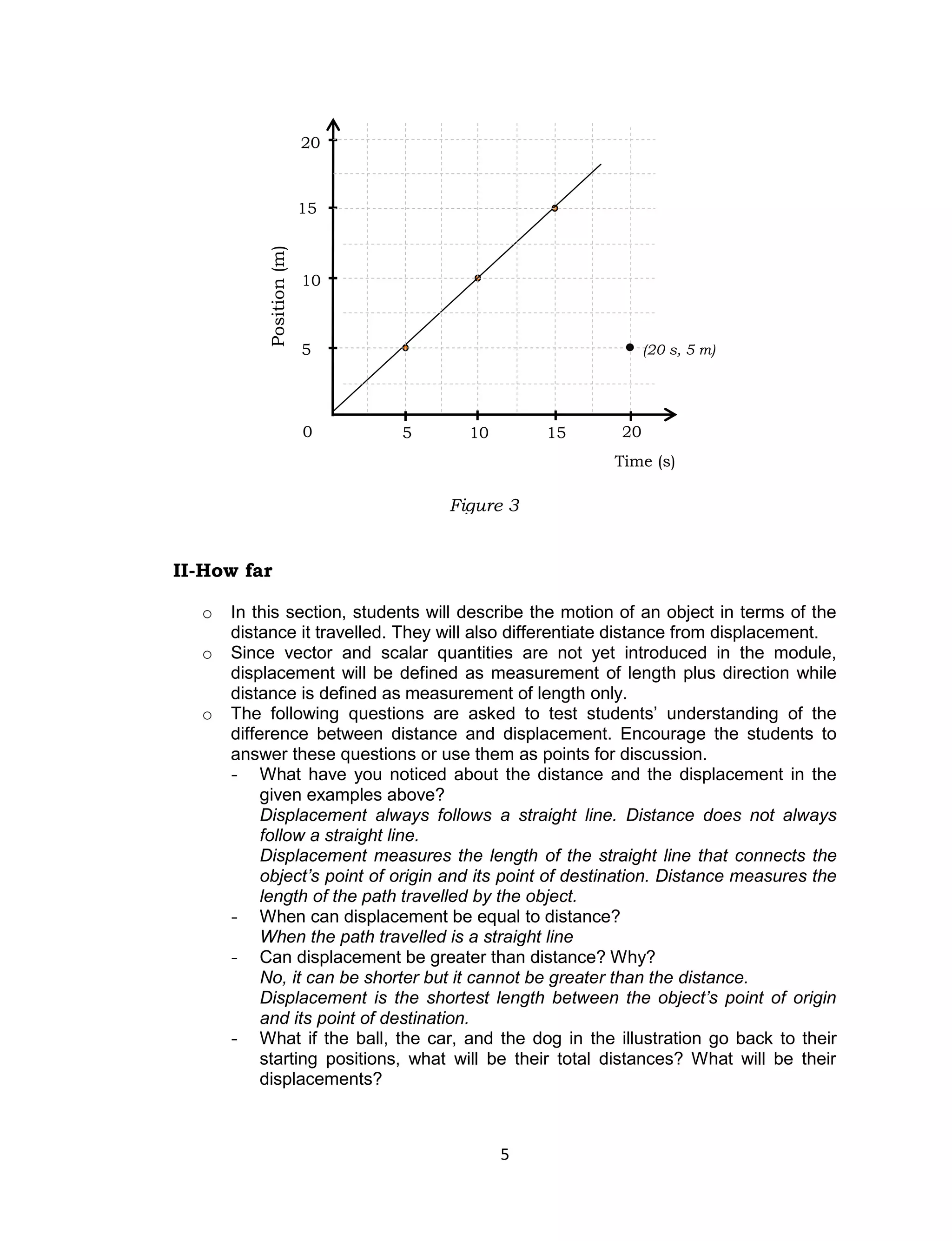
    Table 1

                             Position of the
         Time (sec)
                                   ball
               0                    0
               5                    5
              10                   10
              15                   15


                                          4
20


                         15


          Position (m)   10


                         5                                     (20 s, 5 m)


                         0    5      10         15        20
                                                         Time (s)

                                   Figure 3


II-How far

  o   In this section, students will describe the motion of an object in terms of the
      distance it travelled. They will also differentiate distance from displacement.
  o   Since vector and scalar quantities are not yet introduced in the module,
      displacement will be defined as measurement of length plus direction while
      distance is defined as measurement of length only.
  o   The following questions are asked to test students’ understanding of the
      difference between distance and displacement. Encourage the students to
      answer these questions or use them as points for discussion.
      - What have you noticed about the distance and the displacement in the
           given examples above?
           Displacement always follows a straight line. Distance does not always
           follow a straight line.
           Displacement measures the length of the straight line that connects the
           object’s point of origin and its point of destination. Distance measures the
           length of the path travelled by the object.
      - When can displacement be equal to distance?
           When the path travelled is a straight line
      - Can displacement be greater than distance? Why?
           No, it can be shorter but it cannot be greater than the distance.
           Displacement is the shortest length between the object’s point of origin
           and its point of destination.
      - What if the ball, the car, and the dog in the illustration go back to their
           starting positions, what will be their total distances? What will be their
           displacements?


                                          5
Their total distances will increase two times (will double) but their
               displacements will become zero.


    Activity


      2           Home to school roadmap

    Allow students to work either in pairs or in small groups.
    In the absence of ruler, or meter stick, or any standard distance measuring
     instrument, ask students to design an alternative way to measure the distance.
     Check their design or device for precision.
    If the students live far from school, they can choose a nearer place as their
     starting point. Remind them to include in their maps the street names, reference
     points and precise measurements. Remind them also to stay safe while doing
     the activity outside the school.
    All answers to the questions depend on the students’ data.

III-How fast?

    o    In this section, students will describe the motion of an object in terms of its
         speed. They will also differentiate speed from velocity (which is defined as
         speed plus direction) and average speed from instantaneous speed.


    Activity


      3           Fun Walk

   In this activity, students should be able to design ways to obtain the speed of
    each member of the group and decide how to use these values to determine who
    among them walks fastest.
   In the absence again of a standard instrument for measuring distance, students
    can use their previous design/device.
   Check their units of distance, time, and speed. If for example, they use meter for
    distance and minute for time, then their unit for speed must be meter/minute.

Sample answers to the questions

        Q1. We measured the total distance travelled and time taken to travel the
            distance
        Q2. We divided the distance travelled by the time of travel
        Q3. The fastest participant was the one with the highest computed value of
            distance over time
        Q4. The lesser the time of travel, the greater the speed of travel
        Q5. The greater the distance travelled, the greater the speed of travel

                                            6
Q6. They travelled with the same speed of 2m/s.

IV-How fast is the velocity changing?

    o    In this section, students will be introduced to the concept of acceleration.
    o    Since the students are dealing only with motion along a straight line, the
         concept of acceleration is introduced as due to the change in the speed of the
         moving object. During the discussion, it should be emphasized that
         acceleration may also be due to the change in the direction of the object.
         Acceleration, by definition, is the change in velocity over a time interval, and
         velocity as mentioned earlier is speed plus direction. So even if there is no
         change in speed but there is a change in direction, acceleration is achieved.


    Activity

      4         Doing detective work

   In this activity, students will analyze an example of motion wherein speed (or
    velocity) is changing by examining the record of the dots on a strip of paper.
   Prepare beforehand the paper strips containing dots. The dots should be
    arranged such that the distance between two successive dots increases
    uniformly, like the one shown in the module.
   However, each group can be also asked to work on a strip having different
    arrangement of dots. Some can be decreasing uniformly; others can be
    increasing or decreasing but not uniformly.
   During the discussion, emphasize that any change in the velocity of an object
    results in an acceleration. This includes change in speed (increasing speed or
    decreasing speed which is also called deceleration) or change in direction
    (although this is not discussed in the module). This is to correct the common
    conception among people that acceleration only refers to objects with increasing
    speed.

Sample answers to the questions

        Q1. The distance between two successive dots increases uniformly.
        Q2. The length of the strips of tape in the chart increases uniformly.
        Q3. Each strip of tape provides the speed (or velocity) of the object every 1
            second.
        Q4. Because the length of the tape increases uniformly, it means that the
            speed (or velocity) of the object increases uniformly.
        Q5. The change in length of the tape is constant. The change in speed is
            constant.
            or
            The length of the tape increases by the same amount in each time
            interval. The speed increases by the same amount in each time interval.
        Q6. The object is moving with constant acceleration.
        Q7. The graph is curved or parabolic.

                                            7
Q8. The shape of the speed-time graph is different from the. It is a straight-
          line graph.
     Q9. Similar to the answers in Q5 and Q6
     Q10.If the arrangement of oil drops left by the car is similar to what we used in
          this activity, then the suspect was not telling the truth.

PRE/POST TEST
1. When is an object considered to be in motion?

  I. When its position changes with respect to a point of reference.
  II. When its distance changes with respect to a point of reference.
  III. When its direction changes with respect to a point of reference.

   A. I and II only                   C. II and III only
   B. I and III only                  D. I, II, and III

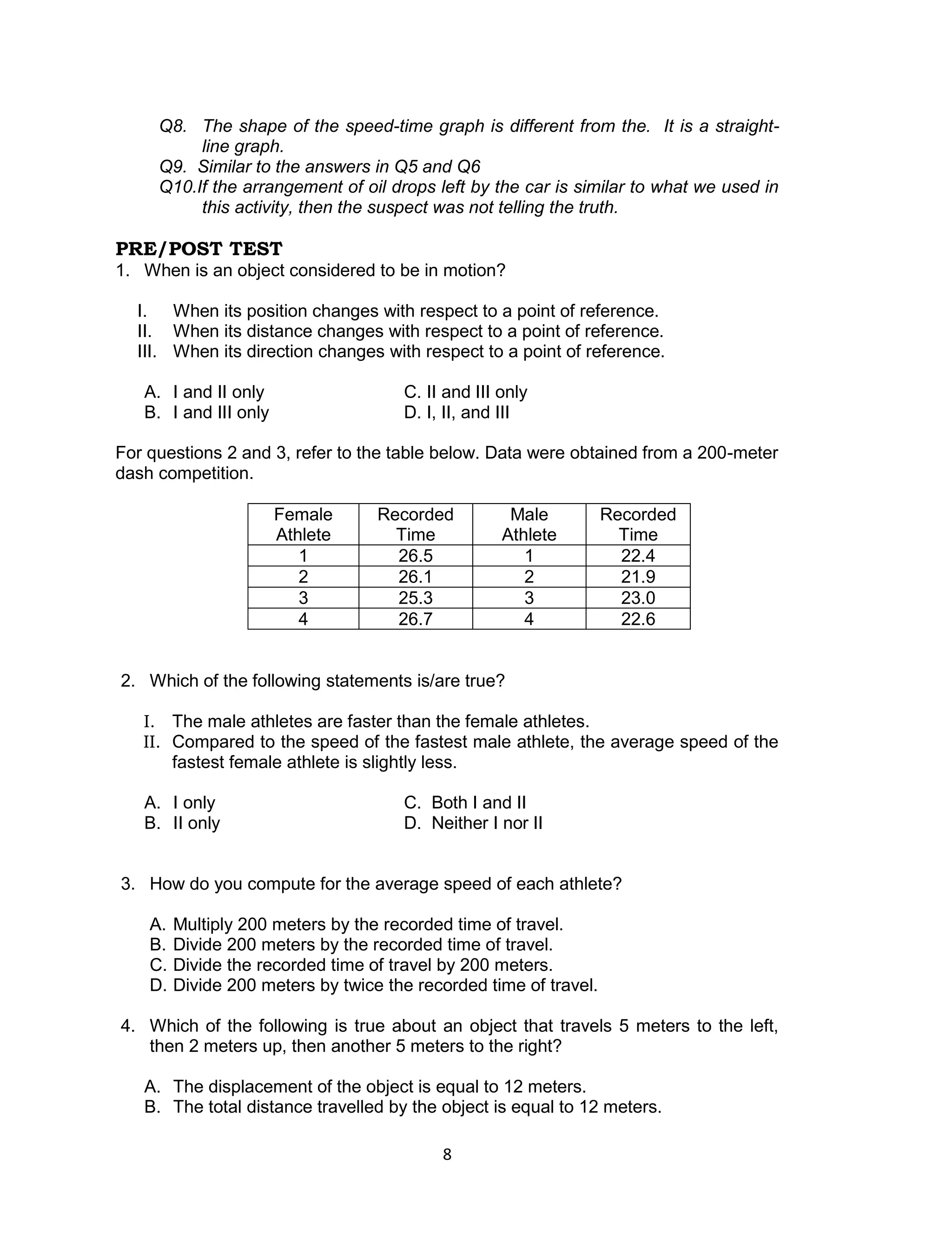
For questions 2 and 3, refer to the table below. Data were obtained from a 200-meter
dash competition.

                       Female      Recorded          Male          Recorded
                       Athlete       Time           Athlete          Time
                          1          26.5              1             22.4
                          2          26.1              2             21.9
                          3          25.3              3             23.0
                          4          26.7              4             22.6


2. Which of the following statements is/are true?

   I. The male athletes are faster than the female athletes.
   II. Compared to the speed of the fastest male athlete, the average speed of the
       fastest female athlete is slightly less.

   A. I only                          C. Both I and II
   B. II only                         D. Neither I nor II


3. How do you compute for the average speed of each athlete?

    A.   Multiply 200 meters by the recorded time of travel.
    B.   Divide 200 meters by the recorded time of travel.
    C.   Divide the recorded time of travel by 200 meters.
    D.   Divide 200 meters by twice the recorded time of travel.

4. Which of the following is true about an object that travels 5 meters to the left,
   then 2 meters up, then another 5 meters to the right?

   A. The displacement of the object is equal to 12 meters.
   B. The total distance travelled by the object is equal to 12 meters.

                                           8
C. The displacement of the object is equal to 12 meters down.
   D. The total distance travelled by the object is equal to 12 meters down.

5. Which of the following statements is NOT true about the object moving with
   constant speed?

   A.   The object is not accelerating
   B.   The speed of the object is equal to zero.
   C.   The distance travelled by the object increases uniformly
   D.   The speed of the object remains the same all throughout the travel


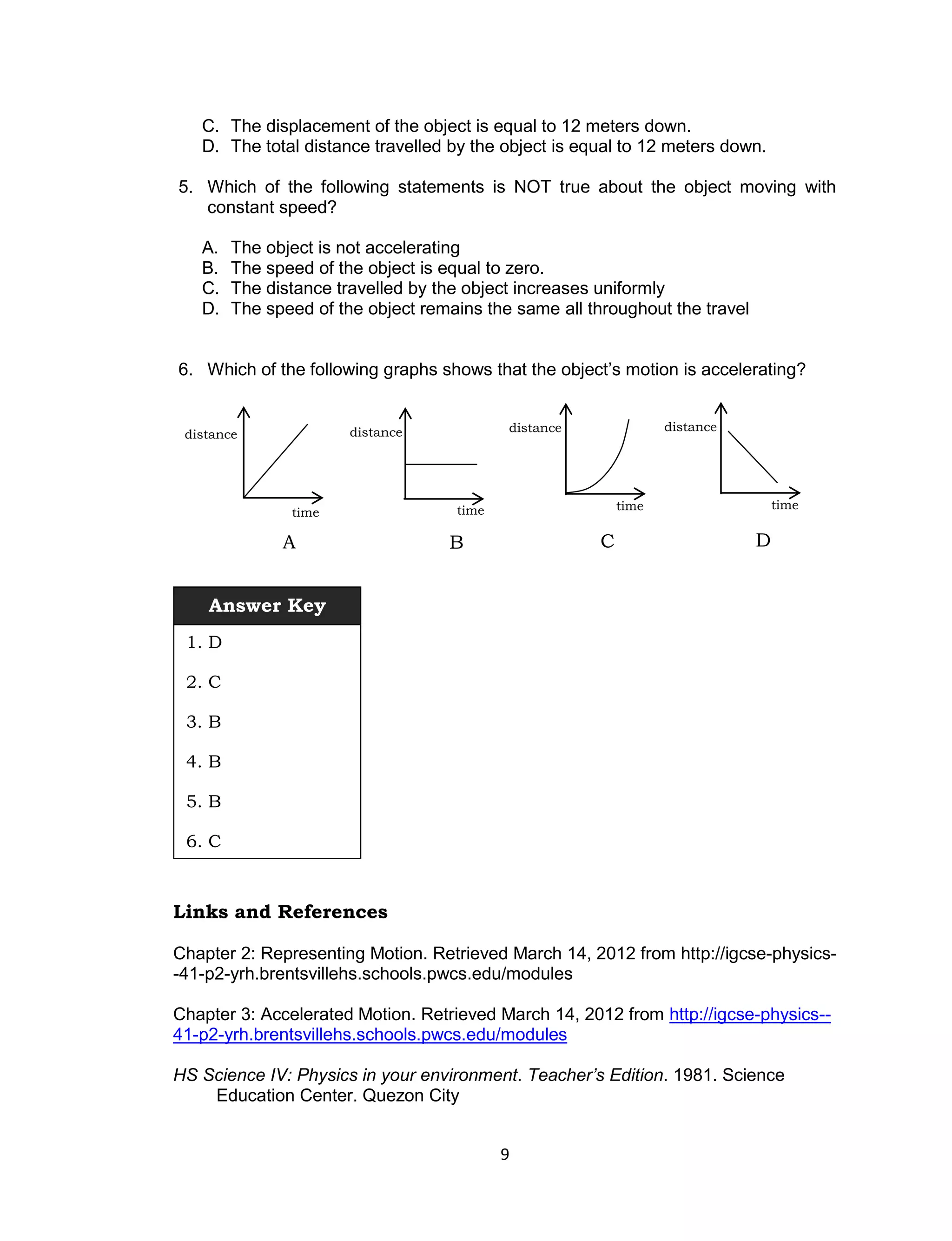
6. Which of the following graphs shows that the object’s motion is accelerating?


                       distance            distance               distance
 distance


                                    time                   time                  time
               time

              A                    B                   C                     D


    Answer Key
 1. D

 2. C

 3. B

 4. B

 5. B

 6. C


Links and References

Chapter 2: Representing Motion. Retrieved March 14, 2012 from http://igcse-physics-
-41-p2-yrh.brentsvillehs.schools.pwcs.edu/modules

Chapter 3: Accelerated Motion. Retrieved March 14, 2012 from http://igcse-physics--
41-p2-yrh.brentsvillehs.schools.pwcs.edu/modules

HS Science IV: Physics in your environment. Teacher’s Edition. 1981. Science
    Education Center. Quezon City


                                           9
TEACHING GUIDE


      Unit 3
     MODULE


        2                WAVES AROUND YOU

       This module introduces the student to the study of waves and its properties.
There is one warm-up activity and three principal activities designed to target key
concepts about wave motion. While the lesson is generally activity-centered, the
teacher must set off the lesson by facilitating the class to give examples of waves in
the environment and to think about what these waves can do.

Importance of the Topics to Real Life

      Sound waves, earthquake waves, waves on stretched strings, and water
waves are all produced by some source of vibration. To explain many other
phenomena in nature, it should be emphasized that it is important to understand
concepts of wave motion.

        For instance, since the Philippines is one of the countries which is a part of
the Pacific Ring of Fire, it experiences frequent earthquakes due to the movements
of tectonic plates or segments of the earth’s crust. It is therefore important to
understand how earthquake waves propagate and to know what actions are taken by
scientists, particularly the geologists, to address the challenges brought by the
geographical location of the Philippines.

        Architects and engineers also consider concepts in wave motion in designing
skyscrapers and bridges. Although these structures appear to be rigid, they actually
vibrate and this fact must be taken into account in their construction.

        Finally, to understand how radio and television work, concepts about the
origin, nature and propagation of electromagnetic waves have to be examined.

Hints for the Teacher

   1. Prepare the students for this lesson by giving a demonstration to serve as
      motivation.

       Demonstration Activity. Introduction to Vibrations

       1) Prepare a metal can with both lids removed.


                                         10
2) Cut a rubber balloon cut and stretched it over one end of the can. Use a
        rubber band to hold the stretched balloon in place.
     3) Put the can and its balloon end up on a table.
     4) Put a small amount of salt on top of the balloon.
     5) Ask a student volunteer to shout (not blow) at the can.
     6) Tell the class to observe what happens to the salt. Also, invite them to
        place their fingers lightly on their throat while creating a sound.

Guide Questions

     1. What two things are vibrating?
        (1) The rubber balloon on the can and (2) the students’ vocal cords in
            their throats

     2. What caused the salt to move?
        The salt is moved by the balloon’s vibrations, which are ultimately caused
        by sound waves traveling through the air. These sound waves are
        generated by the vibration of the vocal chords in the throat. Tell the
        students they will study the details in the next activities and in a separate
        module on sound.

  2. Do the warm up activity with the class and relate it with the demonstration
     activity. The demonstration and the warm-up activity aim to bring out the
     following pre-requisite concepts:

     (1) Waves are caused by a source of a vibration and
     (2) Waves can set objects into motion.

Guide Questions

     1. What do you do when you wave your hand?
        Tell the students that they are essentially “vibrating” their hands by doing
        a repetitive back-and-forth or side-to-side movement with your fingers or
        your palm. (Encourage the students to demonstrate their personal hand
        waves.)

     2. Think of a still lake. How would you generate water waves on the lake?
        Water waves can be generated by vibrating the surface of the water.
        Students can have various answers from their experiences. Tell them that
        the activities that they would perform will allow them to generate waves
        and to understand wave motion.

     3. You may have to demonstrate to students how they can make periodic
        waves using the materials in the activities.


                                       11
Objectives

 After taking up this module, the students should be able to:

     1. Infer that energy, like light and sound travel in the form of waves.
     2. Explain how waves carry energy from one place to another.
     3. Distinguish between transverse and longitudinal waves and mechanical
        and electromagnetic waves.
     4. Create a model to demonstrate the relationship among frequency,
        wavelength, and wave speed.


Guide to Conducting the Principal Activities in the Module

       The activities in the module are designed to be performed within the
classroom. Each activity will take up one class period.

        The following schedule of activities is suggested:

        Session 1              Demonstration Activity
                               Warm Up. What are waves?
                               Activity 1. Let’s Make Waves!
                               Presentation of Group Output
                               Discussion of the Answers to Activity 1

        Session 2              Review of Key Concepts from Activity 1
                               Activity 2. Anatomy of a Wave
                               Presentation of Group Output
                               Discussion of the Answers to Activity 2

        Session 3              Review of the Key Concepts from Activities 1 and 2
                               Activity 3. Mechanical vs. Electromagnetic Waves
                               Discussion of the Answers to Activity 3
                               Summary of the Module
                               Test Your Knowledge


   Activity


     1         Let’s Make Waves!
               What happens when waves pass by?

        The students are given 30 minutes to perform the activity and to answer the
questions in the activity sheet. After completing the activity, the teacher will facilitate
a brief discussion of the findings.

                                            12
It is best to choose three groups to present their findings on the different parts
of the activity (i.e. one representative will show the work of their group on Part A
only; representatives from other groups will talk about Part B and Part C
respectively.)

         The teacher will conclude the meeting by answering the summary part of the
activity sheet with the class.


Answers to the Activity Sheet

What are transverse waves?

   1. Sketches showing the motion of a wave pulse at three subsequent instances
      (snapshots at three different times).

       Time 1


       Time 2


       Time 3


       a. What is the source of the wave pulse?
          A vibration due to a quick shake at one end of the rope
       b. Describe the motion of your hand as you create the pulse.
          A quick up and down movement
       c. Describe the motion of the pulse with respect to the source. The pulse
          moved away from the source.

   2. [Sketch of the waveform or the shape of the wave created by the students.]


                                           13
a. Does the wave transport the colored ribbon from its original position to the
        end of the rope?
        No, it doesn’t.
     b. Describe the vibration of the colored ribbon. How does it move as waves
        pass by? Does it move in the same direction as the wave?
        As the waves pass by, the colored ribbon moves up and down
        repetitively. It does not move in the same direction as the passing waves.
        Instead, it vibrates along the axis perpendicular to the direction of travel of
        the passing waves.

What are longitudinal waves?

  1. Sketch of longitudinal waves in a coil spring.


  2. [Observations on the colored ribbon tied to the coil spring.]
     a. Does the wave transport the colored ribbon from its original position to the
        end of the rope?
        No, it doesn’t.
     b. Describe the vibration of the colored ribbon. How does it move as waves
        pass by?
        As the waves pass by, the colored ribbon moves back and forth
        repetitively. It vibrates along the axis parallel to the direction of travel of
        the passing waves.

What are surface waves?

  1. [Sketch of the waves as seen from above the water basin.] The source of the
     disturbance should be marked.


  2. [Observation on the paper boat.]
     a. Do the waves set the paper boat into motion? What is required to set an
        object into motion?
        Yes, the waves moved the paper boat. Energy is required to set and
        object into motion.
     b. If you exert more energy in creating periodic waves by tapping the
        surface with greater strength, how does this affect the movement of the
        paper boat?
        The wave carried more energy causing the paper boat to vibrate strongly.


                                         14
3. [Observations on the figure showing water waves.]
      a. As shown in the figure, the passage of a wave across a surface of a body
         of water involves the motion of particles following a circular pattern about
         their original positions.
      b. Does the wave transport water molecules from the source of the
         vibration? Support your answer using the shown figure.
         No, the water molecules are not transported from the source of the
         vibration. The figure shows that the water particles merely move in
         circular orbits about their original positions as waves pass by.

Summary

   1. Waves can be typified according to the direction of motion of the vibrating
      particles with respect to the direction in which the waves travel.

        a. Waves in a rope are called transverse waves because the individual
           segments of the rope vibrate perpendicular to the direction in which the
           waves travel.
        b. When each portion of a coil spring is alternatively compressed and
           extended, longitudinal waves are produced.
        c. Waves on the surface of a body of water are a combination of transverse
           and longitudinal waves. Each water molecule moves in a circular pattern
           as the waves pass by.

   2. How do we know that waves carry energy?
      Waves can set other objects into motion.

   3. What happens when waves pass by?
      Particles vibrate alternately to transport the energy of the wave.


   Activity


     2         Anatomy of a Wave
               How can you describe waves?

        The students are given 40 minutes to perform the activity and to answer the
questions in the activity sheet. After completing the activity, the teacher will facilitate
a brief discussion of the findings.

        Before discussing the results of the activity to the class, it is useful to show a
large image of a sinusoidal wave and ask the class to name the parts of the wave.

       The activity has three parts so the groups may be asked to assign a different
representative to discuss the result of their work to the class (i.e. those who have
been chosen as presenters in Activity 1 should not be assigned again).


                                            15
The teacher will conclude the meeting by answering the summary part of the
activity sheet with the class.


Answers to the Activity Sheet

How can you measure the wavelength of a wave?

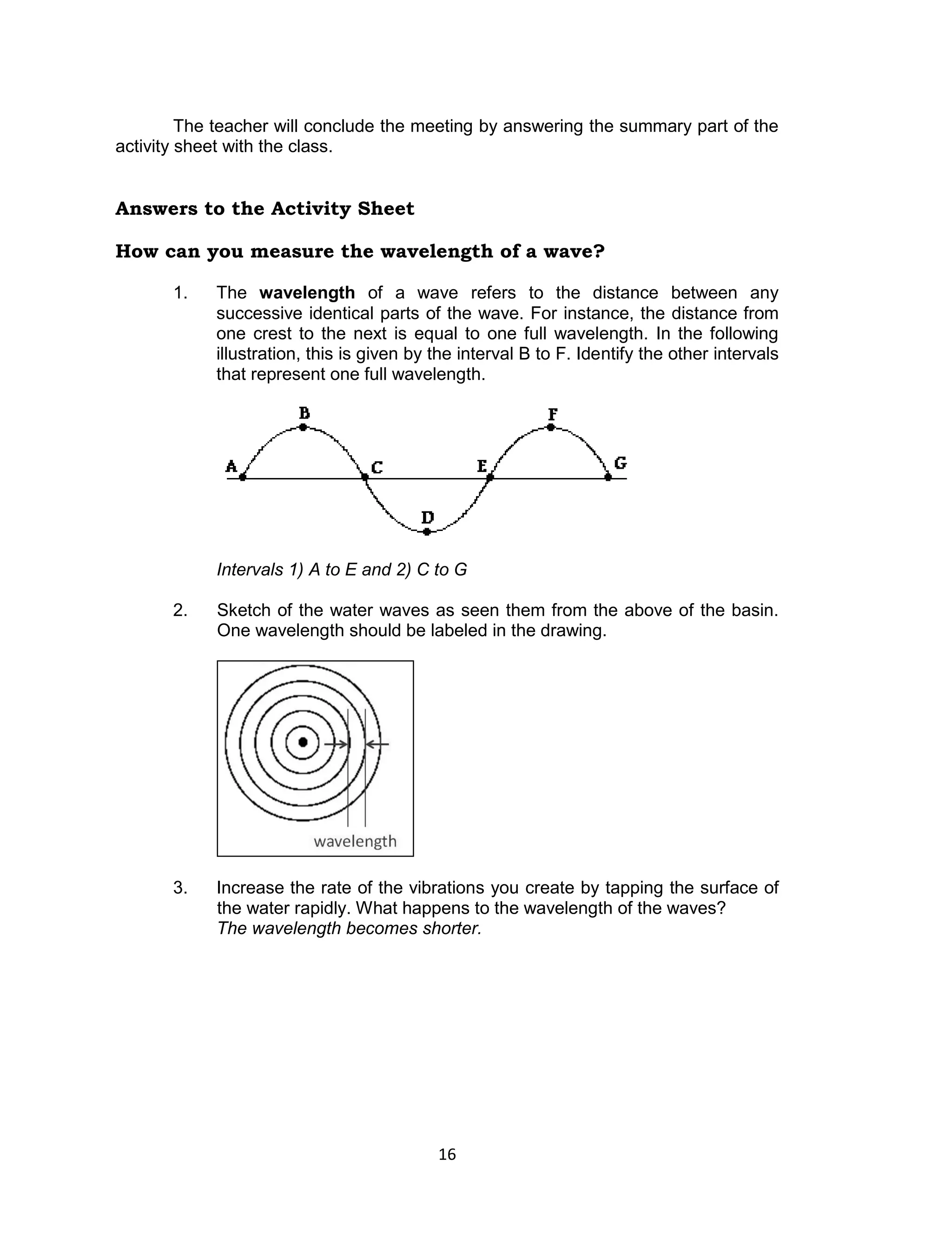
       1.   The wavelength of a wave refers to the distance between any
            successive identical parts of the wave. For instance, the distance from
            one crest to the next is equal to one full wavelength. In the following
            illustration, this is given by the interval B to F. Identify the other intervals
            that represent one full wavelength.


            Intervals 1) A to E and 2) C to G

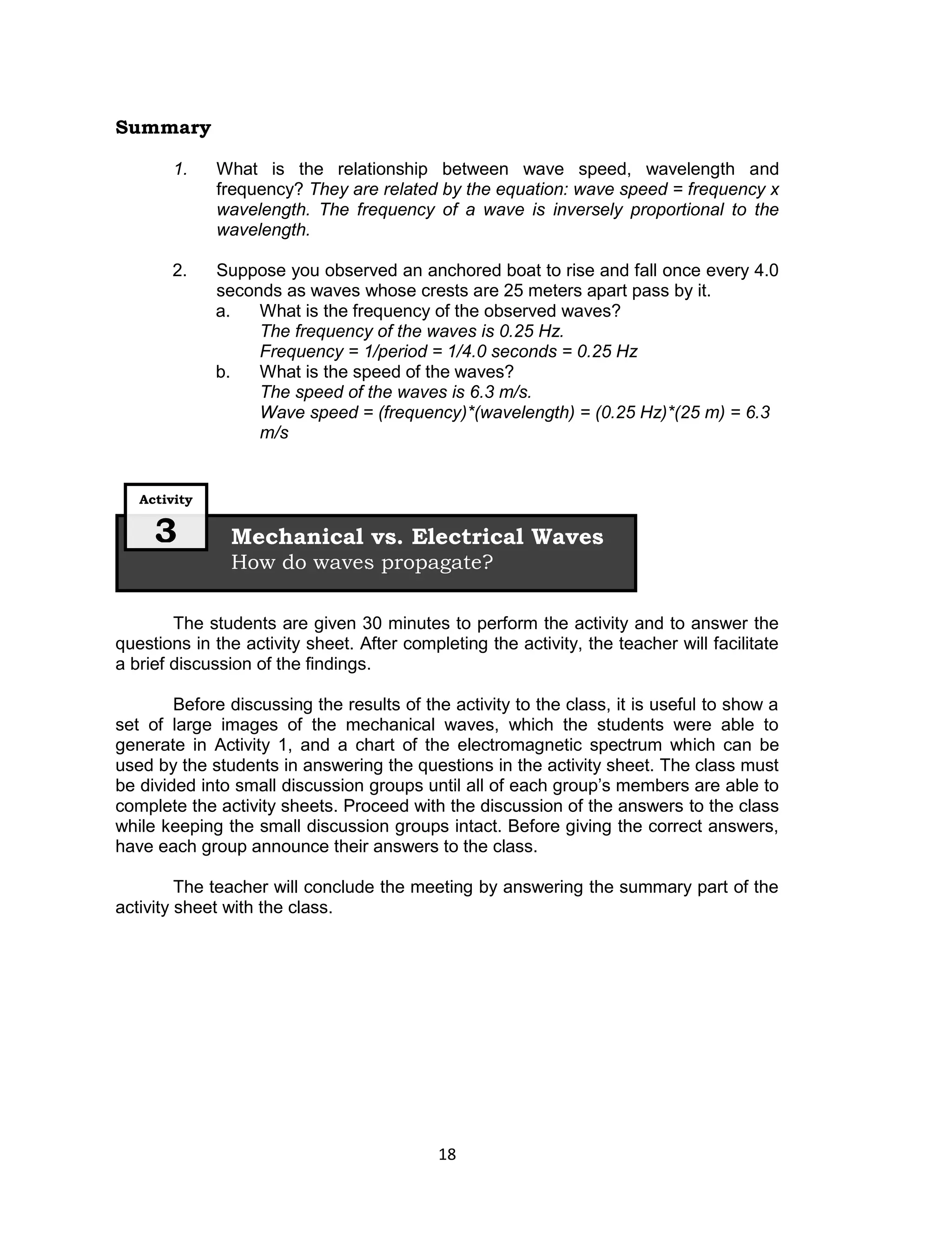
       2.   Sketch of the water waves as seen them from the above of the basin.
            One wavelength should be labeled in the drawing.


       3.   Increase the rate of the vibrations you create by tapping the surface of
            the water rapidly. What happens to the wavelength of the waves?
            The wavelength becomes shorter.


                                           16
[Sketch of the water waves as seen them from the top of the basin.
            Compared to the drawing in number 2, this one has shorter
            wavelengths.]


How can you measure the frequency of a wave?

     1-3. Results are recorded in Table 1. Each group may have different
     answers.

     Table 1. Frequency and period of the wave
        Number of waves                    Frequency
                                                                          Period
     (N cycles) that passed by            of the waves
                                                                  of the waves (seconds)
     the ribbon in 10 seconds        (N cycles/10 seconds)


             Example
             15 cycles              15 cycles/10s = 1.5 Hz          1/1.5 Hz = 0.67 s

     4.     If you increase the frequency of vibration by jerking the end of the rope
            at a faster rate, what happens to the wavelength?
            The wavelength becomes shorter.

How can you measure the speed of a wave?

     1-2a. Results are recorded in Table 2. Each group may have different
     answers.

     Table 2. The speed of a wave
                          Number of waves
                                                    Frequency
          Estimated        (N cycles) that
                                                   of the waves           Wave speed
          wavelength        passed by the
                                                   (N cycles/10          (meter/second)
           (meters)          ribbon in 10
                                                     seconds)
                               seconds


          Example                15 cycles        15 cycles/10s         (0.5m)*(1.5Hz)
           0.5 m                                    = 1.5 Hz               = 0.8 m/s


                                             17
Summary

        1.    What is the relationship between wave speed, wavelength and
              frequency? They are related by the equation: wave speed = frequency x
              wavelength. The frequency of a wave is inversely proportional to the
              wavelength.

       2.     Suppose you observed an anchored boat to rise and fall once every 4.0
              seconds as waves whose crests are 25 meters apart pass by it.
              a.   What is the frequency of the observed waves?
                   The frequency of the waves is 0.25 Hz.
                   Frequency = 1/period = 1/4.0 seconds = 0.25 Hz
              b.   What is the speed of the waves?
                   The speed of the waves is 6.3 m/s.
                   Wave speed = (frequency)*(wavelength) = (0.25 Hz)*(25 m) = 6.3
                   m/s


   Activity

     3         Mechanical vs. Electrical Waves
               How do waves propagate?

        The students are given 30 minutes to perform the activity and to answer the
questions in the activity sheet. After completing the activity, the teacher will facilitate
a brief discussion of the findings.

        Before discussing the results of the activity to the class, it is useful to show a
set of large images of the mechanical waves, which the students were able to
generate in Activity 1, and a chart of the electromagnetic spectrum which can be
used by the students in answering the questions in the activity sheet. The class must
be divided into small discussion groups until all of each group’s members are able to
complete the activity sheets. Proceed with the discussion of the answers to the class
while keeping the small discussion groups intact. Before giving the correct answers,
have each group announce their answers to the class.

         The teacher will conclude the meeting by answering the summary part of the
activity sheet with the class.


                                            18
Answers to the Activity Sheet

What are mechanical waves?

     1. [Identifying the medium of wave propagation for mechanical waves]
        a. In Activity 1 Part B, what is the medium of wave propagation?
            Coil spring
        b. In Activity 1 Part C, what is the medium of wave propagation?
            Water
     2. [Characteristics of mechanical waves]
        a. How can you generate mechanical waves? They can be generated
            by vibrating a medium. A medium is required because vibrating
            particles are needed for the wave to travel.

     3. [Application of the concept of mechanical waves to earthquakes]
        a. What do you think is the source of earthquake waves? Earthquake
           waves are caused by a vibration due to colliding tectonic plates.
        b. What is the medium of propagation of earthquake waves?
           The Earth

What are electromagnetic waves?

     1. [Knowing the electromagnetic waves]
        1) Radio waves                 5) Ultraviolet waves
        2) Microwaves                  6) X-rays
        3) Infrared waves              7) Gamma Rays
        4) Visible light

     2. [Some characteristics of electromagnetic waves]

        a. Describe the relationship between frequency and wavelength of each
           electromagnetic wave.
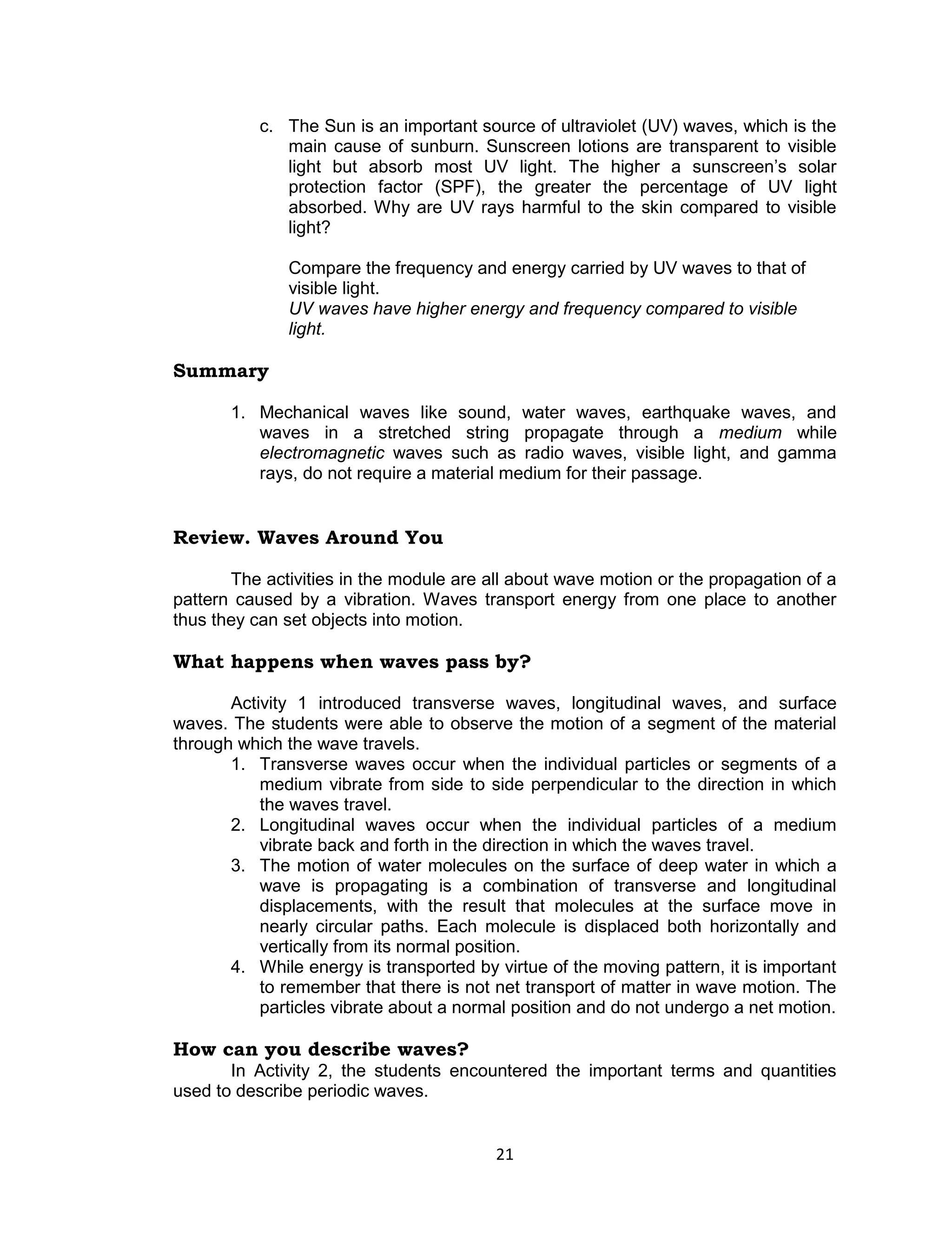
           Among electromagnetic waves, the higher the frequency, the shorter
           the wavelength.
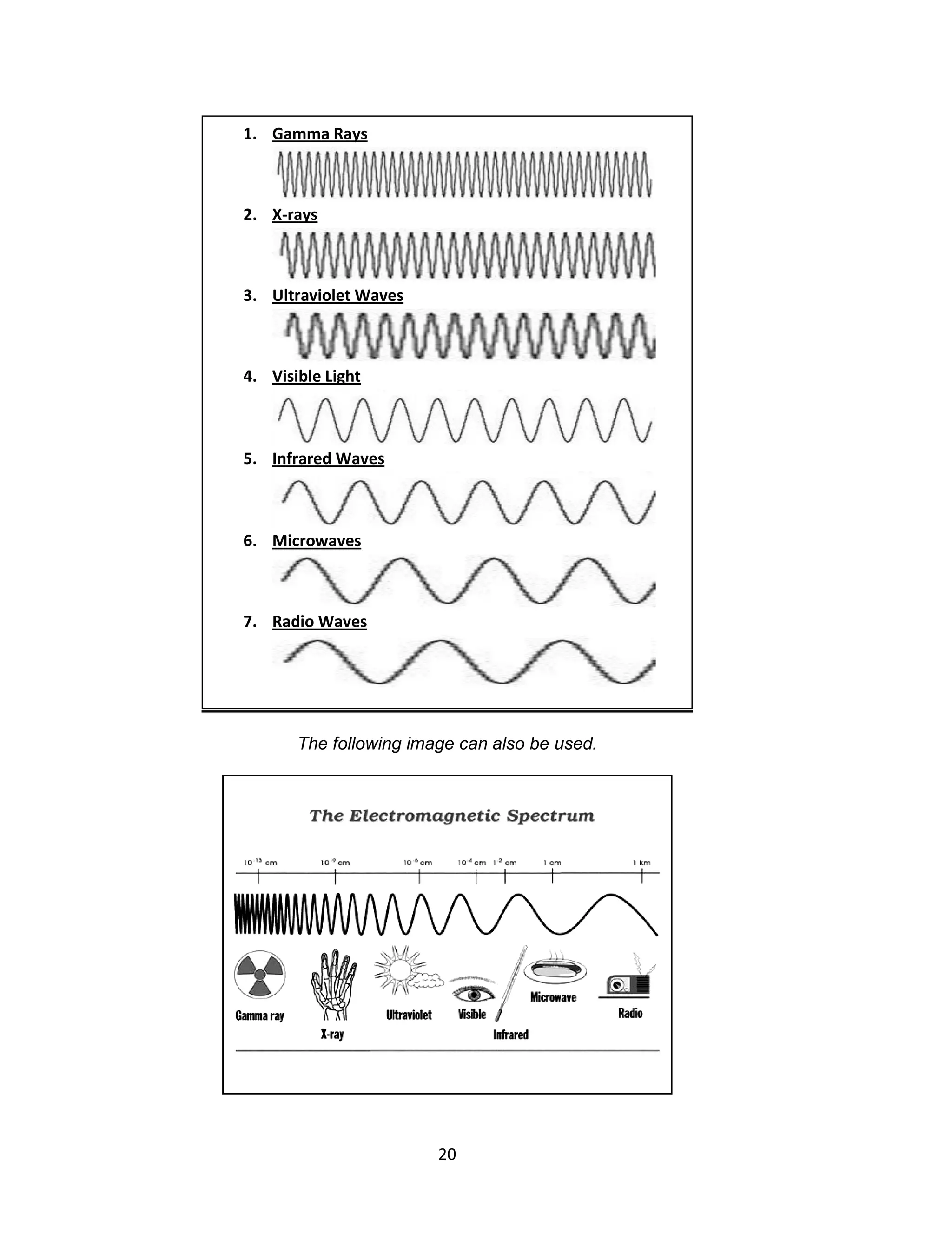
        b. Draw waves to represent each electromagnetic wave. Your
           illustrations must represent the wavelength of a wave relative to the
           others. For instance, gamma rays have a very small wavelength
           compared to the other waves in the spectrum.
           High energy electromagnetic waves have (high, low) frequency and
           (long, short) wavelengths.


                                     19
1. Gamma Rays


2. X-rays


3. Ultraviolet Waves


4. Visible Light


5. Infrared Waves


6. Microwaves


7. Radio Waves


       The following image can also be used.


                        20
c. The Sun is an important source of ultraviolet (UV) waves, which is the
              main cause of sunburn. Sunscreen lotions are transparent to visible
              light but absorb most UV light. The higher a sunscreen’s solar
              protection factor (SPF), the greater the percentage of UV light
              absorbed. Why are UV rays harmful to the skin compared to visible
              light?

              Compare the frequency and energy carried by UV waves to that of
              visible light.
              UV waves have higher energy and frequency compared to visible
              light.

Summary

       1. Mechanical waves like sound, water waves, earthquake waves, and
          waves in a stretched string propagate through a medium while
          electromagnetic waves such as radio waves, visible light, and gamma
          rays, do not require a material medium for their passage.


Review. Waves Around You

       The activities in the module are all about wave motion or the propagation of a
pattern caused by a vibration. Waves transport energy from one place to another
thus they can set objects into motion.

What happens when waves pass by?

       Activity 1 introduced transverse waves, longitudinal waves, and surface
waves. The students were able to observe the motion of a segment of the material
through which the wave travels.
       1. Transverse waves occur when the individual particles or segments of a
           medium vibrate from side to side perpendicular to the direction in which
           the waves travel.
       2. Longitudinal waves occur when the individual particles of a medium
           vibrate back and forth in the direction in which the waves travel.
       3. The motion of water molecules on the surface of deep water in which a
           wave is propagating is a combination of transverse and longitudinal
           displacements, with the result that molecules at the surface move in
           nearly circular paths. Each molecule is displaced both horizontally and
           vertically from its normal position.
       4. While energy is transported by virtue of the moving pattern, it is important
           to remember that there is not net transport of matter in wave motion. The
           particles vibrate about a normal position and do not undergo a net motion.

How can you describe waves?
       In Activity 2, the students encountered the important terms and quantities
used to describe periodic waves.


                                         21
1. The crest and trough refer to the highest point and lowest point of a wave
          pattern, respectively.
       2. The amplitude of a wave is the maximum displacement of a particle of the
          medium on either side of its normal position when the wave passes.
       3. The frequency of periodic waves is the number of waves that pass a
          particular point for every one second while the wavelength is the distance
          between adjacent crests or troughs.
       4. The period is the time required for one complete wave to pass a particular
          point.
       5. The speed of the wave refers to the distance the wave travels per unit
          time. It is related to the frequency of the wave and wavelength through
          the following equation:


How do waves propagate?

       Finally, Activity 3 prompted the students to distinguish between mechanical
and electromagnetic waves.

       1. In mechanical waves, some physical medium is being disturbed for the
          wave to propagate. A wave traveling on a string would not exist without
          the string. Sound waves could not travel through air if there were no air
          molecules. With mechanical waves, what we interpret as a wave
          corresponds to the propagation of a disturbance through a medium.

       2. On the other hand, electromagnetic waves do not require a medium to
          propagate; some examples of electromagnetic waves are visible light,
          radio waves, television signals, and x-rays.


PRE/POST TEST
(For Modules 2 to 4)

Part A: WAVES

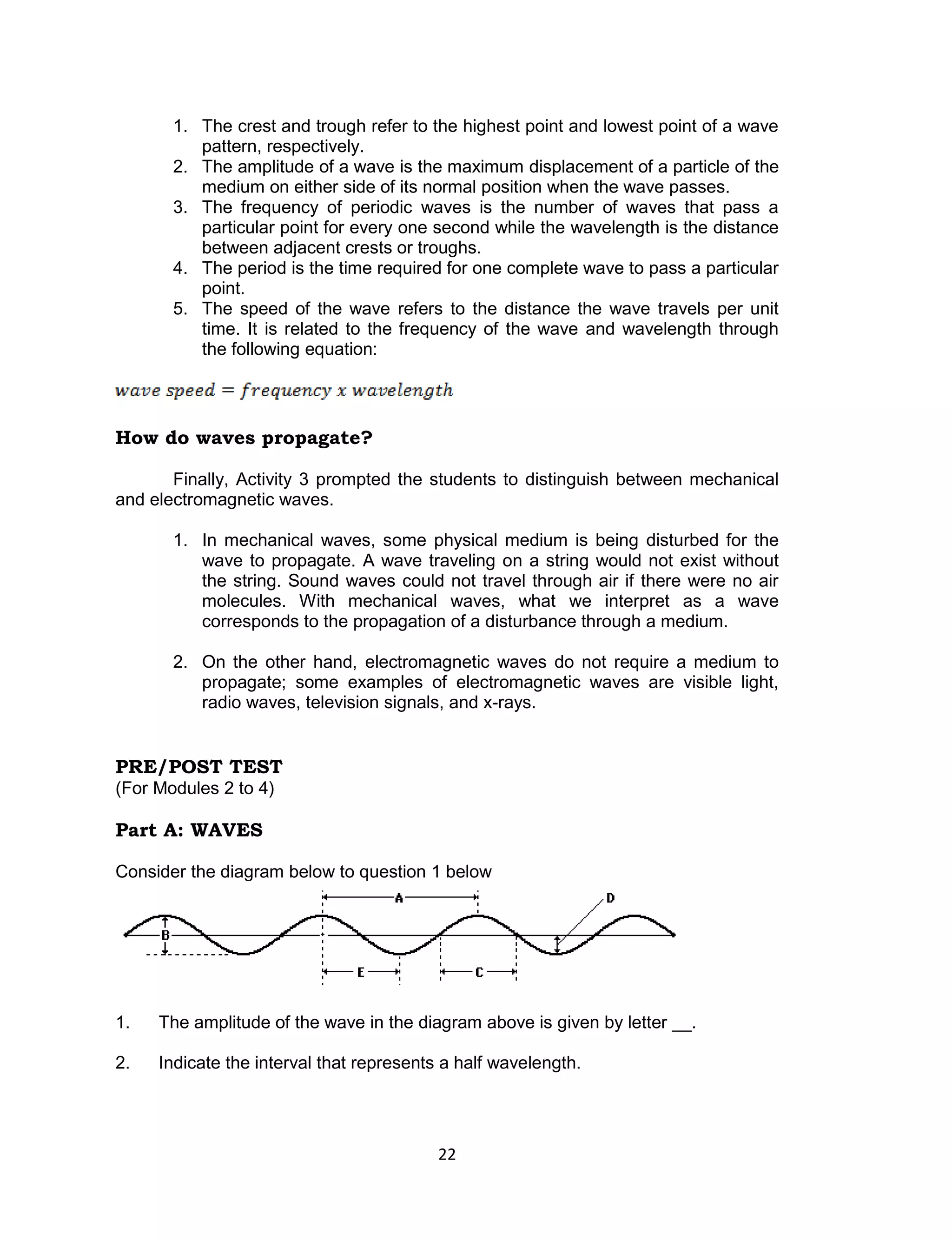
Consider the diagram below to question 1 below


1.   The amplitude of the wave in the diagram above is given by letter __.

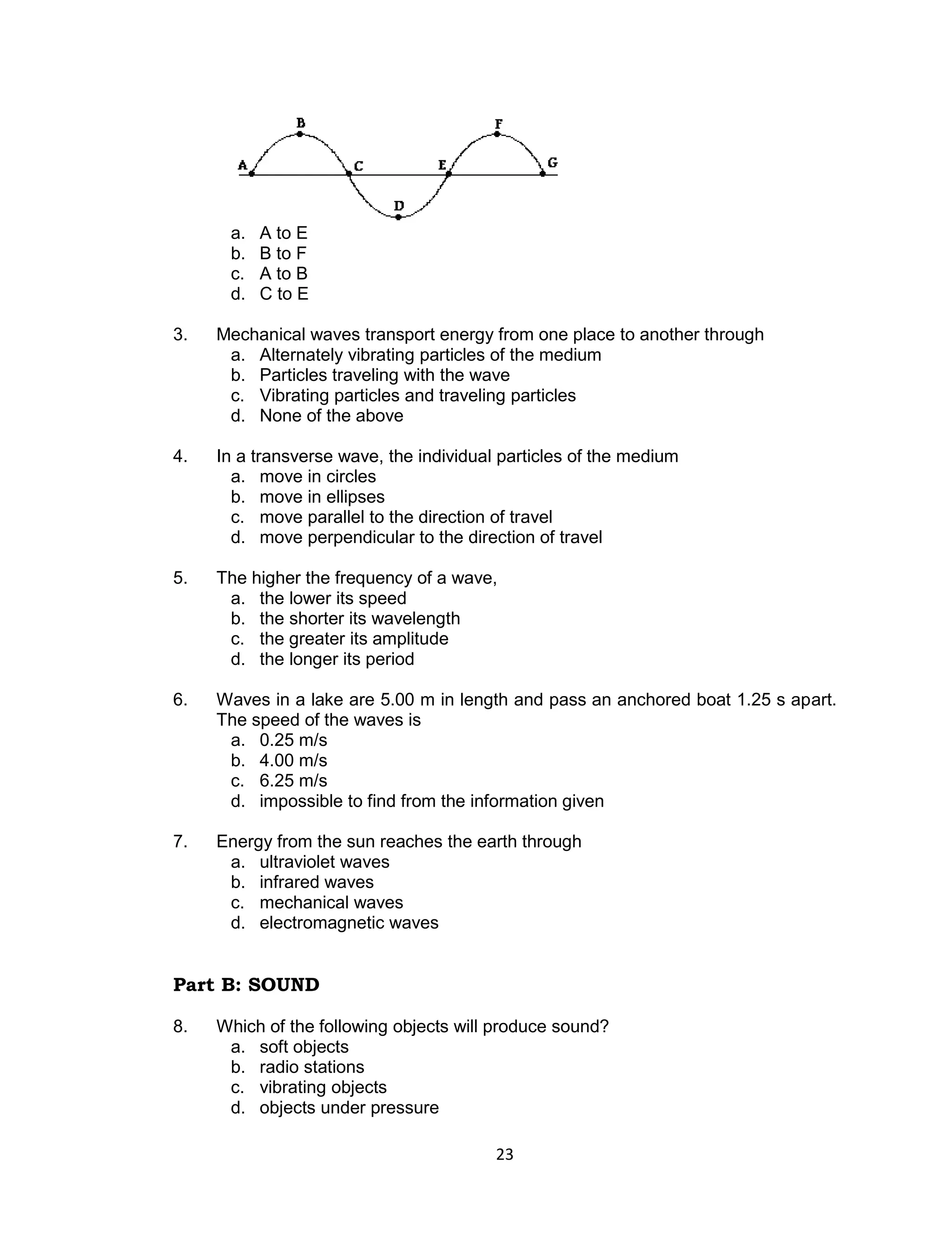
2.   Indicate the interval that represents a half wavelength.


                                          22
a.   A to E
      b.   B to F
      c.   A to B
      d.   C to E

3.   Mechanical waves transport energy from one place to another through
      a. Alternately vibrating particles of the medium
      b. Particles traveling with the wave
      c. Vibrating particles and traveling particles
      d. None of the above

4.   In a transverse wave, the individual particles of the medium
       a. move in circles
       b. move in ellipses
       c. move parallel to the direction of travel
       d. move perpendicular to the direction of travel

5.   The higher the frequency of a wave,
      a. the lower its speed
      b. the shorter its wavelength
      c. the greater its amplitude
      d. the longer its period

6.   Waves in a lake are 5.00 m in length and pass an anchored boat 1.25 s apart.
     The speed of the waves is
      a. 0.25 m/s
      b. 4.00 m/s
      c. 6.25 m/s
      d. impossible to find from the information given

7.   Energy from the sun reaches the earth through
      a. ultraviolet waves
      b. infrared waves
      c. mechanical waves
      d. electromagnetic waves


Part B: SOUND

8.   Which of the following objects will produce sound?
      a. soft objects
      b. radio stations
      c. vibrating objects
      d. objects under pressure

                                         23
9.    Which of the following best describes a high frequency sound?       It has
      _____________.
      a. low pitch
      b. high pitch
      c. low energy
      d. A and C

10.   Compared to a thin string of the same length and tightness a thick string
      produces sounds of ____________.
      a. the same pitch
      b. lower pitch
      c. higher pitch
      d. lower then higher pitch

11.   A sound wave is a _____________.
      a. longitudinal wave
      b. transverse wave
      c. standing wave
      d. shock wave

12.   Which of the following is not capable of transmitting sound?
      a. air
      b. water
      c. steel
      d. a vacuum

13.   Which of the following would most likely transmit sound best?
      a. Steel in cabinet
      b. Water in the ocean
      c. Air in your classroom
      d. Water in a swimming pool


Part C: LIGHT

1.    Which of the following is NOT an electromagnetic wave?
      a. Infrared
      b. Radio
      c. Sound
      d. X ray

2.    How does the wavelength of infrared (IR) compare with the wavelength of
      ultraviolet (UV) waves?
      a. Infrared waves have longer wavelength.
      b. Infrared waves have shorter wavelength.
      c. IR waves have the same wavelength as the UV waves.
      d. IR is not comparable in wavelength with the UV waves


                                        24
3.     Among all the electromagnetic waves (EM), which has the highest
       frequency?
       a. Infrared radiation
       b. Radio wave
       c. Ultraviolet
       d. Gamma rays

4.     ROYGBIV is the basic component of white light. Which color of light carries
       the most energy?
       a. Blue
       b. Green
       c. Orange
       d. Red

5.     Light is an electromagnetic wave. Which characteristic is common in all
       electromagnetic waves?
       a. amplitude
       b. frequency
       c. speed
       d. wavelength

           Answer Key
           Part A                Part B                       Part C
           1. D                  1.C                          1.C
           2. D                  2.B                          2.A
           3. A                  3.B                          3.D
           4. D                  4.A                          4.A
           5. B                  5.D                          5.C
           6. B                  6.A
           7.D


References and Web Links
[1] Anatomy of an electromagnetic wave. Available at:
http://missionscience.nasa.gov/ems/02_anatomy.html
[2] Electromagnetic waves. Available at:
http://www.colorado.edu/physics/2000/waves_particles/
[3] Hewitt, P. (2006). Conceptual Physics 10th Ed. USA: Pearson Addison-Wesley.
[4] The anatomy of a wave. Available at:
http://www.physicsclassroom.com/class/waves/u10l2a.cfm
[5] The nature of a wave. Available at:
http://www.physicsclassroom.com/class/waves/u10l1c.cfm


                                          25
TEACHING GUIDE


        Unit 3
       MODULE


        3                SOUND

        In this module the student will be able to explore the concept of sound.
Specifically, students will be acquainted with (1) sound propagation, (2)
characteristics of sound – pitch, loudness, and quality, and (3) types of sound
according to quality – infrasonic, audible, & ultrasonic.

        The developmental task for the students include being able to (1)
demonstrate how sound is produced; (2) use the concepts of wavelength, velocity,
and amplitude to describe characteristics of sound such as pitch, loudness and
quality; (3) demonstrate changes in pitch and loudness using real or improvised
musical instrument through fair testing; (4) explain sound production in the human
voice box and how pitch, loudness and quality of sound vary from one person to
another; (5) describe how organisms produce, transmit and receive sound of various
frequencies (infrasonic, audible and ultrasonic sound); and (6) create harmonious
music using indigenous products.

Probable Misconceptions

       Sound waves move with the medium.
       Sound can travel in vacuum.
       Sound travels fastest in gas.
       Pitch is dependent on period.

Teaching and Learning Strategies

Motivation
   The facilitator may start with elicitation of the different indigenous instruments
      in the locality used as musical apparatus. Ask them what particular local
      occasions are these used. Ask them how these instruments are played to
      derive from the students the concept of how sound waves are propagated.

Facilitating Learning
    Introduce activity 1 to arrive at the objectives: design a sounding box to
       explain and explore how sound is produced.


                                         26
   Since activity 1 features not only concept attainment but also provides
      opportunities for learners who are artistically inclined to express their talents
      as well then this may be able to keep all students on task.
     Data processing may be done by group presentation and class discussion of
      the guide questions to probe the concept of sound propagation.
     Discussion should also be extended to cover media on which sound travel
      and speed of sound.
     Then introduce Activity 2: Characteristics and Properties of Sound. In this
      activity, the students will be able to use their sounding box to describe the
      characteristics of sound and compare their experimental results with that of
      the standard instrument (guitar).
     Data processing may be done by group presentation and class discussion of
      the guide questions to probe the how pitch is related to frequency.
     Extend the discussion to include types of sound (infrasonic, audible, and
      ultrasonic), the human ear, loudness and intensity.
     As a performance task, introduce Activity 3: Big Time Gig!. In this activity the
      students will be able to: (1) create musical instruments using indigenous
      products and (2) use these instruments to compose tunes and present in a
      Gig. Students may also utilize other indigenous musical instruments.
     In the quest to come up with a Gig students will be able to discover and apply
      the different characteristics and properties of sound. Further, they will also be
      able to utilize and showcase their talents through a presentation or rendition.
     Summary of the whole module may be probed by asking for insights and
      experiences they had during the preparation, presentation and post-
      presentation discussion of the rendition.

Description of Activities

     Activity 1: My Own Sounding Box
      (Students will design a sounding box to explain and explore how sound is
      produced)
     Activity 2: Properties and Characteristics of Sound
      (Using the Sound Box, students will describe the characteristics of sound
      through the concept of wavelength, velocity and amplitude)

     Activity 3: Big Time Gig!!!
      (Students will create musical instruments using indigenous products and use
      these instruments to compose tunes and present in a Gig. Students may also
      utilize other indigenous musical instruments)


                                         27
Answers to Questions:

   Activity


      1        My Own Sounding Box

Q1.    The elastic bands vibrate when plucked. Sound is produced by vibration of the
       elastic band.
Q2.    The sound produced by each elastic band is different from the others. The
       thinker the band the louder the sound produced. The thicker the band, the
       lower the tone.
Q3.    When the elastic bands are stretched then plucked, sound increases in pitch.
Q4.    Highest note – thinnest, Lowest note - thickest


   Activity


      2        Properties and Characteristics of
               Sound

Q1.   The rubber bands were vibrating when plucked. This resulted to produced
      sound. This means that sound is produced by vibration of the medium or
      material.
Q2. Yes. The sound produced by each elastic band is different from the others.
Q3. The thinker the band the louder the sound produced. The thicker the band the
      lower the tone.
Q4. To make a softer sound apply small force in plucking the rubber bands. To
      make a louder sound, apply greater force in plucking the rubber bands
Q5. Pitch is dependent on the thickness or thinness of the string and on the
      stretching of the elastics. Loudness and softness of sound, on the other hand,
      affected by the force exerted in plucking the elastics.
Q6. Yes.
Q7. Yes, the pitch is higher.
Q8. Shorter side – higher pitch; Longer side – lower pitch
Q9. Pitch of sound is affected by the thickness of the rubber band and the amount
      of stretch.
Q10. String No. 0
Q11. String No. 6
Q12. String No. 0
Q13. String No. 0
Q14. String No. 6
Q15. String No. 6
Q16. The higher the frequency, the higher the pitch.


                                         28
Activity

    3         Big Time Gig!!!

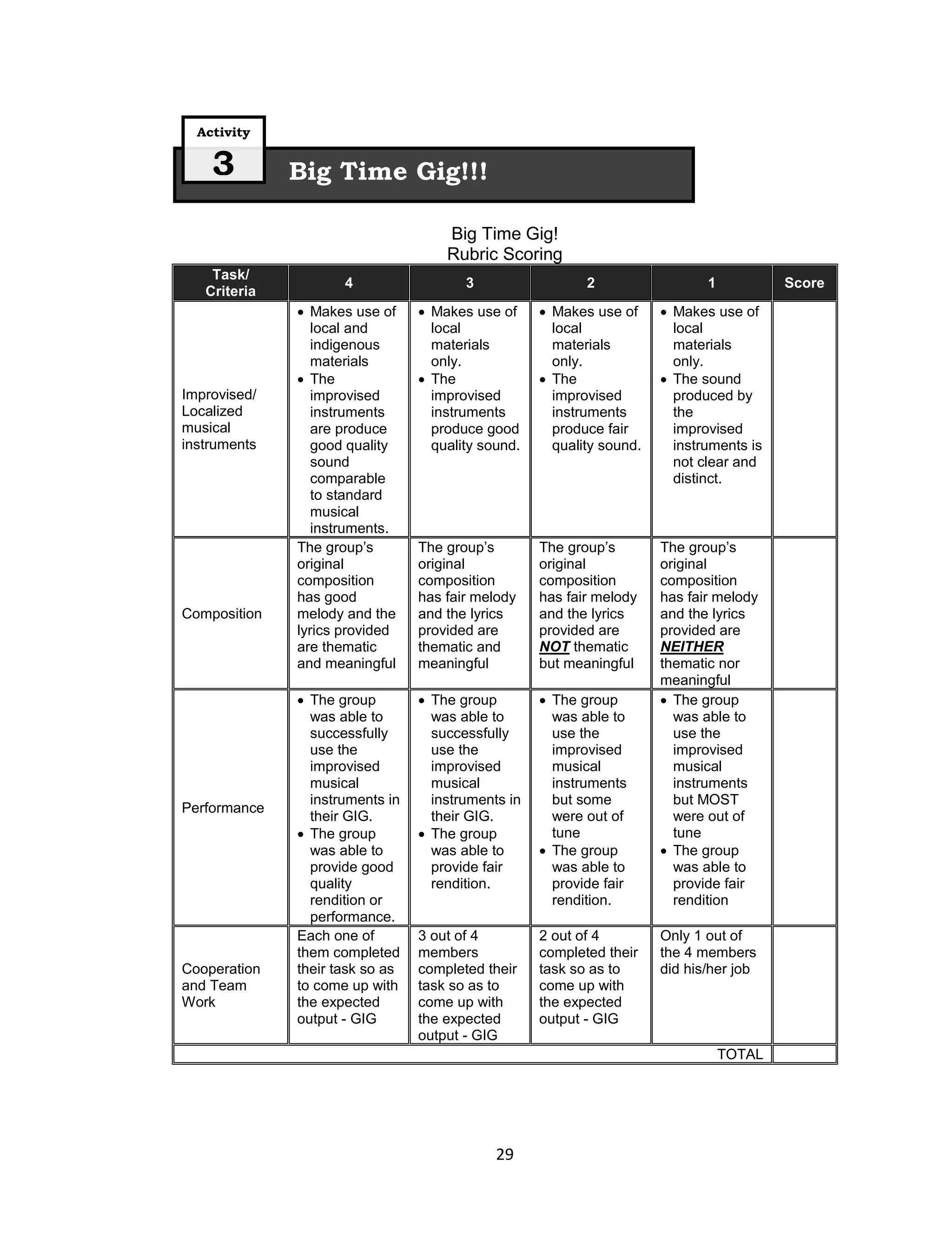
                                     Big Time Gig!
                                     Rubric Scoring
    Task/
                     4                  3                  2                  1           Score
   Criteria
               Makes use of      Makes use of      Makes use of      Makes use of
                 local and         local              local              local
                 indigenous        materials          materials          materials
                 materials         only.              only.              only.
               The               The               The               The sound
Improvised/      improvised        improvised         improvised         produced by
Localized        instruments       instruments        instruments        the
musical          are produce       produce good       produce fair       improvised
instruments      good quality      quality sound.     quality sound.     instruments is
                 sound                                                   not clear and
                 comparable                                              distinct.
                 to standard
                 musical
                 instruments.
              The group’s        The group’s        The group’s        The group’s
              original           original           original           original
              composition        composition        composition        composition
              has good           has fair melody    has fair melody    has fair melody
Composition   melody and the     and the lyrics     and the lyrics     and the lyrics
              lyrics provided    provided are       provided are       provided are
              are thematic       thematic and       NOT thematic       NEITHER
              and meaningful     meaningful         but meaningful     thematic nor
                                                                       meaningful
               The group         The group         The group         The group
                was able to        was able to        was able to        was able to
                successfully       successfully       use the            use the
                use the            use the            improvised         improvised
                improvised         improvised         musical            musical
                musical            musical            instruments        instruments
                instruments in     instruments in     but some           but MOST
Performance
                their GIG.         their GIG.         were out of        were out of
               The group         The group          tune               tune
                was able to        was able to       The group         The group
                provide good       provide fair       was able to        was able to
                quality            rendition.         provide fair       provide fair
                rendition or                          rendition.         rendition
                performance.
              Each one of        3 out of 4         2 out of 4         Only 1 out of
              them completed     members            completed their    the 4 members
Cooperation   their task so as   completed their    task so as to      did his/her job
and Team      to come up with    task so as to      come up with
Work          the expected       come up with       the expected
              output - GIG       the expected       output - GIG
                                 output - GIG
                                                                                  TOTAL


                                             29
TEACHING GUIDE


        Unit 3
       MODULE


        4                 LIGHT

        In this module the student will be able to explore the concept of light.
Specifically, students will be acquainted with (1) light production and propagation,
and (2) characteristics of light – intensity, brightness and color.

        The developmental task for the students include being able to (1)
Demonstrate how light produced by common sources differ in brightness; (2) Relate
characteristics of light such as color and intensity to frequency and wavelength; (3)
Design and implement an experiment that shows that light travels in a straight line;
and (4) Investigate the relationship between light intensity and the distance from a
light source through fair testing.

Probable Misconceptions

       Brightness is measurable.
       Brightness of light is only dependent on the distance from the light source.
       Parts of the electromagnetic spectrum have different speed as that of the
        visible light because these have different wavelength and frequency.
       Light bends even when travelling in a uniform medium.

Teaching and Learning Strategies

Motivation
   The facilitator may start with elicitation of the unique and indigenous light
      sources or lighting material in the locality aside from bubs and fluorescent
      lamps. Ask them to differentiate the different light sources from their place to
      arrive at the concept that there is variety of light sources.

Facilitating Learning
    Introduce Activity No. 1 to arrive at the objectives: (1) design a simple
       photometer (2) determine which chemical substances produce the brightest
       light; and (3) infer that brightness of light is dependent on the distance of the
       source.
    Since activity 1 features not only concept attainment but also provides
       opportunities for learners who are artistically inclined to express their talents
       as well then this may be able to keep all students on task.


                                          30
   Data processing may be done by group presentation and class discussion of
      the guide questions to probe the concept of common light sources and how
      light is produced and propagated.
     Discussion should also be extended to cover differences and similarities of
      brightness and intensity.
     Introduce light as a wave, specifically as a major component of the
      Electromagnetic Theory of Light by James Clark Maxwell.
     Then introduce Activity No. 2: My Spectrum Wheel. In this activity the
      students will (1) design a spectrum wheel and (2) explore the characteristics
      of light such energy, frequency and wavelength.
     Data processing may be done by group presentation and class discussion of
      the data and results in tabular form and guide questions to the characteristics
      of electromagnetic spectrum.
     Extend the discussion to include dispersion as a special kind of refraction.
     Then introduce Activity No. 3: Colors of Light - Colors of Life!. In this activity
      the students should be able to (1) make a color spectrum wheel; (2) explore
      the characteristics of color lights; and (3) observe how primary colors
      combine to form other colors.
     Data processing may be done by group presentation and class discussion of
      the data and results in tabular form and guide questions to the characteristics
      of color spectrum.
     Extend the discussion to include dispersion as a special kind of refraction.
     As a performance task, introduce Activity No. 4: Lighting Up Straight!. In this
      activity the students will be able to: design an experiment given several
      materials to show that light travels in a straight line.
     In the quest to come up with a design, students will be able to discover and
      apply the different characteristics and properties of light.
     Summary of the whole module may be probed by asking for insights and
      experiences they had during the preparation, presentation and post-
      presentation discussion of their outputs.

Description of Activities

     Activity 1: Light Sources: Langis Kandila or Diwali Lights
      (Students will explore the concept of common light sources and how light is
      produced by chemical substances)
     Activity 2: My Spectrum Wheel
      (Students will design a spectrum wheel to explore the characteristics of
      electromagnetic spectrum such as intensity and relate these to frequency and
      wavelength)
     Activity 3: Colors of light – color of life!
      (Students will design a spectrum wheel to explore the characteristics of light
      such as color and intensity and relate these to frequency and wavelength)
     Activity 4: Lighting Up Straight!
      (Students will design n experiment given several materials to show that light
      travels in a straight line)


                                         31
Answers to Questions:

  Activity

      1       Light Sources:
              Langis Kandila or Diwali Lights

Q1.    Sample Computation: If both side of the wedge showed equal illumination
       when it is about 200 cm from 1, and 50 cm from 2, the distances are as 4 to
       1. But as light falls off according to the square of the distance: (200) 2= 40000
       and (50)2 = 2500 or 16 to 1.). Thus the candle-power of the lamp is 16.
Q2.    DL-LK1 (Canola Oil)
Q3.    The farther the light source, the dimmer is the light and the lower the intensity


  Activity


      2       My Spectrum Wheel

Q1.    While the frequency increases, the wavelength decreases.
Q2.    The product of frequency and wavelength for all spectrum regions is
       constant. This is equal to the speed of light in vacuum.
Q3.    As the frequency is increased, the energy is also increased.


  Activity


      3       Colors of Light – Colors of Life!

Q1.    Violet – highest frequency, Violet – shortest wavelength
Q2.    Red – lowest frequency, Red –longest wavelength
Q3.    The wavelength decreases as the frequency is increased.
Q4.    The product of frequency and wavelength in all color lights is constant and
       equal to the speed of light in vacuum.
Q5.    The speed of all color light in air is constant and is equal to the speed of
       visible light.
Q6.    White light separates in color light due to the process known as dispersion.
       As white light enters the air glass interface, different color light exhibit
       different refractive indices thus separates into the visible color lights.


                                          32
Activity

    4         Lighting Up Straight!

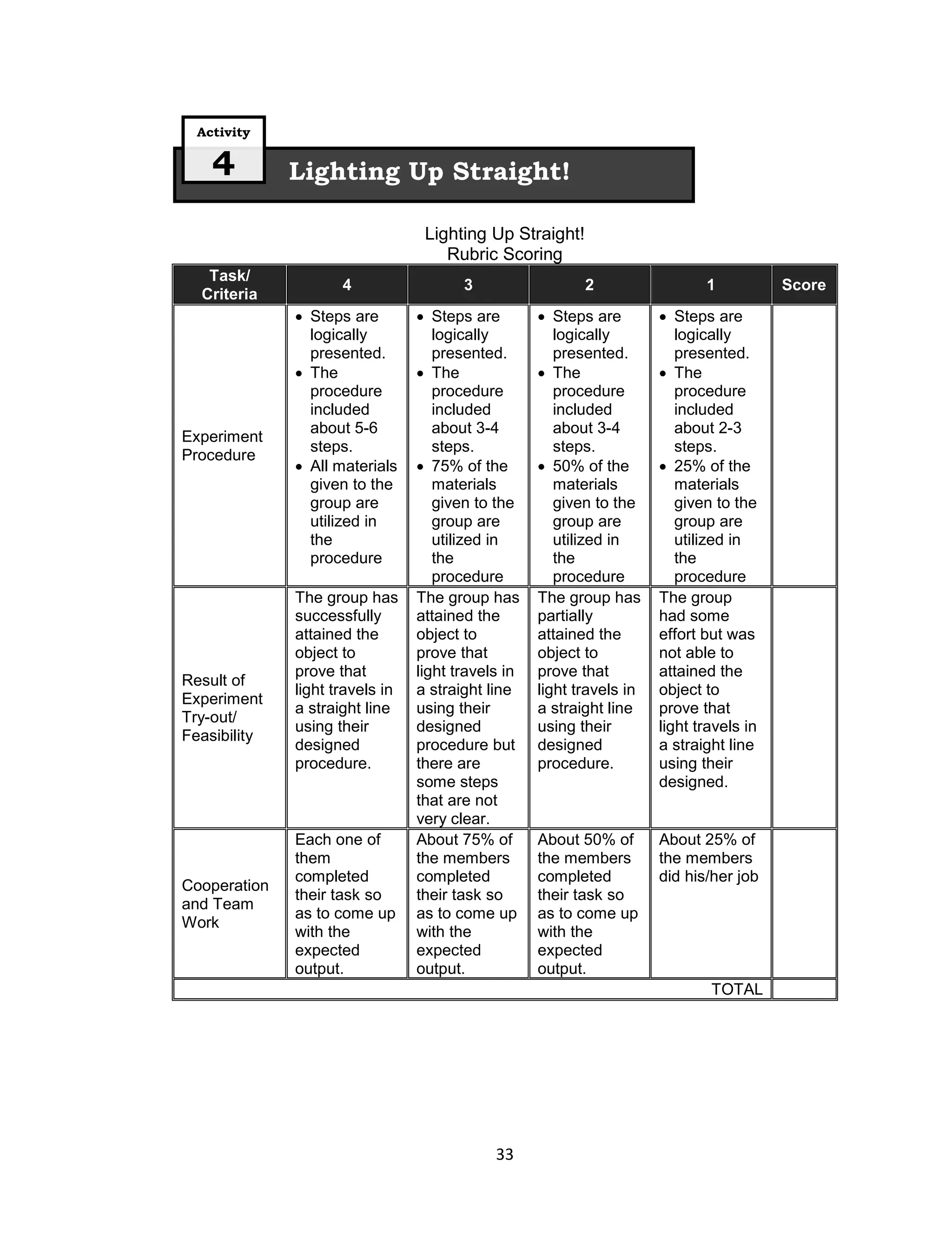
                                  Lighting Up Straight!
                                     Rubric Scoring
   Task/
                     4                  3                  2                  1           Score
  Criteria
               Steps are         Steps are         Steps are         Steps are
                logically           logically          logically          logically
                presented.          presented.         presented.         presented.
               The               The               The               The
                procedure           procedure          procedure          procedure
                included            included           included           included
                about 5-6           about 3-4          about 3-4          about 2-3
Experiment
                steps.              steps.             steps.             steps.
Procedure
               All materials     75% of the        50% of the        25% of the
                given to the        materials          materials          materials
                group are           given to the       given to the       given to the
                utilized in         group are          group are          group are
                the                 utilized in        utilized in        utilized in
                procedure           the                the                the
                                    procedure          procedure          procedure
              The group has      The group has      The group has      The group
              successfully       attained the       partially          had some
              attained the       object to          attained the       effort but was
              object to          prove that         object to          not able to
              prove that         light travels in   prove that         attained the
Result of
              light travels in   a straight line    light travels in   object to
Experiment
              a straight line    using their        a straight line    prove that
Try-out/
              using their        designed           using their        light travels in
Feasibility
              designed           procedure but      designed           a straight line
              procedure.         there are          procedure.         using their
                                 some steps                            designed.
                                 that are not
                                 very clear.
              Each one of        About 75% of       About 50% of       About 25% of
              them               the members        the members        the members
              completed          completed          completed          did his/her job
Cooperation
              their task so      their task so      their task so
and Team
              as to come up      as to come up      as to come up
Work
              with the           with the           with the
              expected           expected           expected
              output.            output.            output.
                                                                               TOTAL


                                             33
TEACHING GUIDE


      Unit 3
     MODULE


        5                 HEAT

         In the previous modules, students learned about sound and light as forms of
energy that travel in waves. This time, they will study about heat which is another
form of energy that travels through moving particles or through radiation. In the first
activity, they will determine the condition needed for heat to transfer from one place
to another and the direction by which it transfers. Then they will observe and
compare the different modes of heat transfer and identify some factors that affect the
transfer of heat. They will specifically investigate how the color of the surface of the
material affects it ability to absorb or emit heat. Lastly, they will apply what they
learned in the module to describe how each part of the thermos bottle helps in
keeping its content hot or cold for a longer period of time.

       The lessons covered in Module 5 are relevant to life because they help
explain some of our everyday experiences with heat. Also, some of the lessons
covered in this module will be picked up in the next quarter when students learn
about “weather and climate”.


Key questions for this module

                 How is heat transferred between objects or places?
                 Do all objects equally conduct, absorb, or emit heat?


Heat and Thermal Energy

   At the start, students may be asked to give their own ideas about heat, based on
    what they learned in the lower grades or based on their everyday experiences
    with heat. Be aware of their misconceptions and take note of those which can be
    addressed by the module, like cold is associated with lack of heat or heat is a
    substance that is in the object that makes the object warm. Make sure to go back
    to them during the processing, wherever applicable.
   The difference between heat and thermal energy should be made clear to the
    students.


                                          34
Heat is a form of energy that refers to the thermal energy that is in the
       process of being transferred, say between objects due to the difference in their
       temperature. In other words, heat is energy “in transit”. It transfers from an
       object of higher temperature to an object of lower temperature.


    Activity


      1         Warm me up, cool me down

     In this activity, students will analyze changes in the temperature of the water
      inside the containers to answer the following questions:
          a) What is the condition needed for heat transfer to occur between the
              containers?
          b) In which direction does heat transfer between them?
          c) Until when will heat transfer continue to occur?
     Since students will gather data using the thermometers, make sure that they
      know how to use the device properly and measure temperature accurately. If
      needed, give them a detailed review of how to use the thermometer and take
      data from it. Aside from the tips on how to measure temperature accurately, the
      following points may also be emphasized:
          a) Handle the thermometer with care to prevent breaking.
          b) Do not hold the thermometer by its bulb (the lower end of the tube)
          c) Do not ‘shake down’ the thermometer to reset it.
          d) Do not use the thermometer to stir the water inside the containers.
          e) Do not allow the thermometer to touch the bottom of the container.
     Each group should be provided with 4 thermometers – one for each container. If
      ever they have only one or two thermometers, they should be advised to
      consider one setup at a time.
     In the absence of a laboratory thermometer, students may use their ‘sense of
      touch’ to determine the relative hotness or coldness of the water inside the
      containers. Just make sure that if they do, they dip their fingers with care and
      use a different finger for each container. Students may be allowed to perform the
      activity provided in the module to show them how sense of touch may give
      different result in their activity.

Sample data:

Table 1

                                            Temperature (°C) of Water After
           Container             0 min       2       4        6         8        10
                                (initial)   mins    mins     mins      mins     mins
                1-Tap water
    Setup 1
                A-Tap water

                                            35
Temperature (°C) of Water After
            Container             0 min       2       4         6        8         10
                                 (initial)   mins    mins      mins     mins      mins
                  2-Tap water
    Setup 2
                  B-Hot water


* This slight increase in temperature could be due to the warmer surrounding

Answers to the questions:

     Q1.      Setup 2. Setup 1
     Q2.      Setup 2.
     Q3.      For heat transfer to take place, the objects must be of different
              temperature.
     Q4.      Container B. Its temperature decreases after 2 minutes.
     Q5.      Container 2. Its temperature increases after 2 minutes.
     Q6.      - Heat is transferred from Container B to container 2.
              - Heat is transferred from object of higher temperature to an object of
                  lower temperature.
              - Heat is transferred from a warmer object to a cooler object.
     Q7.      In container 2, the temperature of water continuously increases while the
              temperature of water in container B continuously decreases. Heat transfer
              is continuously taking place between the containers.
     Q8.      Heat transfer will continue to take place until both objects reach the same
              temperature (just like in Setup1)
     Q9.      The blue line shows that the temperature decreases as time increases.
              This represents Container B (with higher initial temperature).
     Q10.     The red line shows that the temperature increases as time increases.
              This represents Container 2 (with lower initial temperature)
     Q11.     The broken line shows that container 2 and container B have already the
              same temperature and their temperature is still decreasing as time
              continues. This time, heat transfer is taking place between the container
              and the surrounding.

    At this point, it is important to emphasize that heat transfer will continue to occur
     as long as there is a temperature difference.

Methods of Heat Transfer
Heat transfer by Conduction

       Conduction takes place when the particles between objects or places that are
in contact vibrate and collide at different speeds due to the difference in their
temperature. The particles at a higher temperature are more energetic and thus
vibrate faster than the particles at the lower temperature. When these particles
collide, some of the energy from the more energetic particles is transferred to the
less energetic particles, in the form of heat.

                                             36
Heat transfer occurs not only in solids but also in fluids, but not all conduct
heat equally. Some materials conduct heat easily; other materials conduct heat
poorly. Objects that conduct heat poorly, like wood are particularly called insulators.
There is no particular name for those materials which conduct heat easily.

       One basis for determining the use of materials is by their ability to conduct
heat, known as their conductivity. Higher conductivity means that the material is a
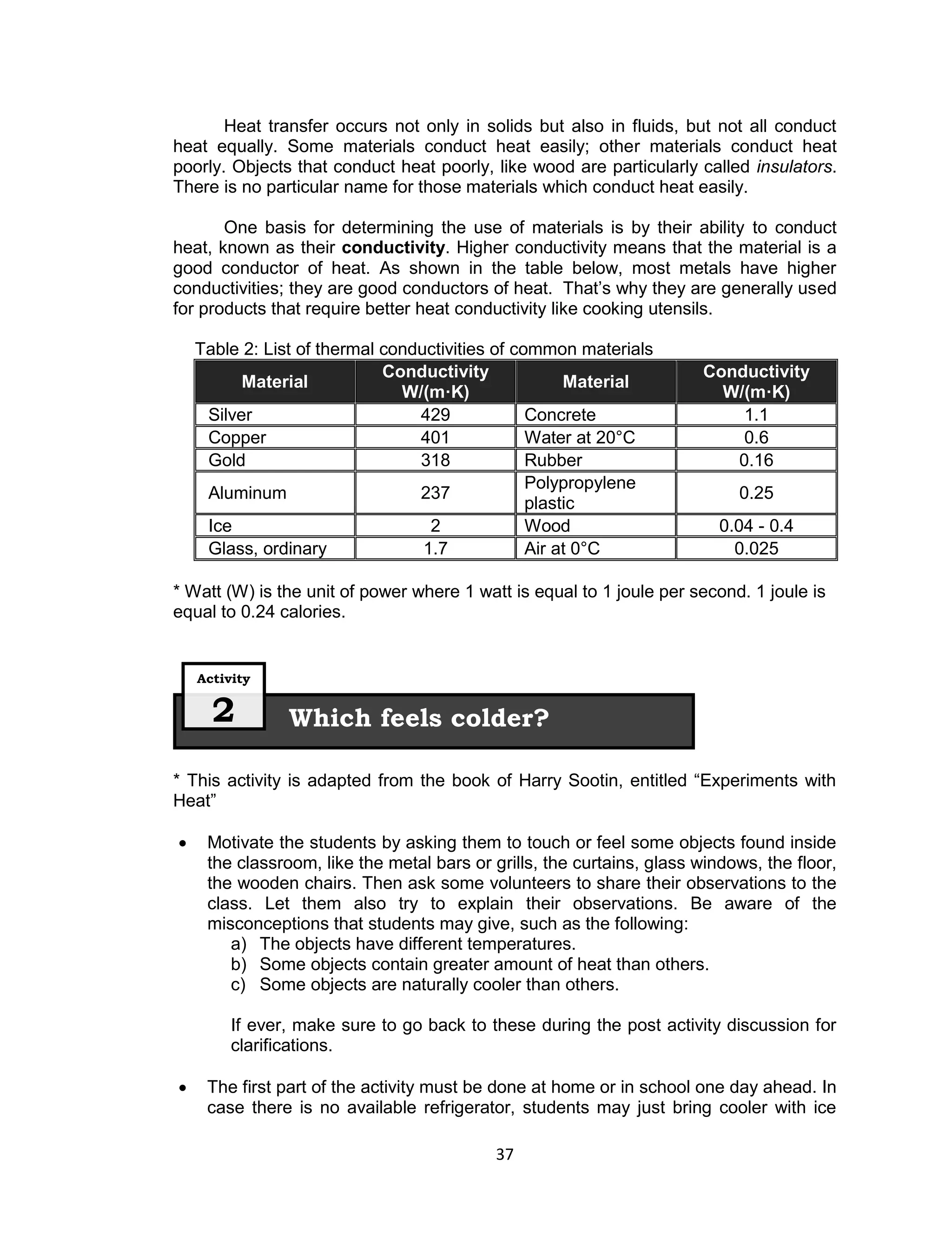
good conductor of heat. As shown in the table below, most metals have higher
conductivities; they are good conductors of heat. That’s why they are generally used
for products that require better heat conductivity like cooking utensils.

    Table 2: List of thermal conductivities of common materials
                             Conductivity                              Conductivity
          Material                                    Material
                               W/(m·K)                                   W/(m·K)
     Silver                      429             Concrete                  1.1
     Copper                      401             Water at 20°C             0.6
     Gold                        318             Rubber                   0.16
                                                 Polypropylene
     Aluminum                    237                                        0.25
                                                 plastic
     Ice                           2             Wood                     0.04 - 0.4
     Glass, ordinary              1.7            Air at 0°C                 0.025

* Watt (W) is the unit of power where 1 watt is equal to 1 joule per second. 1 joule is
equal to 0.24 calories.


    Activity


      2         Which feels colder?

* This activity is adapted from the book of Harry Sootin, entitled “Experiments with
Heat”

    Motivate the students by asking them to touch or feel some objects found inside
     the classroom, like the metal bars or grills, the curtains, glass windows, the floor,
     the wooden chairs. Then ask some volunteers to share their observations to the
     class. Let them also try to explain their observations. Be aware of the
     misconceptions that students may give, such as the following:
        a) The objects have different temperatures.
        b) Some objects contain greater amount of heat than others.
        c) Some objects are naturally cooler than others.

         If ever, make sure to go back to these during the post activity discussion for
         clarifications.

    The first part of the activity must be done at home or in school one day ahead. In
     case there is no available refrigerator, students may just bring cooler with ice

                                           37
cubes inside the classroom where they can place their thermometer and
    samples before the day ends.
   For the second part of the activity, make sure that the students read the
    temperature from the thermometer or touch their sample objects while these are
    still inside the freezer (cooler). Bringing them out may affect the result of their
    experiment, especially if the materials are already out for long. Also, make sure
    that the students feel each sample with a different finger. Lastly, make sure that
    each student will touch all the samples to determine their relative coldness. (Do
    not compare the coldness of an object with another object that is examined by
    another student) They can just compare their conclusions and answers to the
    questions with the other members of the group once they are done examining all
    their samples.
   During the discussion, emphasize that different objects or materials conduct
    heat differently. And this explains why even if they are of the same temperature,
    they do not feel (cold) equally. Materials with higher conductivities feel cooler
    than those with lower conductivities because they allow more energy to be
    transferred from the (warmer) finger than those with lower conductivities.

Answers to the questions:

    Q1. Answer will depend on their reading from the thermometer.
    Q2. The temperature of the objects inside the freezer must all be the same
        because they are just exposed to the same condition. Their temperature
        must also be equal to the temperature that was read from the thermometer.
    Q3. Yes. When my finger got in contact with the object, heat was trasferred
        from my finger to it.
    Q4. Yes. Because my finger loses some amount of thermal energy (heat), so
        that makes me feel the object cold.
    Q5. No, the objects did not feel equally cold. This means that the objects
        conduct heat differently. Some objects conduct heat more easily than the
        others.
    Q6. Answers depend on the objects or materials used.
    Q7. Answers depend on the objects or materials used. The coolest should be
        the best conductor.

Heat Transfer by Convection

         Heat transfer by conduction can take place in solids and in fluids.
Convection, on the other hand, takes place only in fluids because it involves the
movement of particles themselves from one place to another.
         In the module, heat from the bottom part of the water is transferred to the
upper part through convection. As the water gets warmer, it expands and become
lighter and so it rises at the top of the cooler water. This will then be replaced by the
cooler water that goes down from above, which will in turn become warmer and also
will rise to the top.


                                           38
Activity

        3         Move me up

    Refer the students back to the conductivity table. Then ask them this question: Is
     water a good conductor of heat? When they say no, ask them again: Then why
     is it that when we heat the bottom of the pan containing water, the entire water
     evenly gets hot so quickly? Allow students to give their answers/opinions. Be
     aware of their misconceptions and make sure to go back to these during the
     post activity discussion. These may include be the following:
     a) The particles of the water travel faster than the particles of the solids.
     b) Heat is distributed so fast throughout the water (without mentioning how).
    Prepare the hot water prior to the activity. If available, better use an electric
     thermal pot for convenience. Remind the students to take extra care when
     pouring hot water into their containers.
    In the absence of liquid food coloring, students can use the ‘water color’ that
     they use for their arts activities. Make sure that the colored water is much cooler
     than the tap water.
    Remind the students not to bump the table nor shake the containers while doing
     the activity.
    The third and fourth steps are very crucial. Make sure that students follow them
     accordingly and very carefully.
    During the discussion, emphasize that following

    -     This module considers convection in water only. Convection does not only
          take place in liquids. It also takes place in gases, like air. This will be
          discussed when they study about weather and climate in Earth Science.

Sample answers to the questions:

    Q1.        Most of the colored liquid stayed at the bottom (a small amount mixed
               immediately with the water).
    Q2.        When the container was placed on top of the other container with hot
               water, the liquid (water and food coloring) at the bottom rises slowly to the
               top.
    Q3.        Yes. Heat is transferred by the heated liquid that moved from the bottom
               to the top.


                                              39
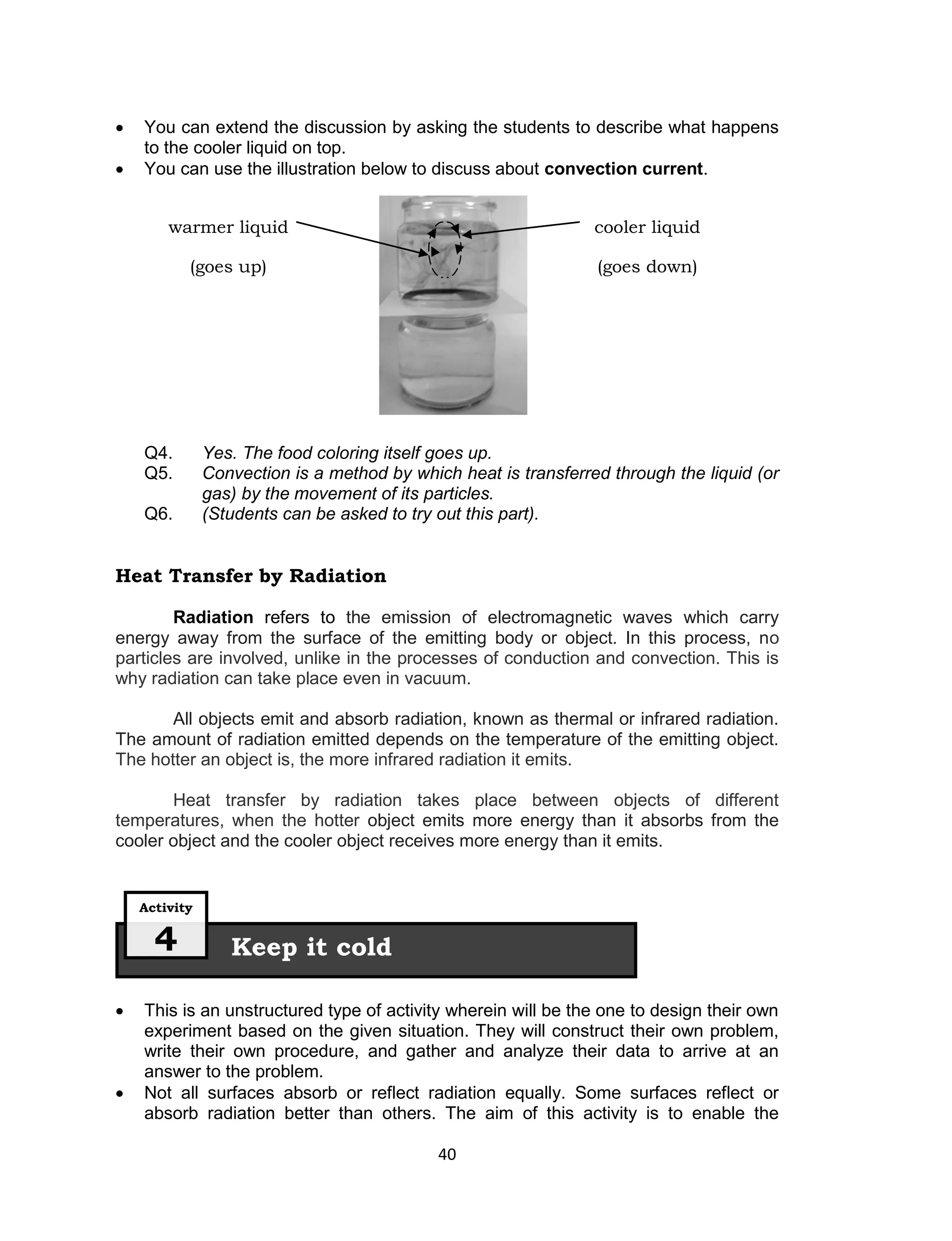
   You can extend the discussion by asking the students to describe what happens
    to the cooler liquid on top.
   You can use the illustration below to discuss about convection current.


        warmer liquid                                            cooler liquid

           (goes up)                                             (goes down)


    Q4.        Yes. The food coloring itself goes up.
    Q5.        Convection is a method by which heat is transferred through the liquid (or
               gas) by the movement of its particles.
    Q6.        (Students can be asked to try out this part).


Heat Transfer by Radiation

        Radiation refers to the emission of electromagnetic waves which carry
energy away from the surface of the emitting body or object. In this process, no
particles are involved, unlike in the processes of conduction and convection. This is
why radiation can take place even in vacuum.

       All objects emit and absorb radiation, known as thermal or infrared radiation.
The amount of radiation emitted depends on the temperature of the emitting object.
The hotter an object is, the more infrared radiation it emits.

       Heat transfer by radiation takes place between objects of different
temperatures, when the hotter object emits more energy than it absorbs from the
cooler object and the cooler object receives more energy than it emits.


    Activity


      4           Keep it cold

   This is an unstructured type of activity wherein will be the one to design their own
    experiment based on the given situation. They will construct their own problem,
    write their own procedure, and gather and analyze their data to arrive at an
    answer to the problem.
   Not all surfaces absorb or reflect radiation equally. Some surfaces reflect or
    absorb radiation better than others. The aim of this activity is to enable the

                                             40
students to compare the abilities of the two different surfaces to absorb or reflect
    radiation from the Sun or from a lighted electric bulb.
   To motivate the students, ask them of their favourite cold drinks. Then ask them
    how they usually make their drinks inside the container stay cold longer.

Prediction
    At this point, there is no need yet to check whether their predictions are right or
    wrong. They should find out themselves later when they do their investigation.


Sample Design

   Testable Question: Which container will keep the temperature of the cold milk tea
    longer?

   Independent variable: The surface of the container (dull and black surface or
    bright and shiny surface).

   Controlled Variables: The amount of the liquid, the amount of light entering the
    container (degree of exposure)

   Dependent variables: The temperature of the liquid inside the container at equal
    intervals of time


Sample Answers to the Questions

    Q1.   Dull black container
    Q2.   Dull black container
    Q3.   Bright shiny container
    Q4.   No.


                                          41
Activity

      5         All at once

       These last two tasks are applications of what the students learned so far from
this module.

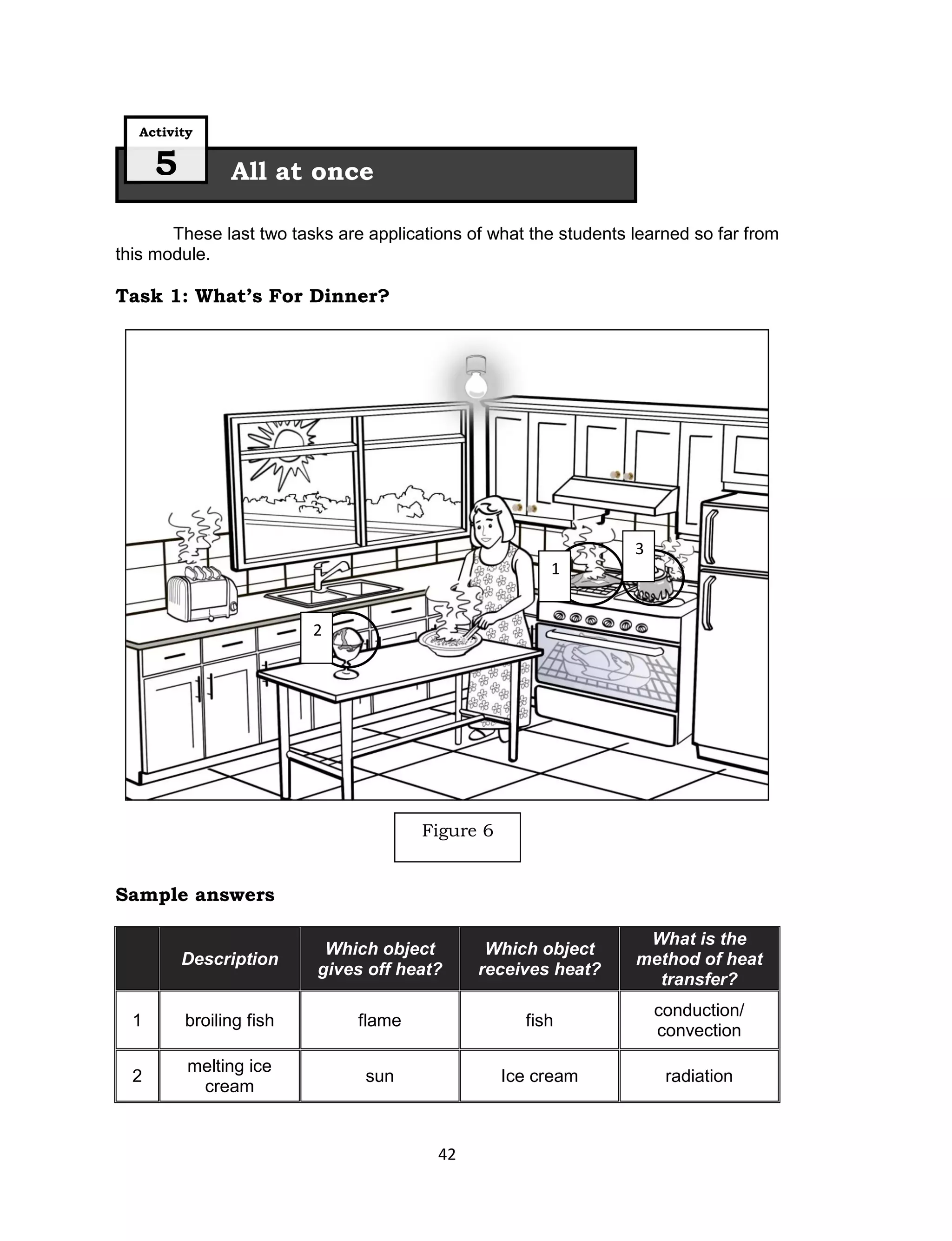
Task 1: What’s For Dinner?


                                                                  3
                                                       1


                          2


                                       Figure 6


Sample answers

                                                                   What is the
                           Which object        Which object
          Description                                             method of heat
                          gives off heat?     receives heat?
                                                                    transfer?
                                                                      conduction/
  1       broiling fish        flame                fish
                                                                      convection

          melting ice
  2                             sun               Ice cream            radiation
           cream


                                         42
What is the
                           Which object          Which object
        Description                                                     method of heat
                          gives off heat?       receives heat?
                                                                          transfer?
       steam coming
      out of the kettle
  3                        boiling water           Air above              convection
        (with boiling
           water)


Task 2
(Adapted from:
http://1e1science.files.wordpress.com/2009/08/13.pdf)

        Below is a diagram showing the basic parts of the thermos bottle. Examine
the parts and the different materials used. Explain how these help to keep the liquid
inside either hot or cold for a longer period of time. Explain also how the methods of
heat transfer are affected by each material.


                                   Stopper made of plastic or cork
                                   (good insulator of heat/prevents
                                   heat lost by conduction)


                                    Silvered inner and outer glass wall (retains
                                    heat inside the bottle/reflects heat that
                                    escapes/prevents heat lost by radiation)

                                    Vacuum between inner and outer wall
                Hot                 (prevents heat to transfer to the other
              liquid                wall/prevents heat lost by conduction and
                                    convection)

                                    Outer casing made of plastic or
                                    metal (retains heat inside)


                                    Ceramic base (conducts heat poorly/

                                    prevents heat lost by conduction)


                Figure 7: Parts of a thermos bottle


                                           43
Summary

Below is a list of concepts or ideas developed in this module.
 Heat is a thermal energy that is in transit.
 Heat transfer takes place between objects of different temperature.
 When the object becomes warmer, it means that it gained energy. When it
   becomes cooler, it means that it lost energy.
 Heat energy always transfers from object of higher temperature to object of lower
   temperature.
 Heat can be transferred in three ways: conduction, convection, and radiation.
 Conduction takes place due to the vibrating and colliding particles of objects that
   are in contact. It can take place in solids, liquids, and gases but it takes place
   best in solids.
 Conductivity refers to the ability of the material to conduct heat. The higher the
   conductivity of the object, the better it conducts heat.
 Metals are mostly good conductors of heat.
 Convection takes place in fluids because their particles can move around. In
   convection, the heat is transferred by the particles themselves.
 During convection, warmer liquid or gas expands and goes up while cooler liquid
   or gas moves down.
 Heat transfer by radiation does not need particles or a medium to take place.
 Different surfaces emit or absorb heat differently. Dull and black surfaces absorb
   heat better than bright and shiny surfaces.


PRE/POST TEST
The illustration on the right shows a lady making a
noodle soup using a pan made of metal. Use this
illustration to answer the questions below:
1. How does heat travel through the pan?
     A. by radiation            C. by dispersion
     B. by convection           D. by conduction

2. How does heat travel through the soup?
   A. by radiation          C. by dispersion
   B. by convection         D. by conduction

3. In what direction does heat travel through the
   soup?
   A. from top to bottom    C. both A and B
   B. from bottom to top    D. neither A nor B

4. Which of the following explains why the lady is able to hold the handle of the pan
   with her bare hands?

       I. The handle is made of good insulator of heat.
       II. The handle has low thermal conductivity.
       III. The handle has high thermal expansion.

                                          44
A. I and II only                 C. II and III only
   B. I and III only                D. I, II, and III

5. Which of the following methods of heat transfer is NOT taking place in the given
   situation?

   A. Conduction                    C. Radiation
   B. Convection                    D. None of them


   Answer Key
 1. D

 2. B

 3. B

 4. A

 5. D


Links and References

Classroom Clipart. "Marine Life." [Online image] 23 October 2003.
      http://classroomclipart.com/cgi-
      bin/kids/imageFolio.cgi?direct=Animals/Marine_Life
        http://coolcosmos.ipac.caltech.edu/cosmic_classroom/light_lessons/ther
        mal/transfer.html


                                        45
TEACHING GUIDE


      Unit 3
     MODULE


        6                ELECTRICITY

         In Module 5, students learned about heat as a form of energy that can be
transferred through conduction, convection and radiation. They identified the
conditions that are necessary for these processes to occur and performed activities
that allowed them to investigate the different modes of heat transfer.

        Here, students will learn about another form of energy which is encountered
in everyday life, electricity. This is a familiar form of energy since it is the energy
required to operate appliances, gadgets, and machines, to name a few. Aside from
these manmade devices, the ever-present nature of electricity is demonstrated by
lightning and the motion of living organisms which is made possible by electrical
signals sent between cells. However, in spite of the familiar existence of electricity,
many people do not know that it actually originates from the motion of charges.

        In this module, students will learn about the different types of charges and
perform activities that will demonstrate how objects can be charged in different ways.
They will also learn the importance of grounding and the use of lightning rods. At the
end of the module students will do an activity that will introduce them to simple
electric circuits.

Key questions for this module


                       What are the different types of charges?
                            How can objects be charged?
                          What is the purpose of grounding?
                              How do lighting rods work?
                    What constitutes a complete electrical circuit?


                                          46
Activity

      1        Charged interactions

   Tell the students to follow the procedure described below. Take note that
    discharging will occur once the sticky side of the tape comes into contact with
    other objects. This will make it difficult for the students to perform the succeeding
    parts of this activity.

Sample answers

    1. Is there any sign of interaction between the tape and the finger?
       The students will observe that the tape will be attracted to the finger.

    2. Is there any sign of interaction between the tape and this object?
       Once again, students will observe an attraction between the tape and the
       object.

    3. Do you observe any interaction?
       The charged tapes will tend to push each other away, i.e. they are repelling
       each other.

    4. Drag a moistened sponge across the nonsticky side of the tapes and repeat
       steps 5, 6 and 8. Do you still observe any interaction?
       Interactions observed earlier will be greatly reduced or will be non-existent.

Discussion for Activity 1

       Ask students to recall what they learned from previous modules about the
composition of matter. Emphasize that different materials have varying atomic
composition and lead them to the idea that this gives the materials different electrical
properties. One of which is the ability of a material to lose or gain electrons when
they come into contact with a different material through friction.

        Discuss how the tape acquired a net charge when the tape was pulled
vigorously from the table in activity 1. Explain that the electrons from the table’s
surface were transferred to the tape and lead them to the difference between the two
types of charges, positive and negative. Then proceed to the description of charging
by friction.

        Through the activity you can also introduce the law of conservation of charge
to the students by explaining that the negative charge acquired by the tape is equal
to the positive charge left on the table.


                                           47
The Law of Conservation of Charge
                Charges cannot be created nor destroyed, but can be
                      transferred from one material to another.
                 The total charge in a system must remain constant.


      Ask students to describe the interactions they observed in the activity. You
may then introduce the concept of electric force which acts on charges. Explain that
an uncharged or neutral object cannot experience this force.

         Let students differentiate between the interactions they observed in the
activity. This will lead them to identify the two kinds of electric forces, repulsive and
attractive. Then you may discuss the electrostatic law:

                                  Electrostatic Law
                     Like charges repel and unlike charges attract.


        Restate that electrical forces do not act on neutral objects. Then ask students
to explain how the neutral objects and the finger which did not acquire an extra
charge during the activity was able to interact with the charged tape. This will lead to
the concept of polarization which can be explained by the electrostatic law. When a
neutral object is placed near a charged object, the charges within the neutral object
are rearranged such that the charged object attracts the opposite charges within the
neutral object. The phenomenon is illustrated in Figure 3.


                       Figure 3. Polarization of a neutral object.

        Let students recall what happened to the interactions after dragging a
moistened sponge on the surface of the tape. They will have noticed that the
interactions were gone or were greatly reduced. Ask them for possible explanations
then lead them to the concept of discharging which is the process of removing
excess charges on an object. You may then discuss grounding which occurs when
discharging is done by means of providing a path between the charged object and a
ground. Define the term ground as any object that can serve as an “unlimited”
source of electrons so that it will be capable of removing or transferring electrons
from or to a charged object in order to neutralize that object.

                                           48
Conclude the discussion for the activity by asking students to explain how
grounding is important for electrical devices and equipment.


    Activity


      2        To charge or not to charge

   Tell the students to follow the procedure accordingly. Take note that charging the
    balloon by rubbing it against the hair will only work when the hair is completely
    dry. If the hair is slightly wet, the water will prevent the transfer of electrons
    between the balloon and the hair.

Sample answers

    Q1. The hair will give up electrons thus the balloon will acquire a negative
         charge.
    Q2. Polarization occurred in step 3. When the charged balloon was placed near
         the neutral soft drink can, the charges in the can were rearranged in such a
         way that the negative charges migrated towards the edge of the can that
         was farther from the balloon.
    Q3. By touching the can, a path was provided for the charges to be transferred.
         This is an example of grounding.
    Q4. Ideally, the soft drink can will be charged. The hand provided a path for
         negative charges to move away from the can thus when the hand was
         removed the can was left with a net charge.
    Q5. The soft drink can has acquired a net positive charge.

Discussion for Activity 2

       Discuss the difference between conductors and insulators and let students
enumerate different examples of each. Ask them to identify which materials in activity
2 are conductors and which are insulators.

       Let students describe how the can was charged and introduce the process of
charging by induction, where an object can be charged without actual contact to
any other charged object.

       In the next activity the students will investigate another method of charging
which depends on the conductivity of the materials.


                                         49
Activity

     3        Pass the charge

Sample answers

   Q1. Ideally, the can in the second set up will be charged since excess charges
        has been transferred to it from the can in the first set up.
   Q2. The contact between the cans is necessary since it is this contact that has
        provided a path for the charges to be transferred. This is possible because
        both cans are good electrical conductors.
   Q3. The can in the second set up has acquired a net positive charge.

Discussion for Activity 3

    The charging process performed by students in Activity 3 is called charging by
conduction which involves the contact of a charged object to a neutral object. By
this time, students have already learned the three types of charging processes. In
the next activity they will investigate how lightning occurs, a natural phenomenon
which is essentially a result of electrical charging.


   Activity

     4        When lighting strikes

        Ask students to use reference books or the internet to answer the following
questions. Remind students to check the reliability of internet sources before using
its content.
         What is a lightning?
         Where does a lightning originate?
         How ‘powerful’ is a lightning bolt?
         Can lightning’s energy be caught stored, and used?
         How many people are killed by lightning per year?
         What can you do to prevent yourself from being struck by lightning?
         Some people have been hit by lightning many times. Why have they
             survived?
         How many bushfires are started by lightning strikes?
         ‘Lightning never strikes twice in the same place.’ Is this a myth or a fact?
         What are lightning rods? How do they function?

Discussion for Activity 4

       After performing activity 5, students will be aware how much energy is
involved when lightnings strike. Lead them to the idea that no matter how much


                                         50
energy is available, if it cannot be controlled, it will be hard for us to use it. This will
naturally lead to this question: How do we control electricity? It starts by providing a
path through which charges can flow. This path is provided by an electric circuit.
Students will investigate the necessary conditions for an electric circuit to function in
the following activity.


    Activity

      5         Let there be light!

   Ask students to follow the following procedures. Remind them that handling
    electrical units should be done with extra care especially when it involves actual
    circuits.
    1. Work with a partner and discover the appropriate arrangements of wires, a
        battery and a bulb
that will
make the bulb light.
    2. Once you are successful
in the arrangement, draw a diagram representing
        your circuit.
    3. Compare your output with other pairs that are successful in their
        arrangement.

Sample answers

    Q1. Answers will vary depending on student output.
    Q2. Answers will vary depending on student output.
    Q3. For the bulb to light, the circuit should be closed and must include all the
        necessary parts (wire, battery, and bulb).

Discussion for Activity 5

        In activity 5, students have seen that with appropriate materials and
connections, they can make the bulb light up. Remind them that light is one form of
energy. Ask them to recall the law of conservation of energy then lead them to the
idea that energy transfer or transformation has occurred in the circuit from electrical
energy to light energy. Explain that all electrical equipment and devices are based on
this process of transformation, where electrical energy is converted other forms of
energy. Prove this point by giving these examples:

         1.    Flat iron – Electrical energy to thermal energy or heat
         2.    Electric fan – Electrical energy to mechanical energy
         3.    Washing machine – electrical energy to mechanical energy.

         You may then ask them to give their own examples.


                                            51
PRE/POST TEST

1.   What will happen when two like charges are brought together?

     A.     They will repel each other.
     B.     They will attract each other.
     C.     They will neutralize each other.
     D.     They will have no effect on each other.

2.   Which of the following describes the usual way by which a material can gain
     a positive charge?

     A.     By gaining protons
     B.     By gaining electrons
     C.     By losing protons
     D.     By losing electrons

3.   If you comb your hair and the comb becomes positively charged, what will
     happen to your hair?

     A.     It will remain uncharged.
     B.     It will be repelled by the comb.
     C.     It will become positively charged.
     D.     It will become negatively charged.

4.   Which of the following can be attracted by a positively charged object?

     A.     Another positively charged object.
     B.     Any other object.
     C.     A neutral object.
     D.     No other object.

5.   A negatively charged rod is brought near a metal can that rests on a wooden
     box. You touch the opposite side of the can momentarily with your finger. If
     you remove your finger before removing the rod, what will happen to the can?

     A.     It will be discharged.
     B.     Its charge will remain as it was.
     C.     It will become positively charged.
     D.     It will become negatively charged.

6.   Is it possible to charge an electrical insulator?

     A.     No, because they hinder charges from passing through them.
     B.     No, because insulators have no free charges in them.
     C.     Yes, because they can also conduct electricity.
     D.     Yes, because electrons can be transferred between insulators through
            friction.


                                         52
7.    A charged object is brought near a metal ball that is mounted on a rubber
      sheet. If the metal ball acquired a negative charge after it was grounded
      momentarily, what must be the charge of the object that was brought near it?

      A.     Neutral
      B.     Positive
      C.     Negative
      D.     Cannot be determined from the given information alone.

8.    What is really meant when we say an appliance "uses up" electricity?

      A.     The current disappears.
      B.     The main power supply voltage is lowered.
      C.     Electrons are taken out of the circuit and put some where else.
      D.     The potential energy of electrons is changed into another form.

9.    The figure shows three pairs of plates. The electrostatic force between the
      plates is shown for two of the pairs. If B is negative, what is the charge of A?
      and what kind of force exists in the third pair?


      A.     negative, attractive              C.   positive, attractive
      B.     negative, repulsive               D.   positive, repulsive

10.   In which set-up(s) will the bulb light up?

                                                              Answer Key
                                                             1.      A
                                                             2.      D
                                                             3.      D
                                                             4.      C
                                                             5.      C
                                                             6.      D
                                                             7.      B
                                                             8.      D
                                                             9.      C
                                                             10.     A


      A.     A only
      B.     B only
      C.     C only
      D.     A, B and C


                                          53
UNIT 4: Earth and Space
Overview

         What do we want the students to learn about “Earth and Space” in Grade 7?
We want students to know that whatever they observe in the environment, whether
these are things or processes, are related to the location of our country on the
planet. In other words, different countries have different environments because they
are located in different places. For example, some countries are located near the
equator while others are near the poles. Will these countries have the same climate?
Obviously not! Some countries are located near bodies of water while others are
surrounded by land. Which countries are more likely to experience typhoons? Some
countries are located near trenches while others are not. Which countries are more
likely to be hit by earthquakes? The location of a certain place will determine what
we see and what happens in the environment.

       There are three modules in this quarter: Module 1 is about the Philippine
Environment, Module 2 is about Solar Energy and the Atmosphere, and Module 3 is
on Seasons and Eclipses. The concepts and skills are presented in an integrated
manner not just within the science disciplines (e.g., Life Science, Chemistry, Physics,
and Earth/Environmental Sciences) but also whenever possible, across learning
areas such as Araling Panlipunan, Mathematics, Health, Technology and Livelihood
Education, and Edukasyon sa Pagpapakatao.

        An integrated approach to teaching and learning will help students recognize
the relevance of the science topics to real life. The environment is where we get the
things we need and use to survive and enjoy life. What happens around also affects
us, directly or indirectly, sometimes in disastrous proportions. Knowledge of what
these events are and how they occur will help us prepare and cope with their
negative effects or even prevent them from happening. Students will realize that
many environmental phenomena are interrelated and complex in nature, so
understanding that “everything is connected to everything else” will also help us get
ready for unexpected events.

        In each module, the first lesson starts with activities that will help students
recall prerequisite concepts and skills. The understanding of these concepts and
skills will be deepened through inquiry-based activities such as analyzing information
on the globe, in maps, tables, graphs, and/or illustrations and discovering on their
own, relationships and connections from the data gathered. The concepts learned in
these modules will prepare students to tackle more abstract science concepts about
Earth and space in higher grade levels.

         There is a pre/post test for each module using selected-response and
constructed-response questions. The result of the pre-test should guide you in
focusing the lesson so that concepts already understood may already be applied to
the current lesson without spending much time reviewing them. The questions in the
text and pre/post test may also be used as exemplars when formulating your own
test items.


                                          54
TEACHING GUIDE


      Unit 4
     MODULE


        1                THE PHILIPPINE
                         ENVIRONMENT

        This module has two parts. The first part deals with the location of the
Philippines on Earth. The second part deals with the varied resources found in the
Philippines.

Key question for this module

              Is there a connection between the location of our country
                and its natural resources (abundant water, fertile soil,
              diverse plants and animals, precious metal deposits, and
                          geothermal power, to name a few)?


        But before talking about our environment, the students must first learn how to
locate the Philippines on the globe. There are two ways by which we can describe
the location of a certain place. One is by determining its latitude and longitude. The
other is by identifying the landmasses and bodies of water in the surrounding area.
They will learn these in Activity 1. The activity has two parts. Part 1 will teach
students how to figure out the latitude and longitude of a certain place. Part 2 will
familiarize the students with the landmasses and bodies of water around the
Philippines.

Latitude and Longitude

        If one examines a map, one can see that there are lines that run from west to
east (left to right) and lines that go from north to south (top to bottom). These are
lines of latitude and longitude, respectively. They are there to help people describe
the location of any place on Earth. These lines are also found on a globe, which is a
better representation of the Earth.


                                         55
Activity

       1          Where in the world is the
                  Philippines? (Part 1)

         Activity 1 is easy to conduct. All you need are a number of globes and the
activity sheets. Divide the class into groups and distribute the globes. Read the first
step in “What to do” and let the students accomplish the task. (The class should
perform only one step or task at a time.) After a reasonable amount of time, call on
each group for their respective answers. After each group has given their answer,
confirm the correct answers while guiding those who were confused into getting the
right answers. Then proceed to the next number until everyone has understood
everything.

Teaching Tips

1.     It goes without saying that you should try out the activity before doing it    in
       class.

2.     When identifying the equator, do not let the students simply point to a segment
       of the equator. Ask them to trace the whole equator. Ask them to do the same
       when identifying the lines of latitude and lines of longitude.

3.     Similarly, when identifying the northern and southern hemispheres, do not let
       the students simply point to a vague spot. They should use their palm in a
       “wiping” motion to indicate the whole extent of each hemisphere. A hemisphere
       is half of the globe. Pointing to a spot is misleading.
4.     After the activity, the students should realize that the location of any place on
       Earth can be described using latitude and longitude. Conduct a sort of
       exercise/competition among the groups. Call out a pair of latitude and
       longitude, and the groups will look for the nearest city. After that exercise, do
       the opposite, calling out the name of a city and the groups will race to find the
       latitude and longitude of that city. Here are some examples that you can use.


          Exercise 1: Identify the city nearest to the following rounded latitudes and
          longitudes.

                Given: Latitude, Longitude              Answer: Nearest city
                       41°N, 74°W                              New York
                       56°N, 38°E                              Moscow
                       12°S, 77°W                                Lima


                                             56
Exercise 2: To the nearest whole degree, estimate the latitude and longitude
       of the following cities.

                                                   Answer: Estimated latitude,
                    Given: City
                                                           longitude
                       Tokyo                              36°N, 140°E
                     Melbourne                            39°S, 146°E
                     Singapore                            1°N, 104°E

5.   Now that the students are familiar with the lines of latitude, discuss the
     relationship between latitude and climate, using a globe and the table below.
     The closer a country is to latitude 0° (equator), the warmer is its climate. By
     studying the globe, the students can give examples of countries with warm
     climate. These are the countries within the tropical zone, bounded by the
     Tropic of Cancer and Tropic of Capricorn.

                    Latitude                                  Name
                       0°                                    Equator
                     23.5°N                              Tropic of Cancer
                     23.5°S                             Tropic of Capricorn
                     66.5°N                                Arctic Circle
                     66.5°S                               Antarctic Circle

     In contrast, the farther a country is from latitude 0°, the colder is its climate.
     These are the countries in the polar regions, within the Arctic Circle and
     Antarctic Circle. And in the zone between the Tropic of Cancer and the Arctic
     Circle, and between the Tropic of Capricorn and the Antarctic Circle, there are
     countries which enjoy a temperate climate, where the seasons change from
     very cold to very warm. Thus, it is clear that the climate changes with latitude.


Answers to questions in Activity 1, Part I

Q1. Lines of latitude:
    - are parallel to the equator and to each other
    - form circles that are smaller at the poles
    - do not meet
    (Students should give descriptions that are based on the drawing and not on a
    memorized definition.)
Q2. (Let the students trace the lines of latitude on the globe.)
Q3. (Let the students show the given latitudes on the globe.)
Q4. (The teacher should guide the students in estimating the latitude.)
Q5. Lines of longitude:
    - are not parallel to each other
    - do not form circles
    - meet at the poles (or extend from pole to pole)
    - have the same length


                                         57
(Students should give descriptions that are based on the drawing and not on a
    memorized definition.)
Q6. (Let the students trace the lines of longitude on the globe.)
Q7. (Let the students show the Prime Meridian on the globe.)
Q8. Starting at the Prime Meridian, moving 180 degrees to the east or to the west
    brings you to longitude 180°. Like the Prime Meridian, longitude 180°
    represents the boundary of the eastern hemisphere and western hemisphere.
    The Prime Meridian and longitude 180° are on opposite sides of the world.
Q9. (The teacher should guide the students in estimating the longitude.)
Q10. The latitude and longitude of Manila is 14°N, 121°E. This reading is
      approximate. It may be difficult to get exact readings from a globe, so
      estimates are acceptable.
Q11. Locating cities such as Manila is easy. Manila is just a “spot” on the globe.
      But locating a whole country like the Philippines may be challenging because
      the country is not a “spot,” it is an “area.” Since the boundary of the
      Philippines (or any country, for that matter) is irregular, we can simplify things
      by drawing a rectangle around the Philippines. So, how do you describe the
      location of the rectangle? One way is by getting the latitude and longitude of
      each corner of the rectangle. The Philippines is located within that rectangle.
      Can you think of another way?

Landmasses and Bodies of Water

        In the next activity, students will become familiar with the location of the
Philippines in terms of the surrounding bodies of water and landmasses. This is in
preparation for the discussion on natural resources later on in this module, and
common weather phenomena in the next module. For instance, the activity will show
that the bodies of water that surround the Philippines are the sources of seasonal
rain that fall on land. Water is a very important resource. It is not only used in
agriculture; it is also needed to generate electricity, sustain all sorts of organisms,
and form soil.


   Activity


     2         Where in the world is the
               Philippines? (Part 2)

       This activity is also easy to do. All you need are globes (to be distributed to
each group) or a large world map (posted on the blackboard) as reference.

Answers to questions in Activity 2, Part II

Q1. South China Sea (called “West Philippine Sea” by the Philippine Government)
    and Indian Ocean
Q2. Philippine Sea and Pacific Ocean
Q3. Asian continent


                                          58
Additional Information

        Activity 2 (Part II) also acquaints the students with some of the landmasses
near the Philippines. In the next module, the students will find out that the Asian
mainland influences the movement of wind over a wide area that includes the
Philippines. The occurrence of the monsoons, (hanging habagat and hanging
amihan) is the result of the interactions of these landmasses and bodies of water
with the atmosphere. And as the students work with the world map, they are
expected to encounter some of the countries near the Philippines which are similarly
located along the Ring of Fire. In later discussions in module 1, students will find out
that countries found near the Ring of Fire are likely to have metallic deposits and
geothermal power. Just make sure that students have a working knowledge about
our location on the globe so that discussions about the environment are better
understood.

Are We Lucky in the Philippines?

        The four activities in this section focus on why we have varied natural
resources in the Philippines, e.g., water, soil, metallic and non-metallic deposits, and
energy. The discussion on water and soil will integrate the concept of biodiversity
covered in Quarter 2.       The characteristics of metals and nonmetals learned in
Quarter 1 will help students appreciate the importance of mineral deposits. The
discussion on energy in Quarter 3 will help students understand weather and other
atmospheric phenomena in succeeding modules for this grade level. What will be
highlighted is the fact that the natural resources found in the Philippines are due to
its geographic and geologic locations.

         Start the lesson by asking students what they associate with the word
‘resources’. Some will give the meaning e.g., ‘resources are things that can be used
for support, help, or drawn on when needed”. Others will give examples of resources:
e.g., air, water, plants, animals, soil, rocks, minerals, crude oil, and other fossil fuels,
sunlight, wind, car, houses, clothes, jewelry, and money. They can define resources
as things used by people to survive or satisfy needs.

         Differentiate resources made by humans and those gathered from nature.
Introduce that the Philippines is considered ‘rich’ in natural resources. In Activity 1
Part II, students learned that the bodies of water that surround the Philippines are the
sources of seasonal rain that fall on land. Students may have negative ideas about
typhoons and heavy rainfall but they should realize that water is important for
sustaining life.

Water Resources and Biodiversity

        In elementary school science, students learned the sources of water in their
community, the importance of the water cycle, the ways to use water wisely, and the
effects of unwise use of water.

        In this section, the focus of the discussion will be on watersheds - the area
that feeds into surface and undergound waters. People know how important water is

                                            59
but they do not know where the supply in the community originates. When ask where
water in their community comes from, most answers would be - from the rain, river,
lake, deep well, or spring. But rain does not come everyday so water must be stored
in nature somewhere else.

       Before doing Activity 3, provide some introduction about watersheds: what
they are, where they are, and why they are important. Try asking from the local office
of the National Power Corporation (NAPOCOR) the book entitled “Watersheds
Sheltering Life”, 2010, published by the same agency, for pictures and discussion of
important watersheds in the country.


     Activity


       3        What are some factors that affect the
                amount of water in watersheds?


        This activity is an example of a semi-guided/semi-structured investigation
because the problem is given. It requires students to choose one variable in the list
of factors that affect the condition of a watershed. Then, they design a procedure to
determine the effect of that variable on the watershed.

        Specifically, students will compare the amount of water that seeps through
the soil 1) when there are plants and without plants, 2) during light and heavy rain, 3)
given different kinds of soil-clay, loam or sandy, and 4) given different
slopes/degrees of steepness of the hill or mountain.

Teaching tips

1.     Review the components of an investigation discussed in Quarter 1.

2.     Make sure that the design of the investigation includes a control setup and an
       experimental setup.

        For the effect of vegetation on watersheds, students should be able to
          prepare two setups – one with grass and the other without. The following
          variables should be kept the same in both setups: kind and amount of soil,
          size of container or plot, amount of rainfall, and height of delivering water.
          Make sure that their materials include a receiver for the water runoff.

        For the effect of the slope of the area: one setup should have a steep slope
          while the other should be gentle. The following variables should be kept the
          same: kind and amount of soil, size of container or plot, amount of rainfall,
          and height of delivering water. The setups may or may not have vegetation
          cover.

        For the effect of kind of soil and amount of rainfall, what variables should be
          kept the same? What shoudl be different?

                                           60
3.   Let students present the results of their investigations. Refer to the rubrics to
     help you critique student outputs.

4.   Summarize the discussion by using a drawing of a watershed and with arrows,
     trace the flow of rainwater as it falls on the ground. The following can be
     highlighted: Surface and underground waters are fed by healthy watersheds.
     Watersheds drain water to rivers, lakes, or dams that supply water for domestic
     and industrial uses. The presence of waterfalls or springs on the sides of
     mountains reveal that lots of water are collected in that watershed. Rain falling
     on mountain areas with vegetation seeps through the soil and collects there.
     Without vegetation cover, rainwater runs off to the lowland carrying topsoil.
     Also, abundant rainfall that occurs over days soak into soils along mountain
     slopes, causing landslides.

5.   Ask what situation will result in lack of water supply in communities and the
     possible effects on people, plants, animals, and the physical environment. In a
     later section of this module, you will discuss ways to conserve water.

6.     Finally, ask: Are watersheds just about water? What other things can be
     found in watersheds? Relate the presence of water to high biodiversity in the
     Philippines. Include a discussion of endemic species in your area and tell
     where they are found. Note that bodies of water also moderate air temperature
     because water absorbs heat; this topic however, requires some chemistry
     concepts so do not introduce it if it does not crop up.

7.   Use a concept map to point out the connections between and among concepts.
     Emphasize the appropriate connecting words or propositions. The arrow directs
     the reader to related concepts. Remember that it is NOT a concept map if there
     are no connecting phrases between concepts. Tell students that concept maps
     may vary depending on the connecting phrases between conceptual terms.

          A sample concept map may look like this:


                                         61
Soil Resources, Rainfall, and Temperature

        Soil is an important resource to any country. However, students will not be
able to observe soil formation because it takes many years for this to happen.

       This lesson enumerates what happens during weathering of rocks. It
discusses the major factors that cause rocks to change over time. Students will
understand the processes by illustrating them. This lesson links Science with English
and Art.


     Activity

       4           How is soil formed from rocks?

        This activity highlights the fact that climate (temperature and rainfall) is a
significant factor not only in soil formation but also in sustaining diversity of plants
and animals in the country.

Teaching Tips

1.     Try illustrating the processes yourself before the class discussion.

2.     Check students’ drawing by calling on some to present their outputs. Let other
       groups posts theirs on the wall. If there are illustrations that show
       misinterpretation of the processes detailed in the chart, explain these.

3.     The illustrations may look like this:


                Drawing A                            Drawing B


                                                    CO2          O2


                 Drawing C                           Drawing D


                                               62
Rocks and Mineral Resources

       Start the lesson by asking what they have observed with rocks and stones
from the beach, from construction sites, and other places. They can infer why some
are smooth, others are rough or with sharp edges; some have beautiful colors and
bands while other are plain. If you have some samples of these rocks, show these to
the students.

Teacher preparation

1.     Prepare big maps in advance for use in the processing of the activity (e.g.,
       Metallic Deposits Map, Map of Volcanoes and Trenches, Ring of Fire diagram
       from the student module, and the Nonmetallic Deposits Map from the TG).

2.     Locate the geologic structures and deposits in your community using the maps.

3.     Invite a local expert to talk about the topic to add value to the lesson.


     Activity


       5        Where are the mineral
                deposits in the Philippines?

       This activity presents the ‘plus’ side of volcanoes. It answers the question:
What mineral deposits do we have in the country? Where are they located and why
are they found only in those places? Using overlay or putting one drawing on plastic
sheet over another enables students to discover the association between the
presence of mineral resources (metallic ones) and geologic structures in the country
such as volcanoes and trenches. Then they can infer why their area has or does not
have mineral deposits.

Teaching Tips

1.     This lesson may take two to three days to finish unless some preparatory work
       like tracing of maps on plastic sheets are assigned to students in advance.

2.     Review students’ knowledge of metals and nonmetals. They had lessons on
       this in Module 1 (Diversity of Materials in the Environment). Practice with
       students naming metals and nonmetals and giving their symbols. Do a game
       using flashcards. For example: Some cards bear the names of metals and
       nonmetals and students give the symbols. Other cards have symbols and
       students give the names.

3.     After the review, let each student copy Table 1 in his or her notebook. (This
       could have been an assigment so as not to waste time.) Let them do the activiy
       as a group.

                                             63
4.    Let students do Activity 5. Help students to learn how to manage their time.
      Move around the groups and see that each one is doing something e.g., one
      member traces the mineral map while another does the map of volcanoes and
      trenches. Also observe how they do the overlaying of plastics with the traced
      maps. Remind them to fill in the columns in the table.

5.    Let the groups discuss the answers to the questions embedded in the activity
      before they finalize their report.

6.    After the activity, post a big map of the Philippines in front of the class. When
      students are presenting their findings, point out on the map the location t they
      are discussing.

7.    Let students make a generalization where metallic deposits are found. Then,
      elicit ideas on the uses of metals (e.g., in the softdrink industry, construction
      industry, at home, in school, in the farm, and other places).

8.    Ask: If metallic deposits are important to the economy of a country, why do you
      think is the Philippines not rich as a nation since we have lots of these?
      Expect varied answers but point out the absence of technology in the country
      to recover the metals from the ores. What we export are the ores, then buy the
      metals at a high price. Here is the connection to Araling Panlipunan.

9.    Summarize the core ideas in the activity e.g., The Philippines has metallic
      mineral deposits. They are found near volcanoes and trenches. These metals
      are used in many ways.

10.   Ask student to ponder this question: Why are minerals located where there
      are volcanoes or trenches? Let students make a guess why mineral deposits
      are found where there are volcanoes or trenches. Do not comment on their
      answers at this point.
11.   Introduce the topic by illustrating on the board the process describe in the
      module.

      There is a continuous source of heat deep under the Earth; this heat melts
      rocks and other materials. Water flowing between these rocks is also heated
      up. The mixture of molten or semi-molten materials, liquids and gases is called
      magma. Because magma is hotter and lighter than the surrounding rocks, it
      rises, melting some of the rocks it passes on the way. If the magma finds a
      way to the surface, it will erupt as lava. Lava flow is observed in erupting
      volcanoes.

      But the rising magma does not always reach the surface to erupt. Instead, it
      may slowly cool and harden beneath the volcano and form different kinds of
      crystalline rocks. Under favourable temperature and pressure conditions, the
      metal-containing rocks continuously melt and redeposit, eventually forming
      rich-mineral veins. Though originally scattered in very small amounts in
      magma, the metals are concentrated when magma moves and circulates ore-
      bearing liquids and gases.


                                          64
Metallic minerals deposits such as copper, gold, silver, lead, and zinc are
      associated with magmas found deep within the roots of extinct volcanoes.

12.   To reinforce their understanding, show the diagram of the Ring of Fire and ask:
      Where is this Ring located? (Around the Pacific Ocean). What countries are
      found in this Ring? (The Pacific Ring of Fire stretches for about 40 000
      kilometers and touches four of the world's continents as well as several major
      island chains. Starting from Antarctica, it is found on the Pacific Ocean - -
      facing coastlines of New Zealand, Indonesia, the Philippines, Japan, Korea,
      China, Russia, Alaska, Canada, the United States, Mexico, Central America
      and South America. The world's largest volcanic region can be found along the
      Pacific Ring of Fire. Have you heard about Mt. Saint Helens in Washington, Mt.
      Pinatubo in the Philippines, Mt. Fuji in Japan, and the Paricutin Volcano in
      Mexico?

      Point out the location of volcanoes (shown as triangles). Mention that there are
      about 450 volcanoes altogether, 75% of which are active. Why is this area
      called the Ring of Fire? (There is a continuing movement of very hot magma
      under the ground.) Do you think there are also mineral deposits in these
      countries? Why or why not? This Ring is alo famous for the occurence of
      strong earthquakes and what causes them. Ask students if they have heard
      that Earth is made up of large plates. NOTE: The existence of volcanoes and
      the occurence of earthquakes in the Ring Of Fire can be explained by plate
      movement. But this topic will be reserved in a later year science class because
      they still need to learn the prerequisite concepts.

13.   Ask: Do you still see the presence of volcanoes in the country as bad? Why or
      why not? Ask for reasons why the presence of volcanoes in a place can be
      considered an advantage even if they result in disasters sometimes. Remind
      them that if people are prepared and follow Phivolcs suggestions on the what
      to do before, during and after a volcanic eruption, negative effects are
      minimized or even avoided. Review the precautionary measures people
      should take in connection with volcanic eruptions from their lessons in
      elementary school science, especially if there is an active volcano in or near
      your area.

14.   Ask students if the presence of volcanoes in the Philippines has other
      advantages besides their association with mineral deposits. (Answers may
      include fertile soils, though developed over a long time and geothermal energy
      resources but these will be discussed in this module when they study about
      energy resources.

15.   Introduce the map on Nonmetallic Mineral Deposits in the Philippines. Ask
      students to identify the nonmetallic deposits and their location. Ask also for
      uses of these nonmetallic mineral deposits in their community.


                                          65
66
16.   End the lesson on rocks and minerals by letting students summarize the core
      ideas e.g., The Philippines has both metallic and nonmetallic mineral
      deposits. These are found in many parts of the country. They are used in
      different ways. In the Ring of Fire, metallic deposits are found near active or
      even extinct volcanoes or near trenches.

Energy Resources and Their Conservation

        Besides supporting diverse life forms and providing mineral resources, the
tropical climate and the geological conditions also provide several possibilities to
get clean and cheap energy. Do you know which energy resources are due to
these factors?

         Students should be assigned to read on energy resources in the Philippines
ahead of the lesson. They should have information at least on the following: solar
energy, heat from the ground (geothermal energy), hydrothermal energy (from
falling water), wind energy, and natural gas.

Teaching Tips

1.    Start the lesson by looking at our energy needs. Ask questions like these:
      Why do we need energy? What are our energy sources? Where do we get
      energy for electricity? Or for running buses, jeeps, tractors and cars?

2.    Discuss that the Philippines is still dependent on imported oil for our domestic
      and industrial needs. But the presence of geologic structures or specifically the
      presence of volcanoes and trenches in the country and our tropical climate also
      provide several possibilities to get clean and cheap energy.

3.    Make a table on the board to record major information about the energy
      resources that will be reported (e.g., advantages and disadvantages, where
      they are found).

4.    Call some students to make their presentation or to record their data on the
      board.

      Crude oil or petroleum is used as fuel to run engines in factories and vehicles.
      As mentioned earlier they are imported so we cannot depend on petroleum
      forever. Moreover, use of petroleum or crude oil cause many environmental
      problems.
      Solar energy is free but the cost of production is expensive and requires a large
      area to collect them. Hydropower is also clean energy but is dependent on how
      much water there is in watersheds and dams.

      Geothermal energy or heat from the ground is less polluting than crude oil. But
      when they are taken from deep under the ground, areas that have high
      biodiversty are destroyed. We have coal but natural gas is the cleanest of all
      fossil fuels.


                                          67
5.     Study the location where our geothermal energy resources are found and why
       we have many hydrothermal power plants using the map and information in
       the text. Both geological and geographic reasons support the presence of
       these energy resources.

6.     Mention that in Ilocos Province, giant windmills are used to generate
       electricity. In Quirino, Ilocos Sur the electricity generated from windmills runs a
       motorized sugarcane press for the community's muscovado sugar production.
       This project is a joint effort between the local farmers and local organizations
       with support from Japan. In Bangui, Ilocos Norte, the windmills as high as 50
       meters not only help improve the tourism in Ilocos but also provides 40% of
       the energy requirements for electricity in the entire province. This proves that
       we don’t have to be dependent on fossil fuel in our country.

7.     Refer to Figure 1 in this module. Ask: What do you think are the
       environmental conditions in Ilocos Sur and Ilocos Norte that allow them to use
       wind power for electricity? Do you think there are other places that have
       similar conditions? Support your answers.

8.     End the day by summarizing the kinds of natural resources in the Philippines.

Conserving and Protecting Natural Resources

       There are two types of natural resources on Earth - renewable and
nonrenewable. Students should know the difference between these two kinds of
resources. Both kinds of resources have to be used wisely.

       This lesson has two activities: one allows students to brainstorm on how
people destroy natural resources and the next gives them an opportunity to plan and
implement a school activity to conserve these resources.


     Activity


       6        How do people destroy
                natural resources?

1. Start the lesson by differentiating renewable and nonrenewable resources. Give
   examples of natural resources and let students label them as either renewable
   or nonrenewable.

2. Introduce Activity 6 “How people destroy natural resources,” a paper- and-pencil
   activity-completing a table. Some information can be recalled from previous
   lessons.

3. Call on students to give their answer for each row. Sample anwers in italics are
   provided in the table below.


                                            68
Activities                           Effects on Natural Resources
                  (1)                                             (2)
 When roads are built, mountains are             Natural habitats damaged.
  blown off using dynamite.                       Plants and animals are killed
 Rice fields are turned into residential         Food resources are reduced.
  or commercial centers.                          Areas are excavated sometimes
                                                   also destroying waterways.
 People cut too many trees for                  Many plants and animals grow on
  lumber or paper or building houses.              trees; biodiversity is reduced.
                                                 Soils in the area become easily
                                                   eroded.
                                                 Reduced food source.
                                                 Plants and animals used as
                                                   medicine are reduced
 More factories are being built to              Natural habitats are damaged
  keep up with the demands of a fast             Plants and animals move away or
  growing population and                           die
  industrialization.                             Bodies of water and landscape are
                                                   destroyed
 Uncontrolled mining and quarrying              Mountain areas are destroyed
  for the purpose of getting precious            Natural habitats are damaged
  metals and stones and gravel.                  Plants, animals and even miners are
                                                   killed
                                                 Cause siltation of rivers
                                                 Cave- ins may occur
 Some farmers use too much                      Destroys the quality of the soil
  chemical fertilizers to replenish soil         Both human and animals are
  fertility.                                       harmed
 Plastics and other wastes are                  Materials made of plastics take long
  thrown into canals and other                     year to decay
  waterways indiscriminately                     Plastic bags clog waterways and
                                                   makes waterways shallow
                                                 Plastics serve as breeding places of
                                                   disease-carrying organisms
 Plastics are burned along with other           Petroleum is the raw material for
  wastes                                           plastic materials
                                                 Air and water pollution
 Cars, trucks, and tricycles that emit          Air and water pollution
  dark smoke (smoke belchers) are                Government spend more money for
  allowed to travel.                               reducing pollution
                                                 People get sick
 Other activities                              Students can add.


  4. Add a third column in the table. Let students present ideas on what they can
      do to prevent or reduce the effects of the activities listed in column 1.

                                           69
Activity

         7        Are you ready for “Make-a-
                  Difference” Day?

        This activity will engage students in a variety of environmental activities that
help foster not only an appreciation for the environment and the resources it provides
but also develop a life-long environmental stewardship.

        Guide students on what to do. The instructions in the module are simple. Let
them choose any activity that will make a difference. Then later, help students write a
letter to the Principal to make this activity a ‘whole school’ mission. (Ask their
English teacher to help.)

Summarizing Statements

      Before giving the posttest let students answer the key question for this
module:

         Is there a connection between the location of our country and its natural
          resources (abundant water, fertile soil, diverse plants and animals, precious
          metal deposits, and geothermal power, to name a few)? What is the
          evidence?
             Most resources are finite. Which of our practices in using natural
          resources are sustainable? Which are not sustainable?

            How can we help conserve natural resources so that future generations
          can also enjoy them?


PRE/POST TEST

1.       In which body of water is 15°S, 75°E located?

2.       In which body of water is 30°N, 45°W located?

3.       Is it possible for a city to be located at 120°S, 30°W? Explain.

4.       Is it possible for a city to be located at 30°N, 150°W? Explain.

5.       What are natural resources?
         These are materials or elements from the environment that people
          a. did not create
          b. invented for themselves
          c. use to meet their needs
          d. observe using a scientific equipment


                                              70
6.    What do you call a resource that people can use again and again but its supply
      can be replaced?
        a. renewable
        b. recyclable
        c. reliable
        d. unlimited

7.    What two factors have the greatest influence on soil formation?
       a. temperature and rainfall
       b. slope of the land and rainfall
       c. kind of soil particles and temperature
       d. reforestation and use of compost as fertilizer

8.    Which pair of resources is renewable?
       a. cotton and leather
       b. aluminum and iron
       c. coal and solar energy
       d. soil and minerals

9.    Why are coal, petroleum, and natural gas considered nonrenewable resources
      if they were produced from plant and animal remains?
         a. It takes a very long time to produce them.
         b. Using them results in environmental problems.
         c. They are difficult to locate and explore from Earth.
         d. The Philippines is dependent on supply from other countries.

10.   Give three energy resources in the Philippines that are considered feasible as
      alternatives to fossil fuels? Give a reason for each choice.
        a. __________________________________________________________
        b. __________________________________________________________
        c. __________________________________________________________

11.   A table is provided below. Fill in the table based on the tasks listed.
        a. Give three examples for each major resource.
        b. Label the examples you gave as renewable (R) or nonrenewable (NR)?
        c. Give one way to preserve the land and water resources that you listed?
        d. Resources on Land: __________________________________________
        e. Resources in Water: __________________________________________

 Resources      Example       R or     Example       R or      Example      R or
                   1          NR          2          NR           3         NR
 Land
 resources
 Water
 resources


                                         71
12.   You see pieces of cardboard, empty softdrink cans, and a broken wooden chair
      dumped in a vacant lot.

      a.   What resources were used in producing these materials?
           ______________________________________________________
      b.   What materials are being wasted in the dumpsites?
           ______________________________________________________

13.   What objects do you use that are made from materials produced from
          Mines:
          ______________________________________________________
          Forest:
          ______________________________________________________
          Farm:
          _______________________________________________________

14.   Is there a relationship between the presence of minerals in the Philippines with
      any geologic structure? Give one reason for your answer.
      ____________________________________________________________

15.   Is there a relationship between our latitude position and the high diversity of life
      forms in the country? Give one reason for your answer.
      ___________________________________________________________

16.   Make a concept map using the following words in the box:

                      natural resources, minerals, rocks, soil, water,
                     watershed, plants, animals, biodiversity, energy,
                                  people, conservation


Answer Key

1.    Indian Ocean
2.    Atlantic Ocean
3.    No. The maximum value for latitude is 90°N or 90°S. There is no latitude
      120°S.
4.    No. There is no landmass at location 30°N, 150°W.
5.    c (use to meet their needs)
6.    a (renewable)
7.    a (temperature and rainfall)
8.    a (cotton and leather)
9.    a (It takes a very long time to produce them)
10.   Any three of the following: geothermal energy (we have large deposits
      because of the presence of many volcanoes); hydrothermal energy          (we
      have abundant rain that can be stored in dams and rivers and other bodies of
      water); wind energy (many places have strong winds with a speed of more
      than 20 km per hour); solar energy (we have lots of sunshine all year round);
      biogas (organic waste can be converted to fuel)

                                           72
11.
 Resources        Example      R or       Example       R or       Example           R or
                     1         NR            2          NR              3            NR
 Land              Metals      NR       Trees, crops     R         Soil, sand        NR
 resources
 Water            Fish and       R         Water          R         Corals,           R
 resources       other food                                        seashells
                  products

      c. (Answers may vary. Sample answers are given below.)

             Resources on land:
             1.  Metals: Recycle discarded products made of metals.
             2.  Trees: Avoid cutting trees all over the place (indiscriminately).
             3.  Soil: Plant trees (reforestation) to reduce soil erosion.

             Resources in water:
             1.  Fish: Reduce or avoid too much use of fertilizers that may be
                 washed into lakes and streams.
             2.  Water: Do not throw waste of any kind into bodies of water.
             3.  Corals: Reduce soil erosion that may lead to siltation. (Too much
                 siltation damages or destroys corals.)

12.   a. Resources used in producing….
            Cardboard: Trees and other plant fiber, starch, plant pigments
            Empty softdrink can: metals
            Broken wooden chair: trees

      b. Materials being wasted in the dumpsites when the following are thrown
         away
            Cardboard: paper
            Sofdrink can: metals
            Broken chair: wood

13.   Objects used that are made of materials produced from
             Mines: jewelry, cans, knives, spoons and forks, toys with metal
             parts, kitchen utensils
             Forest: paper, pencil, chairs, tables, house components, leather
             shoes or bags, medicine from plants, food products
             Farm: food products, medicine from plants, pillows made of cotton
             fiber, animal feathers for varied purposes

14.   Relationship between the presence of minerals in the Philippines with any
      geologic structure:
             Yes, metallic mineral deposits are found near volcanic areas or in
             trenches; metals concentrate there when magma circulates under the
             Earth


                                            73
15.    Relationship between our latitude position and the high diversity of life forms
       in the country:
               Yes, the Philippines is near the equator where there is sunshine all
               year round and rainfall is abundant. Water is needed by all living
               things; sunlight is needed by plants to manufacture food and provides
               the right temperature for humans, plants and animals to grow and
               reproduce.
16.    Accept different kinds of concept maps as long as there are connecting words
       between concepts. You can start with any concept from the list. The arrows
       will help detemine what concepts are connected
       For example:


Links and Other Reading Materials
Natural Resources https://www.cia.gov/library/publications/the-world-
factbook/fields/2111.html
http://en.wikipedia.org/wiki/Wikipedia:Blank_maps
http://www.geographyalltheway.com/ks3_geography/maps_atlases/longitude_latitude.m
http://en.wikipedia.org/wiki/Ilocos_Norte
http://www.phivolcs.dost.gov.ph
http://www.jcmiras.net/surge/p124.htm (Geothermal power plants in the Philippines)
http://www.industcards.com/hydro-philippines.htm (Hydroelectric power plants in the
Philippines)
gdis.denr.gov.ph (Geohazard Map)
What Is the Ring of Fire? eHow.com http://www.ehow.com/info_8114548_ring-
re.html#ixzz1yaL75Ezz
Where Do Volcanoes Form in Relation to Rings Fire?
eHow.com http://www.ehow.com/info_8311896_do-form-relation-rings-
fire.html#ixzz1yaOeblks


                                           74
TEACHING GUIDE


      Unit 4
     MODULE


       2                 SOLAR ENERGY
                         AND THE ATMOSPHERE

Overview
       Our planet receives an abundant supply of life-giving energy from the Sun.
The heat of the Sun or solar energy also propels atmospheric phenomena. This
module will focus on two concepts that will help students understand why the wind
blows, why monsoons occur, and what is the so-called intertropical convergence
zone.
       Since weather events happen in the atmosphere - the envelope of air that
surrounds the Earth- it is important that students be familiar with the structure and
composition of the atmosphere. They can then give reasons for the weather events
as well as global atmospheric phenomena that result from changes in the
composition of the gases in the atmosphere.

Key question for this module


           How is Earth’s atmosphere affected by solar energy?

            How does the location of the Philippine influence its

                             climate and weather?


Layers of the atmosphere

        The atmosphere is divided into layers. The division is based on a single
factor. Students will be able to come up with the answers to the activity question by
analyzing and interpreting a graph. These are higher- order thinking skills.


                                         75
Activity

       1        What is the basis for dividing
                Earth’s atmosphere into Layers?

         By studying Figure 1, students will be able to describe the features of each of
the five layers; compare the features of the five layers; and explain the basis for the
division of the layers of the atmosphere. This activity integrates some mathematics
skills, e.g., estimating height and using a measuring instrument like a ruler. Scaling
(e.g., how many cm in a ruler is one km) may also be introduced as well as imagining
how long a km distance put vertically (as in altitude) looks like.

Teaching Tips

1. Some references give only four layers of the atmsophere. Others mention
   sublayers. For this activity, focus on the layers shown in the graph.

2.     Let students first identify what is in the vertical and horizontal axes in the graph.
       When graphing, the independent variable or variable that is manipulated is
       usually placed in the X (horizontal) axis while dependent variable (variable that
       responds to the change) is placed in the Y (vertical) axis. In Fig 1, the
       temperature, which is the dependent variable, is in the Y axis and the altitude
       or height of the atmosphere in the X axis. To make sense of height (or depth), it
       is practical to place height in the vertical axis rather than in the horizontal axis.
       Altitude means height from the ground.

3.     Let students follow the procedure step-by-step and to answer guide questions.

4.     Note that the graph does not contain information about the gases that make up
       each layer in the atmosphere. Students can get these information from the
       description of the layers in the text. To put the information together, let students
       organize the data from the graph and the text that describes the features of
       each layer. They will then be able to compare the layers of the atmosphere and
       tell the basis for dividing the layers. Making a table to organize data about an
       event or phenomenon from varied sources is also a higher- order thinking skill.


Answers to Questions in Activity 1

Q1. Based on the graph, the five layers of the atmosphere starting from the ground
     or Earth’s surface are: troposphere (about 10 km), stratosphere (about 40 km),
     mesosphere (about 30 km), thermosphere (about 415 km), and exosphere
     (cannot be determined from the graph).
Q2. In the troposphere, the temperature decreases as the altitude (height of the
     atmosphere) increases.


                                             76
In the stratosphere, at heights around 10-20 km above the ground, the
     temperature is almost the same. From about 20 to 50 km above, the
     temperature increases.
     In the mesosphere, the temperature decreases as height increases.
     In the thermosphere, from heights about 87 to 100 km, the temperature
     change is small; it increases gradually from about 100 to 110 km. From 110 km
     to the end of the layer the temperature steadily increases with height.
     The gradual increase in temperature with altitude continues to the exosphere.

     (Note: Though it is not necessary to explain to students at this point the reason
     for the variation in temperature, it is good for you to know that these variations
     are due to changes in the chemical and physical characteristics of the
     atmosphere with altitude.)

Q3. In the lower part of the stratosphere, the temperature increases with height.
    The same is observed starting from the thermosphere up to the exosphere.

Q4. In the troposphere, the temperature decreases as height increases (from about
    15 degrees Celsius to minus 45 degrees). A mountain climber will feel the
    temperature difference as he or she moves from the ground, up. The
    temperature also decreases in the mesosphere (from minus 5 to about minus
    90 degrees Celsius).

     Take note that the temperatures are global averages. The atmospheric
     temperature of countries above the poles is different from the temperature
     above the equator.

Q5. (Let students repeat the trends described above.)

Q6. The layers of Earth’s atmosphere is divided based on temperature differences

Q7. Overall, the graph shows that the closer the atmospheric layer is to the Sun,
    e.g. thermosphere and exosphere), the hotter the temperature. However, if one
    studies the temperature in the lower layer, the reverse trend is observed. For
    example, in the troposphere, the temperature close to Earth is higher than the
    temperature above the ground. Ask students to guess what the reason is.

     (FYI: The main reason why temperature decreases with altitude in the
     troposphere is that it is heated from below. The atmosphere is predominantly
     transparent to sunlight, so the Sun heats the ground directly. The ground
     warms the bottom layers of the atmosphere by radiation and by convection.
     This will be discussed in the next section. The situation is like water heated in a
     pan on the stove--the water is hottest at the bottom and coolest at the top.)

     In general, the variations are also due to changes in the chemical and physical
     characteristics of the atmosphere with altitude. However, students may not yet
     be ready to discuss this.


                                          77
Q8. What other information about Earth’s atmosphere can you derive from the
    graph?

       Let students notice the zigzag portion on the vertical axis (thermosphere layer).
       Let them explain why this is not a straight line.


          A sample table of data about the Earths’ atmosphere may look like this:

                   Estimated                    Relationship     Events
                    distance     Estimated        between      happening       Other
      Layer
                    from the    temperature     temperature      in that    information
                     ground                     and altitude      layer
Troposphere
Stratosphere
Mesosphere
Thermosphere
Exosphere

The students are now ready to study some global atmospheric phenomena.

What is the Greenhouse Effect?

        The most abundant gases in the Earth’s atmosphere are nitrogen (78%) and
oxygen (21%). The remaining 1% is a mixture of carbon dioxide, water vapor, and
ozone. These gases not only produce important weather features such as cloud and
rain, but also have considerable influence on the overall climate of the Earth, through
the greenhouse effect and global warming.


     Activity


       2         Does a greenhouse retain
                 or release heat?
        In the Philippines, greenhouses are used by commercial plant growers or
plant lovers. If there is a greenhouse in your locality, use it as a springboard for the
lesson. Introduce the concept of greenhouses by asking students what they know
about it.

Teaching Tips

1.     A week before the lesson, ask students to gather 1.5 L or 2.0 L softdrink
       plastic containers. Use these to construct your own model greenhouse while
       students do their own. Then try out the activity before you ask students to do it.


                                           78
2.   Each group needs two thermometers. If thermometers are not enough for, say,
     six groups (12 thermometers are needed), have at least two pairs of setups to
     allow comparison of data. Check the thermometers first if they are working
     before distributing to students.

3.   The activity procedure is easy to follow. Put the setups in diffferent locations.
     The temperature readings reported in different locations might not be the same.
     What is important is that the temperature in the bottle with windows is lower
     (cooler) than the temperature in the bottle without. They should be able to
     derive this information from the activity. Use the result of the activity to
     introduce the greenhouse effect clearly stating what bottles A and B represent.

Anwers to Questions in Activity 2

Q1. Accept any prediction. They can say that one bottle will have a higher
    temperature than the other. Let them mention which bottle.

Q2. (Let students write their prediction in their notebooks and the reason for the
    prediction. They can accept or reject this prediction after the activity.)

Q3 & Q4. The graph should have the following:

     X axis: Time (variable that is manipulated or changed)
     Y axis: Temperature (variable that responds to the change)

Q5. (Check graph)

Q6. (Check graph)

Q7. In both bottles, the temperature increased with time.

Q8. The temperature reading in Bottle A is higher than the temperature reading in
    Bottle B. Bottle A is the model greenhouse (close setup)

Q9. A greenhouse retains heat. The evidence is the higher temperature reading in
    Bottle A than in Bottle B.

       After the activity, discuss the topic on ‘greenhouse effect’, highlighting the
small percentage of carbon dioxide in the atmosphere (0.03%) in olden times. This
small percentage keeps the temperature of Earth’s atmosphere suitable for life
forms.

        Introduce the new data about carbon dioxide and other gases. This
discussion will lead to global warming. Take note that global warming is a different
process from ozone depletion. Though ozone is a greenhouse gas, global warming is
the increase in global atmospheric temperature due to the increase in greenhouse
gases while ozone depletion means the reduction of ozone molecules in the
stratosphere. In the stratosphere, the ozone molecules absorb the high energy
radiation from the Sun (thus the increase in temperature). This is good for living

                                         79
things. If the high energy radiation reaches Earth’s surface, they will be harmful to all
life forms, including humans.

         Make an analogy to make the concept of greenhouse effect clearer. A car
parked in an open air has a higher temperature than outside. The car is like the
closed bottle in the activity (the model greenhouse). Inside the car (like a
greenhouse), infrared radiated by sun-warmed objects do not pass readily though
the glass. The trapped energy warms the interior of the car. The trapping of hot air so
that it cannot rise and lose energy by convection also plays a major role.

Common Atmospheric Phenomena

       Now, we are going to look at some of the natural processes that occur in the
troposphere, the lowest part of the atmosphere. As mentioned earlier, the
troposphere is where different weather events happen. In this part of the module, the
students will learn that the Philippines experiences certain weather phenomena
because of the country’s location. In particular, the students will learn that we
experience the monsoons because the Philippines is located near certain
landmasses and bodies of water. They will also learn that the occurrence of
thunderstorms during certain months of the year is due to the country’s location near
the equator. These events in the troposphere cannot happen without the heat
provided by the Sun. So we start by investigating what happens when air is heated.


   Activity

     3         What happens when air is
               heated?
        Activity 3 answers the question, “What happens when air is heated?” The
short answer is, when air is heated, it rises. The teacher should not provide this
answer to the students; they should discover this by themselves by doing the activity
and using their own observations. But the teacher can lead the students toward the
right answer by asking guiding questions.

Answers to Questions in Activity 3

Q1. When the lighted candle was placed under one bag, the bag moved up.

Q2. At the start, the two bags contain about the same amount of air. What happens
     when the candle is placed below one bag? The air inside heats up. The air
     expands and spills out of the bag. There will be less air in that bag than before.
     So the bag rises.

       The students may find it hard to think of such an explanation. If so, the
teacher may ask a series of questions whose answers will lead to the desired
explanation. For example, the teacher may ask the following questions:


                                           80
Teacher:    What does the candle flame do to the air in the bag?
          Student:    The flame heats the air inside the bag.
          Teacher:    What happens when air is heated?
          Student:    Air expands when it is heated. (If they do not know this, do the
                      following activity: Take a glass bottle and attach a balloon to its
                      mouth. If the bottle is placed in hot water, the air inside will
                      expand. One cannot see the expanding air but one can see its
                      effect: the balloon will become inflated.)
          Teacher:    If the air expands [meaning, the volume increases], where will
                      the expanding air go?
          Student:    Out of the bag.
          Teacher:    That means that there will be less air in the bag than before. Will
                      it become lighter or heavier?
          Student:    It will become lighter.
          Teacher:    So, will the bag sink or will it rise?
          Student:    It will rise.
          Teacher:    Okay. Will you please summarize what we just talked about?

      This kind of question-and-answer interaction will help the students think and
come up with the explanation themselves.

Teaching Tips

1.     For safety purposes and because of time constraints, the teacher may opt to
       perform this activity as a demonstration.

2.     The teacher should try out this activity before doing it in class. The stick should
       not be too heavy; the rising bag may not be able to move it. The stick must be
       balanced in a way so that it can move like a see-saw. If the stick is placed on a
       flat surface, it will not budge at all.

3.     Make sure that the air in the classroom is still. Turn off the electric fan and
       close the windows if there is a strong breeze blowing into the room.

        Now that the students know that warm air rises, the next question they should
investigate is, what is the effect of rising warm air on the air in the surroundings?


     Activity


       4        What happens to the air in the
                surroundings as warm air rises?


       In Activity 4, the students should come to the conclusion that the air in the
surroundings will move toward the place where warm air is rising.


                                            81
In this activity, the class will need boxes like the
one shown on the right. Any box will do: a shoebox or the
box used in packaging juice drinks. To save time, the
boxes may be prepared during the students’ free time or
at home. For easy access into the box, the clear plastic
should be attached to the window so that it opens like a
door. It is better if the plastic is a bit stiff so that one can
push on it during the activity to make the box airtight. Each
group should have one box.

       In step No. 3, the students are asked to place the
smoke source near the hole. Some students will overlook
this and insert the smoke source into the hole. Make sure that the smoke source is
not placed inside the box. It should be out of the box, but near the hole. The teacher
should go around and check on it.

Answers to Questions in Activity 4

Q1. Answers will vary.

Q2. The smoke went through the hole into the box toward the lighted candle.

Q3. The candle flame warms up the air above it. The warm air rises out of the box.
    The air in the surroundings goes into the box and moves toward the place
    where warm air is rising.

       If the students are not convinced, let them do the activity without the lighted
candle. (Make sure that the box and the air inside have already cooled down.)
Without the candle flame, there will be no rising warm air. Without rising warm air,
the surrounding air will not move into the box. How will the students know? The
smoke will not go into the box.

       After Activities 3 and 4, the teacher should ask the students to state the two
concepts that they have learned: a) warm air rises and b) air moves toward the place
where warm air is rising. With these two concepts, the teacher can now explain many
processes, including why the wind blows.

What Makes the Air Move?

         The Sun heats up the surface of the Earth. Because the Earth’s surface is
made of different things, some places heat up faster than others. The air above the
warmer places will also warm up and will rise as a result. The air in the surroundings
will then move toward the place where warm air is rising. We call this moving air,
wind. The wind may have special names, depending on certain conditions. For
example, in one situation the wind may be called a land breeze or sea breeze. In
another situation, the wind may be called the monsoon. Winds may also be called
westerlies or easterlies, depending on where the winds come from. The following
activity will be used to explain the occurrence of sea and land breezes.


                                             82
Activity

     5        Which warms up faster?

        In this activity, the students are supposed to discover that sand heats up
faster than water, and that sand cools down faster than water.

Answers to Questions in the Activity 5

Q1. The sand has a higher temperature.

Q2. Answers vary. But there is a greater increase in the temperature of the sand.

Q3. The sand became hot faster.

Q4. The temperature of the water and sand decreased.

Q5. Answers vary. But there is a greater decrease in the temperature of the sand.

Q6. The sand cooled down faster.

Sea Breeze and Land Breeze

        The results of this activity can be used to explain the movement of air from
land to sea, and from sea to land. The sand in the activity represents land while the
water represents the sea. During the day, both land and sea are heated by the Sun.
But the land heats up faster than the sea (similar to what happened in the activity).
So the air above land becomes warm and rises. The air in the nearby sea then
moves in toward the place where warm air is rising. The moving air or wind from the
sea is called a sea breeze.


         Conversely, during nighttime, the land and sea both cool down. As in the
activity, the land cools down faster than the sea. Later on, the land is already cool
but the sea is still warm. The air above the sea will then be warmer than the air
above land. The air above the sea will rise, and the air over land will move toward


                                         83
the place where warm air is rising. The moving air or wind from land is called a land
breeze.


Monsoons

        The monsoons are commonly mistaken for rains. But monsoons are winds.
Like the sea breeze and land breeze, monsoons can also be explained using the two
concepts that were learned earlier: warm air rises and the surrounding air moves in
toward the place where warm air is rising. But while sea and land breezes alternate
on a day-night cycle, the monsoons occur from season to season. And while sea and
land breezes occur locally, along coastal areas, the monsoons affect a much wider
area, including large bodies of water and land.


   Activity


     6         In what direction do winds blow-from
               high to low pressure area
               or vice versa?

        Students will learn from Activity 6 why the monsoons (locally known as
habagat and amihan) occur and why they change in direction during certain months
of the year. Before conducting the activity, the concept of air pressure must be
introduced to the students. Air pressure is the weight of the air above a certain place.
We do not feel the weight of the air above us because we are used to it. The air
pressure is not the same everywhere. In places where warm air is rising, the air
pressure is low. A low-pressure area therefore is a place where warm air is rising
(where the air is ‘light’ or where the air is less dense). In contrast, a high-pressure
area is a place where cool air is sinking. In the activity, the maps that will be used are
marked with “L” and “H.” These letters refer to “low-pressure areas”’ and “high
pressure areas,” respectively.

Answers to Questions in Activity 6

Q1. From the arrows on the map, one can see that the winds move toward low-
    pressure areas.

                                           84
Q2. Winds move away from high-pressure areas.

Q3. Winds blow from high-pressure areas to low-pressure areas.

Q4. North is toward the top portion of the map. South is toward the bottom. West is
    toward the left while east is toward the right.

Q5. (Let the students encircle the Philippines.)

Q6. Near the Philippines, the wind blows from the northeast in January.

Q7. Near the Philippines, the wind blows from the southwest in July.

       From this activity, the students will learn several things.

       1.    The wind moves from a high-pressure area toward a low-pressure area.

       2.    There are two types of monsoons. From October to March, the
             northeast monsoon (amihan) comes from the northeast and moves
             toward the south. Why does the wind move from north to south?
             Because there is a low-pressure area in the south (near Australia) at
             that time.

       3.     From July to September, the southwest monsoon or habagat comes
             from southwest and moves toward the north. That means that the low-
             pressure area is no longer in the south. This time it is located to the
             north of the Philippines (in the Asian continent).

       4.    The northeast monsoon or amihan is cold because it comes from cold
             areas, such as Siberia and Mongolia, in the Asian continent.

        Both the amihan and habagat bring rain to the Philippines. This is because
the winds pass over bodies of water which supply a lot of moisture. The amihan
passes over the Pacific Ocean before it reaches the Philippines, bringing rain to the
eastern part of the Philippines. The habagat passes over the Indian Ocean and
South China Sea (West Philippine Sea) before it arrives in our country, bringing rain
to the western portion of the country.

        The maps may also be used to show that the air pressure all over the world is
not the same. There are high-pressure areas and there are low-pressure areas. And
at certain months of the year, their locations change. Why? That is because the
Earth is tilted and it goes around the Sun. This will be explained in more detail in the
following module.

       The monsoons, habagat and amihan, affect people in different ways. Farmers
welcome the monsoons because they supply rain for their crops. Fisherfolk are not
so happy because it is not safe to go fishing when it is raining and the wind is also
blowing hard. Fishpen owners worry about monsoon rains because when the pens
overflow, they lose all the fish within. But rains from the monsoons fill up the dams


                                           85
that store water for a variety of purposes, such as domestic use (drinking, washing),
irrigation, and electricity generation. Ask the students how the monsoons affect their
daily lives.

        We have already tackled two common weather phenomena, breezes and
monsoons. In the next section, we will discuss a natural process that occurs in the
tropical region but not in temperate or polar areas.

The Intertropical Convergence Zone

       This long technical phrase is often mentioned in many weather news as the
ITCZ. But usually, no explanations are provided to describe what it is. The process is
easy to understand as long as one knows that warm air rises and that air in the
surroundings will move toward the place where warm air is rising.

       We all know that the equatorial region is a warm place. The reason is
because the equator and nearby areas are places that receive direct rays from the
Sun. What does the word “direct” mean? It means that the Sun is directly overhead
and the Sun’s rays hit the ground vertically (see picture below). We can also say that
the rays strike the ground perpendicularly, at right angles, or at 90 degrees. One way
of demonstrating “vertical rays” to students is by showing them vertical posts at noon
and noting that they have no shadows. That means the Sun is directly overhead.

        Because the equatorial area receives direct rays from the Sun, it is much
warmer than any other place on Earth. The warm equatorial area heats up the air
above it. The warm air then rises. Moisture in the rising air will lead to the formation
of clouds, which result in torrential downpours. Thus, the ITCZ is the reason why we
get a lot of thunderstorms during certain months of the year. Which months? During
the months when the Sun’s rays are most direct, during the warm months.


                                          86
Arrows illustrate what is meant by “direct” rays of the
Sun. The rays hit the ground vertically (left photo).
Clouds in this satellite photo show the location of the
ITCZ (right photo).

       As warm air over equatorial areas rises, the air in
the surroundings will move in. Air from north of the
equator and south of the equator will then meet or
converge at the place where warm air is rising. Areas
north and south of the equator are called the tropics.
Thus, we now know why it is called the intertropical
convergence zone. It is the place where winds in the
tropics meet, rise and form clouds, resulting in
thunderstorms during certain times of the year.

        At the end of this module, it should become clear that certain weather
phenomena can be explained by using the same scientific concepts. There is a
common explanation behind why the wind blows, why monsoon winds change
direction, and what the ITCZ is. It is suggested that these phenomena be explained
together because the underlying concepts that are needed to understand them are
practically the same. If these processes are explained separately, it may lead
students into thinking that there are three different explanations. The varied natural
processes that occur around us are all governed by the same scientific laws.


PRE/POST TEST

1.        What is the most abundant element in the Earth's atmosphere?
     a.     Argon
     b.     Carbon dioxide
     c.     Nitrogen
     d.     Oxygen

2.        What is the correct order of Earth's atmospheric layers from bottom to top?
     a.     Stratosphere, Mesosphere, Troposphere, Thermosphere, Exosphere
     b.     Stratosphere, Troposphere, Thermosphere, Mesosphere, Exosphere
     c.     Troposphere, Mesosphere, Stratosphere, Thermosphere, Exosphere
     d.     Troposphere, Stratosphere, Mesosphere, Thermosphere, Exosphere

3.   Which layer of the atmosphere contains the ozone layer?
     a.    Mesosphere
     b.    Stratosphere
     c. Thermosphere
     d.    Troposphere
4.   In which layer do virtually all weather phenomena take place?
     a.    Exosphere
     b.    Mesosphere
     c.    Stratosphere
     d.    Troposphere

                                           87
5.   In which atmospheric layer is most water vapor found?
     a.   Troposphere
     b.   Stratosphere
     c.   Mesosphere
     d.   Thermosphere

6.   What is meant by ‘trace’ gases?
     a.    They are not harmful.
     b.    They are emitted by trees.
     c. They are naturally occurring on Earth.
     d.    They are present in very small amounts.

A Grade 7 Science teacher gave her students data about Earth and an imaginary
planet XYZ. The data are shown below. Give at least TWO REASONS why human
beings could not survive on XYZ. Explain your answer (adapted from TIMSS, 2003).

                                           Earth                   Planet XYZ
     Distance from the Sun (in   148, 640, 000               902, 546, 000
     km)
     Atmospheric conditions
          Gas components
                                 21% oxygen, 0.03%           7% oxygen, 5% carbon
           Ozone layer          carbon dioxide, 78%         dioxide, 88% nitrogen
           Cloud cover          nitrogen                    NO
                                 YES                         NO
                                 YES
     Presence of Minerals        YES                         YES

     Presence of Volcanoes       YES                         YES


7.   What is the basis for the division of the layers of the atmosphere surrounding
     Earth?
     a.   Changing temperature
     b.   Changing amount of oxygen
     c.   Changing weather patterns
     d.   Changing composition of gases

8.   Why is the presence of ozone above the troposphere important for the survival
     of living thing on Earth?
     a.     It warms Earth’s surface.
     b.     It helps in cloud formation.
     c.     It makes jet flying more comfortable.
     d.     It offers protection from the Sun’s harmful UV rays.

9.   The greenhouse effect is a natural phenomenon. Without a natural greenhouse
     effect, the temperature of the Earth would be about -18°C instead of its present
     14°C. Why are scientists concerned about the greenhouse effect?
     a.       There is no technology that will keep the temperature of Earth constant.

                                         88
b.     Planting trees in wider areas is not possible; Earth has many desert
            areas.
     c.     Human activities like burning of fossil fuels and deforestation enhance
            the greenhouse effect.
     d.     The human population is increasing rapidly; more carbon dioxide will be
            released to the atmosphere.

10. Why do hikers put on thicker clothes when climbing a high mountain?
    a.    For protection against insect bites
    b.    The air temperature decreases with altitude
    c.    So they can easily be located when they get lost
    d.    To add more weight so they will not be pushed by the wind

11. Water vapor and carbon dioxide are both greenhouse gases. Why are we so
    worried about increasing carbon dioxide and NOT water vapor?

12. Cutting of trees in large areas contributes to global warming. Give one reason
    to support this statement.

13. Give two ways by which you can help prevent global warming from getting
    worse. Give a reason for each.

14. What happens when air is heated?
    a.  It rises.
    b.  It stays in place.
    c.   It spreads in all directions.
    d.  It moves toward a lower elevation.

15. Which warms up faster, land or water?
    a.  Land
    b.  Water
    c.  Both warm up at the same rate.
    d.  Rate of warming varies; depends on weather conditions.
16. Make a drawing showing the direction of wind during a sea breeze.

17. What happens to the surrounding air as warm air rises?
    a.  Moves in all directions
    b.  Moves to a higher altitude
    c.   Moves away from the rising air
    d.  Moves toward the place where warm air rises

18. In what direction do winds blow?
    a.   From the northeast to the southwest
    b.   From the southwest to the northeast
    c.   From low pressure areas to high pressure areas
    d.   From high-pressure areas to low-pressure areas

19. Which of the following does NOT describe the amihan?
    a.  Brings lots of rain


                                        89
b.   Brings cold weather
      c.   Comes around July to September
      d.   Comes from the northeast and moves southward

20. What is FALSE about ITCZ?
    a.  It results in thunderstorms.
    b.  It occurs in countries near the equator.
    c.   It occurs in the Philippines all year round.
    d.  It is a place where winds in the tropics meet, rise, and form clouds.

Answer key

1.    c. nitrogen
2.    d. Troposphere, Stratosphere, Mesosphere, Thermosphere, Exosphere
3.    b. Stratosphere.
4.    d. Troposphere
5.    a. Troposphere
6.    c. They are present in very small amounts.
7.    Any two of the following: Too cold (far from the Sun); absence of ozone;
      absence of cloud cover (no water); low percentage of oxygen; high
      percentage of carbon dioxide
8.    a. Changing temperature
9.    d. It offers protection from the Sun’s harmful UV rays.
10.   d. The human population is increasing rapidly; more carbon dioxide will be
          released to the atmosphere.
11.   b. The air temperature decreases with altitude
12.   Water vapor collects in the atmosphere but falls as rain when they are heavy
      enough.
13.   Plants use carbon dioxide to make food. When trees are cut, CO2 in the
      atmosphere will not be used up.
14.   Mention any two of the following: Planting trees; Reducing use of gasoline and
      gasoline-related products (burning of these in car engines release CO2);
      Walking or riding a bicycle if travelling short distances.
15.   a. It rises.
16.   a. Land


17.   d. Moves toward the place where warm air rises.

                                         90
18.   d. From high-pressure areas to low-pressure areas
19.   c. Comes around July to September (The correct answer is around October to
         March.)
20.   d. It occurs in the Philippines all year round. (The correct answer is: It only
         occurs during the warm months when our location received the direct rays
         of the Sun.)


References

Denecke. Edward Jr. J. (2009). Let’s Review: Earth Science The Physical Setting. 3rd
ed. New York: Barron’s Educational Series, Inc.

Institute for Science and Mathematics Education Development (1983). Earth
Science: The Philippines in Focus. Diliman, Quezon City, Philippines.

Tarbuck, Edward J.; Lutgens, Frederick K. (2004). Earth Science. 10th ed.
Singapore: Pearson Education South Asia Pte Ltd.

Links

The Earth’s Atmosphere
(http://csep10.phys.utk.edu/astr161/lect/earth/atmosphere.html)
The Greenhouse Effect
 http://hyperphysics.phy-astr.gsu.edu/hbase/thermo/grnhse.html
Images of the Greenhouse Effect
http://www.ucar.edu/learn/1_3_1.htm
World Global Warming and Climate Change Solutions
http://worldglobalwarmingprevention.blogspot.com/


                                         91
TEACHING GUIDE


      Unit 4
     MODULE


       3                SEASONS AND ECLIPSES

        After talking about atmospheric phenomena in Module 2, it is only logical to
move on to a discussion about the seasons. However, you may be wondering why
eclipses are discussed with the seasons in this final module of the quarter. The
reason is because the seasons and eclipses are caused by the movement of the
Earth around the Sun, and the Moon around the Earth, respectively. We do not
directly see the motions of the Earth and Moon but we can certainly observe the
effects of their motion in the form of the seasons and eclipses.

Key question for this module

                  What is the relationship of the seasons with the

                           position of the Sun in the sky?

                              Why do eclipses occur?


Seasons

        According to the Philippine Atmospheric, Geophysical, and Astronomical
Services Administration (PAGASA), the Philippines has two seasons using
temperature and rainfall as bases: the rainy season from June to November, and the
dry season from December to May. But the rainy season does not come at the same
time in different places in the Philippines. For example, the rainy season along the
western part of the country occurs when the habagat blows, while the rainy season
on the eastern part of the country occurs upon the arrival of the amihan. In certain
places of the Philippines, the dry season is further subdivided into the cool dry
season from December to February, and hot dry season from March to May.

       Why do the seasons occur in a regular manner? Why do the seasons change
at practically the same time every year? What this means is that the cause of the
changes in the seasons must be something that is repeated every year. That is what
the students will find out in the following activity.


                                         92
Activity

     1        Why do the seasons change?

       In this activity, the students will discover that the seasons change because
the Earth is tilted and the Earth revolves around the Sun. Before doing this activity,
the teacher should refresh the students’ minds regarding the tilt of the Earth and its
motion around the Sun (revolution). During the activity, the students will learn that
sometimes the direct rays of the Sun will hit the Northern Hemisphere, and at other
times the direct rays will strike the Southern Hemisphere. Whichever hemisphere
receives the direct rays of the Sun, that hemisphere will experience summer. In the
meantime, the other hemisphere will receive oblique rays and it will be winter there.

       When the direct rays of the Sun hit the Northern Hemisphere, it will be
summer there. At exactly the same time, it is winter in the other hemisphere, the
Southern Hemisphere. But since the Earth moves around the Sun, the Earth will
soon reach the other side of its orbit. There, it will be the Southern Hemisphere
which will receive the direct rays from the Sun. This time it will be the Southern
Hemisphere which will experience summer, and the Northern Hemisphere will
experience winter.


Answers to Questions in Activity 1

Q1. The North Pole is tilted toward the Sun in June.
    (That means that the Northern Hemisphere is also tilted toward the Sun in
    June.)

Q2. The North Pole is tilted away from the Sun in December.
    (That means that the Northern Hemisphere is also tilted away from the Sun in
    December.)

Q3. In June, the Northern Hemisphere receives direct rays from the Sun.
    (This is the reason why it is warm during this time in the Northern Hemisphere.
    Actually, from April to August, different countries just north of the equator will
    receive direct rays and experience summer.)

Q4. In December, the Southern Hemisphere receives direct rays from the Sun.
    (Therefore it will be summer in the Southern Hemisphere in December. That is
    strange to hear for people like us who live in the Northern Hemisphere. Since
    the Northern Hemisphere will not receive direct rays, it will become cold and
    winter will fall.)

       To summarize, the warm season is brought on by the direct rays of the Sun.
But since the Earth is tilted, only one hemisphere receives direct rays at any one
time and that hemisphere will experience summer at that time. Since the Earth goes
around the Sun, there will come a time when the other hemisphere will receive the
Sun’s direct rays and that hemisphere will experience summer at that time. When

                                         93
one hemisphere of the Earth is experiencing summer, the other hemisphere
experiences winter. We do not experience winter in the Philippines because we are
too near the equator. But we are happy nonetheless to experience a cold December,
January and February.

          A bit of explanation may be in order. What do “direct rays” mean? Direct
rays mean that the rays of the Sun hit the ground at 90 degrees. The rays are
vertical or perpendicular to the ground. When the Sun’s rays strike the ground at a
high angle, each square meter of the ground receives a greater amount of solar
energy than when the rays are inclined. The result is greater warming. Study the
drawings below.


        You can also use the table below to illustrate why it is hotter during certain
months of the year. As can be seen, the closer the height of the Sun is to 90
degrees, the “warmer” the month. We feel the oppressive heat in April, when the
altitude of the Sun is 87.4 degrees. (Note: this is not the temperature of the
surroundings. This is the angle between the horizon and the Sun.) It is cooler in
December, when the Sun is much lower in the sky at 52 degrees.

                               Height of                      Height of
                   Day          the Sun          Day           the Sun
                               (Altitude)                     (Altitude)
             Jan 22, 2011        55.6°       Jul 22, 2011       84.3°
             Feb 22, 2011        65.1°       Aug 22, 2011       87.3°
             Mar 22, 2011        75.9°       Sep 22, 2011       75.9°
             Apr 22, 2011        87.4°       Oct 22, 2011       64.5°
             May 22, 2011        84.3°       Nov 22, 2011       55.4°
             Jun 22, 2011        81.2°       Dec 22, 2011       52.0°


                                            94
Aside from the effect of the direct rays of the Sun, there are other reasons
why it becomes hot during summertime (and cold during wintertime). The following
activity will show another reason.


   Activity


     2         How does the length of daytime
               and nighttime affect the season?

        In this activity, the students will analyze the data in a table that contains the
times of sunrise and sunset in Manila. (You can get data for any locality through the
internet. Just search for the times of sunrise and sunset and submit the proper
latitude and longitude.) The students will learn that during certain months, the days
become short while the nights grow longer. But during other months, the opposite
occurs.

Answers to the Questions in Activity 2

Q1. From January to December, the time of sunrise changes from being late (6:25
    am), then becoming earlier (5:27 am), then becoming late again (6:16 am).
    (The teacher must see to it that the students will realize that the Sun does not
    rise at the same time the whole year round.)

Q2. From January to December, the time of sunset changes from being early (5:50
    pm), then becoming late (6:28 pm), then becoming early again (5:32 pm).

Q3. The Sun rose earlier on June 22, 2011.

Q4. The Sun set later on December 22, 2011.

Q5. Daytime was longest on June 22, 2011.

Q6. Daytime was shortest on December 22, 2011.

        What is the effect of a long day, followed by a short night? Longer hours of
daylight mean that the Sun is in the sky for a longer time. Thus, there is a longer time
to heat up the surface of the Earth. And a short night means the time to cool down is
less. So the heat adds up day after day. The result is summer. In contrast, a short
day means a shorter time that the Sun is in the sky and there is less time for the
surface of the Earth to warm up. And a long night means there is more time to cool
down. This leads to the cold months that we are familiar with.

       Before proceeding to the last section of this module, you must make sure that
the students have realized that indeed there is a connection between the location of
a country, such as the Philippines, and what makes up its environment. And in
preparation for the next topic, let us be clear that eclipses do not occur preferentially


                                           95
over a country because of its location. Eclipses are discussed here because they are
a product of the motions and positions of objects in space—just like the seasons.

Shadows and Eclipses

        The second part of this module will help students develop a scientific
understanding on the occurrence of eclipses. The activities and discussions in the
Module were sequenced in way that scientific bases are discussed first before
explaining the beliefs attributed to eclipses. However, you can reverse the sequence
of presentation, meaning do Activity 4 first before Activity 3.

         Start the lesson with a shadow play to help students recall how shadows are
formed and how shadows affect the surroundings. In the activity afterward, the
students will be able to use what they just learned about shadows in understanding
eclipses. The post-activity discussion will later show that there is a scientific
explanation for the occurrence of eclipses. The students should be able to develop a
scientific understanding of eclipses to promote scientific literacy in their community.


       Pre-
     Activity
                 Teacher demonstration on
                 formation of shadows

Materials

          shoebox (or other cardboard box)
          wax paper or white paper
          tape
          flashlight
          small objects (such as plastic animals, pencil, coin)

What to do

1.     Make two openings on the shoebox, one on top and another on the bottom
       (see figure below).


                  Flashlight                                      Wax paper


2.     Cover one opening with wax paper (or white paper) and secure it with tape.
3.     Hold a flashlight inside the box and shine the light on wax the paper.
4.     Place the mystery object close to the flashlight. (The shadow will appear very
       big.)


                                             96
5.     Ask students to identify the shadows viewed on the wax paper. (At this
       distance, students cannot guess the shadows accurately).
6.     Slowly move the objects away from the flashlight to make the shadow of the
       object clearer. (This time, students can now accurately guess the shadow.)
7.     Do steps 4-6 to another mystery object.

Ask the following questions:

       a.    What is projected on the paper?
       b.    How are shadows formed?
       c. What is the effect of shadows?
       d.    What are some things you noticed about shadows while the object
            changes its distance from the flashlight?

Teaching Tips
1.     Draw out from the students the idea that shadows are formed when an object
       blocks light.
2.     Let the students explain the effect of distance of objects on its shadow.


     Activity


       3        Are there shadows in space?

        This activity will make use of the students’ concept about shadows in space.
It is a prerequisite concept in understanding the occurrence of eclipses. Remind
students that in their group, they must agree with a common answer to each in each
question in the activity. To do this, all of them must observe what is happening to the
shadows. They should take turns in handling the materials so that everyone can see
it.

1.     Follow the steps in the procedure. The objects must always be in a straight
       line. The shadow of the small ball must be seen on the big ball. The shadow
       of the big ball must be seen on the white paper.

2.     The distances of the objects must be followed strictly. The umbra is darker
       while the penumbra is paler when the materials are one foot step away from
       each other.

Teaching Tips

1.     As suggested earlier, you can reverse the sequence of the activities by starting
       with students’ beliefs about eclipses (Activity 4) before doing Activity 3.

2.     If plastic balls are not available, students may use any smooth rounded object.
       You will not get the same result if you use something that has a rough surface.


                                           97
3.     The umbra and penumbra are dependent on the type of flashlight and the
       distance of the objects from each other. Make sure that the light of the
       flashlight does not ‘spread out’ too much.

4.     Before the activity, find the distance where students can clearly see the
       difference between umbra and penumbra.

Discussion on the Activity

         During the post-activity discussion, first review the formation of a shadow and
its effect on the surroundings. Refer to Activity 3. Then introduce the idea that when
the shadow is not seen, it does not mean that it has disappeared. When the object
moves, the shadow moves with it.

       Discuss the occurrence of eclipses by referring to the objects that were used
in the activity, the figures in the modules, and the explanation about how eclipses
occur. To check understanding, ask students to illustrate and explain in their own
words how eclipses occur using the models used in the activity.

        During the discussion on lunar eclipses, explain why the Moon will not
become totally dark. The appearance of the Moon will depend on the color of the
light that reaches it. When light from the Sun passes through the Earth’s
atmosphere, light with shorter wavelengths are scattered, leaving light of longer
wavelengths to reach the Moon. So the color of the Moon during lunar eclipses may
range from yellow through orange to red.

Answers to the Questions in Activity 3

Q1. None.

Q2. The shadow of the small ball is formed on the surface of the big ball.

Q3. The shadow of the big ball is formed on the paper.

Q4. As the small ball moves, its shadow moves too.

Q5. The shadow of the big ball darkened the small ball.


     Activity


       4        Does a Bakunawa cause eclipses?


         The scientific bases on how eclipses occur have been discussed. In this
activity you will collect and evaluate students beliefs related to eclipses.


                                          98
Teaching tips

1.   As suggested earlier, this activity can serve as springboard for the lesson on
     eclipses.

2.   Ask students to interview elderly people in their family or in the community
     about beliefs and practice related to eclipses and to share these in class.

3.   After doing the activity on “Are there shadows in space?” students must realize
     that some beliefs attributed to eclipses have no scientific bases. Emphasize
     also their roles in educating others about eclipses.

Answers to the Questions in Activity 4

Q1. Answers may vary

Q2. Answers may vary


PRE/POST TEST

1.   The diagram below shows the relative positions of the Sun, the Moon and Earth
     when an eclipse was observed on Earth. Positions X
     and Y are locations on Earth’s surface.


                                          Earth
                                                           Moon


                                          Y                           Sunlight
                                                                       Sunlight
                                                    ●X


       Which statement correctly describes the type of eclipse that was occurring
       and the position on Earth where this eclipse was observed?

       a.   A total solar eclipse was observed in position X
       b.   A total solar eclipse was observed from position Y
       c.   A total lunar eclipse was observed from position X
       d.   A total lunar eclipse was observed from position Y


                                          99
2.   The diagram below shows the Moon at four positions in its orbit around Earth.


                             2


                3                                       Sunlight
                                           1


                             4


      An observer on Earth could see a lunar eclipse when the Moon is at position
                a. 1                              c. 2
                b. 2                              d. 4

3.   Below is an image of a partial solar eclipse as seen by an observer on Earth.
     Which part of the shadow do you think is the observer watching?


                                                          Key

                                                            Moon

                                                            Sun


     a.   Penumbra of the Moon
     b.   Penumbra of the Earth
     c.   Between the umbra and penumbra of the Moon
     d.   Between the umbra and penumbra of the Earth

4.   Where on Earth can a lunar eclipse be observed?


                                        100
a.   Daytime of northern hemisphere
     b.   Nighttime of northern hemisphere
     c.   Daytime of northern and southern hemisphere
     d.   Nighttime of northern and southern hemisphere

5.   Study the globes below. They represent the Earth as seen from the direction of
     the Sun. In the left photo, the Northern Hemisphere is tilted toward the Sun. In
     the right photo, the Northern Hemisphere is tilted away from the Sun. The
     ‘Philippines’ is inside the black square. Which photo shows the Philippines
     during summer?


6.   Study the data in the table below.

     a.   Fill in the last column.

     b.   Explain why it is likely to be hotter in April than in December.

                Day             Sunrise      Sunset        Length of day
          Apr 26, 2011        5:36 AM      6:12 PM
          Apr 27, 2011        5:36 AM      6:12 PM
          Apr 28, 2011        5:35 AM      6:12 PM
          Apr 29, 2011        5:35 AM      6:12 PM
          Apr 30, 2011        5:34 AM      6:13 PM

               Day              Sunrise      Sunset        Length of day
          Dec 26, 2011        6:18 AM      5:34 PM
          Dec 27, 2011        6:19 AM      5:35 PM
          Dec 28, 2011        6:19 AM      5:35 PM
          Dec 29, 2011        6:20 AM      5:36 PM
          Dec 30, 2011        6:20 AM      5:36 PM


                                          101
7.   Study the photos above. The arrows represent the rays of the Sun. Explain why
     it is warmer in April than in December?

Answer Key

1.   a
2.   c
3.   b
4.   d
5.   The left photo shows the Philippines during summer.
6.   a.

          Day               Sunrise       Sunset       Length of day
          Apr 26, 2011      5:36 AM       6:12 PM      12h 36m
          Apr 27, 2011      5:36 AM       6:12 PM      12h 36m
          Apr 28, 2011      5:35 AM       6:12 PM      12h 37m
          Apr 29, 2011      5:35 AM       6:12 PM      12h 37m
          Apr 30, 2011      5:34 AM       6:13 PM      12h 39m


          Day               Sunrise       Sunset       Length of day
          Dec 26, 2011      6:18 AM       5:34 PM      11h 16m
          Dec 27, 2011      6:19 AM       5:35 PM      11h 16m
          Dec 28, 2011      6:19 AM       5:35 PM      11h 16m
          Dec 29, 2011      6:20 AM       5:36 PM      11h 16m
          Dec 30, 2011      6:20 AM       5:36 PM      11h 16m

     b.   It is hotter in April because the days are longer during that month than in
          December.


                                        102
7.   It is warmer in April because of the direct rays of the Sun. Direct rays mean
     each square meter of the ground receives more solar energy than when the
     rays are inclined.

     Conversely, it is cooler in December because the Sun’s rays hit the ground
     obliquely. Oblique rays spread solar energy over a wider area.


References

Denecke. Edward Jr. J. (2009). Let’s Review: Earth Science The Physical Setting. 3rd
ed. New York: Barron’s Educational Series, Inc.

Institute for Science and Mathematics Education Development (1983). Earth
Science: The Philippines in Focus. Diliman, Quezon City, Philippines.

Tarbuck, Edward J.; Lutgens, Frederick K. (2004). Earth Science. 10th ed.
Singapore: Pearson Education South Asia Pte Ltd.


Links

http://www.pagasa.dost.gov.ph/

http://www.timeanddate.com/worldclock/astronomy.html


                                        103

Q3 q4 teachers guide v1.0

  • 1.
    UNIT 3: Energyin Motion Overview The topics covered in Grade 7 deal with the relationship between motion and energy. At the end of the quarter, students should be able to realize that energy exists in different forms, energy transfers from one body to another, and that motion is the concrete manifestation that a body possesses energy. Among the many forms of energy, motion, heat, light, sound, and electrical energy are the most common and most familiar among students. All these forms belong to kinetic energy; they are all associated with some kind of motion - the motion of waves, electrons, atoms, molecules, and objects. In this grade level, the focus is on the sources of the different forms of energy and the different ways by which they are transferred from one place to another. Sound and light are introduced as forms of energy that are transferred by waves while heat is introduced as an energy that is transferred either by randomly moving particles, or by electromagnetic waves (radiation). Electrical energy is described as an energy that is transferred by moving electrical charges through a complete circuit. Motion is considered to be the first topic because it is the most concrete manifestation of the abstract concept of energy. Besides, some of the concepts to be developed in this module will be useful in understanding the succeeding topics, like when students learn about the common characteristics of waves and when they relate these to the characteristics of sound and light waves. The table below shows the general and specific topics covered in Grade 7: Module Specific Topics Focus Questions Title  Uniform Motion Motion - How do objects move?  Accelerated Motion  Types/Kinds of waves - How are waves classified? Wave  Common characteristics of - What characteristics do waves waves have in common? - How is sound produced?  Sources of sound - How does sound propagate? Sound  Characteristics of sound - How do sounds differ from each other?  Sources of light - How is light produced? Light  Characteristics of light - How does light intensity vary 1
  • 2.
    Module Specific Topics Focus Questions Title  How the eye sees color with distance from the source? - How is color related to frequency and wavelength? - When does heat transfer take  Heat transfer place? Heat  Modes of heat transfer - How does heat transfer take  Conductors/insulators of heat place? - How do charges behave?  Electrical charges Electricity - How do charges carry  Simple circuit energy? Each topic or module contains three to five activities, mostly practical work activities, that provide students with opportunities to develop their thinking and manipulative skills. Teachers need to make sure that students are on the right track while performing the activities and are able to grasp the particular concepts involved. 2
  • 3.
    TEACHING GUIDE Unit 3 MODULE 1 DESCRIBING MOTION This module covers basic aspects of motion. Its aim is to enable the students to describe examples of motion along a straight line. Motion is defined as the change in position over an interval of time. Students will therefore describe motion in terms of the positions of the moving object at different points in time, or its distance travelled over a period, or its speed of travel. Furthermore, they will construct or analyze diagrams, graphs, or charts to describe whether an object is in motion or not, or moving with constant speed, or whether it is changing in speed or not. In this module, the relevant concepts are introduced only at a basic, more conceptual and less mathematical level. But the students’ understanding of these concepts will be enhanced when they continue to study about motion in the next grade levels or when they study other relevant topics in physics and in other areas. Key questions for this module When can we say that an object is in motion? How do we describe the motion of an object? This module contains four sections: I-Where o In this section, students will describe the position of an object with respect to a point of reference (or reference point). Activity 1 Where is it?  Prepare beforehand the instructions to be given to the students. The instructions should be vague to make it less helpful to the students. Examples are given below: a. It is right there. 3
  • 4.
    b. Turn andit is there. c. Walk slowly and you will get there. d. It is from here to there.  In this activity, students should be able to realize the importance of the point of reference (or reference point) and direction in describing the position of an object.  Students may use the terms such as beside, above, below, left, right, in front of, or behind when describing the direction of an object from the reference point.  During the processing, it should be emphasized that once the students have selected their point of reference, they can easily describe any change in the position of an object. In other words, they can easily tell whether an object is moving or not. At this point, the definition of motion, which is the change in position over time, can be introduced. Sample answers to the questions Q1. (Students are supposed to have a hard time in finding the object) Q2. The instruction is not clear. There should be another object where we can refer to or compare the position of the object. Q3. (This time, students should be able to find the object) Q4. The distance of the object and its direction from the point of reference are included in the instruction. Q5. A point of reference is something that seems steady that is used to compare the position of an object. Q6. -10 m. Q7. 5 m. Q8. The dog is 25 meters to the left of the house Q9. The tree is 15 meters to the right of the dog. Q10. The initial position of the ball is at 0 m. Its final position is at 15 m. Q11. 10 m. Q12. 15 seconds Q13. 7.5 meters Q14. 12.5 seconds Table 1 Position of the Time (sec) ball 0 0 5 5 10 10 15 15 4
  • 5.
    20 15 Position (m) 10 5 (20 s, 5 m) 0 5 10 15 20 Time (s) Figure 3 II-How far o In this section, students will describe the motion of an object in terms of the distance it travelled. They will also differentiate distance from displacement. o Since vector and scalar quantities are not yet introduced in the module, displacement will be defined as measurement of length plus direction while distance is defined as measurement of length only. o The following questions are asked to test students’ understanding of the difference between distance and displacement. Encourage the students to answer these questions or use them as points for discussion. - What have you noticed about the distance and the displacement in the given examples above? Displacement always follows a straight line. Distance does not always follow a straight line. Displacement measures the length of the straight line that connects the object’s point of origin and its point of destination. Distance measures the length of the path travelled by the object. - When can displacement be equal to distance? When the path travelled is a straight line - Can displacement be greater than distance? Why? No, it can be shorter but it cannot be greater than the distance. Displacement is the shortest length between the object’s point of origin and its point of destination. - What if the ball, the car, and the dog in the illustration go back to their starting positions, what will be their total distances? What will be their displacements? 5
  • 6.
    Their total distanceswill increase two times (will double) but their displacements will become zero. Activity 2 Home to school roadmap  Allow students to work either in pairs or in small groups.  In the absence of ruler, or meter stick, or any standard distance measuring instrument, ask students to design an alternative way to measure the distance. Check their design or device for precision.  If the students live far from school, they can choose a nearer place as their starting point. Remind them to include in their maps the street names, reference points and precise measurements. Remind them also to stay safe while doing the activity outside the school.  All answers to the questions depend on the students’ data. III-How fast? o In this section, students will describe the motion of an object in terms of its speed. They will also differentiate speed from velocity (which is defined as speed plus direction) and average speed from instantaneous speed. Activity 3 Fun Walk  In this activity, students should be able to design ways to obtain the speed of each member of the group and decide how to use these values to determine who among them walks fastest.  In the absence again of a standard instrument for measuring distance, students can use their previous design/device.  Check their units of distance, time, and speed. If for example, they use meter for distance and minute for time, then their unit for speed must be meter/minute. Sample answers to the questions Q1. We measured the total distance travelled and time taken to travel the distance Q2. We divided the distance travelled by the time of travel Q3. The fastest participant was the one with the highest computed value of distance over time Q4. The lesser the time of travel, the greater the speed of travel Q5. The greater the distance travelled, the greater the speed of travel 6
  • 7.
    Q6. They travelledwith the same speed of 2m/s. IV-How fast is the velocity changing? o In this section, students will be introduced to the concept of acceleration. o Since the students are dealing only with motion along a straight line, the concept of acceleration is introduced as due to the change in the speed of the moving object. During the discussion, it should be emphasized that acceleration may also be due to the change in the direction of the object. Acceleration, by definition, is the change in velocity over a time interval, and velocity as mentioned earlier is speed plus direction. So even if there is no change in speed but there is a change in direction, acceleration is achieved. Activity 4 Doing detective work  In this activity, students will analyze an example of motion wherein speed (or velocity) is changing by examining the record of the dots on a strip of paper.  Prepare beforehand the paper strips containing dots. The dots should be arranged such that the distance between two successive dots increases uniformly, like the one shown in the module.  However, each group can be also asked to work on a strip having different arrangement of dots. Some can be decreasing uniformly; others can be increasing or decreasing but not uniformly.  During the discussion, emphasize that any change in the velocity of an object results in an acceleration. This includes change in speed (increasing speed or decreasing speed which is also called deceleration) or change in direction (although this is not discussed in the module). This is to correct the common conception among people that acceleration only refers to objects with increasing speed. Sample answers to the questions Q1. The distance between two successive dots increases uniformly. Q2. The length of the strips of tape in the chart increases uniformly. Q3. Each strip of tape provides the speed (or velocity) of the object every 1 second. Q4. Because the length of the tape increases uniformly, it means that the speed (or velocity) of the object increases uniformly. Q5. The change in length of the tape is constant. The change in speed is constant. or The length of the tape increases by the same amount in each time interval. The speed increases by the same amount in each time interval. Q6. The object is moving with constant acceleration. Q7. The graph is curved or parabolic. 7
  • 8.
    Q8. The shapeof the speed-time graph is different from the. It is a straight- line graph. Q9. Similar to the answers in Q5 and Q6 Q10.If the arrangement of oil drops left by the car is similar to what we used in this activity, then the suspect was not telling the truth. PRE/POST TEST 1. When is an object considered to be in motion? I. When its position changes with respect to a point of reference. II. When its distance changes with respect to a point of reference. III. When its direction changes with respect to a point of reference. A. I and II only C. II and III only B. I and III only D. I, II, and III For questions 2 and 3, refer to the table below. Data were obtained from a 200-meter dash competition. Female Recorded Male Recorded Athlete Time Athlete Time 1 26.5 1 22.4 2 26.1 2 21.9 3 25.3 3 23.0 4 26.7 4 22.6 2. Which of the following statements is/are true? I. The male athletes are faster than the female athletes. II. Compared to the speed of the fastest male athlete, the average speed of the fastest female athlete is slightly less. A. I only C. Both I and II B. II only D. Neither I nor II 3. How do you compute for the average speed of each athlete? A. Multiply 200 meters by the recorded time of travel. B. Divide 200 meters by the recorded time of travel. C. Divide the recorded time of travel by 200 meters. D. Divide 200 meters by twice the recorded time of travel. 4. Which of the following is true about an object that travels 5 meters to the left, then 2 meters up, then another 5 meters to the right? A. The displacement of the object is equal to 12 meters. B. The total distance travelled by the object is equal to 12 meters. 8
  • 9.
    C. The displacementof the object is equal to 12 meters down. D. The total distance travelled by the object is equal to 12 meters down. 5. Which of the following statements is NOT true about the object moving with constant speed? A. The object is not accelerating B. The speed of the object is equal to zero. C. The distance travelled by the object increases uniformly D. The speed of the object remains the same all throughout the travel 6. Which of the following graphs shows that the object’s motion is accelerating? distance distance distance distance time time time time A B C D Answer Key 1. D 2. C 3. B 4. B 5. B 6. C Links and References Chapter 2: Representing Motion. Retrieved March 14, 2012 from http://igcse-physics- -41-p2-yrh.brentsvillehs.schools.pwcs.edu/modules Chapter 3: Accelerated Motion. Retrieved March 14, 2012 from http://igcse-physics-- 41-p2-yrh.brentsvillehs.schools.pwcs.edu/modules HS Science IV: Physics in your environment. Teacher’s Edition. 1981. Science Education Center. Quezon City 9
  • 10.
    TEACHING GUIDE Unit 3 MODULE 2 WAVES AROUND YOU This module introduces the student to the study of waves and its properties. There is one warm-up activity and three principal activities designed to target key concepts about wave motion. While the lesson is generally activity-centered, the teacher must set off the lesson by facilitating the class to give examples of waves in the environment and to think about what these waves can do. Importance of the Topics to Real Life Sound waves, earthquake waves, waves on stretched strings, and water waves are all produced by some source of vibration. To explain many other phenomena in nature, it should be emphasized that it is important to understand concepts of wave motion. For instance, since the Philippines is one of the countries which is a part of the Pacific Ring of Fire, it experiences frequent earthquakes due to the movements of tectonic plates or segments of the earth’s crust. It is therefore important to understand how earthquake waves propagate and to know what actions are taken by scientists, particularly the geologists, to address the challenges brought by the geographical location of the Philippines. Architects and engineers also consider concepts in wave motion in designing skyscrapers and bridges. Although these structures appear to be rigid, they actually vibrate and this fact must be taken into account in their construction. Finally, to understand how radio and television work, concepts about the origin, nature and propagation of electromagnetic waves have to be examined. Hints for the Teacher 1. Prepare the students for this lesson by giving a demonstration to serve as motivation. Demonstration Activity. Introduction to Vibrations 1) Prepare a metal can with both lids removed. 10
  • 11.
    2) Cut arubber balloon cut and stretched it over one end of the can. Use a rubber band to hold the stretched balloon in place. 3) Put the can and its balloon end up on a table. 4) Put a small amount of salt on top of the balloon. 5) Ask a student volunteer to shout (not blow) at the can. 6) Tell the class to observe what happens to the salt. Also, invite them to place their fingers lightly on their throat while creating a sound. Guide Questions 1. What two things are vibrating? (1) The rubber balloon on the can and (2) the students’ vocal cords in their throats 2. What caused the salt to move? The salt is moved by the balloon’s vibrations, which are ultimately caused by sound waves traveling through the air. These sound waves are generated by the vibration of the vocal chords in the throat. Tell the students they will study the details in the next activities and in a separate module on sound. 2. Do the warm up activity with the class and relate it with the demonstration activity. The demonstration and the warm-up activity aim to bring out the following pre-requisite concepts: (1) Waves are caused by a source of a vibration and (2) Waves can set objects into motion. Guide Questions 1. What do you do when you wave your hand? Tell the students that they are essentially “vibrating” their hands by doing a repetitive back-and-forth or side-to-side movement with your fingers or your palm. (Encourage the students to demonstrate their personal hand waves.) 2. Think of a still lake. How would you generate water waves on the lake? Water waves can be generated by vibrating the surface of the water. Students can have various answers from their experiences. Tell them that the activities that they would perform will allow them to generate waves and to understand wave motion. 3. You may have to demonstrate to students how they can make periodic waves using the materials in the activities. 11
  • 12.
    Objectives After takingup this module, the students should be able to: 1. Infer that energy, like light and sound travel in the form of waves. 2. Explain how waves carry energy from one place to another. 3. Distinguish between transverse and longitudinal waves and mechanical and electromagnetic waves. 4. Create a model to demonstrate the relationship among frequency, wavelength, and wave speed. Guide to Conducting the Principal Activities in the Module The activities in the module are designed to be performed within the classroom. Each activity will take up one class period. The following schedule of activities is suggested: Session 1 Demonstration Activity Warm Up. What are waves? Activity 1. Let’s Make Waves! Presentation of Group Output Discussion of the Answers to Activity 1 Session 2 Review of Key Concepts from Activity 1 Activity 2. Anatomy of a Wave Presentation of Group Output Discussion of the Answers to Activity 2 Session 3 Review of the Key Concepts from Activities 1 and 2 Activity 3. Mechanical vs. Electromagnetic Waves Discussion of the Answers to Activity 3 Summary of the Module Test Your Knowledge Activity 1 Let’s Make Waves! What happens when waves pass by? The students are given 30 minutes to perform the activity and to answer the questions in the activity sheet. After completing the activity, the teacher will facilitate a brief discussion of the findings. 12
  • 13.
    It is bestto choose three groups to present their findings on the different parts of the activity (i.e. one representative will show the work of their group on Part A only; representatives from other groups will talk about Part B and Part C respectively.) The teacher will conclude the meeting by answering the summary part of the activity sheet with the class. Answers to the Activity Sheet What are transverse waves? 1. Sketches showing the motion of a wave pulse at three subsequent instances (snapshots at three different times). Time 1 Time 2 Time 3 a. What is the source of the wave pulse? A vibration due to a quick shake at one end of the rope b. Describe the motion of your hand as you create the pulse. A quick up and down movement c. Describe the motion of the pulse with respect to the source. The pulse moved away from the source. 2. [Sketch of the waveform or the shape of the wave created by the students.] 13
  • 14.
    a. Does thewave transport the colored ribbon from its original position to the end of the rope? No, it doesn’t. b. Describe the vibration of the colored ribbon. How does it move as waves pass by? Does it move in the same direction as the wave? As the waves pass by, the colored ribbon moves up and down repetitively. It does not move in the same direction as the passing waves. Instead, it vibrates along the axis perpendicular to the direction of travel of the passing waves. What are longitudinal waves? 1. Sketch of longitudinal waves in a coil spring. 2. [Observations on the colored ribbon tied to the coil spring.] a. Does the wave transport the colored ribbon from its original position to the end of the rope? No, it doesn’t. b. Describe the vibration of the colored ribbon. How does it move as waves pass by? As the waves pass by, the colored ribbon moves back and forth repetitively. It vibrates along the axis parallel to the direction of travel of the passing waves. What are surface waves? 1. [Sketch of the waves as seen from above the water basin.] The source of the disturbance should be marked. 2. [Observation on the paper boat.] a. Do the waves set the paper boat into motion? What is required to set an object into motion? Yes, the waves moved the paper boat. Energy is required to set and object into motion. b. If you exert more energy in creating periodic waves by tapping the surface with greater strength, how does this affect the movement of the paper boat? The wave carried more energy causing the paper boat to vibrate strongly. 14
  • 15.
    3. [Observations onthe figure showing water waves.] a. As shown in the figure, the passage of a wave across a surface of a body of water involves the motion of particles following a circular pattern about their original positions. b. Does the wave transport water molecules from the source of the vibration? Support your answer using the shown figure. No, the water molecules are not transported from the source of the vibration. The figure shows that the water particles merely move in circular orbits about their original positions as waves pass by. Summary 1. Waves can be typified according to the direction of motion of the vibrating particles with respect to the direction in which the waves travel. a. Waves in a rope are called transverse waves because the individual segments of the rope vibrate perpendicular to the direction in which the waves travel. b. When each portion of a coil spring is alternatively compressed and extended, longitudinal waves are produced. c. Waves on the surface of a body of water are a combination of transverse and longitudinal waves. Each water molecule moves in a circular pattern as the waves pass by. 2. How do we know that waves carry energy? Waves can set other objects into motion. 3. What happens when waves pass by? Particles vibrate alternately to transport the energy of the wave. Activity 2 Anatomy of a Wave How can you describe waves? The students are given 40 minutes to perform the activity and to answer the questions in the activity sheet. After completing the activity, the teacher will facilitate a brief discussion of the findings. Before discussing the results of the activity to the class, it is useful to show a large image of a sinusoidal wave and ask the class to name the parts of the wave. The activity has three parts so the groups may be asked to assign a different representative to discuss the result of their work to the class (i.e. those who have been chosen as presenters in Activity 1 should not be assigned again). 15
  • 16.
    The teacher willconclude the meeting by answering the summary part of the activity sheet with the class. Answers to the Activity Sheet How can you measure the wavelength of a wave? 1. The wavelength of a wave refers to the distance between any successive identical parts of the wave. For instance, the distance from one crest to the next is equal to one full wavelength. In the following illustration, this is given by the interval B to F. Identify the other intervals that represent one full wavelength. Intervals 1) A to E and 2) C to G 2. Sketch of the water waves as seen them from the above of the basin. One wavelength should be labeled in the drawing. 3. Increase the rate of the vibrations you create by tapping the surface of the water rapidly. What happens to the wavelength of the waves? The wavelength becomes shorter. 16
  • 17.
    [Sketch of thewater waves as seen them from the top of the basin. Compared to the drawing in number 2, this one has shorter wavelengths.] How can you measure the frequency of a wave? 1-3. Results are recorded in Table 1. Each group may have different answers. Table 1. Frequency and period of the wave Number of waves Frequency Period (N cycles) that passed by of the waves of the waves (seconds) the ribbon in 10 seconds (N cycles/10 seconds) Example 15 cycles 15 cycles/10s = 1.5 Hz 1/1.5 Hz = 0.67 s 4. If you increase the frequency of vibration by jerking the end of the rope at a faster rate, what happens to the wavelength? The wavelength becomes shorter. How can you measure the speed of a wave? 1-2a. Results are recorded in Table 2. Each group may have different answers. Table 2. The speed of a wave Number of waves Frequency Estimated (N cycles) that of the waves Wave speed wavelength passed by the (N cycles/10 (meter/second) (meters) ribbon in 10 seconds) seconds Example 15 cycles 15 cycles/10s (0.5m)*(1.5Hz) 0.5 m = 1.5 Hz = 0.8 m/s 17
  • 18.
    Summary 1. What is the relationship between wave speed, wavelength and frequency? They are related by the equation: wave speed = frequency x wavelength. The frequency of a wave is inversely proportional to the wavelength. 2. Suppose you observed an anchored boat to rise and fall once every 4.0 seconds as waves whose crests are 25 meters apart pass by it. a. What is the frequency of the observed waves? The frequency of the waves is 0.25 Hz. Frequency = 1/period = 1/4.0 seconds = 0.25 Hz b. What is the speed of the waves? The speed of the waves is 6.3 m/s. Wave speed = (frequency)*(wavelength) = (0.25 Hz)*(25 m) = 6.3 m/s Activity 3 Mechanical vs. Electrical Waves How do waves propagate? The students are given 30 minutes to perform the activity and to answer the questions in the activity sheet. After completing the activity, the teacher will facilitate a brief discussion of the findings. Before discussing the results of the activity to the class, it is useful to show a set of large images of the mechanical waves, which the students were able to generate in Activity 1, and a chart of the electromagnetic spectrum which can be used by the students in answering the questions in the activity sheet. The class must be divided into small discussion groups until all of each group’s members are able to complete the activity sheets. Proceed with the discussion of the answers to the class while keeping the small discussion groups intact. Before giving the correct answers, have each group announce their answers to the class. The teacher will conclude the meeting by answering the summary part of the activity sheet with the class. 18
  • 19.
    Answers to theActivity Sheet What are mechanical waves? 1. [Identifying the medium of wave propagation for mechanical waves] a. In Activity 1 Part B, what is the medium of wave propagation? Coil spring b. In Activity 1 Part C, what is the medium of wave propagation? Water 2. [Characteristics of mechanical waves] a. How can you generate mechanical waves? They can be generated by vibrating a medium. A medium is required because vibrating particles are needed for the wave to travel. 3. [Application of the concept of mechanical waves to earthquakes] a. What do you think is the source of earthquake waves? Earthquake waves are caused by a vibration due to colliding tectonic plates. b. What is the medium of propagation of earthquake waves? The Earth What are electromagnetic waves? 1. [Knowing the electromagnetic waves] 1) Radio waves 5) Ultraviolet waves 2) Microwaves 6) X-rays 3) Infrared waves 7) Gamma Rays 4) Visible light 2. [Some characteristics of electromagnetic waves] a. Describe the relationship between frequency and wavelength of each electromagnetic wave. Among electromagnetic waves, the higher the frequency, the shorter the wavelength. b. Draw waves to represent each electromagnetic wave. Your illustrations must represent the wavelength of a wave relative to the others. For instance, gamma rays have a very small wavelength compared to the other waves in the spectrum. High energy electromagnetic waves have (high, low) frequency and (long, short) wavelengths. 19
  • 20.
    1. Gamma Rays 2.X-rays 3. Ultraviolet Waves 4. Visible Light 5. Infrared Waves 6. Microwaves 7. Radio Waves The following image can also be used. 20
  • 21.
    c. The Sunis an important source of ultraviolet (UV) waves, which is the main cause of sunburn. Sunscreen lotions are transparent to visible light but absorb most UV light. The higher a sunscreen’s solar protection factor (SPF), the greater the percentage of UV light absorbed. Why are UV rays harmful to the skin compared to visible light? Compare the frequency and energy carried by UV waves to that of visible light. UV waves have higher energy and frequency compared to visible light. Summary 1. Mechanical waves like sound, water waves, earthquake waves, and waves in a stretched string propagate through a medium while electromagnetic waves such as radio waves, visible light, and gamma rays, do not require a material medium for their passage. Review. Waves Around You The activities in the module are all about wave motion or the propagation of a pattern caused by a vibration. Waves transport energy from one place to another thus they can set objects into motion. What happens when waves pass by? Activity 1 introduced transverse waves, longitudinal waves, and surface waves. The students were able to observe the motion of a segment of the material through which the wave travels. 1. Transverse waves occur when the individual particles or segments of a medium vibrate from side to side perpendicular to the direction in which the waves travel. 2. Longitudinal waves occur when the individual particles of a medium vibrate back and forth in the direction in which the waves travel. 3. The motion of water molecules on the surface of deep water in which a wave is propagating is a combination of transverse and longitudinal displacements, with the result that molecules at the surface move in nearly circular paths. Each molecule is displaced both horizontally and vertically from its normal position. 4. While energy is transported by virtue of the moving pattern, it is important to remember that there is not net transport of matter in wave motion. The particles vibrate about a normal position and do not undergo a net motion. How can you describe waves? In Activity 2, the students encountered the important terms and quantities used to describe periodic waves. 21
  • 22.
    1. The crestand trough refer to the highest point and lowest point of a wave pattern, respectively. 2. The amplitude of a wave is the maximum displacement of a particle of the medium on either side of its normal position when the wave passes. 3. The frequency of periodic waves is the number of waves that pass a particular point for every one second while the wavelength is the distance between adjacent crests or troughs. 4. The period is the time required for one complete wave to pass a particular point. 5. The speed of the wave refers to the distance the wave travels per unit time. It is related to the frequency of the wave and wavelength through the following equation: How do waves propagate? Finally, Activity 3 prompted the students to distinguish between mechanical and electromagnetic waves. 1. In mechanical waves, some physical medium is being disturbed for the wave to propagate. A wave traveling on a string would not exist without the string. Sound waves could not travel through air if there were no air molecules. With mechanical waves, what we interpret as a wave corresponds to the propagation of a disturbance through a medium. 2. On the other hand, electromagnetic waves do not require a medium to propagate; some examples of electromagnetic waves are visible light, radio waves, television signals, and x-rays. PRE/POST TEST (For Modules 2 to 4) Part A: WAVES Consider the diagram below to question 1 below 1. The amplitude of the wave in the diagram above is given by letter __. 2. Indicate the interval that represents a half wavelength. 22
  • 23.
    a. A to E b. B to F c. A to B d. C to E 3. Mechanical waves transport energy from one place to another through a. Alternately vibrating particles of the medium b. Particles traveling with the wave c. Vibrating particles and traveling particles d. None of the above 4. In a transverse wave, the individual particles of the medium a. move in circles b. move in ellipses c. move parallel to the direction of travel d. move perpendicular to the direction of travel 5. The higher the frequency of a wave, a. the lower its speed b. the shorter its wavelength c. the greater its amplitude d. the longer its period 6. Waves in a lake are 5.00 m in length and pass an anchored boat 1.25 s apart. The speed of the waves is a. 0.25 m/s b. 4.00 m/s c. 6.25 m/s d. impossible to find from the information given 7. Energy from the sun reaches the earth through a. ultraviolet waves b. infrared waves c. mechanical waves d. electromagnetic waves Part B: SOUND 8. Which of the following objects will produce sound? a. soft objects b. radio stations c. vibrating objects d. objects under pressure 23
  • 24.
    9. Which of the following best describes a high frequency sound? It has _____________. a. low pitch b. high pitch c. low energy d. A and C 10. Compared to a thin string of the same length and tightness a thick string produces sounds of ____________. a. the same pitch b. lower pitch c. higher pitch d. lower then higher pitch 11. A sound wave is a _____________. a. longitudinal wave b. transverse wave c. standing wave d. shock wave 12. Which of the following is not capable of transmitting sound? a. air b. water c. steel d. a vacuum 13. Which of the following would most likely transmit sound best? a. Steel in cabinet b. Water in the ocean c. Air in your classroom d. Water in a swimming pool Part C: LIGHT 1. Which of the following is NOT an electromagnetic wave? a. Infrared b. Radio c. Sound d. X ray 2. How does the wavelength of infrared (IR) compare with the wavelength of ultraviolet (UV) waves? a. Infrared waves have longer wavelength. b. Infrared waves have shorter wavelength. c. IR waves have the same wavelength as the UV waves. d. IR is not comparable in wavelength with the UV waves 24
  • 25.
    3. Among all the electromagnetic waves (EM), which has the highest frequency? a. Infrared radiation b. Radio wave c. Ultraviolet d. Gamma rays 4. ROYGBIV is the basic component of white light. Which color of light carries the most energy? a. Blue b. Green c. Orange d. Red 5. Light is an electromagnetic wave. Which characteristic is common in all electromagnetic waves? a. amplitude b. frequency c. speed d. wavelength Answer Key Part A Part B Part C 1. D 1.C 1.C 2. D 2.B 2.A 3. A 3.B 3.D 4. D 4.A 4.A 5. B 5.D 5.C 6. B 6.A 7.D References and Web Links [1] Anatomy of an electromagnetic wave. Available at: http://missionscience.nasa.gov/ems/02_anatomy.html [2] Electromagnetic waves. Available at: http://www.colorado.edu/physics/2000/waves_particles/ [3] Hewitt, P. (2006). Conceptual Physics 10th Ed. USA: Pearson Addison-Wesley. [4] The anatomy of a wave. Available at: http://www.physicsclassroom.com/class/waves/u10l2a.cfm [5] The nature of a wave. Available at: http://www.physicsclassroom.com/class/waves/u10l1c.cfm 25
  • 26.
    TEACHING GUIDE Unit 3 MODULE 3 SOUND In this module the student will be able to explore the concept of sound. Specifically, students will be acquainted with (1) sound propagation, (2) characteristics of sound – pitch, loudness, and quality, and (3) types of sound according to quality – infrasonic, audible, & ultrasonic. The developmental task for the students include being able to (1) demonstrate how sound is produced; (2) use the concepts of wavelength, velocity, and amplitude to describe characteristics of sound such as pitch, loudness and quality; (3) demonstrate changes in pitch and loudness using real or improvised musical instrument through fair testing; (4) explain sound production in the human voice box and how pitch, loudness and quality of sound vary from one person to another; (5) describe how organisms produce, transmit and receive sound of various frequencies (infrasonic, audible and ultrasonic sound); and (6) create harmonious music using indigenous products. Probable Misconceptions  Sound waves move with the medium.  Sound can travel in vacuum.  Sound travels fastest in gas.  Pitch is dependent on period. Teaching and Learning Strategies Motivation  The facilitator may start with elicitation of the different indigenous instruments in the locality used as musical apparatus. Ask them what particular local occasions are these used. Ask them how these instruments are played to derive from the students the concept of how sound waves are propagated. Facilitating Learning  Introduce activity 1 to arrive at the objectives: design a sounding box to explain and explore how sound is produced. 26
  • 27.
    Since activity 1 features not only concept attainment but also provides opportunities for learners who are artistically inclined to express their talents as well then this may be able to keep all students on task.  Data processing may be done by group presentation and class discussion of the guide questions to probe the concept of sound propagation.  Discussion should also be extended to cover media on which sound travel and speed of sound.  Then introduce Activity 2: Characteristics and Properties of Sound. In this activity, the students will be able to use their sounding box to describe the characteristics of sound and compare their experimental results with that of the standard instrument (guitar).  Data processing may be done by group presentation and class discussion of the guide questions to probe the how pitch is related to frequency.  Extend the discussion to include types of sound (infrasonic, audible, and ultrasonic), the human ear, loudness and intensity.  As a performance task, introduce Activity 3: Big Time Gig!. In this activity the students will be able to: (1) create musical instruments using indigenous products and (2) use these instruments to compose tunes and present in a Gig. Students may also utilize other indigenous musical instruments.  In the quest to come up with a Gig students will be able to discover and apply the different characteristics and properties of sound. Further, they will also be able to utilize and showcase their talents through a presentation or rendition.  Summary of the whole module may be probed by asking for insights and experiences they had during the preparation, presentation and post- presentation discussion of the rendition. Description of Activities  Activity 1: My Own Sounding Box (Students will design a sounding box to explain and explore how sound is produced)  Activity 2: Properties and Characteristics of Sound (Using the Sound Box, students will describe the characteristics of sound through the concept of wavelength, velocity and amplitude)  Activity 3: Big Time Gig!!! (Students will create musical instruments using indigenous products and use these instruments to compose tunes and present in a Gig. Students may also utilize other indigenous musical instruments) 27
  • 28.
    Answers to Questions: Activity 1 My Own Sounding Box Q1. The elastic bands vibrate when plucked. Sound is produced by vibration of the elastic band. Q2. The sound produced by each elastic band is different from the others. The thinker the band the louder the sound produced. The thicker the band, the lower the tone. Q3. When the elastic bands are stretched then plucked, sound increases in pitch. Q4. Highest note – thinnest, Lowest note - thickest Activity 2 Properties and Characteristics of Sound Q1. The rubber bands were vibrating when plucked. This resulted to produced sound. This means that sound is produced by vibration of the medium or material. Q2. Yes. The sound produced by each elastic band is different from the others. Q3. The thinker the band the louder the sound produced. The thicker the band the lower the tone. Q4. To make a softer sound apply small force in plucking the rubber bands. To make a louder sound, apply greater force in plucking the rubber bands Q5. Pitch is dependent on the thickness or thinness of the string and on the stretching of the elastics. Loudness and softness of sound, on the other hand, affected by the force exerted in plucking the elastics. Q6. Yes. Q7. Yes, the pitch is higher. Q8. Shorter side – higher pitch; Longer side – lower pitch Q9. Pitch of sound is affected by the thickness of the rubber band and the amount of stretch. Q10. String No. 0 Q11. String No. 6 Q12. String No. 0 Q13. String No. 0 Q14. String No. 6 Q15. String No. 6 Q16. The higher the frequency, the higher the pitch. 28
  • 29.
    Activity 3 Big Time Gig!!! Big Time Gig! Rubric Scoring Task/ 4 3 2 1 Score Criteria  Makes use of  Makes use of  Makes use of  Makes use of local and local local local indigenous materials materials materials materials only. only. only.  The  The  The  The sound Improvised/ improvised improvised improvised produced by Localized instruments instruments instruments the musical are produce produce good produce fair improvised instruments good quality quality sound. quality sound. instruments is sound not clear and comparable distinct. to standard musical instruments. The group’s The group’s The group’s The group’s original original original original composition composition composition composition has good has fair melody has fair melody has fair melody Composition melody and the and the lyrics and the lyrics and the lyrics lyrics provided provided are provided are provided are are thematic thematic and NOT thematic NEITHER and meaningful meaningful but meaningful thematic nor meaningful  The group  The group  The group  The group was able to was able to was able to was able to successfully successfully use the use the use the use the improvised improvised improvised improvised musical musical musical musical instruments instruments instruments in instruments in but some but MOST Performance their GIG. their GIG. were out of were out of  The group  The group tune tune was able to was able to  The group  The group provide good provide fair was able to was able to quality rendition. provide fair provide fair rendition or rendition. rendition performance. Each one of 3 out of 4 2 out of 4 Only 1 out of them completed members completed their the 4 members Cooperation their task so as completed their task so as to did his/her job and Team to come up with task so as to come up with Work the expected come up with the expected output - GIG the expected output - GIG output - GIG TOTAL 29
  • 30.
    TEACHING GUIDE Unit 3 MODULE 4 LIGHT In this module the student will be able to explore the concept of light. Specifically, students will be acquainted with (1) light production and propagation, and (2) characteristics of light – intensity, brightness and color. The developmental task for the students include being able to (1) Demonstrate how light produced by common sources differ in brightness; (2) Relate characteristics of light such as color and intensity to frequency and wavelength; (3) Design and implement an experiment that shows that light travels in a straight line; and (4) Investigate the relationship between light intensity and the distance from a light source through fair testing. Probable Misconceptions  Brightness is measurable.  Brightness of light is only dependent on the distance from the light source.  Parts of the electromagnetic spectrum have different speed as that of the visible light because these have different wavelength and frequency.  Light bends even when travelling in a uniform medium. Teaching and Learning Strategies Motivation  The facilitator may start with elicitation of the unique and indigenous light sources or lighting material in the locality aside from bubs and fluorescent lamps. Ask them to differentiate the different light sources from their place to arrive at the concept that there is variety of light sources. Facilitating Learning  Introduce Activity No. 1 to arrive at the objectives: (1) design a simple photometer (2) determine which chemical substances produce the brightest light; and (3) infer that brightness of light is dependent on the distance of the source.  Since activity 1 features not only concept attainment but also provides opportunities for learners who are artistically inclined to express their talents as well then this may be able to keep all students on task. 30
  • 31.
    Data processing may be done by group presentation and class discussion of the guide questions to probe the concept of common light sources and how light is produced and propagated.  Discussion should also be extended to cover differences and similarities of brightness and intensity.  Introduce light as a wave, specifically as a major component of the Electromagnetic Theory of Light by James Clark Maxwell.  Then introduce Activity No. 2: My Spectrum Wheel. In this activity the students will (1) design a spectrum wheel and (2) explore the characteristics of light such energy, frequency and wavelength.  Data processing may be done by group presentation and class discussion of the data and results in tabular form and guide questions to the characteristics of electromagnetic spectrum.  Extend the discussion to include dispersion as a special kind of refraction.  Then introduce Activity No. 3: Colors of Light - Colors of Life!. In this activity the students should be able to (1) make a color spectrum wheel; (2) explore the characteristics of color lights; and (3) observe how primary colors combine to form other colors.  Data processing may be done by group presentation and class discussion of the data and results in tabular form and guide questions to the characteristics of color spectrum.  Extend the discussion to include dispersion as a special kind of refraction.  As a performance task, introduce Activity No. 4: Lighting Up Straight!. In this activity the students will be able to: design an experiment given several materials to show that light travels in a straight line.  In the quest to come up with a design, students will be able to discover and apply the different characteristics and properties of light.  Summary of the whole module may be probed by asking for insights and experiences they had during the preparation, presentation and post- presentation discussion of their outputs. Description of Activities  Activity 1: Light Sources: Langis Kandila or Diwali Lights (Students will explore the concept of common light sources and how light is produced by chemical substances)  Activity 2: My Spectrum Wheel (Students will design a spectrum wheel to explore the characteristics of electromagnetic spectrum such as intensity and relate these to frequency and wavelength)  Activity 3: Colors of light – color of life! (Students will design a spectrum wheel to explore the characteristics of light such as color and intensity and relate these to frequency and wavelength)  Activity 4: Lighting Up Straight! (Students will design n experiment given several materials to show that light travels in a straight line) 31
  • 32.
    Answers to Questions: Activity 1 Light Sources: Langis Kandila or Diwali Lights Q1. Sample Computation: If both side of the wedge showed equal illumination when it is about 200 cm from 1, and 50 cm from 2, the distances are as 4 to 1. But as light falls off according to the square of the distance: (200) 2= 40000 and (50)2 = 2500 or 16 to 1.). Thus the candle-power of the lamp is 16. Q2. DL-LK1 (Canola Oil) Q3. The farther the light source, the dimmer is the light and the lower the intensity Activity 2 My Spectrum Wheel Q1. While the frequency increases, the wavelength decreases. Q2. The product of frequency and wavelength for all spectrum regions is constant. This is equal to the speed of light in vacuum. Q3. As the frequency is increased, the energy is also increased. Activity 3 Colors of Light – Colors of Life! Q1. Violet – highest frequency, Violet – shortest wavelength Q2. Red – lowest frequency, Red –longest wavelength Q3. The wavelength decreases as the frequency is increased. Q4. The product of frequency and wavelength in all color lights is constant and equal to the speed of light in vacuum. Q5. The speed of all color light in air is constant and is equal to the speed of visible light. Q6. White light separates in color light due to the process known as dispersion. As white light enters the air glass interface, different color light exhibit different refractive indices thus separates into the visible color lights. 32
  • 33.
    Activity 4 Lighting Up Straight! Lighting Up Straight! Rubric Scoring Task/ 4 3 2 1 Score Criteria  Steps are  Steps are  Steps are  Steps are logically logically logically logically presented. presented. presented. presented.  The  The  The  The procedure procedure procedure procedure included included included included about 5-6 about 3-4 about 3-4 about 2-3 Experiment steps. steps. steps. steps. Procedure  All materials  75% of the  50% of the  25% of the given to the materials materials materials group are given to the given to the given to the utilized in group are group are group are the utilized in utilized in utilized in procedure the the the procedure procedure procedure The group has The group has The group has The group successfully attained the partially had some attained the object to attained the effort but was object to prove that object to not able to prove that light travels in prove that attained the Result of light travels in a straight line light travels in object to Experiment a straight line using their a straight line prove that Try-out/ using their designed using their light travels in Feasibility designed procedure but designed a straight line procedure. there are procedure. using their some steps designed. that are not very clear. Each one of About 75% of About 50% of About 25% of them the members the members the members completed completed completed did his/her job Cooperation their task so their task so their task so and Team as to come up as to come up as to come up Work with the with the with the expected expected expected output. output. output. TOTAL 33
  • 34.
    TEACHING GUIDE Unit 3 MODULE 5 HEAT In the previous modules, students learned about sound and light as forms of energy that travel in waves. This time, they will study about heat which is another form of energy that travels through moving particles or through radiation. In the first activity, they will determine the condition needed for heat to transfer from one place to another and the direction by which it transfers. Then they will observe and compare the different modes of heat transfer and identify some factors that affect the transfer of heat. They will specifically investigate how the color of the surface of the material affects it ability to absorb or emit heat. Lastly, they will apply what they learned in the module to describe how each part of the thermos bottle helps in keeping its content hot or cold for a longer period of time. The lessons covered in Module 5 are relevant to life because they help explain some of our everyday experiences with heat. Also, some of the lessons covered in this module will be picked up in the next quarter when students learn about “weather and climate”. Key questions for this module How is heat transferred between objects or places? Do all objects equally conduct, absorb, or emit heat? Heat and Thermal Energy  At the start, students may be asked to give their own ideas about heat, based on what they learned in the lower grades or based on their everyday experiences with heat. Be aware of their misconceptions and take note of those which can be addressed by the module, like cold is associated with lack of heat or heat is a substance that is in the object that makes the object warm. Make sure to go back to them during the processing, wherever applicable.  The difference between heat and thermal energy should be made clear to the students. 34
  • 35.
    Heat is aform of energy that refers to the thermal energy that is in the process of being transferred, say between objects due to the difference in their temperature. In other words, heat is energy “in transit”. It transfers from an object of higher temperature to an object of lower temperature. Activity 1 Warm me up, cool me down  In this activity, students will analyze changes in the temperature of the water inside the containers to answer the following questions: a) What is the condition needed for heat transfer to occur between the containers? b) In which direction does heat transfer between them? c) Until when will heat transfer continue to occur?  Since students will gather data using the thermometers, make sure that they know how to use the device properly and measure temperature accurately. If needed, give them a detailed review of how to use the thermometer and take data from it. Aside from the tips on how to measure temperature accurately, the following points may also be emphasized: a) Handle the thermometer with care to prevent breaking. b) Do not hold the thermometer by its bulb (the lower end of the tube) c) Do not ‘shake down’ the thermometer to reset it. d) Do not use the thermometer to stir the water inside the containers. e) Do not allow the thermometer to touch the bottom of the container.  Each group should be provided with 4 thermometers – one for each container. If ever they have only one or two thermometers, they should be advised to consider one setup at a time.  In the absence of a laboratory thermometer, students may use their ‘sense of touch’ to determine the relative hotness or coldness of the water inside the containers. Just make sure that if they do, they dip their fingers with care and use a different finger for each container. Students may be allowed to perform the activity provided in the module to show them how sense of touch may give different result in their activity. Sample data: Table 1 Temperature (°C) of Water After Container 0 min 2 4 6 8 10 (initial) mins mins mins mins mins 1-Tap water Setup 1 A-Tap water 35
  • 36.
    Temperature (°C) ofWater After Container 0 min 2 4 6 8 10 (initial) mins mins mins mins mins 2-Tap water Setup 2 B-Hot water * This slight increase in temperature could be due to the warmer surrounding Answers to the questions: Q1. Setup 2. Setup 1 Q2. Setup 2. Q3. For heat transfer to take place, the objects must be of different temperature. Q4. Container B. Its temperature decreases after 2 minutes. Q5. Container 2. Its temperature increases after 2 minutes. Q6. - Heat is transferred from Container B to container 2. - Heat is transferred from object of higher temperature to an object of lower temperature. - Heat is transferred from a warmer object to a cooler object. Q7. In container 2, the temperature of water continuously increases while the temperature of water in container B continuously decreases. Heat transfer is continuously taking place between the containers. Q8. Heat transfer will continue to take place until both objects reach the same temperature (just like in Setup1) Q9. The blue line shows that the temperature decreases as time increases. This represents Container B (with higher initial temperature). Q10. The red line shows that the temperature increases as time increases. This represents Container 2 (with lower initial temperature) Q11. The broken line shows that container 2 and container B have already the same temperature and their temperature is still decreasing as time continues. This time, heat transfer is taking place between the container and the surrounding.  At this point, it is important to emphasize that heat transfer will continue to occur as long as there is a temperature difference. Methods of Heat Transfer Heat transfer by Conduction Conduction takes place when the particles between objects or places that are in contact vibrate and collide at different speeds due to the difference in their temperature. The particles at a higher temperature are more energetic and thus vibrate faster than the particles at the lower temperature. When these particles collide, some of the energy from the more energetic particles is transferred to the less energetic particles, in the form of heat. 36
  • 37.
    Heat transfer occursnot only in solids but also in fluids, but not all conduct heat equally. Some materials conduct heat easily; other materials conduct heat poorly. Objects that conduct heat poorly, like wood are particularly called insulators. There is no particular name for those materials which conduct heat easily. One basis for determining the use of materials is by their ability to conduct heat, known as their conductivity. Higher conductivity means that the material is a good conductor of heat. As shown in the table below, most metals have higher conductivities; they are good conductors of heat. That’s why they are generally used for products that require better heat conductivity like cooking utensils. Table 2: List of thermal conductivities of common materials Conductivity Conductivity Material Material W/(m·K) W/(m·K) Silver 429 Concrete 1.1 Copper 401 Water at 20°C 0.6 Gold 318 Rubber 0.16 Polypropylene Aluminum 237 0.25 plastic Ice 2 Wood 0.04 - 0.4 Glass, ordinary 1.7 Air at 0°C 0.025 * Watt (W) is the unit of power where 1 watt is equal to 1 joule per second. 1 joule is equal to 0.24 calories. Activity 2 Which feels colder? * This activity is adapted from the book of Harry Sootin, entitled “Experiments with Heat”  Motivate the students by asking them to touch or feel some objects found inside the classroom, like the metal bars or grills, the curtains, glass windows, the floor, the wooden chairs. Then ask some volunteers to share their observations to the class. Let them also try to explain their observations. Be aware of the misconceptions that students may give, such as the following: a) The objects have different temperatures. b) Some objects contain greater amount of heat than others. c) Some objects are naturally cooler than others. If ever, make sure to go back to these during the post activity discussion for clarifications.  The first part of the activity must be done at home or in school one day ahead. In case there is no available refrigerator, students may just bring cooler with ice 37
  • 38.
    cubes inside theclassroom where they can place their thermometer and samples before the day ends.  For the second part of the activity, make sure that the students read the temperature from the thermometer or touch their sample objects while these are still inside the freezer (cooler). Bringing them out may affect the result of their experiment, especially if the materials are already out for long. Also, make sure that the students feel each sample with a different finger. Lastly, make sure that each student will touch all the samples to determine their relative coldness. (Do not compare the coldness of an object with another object that is examined by another student) They can just compare their conclusions and answers to the questions with the other members of the group once they are done examining all their samples.  During the discussion, emphasize that different objects or materials conduct heat differently. And this explains why even if they are of the same temperature, they do not feel (cold) equally. Materials with higher conductivities feel cooler than those with lower conductivities because they allow more energy to be transferred from the (warmer) finger than those with lower conductivities. Answers to the questions: Q1. Answer will depend on their reading from the thermometer. Q2. The temperature of the objects inside the freezer must all be the same because they are just exposed to the same condition. Their temperature must also be equal to the temperature that was read from the thermometer. Q3. Yes. When my finger got in contact with the object, heat was trasferred from my finger to it. Q4. Yes. Because my finger loses some amount of thermal energy (heat), so that makes me feel the object cold. Q5. No, the objects did not feel equally cold. This means that the objects conduct heat differently. Some objects conduct heat more easily than the others. Q6. Answers depend on the objects or materials used. Q7. Answers depend on the objects or materials used. The coolest should be the best conductor. Heat Transfer by Convection Heat transfer by conduction can take place in solids and in fluids. Convection, on the other hand, takes place only in fluids because it involves the movement of particles themselves from one place to another. In the module, heat from the bottom part of the water is transferred to the upper part through convection. As the water gets warmer, it expands and become lighter and so it rises at the top of the cooler water. This will then be replaced by the cooler water that goes down from above, which will in turn become warmer and also will rise to the top. 38
  • 39.
    Activity 3 Move me up  Refer the students back to the conductivity table. Then ask them this question: Is water a good conductor of heat? When they say no, ask them again: Then why is it that when we heat the bottom of the pan containing water, the entire water evenly gets hot so quickly? Allow students to give their answers/opinions. Be aware of their misconceptions and make sure to go back to these during the post activity discussion. These may include be the following: a) The particles of the water travel faster than the particles of the solids. b) Heat is distributed so fast throughout the water (without mentioning how).  Prepare the hot water prior to the activity. If available, better use an electric thermal pot for convenience. Remind the students to take extra care when pouring hot water into their containers.  In the absence of liquid food coloring, students can use the ‘water color’ that they use for their arts activities. Make sure that the colored water is much cooler than the tap water.  Remind the students not to bump the table nor shake the containers while doing the activity.  The third and fourth steps are very crucial. Make sure that students follow them accordingly and very carefully.  During the discussion, emphasize that following - This module considers convection in water only. Convection does not only take place in liquids. It also takes place in gases, like air. This will be discussed when they study about weather and climate in Earth Science. Sample answers to the questions: Q1. Most of the colored liquid stayed at the bottom (a small amount mixed immediately with the water). Q2. When the container was placed on top of the other container with hot water, the liquid (water and food coloring) at the bottom rises slowly to the top. Q3. Yes. Heat is transferred by the heated liquid that moved from the bottom to the top. 39
  • 40.
    You can extend the discussion by asking the students to describe what happens to the cooler liquid on top.  You can use the illustration below to discuss about convection current. warmer liquid cooler liquid (goes up) (goes down) Q4. Yes. The food coloring itself goes up. Q5. Convection is a method by which heat is transferred through the liquid (or gas) by the movement of its particles. Q6. (Students can be asked to try out this part). Heat Transfer by Radiation Radiation refers to the emission of electromagnetic waves which carry energy away from the surface of the emitting body or object. In this process, no particles are involved, unlike in the processes of conduction and convection. This is why radiation can take place even in vacuum. All objects emit and absorb radiation, known as thermal or infrared radiation. The amount of radiation emitted depends on the temperature of the emitting object. The hotter an object is, the more infrared radiation it emits. Heat transfer by radiation takes place between objects of different temperatures, when the hotter object emits more energy than it absorbs from the cooler object and the cooler object receives more energy than it emits. Activity 4 Keep it cold  This is an unstructured type of activity wherein will be the one to design their own experiment based on the given situation. They will construct their own problem, write their own procedure, and gather and analyze their data to arrive at an answer to the problem.  Not all surfaces absorb or reflect radiation equally. Some surfaces reflect or absorb radiation better than others. The aim of this activity is to enable the 40
  • 41.
    students to comparethe abilities of the two different surfaces to absorb or reflect radiation from the Sun or from a lighted electric bulb.  To motivate the students, ask them of their favourite cold drinks. Then ask them how they usually make their drinks inside the container stay cold longer. Prediction At this point, there is no need yet to check whether their predictions are right or wrong. They should find out themselves later when they do their investigation. Sample Design  Testable Question: Which container will keep the temperature of the cold milk tea longer?  Independent variable: The surface of the container (dull and black surface or bright and shiny surface).  Controlled Variables: The amount of the liquid, the amount of light entering the container (degree of exposure)  Dependent variables: The temperature of the liquid inside the container at equal intervals of time Sample Answers to the Questions Q1. Dull black container Q2. Dull black container Q3. Bright shiny container Q4. No. 41
  • 42.
    Activity 5 All at once These last two tasks are applications of what the students learned so far from this module. Task 1: What’s For Dinner? 3 1 2 Figure 6 Sample answers What is the Which object Which object Description method of heat gives off heat? receives heat? transfer? conduction/ 1 broiling fish flame fish convection melting ice 2 sun Ice cream radiation cream 42
  • 43.
    What is the Which object Which object Description method of heat gives off heat? receives heat? transfer? steam coming out of the kettle 3 boiling water Air above convection (with boiling water) Task 2 (Adapted from: http://1e1science.files.wordpress.com/2009/08/13.pdf) Below is a diagram showing the basic parts of the thermos bottle. Examine the parts and the different materials used. Explain how these help to keep the liquid inside either hot or cold for a longer period of time. Explain also how the methods of heat transfer are affected by each material. Stopper made of plastic or cork (good insulator of heat/prevents heat lost by conduction) Silvered inner and outer glass wall (retains heat inside the bottle/reflects heat that escapes/prevents heat lost by radiation) Vacuum between inner and outer wall Hot (prevents heat to transfer to the other liquid wall/prevents heat lost by conduction and convection) Outer casing made of plastic or metal (retains heat inside) Ceramic base (conducts heat poorly/ prevents heat lost by conduction) Figure 7: Parts of a thermos bottle 43
  • 44.
    Summary Below is alist of concepts or ideas developed in this module.  Heat is a thermal energy that is in transit.  Heat transfer takes place between objects of different temperature.  When the object becomes warmer, it means that it gained energy. When it becomes cooler, it means that it lost energy.  Heat energy always transfers from object of higher temperature to object of lower temperature.  Heat can be transferred in three ways: conduction, convection, and radiation.  Conduction takes place due to the vibrating and colliding particles of objects that are in contact. It can take place in solids, liquids, and gases but it takes place best in solids.  Conductivity refers to the ability of the material to conduct heat. The higher the conductivity of the object, the better it conducts heat.  Metals are mostly good conductors of heat.  Convection takes place in fluids because their particles can move around. In convection, the heat is transferred by the particles themselves.  During convection, warmer liquid or gas expands and goes up while cooler liquid or gas moves down.  Heat transfer by radiation does not need particles or a medium to take place.  Different surfaces emit or absorb heat differently. Dull and black surfaces absorb heat better than bright and shiny surfaces. PRE/POST TEST The illustration on the right shows a lady making a noodle soup using a pan made of metal. Use this illustration to answer the questions below: 1. How does heat travel through the pan? A. by radiation C. by dispersion B. by convection D. by conduction 2. How does heat travel through the soup? A. by radiation C. by dispersion B. by convection D. by conduction 3. In what direction does heat travel through the soup? A. from top to bottom C. both A and B B. from bottom to top D. neither A nor B 4. Which of the following explains why the lady is able to hold the handle of the pan with her bare hands? I. The handle is made of good insulator of heat. II. The handle has low thermal conductivity. III. The handle has high thermal expansion. 44
  • 45.
    A. I andII only C. II and III only B. I and III only D. I, II, and III 5. Which of the following methods of heat transfer is NOT taking place in the given situation? A. Conduction C. Radiation B. Convection D. None of them Answer Key 1. D 2. B 3. B 4. A 5. D Links and References Classroom Clipart. "Marine Life." [Online image] 23 October 2003. http://classroomclipart.com/cgi- bin/kids/imageFolio.cgi?direct=Animals/Marine_Life http://coolcosmos.ipac.caltech.edu/cosmic_classroom/light_lessons/ther mal/transfer.html 45
  • 46.
    TEACHING GUIDE Unit 3 MODULE 6 ELECTRICITY In Module 5, students learned about heat as a form of energy that can be transferred through conduction, convection and radiation. They identified the conditions that are necessary for these processes to occur and performed activities that allowed them to investigate the different modes of heat transfer. Here, students will learn about another form of energy which is encountered in everyday life, electricity. This is a familiar form of energy since it is the energy required to operate appliances, gadgets, and machines, to name a few. Aside from these manmade devices, the ever-present nature of electricity is demonstrated by lightning and the motion of living organisms which is made possible by electrical signals sent between cells. However, in spite of the familiar existence of electricity, many people do not know that it actually originates from the motion of charges. In this module, students will learn about the different types of charges and perform activities that will demonstrate how objects can be charged in different ways. They will also learn the importance of grounding and the use of lightning rods. At the end of the module students will do an activity that will introduce them to simple electric circuits. Key questions for this module What are the different types of charges? How can objects be charged? What is the purpose of grounding? How do lighting rods work? What constitutes a complete electrical circuit? 46
  • 47.
    Activity 1 Charged interactions  Tell the students to follow the procedure described below. Take note that discharging will occur once the sticky side of the tape comes into contact with other objects. This will make it difficult for the students to perform the succeeding parts of this activity. Sample answers 1. Is there any sign of interaction between the tape and the finger? The students will observe that the tape will be attracted to the finger. 2. Is there any sign of interaction between the tape and this object? Once again, students will observe an attraction between the tape and the object. 3. Do you observe any interaction? The charged tapes will tend to push each other away, i.e. they are repelling each other. 4. Drag a moistened sponge across the nonsticky side of the tapes and repeat steps 5, 6 and 8. Do you still observe any interaction? Interactions observed earlier will be greatly reduced or will be non-existent. Discussion for Activity 1 Ask students to recall what they learned from previous modules about the composition of matter. Emphasize that different materials have varying atomic composition and lead them to the idea that this gives the materials different electrical properties. One of which is the ability of a material to lose or gain electrons when they come into contact with a different material through friction. Discuss how the tape acquired a net charge when the tape was pulled vigorously from the table in activity 1. Explain that the electrons from the table’s surface were transferred to the tape and lead them to the difference between the two types of charges, positive and negative. Then proceed to the description of charging by friction. Through the activity you can also introduce the law of conservation of charge to the students by explaining that the negative charge acquired by the tape is equal to the positive charge left on the table. 47
  • 48.
    The Law ofConservation of Charge Charges cannot be created nor destroyed, but can be transferred from one material to another. The total charge in a system must remain constant. Ask students to describe the interactions they observed in the activity. You may then introduce the concept of electric force which acts on charges. Explain that an uncharged or neutral object cannot experience this force. Let students differentiate between the interactions they observed in the activity. This will lead them to identify the two kinds of electric forces, repulsive and attractive. Then you may discuss the electrostatic law: Electrostatic Law Like charges repel and unlike charges attract. Restate that electrical forces do not act on neutral objects. Then ask students to explain how the neutral objects and the finger which did not acquire an extra charge during the activity was able to interact with the charged tape. This will lead to the concept of polarization which can be explained by the electrostatic law. When a neutral object is placed near a charged object, the charges within the neutral object are rearranged such that the charged object attracts the opposite charges within the neutral object. The phenomenon is illustrated in Figure 3. Figure 3. Polarization of a neutral object. Let students recall what happened to the interactions after dragging a moistened sponge on the surface of the tape. They will have noticed that the interactions were gone or were greatly reduced. Ask them for possible explanations then lead them to the concept of discharging which is the process of removing excess charges on an object. You may then discuss grounding which occurs when discharging is done by means of providing a path between the charged object and a ground. Define the term ground as any object that can serve as an “unlimited” source of electrons so that it will be capable of removing or transferring electrons from or to a charged object in order to neutralize that object. 48
  • 49.
    Conclude the discussionfor the activity by asking students to explain how grounding is important for electrical devices and equipment. Activity 2 To charge or not to charge  Tell the students to follow the procedure accordingly. Take note that charging the balloon by rubbing it against the hair will only work when the hair is completely dry. If the hair is slightly wet, the water will prevent the transfer of electrons between the balloon and the hair. Sample answers Q1. The hair will give up electrons thus the balloon will acquire a negative charge. Q2. Polarization occurred in step 3. When the charged balloon was placed near the neutral soft drink can, the charges in the can were rearranged in such a way that the negative charges migrated towards the edge of the can that was farther from the balloon. Q3. By touching the can, a path was provided for the charges to be transferred. This is an example of grounding. Q4. Ideally, the soft drink can will be charged. The hand provided a path for negative charges to move away from the can thus when the hand was removed the can was left with a net charge. Q5. The soft drink can has acquired a net positive charge. Discussion for Activity 2 Discuss the difference between conductors and insulators and let students enumerate different examples of each. Ask them to identify which materials in activity 2 are conductors and which are insulators. Let students describe how the can was charged and introduce the process of charging by induction, where an object can be charged without actual contact to any other charged object. In the next activity the students will investigate another method of charging which depends on the conductivity of the materials. 49
  • 50.
    Activity 3 Pass the charge Sample answers Q1. Ideally, the can in the second set up will be charged since excess charges has been transferred to it from the can in the first set up. Q2. The contact between the cans is necessary since it is this contact that has provided a path for the charges to be transferred. This is possible because both cans are good electrical conductors. Q3. The can in the second set up has acquired a net positive charge. Discussion for Activity 3 The charging process performed by students in Activity 3 is called charging by conduction which involves the contact of a charged object to a neutral object. By this time, students have already learned the three types of charging processes. In the next activity they will investigate how lightning occurs, a natural phenomenon which is essentially a result of electrical charging. Activity 4 When lighting strikes Ask students to use reference books or the internet to answer the following questions. Remind students to check the reliability of internet sources before using its content.  What is a lightning?  Where does a lightning originate?  How ‘powerful’ is a lightning bolt?  Can lightning’s energy be caught stored, and used?  How many people are killed by lightning per year?  What can you do to prevent yourself from being struck by lightning?  Some people have been hit by lightning many times. Why have they survived?  How many bushfires are started by lightning strikes?  ‘Lightning never strikes twice in the same place.’ Is this a myth or a fact?  What are lightning rods? How do they function? Discussion for Activity 4 After performing activity 5, students will be aware how much energy is involved when lightnings strike. Lead them to the idea that no matter how much 50
  • 51.
    energy is available,if it cannot be controlled, it will be hard for us to use it. This will naturally lead to this question: How do we control electricity? It starts by providing a path through which charges can flow. This path is provided by an electric circuit. Students will investigate the necessary conditions for an electric circuit to function in the following activity. Activity 5 Let there be light!  Ask students to follow the following procedures. Remind them that handling electrical units should be done with extra care especially when it involves actual circuits. 1. Work with a partner and discover the appropriate arrangements of wires, a battery and a bulb
that will
make the bulb light. 2. Once you are successful
in the arrangement, draw a diagram representing your circuit. 3. Compare your output with other pairs that are successful in their arrangement. Sample answers Q1. Answers will vary depending on student output. Q2. Answers will vary depending on student output. Q3. For the bulb to light, the circuit should be closed and must include all the necessary parts (wire, battery, and bulb). Discussion for Activity 5 In activity 5, students have seen that with appropriate materials and connections, they can make the bulb light up. Remind them that light is one form of energy. Ask them to recall the law of conservation of energy then lead them to the idea that energy transfer or transformation has occurred in the circuit from electrical energy to light energy. Explain that all electrical equipment and devices are based on this process of transformation, where electrical energy is converted other forms of energy. Prove this point by giving these examples: 1. Flat iron – Electrical energy to thermal energy or heat 2. Electric fan – Electrical energy to mechanical energy 3. Washing machine – electrical energy to mechanical energy. You may then ask them to give their own examples. 51
  • 52.
    PRE/POST TEST 1. What will happen when two like charges are brought together? A. They will repel each other. B. They will attract each other. C. They will neutralize each other. D. They will have no effect on each other. 2. Which of the following describes the usual way by which a material can gain a positive charge? A. By gaining protons B. By gaining electrons C. By losing protons D. By losing electrons 3. If you comb your hair and the comb becomes positively charged, what will happen to your hair? A. It will remain uncharged. B. It will be repelled by the comb. C. It will become positively charged. D. It will become negatively charged. 4. Which of the following can be attracted by a positively charged object? A. Another positively charged object. B. Any other object. C. A neutral object. D. No other object. 5. A negatively charged rod is brought near a metal can that rests on a wooden box. You touch the opposite side of the can momentarily with your finger. If you remove your finger before removing the rod, what will happen to the can? A. It will be discharged. B. Its charge will remain as it was. C. It will become positively charged. D. It will become negatively charged. 6. Is it possible to charge an electrical insulator? A. No, because they hinder charges from passing through them. B. No, because insulators have no free charges in them. C. Yes, because they can also conduct electricity. D. Yes, because electrons can be transferred between insulators through friction. 52
  • 53.
    7. A charged object is brought near a metal ball that is mounted on a rubber sheet. If the metal ball acquired a negative charge after it was grounded momentarily, what must be the charge of the object that was brought near it? A. Neutral B. Positive C. Negative D. Cannot be determined from the given information alone. 8. What is really meant when we say an appliance "uses up" electricity? A. The current disappears. B. The main power supply voltage is lowered. C. Electrons are taken out of the circuit and put some where else. D. The potential energy of electrons is changed into another form. 9. The figure shows three pairs of plates. The electrostatic force between the plates is shown for two of the pairs. If B is negative, what is the charge of A? and what kind of force exists in the third pair? A. negative, attractive C. positive, attractive B. negative, repulsive D. positive, repulsive 10. In which set-up(s) will the bulb light up? Answer Key 1. A 2. D 3. D 4. C 5. C 6. D 7. B 8. D 9. C 10. A A. A only B. B only C. C only D. A, B and C 53
  • 54.
    UNIT 4: Earthand Space Overview What do we want the students to learn about “Earth and Space” in Grade 7? We want students to know that whatever they observe in the environment, whether these are things or processes, are related to the location of our country on the planet. In other words, different countries have different environments because they are located in different places. For example, some countries are located near the equator while others are near the poles. Will these countries have the same climate? Obviously not! Some countries are located near bodies of water while others are surrounded by land. Which countries are more likely to experience typhoons? Some countries are located near trenches while others are not. Which countries are more likely to be hit by earthquakes? The location of a certain place will determine what we see and what happens in the environment. There are three modules in this quarter: Module 1 is about the Philippine Environment, Module 2 is about Solar Energy and the Atmosphere, and Module 3 is on Seasons and Eclipses. The concepts and skills are presented in an integrated manner not just within the science disciplines (e.g., Life Science, Chemistry, Physics, and Earth/Environmental Sciences) but also whenever possible, across learning areas such as Araling Panlipunan, Mathematics, Health, Technology and Livelihood Education, and Edukasyon sa Pagpapakatao. An integrated approach to teaching and learning will help students recognize the relevance of the science topics to real life. The environment is where we get the things we need and use to survive and enjoy life. What happens around also affects us, directly or indirectly, sometimes in disastrous proportions. Knowledge of what these events are and how they occur will help us prepare and cope with their negative effects or even prevent them from happening. Students will realize that many environmental phenomena are interrelated and complex in nature, so understanding that “everything is connected to everything else” will also help us get ready for unexpected events. In each module, the first lesson starts with activities that will help students recall prerequisite concepts and skills. The understanding of these concepts and skills will be deepened through inquiry-based activities such as analyzing information on the globe, in maps, tables, graphs, and/or illustrations and discovering on their own, relationships and connections from the data gathered. The concepts learned in these modules will prepare students to tackle more abstract science concepts about Earth and space in higher grade levels. There is a pre/post test for each module using selected-response and constructed-response questions. The result of the pre-test should guide you in focusing the lesson so that concepts already understood may already be applied to the current lesson without spending much time reviewing them. The questions in the text and pre/post test may also be used as exemplars when formulating your own test items. 54
  • 55.
    TEACHING GUIDE Unit 4 MODULE 1 THE PHILIPPINE ENVIRONMENT This module has two parts. The first part deals with the location of the Philippines on Earth. The second part deals with the varied resources found in the Philippines. Key question for this module Is there a connection between the location of our country and its natural resources (abundant water, fertile soil, diverse plants and animals, precious metal deposits, and geothermal power, to name a few)? But before talking about our environment, the students must first learn how to locate the Philippines on the globe. There are two ways by which we can describe the location of a certain place. One is by determining its latitude and longitude. The other is by identifying the landmasses and bodies of water in the surrounding area. They will learn these in Activity 1. The activity has two parts. Part 1 will teach students how to figure out the latitude and longitude of a certain place. Part 2 will familiarize the students with the landmasses and bodies of water around the Philippines. Latitude and Longitude If one examines a map, one can see that there are lines that run from west to east (left to right) and lines that go from north to south (top to bottom). These are lines of latitude and longitude, respectively. They are there to help people describe the location of any place on Earth. These lines are also found on a globe, which is a better representation of the Earth. 55
  • 56.
    Activity 1 Where in the world is the Philippines? (Part 1) Activity 1 is easy to conduct. All you need are a number of globes and the activity sheets. Divide the class into groups and distribute the globes. Read the first step in “What to do” and let the students accomplish the task. (The class should perform only one step or task at a time.) After a reasonable amount of time, call on each group for their respective answers. After each group has given their answer, confirm the correct answers while guiding those who were confused into getting the right answers. Then proceed to the next number until everyone has understood everything. Teaching Tips 1. It goes without saying that you should try out the activity before doing it in class. 2. When identifying the equator, do not let the students simply point to a segment of the equator. Ask them to trace the whole equator. Ask them to do the same when identifying the lines of latitude and lines of longitude. 3. Similarly, when identifying the northern and southern hemispheres, do not let the students simply point to a vague spot. They should use their palm in a “wiping” motion to indicate the whole extent of each hemisphere. A hemisphere is half of the globe. Pointing to a spot is misleading. 4. After the activity, the students should realize that the location of any place on Earth can be described using latitude and longitude. Conduct a sort of exercise/competition among the groups. Call out a pair of latitude and longitude, and the groups will look for the nearest city. After that exercise, do the opposite, calling out the name of a city and the groups will race to find the latitude and longitude of that city. Here are some examples that you can use. Exercise 1: Identify the city nearest to the following rounded latitudes and longitudes. Given: Latitude, Longitude Answer: Nearest city 41°N, 74°W New York 56°N, 38°E Moscow 12°S, 77°W Lima 56
  • 57.
    Exercise 2: Tothe nearest whole degree, estimate the latitude and longitude of the following cities. Answer: Estimated latitude, Given: City longitude Tokyo 36°N, 140°E Melbourne 39°S, 146°E Singapore 1°N, 104°E 5. Now that the students are familiar with the lines of latitude, discuss the relationship between latitude and climate, using a globe and the table below. The closer a country is to latitude 0° (equator), the warmer is its climate. By studying the globe, the students can give examples of countries with warm climate. These are the countries within the tropical zone, bounded by the Tropic of Cancer and Tropic of Capricorn. Latitude Name 0° Equator 23.5°N Tropic of Cancer 23.5°S Tropic of Capricorn 66.5°N Arctic Circle 66.5°S Antarctic Circle In contrast, the farther a country is from latitude 0°, the colder is its climate. These are the countries in the polar regions, within the Arctic Circle and Antarctic Circle. And in the zone between the Tropic of Cancer and the Arctic Circle, and between the Tropic of Capricorn and the Antarctic Circle, there are countries which enjoy a temperate climate, where the seasons change from very cold to very warm. Thus, it is clear that the climate changes with latitude. Answers to questions in Activity 1, Part I Q1. Lines of latitude: - are parallel to the equator and to each other - form circles that are smaller at the poles - do not meet (Students should give descriptions that are based on the drawing and not on a memorized definition.) Q2. (Let the students trace the lines of latitude on the globe.) Q3. (Let the students show the given latitudes on the globe.) Q4. (The teacher should guide the students in estimating the latitude.) Q5. Lines of longitude: - are not parallel to each other - do not form circles - meet at the poles (or extend from pole to pole) - have the same length 57
  • 58.
    (Students should givedescriptions that are based on the drawing and not on a memorized definition.) Q6. (Let the students trace the lines of longitude on the globe.) Q7. (Let the students show the Prime Meridian on the globe.) Q8. Starting at the Prime Meridian, moving 180 degrees to the east or to the west brings you to longitude 180°. Like the Prime Meridian, longitude 180° represents the boundary of the eastern hemisphere and western hemisphere. The Prime Meridian and longitude 180° are on opposite sides of the world. Q9. (The teacher should guide the students in estimating the longitude.) Q10. The latitude and longitude of Manila is 14°N, 121°E. This reading is approximate. It may be difficult to get exact readings from a globe, so estimates are acceptable. Q11. Locating cities such as Manila is easy. Manila is just a “spot” on the globe. But locating a whole country like the Philippines may be challenging because the country is not a “spot,” it is an “area.” Since the boundary of the Philippines (or any country, for that matter) is irregular, we can simplify things by drawing a rectangle around the Philippines. So, how do you describe the location of the rectangle? One way is by getting the latitude and longitude of each corner of the rectangle. The Philippines is located within that rectangle. Can you think of another way? Landmasses and Bodies of Water In the next activity, students will become familiar with the location of the Philippines in terms of the surrounding bodies of water and landmasses. This is in preparation for the discussion on natural resources later on in this module, and common weather phenomena in the next module. For instance, the activity will show that the bodies of water that surround the Philippines are the sources of seasonal rain that fall on land. Water is a very important resource. It is not only used in agriculture; it is also needed to generate electricity, sustain all sorts of organisms, and form soil. Activity 2 Where in the world is the Philippines? (Part 2) This activity is also easy to do. All you need are globes (to be distributed to each group) or a large world map (posted on the blackboard) as reference. Answers to questions in Activity 2, Part II Q1. South China Sea (called “West Philippine Sea” by the Philippine Government) and Indian Ocean Q2. Philippine Sea and Pacific Ocean Q3. Asian continent 58
  • 59.
    Additional Information Activity 2 (Part II) also acquaints the students with some of the landmasses near the Philippines. In the next module, the students will find out that the Asian mainland influences the movement of wind over a wide area that includes the Philippines. The occurrence of the monsoons, (hanging habagat and hanging amihan) is the result of the interactions of these landmasses and bodies of water with the atmosphere. And as the students work with the world map, they are expected to encounter some of the countries near the Philippines which are similarly located along the Ring of Fire. In later discussions in module 1, students will find out that countries found near the Ring of Fire are likely to have metallic deposits and geothermal power. Just make sure that students have a working knowledge about our location on the globe so that discussions about the environment are better understood. Are We Lucky in the Philippines? The four activities in this section focus on why we have varied natural resources in the Philippines, e.g., water, soil, metallic and non-metallic deposits, and energy. The discussion on water and soil will integrate the concept of biodiversity covered in Quarter 2. The characteristics of metals and nonmetals learned in Quarter 1 will help students appreciate the importance of mineral deposits. The discussion on energy in Quarter 3 will help students understand weather and other atmospheric phenomena in succeeding modules for this grade level. What will be highlighted is the fact that the natural resources found in the Philippines are due to its geographic and geologic locations. Start the lesson by asking students what they associate with the word ‘resources’. Some will give the meaning e.g., ‘resources are things that can be used for support, help, or drawn on when needed”. Others will give examples of resources: e.g., air, water, plants, animals, soil, rocks, minerals, crude oil, and other fossil fuels, sunlight, wind, car, houses, clothes, jewelry, and money. They can define resources as things used by people to survive or satisfy needs. Differentiate resources made by humans and those gathered from nature. Introduce that the Philippines is considered ‘rich’ in natural resources. In Activity 1 Part II, students learned that the bodies of water that surround the Philippines are the sources of seasonal rain that fall on land. Students may have negative ideas about typhoons and heavy rainfall but they should realize that water is important for sustaining life. Water Resources and Biodiversity In elementary school science, students learned the sources of water in their community, the importance of the water cycle, the ways to use water wisely, and the effects of unwise use of water. In this section, the focus of the discussion will be on watersheds - the area that feeds into surface and undergound waters. People know how important water is 59
  • 60.
    but they donot know where the supply in the community originates. When ask where water in their community comes from, most answers would be - from the rain, river, lake, deep well, or spring. But rain does not come everyday so water must be stored in nature somewhere else. Before doing Activity 3, provide some introduction about watersheds: what they are, where they are, and why they are important. Try asking from the local office of the National Power Corporation (NAPOCOR) the book entitled “Watersheds Sheltering Life”, 2010, published by the same agency, for pictures and discussion of important watersheds in the country. Activity 3 What are some factors that affect the amount of water in watersheds? This activity is an example of a semi-guided/semi-structured investigation because the problem is given. It requires students to choose one variable in the list of factors that affect the condition of a watershed. Then, they design a procedure to determine the effect of that variable on the watershed. Specifically, students will compare the amount of water that seeps through the soil 1) when there are plants and without plants, 2) during light and heavy rain, 3) given different kinds of soil-clay, loam or sandy, and 4) given different slopes/degrees of steepness of the hill or mountain. Teaching tips 1. Review the components of an investigation discussed in Quarter 1. 2. Make sure that the design of the investigation includes a control setup and an experimental setup.  For the effect of vegetation on watersheds, students should be able to prepare two setups – one with grass and the other without. The following variables should be kept the same in both setups: kind and amount of soil, size of container or plot, amount of rainfall, and height of delivering water. Make sure that their materials include a receiver for the water runoff.  For the effect of the slope of the area: one setup should have a steep slope while the other should be gentle. The following variables should be kept the same: kind and amount of soil, size of container or plot, amount of rainfall, and height of delivering water. The setups may or may not have vegetation cover.  For the effect of kind of soil and amount of rainfall, what variables should be kept the same? What shoudl be different? 60
  • 61.
    3. Let students present the results of their investigations. Refer to the rubrics to help you critique student outputs. 4. Summarize the discussion by using a drawing of a watershed and with arrows, trace the flow of rainwater as it falls on the ground. The following can be highlighted: Surface and underground waters are fed by healthy watersheds. Watersheds drain water to rivers, lakes, or dams that supply water for domestic and industrial uses. The presence of waterfalls or springs on the sides of mountains reveal that lots of water are collected in that watershed. Rain falling on mountain areas with vegetation seeps through the soil and collects there. Without vegetation cover, rainwater runs off to the lowland carrying topsoil. Also, abundant rainfall that occurs over days soak into soils along mountain slopes, causing landslides. 5. Ask what situation will result in lack of water supply in communities and the possible effects on people, plants, animals, and the physical environment. In a later section of this module, you will discuss ways to conserve water. 6. Finally, ask: Are watersheds just about water? What other things can be found in watersheds? Relate the presence of water to high biodiversity in the Philippines. Include a discussion of endemic species in your area and tell where they are found. Note that bodies of water also moderate air temperature because water absorbs heat; this topic however, requires some chemistry concepts so do not introduce it if it does not crop up. 7. Use a concept map to point out the connections between and among concepts. Emphasize the appropriate connecting words or propositions. The arrow directs the reader to related concepts. Remember that it is NOT a concept map if there are no connecting phrases between concepts. Tell students that concept maps may vary depending on the connecting phrases between conceptual terms. A sample concept map may look like this: 61
  • 62.
    Soil Resources, Rainfall,and Temperature Soil is an important resource to any country. However, students will not be able to observe soil formation because it takes many years for this to happen. This lesson enumerates what happens during weathering of rocks. It discusses the major factors that cause rocks to change over time. Students will understand the processes by illustrating them. This lesson links Science with English and Art. Activity 4 How is soil formed from rocks? This activity highlights the fact that climate (temperature and rainfall) is a significant factor not only in soil formation but also in sustaining diversity of plants and animals in the country. Teaching Tips 1. Try illustrating the processes yourself before the class discussion. 2. Check students’ drawing by calling on some to present their outputs. Let other groups posts theirs on the wall. If there are illustrations that show misinterpretation of the processes detailed in the chart, explain these. 3. The illustrations may look like this: Drawing A Drawing B CO2 O2 Drawing C Drawing D 62
  • 63.
    Rocks and MineralResources Start the lesson by asking what they have observed with rocks and stones from the beach, from construction sites, and other places. They can infer why some are smooth, others are rough or with sharp edges; some have beautiful colors and bands while other are plain. If you have some samples of these rocks, show these to the students. Teacher preparation 1. Prepare big maps in advance for use in the processing of the activity (e.g., Metallic Deposits Map, Map of Volcanoes and Trenches, Ring of Fire diagram from the student module, and the Nonmetallic Deposits Map from the TG). 2. Locate the geologic structures and deposits in your community using the maps. 3. Invite a local expert to talk about the topic to add value to the lesson. Activity 5 Where are the mineral deposits in the Philippines? This activity presents the ‘plus’ side of volcanoes. It answers the question: What mineral deposits do we have in the country? Where are they located and why are they found only in those places? Using overlay or putting one drawing on plastic sheet over another enables students to discover the association between the presence of mineral resources (metallic ones) and geologic structures in the country such as volcanoes and trenches. Then they can infer why their area has or does not have mineral deposits. Teaching Tips 1. This lesson may take two to three days to finish unless some preparatory work like tracing of maps on plastic sheets are assigned to students in advance. 2. Review students’ knowledge of metals and nonmetals. They had lessons on this in Module 1 (Diversity of Materials in the Environment). Practice with students naming metals and nonmetals and giving their symbols. Do a game using flashcards. For example: Some cards bear the names of metals and nonmetals and students give the symbols. Other cards have symbols and students give the names. 3. After the review, let each student copy Table 1 in his or her notebook. (This could have been an assigment so as not to waste time.) Let them do the activiy as a group. 63
  • 64.
    4. Let students do Activity 5. Help students to learn how to manage their time. Move around the groups and see that each one is doing something e.g., one member traces the mineral map while another does the map of volcanoes and trenches. Also observe how they do the overlaying of plastics with the traced maps. Remind them to fill in the columns in the table. 5. Let the groups discuss the answers to the questions embedded in the activity before they finalize their report. 6. After the activity, post a big map of the Philippines in front of the class. When students are presenting their findings, point out on the map the location t they are discussing. 7. Let students make a generalization where metallic deposits are found. Then, elicit ideas on the uses of metals (e.g., in the softdrink industry, construction industry, at home, in school, in the farm, and other places). 8. Ask: If metallic deposits are important to the economy of a country, why do you think is the Philippines not rich as a nation since we have lots of these? Expect varied answers but point out the absence of technology in the country to recover the metals from the ores. What we export are the ores, then buy the metals at a high price. Here is the connection to Araling Panlipunan. 9. Summarize the core ideas in the activity e.g., The Philippines has metallic mineral deposits. They are found near volcanoes and trenches. These metals are used in many ways. 10. Ask student to ponder this question: Why are minerals located where there are volcanoes or trenches? Let students make a guess why mineral deposits are found where there are volcanoes or trenches. Do not comment on their answers at this point. 11. Introduce the topic by illustrating on the board the process describe in the module. There is a continuous source of heat deep under the Earth; this heat melts rocks and other materials. Water flowing between these rocks is also heated up. The mixture of molten or semi-molten materials, liquids and gases is called magma. Because magma is hotter and lighter than the surrounding rocks, it rises, melting some of the rocks it passes on the way. If the magma finds a way to the surface, it will erupt as lava. Lava flow is observed in erupting volcanoes. But the rising magma does not always reach the surface to erupt. Instead, it may slowly cool and harden beneath the volcano and form different kinds of crystalline rocks. Under favourable temperature and pressure conditions, the metal-containing rocks continuously melt and redeposit, eventually forming rich-mineral veins. Though originally scattered in very small amounts in magma, the metals are concentrated when magma moves and circulates ore- bearing liquids and gases. 64
  • 65.
    Metallic minerals depositssuch as copper, gold, silver, lead, and zinc are associated with magmas found deep within the roots of extinct volcanoes. 12. To reinforce their understanding, show the diagram of the Ring of Fire and ask: Where is this Ring located? (Around the Pacific Ocean). What countries are found in this Ring? (The Pacific Ring of Fire stretches for about 40 000 kilometers and touches four of the world's continents as well as several major island chains. Starting from Antarctica, it is found on the Pacific Ocean - - facing coastlines of New Zealand, Indonesia, the Philippines, Japan, Korea, China, Russia, Alaska, Canada, the United States, Mexico, Central America and South America. The world's largest volcanic region can be found along the Pacific Ring of Fire. Have you heard about Mt. Saint Helens in Washington, Mt. Pinatubo in the Philippines, Mt. Fuji in Japan, and the Paricutin Volcano in Mexico? Point out the location of volcanoes (shown as triangles). Mention that there are about 450 volcanoes altogether, 75% of which are active. Why is this area called the Ring of Fire? (There is a continuing movement of very hot magma under the ground.) Do you think there are also mineral deposits in these countries? Why or why not? This Ring is alo famous for the occurence of strong earthquakes and what causes them. Ask students if they have heard that Earth is made up of large plates. NOTE: The existence of volcanoes and the occurence of earthquakes in the Ring Of Fire can be explained by plate movement. But this topic will be reserved in a later year science class because they still need to learn the prerequisite concepts. 13. Ask: Do you still see the presence of volcanoes in the country as bad? Why or why not? Ask for reasons why the presence of volcanoes in a place can be considered an advantage even if they result in disasters sometimes. Remind them that if people are prepared and follow Phivolcs suggestions on the what to do before, during and after a volcanic eruption, negative effects are minimized or even avoided. Review the precautionary measures people should take in connection with volcanic eruptions from their lessons in elementary school science, especially if there is an active volcano in or near your area. 14. Ask students if the presence of volcanoes in the Philippines has other advantages besides their association with mineral deposits. (Answers may include fertile soils, though developed over a long time and geothermal energy resources but these will be discussed in this module when they study about energy resources. 15. Introduce the map on Nonmetallic Mineral Deposits in the Philippines. Ask students to identify the nonmetallic deposits and their location. Ask also for uses of these nonmetallic mineral deposits in their community. 65
  • 66.
  • 67.
    16. End the lesson on rocks and minerals by letting students summarize the core ideas e.g., The Philippines has both metallic and nonmetallic mineral deposits. These are found in many parts of the country. They are used in different ways. In the Ring of Fire, metallic deposits are found near active or even extinct volcanoes or near trenches. Energy Resources and Their Conservation Besides supporting diverse life forms and providing mineral resources, the tropical climate and the geological conditions also provide several possibilities to get clean and cheap energy. Do you know which energy resources are due to these factors? Students should be assigned to read on energy resources in the Philippines ahead of the lesson. They should have information at least on the following: solar energy, heat from the ground (geothermal energy), hydrothermal energy (from falling water), wind energy, and natural gas. Teaching Tips 1. Start the lesson by looking at our energy needs. Ask questions like these: Why do we need energy? What are our energy sources? Where do we get energy for electricity? Or for running buses, jeeps, tractors and cars? 2. Discuss that the Philippines is still dependent on imported oil for our domestic and industrial needs. But the presence of geologic structures or specifically the presence of volcanoes and trenches in the country and our tropical climate also provide several possibilities to get clean and cheap energy. 3. Make a table on the board to record major information about the energy resources that will be reported (e.g., advantages and disadvantages, where they are found). 4. Call some students to make their presentation or to record their data on the board. Crude oil or petroleum is used as fuel to run engines in factories and vehicles. As mentioned earlier they are imported so we cannot depend on petroleum forever. Moreover, use of petroleum or crude oil cause many environmental problems. Solar energy is free but the cost of production is expensive and requires a large area to collect them. Hydropower is also clean energy but is dependent on how much water there is in watersheds and dams. Geothermal energy or heat from the ground is less polluting than crude oil. But when they are taken from deep under the ground, areas that have high biodiversty are destroyed. We have coal but natural gas is the cleanest of all fossil fuels. 67
  • 68.
    5. Study the location where our geothermal energy resources are found and why we have many hydrothermal power plants using the map and information in the text. Both geological and geographic reasons support the presence of these energy resources. 6. Mention that in Ilocos Province, giant windmills are used to generate electricity. In Quirino, Ilocos Sur the electricity generated from windmills runs a motorized sugarcane press for the community's muscovado sugar production. This project is a joint effort between the local farmers and local organizations with support from Japan. In Bangui, Ilocos Norte, the windmills as high as 50 meters not only help improve the tourism in Ilocos but also provides 40% of the energy requirements for electricity in the entire province. This proves that we don’t have to be dependent on fossil fuel in our country. 7. Refer to Figure 1 in this module. Ask: What do you think are the environmental conditions in Ilocos Sur and Ilocos Norte that allow them to use wind power for electricity? Do you think there are other places that have similar conditions? Support your answers. 8. End the day by summarizing the kinds of natural resources in the Philippines. Conserving and Protecting Natural Resources There are two types of natural resources on Earth - renewable and nonrenewable. Students should know the difference between these two kinds of resources. Both kinds of resources have to be used wisely. This lesson has two activities: one allows students to brainstorm on how people destroy natural resources and the next gives them an opportunity to plan and implement a school activity to conserve these resources. Activity 6 How do people destroy natural resources? 1. Start the lesson by differentiating renewable and nonrenewable resources. Give examples of natural resources and let students label them as either renewable or nonrenewable. 2. Introduce Activity 6 “How people destroy natural resources,” a paper- and-pencil activity-completing a table. Some information can be recalled from previous lessons. 3. Call on students to give their answer for each row. Sample anwers in italics are provided in the table below. 68
  • 69.
    Activities Effects on Natural Resources (1) (2)  When roads are built, mountains are  Natural habitats damaged. blown off using dynamite.  Plants and animals are killed  Rice fields are turned into residential  Food resources are reduced. or commercial centers.  Areas are excavated sometimes also destroying waterways.  People cut too many trees for  Many plants and animals grow on lumber or paper or building houses. trees; biodiversity is reduced.  Soils in the area become easily eroded.  Reduced food source.  Plants and animals used as medicine are reduced  More factories are being built to  Natural habitats are damaged keep up with the demands of a fast  Plants and animals move away or growing population and die industrialization.  Bodies of water and landscape are destroyed  Uncontrolled mining and quarrying  Mountain areas are destroyed for the purpose of getting precious  Natural habitats are damaged metals and stones and gravel.  Plants, animals and even miners are killed  Cause siltation of rivers  Cave- ins may occur  Some farmers use too much  Destroys the quality of the soil chemical fertilizers to replenish soil  Both human and animals are fertility. harmed  Plastics and other wastes are  Materials made of plastics take long thrown into canals and other year to decay waterways indiscriminately  Plastic bags clog waterways and makes waterways shallow  Plastics serve as breeding places of disease-carrying organisms  Plastics are burned along with other  Petroleum is the raw material for wastes plastic materials  Air and water pollution  Cars, trucks, and tricycles that emit  Air and water pollution dark smoke (smoke belchers) are  Government spend more money for allowed to travel. reducing pollution  People get sick  Other activities Students can add. 4. Add a third column in the table. Let students present ideas on what they can do to prevent or reduce the effects of the activities listed in column 1. 69
  • 70.
    Activity 7 Are you ready for “Make-a- Difference” Day? This activity will engage students in a variety of environmental activities that help foster not only an appreciation for the environment and the resources it provides but also develop a life-long environmental stewardship. Guide students on what to do. The instructions in the module are simple. Let them choose any activity that will make a difference. Then later, help students write a letter to the Principal to make this activity a ‘whole school’ mission. (Ask their English teacher to help.) Summarizing Statements Before giving the posttest let students answer the key question for this module:  Is there a connection between the location of our country and its natural resources (abundant water, fertile soil, diverse plants and animals, precious metal deposits, and geothermal power, to name a few)? What is the evidence?  Most resources are finite. Which of our practices in using natural resources are sustainable? Which are not sustainable?  How can we help conserve natural resources so that future generations can also enjoy them? PRE/POST TEST 1. In which body of water is 15°S, 75°E located? 2. In which body of water is 30°N, 45°W located? 3. Is it possible for a city to be located at 120°S, 30°W? Explain. 4. Is it possible for a city to be located at 30°N, 150°W? Explain. 5. What are natural resources? These are materials or elements from the environment that people a. did not create b. invented for themselves c. use to meet their needs d. observe using a scientific equipment 70
  • 71.
    6. What do you call a resource that people can use again and again but its supply can be replaced? a. renewable b. recyclable c. reliable d. unlimited 7. What two factors have the greatest influence on soil formation? a. temperature and rainfall b. slope of the land and rainfall c. kind of soil particles and temperature d. reforestation and use of compost as fertilizer 8. Which pair of resources is renewable? a. cotton and leather b. aluminum and iron c. coal and solar energy d. soil and minerals 9. Why are coal, petroleum, and natural gas considered nonrenewable resources if they were produced from plant and animal remains? a. It takes a very long time to produce them. b. Using them results in environmental problems. c. They are difficult to locate and explore from Earth. d. The Philippines is dependent on supply from other countries. 10. Give three energy resources in the Philippines that are considered feasible as alternatives to fossil fuels? Give a reason for each choice. a. __________________________________________________________ b. __________________________________________________________ c. __________________________________________________________ 11. A table is provided below. Fill in the table based on the tasks listed. a. Give three examples for each major resource. b. Label the examples you gave as renewable (R) or nonrenewable (NR)? c. Give one way to preserve the land and water resources that you listed? d. Resources on Land: __________________________________________ e. Resources in Water: __________________________________________ Resources Example R or Example R or Example R or 1 NR 2 NR 3 NR Land resources Water resources 71
  • 72.
    12. You see pieces of cardboard, empty softdrink cans, and a broken wooden chair dumped in a vacant lot. a. What resources were used in producing these materials? ______________________________________________________ b. What materials are being wasted in the dumpsites? ______________________________________________________ 13. What objects do you use that are made from materials produced from Mines: ______________________________________________________ Forest: ______________________________________________________ Farm: _______________________________________________________ 14. Is there a relationship between the presence of minerals in the Philippines with any geologic structure? Give one reason for your answer. ____________________________________________________________ 15. Is there a relationship between our latitude position and the high diversity of life forms in the country? Give one reason for your answer. ___________________________________________________________ 16. Make a concept map using the following words in the box: natural resources, minerals, rocks, soil, water, watershed, plants, animals, biodiversity, energy, people, conservation Answer Key 1. Indian Ocean 2. Atlantic Ocean 3. No. The maximum value for latitude is 90°N or 90°S. There is no latitude 120°S. 4. No. There is no landmass at location 30°N, 150°W. 5. c (use to meet their needs) 6. a (renewable) 7. a (temperature and rainfall) 8. a (cotton and leather) 9. a (It takes a very long time to produce them) 10. Any three of the following: geothermal energy (we have large deposits because of the presence of many volcanoes); hydrothermal energy (we have abundant rain that can be stored in dams and rivers and other bodies of water); wind energy (many places have strong winds with a speed of more than 20 km per hour); solar energy (we have lots of sunshine all year round); biogas (organic waste can be converted to fuel) 72
  • 73.
    11. Resources Example R or Example R or Example R or 1 NR 2 NR 3 NR Land Metals NR Trees, crops R Soil, sand NR resources Water Fish and R Water R Corals, R resources other food seashells products c. (Answers may vary. Sample answers are given below.) Resources on land: 1. Metals: Recycle discarded products made of metals. 2. Trees: Avoid cutting trees all over the place (indiscriminately). 3. Soil: Plant trees (reforestation) to reduce soil erosion. Resources in water: 1. Fish: Reduce or avoid too much use of fertilizers that may be washed into lakes and streams. 2. Water: Do not throw waste of any kind into bodies of water. 3. Corals: Reduce soil erosion that may lead to siltation. (Too much siltation damages or destroys corals.) 12. a. Resources used in producing…. Cardboard: Trees and other plant fiber, starch, plant pigments Empty softdrink can: metals Broken wooden chair: trees b. Materials being wasted in the dumpsites when the following are thrown away Cardboard: paper Sofdrink can: metals Broken chair: wood 13. Objects used that are made of materials produced from Mines: jewelry, cans, knives, spoons and forks, toys with metal parts, kitchen utensils Forest: paper, pencil, chairs, tables, house components, leather shoes or bags, medicine from plants, food products Farm: food products, medicine from plants, pillows made of cotton fiber, animal feathers for varied purposes 14. Relationship between the presence of minerals in the Philippines with any geologic structure: Yes, metallic mineral deposits are found near volcanic areas or in trenches; metals concentrate there when magma circulates under the Earth 73
  • 74.
    15. Relationship between our latitude position and the high diversity of life forms in the country: Yes, the Philippines is near the equator where there is sunshine all year round and rainfall is abundant. Water is needed by all living things; sunlight is needed by plants to manufacture food and provides the right temperature for humans, plants and animals to grow and reproduce. 16. Accept different kinds of concept maps as long as there are connecting words between concepts. You can start with any concept from the list. The arrows will help detemine what concepts are connected For example: Links and Other Reading Materials Natural Resources https://www.cia.gov/library/publications/the-world- factbook/fields/2111.html http://en.wikipedia.org/wiki/Wikipedia:Blank_maps http://www.geographyalltheway.com/ks3_geography/maps_atlases/longitude_latitude.m http://en.wikipedia.org/wiki/Ilocos_Norte http://www.phivolcs.dost.gov.ph http://www.jcmiras.net/surge/p124.htm (Geothermal power plants in the Philippines) http://www.industcards.com/hydro-philippines.htm (Hydroelectric power plants in the Philippines) gdis.denr.gov.ph (Geohazard Map) What Is the Ring of Fire? eHow.com http://www.ehow.com/info_8114548_ring- re.html#ixzz1yaL75Ezz Where Do Volcanoes Form in Relation to Rings Fire? eHow.com http://www.ehow.com/info_8311896_do-form-relation-rings- fire.html#ixzz1yaOeblks 74
  • 75.
    TEACHING GUIDE Unit 4 MODULE 2 SOLAR ENERGY AND THE ATMOSPHERE Overview Our planet receives an abundant supply of life-giving energy from the Sun. The heat of the Sun or solar energy also propels atmospheric phenomena. This module will focus on two concepts that will help students understand why the wind blows, why monsoons occur, and what is the so-called intertropical convergence zone. Since weather events happen in the atmosphere - the envelope of air that surrounds the Earth- it is important that students be familiar with the structure and composition of the atmosphere. They can then give reasons for the weather events as well as global atmospheric phenomena that result from changes in the composition of the gases in the atmosphere. Key question for this module How is Earth’s atmosphere affected by solar energy? How does the location of the Philippine influence its climate and weather? Layers of the atmosphere The atmosphere is divided into layers. The division is based on a single factor. Students will be able to come up with the answers to the activity question by analyzing and interpreting a graph. These are higher- order thinking skills. 75
  • 76.
    Activity 1 What is the basis for dividing Earth’s atmosphere into Layers? By studying Figure 1, students will be able to describe the features of each of the five layers; compare the features of the five layers; and explain the basis for the division of the layers of the atmosphere. This activity integrates some mathematics skills, e.g., estimating height and using a measuring instrument like a ruler. Scaling (e.g., how many cm in a ruler is one km) may also be introduced as well as imagining how long a km distance put vertically (as in altitude) looks like. Teaching Tips 1. Some references give only four layers of the atmsophere. Others mention sublayers. For this activity, focus on the layers shown in the graph. 2. Let students first identify what is in the vertical and horizontal axes in the graph. When graphing, the independent variable or variable that is manipulated is usually placed in the X (horizontal) axis while dependent variable (variable that responds to the change) is placed in the Y (vertical) axis. In Fig 1, the temperature, which is the dependent variable, is in the Y axis and the altitude or height of the atmosphere in the X axis. To make sense of height (or depth), it is practical to place height in the vertical axis rather than in the horizontal axis. Altitude means height from the ground. 3. Let students follow the procedure step-by-step and to answer guide questions. 4. Note that the graph does not contain information about the gases that make up each layer in the atmosphere. Students can get these information from the description of the layers in the text. To put the information together, let students organize the data from the graph and the text that describes the features of each layer. They will then be able to compare the layers of the atmosphere and tell the basis for dividing the layers. Making a table to organize data about an event or phenomenon from varied sources is also a higher- order thinking skill. Answers to Questions in Activity 1 Q1. Based on the graph, the five layers of the atmosphere starting from the ground or Earth’s surface are: troposphere (about 10 km), stratosphere (about 40 km), mesosphere (about 30 km), thermosphere (about 415 km), and exosphere (cannot be determined from the graph). Q2. In the troposphere, the temperature decreases as the altitude (height of the atmosphere) increases. 76
  • 77.
    In the stratosphere,at heights around 10-20 km above the ground, the temperature is almost the same. From about 20 to 50 km above, the temperature increases. In the mesosphere, the temperature decreases as height increases. In the thermosphere, from heights about 87 to 100 km, the temperature change is small; it increases gradually from about 100 to 110 km. From 110 km to the end of the layer the temperature steadily increases with height. The gradual increase in temperature with altitude continues to the exosphere. (Note: Though it is not necessary to explain to students at this point the reason for the variation in temperature, it is good for you to know that these variations are due to changes in the chemical and physical characteristics of the atmosphere with altitude.) Q3. In the lower part of the stratosphere, the temperature increases with height. The same is observed starting from the thermosphere up to the exosphere. Q4. In the troposphere, the temperature decreases as height increases (from about 15 degrees Celsius to minus 45 degrees). A mountain climber will feel the temperature difference as he or she moves from the ground, up. The temperature also decreases in the mesosphere (from minus 5 to about minus 90 degrees Celsius). Take note that the temperatures are global averages. The atmospheric temperature of countries above the poles is different from the temperature above the equator. Q5. (Let students repeat the trends described above.) Q6. The layers of Earth’s atmosphere is divided based on temperature differences Q7. Overall, the graph shows that the closer the atmospheric layer is to the Sun, e.g. thermosphere and exosphere), the hotter the temperature. However, if one studies the temperature in the lower layer, the reverse trend is observed. For example, in the troposphere, the temperature close to Earth is higher than the temperature above the ground. Ask students to guess what the reason is. (FYI: The main reason why temperature decreases with altitude in the troposphere is that it is heated from below. The atmosphere is predominantly transparent to sunlight, so the Sun heats the ground directly. The ground warms the bottom layers of the atmosphere by radiation and by convection. This will be discussed in the next section. The situation is like water heated in a pan on the stove--the water is hottest at the bottom and coolest at the top.) In general, the variations are also due to changes in the chemical and physical characteristics of the atmosphere with altitude. However, students may not yet be ready to discuss this. 77
  • 78.
    Q8. What otherinformation about Earth’s atmosphere can you derive from the graph? Let students notice the zigzag portion on the vertical axis (thermosphere layer). Let them explain why this is not a straight line. A sample table of data about the Earths’ atmosphere may look like this: Estimated Relationship Events distance Estimated between happening Other Layer from the temperature temperature in that information ground and altitude layer Troposphere Stratosphere Mesosphere Thermosphere Exosphere The students are now ready to study some global atmospheric phenomena. What is the Greenhouse Effect? The most abundant gases in the Earth’s atmosphere are nitrogen (78%) and oxygen (21%). The remaining 1% is a mixture of carbon dioxide, water vapor, and ozone. These gases not only produce important weather features such as cloud and rain, but also have considerable influence on the overall climate of the Earth, through the greenhouse effect and global warming. Activity 2 Does a greenhouse retain or release heat? In the Philippines, greenhouses are used by commercial plant growers or plant lovers. If there is a greenhouse in your locality, use it as a springboard for the lesson. Introduce the concept of greenhouses by asking students what they know about it. Teaching Tips 1. A week before the lesson, ask students to gather 1.5 L or 2.0 L softdrink plastic containers. Use these to construct your own model greenhouse while students do their own. Then try out the activity before you ask students to do it. 78
  • 79.
    2. Each group needs two thermometers. If thermometers are not enough for, say, six groups (12 thermometers are needed), have at least two pairs of setups to allow comparison of data. Check the thermometers first if they are working before distributing to students. 3. The activity procedure is easy to follow. Put the setups in diffferent locations. The temperature readings reported in different locations might not be the same. What is important is that the temperature in the bottle with windows is lower (cooler) than the temperature in the bottle without. They should be able to derive this information from the activity. Use the result of the activity to introduce the greenhouse effect clearly stating what bottles A and B represent. Anwers to Questions in Activity 2 Q1. Accept any prediction. They can say that one bottle will have a higher temperature than the other. Let them mention which bottle. Q2. (Let students write their prediction in their notebooks and the reason for the prediction. They can accept or reject this prediction after the activity.) Q3 & Q4. The graph should have the following: X axis: Time (variable that is manipulated or changed) Y axis: Temperature (variable that responds to the change) Q5. (Check graph) Q6. (Check graph) Q7. In both bottles, the temperature increased with time. Q8. The temperature reading in Bottle A is higher than the temperature reading in Bottle B. Bottle A is the model greenhouse (close setup) Q9. A greenhouse retains heat. The evidence is the higher temperature reading in Bottle A than in Bottle B. After the activity, discuss the topic on ‘greenhouse effect’, highlighting the small percentage of carbon dioxide in the atmosphere (0.03%) in olden times. This small percentage keeps the temperature of Earth’s atmosphere suitable for life forms. Introduce the new data about carbon dioxide and other gases. This discussion will lead to global warming. Take note that global warming is a different process from ozone depletion. Though ozone is a greenhouse gas, global warming is the increase in global atmospheric temperature due to the increase in greenhouse gases while ozone depletion means the reduction of ozone molecules in the stratosphere. In the stratosphere, the ozone molecules absorb the high energy radiation from the Sun (thus the increase in temperature). This is good for living 79
  • 80.
    things. If thehigh energy radiation reaches Earth’s surface, they will be harmful to all life forms, including humans. Make an analogy to make the concept of greenhouse effect clearer. A car parked in an open air has a higher temperature than outside. The car is like the closed bottle in the activity (the model greenhouse). Inside the car (like a greenhouse), infrared radiated by sun-warmed objects do not pass readily though the glass. The trapped energy warms the interior of the car. The trapping of hot air so that it cannot rise and lose energy by convection also plays a major role. Common Atmospheric Phenomena Now, we are going to look at some of the natural processes that occur in the troposphere, the lowest part of the atmosphere. As mentioned earlier, the troposphere is where different weather events happen. In this part of the module, the students will learn that the Philippines experiences certain weather phenomena because of the country’s location. In particular, the students will learn that we experience the monsoons because the Philippines is located near certain landmasses and bodies of water. They will also learn that the occurrence of thunderstorms during certain months of the year is due to the country’s location near the equator. These events in the troposphere cannot happen without the heat provided by the Sun. So we start by investigating what happens when air is heated. Activity 3 What happens when air is heated? Activity 3 answers the question, “What happens when air is heated?” The short answer is, when air is heated, it rises. The teacher should not provide this answer to the students; they should discover this by themselves by doing the activity and using their own observations. But the teacher can lead the students toward the right answer by asking guiding questions. Answers to Questions in Activity 3 Q1. When the lighted candle was placed under one bag, the bag moved up. Q2. At the start, the two bags contain about the same amount of air. What happens when the candle is placed below one bag? The air inside heats up. The air expands and spills out of the bag. There will be less air in that bag than before. So the bag rises. The students may find it hard to think of such an explanation. If so, the teacher may ask a series of questions whose answers will lead to the desired explanation. For example, the teacher may ask the following questions: 80
  • 81.
    Teacher: What does the candle flame do to the air in the bag? Student: The flame heats the air inside the bag. Teacher: What happens when air is heated? Student: Air expands when it is heated. (If they do not know this, do the following activity: Take a glass bottle and attach a balloon to its mouth. If the bottle is placed in hot water, the air inside will expand. One cannot see the expanding air but one can see its effect: the balloon will become inflated.) Teacher: If the air expands [meaning, the volume increases], where will the expanding air go? Student: Out of the bag. Teacher: That means that there will be less air in the bag than before. Will it become lighter or heavier? Student: It will become lighter. Teacher: So, will the bag sink or will it rise? Student: It will rise. Teacher: Okay. Will you please summarize what we just talked about? This kind of question-and-answer interaction will help the students think and come up with the explanation themselves. Teaching Tips 1. For safety purposes and because of time constraints, the teacher may opt to perform this activity as a demonstration. 2. The teacher should try out this activity before doing it in class. The stick should not be too heavy; the rising bag may not be able to move it. The stick must be balanced in a way so that it can move like a see-saw. If the stick is placed on a flat surface, it will not budge at all. 3. Make sure that the air in the classroom is still. Turn off the electric fan and close the windows if there is a strong breeze blowing into the room. Now that the students know that warm air rises, the next question they should investigate is, what is the effect of rising warm air on the air in the surroundings? Activity 4 What happens to the air in the surroundings as warm air rises? In Activity 4, the students should come to the conclusion that the air in the surroundings will move toward the place where warm air is rising. 81
  • 82.
    In this activity,the class will need boxes like the one shown on the right. Any box will do: a shoebox or the box used in packaging juice drinks. To save time, the boxes may be prepared during the students’ free time or at home. For easy access into the box, the clear plastic should be attached to the window so that it opens like a door. It is better if the plastic is a bit stiff so that one can push on it during the activity to make the box airtight. Each group should have one box. In step No. 3, the students are asked to place the smoke source near the hole. Some students will overlook this and insert the smoke source into the hole. Make sure that the smoke source is not placed inside the box. It should be out of the box, but near the hole. The teacher should go around and check on it. Answers to Questions in Activity 4 Q1. Answers will vary. Q2. The smoke went through the hole into the box toward the lighted candle. Q3. The candle flame warms up the air above it. The warm air rises out of the box. The air in the surroundings goes into the box and moves toward the place where warm air is rising. If the students are not convinced, let them do the activity without the lighted candle. (Make sure that the box and the air inside have already cooled down.) Without the candle flame, there will be no rising warm air. Without rising warm air, the surrounding air will not move into the box. How will the students know? The smoke will not go into the box. After Activities 3 and 4, the teacher should ask the students to state the two concepts that they have learned: a) warm air rises and b) air moves toward the place where warm air is rising. With these two concepts, the teacher can now explain many processes, including why the wind blows. What Makes the Air Move? The Sun heats up the surface of the Earth. Because the Earth’s surface is made of different things, some places heat up faster than others. The air above the warmer places will also warm up and will rise as a result. The air in the surroundings will then move toward the place where warm air is rising. We call this moving air, wind. The wind may have special names, depending on certain conditions. For example, in one situation the wind may be called a land breeze or sea breeze. In another situation, the wind may be called the monsoon. Winds may also be called westerlies or easterlies, depending on where the winds come from. The following activity will be used to explain the occurrence of sea and land breezes. 82
  • 83.
    Activity 5 Which warms up faster? In this activity, the students are supposed to discover that sand heats up faster than water, and that sand cools down faster than water. Answers to Questions in the Activity 5 Q1. The sand has a higher temperature. Q2. Answers vary. But there is a greater increase in the temperature of the sand. Q3. The sand became hot faster. Q4. The temperature of the water and sand decreased. Q5. Answers vary. But there is a greater decrease in the temperature of the sand. Q6. The sand cooled down faster. Sea Breeze and Land Breeze The results of this activity can be used to explain the movement of air from land to sea, and from sea to land. The sand in the activity represents land while the water represents the sea. During the day, both land and sea are heated by the Sun. But the land heats up faster than the sea (similar to what happened in the activity). So the air above land becomes warm and rises. The air in the nearby sea then moves in toward the place where warm air is rising. The moving air or wind from the sea is called a sea breeze. Conversely, during nighttime, the land and sea both cool down. As in the activity, the land cools down faster than the sea. Later on, the land is already cool but the sea is still warm. The air above the sea will then be warmer than the air above land. The air above the sea will rise, and the air over land will move toward 83
  • 84.
    the place wherewarm air is rising. The moving air or wind from land is called a land breeze. Monsoons The monsoons are commonly mistaken for rains. But monsoons are winds. Like the sea breeze and land breeze, monsoons can also be explained using the two concepts that were learned earlier: warm air rises and the surrounding air moves in toward the place where warm air is rising. But while sea and land breezes alternate on a day-night cycle, the monsoons occur from season to season. And while sea and land breezes occur locally, along coastal areas, the monsoons affect a much wider area, including large bodies of water and land. Activity 6 In what direction do winds blow-from high to low pressure area or vice versa? Students will learn from Activity 6 why the monsoons (locally known as habagat and amihan) occur and why they change in direction during certain months of the year. Before conducting the activity, the concept of air pressure must be introduced to the students. Air pressure is the weight of the air above a certain place. We do not feel the weight of the air above us because we are used to it. The air pressure is not the same everywhere. In places where warm air is rising, the air pressure is low. A low-pressure area therefore is a place where warm air is rising (where the air is ‘light’ or where the air is less dense). In contrast, a high-pressure area is a place where cool air is sinking. In the activity, the maps that will be used are marked with “L” and “H.” These letters refer to “low-pressure areas”’ and “high pressure areas,” respectively. Answers to Questions in Activity 6 Q1. From the arrows on the map, one can see that the winds move toward low- pressure areas. 84
  • 85.
    Q2. Winds moveaway from high-pressure areas. Q3. Winds blow from high-pressure areas to low-pressure areas. Q4. North is toward the top portion of the map. South is toward the bottom. West is toward the left while east is toward the right. Q5. (Let the students encircle the Philippines.) Q6. Near the Philippines, the wind blows from the northeast in January. Q7. Near the Philippines, the wind blows from the southwest in July. From this activity, the students will learn several things. 1. The wind moves from a high-pressure area toward a low-pressure area. 2. There are two types of monsoons. From October to March, the northeast monsoon (amihan) comes from the northeast and moves toward the south. Why does the wind move from north to south? Because there is a low-pressure area in the south (near Australia) at that time. 3. From July to September, the southwest monsoon or habagat comes from southwest and moves toward the north. That means that the low- pressure area is no longer in the south. This time it is located to the north of the Philippines (in the Asian continent). 4. The northeast monsoon or amihan is cold because it comes from cold areas, such as Siberia and Mongolia, in the Asian continent. Both the amihan and habagat bring rain to the Philippines. This is because the winds pass over bodies of water which supply a lot of moisture. The amihan passes over the Pacific Ocean before it reaches the Philippines, bringing rain to the eastern part of the Philippines. The habagat passes over the Indian Ocean and South China Sea (West Philippine Sea) before it arrives in our country, bringing rain to the western portion of the country. The maps may also be used to show that the air pressure all over the world is not the same. There are high-pressure areas and there are low-pressure areas. And at certain months of the year, their locations change. Why? That is because the Earth is tilted and it goes around the Sun. This will be explained in more detail in the following module. The monsoons, habagat and amihan, affect people in different ways. Farmers welcome the monsoons because they supply rain for their crops. Fisherfolk are not so happy because it is not safe to go fishing when it is raining and the wind is also blowing hard. Fishpen owners worry about monsoon rains because when the pens overflow, they lose all the fish within. But rains from the monsoons fill up the dams 85
  • 86.
    that store waterfor a variety of purposes, such as domestic use (drinking, washing), irrigation, and electricity generation. Ask the students how the monsoons affect their daily lives. We have already tackled two common weather phenomena, breezes and monsoons. In the next section, we will discuss a natural process that occurs in the tropical region but not in temperate or polar areas. The Intertropical Convergence Zone This long technical phrase is often mentioned in many weather news as the ITCZ. But usually, no explanations are provided to describe what it is. The process is easy to understand as long as one knows that warm air rises and that air in the surroundings will move toward the place where warm air is rising. We all know that the equatorial region is a warm place. The reason is because the equator and nearby areas are places that receive direct rays from the Sun. What does the word “direct” mean? It means that the Sun is directly overhead and the Sun’s rays hit the ground vertically (see picture below). We can also say that the rays strike the ground perpendicularly, at right angles, or at 90 degrees. One way of demonstrating “vertical rays” to students is by showing them vertical posts at noon and noting that they have no shadows. That means the Sun is directly overhead. Because the equatorial area receives direct rays from the Sun, it is much warmer than any other place on Earth. The warm equatorial area heats up the air above it. The warm air then rises. Moisture in the rising air will lead to the formation of clouds, which result in torrential downpours. Thus, the ITCZ is the reason why we get a lot of thunderstorms during certain months of the year. Which months? During the months when the Sun’s rays are most direct, during the warm months. 86
  • 87.
    Arrows illustrate whatis meant by “direct” rays of the Sun. The rays hit the ground vertically (left photo). Clouds in this satellite photo show the location of the ITCZ (right photo). As warm air over equatorial areas rises, the air in the surroundings will move in. Air from north of the equator and south of the equator will then meet or converge at the place where warm air is rising. Areas north and south of the equator are called the tropics. Thus, we now know why it is called the intertropical convergence zone. It is the place where winds in the tropics meet, rise and form clouds, resulting in thunderstorms during certain times of the year. At the end of this module, it should become clear that certain weather phenomena can be explained by using the same scientific concepts. There is a common explanation behind why the wind blows, why monsoon winds change direction, and what the ITCZ is. It is suggested that these phenomena be explained together because the underlying concepts that are needed to understand them are practically the same. If these processes are explained separately, it may lead students into thinking that there are three different explanations. The varied natural processes that occur around us are all governed by the same scientific laws. PRE/POST TEST 1. What is the most abundant element in the Earth's atmosphere? a. Argon b. Carbon dioxide c. Nitrogen d. Oxygen 2. What is the correct order of Earth's atmospheric layers from bottom to top? a. Stratosphere, Mesosphere, Troposphere, Thermosphere, Exosphere b. Stratosphere, Troposphere, Thermosphere, Mesosphere, Exosphere c. Troposphere, Mesosphere, Stratosphere, Thermosphere, Exosphere d. Troposphere, Stratosphere, Mesosphere, Thermosphere, Exosphere 3. Which layer of the atmosphere contains the ozone layer? a. Mesosphere b. Stratosphere c. Thermosphere d. Troposphere 4. In which layer do virtually all weather phenomena take place? a. Exosphere b. Mesosphere c. Stratosphere d. Troposphere 87
  • 88.
    5. In which atmospheric layer is most water vapor found? a. Troposphere b. Stratosphere c. Mesosphere d. Thermosphere 6. What is meant by ‘trace’ gases? a. They are not harmful. b. They are emitted by trees. c. They are naturally occurring on Earth. d. They are present in very small amounts. A Grade 7 Science teacher gave her students data about Earth and an imaginary planet XYZ. The data are shown below. Give at least TWO REASONS why human beings could not survive on XYZ. Explain your answer (adapted from TIMSS, 2003). Earth Planet XYZ Distance from the Sun (in 148, 640, 000 902, 546, 000 km) Atmospheric conditions  Gas components 21% oxygen, 0.03% 7% oxygen, 5% carbon  Ozone layer carbon dioxide, 78% dioxide, 88% nitrogen  Cloud cover nitrogen NO YES NO YES Presence of Minerals YES YES Presence of Volcanoes YES YES 7. What is the basis for the division of the layers of the atmosphere surrounding Earth? a. Changing temperature b. Changing amount of oxygen c. Changing weather patterns d. Changing composition of gases 8. Why is the presence of ozone above the troposphere important for the survival of living thing on Earth? a. It warms Earth’s surface. b. It helps in cloud formation. c. It makes jet flying more comfortable. d. It offers protection from the Sun’s harmful UV rays. 9. The greenhouse effect is a natural phenomenon. Without a natural greenhouse effect, the temperature of the Earth would be about -18°C instead of its present 14°C. Why are scientists concerned about the greenhouse effect? a. There is no technology that will keep the temperature of Earth constant. 88
  • 89.
    b. Planting trees in wider areas is not possible; Earth has many desert areas. c. Human activities like burning of fossil fuels and deforestation enhance the greenhouse effect. d. The human population is increasing rapidly; more carbon dioxide will be released to the atmosphere. 10. Why do hikers put on thicker clothes when climbing a high mountain? a. For protection against insect bites b. The air temperature decreases with altitude c. So they can easily be located when they get lost d. To add more weight so they will not be pushed by the wind 11. Water vapor and carbon dioxide are both greenhouse gases. Why are we so worried about increasing carbon dioxide and NOT water vapor? 12. Cutting of trees in large areas contributes to global warming. Give one reason to support this statement. 13. Give two ways by which you can help prevent global warming from getting worse. Give a reason for each. 14. What happens when air is heated? a. It rises. b. It stays in place. c. It spreads in all directions. d. It moves toward a lower elevation. 15. Which warms up faster, land or water? a. Land b. Water c. Both warm up at the same rate. d. Rate of warming varies; depends on weather conditions. 16. Make a drawing showing the direction of wind during a sea breeze. 17. What happens to the surrounding air as warm air rises? a. Moves in all directions b. Moves to a higher altitude c. Moves away from the rising air d. Moves toward the place where warm air rises 18. In what direction do winds blow? a. From the northeast to the southwest b. From the southwest to the northeast c. From low pressure areas to high pressure areas d. From high-pressure areas to low-pressure areas 19. Which of the following does NOT describe the amihan? a. Brings lots of rain 89
  • 90.
    b. Brings cold weather c. Comes around July to September d. Comes from the northeast and moves southward 20. What is FALSE about ITCZ? a. It results in thunderstorms. b. It occurs in countries near the equator. c. It occurs in the Philippines all year round. d. It is a place where winds in the tropics meet, rise, and form clouds. Answer key 1. c. nitrogen 2. d. Troposphere, Stratosphere, Mesosphere, Thermosphere, Exosphere 3. b. Stratosphere. 4. d. Troposphere 5. a. Troposphere 6. c. They are present in very small amounts. 7. Any two of the following: Too cold (far from the Sun); absence of ozone; absence of cloud cover (no water); low percentage of oxygen; high percentage of carbon dioxide 8. a. Changing temperature 9. d. It offers protection from the Sun’s harmful UV rays. 10. d. The human population is increasing rapidly; more carbon dioxide will be released to the atmosphere. 11. b. The air temperature decreases with altitude 12. Water vapor collects in the atmosphere but falls as rain when they are heavy enough. 13. Plants use carbon dioxide to make food. When trees are cut, CO2 in the atmosphere will not be used up. 14. Mention any two of the following: Planting trees; Reducing use of gasoline and gasoline-related products (burning of these in car engines release CO2); Walking or riding a bicycle if travelling short distances. 15. a. It rises. 16. a. Land 17. d. Moves toward the place where warm air rises. 90
  • 91.
    18. d. From high-pressure areas to low-pressure areas 19. c. Comes around July to September (The correct answer is around October to March.) 20. d. It occurs in the Philippines all year round. (The correct answer is: It only occurs during the warm months when our location received the direct rays of the Sun.) References Denecke. Edward Jr. J. (2009). Let’s Review: Earth Science The Physical Setting. 3rd ed. New York: Barron’s Educational Series, Inc. Institute for Science and Mathematics Education Development (1983). Earth Science: The Philippines in Focus. Diliman, Quezon City, Philippines. Tarbuck, Edward J.; Lutgens, Frederick K. (2004). Earth Science. 10th ed. Singapore: Pearson Education South Asia Pte Ltd. Links The Earth’s Atmosphere (http://csep10.phys.utk.edu/astr161/lect/earth/atmosphere.html) The Greenhouse Effect http://hyperphysics.phy-astr.gsu.edu/hbase/thermo/grnhse.html Images of the Greenhouse Effect http://www.ucar.edu/learn/1_3_1.htm World Global Warming and Climate Change Solutions http://worldglobalwarmingprevention.blogspot.com/ 91
  • 92.
    TEACHING GUIDE Unit 4 MODULE 3 SEASONS AND ECLIPSES After talking about atmospheric phenomena in Module 2, it is only logical to move on to a discussion about the seasons. However, you may be wondering why eclipses are discussed with the seasons in this final module of the quarter. The reason is because the seasons and eclipses are caused by the movement of the Earth around the Sun, and the Moon around the Earth, respectively. We do not directly see the motions of the Earth and Moon but we can certainly observe the effects of their motion in the form of the seasons and eclipses. Key question for this module What is the relationship of the seasons with the position of the Sun in the sky? Why do eclipses occur? Seasons According to the Philippine Atmospheric, Geophysical, and Astronomical Services Administration (PAGASA), the Philippines has two seasons using temperature and rainfall as bases: the rainy season from June to November, and the dry season from December to May. But the rainy season does not come at the same time in different places in the Philippines. For example, the rainy season along the western part of the country occurs when the habagat blows, while the rainy season on the eastern part of the country occurs upon the arrival of the amihan. In certain places of the Philippines, the dry season is further subdivided into the cool dry season from December to February, and hot dry season from March to May. Why do the seasons occur in a regular manner? Why do the seasons change at practically the same time every year? What this means is that the cause of the changes in the seasons must be something that is repeated every year. That is what the students will find out in the following activity. 92
  • 93.
    Activity 1 Why do the seasons change? In this activity, the students will discover that the seasons change because the Earth is tilted and the Earth revolves around the Sun. Before doing this activity, the teacher should refresh the students’ minds regarding the tilt of the Earth and its motion around the Sun (revolution). During the activity, the students will learn that sometimes the direct rays of the Sun will hit the Northern Hemisphere, and at other times the direct rays will strike the Southern Hemisphere. Whichever hemisphere receives the direct rays of the Sun, that hemisphere will experience summer. In the meantime, the other hemisphere will receive oblique rays and it will be winter there. When the direct rays of the Sun hit the Northern Hemisphere, it will be summer there. At exactly the same time, it is winter in the other hemisphere, the Southern Hemisphere. But since the Earth moves around the Sun, the Earth will soon reach the other side of its orbit. There, it will be the Southern Hemisphere which will receive the direct rays from the Sun. This time it will be the Southern Hemisphere which will experience summer, and the Northern Hemisphere will experience winter. Answers to Questions in Activity 1 Q1. The North Pole is tilted toward the Sun in June. (That means that the Northern Hemisphere is also tilted toward the Sun in June.) Q2. The North Pole is tilted away from the Sun in December. (That means that the Northern Hemisphere is also tilted away from the Sun in December.) Q3. In June, the Northern Hemisphere receives direct rays from the Sun. (This is the reason why it is warm during this time in the Northern Hemisphere. Actually, from April to August, different countries just north of the equator will receive direct rays and experience summer.) Q4. In December, the Southern Hemisphere receives direct rays from the Sun. (Therefore it will be summer in the Southern Hemisphere in December. That is strange to hear for people like us who live in the Northern Hemisphere. Since the Northern Hemisphere will not receive direct rays, it will become cold and winter will fall.) To summarize, the warm season is brought on by the direct rays of the Sun. But since the Earth is tilted, only one hemisphere receives direct rays at any one time and that hemisphere will experience summer at that time. Since the Earth goes around the Sun, there will come a time when the other hemisphere will receive the Sun’s direct rays and that hemisphere will experience summer at that time. When 93
  • 94.
    one hemisphere ofthe Earth is experiencing summer, the other hemisphere experiences winter. We do not experience winter in the Philippines because we are too near the equator. But we are happy nonetheless to experience a cold December, January and February. A bit of explanation may be in order. What do “direct rays” mean? Direct rays mean that the rays of the Sun hit the ground at 90 degrees. The rays are vertical or perpendicular to the ground. When the Sun’s rays strike the ground at a high angle, each square meter of the ground receives a greater amount of solar energy than when the rays are inclined. The result is greater warming. Study the drawings below. You can also use the table below to illustrate why it is hotter during certain months of the year. As can be seen, the closer the height of the Sun is to 90 degrees, the “warmer” the month. We feel the oppressive heat in April, when the altitude of the Sun is 87.4 degrees. (Note: this is not the temperature of the surroundings. This is the angle between the horizon and the Sun.) It is cooler in December, when the Sun is much lower in the sky at 52 degrees. Height of Height of Day the Sun Day the Sun (Altitude) (Altitude) Jan 22, 2011 55.6° Jul 22, 2011 84.3° Feb 22, 2011 65.1° Aug 22, 2011 87.3° Mar 22, 2011 75.9° Sep 22, 2011 75.9° Apr 22, 2011 87.4° Oct 22, 2011 64.5° May 22, 2011 84.3° Nov 22, 2011 55.4° Jun 22, 2011 81.2° Dec 22, 2011 52.0° 94
  • 95.
    Aside from theeffect of the direct rays of the Sun, there are other reasons why it becomes hot during summertime (and cold during wintertime). The following activity will show another reason. Activity 2 How does the length of daytime and nighttime affect the season? In this activity, the students will analyze the data in a table that contains the times of sunrise and sunset in Manila. (You can get data for any locality through the internet. Just search for the times of sunrise and sunset and submit the proper latitude and longitude.) The students will learn that during certain months, the days become short while the nights grow longer. But during other months, the opposite occurs. Answers to the Questions in Activity 2 Q1. From January to December, the time of sunrise changes from being late (6:25 am), then becoming earlier (5:27 am), then becoming late again (6:16 am). (The teacher must see to it that the students will realize that the Sun does not rise at the same time the whole year round.) Q2. From January to December, the time of sunset changes from being early (5:50 pm), then becoming late (6:28 pm), then becoming early again (5:32 pm). Q3. The Sun rose earlier on June 22, 2011. Q4. The Sun set later on December 22, 2011. Q5. Daytime was longest on June 22, 2011. Q6. Daytime was shortest on December 22, 2011. What is the effect of a long day, followed by a short night? Longer hours of daylight mean that the Sun is in the sky for a longer time. Thus, there is a longer time to heat up the surface of the Earth. And a short night means the time to cool down is less. So the heat adds up day after day. The result is summer. In contrast, a short day means a shorter time that the Sun is in the sky and there is less time for the surface of the Earth to warm up. And a long night means there is more time to cool down. This leads to the cold months that we are familiar with. Before proceeding to the last section of this module, you must make sure that the students have realized that indeed there is a connection between the location of a country, such as the Philippines, and what makes up its environment. And in preparation for the next topic, let us be clear that eclipses do not occur preferentially 95
  • 96.
    over a countrybecause of its location. Eclipses are discussed here because they are a product of the motions and positions of objects in space—just like the seasons. Shadows and Eclipses The second part of this module will help students develop a scientific understanding on the occurrence of eclipses. The activities and discussions in the Module were sequenced in way that scientific bases are discussed first before explaining the beliefs attributed to eclipses. However, you can reverse the sequence of presentation, meaning do Activity 4 first before Activity 3. Start the lesson with a shadow play to help students recall how shadows are formed and how shadows affect the surroundings. In the activity afterward, the students will be able to use what they just learned about shadows in understanding eclipses. The post-activity discussion will later show that there is a scientific explanation for the occurrence of eclipses. The students should be able to develop a scientific understanding of eclipses to promote scientific literacy in their community. Pre- Activity Teacher demonstration on formation of shadows Materials shoebox (or other cardboard box) wax paper or white paper tape flashlight small objects (such as plastic animals, pencil, coin) What to do 1. Make two openings on the shoebox, one on top and another on the bottom (see figure below). Flashlight Wax paper 2. Cover one opening with wax paper (or white paper) and secure it with tape. 3. Hold a flashlight inside the box and shine the light on wax the paper. 4. Place the mystery object close to the flashlight. (The shadow will appear very big.) 96
  • 97.
    5. Ask students to identify the shadows viewed on the wax paper. (At this distance, students cannot guess the shadows accurately). 6. Slowly move the objects away from the flashlight to make the shadow of the object clearer. (This time, students can now accurately guess the shadow.) 7. Do steps 4-6 to another mystery object. Ask the following questions: a. What is projected on the paper? b. How are shadows formed? c. What is the effect of shadows? d. What are some things you noticed about shadows while the object changes its distance from the flashlight? Teaching Tips 1. Draw out from the students the idea that shadows are formed when an object blocks light. 2. Let the students explain the effect of distance of objects on its shadow. Activity 3 Are there shadows in space? This activity will make use of the students’ concept about shadows in space. It is a prerequisite concept in understanding the occurrence of eclipses. Remind students that in their group, they must agree with a common answer to each in each question in the activity. To do this, all of them must observe what is happening to the shadows. They should take turns in handling the materials so that everyone can see it. 1. Follow the steps in the procedure. The objects must always be in a straight line. The shadow of the small ball must be seen on the big ball. The shadow of the big ball must be seen on the white paper. 2. The distances of the objects must be followed strictly. The umbra is darker while the penumbra is paler when the materials are one foot step away from each other. Teaching Tips 1. As suggested earlier, you can reverse the sequence of the activities by starting with students’ beliefs about eclipses (Activity 4) before doing Activity 3. 2. If plastic balls are not available, students may use any smooth rounded object. You will not get the same result if you use something that has a rough surface. 97
  • 98.
    3. The umbra and penumbra are dependent on the type of flashlight and the distance of the objects from each other. Make sure that the light of the flashlight does not ‘spread out’ too much. 4. Before the activity, find the distance where students can clearly see the difference between umbra and penumbra. Discussion on the Activity During the post-activity discussion, first review the formation of a shadow and its effect on the surroundings. Refer to Activity 3. Then introduce the idea that when the shadow is not seen, it does not mean that it has disappeared. When the object moves, the shadow moves with it. Discuss the occurrence of eclipses by referring to the objects that were used in the activity, the figures in the modules, and the explanation about how eclipses occur. To check understanding, ask students to illustrate and explain in their own words how eclipses occur using the models used in the activity. During the discussion on lunar eclipses, explain why the Moon will not become totally dark. The appearance of the Moon will depend on the color of the light that reaches it. When light from the Sun passes through the Earth’s atmosphere, light with shorter wavelengths are scattered, leaving light of longer wavelengths to reach the Moon. So the color of the Moon during lunar eclipses may range from yellow through orange to red. Answers to the Questions in Activity 3 Q1. None. Q2. The shadow of the small ball is formed on the surface of the big ball. Q3. The shadow of the big ball is formed on the paper. Q4. As the small ball moves, its shadow moves too. Q5. The shadow of the big ball darkened the small ball. Activity 4 Does a Bakunawa cause eclipses? The scientific bases on how eclipses occur have been discussed. In this activity you will collect and evaluate students beliefs related to eclipses. 98
  • 99.
    Teaching tips 1. As suggested earlier, this activity can serve as springboard for the lesson on eclipses. 2. Ask students to interview elderly people in their family or in the community about beliefs and practice related to eclipses and to share these in class. 3. After doing the activity on “Are there shadows in space?” students must realize that some beliefs attributed to eclipses have no scientific bases. Emphasize also their roles in educating others about eclipses. Answers to the Questions in Activity 4 Q1. Answers may vary Q2. Answers may vary PRE/POST TEST 1. The diagram below shows the relative positions of the Sun, the Moon and Earth when an eclipse was observed on Earth. Positions X and Y are locations on Earth’s surface. Earth Moon Y Sunlight Sunlight ●X Which statement correctly describes the type of eclipse that was occurring and the position on Earth where this eclipse was observed? a. A total solar eclipse was observed in position X b. A total solar eclipse was observed from position Y c. A total lunar eclipse was observed from position X d. A total lunar eclipse was observed from position Y 99
  • 100.
    2. The diagram below shows the Moon at four positions in its orbit around Earth. 2 3 Sunlight 1 4 An observer on Earth could see a lunar eclipse when the Moon is at position a. 1 c. 2 b. 2 d. 4 3. Below is an image of a partial solar eclipse as seen by an observer on Earth. Which part of the shadow do you think is the observer watching? Key Moon Sun a. Penumbra of the Moon b. Penumbra of the Earth c. Between the umbra and penumbra of the Moon d. Between the umbra and penumbra of the Earth 4. Where on Earth can a lunar eclipse be observed? 100
  • 101.
    a. Daytime of northern hemisphere b. Nighttime of northern hemisphere c. Daytime of northern and southern hemisphere d. Nighttime of northern and southern hemisphere 5. Study the globes below. They represent the Earth as seen from the direction of the Sun. In the left photo, the Northern Hemisphere is tilted toward the Sun. In the right photo, the Northern Hemisphere is tilted away from the Sun. The ‘Philippines’ is inside the black square. Which photo shows the Philippines during summer? 6. Study the data in the table below. a. Fill in the last column. b. Explain why it is likely to be hotter in April than in December. Day Sunrise Sunset Length of day Apr 26, 2011 5:36 AM 6:12 PM Apr 27, 2011 5:36 AM 6:12 PM Apr 28, 2011 5:35 AM 6:12 PM Apr 29, 2011 5:35 AM 6:12 PM Apr 30, 2011 5:34 AM 6:13 PM Day Sunrise Sunset Length of day Dec 26, 2011 6:18 AM 5:34 PM Dec 27, 2011 6:19 AM 5:35 PM Dec 28, 2011 6:19 AM 5:35 PM Dec 29, 2011 6:20 AM 5:36 PM Dec 30, 2011 6:20 AM 5:36 PM 101
  • 102.
    7. Study the photos above. The arrows represent the rays of the Sun. Explain why it is warmer in April than in December? Answer Key 1. a 2. c 3. b 4. d 5. The left photo shows the Philippines during summer. 6. a. Day Sunrise Sunset Length of day Apr 26, 2011 5:36 AM 6:12 PM 12h 36m Apr 27, 2011 5:36 AM 6:12 PM 12h 36m Apr 28, 2011 5:35 AM 6:12 PM 12h 37m Apr 29, 2011 5:35 AM 6:12 PM 12h 37m Apr 30, 2011 5:34 AM 6:13 PM 12h 39m Day Sunrise Sunset Length of day Dec 26, 2011 6:18 AM 5:34 PM 11h 16m Dec 27, 2011 6:19 AM 5:35 PM 11h 16m Dec 28, 2011 6:19 AM 5:35 PM 11h 16m Dec 29, 2011 6:20 AM 5:36 PM 11h 16m Dec 30, 2011 6:20 AM 5:36 PM 11h 16m b. It is hotter in April because the days are longer during that month than in December. 102
  • 103.
    7. It is warmer in April because of the direct rays of the Sun. Direct rays mean each square meter of the ground receives more solar energy than when the rays are inclined. Conversely, it is cooler in December because the Sun’s rays hit the ground obliquely. Oblique rays spread solar energy over a wider area. References Denecke. Edward Jr. J. (2009). Let’s Review: Earth Science The Physical Setting. 3rd ed. New York: Barron’s Educational Series, Inc. Institute for Science and Mathematics Education Development (1983). Earth Science: The Philippines in Focus. Diliman, Quezon City, Philippines. Tarbuck, Edward J.; Lutgens, Frederick K. (2004). Earth Science. 10th ed. Singapore: Pearson Education South Asia Pte Ltd. Links http://www.pagasa.dost.gov.ph/ http://www.timeanddate.com/worldclock/astronomy.html 103