Group Activity On
Biography Of A Nobel Prize Winning Physicist –
J.J.Thomson
Submitted to :
Dr. N.L. Mathakari
Dr. A.B. Deore
Submitted by :
Mr. Anish Agarwal (101018)
Mr. Aditya Agarwal (101019)
Mr. Akkahshh Agarwaal (101020)
Mr. Anshul Agarwal (101021)
MIT-WORLD PEACE UNIVERSITY , KOTHRUD
PUNE - 411038
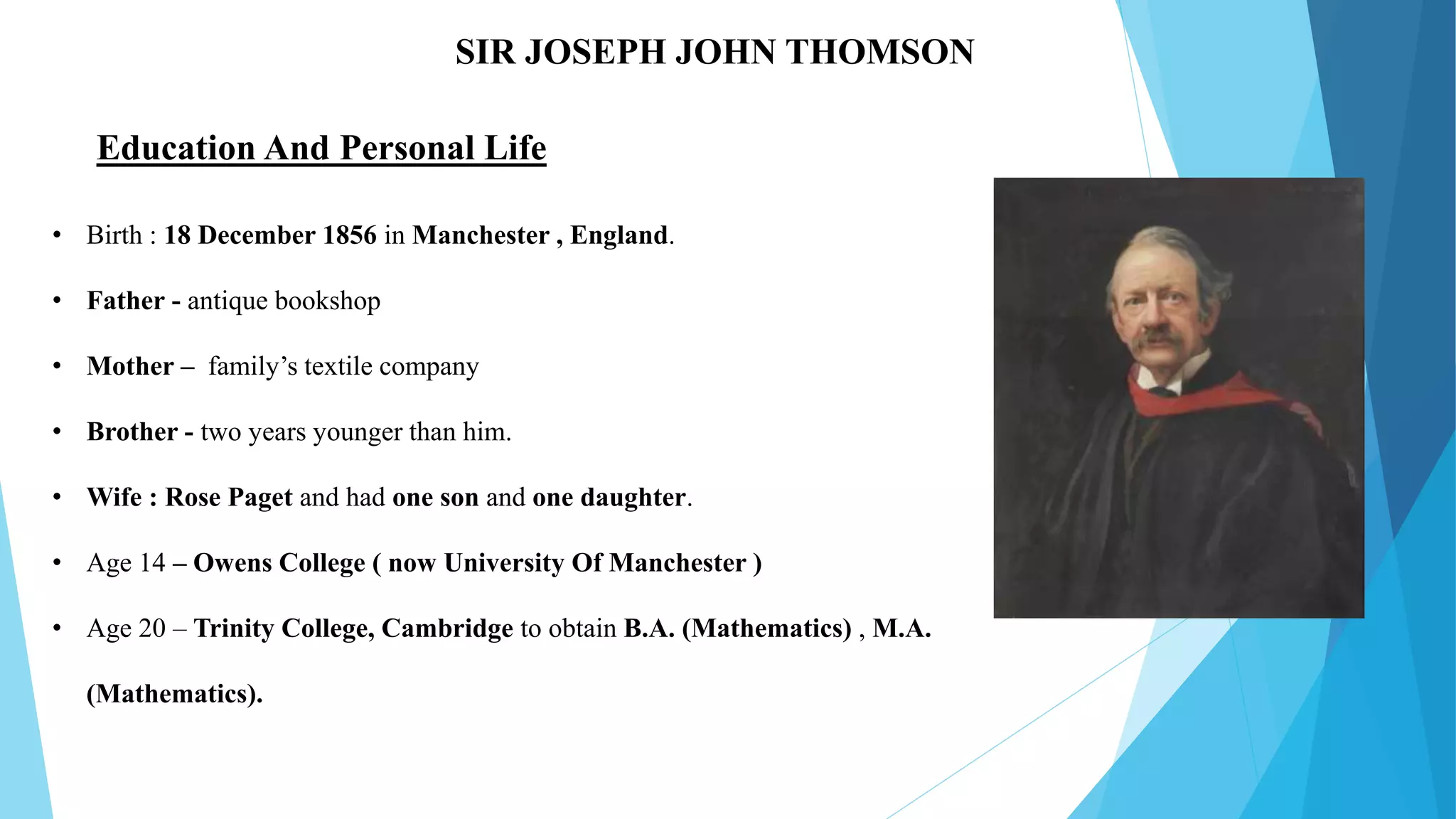
SIR JOSEPH JOHN THOMSON
• Birth : 18 December 1856 in Manchester , England.
• Father - antique bookshop
• Mother – family’s textile company
• Brother - two years younger than him.
• Wife : Rose Paget and had one son and one daughter.
• Age 14 – Owens College ( now University Of Manchester )
• Age 20 – Trinity College, Cambridge to obtain B.A. (Mathematics) , M.A.
(Mathematics).
Education And Personal Life
Career
• Age 28 – Cavendish Professor Of Physics at University of Cambridge.
• Nobel Prize in 1906 – Conduction of electricity by gases.
• Lectures at Princeton And Yale University – Discharge of electricity through gases
• Discovered the electron
• Elected as a Fellow of the Royal Society
• thomson (Th) – unit of mass-to-charge ratio
• JJ Thomson Avenue – University of Cambridge campus
• Various awards and honors – Adams Prize, Franklin Medal, etc.
The Cathode Ray Tube Experiment : Discovery of the
electron
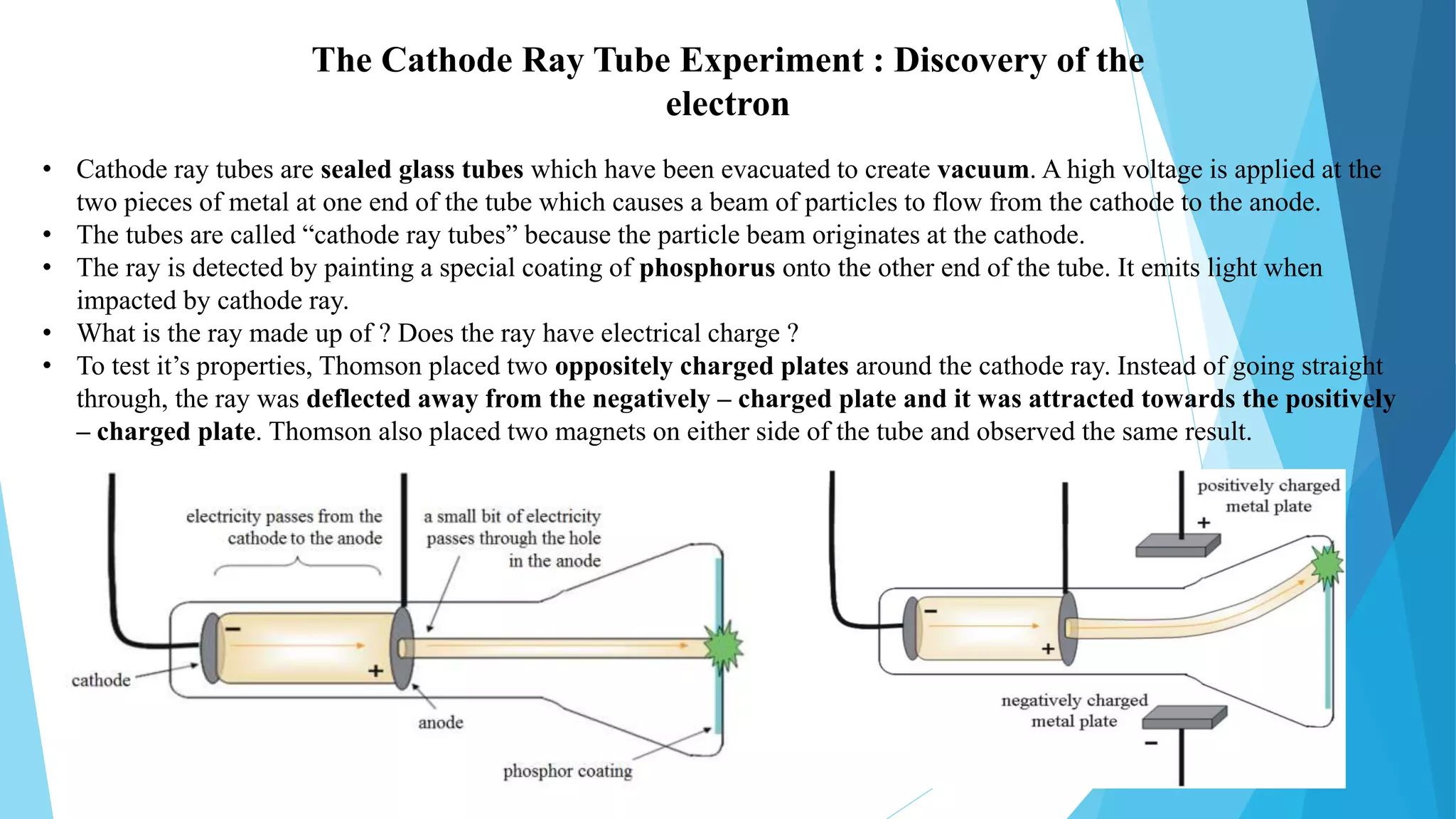
• Cathode ray tubes are sealed glass tubes which have been evacuated to create vacuum. A high voltage is applied at the
two pieces of metal at one end of the tube which causes a beam of particles to flow from the cathode to the anode.
• The tubes are called “cathode ray tubes” because the particle beam originates at the cathode.
• The ray is detected by painting a special coating of phosphorus onto the other end of the tube. It emits light when
impacted by cathode ray.
• What is the ray made up of ? Does the ray have electrical charge ?
• To test it’s properties, Thomson placed two oppositely charged plates around the cathode ray. Instead of going straight
through, the ray was deflected away from the negatively – charged plate and it was attracted towards the positively
– charged plate. Thomson also placed two magnets on either side of the tube and observed the same result.
• The results helped him to determine the mass-to-charge ratio of the particles.
• He repeated the experiments using different metals and found that the properties of the cathode ray remained
constant irrespective of the metal used.
• Thomson made the following CONCLUSIONS from his experiment :
1. The cathode ray is composed of negatively charged particles.
2. The particles that make up cathode rays are a 1000 times smaller than hydrogen atom.
3. All different metals give off cathode rays.
• Atoms have tiny, negatively charged particles inside them – “ELECTRONS”
• On the whole, atoms are electrically neutral. Hence, there must be positive charge in the atom to balance out the
electrons.
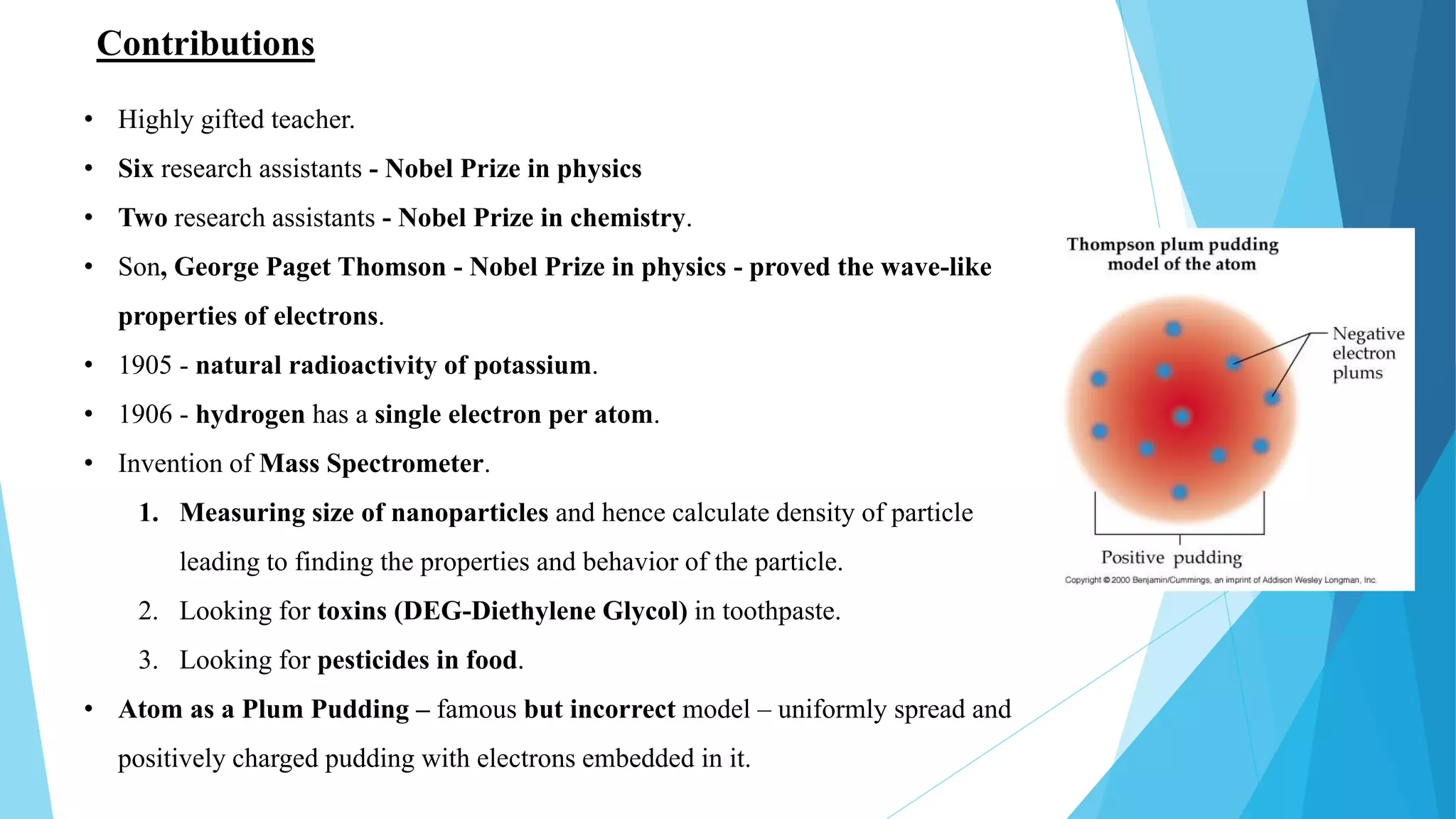
• This lead to the Plum Pudding Model of an Atom.
The Cathode Ray Tube Experiment : Discovery of the
electron
Contributions
• Highly gifted teacher.
• Six research assistants - Nobel Prize in physics
• Two research assistants - Nobel Prize in chemistry.
• Son, George Paget Thomson - Nobel Prize in physics - proved the wave-like
properties of electrons.
• 1905 - natural radioactivity of potassium.
• 1906 - hydrogen has a single electron per atom.
• Invention of Mass Spectrometer.
1. Measuring size of nanoparticles and hence calculate density of particle
leading to finding the properties and behavior of the particle.
2. Looking for toxins (DEG-Diethylene Glycol) in toothpaste.
3. Looking for pesticides in food.
• Atom as a Plum Pudding – famous but incorrect model – uniformly spread and
positively charged pudding with electrons embedded in it.
BIBLIOGRAPHY
• https://en.Wikipedia.org/wiki/J._J._Thomson
• https://www.famousscientists.org/j-j-thomson/
• https://www.nobelprize.org/nobel_prizes/physics/laureates/1906/tho
mson-facts.html

Cathode Ray Tube Experiment - J.J. Thomson

  • 1.
    Group Activity On BiographyOf A Nobel Prize Winning Physicist – J.J.Thomson Submitted to : Dr. N.L. Mathakari Dr. A.B. Deore Submitted by : Mr. Anish Agarwal (101018) Mr. Aditya Agarwal (101019) Mr. Akkahshh Agarwaal (101020) Mr. Anshul Agarwal (101021) MIT-WORLD PEACE UNIVERSITY , KOTHRUD PUNE - 411038
  • 2.
    SIR JOSEPH JOHNTHOMSON • Birth : 18 December 1856 in Manchester , England. • Father - antique bookshop • Mother – family’s textile company • Brother - two years younger than him. • Wife : Rose Paget and had one son and one daughter. • Age 14 – Owens College ( now University Of Manchester ) • Age 20 – Trinity College, Cambridge to obtain B.A. (Mathematics) , M.A. (Mathematics). Education And Personal Life
  • 3.
    Career • Age 28– Cavendish Professor Of Physics at University of Cambridge. • Nobel Prize in 1906 – Conduction of electricity by gases. • Lectures at Princeton And Yale University – Discharge of electricity through gases • Discovered the electron • Elected as a Fellow of the Royal Society • thomson (Th) – unit of mass-to-charge ratio • JJ Thomson Avenue – University of Cambridge campus • Various awards and honors – Adams Prize, Franklin Medal, etc.
  • 4.
    The Cathode RayTube Experiment : Discovery of the electron • Cathode ray tubes are sealed glass tubes which have been evacuated to create vacuum. A high voltage is applied at the two pieces of metal at one end of the tube which causes a beam of particles to flow from the cathode to the anode. • The tubes are called “cathode ray tubes” because the particle beam originates at the cathode. • The ray is detected by painting a special coating of phosphorus onto the other end of the tube. It emits light when impacted by cathode ray. • What is the ray made up of ? Does the ray have electrical charge ? • To test it’s properties, Thomson placed two oppositely charged plates around the cathode ray. Instead of going straight through, the ray was deflected away from the negatively – charged plate and it was attracted towards the positively – charged plate. Thomson also placed two magnets on either side of the tube and observed the same result.
  • 5.
    • The resultshelped him to determine the mass-to-charge ratio of the particles. • He repeated the experiments using different metals and found that the properties of the cathode ray remained constant irrespective of the metal used. • Thomson made the following CONCLUSIONS from his experiment : 1. The cathode ray is composed of negatively charged particles. 2. The particles that make up cathode rays are a 1000 times smaller than hydrogen atom. 3. All different metals give off cathode rays. • Atoms have tiny, negatively charged particles inside them – “ELECTRONS” • On the whole, atoms are electrically neutral. Hence, there must be positive charge in the atom to balance out the electrons. • This lead to the Plum Pudding Model of an Atom. The Cathode Ray Tube Experiment : Discovery of the electron
  • 6.
    Contributions • Highly giftedteacher. • Six research assistants - Nobel Prize in physics • Two research assistants - Nobel Prize in chemistry. • Son, George Paget Thomson - Nobel Prize in physics - proved the wave-like properties of electrons. • 1905 - natural radioactivity of potassium. • 1906 - hydrogen has a single electron per atom. • Invention of Mass Spectrometer. 1. Measuring size of nanoparticles and hence calculate density of particle leading to finding the properties and behavior of the particle. 2. Looking for toxins (DEG-Diethylene Glycol) in toothpaste. 3. Looking for pesticides in food. • Atom as a Plum Pudding – famous but incorrect model – uniformly spread and positively charged pudding with electrons embedded in it.
  • 7.
    BIBLIOGRAPHY • https://en.Wikipedia.org/wiki/J._J._Thomson • https://www.famousscientists.org/j-j-thomson/ •https://www.nobelprize.org/nobel_prizes/physics/laureates/1906/tho mson-facts.html