Chapter Introduction
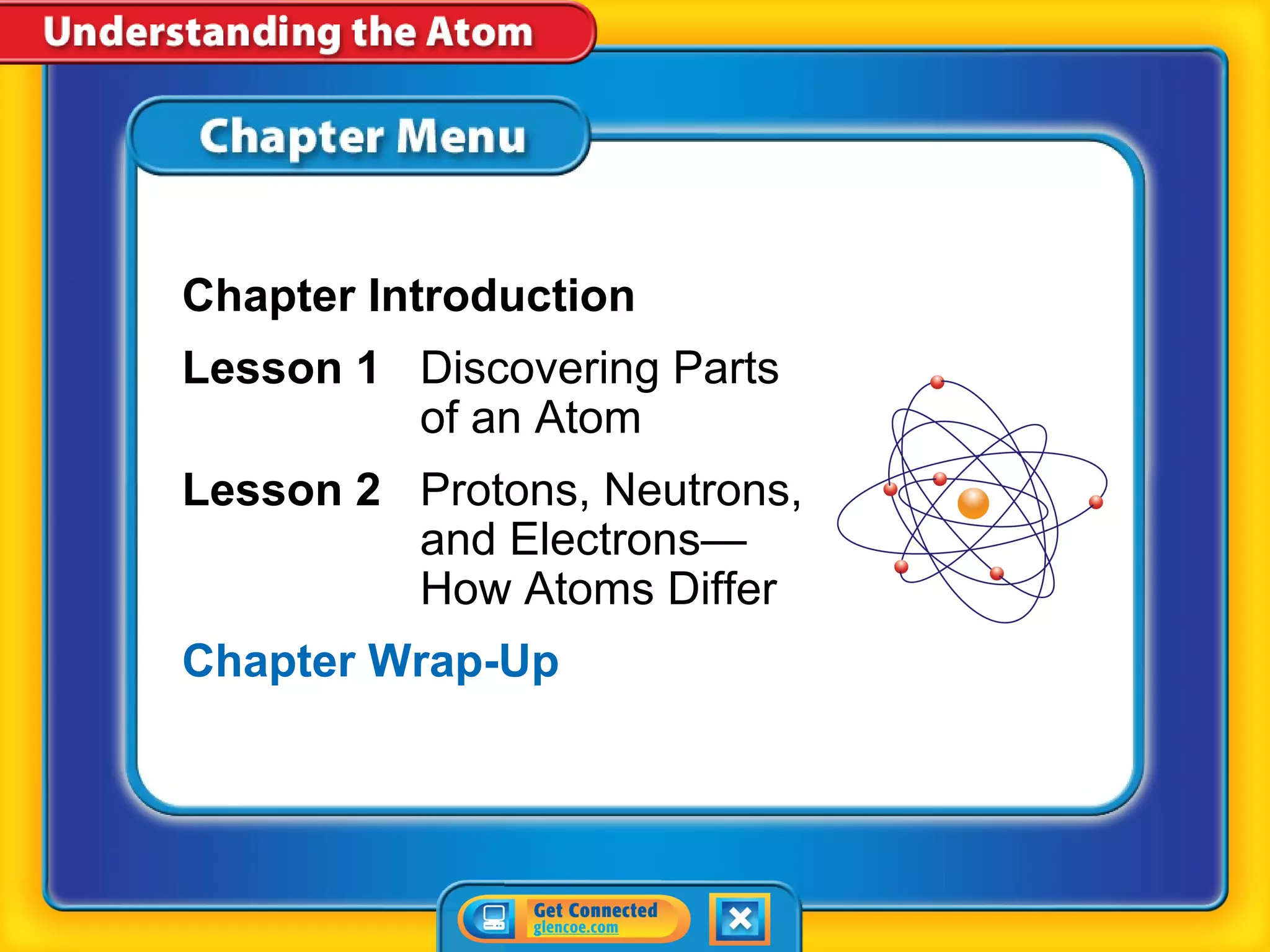
Lesson 1 Discovering Parts
         of an Atom
Lesson 2 Protons, Neutrons,
         and Electrons—
         How Atoms Differ
Chapter Wrap-Up
What are atoms, and
what are they made of?
What do you think?
Before you begin, decide if you agree or
disagree with each of these statements.
As you view this presentation, see if you
change your mind about any of the
statements.
Do you agree or disagree?
1. The earliest model of an atom
   contained only protons and electrons.
2. Air fills most of an atom.
3. In the present-day model of the atom,
   the nucleus of the atom is at the center
   of an electron cloud.
Do you agree or disagree?
4. All atoms of the same element have
   the same number of protons.
5. Atoms of one element cannot be
   changed into atoms of another
   element.
6. Ions form when atoms lose or gain
   electrons.
Discovering Part of an Atom

 • What is an atom?
 • How would you describe the size of an
   atom?
 • How has the atomic model changed
   over time?
Discovering Part of an Atom

 • atom       • neutron
 • electron   • electron cloud
 • nucleus
 • proton
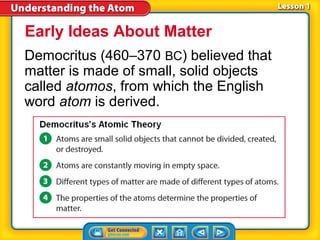
Early Ideas About Matter
Democritus (460–370 BC) believed that
matter is made of small, solid objects
called atomos, from which the English
word atom is derived.
Early Ideas About Matter (cont.)
• Aristotle (384–322 BC) did not believe
  that empty space exists, but instead
  believed that all matter is made of fire,
  water, air, and earth.
• Because Aristotle was so influential,
  his ideas were accepted and
  Democritus’s ideas about atoms were
  not studied again for more than 2,000
  years.
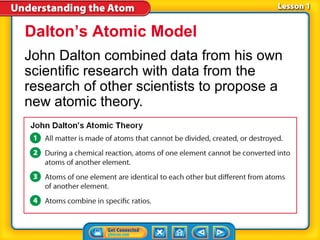
Dalton’s Atomic Model
John Dalton combined data from his own
scientific research with data from the
research of other scientists to propose a
new atomic theory.
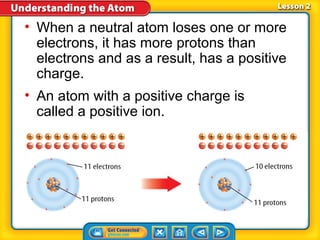
The Atom
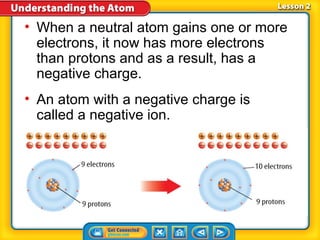
An atom is the smallest piece of an
element that still represents that element.


        What is a copper atom?
The Atom (cont.)
• Atoms of different elements are different
  sizes, but all are very, very small.
• You cannot see atoms with just your
  eyes or even with most microscopes.


        How would you describe the
        size of an atom?
The Atom (cont.)
• The 1981 invention of a high-powered
  microscope, called a scanning tunneling
  microscope (STM), enabled scientists to
  see individual atoms for the first time.
• Scientists have learned that atoms are
  not the smallest particles of matter.
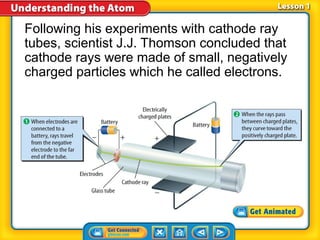
Following his experiments with cathode ray
tubes, scientist J.J. Thomson concluded that
cathode rays were made of small, negatively
charged particles which he called electrons.
Thomson—Discovering Electrons
An electron is a particle with one negative
charge (1–).


  electron
  from Greek electron, means
  “amber,” the physical force so called
  because it first was generated by
  rubbing amber. Amber is a fossilized
  substance produced by trees.
Thomson—Discovering Electrons (cont.)
• Because atoms are neutral, or not
  electrically charged, Thomson proposed
  that atoms also must contain a positive
  charge that balances the negatively
  charged electrons.
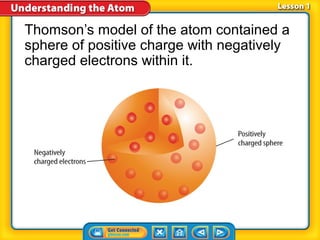
• Thomson’s proposed atom was a sphere
  with a positive charge evenly spread
  throughout and negatively charged
  electrons within it.
Thomson’s model of the atom contained a
sphere of positive charge with negatively
charged electrons within it.
Rutherford—Discovering
the Nucleus
Scientist Ernest Rutherford set up
experiments to test Thomson’s atomic
model and to learn more about what
atoms contain.
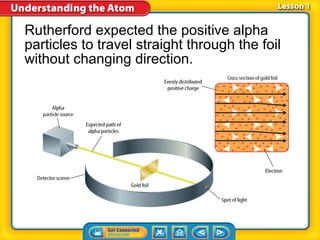
Rutherford expected the positive alpha
particles to travel straight through the foil
without changing direction.
Some alpha particles traveled in a straight
path, as expected. But some changed
direction, and some bounced straight
back.
Rutherford—Discovering
the Nucleus (cont.)


      Given the results of the gold
      foil experiment, how do you
      think an actual atom differs
      from Thomson’s model?
Rutherford—Discovering
the Nucleus (cont.)
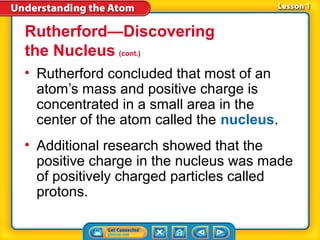
• Rutherford concluded that most of an
  atom’s mass and positive charge is
  concentrated in a small area in the
  center of the atom called the nucleus.
• Additional research showed that the
  positive charge in the nucleus was made
  of positively charged particles called
  protons.
Rutherford—Discovering
the Nucleus (cont.)
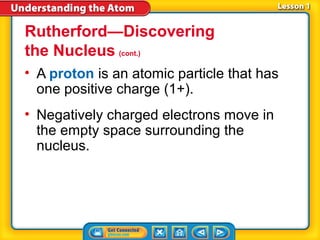
• A proton is an atomic particle that has
  one positive charge (1+).
• Negatively charged electrons move in
  the empty space surrounding the
  nucleus.
Rutherford’s model contains a small, dense,
positive nucleus. Tiny, negatively charged
electrons travel in empty space around the
nucleus.
Discovering Neutrons
• James Chadwick discovered that, in
  addition to protons, the nucleus also
  contained neutrons.
• A neutron is a neutral particle that exists
  in the nucleus of an atom.
Bohr’s Atomic Model
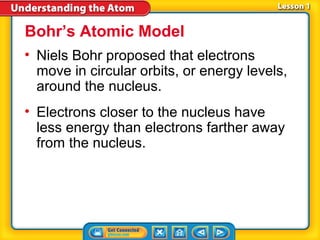
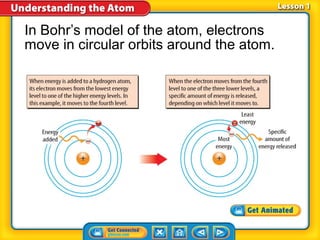
• Niels Bohr proposed that electrons
  move in circular orbits, or energy levels,
  around the nucleus.
• Electrons closer to the nucleus have
  less energy than electrons farther away
  from the nucleus.
Bohr’s Atomic Model (cont.)
• More research showed that, although
  electrons have specific amounts of
  energy, energy levels are not arranged
  in circular orbits.
• When an electron moves from a higher
  energy level to a lower energy level,
  energy is released—sometimes as
  visible light.
In Bohr’s model of the atom, electrons
move in circular orbits around the atom.
Bohr’s Atomic Model (cont.)


       How did Bohr’s model of the
       atom differ from Rutherford’s?
The Modern Atomic Model
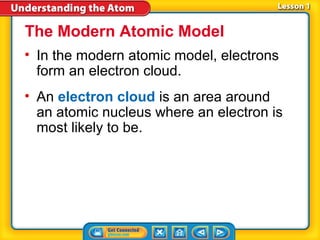
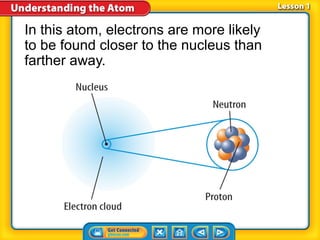
• In the modern atomic model, electrons
  form an electron cloud.
• An electron cloud is an area around
  an atomic nucleus where an electron is
  most likely to be.
In this atom, electrons are more likely
to be found closer to the nucleus than
farther away.
The Modern Atomic Model (cont.)


      How has the model of the atom
      changed over time?
Quarks
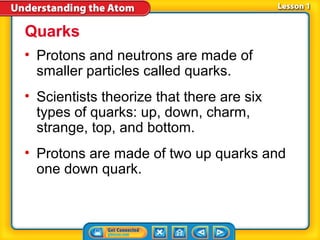
• Protons and neutrons are made of
  smaller particles called quarks.
• Scientists theorize that there are six
  types of quarks: up, down, charm,
  strange, top, and bottom.
• Protons are made of two up quarks and
  one down quark.
Quarks (cont.)
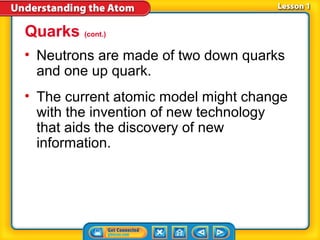
• Neutrons are made of two down quarks
  and one up quark.
• The current atomic model might change
  with the invention of new technology
  that aids the discovery of new
  information.
• If you were to divide an element into
  smaller and smaller pieces, the
  smallest piece would be an atom.
• Atoms are so small that they can be
  seen only by using very powerful
  microscopes.
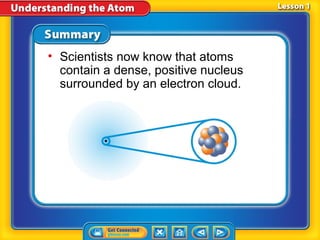
• Scientists now know that atoms
  contain a dense, positive nucleus
  surrounded by an electron cloud.
Which term describes a particle
with one negative charge?

A. atom
B. electron
C. nucleus
D. proton
Whose model of the atom
contained a sphere of positive
charge with negatively charged
electrons within it?
A. Dalton
B. Democritus
C. Rutherford
D. Thomson
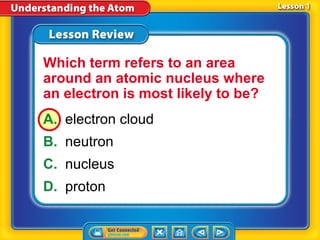
Which term refers to an area
around an atomic nucleus where
an electron is most likely to be?
A. electron cloud
B. neutron
C. nucleus
D. proton
Do you agree or disagree?

1. The earliest model of an atom
   contained only protons and electrons.
2. Air fills most of an atom.
3. In the present-day model of the atom,
   the nucleus of the atom is at the center
   of an electron cloud.
Protons, Neutrons, and
Electrons—How Atoms Differ

• What happens during nuclear decay?
• How does a neutral atom change
  when its number of protons, electrons,
  or neutrons changes?
Protons, Neutrons, and
Electrons—How Atoms Differ

• atomic number    • radioactive
• isotope          • nuclear decay
• mass number      • ion
• average atomic
  mass
The Parts of the Atom
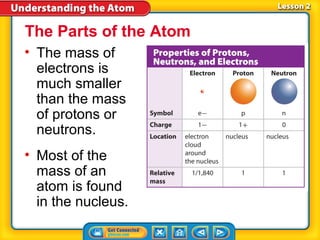
• The mass of
  electrons is
  much smaller
  than the mass
  of protons or
  neutrons.
• Most of the
  mass of an
  atom is found
  in the nucleus.
Different Elements—Different
Numbers of Protons
• The number of protons in an atom of an
  element is the element’s atomic
  number.
• The atomic number is the whole number
  listed with each element on the periodic
  table.
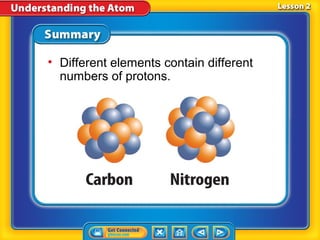
• Atoms of different elements contain
  different numbers of protons.
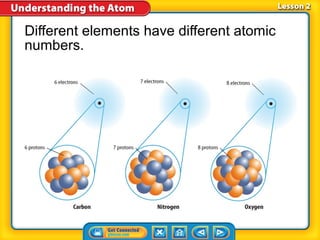
Different elements have different atomic
numbers.
Different Elements—Different
Numbers of Protons (cont.)
• Neutral atoms of different elements also
  have different numbers of electrons.
• In a neutral atom, the number of
  electrons equals the number of protons;
  therefore, the number of positive
  charges equals the number of negative
  charges.
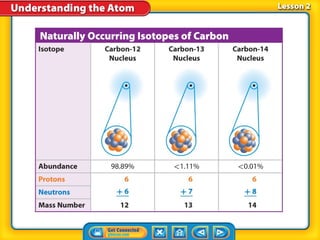
Neutrons and Isotopes
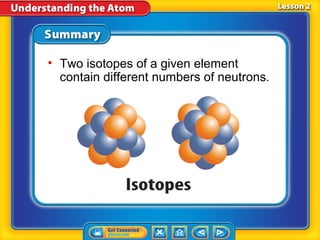
• Atoms of the same element can have
  different numbers of neutrons.
• Isotopes are atoms of the same
  element that have different numbers of
  neutrons.
• Most elements have several isotopes.
Neutrons and Isotopes (cont.)


   isotope
   from Greek isos, means “equal”;
   and topos, means “place”
Neutrons and Isotopes (cont.)
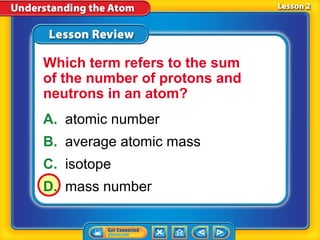
• The mass number of an atom is the
  sum of the number of protons and
  neutrons in an atom.
 Mass number = number of protons + number of neutrons

• An isotope is often written with the
  element name followed by the mass
  number.
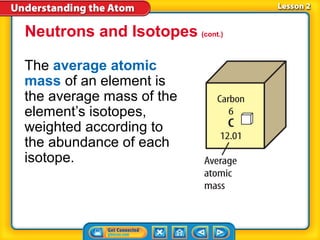
Neutrons and Isotopes (cont.)

The average atomic
mass of an element is
the average mass of the
element’s isotopes,
weighted according to
the abundance of each
isotope.
Radioactivity
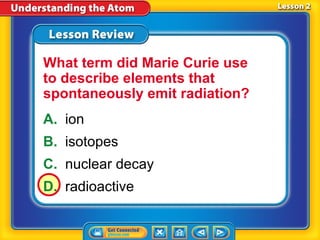
• Marie Curie called elements that
  spontaneously emit radiation
  radioactive.
• Henri Becquerel and Pierre and Marie
  Curie discovered that the radiation
  released by uranium was made of
  energy and particles.
Radioactivity (cont.)
• This radiation came from the nuclei of
  the uranium atoms.
• When uranium releases radiation, it
  changes to a different element.
Radioactivity (cont.)
• Nuclear decay is a process that occurs
  when an unstable atomic nucleus
  changes into another more stable
  nucleus by emitting radiation.
• Nuclear decay can produce three
  different types of radiation—alpha
  particles, beta particles, and gamma
  rays.
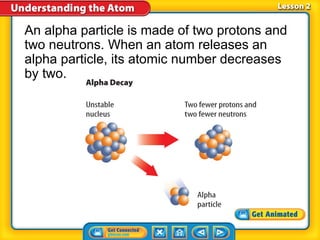
An alpha particle is made of two protons and
two neutrons. When an atom releases an
alpha particle, its atomic number decreases
by two.
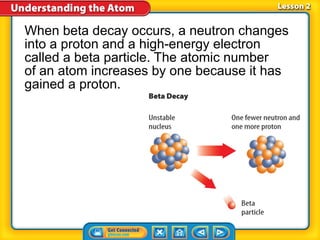
When beta decay occurs, a neutron changes
into a proton and a high-energy electron
called a beta particle. The atomic number
of an atom increases by one because it has
gained a proton.
Because gamma rays do not contain
particles, the release of gamma rays does
not change one element into another
element.
Radioactivity (cont.)


          What happens during
          radioactive decay?
Radioactivity (cont.)
• The energy released by radioactive
  decay can be both harmful and
  beneficial to humans.
• Radiation therapy can be beneficial to
  humans by destroying harmful cells such
  as cancer cells.
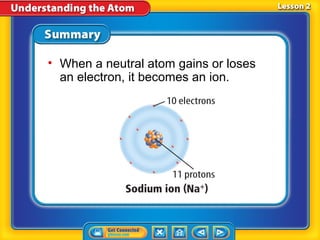
Ions—Gaining or Losing Electrons
• An ion is an atom that is no longer
  neutral because it has gained or lost
  electrons.
• An ion can be positively or negatively
  charged depending on whether it has
  lost or gained electrons.
• When a neutral atom loses one or more
  electrons, it has more protons than
  electrons and as a result, has a positive
  charge.
• An atom with a positive charge is
  called a positive ion.
• When a neutral atom gains one or more
  electrons, it now has more electrons
  than protons and as a result, has a
  negative charge.
• An atom with a negative charge is
  called a negative ion.
Ions—Gaining or Losing Electrons
                                 (cont.)


    How does a neutral atom change
    when its number of protons or
    electrons changes?
• Different elements contain different
  numbers of protons.
• Two isotopes of a given element
  contain different numbers of neutrons.
• When a neutral atom gains or loses
  an electron, it becomes an ion.
Where is most of the mass of
an atom found?

A. electrons
B. neutrons
C. nucleus
D. protons
Which term refers to the sum
of the number of protons and
neutrons in an atom?
A. atomic number
B. average atomic mass
C. isotope
D. mass number
What term did Marie Curie use
to describe elements that
spontaneously emit radiation?
A. ion
B. isotopes
C. nuclear decay
D. radioactive
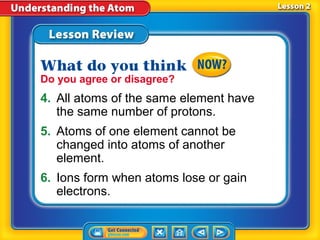
Do you agree or disagree?
4. All atoms of the same element have
   the same number of protons.
5. Atoms of one element cannot be
   changed into atoms of another
   element.
6. Ions form when atoms lose or gain
   electrons.
Key Concept Summary
Interactive Concept Map
Chapter Review
Standardized Test Practice
An atom is the
smallest unit of an
element and is made
mostly of empty space.
It contains a tiny
nucleus surrounded
by an electron cloud.
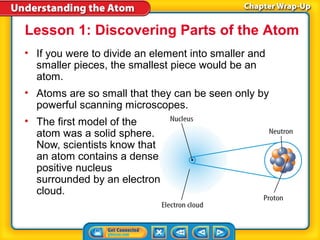
Lesson 1: Discovering Parts of the Atom
• If you were to divide an element into smaller and
  smaller pieces, the smallest piece would be an
  atom.
• Atoms are so small that they can be seen only by
  powerful scanning microscopes.
• The first model of the
  atom was a solid sphere.
  Now, scientists know that
  an atom contains a dense
  positive nucleus
  surrounded by an electron
  cloud.
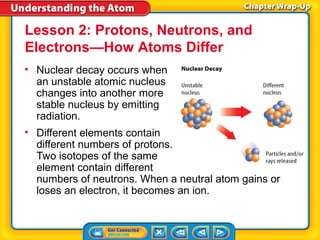
Lesson 2: Protons, Neutrons, and
Electrons—How Atoms Differ
• Nuclear decay occurs when
  an unstable atomic nucleus
  changes into another more
  stable nucleus by emitting
  radiation.
• Different elements contain
  different numbers of protons.
  Two isotopes of the same
  element contain different
  numbers of neutrons. When a neutral atom gains or
  loses an electron, it becomes an ion.
Which term describes a neutral
particle that exists in the nucleus
of an atom?
A. atom
B. electron
C. neutron
D. proton
Who discovered that, in addition
to protons, the nucleus also
contained neutrons?
A. Thomson
B. Rutherford
C. Chadwick
D. Bohr
Protons and neutrons are made
of smaller particles called what?

A. electron cloud
B. isotope
C. nucleus
D. quarks
Which term refers to the process
that occurs when an unstable
atomic nucleus changes into
another more stable nucleus
by emitting radiation?
A.   radiation
B.   radioactivity
C.   nuclear decay
D.   radiation therapy
Which describes an atom with a
positive charge?

A. positive ion
B. negative ion
C. isotope
D. quarks
Which term refers to the smallest
piece of an element that still
represents that element?
A. quark
B. nucleus
C. electron
D. atom
Who concluded that most of an
atom’s mass and positive charge
is concentrated in the nucleus?
A. Aristotle
B. Bohr
C. Chadwick
D. Rutherford
Which is an atomic particle that
has one positive charge?

A. proton
B. nucleus
C. neutron
D. electron
Which term refers to an atom that
is no longer neutral because it
has gained or lost electrons?
A. ion
B. isotope
C. neutron
D. proton
Which refers to the average mass
of an element’s isotopes,
weighted according to the
abundance of each isotope?
A. atomic number
B. mass number
C. relative mass
D. average atomic mass

Understanding the atom

  • 1.
    Chapter Introduction Lesson 1Discovering Parts of an Atom Lesson 2 Protons, Neutrons, and Electrons— How Atoms Differ Chapter Wrap-Up
  • 2.
    What are atoms,and what are they made of?
  • 3.
    What do youthink? Before you begin, decide if you agree or disagree with each of these statements. As you view this presentation, see if you change your mind about any of the statements.
  • 4.
    Do you agreeor disagree? 1. The earliest model of an atom contained only protons and electrons. 2. Air fills most of an atom. 3. In the present-day model of the atom, the nucleus of the atom is at the center of an electron cloud.
  • 5.
    Do you agreeor disagree? 4. All atoms of the same element have the same number of protons. 5. Atoms of one element cannot be changed into atoms of another element. 6. Ions form when atoms lose or gain electrons.
  • 6.
    Discovering Part ofan Atom • What is an atom? • How would you describe the size of an atom? • How has the atomic model changed over time?
  • 7.
    Discovering Part ofan Atom • atom • neutron • electron • electron cloud • nucleus • proton
  • 8.
    Early Ideas AboutMatter Democritus (460–370 BC) believed that matter is made of small, solid objects called atomos, from which the English word atom is derived.
  • 9.
    Early Ideas AboutMatter (cont.) • Aristotle (384–322 BC) did not believe that empty space exists, but instead believed that all matter is made of fire, water, air, and earth. • Because Aristotle was so influential, his ideas were accepted and Democritus’s ideas about atoms were not studied again for more than 2,000 years.
  • 10.
    Dalton’s Atomic Model JohnDalton combined data from his own scientific research with data from the research of other scientists to propose a new atomic theory.
  • 11.
    The Atom An atomis the smallest piece of an element that still represents that element. What is a copper atom?
  • 12.
    The Atom (cont.) •Atoms of different elements are different sizes, but all are very, very small. • You cannot see atoms with just your eyes or even with most microscopes. How would you describe the size of an atom?
  • 13.
    The Atom (cont.) •The 1981 invention of a high-powered microscope, called a scanning tunneling microscope (STM), enabled scientists to see individual atoms for the first time. • Scientists have learned that atoms are not the smallest particles of matter.
  • 14.
    Following his experimentswith cathode ray tubes, scientist J.J. Thomson concluded that cathode rays were made of small, negatively charged particles which he called electrons.
  • 15.
    Thomson—Discovering Electrons An electronis a particle with one negative charge (1–). electron from Greek electron, means “amber,” the physical force so called because it first was generated by rubbing amber. Amber is a fossilized substance produced by trees.
  • 16.
    Thomson—Discovering Electrons (cont.) •Because atoms are neutral, or not electrically charged, Thomson proposed that atoms also must contain a positive charge that balances the negatively charged electrons. • Thomson’s proposed atom was a sphere with a positive charge evenly spread throughout and negatively charged electrons within it.
  • 17.
    Thomson’s model ofthe atom contained a sphere of positive charge with negatively charged electrons within it.
  • 18.
    Rutherford—Discovering the Nucleus Scientist ErnestRutherford set up experiments to test Thomson’s atomic model and to learn more about what atoms contain.
  • 19.
    Rutherford expected thepositive alpha particles to travel straight through the foil without changing direction.
  • 20.
    Some alpha particlestraveled in a straight path, as expected. But some changed direction, and some bounced straight back.
  • 21.
    Rutherford—Discovering the Nucleus (cont.) Given the results of the gold foil experiment, how do you think an actual atom differs from Thomson’s model?
  • 22.
    Rutherford—Discovering the Nucleus (cont.) •Rutherford concluded that most of an atom’s mass and positive charge is concentrated in a small area in the center of the atom called the nucleus. • Additional research showed that the positive charge in the nucleus was made of positively charged particles called protons.
  • 23.
    Rutherford—Discovering the Nucleus (cont.) •A proton is an atomic particle that has one positive charge (1+). • Negatively charged electrons move in the empty space surrounding the nucleus.
  • 24.
    Rutherford’s model containsa small, dense, positive nucleus. Tiny, negatively charged electrons travel in empty space around the nucleus.
  • 25.
    Discovering Neutrons • JamesChadwick discovered that, in addition to protons, the nucleus also contained neutrons. • A neutron is a neutral particle that exists in the nucleus of an atom.
  • 26.
    Bohr’s Atomic Model •Niels Bohr proposed that electrons move in circular orbits, or energy levels, around the nucleus. • Electrons closer to the nucleus have less energy than electrons farther away from the nucleus.
  • 27.
    Bohr’s Atomic Model(cont.) • More research showed that, although electrons have specific amounts of energy, energy levels are not arranged in circular orbits. • When an electron moves from a higher energy level to a lower energy level, energy is released—sometimes as visible light.
  • 28.
    In Bohr’s modelof the atom, electrons move in circular orbits around the atom.
  • 29.
    Bohr’s Atomic Model(cont.) How did Bohr’s model of the atom differ from Rutherford’s?
  • 30.
    The Modern AtomicModel • In the modern atomic model, electrons form an electron cloud. • An electron cloud is an area around an atomic nucleus where an electron is most likely to be.
  • 31.
    In this atom,electrons are more likely to be found closer to the nucleus than farther away.
  • 32.
    The Modern AtomicModel (cont.) How has the model of the atom changed over time?
  • 33.
    Quarks • Protons andneutrons are made of smaller particles called quarks. • Scientists theorize that there are six types of quarks: up, down, charm, strange, top, and bottom. • Protons are made of two up quarks and one down quark.
  • 34.
    Quarks (cont.) • Neutronsare made of two down quarks and one up quark. • The current atomic model might change with the invention of new technology that aids the discovery of new information.
  • 35.
    • If youwere to divide an element into smaller and smaller pieces, the smallest piece would be an atom. • Atoms are so small that they can be seen only by using very powerful microscopes.
  • 36.
    • Scientists nowknow that atoms contain a dense, positive nucleus surrounded by an electron cloud.
  • 37.
    Which term describesa particle with one negative charge? A. atom B. electron C. nucleus D. proton
  • 38.
    Whose model ofthe atom contained a sphere of positive charge with negatively charged electrons within it? A. Dalton B. Democritus C. Rutherford D. Thomson
  • 39.
    Which term refersto an area around an atomic nucleus where an electron is most likely to be? A. electron cloud B. neutron C. nucleus D. proton
  • 40.
    Do you agreeor disagree? 1. The earliest model of an atom contained only protons and electrons. 2. Air fills most of an atom. 3. In the present-day model of the atom, the nucleus of the atom is at the center of an electron cloud.
  • 41.
    Protons, Neutrons, and Electrons—HowAtoms Differ • What happens during nuclear decay? • How does a neutral atom change when its number of protons, electrons, or neutrons changes?
  • 42.
    Protons, Neutrons, and Electrons—HowAtoms Differ • atomic number • radioactive • isotope • nuclear decay • mass number • ion • average atomic mass
  • 43.
    The Parts ofthe Atom • The mass of electrons is much smaller than the mass of protons or neutrons. • Most of the mass of an atom is found in the nucleus.
  • 44.
    Different Elements—Different Numbers ofProtons • The number of protons in an atom of an element is the element’s atomic number. • The atomic number is the whole number listed with each element on the periodic table. • Atoms of different elements contain different numbers of protons.
  • 45.
    Different elements havedifferent atomic numbers.
  • 46.
    Different Elements—Different Numbers ofProtons (cont.) • Neutral atoms of different elements also have different numbers of electrons. • In a neutral atom, the number of electrons equals the number of protons; therefore, the number of positive charges equals the number of negative charges.
  • 47.
    Neutrons and Isotopes •Atoms of the same element can have different numbers of neutrons. • Isotopes are atoms of the same element that have different numbers of neutrons. • Most elements have several isotopes.
  • 48.
    Neutrons and Isotopes(cont.) isotope from Greek isos, means “equal”; and topos, means “place”
  • 49.
    Neutrons and Isotopes(cont.) • The mass number of an atom is the sum of the number of protons and neutrons in an atom. Mass number = number of protons + number of neutrons • An isotope is often written with the element name followed by the mass number.
  • 51.
    Neutrons and Isotopes(cont.) The average atomic mass of an element is the average mass of the element’s isotopes, weighted according to the abundance of each isotope.
  • 52.
    Radioactivity • Marie Curiecalled elements that spontaneously emit radiation radioactive. • Henri Becquerel and Pierre and Marie Curie discovered that the radiation released by uranium was made of energy and particles.
  • 53.
    Radioactivity (cont.) • Thisradiation came from the nuclei of the uranium atoms. • When uranium releases radiation, it changes to a different element.
  • 54.
    Radioactivity (cont.) • Nucleardecay is a process that occurs when an unstable atomic nucleus changes into another more stable nucleus by emitting radiation. • Nuclear decay can produce three different types of radiation—alpha particles, beta particles, and gamma rays.
  • 55.
    An alpha particleis made of two protons and two neutrons. When an atom releases an alpha particle, its atomic number decreases by two.
  • 56.
    When beta decayoccurs, a neutron changes into a proton and a high-energy electron called a beta particle. The atomic number of an atom increases by one because it has gained a proton.
  • 57.
    Because gamma raysdo not contain particles, the release of gamma rays does not change one element into another element.
  • 58.
    Radioactivity (cont.) What happens during radioactive decay?
  • 59.
    Radioactivity (cont.) • Theenergy released by radioactive decay can be both harmful and beneficial to humans. • Radiation therapy can be beneficial to humans by destroying harmful cells such as cancer cells.
  • 60.
    Ions—Gaining or LosingElectrons • An ion is an atom that is no longer neutral because it has gained or lost electrons. • An ion can be positively or negatively charged depending on whether it has lost or gained electrons.
  • 61.
    • When aneutral atom loses one or more electrons, it has more protons than electrons and as a result, has a positive charge. • An atom with a positive charge is called a positive ion.
  • 62.
    • When aneutral atom gains one or more electrons, it now has more electrons than protons and as a result, has a negative charge. • An atom with a negative charge is called a negative ion.
  • 63.
    Ions—Gaining or LosingElectrons (cont.) How does a neutral atom change when its number of protons or electrons changes?
  • 64.
    • Different elementscontain different numbers of protons.
  • 65.
    • Two isotopesof a given element contain different numbers of neutrons.
  • 66.
    • When aneutral atom gains or loses an electron, it becomes an ion.
  • 67.
    Where is mostof the mass of an atom found? A. electrons B. neutrons C. nucleus D. protons
  • 68.
    Which term refersto the sum of the number of protons and neutrons in an atom? A. atomic number B. average atomic mass C. isotope D. mass number
  • 69.
    What term didMarie Curie use to describe elements that spontaneously emit radiation? A. ion B. isotopes C. nuclear decay D. radioactive
  • 70.
    Do you agreeor disagree? 4. All atoms of the same element have the same number of protons. 5. Atoms of one element cannot be changed into atoms of another element. 6. Ions form when atoms lose or gain electrons.
  • 71.
    Key Concept Summary InteractiveConcept Map Chapter Review Standardized Test Practice
  • 72.
    An atom isthe smallest unit of an element and is made mostly of empty space. It contains a tiny nucleus surrounded by an electron cloud.
  • 73.
    Lesson 1: DiscoveringParts of the Atom • If you were to divide an element into smaller and smaller pieces, the smallest piece would be an atom. • Atoms are so small that they can be seen only by powerful scanning microscopes. • The first model of the atom was a solid sphere. Now, scientists know that an atom contains a dense positive nucleus surrounded by an electron cloud.
  • 74.
    Lesson 2: Protons,Neutrons, and Electrons—How Atoms Differ • Nuclear decay occurs when an unstable atomic nucleus changes into another more stable nucleus by emitting radiation. • Different elements contain different numbers of protons. Two isotopes of the same element contain different numbers of neutrons. When a neutral atom gains or loses an electron, it becomes an ion.
  • 75.
    Which term describesa neutral particle that exists in the nucleus of an atom? A. atom B. electron C. neutron D. proton
  • 76.
    Who discovered that,in addition to protons, the nucleus also contained neutrons? A. Thomson B. Rutherford C. Chadwick D. Bohr
  • 77.
    Protons and neutronsare made of smaller particles called what? A. electron cloud B. isotope C. nucleus D. quarks
  • 78.
    Which term refersto the process that occurs when an unstable atomic nucleus changes into another more stable nucleus by emitting radiation? A. radiation B. radioactivity C. nuclear decay D. radiation therapy
  • 79.
    Which describes anatom with a positive charge? A. positive ion B. negative ion C. isotope D. quarks
  • 80.
    Which term refersto the smallest piece of an element that still represents that element? A. quark B. nucleus C. electron D. atom
  • 81.
    Who concluded thatmost of an atom’s mass and positive charge is concentrated in the nucleus? A. Aristotle B. Bohr C. Chadwick D. Rutherford
  • 82.
    Which is anatomic particle that has one positive charge? A. proton B. nucleus C. neutron D. electron
  • 83.
    Which term refersto an atom that is no longer neutral because it has gained or lost electrons? A. ion B. isotope C. neutron D. proton
  • 84.
    Which refers tothe average mass of an element’s isotopes, weighted according to the abundance of each isotope? A. atomic number B. mass number C. relative mass D. average atomic mass