Periodic Table
Fill in the blank
1. Any thing which has mass, occupies space and can be perceive through our senses is called as
___________
Matter
2. Matter is made up of __________.
Atoms
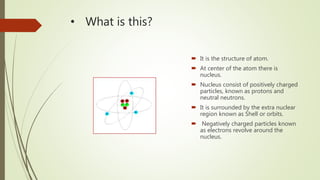
• What is this?
 It is the structure of atom.
 At center of the atom there is
nucleus.
 Nucleus consist of positively charged
particles, known as protons and
neutral neutrons.
 It is surrounded by the extra nuclear
region known as Shell or orbits.
 Negatively charged particles known
as electrons revolve around the
nucleus.
Proton(s)
 It is situated inside the nucleus.
 It is positively charged.
 It is denoted by p+
Electron(s)
 Negatively charged
 Revolves in fixed path known as
orbits.
 Mass in negligible
 Denoted by e-.
• Atomic number
 Number of protons or number of electrons in the atom.
Denoted by the letter Z
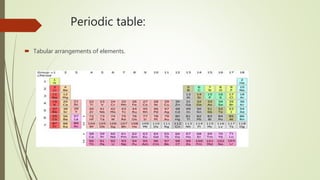
Periodic table:
 Tabular arrangements of elements.
 It is given by Henry Moseley.
 Elements are classified according to increasing order of the atomic number.
 Hydrogen is the first element in the table with atomic number 1.
 18 vertical columns known as groups
 7 horizontal rows known as periods.
Law: Physical and chemical properties of the
elements are periodic function of their atomic
number.
 Similar properties are repeated after regular interval of time.
 Elements in the same group posses similar chemical properties.
Foe eg
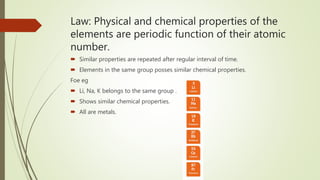
 Li, Na, K belongs to the same group .
 Shows similar chemical properties.
 All are metals.
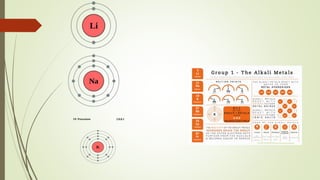
Group 1: Alkali metals
 Highly reactive metals.
 Li,Na, K
 Reacts with water to form hydroxides.
 Have one valence electron in their
outermost orbit.
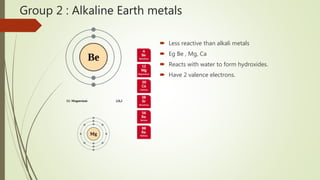
Group 2 : Alkaline Earth metals
 Less reactive than alkali metals
 Eg Be , Mg, Ca
 Reacts with water to form hydroxides.
 Have 2 valence electrons.
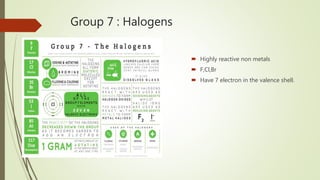
Group 7 : Halogens
 Highly reactive non metals
 F,Cl,Br
 Have 7 electron in the valence shell.

Periodic table Grade 7

  • 1.
  • 2.
    Fill in theblank 1. Any thing which has mass, occupies space and can be perceive through our senses is called as ___________ Matter 2. Matter is made up of __________. Atoms
  • 3.
    • What isthis?  It is the structure of atom.  At center of the atom there is nucleus.  Nucleus consist of positively charged particles, known as protons and neutral neutrons.  It is surrounded by the extra nuclear region known as Shell or orbits.  Negatively charged particles known as electrons revolve around the nucleus.
  • 4.
    Proton(s)  It issituated inside the nucleus.  It is positively charged.  It is denoted by p+
  • 5.
    Electron(s)  Negatively charged Revolves in fixed path known as orbits.  Mass in negligible  Denoted by e-.
  • 6.
    • Atomic number Number of protons or number of electrons in the atom. Denoted by the letter Z
  • 8.
    Periodic table:  Tabulararrangements of elements.
  • 9.
     It isgiven by Henry Moseley.  Elements are classified according to increasing order of the atomic number.  Hydrogen is the first element in the table with atomic number 1.  18 vertical columns known as groups  7 horizontal rows known as periods.
  • 10.
    Law: Physical andchemical properties of the elements are periodic function of their atomic number.  Similar properties are repeated after regular interval of time.  Elements in the same group posses similar chemical properties. Foe eg  Li, Na, K belongs to the same group .  Shows similar chemical properties.  All are metals.
  • 11.
    Group 1: Alkalimetals  Highly reactive metals.  Li,Na, K  Reacts with water to form hydroxides.  Have one valence electron in their outermost orbit.
  • 13.
    Group 2 :Alkaline Earth metals  Less reactive than alkali metals  Eg Be , Mg, Ca  Reacts with water to form hydroxides.  Have 2 valence electrons.
  • 15.
    Group 7 :Halogens  Highly reactive non metals  F,Cl,Br  Have 7 electron in the valence shell.