Introduction


Made By :- Sanyam Ohra
      Class :- IX th A
   Submit To :- Veer Sir
       Roll No :- 20
Particles
• Atoms
• molecules
What's an atom?

                 Definition:
A microscopic small particle that could not
be made any smaller and still behave as a
 chemical system. Atoms are the smallest
   particles that can exist and represent
    elements identity. Atoms cannot be
           created or destroyed
Atoms

• Atoms consist of protons, neutrons, electrons
• The atomic structure is shown in the diagram
  below
• Protons have positive charge
• Electrons have negative charge
• Neutrons have no charge
ATOMIC STRUCTURE
ATOMIC STRUCTURE
Properties
           Particle    Mass (kg)         Mass (amu)#    Charge*

Electron              9.10939 x 10 -31    0.00055 = 0     -1

Proton                1.67262 x 10 -27    1.00728 = 1     +1

Neutron               1.67493 x 10 -27    1.00866 = 1      0
Atoms

•   Sub-atomic particles
•   Electrons
•   Protons
•   Neutrons
ATOMIC PARTICLES:

• Atoms consist of three subatomic particles:
• electrons
  – electrons are negatively charged particles and their
    properties are summarized in the following table
• protons
  – protons are positively charged particles and their
    properties are summarized in the following table
• neutrons
  – neutrons have no charge and their properties are
    summarized in the following table
ELECTRONS
•   Small negatively charged particle
•   Orbit, circle, around the nucleus
•   Have no mass.
•   Atoms are neutral.
•   Number of electrons = number of protons
PROTONS:

• small, positively charged particles
• reside in the nucleus
• along with the neutron, make up most of the
  mass of the atom
• the number of protons is what defines the
  type of a particular atom.
• Atoms are neutral
• Number of protons = number of electrons
NEUTRONS:

• small particles with no charge
• reside in the nucleus
• along with the proton, make up most of the
  mass of the atom
ATOMS--Dalton's Atomic Theory

• All matter (including elements) is composed of
  atoms; each atom is a very small, chemically
  indivisible particle
  – the word 'atom' is from the Greek word "atmos"
    which means "cannot be cut apart"
• elements are different because they are
  composed of different types of atoms
• each type of atom has properties different
  from other atoms
Atomic theory of matter
• Matter composed of atoms
• Atoms of given element have identical
  properties
• Different elements have different properties
• Atoms combine in whole number ratios
• Not created or destroyed in ordinary chemical
  reactions
What's a molecule?

              Definition:
The smallest particles of an element or
 compound that can exist and retain the
 chemical properties of that element or
               compound
Molecules
•Molecular formula gives composition:
number of atoms of each element
present
•Molecular mass= sum of masses of
atoms
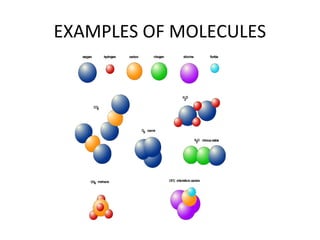
EXAMPLES OF MOLECULES
Examples of molecules
Representing molecules
• Names: ethanol, ethyl alcohol

•Formulas: C2H8O, C2H5OH, CH3CH2OH

•Structural drawings

•Models

Sanyam ohra

  • 1.
    Introduction Made By :-Sanyam Ohra Class :- IX th A Submit To :- Veer Sir Roll No :- 20
  • 2.
  • 3.
    What's an atom? Definition: A microscopic small particle that could not be made any smaller and still behave as a chemical system. Atoms are the smallest particles that can exist and represent elements identity. Atoms cannot be created or destroyed
  • 4.
    Atoms • Atoms consistof protons, neutrons, electrons • The atomic structure is shown in the diagram below • Protons have positive charge • Electrons have negative charge • Neutrons have no charge
  • 5.
  • 6.
  • 7.
    Properties Particle Mass (kg) Mass (amu)# Charge* Electron 9.10939 x 10 -31 0.00055 = 0 -1 Proton 1.67262 x 10 -27 1.00728 = 1 +1 Neutron 1.67493 x 10 -27 1.00866 = 1 0
  • 8.
    Atoms • Sub-atomic particles • Electrons • Protons • Neutrons
  • 9.
    ATOMIC PARTICLES: • Atomsconsist of three subatomic particles: • electrons – electrons are negatively charged particles and their properties are summarized in the following table • protons – protons are positively charged particles and their properties are summarized in the following table • neutrons – neutrons have no charge and their properties are summarized in the following table
  • 10.
    ELECTRONS • Small negatively charged particle • Orbit, circle, around the nucleus • Have no mass. • Atoms are neutral. • Number of electrons = number of protons
  • 11.
    PROTONS: • small, positivelycharged particles • reside in the nucleus • along with the neutron, make up most of the mass of the atom • the number of protons is what defines the type of a particular atom. • Atoms are neutral • Number of protons = number of electrons
  • 12.
    NEUTRONS: • small particleswith no charge • reside in the nucleus • along with the proton, make up most of the mass of the atom
  • 13.
    ATOMS--Dalton's Atomic Theory •All matter (including elements) is composed of atoms; each atom is a very small, chemically indivisible particle – the word 'atom' is from the Greek word "atmos" which means "cannot be cut apart" • elements are different because they are composed of different types of atoms • each type of atom has properties different from other atoms
  • 14.
    Atomic theory ofmatter • Matter composed of atoms • Atoms of given element have identical properties • Different elements have different properties • Atoms combine in whole number ratios • Not created or destroyed in ordinary chemical reactions
  • 15.
    What's a molecule? Definition: The smallest particles of an element or compound that can exist and retain the chemical properties of that element or compound
  • 16.
    Molecules •Molecular formula givescomposition: number of atoms of each element present •Molecular mass= sum of masses of atoms
  • 17.
  • 18.
  • 19.
    Representing molecules • Names:ethanol, ethyl alcohol •Formulas: C2H8O, C2H5OH, CH3CH2OH •Structural drawings •Models