Welcome to the science presentation 
of Formative Assessment-3 
The topic we are going to 
discuss now is
Group Members 
Chirag jain 
Sanyam jain 
Risahbh 
Deepanshu 
Akshay 
Tushant 
Uttkarsh 
Swarndeep 
Gaurav
1. Metals are malleable , that is , metals 
can be beaten into thin sheets with a 
hammer . 
2. Metals are ductile , that is , metals can 
be drawn into thin wires. 
3. Metals are good conductors of heat . 
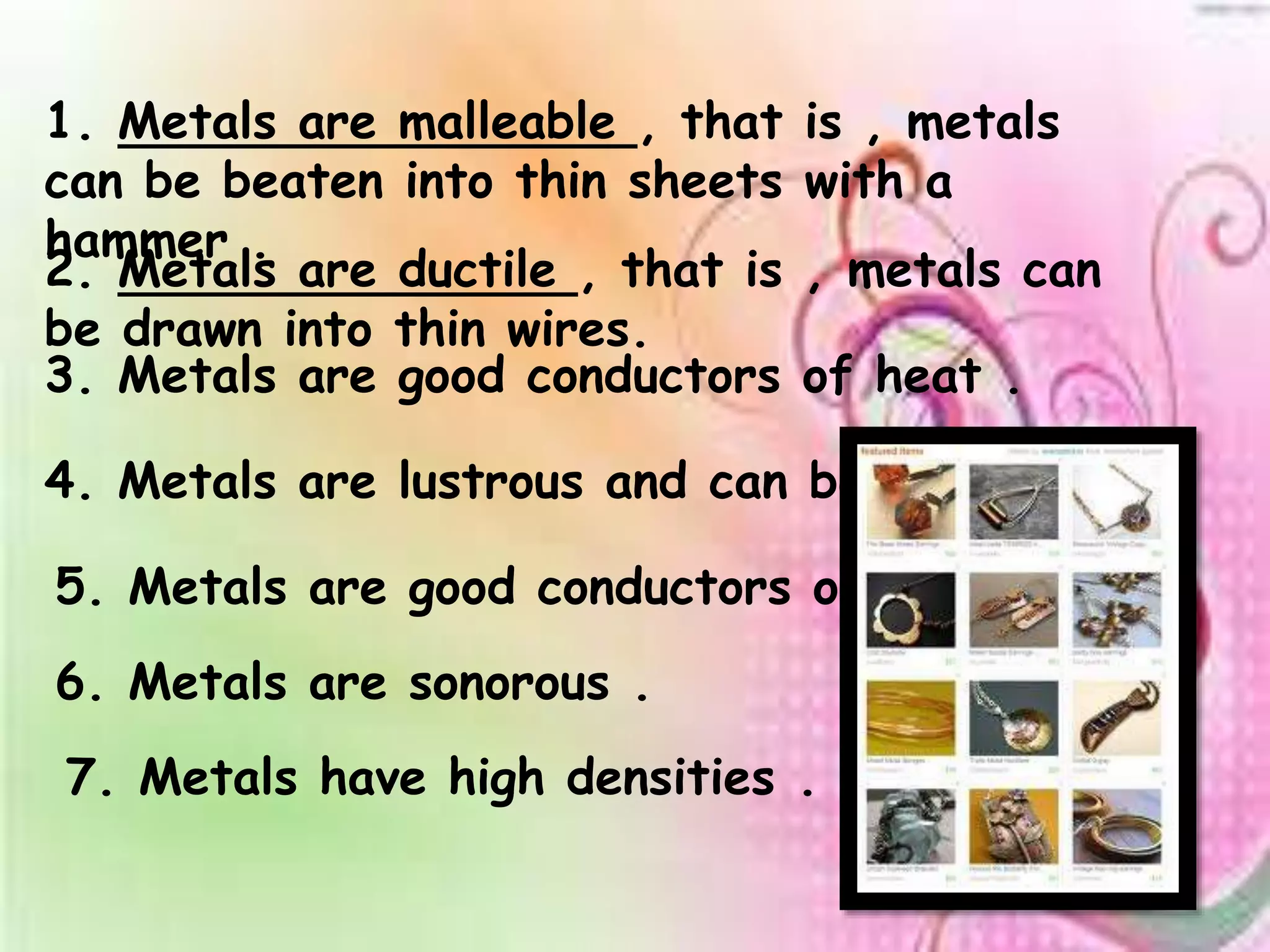
4. Metals are lustrous and can be polished . 
5. Metals are good conductors of electricity . 
6. Metals are sonorous . 
7. Metals have high densities .
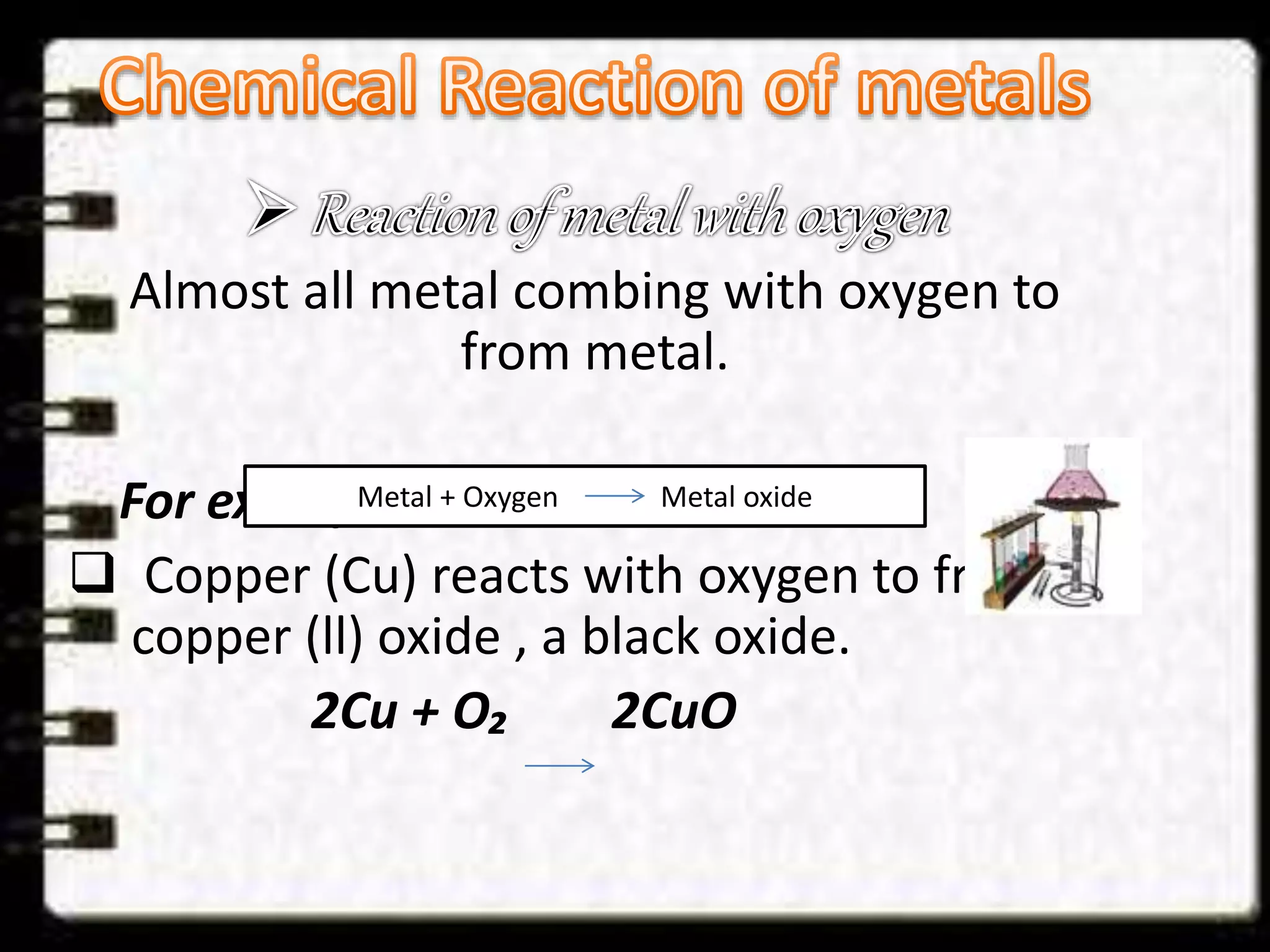
Almost all metal combing with oxygen to 
from metal. 
For example:- 
Metal + Oxygen Metal oxide 
 Copper (Cu) reacts with oxygen to from 
copper (ll) oxide , a black oxide. 
2Cu + O₂ 2CuO
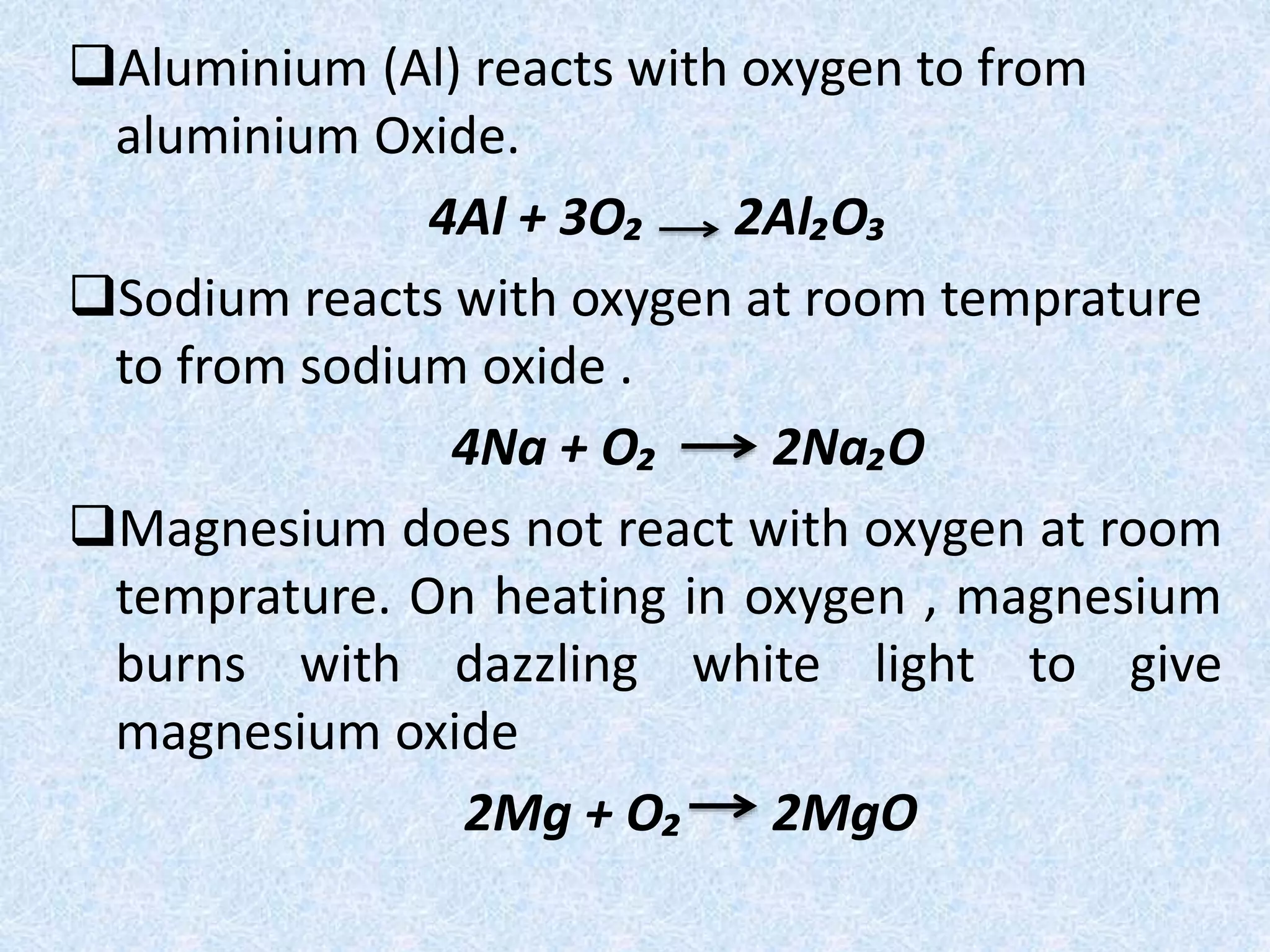
Aluminium (Al) reacts with oxygen to from 
aluminium Oxide. 
4Al + 3O₂ 2Al₂O₃ 
Sodium reacts with oxygen at room temprature 
to from sodium oxide . 
4Na + O₂ 2Na₂O 
Magnesium does not react with oxygen at room 
temprature. On heating in oxygen , magnesium 
burns with dazzling white light to give 
magnesium oxide 
2Mg + O₂ 2MgO
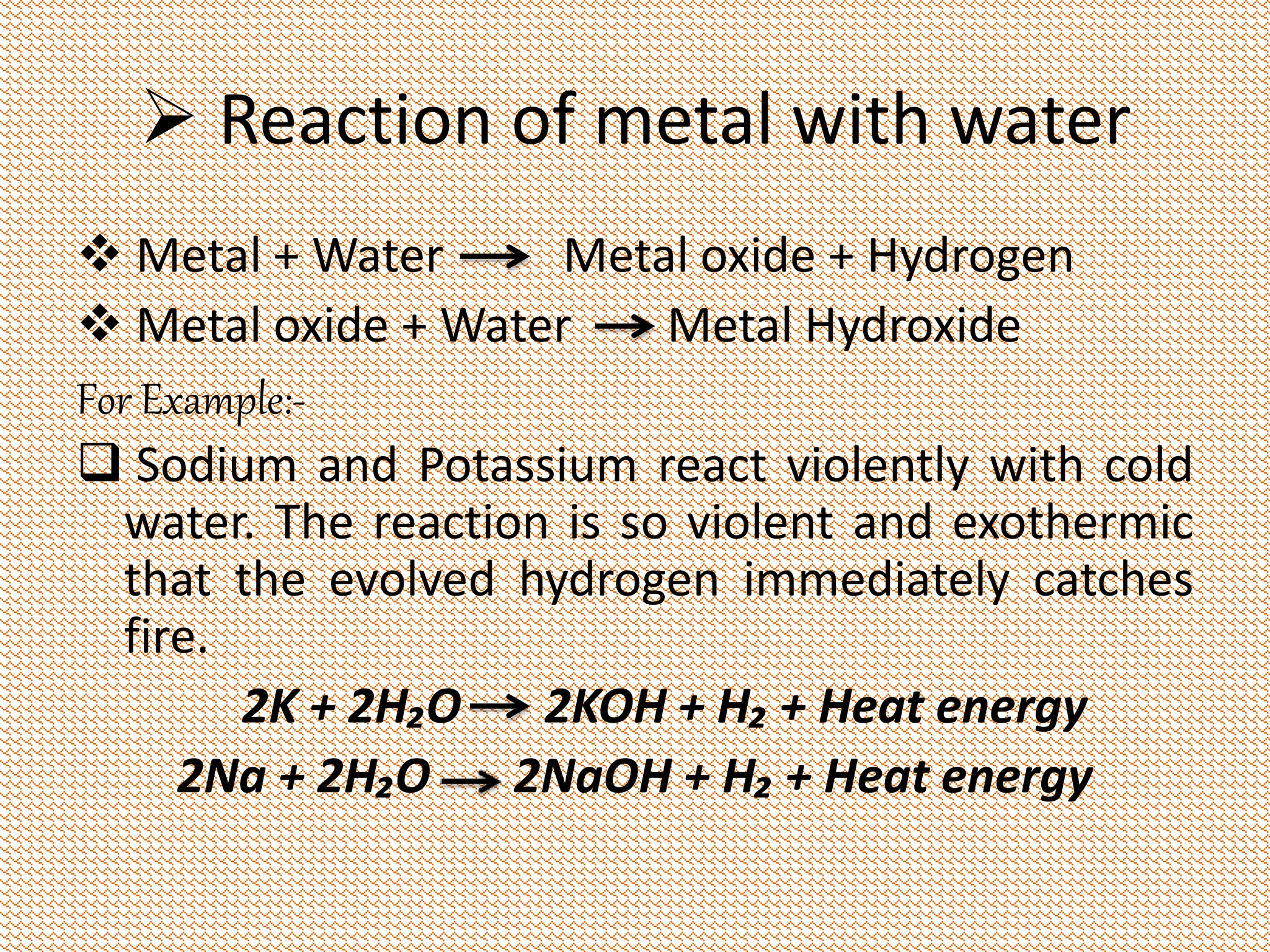
 Reaction of metal with water 
 Metal + Water Metal oxide + Hydrogen 
 Metal oxide + Water Metal Hydroxide 
For Example:- 
 Sodium and Potassium react violently with cold 
water. The reaction is so violent and exothermic 
that the evolved hydrogen immediately catches 
fire. 
2K + 2H₂O 2KOH + H₂ + Heat energy 
2Na + 2H₂O 2NaOH + H₂ + Heat energy
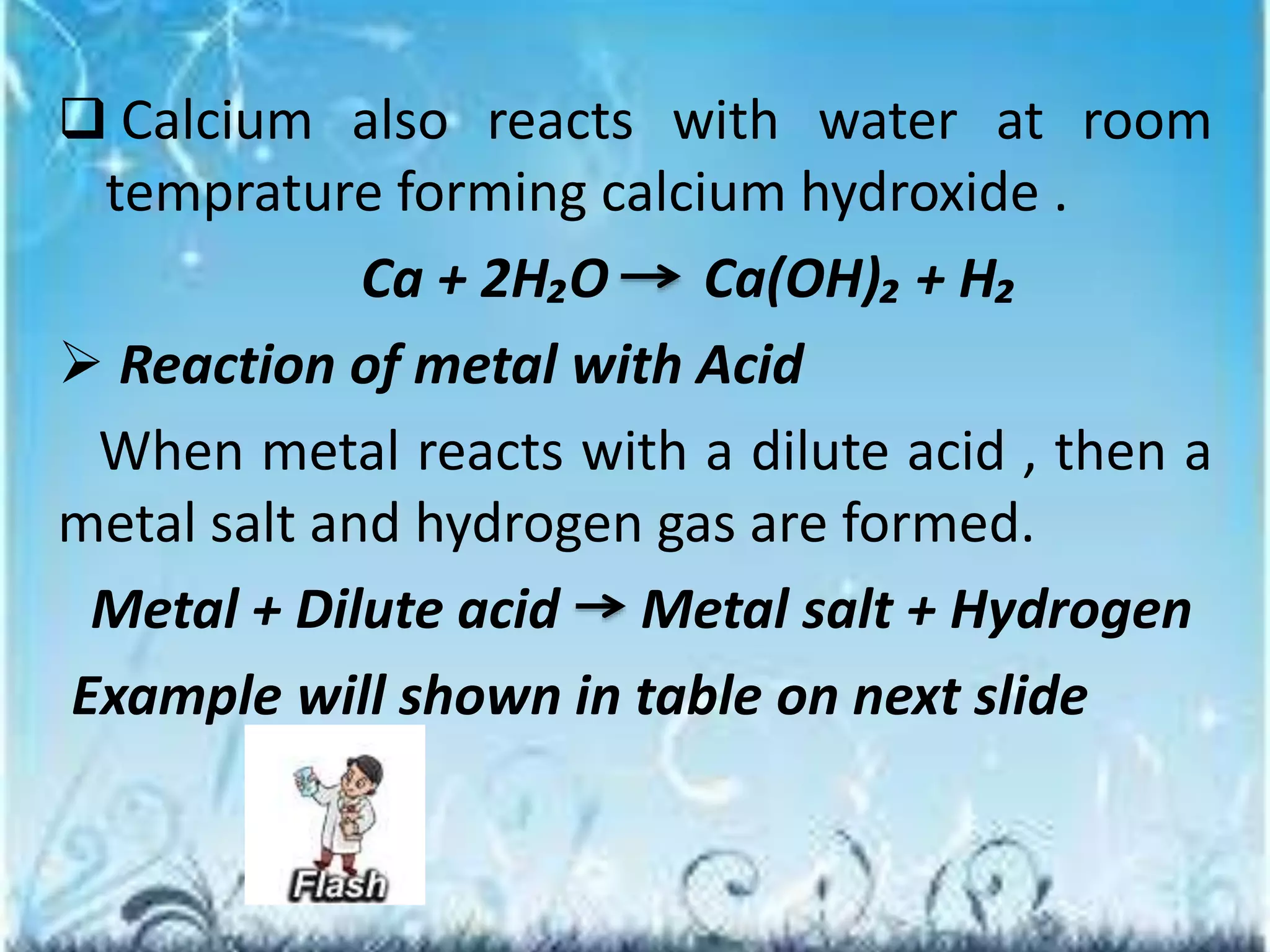
 Calcium also reacts with water at room 
temprature forming calcium hydroxide . 
Ca + 2H₂O Ca(OH)₂ + H₂ 
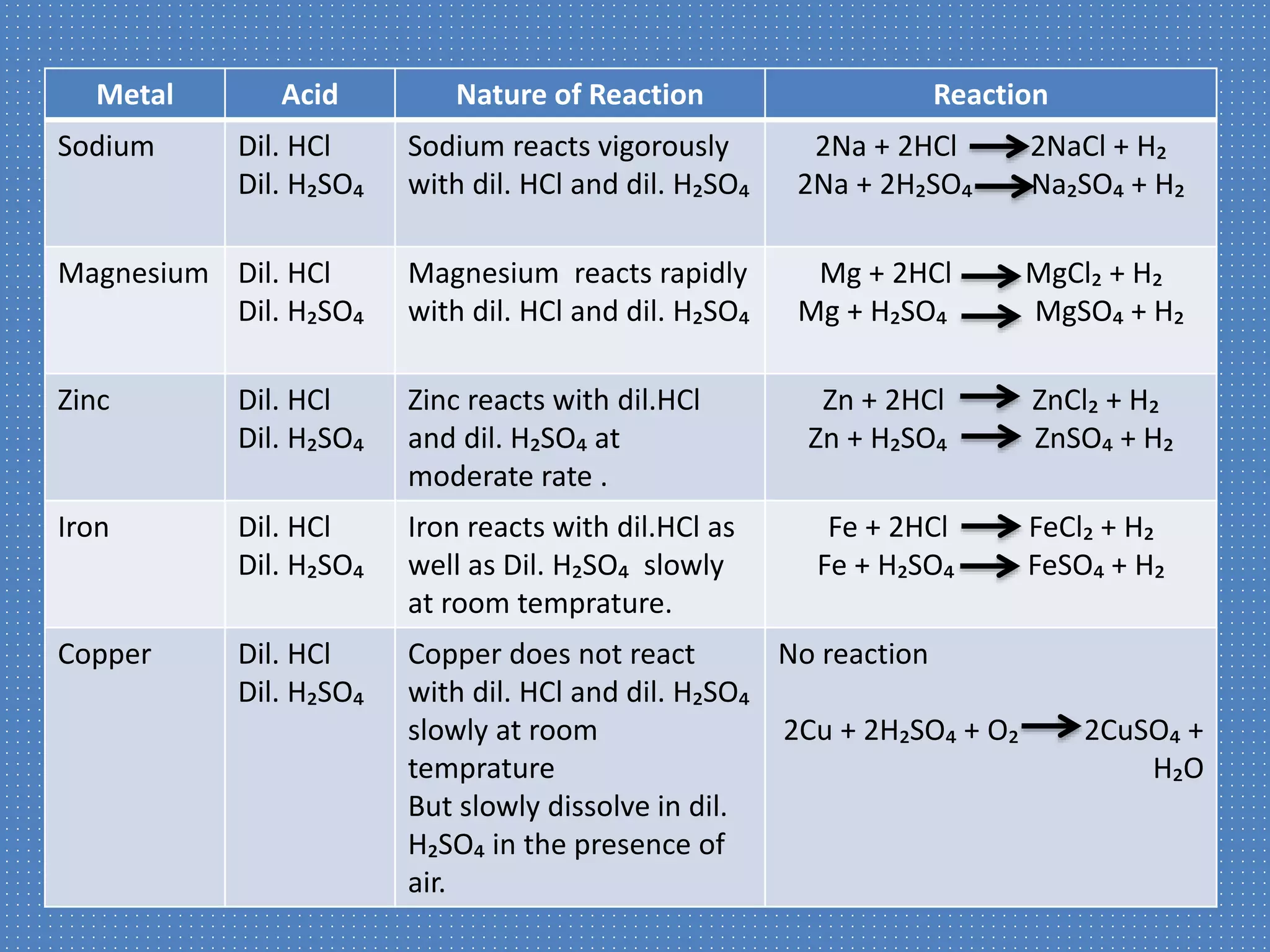
 Reaction of metal with Acid 
When metal reacts with a dilute acid , then a 
metal salt and hydrogen gas are formed. 
Metal + Dilute acid Metal salt + Hydrogen 
Example will shown in table on next slide
Metal Acid Nature of Reaction Reaction 
Sodium Dil. HCl 
Dil. H₂SO₄ 
Sodium reacts vigorously 
with dil. HCl and dil. H₂SO₄ 
2Na + 2HCl 2NaCl + H₂ 
2Na + 2H₂SO₄ Na₂SO₄ + H₂ 
Magnesium Dil. HCl 
Dil. H₂SO₄ 
Magnesium reacts rapidly 
with dil. HCl and dil. H₂SO₄ 
Mg + 2HCl MgCl₂ + H₂ 
Mg + H₂SO₄ MgSO₄ + H₂ 
Zinc Dil. HCl 
Dil. H₂SO₄ 
Zinc reacts with dil.HCl 
and dil. H₂SO₄ at 
moderate rate . 
Zn + 2HCl ZnCl₂ + H₂ 
Zn + H₂SO₄ ZnSO₄ + H₂ 
Iron Dil. HCl 
Dil. H₂SO₄ 
Iron reacts with dil.HCl as 
well as Dil. H₂SO₄ slowly 
at room temprature. 
Fe + 2HCl FeCl₂ + H₂ 
Fe + H₂SO₄ FeSO₄ + H₂ 
Copper Dil. HCl 
Dil. H₂SO₄ 
Copper does not react 
with dil. HCl and dil. H₂SO₄ 
slowly at room 
temprature 
But slowly dissolve in dil. 
H₂SO₄ in the presence of 
air. 
No reaction 
2Cu + 2H₂SO₄ + O₂ 2CuSO₄ + 
H₂O
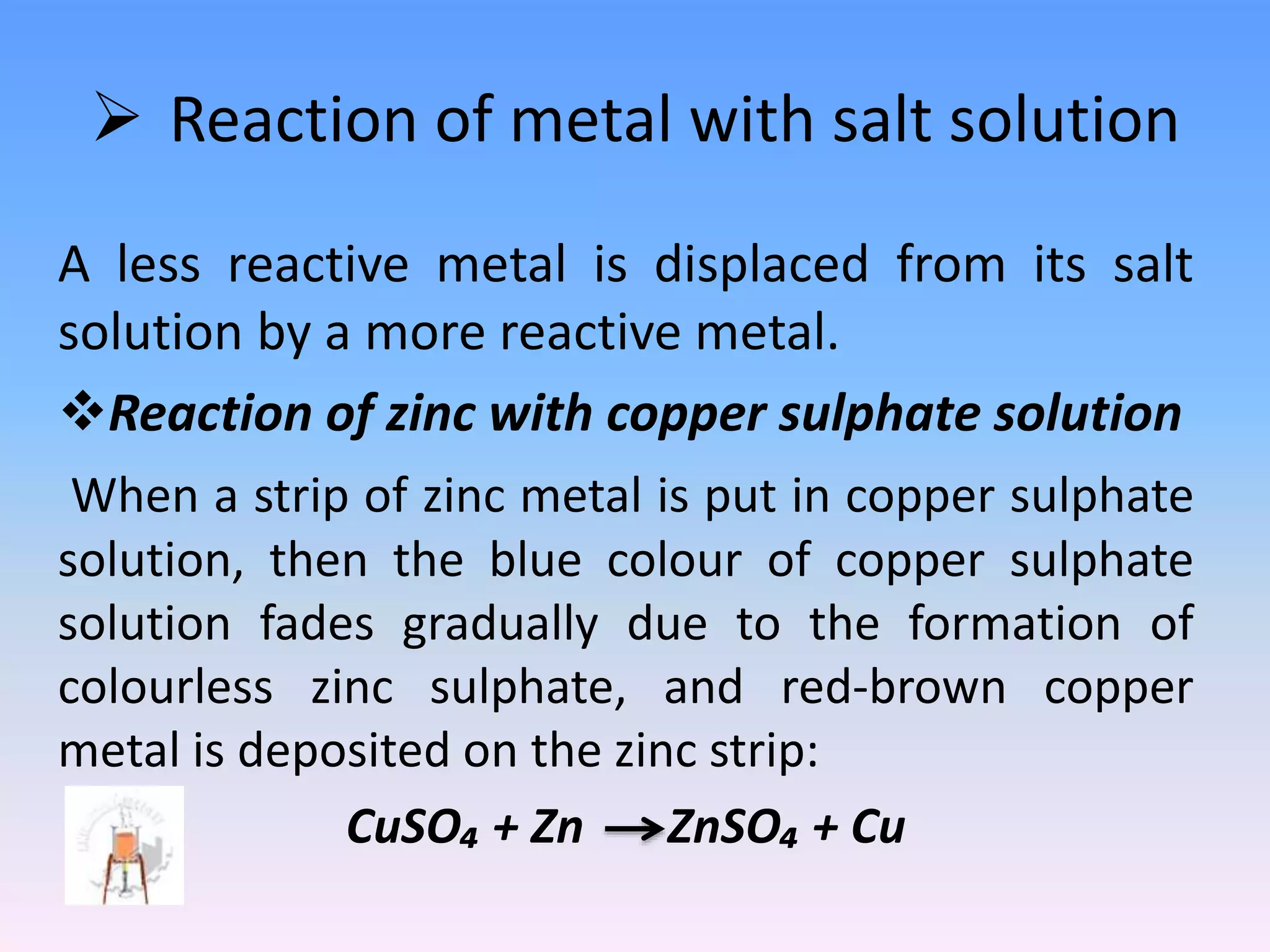
 Reaction of metal with salt solution 
A less reactive metal is displaced from its salt 
solution by a more reactive metal. 
Reaction of zinc with copper sulphate solution 
When a strip of zinc metal is put in copper sulphate 
solution, then the blue colour of copper sulphate 
solution fades gradually due to the formation of 
colourless zinc sulphate, and red-brown copper 
metal is deposited on the zinc strip: 
CuSO₄ + Zn ZnSO₄ + Cu
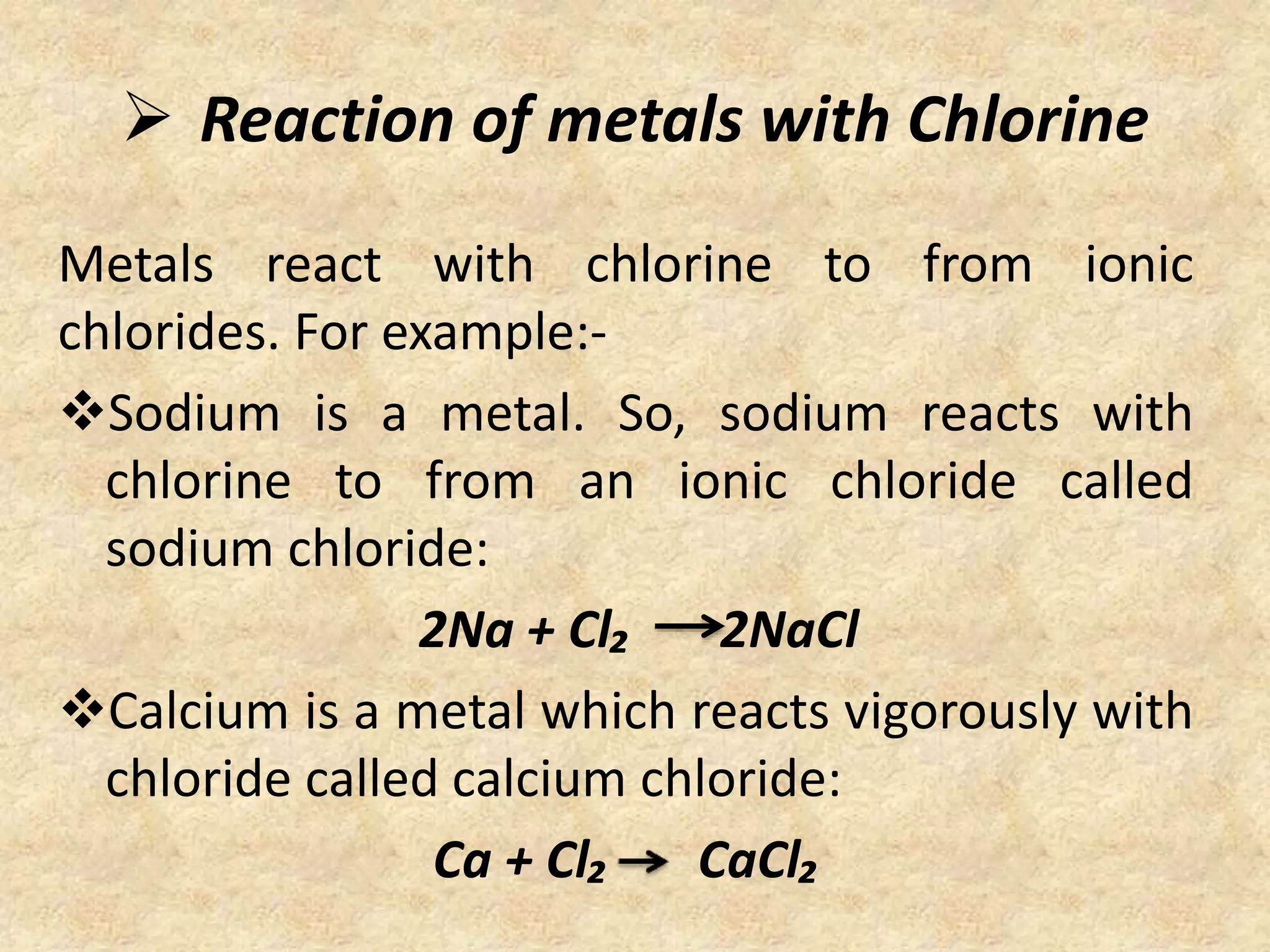
 Reaction of metals with Chlorine 
Metals react with chlorine to from ionic 
chlorides. For example:- 
Sodium is a metal. So, sodium reacts with 
chlorine to from an ionic chloride called 
sodium chloride: 
2Na + Cl₂ 2NaCl 
Calcium is a metal which reacts vigorously with 
chloride called calcium chloride: 
Ca + Cl₂ CaCl₂
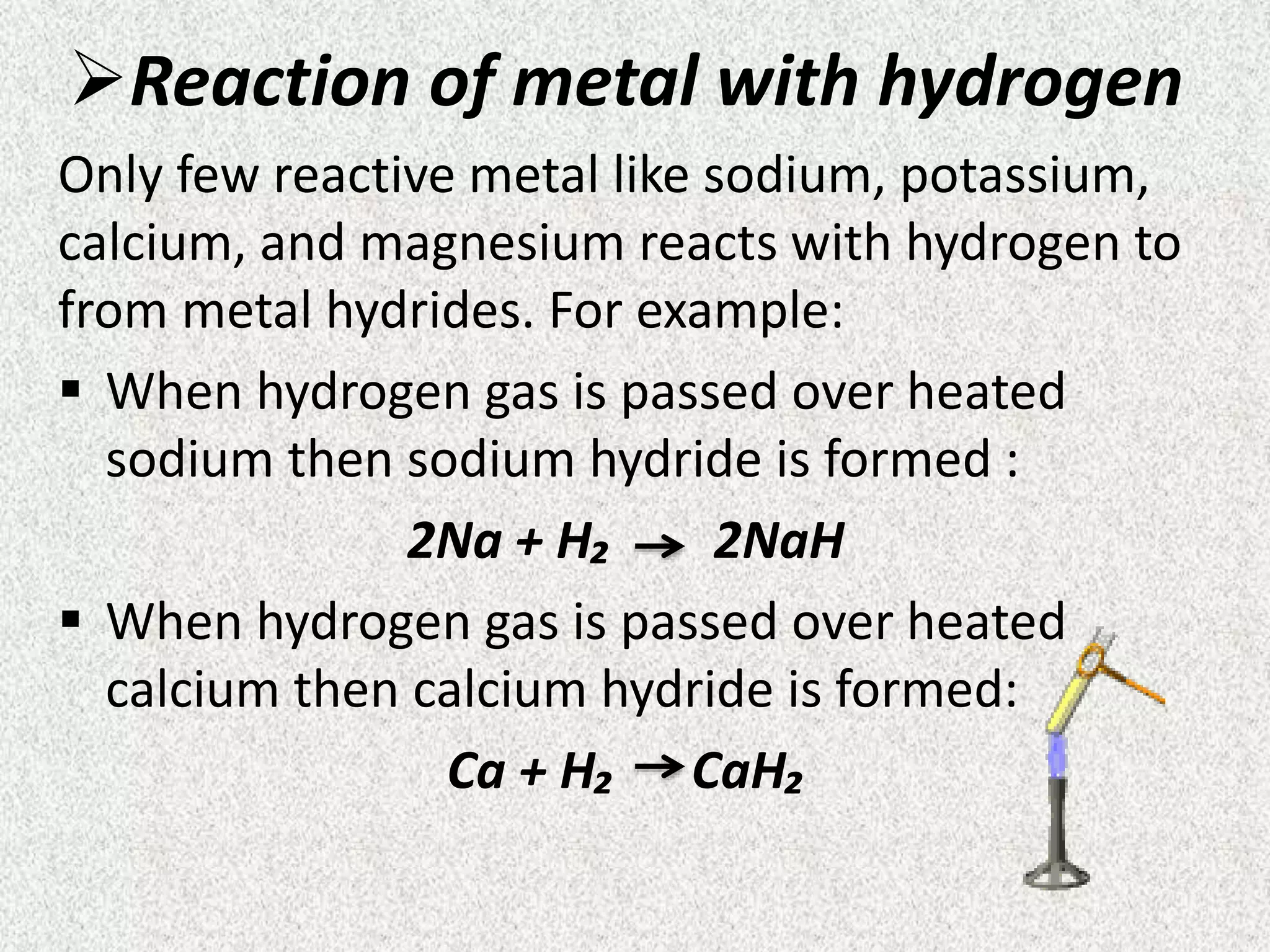
Reaction of metal with hydrogen 
Only few reactive metal like sodium, potassium, 
calcium, and magnesium reacts with hydrogen to 
from metal hydrides. For example: 
 When hydrogen gas is passed over heated 
sodium then sodium hydride is formed : 
2Na + H₂ 2NaH 
 When hydrogen gas is passed over heated 
calcium then calcium hydride is formed: 
Ca + H₂ CaH₂
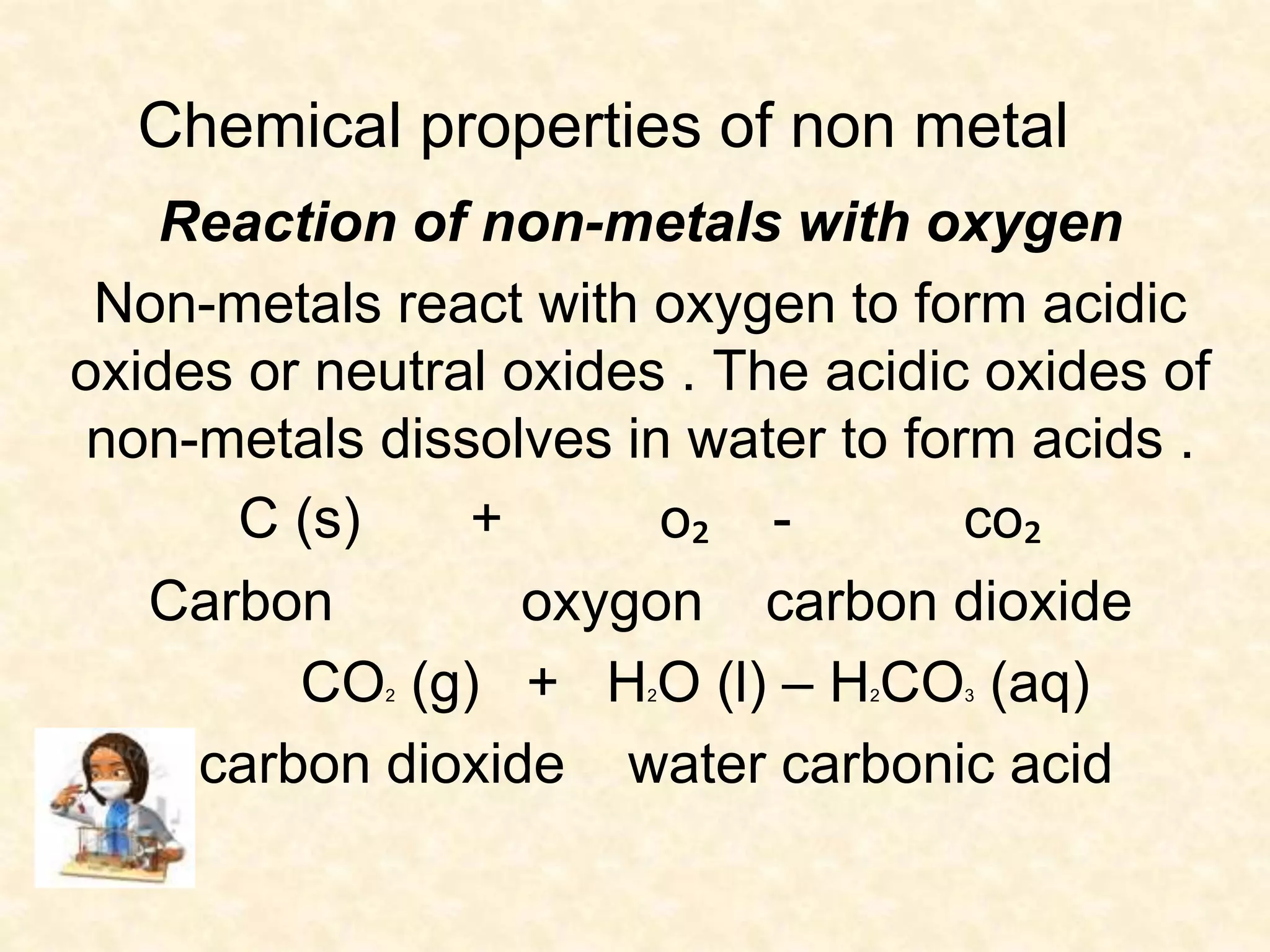
Chemical properties of non metal 
Reaction of non-metals with oxygen 
Non-metals react with oxygen to form acidic 
oxides or neutral oxides . The acidic oxides of 
non-metals dissolves in water to form acids . 
C (s) + o₂ - co₂ 
Carbon oxygon carbon dioxide 
CO2 (g) + H2O (l) – H2CO3 (aq) 
carbon dioxide water carbonic acid
Reaction of non-metals with water 
• Non-metals do not react with water to 
evolve hydrogen gas . This is because 
non-metals cannot give electrons to 
reduce the hydrogen ions of water into 
hydrogen gas
Reaction of non-metals with dilute acids 
Non-metals do not react with dilute acids . 
Non-metals do not displaces hydrogen from 
acids . Non-metals like carbon , sulphur or 
phosphorus are put into a test tube 
containing dilute sulphuric acid or dilute 
hydrochloric acid , then no hydrogen gas is 
evolved .
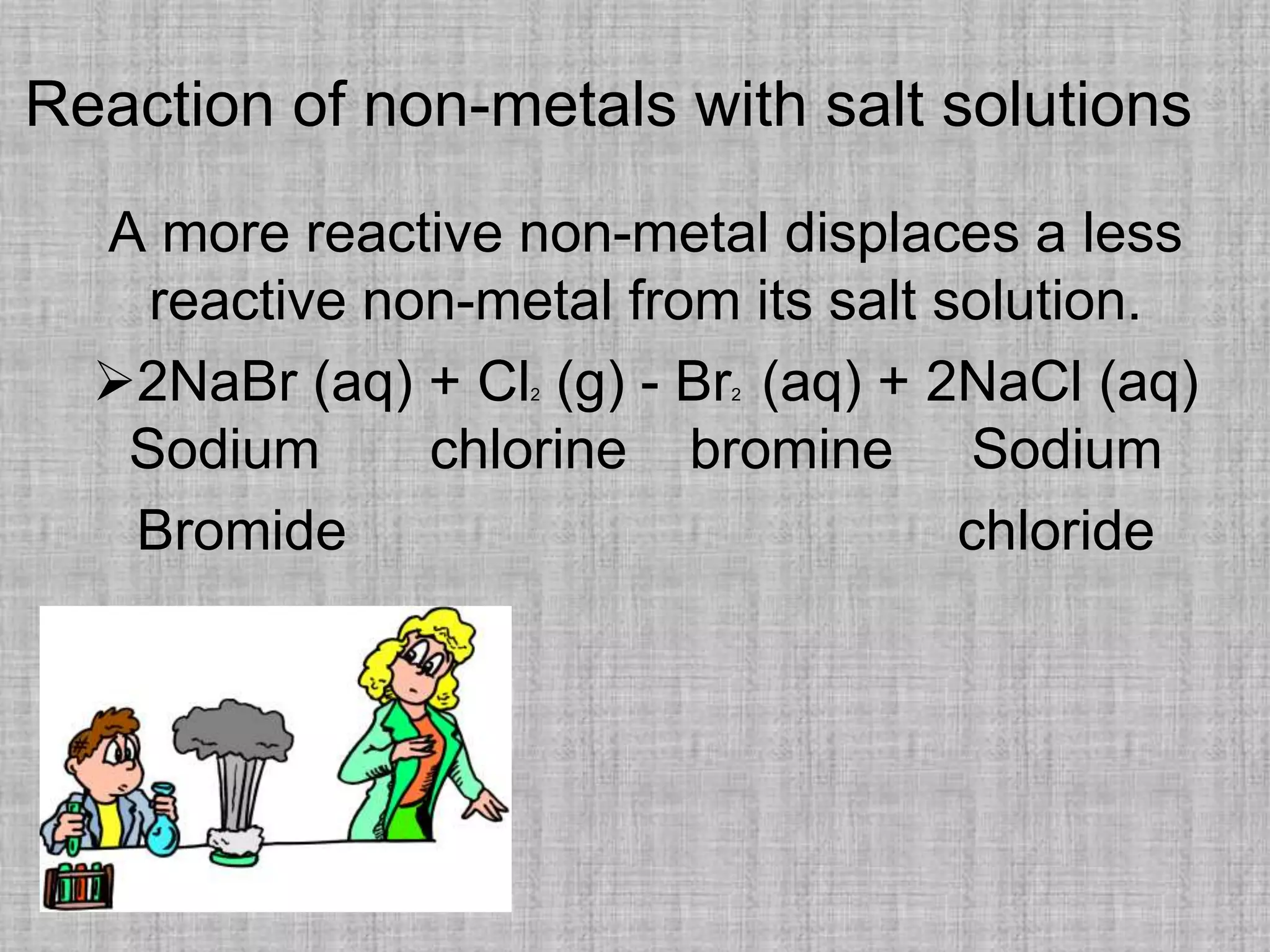
Reaction of non-metals with salt solutions 
A more reactive non-metal displaces a less 
reactive non-metal from its salt solution. 
2NaBr (aq) + Cl2 (g) - Br2 (aq) + 2NaCl (aq) 
Sodium chlorine bromine Sodium 
Bromide chloride
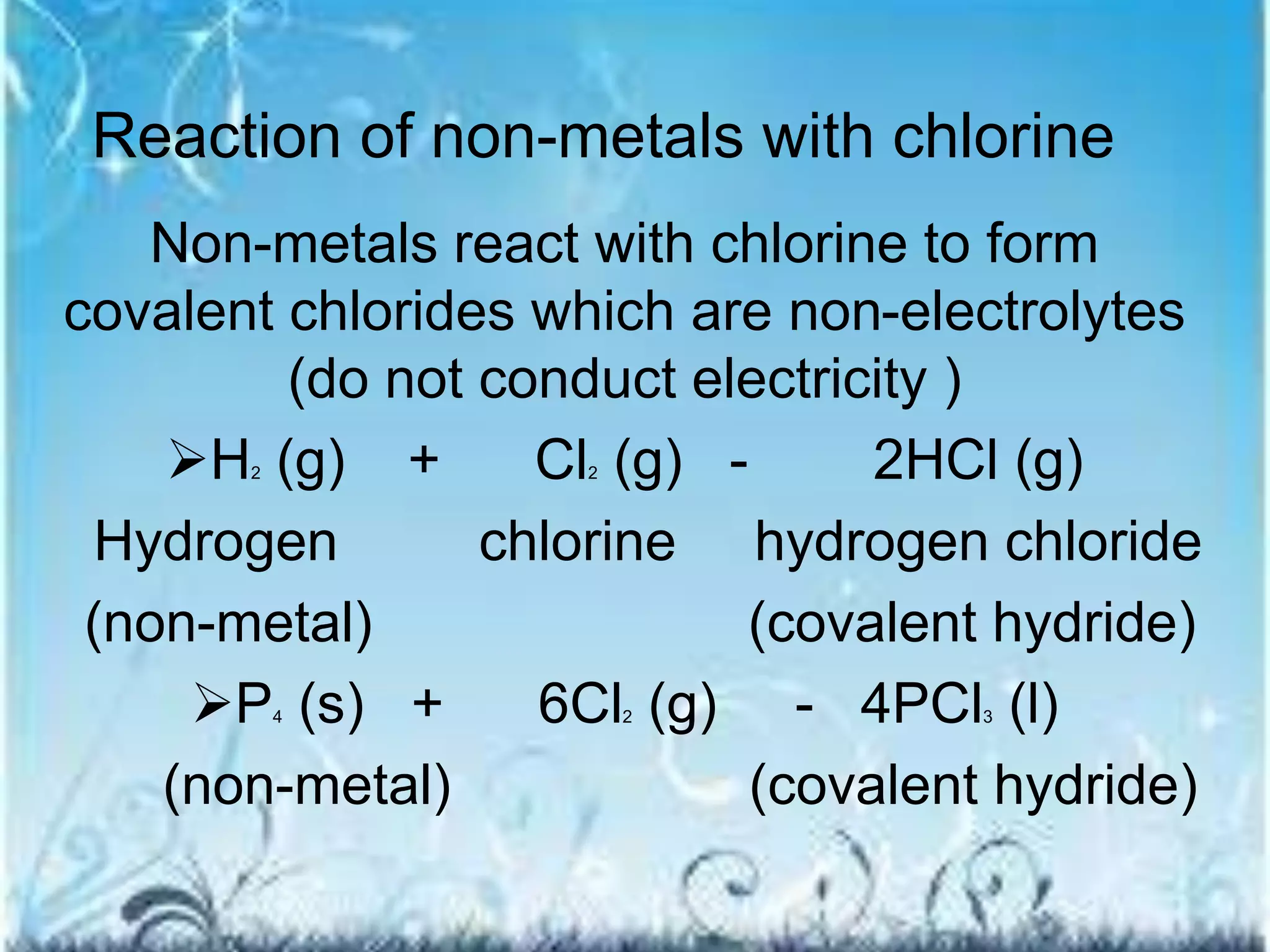
Reaction of non-metals with chlorine 
Non-metals react with chlorine to form 
covalent chlorides which are non-electrolytes 
(do not conduct electricity ) 
H2 (g) + Cl2 (g) - 2HCl (g) 
Hydrogen chlorine hydrogen chloride 
(non-metal) (covalent hydride) 
P4 (s) + 6Cl2 (g) - 4PCl3 (l) 
(non-metal) (covalent hydride)
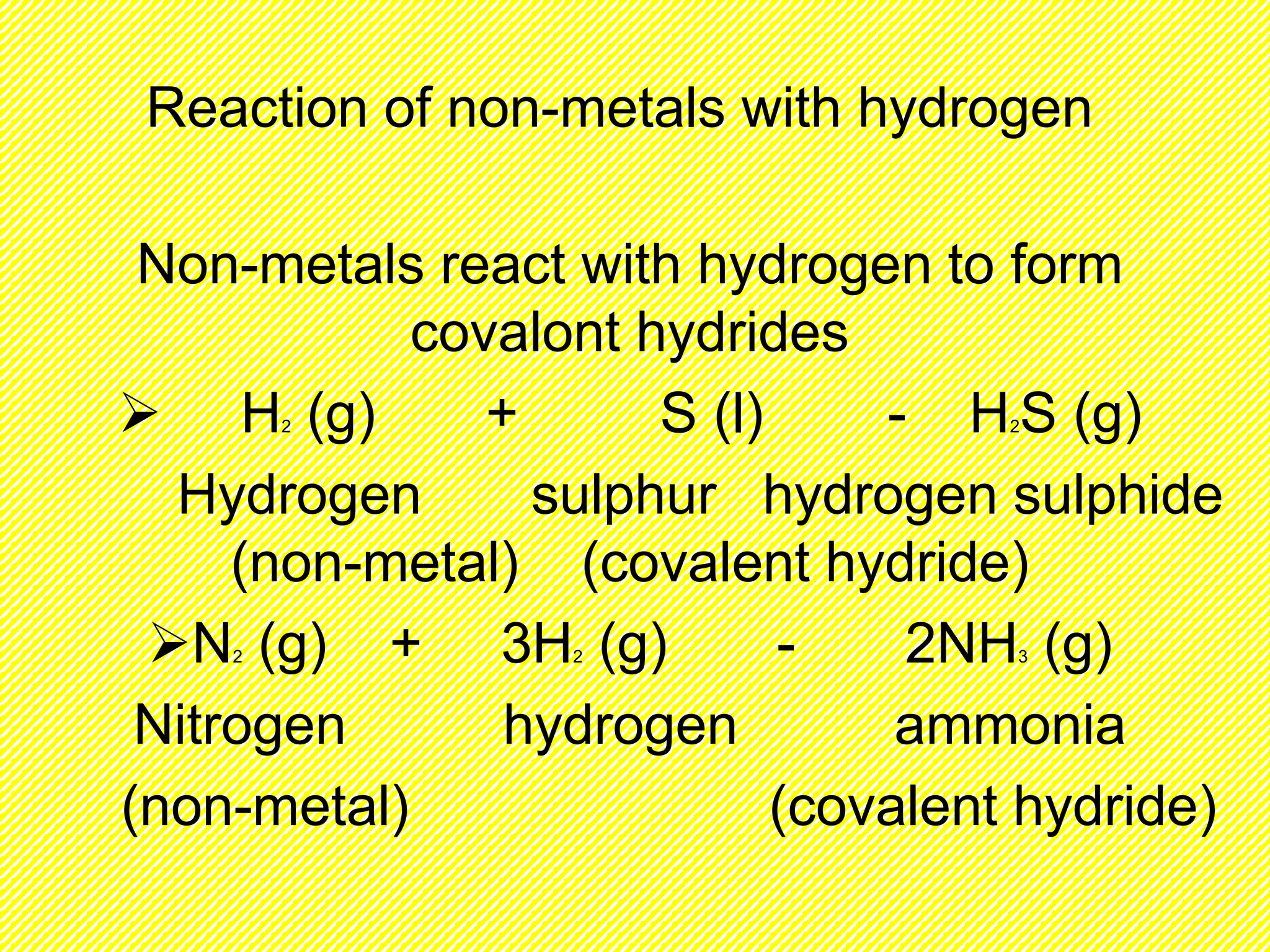
Reaction of non-metals with hydrogen 
Non-metals react with hydrogen to form 
covalont hydrides 
 H2 (g) + S (l) - H2S (g) 
Hydrogen sulphur hydrogen sulphide 
(non-metal) (covalent hydride) 
N2 (g) + 3H2 (g) - 2NH3 (g) 
Nitrogen hydrogen ammonia 
(non-metal) (covalent hydride)
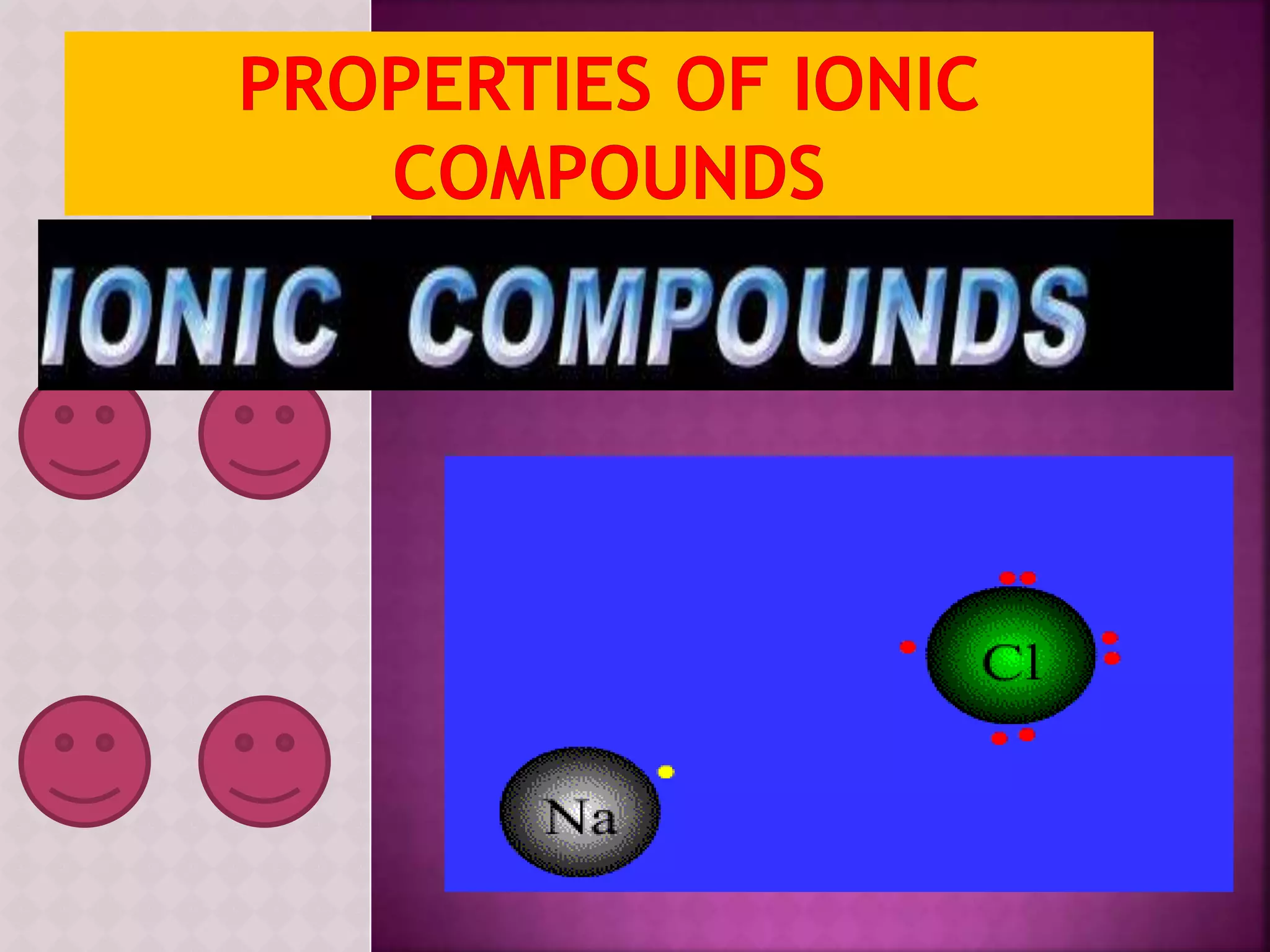
Ionic compounds 
The compounds containing ionic bonds 
are called ionic compounds.Theyare 
formed by transfer of electrons from one 
atom to another . Ionic compounds are 
made up of positively charged 
ions[cataions]+ and negatively charged 
ions [anions].Ionic compounds are 
also known as Electrovalent 
compounds.
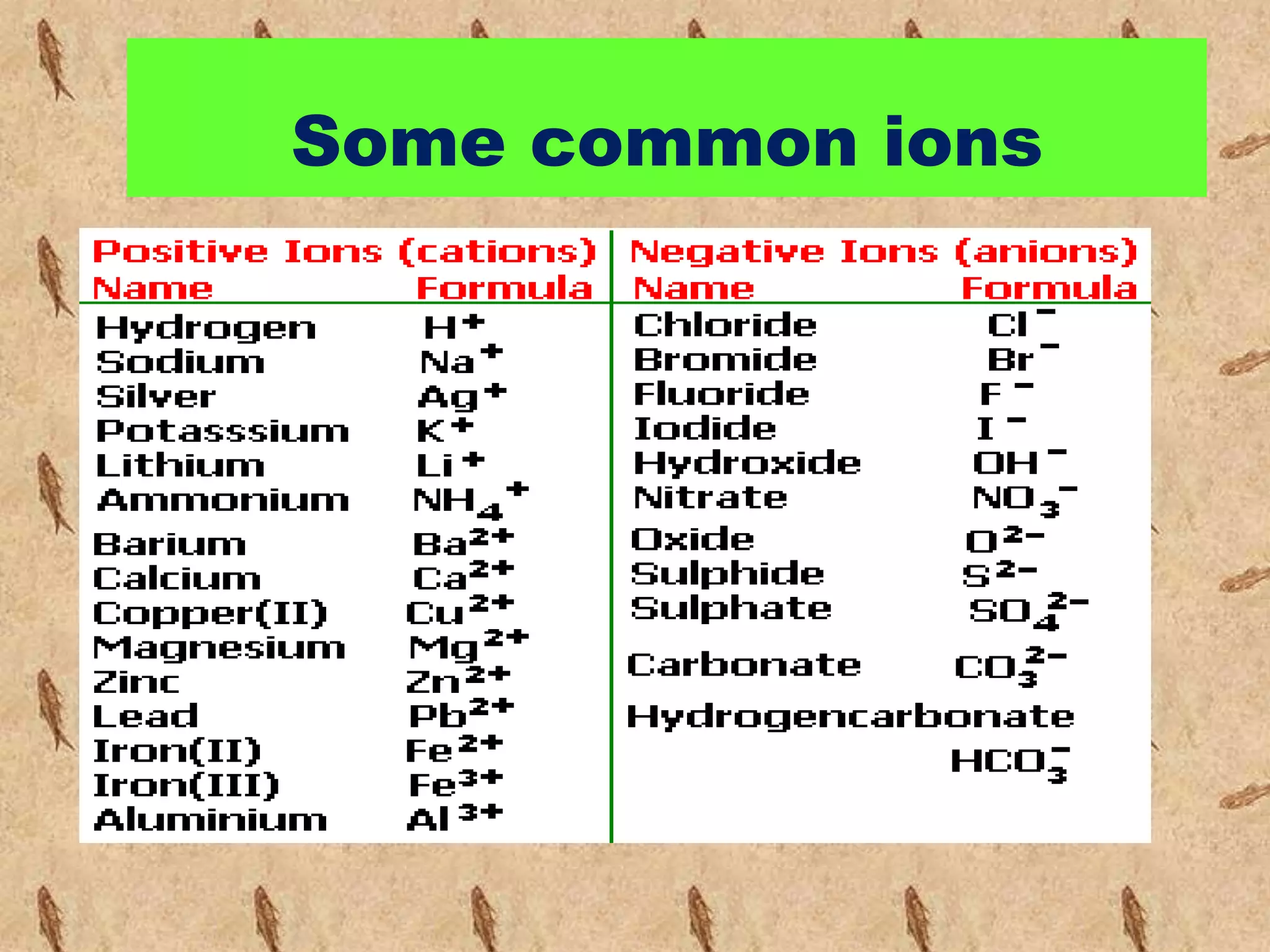
Some common ions
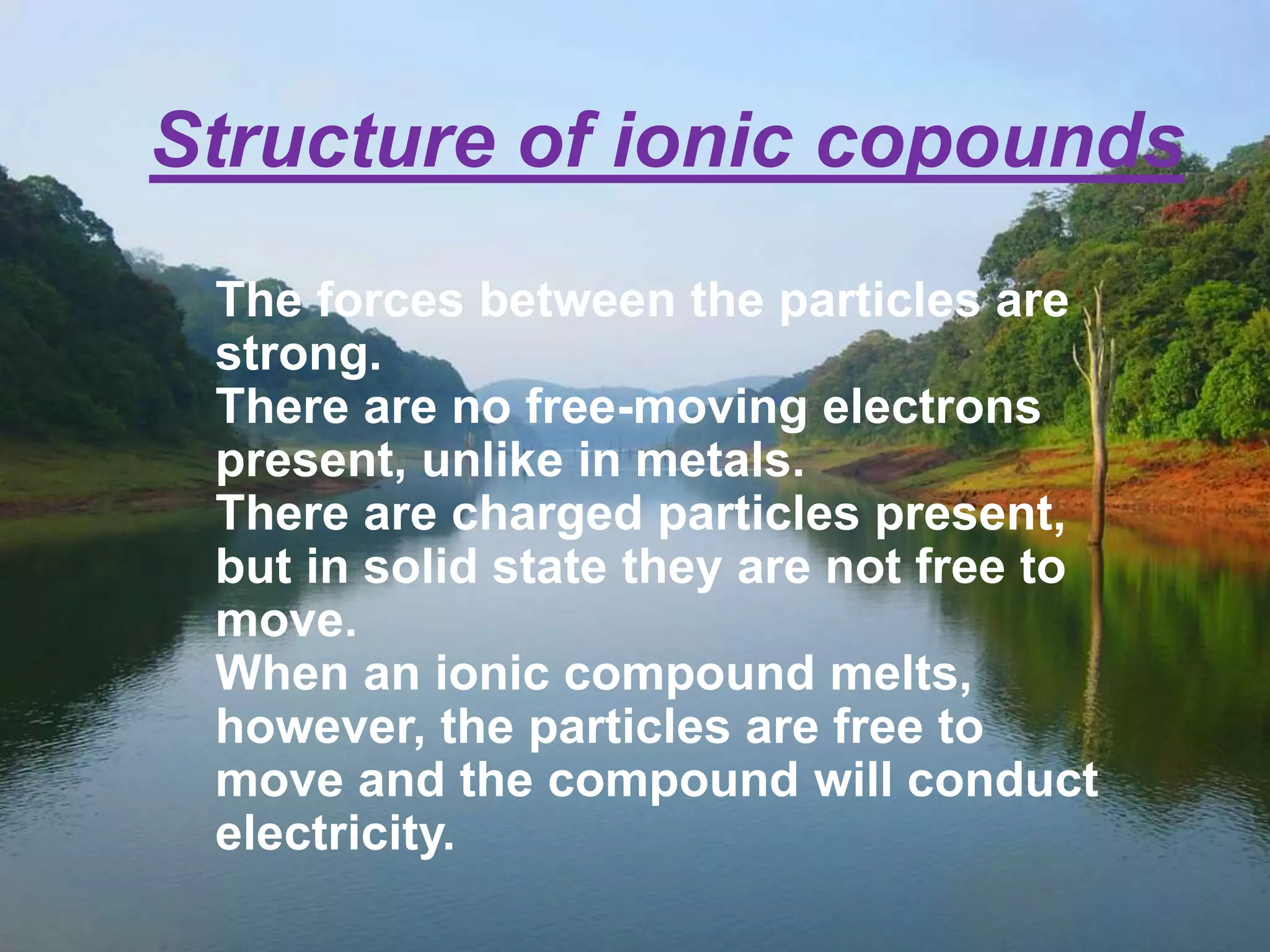
Structure of ionic copounds 
The forces between the particles are 
strong. 
There are no free-moving electrons 
present, unlike in metals. 
There are charged particles present, 
but in solid state they are not free to 
move. 
When an ionic compound melts, 
however, the particles are free to 
move and the compound will conduct 
electricity.
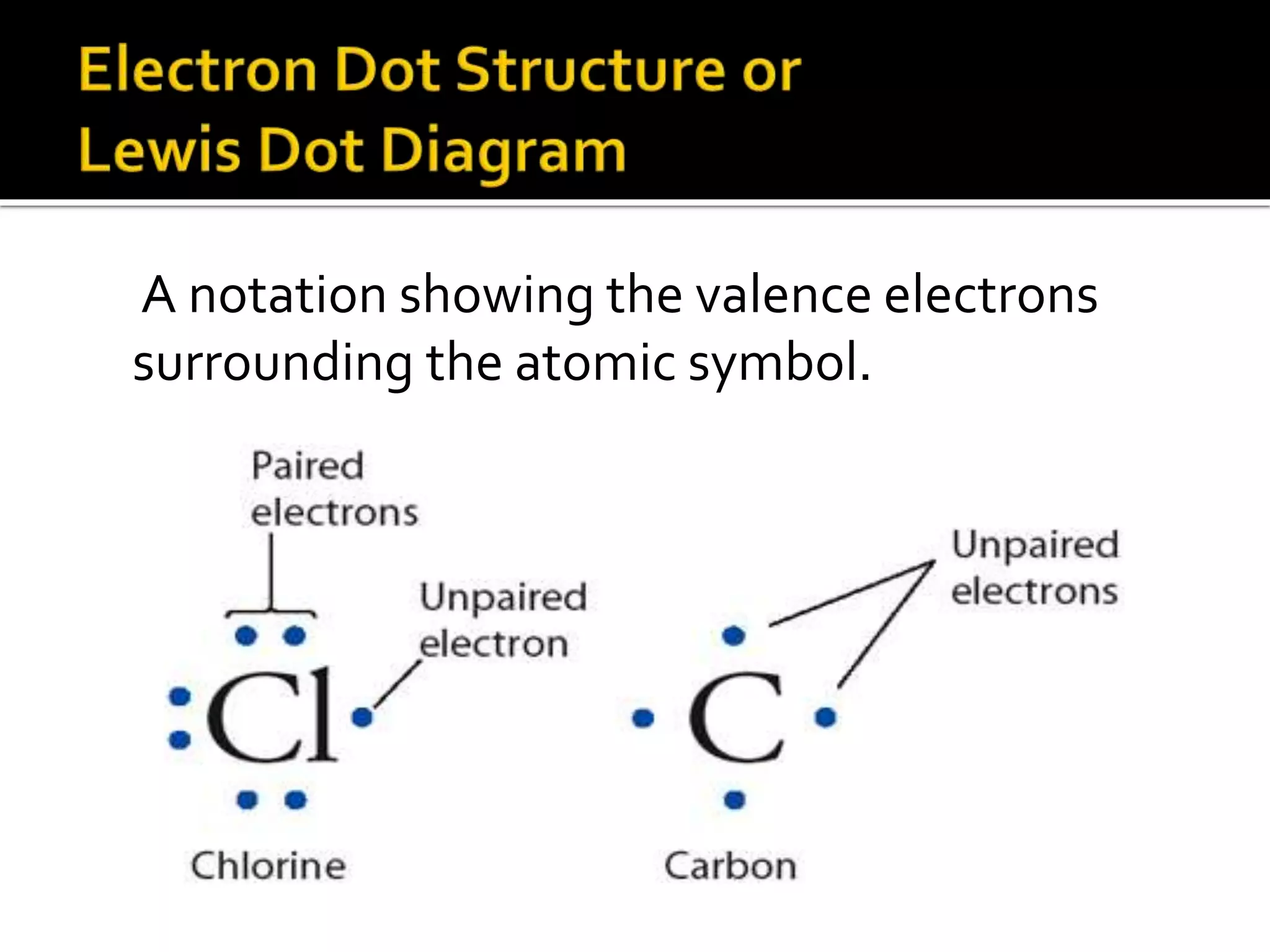
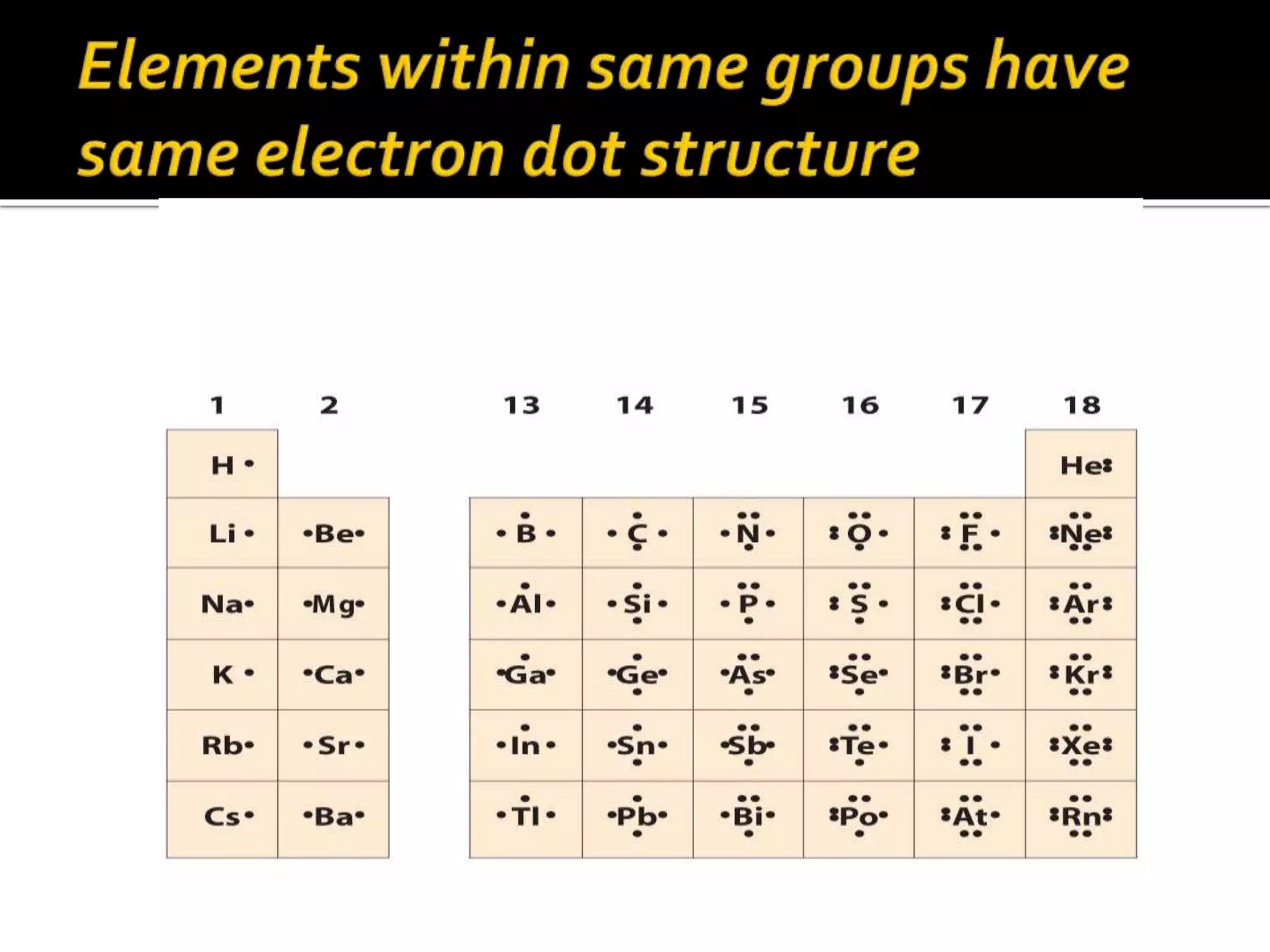
A notation showing the valence electrons 
surrounding the atomic symbol.
1 THESE COMPOUNDS ARE USUALL 
CRYSTALLINE SOLIDS . BECAUSE THEIR 
OPPOSITELY RGED IONS ATTRACT 
EACH OTHER.THESE IONIC 
COMPOUNDS ARE HARD AND BRITTLE 
. IONIC COMPOUNDS HAVE HIGH 
MELTING AND HIGH BOILING POINT. 
EX – SODIUM CHLORIDE HAS HIGH 
MELTING POINT.
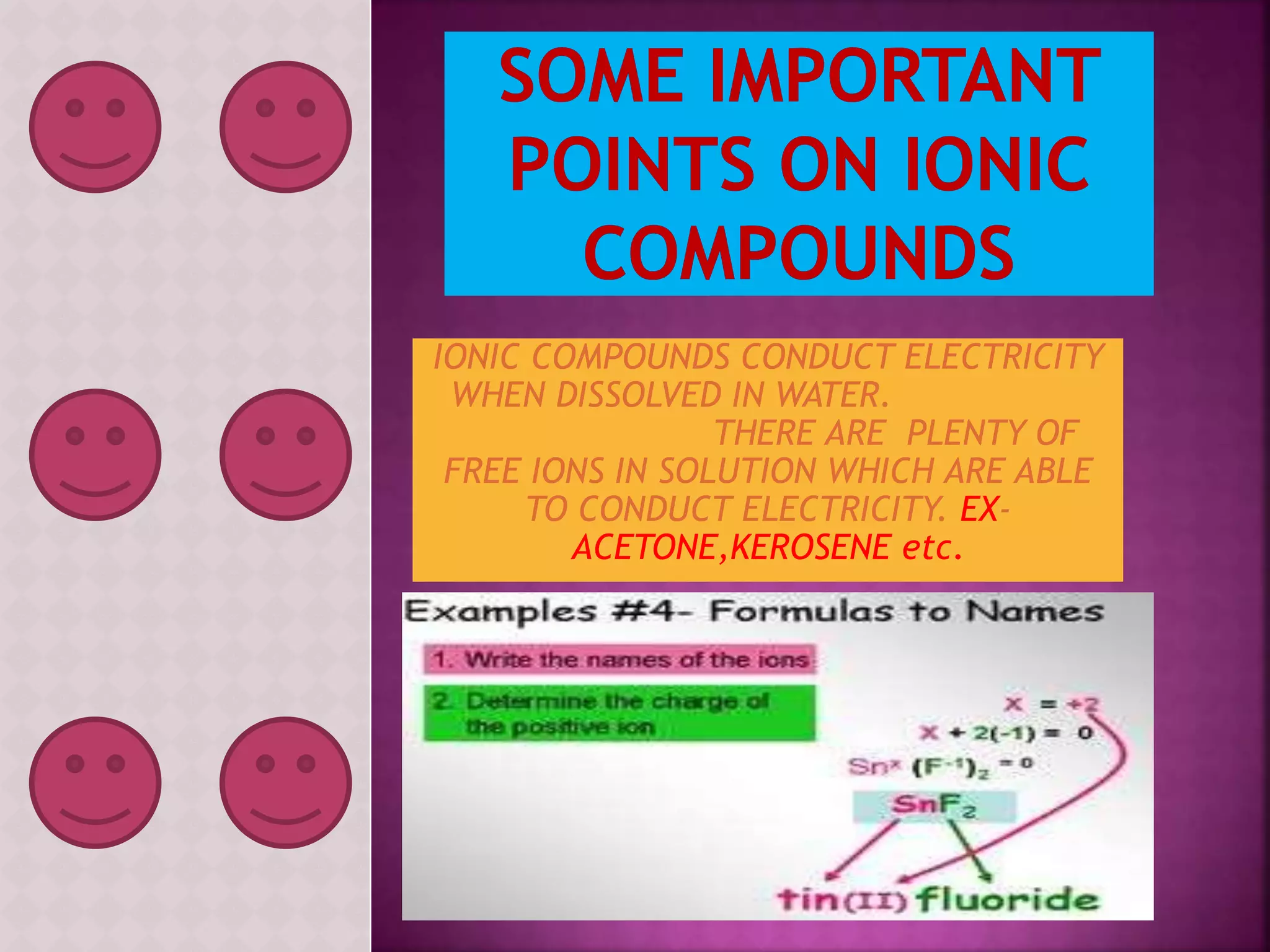
IONIC COMPOUNDS CONDUCT ELECTRICITY 
WHEN DISSOLVED IN WATER. 
THERE ARE PLENTY OF 
FREE IONS IN SOLUTION WHICH ARE ABLE 
TO CONDUCT ELECTRICITY. EX-ACETONE, 
KEROSENE etc.
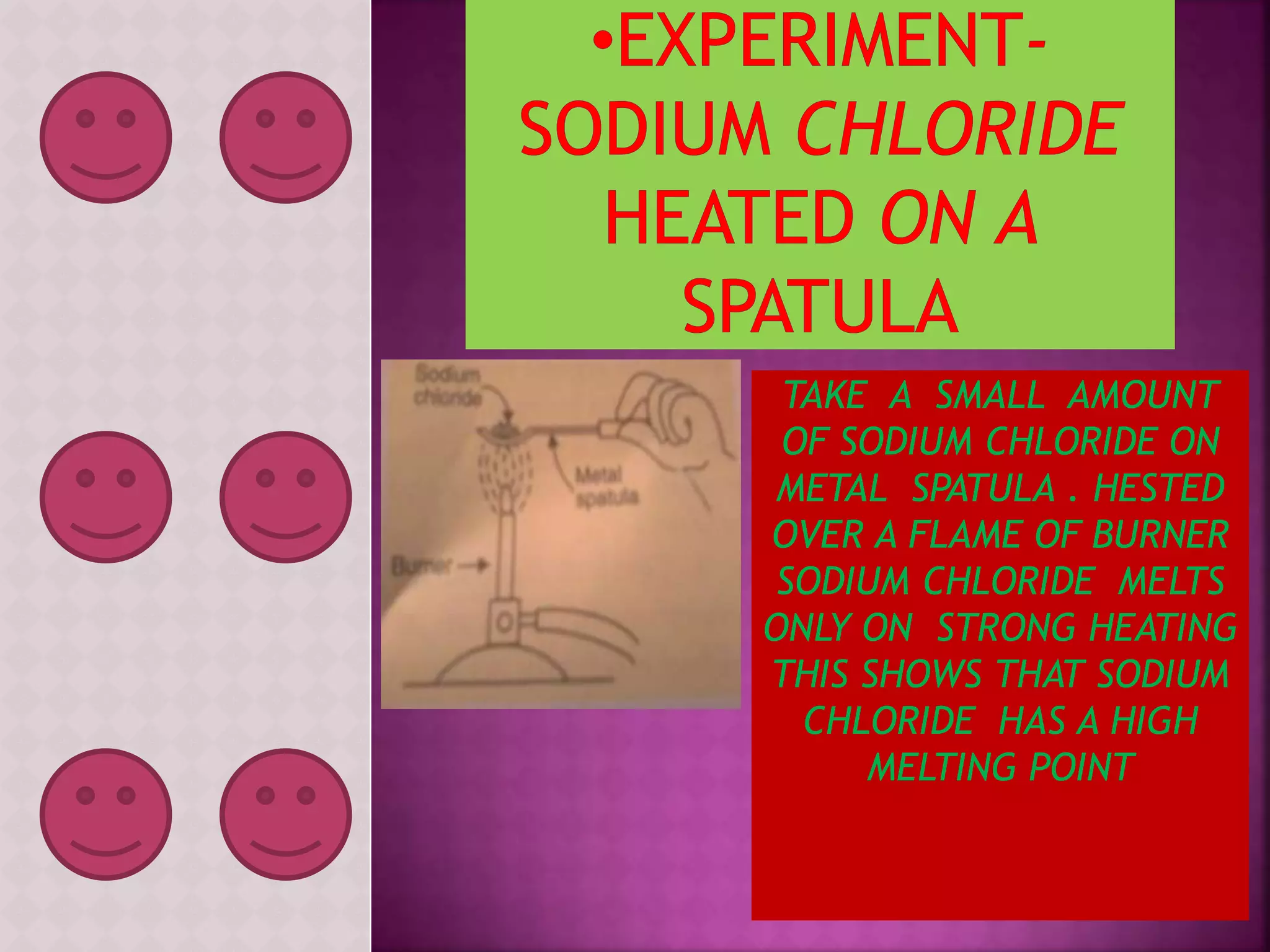
TAKE A SMALL AMOUNT 
OF SODIUM CHLORIDE ON 
METAL SPATULA . HESTED 
OVER A FLAME OF BURNER 
SODIUM CHLORIDE MELTS 
ONLY ON STRONG HEATING 
THIS SHOWS THAT SODIUM 
CHLORIDE HAS A HIGH 
MELTING POINT
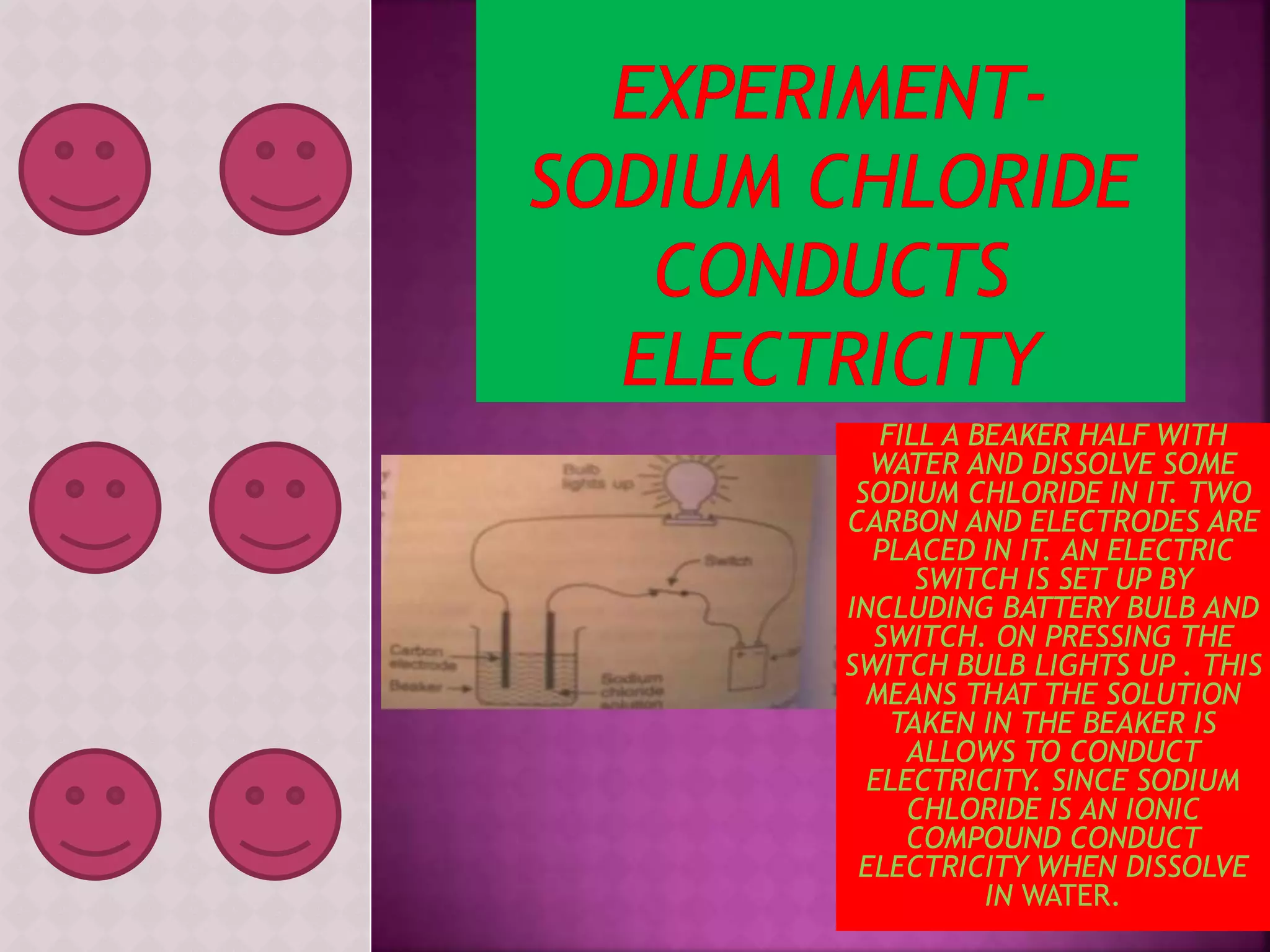
FILL A BEAKER HALF WITH 
WATER AND DISSOLVE SOME 
SODIUM CHLORIDE IN IT. TWO 
CARBON AND ELECTRODES ARE 
PLACED IN IT. AN ELECTRIC 
SWITCH IS SET UP BY 
INCLUDING BATTERY BULB AND 
SWITCH. ON PRESSING THE 
SWITCH BULB LIGHTS UP . THIS 
MEANS THAT THE SOLUTION 
TAKEN IN THE BEAKER IS 
ALLOWS TO CONDUCT 
ELECTRICITY. SINCE SODIUM 
CHLORIDE IS AN IONIC 
COMPOUND CONDUCT 
ELECTRICITY WHEN DISSOLVE 
IN WATER.
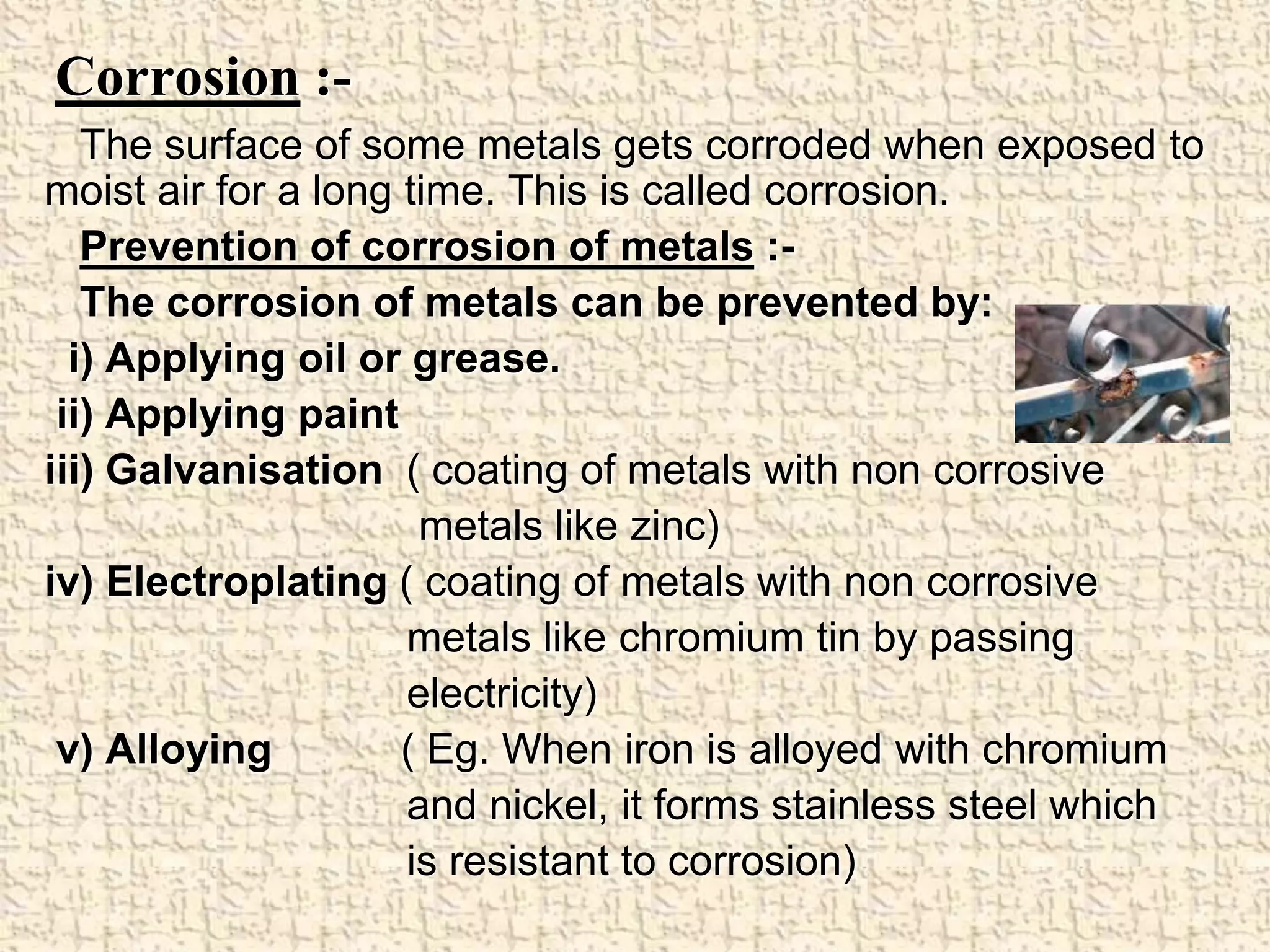
Corrosion :- 
The surface of some metals gets corroded when exposed to 
moist air for a long time. This is called corrosion. 
Prevention of corrosion of metals :- 
The corrosion of metals can be prevented by: 
i) Applying oil or grease. 
ii) Applying paint 
iii) Galvanisation ( coating of metals with non corrosive 
metals like zinc) 
iv) Electroplating ( coating of metals with non corrosive 
metals like chromium tin by passing 
electricity) 
v) Alloying ( Eg. When iron is alloyed with chromium 
and nickel, it forms stainless steel which 
is resistant to corrosion)
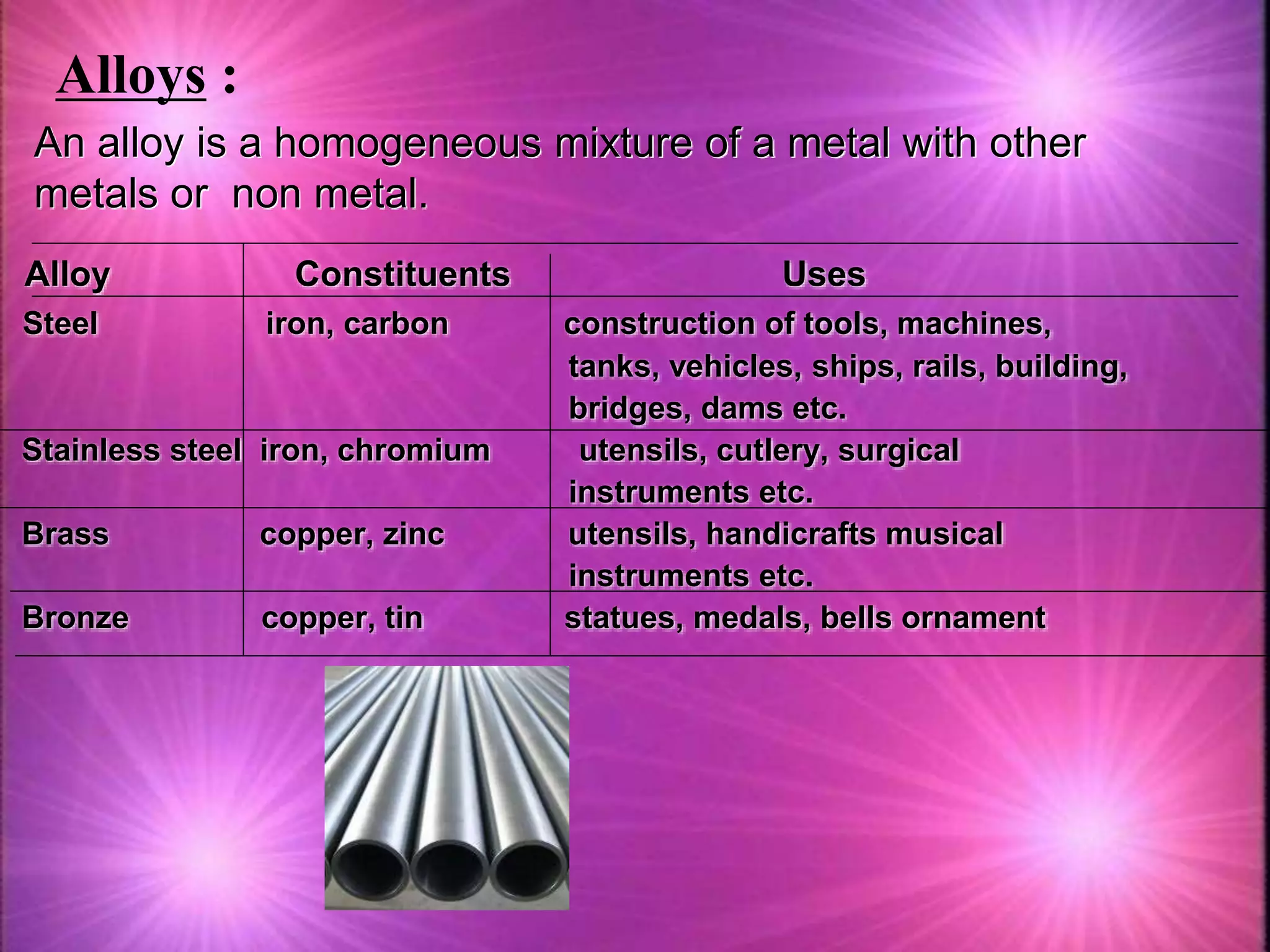
Alloys : 
An alloy is a homogeneous mixture of a metal with other 
metals or non metal. 
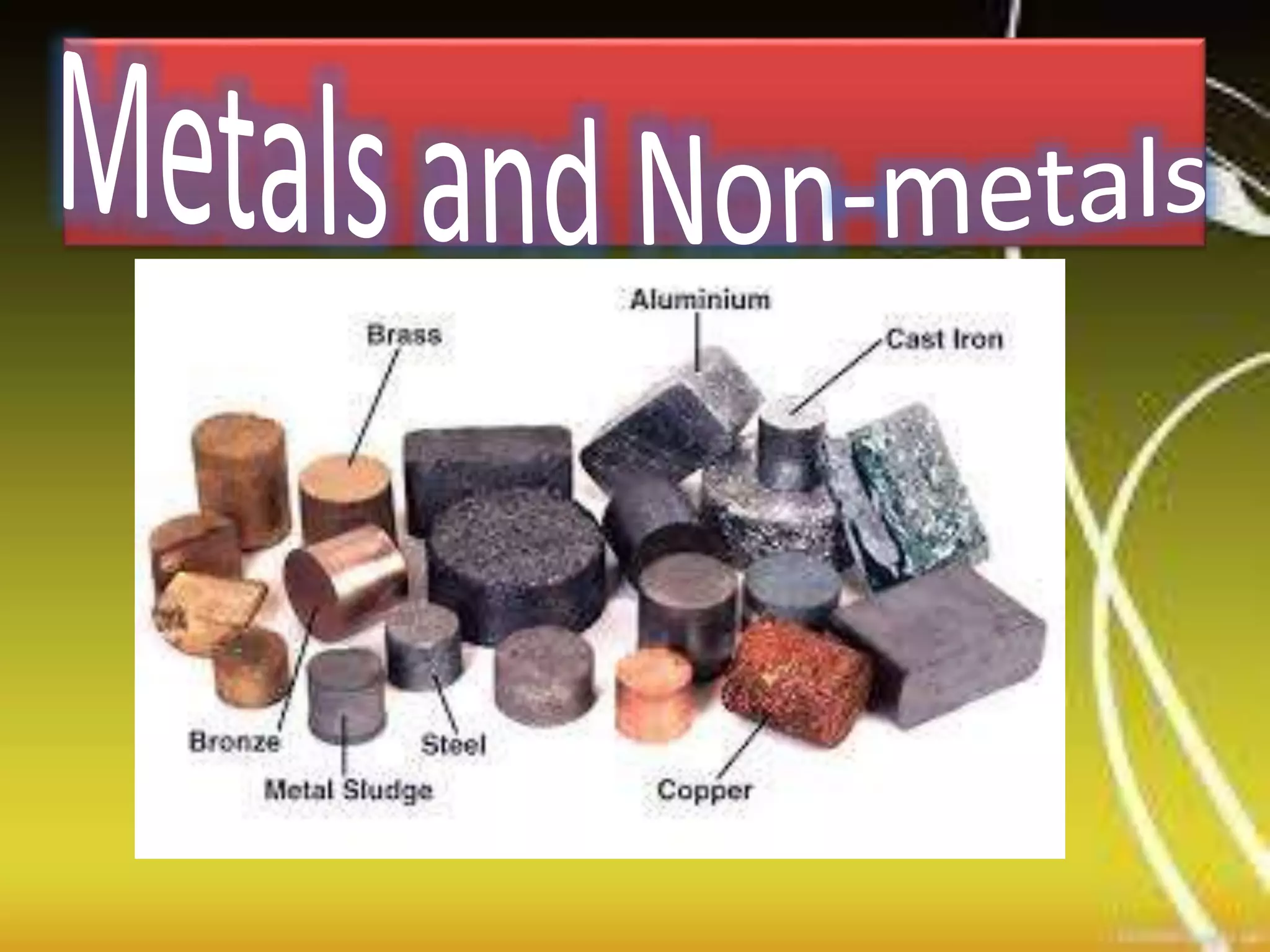
Alloy Constituents Uses 
Steel iron, carbon construction of tools, machines, 
tanks, vehicles, ships, rails, building, 
bridges, dams etc. 
Stainless steel iron, chromium utensils, cutlery, surgical 
instruments etc. 
Brass copper, zinc utensils, handicrafts musical 
instruments etc. 
Bronze copper, tin statues, medals, bells ornament
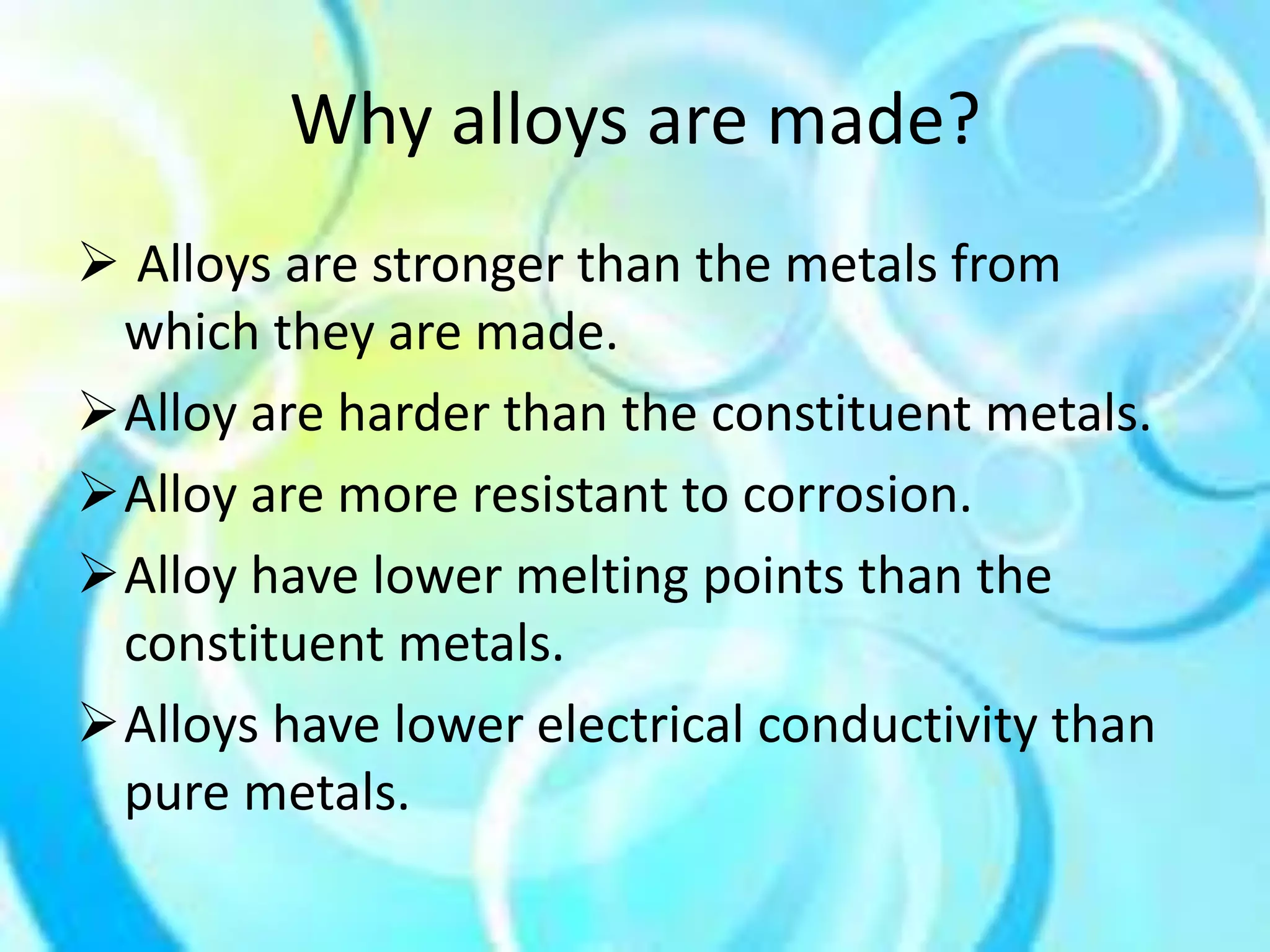
Why alloys are made? 
 Alloys are stronger than the metals from 
which they are made. 
Alloy are harder than the constituent metals. 
Alloy are more resistant to corrosion. 
Alloy have lower melting points than the 
constituent metals. 
Alloys have lower electrical conductivity than 
pure metals.
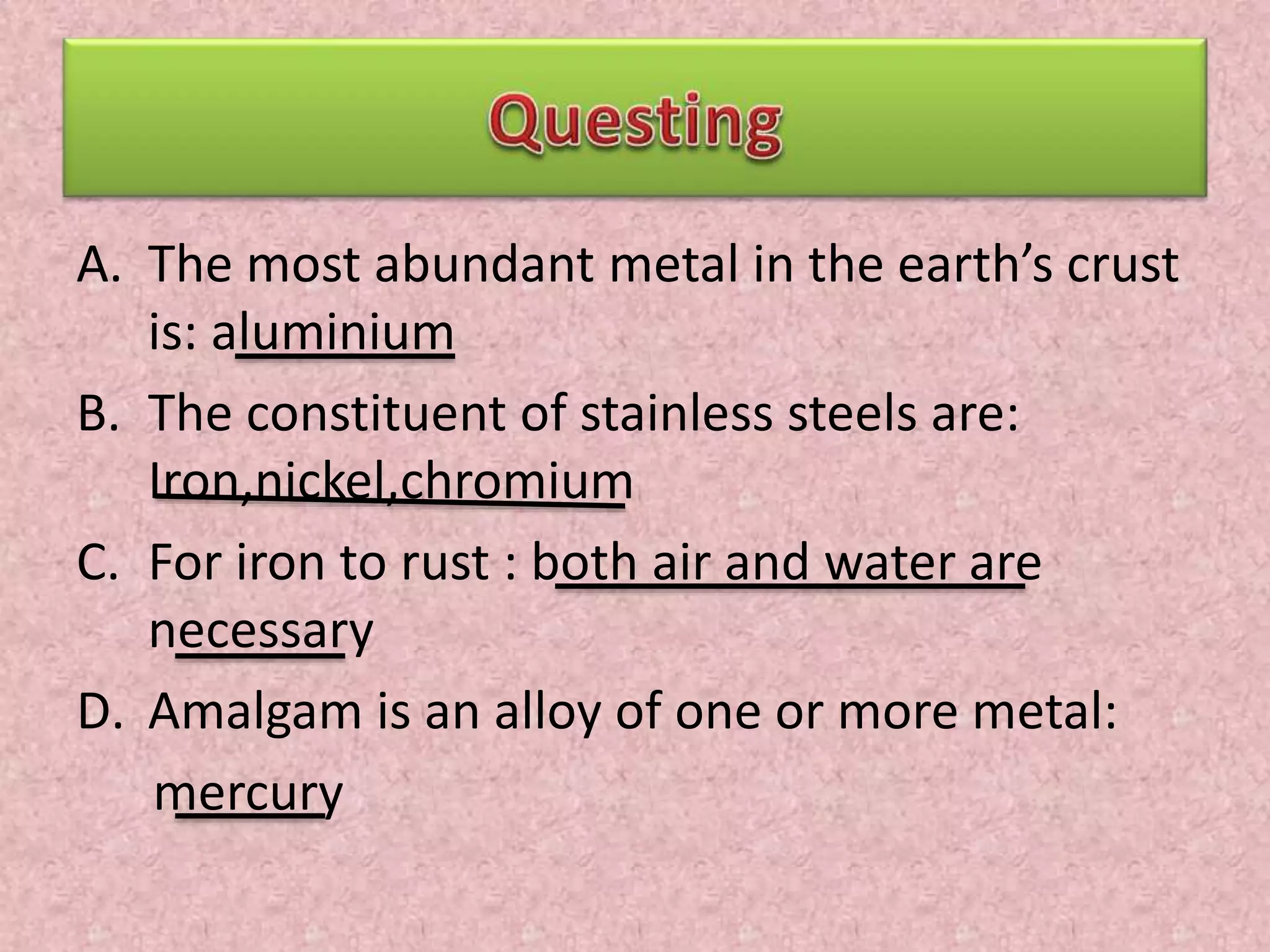
A. The most abundant metal in the earth’s crust 
is: aluminium 
B. The constituent of stainless steels are: 
Iron,nickel,chromium 
C. For iron to rust : both air and water are 
necessary 
D. Amalgam is an alloy of one or more metal: 
mercury
Reaction of metal with oxygen

Reaction of metal with oxygen

  • 1.
    Welcome to thescience presentation of Formative Assessment-3 The topic we are going to discuss now is
  • 3.
    Group Members Chiragjain Sanyam jain Risahbh Deepanshu Akshay Tushant Uttkarsh Swarndeep Gaurav
  • 5.
    1. Metals aremalleable , that is , metals can be beaten into thin sheets with a hammer . 2. Metals are ductile , that is , metals can be drawn into thin wires. 3. Metals are good conductors of heat . 4. Metals are lustrous and can be polished . 5. Metals are good conductors of electricity . 6. Metals are sonorous . 7. Metals have high densities .
  • 6.
    Almost all metalcombing with oxygen to from metal. For example:- Metal + Oxygen Metal oxide  Copper (Cu) reacts with oxygen to from copper (ll) oxide , a black oxide. 2Cu + O₂ 2CuO
  • 7.
    Aluminium (Al) reactswith oxygen to from aluminium Oxide. 4Al + 3O₂ 2Al₂O₃ Sodium reacts with oxygen at room temprature to from sodium oxide . 4Na + O₂ 2Na₂O Magnesium does not react with oxygen at room temprature. On heating in oxygen , magnesium burns with dazzling white light to give magnesium oxide 2Mg + O₂ 2MgO
  • 8.
     Reaction ofmetal with water  Metal + Water Metal oxide + Hydrogen  Metal oxide + Water Metal Hydroxide For Example:-  Sodium and Potassium react violently with cold water. The reaction is so violent and exothermic that the evolved hydrogen immediately catches fire. 2K + 2H₂O 2KOH + H₂ + Heat energy 2Na + 2H₂O 2NaOH + H₂ + Heat energy
  • 9.
     Calcium alsoreacts with water at room temprature forming calcium hydroxide . Ca + 2H₂O Ca(OH)₂ + H₂  Reaction of metal with Acid When metal reacts with a dilute acid , then a metal salt and hydrogen gas are formed. Metal + Dilute acid Metal salt + Hydrogen Example will shown in table on next slide
  • 10.
    Metal Acid Natureof Reaction Reaction Sodium Dil. HCl Dil. H₂SO₄ Sodium reacts vigorously with dil. HCl and dil. H₂SO₄ 2Na + 2HCl 2NaCl + H₂ 2Na + 2H₂SO₄ Na₂SO₄ + H₂ Magnesium Dil. HCl Dil. H₂SO₄ Magnesium reacts rapidly with dil. HCl and dil. H₂SO₄ Mg + 2HCl MgCl₂ + H₂ Mg + H₂SO₄ MgSO₄ + H₂ Zinc Dil. HCl Dil. H₂SO₄ Zinc reacts with dil.HCl and dil. H₂SO₄ at moderate rate . Zn + 2HCl ZnCl₂ + H₂ Zn + H₂SO₄ ZnSO₄ + H₂ Iron Dil. HCl Dil. H₂SO₄ Iron reacts with dil.HCl as well as Dil. H₂SO₄ slowly at room temprature. Fe + 2HCl FeCl₂ + H₂ Fe + H₂SO₄ FeSO₄ + H₂ Copper Dil. HCl Dil. H₂SO₄ Copper does not react with dil. HCl and dil. H₂SO₄ slowly at room temprature But slowly dissolve in dil. H₂SO₄ in the presence of air. No reaction 2Cu + 2H₂SO₄ + O₂ 2CuSO₄ + H₂O
  • 11.
     Reaction ofmetal with salt solution A less reactive metal is displaced from its salt solution by a more reactive metal. Reaction of zinc with copper sulphate solution When a strip of zinc metal is put in copper sulphate solution, then the blue colour of copper sulphate solution fades gradually due to the formation of colourless zinc sulphate, and red-brown copper metal is deposited on the zinc strip: CuSO₄ + Zn ZnSO₄ + Cu
  • 12.
     Reaction ofmetals with Chlorine Metals react with chlorine to from ionic chlorides. For example:- Sodium is a metal. So, sodium reacts with chlorine to from an ionic chloride called sodium chloride: 2Na + Cl₂ 2NaCl Calcium is a metal which reacts vigorously with chloride called calcium chloride: Ca + Cl₂ CaCl₂
  • 13.
    Reaction of metalwith hydrogen Only few reactive metal like sodium, potassium, calcium, and magnesium reacts with hydrogen to from metal hydrides. For example:  When hydrogen gas is passed over heated sodium then sodium hydride is formed : 2Na + H₂ 2NaH  When hydrogen gas is passed over heated calcium then calcium hydride is formed: Ca + H₂ CaH₂
  • 14.
    Chemical properties ofnon metal Reaction of non-metals with oxygen Non-metals react with oxygen to form acidic oxides or neutral oxides . The acidic oxides of non-metals dissolves in water to form acids . C (s) + o₂ - co₂ Carbon oxygon carbon dioxide CO2 (g) + H2O (l) – H2CO3 (aq) carbon dioxide water carbonic acid
  • 15.
    Reaction of non-metalswith water • Non-metals do not react with water to evolve hydrogen gas . This is because non-metals cannot give electrons to reduce the hydrogen ions of water into hydrogen gas
  • 16.
    Reaction of non-metalswith dilute acids Non-metals do not react with dilute acids . Non-metals do not displaces hydrogen from acids . Non-metals like carbon , sulphur or phosphorus are put into a test tube containing dilute sulphuric acid or dilute hydrochloric acid , then no hydrogen gas is evolved .
  • 17.
    Reaction of non-metalswith salt solutions A more reactive non-metal displaces a less reactive non-metal from its salt solution. 2NaBr (aq) + Cl2 (g) - Br2 (aq) + 2NaCl (aq) Sodium chlorine bromine Sodium Bromide chloride
  • 18.
    Reaction of non-metalswith chlorine Non-metals react with chlorine to form covalent chlorides which are non-electrolytes (do not conduct electricity ) H2 (g) + Cl2 (g) - 2HCl (g) Hydrogen chlorine hydrogen chloride (non-metal) (covalent hydride) P4 (s) + 6Cl2 (g) - 4PCl3 (l) (non-metal) (covalent hydride)
  • 19.
    Reaction of non-metalswith hydrogen Non-metals react with hydrogen to form covalont hydrides  H2 (g) + S (l) - H2S (g) Hydrogen sulphur hydrogen sulphide (non-metal) (covalent hydride) N2 (g) + 3H2 (g) - 2NH3 (g) Nitrogen hydrogen ammonia (non-metal) (covalent hydride)
  • 20.
    Ionic compounds Thecompounds containing ionic bonds are called ionic compounds.Theyare formed by transfer of electrons from one atom to another . Ionic compounds are made up of positively charged ions[cataions]+ and negatively charged ions [anions].Ionic compounds are also known as Electrovalent compounds.
  • 21.
  • 22.
    Structure of ioniccopounds The forces between the particles are strong. There are no free-moving electrons present, unlike in metals. There are charged particles present, but in solid state they are not free to move. When an ionic compound melts, however, the particles are free to move and the compound will conduct electricity.
  • 23.
    A notation showingthe valence electrons surrounding the atomic symbol.
  • 27.
    1 THESE COMPOUNDSARE USUALL CRYSTALLINE SOLIDS . BECAUSE THEIR OPPOSITELY RGED IONS ATTRACT EACH OTHER.THESE IONIC COMPOUNDS ARE HARD AND BRITTLE . IONIC COMPOUNDS HAVE HIGH MELTING AND HIGH BOILING POINT. EX – SODIUM CHLORIDE HAS HIGH MELTING POINT.
  • 28.
    IONIC COMPOUNDS CONDUCTELECTRICITY WHEN DISSOLVED IN WATER. THERE ARE PLENTY OF FREE IONS IN SOLUTION WHICH ARE ABLE TO CONDUCT ELECTRICITY. EX-ACETONE, KEROSENE etc.
  • 29.
    TAKE A SMALLAMOUNT OF SODIUM CHLORIDE ON METAL SPATULA . HESTED OVER A FLAME OF BURNER SODIUM CHLORIDE MELTS ONLY ON STRONG HEATING THIS SHOWS THAT SODIUM CHLORIDE HAS A HIGH MELTING POINT
  • 30.
    FILL A BEAKERHALF WITH WATER AND DISSOLVE SOME SODIUM CHLORIDE IN IT. TWO CARBON AND ELECTRODES ARE PLACED IN IT. AN ELECTRIC SWITCH IS SET UP BY INCLUDING BATTERY BULB AND SWITCH. ON PRESSING THE SWITCH BULB LIGHTS UP . THIS MEANS THAT THE SOLUTION TAKEN IN THE BEAKER IS ALLOWS TO CONDUCT ELECTRICITY. SINCE SODIUM CHLORIDE IS AN IONIC COMPOUND CONDUCT ELECTRICITY WHEN DISSOLVE IN WATER.
  • 31.
    Corrosion :- Thesurface of some metals gets corroded when exposed to moist air for a long time. This is called corrosion. Prevention of corrosion of metals :- The corrosion of metals can be prevented by: i) Applying oil or grease. ii) Applying paint iii) Galvanisation ( coating of metals with non corrosive metals like zinc) iv) Electroplating ( coating of metals with non corrosive metals like chromium tin by passing electricity) v) Alloying ( Eg. When iron is alloyed with chromium and nickel, it forms stainless steel which is resistant to corrosion)
  • 32.
    Alloys : Analloy is a homogeneous mixture of a metal with other metals or non metal. Alloy Constituents Uses Steel iron, carbon construction of tools, machines, tanks, vehicles, ships, rails, building, bridges, dams etc. Stainless steel iron, chromium utensils, cutlery, surgical instruments etc. Brass copper, zinc utensils, handicrafts musical instruments etc. Bronze copper, tin statues, medals, bells ornament
  • 33.
    Why alloys aremade?  Alloys are stronger than the metals from which they are made. Alloy are harder than the constituent metals. Alloy are more resistant to corrosion. Alloy have lower melting points than the constituent metals. Alloys have lower electrical conductivity than pure metals.
  • 34.
    A. The mostabundant metal in the earth’s crust is: aluminium B. The constituent of stainless steels are: Iron,nickel,chromium C. For iron to rust : both air and water are necessary D. Amalgam is an alloy of one or more metal: mercury