
STRUCTURE OF AN ATOM
BY IRA DEOKULE VIII J ROLL NO. 6
Developments in the model
of atom
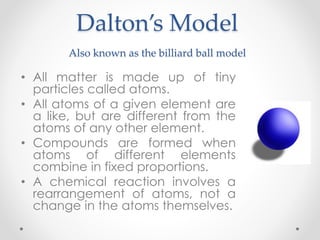
Dalton’s Model
Also known as the billiard ball model
• All matter is made up of tiny
particles called atoms.
• All atoms of a given element are
a like, but are different from the
atoms of any other element.
• Compounds are formed when
atoms of different elements
combine in fixed proportions.
• A chemical reaction involves a
rearrangement of atoms, not a
change in the atoms themselves.
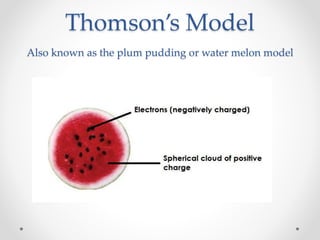
Thomson’s Model
Also known as the plum pudding or water melon model
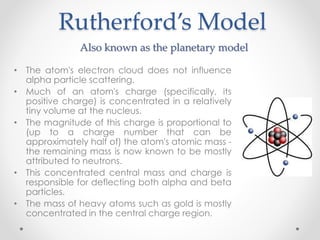
Rutherford’s Model
• The atom's electron cloud does not influence
alpha particle scattering.
• Much of an atom's charge (specifically, its
positive charge) is concentrated in a relatively
tiny volume at the nucleus.
• The magnitude of this charge is proportional to
(up to a charge number that can be
approximately half of) the atom's atomic mass -
the remaining mass is now known to be mostly
attributed to neutrons.
• This concentrated central mass and charge is
responsible for deflecting both alpha and beta
particles.
• The mass of heavy atoms such as gold is mostly
concentrated in the central charge region.
Parts of the atom
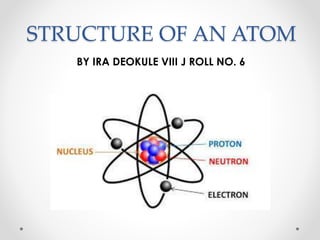
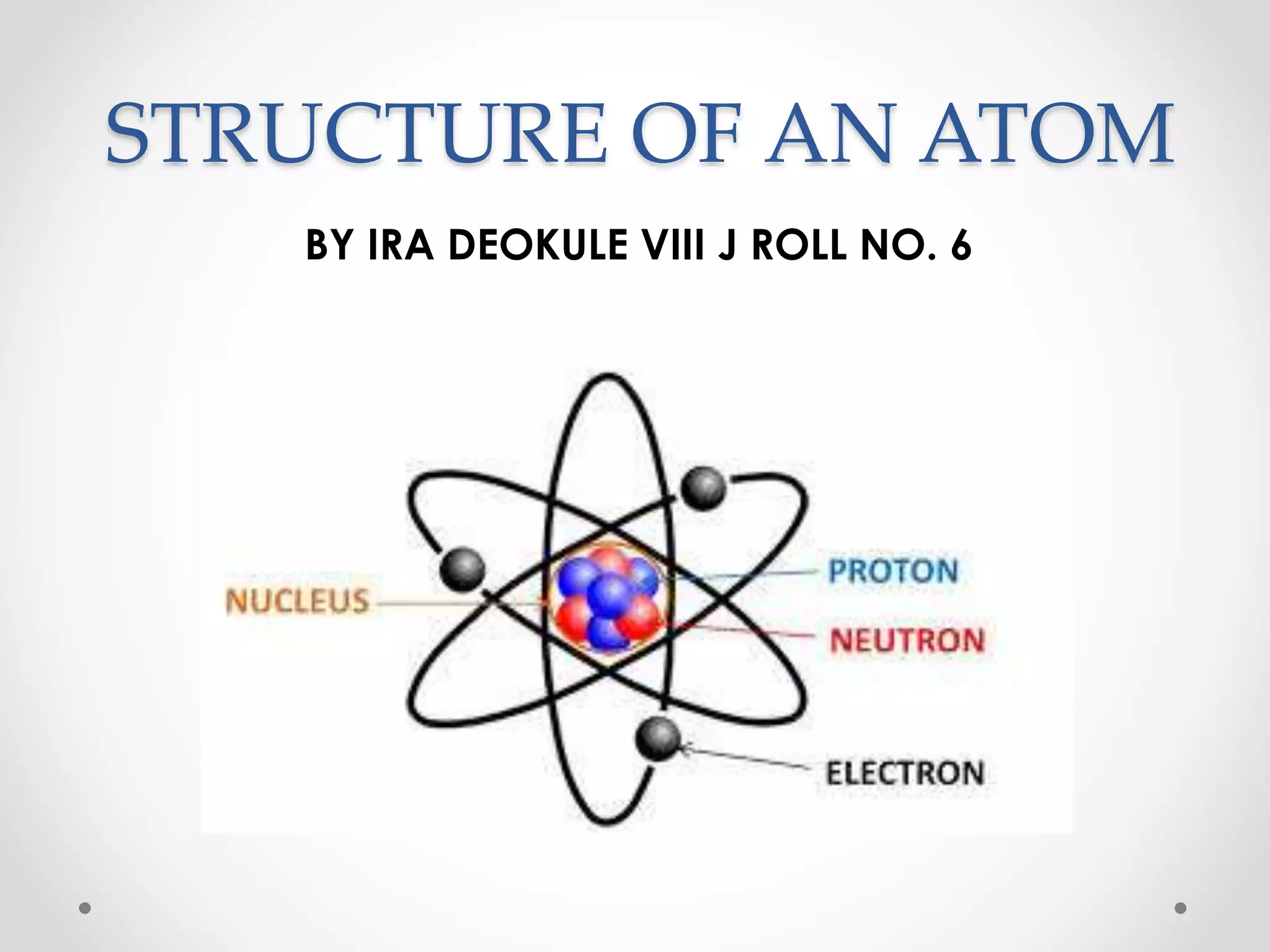
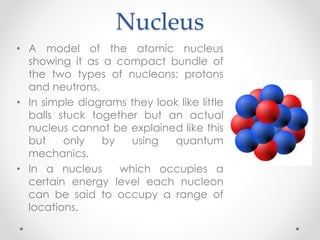
Nucleus
• A model of the atomic nucleus
showing it as a compact bundle of
the two types of nucleons: protons
and neutrons.
• In simple diagrams they look like little
balls stuck together but an actual
nucleus cannot be explained like this
but only by using quantum
mechanics.
• In a nucleus which occupies a
certain energy level each nucleon
can be said to occupy a range of
locations.
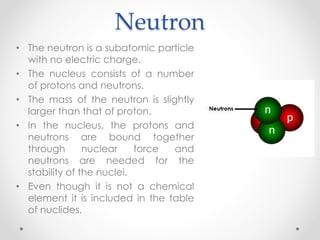
Neutron
• The neutron is a subatomic particle
with no electric charge.
• The nucleus consists of a number
of protons and neutrons.
• The mass of the neutron is slightly
larger than that of proton.
• In the nucleus, the protons and
neutrons are bound together
through nuclear force and
neutrons are needed for the
stability of the nuclei.
• Even though it is not a chemical
element it is included in the table
of nuclides.
Protons
• The proton is subatomic particle
with a positive electric charge.
• The nucleus consists of a number
of protons and neutrons.
• The mass of the proton is slightly
larger than that of neutron.
• The number of protons in the
nucleus is referred to as it’s
atomic number.
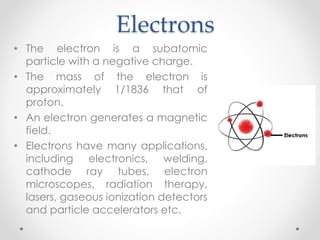
Electrons
• The electron is a subatomic
particle with a negative charge.
• The mass of the electron is
approximately 1/1836 that of
proton.
• An electron generates a magnetic
field.
• Electrons have many applications,
including electronics, welding,
cathode ray tubes, electron
microscopes, radiation therapy,
lasers, gaseous ionization detectors
and particle accelerators etc.
Thank You

Structure of an Atom

  • 1.
    STRUCTURE OF ANATOM BY IRA DEOKULE VIII J ROLL NO. 6
  • 2.
    Developments in themodel of atom
  • 3.
    Dalton’s Model Also knownas the billiard ball model • All matter is made up of tiny particles called atoms. • All atoms of a given element are a like, but are different from the atoms of any other element. • Compounds are formed when atoms of different elements combine in fixed proportions. • A chemical reaction involves a rearrangement of atoms, not a change in the atoms themselves.
  • 4.
    Thomson’s Model Also knownas the plum pudding or water melon model
  • 5.
    Rutherford’s Model • Theatom's electron cloud does not influence alpha particle scattering. • Much of an atom's charge (specifically, its positive charge) is concentrated in a relatively tiny volume at the nucleus. • The magnitude of this charge is proportional to (up to a charge number that can be approximately half of) the atom's atomic mass - the remaining mass is now known to be mostly attributed to neutrons. • This concentrated central mass and charge is responsible for deflecting both alpha and beta particles. • The mass of heavy atoms such as gold is mostly concentrated in the central charge region.
  • 6.
  • 7.
    Nucleus • A modelof the atomic nucleus showing it as a compact bundle of the two types of nucleons: protons and neutrons. • In simple diagrams they look like little balls stuck together but an actual nucleus cannot be explained like this but only by using quantum mechanics. • In a nucleus which occupies a certain energy level each nucleon can be said to occupy a range of locations.
  • 8.
    Neutron • The neutronis a subatomic particle with no electric charge. • The nucleus consists of a number of protons and neutrons. • The mass of the neutron is slightly larger than that of proton. • In the nucleus, the protons and neutrons are bound together through nuclear force and neutrons are needed for the stability of the nuclei. • Even though it is not a chemical element it is included in the table of nuclides.
  • 9.
    Protons • The protonis subatomic particle with a positive electric charge. • The nucleus consists of a number of protons and neutrons. • The mass of the proton is slightly larger than that of neutron. • The number of protons in the nucleus is referred to as it’s atomic number.
  • 10.
    Electrons • The electronis a subatomic particle with a negative charge. • The mass of the electron is approximately 1/1836 that of proton. • An electron generates a magnetic field. • Electrons have many applications, including electronics, welding, cathode ray tubes, electron microscopes, radiation therapy, lasers, gaseous ionization detectors and particle accelerators etc.
  • 11.