This document discusses pyroelectric sensors and their use in detecting human movement. It contains the following key points:
1. Pyroelectric sensors can detect rapid temperature changes caused by human movement, but are sensitive to air currents which can trigger false alarms.
2. The sensor works by detecting the infrared radiation emitted from warm bodies using a lens to focus the radiation onto two sensing elements. As a heat source moves, it exposes one element then the other.
3. For outdoor use, the sensor requires protection from rain and wind. Focusing lenses and shadow masks are used to improve detection range and create a detectable signal pattern from moving heat sources.
PYROELECTRIC
A pyroelectric sensoris very
sensitive to rapid temperature
changes. A rapid change in air
temperature due to a breeze
from an open window or from an
air conditioner or heater can
cause false triggering. The
shadow and pinhole lenses
described above do not offer
protection against such air
movement because they are
actually open lenses. For outdoor
use you would also need
protection against rain.
WHAT IS PYROELECTRIC?
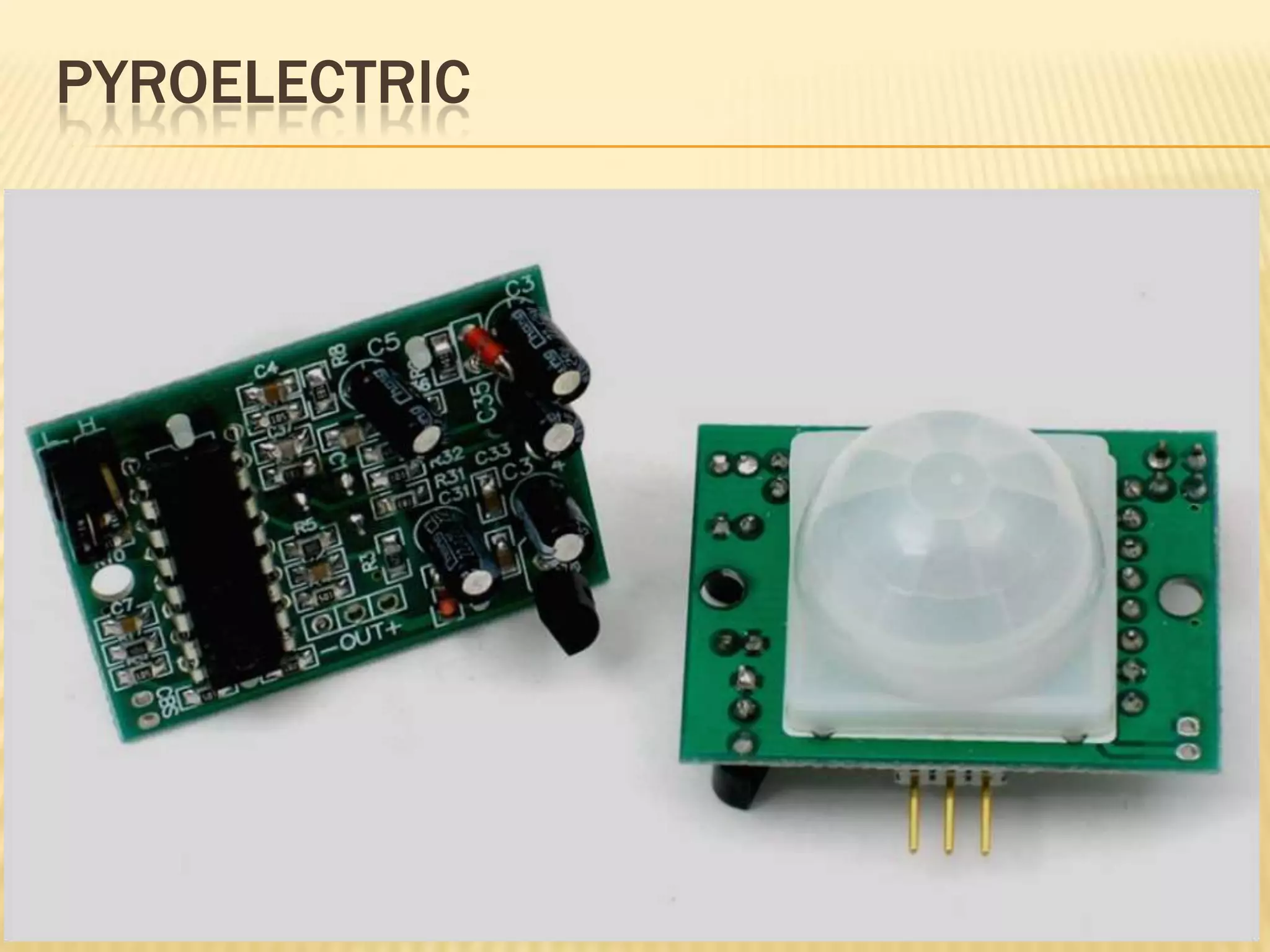
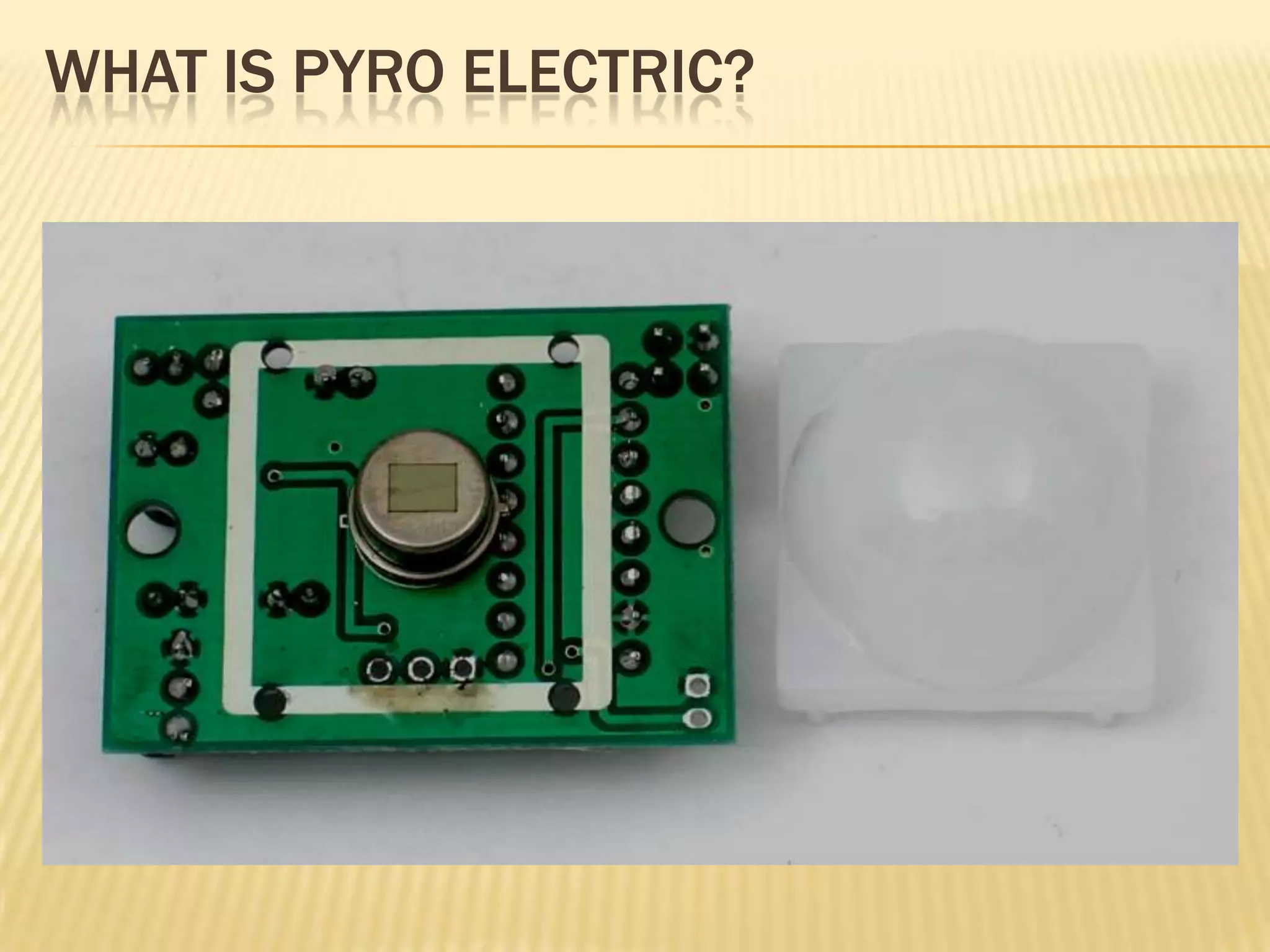
PIR sensor memiliki kemampuan untuk
mendeteksi gerakan manusia yang masuk
dalam range dari sensor. Bentuknya mungil,
murah, low-power, dan mudah
penggunaannya. Untuk alasan inilah, maka
biasanya sensor ini banyak dijumpai pada
gadget untuk keperluan rumah tangga dan
bisnis. Sensor ini lebih dikenal sebagai PIR,
"Passive Infrared", "Pyroelectric", atau
sensor "IR motion”.
6.
FOCUSING DEVICES FORPYROELECTRIC
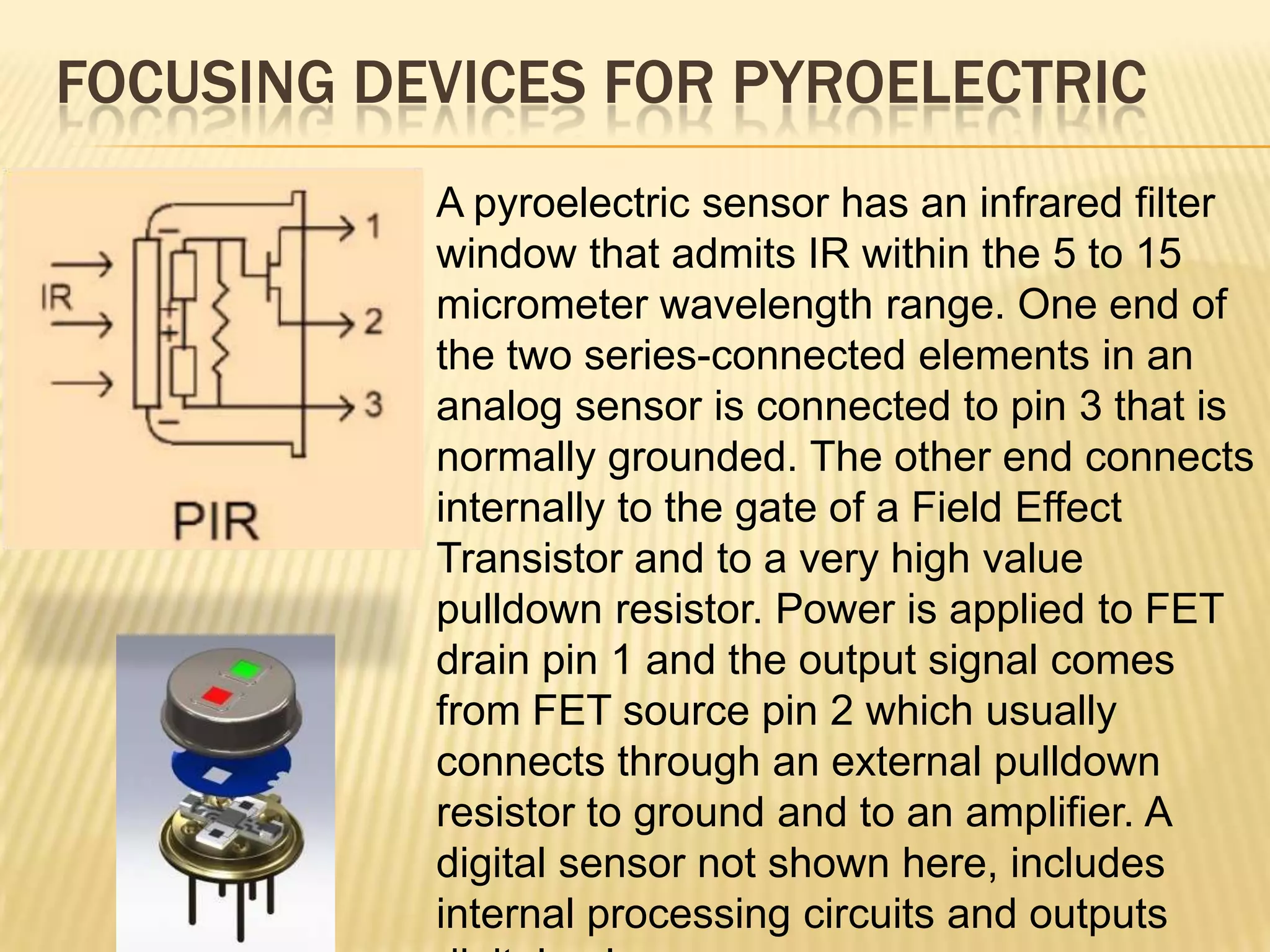
A pyroelectric sensor has an infrared filter
window that admits IR within the 5 to 15
micrometer wavelength range. One end of
the two series-connected elements in an
analog sensor is connected to pin 3 that is
normally grounded. The other end connects
internally to the gate of a Field Effect
Transistor and to a very high value
pulldown resistor. Power is applied to FET
drain pin 1 and the output signal comes
from FET source pin 2 which usually
connects through an external pulldown
resistor to ground and to an amplifier. A
digital sensor not shown here, includes
internal processing circuits and outputs
7.
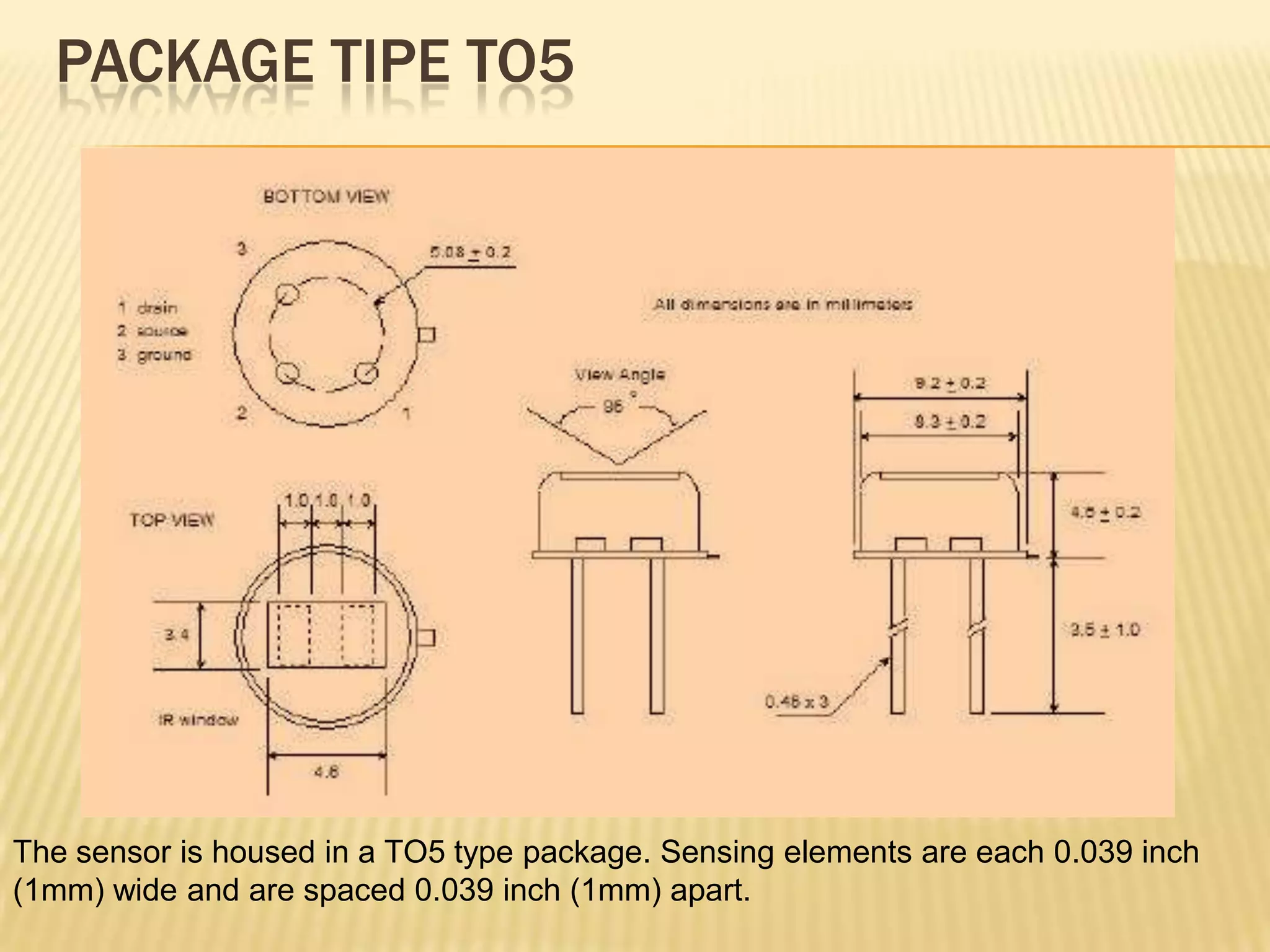
PACKAGE TIPE TO5
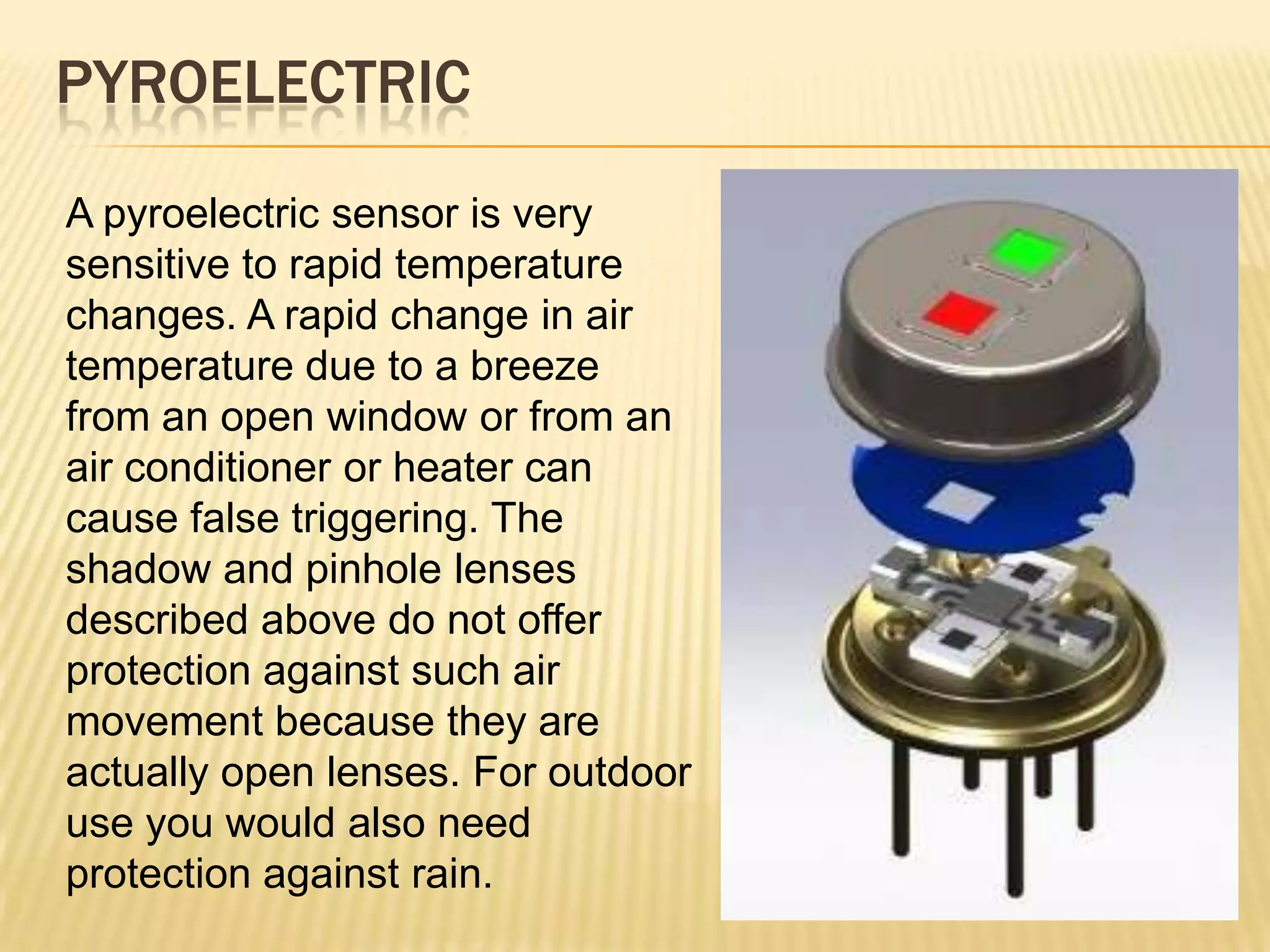
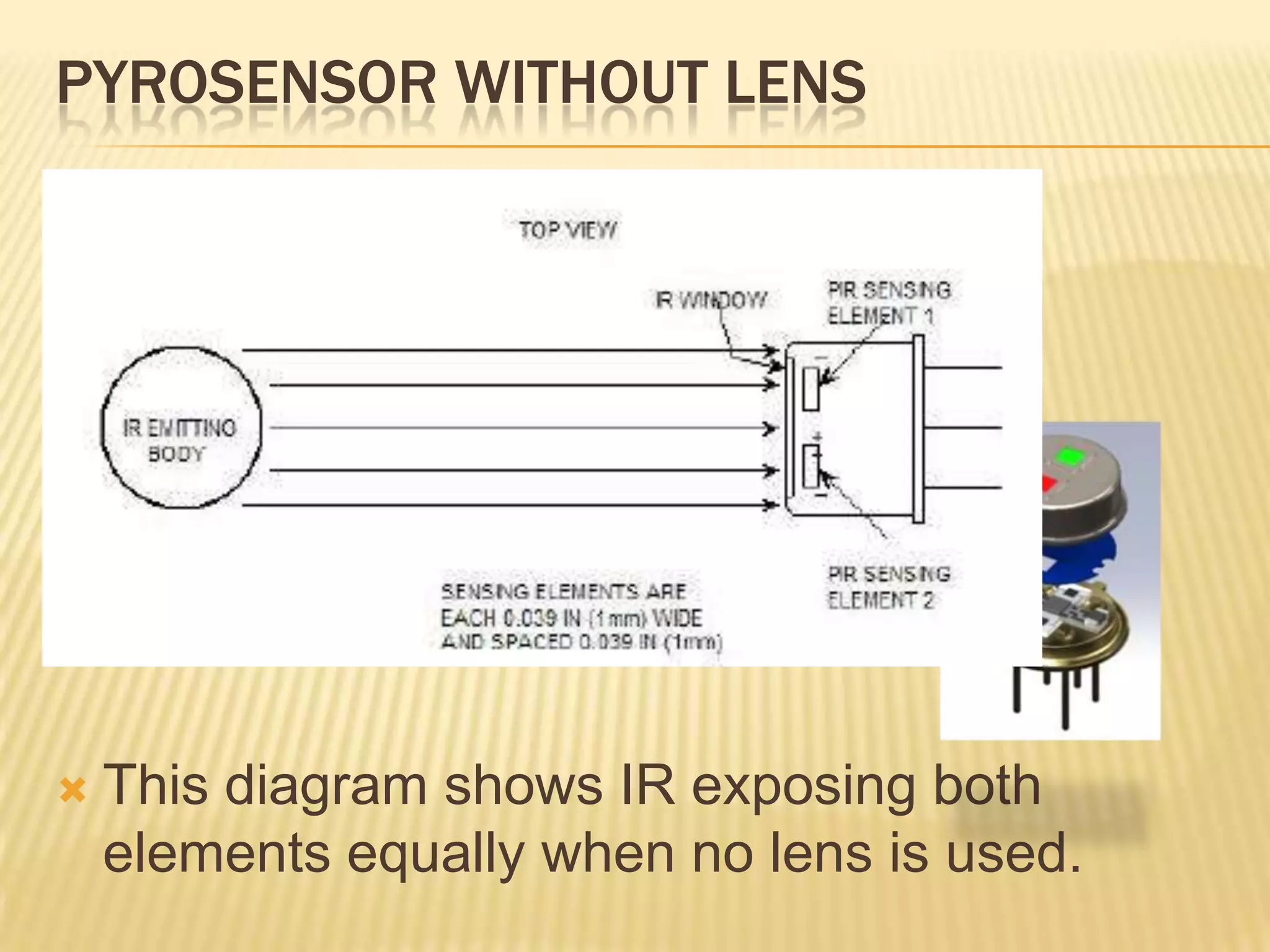
Thesensor is housed in a TO5 type package. Sensing elements are each 0.039 inch
(1mm) wide and are spaced 0.039 inch (1mm) apart.
8.
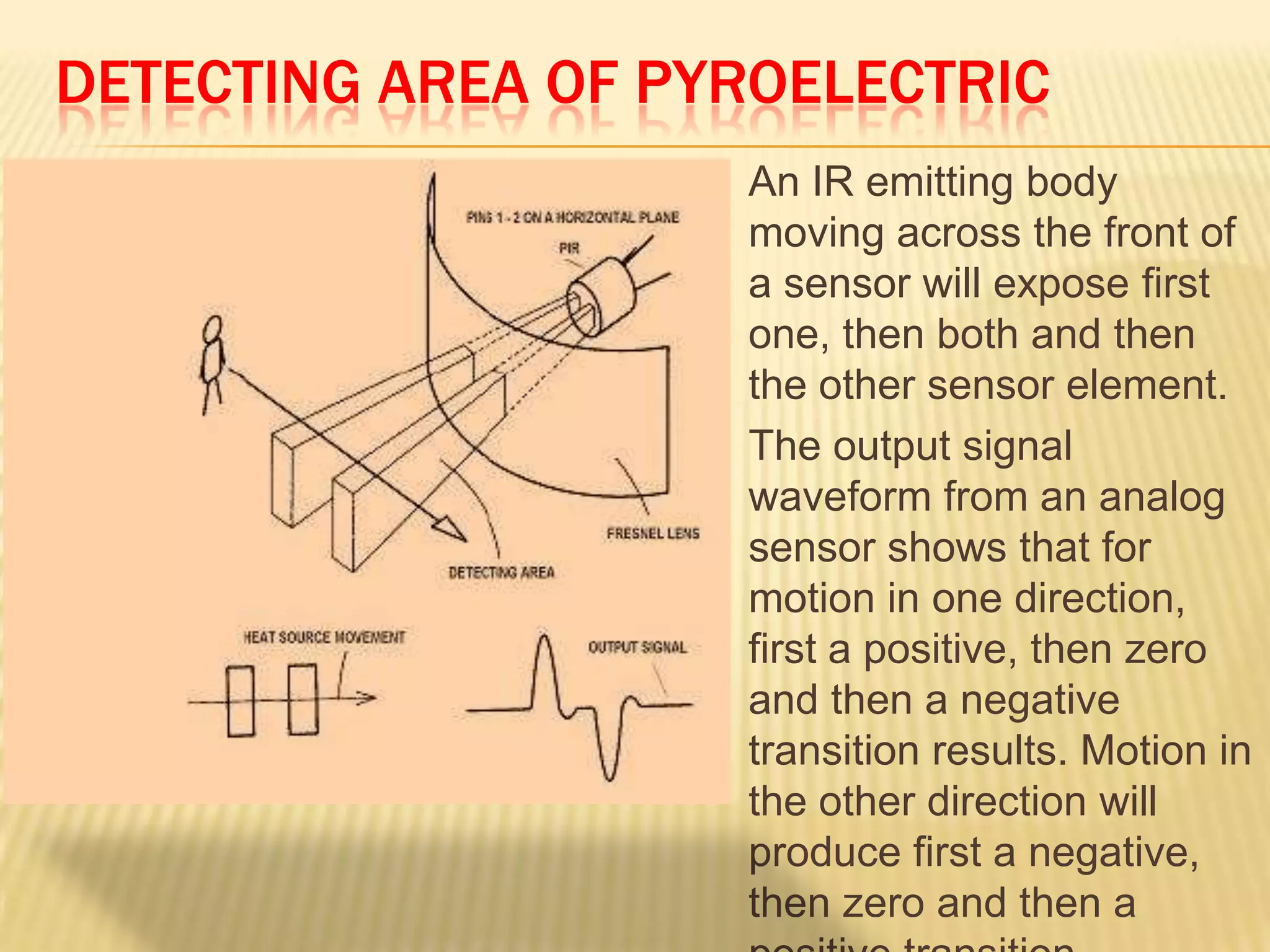
DETECTING AREA OFPYROELECTRIC
An IR emitting body
moving across the front of
a sensor will expose first
one, then both and then
the other sensor element.
The output signal
waveform from an analog
sensor shows that for
motion in one direction,
first a positive, then zero
and then a negative
transition results. Motion in
the other direction will
produce first a negative,
then zero and then a
9.
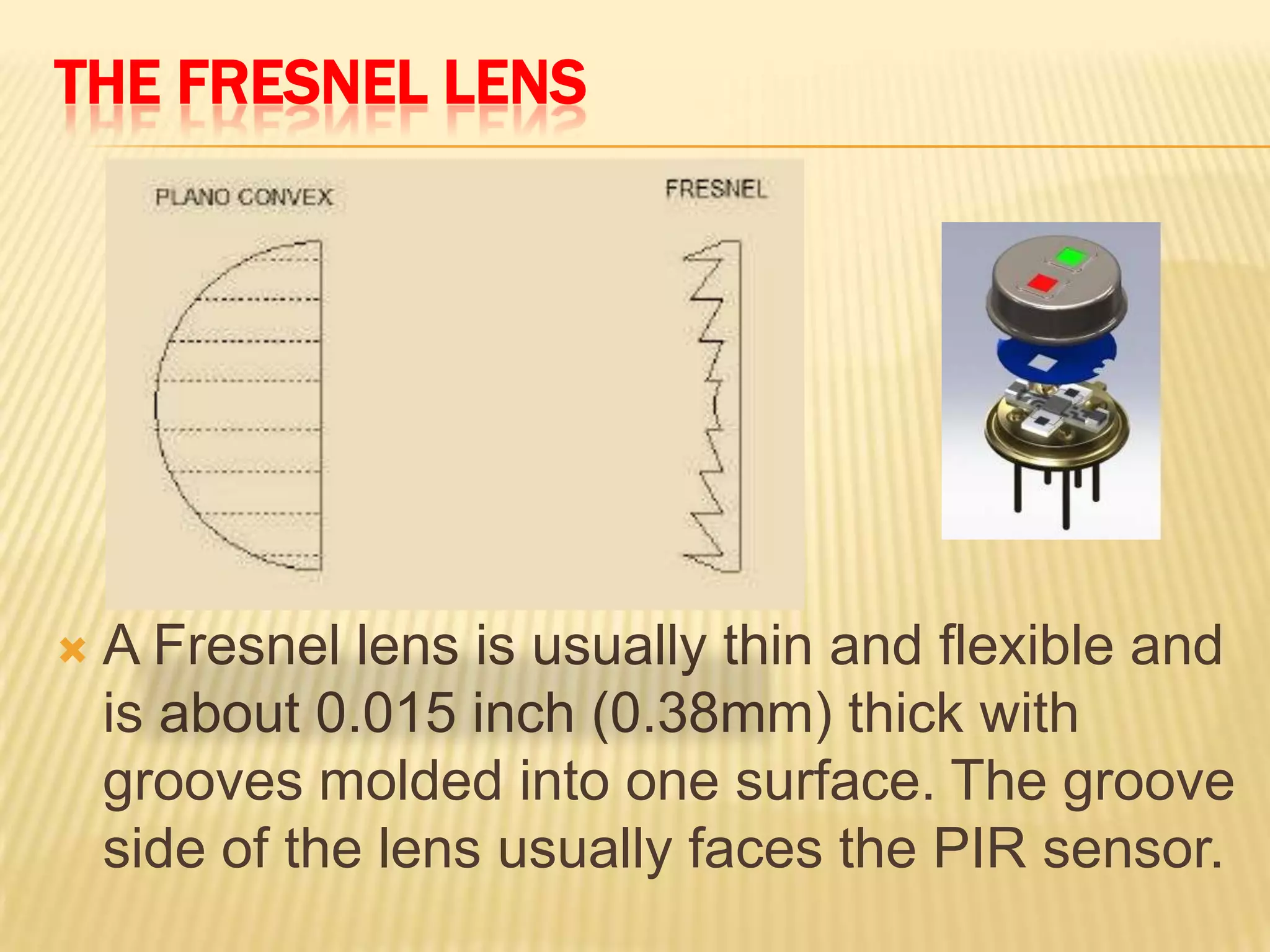
THE FRESNEL LENS
AFresnel lens is usually thin and flexible and
is about 0.015 inch (0.38mm) thick with
grooves molded into one surface. The groove
side of the lens usually faces the PIR sensor.
10.
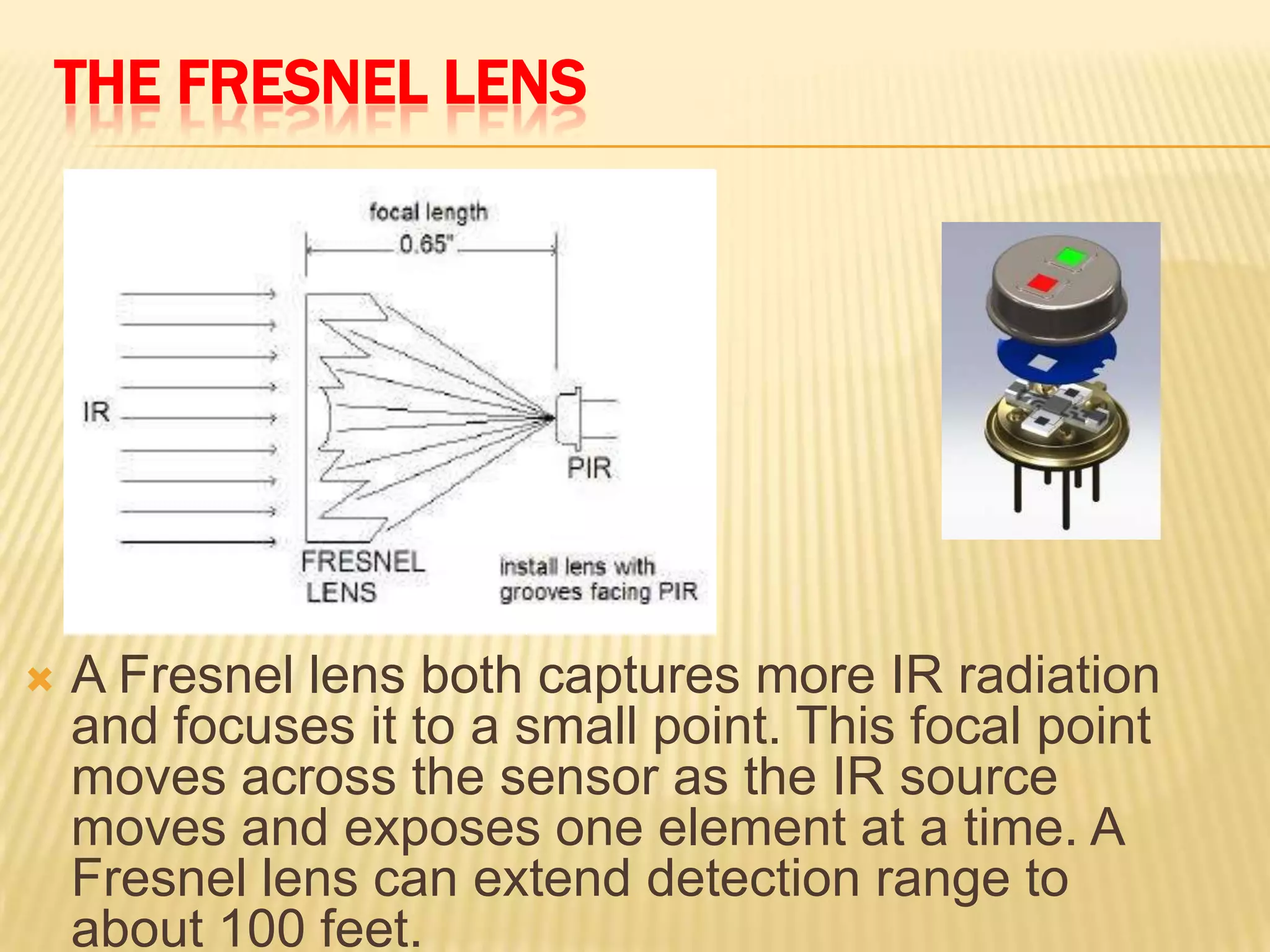
THE FRESNEL LENS
AFresnel lens both captures more IR radiation
and focuses it to a small point. This focal point
moves across the sensor as the IR source
moves and exposes one element at a time. A
Fresnel lens can extend detection range to
about 100 feet.
SHADOW LENS
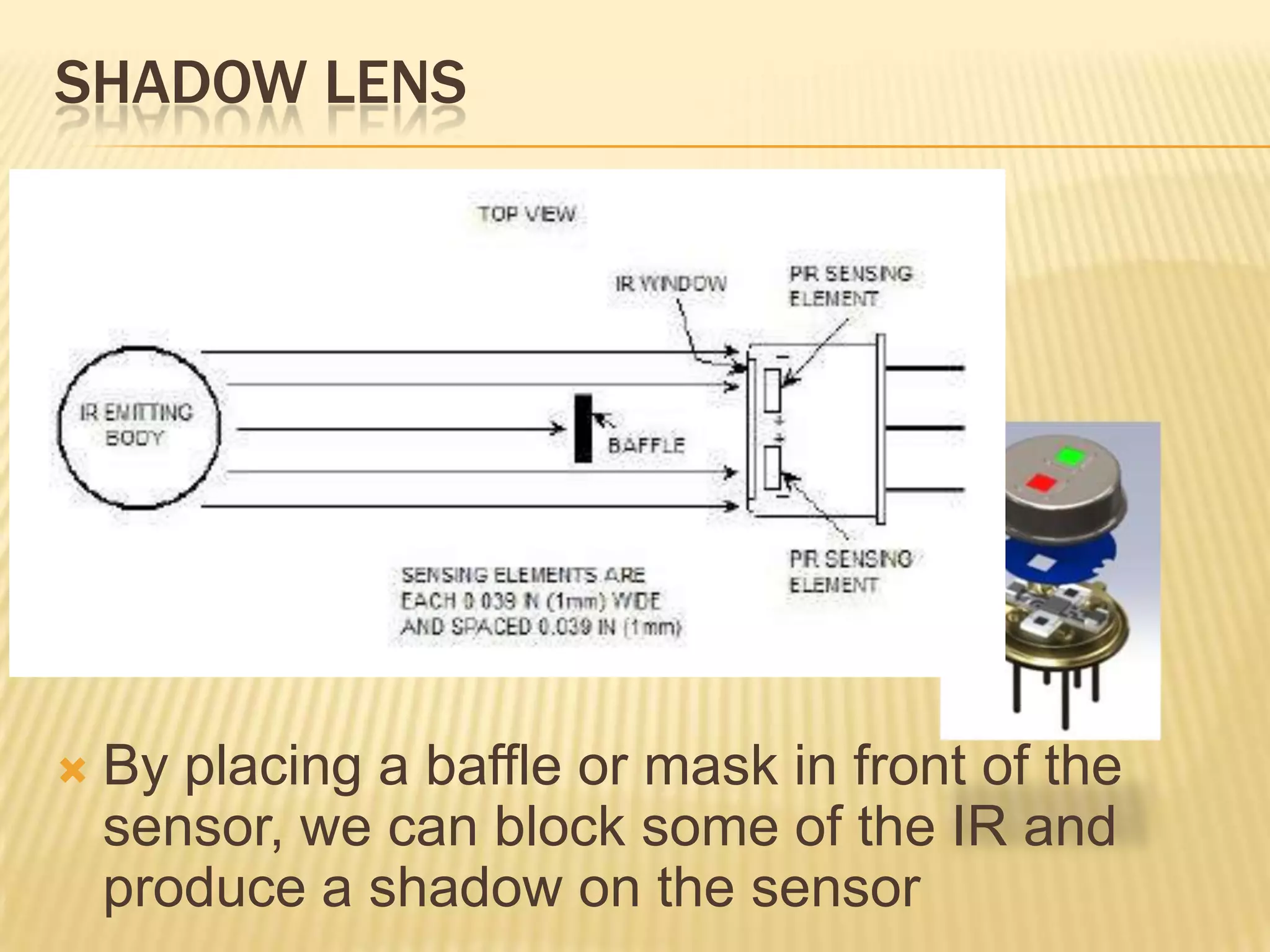
By placinga baffle or mask in front of the
sensor, we can block some of the IR and
produce a shadow on the sensor
13.
SHADOW LENS
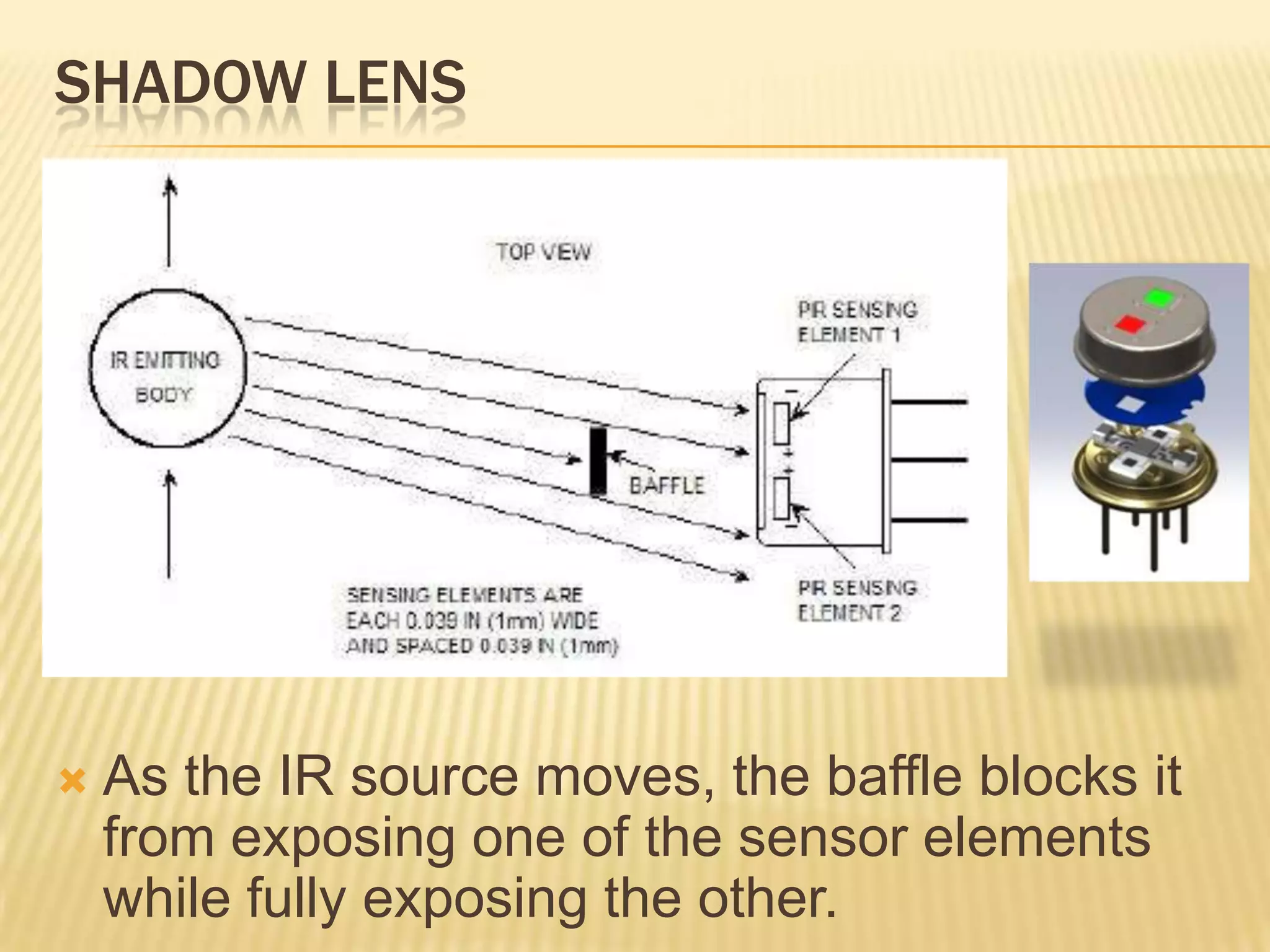
As theIR source moves, the baffle blocks it
from exposing one of the sensor elements
while fully exposing the other.
14.
SHADOW LENS
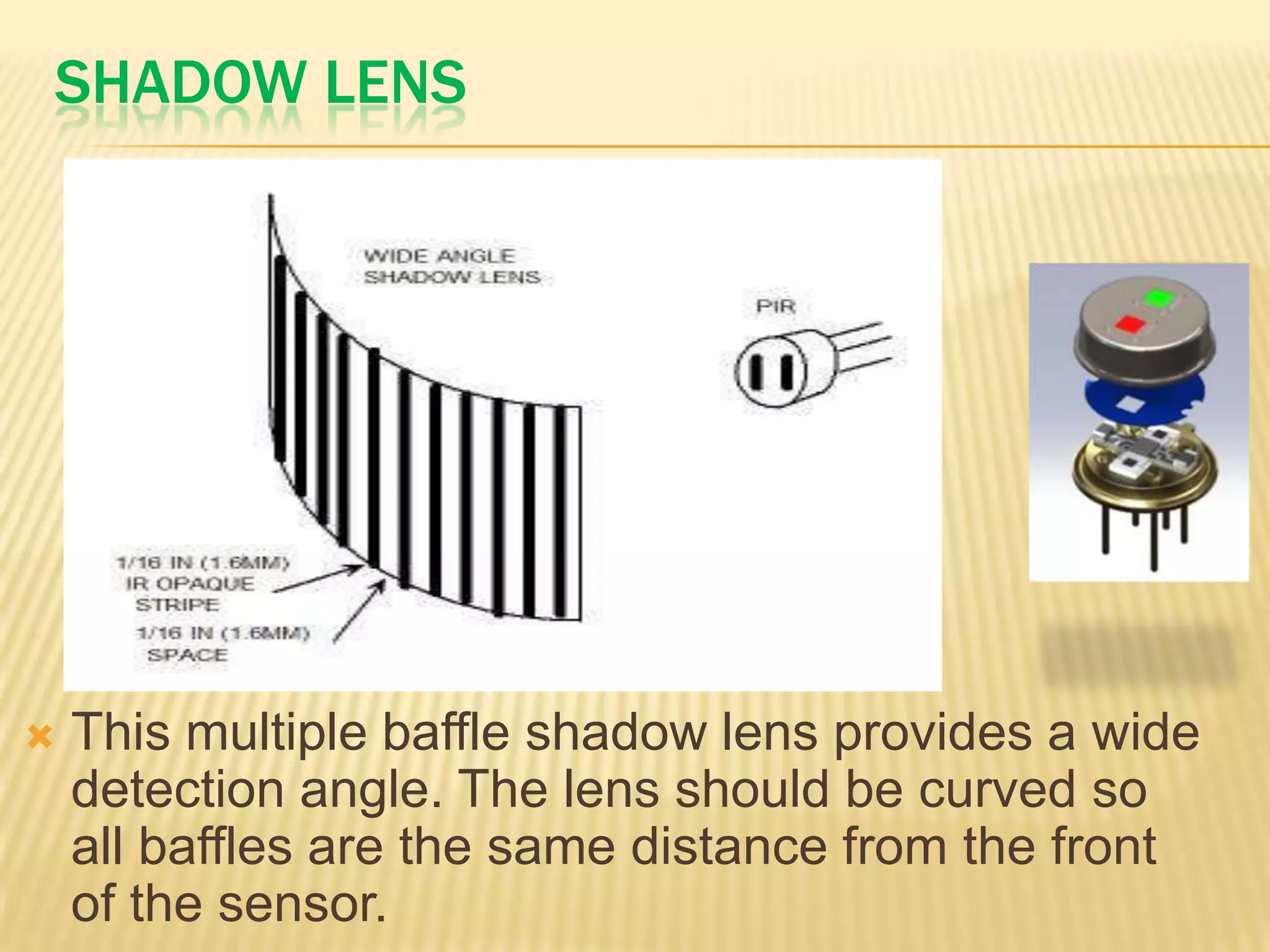
This multiplebaffle shadow lens provides a wide
detection angle. The lens should be curved so
all baffles are the same distance from the front
of the sensor.
TYPICAL CONFIGURATION OFPIR (1)
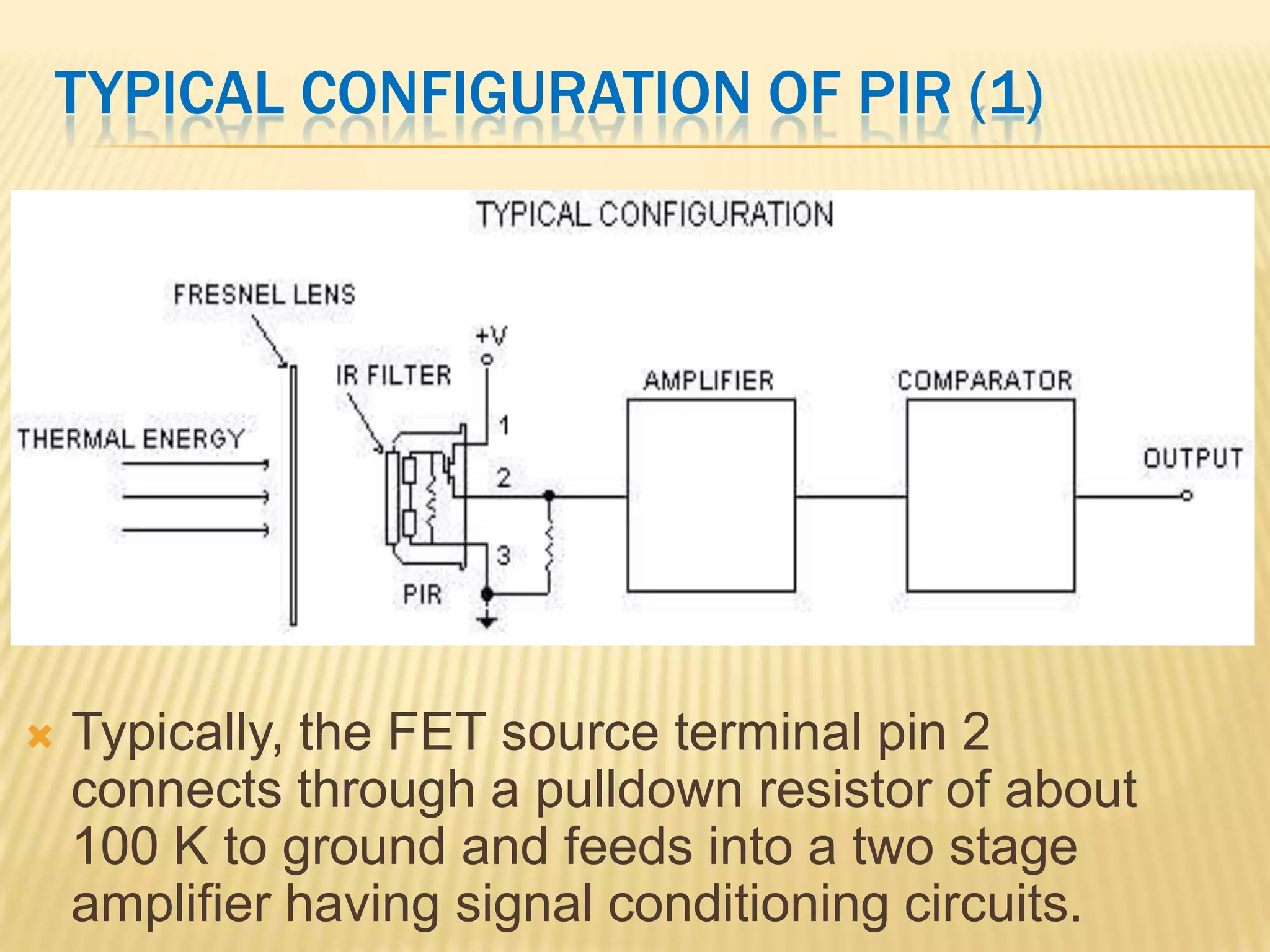
Typically, the FET source terminal pin 2
connects through a pulldown resistor of about
100 K to ground and feeds into a two stage
amplifier having signal conditioning circuits.
17.
TYPICAL CONFIGURATION OFPIR (2)
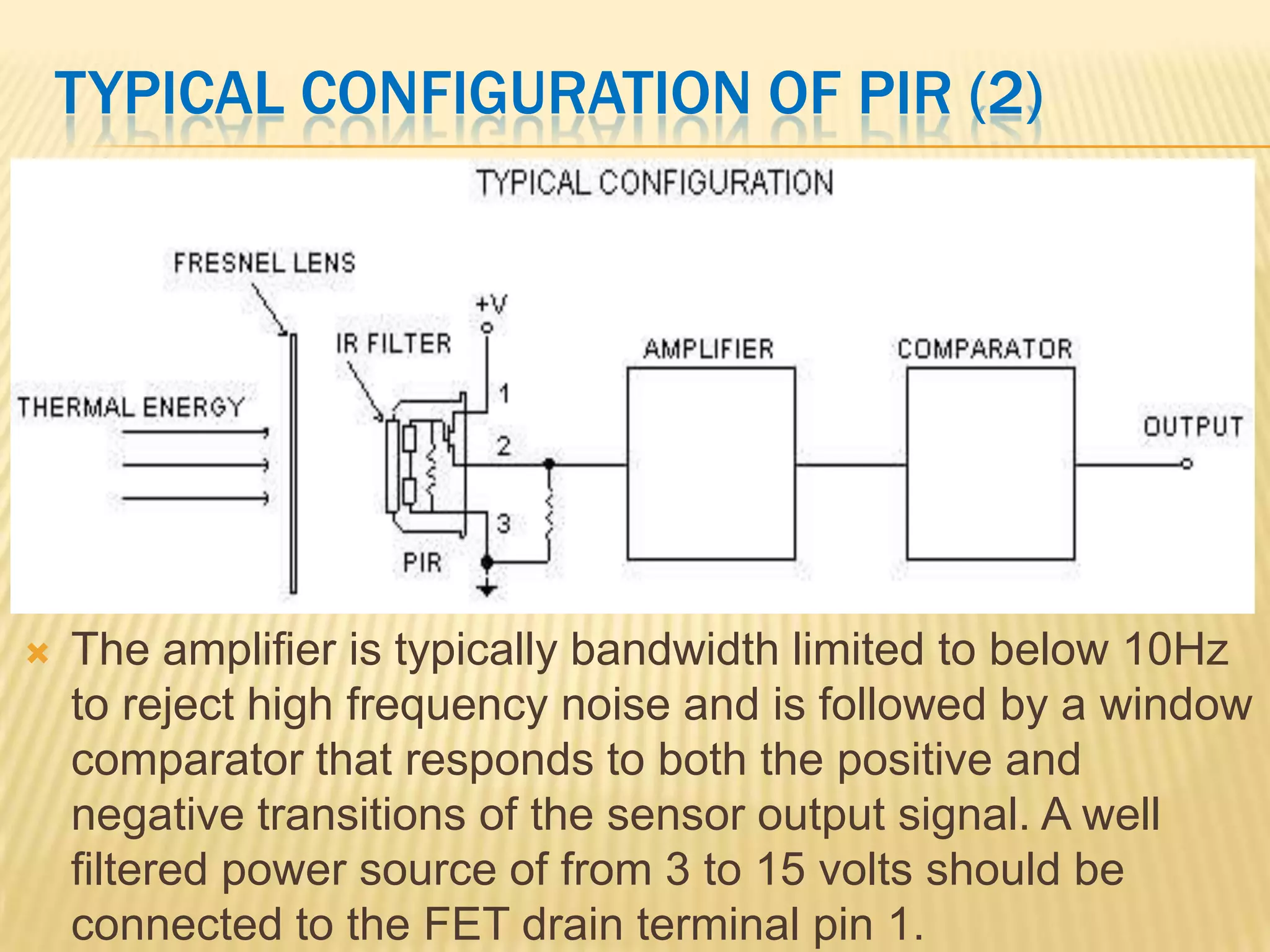
The amplifier is typically bandwidth limited to below 10Hz
to reject high frequency noise and is followed by a window
comparator that responds to both the positive and
negative transitions of the sensor output signal. A well
filtered power source of from 3 to 15 volts should be
connected to the FET drain terminal pin 1.
THE ARTICLE OFPYROELECTRIC SENSORS
MULTIPLE HUMAN TRACKING
AND
IDENTIFICATION WITH
WIRELESS
DISTRIBUTED PYROELECTRIC
SENSORS
22.
ABSTRACT (1)
The advantageof thermal human tracking over the
optical counterpart lies in its theoretical and practical
illumination invariance. The goal of our research is to
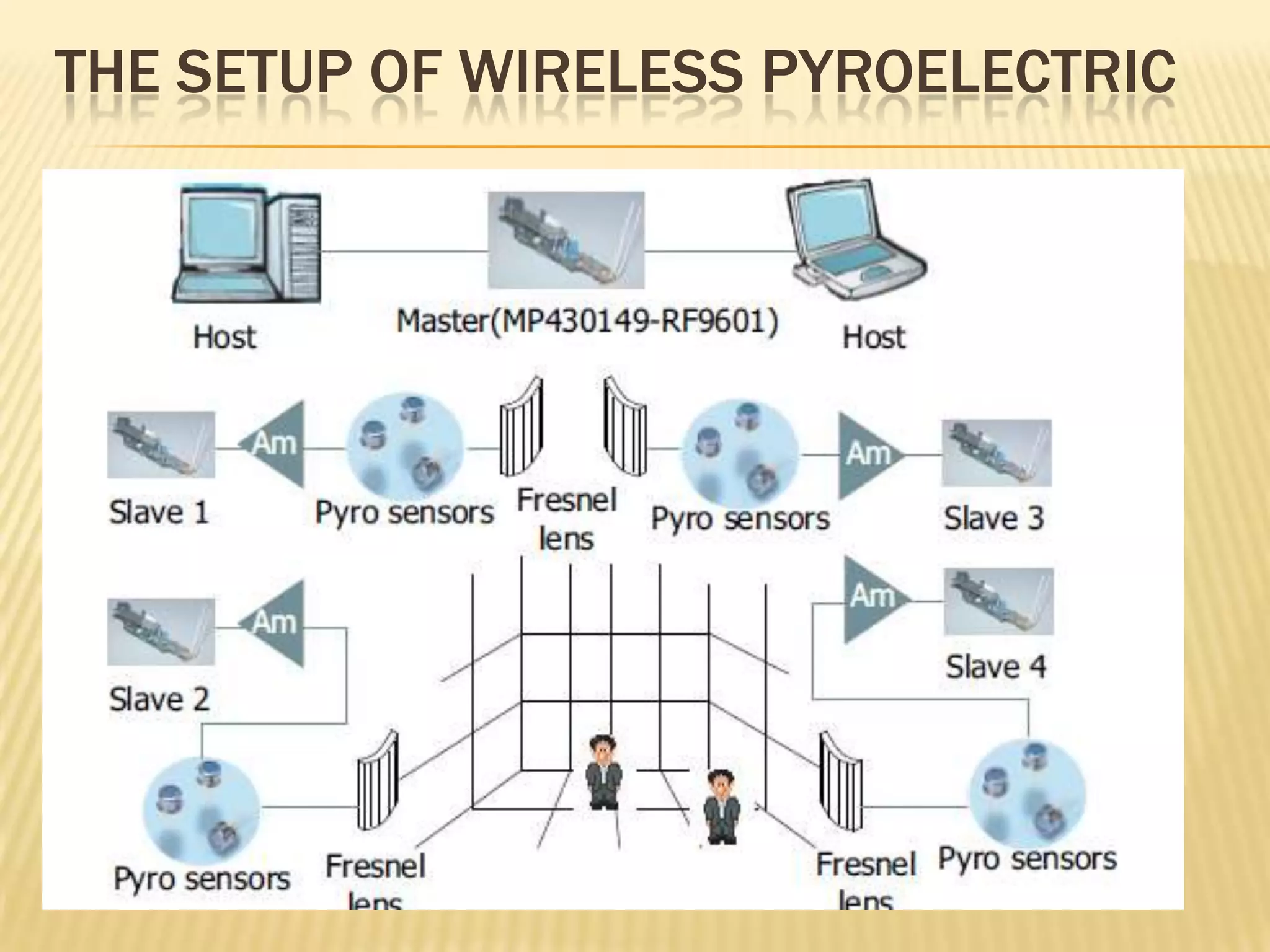
develop a prototype wireless distributed pyroelectric
sensor system, which can track multiple human
objects inside a room, while maintaining their identities
under allillumination circumstances. It involves two
sub-problems: multiple thermal source tracking and
thermal object identification.
23.
ABSTRACT (2)
Throughout constructionof the prototype sensor system,
the following topics have been addressed, investigated,
and managed:
(1) Signal processing balance between photonics and
elec-tronics.
(2) Algorithm trade-off between performance and cost,
for real-time system implementation.
(3) Distributed computation and communication management amongst host, master, and slave modules.
24.
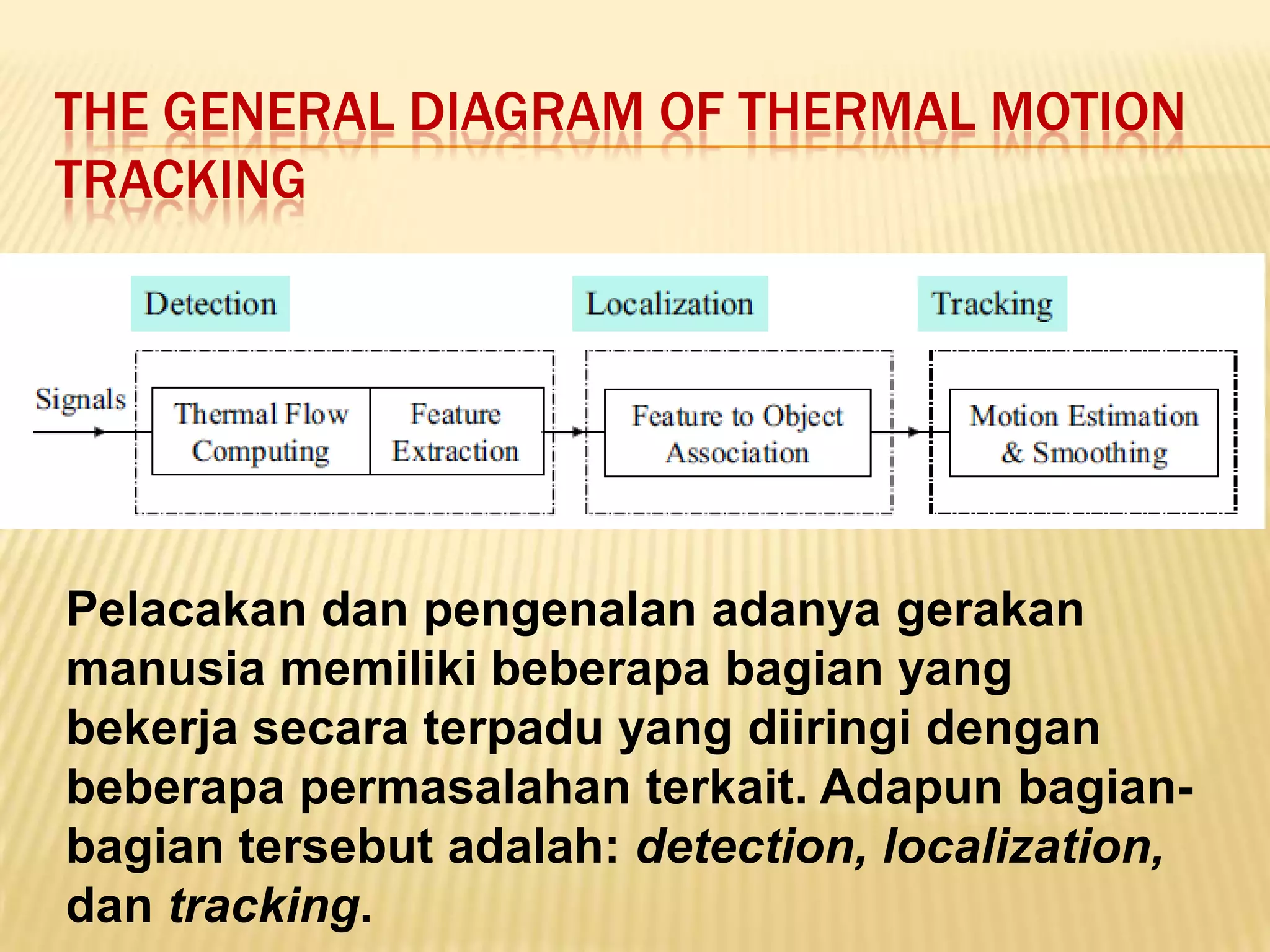
THE GENERAL DIAGRAMOF THERMAL MOTION
TRACKING
Pelacakan dan pengenalan adanya gerakan
manusia memiliki beberapa bagian yang
bekerja secara terpadu yang diiringi dengan
beberapa permasalahan terkait. Adapun bagianbagian tersebut adalah: detection, localization,
dan tracking.
25.
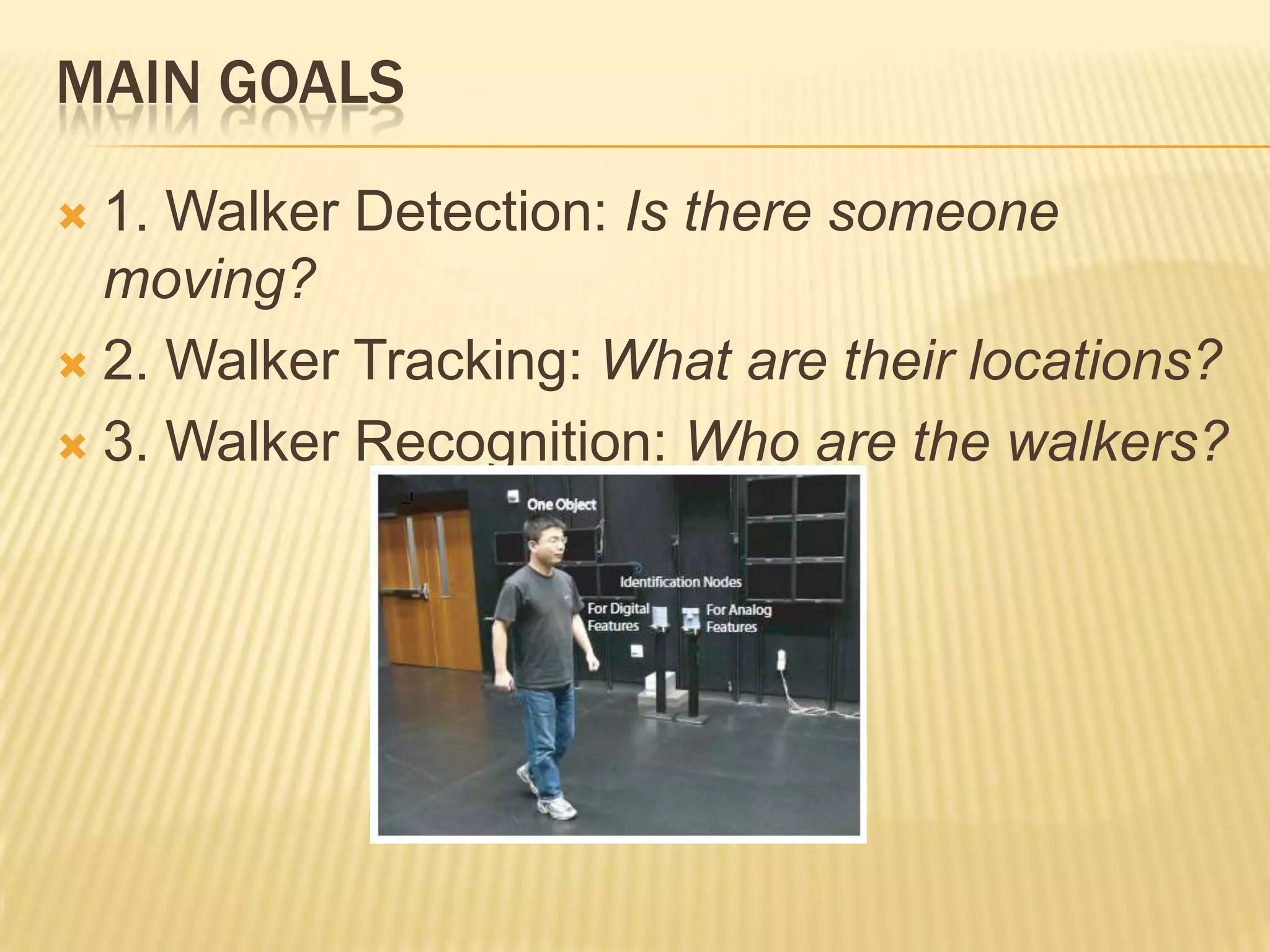
MAIN GOALS
1. WalkerDetection: Is there someone
moving?
2. Walker Tracking: What are their locations?
3. Walker Recognition: Who are the walkers?
26.
THE CHALLENGES
High variabilityand volatility of human
motions and their thermal biometrics
Difficulties in capturing and representing
main components of motions/thermal
features
Reduced sensitivity of pyroelectric sensors
with respect to distant objects.