SENSORS
Contents
 DHT 11 (Humidity Sensor)
 PIR Sensor
 LDR
 Joystick Sensor
 RFID Sensor
 Ultrasonic Sensor
 IR Sensor
 Color Sensor
 Gas Sensor
 Fingerprint Sensor
 Soil Moisture Sensor
Color Sensor
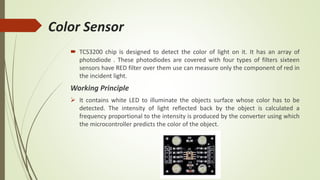
 TCS3200 chip is designed to detect the color of light on it. It has an array of
photodiode . These photodiodes are covered with four types of filters sixteen
sensors have RED filter over them use can measure only the component of red in
the incident light.
Working Principle
 It contains white LED to illuminate the objects surface whose color has to be
detected. The intensity of light reflected back by the object is calculated a
frequency proportional to the intensity is produced by the converter using which
the microcontroller predicts the color of the object.
DHT 11 Sensor
 DHT11 is a low-cost digital sensor for sensing temperature and
humidity. This sensor can be easily interfaced with any micro-controller
such as Arduino, Raspberry Pi etc… to measure humidity and temperature
instantaneously.
 DHT11 humidity and temperature sensor is available as a sensor and as a
module. The difference between this sensor and module is the pull-up
resistor and a power-on LED. DHT11 is a relative humidity sensor. To
measure the surrounding air this sensor uses a thermistor and a capacitive
humidity sensor.
Working Principle
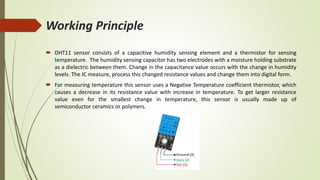
 DHT11 sensor consists of a capacitive humidity sensing element and a thermistor for sensing
temperature. The humidity sensing capacitor has two electrodes with a moisture holding substrate
as a dielectric between them. Change in the capacitance value occurs with the change in humidity
levels. The IC measure, process this changed resistance values and change them into digital form.
 For measuring temperature this sensor uses a Negative Temperature coefficient thermistor, which
causes a decrease in its resistance value with increase in temperature. To get larger resistance
value even for the smallest change in temperature, this sensor is usually made up of
semiconductor ceramics or polymers.
Specifications
• Operating Voltage: 3.5V to 5.5V
• Operating current: 0.3mA (measuring) 60uA (standby)
• Output: Serial data
• Temperature Range: 0°C to 50°C
• Humidity Range: 20% to 90%
• Resolution: Temperature and Humidity both are 16-bit
• Accuracy: ±1°C and ±1%
Applications
• Measure temperature and humidity
• Local Weather station
• Automatic climate control
• Environment monitoring
PIR Sensor
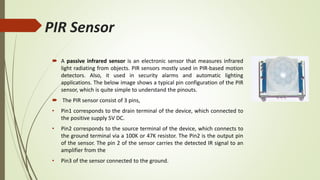
 A passive infrared sensor is an electronic sensor that measures infrared
light radiating from objects. PIR sensors mostly used in PIR-based motion
detectors. Also, it used in security alarms and automatic lighting
applications. The below image shows a typical pin configuration of the PIR
sensor, which is quite simple to understand the pinouts.
 The PIR sensor consist of 3 pins,
• Pin1 corresponds to the drain terminal of the device, which connected to
the positive supply 5V DC.
• Pin2 corresponds to the source terminal of the device, which connects to
the ground terminal via a 100K or 47K resistor. The Pin2 is the output pin
of the sensor. The pin 2 of the sensor carries the detected IR signal to an
amplifier from the
• Pin3 of the sensor connected to the ground.
Working Principle
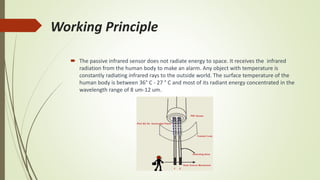
 The passive infrared sensor does not radiate energy to space. It receives the infrared
radiation from the human body to make an alarm. Any object with temperature is
constantly radiating infrared rays to the outside world. The surface temperature of the
human body is between 36° C - 27 ° C and most of its radiant energy concentrated in the
wavelength range of 8 um-12 um.
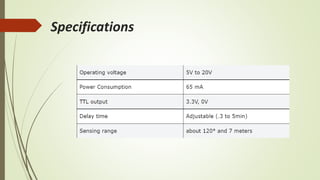
Specifications
Applications
• All outdoor Lights
• Lift Lobby
• Multi Apartment Complexes
• Common staircases
• For Basement or Covered Parking Area
• Shopping Malls
• For garden lights
LDR
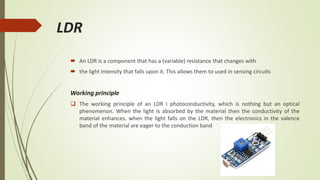
 An LDR is a component that has a (variable) resistance that changes with
 the light intensity that falls upon it. This allows them to used in sensing circuits
Working principle
 The working principle of an LDR I photoconductivity, which is nothing but an optical
phenomenon. When the light is absorbed by the material then the conductivity of the
material enhances. when the light falls on the LDR, then the electronics in the valence
band of the material are eager to the conduction band
Specifications
 Can be used to sense light
 Easy to use on breadboard or perf Board
 Easy to use with microcontroller or even with normal digital/analog IC
 Small, cheap and easily available
Applications
• Automatic Street Light
• Detect Day or Night
• Automatic Head Light Dimmer
• Position sensor
• Used along with LED as obstacle detector
• Automatic bedroom Lights
• Automatic Rear view mirror
Joystick Sensor
 This module offers an affordable to that. the joystick module Is similar to analog joystick
found in gamepads.
Working principle
 It made by mounting two potentiometers at 90 degrees angle. The
potentiometers are connected to a shot stick centered by springs.
 This module produces an output of around 2.5v from x and y when it Is in resting
position
Specifications
• Operating Voltage: 5V
• Internal Potentiometer value: 10k
• 2.54mm pin interface leads
• Dimensions: 1.57 in x 1.02 in x 1.26 in (4.0 cm x 2.6 cm x 3.2 cm)
• Operating temperature: 0 to 70 °C
Applications
• Camera Pan/Tilt Control
• Game Input/Control
• Robot Control
• Analog Input of Parameters
• Widely use in DIY projects
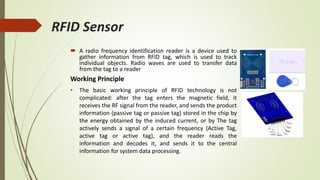
RFID Sensor
 A radio frequency identification reader is a device used to
gather information from RFID tag, which is used to track
individual objects. Radio waves are used to transfer data
from the tag to a reader
Working Principle
• The basic working principle of RFID technology is not
complicated: after the tag enters the magnetic field, it
receives the RF signal from the reader, and sends the product
information (passive tag or passive tag) stored in the chip by
the energy obtained by the induced current, or by The tag
actively sends a signal of a certain frequency (Active Tag,
active tag or active tag), and the reader reads the
information and decodes it, and sends it to the central
information for system data processing.
Specifications
 13.56MHZ RFID module
 Operating voltage – 2.5v to 3.3v
 Communication –spi,i2c protocol, UART
 Maximum Data Rate – 10Mbps
 Read range – 5cm
 Current consumption – 13-26 ma
 Power down mode consumption – 10uA(min)
Applications
• Used in office/schools for attendance management.
• Used for inventory tracking.
• Used to avoid fraudulent/stolen products from malls and super markets.
• In constructions industries RFID technology can be used to manage materials.
• Used in Real Time Location systems (RTLS) for tracking the location of a particular
asset or an employee.
• Used to lock and unlock the doors.
• And many more.
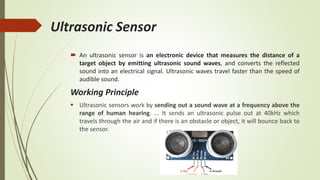
Ultrasonic Sensor
 An ultrasonic sensor is an electronic device that measures the distance of a
target object by emitting ultrasonic sound waves, and converts the reflected
sound into an electrical signal. Ultrasonic waves travel faster than the speed of
audible sound.
Working Principle
 Ultrasonic sensors work by sending out a sound wave at a frequency above the
range of human hearing. ... It sends an ultrasonic pulse out at 40kHz which
travels through the air and if there is an obstacle or object, it will bounce back to
the sensor.
Specifications
 Operating voltage: +5V
 Theoretical Measuring Distance: 2cm to 450cm
 Practical Measuring Distance: 2cm to 80cm
 Accuracy: 3mm
 Measuring angle covered: <15°
 Operating Current: <15mA
 Operating Frequency: 40Hz
Applications
• Anti-Collision Detection
• People Detection
• Contouring or Profiling
• Presence Detection
• Box Sorting using a Multi-Transducer System
• Easy Control of Trash Collection Vehicles
• Pallet Detection with Forklifts
• Bottle Counting on Drink Filling Machines
IR Sensor
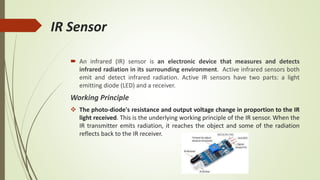
 An infrared (IR) sensor is an electronic device that measures and detects
infrared radiation in its surrounding environment. Active infrared sensors both
emit and detect infrared radiation. Active IR sensors have two parts: a light
emitting diode (LED) and a receiver.
Working Principle
 The photo-diode's resistance and output voltage change in proportion to the IR
light received. This is the underlying working principle of the IR sensor. When the
IR transmitter emits radiation, it reaches the object and some of the radiation
reflects back to the IR receiver.
Specifications
 5VDC Operating voltage
 I/O pins are 5V and 3.3V compliant
 Range: Up to 20cm
 Adjustable Sensing range
 Built-in Ambient Light Sensor
 20mA supply current
Applications
• Rail Safety
• IR Imaging Devices
• Infrared Astronomy
• Optical Power Meters
• Night Vision Devices
• Sorting Devices
• Moisture Analyzers
• Missile Guidance
• Flame Monitors
• Remote Sensing
Color Sensor
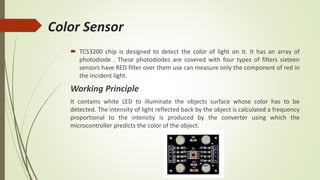
 TCS3200 chip is designed to detect the color of light on it. It has an array of
photodiode . These photodiodes are covered with four types of filters sixteen
sensors have RED filter over them use can measure only the component of red in
the incident light.
Working Principle
It contains white LED to illuminate the objects surface whose color has to be
detected. The intensity of light reflected back by the object is calculated a frequency
proportional to the intensity is produced by the converter using which the
microcontroller predicts the color of the object.
Specifications
• Supply Voltage:2.7V- 5.5V.
• Communicates Directly With a Microcontroller/Arduino.
• High-Resolution Conversion of Light Intensity to Frequency.
• Power Down Feature.
• Programmable Color and Full-Scale Output Frequency.
Applications
• Test strip reading.
• Sorting by color.
• Ambient light sensing and calibration.
• Color matching.
Gas Sensor
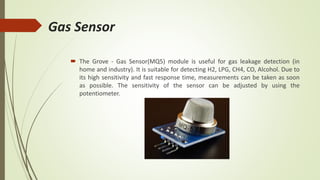
 The Grove - Gas Sensor(MQ5) module is useful for gas leakage detection (in
home and industry). It is suitable for detecting H2, LPG, CH4, CO, Alcohol. Due to
its high sensitivity and fast response time, measurements can be taken as soon
as possible. The sensitivity of the sensor can be adjusted by using the
potentiometer.
Working Principle
 The working principle behind the MQ-5 gas sensor is as follows: The sensor has a sensitive
filament made of SnO2.
 In the presence of clean air, this filament tends to have lower electrical conductivity.
 When a combustible gas such as LPG is introduced, the filament’s conductivity rises, and
the amount of change in its conductance/resistance can be used to indicate the
equivalent gas concentration.
 This effect tends to be particularly pronounced at higher temperatures, and resisitive
heating element is present as well. SnO2 is particularly sensitive to Methane, Butane and
Propane, but is also sensitive to other combustible gases as well.
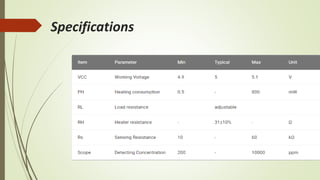
Specifications
Applications
• Used in industries to monitor the concentration of the toxic gases.
• Used in households to detect an emergency incidents.
• Used at oil rig locations to monitor the concentration of the gases those are released.
• Used at hotels to avoid customers from smoking.
• Used in air quality check at offices.
• Used in air conditioners to monitor the CO2 levels.
• Used in detecting fire.

• Used to check concentration of gases in mines.
• Breath analyzer
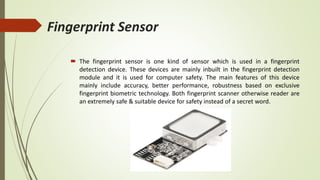
Fingerprint Sensor
 The fingerprint sensor is one kind of sensor which is used in a fingerprint
detection device. These devices are mainly inbuilt in the fingerprint detection
module and it is used for computer safety. The main features of this device
mainly include accuracy, better performance, robustness based on exclusive
fingerprint biometric technology. Both fingerprint scanner otherwise reader are
an extremely safe & suitable device for safety instead of a secret word.
Working Principle
 The working principle of the fingerprint sensor mainly depends on the
processing. The fingerprint processing mainly includes two elements namely
enrollment and matching. In fingerprint enrolling, every user requires to place
the finger twice.
 So that the system will check the finger images to process as well as to generate
a pattern of the finger and it will be stored. When matching, a user places the
finger using an optical sensor then the system will produce a pattern of the finger
& compares it with the finger library templates.
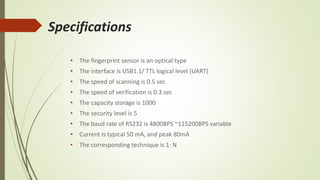
Specifications
• The fingerprint sensor is an optical type
• The interface is USB1.1/ TTL logical level (UART)
• The speed of scanning is 0.5 sec
• The speed of verification is 0.3 sec
• The capacity storage is 1000
• The security level is 5
• The baud rate of RS232 is 4800BPS ~115200BPS variable
• Current is typical 50 mA, and peak 80mA
• The corresponding technique is 1: N
Applications
 By using this we can make registration, fingerprint collection, search, and
comparison. These modules are inbuilt with FLASH memory that stores the
fingerprints.
 The fingerprint sensor applications include mobile, lock, unlock, in the display, on
screen, security systems, time attendance systems, door locks, etc.
Soil Moisture Sensor
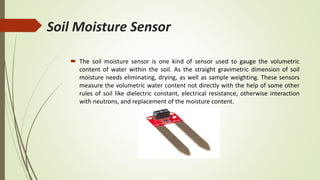
 The soil moisture sensor is one kind of sensor used to gauge the volumetric
content of water within the soil. As the straight gravimetric dimension of soil
moisture needs eliminating, drying, as well as sample weighting. These sensors
measure the volumetric water content not directly with the help of some other
rules of soil like dielectric constant, electrical resistance, otherwise interaction
with neutrons, and replacement of the moisture content.
Working Principle
 This sensor mainly utilizes capacitance to gauge the water content of the soil
(dielectric permittivity). The working of this sensor can be done by inserting this
sensor into the earth and the status of the water content in the soil can be
reported in the form of a percent.
 This sensor makes it perfect to execute experiments within science courses like
environmental science, agricultural science, biology, soil science, botany, and
horticulture.
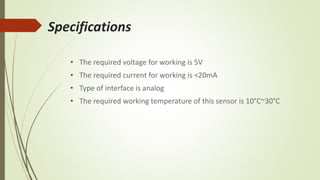
Specifications
• The required voltage for working is 5V
• The required current for working is <20mA
• Type of interface is analog
• The required working temperature of this sensor is 10°C~30°C
Applications
• Agriculture
• Landscape irrigation
• Research
• Simple sensors for gardeners
1693579833307_Sensors.ppt

1693579833307_Sensors.ppt

  • 1.
  • 2.
    Contents  DHT 11(Humidity Sensor)  PIR Sensor  LDR  Joystick Sensor  RFID Sensor  Ultrasonic Sensor  IR Sensor  Color Sensor  Gas Sensor  Fingerprint Sensor  Soil Moisture Sensor
  • 3.
    Color Sensor  TCS3200chip is designed to detect the color of light on it. It has an array of photodiode . These photodiodes are covered with four types of filters sixteen sensors have RED filter over them use can measure only the component of red in the incident light. Working Principle  It contains white LED to illuminate the objects surface whose color has to be detected. The intensity of light reflected back by the object is calculated a frequency proportional to the intensity is produced by the converter using which the microcontroller predicts the color of the object.
  • 4.
    DHT 11 Sensor DHT11 is a low-cost digital sensor for sensing temperature and humidity. This sensor can be easily interfaced with any micro-controller such as Arduino, Raspberry Pi etc… to measure humidity and temperature instantaneously.  DHT11 humidity and temperature sensor is available as a sensor and as a module. The difference between this sensor and module is the pull-up resistor and a power-on LED. DHT11 is a relative humidity sensor. To measure the surrounding air this sensor uses a thermistor and a capacitive humidity sensor.
  • 5.
    Working Principle  DHT11sensor consists of a capacitive humidity sensing element and a thermistor for sensing temperature. The humidity sensing capacitor has two electrodes with a moisture holding substrate as a dielectric between them. Change in the capacitance value occurs with the change in humidity levels. The IC measure, process this changed resistance values and change them into digital form.  For measuring temperature this sensor uses a Negative Temperature coefficient thermistor, which causes a decrease in its resistance value with increase in temperature. To get larger resistance value even for the smallest change in temperature, this sensor is usually made up of semiconductor ceramics or polymers.
  • 6.
    Specifications • Operating Voltage:3.5V to 5.5V • Operating current: 0.3mA (measuring) 60uA (standby) • Output: Serial data • Temperature Range: 0°C to 50°C • Humidity Range: 20% to 90% • Resolution: Temperature and Humidity both are 16-bit • Accuracy: ±1°C and ±1%
  • 7.
    Applications • Measure temperatureand humidity • Local Weather station • Automatic climate control • Environment monitoring
  • 8.
    PIR Sensor  Apassive infrared sensor is an electronic sensor that measures infrared light radiating from objects. PIR sensors mostly used in PIR-based motion detectors. Also, it used in security alarms and automatic lighting applications. The below image shows a typical pin configuration of the PIR sensor, which is quite simple to understand the pinouts.  The PIR sensor consist of 3 pins, • Pin1 corresponds to the drain terminal of the device, which connected to the positive supply 5V DC. • Pin2 corresponds to the source terminal of the device, which connects to the ground terminal via a 100K or 47K resistor. The Pin2 is the output pin of the sensor. The pin 2 of the sensor carries the detected IR signal to an amplifier from the • Pin3 of the sensor connected to the ground.
  • 9.
    Working Principle  Thepassive infrared sensor does not radiate energy to space. It receives the infrared radiation from the human body to make an alarm. Any object with temperature is constantly radiating infrared rays to the outside world. The surface temperature of the human body is between 36° C - 27 ° C and most of its radiant energy concentrated in the wavelength range of 8 um-12 um.
  • 10.
  • 11.
    Applications • All outdoorLights • Lift Lobby • Multi Apartment Complexes • Common staircases • For Basement or Covered Parking Area • Shopping Malls • For garden lights
  • 12.
    LDR  An LDRis a component that has a (variable) resistance that changes with  the light intensity that falls upon it. This allows them to used in sensing circuits Working principle  The working principle of an LDR I photoconductivity, which is nothing but an optical phenomenon. When the light is absorbed by the material then the conductivity of the material enhances. when the light falls on the LDR, then the electronics in the valence band of the material are eager to the conduction band
  • 13.
    Specifications  Can beused to sense light  Easy to use on breadboard or perf Board  Easy to use with microcontroller or even with normal digital/analog IC  Small, cheap and easily available
  • 14.
    Applications • Automatic StreetLight • Detect Day or Night • Automatic Head Light Dimmer • Position sensor • Used along with LED as obstacle detector • Automatic bedroom Lights • Automatic Rear view mirror
  • 15.
    Joystick Sensor  Thismodule offers an affordable to that. the joystick module Is similar to analog joystick found in gamepads. Working principle  It made by mounting two potentiometers at 90 degrees angle. The potentiometers are connected to a shot stick centered by springs.  This module produces an output of around 2.5v from x and y when it Is in resting position
  • 16.
    Specifications • Operating Voltage:5V • Internal Potentiometer value: 10k • 2.54mm pin interface leads • Dimensions: 1.57 in x 1.02 in x 1.26 in (4.0 cm x 2.6 cm x 3.2 cm) • Operating temperature: 0 to 70 °C
  • 17.
    Applications • Camera Pan/TiltControl • Game Input/Control • Robot Control • Analog Input of Parameters • Widely use in DIY projects
  • 18.
    RFID Sensor  Aradio frequency identification reader is a device used to gather information from RFID tag, which is used to track individual objects. Radio waves are used to transfer data from the tag to a reader Working Principle • The basic working principle of RFID technology is not complicated: after the tag enters the magnetic field, it receives the RF signal from the reader, and sends the product information (passive tag or passive tag) stored in the chip by the energy obtained by the induced current, or by The tag actively sends a signal of a certain frequency (Active Tag, active tag or active tag), and the reader reads the information and decodes it, and sends it to the central information for system data processing.
  • 19.
    Specifications  13.56MHZ RFIDmodule  Operating voltage – 2.5v to 3.3v  Communication –spi,i2c protocol, UART  Maximum Data Rate – 10Mbps  Read range – 5cm  Current consumption – 13-26 ma  Power down mode consumption – 10uA(min)
  • 20.
    Applications • Used inoffice/schools for attendance management. • Used for inventory tracking. • Used to avoid fraudulent/stolen products from malls and super markets. • In constructions industries RFID technology can be used to manage materials. • Used in Real Time Location systems (RTLS) for tracking the location of a particular asset or an employee. • Used to lock and unlock the doors. • And many more.
  • 21.
    Ultrasonic Sensor  Anultrasonic sensor is an electronic device that measures the distance of a target object by emitting ultrasonic sound waves, and converts the reflected sound into an electrical signal. Ultrasonic waves travel faster than the speed of audible sound. Working Principle  Ultrasonic sensors work by sending out a sound wave at a frequency above the range of human hearing. ... It sends an ultrasonic pulse out at 40kHz which travels through the air and if there is an obstacle or object, it will bounce back to the sensor.
  • 22.
    Specifications  Operating voltage:+5V  Theoretical Measuring Distance: 2cm to 450cm  Practical Measuring Distance: 2cm to 80cm  Accuracy: 3mm  Measuring angle covered: <15°  Operating Current: <15mA  Operating Frequency: 40Hz
  • 23.
    Applications • Anti-Collision Detection •People Detection • Contouring or Profiling • Presence Detection • Box Sorting using a Multi-Transducer System • Easy Control of Trash Collection Vehicles • Pallet Detection with Forklifts • Bottle Counting on Drink Filling Machines
  • 24.
    IR Sensor  Aninfrared (IR) sensor is an electronic device that measures and detects infrared radiation in its surrounding environment. Active infrared sensors both emit and detect infrared radiation. Active IR sensors have two parts: a light emitting diode (LED) and a receiver. Working Principle  The photo-diode's resistance and output voltage change in proportion to the IR light received. This is the underlying working principle of the IR sensor. When the IR transmitter emits radiation, it reaches the object and some of the radiation reflects back to the IR receiver.
  • 25.
    Specifications  5VDC Operatingvoltage  I/O pins are 5V and 3.3V compliant  Range: Up to 20cm  Adjustable Sensing range  Built-in Ambient Light Sensor  20mA supply current
  • 26.
    Applications • Rail Safety •IR Imaging Devices • Infrared Astronomy • Optical Power Meters • Night Vision Devices • Sorting Devices • Moisture Analyzers • Missile Guidance • Flame Monitors • Remote Sensing
  • 27.
    Color Sensor  TCS3200chip is designed to detect the color of light on it. It has an array of photodiode . These photodiodes are covered with four types of filters sixteen sensors have RED filter over them use can measure only the component of red in the incident light. Working Principle It contains white LED to illuminate the objects surface whose color has to be detected. The intensity of light reflected back by the object is calculated a frequency proportional to the intensity is produced by the converter using which the microcontroller predicts the color of the object.
  • 28.
    Specifications • Supply Voltage:2.7V-5.5V. • Communicates Directly With a Microcontroller/Arduino. • High-Resolution Conversion of Light Intensity to Frequency. • Power Down Feature. • Programmable Color and Full-Scale Output Frequency.
  • 29.
    Applications • Test stripreading. • Sorting by color. • Ambient light sensing and calibration. • Color matching.
  • 30.
    Gas Sensor  TheGrove - Gas Sensor(MQ5) module is useful for gas leakage detection (in home and industry). It is suitable for detecting H2, LPG, CH4, CO, Alcohol. Due to its high sensitivity and fast response time, measurements can be taken as soon as possible. The sensitivity of the sensor can be adjusted by using the potentiometer.
  • 31.
    Working Principle  Theworking principle behind the MQ-5 gas sensor is as follows: The sensor has a sensitive filament made of SnO2.  In the presence of clean air, this filament tends to have lower electrical conductivity.  When a combustible gas such as LPG is introduced, the filament’s conductivity rises, and the amount of change in its conductance/resistance can be used to indicate the equivalent gas concentration.  This effect tends to be particularly pronounced at higher temperatures, and resisitive heating element is present as well. SnO2 is particularly sensitive to Methane, Butane and Propane, but is also sensitive to other combustible gases as well.
  • 32.
  • 33.
    Applications • Used inindustries to monitor the concentration of the toxic gases. • Used in households to detect an emergency incidents. • Used at oil rig locations to monitor the concentration of the gases those are released. • Used at hotels to avoid customers from smoking. • Used in air quality check at offices. • Used in air conditioners to monitor the CO2 levels. • Used in detecting fire. • Used to check concentration of gases in mines. • Breath analyzer
  • 34.
    Fingerprint Sensor  Thefingerprint sensor is one kind of sensor which is used in a fingerprint detection device. These devices are mainly inbuilt in the fingerprint detection module and it is used for computer safety. The main features of this device mainly include accuracy, better performance, robustness based on exclusive fingerprint biometric technology. Both fingerprint scanner otherwise reader are an extremely safe & suitable device for safety instead of a secret word.
  • 35.
    Working Principle  Theworking principle of the fingerprint sensor mainly depends on the processing. The fingerprint processing mainly includes two elements namely enrollment and matching. In fingerprint enrolling, every user requires to place the finger twice.  So that the system will check the finger images to process as well as to generate a pattern of the finger and it will be stored. When matching, a user places the finger using an optical sensor then the system will produce a pattern of the finger & compares it with the finger library templates.
  • 36.
    Specifications • The fingerprintsensor is an optical type • The interface is USB1.1/ TTL logical level (UART) • The speed of scanning is 0.5 sec • The speed of verification is 0.3 sec • The capacity storage is 1000 • The security level is 5 • The baud rate of RS232 is 4800BPS ~115200BPS variable • Current is typical 50 mA, and peak 80mA • The corresponding technique is 1: N
  • 37.
    Applications  By usingthis we can make registration, fingerprint collection, search, and comparison. These modules are inbuilt with FLASH memory that stores the fingerprints.  The fingerprint sensor applications include mobile, lock, unlock, in the display, on screen, security systems, time attendance systems, door locks, etc.
  • 38.
    Soil Moisture Sensor The soil moisture sensor is one kind of sensor used to gauge the volumetric content of water within the soil. As the straight gravimetric dimension of soil moisture needs eliminating, drying, as well as sample weighting. These sensors measure the volumetric water content not directly with the help of some other rules of soil like dielectric constant, electrical resistance, otherwise interaction with neutrons, and replacement of the moisture content.
  • 39.
    Working Principle  Thissensor mainly utilizes capacitance to gauge the water content of the soil (dielectric permittivity). The working of this sensor can be done by inserting this sensor into the earth and the status of the water content in the soil can be reported in the form of a percent.  This sensor makes it perfect to execute experiments within science courses like environmental science, agricultural science, biology, soil science, botany, and horticulture.
  • 40.
    Specifications • The requiredvoltage for working is 5V • The required current for working is <20mA • Type of interface is analog • The required working temperature of this sensor is 10°C~30°C
  • 41.
    Applications • Agriculture • Landscapeirrigation • Research • Simple sensors for gardeners