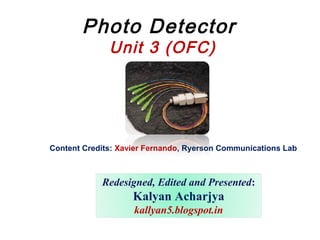
Photo Detector
Unit 3 (OFC)
Content Credits: Xavier Fernando, Ryerson Communications Lab
Redesigned, Edited and Presented:
Kalyan Acharjya
kallyan5.blogspot.in
What is Photo Detectors?
• Optical receivers convert optical signal (light) to
electrical signal (current/voltage)
– Hence referred ‘O/E Converter’
• Photodetector is the fundamental element of optical
receiver, followed by amplifiers and signal
conditioning circuitry
• There are several photodetector types:
– Photodiodes, Phototransistors, Photon multipliers,
Photo-resistors etc.
Photodetector Requirements
• Good sensitivity (Responsivity) at the desired
wavelength and poor Responsivity elsewhere
 wavelength selectivity
• Fast response time  high bandwidth
• Compatible physical dimensions
• Low noise
• Insensitive to temperature variations
• Long operating life and reasonable cost
Photodiodes
• Due to above requirements, only photodiodes
are used as photo detectors in optical
communication systems
• Positive-Intrinsic-Negative (pin) photodiode
– No internal gain
• Avalanche Photo Diode (APD)
– An internal gain of M due to self multiplication
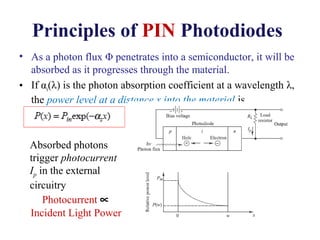
Principles of PIN Photodiodes
• As a photon flux Φ penetrates into a semiconductor, it will be
absorbed as it progresses through the material.
• If αs(λ) is the photon absorption coefficient at a wavelength λ,
the power level at a distance x into the material is
Absorbed photons
trigger photocurrent
Ip in the external
circuitry
Photocurrent ∝
Incident Light Power
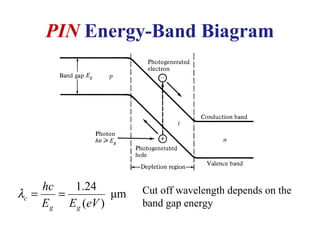
PIN Energy-Band Biagram
Cut off wavelength depends on the
band gap energy
μm
)(
24.1
eVEE
hc
gg
c ==λ
Avalanche Photodiode (APD)
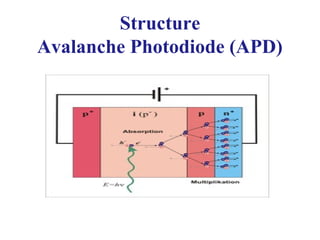
• APD has an internal gain obtained by having a high
electric field that energizes photo-generated electrons
and holes
• These electrons and holes ionize bound electrons in
the valence band upon colliding with them
• This mechanism is known as impact ionization
• The newly generated electrons and holes are also
accelerated by the high electric field and they gain
enough energy to cause further impact ionization
• This phenomena is called the avalanche effect.
Structure
Avalanche Photodiode (APD)
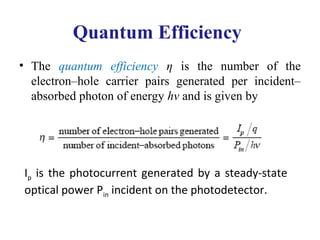
Quantum Efficiency
• The quantum efficiency η is the number of the
electron–hole carrier pairs generated per incident–
absorbed photon of energy hν and is given by
Ip is the photocurrent generated by a steady-state
optical power Pin incident on the photodetector.
APD vs PIN
• APD has high gain due to self multiplying
mechanism, used in high end systems
• The tradeoff is the ‘excess noise’ due to random
nature of the self multiplying process.
• APD’s need high reverse bias voltage (Ex: 40 V)
• Therefore costly and need additional circuitry
Optical Fiber-Light up Tomorrow
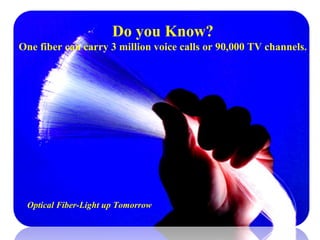
Do you Know?
One fiber can carry 3 million voice calls or 90,000 TV channels.
Why Fiber Optics Technology
10 Fun Facts
 Fiber Optics are Thinner.
 Fiber Optics are Lightweight.
 Fiber Optics are more Secure.
 Fiber Optics are Binary.
 Fiber Optics are more efficient.
 Fiber Optics use less energy.
 Fiber Optics are “Green”.
 Fiber Optics use Light.
 Fiber Optics aren’t influenced by Weather Conditions.
 Fiber Optics are Faster.
Thank You
kalyan5.blogspot.in
We can’t imagine Modern Techno-World, without Fiber Optics!

Photodetector (Photodiode)

  • 1.
    Photo Detector Unit 3(OFC) Content Credits: Xavier Fernando, Ryerson Communications Lab Redesigned, Edited and Presented: Kalyan Acharjya kallyan5.blogspot.in
  • 2.
    What is PhotoDetectors? • Optical receivers convert optical signal (light) to electrical signal (current/voltage) – Hence referred ‘O/E Converter’ • Photodetector is the fundamental element of optical receiver, followed by amplifiers and signal conditioning circuitry • There are several photodetector types: – Photodiodes, Phototransistors, Photon multipliers, Photo-resistors etc.
  • 3.
    Photodetector Requirements • Goodsensitivity (Responsivity) at the desired wavelength and poor Responsivity elsewhere  wavelength selectivity • Fast response time  high bandwidth • Compatible physical dimensions • Low noise • Insensitive to temperature variations • Long operating life and reasonable cost
  • 4.
    Photodiodes • Due toabove requirements, only photodiodes are used as photo detectors in optical communication systems • Positive-Intrinsic-Negative (pin) photodiode – No internal gain • Avalanche Photo Diode (APD) – An internal gain of M due to self multiplication
  • 5.
    Principles of PINPhotodiodes • As a photon flux Φ penetrates into a semiconductor, it will be absorbed as it progresses through the material. • If αs(λ) is the photon absorption coefficient at a wavelength λ, the power level at a distance x into the material is Absorbed photons trigger photocurrent Ip in the external circuitry Photocurrent ∝ Incident Light Power
  • 6.
    PIN Energy-Band Biagram Cutoff wavelength depends on the band gap energy μm )( 24.1 eVEE hc gg c ==λ
  • 7.
    Avalanche Photodiode (APD) •APD has an internal gain obtained by having a high electric field that energizes photo-generated electrons and holes • These electrons and holes ionize bound electrons in the valence band upon colliding with them • This mechanism is known as impact ionization • The newly generated electrons and holes are also accelerated by the high electric field and they gain enough energy to cause further impact ionization • This phenomena is called the avalanche effect.
  • 8.
  • 9.
    Quantum Efficiency • Thequantum efficiency η is the number of the electron–hole carrier pairs generated per incident– absorbed photon of energy hν and is given by Ip is the photocurrent generated by a steady-state optical power Pin incident on the photodetector.
  • 10.
    APD vs PIN •APD has high gain due to self multiplying mechanism, used in high end systems • The tradeoff is the ‘excess noise’ due to random nature of the self multiplying process. • APD’s need high reverse bias voltage (Ex: 40 V) • Therefore costly and need additional circuitry
  • 11.
    Optical Fiber-Light upTomorrow Do you Know? One fiber can carry 3 million voice calls or 90,000 TV channels.
  • 12.
    Why Fiber OpticsTechnology 10 Fun Facts  Fiber Optics are Thinner.  Fiber Optics are Lightweight.  Fiber Optics are more Secure.  Fiber Optics are Binary.  Fiber Optics are more efficient.  Fiber Optics use less energy.  Fiber Optics are “Green”.  Fiber Optics use Light.  Fiber Optics aren’t influenced by Weather Conditions.  Fiber Optics are Faster.
  • 13.
    Thank You kalyan5.blogspot.in We can’timagine Modern Techno-World, without Fiber Optics!