1
Laser Diode Structures
MEC
2
Contents
• Heterojunctions.
• Semiconductor Materials.
• Semiconductor Injection Lasers.
• Gain guided Lasers.
• Index Guided Lasers.
• Buried Heterostructure Lasers.
• Injection Laser Characteristics.
3
Heterojunctions
• Dielectric step due to different refractive
indices at either side of the junction.
• Radiation confinement to active region (walls
of an optical waveguide).
• Efficiency of containment depends on the
magnitude of the step, dictated by difference
in bandgap energies and wavelength of
radiation.
• Double-heterojunction (DH) structure - carrier
and optical confinement reduce threshold
currents (50 to 200 mA) for lasing by around
100.
4
Heterojunctions
• Homojunction - single p-n junction from a
single-crystal semiconductor material.
• Radiative properties improved using
heterojunctions.
• Heterojunction - interface between two
adjoining single crystal semiconductors
with different bandgap energies.
• Heterostructure - devices fabricated with
heterojunctions.
5
Heterojunctions
• Isotype (n–n or p–p) or anisotype (p–n).
• Isotype heterojunction - potential barrier
within the structure for confinement of
minority carriers to a small active region
(carrier confinement).
• Reduces carrier diffusion length and volume
within the structure where radiative
recombination take place.
• Fabrication of injection lasers and high-
radiance LEDs.
6
Heterojunctions
• Isotype heterojunctions used in LEDs to
provide a transparent layer close to active
region - reduces absorption of light emitted
from structure.
• Anisotype heterojunctions - large bandgap
differences improve injection efficiency of
either electrons or holes.
7
Heterojunctions
8
Heterojunctions
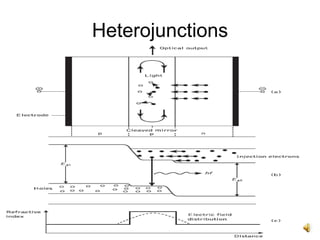
• Applied voltage for bandgap energy of the active
layer - large number of electrons(or holes)
injected into active layer, laser oscillation
commences.
• Carriers confined to active layer by energy
barriers provided by heterojunctions placed
within diffusion length of injected carriers.
• Refractive index step at heterojunctions provides
radiation containment to active layer.
9
Heterojunctions
• Active layer forms center of dielectric
waveguide, confines electroluminescence
within the region.
• Refractive index step desirable to prevent
losses due to lack of waveguiding.
• Reduce defects at interfaces - misfit
dislocations or inclusions cause nonradiative
recombination, reduce internal quantum
efficiency.
• Lattice matching needed.
10
Semiconductor Materials
• Materials to lend themselves to the formation
of p–n junctions.
• Efficient electroluminescence - high
probability of radiative transitions, high
internal quantum efficiency.
• Useful emission wavelength - materials to
emit light at wavelength to be utilized with
current optical fibers and detectors.
• Direct bandgap semiconductors/indirect
bandgap semiconductors with appropriate
impurity centers.
11
Semiconductor Materials
12
Semiconductor Materials
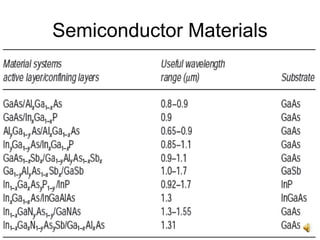
• GaAs/AlGaAs DH system used for fabricating
lasers and LEDs for shorter wavelengths.
• InGaAsP/InP material system for both long
wavelength light sources and detectors.
• Ternary-nitride-based alloys have advantage
over GaAs or InP-based alloys - better index
match with silica optical fibers.
• Introducing nitrogen reduces bandgap
sufficiently, gallium nitride (GaN) for blue
lasers.
13
Semiconductor Injection Lasers
• Also called Injection Laser Diodes (ILD) or
Injection Lasers.
• Stimulated emission by recombination of
injected carriers.
• Optical cavity in the crystal structure to
provide feedback of photons.
14
Advantages of Semiconductor
Injection Lasers
• High radiance due to amplifying effect of
stimulated emission - milliwatts of optical
output power.
• Narrow linewidth of the order of 1 nm.
• Modulation capabilities to extend up to GHz.
• Relative temporal coherence to allow
heterodyne (coherent) detection.
• Good spatial coherence - output focused by
lens into a spot - efficient coupling.
15
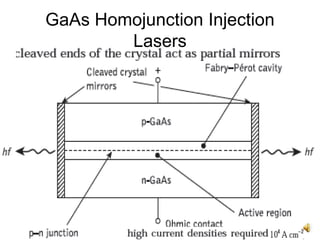
GaAs Homojunction Injection
Lasers
16
GaAs Homojunction Injection
Lasers
• High threshold current density.
• Lack of carrier containment.
• Inefficient light sources.
• Improved carrier containment, lower
threshold current densities (around 103 A
cm−2) with heterojunction (DH) structures.
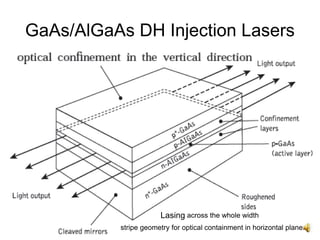
• DH injection laser fabricated from lattice-
matched III–V alloys - carrier and optical
confinement on both sides.
17
GaAs/AlGaAs DH Injection Lasers
Lasing across the whole width
stripe geometry for optical containment in horizontal plane.
18
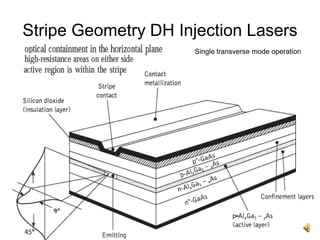
Stripe Geometry DH Injection Lasers
Single transverse mode operation
19
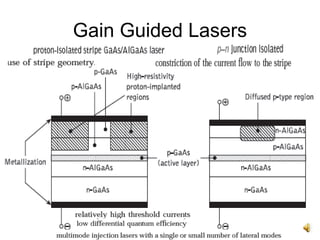
Gain Guided Lasers
20
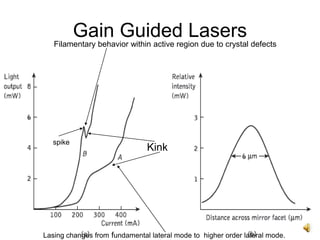
Gain Guided Lasers
Kink
Filamentary behavior within active region due to crystal defects
Lasing changes from fundamental lateral mode to higher order lateral mode.
spike
21
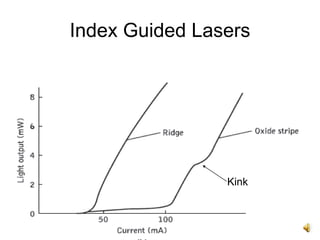
Index Guided Lasers
• Active region
waveguide thickness
varied by growing it
over a channel or
ridge in the substrate.
• Edges of the ridge
reflect light, guides it
within active layer,
forms a waveguide.
22
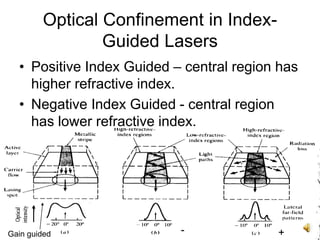
Optical Confinement in Index-
Guided Lasers
• Positive Index Guided – central region has
higher refractive index.
• Negative Index Guided - central region
has lower refractive index.
+-Gain guided
23
Index Guided Lasers
Kink
24
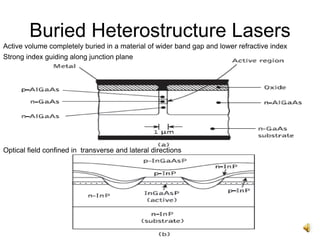
Buried Heterostructure Lasers
Strong index guiding along junction plane
Active volume completely buried in a material of wider band gap and lower refractive index
Optical field confined in transverse and lateral directions
25
Distributed Feedback Lasers
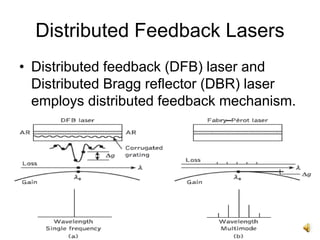
• Approach to single-frequency operation.
• Use of distributed resonators, fabricated into
laser structure to give integrated wavelength
selectivity.
• Distributed Bragg diffraction grating provides
periodic variation in refractive index in the laser
heterostructure waveguide along the direction of
wave propagation.
• Feedback of optical energy obtained through
Bragg reflection.
26
Distributed Feedback Lasers
• Distributed feedback (DFB) laser and
Distributed Bragg reflector (DBR) laser
employs distributed feedback mechanism.
27
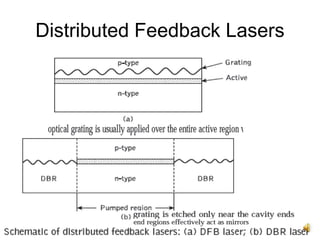
Distributed Feedback Lasers
28
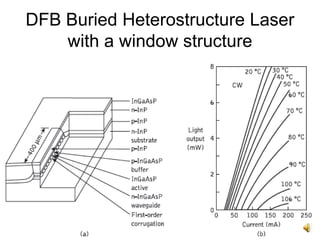
DFB Buried Heterostructure Laser
with a window structure
29
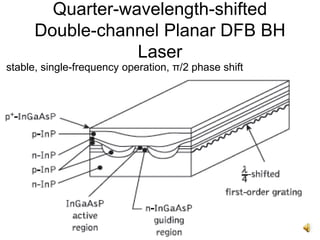
Quarter-wavelength-shifted
Double-channel Planar DFB BH
Laser
stable, single-frequency operation, π/2 phase shift
30
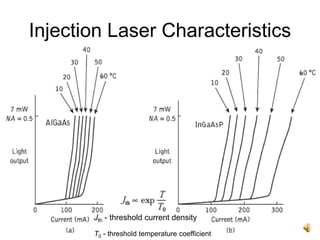
Injection Laser Characteristics
• Threshold current temperature dependence
T0 - threshold temperature coefficient
Jth - threshold current density
31
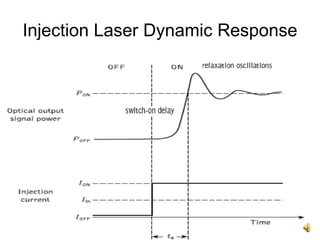
Injection Laser Dynamic Response
32
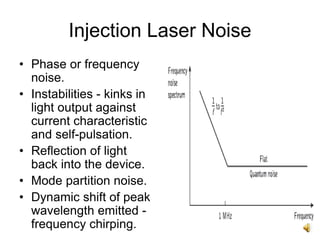
Injection Laser Noise
• Phase or frequency
noise.
• Instabilities - kinks in
light output against
current characteristic
and self-pulsation.
• Reflection of light
back into the device.
• Mode partition noise.
• Dynamic shift of peak
wavelength emitted -
frequency chirping.
33
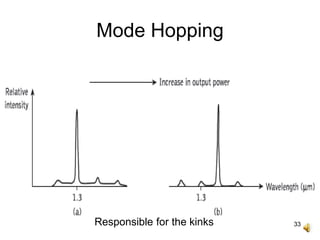
Mode Hopping
Responsible for the kinks
34
Reliability
• Catastrophic degradation – result of mechanical
damage of mirror facets, leads to partial or
complete laser failure.
• Gradual degradation:
(a) defect formation in the active region.
(b) degradation of the current-confining
junctions.
- Characterized by increase in threshold current
for the laser, decrease in external quantum
efficiency.
35
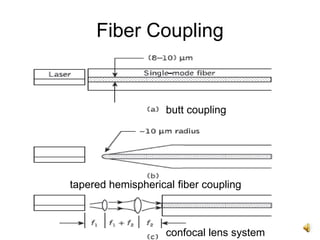
Fiber Coupling
butt coupling
tapered hemispherical fiber coupling
confocal lens system
36
Thank You

Laser diode structures

  • 1.
  • 2.
    2 Contents • Heterojunctions. • SemiconductorMaterials. • Semiconductor Injection Lasers. • Gain guided Lasers. • Index Guided Lasers. • Buried Heterostructure Lasers. • Injection Laser Characteristics.
  • 3.
    3 Heterojunctions • Dielectric stepdue to different refractive indices at either side of the junction. • Radiation confinement to active region (walls of an optical waveguide). • Efficiency of containment depends on the magnitude of the step, dictated by difference in bandgap energies and wavelength of radiation. • Double-heterojunction (DH) structure - carrier and optical confinement reduce threshold currents (50 to 200 mA) for lasing by around 100.
  • 4.
    4 Heterojunctions • Homojunction -single p-n junction from a single-crystal semiconductor material. • Radiative properties improved using heterojunctions. • Heterojunction - interface between two adjoining single crystal semiconductors with different bandgap energies. • Heterostructure - devices fabricated with heterojunctions.
  • 5.
    5 Heterojunctions • Isotype (n–nor p–p) or anisotype (p–n). • Isotype heterojunction - potential barrier within the structure for confinement of minority carriers to a small active region (carrier confinement). • Reduces carrier diffusion length and volume within the structure where radiative recombination take place. • Fabrication of injection lasers and high- radiance LEDs.
  • 6.
    6 Heterojunctions • Isotype heterojunctionsused in LEDs to provide a transparent layer close to active region - reduces absorption of light emitted from structure. • Anisotype heterojunctions - large bandgap differences improve injection efficiency of either electrons or holes.
  • 7.
  • 8.
    8 Heterojunctions • Applied voltagefor bandgap energy of the active layer - large number of electrons(or holes) injected into active layer, laser oscillation commences. • Carriers confined to active layer by energy barriers provided by heterojunctions placed within diffusion length of injected carriers. • Refractive index step at heterojunctions provides radiation containment to active layer.
  • 9.
    9 Heterojunctions • Active layerforms center of dielectric waveguide, confines electroluminescence within the region. • Refractive index step desirable to prevent losses due to lack of waveguiding. • Reduce defects at interfaces - misfit dislocations or inclusions cause nonradiative recombination, reduce internal quantum efficiency. • Lattice matching needed.
  • 10.
    10 Semiconductor Materials • Materialsto lend themselves to the formation of p–n junctions. • Efficient electroluminescence - high probability of radiative transitions, high internal quantum efficiency. • Useful emission wavelength - materials to emit light at wavelength to be utilized with current optical fibers and detectors. • Direct bandgap semiconductors/indirect bandgap semiconductors with appropriate impurity centers.
  • 11.
  • 12.
    12 Semiconductor Materials • GaAs/AlGaAsDH system used for fabricating lasers and LEDs for shorter wavelengths. • InGaAsP/InP material system for both long wavelength light sources and detectors. • Ternary-nitride-based alloys have advantage over GaAs or InP-based alloys - better index match with silica optical fibers. • Introducing nitrogen reduces bandgap sufficiently, gallium nitride (GaN) for blue lasers.
  • 13.
    13 Semiconductor Injection Lasers •Also called Injection Laser Diodes (ILD) or Injection Lasers. • Stimulated emission by recombination of injected carriers. • Optical cavity in the crystal structure to provide feedback of photons.
  • 14.
    14 Advantages of Semiconductor InjectionLasers • High radiance due to amplifying effect of stimulated emission - milliwatts of optical output power. • Narrow linewidth of the order of 1 nm. • Modulation capabilities to extend up to GHz. • Relative temporal coherence to allow heterodyne (coherent) detection. • Good spatial coherence - output focused by lens into a spot - efficient coupling.
  • 15.
  • 16.
    16 GaAs Homojunction Injection Lasers •High threshold current density. • Lack of carrier containment. • Inefficient light sources. • Improved carrier containment, lower threshold current densities (around 103 A cm−2) with heterojunction (DH) structures. • DH injection laser fabricated from lattice- matched III–V alloys - carrier and optical confinement on both sides.
  • 17.
    17 GaAs/AlGaAs DH InjectionLasers Lasing across the whole width stripe geometry for optical containment in horizontal plane.
  • 18.
    18 Stripe Geometry DHInjection Lasers Single transverse mode operation
  • 19.
  • 20.
    20 Gain Guided Lasers Kink Filamentarybehavior within active region due to crystal defects Lasing changes from fundamental lateral mode to higher order lateral mode. spike
  • 21.
    21 Index Guided Lasers •Active region waveguide thickness varied by growing it over a channel or ridge in the substrate. • Edges of the ridge reflect light, guides it within active layer, forms a waveguide.
  • 22.
    22 Optical Confinement inIndex- Guided Lasers • Positive Index Guided – central region has higher refractive index. • Negative Index Guided - central region has lower refractive index. +-Gain guided
  • 23.
  • 24.
    24 Buried Heterostructure Lasers Strongindex guiding along junction plane Active volume completely buried in a material of wider band gap and lower refractive index Optical field confined in transverse and lateral directions
  • 25.
    25 Distributed Feedback Lasers •Approach to single-frequency operation. • Use of distributed resonators, fabricated into laser structure to give integrated wavelength selectivity. • Distributed Bragg diffraction grating provides periodic variation in refractive index in the laser heterostructure waveguide along the direction of wave propagation. • Feedback of optical energy obtained through Bragg reflection.
  • 26.
    26 Distributed Feedback Lasers •Distributed feedback (DFB) laser and Distributed Bragg reflector (DBR) laser employs distributed feedback mechanism.
  • 27.
  • 28.
    28 DFB Buried HeterostructureLaser with a window structure
  • 29.
    29 Quarter-wavelength-shifted Double-channel Planar DFBBH Laser stable, single-frequency operation, π/2 phase shift
  • 30.
    30 Injection Laser Characteristics •Threshold current temperature dependence T0 - threshold temperature coefficient Jth - threshold current density
  • 31.
  • 32.
    32 Injection Laser Noise •Phase or frequency noise. • Instabilities - kinks in light output against current characteristic and self-pulsation. • Reflection of light back into the device. • Mode partition noise. • Dynamic shift of peak wavelength emitted - frequency chirping.
  • 33.
  • 34.
    34 Reliability • Catastrophic degradation– result of mechanical damage of mirror facets, leads to partial or complete laser failure. • Gradual degradation: (a) defect formation in the active region. (b) degradation of the current-confining junctions. - Characterized by increase in threshold current for the laser, decrease in external quantum efficiency.
  • 35.
    35 Fiber Coupling butt coupling taperedhemispherical fiber coupling confocal lens system
  • 36.