IN 504 Analytical Instruments
Module 2
1
Presented by;
Anju Sunny
CUSAT
Reference Text: R S Khandpur
“Handbook of Analytical Instrumentation”
Overview
 Introduction
 Difference between UV-VIS and IR Spectrometer
 Various regions of the IR range of the spectrum
 Basic components of IR spectrometer
2
Infrared (IR) Sources
The Nernst Glower:
 The Nernst glower is composed of rare earth oxides formed into a
cylinder having a diameter of 1 to 2 mm and a length of 20 mm.
Platinum leads are sealed to the ends of the cylinder to permit
electrical connection to what amounts to a resistive heating element.
A current is passed through the device, heat into a temperature
between 1200 K and 2200 K to result IR emission.
The Globar Source:
• A Globar is a silicon carbide rod, usually about 50 mm in length and
5 mm in diameter. It also is electrically heated (1300 to 1500 K).
Spectral energies of the Globar and the Nernst glower are comparable
except in the region below 5m, where the Globar provides a
significantly greater output.
Infrared (IR) Sources
Incandescent Wire Source ( Nichrome wire):
• A source of somewhat lower intensity but longer life than the
Globar or Nernst glower is a tightly wound spiral of nichrome wire
heated to about 1100 K by an electrical current.
The Mercury Arc:
• For the far-infrared region of the spectrum (> 50 m), none of the
thermal sources just described provides sufficient radiant power for
convenient detection. Here, a high-pressure mercury arc is used.
This device consists of a quartz-jacketed tube containing mercury
vapor at a pressure greater than one atmosphere. Passage of
electricity through the vapor forms an internal plasma source that
provides continuum radiation in the far-infrared region.
Infrared (IR) Sources
The Tungsten Filament Lamp:
• An ordinary tungsten filament lamp is a convenient source for the
near-infrared region of 4000 to 12,800 cm-1.
The Carbon Dioxide Laser Source:
 A tunable carbon dioxide laser is used as an infrared source for
monitoring the concentrations of certain atmospheric pollutants and
for determining absorbing species in aqueous solutions. A carbon
dioxide laser produces a band of radiation in the 900 to 1100 cm-1
range.
Optical Components used in Spectroscopy
 Entrance Slit: Purpose is to provide rectangular optical
image.
 Collimating Mirror or lens: Purpose is to produce parallel
beams of radiation, it overcomes diffraction.
 Prism or Grating: Disperses radiation into its component
wavelengths.
 Focusing Mirror or lens: Reforms image from slit onto
focal plane.
 Exit Slit: Isolates Spectral Band. 6
Optical Components used in Spectroscopy
7
Diffraction Grating Monochromator Prism type Monochromator
IR Detectors
 Thermal radiant energy  Electrical energy
8
Detectors
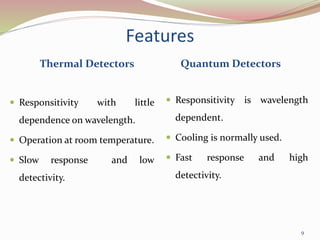
Thermal Detectors Quantum Detectors
Eg: Thermocouple
Thermopile
Bolometer
Pneumatic detector (Golay)
Pyroelectric detector
Eg: Intrinsic type
- Solid state Photo Detectors
Extrinsic type
- Photoconductive cell
Features
Thermal Detectors Quantum Detectors
 Responsitivity with little
dependence on wavelength.
 Operation at room temperature.
 Slow response and low
detectivity.
 Responsitivity is wavelength
dependent.
 Cooling is normally used.
 Fast response and high
detectivity.
9
Quantum Detectors
Solid state Photo Detectors Photoconductive cell
 Principle:- Photo electric effect
 Materials:- Cadmium-Mercury-
Telluride(CMT) or
Indium Antimonide (InSb)
 Sensitivity:- 2-6 μ (InSb)
10-12 μ (CMT)
 Principle:- Electrical resistors,
which decrease in resistance in
relation to the intensity of light
striking there surface.
 Materials:- Semiconductors like
Lead sulphide or Lead telluride
 Sensitivity:- 3.5 μ (Lead sulphide)
6 μ (Lead telluride)
10
Thermal Detectors
1) Thermocouple
 Principle:- In these detectors, the signal originates from a
potential difference caused by heating a junction of the
unlike metals by the infrared beam, while the other
junction is kept at constant temperature.
11
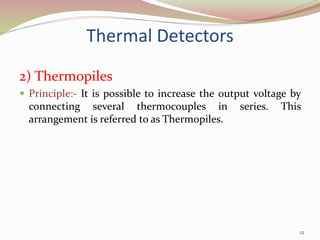
Thermal Detectors
2) Thermopiles
 Principle:- It is possible to increase the output voltage by
connecting several thermocouples in series. This
arrangement is referred to as Thermopiles.
12
Thermal Detectors
3) Bolometer
 Principle:- It provides an electrical signal as a result of the
variation in resistance of a conductor with temperature.
13
Thermal Detectors
4) Pneumatic detector (Golay Detector)
 Principle:- It measures the intensity of IR radiation by the
expansion of a gas filled in its chamber, upon heating.
14
Light source
Photocell
Thermal Detectors
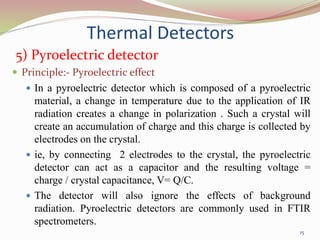
5) Pyroelectric detector
 Principle:- Pyroelectric effect
 In a pyroelectric detector which is composed of a pyroelectric
material, a change in temperature due to the application of IR
radiation creates a change in polarization . Such a crystal will
create an accumulation of charge and this charge is collected by
electrodes on the crystal.
 ie, by connecting 2 electrodes to the crystal, the pyroelectric
detector can act as a capacitor and the resulting voltage =
charge / crystal capacitance, V= Q/C.
 The detector will also ignore the effects of background
radiation. Pyroelectric detectors are commonly used in FTIR
spectrometers.
15
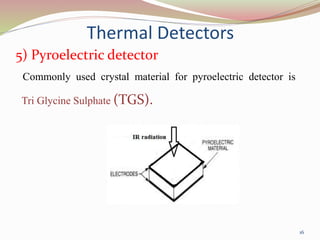
Thermal Detectors
5) Pyroelectric detector
Commonly used crystal material for pyroelectric detector is
Tri Glycine Sulphate (TGS).
16
Thermal Detectors
5) Pyroelectric detector
 The very small electrical charges are generally converted within the
detector housing to convenient signal voltages by use of extremely
low noise and low leakage Field Effect Transistors (FET).
17
FTIR Spectrometer
(Fourier Transform Spectrometer)
Fourier Transforms
 Fourier transform defines a relationship between a
signal in time domain and its representation in
frequency domain.
 Being a transform, no information is created or lost in
the process, so the original signal can be recovered
from the Fourier transform and vice versa.
 The Fourier transform of a signal is a continuous
complex valued signal capable of representing real
valued or complex valued continuous time signals.
What is a FTIR Spectrometer?
 FTIR (Fourier Transform InfraRed) spectrometer obtains an
infrared spectra by first collecting an interferogram of a
sample signal using an interferometer, then performs a
Fourier Transform on the interferogram to obtain the
spectrum.
 An interferometer is an instrument that uses the technique of
superimposing (interfering) two or more waves, to detect
differences between them. The FTIR spectrometer uses a
Michelson interferometer.
21
FT-IR Spectrometer
Principle:
Michelson’s Interferometer
Basic Optical Components of
the Interferometer (Principle)
Schematic diagram of a
Michelson interferometer for FTIR
 Monochromatic radiation entering the interferometer is
split into 2 beams having two different path lengths by
Beam splitter.
 When beams A and B recombine, an interference pattern
is produced.
 A detector measures the intensity variations of the exit
beam as a function of path difference.
 When two beams are in phase at beam splitter, maximum
intensity will reach detector.
Interferometer
 When two beams are out of phase intensity will be
minimum.
 When mirror M2 moved uniformly, Detector output will be
a sine wave.
 Amplitude of signal will depend on the intensity of
incoming radiation.
 Frequency is determined by
Translation velocity of M2
Wavelength of incoming radiation
Interferometer
FTIR Spectrometer - Block Diagram
Components of FTIR
1) IR Source (Glowbar)
2) Interferometer
3) Sample cell
4) Detector (Pyroelectric Detector)
5) Computer
6) Recorder or Plotter
How to Perform Fourier Transform?
27
Computer controls scan system and carry out math transformation,
ie performs Fourier transform.
The interferogram in practice consists of a set of intensities
measured for discrete values of path length differences (retardation).
 A discrete Fourier transform (Fast Fourier transform(FFT)
algorithm) is used to get the spectrum.
• Very high resolution (< 0.1 cm –1 )
Resolution governed by distance movable mirror travels
• Very high sensitivity (nanogram quantity)
can be coupled with GC analysis (–> measure IR spectra in gas-phase)
• High S/N ratios - high throughput
Few optics, no slits mean high intensity of light
• Rapid (<10 s)
• Reproducible and
• Inexpensive
Advantages of FTIR
Advantages of FTIR Over Dispersive Instrument
 In principle, an interferometer has several basic advantages over
a classical dispersive instrument. These advantages are:
 Multiplex advantage (Fellgett advantage): All source
wavelengths are measured simultaneously in an interferometer,
whereas in a dispersive spectrometer they are measured
successively. A complete spectrum can be collected very rapidly
and many scans can be averaged in the time taken for a single
scan of a dispersive spectrometer.
 Throughput advantage (Jacquinot advantage): For the same
resolution, the energy throughput in an interferometer can be
higher than in a dispersive spectrometer, where it is restricted by
the slits. FTIR has the ability to achieve the same signal-to-noise
ratio as a dispersive instrument in a much shorter time.
29
Advantages of FTIR Over Dispersive Instrument
 Calibration advantage: The wavenumber scale of an
interferometer is derived from a HeNe laser that acts as an internal
reference for each scan. The wavenumber of this laser is known
very accurately and is very stable. As a result, the wavenumber
calibration of interferometers is much more accurate and has much
better long term stability than the calibration of dispersive
instruments.
 Negligible stray light: Because of the way in which the
interferometer modulates each source wavelength. There is no
direct equivalent of the stray light found in dispersive
spectrometers.
 No discontinuities: Because there are no grating or filter changes,
there are no discontinuities in the spectrum.
30
Applications
Drug Analysis
Fiber Analysis
Paint Chip Analysis
Ink Analysis
Paper Analysis
Biological Analysis
Raman
Spectroscopy
32
Introduction
 It is a powerful tool for the Analytical tool,
 For the quantitative analysis of complex mixtures
 For locating various functional groups or chemical bonds in
molecules.
 Its principle is based on Raman effect.
33
Principle-Raman Effect
 Consider a sample irradiated with monochromatic light in the
visible region, majority of light simply passes through the sample
in the direction of incident beam and a small amount of (1 part in
105 ) is scattered by sample in all directions which can be observed
by viewing the sample at right angles to the incident beam.
 The scattering of light at the same frequency as the incident
radiation is called Rayleigh scattering.
 About 1% of the total scattered intensity occurs at frequencies
other than the incident frequency called Raman scattering and this
is due to interaction between incident photons and vibrational
energy levels of molecules.
34
Principle-Raman Effect
 The scattered lines are called Raman lines and are
characteristics of the vibrational modes of the substance
irradiated and represent a sort of finger print of that
substance.
35
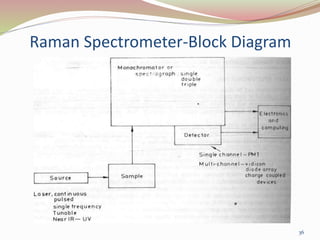
Raman Spectrometer-Block Diagram
36
Components of a Raman Spectrometer
1. A source of monochromatic radiation (helium neon laser)
2. Compartment and associated optics
3. Monochromator
4. Detection system (Photomultiplier tube)
5. Computer
37

Uv vis-ir spectroscopy

  • 1.
    IN 504 AnalyticalInstruments Module 2 1 Presented by; Anju Sunny CUSAT Reference Text: R S Khandpur “Handbook of Analytical Instrumentation”
  • 2.
    Overview  Introduction  Differencebetween UV-VIS and IR Spectrometer  Various regions of the IR range of the spectrum  Basic components of IR spectrometer 2
  • 3.
    Infrared (IR) Sources TheNernst Glower:  The Nernst glower is composed of rare earth oxides formed into a cylinder having a diameter of 1 to 2 mm and a length of 20 mm. Platinum leads are sealed to the ends of the cylinder to permit electrical connection to what amounts to a resistive heating element. A current is passed through the device, heat into a temperature between 1200 K and 2200 K to result IR emission. The Globar Source: • A Globar is a silicon carbide rod, usually about 50 mm in length and 5 mm in diameter. It also is electrically heated (1300 to 1500 K). Spectral energies of the Globar and the Nernst glower are comparable except in the region below 5m, where the Globar provides a significantly greater output.
  • 4.
    Infrared (IR) Sources IncandescentWire Source ( Nichrome wire): • A source of somewhat lower intensity but longer life than the Globar or Nernst glower is a tightly wound spiral of nichrome wire heated to about 1100 K by an electrical current. The Mercury Arc: • For the far-infrared region of the spectrum (> 50 m), none of the thermal sources just described provides sufficient radiant power for convenient detection. Here, a high-pressure mercury arc is used. This device consists of a quartz-jacketed tube containing mercury vapor at a pressure greater than one atmosphere. Passage of electricity through the vapor forms an internal plasma source that provides continuum radiation in the far-infrared region.
  • 5.
    Infrared (IR) Sources TheTungsten Filament Lamp: • An ordinary tungsten filament lamp is a convenient source for the near-infrared region of 4000 to 12,800 cm-1. The Carbon Dioxide Laser Source:  A tunable carbon dioxide laser is used as an infrared source for monitoring the concentrations of certain atmospheric pollutants and for determining absorbing species in aqueous solutions. A carbon dioxide laser produces a band of radiation in the 900 to 1100 cm-1 range.
  • 6.
    Optical Components usedin Spectroscopy  Entrance Slit: Purpose is to provide rectangular optical image.  Collimating Mirror or lens: Purpose is to produce parallel beams of radiation, it overcomes diffraction.  Prism or Grating: Disperses radiation into its component wavelengths.  Focusing Mirror or lens: Reforms image from slit onto focal plane.  Exit Slit: Isolates Spectral Band. 6
  • 7.
    Optical Components usedin Spectroscopy 7 Diffraction Grating Monochromator Prism type Monochromator
  • 8.
    IR Detectors  Thermalradiant energy  Electrical energy 8 Detectors Thermal Detectors Quantum Detectors Eg: Thermocouple Thermopile Bolometer Pneumatic detector (Golay) Pyroelectric detector Eg: Intrinsic type - Solid state Photo Detectors Extrinsic type - Photoconductive cell
  • 9.
    Features Thermal Detectors QuantumDetectors  Responsitivity with little dependence on wavelength.  Operation at room temperature.  Slow response and low detectivity.  Responsitivity is wavelength dependent.  Cooling is normally used.  Fast response and high detectivity. 9
  • 10.
    Quantum Detectors Solid statePhoto Detectors Photoconductive cell  Principle:- Photo electric effect  Materials:- Cadmium-Mercury- Telluride(CMT) or Indium Antimonide (InSb)  Sensitivity:- 2-6 μ (InSb) 10-12 μ (CMT)  Principle:- Electrical resistors, which decrease in resistance in relation to the intensity of light striking there surface.  Materials:- Semiconductors like Lead sulphide or Lead telluride  Sensitivity:- 3.5 μ (Lead sulphide) 6 μ (Lead telluride) 10
  • 11.
    Thermal Detectors 1) Thermocouple Principle:- In these detectors, the signal originates from a potential difference caused by heating a junction of the unlike metals by the infrared beam, while the other junction is kept at constant temperature. 11
  • 12.
    Thermal Detectors 2) Thermopiles Principle:- It is possible to increase the output voltage by connecting several thermocouples in series. This arrangement is referred to as Thermopiles. 12
  • 13.
    Thermal Detectors 3) Bolometer Principle:- It provides an electrical signal as a result of the variation in resistance of a conductor with temperature. 13
  • 14.
    Thermal Detectors 4) Pneumaticdetector (Golay Detector)  Principle:- It measures the intensity of IR radiation by the expansion of a gas filled in its chamber, upon heating. 14 Light source Photocell
  • 15.
    Thermal Detectors 5) Pyroelectricdetector  Principle:- Pyroelectric effect  In a pyroelectric detector which is composed of a pyroelectric material, a change in temperature due to the application of IR radiation creates a change in polarization . Such a crystal will create an accumulation of charge and this charge is collected by electrodes on the crystal.  ie, by connecting 2 electrodes to the crystal, the pyroelectric detector can act as a capacitor and the resulting voltage = charge / crystal capacitance, V= Q/C.  The detector will also ignore the effects of background radiation. Pyroelectric detectors are commonly used in FTIR spectrometers. 15
  • 16.
    Thermal Detectors 5) Pyroelectricdetector Commonly used crystal material for pyroelectric detector is Tri Glycine Sulphate (TGS). 16
  • 17.
    Thermal Detectors 5) Pyroelectricdetector  The very small electrical charges are generally converted within the detector housing to convenient signal voltages by use of extremely low noise and low leakage Field Effect Transistors (FET). 17
  • 18.
  • 19.
    Fourier Transforms  Fouriertransform defines a relationship between a signal in time domain and its representation in frequency domain.  Being a transform, no information is created or lost in the process, so the original signal can be recovered from the Fourier transform and vice versa.  The Fourier transform of a signal is a continuous complex valued signal capable of representing real valued or complex valued continuous time signals.
  • 20.
    What is aFTIR Spectrometer?  FTIR (Fourier Transform InfraRed) spectrometer obtains an infrared spectra by first collecting an interferogram of a sample signal using an interferometer, then performs a Fourier Transform on the interferogram to obtain the spectrum.  An interferometer is an instrument that uses the technique of superimposing (interfering) two or more waves, to detect differences between them. The FTIR spectrometer uses a Michelson interferometer.
  • 21.
  • 22.
    Basic Optical Componentsof the Interferometer (Principle) Schematic diagram of a Michelson interferometer for FTIR
  • 23.
     Monochromatic radiationentering the interferometer is split into 2 beams having two different path lengths by Beam splitter.  When beams A and B recombine, an interference pattern is produced.  A detector measures the intensity variations of the exit beam as a function of path difference.  When two beams are in phase at beam splitter, maximum intensity will reach detector. Interferometer
  • 24.
     When twobeams are out of phase intensity will be minimum.  When mirror M2 moved uniformly, Detector output will be a sine wave.  Amplitude of signal will depend on the intensity of incoming radiation.  Frequency is determined by Translation velocity of M2 Wavelength of incoming radiation Interferometer
  • 25.
    FTIR Spectrometer -Block Diagram
  • 26.
    Components of FTIR 1)IR Source (Glowbar) 2) Interferometer 3) Sample cell 4) Detector (Pyroelectric Detector) 5) Computer 6) Recorder or Plotter
  • 27.
    How to PerformFourier Transform? 27 Computer controls scan system and carry out math transformation, ie performs Fourier transform. The interferogram in practice consists of a set of intensities measured for discrete values of path length differences (retardation).  A discrete Fourier transform (Fast Fourier transform(FFT) algorithm) is used to get the spectrum.
  • 28.
    • Very highresolution (< 0.1 cm –1 ) Resolution governed by distance movable mirror travels • Very high sensitivity (nanogram quantity) can be coupled with GC analysis (–> measure IR spectra in gas-phase) • High S/N ratios - high throughput Few optics, no slits mean high intensity of light • Rapid (<10 s) • Reproducible and • Inexpensive Advantages of FTIR
  • 29.
    Advantages of FTIROver Dispersive Instrument  In principle, an interferometer has several basic advantages over a classical dispersive instrument. These advantages are:  Multiplex advantage (Fellgett advantage): All source wavelengths are measured simultaneously in an interferometer, whereas in a dispersive spectrometer they are measured successively. A complete spectrum can be collected very rapidly and many scans can be averaged in the time taken for a single scan of a dispersive spectrometer.  Throughput advantage (Jacquinot advantage): For the same resolution, the energy throughput in an interferometer can be higher than in a dispersive spectrometer, where it is restricted by the slits. FTIR has the ability to achieve the same signal-to-noise ratio as a dispersive instrument in a much shorter time. 29
  • 30.
    Advantages of FTIROver Dispersive Instrument  Calibration advantage: The wavenumber scale of an interferometer is derived from a HeNe laser that acts as an internal reference for each scan. The wavenumber of this laser is known very accurately and is very stable. As a result, the wavenumber calibration of interferometers is much more accurate and has much better long term stability than the calibration of dispersive instruments.  Negligible stray light: Because of the way in which the interferometer modulates each source wavelength. There is no direct equivalent of the stray light found in dispersive spectrometers.  No discontinuities: Because there are no grating or filter changes, there are no discontinuities in the spectrum. 30
  • 31.
    Applications Drug Analysis Fiber Analysis PaintChip Analysis Ink Analysis Paper Analysis Biological Analysis
  • 32.
  • 33.
    Introduction  It isa powerful tool for the Analytical tool,  For the quantitative analysis of complex mixtures  For locating various functional groups or chemical bonds in molecules.  Its principle is based on Raman effect. 33
  • 34.
    Principle-Raman Effect  Considera sample irradiated with monochromatic light in the visible region, majority of light simply passes through the sample in the direction of incident beam and a small amount of (1 part in 105 ) is scattered by sample in all directions which can be observed by viewing the sample at right angles to the incident beam.  The scattering of light at the same frequency as the incident radiation is called Rayleigh scattering.  About 1% of the total scattered intensity occurs at frequencies other than the incident frequency called Raman scattering and this is due to interaction between incident photons and vibrational energy levels of molecules. 34
  • 35.
    Principle-Raman Effect  Thescattered lines are called Raman lines and are characteristics of the vibrational modes of the substance irradiated and represent a sort of finger print of that substance. 35
  • 36.
  • 37.
    Components of aRaman Spectrometer 1. A source of monochromatic radiation (helium neon laser) 2. Compartment and associated optics 3. Monochromator 4. Detection system (Photomultiplier tube) 5. Computer 37