SENSORS
SENSOR
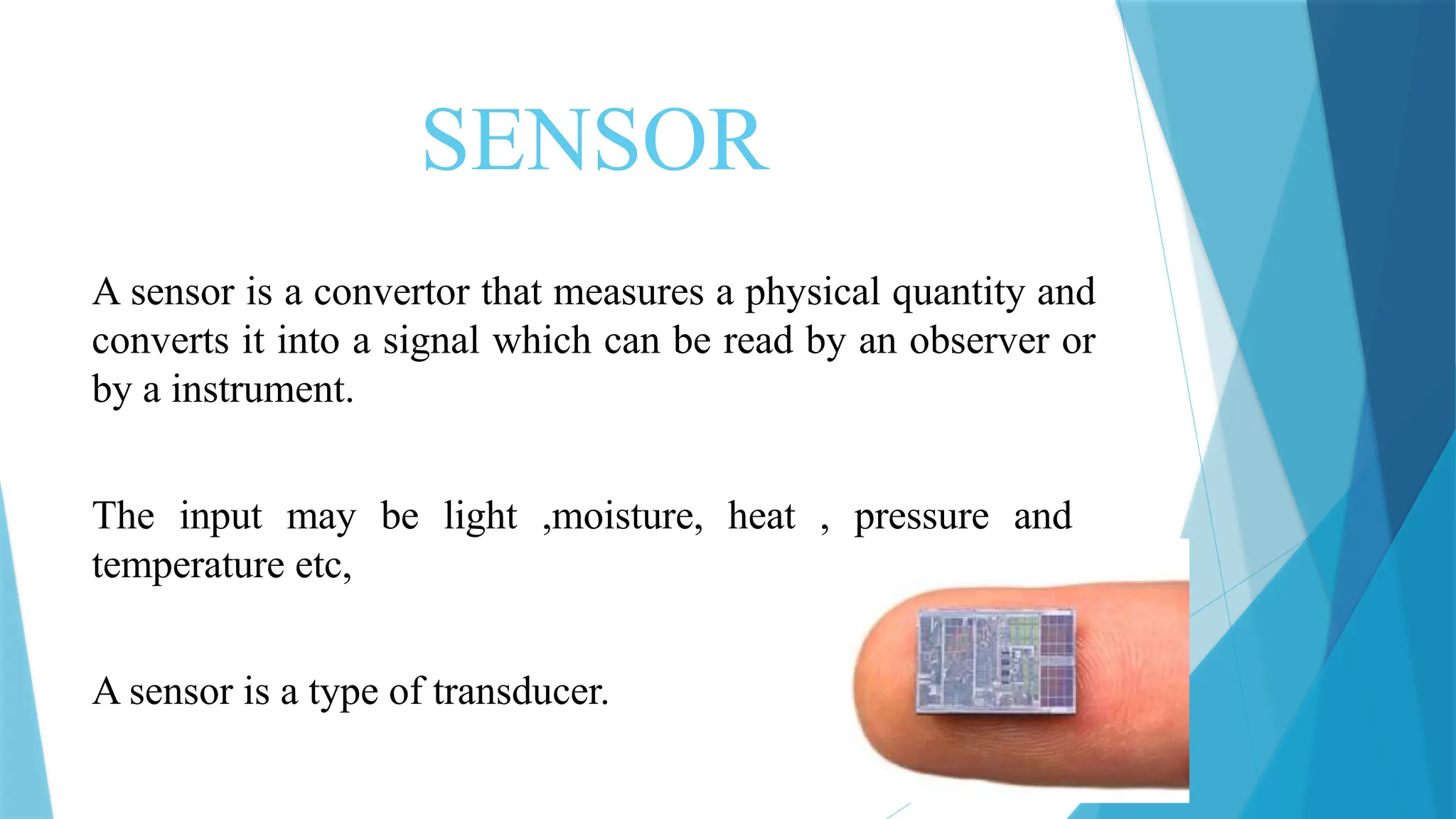
A sensor is a convertor that measures a physical quantity and
converts it into a signal which can be read by an observer or
by a instrument.
The input may be light ,moisture, heat , pressure and
temperature etc,
A sensor is a type of transducer.
CLASSIFICATION OF SENSORS
In the first classification of the sensors, they are divided in to Active and Passive.
• Active sensors emit energy and measure the reflected or scattered
signal,
• while passive sensors detect the natural radiation or emission from
the target or the environment.
Applications of active sensors
 Active sensors are used as radar, lidar, sonar, ultrasound, laser, and microwave.
 Radar (Radio Detection and Ranging)
 uses radio waves
 to detect and track objects in the air, on the ground, or at sea.
 Lidar (Light Detection and Ranging)
 use laser pulses
 to measure distance and create high-resolution maps of the surface or the
atmosphere.
 Sonar (Sound Navigation and Ranging)
 Uses sound waves
 to locate and identify underwater objects or features.
 Ultrasound
 Uses ultrasonic waves
 that can penetrate liquid materials and produce images or
measurements of the internal structure or condition.
Applications of passive sensors
Passive sensors are used in various fields and applications, such as infrared, visible,
ultraviolet, thermal, acoustic, and magnetic.
 Infrared radiation sensors
detect heat or thermal radiation from objects or sources
 Visible radiation sensors
capture images or colors of an objects
 Ultraviolet radiation sensors
which can gives hidden or fluorescent features of substances;
 Temperature sensors
measure the heat or coldness of objects or environments
 Sound sensors
pick up vibrations or noises from objects or sources
 Magnetic sensors
measure the strength or direction of magnetic fields or forces.
Analog and Digital Sensors
Digital Sensors
 A digital sensor is an electronic or electrochemical sensor, where data is digitally
converted and transmitted
 These sensors has fast transmission rate as well as poor distortion.
 The main reason that many people prefer using digital sensors is because
 they don’t have the same limitations as analog sensors.
 used for wastewater treatment, water purification, and similar industrial
processes.
 also measure conductivity, pH levels, ammonium concentration, nitrate
concentration, and dissolved oxygen.
Analog sensors
Measures a physical quantity or phenomenon and provides an output signal .
In other words, Analog sensors provide an output signal that varies continuously with
changes in the measured parameter.
The analog quantities that are known to be continuous in nature include;
speed, pressure, displacement, strain, and temperature.
For instance, you can use a thermometer to measure the temperature of a liquid. By
obtaining continuous readings, the analog sensor will respond immediately to any
changes that occur in the temperature of the liquid as its heats up or cools down.
 There are many types of analog sensors, among the most common type is a
pressure sensor, which is commonly used in industrial and lab settings to
manage the pressure of liquids or gases.
 These sensors will act as transducers by generating a signal when pressure is
imposed.
 A pressure sensor is used to monitor and control hundreds of applications.
 such variables as gas and fluid flow, water level, speed, . Keep in mind that
pressure analog sensors may also be referred to as pressure transducers, pressure
senders, pressure transmitters, and pressure indicators.
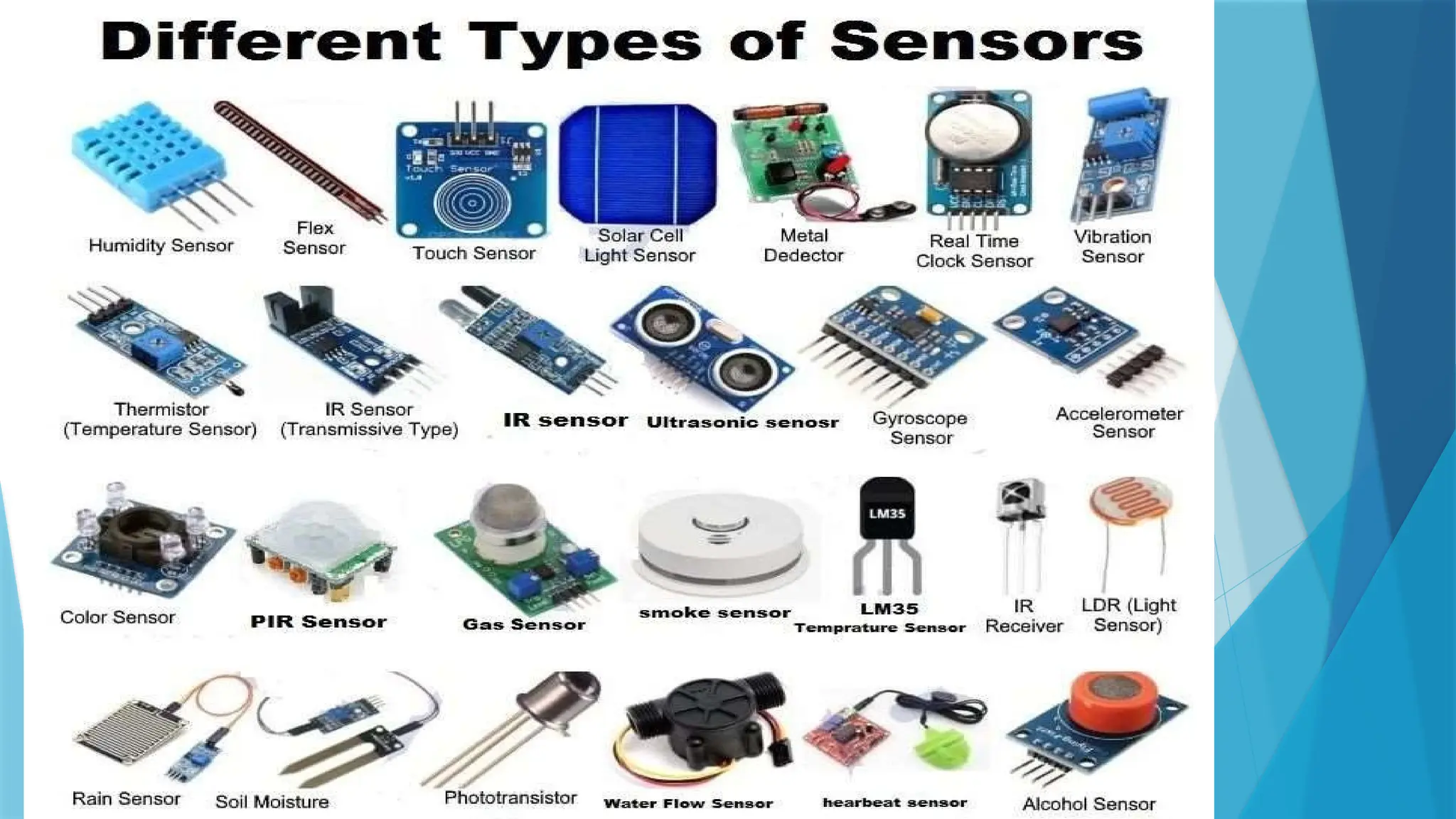
DIFFERENT TYPES OF SENSORS
All these sensors are used for measuring one of the physical properties like
Temperature, Resistance, Capacitance, Conduction, Heat Transfer etc.
• Temperature Sensor
• Proximity Sensor
• Accelerometer
• IR Sensor (Infrared Sensor)
• Pressure Sensor
• Light Sensor
• Ultrasonic Sensor
• Smoke, Gas and Alcohol Sensor
• Touch Sensor
• Color Sensor
• Humidity Sensor
• Flow and Level Sensor
The five types of smart sensors that are commonly used in industrial environments include:
 Level Sensors
Measure how much volume space takes up in a container of any size.
For instance, the fuel gauge in a car could be connected directly to one of these sensors,
which will monitor how much fuel remains in the tank.
 Pressure Sensors
These sensors are used to monitor fluid and gas pressure in a pipeline. In the event of a
drop in pressure, the sensor will send out a warning, that there is a flow control problem
or a leak of some kind.
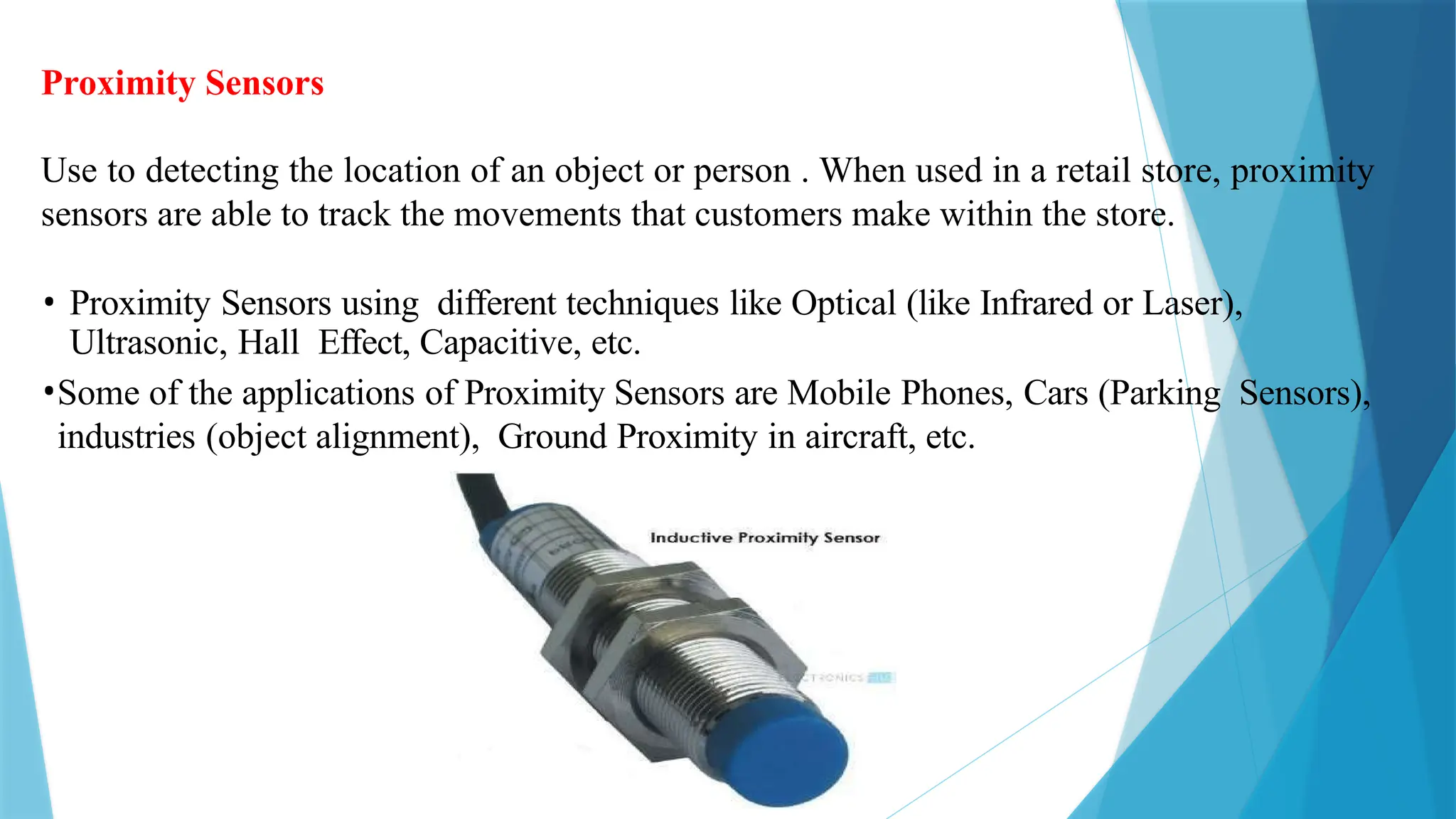
Proximity Sensors
Use to detecting the location of an object or person . When used in a retail store, proximity
sensors are able to track the movements that customers make within the store.
• Proximity Sensors using different techniques like Optical (like Infrared or Laser),
Ultrasonic, Hall Effect, Capacitive, etc.
•Some of the applications of Proximity Sensors are Mobile Phones, Cars (Parking Sensors),
industries (object alignment), Ground Proximity in aircraft, etc.
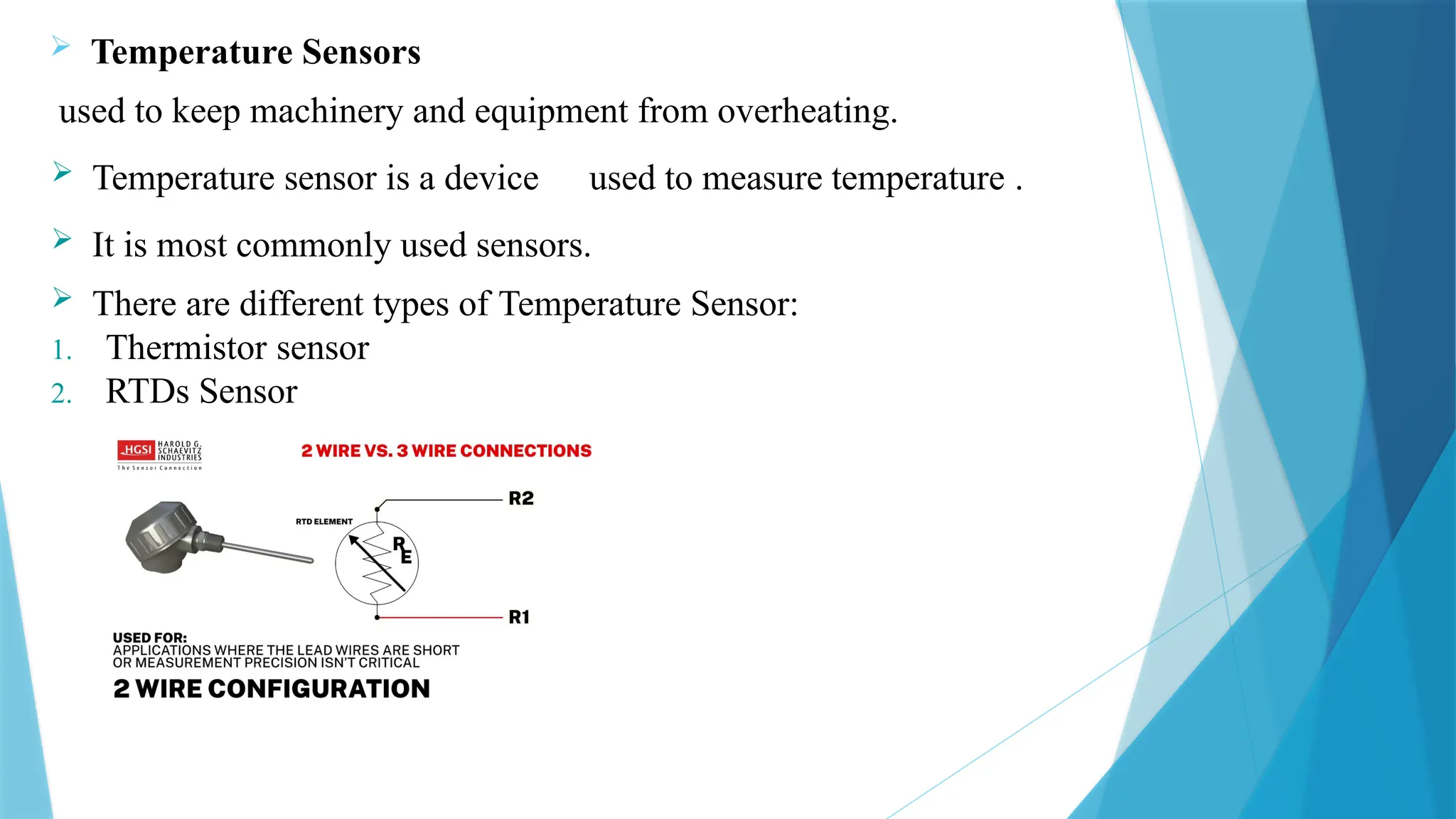
 Temperature Sensors
used to keep machinery and equipment from overheating.
 Temperature sensor is a device used to measure temperature .
 It is most commonly used sensors.
 There are different types of Temperature Sensor:
1. Thermistor sensor
2. RTDs Sensor
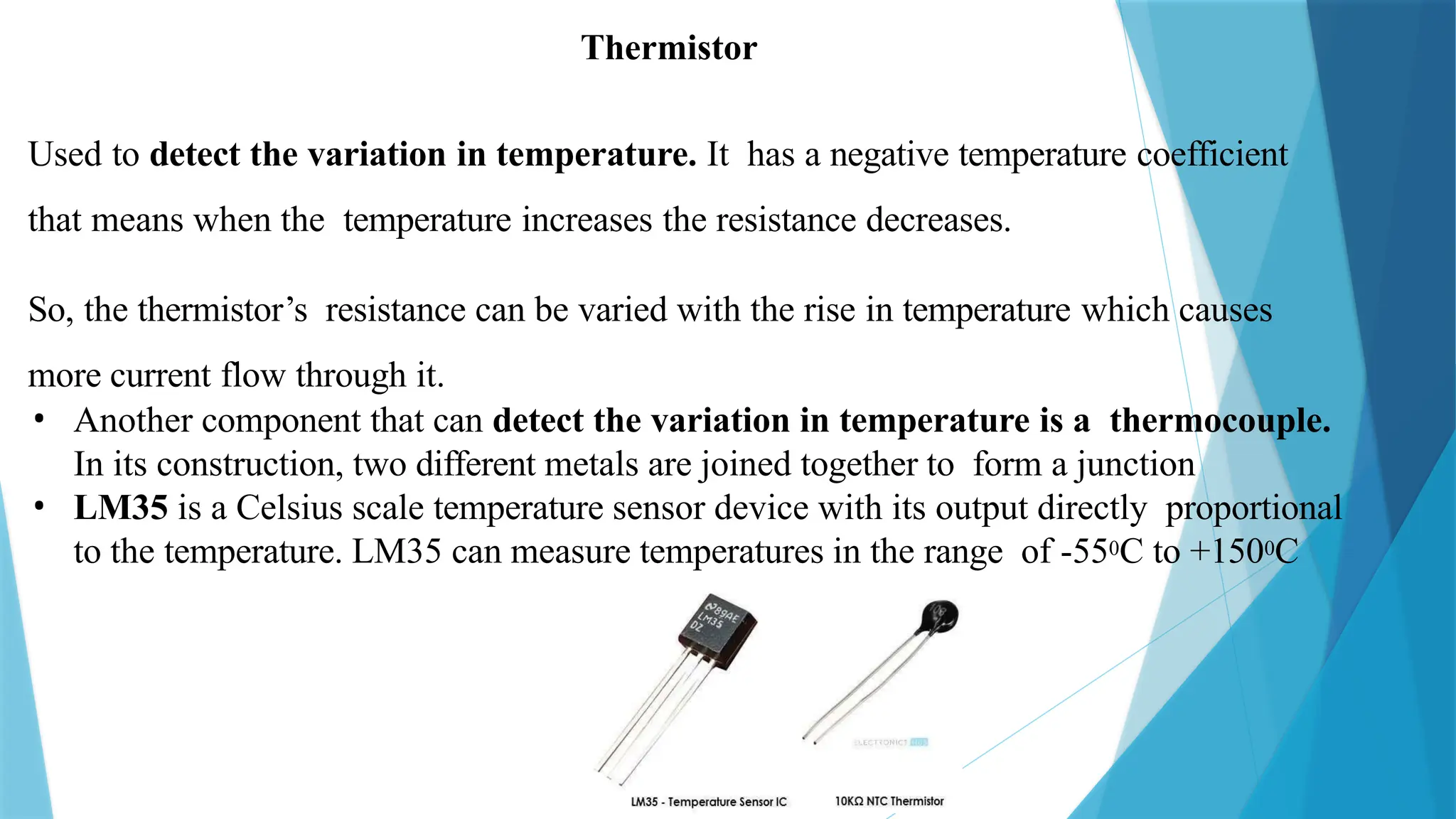
Used to detect the variation in temperature. It has a negative temperature coefficient
that means when the temperature increases the resistance decreases.
So, the thermistor’s resistance can be varied with the rise in temperature which causes
more current flow through it.
• Another component that can detect the variation in temperature is a thermocouple.
In its construction, two different metals are joined together to form a junction
• LM35 is a Celsius scale temperature sensor device with its output directly proportional
to the temperature. LM35 can measure temperatures in the range of -550C to +1500C
Thermistor
APPLICATIONS OF TEMPERATURE SENSOR:
• Home Appliances- water heater , toasters ,washing machine , dishwasher and coffee
machines will all contain temperature sensors.
• Within computers , there are temperature sensors to ensure the system does not over
heat.
Infrared Sensors
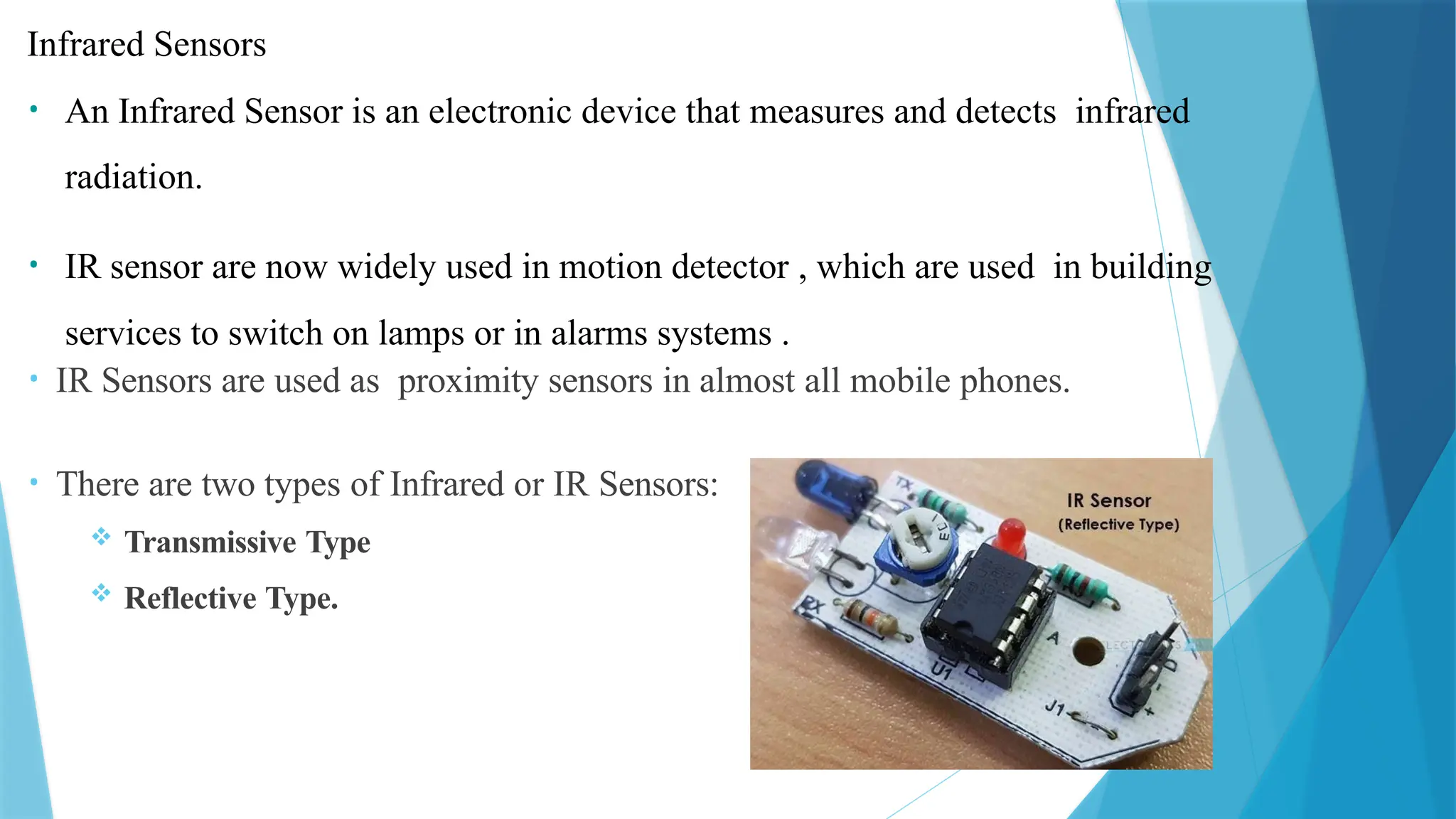
• An Infrared Sensor is an electronic device that measures and detects infrared
radiation.
• IR sensor are now widely used in motion detector , which are used in building
services to switch on lamps or in alarms systems .
• IR Sensors are used as proximity sensors in almost all mobile phones.
• There are two types of Infrared or IR Sensors:
 Transmissive Type
 Reflective Type.
• In Transmissive Type IR Sensor, the IR LED and the IR Photo Diode are
positioned facing each other so that when an object passes between them,
the sensor detects the object.
• The other type of IR Sensor is a Reflective Type IR Sensor.
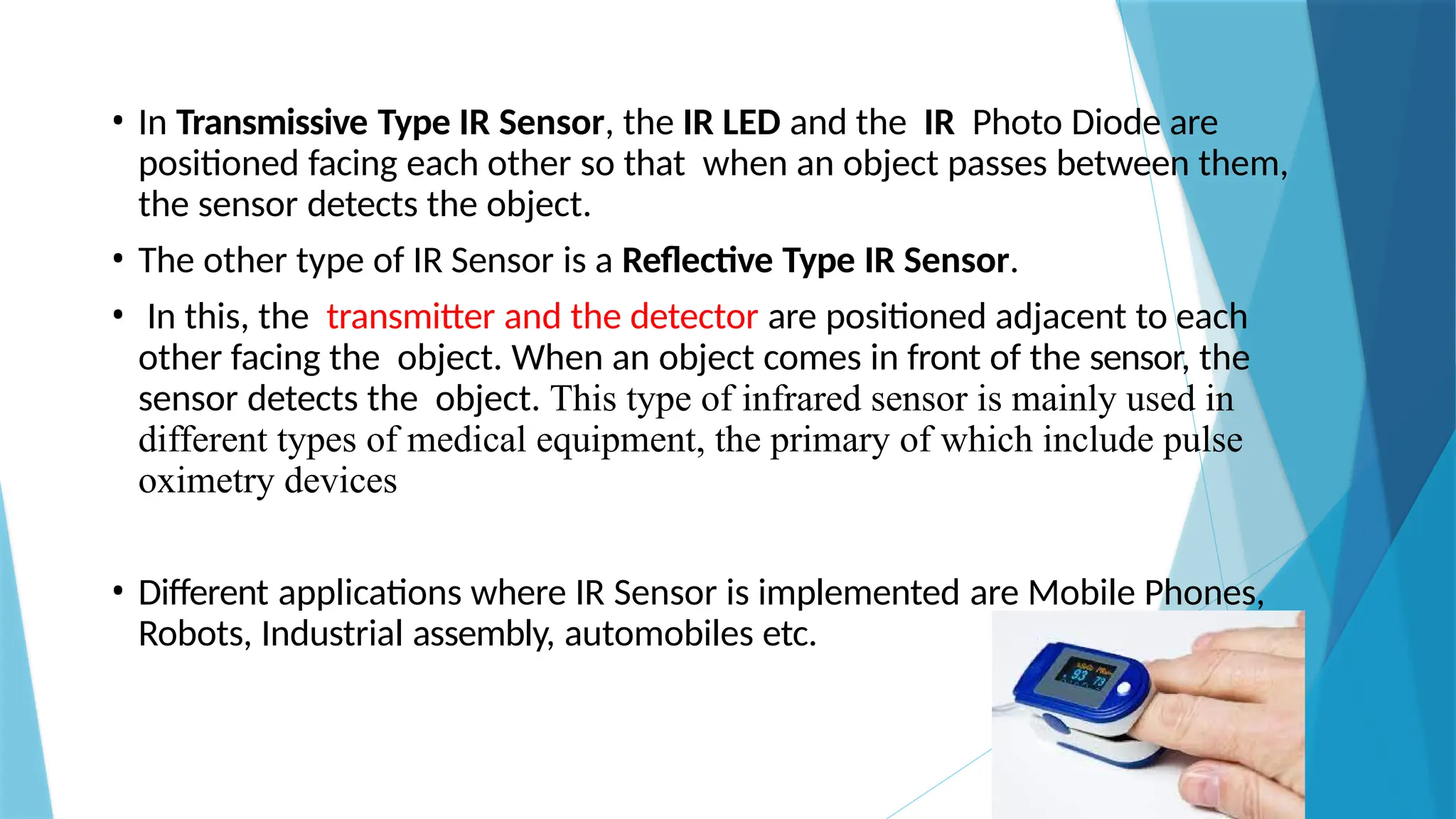
• In this, the transmitter and the detector are positioned adjacent to each
other facing the object. When an object comes in front of the sensor, the
sensor detects the object. This type of infrared sensor is mainly used in
different types of medical equipment, the primary of which include pulse
oximetry devices
• Different applications where IR Sensor is implemented are Mobile Phones,
Robots, Industrial assembly, automobiles etc.
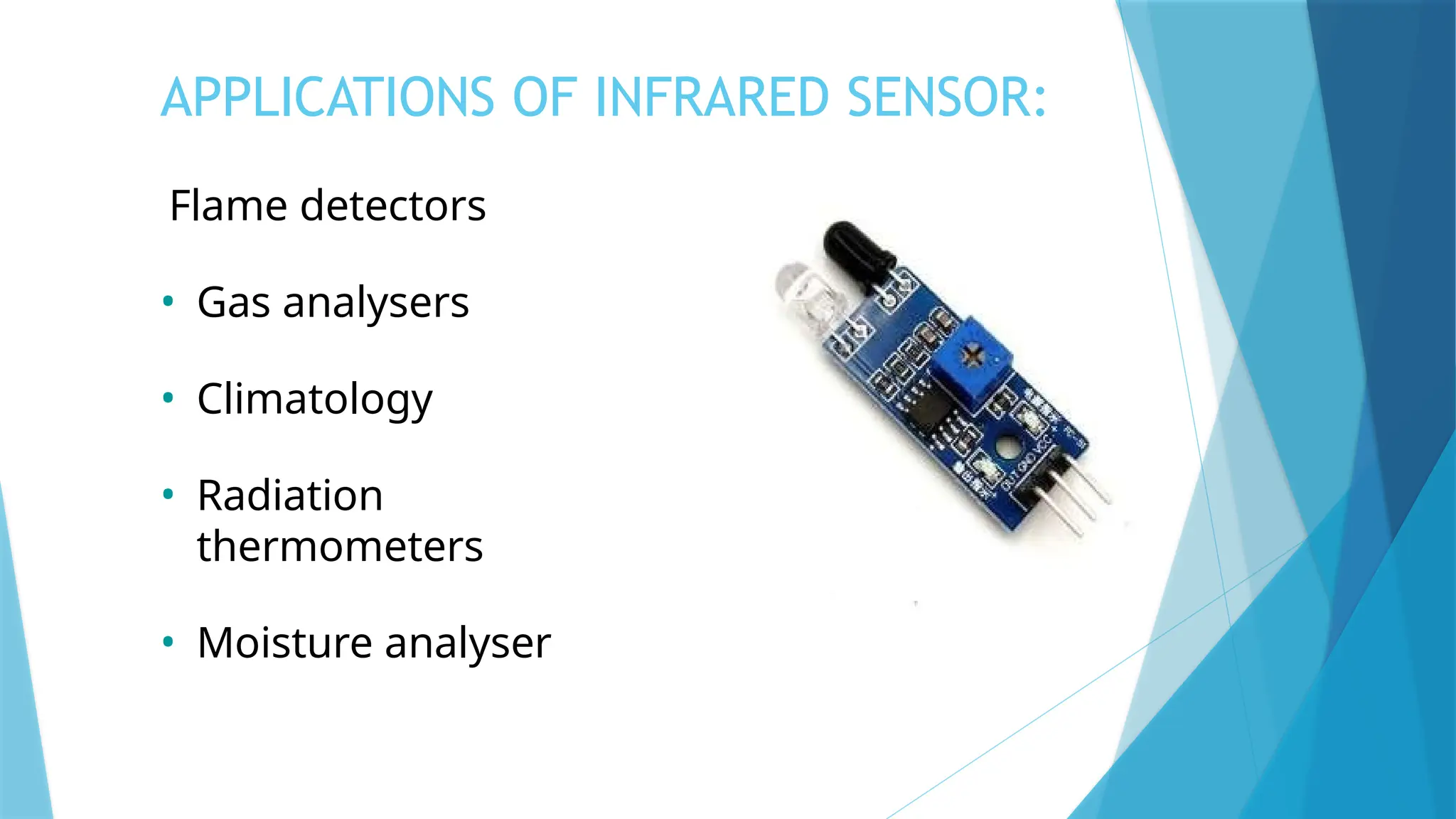
APPLICATIONS OF INFRARED SENSOR:
Flame detectors
• Gas analysers
• Climatology
• Radiation
thermometers
• Moisture analyser
ULTRASONIC SENSOR
• Used to measure the distance as well as the velocity of an object.
• An Ultrasonic Sensor works based on the properties of the sound waves with a
frequency greater than that of the human audible range.
• There are two kinds of ultrasonic sensors, “active ultrasonic sensors” and “passive
ultrasonic sensors”.
• An active ultrasonic sensor generates the high-frequency sound wave to receive
back the ultrasonic sensor for evaluating the echo. But,
• Passive ultrasonic sensors are just used for detecting ultrasonic noise.
• Ultrasonic waves travel faster then the speed of audible sounds.
• Ultrasonic sensor have two main components :
1 Transmitter
2 Receiver
• This ultrasonic sensor is used to calculate the distance between the ultrasonic
transmitter and the target and also used to measure the velocity of the
target.
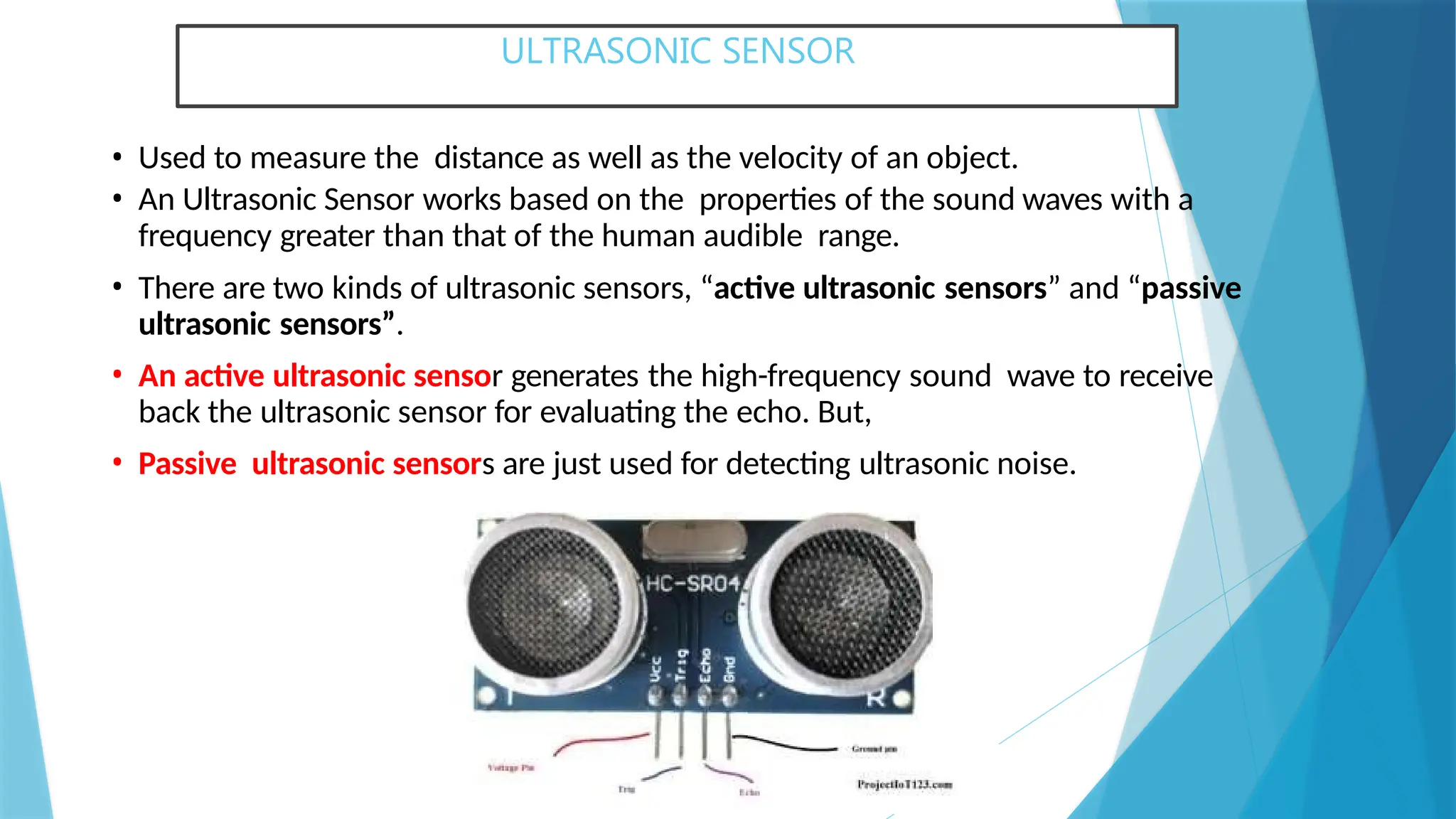
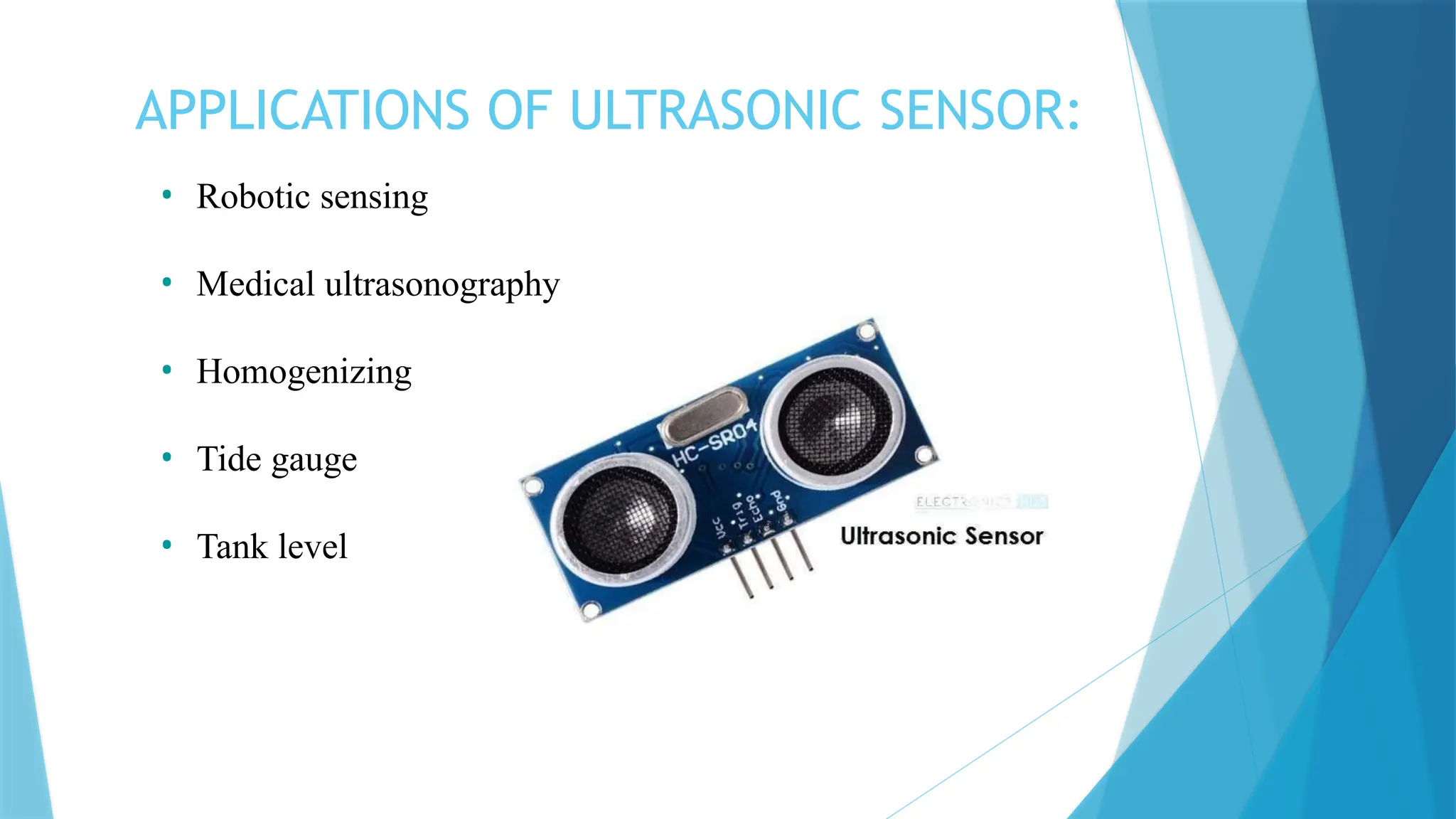
• Ultrasonic sensor HC-SR04 can be used to measure distance in the range of
2cm- 400cm with an accuracy of 3mm.
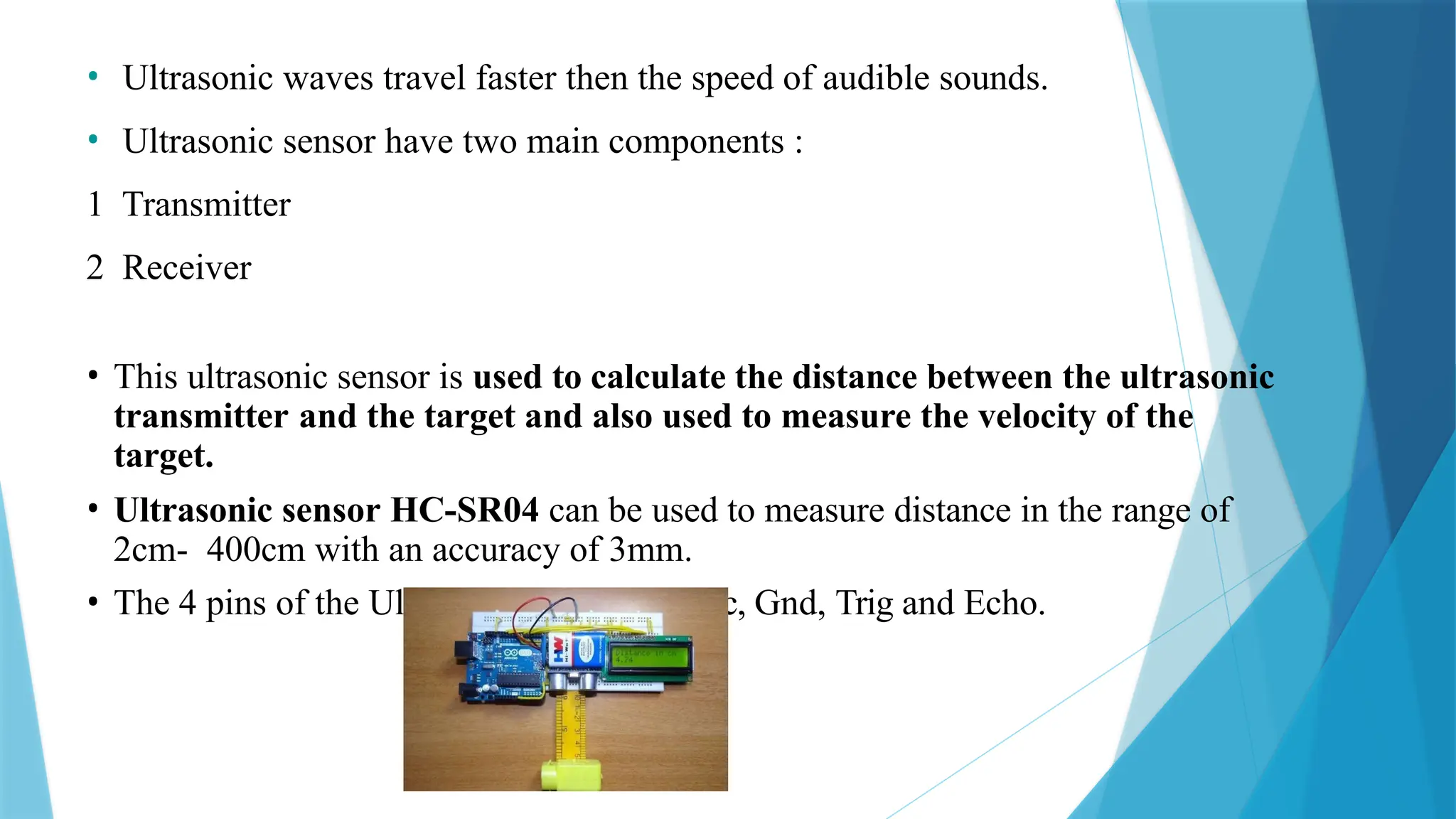
• The 4 pins of the Ultrasonic sensor are Vcc, Gnd, Trig and Echo.
APPLICATIONS OF ULTRASONIC SENSOR:
• Robotic sensing
• Medical ultrasonography
• Homogenizing
• Tide gauge
• Tank level
Pyroelectric Sensor(PIR):
• used for measuring the infrared light radiation emitted from objects.
• Every object that has a temperature emit heat energy in form of radiation at
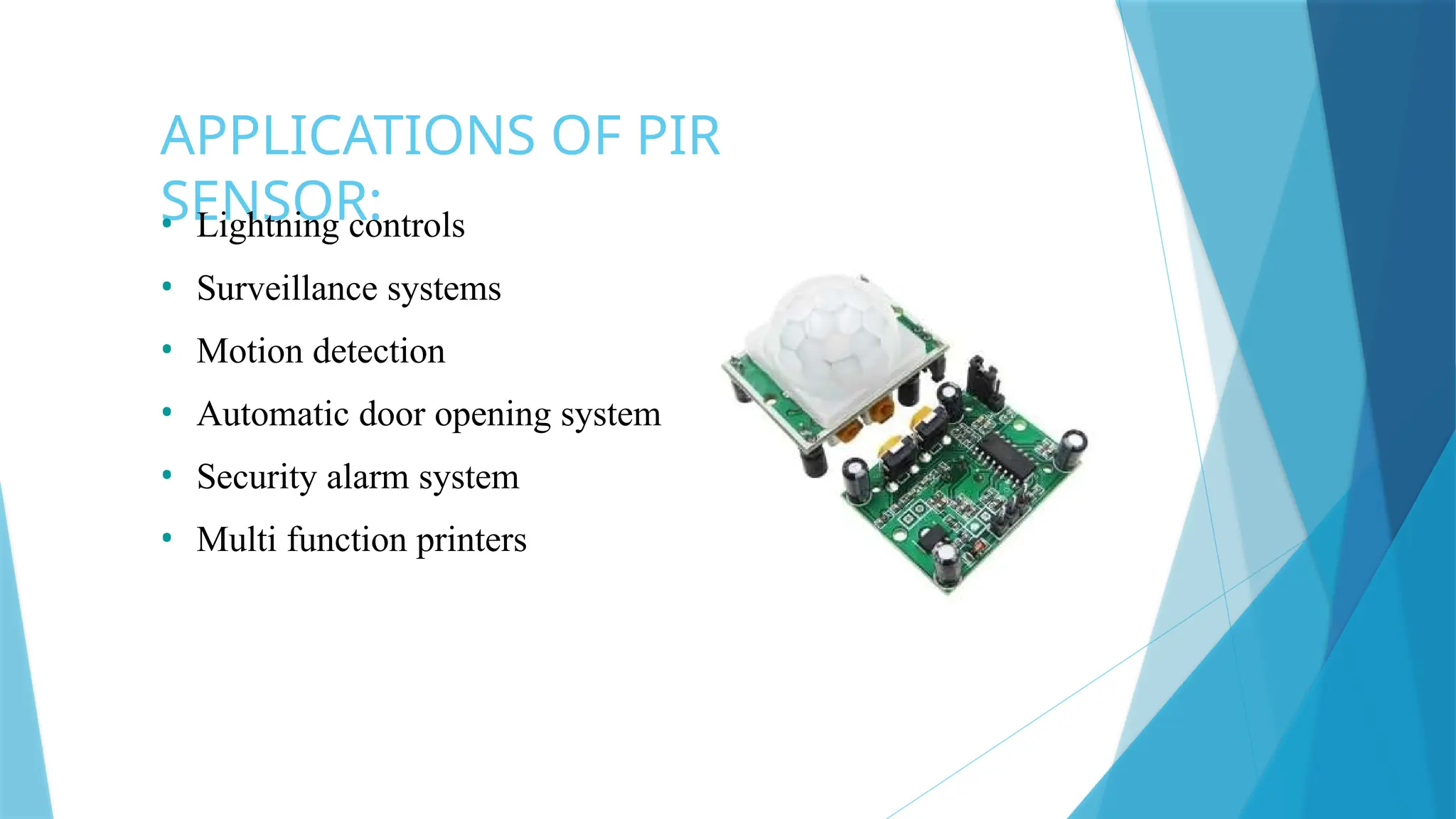
infrared wavelength which can be detected by PIR motion sensor.
• When the object comes in the field view of the sensor ,positive change is
produced ,similarly if the object leaves negative change is produced.
• It is also called passive sensor , because it doesn’t emit any energy for detecting
radiation.
APPLICATIONS OF PIR
SENSOR:
• Lightning controls
• Surveillance systems
• Motion detection
• Automatic door opening system
• Security alarm system
• Multi function printers
HUMIDITY SENSOR:
• A Humidity sensor is an electronic device that measures the humidity in its
environment and converts it in to electrical signal
• There are 3 basic types of sensors
• Capacitive
• Resistive
• Thermal
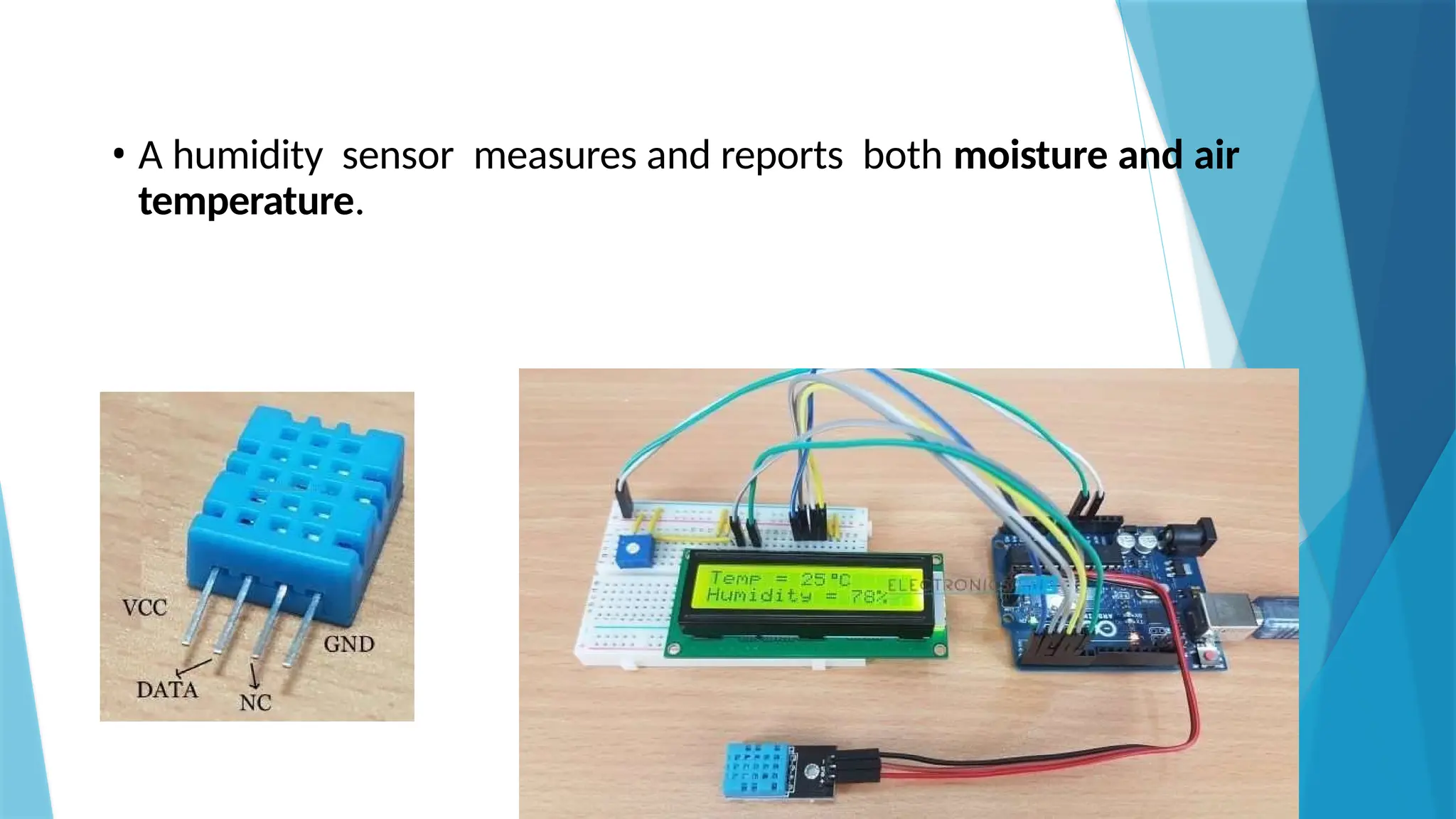
• A humidity sensor measures and reports both moisture and air
temperature.
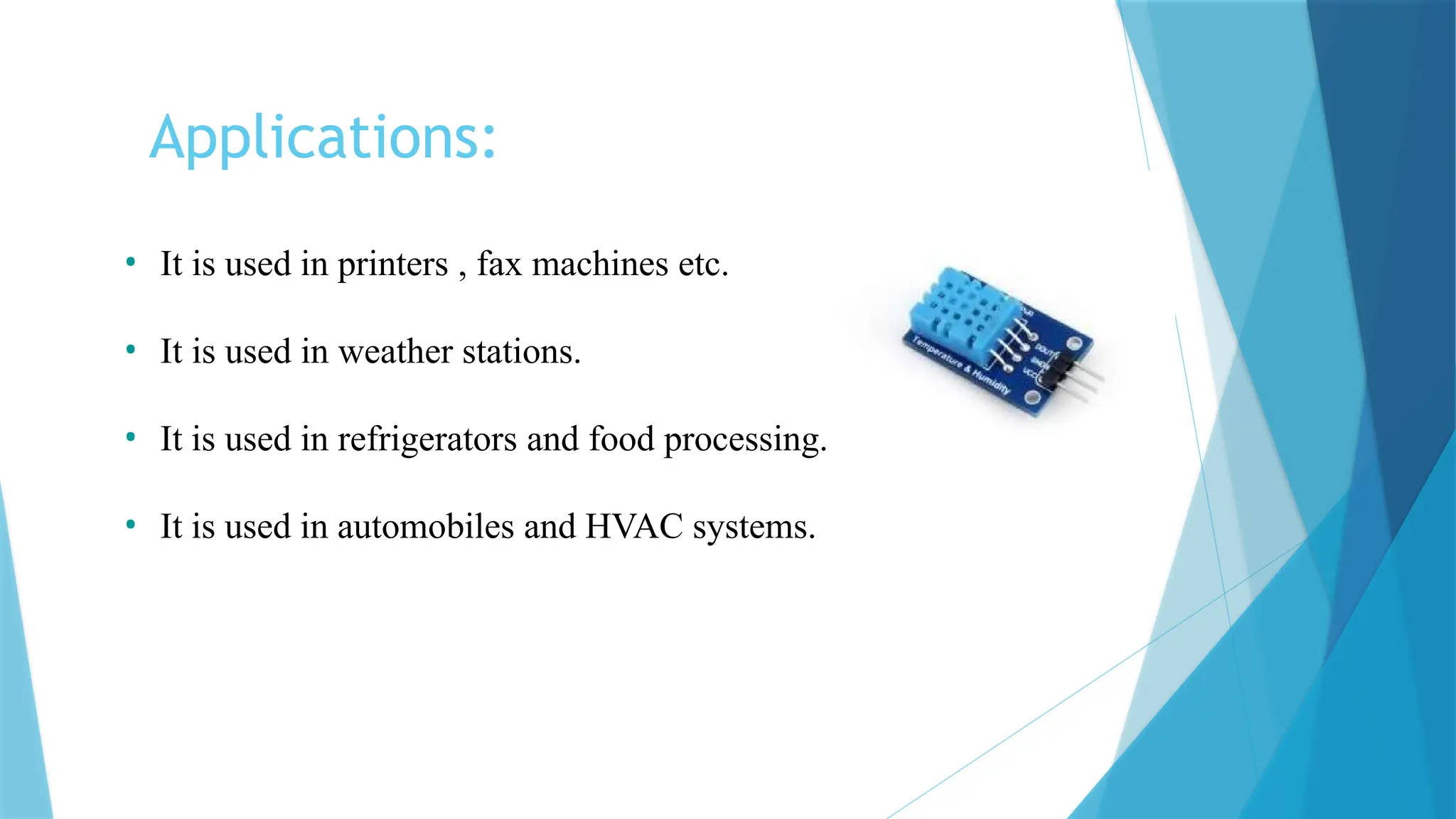
Applications:
• It is used in printers , fax machines etc.
• It is used in weather stations.
• It is used in refrigerators and food processing.
• It is used in automobiles and HVAC systems.
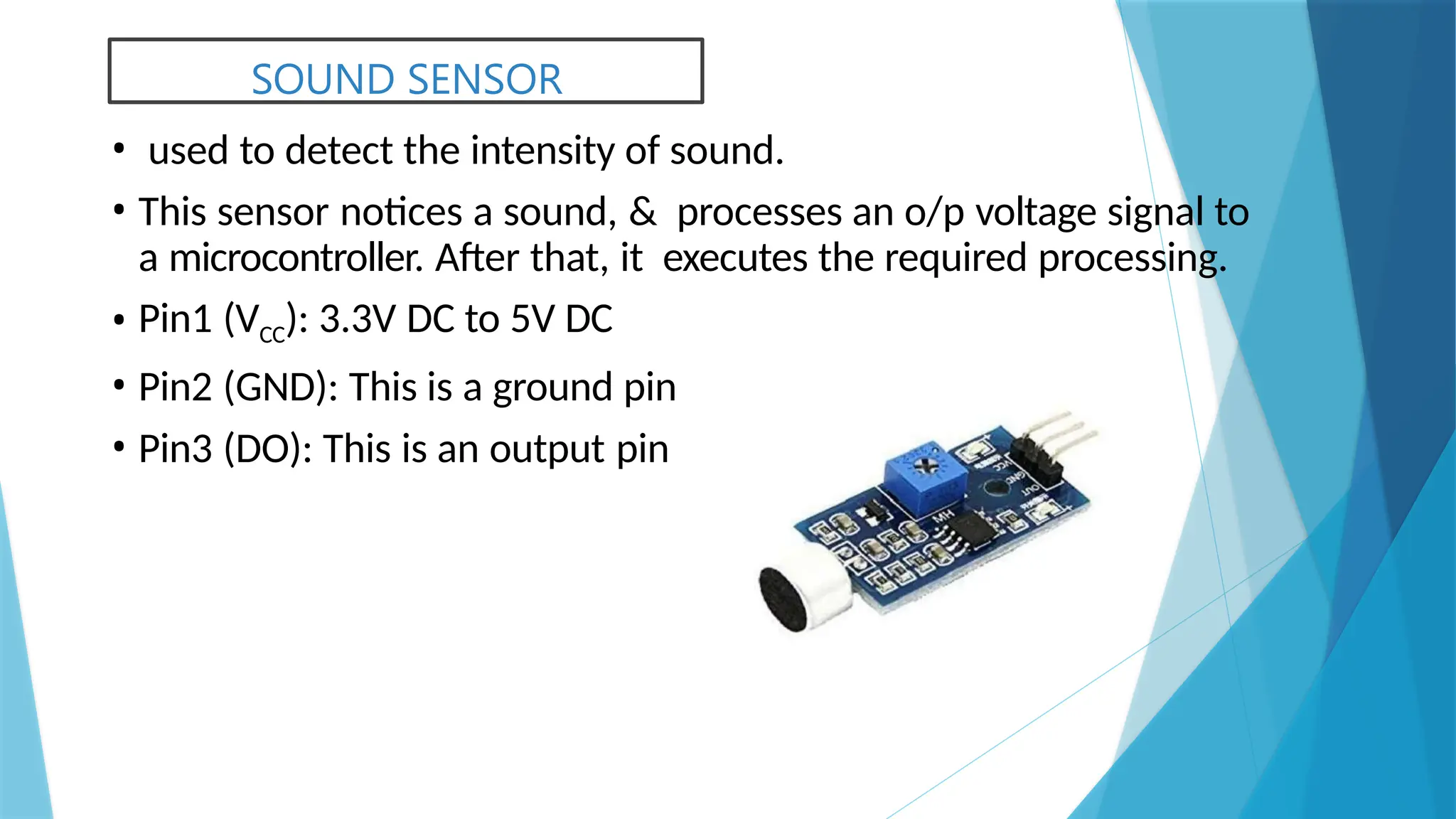
SOUND SENSOR
• used to detect the intensity of sound.
• This sensor notices a sound, & processes an o/p voltage signal to
a microcontroller. After that, it executes the required processing.
• Pin1 (VCC): 3.3V DC to 5V DC
• Pin2 (GND): This is a ground pin
• Pin3 (DO): This is an output pin
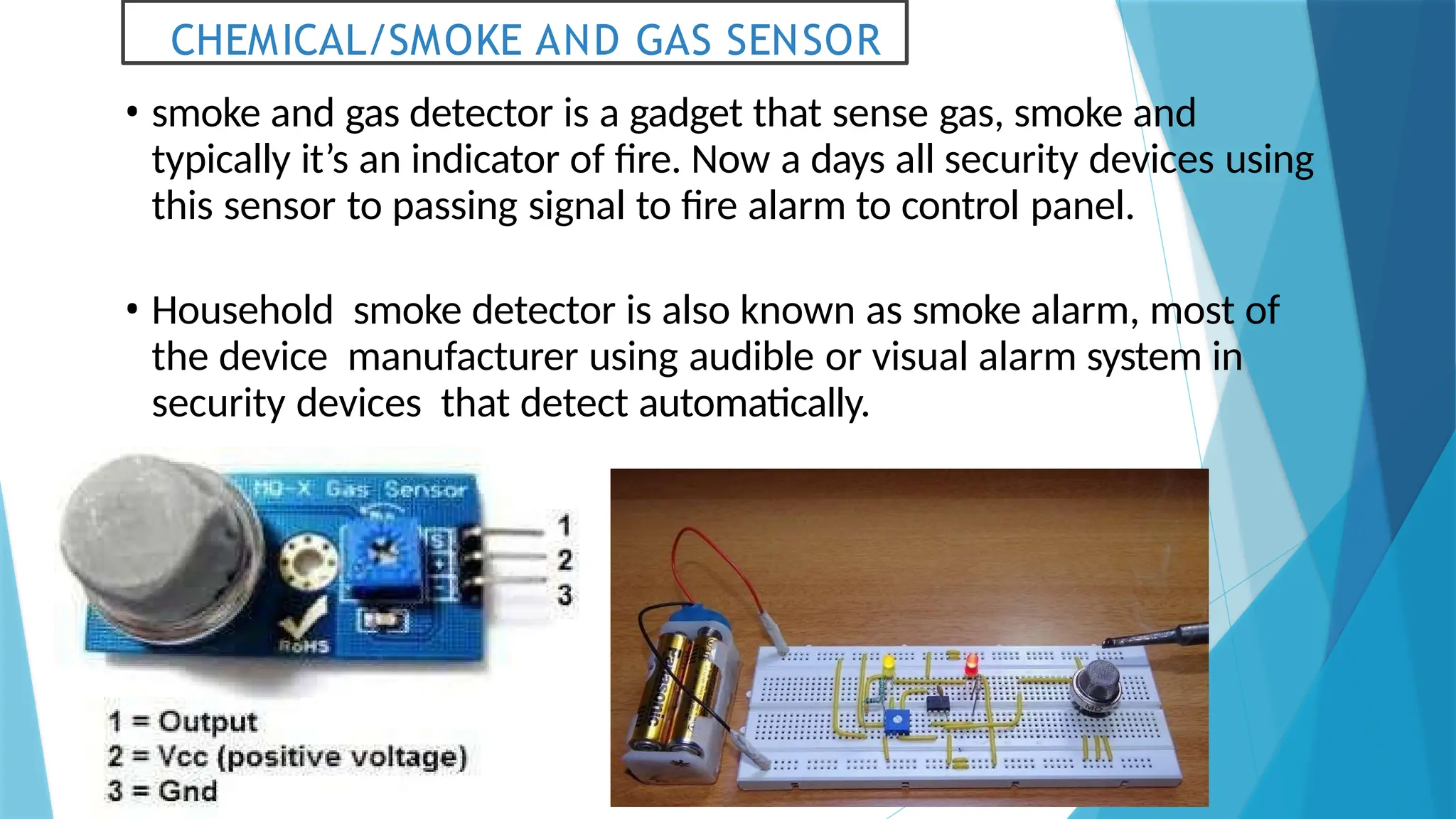
CHEMICAL/SMOKE AND GAS SENSOR
• smoke and gas detector is a gadget that sense gas, smoke and
typically it’s an indicator of fire. Now a days all security devices using
this sensor to passing signal to fire alarm to control panel.
• Household smoke detector is also known as smoke alarm, most of
the device manufacturer using audible or visual alarm system in
security devices that detect automatically.
NANOSENSORS
Nano sensors are any biological, chemical or physical
sensory points used to convey information about
nanoparticles to the macroscopic world. They are tiny
sensors in the size of a few nanometres about 10 to 100
nanometre. They can detect the presence of nanomaterial
or molecules in that size or even smaller.
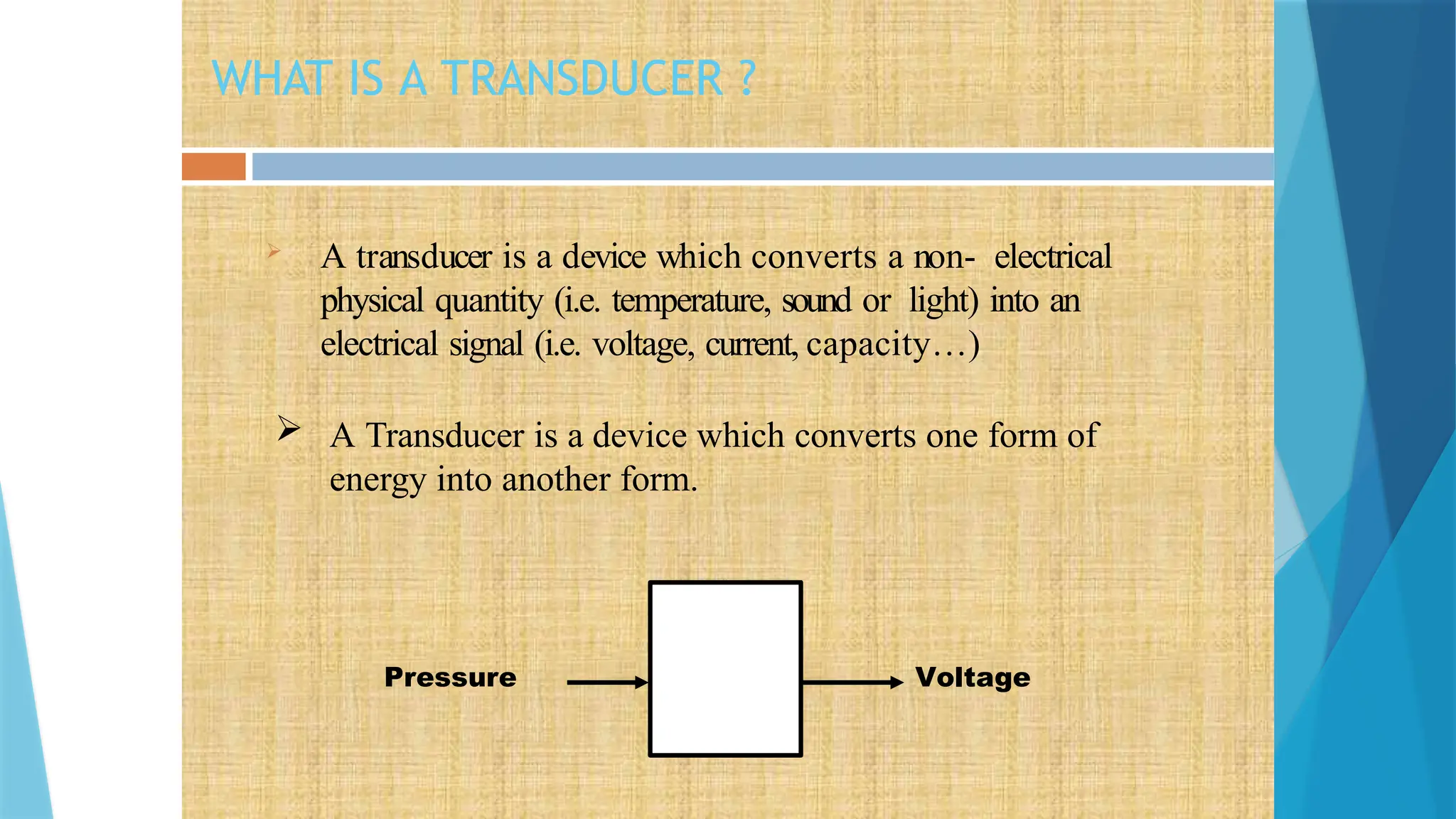
WHAT IS A TRANSDUCER ?
 A transducer is a device which converts a non- electrical
physical quantity (i.e. temperature, sound or light) into an
electrical signal (i.e. voltage, current, capacity…)
 A Transducer is a device which converts one form of
energy into another form.
Pressure Voltage
WHAT IS A TRANSDUCER ?
 A Transducer is a device when actuated by energy in
one system, supplies energy in the same form or in
another form to a second system.
Energy conversion
Energy conversion, also known as energy transformation,
is the process of changing one form of energy into another.
There are different forms of energy like
 thermal energy,
 electrical energy,
 nuclear energy,
 electromagnetic energy,
 mechanical energy,
 chemical energy,
 sound energy, etc.
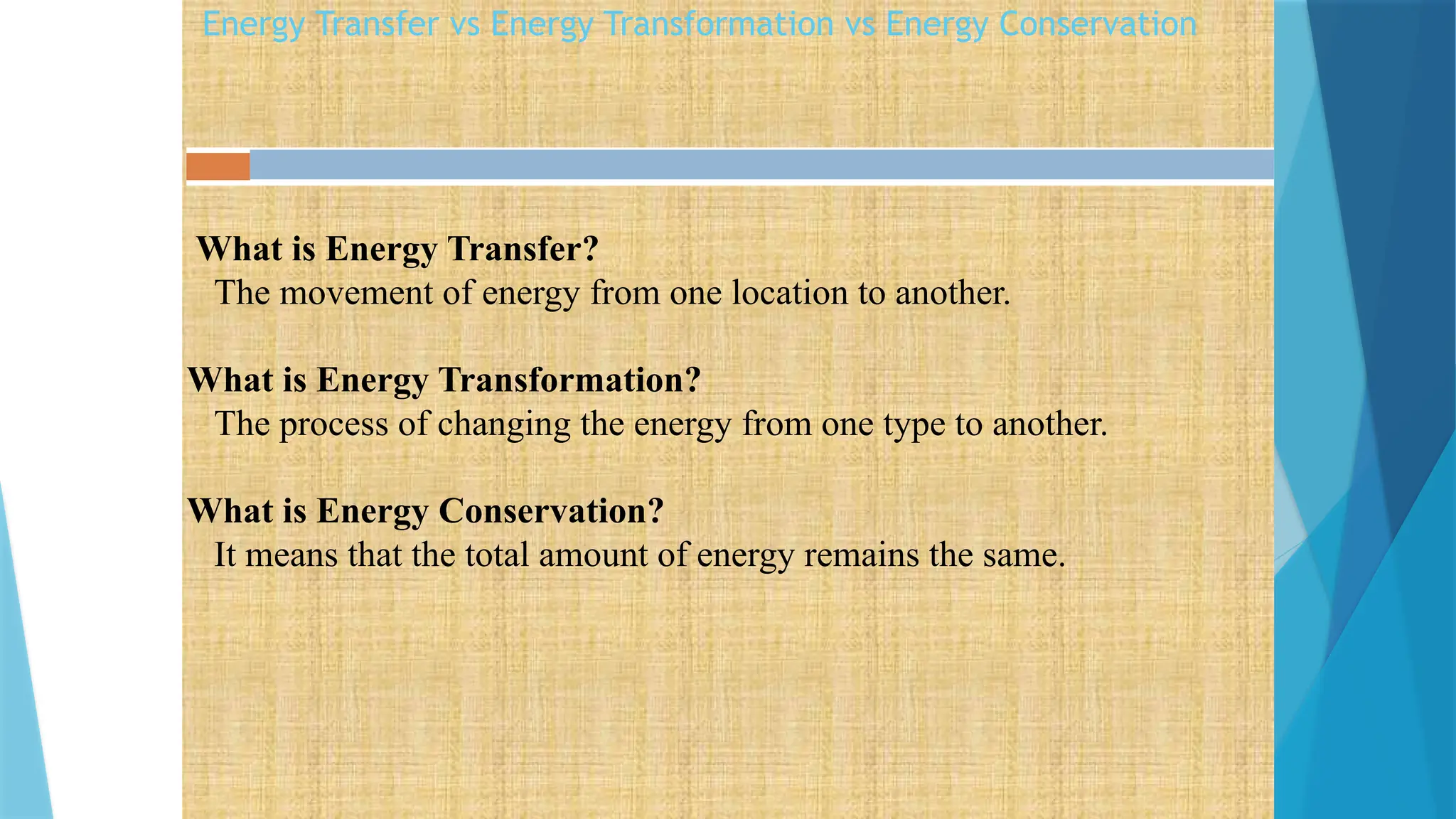
What is Energy Transfer?
The movement of energy from one location to another.
What is Energy Transformation?
The process of changing the energy from one type to another.
What is Energy Conservation?
It means that the total amount of energy remains the same.
Energy Transfer vs Energy Transformation vs Energy Conservation
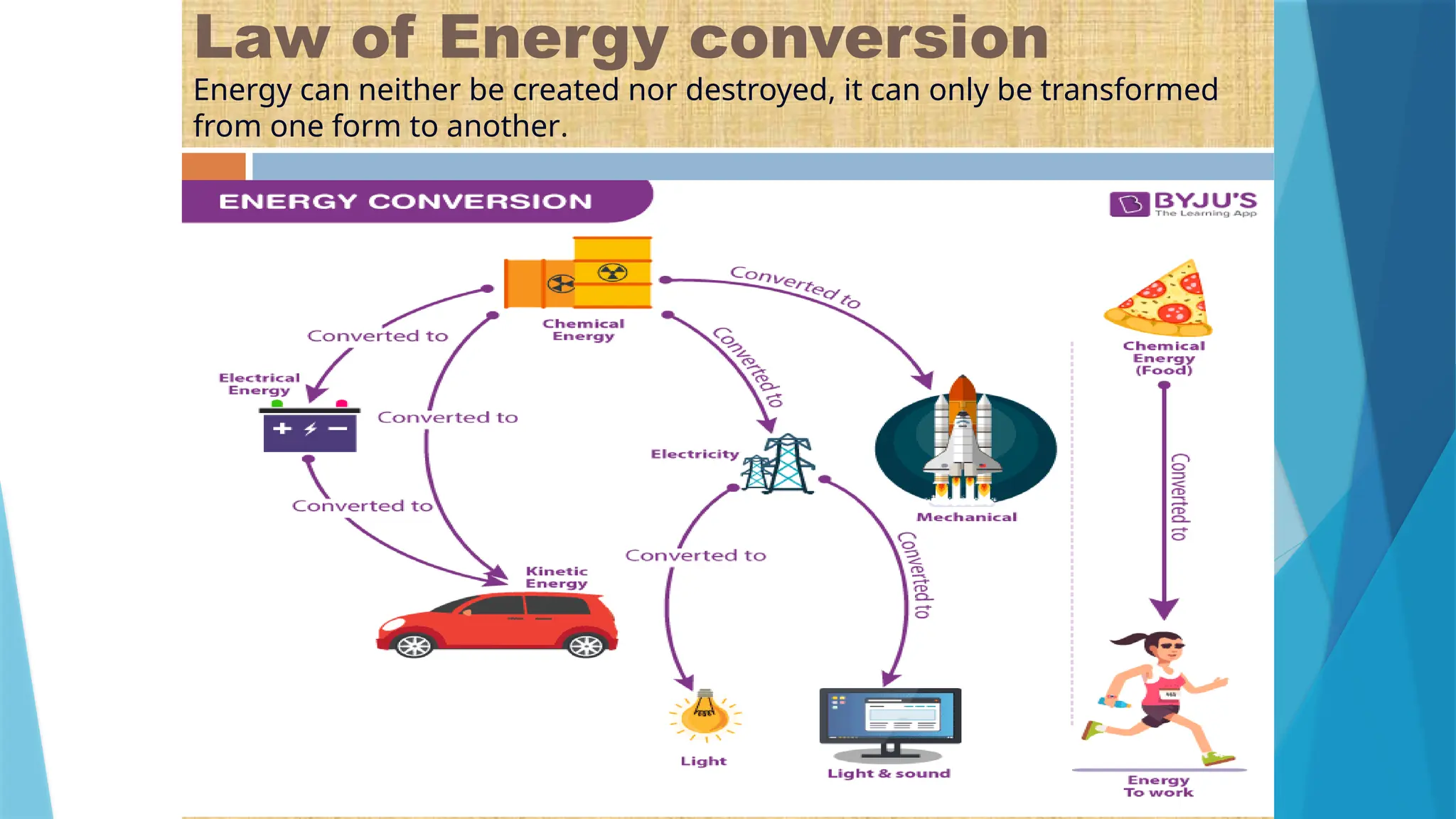
Law of Energy conversion
Energy can neither be created nor destroyed, it can only be transformed
from one form to another.
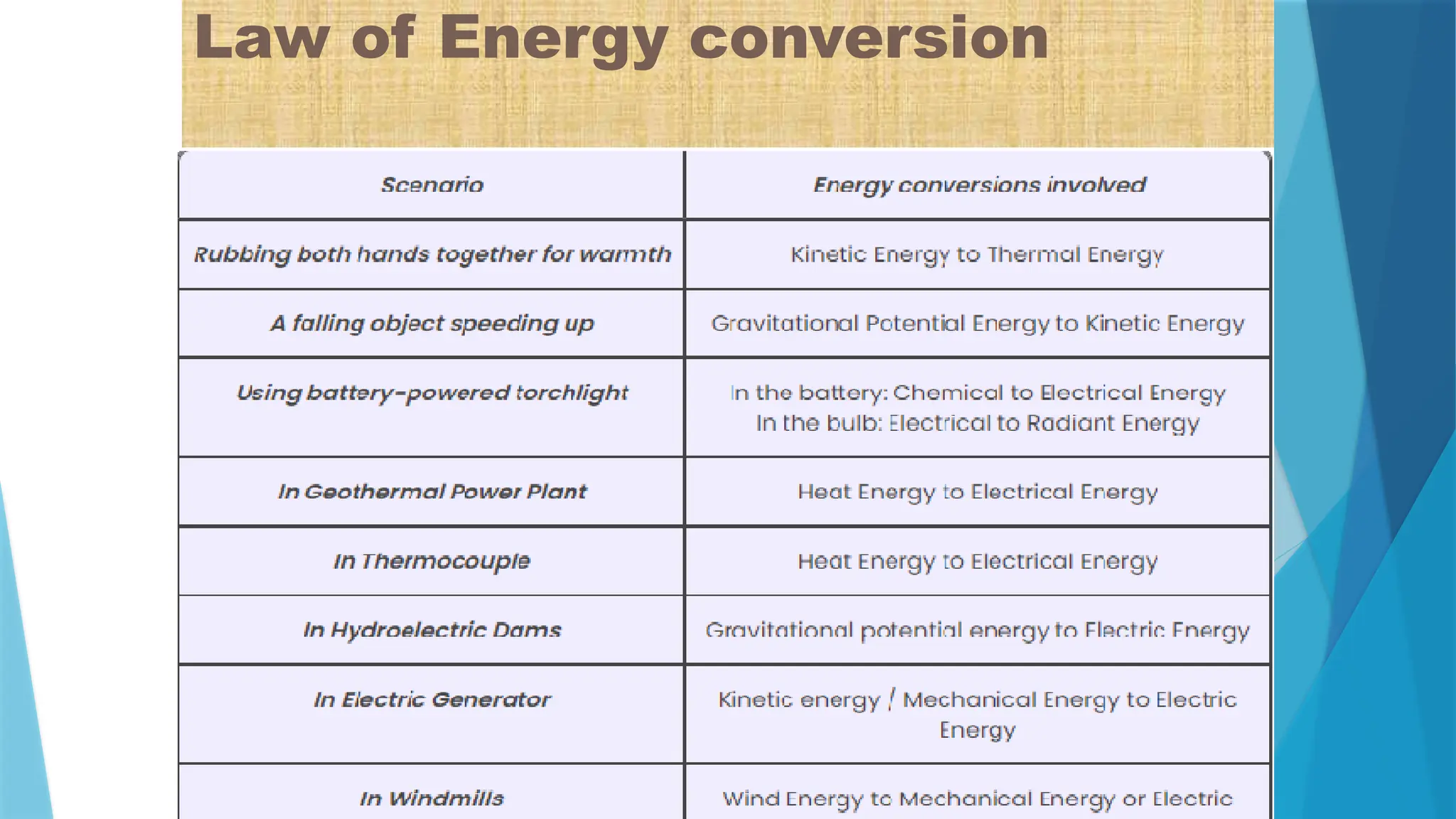
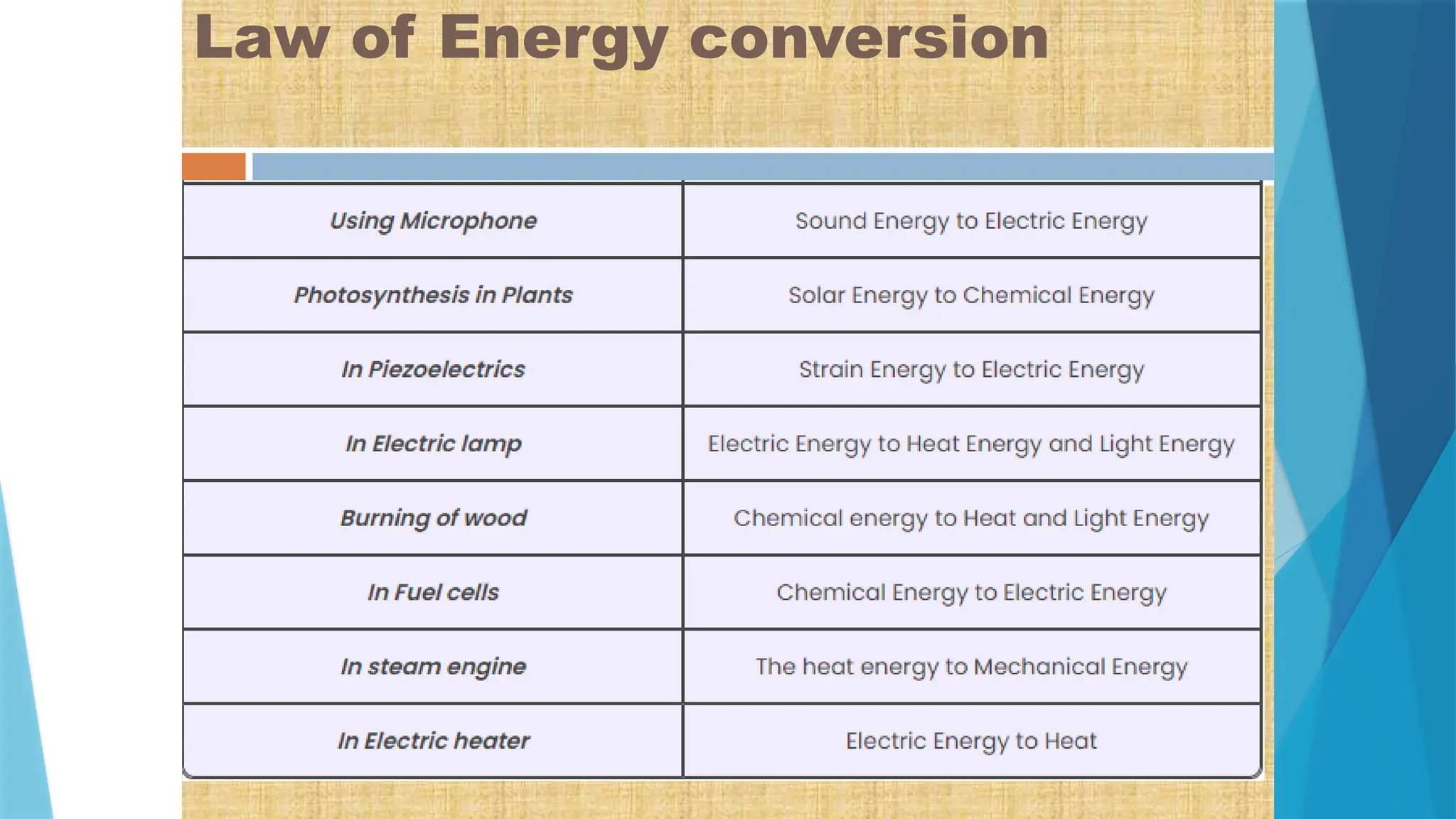
Law of Energy conversion
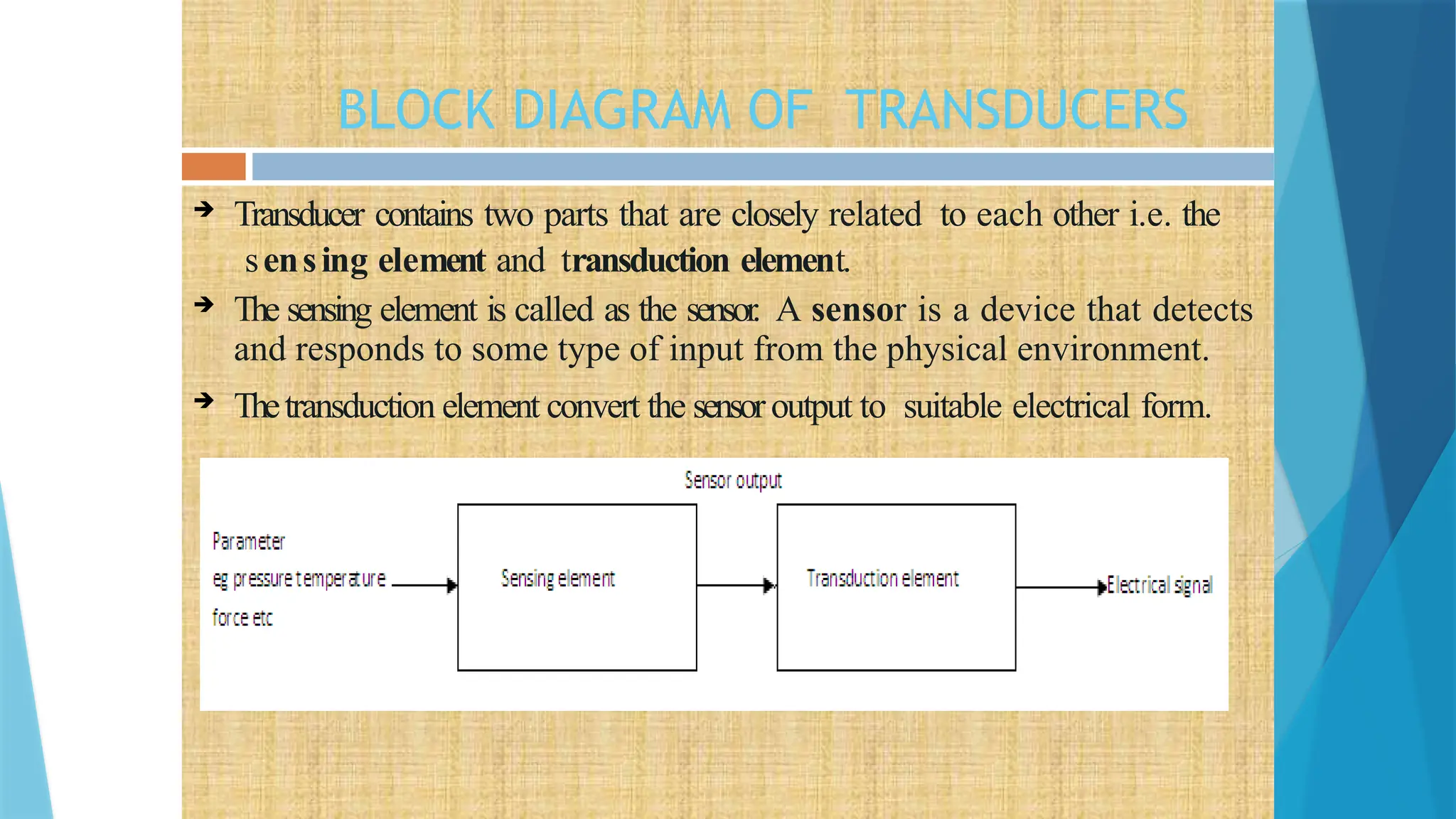
BLOCK DIAGRAM OF TRANSDUCERS
 Transducer contains two parts that are closely related to each other i.e. the
sensing element and transduction element.
 The sensing element is called as the sensor. A sensor is a device that detects
and responds to some type of input from the physical environment.
 Thetransduction element convert the sensoroutput to suitable electrical form.
WHAT IS SENSOR
A sensor is a device that measures a physical quantity and
converts it into a electrical signal which can be read by an
observer or by an instrument.
 WHAT IS BIO - SENSOR
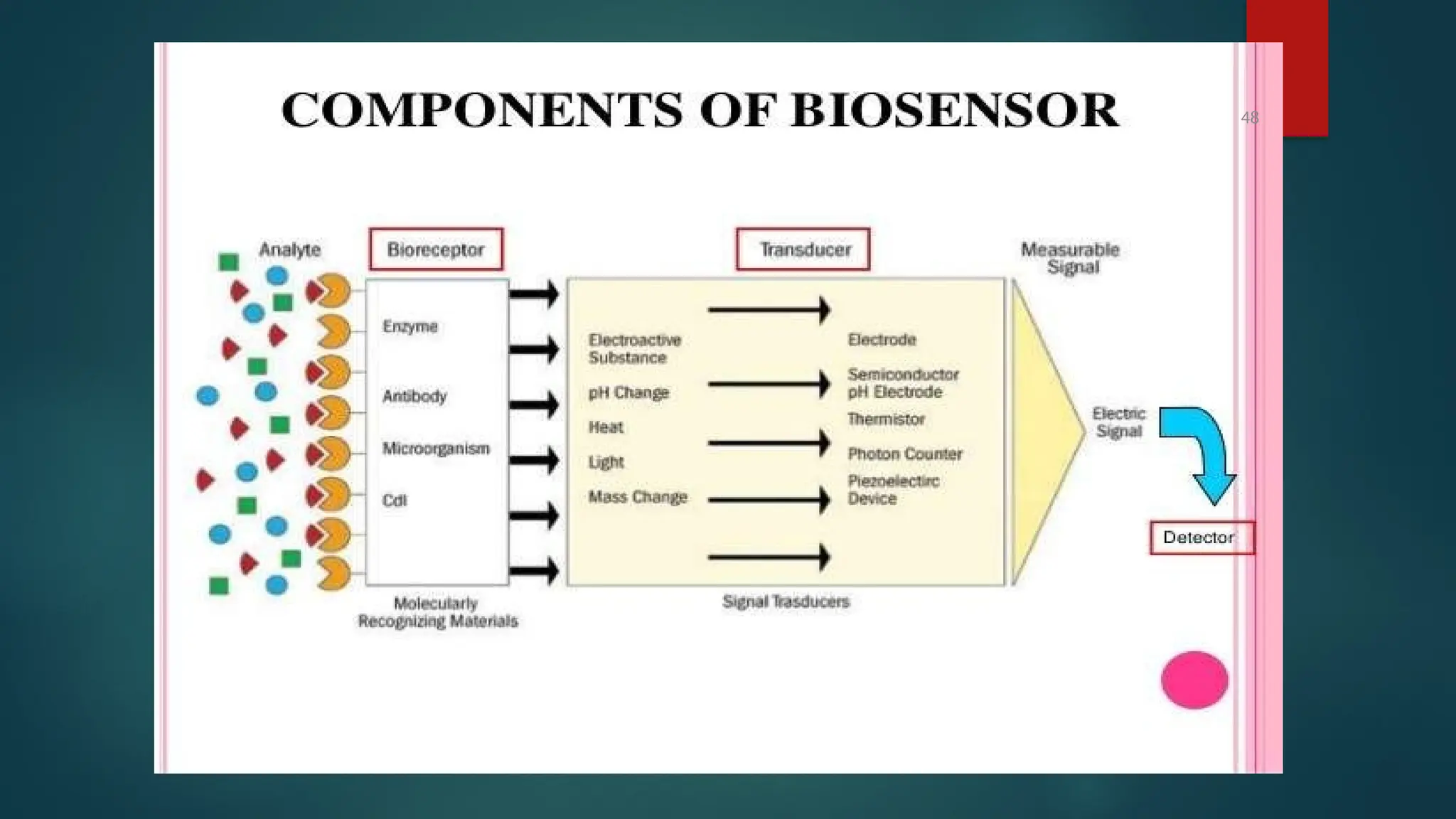
 The term “biosensor” is short for “biological sensor.” The device is made up of a
transducer and a biological element that may be an enzyme, an antibody or a
nucleic acid.
 A biosensor is an analytical device, used for the detection of an analyte, that
combines a biological component (The living organism of the ecosystem is called a biological
component like bacteria, animals, Fungi, plants, etc ) with a physicochemical detector.
 Analyte: An analyte is a compound (e.g. glucose, urea, drug) whose
concentration has to be measured.
 Bioreceptor: A molecule that specifically recognises the analyte is known as a
bioreceptor. Ex, Enzymes, cells, deoxyribonucleic acid (DNA) and antibodies
Biosensor
43
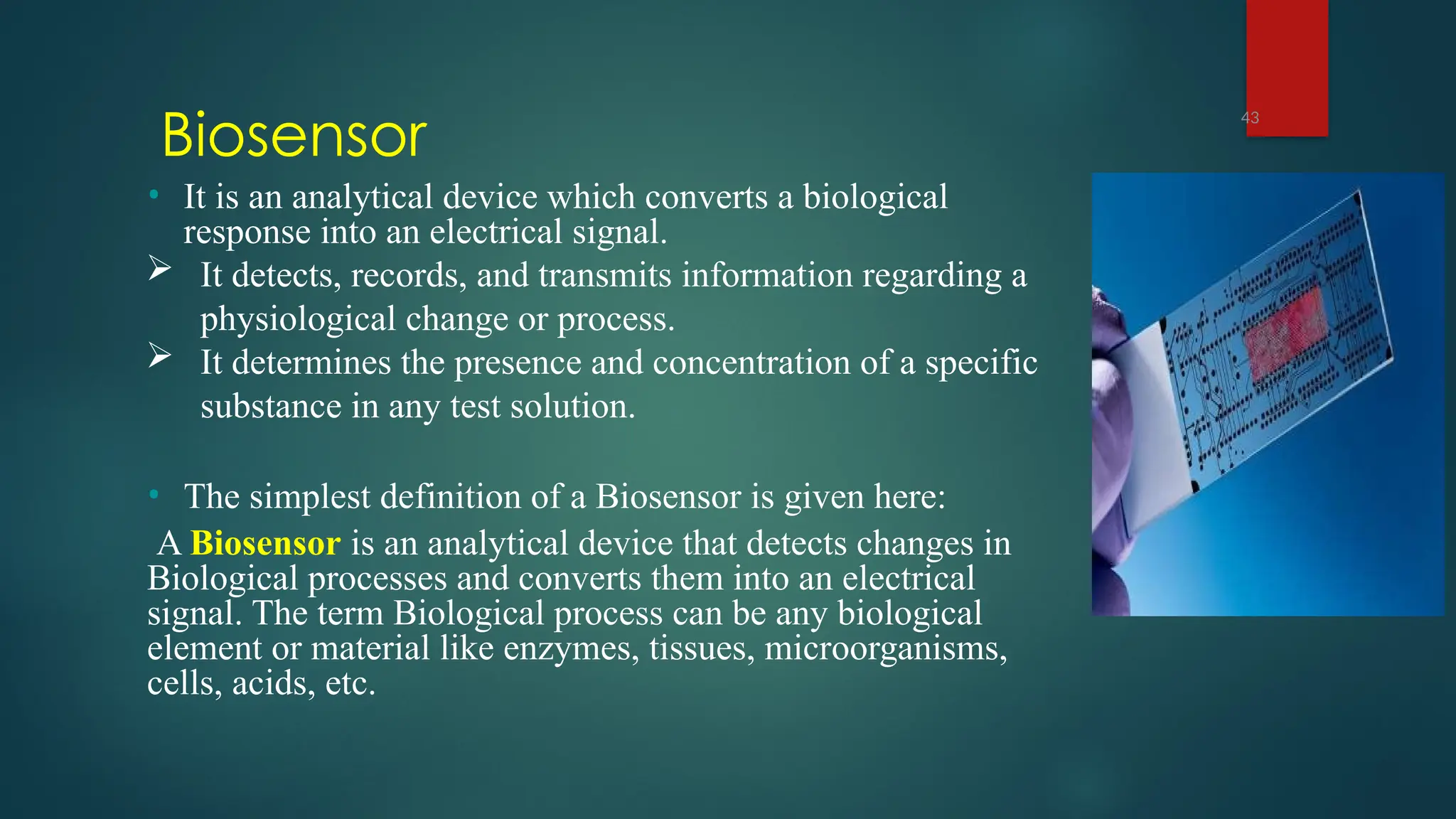
• It is an analytical device which converts a biological
response into an electrical signal.
 It detects, records, and transmits information regarding a
physiological change or process.
 It determines the presence and concentration of a specific
substance in any test solution.
• The simplest definition of a Biosensor is given here:
A Biosensor is an analytical device that detects changes in
Biological processes and converts them into an electrical
signal. The term Biological process can be any biological
element or material like enzymes, tissues, microorganisms,
cells, acids, etc.
Example of Biosensor
Before proceeding further with different types of Biosensors and applications of
Biosensor, let us look at a simple example of a Biosensor:
The Glucometer
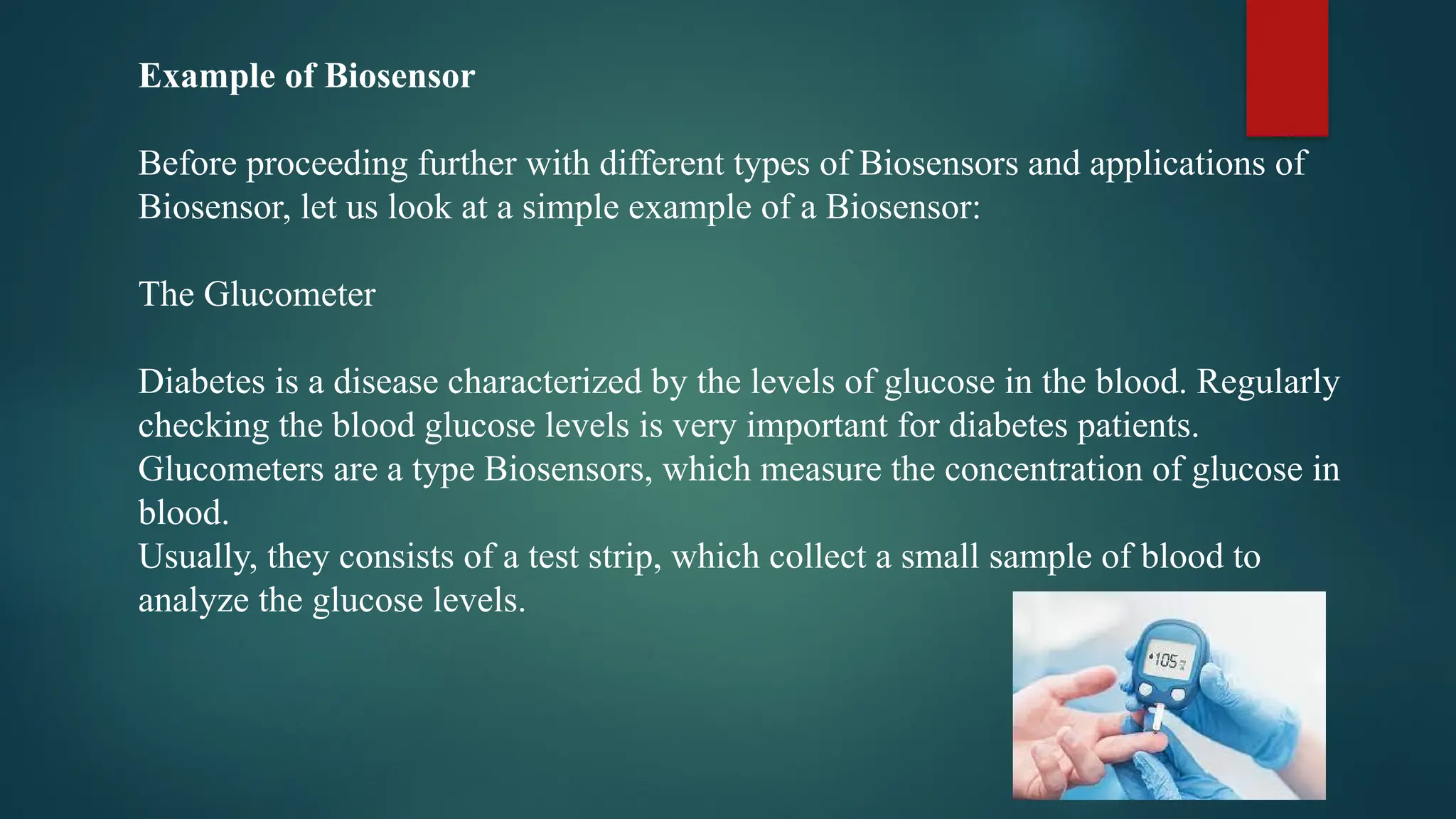
Diabetes is a disease characterized by the levels of glucose in the blood. Regularly
checking the blood glucose levels is very important for diabetes patients.
Glucometers are a type Biosensors, which measure the concentration of glucose in
blood.
Usually, they consists of a test strip, which collect a small sample of blood to
analyze the glucose levels.
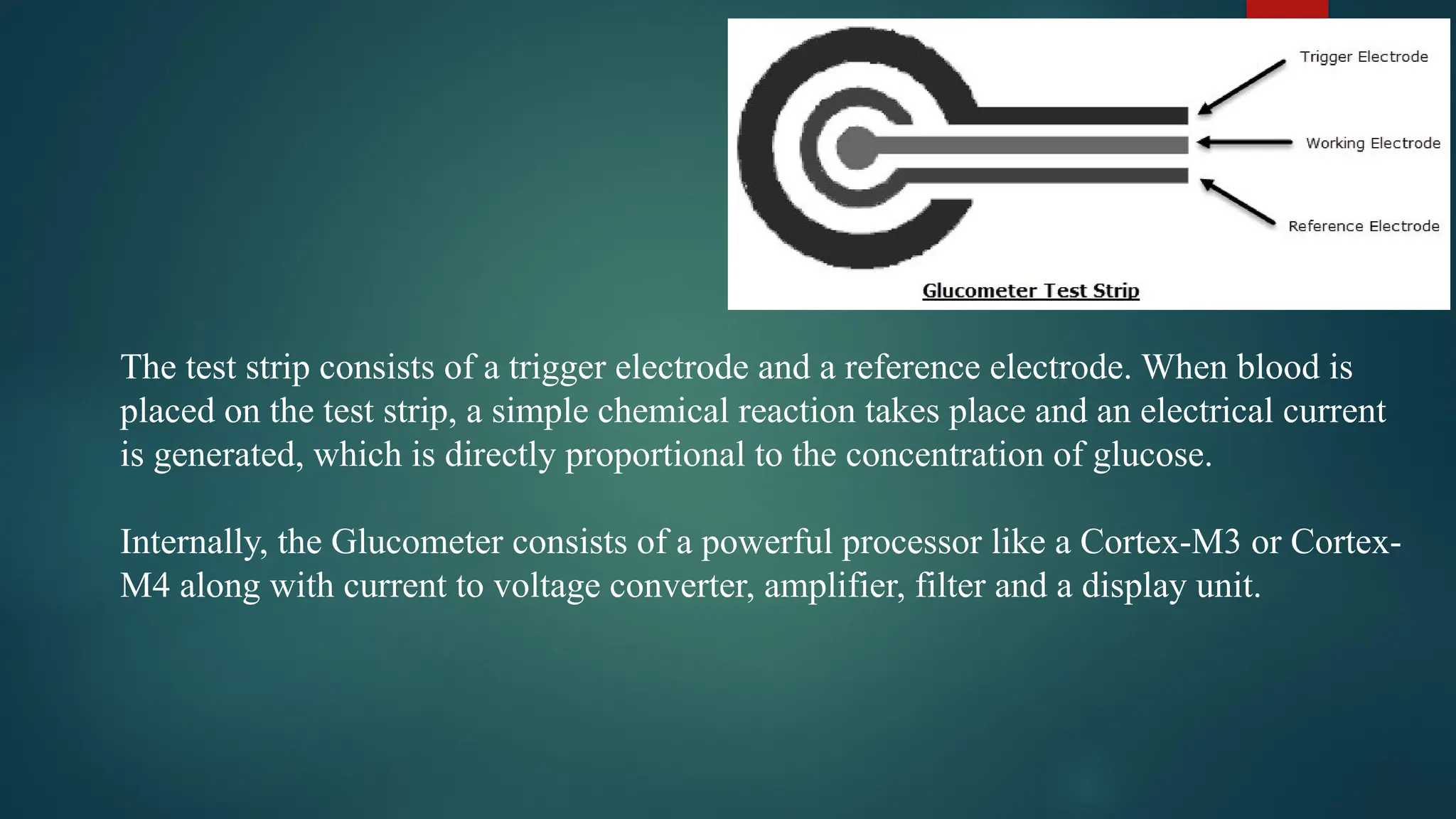
The test strip consists of a trigger electrode and a reference electrode. When blood is
placed on the test strip, a simple chemical reaction takes place and an electrical current
is generated, which is directly proportional to the concentration of glucose.
Internally, the Glucometer consists of a powerful processor like a Cortex-M3 or Cortex-
M4 along with current to voltage converter, amplifier, filter and a display unit.
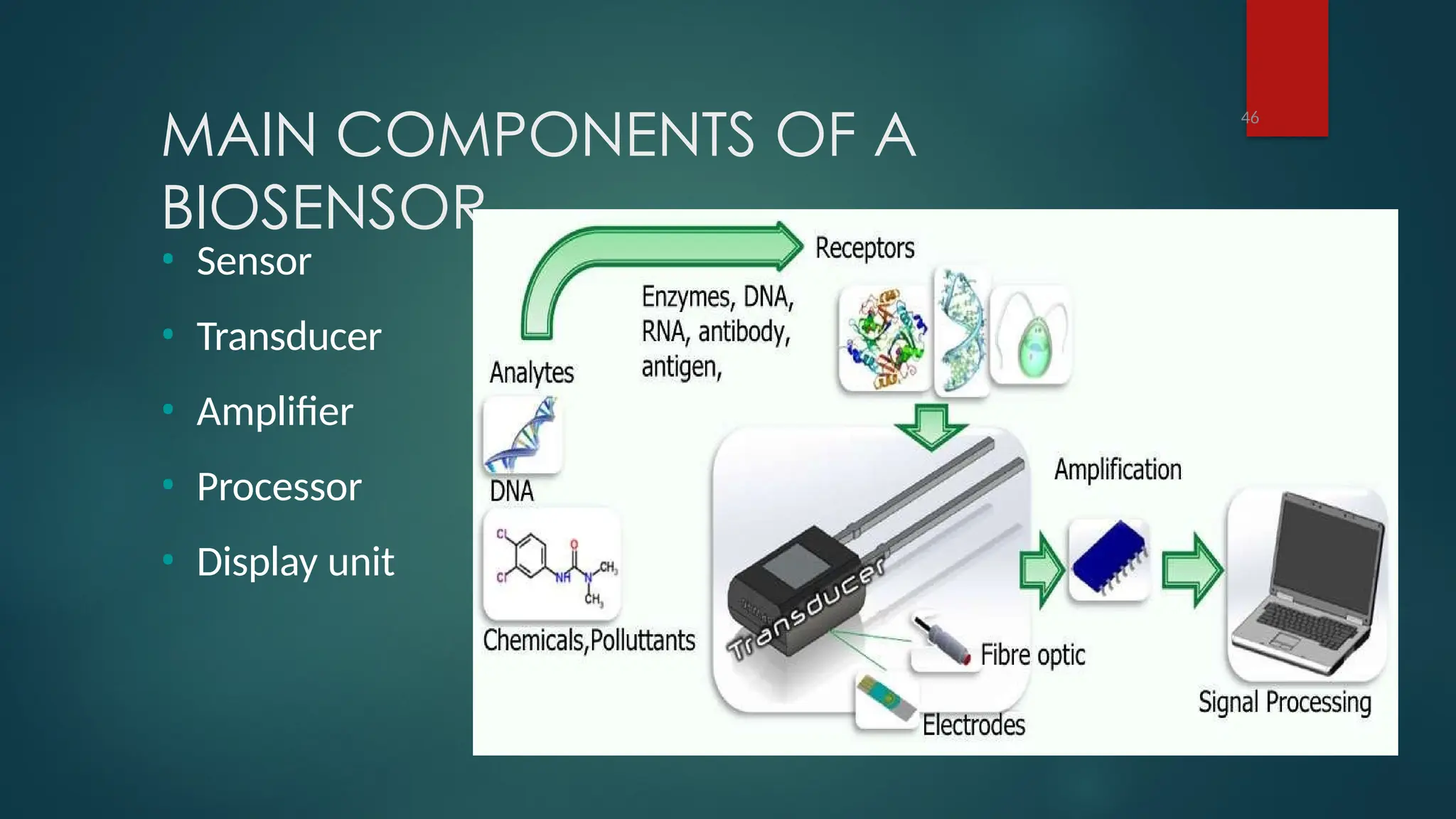
MAIN COMPONENTS OF A
BIOSENSOR
46
• Sensor
• Transducer
• Amplifier
• Processor
• Display unit
• Sensor
It is a sensitive biological element (biological material (eg. tissue,
microorganisms, organelles, cell receptors, enzymes, antibodies,
nucleic acids, etc).
• Transducer
Transducer is a device that converts energy from one form to
another form. In biosensors transducers convert the biochemical
activity into electrical energy.
47
48
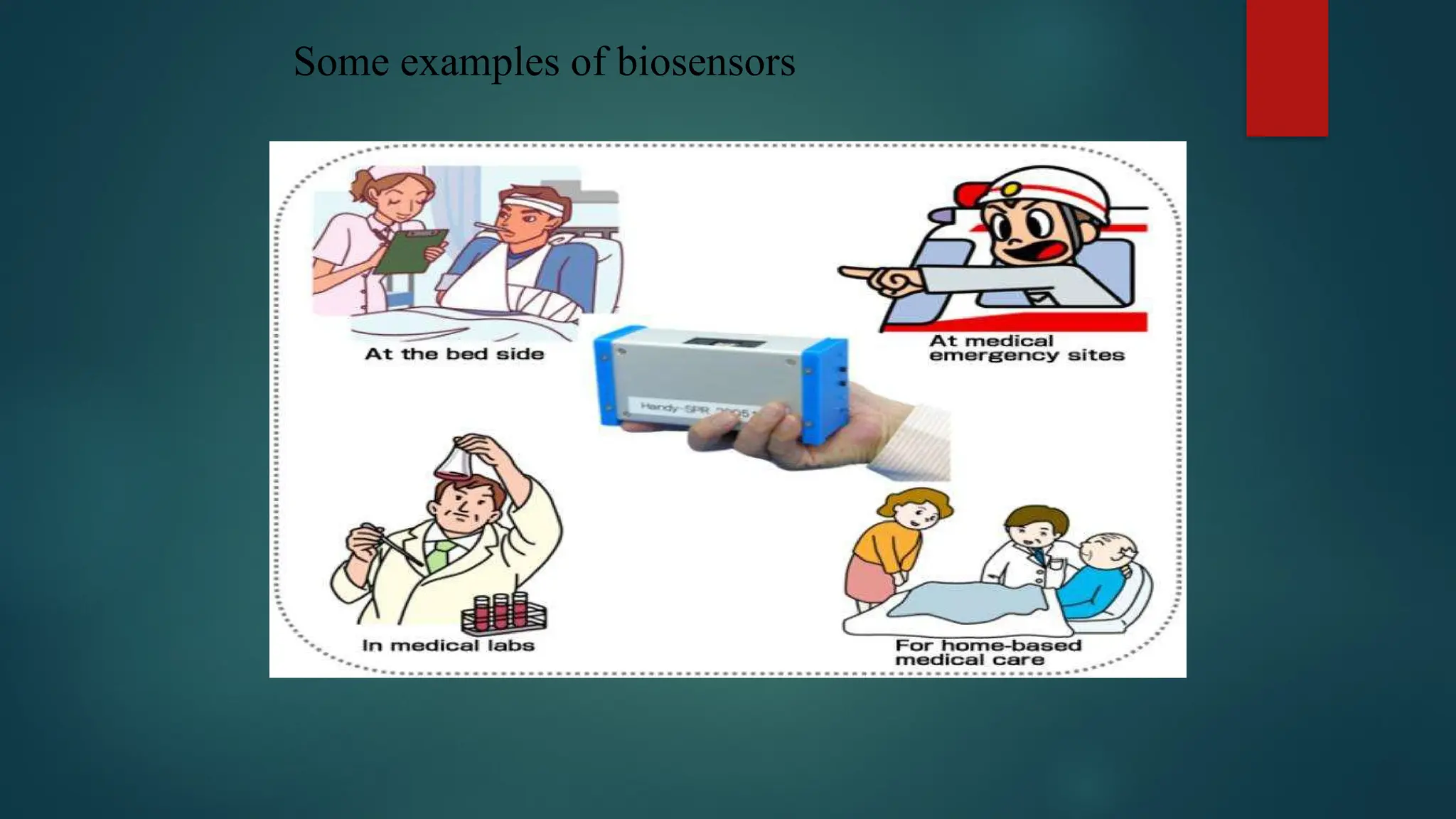
Some examples of biosensors
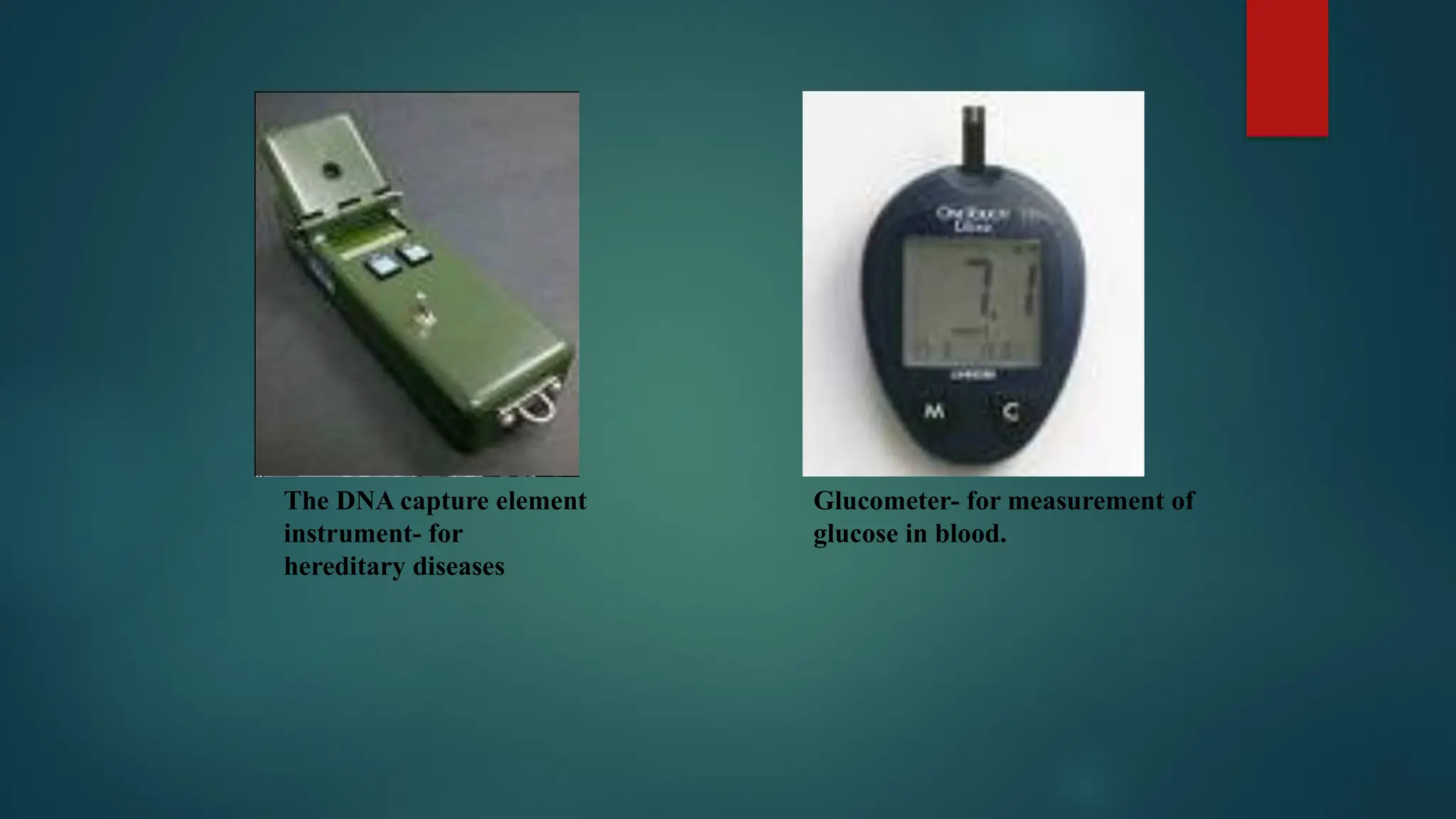
The DNA capture element
instrument- for
hereditary diseases
Glucometer- for measurement of
glucose in blood.
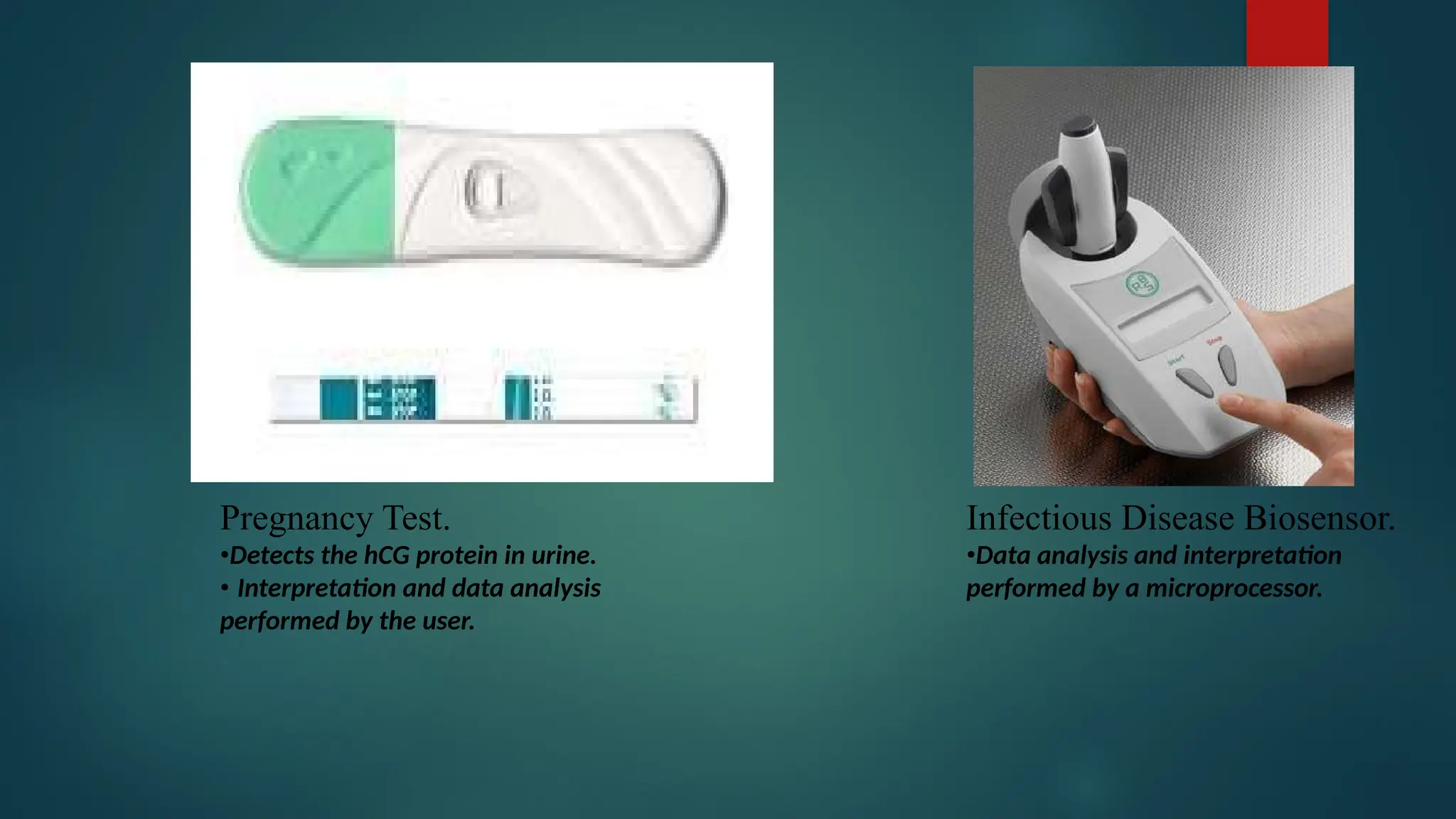
Infectious Disease Biosensor.
•Data analysis and interpretation
performed by a microprocessor.
Pregnancy Test.
•Detects the hCG protein in urine.
• Interpretation and data analysis
performed by the user.
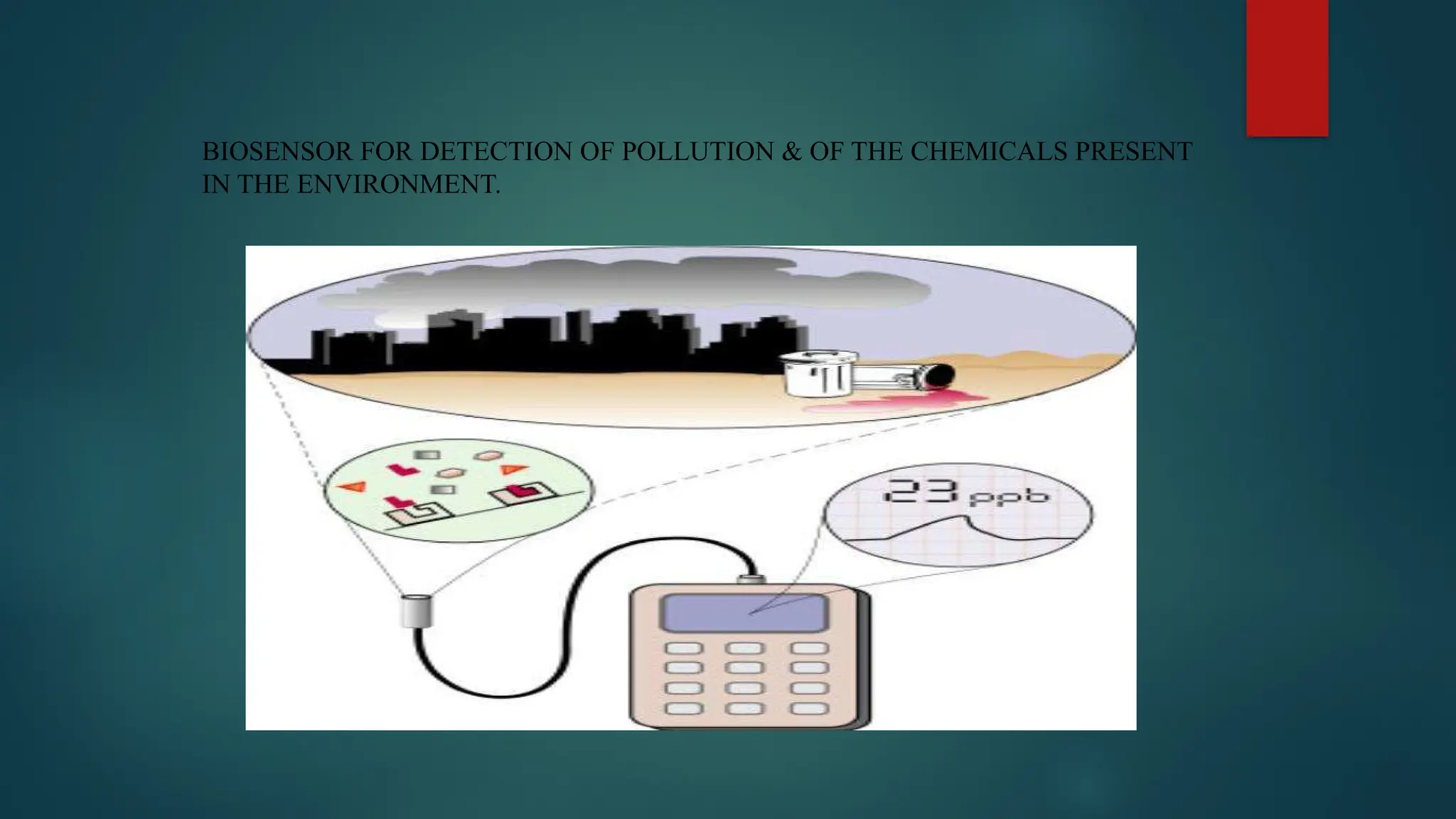
BIOSENSOR FOR DETECTION OF POLLUTION & OF THE CHEMICALS PRESENT
IN THE ENVIRONMENT.
THANK YOU!!!

Biomedical engineering and biomedical research

  • 1.
  • 2.
    SENSOR A sensor isa convertor that measures a physical quantity and converts it into a signal which can be read by an observer or by a instrument. The input may be light ,moisture, heat , pressure and temperature etc, A sensor is a type of transducer.
  • 3.
    CLASSIFICATION OF SENSORS Inthe first classification of the sensors, they are divided in to Active and Passive. • Active sensors emit energy and measure the reflected or scattered signal, • while passive sensors detect the natural radiation or emission from the target or the environment.
  • 4.
    Applications of activesensors  Active sensors are used as radar, lidar, sonar, ultrasound, laser, and microwave.  Radar (Radio Detection and Ranging)  uses radio waves  to detect and track objects in the air, on the ground, or at sea.  Lidar (Light Detection and Ranging)  use laser pulses  to measure distance and create high-resolution maps of the surface or the atmosphere.
  • 5.
     Sonar (SoundNavigation and Ranging)  Uses sound waves  to locate and identify underwater objects or features.  Ultrasound  Uses ultrasonic waves  that can penetrate liquid materials and produce images or measurements of the internal structure or condition.
  • 6.
    Applications of passivesensors Passive sensors are used in various fields and applications, such as infrared, visible, ultraviolet, thermal, acoustic, and magnetic.  Infrared radiation sensors detect heat or thermal radiation from objects or sources  Visible radiation sensors capture images or colors of an objects  Ultraviolet radiation sensors which can gives hidden or fluorescent features of substances;
  • 7.
     Temperature sensors measurethe heat or coldness of objects or environments  Sound sensors pick up vibrations or noises from objects or sources  Magnetic sensors measure the strength or direction of magnetic fields or forces.
  • 8.
    Analog and DigitalSensors Digital Sensors  A digital sensor is an electronic or electrochemical sensor, where data is digitally converted and transmitted  These sensors has fast transmission rate as well as poor distortion.  The main reason that many people prefer using digital sensors is because  they don’t have the same limitations as analog sensors.  used for wastewater treatment, water purification, and similar industrial processes.  also measure conductivity, pH levels, ammonium concentration, nitrate concentration, and dissolved oxygen.
  • 9.
    Analog sensors Measures aphysical quantity or phenomenon and provides an output signal . In other words, Analog sensors provide an output signal that varies continuously with changes in the measured parameter. The analog quantities that are known to be continuous in nature include; speed, pressure, displacement, strain, and temperature. For instance, you can use a thermometer to measure the temperature of a liquid. By obtaining continuous readings, the analog sensor will respond immediately to any changes that occur in the temperature of the liquid as its heats up or cools down.
  • 10.
     There aremany types of analog sensors, among the most common type is a pressure sensor, which is commonly used in industrial and lab settings to manage the pressure of liquids or gases.  These sensors will act as transducers by generating a signal when pressure is imposed.  A pressure sensor is used to monitor and control hundreds of applications.  such variables as gas and fluid flow, water level, speed, . Keep in mind that pressure analog sensors may also be referred to as pressure transducers, pressure senders, pressure transmitters, and pressure indicators.
  • 11.
    DIFFERENT TYPES OFSENSORS All these sensors are used for measuring one of the physical properties like Temperature, Resistance, Capacitance, Conduction, Heat Transfer etc. • Temperature Sensor • Proximity Sensor • Accelerometer • IR Sensor (Infrared Sensor) • Pressure Sensor • Light Sensor • Ultrasonic Sensor • Smoke, Gas and Alcohol Sensor • Touch Sensor • Color Sensor • Humidity Sensor • Flow and Level Sensor
  • 12.
    The five typesof smart sensors that are commonly used in industrial environments include:  Level Sensors Measure how much volume space takes up in a container of any size. For instance, the fuel gauge in a car could be connected directly to one of these sensors, which will monitor how much fuel remains in the tank.  Pressure Sensors These sensors are used to monitor fluid and gas pressure in a pipeline. In the event of a drop in pressure, the sensor will send out a warning, that there is a flow control problem or a leak of some kind.
  • 13.
    Proximity Sensors Use todetecting the location of an object or person . When used in a retail store, proximity sensors are able to track the movements that customers make within the store. • Proximity Sensors using different techniques like Optical (like Infrared or Laser), Ultrasonic, Hall Effect, Capacitive, etc. •Some of the applications of Proximity Sensors are Mobile Phones, Cars (Parking Sensors), industries (object alignment), Ground Proximity in aircraft, etc.
  • 14.
     Temperature Sensors usedto keep machinery and equipment from overheating.  Temperature sensor is a device used to measure temperature .  It is most commonly used sensors.  There are different types of Temperature Sensor: 1. Thermistor sensor 2. RTDs Sensor
  • 15.
    Used to detectthe variation in temperature. It has a negative temperature coefficient that means when the temperature increases the resistance decreases. So, the thermistor’s resistance can be varied with the rise in temperature which causes more current flow through it. • Another component that can detect the variation in temperature is a thermocouple. In its construction, two different metals are joined together to form a junction • LM35 is a Celsius scale temperature sensor device with its output directly proportional to the temperature. LM35 can measure temperatures in the range of -550C to +1500C Thermistor
  • 16.
    APPLICATIONS OF TEMPERATURESENSOR: • Home Appliances- water heater , toasters ,washing machine , dishwasher and coffee machines will all contain temperature sensors. • Within computers , there are temperature sensors to ensure the system does not over heat.
  • 17.
    Infrared Sensors • AnInfrared Sensor is an electronic device that measures and detects infrared radiation. • IR sensor are now widely used in motion detector , which are used in building services to switch on lamps or in alarms systems . • IR Sensors are used as proximity sensors in almost all mobile phones. • There are two types of Infrared or IR Sensors:  Transmissive Type  Reflective Type.
  • 18.
    • In TransmissiveType IR Sensor, the IR LED and the IR Photo Diode are positioned facing each other so that when an object passes between them, the sensor detects the object. • The other type of IR Sensor is a Reflective Type IR Sensor. • In this, the transmitter and the detector are positioned adjacent to each other facing the object. When an object comes in front of the sensor, the sensor detects the object. This type of infrared sensor is mainly used in different types of medical equipment, the primary of which include pulse oximetry devices • Different applications where IR Sensor is implemented are Mobile Phones, Robots, Industrial assembly, automobiles etc.
  • 19.
    APPLICATIONS OF INFRAREDSENSOR: Flame detectors • Gas analysers • Climatology • Radiation thermometers • Moisture analyser
  • 20.
    ULTRASONIC SENSOR • Usedto measure the distance as well as the velocity of an object. • An Ultrasonic Sensor works based on the properties of the sound waves with a frequency greater than that of the human audible range. • There are two kinds of ultrasonic sensors, “active ultrasonic sensors” and “passive ultrasonic sensors”. • An active ultrasonic sensor generates the high-frequency sound wave to receive back the ultrasonic sensor for evaluating the echo. But, • Passive ultrasonic sensors are just used for detecting ultrasonic noise.
  • 21.
    • Ultrasonic wavestravel faster then the speed of audible sounds. • Ultrasonic sensor have two main components : 1 Transmitter 2 Receiver • This ultrasonic sensor is used to calculate the distance between the ultrasonic transmitter and the target and also used to measure the velocity of the target. • Ultrasonic sensor HC-SR04 can be used to measure distance in the range of 2cm- 400cm with an accuracy of 3mm. • The 4 pins of the Ultrasonic sensor are Vcc, Gnd, Trig and Echo.
  • 22.
    APPLICATIONS OF ULTRASONICSENSOR: • Robotic sensing • Medical ultrasonography • Homogenizing • Tide gauge • Tank level
  • 23.
    Pyroelectric Sensor(PIR): • usedfor measuring the infrared light radiation emitted from objects. • Every object that has a temperature emit heat energy in form of radiation at infrared wavelength which can be detected by PIR motion sensor. • When the object comes in the field view of the sensor ,positive change is produced ,similarly if the object leaves negative change is produced. • It is also called passive sensor , because it doesn’t emit any energy for detecting radiation.
  • 24.
    APPLICATIONS OF PIR SENSOR: •Lightning controls • Surveillance systems • Motion detection • Automatic door opening system • Security alarm system • Multi function printers
  • 25.
    HUMIDITY SENSOR: • AHumidity sensor is an electronic device that measures the humidity in its environment and converts it in to electrical signal • There are 3 basic types of sensors • Capacitive • Resistive • Thermal
  • 26.
    • A humiditysensor measures and reports both moisture and air temperature.
  • 27.
    Applications: • It isused in printers , fax machines etc. • It is used in weather stations. • It is used in refrigerators and food processing. • It is used in automobiles and HVAC systems.
  • 28.
    SOUND SENSOR • usedto detect the intensity of sound. • This sensor notices a sound, & processes an o/p voltage signal to a microcontroller. After that, it executes the required processing. • Pin1 (VCC): 3.3V DC to 5V DC • Pin2 (GND): This is a ground pin • Pin3 (DO): This is an output pin
  • 29.
    CHEMICAL/SMOKE AND GASSENSOR • smoke and gas detector is a gadget that sense gas, smoke and typically it’s an indicator of fire. Now a days all security devices using this sensor to passing signal to fire alarm to control panel. • Household smoke detector is also known as smoke alarm, most of the device manufacturer using audible or visual alarm system in security devices that detect automatically.
  • 30.
    NANOSENSORS Nano sensors areany biological, chemical or physical sensory points used to convey information about nanoparticles to the macroscopic world. They are tiny sensors in the size of a few nanometres about 10 to 100 nanometre. They can detect the presence of nanomaterial or molecules in that size or even smaller.
  • 33.
    WHAT IS ATRANSDUCER ?  A transducer is a device which converts a non- electrical physical quantity (i.e. temperature, sound or light) into an electrical signal (i.e. voltage, current, capacity…)  A Transducer is a device which converts one form of energy into another form. Pressure Voltage
  • 34.
    WHAT IS ATRANSDUCER ?  A Transducer is a device when actuated by energy in one system, supplies energy in the same form or in another form to a second system.
  • 35.
    Energy conversion Energy conversion,also known as energy transformation, is the process of changing one form of energy into another. There are different forms of energy like  thermal energy,  electrical energy,  nuclear energy,  electromagnetic energy,  mechanical energy,  chemical energy,  sound energy, etc.
  • 36.
    What is EnergyTransfer? The movement of energy from one location to another. What is Energy Transformation? The process of changing the energy from one type to another. What is Energy Conservation? It means that the total amount of energy remains the same. Energy Transfer vs Energy Transformation vs Energy Conservation
  • 37.
    Law of Energyconversion Energy can neither be created nor destroyed, it can only be transformed from one form to another.
  • 38.
    Law of Energyconversion
  • 39.
    Law of Energyconversion
  • 40.
    BLOCK DIAGRAM OFTRANSDUCERS  Transducer contains two parts that are closely related to each other i.e. the sensing element and transduction element.  The sensing element is called as the sensor. A sensor is a device that detects and responds to some type of input from the physical environment.  Thetransduction element convert the sensoroutput to suitable electrical form.
  • 41.
    WHAT IS SENSOR Asensor is a device that measures a physical quantity and converts it into a electrical signal which can be read by an observer or by an instrument.
  • 42.
     WHAT ISBIO - SENSOR  The term “biosensor” is short for “biological sensor.” The device is made up of a transducer and a biological element that may be an enzyme, an antibody or a nucleic acid.  A biosensor is an analytical device, used for the detection of an analyte, that combines a biological component (The living organism of the ecosystem is called a biological component like bacteria, animals, Fungi, plants, etc ) with a physicochemical detector.  Analyte: An analyte is a compound (e.g. glucose, urea, drug) whose concentration has to be measured.  Bioreceptor: A molecule that specifically recognises the analyte is known as a bioreceptor. Ex, Enzymes, cells, deoxyribonucleic acid (DNA) and antibodies
  • 43.
    Biosensor 43 • It isan analytical device which converts a biological response into an electrical signal.  It detects, records, and transmits information regarding a physiological change or process.  It determines the presence and concentration of a specific substance in any test solution. • The simplest definition of a Biosensor is given here: A Biosensor is an analytical device that detects changes in Biological processes and converts them into an electrical signal. The term Biological process can be any biological element or material like enzymes, tissues, microorganisms, cells, acids, etc.
  • 44.
    Example of Biosensor Beforeproceeding further with different types of Biosensors and applications of Biosensor, let us look at a simple example of a Biosensor: The Glucometer Diabetes is a disease characterized by the levels of glucose in the blood. Regularly checking the blood glucose levels is very important for diabetes patients. Glucometers are a type Biosensors, which measure the concentration of glucose in blood. Usually, they consists of a test strip, which collect a small sample of blood to analyze the glucose levels.
  • 45.
    The test stripconsists of a trigger electrode and a reference electrode. When blood is placed on the test strip, a simple chemical reaction takes place and an electrical current is generated, which is directly proportional to the concentration of glucose. Internally, the Glucometer consists of a powerful processor like a Cortex-M3 or Cortex- M4 along with current to voltage converter, amplifier, filter and a display unit.
  • 46.
    MAIN COMPONENTS OFA BIOSENSOR 46 • Sensor • Transducer • Amplifier • Processor • Display unit
  • 47.
    • Sensor It isa sensitive biological element (biological material (eg. tissue, microorganisms, organelles, cell receptors, enzymes, antibodies, nucleic acids, etc). • Transducer Transducer is a device that converts energy from one form to another form. In biosensors transducers convert the biochemical activity into electrical energy. 47
  • 48.
  • 50.
    Some examples ofbiosensors
  • 51.
    The DNA captureelement instrument- for hereditary diseases Glucometer- for measurement of glucose in blood.
  • 52.
    Infectious Disease Biosensor. •Dataanalysis and interpretation performed by a microprocessor. Pregnancy Test. •Detects the hCG protein in urine. • Interpretation and data analysis performed by the user.
  • 53.
    BIOSENSOR FOR DETECTIONOF POLLUTION & OF THE CHEMICALS PRESENT IN THE ENVIRONMENT.
  • 54.