PRESENTED BY
VAISHALI.K
M.Tech (ECE) - Ist yr
21304023
DEPARTMENT OF ELECTRONICS & COMMUNICATION
ENGINEERING
PONDICHERRY UNIVERSITY
SUBMITTED TO
Dr.R.NAKKERAN,
Head of the department,
Dept.Of Electronics Engineering
AGENDA
 Introduction
 Coherent detection
 Homodyne detection
 Heterodyne detection
 Heterodyne detection principle
 Advantages
 Applications
 References
2
INTRODUCTION
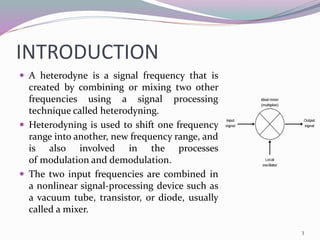
 A heterodyne is a signal frequency that is
created by combining or mixing two other
frequencies using a signal processing
technique called heterodyning.
 Heterodyning is used to shift one frequency
range into another, new frequency range, and
is also involved in the processes
of modulation and demodulation.
 The two input frequencies are combined in
a nonlinear signal-processing device such as
a vacuum tube, transistor, or diode, usually
called a mixer.
3
INTRODUCTION
 In coherent detection the local carrier generated at the receiver is
phase locked with the carrier at the transmitter.
 Hence it is also called synchronous detection.
 In non coherent detection the local carrier generated at the
receiver not be phase locked with the carrier at the transmitter.
 Hence it is also called asynchronous detection.
4
COHERENT DETECTION
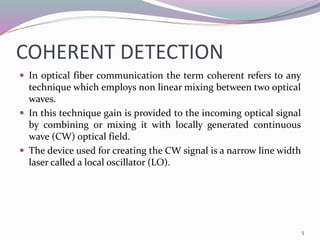
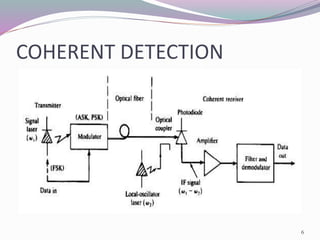
 In optical fiber communication the term coherent refers to any
technique which employs non linear mixing between two optical
waves.
 In this technique gain is provided to the incoming optical signal
by combining or mixing it with locally generated continuous
wave (CW) optical field.
 The device used for creating the CW signal is a narrow line width
laser called a local oscillator (LO).
5
COHERENT DETECTION
6
MATHEMATICAL ANALYSIS OF
COHERENT DETECTION
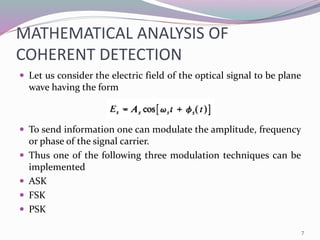
 Let us consider the electric field of the optical signal to be plane
wave having the form
 To send information one can modulate the amplitude, frequency
or phase of the signal carrier.
 Thus one of the following three modulation techniques can be
implemented
 ASK
 FSK
 PSK
7
MATHEMATICAL ANALYSIS OF
COHERENT DETECTION
 In direct detection system the electrical signal coming into the
transmitter amplitude modulates the optical power level of the
light source.
 Thus the optical power is proportional to the signal current level.
 At the receiver the incoming optical signal is converted directly
into demodulated electrical output.
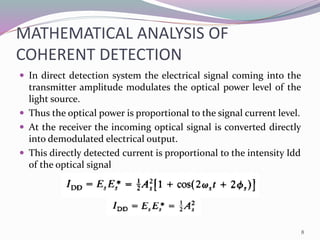
 This directly detected current is proportional to the intensity Idd
of the optical signal
8
MATHEMATICAL ANALYSIS OF
COHERENT DETECTION
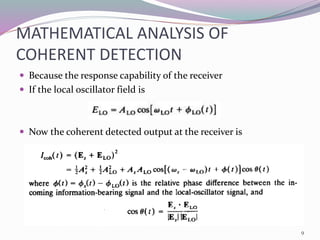
 Because the response capability of the receiver
 If the local oscillator field is
 Now the coherent detected output at the receiver is
9
MATHEMATICAL ANALYSIS OF
COHERENT DETECTION
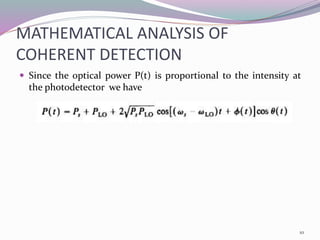
 Since the optical power P(t) is proportional to the intensity at
the photodetector we have
10
HOMODYNE DETECTION
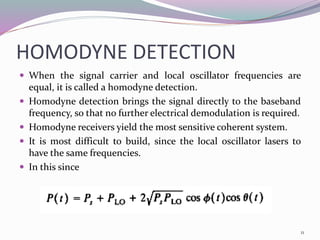
 When the signal carrier and local oscillator frequencies are
equal, it is called a homodyne detection.
 Homodyne detection brings the signal directly to the baseband
frequency, so that no further electrical demodulation is required.
 Homodyne receivers yield the most sensitive coherent system.
 It is most difficult to build, since the local oscillator lasers to
have the same frequencies.
 In this since
11
HETERODYNE DETECTION
 In heterodyne detection, the intermediate frequency is nonzero
and an optical phase locked loop is not needed.
 In heterodyne detection, the local-oscillator frequency (LO)
ωLO is chosen to differ from the signal-carrier frequency ω0 such
that the intermediate frequency ωIF is in the microwave region
(ωIF = 1 GHz).
 Heterodyne receivers are much easier to implement than
homodyne receivers.
 In heterodyne detection, 3dB degradation in sensitivity
compared to homodyne detection.
12
HETERODYNE DETECTION
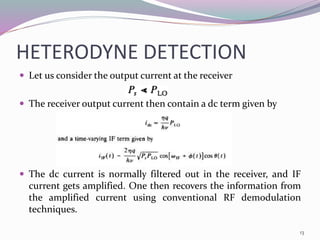
 Let us consider the output current at the receiver
 The receiver output current then contain a dc term given by
 The dc current is normally filtered out in the receiver, and IF
current gets amplified. One then recovers the information from
the amplified current using conventional RF demodulation
techniques.
13
HETERODYNE DETECTION
14
HETERODYNE DETECTION
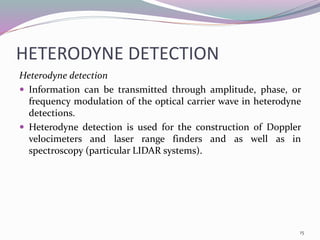
Heterodyne detection
 Information can be transmitted through amplitude, phase, or
frequency modulation of the optical carrier wave in heterodyne
detections.
 Heterodyne detection is used for the construction of Doppler
velocimeters and laser range finders and as well as in
spectroscopy (particular LIDAR systems).
15
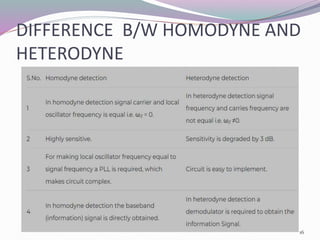
DIFFERENCE B/W HOMODYNE AND
HETERODYNE
16
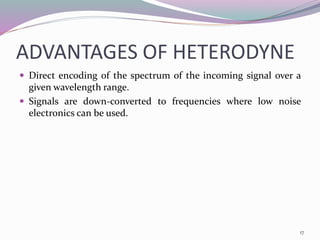
ADVANTAGES OF HETERODYNE
 Direct encoding of the spectrum of the incoming signal over a
given wavelength range.
 Signals are down-converted to frequencies where low noise
electronics can be used.
17
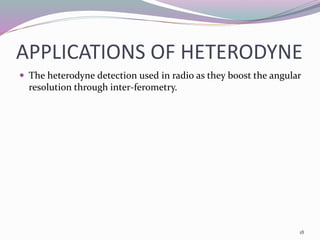
APPLICATIONS OF HETERODYNE
 The heterodyne detection used in radio as they boost the angular
resolution through inter-ferometry.
18
REFERENCE
 optical-fiber-communications-by-gerd-keiser_2
 https://youtu.be/h-M270YlImk
 https://electronics-club.com/difference-between-
homodyne-and-heterodyne-detection/
19

Optical heterodyne detection

  • 1.
    PRESENTED BY VAISHALI.K M.Tech (ECE)- Ist yr 21304023 DEPARTMENT OF ELECTRONICS & COMMUNICATION ENGINEERING PONDICHERRY UNIVERSITY SUBMITTED TO Dr.R.NAKKERAN, Head of the department, Dept.Of Electronics Engineering
  • 2.
    AGENDA  Introduction  Coherentdetection  Homodyne detection  Heterodyne detection  Heterodyne detection principle  Advantages  Applications  References 2
  • 3.
    INTRODUCTION  A heterodyneis a signal frequency that is created by combining or mixing two other frequencies using a signal processing technique called heterodyning.  Heterodyning is used to shift one frequency range into another, new frequency range, and is also involved in the processes of modulation and demodulation.  The two input frequencies are combined in a nonlinear signal-processing device such as a vacuum tube, transistor, or diode, usually called a mixer. 3
  • 4.
    INTRODUCTION  In coherentdetection the local carrier generated at the receiver is phase locked with the carrier at the transmitter.  Hence it is also called synchronous detection.  In non coherent detection the local carrier generated at the receiver not be phase locked with the carrier at the transmitter.  Hence it is also called asynchronous detection. 4
  • 5.
    COHERENT DETECTION  Inoptical fiber communication the term coherent refers to any technique which employs non linear mixing between two optical waves.  In this technique gain is provided to the incoming optical signal by combining or mixing it with locally generated continuous wave (CW) optical field.  The device used for creating the CW signal is a narrow line width laser called a local oscillator (LO). 5
  • 6.
  • 7.
    MATHEMATICAL ANALYSIS OF COHERENTDETECTION  Let us consider the electric field of the optical signal to be plane wave having the form  To send information one can modulate the amplitude, frequency or phase of the signal carrier.  Thus one of the following three modulation techniques can be implemented  ASK  FSK  PSK 7
  • 8.
    MATHEMATICAL ANALYSIS OF COHERENTDETECTION  In direct detection system the electrical signal coming into the transmitter amplitude modulates the optical power level of the light source.  Thus the optical power is proportional to the signal current level.  At the receiver the incoming optical signal is converted directly into demodulated electrical output.  This directly detected current is proportional to the intensity Idd of the optical signal 8
  • 9.
    MATHEMATICAL ANALYSIS OF COHERENTDETECTION  Because the response capability of the receiver  If the local oscillator field is  Now the coherent detected output at the receiver is 9
  • 10.
    MATHEMATICAL ANALYSIS OF COHERENTDETECTION  Since the optical power P(t) is proportional to the intensity at the photodetector we have 10
  • 11.
    HOMODYNE DETECTION  Whenthe signal carrier and local oscillator frequencies are equal, it is called a homodyne detection.  Homodyne detection brings the signal directly to the baseband frequency, so that no further electrical demodulation is required.  Homodyne receivers yield the most sensitive coherent system.  It is most difficult to build, since the local oscillator lasers to have the same frequencies.  In this since 11
  • 12.
    HETERODYNE DETECTION  Inheterodyne detection, the intermediate frequency is nonzero and an optical phase locked loop is not needed.  In heterodyne detection, the local-oscillator frequency (LO) ωLO is chosen to differ from the signal-carrier frequency ω0 such that the intermediate frequency ωIF is in the microwave region (ωIF = 1 GHz).  Heterodyne receivers are much easier to implement than homodyne receivers.  In heterodyne detection, 3dB degradation in sensitivity compared to homodyne detection. 12
  • 13.
    HETERODYNE DETECTION  Letus consider the output current at the receiver  The receiver output current then contain a dc term given by  The dc current is normally filtered out in the receiver, and IF current gets amplified. One then recovers the information from the amplified current using conventional RF demodulation techniques. 13
  • 14.
  • 15.
    HETERODYNE DETECTION Heterodyne detection Information can be transmitted through amplitude, phase, or frequency modulation of the optical carrier wave in heterodyne detections.  Heterodyne detection is used for the construction of Doppler velocimeters and laser range finders and as well as in spectroscopy (particular LIDAR systems). 15
  • 16.
    DIFFERENCE B/W HOMODYNEAND HETERODYNE 16
  • 17.
    ADVANTAGES OF HETERODYNE Direct encoding of the spectrum of the incoming signal over a given wavelength range.  Signals are down-converted to frequencies where low noise electronics can be used. 17
  • 18.
    APPLICATIONS OF HETERODYNE The heterodyne detection used in radio as they boost the angular resolution through inter-ferometry. 18
  • 19.
    REFERENCE  optical-fiber-communications-by-gerd-keiser_2  https://youtu.be/h-M270YlImk https://electronics-club.com/difference-between- homodyne-and-heterodyne-detection/ 19