


ENERGY HARVESTING BY 
MICROMACHINES 
CHANDAN KUMAR
WHY WE NEED ENERGY HARVESTING 
• In modern days, the use of energy consumption increasing very rapidly. 
Fossil fuels are finite and environmentally costly. 
• Sustainable, environmental energy can be derived from nuclear fission or 
captured from ambient sources. Large-scale ambient energy (eg. solar, wind 
and tide), is widely available and large-scale technologies are being 
developed to efficiently capture it. 
• At the other end of the scale, there are small amounts of ‘wasted’ energy 
that could be useful if captured. Recovering even a fraction of this energy 
would have a significant economic and environmental impact. This is where 
energy harvesting (EH) comes in.
INTRODUCTION 
• Energy harvesting (also known as power harvesting or energy scavenging) is the process 
by which energy is derived from external sources (e.g. solar power, thermal energy, wind 
energy, salinity gradients, and kinetic energy), captured, and stored for small, wireless 
autonomous devices, like the used in wearable electronics and wireless sensor network. 
• EH also has the potential to replace batteries for small, low power electronic devices. This 
has several benefits: 
• Maintenance free – no need to replace batteries 
• Environmentally friendly – disposal of batteries is tightly regulated because they contain 
chemicals and metals that are harmful to the environment and hazardous to human 
health 
• Opens up new applications – such as deploying EH sensors to monitor remote or 
underwater locations.
Where can energy be harvested? 
• Energy is lost in every industrial process and everyday technology that you can think of, 
eg: 
• Power stations – nearly all of the world's electrical power is generated by heat engines. 
These are gas or steam-powered turbines that convert heat to mechanical energy, which 
is then converted to electricity. Approximately two-thirds of the energy input is not 
converted to electrical power but lost as heat 
• Computers and microwaves (in fact all our electronic gadgets) – lose energy through heat 
and/or vibration
How can we harvest waste energy? 
• 
Different types of waste energy can be captured using different EH materials. The most 
promising micro scale EH technologies in development include: 
• Vibration, movement and sound can be captured and transformed into electrical power 
using piezoelectric materials 
• Heat can be captured and transformed into electrical power using 
thermoelectric and pyro electric materials.
Types of energy harvesting material: 
• Piezoelectric material- Mechanical stress ↔ electrical signal 
• E.g. Battery-less remote control – the force used to press a button is sufficient to power 
a wireless radio or infrared signal 
• Thermoelectric material-Temperature differences across the material ↔ electric voltage 
• E.g. Road transport – Cars and lorries equipped with a thermoelectric generators (TEG) 
would have significant fuel savings (especially with the increasing cost of petrol). In 2009, 
VW demonstrated this proof of concept . The thermoelectric generator of their prototype 
car gained about 600W from running on a highway, reducing fuel consumption by 5% – it 
is highly likely efficiency has improved significantly since then 
• Pyro electric material.- Change in temperature ↔ electric charge 
• E.g. The pyroelectric effect is used in some sensors, but it is still some way from 
commercial energy harvesting applications.
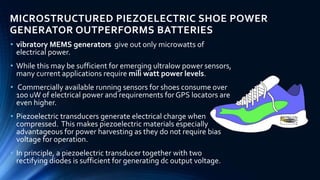
MICROSTRUCTURED PIEZOELECTRIC SHOE POWER 
GENERATOR OUTPERFORMS BATTERIES 
• vibratory MEMS generators give out only microwatts of 
electrical power. 
• While this may be sufficient for emerging ultralow power sensors, 
many current applications require mili watt power levels. 
• Commercially available running sensors for shoes consume over 
100 uW of electrical power and requirements for GPS locators are 
even higher. 
• Piezoelectric transducers generate electrical charge when 
compressed. This makes piezoelectric materials especially 
advantageous for power harvesting as they do not require bias 
voltage for operation. 
• In principle, a piezoelectric transducer together with two 
rectifying diodes is sufficient for generating dc output voltage.
Continued…. 
• A significant challenge in harvesting piezoelectric energy is that piezoelectric 
materials are optimal for generating high voltages but provide only a low current 
output. 
• The polymer used in the shoe transducer provides over 5 mJ of energy per step 
but at voltages too large (>50 V) to be directly used in low power sensors. 
• A breakthrough in piezoelectric power generation is the new voltage regulation 
circuits that is developed at Louisiana Tech University that efficiently converts 
the piezoelectric charge into a usable voltage. 
• . A conversion circuit coverts the high voltage to a regulated 3 V output for 
charging batteries or for directly powering electronics at better than 70% 
conversion efficiency. Combined with the polymer transducer, the regulation 
circuit gives time-averaged power of 2 mWper shoe during a regular walk.
New Applications for Energy Harvesting 
• Medical and Fitness Devices:- RF is already being used experimentally to recharge the 
batteries in pacemakers and implanted transcutaneous electrical nerve stimulation 
(TENS) devices. The patient sits in a chair that contains a low-frequency RF source 
whose output is received, rectified, and stored by the device. 
• Researchers at MIT and Harvard have developed a chip that can be implanted into the 
inner ear, with power provided by harvesting the energy in sound waves. The chip is 
designed to monitor biological activity in the ears of people with hearing or balance 
impairments. 
• MEMS pyroelectric generator:- Oak Ridge National Laboratories has developed a 
unique pyroelectric generator that can cool electronic devices, photocells, computers, 
and even large waste-heat producing systems while generating electricity .
Conclusion:- 
• Energy harvesting is useful in giving energy to low energy devices. EH also has the 
potential to replace batteries for small, low power electronic devices. Benefits of EH:- 
• Maintenance free – no need to replace batteries 
• Environmentally friendly – disposal of batteries is tightly regulated because they contain 
chemicals and metals that are harmful to the environment and hazardous to human health 
• Opens up new applications – such as deploying EH sensors to monitor remote or 
underwater locations. 
• EH has also new applications in different sectors like medical fitness and solar field.
Energy harvesting by chandan kumar

Energy harvesting by chandan kumar

  • 1.
    ENERGY HARVESTING BY MICROMACHINES CHANDAN KUMAR
  • 2.
    WHY WE NEEDENERGY HARVESTING • In modern days, the use of energy consumption increasing very rapidly. Fossil fuels are finite and environmentally costly. • Sustainable, environmental energy can be derived from nuclear fission or captured from ambient sources. Large-scale ambient energy (eg. solar, wind and tide), is widely available and large-scale technologies are being developed to efficiently capture it. • At the other end of the scale, there are small amounts of ‘wasted’ energy that could be useful if captured. Recovering even a fraction of this energy would have a significant economic and environmental impact. This is where energy harvesting (EH) comes in.
  • 3.
    INTRODUCTION • Energyharvesting (also known as power harvesting or energy scavenging) is the process by which energy is derived from external sources (e.g. solar power, thermal energy, wind energy, salinity gradients, and kinetic energy), captured, and stored for small, wireless autonomous devices, like the used in wearable electronics and wireless sensor network. • EH also has the potential to replace batteries for small, low power electronic devices. This has several benefits: • Maintenance free – no need to replace batteries • Environmentally friendly – disposal of batteries is tightly regulated because they contain chemicals and metals that are harmful to the environment and hazardous to human health • Opens up new applications – such as deploying EH sensors to monitor remote or underwater locations.
  • 4.
    Where can energybe harvested? • Energy is lost in every industrial process and everyday technology that you can think of, eg: • Power stations – nearly all of the world's electrical power is generated by heat engines. These are gas or steam-powered turbines that convert heat to mechanical energy, which is then converted to electricity. Approximately two-thirds of the energy input is not converted to electrical power but lost as heat • Computers and microwaves (in fact all our electronic gadgets) – lose energy through heat and/or vibration
  • 5.
    How can weharvest waste energy? • Different types of waste energy can be captured using different EH materials. The most promising micro scale EH technologies in development include: • Vibration, movement and sound can be captured and transformed into electrical power using piezoelectric materials • Heat can be captured and transformed into electrical power using thermoelectric and pyro electric materials.
  • 6.
    Types of energyharvesting material: • Piezoelectric material- Mechanical stress ↔ electrical signal • E.g. Battery-less remote control – the force used to press a button is sufficient to power a wireless radio or infrared signal • Thermoelectric material-Temperature differences across the material ↔ electric voltage • E.g. Road transport – Cars and lorries equipped with a thermoelectric generators (TEG) would have significant fuel savings (especially with the increasing cost of petrol). In 2009, VW demonstrated this proof of concept . The thermoelectric generator of their prototype car gained about 600W from running on a highway, reducing fuel consumption by 5% – it is highly likely efficiency has improved significantly since then • Pyro electric material.- Change in temperature ↔ electric charge • E.g. The pyroelectric effect is used in some sensors, but it is still some way from commercial energy harvesting applications.
  • 7.
    MICROSTRUCTURED PIEZOELECTRIC SHOEPOWER GENERATOR OUTPERFORMS BATTERIES • vibratory MEMS generators give out only microwatts of electrical power. • While this may be sufficient for emerging ultralow power sensors, many current applications require mili watt power levels. • Commercially available running sensors for shoes consume over 100 uW of electrical power and requirements for GPS locators are even higher. • Piezoelectric transducers generate electrical charge when compressed. This makes piezoelectric materials especially advantageous for power harvesting as they do not require bias voltage for operation. • In principle, a piezoelectric transducer together with two rectifying diodes is sufficient for generating dc output voltage.
  • 8.
    Continued…. • Asignificant challenge in harvesting piezoelectric energy is that piezoelectric materials are optimal for generating high voltages but provide only a low current output. • The polymer used in the shoe transducer provides over 5 mJ of energy per step but at voltages too large (>50 V) to be directly used in low power sensors. • A breakthrough in piezoelectric power generation is the new voltage regulation circuits that is developed at Louisiana Tech University that efficiently converts the piezoelectric charge into a usable voltage. • . A conversion circuit coverts the high voltage to a regulated 3 V output for charging batteries or for directly powering electronics at better than 70% conversion efficiency. Combined with the polymer transducer, the regulation circuit gives time-averaged power of 2 mWper shoe during a regular walk.
  • 9.
    New Applications forEnergy Harvesting • Medical and Fitness Devices:- RF is already being used experimentally to recharge the batteries in pacemakers and implanted transcutaneous electrical nerve stimulation (TENS) devices. The patient sits in a chair that contains a low-frequency RF source whose output is received, rectified, and stored by the device. • Researchers at MIT and Harvard have developed a chip that can be implanted into the inner ear, with power provided by harvesting the energy in sound waves. The chip is designed to monitor biological activity in the ears of people with hearing or balance impairments. • MEMS pyroelectric generator:- Oak Ridge National Laboratories has developed a unique pyroelectric generator that can cool electronic devices, photocells, computers, and even large waste-heat producing systems while generating electricity .
  • 10.
    Conclusion:- • Energyharvesting is useful in giving energy to low energy devices. EH also has the potential to replace batteries for small, low power electronic devices. Benefits of EH:- • Maintenance free – no need to replace batteries • Environmentally friendly – disposal of batteries is tightly regulated because they contain chemicals and metals that are harmful to the environment and hazardous to human health • Opens up new applications – such as deploying EH sensors to monitor remote or underwater locations. • EH has also new applications in different sectors like medical fitness and solar field.