Passive Filters
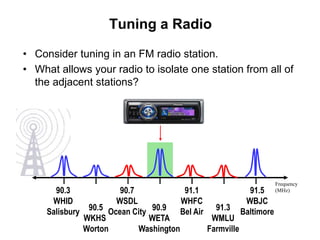
90.7
WSDL
Ocean City
90.3
WHID
Salisbury
Frequency
(MHz)
90.5
WKHS
Worton
91.3
WMLU
Farmville
90.9
WETA
Washington
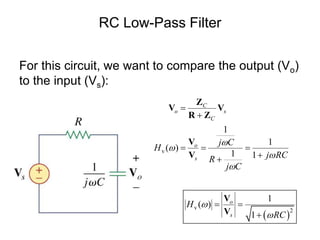
91.1
WHFC
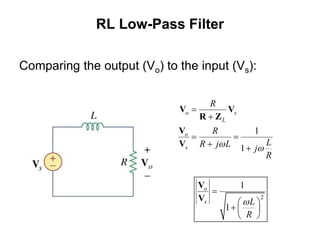
Bel Air
91.5
WBJC
Baltimore
Tuning a Radio
• Consider tuning in an FM radio station.
• What allows your radio to isolate one station from all of
the adjacent stations?
Filters
• A filter is a frequency-selective circuit.
• Filters are designed to pass some frequencies and reject
others.
Frequency
(MHz)
90.9
WETA
Washington
Active and Passive Filters
• Filter circuits depend on the fact that the impedance of
capacitors and inductors is a function of frequency
• There are numerous ways to construct filters, but there
are two broad categories of filters:
– Passive filters are composed of only passive
components (resistors, capacitors, inductors) and do
not provide amplification.
– Active filters typically employ RC networks and
amplifiers (opamps) with feedback and offer a number
of advantages.
Passive Filters
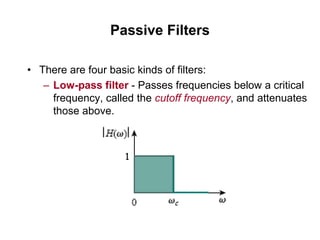
• There are four basic kinds of filters:
– Low-pass filter - Passes frequencies below a critical
frequency, called the cutoff frequency, and attenuates
those above.
Passive Filters
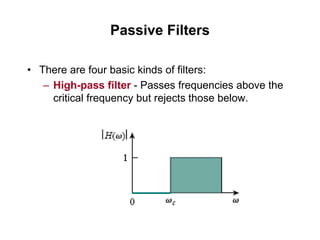
• There are four basic kinds of filters:
– High-pass filter - Passes frequencies above the
critical frequency but rejects those below.
Passive Filters
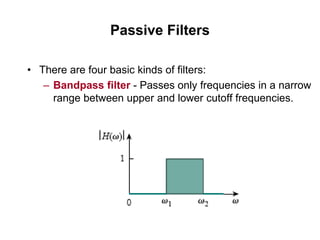
• There are four basic kinds of filters:
– Bandpass filter - Passes only frequencies in a narrow
range between upper and lower cutoff frequencies.
Passive Filters
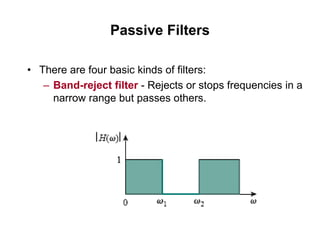
• There are four basic kinds of filters:
– Band-reject filter - Rejects or stops frequencies in a
narrow range but passes others.
Low Pass Filters
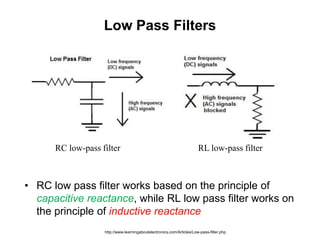
RL low-pass filterRC low-pass filter
• RC low pass filter works based on the principle of
capacitive reactance, while RL low pass filter works on
the principle of inductive reactance
http://www.learningaboutelectronics.com/Articles/Low-pass-filter.php
Capacitive Reactance
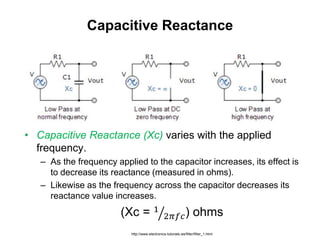
• Capacitive Reactance (Xc) varies with the applied
frequency.
– As the frequency applied to the capacitor increases, its effect is
to decrease its reactance (measured in ohms).
– Likewise as the frequency across the capacitor decreases its
reactance value increases.
(Xc = 1
2𝜋𝑓𝑐) ohms
http://www.electronics-tutorials.ws/filter/filter_1.html
Inductive Reactance
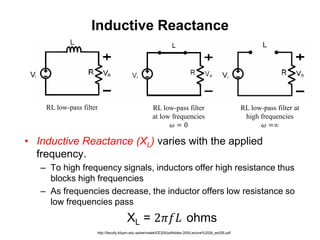
• Inductive Reactance (XL) varies with the applied
frequency.
– To high frequency signals, inductors offer high resistance thus
blocks high frequencies
– As frequencies decrease, the inductor offers low resistance so
low frequencies pass
XL = 2𝜋𝑓𝐿 ohms
http://faculty.kfupm.edu.sa/ee/malek/EE205/pdfslides-205/Lecture%2028_ee205.pdf
RL low-pass filter RL low-pass filter
at low frequencies
𝜔 = 0
RL low-pass filter at
high frequencies
𝜔 =∞
RC Low-Pass Filter – Frequency Response
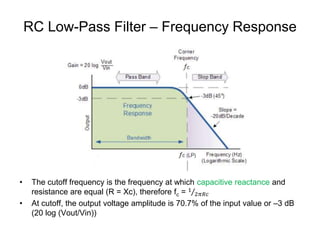
• The cutoff frequency is the frequency at which capacitive reactance and
resistance are equal (R = Xc), therefore fc = 1
2𝜋𝑅𝑐
• At cutoff, the output voltage amplitude is 70.7% of the input value or –3 dB
(20 log (Vout/Vin))
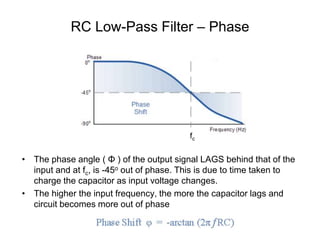
RC Low-Pass Filter – Phase
• The phase angle ( Φ ) of the output signal LAGS behind that of the
input and at fc, is -45o out of phase. This is due to time taken to
charge the capacitor as input voltage changes.
• The higher the input frequency, the more the capacitor lags and
circuit becomes more out of phase
fc
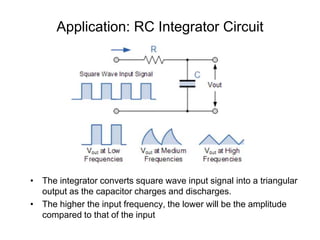
Application: RC Integrator Circuit
• The integrator converts square wave input signal into a triangular
output as the capacitor charges and discharges.
• The higher the input frequency, the lower will be the amplitude
compared to that of the input
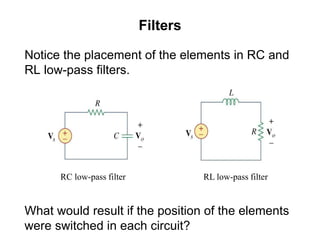
Filters
Notice the placement of the elements in RC and
RL low-pass filters.
What would result if the position of the elements
were switched in each circuit?
RL low-pass filterRC low-pass filter
RC and RL High-Pass Filter Circuits
Switching elements results in a High-Pass Filter.
co co
1
or [Hz]
2 2
R
f f
RC L 
 
f (Hz)fco
actual
passbandreject-band
“ideal”
cutoff frequency
o
s
V
V
0 dB
–3 dB
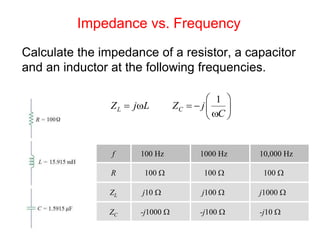
Impedance vs. Frequency
Calculate the impedance of a resistor, a capacitor
and an inductor at the following frequencies.
1
L CZ j L Z j
C
 
     
 
f 100 Hz 1000 Hz 10,000 Hz
R 100 W 100 W 100 W
ZL j10 W j100 W j1000 W
ZC -j1000 W -j100 W -j10 W
RC Low-Pass Filter
For this circuit, we want to compare the output (Vo)
to the input (Vs):
 
v
v 2
1
1
( )
1 1
1
( )
1
C
o s
C
o
s
o
s
j C
H
j RCR
j C
H
RC








  

 

Z
V V
R Z
V
V
V
V
Example
What is the cutoff frequency for this filter?
Given:
8.2
0.0033
R k
C F
 W
 
co
coor [Hz]
2
RC
f
RC






co 5.88 kHzf 
RL Low-Pass Filter
Comparing the output (Vo) to the input (Vs):
2
1
1
1
1
o s
L
o
s
o
s
R
R
LR j L j
R
L
R
 



 
 

 
  
 
V V
R Z
V
V
V
V
EXAMPLE – RL Low Pass Filter
Design a series RL low-pass filter to filter out any noise above 10 Hz.
R and L cannot be specified independently to generate a value for fco = 10 Hz
or co = 2fco. Therefore, let us choose L=100 mH. Then,
3
(2 )(10)(100 10 ) 6.28coR L  
    W
 
2 2 22
20
( )
400
R
L
o s s
R
L
V V V


 
 

f(Hz) |Vs| |Vo|
1 1.0 0.995
10 1.0 0.707
60 1.0 0.164
co co2
1
which implies: or [Hz]
2
1
o
s
R R
f
L LL
R


  
 
  
 
V
V
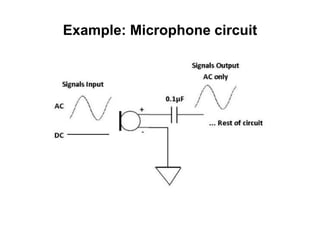
Example: Microphone circuit
Example
What resistor value R will produce a cutoff frequency of 3.4 kHz
with a 0.047 mF capacitor? Is this a high-pass or low-pass filter?
co
co
1
[Hz]
2
1
R=
2
f
RC
C f




1004R  W
This is a High-Pass Filter

Passive filters

  • 1.
  • 2.
    90.7 WSDL Ocean City 90.3 WHID Salisbury Frequency (MHz) 90.5 WKHS Worton 91.3 WMLU Farmville 90.9 WETA Washington 91.1 WHFC Bel Air 91.5 WBJC Baltimore Tuninga Radio • Consider tuning in an FM radio station. • What allows your radio to isolate one station from all of the adjacent stations?
  • 3.
    Filters • A filteris a frequency-selective circuit. • Filters are designed to pass some frequencies and reject others. Frequency (MHz) 90.9 WETA Washington
  • 4.
    Active and PassiveFilters • Filter circuits depend on the fact that the impedance of capacitors and inductors is a function of frequency • There are numerous ways to construct filters, but there are two broad categories of filters: – Passive filters are composed of only passive components (resistors, capacitors, inductors) and do not provide amplification. – Active filters typically employ RC networks and amplifiers (opamps) with feedback and offer a number of advantages.
  • 5.
    Passive Filters • Thereare four basic kinds of filters: – Low-pass filter - Passes frequencies below a critical frequency, called the cutoff frequency, and attenuates those above.
  • 6.
    Passive Filters • Thereare four basic kinds of filters: – High-pass filter - Passes frequencies above the critical frequency but rejects those below.
  • 7.
    Passive Filters • Thereare four basic kinds of filters: – Bandpass filter - Passes only frequencies in a narrow range between upper and lower cutoff frequencies.
  • 8.
    Passive Filters • Thereare four basic kinds of filters: – Band-reject filter - Rejects or stops frequencies in a narrow range but passes others.
  • 9.
    Low Pass Filters RLlow-pass filterRC low-pass filter • RC low pass filter works based on the principle of capacitive reactance, while RL low pass filter works on the principle of inductive reactance http://www.learningaboutelectronics.com/Articles/Low-pass-filter.php
  • 10.
    Capacitive Reactance • CapacitiveReactance (Xc) varies with the applied frequency. – As the frequency applied to the capacitor increases, its effect is to decrease its reactance (measured in ohms). – Likewise as the frequency across the capacitor decreases its reactance value increases. (Xc = 1 2𝜋𝑓𝑐) ohms http://www.electronics-tutorials.ws/filter/filter_1.html
  • 11.
    Inductive Reactance • InductiveReactance (XL) varies with the applied frequency. – To high frequency signals, inductors offer high resistance thus blocks high frequencies – As frequencies decrease, the inductor offers low resistance so low frequencies pass XL = 2𝜋𝑓𝐿 ohms http://faculty.kfupm.edu.sa/ee/malek/EE205/pdfslides-205/Lecture%2028_ee205.pdf RL low-pass filter RL low-pass filter at low frequencies 𝜔 = 0 RL low-pass filter at high frequencies 𝜔 =∞
  • 12.
    RC Low-Pass Filter– Frequency Response • The cutoff frequency is the frequency at which capacitive reactance and resistance are equal (R = Xc), therefore fc = 1 2𝜋𝑅𝑐 • At cutoff, the output voltage amplitude is 70.7% of the input value or –3 dB (20 log (Vout/Vin))
  • 13.
    RC Low-Pass Filter– Phase • The phase angle ( Φ ) of the output signal LAGS behind that of the input and at fc, is -45o out of phase. This is due to time taken to charge the capacitor as input voltage changes. • The higher the input frequency, the more the capacitor lags and circuit becomes more out of phase fc
  • 14.
    Application: RC IntegratorCircuit • The integrator converts square wave input signal into a triangular output as the capacitor charges and discharges. • The higher the input frequency, the lower will be the amplitude compared to that of the input
  • 15.
    Filters Notice the placementof the elements in RC and RL low-pass filters. What would result if the position of the elements were switched in each circuit? RL low-pass filterRC low-pass filter
  • 16.
    RC and RLHigh-Pass Filter Circuits Switching elements results in a High-Pass Filter. co co 1 or [Hz] 2 2 R f f RC L    f (Hz)fco actual passbandreject-band “ideal” cutoff frequency o s V V 0 dB –3 dB
  • 17.
    Impedance vs. Frequency Calculatethe impedance of a resistor, a capacitor and an inductor at the following frequencies. 1 L CZ j L Z j C           f 100 Hz 1000 Hz 10,000 Hz R 100 W 100 W 100 W ZL j10 W j100 W j1000 W ZC -j1000 W -j100 W -j10 W
  • 18.
    RC Low-Pass Filter Forthis circuit, we want to compare the output (Vo) to the input (Vs):   v v 2 1 1 ( ) 1 1 1 ( ) 1 C o s C o s o s j C H j RCR j C H RC                Z V V R Z V V V V
  • 19.
    Example What is thecutoff frequency for this filter? Given: 8.2 0.0033 R k C F  W   co coor [Hz] 2 RC f RC       co 5.88 kHzf 
  • 20.
    RL Low-Pass Filter Comparingthe output (Vo) to the input (Vs): 2 1 1 1 1 o s L o s o s R R LR j L j R L R                  V V R Z V V V V
  • 21.
    EXAMPLE – RLLow Pass Filter Design a series RL low-pass filter to filter out any noise above 10 Hz. R and L cannot be specified independently to generate a value for fco = 10 Hz or co = 2fco. Therefore, let us choose L=100 mH. Then, 3 (2 )(10)(100 10 ) 6.28coR L       W   2 2 22 20 ( ) 400 R L o s s R L V V V        f(Hz) |Vs| |Vo| 1 1.0 0.995 10 1.0 0.707 60 1.0 0.164 co co2 1 which implies: or [Hz] 2 1 o s R R f L LL R             V V
  • 22.
  • 23.
    Example What resistor valueR will produce a cutoff frequency of 3.4 kHz with a 0.047 mF capacitor? Is this a high-pass or low-pass filter? co co 1 [Hz] 2 1 R= 2 f RC C f     1004R  W This is a High-Pass Filter