Presentation
on
Contents
*Introduction
*Internal working
*Configurations
*Pros and Cons
*Applications
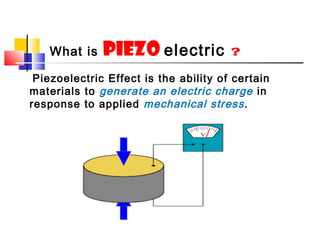
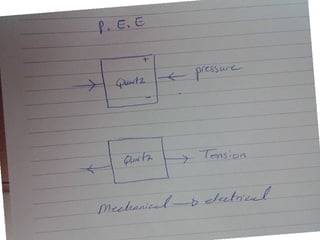
Piezoelectric Effect is the ability of certain
materials to generate an electric charge in
response to applied mechanical stress.
What is piezo electric ?
ROOT!
Piezoelectricity
Greek root Latin root
“piezein” to press “Electrum”amber
DISCOVERY
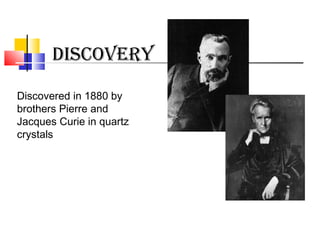
Discovered in 1880 by
brothers Pierre and
Jacques Curie in quartz
crystals
Developing theories…
 Pierre and Jacques Curie predicted and
demonstrated the piezoelectric effect using
tinfoil, glue, wire, magnets.
 They showed that crystals of tourmaline, quartz,
topaz, and Rochelle salt generate electrical
polarization from mechanical stress.
 The converse effect was mathematically derived
by Gabriel Lippman in 1881 using fundamental
thermodynamic principles and was later
experimentally confirmed by the Curies.
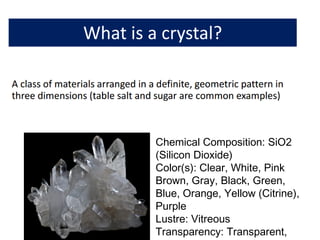
Chemical Composition: SiO2
(Silicon Dioxide)
Color(s): Clear, White, Pink
Brown, Gray, Black, Green,
Blue, Orange, Yellow (Citrine),
Purple
Lustre: Vitreous
Transparency: Transparent,
Types of Piezoelectric Materials
 Naturally occurring crystals:
cane sugar, Quartz, Rochelle salt, Topaz, Tourmaline Group
Minerals, and dry bone (apatite crystals)
 Man-made crystals:
Gallium orthophosphate (GaPO4), Langasite (La3Ga5SiO14)
 Man-made ceramics:
Barium titanate (BaTiO3), Lead titanate (PbTiO3), Lead zirconate
titanate (Pb[ZrxTi1-x]O3 0<x<1) - More commonly known as PZT,
Potassium niobate (KNbO3), Lithium niobate (LiNbO3), Lithium
tantalate (LiTaO3), Sodium tungstate (NaxWO3), Ba2NaNb5O5,
Pb2KNb5O15
 Polymers:
Polyvinylidene fluoride (PVDF)
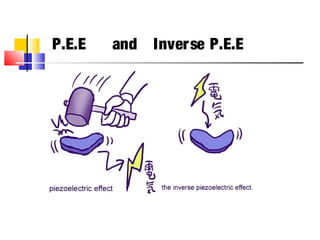
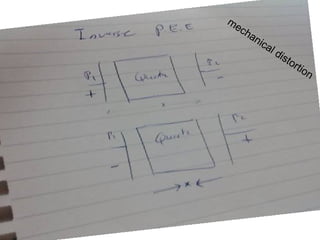
P.E.E and Inverse P.E.E
mechanical distortion
Internal working
 The effect is explained by the displacement of ions in
crystals that have a nonsymmetrical unit cell
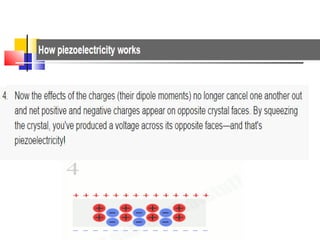
 When the crystal is compressed, the ions in each unit
cell are displaced, causing the electric polarization of
the unit cell.
 Because of the regularity of crystalline structure,
these effects accumulate, causing the appearance of
an electric potential difference between certain faces
of the crystal.
 When an external electric field is applied to the
crystal, the ions in each unit cell are displaced by
electrostatic forces, resulting in the mechanical
deformation of the whole crystal.
Piezoelectricity
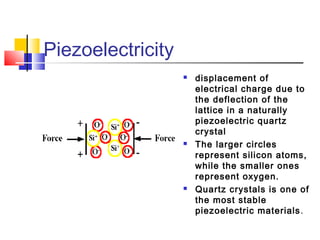
 displacement of
electrical charge due to
the deflection of the
lattice in a naturally
piezoelectric quartz
crystal
 The larger circles
represent silicon atoms,
while the smaller ones
represent oxygen.
 Quartz crystals is one of
the most stable
piezoelectric materials.
Configurations
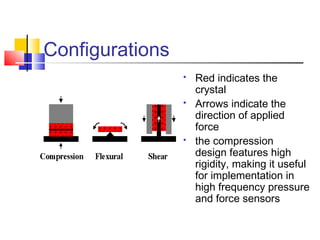
 Red indicates the
crystal
 Arrows indicate the
direction of applied
force
 the compression
design features high
rigidity, making it useful
for implementation in
high frequency pressure
and force sensors
Configurations
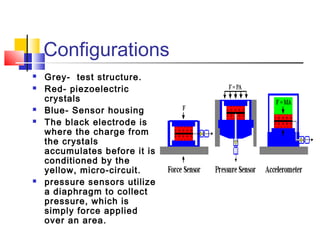
 Grey- test structure.
 Red- piezoelectric
crystals
 Blue- Sensor housing
 The black electrode is
where the charge from
the crystals
accumulates before it is
conditioned by the
yellow, micro-circuit.
 pressure sensors utilize
a diaphragm to collect
pressure, which is
simply force applied
over an area.
Pros and Cons
 Have a high Stiffness
value and produce a
high output with very
little strain.
 Ideal for rugged use.
 Excellent linearity over
a wide amplitude.
 Ideal for continuous
online condition
monitoring smart
systems.
 Can be used only for
dynamic pressure
sensing as in case of
static sensing the
signals will decay away.
 Operation over long
cables may affect
frequency response and
introduce noise and
distortion, the cables
need to be protected.
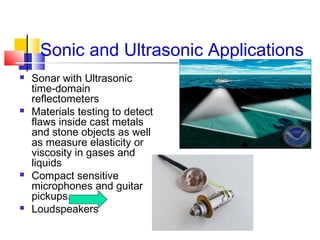
Sonic and Ultrasonic Applications
 Sonar with Ultrasonic
time-domain
reflectometers
 Materials testing to detect
flaws inside cast metals
and stone objects as well
as measure elasticity or
viscosity in gases and
liquids
 Compact sensitive
microphones and guitar
pickups.
 Loudspeakers
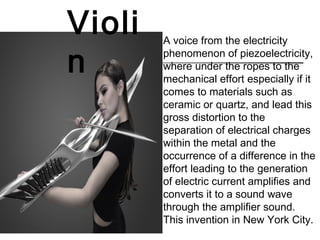
A voice from the electricity
phenomenon of piezoelectricity,
where under the ropes to the
mechanical effort especially if it
comes to materials such as
ceramic or quartz, and lead this
gross distortion to the
separation of electrical charges
within the metal and the
occurrence of a difference in the
effort leading to the generation
of electric current amplifies and
converts it to a sound wave
through the amplifier sound.
This invention in New York City.
Violi
n
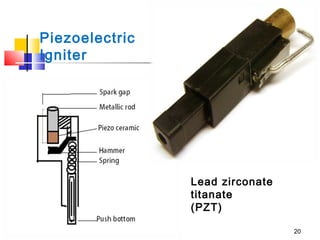
Piezoelectric
Igniter
20
Lead zirconate
titanate
(PZT)
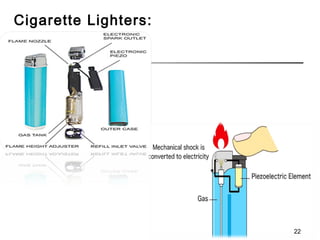
Cigarette Lighters:
22
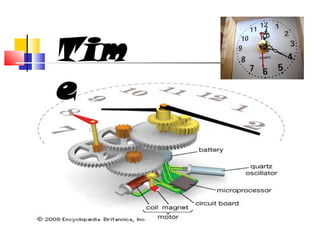
Tim
e
Motor Applications
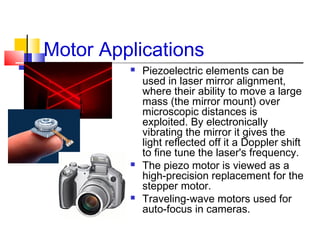
 Piezoelectric elements can be
used in laser mirror alignment,
where their ability to move a large
mass (the mirror mount) over
microscopic distances is
exploited. By electronically
vibrating the mirror it gives the
light reflected off it a Doppler shift
to fine tune the laser's frequency.
 The piezo motor is viewed as a
high-precision replacement for the
stepper motor.
 Traveling-wave motors used for
auto-focus in cameras.

Piezoelectric effect hana basheer

  • 1.
  • 2.
  • 3.
    Piezoelectric Effect isthe ability of certain materials to generate an electric charge in response to applied mechanical stress. What is piezo electric ?
  • 4.
    ROOT! Piezoelectricity Greek root Latinroot “piezein” to press “Electrum”amber
  • 5.
    DISCOVERY Discovered in 1880by brothers Pierre and Jacques Curie in quartz crystals
  • 6.
    Developing theories…  Pierreand Jacques Curie predicted and demonstrated the piezoelectric effect using tinfoil, glue, wire, magnets.  They showed that crystals of tourmaline, quartz, topaz, and Rochelle salt generate electrical polarization from mechanical stress.  The converse effect was mathematically derived by Gabriel Lippman in 1881 using fundamental thermodynamic principles and was later experimentally confirmed by the Curies.
  • 7.
    Chemical Composition: SiO2 (SiliconDioxide) Color(s): Clear, White, Pink Brown, Gray, Black, Green, Blue, Orange, Yellow (Citrine), Purple Lustre: Vitreous Transparency: Transparent,
  • 8.
    Types of PiezoelectricMaterials  Naturally occurring crystals: cane sugar, Quartz, Rochelle salt, Topaz, Tourmaline Group Minerals, and dry bone (apatite crystals)  Man-made crystals: Gallium orthophosphate (GaPO4), Langasite (La3Ga5SiO14)  Man-made ceramics: Barium titanate (BaTiO3), Lead titanate (PbTiO3), Lead zirconate titanate (Pb[ZrxTi1-x]O3 0<x<1) - More commonly known as PZT, Potassium niobate (KNbO3), Lithium niobate (LiNbO3), Lithium tantalate (LiTaO3), Sodium tungstate (NaxWO3), Ba2NaNb5O5, Pb2KNb5O15  Polymers: Polyvinylidene fluoride (PVDF)
  • 9.
  • 11.
  • 12.
    Internal working  Theeffect is explained by the displacement of ions in crystals that have a nonsymmetrical unit cell  When the crystal is compressed, the ions in each unit cell are displaced, causing the electric polarization of the unit cell.  Because of the regularity of crystalline structure, these effects accumulate, causing the appearance of an electric potential difference between certain faces of the crystal.  When an external electric field is applied to the crystal, the ions in each unit cell are displaced by electrostatic forces, resulting in the mechanical deformation of the whole crystal.
  • 14.
    Piezoelectricity  displacement of electricalcharge due to the deflection of the lattice in a naturally piezoelectric quartz crystal  The larger circles represent silicon atoms, while the smaller ones represent oxygen.  Quartz crystals is one of the most stable piezoelectric materials.
  • 15.
    Configurations  Red indicatesthe crystal  Arrows indicate the direction of applied force  the compression design features high rigidity, making it useful for implementation in high frequency pressure and force sensors
  • 16.
    Configurations  Grey- teststructure.  Red- piezoelectric crystals  Blue- Sensor housing  The black electrode is where the charge from the crystals accumulates before it is conditioned by the yellow, micro-circuit.  pressure sensors utilize a diaphragm to collect pressure, which is simply force applied over an area.
  • 17.
    Pros and Cons Have a high Stiffness value and produce a high output with very little strain.  Ideal for rugged use.  Excellent linearity over a wide amplitude.  Ideal for continuous online condition monitoring smart systems.  Can be used only for dynamic pressure sensing as in case of static sensing the signals will decay away.  Operation over long cables may affect frequency response and introduce noise and distortion, the cables need to be protected.
  • 18.
    Sonic and UltrasonicApplications  Sonar with Ultrasonic time-domain reflectometers  Materials testing to detect flaws inside cast metals and stone objects as well as measure elasticity or viscosity in gases and liquids  Compact sensitive microphones and guitar pickups.  Loudspeakers
  • 19.
    A voice fromthe electricity phenomenon of piezoelectricity, where under the ropes to the mechanical effort especially if it comes to materials such as ceramic or quartz, and lead this gross distortion to the separation of electrical charges within the metal and the occurrence of a difference in the effort leading to the generation of electric current amplifies and converts it to a sound wave through the amplifier sound. This invention in New York City. Violi n
  • 20.
  • 22.
  • 23.
  • 26.
    Motor Applications  Piezoelectricelements can be used in laser mirror alignment, where their ability to move a large mass (the mirror mount) over microscopic distances is exploited. By electronically vibrating the mirror it gives the light reflected off it a Doppler shift to fine tune the laser's frequency.  The piezo motor is viewed as a high-precision replacement for the stepper motor.  Traveling-wave motors used for auto-focus in cameras.

Editor's Notes

  • #19 Sonar: Transducers that are a mosaic of thin quartz crystals glued between two steel plates (the composite having a resonant frequency of about 50 KHz), mounted in a housing suitable for submersion. It emits a high frequency &amp;quot;chirp&amp;quot; underwater and measures depth by timing the return echo. Materials testing: elastic and viscous properties of liquids and gases could be determined with comparative ease, and previously invisible flaws in solid metal structural members could be detected
  • #27 Piezo motors are driven by dual orthogonal vibration modes with a phase shift of 90°, the contact point between two surfaces vibrates in an elliptical path, producing a frictional force between the surfaces. Usually, one surface is fixed causing the other to move. In most piezoelectric motors the piezoelectric crystal is excited by a sine wave signal at the resonant frequency of the motor.