CHAPTER 3: Active Filter
analogue electronics
1
Chapter Outcomes
2
analogue electronics
 Describe the frequency response of basic filters
 Describe the three basic filter response characteristics
 Analyze low-, high- and band-pass filters
 Design active filter
Introduction
PASSIVE FILTER ACTIVE FILTER
•RC, RL and RLC circuits •Active components + passive components
•Transistors or op-amps + RC/RL/RLC
•Provides frequency selectivity •Provides voltage gain
•Advantage: simple •Advantage: Loading effect is minimal
-o/p independent of the load
driven
3
analogue electronics
 Filters are circuits that are capable of passing signals with
certain selected frequencies while rejecting signals with
other frequencies
 2 types of filter
Introduction
Types of active filter:
Low-Pass Filter
High-Pass Filter
Bandpass Filter
o Cascaded Low-Pass and High-Pass Filter
o Multiple-Feedback Band-Pass Filter
o State-Variable Filter
o Biquad Filter
Bandstop Filter
o Multiple-Feedback Band-Stop Filter
o State-Variable Band-Stop Filter
The op-amp active filter provides controllable
cutoff frequencies and controllable gain
4
analogue electronics
Frequency Response
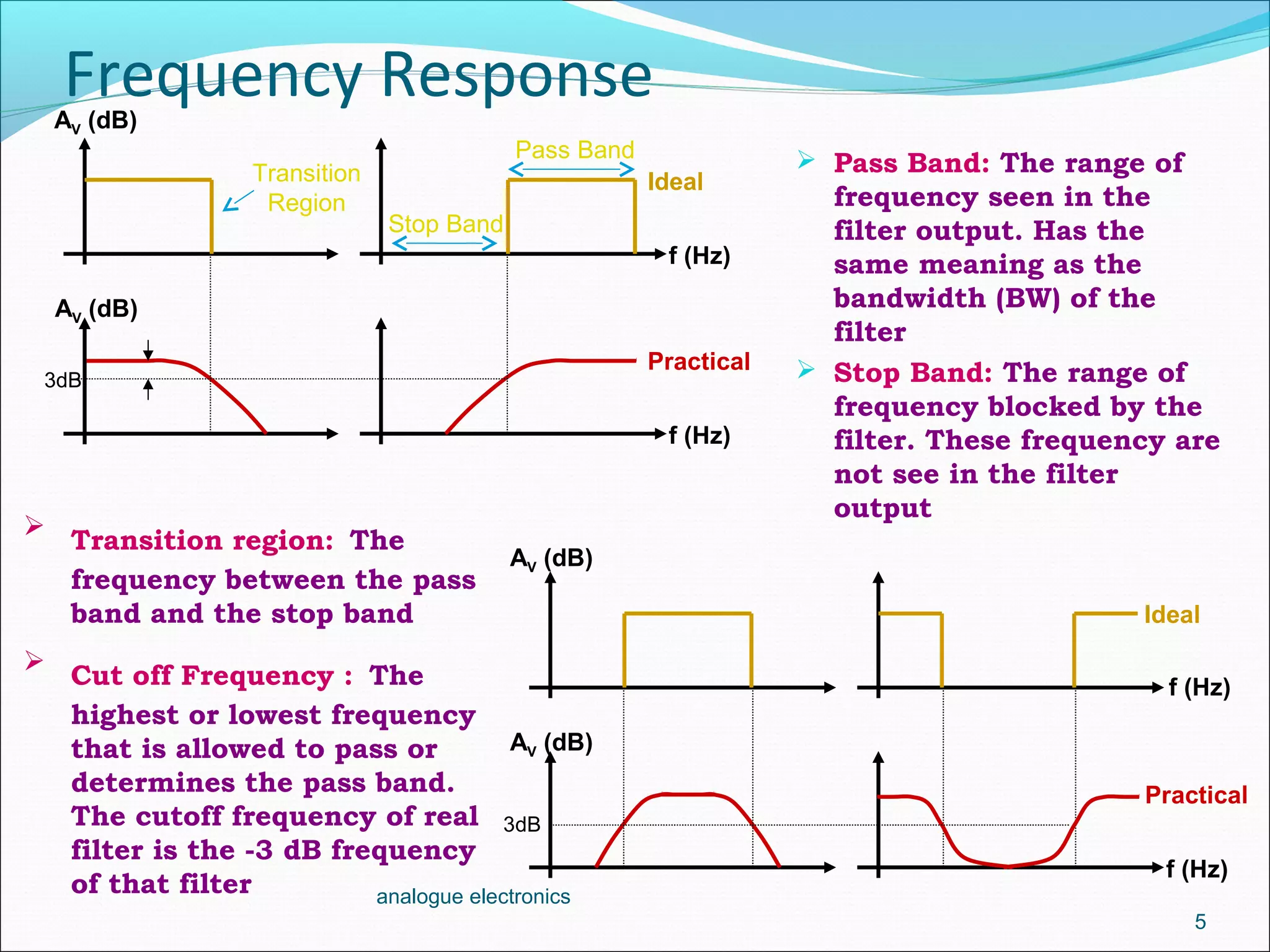
 Pass Band: The range of
frequency seen in the
filter output. Has the
same meaning as the
bandwidth (BW) of the
filter
 Stop Band: The range of
frequency blocked by the
filter. These frequency are
not see in the filter
output
5
analogue electronics
AV (dB)
f (Hz)
f (Hz)
AV (dB)
3dB
Ideal
Practical
AV (dB)
AV (dB)
f (Hz)
f (Hz)
3dB
Ideal
Practical
Pass Band
Stop Band
Transition
Region

Transition region: The
frequency between the pass
band and the stop band

Cut off Frequency : The
highest or lowest frequency
that is allowed to pass or
determines the pass band.
The cutoff frequency of real
filter is the -3 dB frequency
of that filter
Decibel (dB)
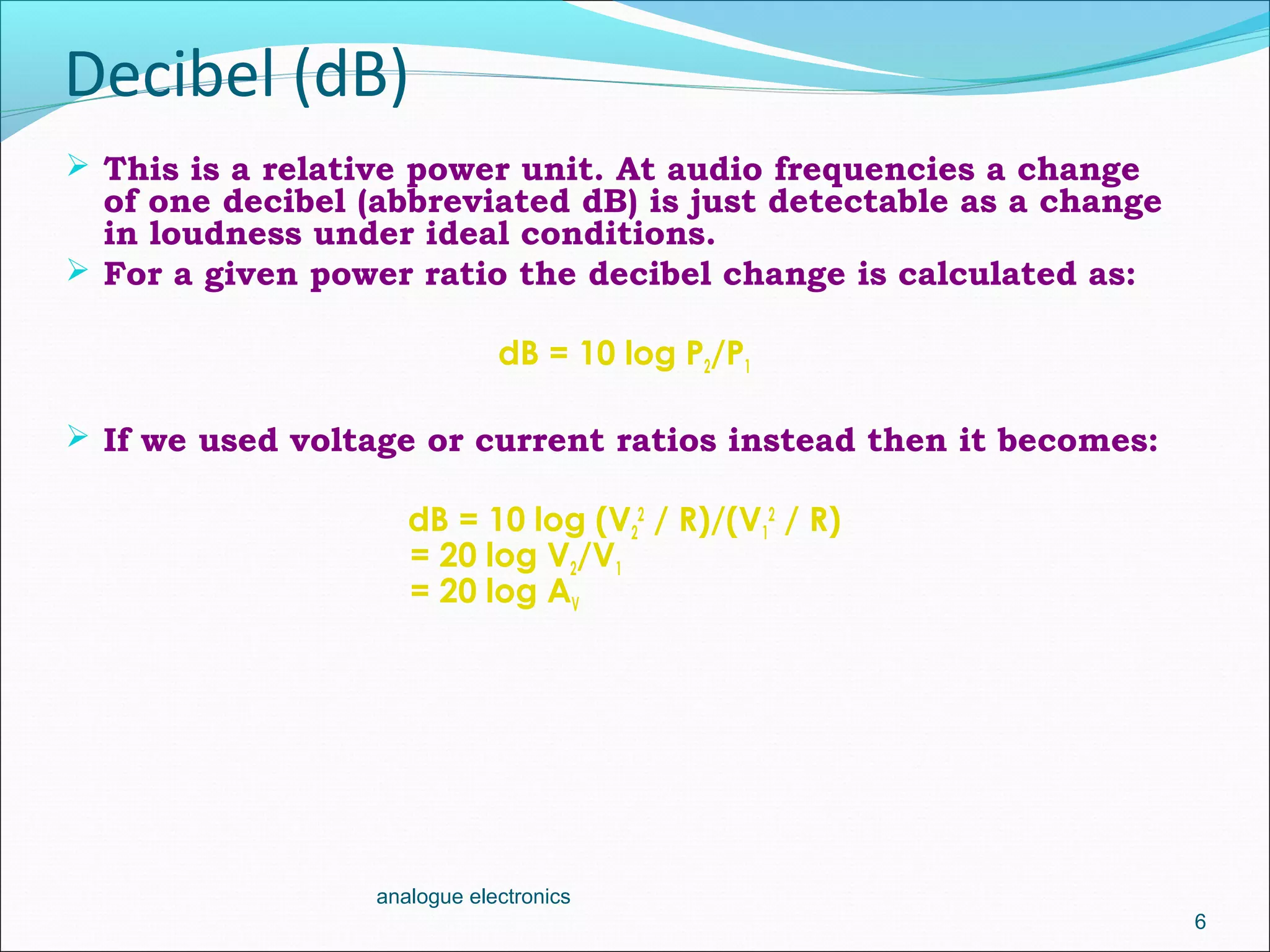
 This is a relative power unit. At audio frequencies a change
of one decibel (abbreviated dB) is just detectable as a change
in loudness under ideal conditions.
 For a given power ratio the decibel change is calculated as:
dB = 10 log P2/P1
 If we used voltage or current ratios instead then it becomes:
dB = 10 log (V2
2
/ R)/(V1
2
/ R)
= 20 log V2/V1
= 20 log AV
6
analogue electronics
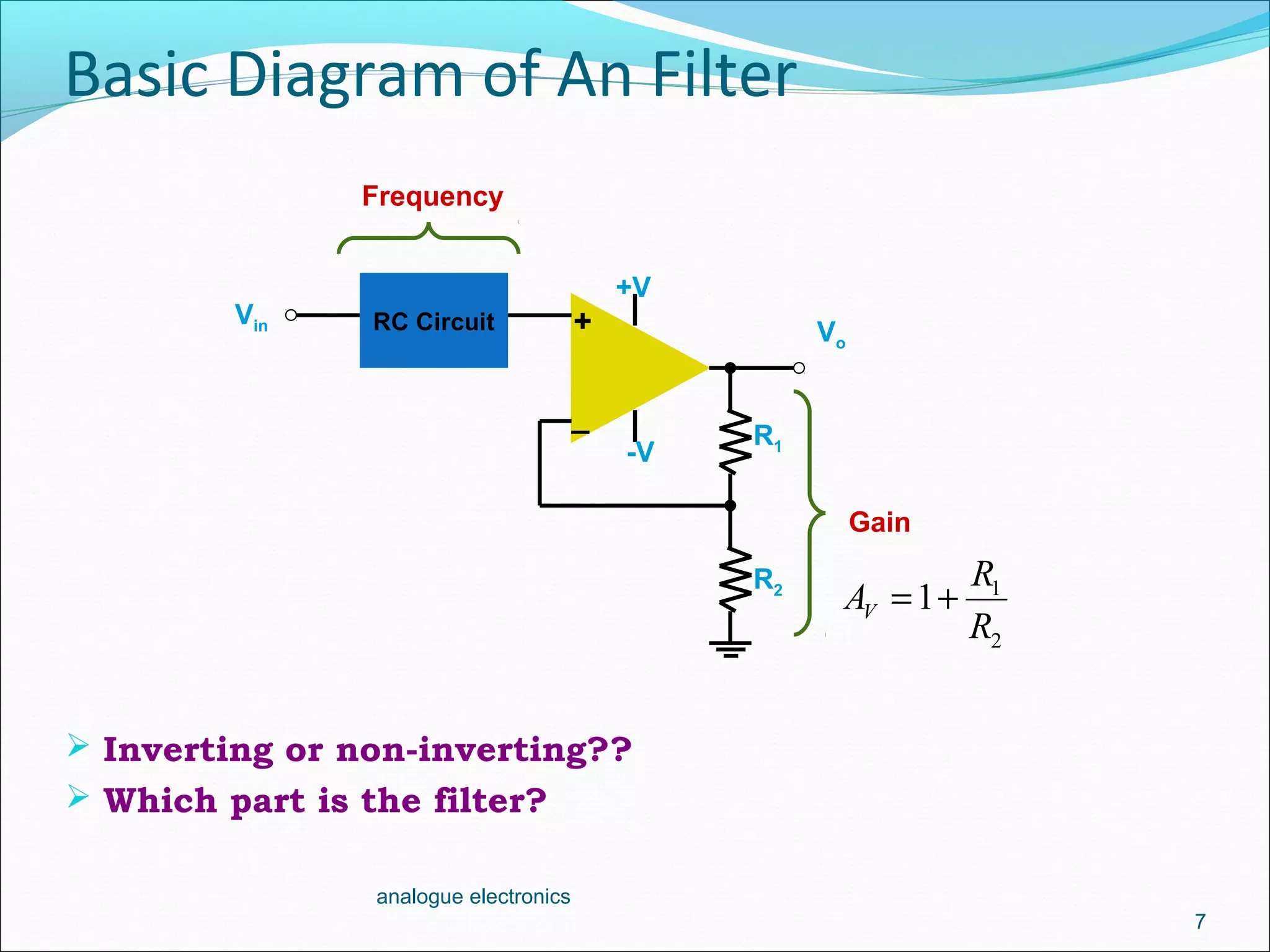
Basic Diagram of An Filter
 Inverting or non-inverting??
 Which part is the filter?
7
analogue electronics
_
+Vin
R1
R2
Vo
+V
-V
RC Circuit
Gain
Frequency
1
2
1V
R
A
R
= +
Cut-Off Frequency
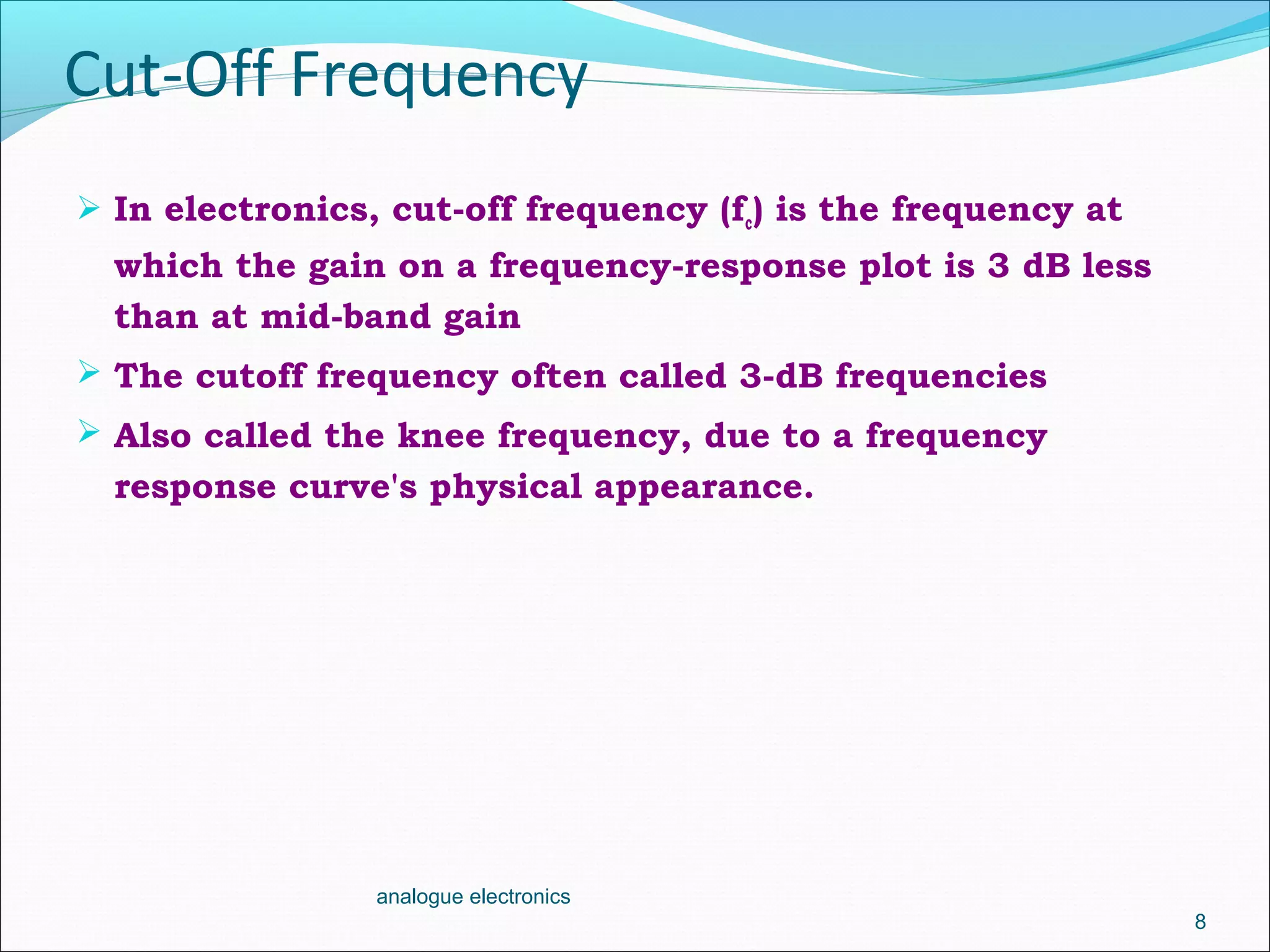
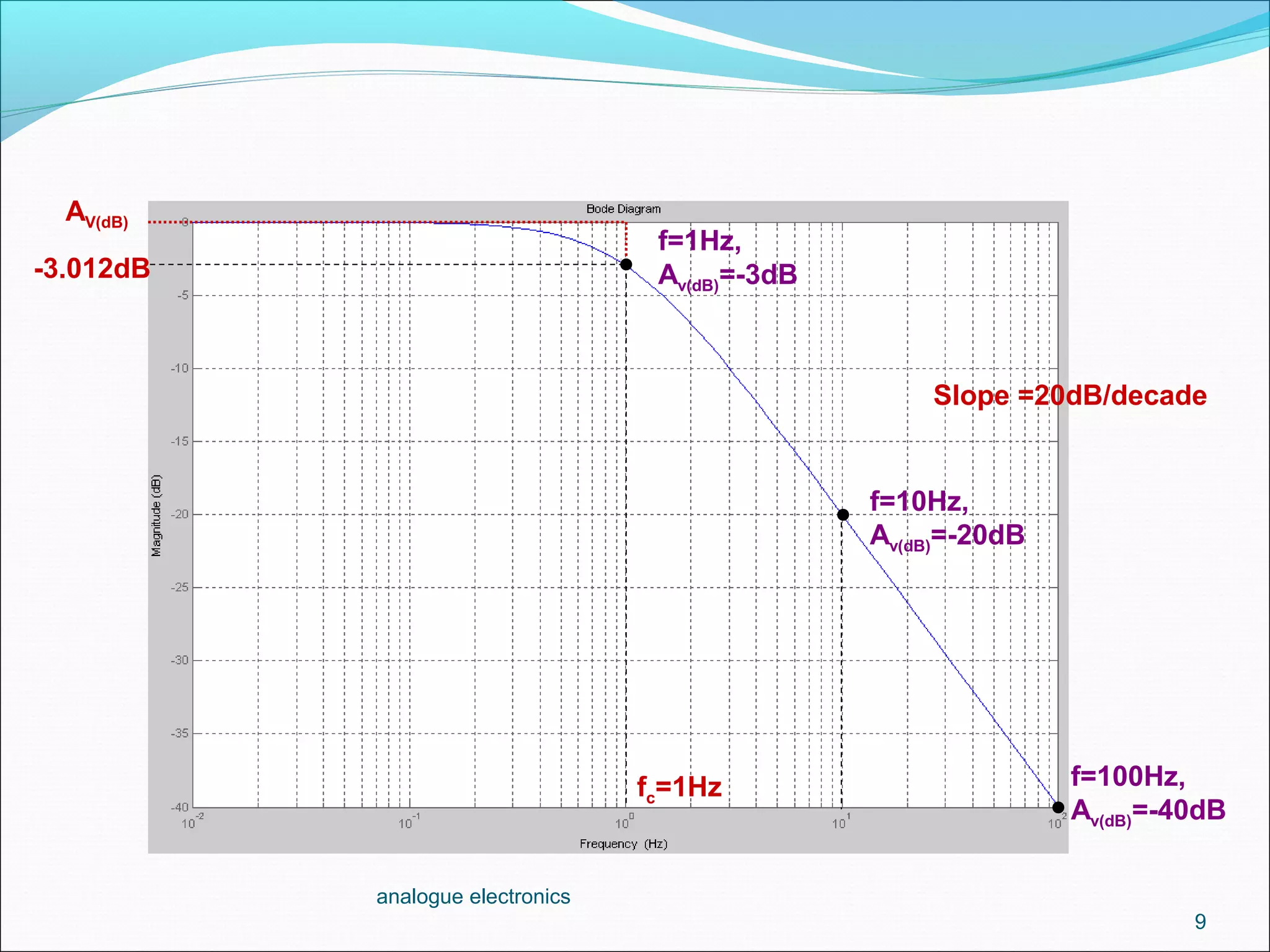
 In electronics, cut-off frequency (fc) is the frequency at
which the gain on a frequency-response plot is 3 dB less
than at mid-band gain
 The cutoff frequency often called 3-dB frequencies
 Also called the knee frequency, due to a frequency
response curve's physical appearance.
8
analogue electronics
9
analogue electronics
AV(dB)
-3.012dB
fc=1Hz
Slope =20dB/decade
f=1Hz,
Av(dB)=-3dB
f=10Hz,
Av(dB)=-20dB
f=100Hz,
Av(dB)=-40dB
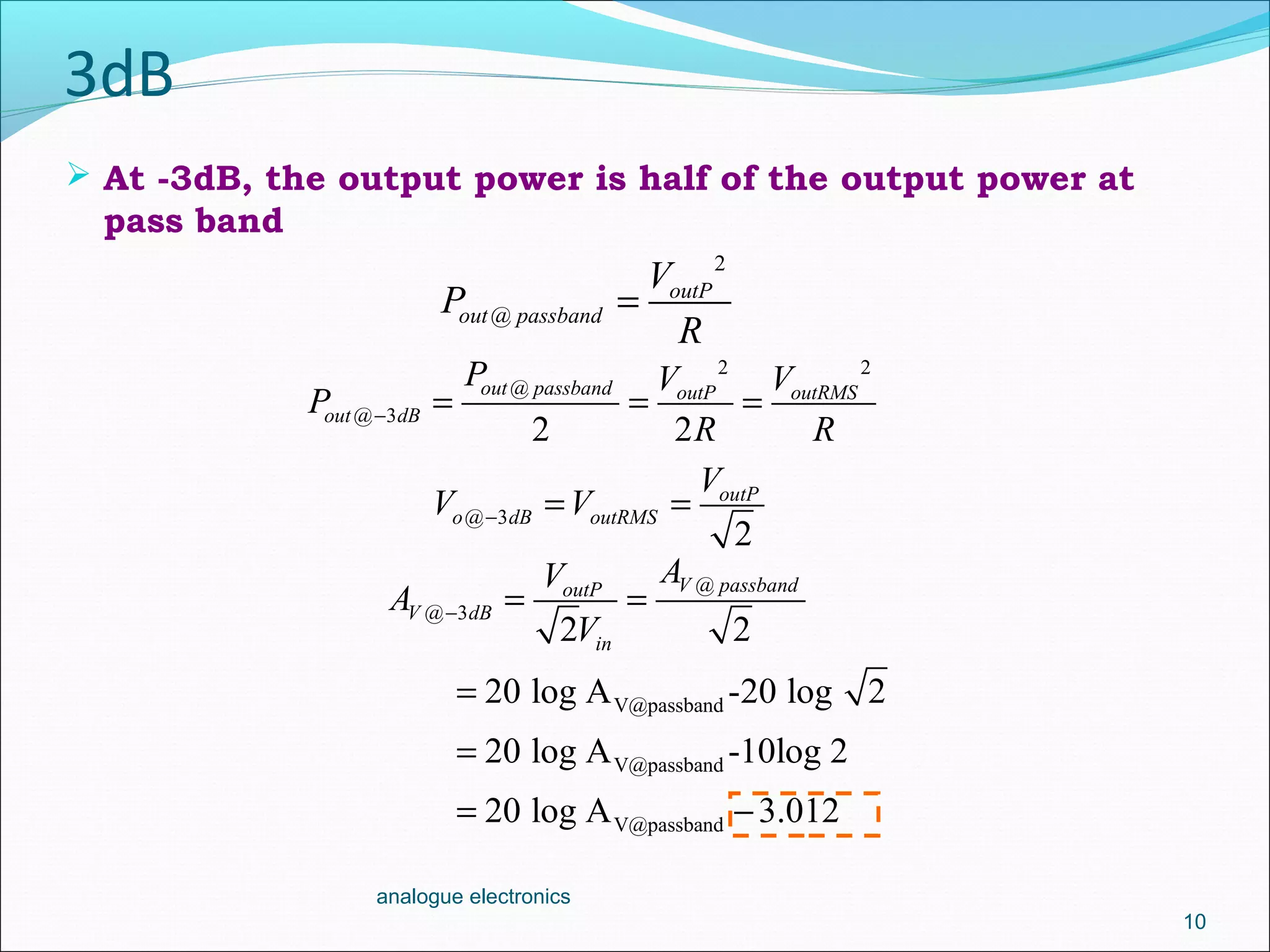
3dB
 At -3dB, the output power is half of the output power at
pass band
10
analogue electronics
V@passband
V@passband
V@passband
20 log A -20 log 2
20 log A -10log 2
20 log A 3.012
=
=
= −
2
@
outP
out passband
V
P
R
=
2 2
@
@ 3
2 2
out passband outP outRMS
out dB
P V V
P
R R
− = = =
@ 3
2
outP
o dB outRMS
V
V V− = =
@
@ 3
2 2
V passbandoutP
V dB
in
AV
A
V
− = =
Filter Response Characteristics
11
analogue electronics
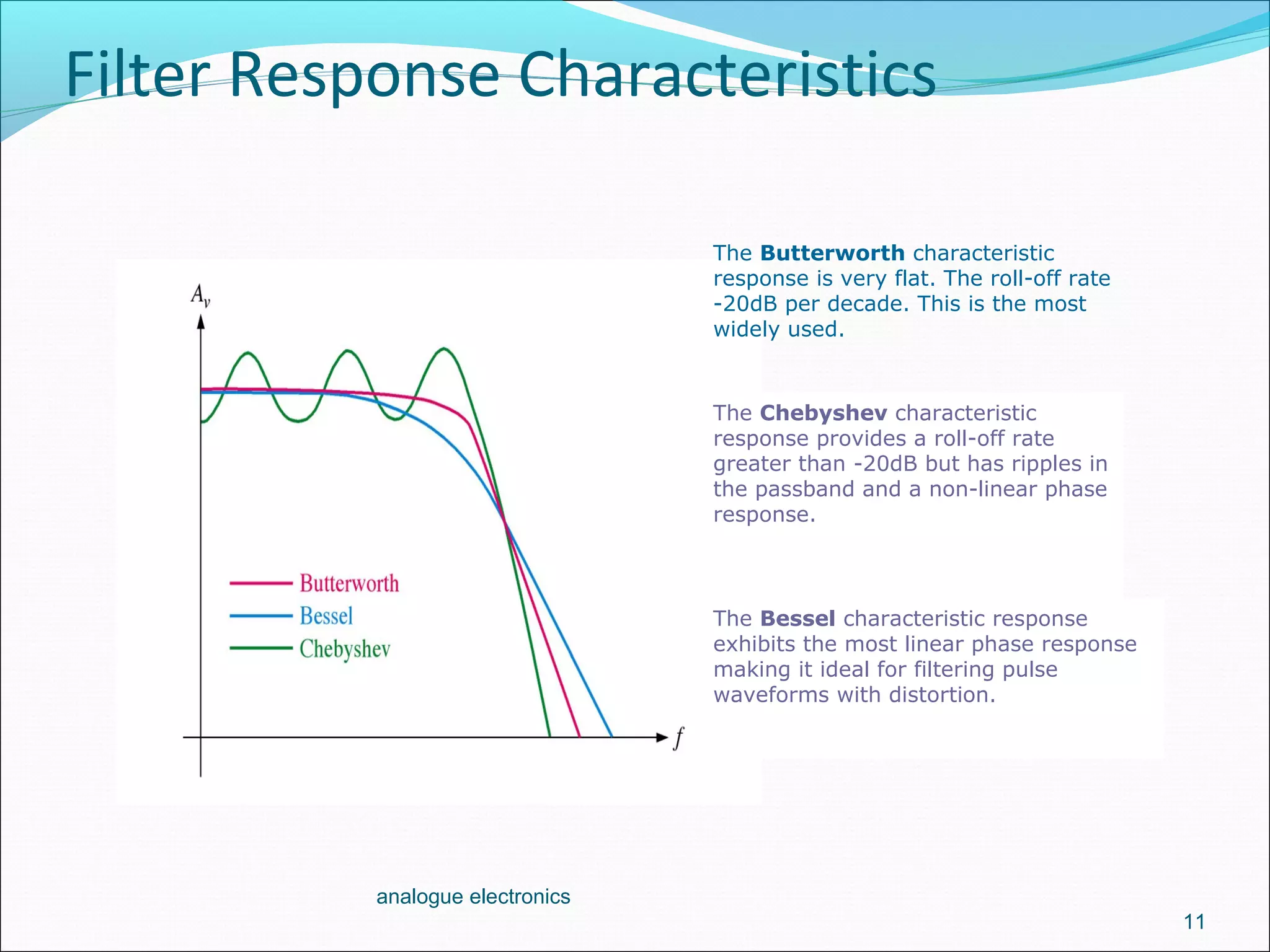
The Butterworth characteristic
response is very flat. The roll-off rate
-20dB per decade. This is the most
widely used.
The Chebyshev characteristic
response provides a roll-off rate
greater than -20dB but has ripples in
the passband and a non-linear phase
response.
The Bessel characteristic response
exhibits the most linear phase response
making it ideal for filtering pulse
waveforms with distortion.
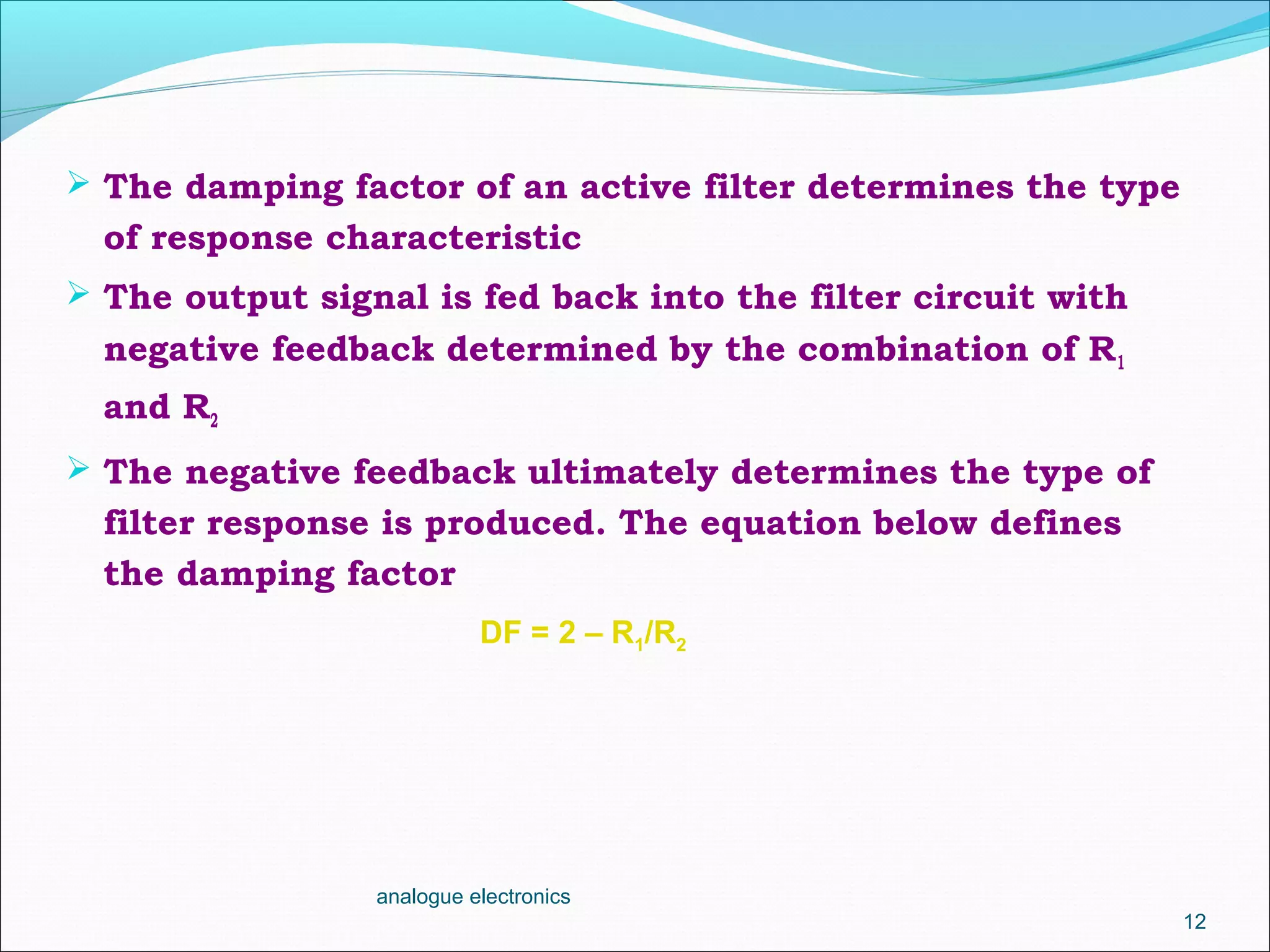
 The damping factor of an active filter determines the type
of response characteristic
 The output signal is fed back into the filter circuit with
negative feedback determined by the combination of R1
and R2
 The negative feedback ultimately determines the type of
filter response is produced. The equation below defines
the damping factor
analogue electronics
12
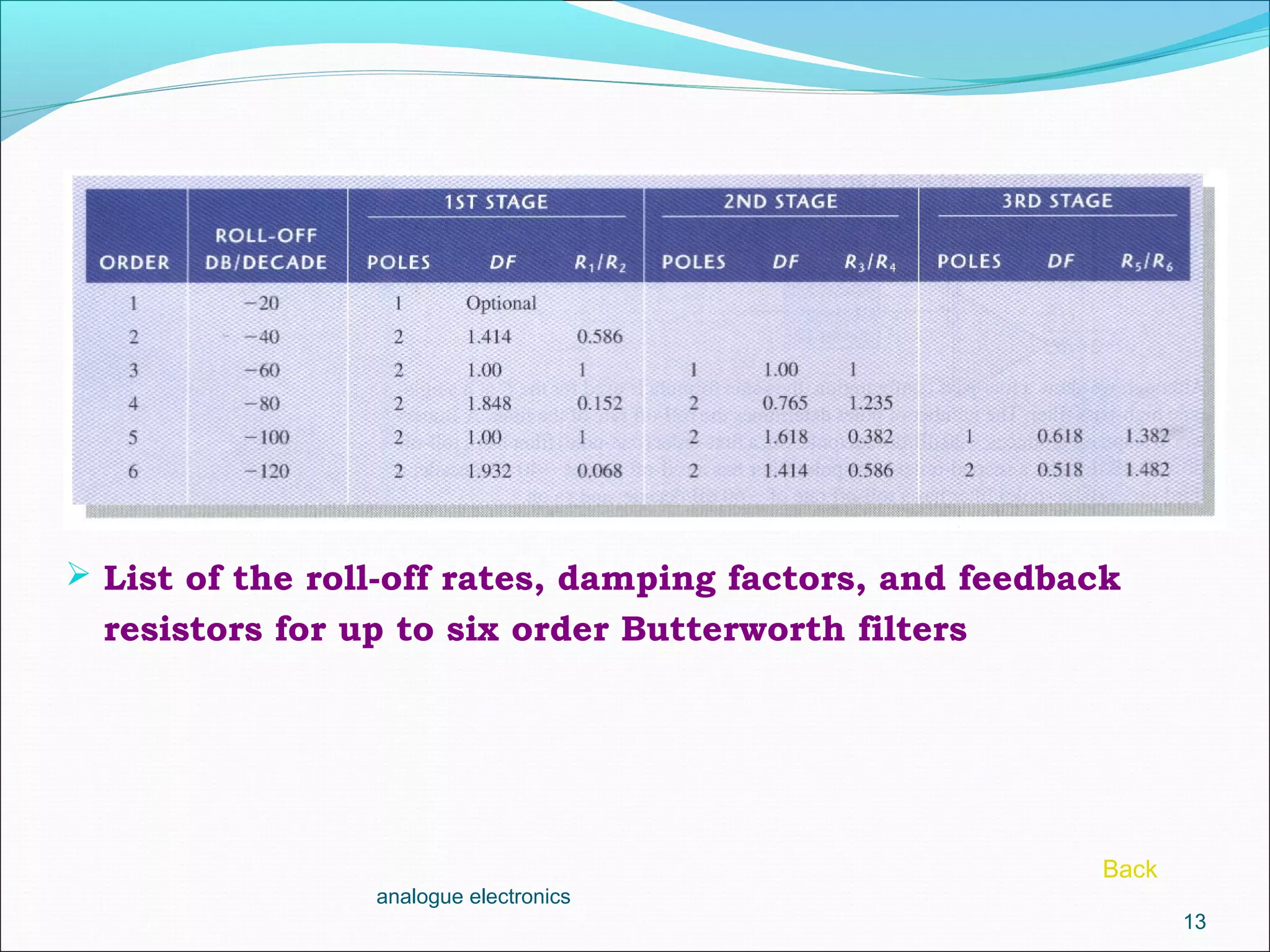
DF = 2 – R1/R2
 List of the roll-off rates, damping factors, and feedback
resistors for up to six order Butterworth filters
13
analogue electronics
Back
1. Low Pass Filter
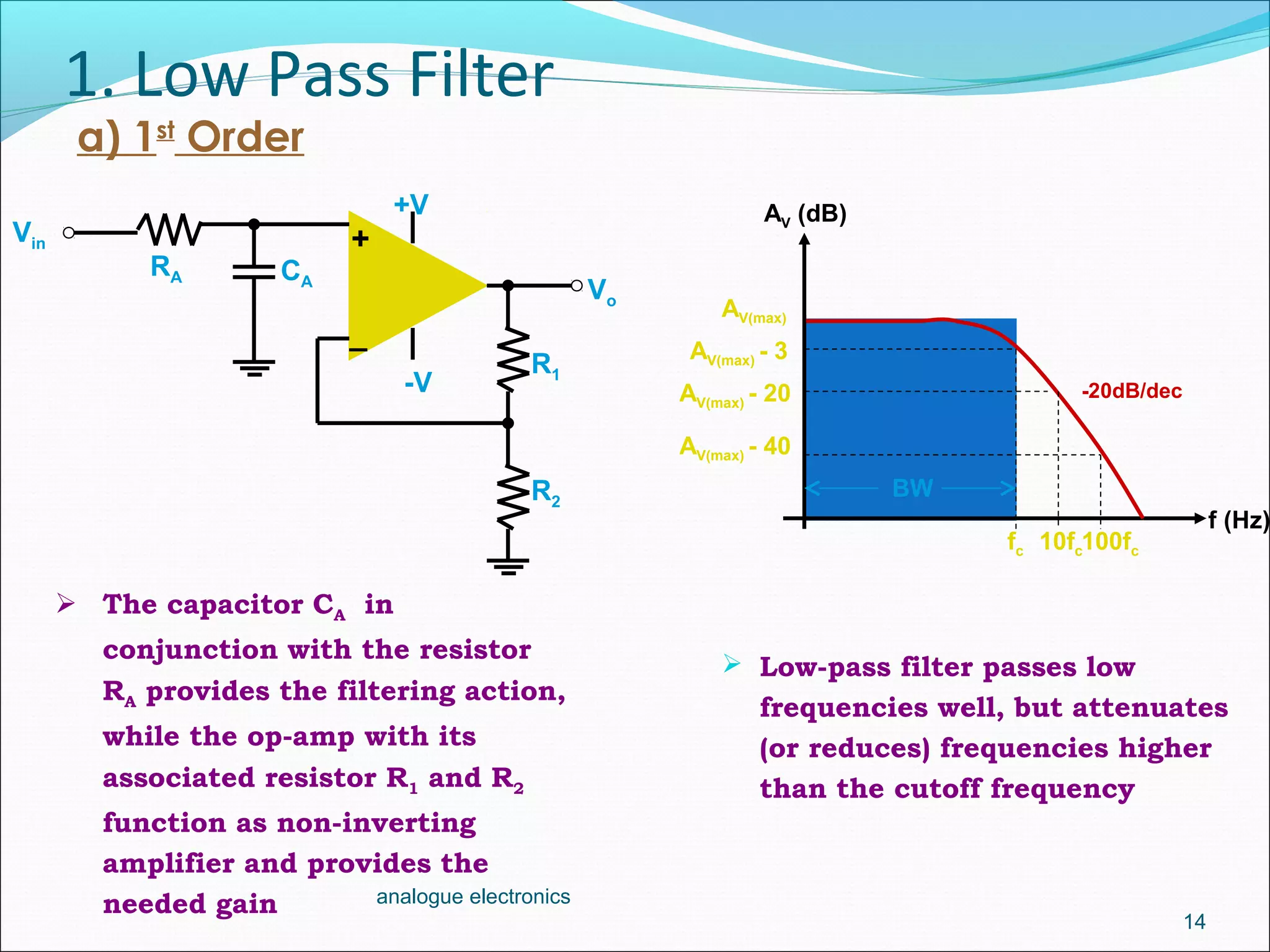
 Low-pass filter passes low
frequencies well, but attenuates
(or reduces) frequencies higher
than the cutoff frequency
14
analogue electronics
a) 1st
Order
R1
R2
_
+Vin
+V
-V
RA CA
Vo
AV (dB)
AV(max)
AV(max) - 3
fc 10fc100fc
AV(max) - 20
AV(max) - 40
-20dB/dec
f (Hz)
 The capacitor CA in
conjunction with the resistor
RA provides the filtering action,
while the op-amp with its
associated resistor R1 and R2
function as non-inverting
amplifier and provides the
needed gain
BW
Analysis
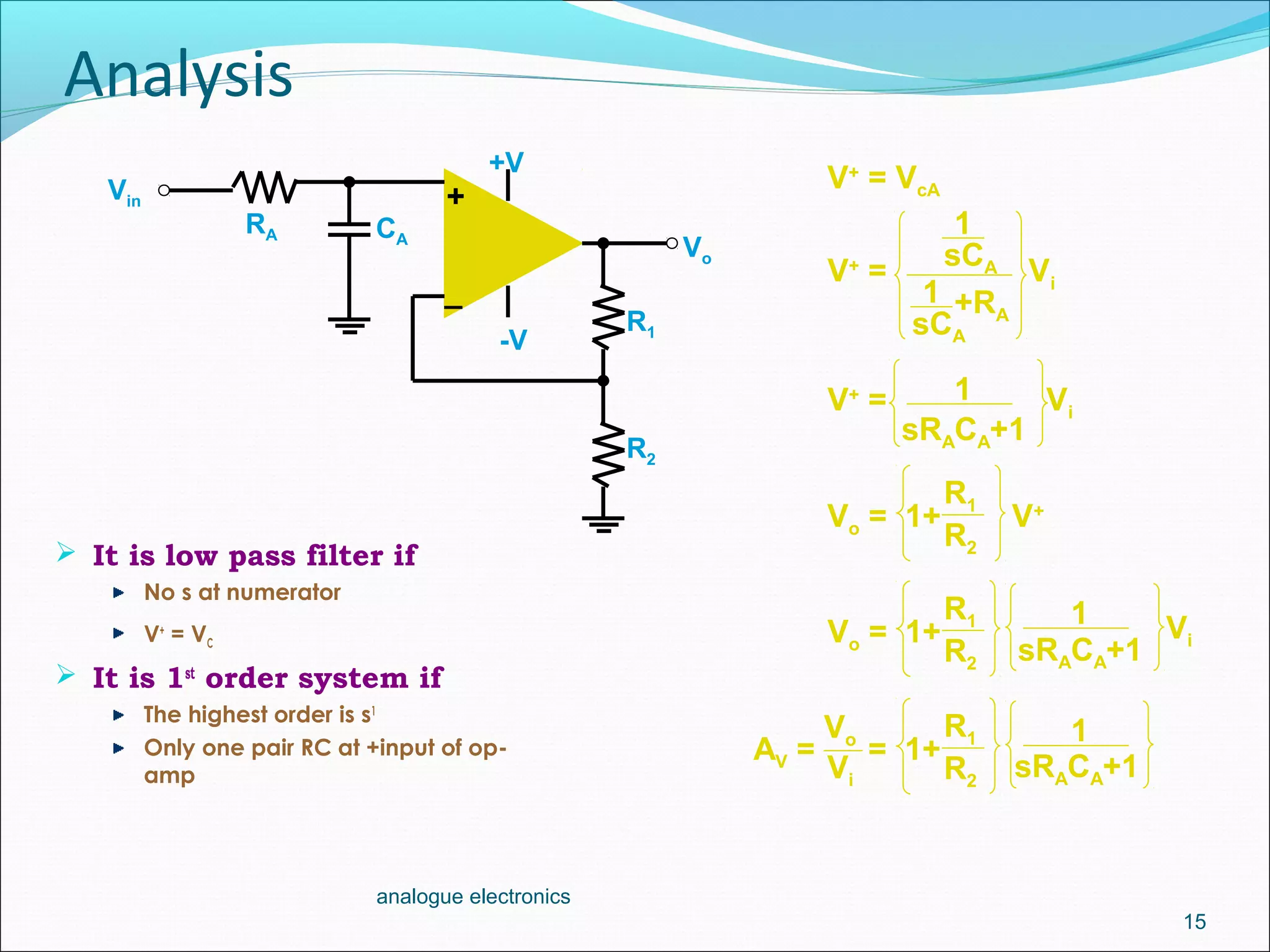
 It is low pass filter if
No s at numerator
V+
= VC
 It is 1st
order system if
The highest order is s1
Only one pair RC at +input of op-
amp
15
analogue electronics
Vo = 1+ V+
R1
R2
_
+Vin
+V
-V
RA CA
Vo
V+
= Vi
1
sCA
1
sCA
+RA
R1
R2
Vo = 1+
R1
R2
Vi
V+
= Vi
1
sRACA+1
1
V+
= VcA
AV = = 1+
R1
R2Vi
1Vo
sRACA+1
sRACA+1
Analysis
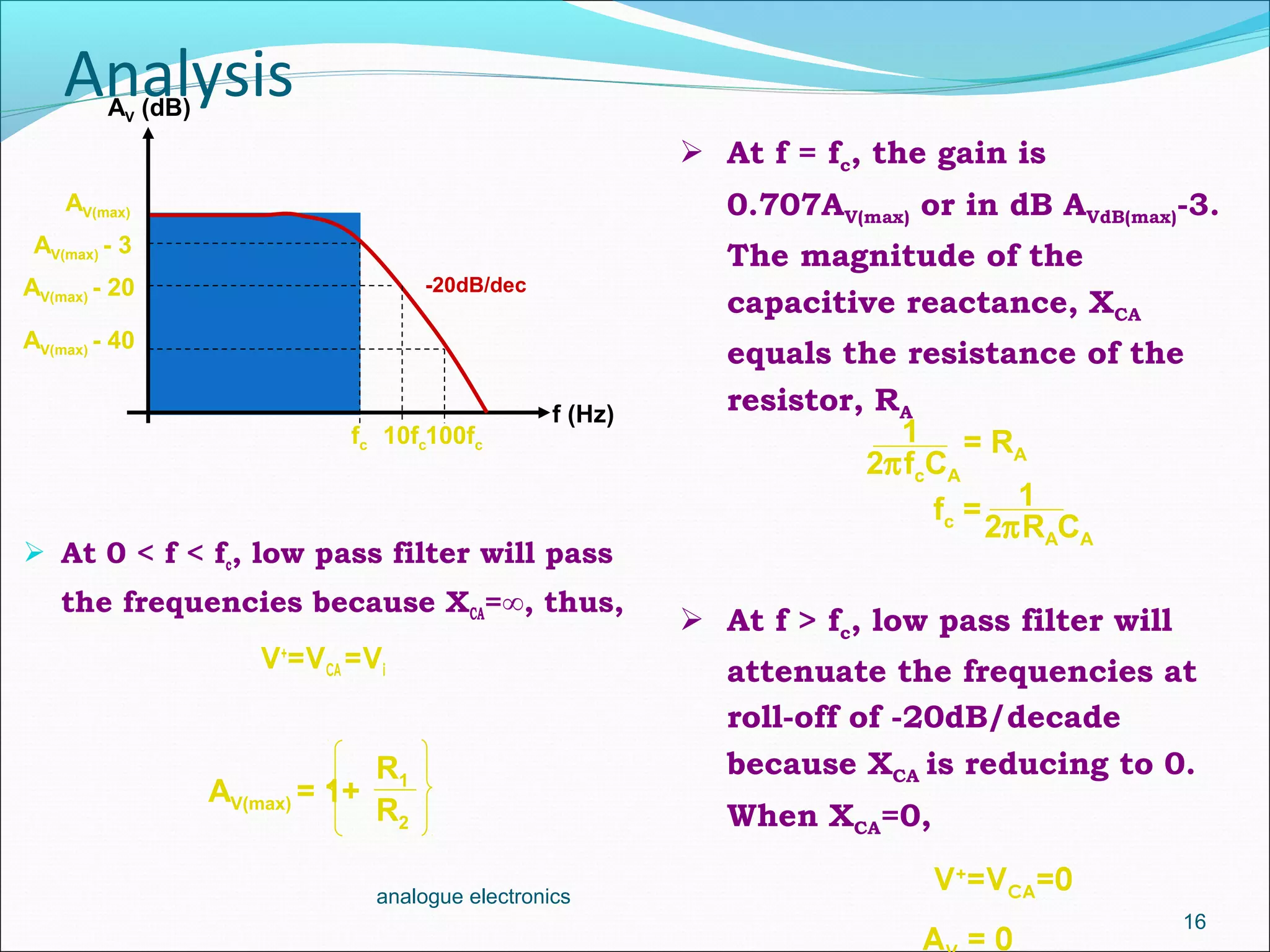
 At 0 < f < fc, low pass filter will pass
the frequencies because XCA=∞, thus,
V+
=VCA =Vi
16
analogue electronics
AV (dB)
AV(max)
AV(max) - 3
fc 10fc100fc
AV(max) - 20
AV(max) - 40
-20dB/dec
f (Hz)
AV(max) = 1+
R1
R2
 At f = fc, the gain is
0.707AV(max) or in dB AVdB(max)-3.
The magnitude of the
capacitive reactance, XCA
equals the resistance of the
resistor, RA
 At f > fc, low pass filter will
attenuate the frequencies at
roll-off of -20dB/decade
because XCA is reducing to 0.
When XCA=0,
V+
=VCA=0
A = 0
1
2πfcCA
= RA
fc = 1
2πRACA
17
analogue electronics
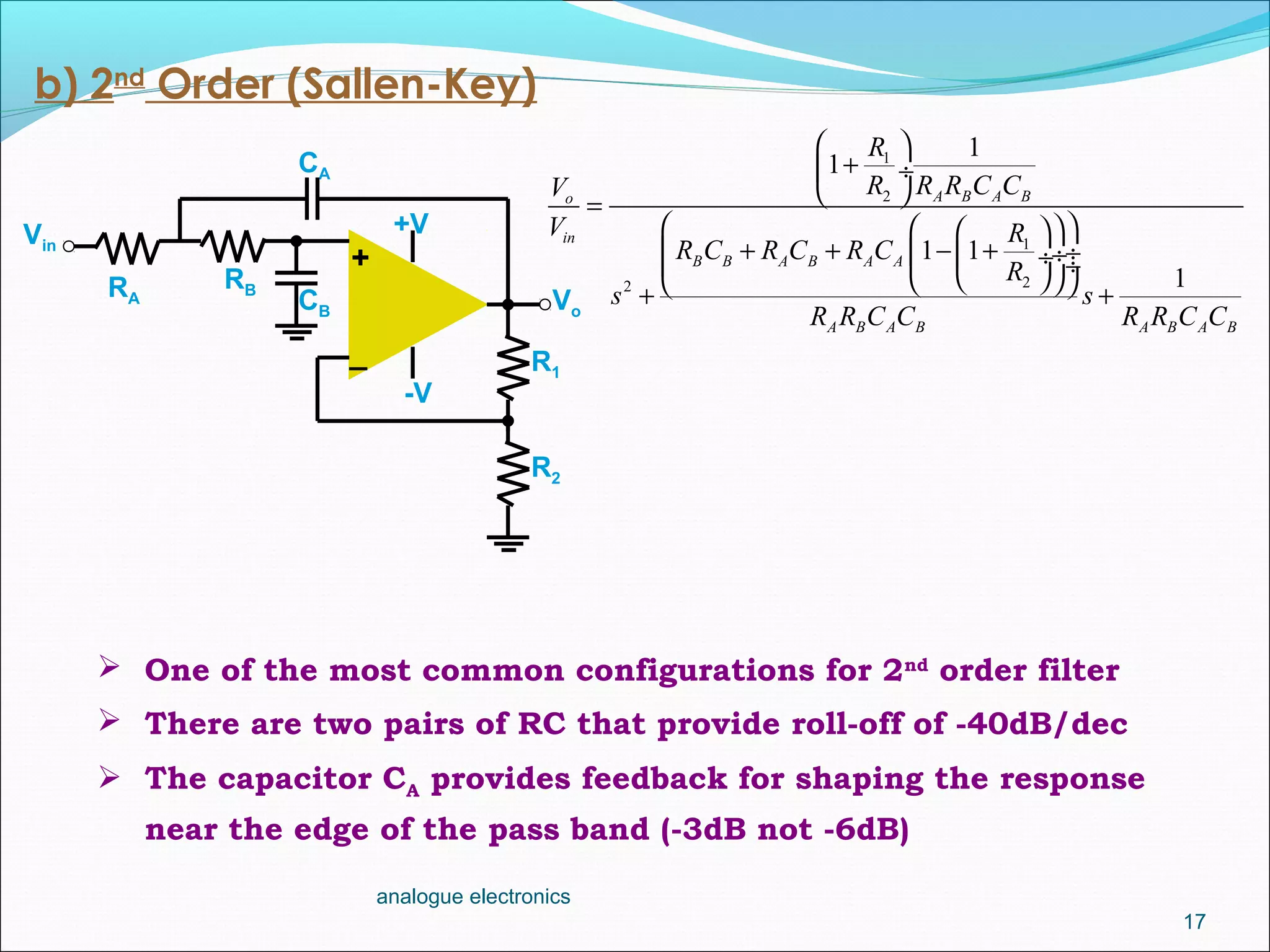
b) 2nd
Order (Sallen-Key)
 One of the most common configurations for 2nd
order filter
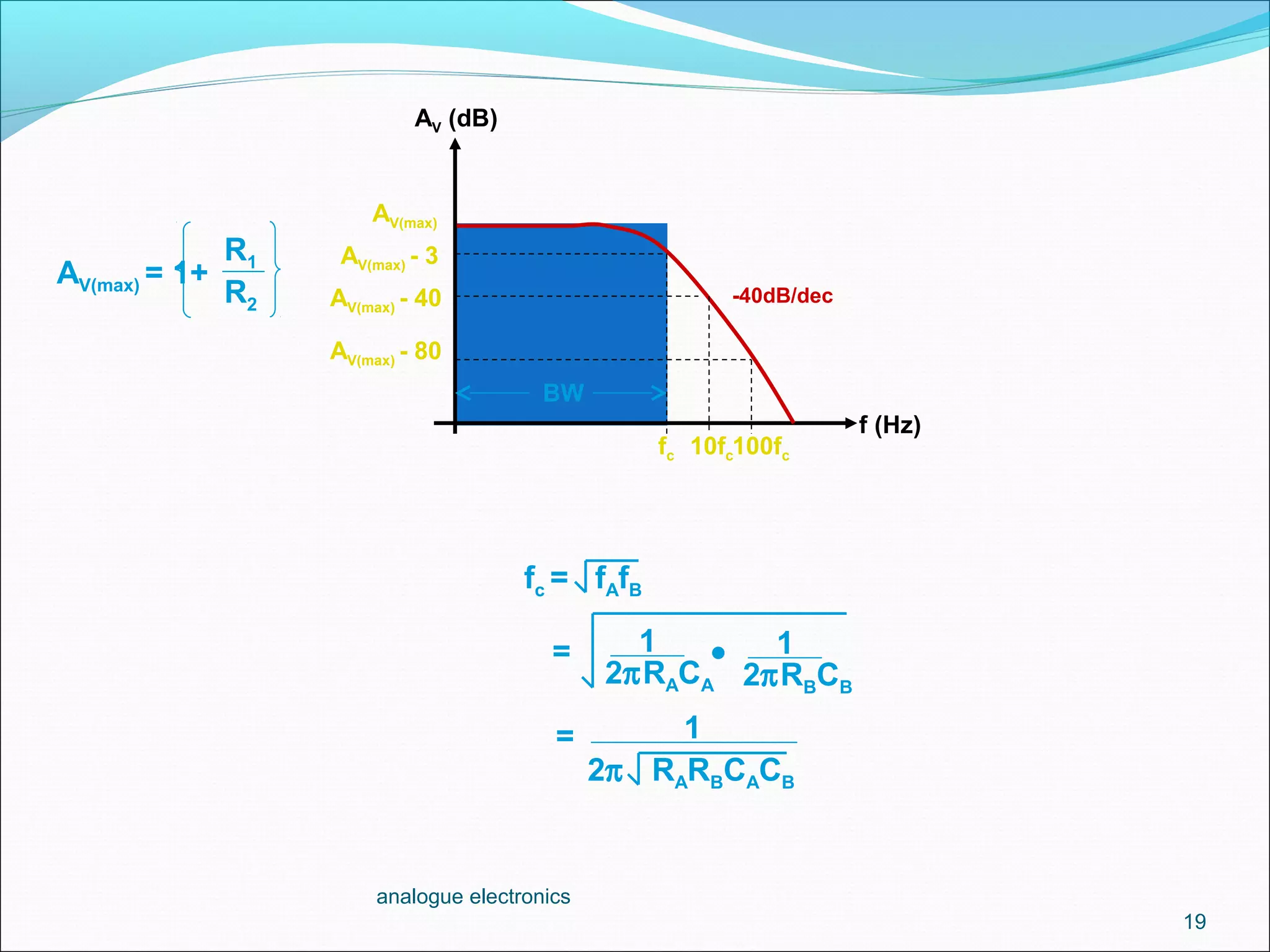
 There are two pairs of RC that provide roll-off of -40dB/dec
 The capacitor CA provides feedback for shaping the response
near the edge of the pass band (-3dB not -6dB)
Vo
R1
R2
_
+
Vin
+V
-V
RA
CA
RB
CB
1
2
1
22
1
1
1 1
1
A B A Bo
in
B B A B A A
A B A B A B A B
R
R R R C CV
V R
R C R C R C
R
s s
R R C C R R C C
 
+ ÷
 =
   
+ + − + ÷ ÷ ÷ ÷   + +
analogue electronics
18
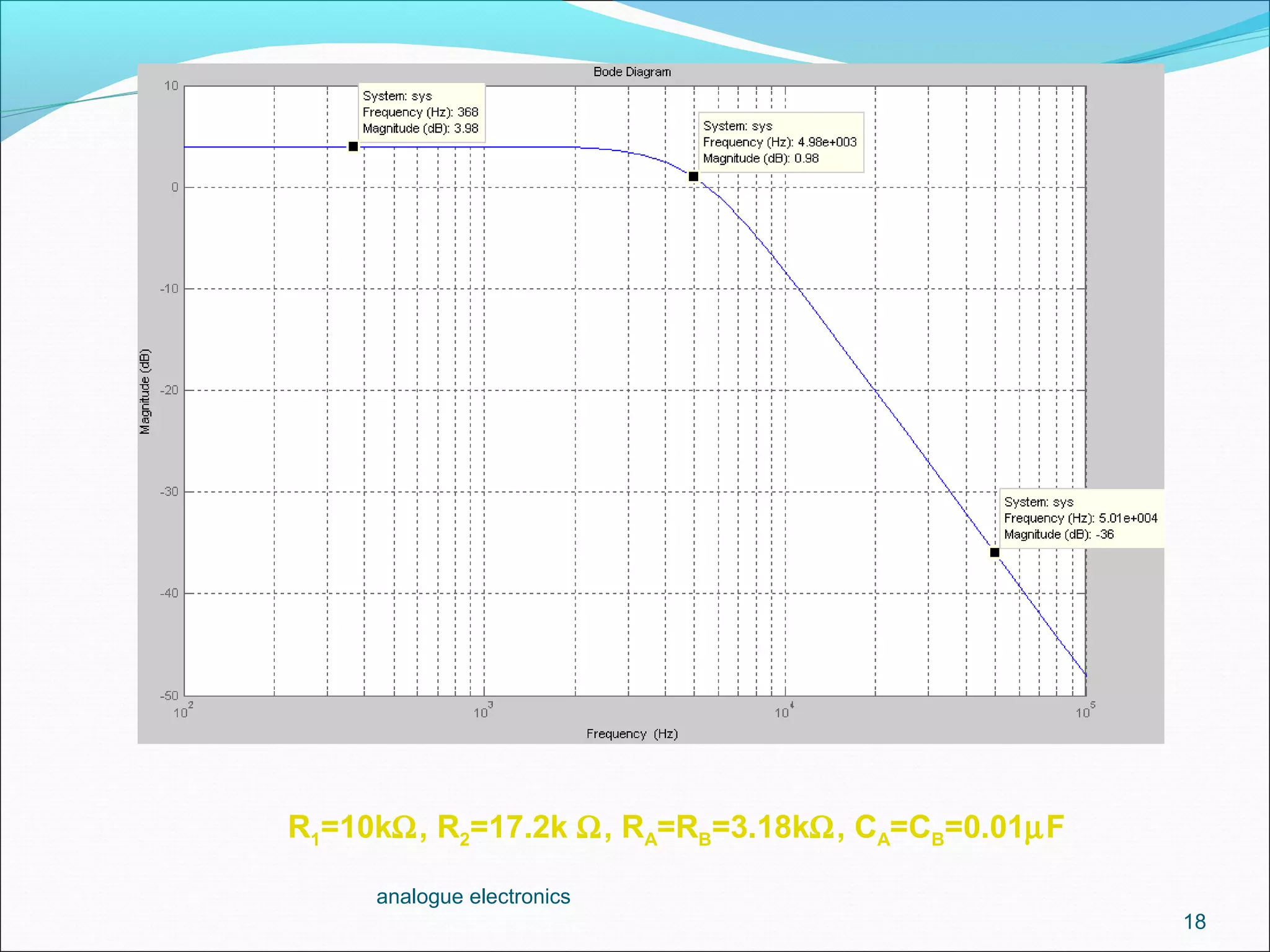
R1=10kΩ, R2=17.2k Ω, RA=RB=3.18kΩ, CA=CB=0.01µF
19
analogue electronics
AV (dB)
AV(max)
AV(max) - 3
fc 10fc100fc
AV(max) - 40
AV(max) - 80
-40dB/dec
f (Hz)
BW
AV(max) = 1+
R1
R2
1
2π RARBCACB
fc = fAfB
1
2πRACA
1
2πRBCB
•=
=
Higher Order Low Pass Filter
20
analogue electronics
R1
R2
_
+
Vin
+V
-V
RA
CA
RB
CB
R3
R4
_
+
+V
-V
RC CC
Vo
R1
R2
_
+
Vin
+V
-V
RA
CA
RB
CB
Vo
R3
R4
_
+
+V
-V
RC
CC
RD
CD
Table for Butterworth response
3rd
order system
4th
order system
analogue electronics
21
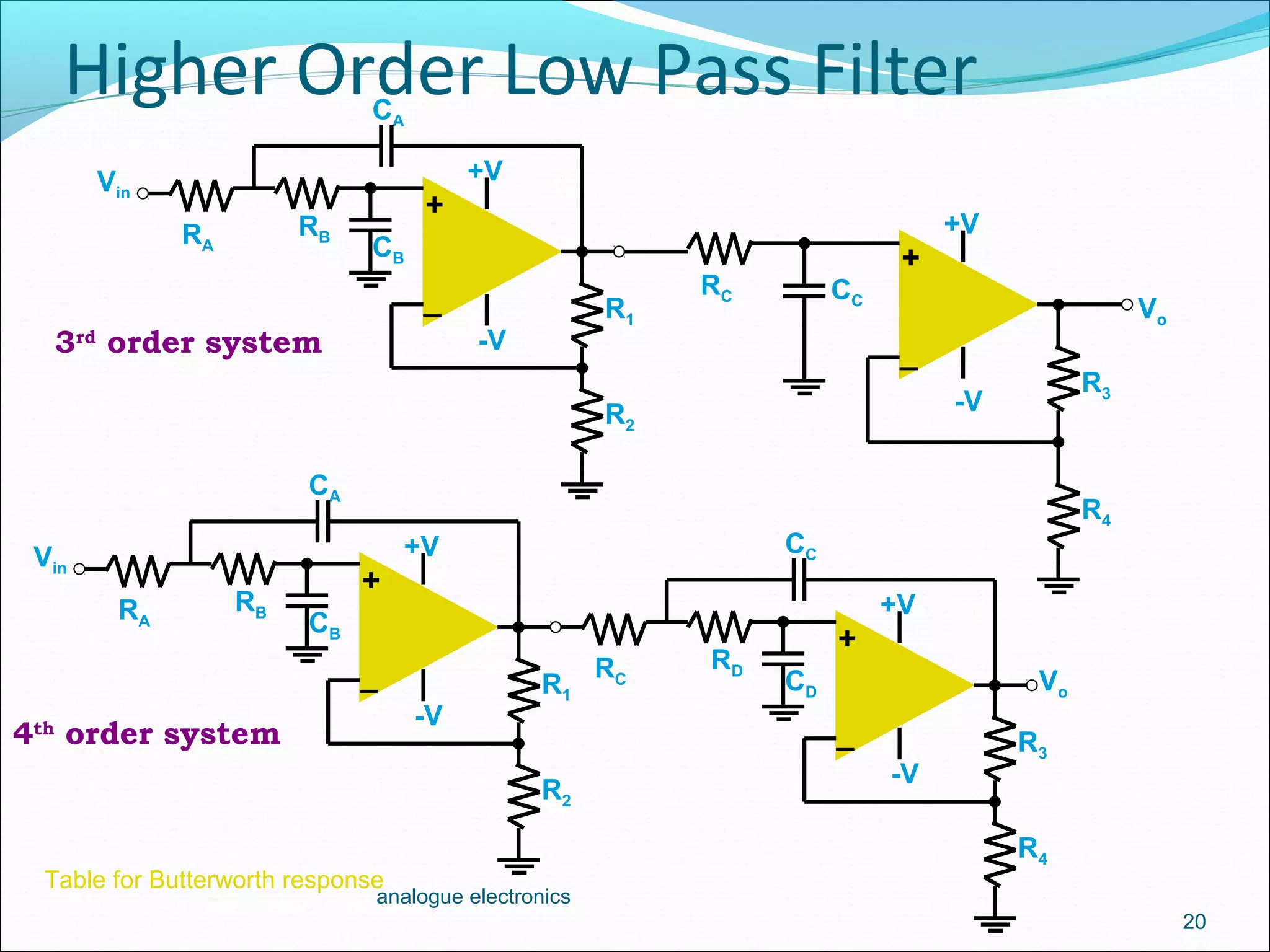
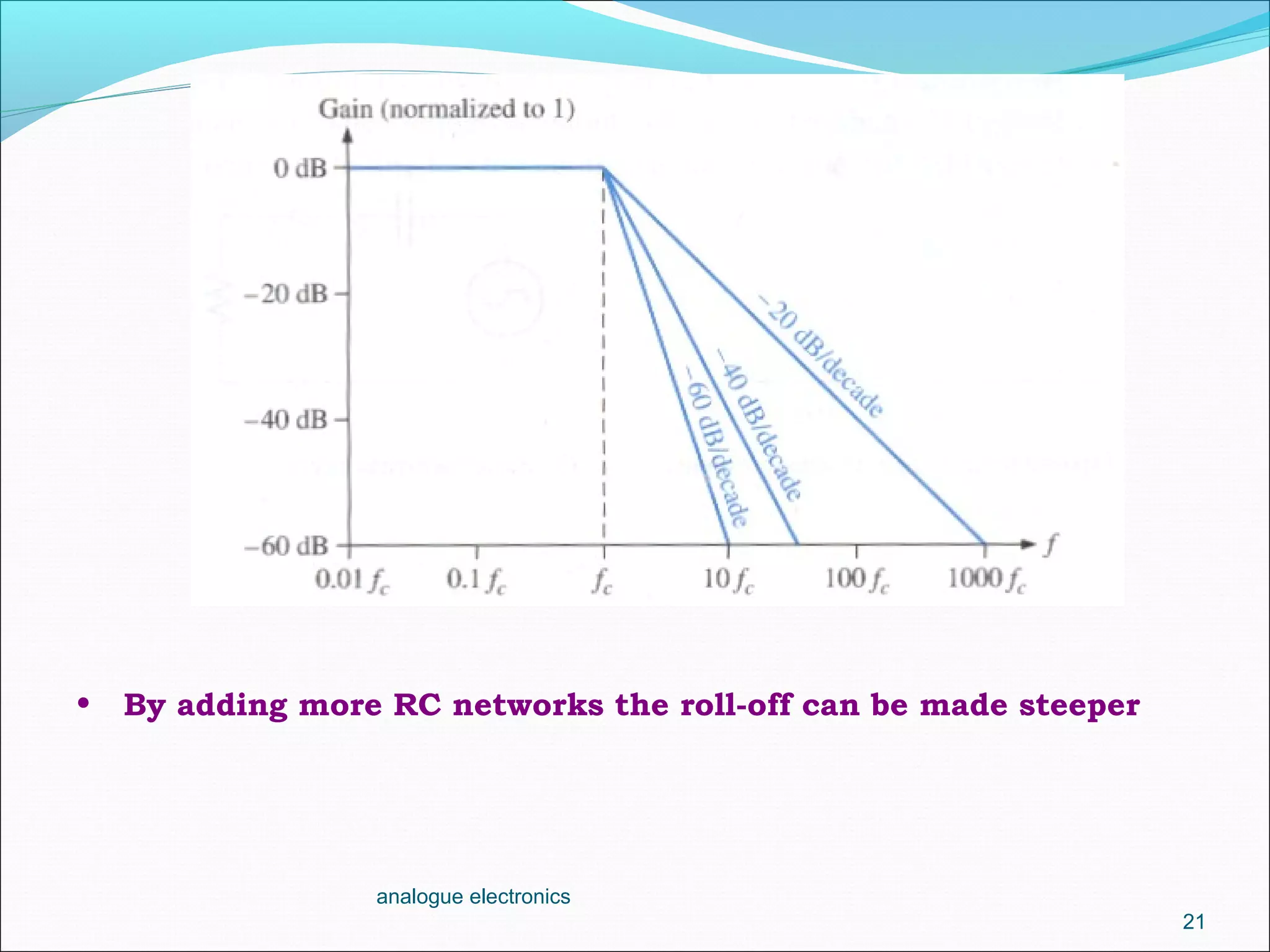
• By adding more RC networks the roll-off can be made steeper

Active Filter (Low Pass)

  • 1.
    CHAPTER 3: ActiveFilter analogue electronics 1
  • 2.
    Chapter Outcomes 2 analogue electronics Describe the frequency response of basic filters  Describe the three basic filter response characteristics  Analyze low-, high- and band-pass filters  Design active filter
  • 3.
    Introduction PASSIVE FILTER ACTIVEFILTER •RC, RL and RLC circuits •Active components + passive components •Transistors or op-amps + RC/RL/RLC •Provides frequency selectivity •Provides voltage gain •Advantage: simple •Advantage: Loading effect is minimal -o/p independent of the load driven 3 analogue electronics  Filters are circuits that are capable of passing signals with certain selected frequencies while rejecting signals with other frequencies  2 types of filter
  • 4.
    Introduction Types of activefilter: Low-Pass Filter High-Pass Filter Bandpass Filter o Cascaded Low-Pass and High-Pass Filter o Multiple-Feedback Band-Pass Filter o State-Variable Filter o Biquad Filter Bandstop Filter o Multiple-Feedback Band-Stop Filter o State-Variable Band-Stop Filter The op-amp active filter provides controllable cutoff frequencies and controllable gain 4 analogue electronics
  • 5.
    Frequency Response  PassBand: The range of frequency seen in the filter output. Has the same meaning as the bandwidth (BW) of the filter  Stop Band: The range of frequency blocked by the filter. These frequency are not see in the filter output 5 analogue electronics AV (dB) f (Hz) f (Hz) AV (dB) 3dB Ideal Practical AV (dB) AV (dB) f (Hz) f (Hz) 3dB Ideal Practical Pass Band Stop Band Transition Region  Transition region: The frequency between the pass band and the stop band  Cut off Frequency : The highest or lowest frequency that is allowed to pass or determines the pass band. The cutoff frequency of real filter is the -3 dB frequency of that filter
  • 6.
    Decibel (dB)  Thisis a relative power unit. At audio frequencies a change of one decibel (abbreviated dB) is just detectable as a change in loudness under ideal conditions.  For a given power ratio the decibel change is calculated as: dB = 10 log P2/P1  If we used voltage or current ratios instead then it becomes: dB = 10 log (V2 2 / R)/(V1 2 / R) = 20 log V2/V1 = 20 log AV 6 analogue electronics
  • 7.
    Basic Diagram ofAn Filter  Inverting or non-inverting??  Which part is the filter? 7 analogue electronics _ +Vin R1 R2 Vo +V -V RC Circuit Gain Frequency 1 2 1V R A R = +
  • 8.
    Cut-Off Frequency  Inelectronics, cut-off frequency (fc) is the frequency at which the gain on a frequency-response plot is 3 dB less than at mid-band gain  The cutoff frequency often called 3-dB frequencies  Also called the knee frequency, due to a frequency response curve's physical appearance. 8 analogue electronics
  • 9.
  • 10.
    3dB  At -3dB,the output power is half of the output power at pass band 10 analogue electronics V@passband V@passband V@passband 20 log A -20 log 2 20 log A -10log 2 20 log A 3.012 = = = − 2 @ outP out passband V P R = 2 2 @ @ 3 2 2 out passband outP outRMS out dB P V V P R R − = = = @ 3 2 outP o dB outRMS V V V− = = @ @ 3 2 2 V passbandoutP V dB in AV A V − = =
  • 11.
    Filter Response Characteristics 11 analogueelectronics The Butterworth characteristic response is very flat. The roll-off rate -20dB per decade. This is the most widely used. The Chebyshev characteristic response provides a roll-off rate greater than -20dB but has ripples in the passband and a non-linear phase response. The Bessel characteristic response exhibits the most linear phase response making it ideal for filtering pulse waveforms with distortion.
  • 12.
     The dampingfactor of an active filter determines the type of response characteristic  The output signal is fed back into the filter circuit with negative feedback determined by the combination of R1 and R2  The negative feedback ultimately determines the type of filter response is produced. The equation below defines the damping factor analogue electronics 12 DF = 2 – R1/R2
  • 13.
     List ofthe roll-off rates, damping factors, and feedback resistors for up to six order Butterworth filters 13 analogue electronics Back
  • 14.
    1. Low PassFilter  Low-pass filter passes low frequencies well, but attenuates (or reduces) frequencies higher than the cutoff frequency 14 analogue electronics a) 1st Order R1 R2 _ +Vin +V -V RA CA Vo AV (dB) AV(max) AV(max) - 3 fc 10fc100fc AV(max) - 20 AV(max) - 40 -20dB/dec f (Hz)  The capacitor CA in conjunction with the resistor RA provides the filtering action, while the op-amp with its associated resistor R1 and R2 function as non-inverting amplifier and provides the needed gain BW
  • 15.
    Analysis  It islow pass filter if No s at numerator V+ = VC  It is 1st order system if The highest order is s1 Only one pair RC at +input of op- amp 15 analogue electronics Vo = 1+ V+ R1 R2 _ +Vin +V -V RA CA Vo V+ = Vi 1 sCA 1 sCA +RA R1 R2 Vo = 1+ R1 R2 Vi V+ = Vi 1 sRACA+1 1 V+ = VcA AV = = 1+ R1 R2Vi 1Vo sRACA+1 sRACA+1
  • 16.
    Analysis  At 0< f < fc, low pass filter will pass the frequencies because XCA=∞, thus, V+ =VCA =Vi 16 analogue electronics AV (dB) AV(max) AV(max) - 3 fc 10fc100fc AV(max) - 20 AV(max) - 40 -20dB/dec f (Hz) AV(max) = 1+ R1 R2  At f = fc, the gain is 0.707AV(max) or in dB AVdB(max)-3. The magnitude of the capacitive reactance, XCA equals the resistance of the resistor, RA  At f > fc, low pass filter will attenuate the frequencies at roll-off of -20dB/decade because XCA is reducing to 0. When XCA=0, V+ =VCA=0 A = 0 1 2πfcCA = RA fc = 1 2πRACA
  • 17.
    17 analogue electronics b) 2nd Order(Sallen-Key)  One of the most common configurations for 2nd order filter  There are two pairs of RC that provide roll-off of -40dB/dec  The capacitor CA provides feedback for shaping the response near the edge of the pass band (-3dB not -6dB) Vo R1 R2 _ + Vin +V -V RA CA RB CB 1 2 1 22 1 1 1 1 1 A B A Bo in B B A B A A A B A B A B A B R R R R C CV V R R C R C R C R s s R R C C R R C C   + ÷  =     + + − + ÷ ÷ ÷ ÷   + +
  • 18.
    analogue electronics 18 R1=10kΩ, R2=17.2kΩ, RA=RB=3.18kΩ, CA=CB=0.01µF
  • 19.
    19 analogue electronics AV (dB) AV(max) AV(max)- 3 fc 10fc100fc AV(max) - 40 AV(max) - 80 -40dB/dec f (Hz) BW AV(max) = 1+ R1 R2 1 2π RARBCACB fc = fAfB 1 2πRACA 1 2πRBCB •= =
  • 20.
    Higher Order LowPass Filter 20 analogue electronics R1 R2 _ + Vin +V -V RA CA RB CB R3 R4 _ + +V -V RC CC Vo R1 R2 _ + Vin +V -V RA CA RB CB Vo R3 R4 _ + +V -V RC CC RD CD Table for Butterworth response 3rd order system 4th order system
  • 21.
    analogue electronics 21 • Byadding more RC networks the roll-off can be made steeper