BACILLUS SPECIES
         BACILLUS ANTHRAX

                  DEEPA BABIN
      ASST PROF MICROBIOLOGY
                    TMC Kollam
Anthrax
  Anthrax is a serious zoonotic disease that
   can affect most mammals and several
     species of birds, but is particularly
          important in herbivores.

  The word anthrax is derived from a Greek
    word meaning charcoal or carbuncle.

    Anthrax, the disease, likely originated
  6,000 to 7,000 years ago in Mesopotamia
  and Egypt, where agricultural civilization
              was first recorded
• Malignant Pustule, Malignant Edema,
  Woolsorters’ Disease, Ragpickers’
  Disease, Maladi Charbon, Splenic Fever
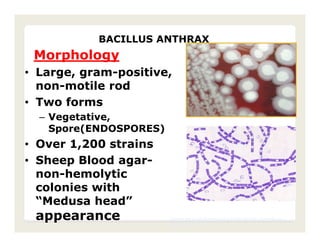
BACILLUS ANTHRAX
 Morphology
• Large, gram-positive,
  non-motile rod
• Two forms
  – Vegetative,
    Spore(ENDOSPORES)
• Over 1,200 strains
• Sheep Blood agar-
  non-hemolytic
  colonies with
  “Medusa head”
 appearance             Center for Food Security and Public Health, Iowa State
                        University, 2011
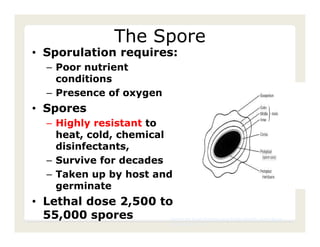
The Spore
• Sporulation requires:
  – Poor nutrient
    conditions
  – Presence of oxygen
• Spores
  – Highly resistant to
    heat, cold, chemical
    disinfectants,
  – Survive for decades
  – Taken up by host and
    germinate
• Lethal dose 2,500 to
  55,000 spores          Center for Food Security and Public Health, Iowa State
                         University, 2011
History

 Sverdlovsk, Russia, 1979
• 94 people sick – 64 died ,Soviets blamed
  contaminated meat
• President Yeltsin admits outbreak
  related to military facility
 Aum Shinrikyo - Tokyo, 1993
    Japanese religious cult “Supreme
   truth”
   Attempt at biological terrorism
    Released anthrax from office building
   Vaccine strain used
   No human injuries


                       Center for Food Security and Public Health, Iowa State
                       University, 2011
U.S., 2001


    Center for Food Security and Public Health, Iowa State
    University, 2011
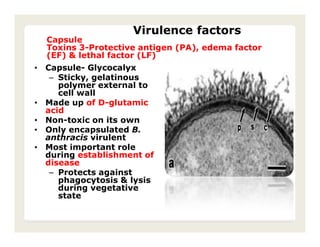
Virulence factors
  Capsule
  Toxins 3-Protective antigen (PA), edema factor
  (EF) & lethal factor (LF)
• Capsule- Glycocalyx
   – Sticky, gelatinous
     polymer external to
     cell wall
• Made up of D-glutamic
  acid
• Non-toxic on its own
• Only encapsulated B.
  anthracis virulent
• Most important role
  during establishment of
  disease
   – Protects against
     phagocytosis & lysis
     during vegetative
     state
2001-anthrax letter
 Vellore 1990(epizootic sheeps)


INDIA 1990-2001
      1990-
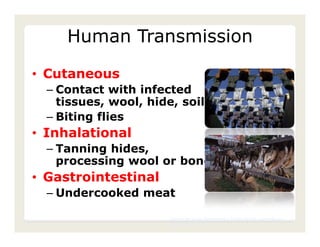
Human Transmission

• Cutaneous
  – Contact with infected
    tissues, wool, hide, soil
  – Biting flies
• Inhalational
  – Tanning hides,
    processing wool or bone
• Gastrointestinal
  – Undercooked meat

                       Center for Food Security and Public Health, Iowa State
                       University, 2011
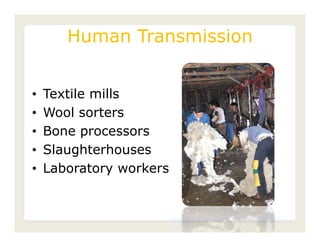
Human Transmission


•   Textile mills
•   Wool sorters
•   Bone processors
•   Slaughterhouses
•   Laboratory workers


                         Center for Food Security and Public Health, Iowa State
                         University, 2011
Animal Transmission

• Bacteria present in hemorrhagic
  exudate from mouth, nose, anus
• Oxygen exposure
  – Spores form
  – Soil contamination
• Sporulation does not occur in a
  closed carcass
• Spores viable for decades
                         Center for Food Security and Public Health, Iowa State
                         University, 2011
Mechanism of Infection
•   Anthrax spores enter body
•   Germinate & multiple in lymph nodes
•   PA, EF, LF excreted from bacteria
•   PA binds to TEM8.
•   EF and/or LF binds
•   Complex internalized by endocytosis
•   Acidification of endosome
•   Death probably results from high levels of
    bacteria secreting LF toxins in blood
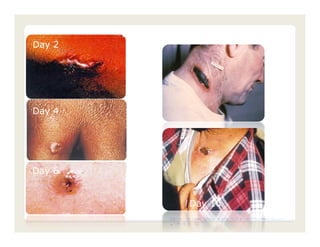
Cutaneous Anthrax

• 95% of all cases globally
• Incubation: 2 to 3 days
• Spores enter skin through open
  wound or abrasion
• Papule    vesicle    ulcer  black
  eschar-Malignant pustules
• Hide porters disease(dock workers)
• Case fatality rate 5 to 20%
• Untreated – septicemia and death
                    Center for Food Security and Public Health, Iowa State
                    University, 2011
Day 6
Day 2


Day 4


Day 6
Day 6


                 Day 10
        Center for Food Security and Public Health, Iowa State
        University, 2011
Gastrointestinal Anthrax

• Incubation: 2 to 5 days
• Severe gastroenteritis common
  – Consumption of undercooked or
    contaminated meat
• Case fatality rate: 25 to 75%


                      Center for Food Security and Public Health, Iowa State
                      University, 2011
Pulmonary Anthrax-Wool
      sorters disease
• Incubation: 1 to 7 days
• Initial phase
  – Nonspecific (mild fever, malaise)
• Second phase
  – Severe respiratory distress
  – Hemorrhagic pneumonia, death in 24 to
    36 hours
• Case fatality: 75 to 90% (untreated)
                        Center for Food Security and Public Health, Iowa State
                        University, 2011
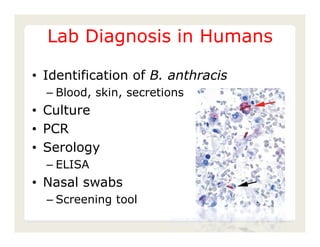
Lab Diagnosis in Humans

• Identification of B. anthracis
  – Blood, skin, secretions
• Culture
• PCR
• Serology
  – ELISA
• Nasal swabs
  – Screening tool
                        Center for Food Security and Public Health, Iowa State
                        University, 2011
Treatment

• Penicillin
  – Most natural strains susceptible
• Additional antibiotic options
  – Ciprofloxacin
     • Treatment of choice in 2001
     • No strains known to be resistant
  – Doxycycline
• Course of treatment: 60 days

                           Center for Food Security and Public Health, Iowa State
                           University, 2011
Prevention and Control

• Humans protected by preventing
  disease in animals
  −Veterinary supervision
  −Trade restrictions
• Improved industry standards
• Safety practices in laboratories
• Post-exposure antibiotic prophylaxis

                      Center for Food Security and Public Health, Iowa State
                      University, 2011
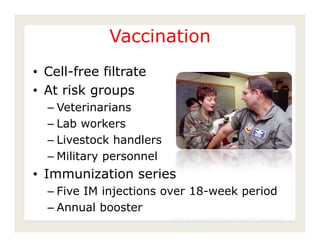
Vaccination
• Cell-free filtrate
• At risk groups
  – Veterinarians
  – Lab workers
  – Livestock handlers
  – Military personnel
• Immunization series
  – Five IM injections over 18-week period
  – Annual booster
                         Center for Food Security and Public Health, Iowa State
                         University, 2011

Anthrax ppt deepa

  • 1.
    BACILLUS SPECIES BACILLUS ANTHRAX DEEPA BABIN ASST PROF MICROBIOLOGY TMC Kollam
  • 2.
    Anthrax Anthraxis a serious zoonotic disease that can affect most mammals and several species of birds, but is particularly important in herbivores. The word anthrax is derived from a Greek word meaning charcoal or carbuncle. Anthrax, the disease, likely originated 6,000 to 7,000 years ago in Mesopotamia and Egypt, where agricultural civilization was first recorded • Malignant Pustule, Malignant Edema, Woolsorters’ Disease, Ragpickers’ Disease, Maladi Charbon, Splenic Fever
  • 3.
    BACILLUS ANTHRAX Morphology •Large, gram-positive, non-motile rod • Two forms – Vegetative, Spore(ENDOSPORES) • Over 1,200 strains • Sheep Blood agar- non-hemolytic colonies with “Medusa head” appearance Center for Food Security and Public Health, Iowa State University, 2011
  • 4.
    The Spore • Sporulationrequires: – Poor nutrient conditions – Presence of oxygen • Spores – Highly resistant to heat, cold, chemical disinfectants, – Survive for decades – Taken up by host and germinate • Lethal dose 2,500 to 55,000 spores Center for Food Security and Public Health, Iowa State University, 2011
  • 5.
    History Sverdlovsk, Russia,1979 • 94 people sick – 64 died ,Soviets blamed contaminated meat • President Yeltsin admits outbreak related to military facility Aum Shinrikyo - Tokyo, 1993 Japanese religious cult “Supreme truth” Attempt at biological terrorism Released anthrax from office building Vaccine strain used No human injuries Center for Food Security and Public Health, Iowa State University, 2011
  • 6.
    U.S., 2001 Center for Food Security and Public Health, Iowa State University, 2011
  • 7.
    Virulence factors Capsule Toxins 3-Protective antigen (PA), edema factor (EF) & lethal factor (LF) • Capsule- Glycocalyx – Sticky, gelatinous polymer external to cell wall • Made up of D-glutamic acid • Non-toxic on its own • Only encapsulated B. anthracis virulent • Most important role during establishment of disease – Protects against phagocytosis & lysis during vegetative state
  • 8.
    2001-anthrax letter Vellore1990(epizootic sheeps) INDIA 1990-2001 1990-
  • 9.
    Human Transmission • Cutaneous – Contact with infected tissues, wool, hide, soil – Biting flies • Inhalational – Tanning hides, processing wool or bone • Gastrointestinal – Undercooked meat Center for Food Security and Public Health, Iowa State University, 2011
  • 10.
    Human Transmission • Textile mills • Wool sorters • Bone processors • Slaughterhouses • Laboratory workers Center for Food Security and Public Health, Iowa State University, 2011
  • 11.
    Animal Transmission • Bacteriapresent in hemorrhagic exudate from mouth, nose, anus • Oxygen exposure – Spores form – Soil contamination • Sporulation does not occur in a closed carcass • Spores viable for decades Center for Food Security and Public Health, Iowa State University, 2011
  • 12.
    Mechanism of Infection • Anthrax spores enter body • Germinate & multiple in lymph nodes • PA, EF, LF excreted from bacteria • PA binds to TEM8. • EF and/or LF binds • Complex internalized by endocytosis • Acidification of endosome • Death probably results from high levels of bacteria secreting LF toxins in blood
  • 13.
    Cutaneous Anthrax • 95%of all cases globally • Incubation: 2 to 3 days • Spores enter skin through open wound or abrasion • Papule vesicle ulcer black eschar-Malignant pustules • Hide porters disease(dock workers) • Case fatality rate 5 to 20% • Untreated – septicemia and death Center for Food Security and Public Health, Iowa State University, 2011
  • 14.
    Day 6 Day 2 Day4 Day 6 Day 6 Day 10 Center for Food Security and Public Health, Iowa State University, 2011
  • 15.
    Gastrointestinal Anthrax • Incubation:2 to 5 days • Severe gastroenteritis common – Consumption of undercooked or contaminated meat • Case fatality rate: 25 to 75% Center for Food Security and Public Health, Iowa State University, 2011
  • 16.
    Pulmonary Anthrax-Wool sorters disease • Incubation: 1 to 7 days • Initial phase – Nonspecific (mild fever, malaise) • Second phase – Severe respiratory distress – Hemorrhagic pneumonia, death in 24 to 36 hours • Case fatality: 75 to 90% (untreated) Center for Food Security and Public Health, Iowa State University, 2011
  • 17.
    Lab Diagnosis inHumans • Identification of B. anthracis – Blood, skin, secretions • Culture • PCR • Serology – ELISA • Nasal swabs – Screening tool Center for Food Security and Public Health, Iowa State University, 2011
  • 18.
    Treatment • Penicillin – Most natural strains susceptible • Additional antibiotic options – Ciprofloxacin • Treatment of choice in 2001 • No strains known to be resistant – Doxycycline • Course of treatment: 60 days Center for Food Security and Public Health, Iowa State University, 2011
  • 19.
    Prevention and Control •Humans protected by preventing disease in animals −Veterinary supervision −Trade restrictions • Improved industry standards • Safety practices in laboratories • Post-exposure antibiotic prophylaxis Center for Food Security and Public Health, Iowa State University, 2011
  • 20.
    Vaccination • Cell-free filtrate •At risk groups – Veterinarians – Lab workers – Livestock handlers – Military personnel • Immunization series – Five IM injections over 18-week period – Annual booster Center for Food Security and Public Health, Iowa State University, 2011