Opportunistic Infections (OI)
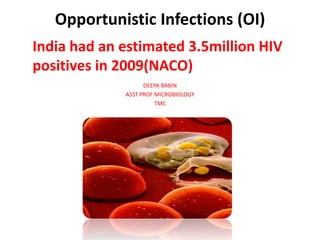
India had an estimated 3.5million HIV
positives in 2009(NACO)
                   DEEPA BABIN
             ASST PROF MICROBIOLOGY
                       TMC
Background
Patients are susceptible to
bacterial, fungal, parasitic and
viral infections

HIV, Cancer chemotherapy,
bone marrow transplantation,
immune deficiency disorder or
blood disorders .
                                   2
                                   2
Definition

• An infection by a microorganism when
  the body's immune system is impaired
  and unable to fight off infection, as in
  AIDS, Infants, neutropenia, and
  congenital
AIDS (Aquired Immune Deficiency
                Syndrome)
AIDS (Aquired Immune Deficiency
Syndrome) is the final stage and
natural progression of HIV (Human
Immunodeficiency Virus.)
These infections usually occur
when the CD4 cells drop below 200
cells/ul, i.e. immunocompromised
state.
 It is estimated that as many as 40
million people worldwide suffer
from AIDS
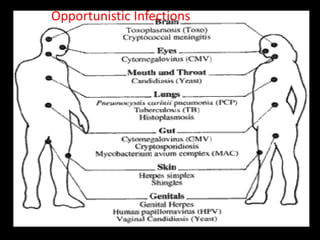
Opportunistic Infections
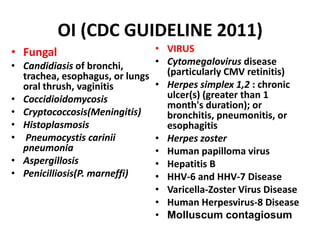
OI (CDC GUIDELINE 2011)
• Fungal                       • VIRUS
• Candidiasis of bronchi,      • Cytomegalovirus disease
  trachea, esophagus, or lungs   (particularly CMV retinitis)
  oral thrush, vaginitis       • Herpes simplex 1,2 : chronic
• Coccidioidomycosis             ulcer(s) (greater than 1
                                 month's duration); or
• Cryptococcosis(Meningitis)     bronchitis, pneumonitis, or
• Histoplasmosis                 esophagitis
• Pneumocystis carinii         • Herpes zoster
  pneumonia                    • Human papilloma virus
• Aspergillosis                • Hepatitis B
• Penicilliosis(P. marneffi)   • HHV-6 and HHV-7 Disease
                               • Varicella-Zoster Virus Disease
                               • Human Herpesvirus-8 Disease
                               • Molluscum contagiosum
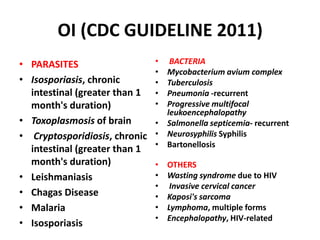
OI (CDC GUIDELINE 2011)
• PARASITES                    •  BACTERIA
                               • Mycobacterium avium complex
• Isosporiasis, chronic        • Tuberculosis
  intestinal (greater than 1   • Pneumonia -recurrent
  month's duration)            • Progressive multifocal
                                 leukoencephalopathy
• Toxoplasmosis of brain       • Salmonella septicemia- recurrent
• Cryptosporidiosis, chronic   • Neurosyphilis Syphilis
                               • Bartonellosis
  intestinal (greater than 1
  month's duration)            •   OTHERS
• Leishmaniasis                •   Wasting syndrome due to HIV
                               •    Invasive cervical cancer
• Chagas Disease               •   Kaposi's sarcoma
• Malaria                      •   Lymphoma, multiple forms
                               •   Encephalopathy, HIV-related
• Isosporiasis
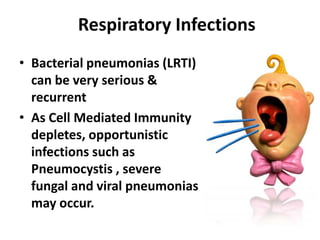
Respiratory Infections
• Bacterial pneumonias (LRTI)
  can be very serious &
  recurrent
• As Cell Mediated Immunity
  depletes, opportunistic
  infections such as
  Pneumocystis , severe
  fungal and viral pneumonias
  may occur.
Respiratory Infections
            Bacterial:                      Fungal:
       Pneumococcal,                Cryptococcosis,
     Klebsiella, E.coli,            Histoplasmosis,
         Heamophilus,      Pneumocystis jiroveci
       Staphylococcal                 Aspergillosis,
          pneumonias,
    Tuberculosis, MAC.
                 Viral:    Other:   Kaposi’s sarcoma,
     Cytomegalovirus
  Herpes simplex virus
Lymphocytic interstitial
          pneumonitis
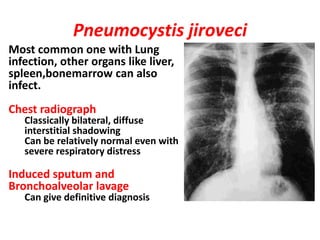
Pneumocystis jiroveci
Most common one with Lung
infection, other organs like liver,
spleen,bonemarrow can also
infect.
Chest radiograph
   Classically bilateral, diffuse
   interstitial shadowing
   Can be relatively normal even with
   severe respiratory distress

Induced sputum and
Bronchoalveolar lavage
   Can give definitive diagnosis
Mycobacterium tuberculosis
• 85,000 new cases of tuberculosis in
  United States in 2009 (6% among
  children <15 years of age)
• Number of these that were HIV
  infected is uncertain
• Incidence of TB in HIV-infected
  100 times higher than in
  uninfected
• Extrapulmonary and miliary TB
  more common
• Congenital TB has been reported
• Drug-resistant TB can be
  transmitted
Diagnosis of Pulmonary TB
• Sputum examination
   – Negative Sputum does not
     exclude TB!
   – Sputum negative PTB more
     common in HIV+
   – Only 50% sensitive
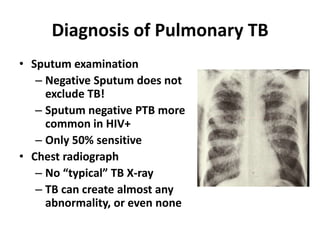
• Chest radiograph
   – No “typical” TB X-ray
   – TB can create almost any
     abnormality, or even none
Diagnosis of Extrapulmonary TB
• Often very difficult
  – CXR often normal and sputum if available is
    negative
• If lymph nodes enlarged - aspirate
• If meningism present - lumbar puncture
• If septic arthritis or abscess - aspirate
  – Always request ZN Stains on samples
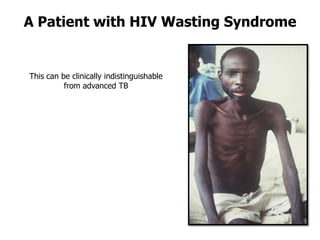
A Patient with HIV Wasting Syndrome


This can be clinically indistinguishable
          from advanced TB
Mycobacterium avium Complex
• Appear as isolated lymphadinitis
• Recurrent fever, weight loss, failure to thrive,
  neutropenia, night sweats, chronic diarrhea,
  malabsorption, abdominal pain
• Lymphadenopathy, hepatomegaly, splenomegaly
• Respiratory symptoms
• Diagnosis-Biopsy,AFB stain,Blood culture,PCR
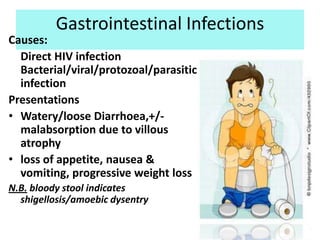
Gastrointestinal Infections
Causes:
  Direct HIV infection
  Bacterial/viral/protozoal/parasitic
  infection
Presentations
• Watery/loose Diarrhoea,+/-
  malabsorption due to villous
  atrophy
• loss of appetite, nausea &
  vomiting, progressive weight loss
N.B. bloody stool indicates
  shigellosis/amoebic dysentry
Diarrhoea
      Acute                      Chronic
- Bacterial               - CMV
• Salmonella              - Mycobacterium avium
• Shigella                   complex
• Campylobacter           - Parasites
• Clostridium difficile   • Microsporidia
- Enteric viruses         • Cryptosporidia
• adenovirus              • Cyclospora cayetanensis
• astrovirus              • Giardia lamblia
                          • Isospora belli
Neurological Infections
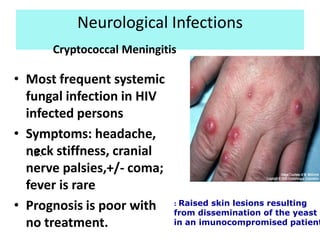
      Cryptococcal Meningitis

• Most frequent systemic
  fungal infection in HIV
  infected persons
• Symptoms: headache,
  neck stiffness, cranial
   .B.
  nerve palsies,+/- coma;
  fever is rare
• Prognosis is poor with    :Raised skin lesions resulting
                            from dissemination of the yeast
  no treatment.             in an imunocompromised patient
Syphilis
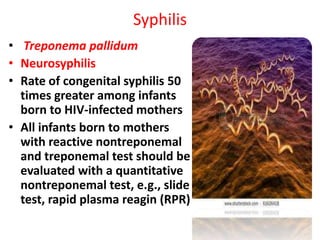
• Treponema pallidum
• Neurosyphilis
• Rate of congenital syphilis 50
  times greater among infants
  born to HIV-infected mothers
• All infants born to mothers
  with reactive nontreponemal
  and treponemal test should be
  evaluated with a quantitative
  nontreponemal test, e.g., slide
  test, rapid plasma reagin (RPR)
Toxoplasmal meningitis

CNS infection of T gondii is
 an AIDS indicator
CD4 cells >50 cells/ml
Meningitis
Diagnosis
Serology-Ab detection
PCR
Candidiasis
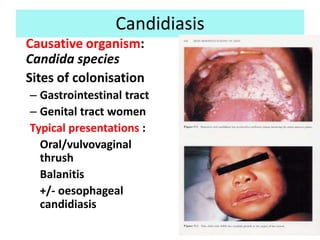
Causative organism:
Candida species
Sites of colonisation
– Gastrointestinal tract
– Genital tract women
Typical presentations :
  Oral/vulvovaginal
  thrush
  Balanitis
  +/- oesophageal
  candidiasis
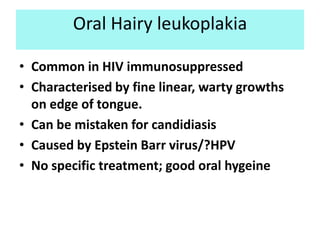
Oral Hairy leukoplakia

• Common in HIV immunosuppressed
• Characterised by fine linear, warty growths
  on edge of tongue.
• Can be mistaken for candidiasis
• Caused by Epstein Barr virus/?HPV
• No specific treatment; good oral hygeine
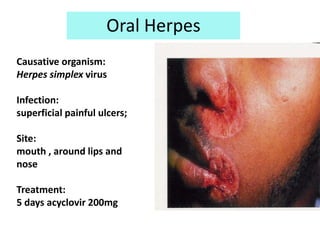
Oral Herpes
Causative organism:
Herpes simplex virus

Infection:
superficial painful ulcers;

Site:
mouth , around lips and
nose

Treatment:
5 days acyclovir 200mg
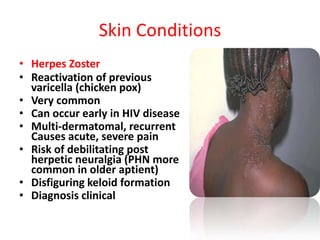
Skin Conditions
• Herpes Zoster
• Reactivation of previous
  varicella (chicken pox)
• Very common
• Can occur early in HIV disease
• Multi-dermatomal, recurrent
  Causes acute, severe pain
• Risk of debilitating post
  herpetic neuralgia (PHN more
  common in older aptient)
• Disfiguring keloid formation
• Diagnosis clinical
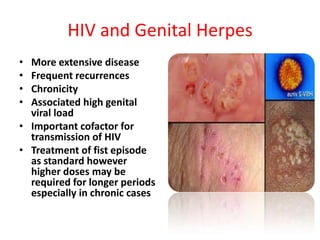
HIV and Genital Herpes
• More extensive disease
• Frequent recurrences
• Chronicity
• Associated high genital
  viral load
• Important cofactor for
  transmission of HIV
• Treatment of fist episode
  as standard however
  higher doses may be
  required for longer periods
  especially in chronic cases
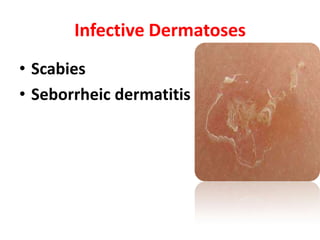
Infective Dermatoses
• Scabies
• Seborrheic dermatitis
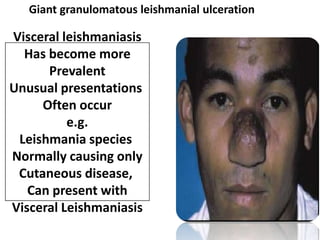
Giant granulomatous leishmanial ulceration

Visceral leishmaniasis
  Has become more
      Prevalent
Unusual presentations
     Often occur
          e.g.
 Leishmania species
Normally causing only
 Cutaneous disease,
   Can present with
Visceral Leishmaniasis
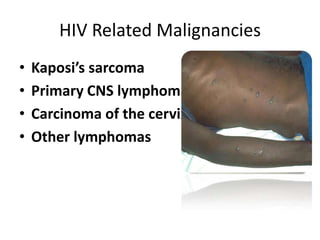
HIV Related Malignancies
•   Kaposi’s sarcoma
•   Primary CNS lymphoma
•   Carcinoma of the cervix
•   Other lymphomas
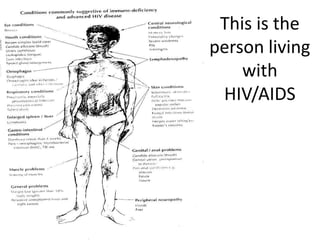
This is the
person living
    with
 HIV/AIDS
The Role of ARVs in Opportunistic
                    Infections
• Antiretroviral therapy(ARV)
• ARVs improve the immune status, and therefore, enhance
  how the host fights disease – keeping it free from
  infections that might otherwise have taken the
  opportunity to occur.

• Widespread use of Highly Active Anti Retroviral Therapy
  (HAART) has been associated with considerable

   – Reduction in mortality
   – Reduction in morbidity
   – Reduction in social isolation
HIV/AIDS is one of the greatest
worldwide public health
challenges of the modern age,
and as future health care
workers, it is of the utmost
importance that we maintain
awareness and continuing
knowledge of this
heartbreaking and deadly
scourge.
THANK YOU ALL
      MY
 DEAR STUDENTS
Opportunistic infections (oi) deepa

Opportunistic infections (oi) deepa

  • 1.
    Opportunistic Infections (OI) Indiahad an estimated 3.5million HIV positives in 2009(NACO) DEEPA BABIN ASST PROF MICROBIOLOGY TMC
  • 2.
    Background Patients are susceptibleto bacterial, fungal, parasitic and viral infections HIV, Cancer chemotherapy, bone marrow transplantation, immune deficiency disorder or blood disorders . 2 2
  • 3.
    Definition • An infectionby a microorganism when the body's immune system is impaired and unable to fight off infection, as in AIDS, Infants, neutropenia, and congenital
  • 4.
    AIDS (Aquired ImmuneDeficiency Syndrome) AIDS (Aquired Immune Deficiency Syndrome) is the final stage and natural progression of HIV (Human Immunodeficiency Virus.) These infections usually occur when the CD4 cells drop below 200 cells/ul, i.e. immunocompromised state. It is estimated that as many as 40 million people worldwide suffer from AIDS
  • 5.
  • 6.
    OI (CDC GUIDELINE2011) • Fungal • VIRUS • Candidiasis of bronchi, • Cytomegalovirus disease trachea, esophagus, or lungs (particularly CMV retinitis) oral thrush, vaginitis • Herpes simplex 1,2 : chronic • Coccidioidomycosis ulcer(s) (greater than 1 month's duration); or • Cryptococcosis(Meningitis) bronchitis, pneumonitis, or • Histoplasmosis esophagitis • Pneumocystis carinii • Herpes zoster pneumonia • Human papilloma virus • Aspergillosis • Hepatitis B • Penicilliosis(P. marneffi) • HHV-6 and HHV-7 Disease • Varicella-Zoster Virus Disease • Human Herpesvirus-8 Disease • Molluscum contagiosum
  • 7.
    OI (CDC GUIDELINE2011) • PARASITES • BACTERIA • Mycobacterium avium complex • Isosporiasis, chronic • Tuberculosis intestinal (greater than 1 • Pneumonia -recurrent month's duration) • Progressive multifocal leukoencephalopathy • Toxoplasmosis of brain • Salmonella septicemia- recurrent • Cryptosporidiosis, chronic • Neurosyphilis Syphilis • Bartonellosis intestinal (greater than 1 month's duration) • OTHERS • Leishmaniasis • Wasting syndrome due to HIV • Invasive cervical cancer • Chagas Disease • Kaposi's sarcoma • Malaria • Lymphoma, multiple forms • Encephalopathy, HIV-related • Isosporiasis
  • 8.
    Respiratory Infections • Bacterialpneumonias (LRTI) can be very serious & recurrent • As Cell Mediated Immunity depletes, opportunistic infections such as Pneumocystis , severe fungal and viral pneumonias may occur.
  • 9.
    Respiratory Infections Bacterial: Fungal: Pneumococcal, Cryptococcosis, Klebsiella, E.coli, Histoplasmosis, Heamophilus, Pneumocystis jiroveci Staphylococcal Aspergillosis, pneumonias, Tuberculosis, MAC. Viral: Other: Kaposi’s sarcoma, Cytomegalovirus Herpes simplex virus Lymphocytic interstitial pneumonitis
  • 10.
    Pneumocystis jiroveci Most commonone with Lung infection, other organs like liver, spleen,bonemarrow can also infect. Chest radiograph Classically bilateral, diffuse interstitial shadowing Can be relatively normal even with severe respiratory distress Induced sputum and Bronchoalveolar lavage Can give definitive diagnosis
  • 11.
    Mycobacterium tuberculosis • 85,000new cases of tuberculosis in United States in 2009 (6% among children <15 years of age) • Number of these that were HIV infected is uncertain • Incidence of TB in HIV-infected 100 times higher than in uninfected • Extrapulmonary and miliary TB more common • Congenital TB has been reported • Drug-resistant TB can be transmitted
  • 12.
    Diagnosis of PulmonaryTB • Sputum examination – Negative Sputum does not exclude TB! – Sputum negative PTB more common in HIV+ – Only 50% sensitive • Chest radiograph – No “typical” TB X-ray – TB can create almost any abnormality, or even none
  • 13.
    Diagnosis of ExtrapulmonaryTB • Often very difficult – CXR often normal and sputum if available is negative • If lymph nodes enlarged - aspirate • If meningism present - lumbar puncture • If septic arthritis or abscess - aspirate – Always request ZN Stains on samples
  • 14.
    A Patient withHIV Wasting Syndrome This can be clinically indistinguishable from advanced TB
  • 15.
    Mycobacterium avium Complex •Appear as isolated lymphadinitis • Recurrent fever, weight loss, failure to thrive, neutropenia, night sweats, chronic diarrhea, malabsorption, abdominal pain • Lymphadenopathy, hepatomegaly, splenomegaly • Respiratory symptoms • Diagnosis-Biopsy,AFB stain,Blood culture,PCR
  • 16.
    Gastrointestinal Infections Causes: Direct HIV infection Bacterial/viral/protozoal/parasitic infection Presentations • Watery/loose Diarrhoea,+/- malabsorption due to villous atrophy • loss of appetite, nausea & vomiting, progressive weight loss N.B. bloody stool indicates shigellosis/amoebic dysentry
  • 17.
    Diarrhoea Acute Chronic - Bacterial - CMV • Salmonella - Mycobacterium avium • Shigella complex • Campylobacter - Parasites • Clostridium difficile • Microsporidia - Enteric viruses • Cryptosporidia • adenovirus • Cyclospora cayetanensis • astrovirus • Giardia lamblia • Isospora belli
  • 18.
    Neurological Infections Cryptococcal Meningitis • Most frequent systemic fungal infection in HIV infected persons • Symptoms: headache, neck stiffness, cranial .B. nerve palsies,+/- coma; fever is rare • Prognosis is poor with :Raised skin lesions resulting from dissemination of the yeast no treatment. in an imunocompromised patient
  • 19.
    Syphilis • Treponema pallidum •Neurosyphilis • Rate of congenital syphilis 50 times greater among infants born to HIV-infected mothers • All infants born to mothers with reactive nontreponemal and treponemal test should be evaluated with a quantitative nontreponemal test, e.g., slide test, rapid plasma reagin (RPR)
  • 20.
    Toxoplasmal meningitis CNS infectionof T gondii is an AIDS indicator CD4 cells >50 cells/ml Meningitis Diagnosis Serology-Ab detection PCR
  • 21.
    Candidiasis Causative organism: Candida species Sitesof colonisation – Gastrointestinal tract – Genital tract women Typical presentations : Oral/vulvovaginal thrush Balanitis +/- oesophageal candidiasis
  • 22.
    Oral Hairy leukoplakia •Common in HIV immunosuppressed • Characterised by fine linear, warty growths on edge of tongue. • Can be mistaken for candidiasis • Caused by Epstein Barr virus/?HPV • No specific treatment; good oral hygeine
  • 23.
    Oral Herpes Causative organism: Herpessimplex virus Infection: superficial painful ulcers; Site: mouth , around lips and nose Treatment: 5 days acyclovir 200mg
  • 24.
    Skin Conditions • HerpesZoster • Reactivation of previous varicella (chicken pox) • Very common • Can occur early in HIV disease • Multi-dermatomal, recurrent Causes acute, severe pain • Risk of debilitating post herpetic neuralgia (PHN more common in older aptient) • Disfiguring keloid formation • Diagnosis clinical
  • 25.
    HIV and GenitalHerpes • More extensive disease • Frequent recurrences • Chronicity • Associated high genital viral load • Important cofactor for transmission of HIV • Treatment of fist episode as standard however higher doses may be required for longer periods especially in chronic cases
  • 26.
  • 27.
    Giant granulomatous leishmanialulceration Visceral leishmaniasis Has become more Prevalent Unusual presentations Often occur e.g. Leishmania species Normally causing only Cutaneous disease, Can present with Visceral Leishmaniasis
  • 28.
    HIV Related Malignancies • Kaposi’s sarcoma • Primary CNS lymphoma • Carcinoma of the cervix • Other lymphomas
  • 29.
    This is the personliving with HIV/AIDS
  • 30.
    The Role ofARVs in Opportunistic Infections • Antiretroviral therapy(ARV) • ARVs improve the immune status, and therefore, enhance how the host fights disease – keeping it free from infections that might otherwise have taken the opportunity to occur. • Widespread use of Highly Active Anti Retroviral Therapy (HAART) has been associated with considerable – Reduction in mortality – Reduction in morbidity – Reduction in social isolation
  • 31.
    HIV/AIDS is oneof the greatest worldwide public health challenges of the modern age, and as future health care workers, it is of the utmost importance that we maintain awareness and continuing knowledge of this heartbreaking and deadly scourge.
  • 32.
    THANK YOU ALL MY DEAR STUDENTS