Complement cascade


DEEPA BABIN
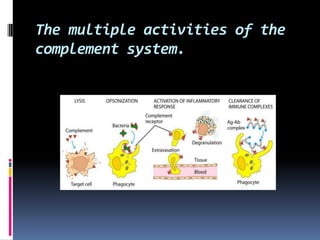
The multiple activities of the
complement system.
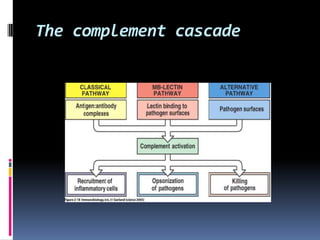
The complement cascade
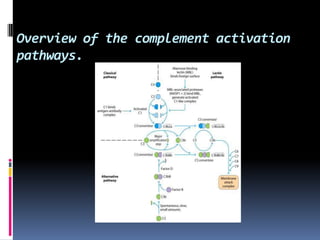
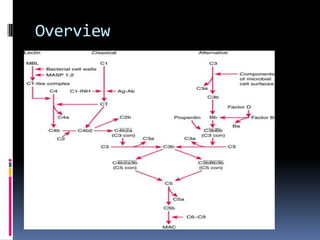
Overview of the complement activation
pathways.
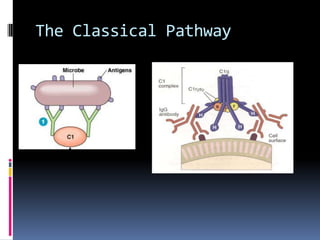
The Classical Pathway
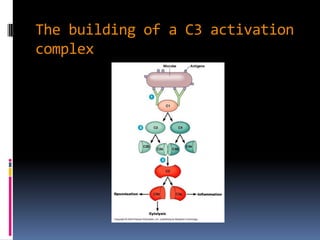
The building of a C3 activation
complex
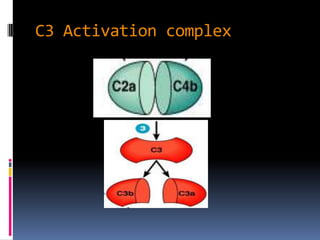
C3 Activation complex
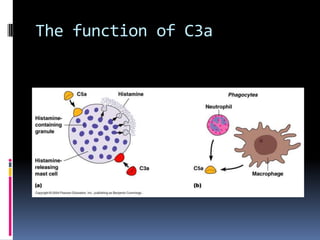
The function of C3a
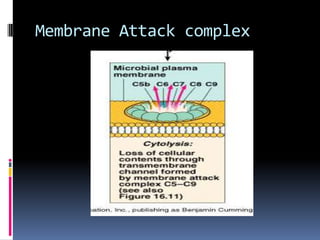
Membrane Attack complex
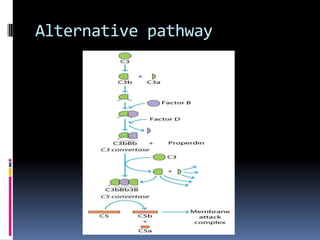
Alternative pathway
Overview
Complement Deficiency
Disease
   Cl inhibitor             Hereditary angioneurotic edema
   Early components of      SLE and other collagen
    Classical pathway C1,    Vascular diseases
      C2,C4
   C3 and its regulatory           Severe recurrent pyogenic
Protein C3b inactivator          infections


   C5 to C8                Bacteremia, mainly with
                            Gram negative diplococci, toxoplasmosis


   C9                      No particular disease
Pathologic effects of a normal
complement system

 - The immune complexes produced in
  autoimmune diseases may bind to vascular
  endothelium and kidney glomeruli and activate
  complement (MAC generation).
 - It initiates the acute inflammatory responses that
  destroy the vessel walls or glomeruli and lead to
  thrombosis, ischemic damage to tissues, and
  scarring.
 - Some of the late complement proteins
  activateprothrombinases in the circulation that
  initiate thrombosis.
CASE STUDIES-Case A

 Case A: A 23yr man complains of fever (102oF),
  headache, neck stiffness and fatigue of 2 days duration.
  Lumbar puncture shows increased pressure with cloudy
  cerebrospinal fluid containing large numbers of
  neutrophils, increased protein, decreased glucose and
  gram negative diplococci. Laboratory studies show C5
  (5th component of complement) levels at 18%and normal
  levels of C2, C3 and C7. The patient recovers after
  institution of intravenous antibiotic therapy.
?

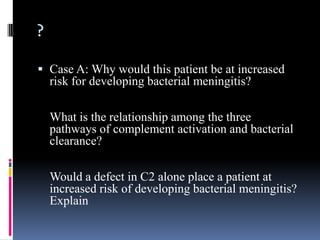
 Case A: Why would this patient be at increased
  risk for developing bacterial meningitis?

    What is the relationship among the three
    pathways of complement activation and bacterial
    clearance?

    Would a defect in C2 alone place a patient at
    increased risk of developing bacterial meningitis?
    Explain
Case B

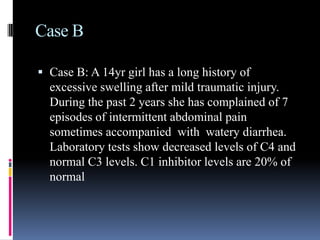
 Case B: A 14yr girl has a long history of
  excessive swelling after mild traumatic injury.
  During the past 2 years she has complained of 7
  episodes of intermittent abdominal pain
  sometimes accompanied with watery diarrhea.
  Laboratory tests show decreased levels of C4 and
  normal C3 levels. C1 inhibitor levels are 20% of
  normal
?

 What pathologic changes would explain this
  patients symptoms?

    What is the effect of defective C1 esterase levels
    on complement system regulation?

    What other inflammatory mediator systems are
    effected by C1esterase inhibitor?

    Why are these patients not at significant risk for
    bacterial infection?

Complement system

  • 1.
  • 2.
    The multiple activitiesof the complement system.
  • 3.
  • 4.
    Overview of thecomplement activation pathways.
  • 5.
  • 6.
    The building ofa C3 activation complex
  • 7.
  • 8.
  • 9.
  • 10.
  • 11.
  • 12.
    Complement Deficiency Disease  Cl inhibitor Hereditary angioneurotic edema  Early components of SLE and other collagen Classical pathway C1, Vascular diseases C2,C4  C3 and its regulatory Severe recurrent pyogenic Protein C3b inactivator infections  C5 to C8 Bacteremia, mainly with Gram negative diplococci, toxoplasmosis  C9 No particular disease
  • 13.
    Pathologic effects ofa normal complement system  - The immune complexes produced in autoimmune diseases may bind to vascular endothelium and kidney glomeruli and activate complement (MAC generation).  - It initiates the acute inflammatory responses that destroy the vessel walls or glomeruli and lead to thrombosis, ischemic damage to tissues, and scarring.  - Some of the late complement proteins activateprothrombinases in the circulation that initiate thrombosis.
  • 14.
    CASE STUDIES-Case A Case A: A 23yr man complains of fever (102oF), headache, neck stiffness and fatigue of 2 days duration. Lumbar puncture shows increased pressure with cloudy cerebrospinal fluid containing large numbers of neutrophils, increased protein, decreased glucose and gram negative diplococci. Laboratory studies show C5 (5th component of complement) levels at 18%and normal levels of C2, C3 and C7. The patient recovers after institution of intravenous antibiotic therapy.
  • 15.
    ?  Case A:Why would this patient be at increased risk for developing bacterial meningitis? What is the relationship among the three pathways of complement activation and bacterial clearance? Would a defect in C2 alone place a patient at increased risk of developing bacterial meningitis? Explain
  • 16.
    Case B  CaseB: A 14yr girl has a long history of excessive swelling after mild traumatic injury. During the past 2 years she has complained of 7 episodes of intermittent abdominal pain sometimes accompanied with watery diarrhea. Laboratory tests show decreased levels of C4 and normal C3 levels. C1 inhibitor levels are 20% of normal
  • 17.
    ?  What pathologicchanges would explain this patients symptoms? What is the effect of defective C1 esterase levels on complement system regulation? What other inflammatory mediator systems are effected by C1esterase inhibitor? Why are these patients not at significant risk for bacterial infection?