
Anthrax is an acute disease caused by
the bacterium Bacillus anthracis. Most
forms of the disease are lethal, and it
affects both humans and animals. There
are now effective vaccines against
anthrax, and some forms of the disease
respond well to antibiotic treatment.
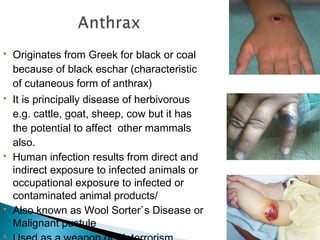
Cutaneous Anthrax:
An acute illness, or post-mortem examination revealing a painless skin
lesion developing over 2 to 6 days from a papular through a vesicular stage
into a depressed black eschar with surrounding edema. Fever, malaise and
lymphadenopathy may accompany the lesion.
Inhalation Anthrax:
An acute illness, or post-mortem examination revealing a prodrome
resembling a viral respiratory illness, followed by hypoxia, dyspnea or acute
respiratory distress with resulting cyanosis and shock. Radiological evidence
of mediastinal widening or pleural effusion is common.
Gastrointestinal Anthrax:
An acute illness, or post-mortem examination revealing severe abdominal
pain and tenderness, nausea, vomiting, hematemesis, bloody diarrhea,
anorexia, fever, abdominal swelling and septicemia.
Meningeal Anthrax:
An acute illness, or post-mortem examination revealing fever, convulsions,
coma, or meningeal signs. Signs of another form will likely be evident as this
syndrome is usually secondary to the above syndromes.
Definition Contd……..
 Originates from Greek for black or coal
because of black eschar (characteristic
of cutaneous form of anthrax)
 It is principally disease of herbivorous
e.g. cattle, goat, sheep, cow but it has
the potential to affect other mammals
also.
 Human infection results from direct and
indirect exposure to infected animals or
occupational exposure to infected or
contaminated animal products/
 Also known as Wool Sorter`s Disease or
Malignant pustule

Anthrax Global DistributionAnthrax Global Distribution
20,000 to 100,000 cases estimated globally/year20,000 to 100,000 cases estimated globally/year
http://www.vetmed.lsu.edu/whocc/mp_world.htmhttp://www.vetmed.lsu.edu/whocc/mp_world.htm
Bacillus anthracis - Gram positive non-
motile, spore forming rod with a
diameter of 1.5 µm and length of 5 µm ,
found in soil, herbs, vegetation, etc.
 Spores can remain viable for decades
so used as bio-weapon. They are also
resistant to heat, UV ray, radiation and
most disinfectants.
Spores are the predominant form in the
environment.
It is a Zoonosis.
Human infection occur as a result of contact
with the infected animal or animal products
e.g.- goat hair in textile mills, animal skin and
contaminated articles.
Modes: Inoculation of spores in breaks of skin,
Inhalation of spores, Ingestion of contaminated
food mainly meat.
Human to Human Transmission are extremely
rare.
Anthrax
Pathogenesis
Spore
 Cutaneous
Contact with infected
tissues, wool, hide, soil
Biting flies
 Inhalational
Tanning hides,
processing wool or bone
Direct inhalation of spores from contaminated articles
(used for bioterrorism)
 Gastrointestinal
Undercooked meat specially
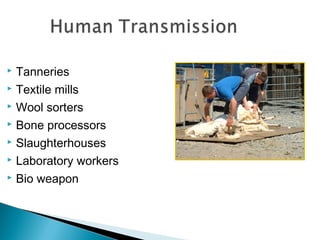
 Tanneries
 Textile mills
 Wool sorters
 Bone processors
 Slaughterhouses
 Laboratory workers
 Bio weapon
 Bacteria present in hemorrhagic
exudates from mouth, nose, anus
 Inhalation:
◦ Spores form
◦ Soil contamination
 Sporulation does not occur in a
closed carcass
 Spores viable for decades
 Ingestion
◦ Most common
◦ Herbivores
 Contaminated soil
 Heavy rainfall, drought
◦ Carnivores
 Contaminated meat
 Inhalation
 Mechanical (insects)
 Mainly three types :-
1. Cutaneous Anthrax
2. Pulmonary Anthrax
3. Gastro – intestinal Anthrax
Commonest form : over 95% of all
cases
Incubation period : 2 -6 days
Papule, Vesicle, Ulcer followed by
coaled black necrotic Escher
Lesion – painless & non purulent
Resolution of eschar occurs over 6
weeks and is not hastened by
treatment
Self limiting – over 90% resolve
without complication.
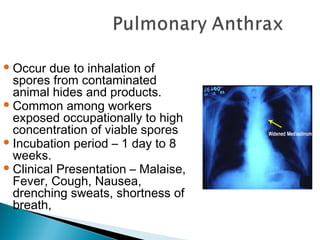
Occur due to inhalation of
spores from contaminated
animal hides and products.
Common among workers
exposed occupationally to high
concentration of viable spores
Incubation period – 1 day to 8
weeks.
Clinical Presentation – Malaise,
Fever, Cough, Nausea,
drenching sweats, shortness of
breath,
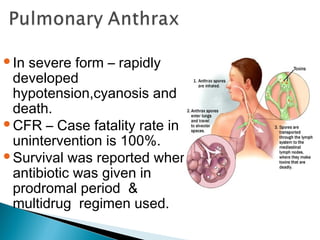
In severe form – rapidly
developed
hypotension,cyanosis and
death.
CFR – Case fatality rate in
unintervention is 100%.
Survival was reported when
antibiotic was given in
prodromal period &
multidrug regimen used.
 Following ingestion of organism in
contaminated food
 Incubation Period : 2 to 5 days
 Two clinical forms - Intestinal
anthrax and Oropharyngeal anthrax
 Intestinal :- nausea, vomiting, fever,
abdominal pain, diarrhoea,
haemetemesis, ascites , may be
fatal.
 Oropharyngeal – sore throat,
dysphagia, fever, lymphadenopathy
in neck etc
 Anthrax Meningitis :
- it is haemorrhagic also.
- may develope in 30-40% cases.
- 100% Mortality.
Anthrax and Biological Warfare
Countries > 10 countries in the
world
Clouds of spores of Anthrax
bacilli – aerosol ( war heads
filled with anthrax spores)
- Through dried spores in
envelops
September 9/11 WTC attack
Postal workers affected –
Inhalation anthrax
US – Columbia, Florida, New
Jersey, N. York
Other parts of the world
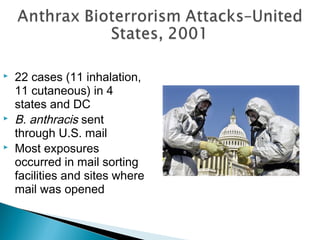
 22 cases (11 inhalation,
11 cutaneous) in 4
states and DC
 B. anthracis sent
through U.S. mail
 Most exposures
occurred in mail sorting
facilities and sites where
mail was opened
 50 kg of spores
◦ Urban area of 5 million
◦ Estimated impact
 250,000 cases of anthrax
 100,000 deaths
 100 kg of spores
◦ Upwind of Washington D.C.
◦ Estimated impact
 130,000 to 3 million deaths
 Do not open suspicious mail
◦ inappropriate or unusual labeling
◦ strange or no return address
◦ postmark different from return address
◦ excessive packaging material
 Keep mail away from face
 No not blow or sniff mail or mail contents
 Wash hands after handling
 Avoid vigorous handling (tearing, shredding)
 Discard envelopes
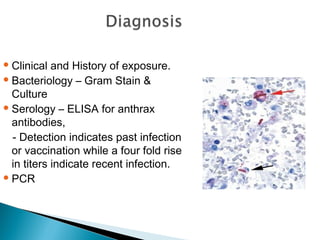
Clinical and History of exposure.
Bacteriology – Gram Stain &
Culture
Serology – ELISA for anthrax
antibodies,
- Detection indicates past infection
or vaccination while a four fold rise
in titers indicate recent infection.
PCR
SPECIMEN TO COLLECT ( HUMAN ANTHRAX)
Cutaneous anthrax: Vesicular exudate – swabs and
capillary tube aspirate
Intestinal anthrax: - Stool sample - isolate – guinea pig
inoculation
- Blood( venipuncture) smear examination for bacilli
- Peritoneal fluid for culture
- Paired sera for Ab
Pulmonary anthrax: If mild disease ( No sample)
Severely ill – Blood , sputum, serum samples for Ab
 Prompt and timely antibiotic
therapy
 Penicillin is yet the antibiotic of
choice
 Other antibiotics –
Chloramphenicol, Tetracycline,
Doxycycline, Fluoroquinolones,
Erythromycin
 During the Bioterrorism attack in 2001
in USA, it was found that using two or
more antibiotics intravenously
improved survival.
 CDC protocols issued after the
bioterrorism attacks recommend
ciprofloxacin 400 mg BD or
Doxycycline 100 mg BD for a total of
60 days
 Treatment remains same for pregnant
women and immunocompromised
individuals.
Preliminary disinfection
10% formaldehyde
4% glutaraldehyde (pH 8.0-8.5)
Cleaning
Hot water, scrubbing, protective clothing
Final disinfection: one of the following
10% formaldehyde
4% glutaraldehyde (pH 8.0-8.5)
3% hydrogen peroxide,
1% peracetic acid
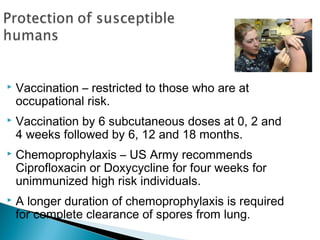
 Vaccination – restricted to those who are at
occupational risk.
 Vaccination by 6 subcutaneous doses at 0, 2 and
4 weeks followed by 6, 12 and 18 months.
 Chemoprophylaxis – US Army recommends
Ciprofloxacin or Doxycycline for four weeks for
unimmunized high risk individuals.
 A longer duration of chemoprophylaxis is required
for complete clearance of spores from lung.
 Integrated plan of control activities with
Health, Animal husbandry, PRI and other
related sectors
 Screening of animals
 Control of the disease in animals is key to
prevention of anthrax in humans
 Quartantine the area
 Vaccination of susceptible animals
 Correct disposal of infected carcasses by
deep burial
 Proper disinfection, decontamination and
disposal of contaminated materials.
 Early diagnosis and prompt treatment (both for human and animals).
 Chemoprophylaxis of contacts with specific antibiotics (Doxycycline,
Ciprofloxacin)
 Awareness campaign (IEC and BCC)
- prompt information sharing
- seeking health advice
- proper handling of animals in slaughter house, tanning
industry, etc
- not to kill sick animals for consumption, proper cooking
of specially meat products, deep burial of the dead
animals.
THANK YOU

Anthrax_D Dutta

  • 2.
    Anthrax is an acute disease causedby the bacterium Bacillus anthracis. Most forms of the disease are lethal, and it affects both humans and animals. There are now effective vaccines against anthrax, and some forms of the disease respond well to antibiotic treatment.
  • 3.
    Cutaneous Anthrax: An acuteillness, or post-mortem examination revealing a painless skin lesion developing over 2 to 6 days from a papular through a vesicular stage into a depressed black eschar with surrounding edema. Fever, malaise and lymphadenopathy may accompany the lesion. Inhalation Anthrax: An acute illness, or post-mortem examination revealing a prodrome resembling a viral respiratory illness, followed by hypoxia, dyspnea or acute respiratory distress with resulting cyanosis and shock. Radiological evidence of mediastinal widening or pleural effusion is common. Gastrointestinal Anthrax: An acute illness, or post-mortem examination revealing severe abdominal pain and tenderness, nausea, vomiting, hematemesis, bloody diarrhea, anorexia, fever, abdominal swelling and septicemia. Meningeal Anthrax: An acute illness, or post-mortem examination revealing fever, convulsions, coma, or meningeal signs. Signs of another form will likely be evident as this syndrome is usually secondary to the above syndromes. Definition Contd……..
  • 4.
     Originates fromGreek for black or coal because of black eschar (characteristic of cutaneous form of anthrax)  It is principally disease of herbivorous e.g. cattle, goat, sheep, cow but it has the potential to affect other mammals also.  Human infection results from direct and indirect exposure to infected animals or occupational exposure to infected or contaminated animal products/  Also known as Wool Sorter`s Disease or Malignant pustule 
  • 5.
    Anthrax Global DistributionAnthraxGlobal Distribution 20,000 to 100,000 cases estimated globally/year20,000 to 100,000 cases estimated globally/year http://www.vetmed.lsu.edu/whocc/mp_world.htmhttp://www.vetmed.lsu.edu/whocc/mp_world.htm
  • 6.
    Bacillus anthracis -Gram positive non- motile, spore forming rod with a diameter of 1.5 µm and length of 5 µm , found in soil, herbs, vegetation, etc.  Spores can remain viable for decades so used as bio-weapon. They are also resistant to heat, UV ray, radiation and most disinfectants. Spores are the predominant form in the environment.
  • 7.
    It is aZoonosis. Human infection occur as a result of contact with the infected animal or animal products e.g.- goat hair in textile mills, animal skin and contaminated articles. Modes: Inoculation of spores in breaks of skin, Inhalation of spores, Ingestion of contaminated food mainly meat. Human to Human Transmission are extremely rare.
  • 9.
  • 10.
     Cutaneous Contact withinfected tissues, wool, hide, soil Biting flies  Inhalational Tanning hides, processing wool or bone Direct inhalation of spores from contaminated articles (used for bioterrorism)  Gastrointestinal Undercooked meat specially
  • 11.
     Tanneries  Textilemills  Wool sorters  Bone processors  Slaughterhouses  Laboratory workers  Bio weapon
  • 12.
     Bacteria presentin hemorrhagic exudates from mouth, nose, anus  Inhalation: ◦ Spores form ◦ Soil contamination  Sporulation does not occur in a closed carcass  Spores viable for decades
  • 13.
     Ingestion ◦ Mostcommon ◦ Herbivores  Contaminated soil  Heavy rainfall, drought ◦ Carnivores  Contaminated meat  Inhalation  Mechanical (insects)
  • 14.
     Mainly threetypes :- 1. Cutaneous Anthrax 2. Pulmonary Anthrax 3. Gastro – intestinal Anthrax
  • 15.
    Commonest form :over 95% of all cases Incubation period : 2 -6 days Papule, Vesicle, Ulcer followed by coaled black necrotic Escher Lesion – painless & non purulent Resolution of eschar occurs over 6 weeks and is not hastened by treatment Self limiting – over 90% resolve without complication.
  • 19.
    Occur due toinhalation of spores from contaminated animal hides and products. Common among workers exposed occupationally to high concentration of viable spores Incubation period – 1 day to 8 weeks. Clinical Presentation – Malaise, Fever, Cough, Nausea, drenching sweats, shortness of breath,
  • 20.
    In severe form– rapidly developed hypotension,cyanosis and death. CFR – Case fatality rate in unintervention is 100%. Survival was reported when antibiotic was given in prodromal period & multidrug regimen used.
  • 21.
     Following ingestionof organism in contaminated food  Incubation Period : 2 to 5 days  Two clinical forms - Intestinal anthrax and Oropharyngeal anthrax  Intestinal :- nausea, vomiting, fever, abdominal pain, diarrhoea, haemetemesis, ascites , may be fatal.  Oropharyngeal – sore throat, dysphagia, fever, lymphadenopathy in neck etc
  • 22.
     Anthrax Meningitis: - it is haemorrhagic also. - may develope in 30-40% cases. - 100% Mortality.
  • 23.
    Anthrax and BiologicalWarfare Countries > 10 countries in the world Clouds of spores of Anthrax bacilli – aerosol ( war heads filled with anthrax spores) - Through dried spores in envelops September 9/11 WTC attack Postal workers affected – Inhalation anthrax US – Columbia, Florida, New Jersey, N. York Other parts of the world
  • 24.
     22 cases(11 inhalation, 11 cutaneous) in 4 states and DC  B. anthracis sent through U.S. mail  Most exposures occurred in mail sorting facilities and sites where mail was opened
  • 25.
     50 kgof spores ◦ Urban area of 5 million ◦ Estimated impact  250,000 cases of anthrax  100,000 deaths  100 kg of spores ◦ Upwind of Washington D.C. ◦ Estimated impact  130,000 to 3 million deaths
  • 26.
     Do notopen suspicious mail ◦ inappropriate or unusual labeling ◦ strange or no return address ◦ postmark different from return address ◦ excessive packaging material  Keep mail away from face  No not blow or sniff mail or mail contents  Wash hands after handling  Avoid vigorous handling (tearing, shredding)  Discard envelopes
  • 27.
    Clinical and Historyof exposure. Bacteriology – Gram Stain & Culture Serology – ELISA for anthrax antibodies, - Detection indicates past infection or vaccination while a four fold rise in titers indicate recent infection. PCR
  • 28.
    SPECIMEN TO COLLECT( HUMAN ANTHRAX) Cutaneous anthrax: Vesicular exudate – swabs and capillary tube aspirate Intestinal anthrax: - Stool sample - isolate – guinea pig inoculation - Blood( venipuncture) smear examination for bacilli - Peritoneal fluid for culture - Paired sera for Ab Pulmonary anthrax: If mild disease ( No sample) Severely ill – Blood , sputum, serum samples for Ab
  • 29.
     Prompt andtimely antibiotic therapy  Penicillin is yet the antibiotic of choice  Other antibiotics – Chloramphenicol, Tetracycline, Doxycycline, Fluoroquinolones, Erythromycin
  • 30.
     During theBioterrorism attack in 2001 in USA, it was found that using two or more antibiotics intravenously improved survival.  CDC protocols issued after the bioterrorism attacks recommend ciprofloxacin 400 mg BD or Doxycycline 100 mg BD for a total of 60 days  Treatment remains same for pregnant women and immunocompromised individuals.
  • 31.
    Preliminary disinfection 10% formaldehyde 4%glutaraldehyde (pH 8.0-8.5) Cleaning Hot water, scrubbing, protective clothing Final disinfection: one of the following 10% formaldehyde 4% glutaraldehyde (pH 8.0-8.5) 3% hydrogen peroxide, 1% peracetic acid
  • 32.
     Vaccination –restricted to those who are at occupational risk.  Vaccination by 6 subcutaneous doses at 0, 2 and 4 weeks followed by 6, 12 and 18 months.  Chemoprophylaxis – US Army recommends Ciprofloxacin or Doxycycline for four weeks for unimmunized high risk individuals.  A longer duration of chemoprophylaxis is required for complete clearance of spores from lung.
  • 33.
     Integrated planof control activities with Health, Animal husbandry, PRI and other related sectors  Screening of animals  Control of the disease in animals is key to prevention of anthrax in humans  Quartantine the area  Vaccination of susceptible animals  Correct disposal of infected carcasses by deep burial  Proper disinfection, decontamination and disposal of contaminated materials.
  • 34.
     Early diagnosisand prompt treatment (both for human and animals).  Chemoprophylaxis of contacts with specific antibiotics (Doxycycline, Ciprofloxacin)  Awareness campaign (IEC and BCC) - prompt information sharing - seeking health advice - proper handling of animals in slaughter house, tanning industry, etc - not to kill sick animals for consumption, proper cooking of specially meat products, deep burial of the dead animals.
  • 35.

Editor's Notes

  • #11 There are three main routes of anthrax transmission in humans. Cutaneous anthrax may occur when handling infected tissues, wool, hides, soil, and products made from contaminated hides or hair, such as drums, rugs, or brushes. Biting flies are also suspected of being mechanical vectors of anthrax to humans under certain conditions. Inhalational anthrax has been associated with tanning hides and processing wool or bone. Gastrointestinal anthrax occurs when individuals eat undercooked contaminated meat from animals that have died of anthrax. Laboratory acquired cases have also occurred. [The top image shows wool hanging outdoors. Bottom image: Cattle hides. Source (for both): pixabay.com-public domain]
  • #12 People with occupational exposure to animal products are at risk of anthrax infection. This includes workers in tanneries, textile mills, wool sorters, and others. In the 1960s, unvaccinated mill workers were ‘chronically exposed’ to anthrax; case rates of 0.6 to 1.4% were observed. B. anthracis was recovered from the nose and pharynx of 14% of healthy workers in one study; in another study, workers were inhaled 600 to 1300 spores during the working day with no ill effect. A well-documented outbreak of pulmonary anthrax occurred in one mill with a similar level of contamination. [Photo shows two men shearing sheep. Source: geograph.org.uk-creative-commons]
  • #13 In infected animals, large numbers of bacteria are present in hemorrhagic exudates from the mouth, nose, and anus. When they are exposed to oxygen, these bacteria form spores and contaminate the soil. Sporulation also occurs if a carcass is opened and oxygen exposure occurs – sporulation does not occur inside a closed carcass. Anthrax spores can remain viable for decades in the soil or animal products, such as dried or processed hides and wool. Spores can survive for two years in water, 10 years in milk, and up to 71 years on silk threads. Vegetative organisms are thought to be destroyed within a few days during the decomposition of unopened carcasses.
  • #14 In animals, transmission occurs by ingestion and possibly inhalation of spores, although entry through skin lesions has not been ruled out. Herbivores usually become infected when they ingest sufficient numbers of spores in soil or on plants in pastures. Outbreaks are often associated with heavy rainfall, flooding, or drought. Contaminated bone meal and other feed can also spread this disease. Carnivores usually become infected after eating contaminated meat. Vultures and flies may disseminate anthrax mechanically after feeding on infected carcasses. [This photo shows cattle grazing in a pasture. Source: U.S. Department of Agriculture, NRCS]
  • #26 Previous acts of biological terrorism have been small in scale. It is estimated that in a city of 5 million people, a release of 50 kg of anthrax spores (10 km upwind and 2 km wide) would extend over 20 km in 2 hours. This would result in 500,000 people placed at risk. There would be an estimated 250,000 illness and 125,000 deaths. A 1993 report by the U.S. Congressional Office of Technology Assessment estimated that 130,000 to 3 million deaths may occur following the aerosolized release of 100 kg of anthrax spores upwind of Washington D.C.
  • #32 Where practical, cleaning of all surfaces should be done by straightforward washing and scrubbing using ample hot water. Protective clothing should be worn. For final disinfection, one of the following disinfectants should be applied at a rate of 0.4 liters per square meter for an exposure time of at least 2 hours: 10% formaldehyde (approximately 30% formalin), 4% glutaraldehyde (pH 8.0-8.5), 3% hydrogen peroxide, or 1% peracetic acid. Hydrogen peroxide and peracetic acid are not appropriate if blood is present. When using glutaraldehyde, hydrogen peroxide, or peracetic acid, the surface should be treated twice with an interval of at least one hour between applications. Formaldehyde and glutaraldehyde should not be used at temperatures below 10oC. After the final disinfection, closed spaces, such as rooms or animal houses, should be well ventilated before use. The effectiveness of the disinfection procedure cannot be assumed, and attempts should be made to confirm it has been adequate by means of swabs and culture.