Anthrax and
     Anthrax Vaccine
    Under Supervision of :
Prof. Dr Ekram M. El-Shabrawy
Team Work :
   Mostafa Emad Ahmed
   Mohammed Bahaa El-Din
   Mostafa Abd-Elsamee
   Ahmed Mohamed Taha
Contents
Causative            Laboratory Tests
 Organism.            Vaccine
Disease Exit.        Treatment
Pathogenesis.        Chemoprophylaxis
Virulence Factors. Epidemiology.
Clinical Forms.    Prevention &
Clinical Findings.    Control
Causative Organism
Scientific classification:-
              • Bacteria
    Kingom
              • Firmicutes
    Phylum
               • Bacilli
     Class
              • Bacillacea
    Family
              • Bacillus
     Genus
              • B. anthracis
    Species
Causative Organism
    * Bacillus Species

 The genus bacillus includes large
  aerobic.
 Gram-positive rods occurring in chains.
 Most members of this genus are
  saprophytic organisms prevalent in soil,
  water, and air and on vegetation.
 Spores may remain viable in soil for
  years
Causative Organism
B cereus can grow in foods and
 produce an enterotoxin or an
 emetic toxin and cause food
 poisoning.
may occasionally produce
 disease in immunocompromised
 humans .
 B anthracis, which causes
 anthrax, is the principal
 pathogen of the genus.
Causative Organism
   * Morphology
The typical cells,
 measuring 1 x 3 - 4
 micron.
have square ends
 and are arranged in
 long chains.
spores are located
 in the center of the
 nonmotile bacilli.
Causative Organism
   Identification
On Culture:-
Colonies of B anthraces are
 round and have a "cut glass"
 appearance.


Haemolysis is uncommon with
 B anthraces.
Causative Organism
 Identification

Growth in
 gelatine stabs
 resembles an
 inverted fir
 tree.
Causative Organism
    Identification
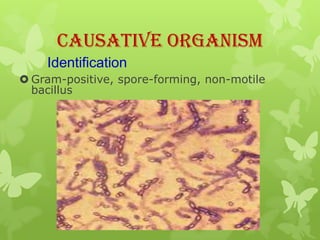
 Gram-positive, spore-forming, non-motile
  bacillus
Causative Organism
Growth Characteristics:-
 The saprophytic bacilli utilize simple
  sources of nitrogen and carbon for
  energy and growth.

 The spores are resistant to
  environmental changes, withstand dry
  heat and certain chemical disinfectants
  for moderate periods, and persist for
  years in dry earth
Disease Exit
     Type :-
 Anthrax is primarily a Zoonotic disease ( eg. goats,
  sheep, cattle, horses, etc;)
 other animals (eg, rats) are relatively resistant to
 the infection
Disease Exit
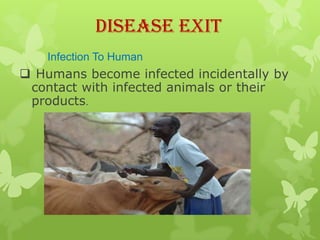
    Infection To Human
 Humans become infected incidentally by
 contact with infected animals or their
 products.
Disease Exit
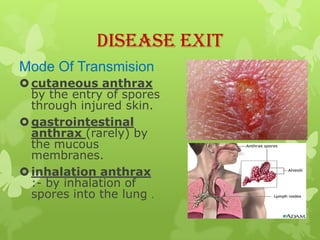
Mode Of Transmision
 cutaneous anthrax
  by the entry of spores
  through injured skin.
 gastrointestinal
  anthrax (rarely) by
  the mucous
  membranes.
 inhalation anthrax
  :- by inhalation of
  spores into the lung .
Pathogenesis
                   growth of
                      the
                   vegetative
                   organisms


                                  via lymphatics
To Man or Animal                to the bloodstream


                      From
                      dead
                     body to
                      Env.
Pathogenesis
B anthracis that does not produce a
 capsule is not virulent and does not
 induce anthrax in test animals.


 The poly-D-glutamic acid capsule is
 antiphagocytic. The capsule gene is
 on a plasmid.
Virulence Factors
     Anthrax Toxin:-
Toxin Structure:-
  Anthrax toxin is made up of three proteins:-

 protective antigen (PA).

 edema factor (EF).

 lethal factor (LF).
Virulence Factors
    Anthrax Toxin:-
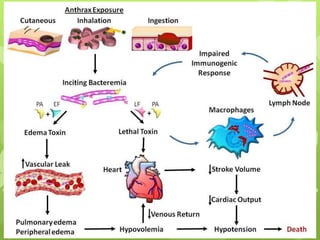
 EF is an adenylyl cyclase; with PA it forms a
  toxin known as edema toxin.

 LF plus PA form lethal toxin, which is a
 major virulence factor and cause of death in
 infected animals.

 Toxins responsible for tissue damage and
  edema
Virulence Factors
Anthrax Toxin:-

Lethal Factor     Protective Antigen   Edema Factor


           Lethal Toxin          Edema Toxin


      Tissue damage, shock         Edema
Virulence Factors
How Toxin Work:-
clinical
             forms


Cutaneous      GIT     Pulmonary
Clinical Findings
 In humans, approximately 95% of cases are
  cutaneous anthrax and 5% are inhalation.

  100%
   90%
   80%
   70%
   60%                                Column1
   50%
                                      Series 2
   40%
   30%                                Series 1
   20%
   10%
    0%
         cutanous   Pulmonary   GIT
Clinical Findings
 Gastrointestinal anthrax is very
  rare; it has been reported from Africa,
  Asia, and the United States following
  occasions where people have eaten
  meat from infected animals.

 The bioterrorism events in the fall of
  2001 resulted in 22 cases of anthrax:
  11 inhalation and 11 cutaneous. Five of
  the patients with inhalation anthrax
  died. All the other patients survived.
Cutaneous Anthrax
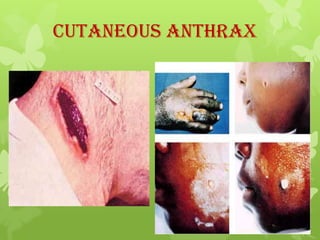
     Clinical Picture :-
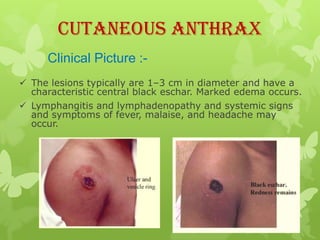
 The lesions typically are 1–3 cm in diameter and have a
  characteristic central black eschar. Marked edema occurs.
 Lymphangitis and lymphadenopathy and systemic signs
  and symptoms of fever, malaise, and headache may
  occur.
Cutaneous Anthrax
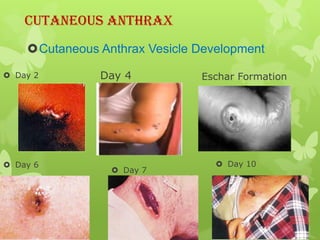
    Cutaneous Anthrax Vesicle Development

 Day 2        Day 4           Eschar Formation


 Day 6                            Day 10
                  Day 7
Cutaneous Anthrax
   Sequelae :-
1) Healing
 After 7–10 days the eschar is fully developed.
  Eventually it dries, loosens, and separates.


 healing is by granulation and leaves a scar.


 It may take many weeks for the lesion to
 heal and the edema to subside.
Cutaneous Anthrax
 Sequelae :-
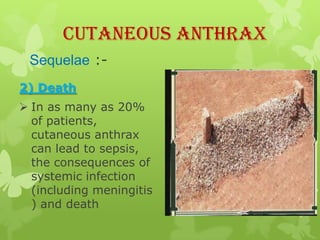
2) Death
 In as many as 20%
  of patients,
  cutaneous anthrax
  can lead to sepsis,
  the consequences of
  systemic infection
  (including meningitis
  ) and death
Cutaneous Anthrax
Inhalation Anthrax
   Preview:-
 Incubation period: 1-7 days (range up to
  43 days).

 Infection occure by inhalation of B.Anthrasis
  spores.

 Case-fatality:
    1) without antibiotic treatment – 85%- 97%
    2) with antibiotic treatment – 75% (45% in
2001)
Inhalation Anthrax
Clinical Picture:-
 The early clinical manifestations are associated
  with marked hemorrhagic necrosis and edema
  of the mediastinum.
Inhalation Anthrax
   Clinical Picture:-
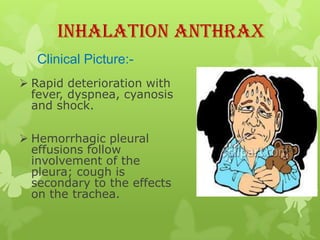
 Rapid deterioration with
  fever, dyspnea, cyanosis
  and shock.

 Hemorrhagic pleural
  effusions follow
  involvement of the
  pleura; cough is
  secondary to the effects
  on the trachea.
Inhalation Anthrax
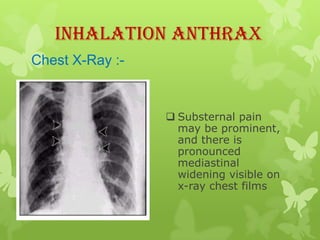
                 Chest X-rays is
Chest X-Ray :-   advised as an initial
                 method of inhalation
                 anthrax detection,
                 but it is sometimes
                 not useful for
                 patients without
                 symptoms.

                 Find a widened
                 mediastinum and
                 pleural effusion
Inhalation Anthrax
Chest X-Ray :-


                  Substernal pain
                   may be prominent,
                   and there is
                   pronounced
                   mediastinal
                   widening visible on
                   x-ray chest films
Gastrointestinal anthrax
Preview:-
Animals acquire anthrax through
 ingestion of spores and spread of the
 organisms from the intestinal tract


This is Rare in Humans,
 Gastrointestinal anthrax is Extremely
 Uncommon.
Gastrointestinal anthrax
Clinical Picture :-
Abdominal pain, vomiting, and bloody
 diarrhea are clinical signs.


Sepsis occurs, and there may be
 hematogenous spread to the
 gastrointestinal tract, causing bowel
 ulceration, or to the meninges,
 causing hemorrhagic meningitis.
Laboratory Diagnostic Tests
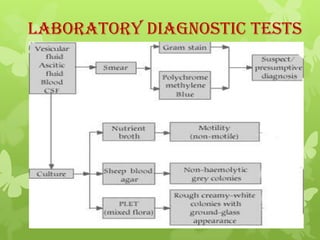
    Specimens:-
 Specimens to be
  examined are fluid
  or pus from a local
  lesion, blood, and
  sputum.


Gram Stain :-
    Gram stain shows
    large gram-positive
    rods.
Laboratory Diagnostic Tests
Direct Examination :
 Stained smears from the local lesion or of
  blood from dead animals often show chains of
  large gram-positive rods.
 Carbohydrate fermentation is not useful.
 . Anthrax can be identified in dried smears by
  immunofluorescence staining techniques.


        immunofluorescence staining of sporation
Laboratory Diagnostic Tests
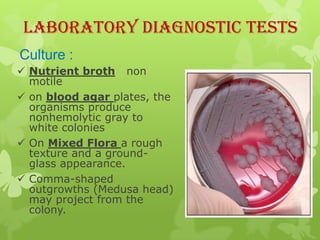
Culture :
 Nutrient broth non
  motile
 on blood agar plates, the
  organisms produce
  nonhemolytic gray to
  white colonies
 On Mixed Flora a rough
  texture and a ground-
  glass appearance.
 Comma-shaped
  outgrowths (Medusa head)
  may project from the
  colony.
Laboratory Diagnostic Tests
Lab Characters
 Virulent anthrax cultures kill mice upon
  intraperitoneal injection.


 Demonstration of capsule requires growth
  on bicarbonate-containing medium in 5–7%
  CO2.


 Lysis by a specific anthrax -bacteriophage
 may be helpful in identifying the organism.
Anthrax Vaccines
   Development By Years
 1881   Pasteur develops first live attenuated
         veterinary vaccine for livestock


 1939   Improved live veterinary vaccine


 1954   First cell-free human vaccine


 1970   Improved cell-free vaccine licensed
Anthrax Vaccines
Preparation:
 Immunization to prevent
  anthrax is based on the
  classic experiments of
  Louis Pasteur.
 In 1881 he proved that
  cultures grown in broth at
  42–52 C for several
  months lost much of their
  virulence
 be injected live into sheep
  and cattle without causing    Louis Pasteur
  disease; subsequently,
  such animals proved to be
  immune.
Anthrax Vaccines
Preparation:
 Four countries
  produce vaccines for
  anthrax.
 Russia and China
  use attenuated spore-
  based vaccine
  administered by
  scarification.
 The US and Great
  Britain use a bacteria-
  free filtrate of cultures
  adsorbed to aluminum
  hydroxide
Anthrax Vaccines
Pre-exposure Vaccination
The current US FDA approved
  vaccine contains cell-free filtrates of
  a toxigenic nonencapsulated
  nonvirulent strain of B anthracis.

The vaccine is available only to the
 US Department of Defense and to
 persons at risk for repeated
 exposure to B anthracis.
Anthrax Vaccines
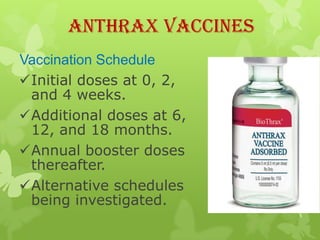
Vaccination Schedule
Initial doses at 0, 2,
 and 4 weeks.
Additional doses at 6,
 12, and 18 months.
Annual booster doses
 thereafter.
Alternative schedules
 being investigated.
Anthrax Vaccines
Post-exposure Vaccination
 No efficacy data for postexposure
  vaccination of humans.

 Postexposure vaccination alone not
  effective in animals

 Combination of vaccine and antibiotics
  appears effective in animal model
Anthrax Vaccines
Precautions and Contraindications
Severe allergic reaction to a vaccine
 component or following a prior dose.

Previous anthrax disease.

Moderate or severe acute illness.

                               • By: El Omda
Treatment
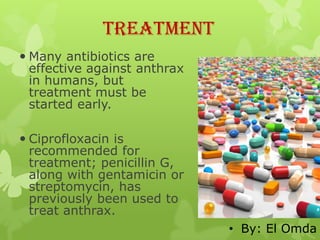
 Many antibiotics are
  effective against anthrax
  in humans, but
  treatment must be
  started early.

 Ciprofloxacin is
  recommended for
  treatment; penicillin G,
  along with gentamicin or
  streptomycin, has
  previously been used to
  treat anthrax.
                              • By: El Omda
Chemoprophylaxis
 prophylaxis with
  ciprofloxacin or
  doxycycline should be
  continued for 4 weeks
  while three doses of
  vaccine are being
  given, or for 8 weeks if
  no vaccine is
  administered.
 In the setting of
  potential exposure to B
  anthracis as an agent
  of biologic warfare.
                             • By: El Omda
Epidemiology
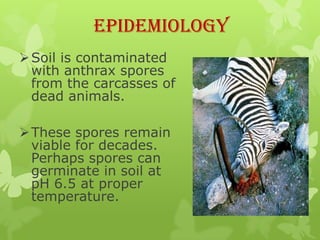
 Soil is contaminated
  with anthrax spores
  from the carcasses of
  dead animals.

 These spores remain
  viable for decades.
  Perhaps spores can
  germinate in soil at
  pH 6.5 at proper
  temperature.
Epidemiology
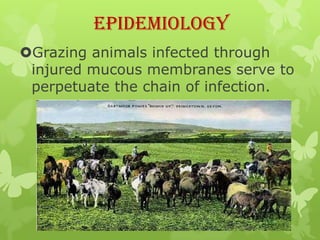
Grazing animals infected through
 injured mucous membranes serve to
 perpetuate the chain of infection.
Prevention & Control
Control measures include :-
(1) disposal of animal carcasses by
 burning or by deep burial in lime pits,
(2) decontamination of animal
 products.
(3) protective clothing and gloves for
 handling potentially infected materials.
(4) active immunization of domestic
 animals with live attenuated vaccines.
 Persons with high occupational risk
 should be immunized.         • By: El Omda
• By: El Omda

Anthrax ..

  • 1.
    Anthrax and Anthrax Vaccine Under Supervision of : Prof. Dr Ekram M. El-Shabrawy Team Work :  Mostafa Emad Ahmed  Mohammed Bahaa El-Din  Mostafa Abd-Elsamee  Ahmed Mohamed Taha
  • 2.
    Contents Causative Laboratory Tests Organism. Vaccine Disease Exit. Treatment Pathogenesis. Chemoprophylaxis Virulence Factors. Epidemiology. Clinical Forms. Prevention & Clinical Findings. Control
  • 3.
    Causative Organism Scientific classification:- • Bacteria Kingom • Firmicutes Phylum • Bacilli Class • Bacillacea Family • Bacillus Genus • B. anthracis Species
  • 4.
    Causative Organism * Bacillus Species  The genus bacillus includes large aerobic.  Gram-positive rods occurring in chains.  Most members of this genus are saprophytic organisms prevalent in soil, water, and air and on vegetation.  Spores may remain viable in soil for years
  • 5.
    Causative Organism B cereuscan grow in foods and produce an enterotoxin or an emetic toxin and cause food poisoning. may occasionally produce disease in immunocompromised humans .  B anthracis, which causes anthrax, is the principal pathogen of the genus.
  • 6.
    Causative Organism * Morphology The typical cells, measuring 1 x 3 - 4 micron. have square ends and are arranged in long chains. spores are located in the center of the nonmotile bacilli.
  • 7.
    Causative Organism Identification On Culture:- Colonies of B anthraces are round and have a "cut glass" appearance. Haemolysis is uncommon with B anthraces.
  • 8.
    Causative Organism Identification Growthin gelatine stabs resembles an inverted fir tree.
  • 9.
    Causative Organism Identification  Gram-positive, spore-forming, non-motile bacillus
  • 10.
    Causative Organism Growth Characteristics:- The saprophytic bacilli utilize simple sources of nitrogen and carbon for energy and growth.  The spores are resistant to environmental changes, withstand dry heat and certain chemical disinfectants for moderate periods, and persist for years in dry earth
  • 11.
    Disease Exit Type :-  Anthrax is primarily a Zoonotic disease ( eg. goats, sheep, cattle, horses, etc;)  other animals (eg, rats) are relatively resistant to the infection
  • 12.
    Disease Exit Infection To Human  Humans become infected incidentally by contact with infected animals or their products.
  • 13.
    Disease Exit Mode OfTransmision  cutaneous anthrax by the entry of spores through injured skin.  gastrointestinal anthrax (rarely) by the mucous membranes.  inhalation anthrax :- by inhalation of spores into the lung .
  • 14.
    Pathogenesis growth of the vegetative organisms via lymphatics To Man or Animal to the bloodstream From dead body to Env.
  • 15.
    Pathogenesis B anthracis thatdoes not produce a capsule is not virulent and does not induce anthrax in test animals.  The poly-D-glutamic acid capsule is antiphagocytic. The capsule gene is on a plasmid.
  • 16.
    Virulence Factors Anthrax Toxin:- Toxin Structure:- Anthrax toxin is made up of three proteins:-  protective antigen (PA).  edema factor (EF).  lethal factor (LF).
  • 17.
    Virulence Factors Anthrax Toxin:-  EF is an adenylyl cyclase; with PA it forms a toxin known as edema toxin.  LF plus PA form lethal toxin, which is a major virulence factor and cause of death in infected animals.  Toxins responsible for tissue damage and edema
  • 18.
    Virulence Factors Anthrax Toxin:- LethalFactor Protective Antigen Edema Factor Lethal Toxin Edema Toxin Tissue damage, shock Edema
  • 19.
  • 21.
    clinical forms Cutaneous GIT Pulmonary
  • 22.
    Clinical Findings  Inhumans, approximately 95% of cases are cutaneous anthrax and 5% are inhalation. 100% 90% 80% 70% 60% Column1 50% Series 2 40% 30% Series 1 20% 10% 0% cutanous Pulmonary GIT
  • 23.
    Clinical Findings  Gastrointestinalanthrax is very rare; it has been reported from Africa, Asia, and the United States following occasions where people have eaten meat from infected animals.  The bioterrorism events in the fall of 2001 resulted in 22 cases of anthrax: 11 inhalation and 11 cutaneous. Five of the patients with inhalation anthrax died. All the other patients survived.
  • 24.
    Cutaneous Anthrax Clinical Picture :-  The lesions typically are 1–3 cm in diameter and have a characteristic central black eschar. Marked edema occurs.  Lymphangitis and lymphadenopathy and systemic signs and symptoms of fever, malaise, and headache may occur.
  • 25.
    Cutaneous Anthrax Cutaneous Anthrax Vesicle Development  Day 2 Day 4 Eschar Formation  Day 6  Day 10  Day 7
  • 26.
    Cutaneous Anthrax Sequelae :- 1) Healing  After 7–10 days the eschar is fully developed. Eventually it dries, loosens, and separates.  healing is by granulation and leaves a scar.  It may take many weeks for the lesion to heal and the edema to subside.
  • 27.
    Cutaneous Anthrax Sequelae:- 2) Death  In as many as 20% of patients, cutaneous anthrax can lead to sepsis, the consequences of systemic infection (including meningitis ) and death
  • 28.
  • 29.
    Inhalation Anthrax Preview:-  Incubation period: 1-7 days (range up to 43 days).  Infection occure by inhalation of B.Anthrasis spores.  Case-fatality: 1) without antibiotic treatment – 85%- 97% 2) with antibiotic treatment – 75% (45% in 2001)
  • 30.
    Inhalation Anthrax Clinical Picture:- The early clinical manifestations are associated with marked hemorrhagic necrosis and edema of the mediastinum.
  • 31.
    Inhalation Anthrax Clinical Picture:-  Rapid deterioration with fever, dyspnea, cyanosis and shock.  Hemorrhagic pleural effusions follow involvement of the pleura; cough is secondary to the effects on the trachea.
  • 32.
    Inhalation Anthrax Chest X-rays is Chest X-Ray :- advised as an initial method of inhalation anthrax detection, but it is sometimes not useful for patients without symptoms. Find a widened mediastinum and pleural effusion
  • 33.
    Inhalation Anthrax Chest X-Ray:-  Substernal pain may be prominent, and there is pronounced mediastinal widening visible on x-ray chest films
  • 34.
    Gastrointestinal anthrax Preview:- Animals acquireanthrax through ingestion of spores and spread of the organisms from the intestinal tract This is Rare in Humans, Gastrointestinal anthrax is Extremely Uncommon.
  • 35.
    Gastrointestinal anthrax Clinical Picture:- Abdominal pain, vomiting, and bloody diarrhea are clinical signs. Sepsis occurs, and there may be hematogenous spread to the gastrointestinal tract, causing bowel ulceration, or to the meninges, causing hemorrhagic meningitis.
  • 36.
    Laboratory Diagnostic Tests Specimens:-  Specimens to be examined are fluid or pus from a local lesion, blood, and sputum. Gram Stain :-  Gram stain shows large gram-positive rods.
  • 37.
    Laboratory Diagnostic Tests DirectExamination :  Stained smears from the local lesion or of blood from dead animals often show chains of large gram-positive rods.  Carbohydrate fermentation is not useful.  . Anthrax can be identified in dried smears by immunofluorescence staining techniques. immunofluorescence staining of sporation
  • 38.
    Laboratory Diagnostic Tests Culture:  Nutrient broth non motile  on blood agar plates, the organisms produce nonhemolytic gray to white colonies  On Mixed Flora a rough texture and a ground- glass appearance.  Comma-shaped outgrowths (Medusa head) may project from the colony.
  • 39.
  • 40.
    Laboratory Diagnostic Tests LabCharacters  Virulent anthrax cultures kill mice upon intraperitoneal injection.  Demonstration of capsule requires growth on bicarbonate-containing medium in 5–7% CO2.  Lysis by a specific anthrax -bacteriophage may be helpful in identifying the organism.
  • 41.
    Anthrax Vaccines Development By Years  1881 Pasteur develops first live attenuated veterinary vaccine for livestock  1939 Improved live veterinary vaccine  1954 First cell-free human vaccine  1970 Improved cell-free vaccine licensed
  • 42.
    Anthrax Vaccines Preparation:  Immunizationto prevent anthrax is based on the classic experiments of Louis Pasteur.  In 1881 he proved that cultures grown in broth at 42–52 C for several months lost much of their virulence  be injected live into sheep and cattle without causing Louis Pasteur disease; subsequently, such animals proved to be immune.
  • 43.
    Anthrax Vaccines Preparation:  Fourcountries produce vaccines for anthrax.  Russia and China use attenuated spore- based vaccine administered by scarification.  The US and Great Britain use a bacteria- free filtrate of cultures adsorbed to aluminum hydroxide
  • 44.
    Anthrax Vaccines Pre-exposure Vaccination Thecurrent US FDA approved vaccine contains cell-free filtrates of a toxigenic nonencapsulated nonvirulent strain of B anthracis. The vaccine is available only to the US Department of Defense and to persons at risk for repeated exposure to B anthracis.
  • 45.
    Anthrax Vaccines Vaccination Schedule Initialdoses at 0, 2, and 4 weeks. Additional doses at 6, 12, and 18 months. Annual booster doses thereafter. Alternative schedules being investigated.
  • 46.
    Anthrax Vaccines Post-exposure Vaccination No efficacy data for postexposure vaccination of humans.  Postexposure vaccination alone not effective in animals  Combination of vaccine and antibiotics appears effective in animal model
  • 47.
    Anthrax Vaccines Precautions andContraindications Severe allergic reaction to a vaccine component or following a prior dose. Previous anthrax disease. Moderate or severe acute illness. • By: El Omda
  • 48.
    Treatment  Many antibioticsare effective against anthrax in humans, but treatment must be started early.  Ciprofloxacin is recommended for treatment; penicillin G, along with gentamicin or streptomycin, has previously been used to treat anthrax. • By: El Omda
  • 49.
    Chemoprophylaxis  prophylaxis with ciprofloxacin or doxycycline should be continued for 4 weeks while three doses of vaccine are being given, or for 8 weeks if no vaccine is administered.  In the setting of potential exposure to B anthracis as an agent of biologic warfare. • By: El Omda
  • 50.
    Epidemiology  Soil iscontaminated with anthrax spores from the carcasses of dead animals.  These spores remain viable for decades. Perhaps spores can germinate in soil at pH 6.5 at proper temperature.
  • 51.
    Epidemiology Grazing animals infectedthrough injured mucous membranes serve to perpetuate the chain of infection.
  • 52.
    Prevention & Control Controlmeasures include :- (1) disposal of animal carcasses by burning or by deep burial in lime pits, (2) decontamination of animal products. (3) protective clothing and gloves for handling potentially infected materials. (4) active immunization of domestic animals with live attenuated vaccines. Persons with high occupational risk should be immunized. • By: El Omda
  • 53.