BACILLUS
A Presentation By
G. Prashanth Kumar
Department of Microbiology & Parasitology,
International Medical & Technological University,
Dar-es-Salaam, Tanzania.
INDRODUCTION
• The sporogenous, rod-shaped bacteria are classified
into two genera: Aerobic Bacilli
Anaerobic Clostridia
• The genus Bacillus consists of aerobic bacilli forming
heat resistant spores.
• They are Gram positive but tend to be decolourised
easily so as to appear Gram variable, or even frankly
Gram negative.
• They are generally motile with peritrichous flagella.
• The genus includes psychrophilic, mesophilic and
thermophilic species.
INDRODUCTION
• The maximum temperatures for vegetative growth
ranging from about 25°C to above 75 °C and the
minimum from about 5 °C to 45°C.
• Their salt tolerance varies from less than 2 % to 25 %
NaCl.
• Their spores are ubiquitous, being found in the soil,
dust, water and air and constitute the commonest
contaminants in bacteriological culture media.
• Bacillus anthracis, the causative agent of anthrax is the
major pathogenic species.
• B cereus can cause foodborne gastroenteritis some
species may be responsible for opportunistic
infections.
BACILLUS ANTHRACIS
BACILLUS ANTHRACIS
• Anthracis from the Greek word anthrakos for coal (black
colour of the eschar).
• The historical interest is attached to the anthrax bacillus.
• 1st to Observe under Microscope. (Pollender, 1849)
• 1st to communicable disease. (Davaine, 1850)
• 1st to be isolated in pure culture and observe the spores.
(Robert Koch, 1876)
• 1st to prepare for attenuated vaccine. (Louis Pasteur,
1881)
• Primarily a disease of domesticated & wild animals
– Herbivores such as sheep, cows, horses, goats
BACILLUS ANTHRACIS
• Natural reservoir is soil
– Does not depend on an animal reservoir making it hard to
eradicate
– Cannot be regularly cultivated from soils where there is an
absence of endemic anthrax
– Occurs sporadically throughout US
– South Dakota, Arkansas, Texas, Louisiana, Mississippi,
California recognized endemic areas
• Anthrax was for long feared as a potential tool in biological
warfare.
• This fear became an actual fact in 2001, when anthrax in the
form of weapons grade spores having enhanced
dispersability and virulence was sent by mail to various
destinations in the USA, causing disease and death in many
persons.
MORPHOLOGY
• The anthrax bacillus is one of the largest of pathogenic
bacteria, measuring 3-10 µm x 1-1.6 µm.
• In tissues, it is found singly, in pairs or in short chains,
the entire chain being surrounded by a capsule.
• The capsule is polypeptide in nature.
• Capsules are not formed under ordinary conditions of
culture but only if the media contain added bicarbonate
or are incubated under 10-25 % CO2.
• If grown in media containing serum, albumin, charcoal or
starch, capsule formation may occur in the absence of
CO2.
• In cultures, the bacilli are arranged end to end in long
chains like 'bamboo stick' appearance.
MORPHOLOGY
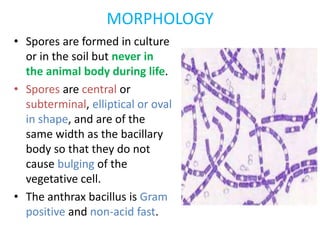
• Spores are formed in culture
or in the soil but never in
the animal body during life.
• Spores are central or
subterminal, elliptical or oval
in shape, and are of the
same width as the bacillary
body so that they do not
cause bulging of the
vegetative cell.
• The anthrax bacillus is Gram
positive and non-acid fast.
MORPHOLOGY
• The spores do not stain by ordinary methods but can be
stained differentially by special techniques When stained
with Sudan black B, fat globules may be made out within
the bacilli.
• M"Fadyean's reaction: When blood films containing
anthrax bacilli are stained with polychrome methylene blue
for a few seconds and examined under the microscope, an
amorphous purplish material is noticed around the bacilli.
This represents the capsular material and is characteristic
of the anthrax bacillus.
• This is called the M"Fadyean's reaction is the presumptive
diagnosis of anthrax in animals.
• The anthrax bacillus is nonmotile, unlike most other
members of this genus.
B. anthracis in McFadyean
Reaction
B. anthracis in Spore stain
CULTURAL CHARACTERISTICS
• It is an aerobe, and facultative
anaerobe, with a temperature
range for growth of 12-45 °C
(optimum 35-37 °C).
• Good growth occurs on ordinary
media. On agar plates, irregularly
round colonies are formed, 2-3 mm
in diameter, raised, dull, opaque,
greyish white, with a frosted glass
appearance.
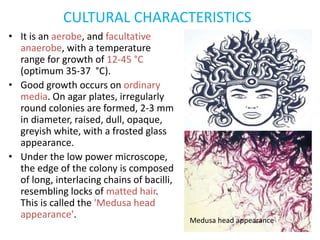
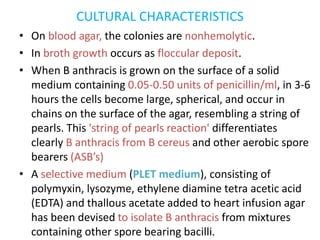
• Under the low power microscope,
the edge of the colony is composed
of long, interlacing chains of bacilli,
resembling locks of matted hair.
This is called the 'Medusa head
appearance'. Medusa head appearance
CULTURAL CHARACTERISTICS
• On blood agar, the colonies are nonhemolytic.
• In broth growth occurs as floccular deposit.
• When B anthracis is grown on the surface of a solid
medium containing 0.05-0.50 units of penicillin/ml, in 3-6
hours the cells become large, spherical, and occur in
chains on the surface of the agar, resembling a string of
pearls. This 'string of pearls reaction' differentiates
clearly B anthracis from B cereus and other aerobic spore
bearers (ASB’s)
• A selective medium (PLET medium), consisting of
polymyxin, lysozyme, ethylene diamine tetra acetic acid
(EDTA) and thallous acetate added to heart infusion agar
has been devised to isolate B anthracis from mixtures
containing other spore bearing bacilli.
BIOCHEMICAL REACTIONS
• Glucose, maltose and sucrose
are fermented producing acid
but no gas.
• Nitrates are reduced to
nitrites.
• Catalase is formed.
• On gelatin stab culture, a
characteristic 'inverted fir
tree' appearance is seen,
with slow liquefaction
commencing from the top.
Gelatine stab culture
RESISTANCE
• The vegetative bacilli are not particularly resistant and
are destroyed at 60°C in 30 minutes.
• In the carcasses of animals which have died of anthrax,
the bacilli remain viable in the bone marrow for a week
and in the skin for two weeks.
• The spores are highly resistant to physical and chemical
agents.
• They have been isolated from naturally infected soil after
as long as 60 years.
• They resist dry heat at 140°C for 1-3 hours and boiling for
10 minutes.
• They survive in 5 % phenol for weeks.
RESISTANCE
• HgCl2 in a 1/1000 solution may fail to kill anthrax
spores in less than 70 hours.
• 4% potassium permanganate kills them in 15 minutes.
• Destruction of the spores in animal products imported
into nonendemic countries is achieved by ‘Duckering'
in which 2% formaldehyde solution is used at 30-40 °C
for 20 minutes for disinfection of wool and as 0.25 % at
60°C for six hours for animal hair and bristles.
• The anthrax bacillus is susceptible to sulphonamides,
penicillin, erythromycin, streptomycin tetracycline and
chloramphenicol.
• Occasional strains resistant to penicillin are
encountered.
PATHOGENICITY
• In nature, anthrax is primarily a disease of cattle and
sheep, and less often of horses and swine but
experimentally most animals are susceptible to a greater
or lesser degree.
• Rabbits, guinea pigs and mice are susceptible.
• Following the subcutaneous inoculation of a culture into
a guinea pig, the animal dies in 24-72 hours showing a
local, gelatinous, haemorrhagic edema at the site of
inoculation, extensive subcutaneous congestion and
characteristically, an enlarged, dark red, friable spleen.
• The bacilli are found in large numbers in the local lesion,
heart blood and spleen (more than 108 bacilli/ ml)
VIRULANCE FACTORS
• Two virulence factors have been identified- Capsular
polypeptide and Anthrax toxin.
• The capsular polypeptide aids virulence by inhibiting
phagocytosis.
• Loss of the plasmid (pX 02) which controls capsule
production leads to loss of virulence.
• This is how the live attenuated anthrax spore vaccine
(Sterne strain) was obtained.
• The anthrax toxin was identified by the finding that the
injection of sterile plasma of guinea pigs dying of
anthrax into healthy guinea pigs killed them and that
death could be prevented by immune serum.
VIRULANCE FACTORS
• The toxin is a complex of three fractions:
• The edema factor (OF or Factor I)
• The protective antigen factor (PA or Factor II) and
• The lethal factor (LF or Factor III).
• They are not toxic individually but the whole
complex produces local edema and generalised
shock
• The three factors have been characterised and
cloned.
• PA is the fraction that binds to the receptors on the
target cell surface, and in turn provides attachment
sites for OF or LF, facilitating their entry into the
cell.
VIRULANCE FACTORS
• The antibody to PA is protective because it blocks the first
step in toxin activity, namely, its binding to target cells.
• OF is an adenyl cyclase which is activated only inside the
target cells, leading to intracellular accumulation of cyclic
AMP.
• This is believed to be responsible for the edema and
other biological effects of the toxin.
• Entry of LF into the target cell causes cell death but the
mechanism of action is not known Loss of the plasmid
(pX 01) which encodes the F toxin renders the strain
avirulent.
• This is believed to have been the basis for the original
anthrax vaccine developed by Pasteur.
• The avirulent Sterne vaccine strain is devoid of the
plasmid coding for the capsular polysaccharide.
ANTHRAX
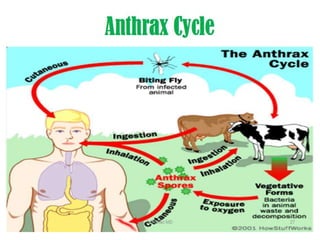
• Anthrax is a zoonosis.
• Animals are infected by ingestion of the spores present in
the soil.
• Direct spread from animal to animal is rare.
• The disease is generally a fatal septicemia but may
sometimes be localised, resembling the cutaneous disease
in human beings.
• Infected animals shed in the discharges from the mouth,
nose and rectum, large numbers of bacilli, which sporulate
in soil and remain as the source of infection.
• Human anthrax is contracted from animals, directly or
indirectly. The disease may be 1. cutaneous; 2. pulmonary;
or 3. intestinal, all types leading to fatal septicemia or
meningitis.
CUTATEOUS ANTHRAX
• This follows entry of the infection through the skin.
• The face, neck, hands, arms and back are the usual
sites.
• The lesion starts as a papule 1- 3 days after infection
and becomes vesicular, containing fluid which may be
clear or bloodstained
• The whole area is congested and edematous, and
several satellite lesions filled with serum or yellow fluid
are arranged round a central necrotic lesion which is
covered by a black eschar (The name anthrax, which
means coal, comes from the black colour of the
eschar.)
CUTATEOUS ANTHRAX
• The lesion is called a
malignant pustule.
• The disease used to be
common in dock workers
carrying loads of hides and
skins on their bare backs and
hence was known as the hide
porter's disease.
• Cutaneous anthrax generally
resolves spontaneously, but
10-20 per cent of untreated
patients may develop fatal
septicemia or meningitis.
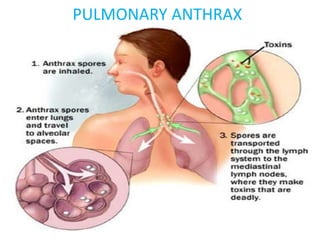
PULMONARY ANTHRAX
• This is called the wool
sorter's disease because it
used to be common in
workers in wool factories,
due to Inhalation of dust
from infected wool.
• This is a hemorrhagic
pneumonia with a high
fatality rate.
• Hemorrhagic meningitis
may occur as a complication
PULMONARY ANTHRAX
INTESTINAL ANTHRAX
• This is rare and occurs mainly in primitive communities
who eat the carcasses of animals dying of anthrax.
• A violent enteritis with bloody diarrhea occurs, with high
case fatality.
ANTHRAX
• Human anthrax may be industrial or non- industrial
(agricultural).
• The former is found in workers in industries such as meat
packing or wool factories.
• Non-industrial anthrax is often an occupational disease
in those who associate frequently with animals, such as
veterinarians, butchers and farmers. It may also be found
in the general population.
• Cutaneous anthrax used to be caused by shaving brushes
made with animal hair.
• Stomoxys calcitrans and other biting insects may
occasionally transmit infection mechanically.
LABORATORY DIAGNOSIS
• Anthrax may be diagnosed by:
• Microscopy,
• Culture,
• Animal inoculation and
• Serological demonstration of the anthrax antigen in
infected tissues.
• Antibodies to the organism can be demonstrated by gel
diffusion, complement fixation, antigen coated tanned
red cell agglutination and ELISA techniques.
LABORATORY DIAGNOSIS
• When an animal is suspected to have died of anthrax,
autopsy is not permissible, as the spilt blood will lead to
contamination of the soil.
• An ear may be cut off from the carcass and sent to the
laboratory. Alternatively, swab soaked in blood or several
blood smears may be sent.
• The demonstration of Gram- positive bacilli with the
morphology of anthrax bacilli and a positive M'Fadyean's
reaction will enable presumptive diagnosis to be made.
• Immunofluorescent microscopy can confirm the
identification.
LABORATORY DIAGNOSIS
• After the bioterrorism experience in the USA in 2001, the
CDC have prepared guidelines for identification of anthrax
bacillus.
• Any large Gram - positive bacillus with the general
morphology and cultural features of anthrax-nonmotile,
nonhemolytic on blood agar and catalase positive-can be
given a presumptive report of anthrax.
• For initial confirmation, lysis by gamma phage and DFA for
capsule-specific staining and for polysaccharide cell wall
antigen are sufficient.
• For further confirmation, PCR for anthrax bacillus specific
chromosomal markers can be done.
• For epidemiological studies and strain characterisation,
MLVA or AFLP can be used.
PROPHYLAXIS
• Prevention of human anthrax is mainly by general methods
such as improvement of factory hygiene and proper
sterilisation of animal products like hides and wool.
• Carcasses of animals suspected to have died of anthrax are
buried deep in quicklime or cremated to prevent soil
contamination.
• Prevention of anthrax in animals is aided by active
immunisation.
• The original Pasteur's anthrax vaccine is of great historical
importance.
• It was Pasteur's convincing demonstration of the protective
effect of his anthrax vaccine in a public experiment at Pouilly-
le- Fort in 1881 that marked the beginning of scientific
immunoprophylaxis.
PROPHYLAXIS
• Pasteur's vaccine was the anthrax bacillus attenuated by
growth at 42-43 °c.
• The spore is the common infective form in nature, vaccines
consisting of spores of attenuated strains were developed.
• The Sterne vaccine contained spores of a noncapsulated
avirulent mutant strain.
• The Mazucchi vaccine contained spores of stable
attenuated Carbazoo strain in 2 % saponin.
• The spore vaccines have been used extensively in animals
with good results.
PROPHYLAXIS
• They give protection for a year following a single
injection.
• They are not considered safe for human use, though they
have been used for human immunisation in Russia.
• Alum precipitated toxoid prepared from the protective
antigen has been shown to be a safe and effective
vaccine for human use It has been used in persons
occupationally exposed to anthrax infection.
• Three doses given intramuscularly at intervals of six
weeks between first and second, and six months
between second and third doses induce good immunity,
which can be reinforced if necessary with annual booster
injections.
TREATMENT
• Antibiotic therapy is effective in human cases but rarely
succeeds in animals as therapy is not started sufficiently
early.
• Antibiotics have no effect on the toxin once it is formed.
• Penicillin and streptomycin are no longer used for
treatment.
• They have been replaced by doxycycline and
ciprofloxacin, which are effective in prophylaxis and
treatment.
ANTHRACOID BACILLI
• A large number and variety of nonpathogenic aerobic
spore bearing bacilli appearing as common contaminants
in cultures and having a general resemblance to the
anthrax bacilli have been collectively called pseudoanthrax
or anthracoid bacilli.
• Many members of the genus bacillus, other than the
anthrax bacillus, have occasionally caused human
infections.
• It has also been associated with septicemia, meningitis,
endocarditis, pneumonia, wound infections and other
suppurative lesions, particularly as an opportunist
pathogen.
• B subtilis, B licheniformis and a few other species have also
been occasionally isolated from such lesions..
BACILLUS CEREU
• B cereus has become an important cause of food poisoning.
• It is widely distributed in nature and may be readily isolated
from soil, vegetables and a wide variety of foods including
milk, cereals, spices, meat and poultry.
• B cereus is generally motile but nonmotile strains may
occur.
• It resembles B anthracis except that it is not capsulated and
does not react with anthrax fluorescent antibody conjugate.
• B cereus produces two patterns of foodborne disease.
• One is associated with a wide range of foods including
cooked meat and vegetables.
BACILLUS CEREU
• It is characterised by diarrhea and abdominal pain, 8-16
hours after ingestion of contaminated foods.
• Vomiting is rare.
• The second type is associated almost exclusively with the
consumption of cooked rice, usually fried rice from
Chinese restaurants.
• The ilIness is characterised by acute nausea and vomiting
1-5 hours after the meal.
• Diarrhea is not common.
• B cereus is present in large numbers in the cooked rice and
fecal samples from these patients.
BACILLUS CEREU
• Both types of illness are mild and self-limited, requiring no
specific treatment.
• Strains causing the emetic type of disease produce a toxin
which causes vomiting when fed to Rhesus monkeys,
resembling staphylococcal enterotoxin.
• The emetic toxin was produced only when B cereus was
grown in rice but not in other media.
• A special mannitol-egg yolk-phenol red- polymyxin agar
(MYPA) medium is useful in isolating B cereus from feces
and other sources.
• B cereus produces lecithinase and ferments glucose but not
mannitol..
Bacillus

Bacillus

  • 1.
    BACILLUS A Presentation By G.Prashanth Kumar Department of Microbiology & Parasitology, International Medical & Technological University, Dar-es-Salaam, Tanzania.
  • 2.
    INDRODUCTION • The sporogenous,rod-shaped bacteria are classified into two genera: Aerobic Bacilli Anaerobic Clostridia • The genus Bacillus consists of aerobic bacilli forming heat resistant spores. • They are Gram positive but tend to be decolourised easily so as to appear Gram variable, or even frankly Gram negative. • They are generally motile with peritrichous flagella. • The genus includes psychrophilic, mesophilic and thermophilic species.
  • 3.
    INDRODUCTION • The maximumtemperatures for vegetative growth ranging from about 25°C to above 75 °C and the minimum from about 5 °C to 45°C. • Their salt tolerance varies from less than 2 % to 25 % NaCl. • Their spores are ubiquitous, being found in the soil, dust, water and air and constitute the commonest contaminants in bacteriological culture media. • Bacillus anthracis, the causative agent of anthrax is the major pathogenic species. • B cereus can cause foodborne gastroenteritis some species may be responsible for opportunistic infections.
  • 4.
  • 5.
    BACILLUS ANTHRACIS • Anthracisfrom the Greek word anthrakos for coal (black colour of the eschar). • The historical interest is attached to the anthrax bacillus. • 1st to Observe under Microscope. (Pollender, 1849) • 1st to communicable disease. (Davaine, 1850) • 1st to be isolated in pure culture and observe the spores. (Robert Koch, 1876) • 1st to prepare for attenuated vaccine. (Louis Pasteur, 1881) • Primarily a disease of domesticated & wild animals – Herbivores such as sheep, cows, horses, goats
  • 6.
    BACILLUS ANTHRACIS • Naturalreservoir is soil – Does not depend on an animal reservoir making it hard to eradicate – Cannot be regularly cultivated from soils where there is an absence of endemic anthrax – Occurs sporadically throughout US – South Dakota, Arkansas, Texas, Louisiana, Mississippi, California recognized endemic areas • Anthrax was for long feared as a potential tool in biological warfare. • This fear became an actual fact in 2001, when anthrax in the form of weapons grade spores having enhanced dispersability and virulence was sent by mail to various destinations in the USA, causing disease and death in many persons.
  • 7.
    MORPHOLOGY • The anthraxbacillus is one of the largest of pathogenic bacteria, measuring 3-10 µm x 1-1.6 µm. • In tissues, it is found singly, in pairs or in short chains, the entire chain being surrounded by a capsule. • The capsule is polypeptide in nature. • Capsules are not formed under ordinary conditions of culture but only if the media contain added bicarbonate or are incubated under 10-25 % CO2. • If grown in media containing serum, albumin, charcoal or starch, capsule formation may occur in the absence of CO2. • In cultures, the bacilli are arranged end to end in long chains like 'bamboo stick' appearance.
  • 8.
    MORPHOLOGY • Spores areformed in culture or in the soil but never in the animal body during life. • Spores are central or subterminal, elliptical or oval in shape, and are of the same width as the bacillary body so that they do not cause bulging of the vegetative cell. • The anthrax bacillus is Gram positive and non-acid fast.
  • 9.
    MORPHOLOGY • The sporesdo not stain by ordinary methods but can be stained differentially by special techniques When stained with Sudan black B, fat globules may be made out within the bacilli. • M"Fadyean's reaction: When blood films containing anthrax bacilli are stained with polychrome methylene blue for a few seconds and examined under the microscope, an amorphous purplish material is noticed around the bacilli. This represents the capsular material and is characteristic of the anthrax bacillus. • This is called the M"Fadyean's reaction is the presumptive diagnosis of anthrax in animals. • The anthrax bacillus is nonmotile, unlike most other members of this genus.
  • 10.
    B. anthracis inMcFadyean Reaction B. anthracis in Spore stain
  • 11.
    CULTURAL CHARACTERISTICS • Itis an aerobe, and facultative anaerobe, with a temperature range for growth of 12-45 °C (optimum 35-37 °C). • Good growth occurs on ordinary media. On agar plates, irregularly round colonies are formed, 2-3 mm in diameter, raised, dull, opaque, greyish white, with a frosted glass appearance. • Under the low power microscope, the edge of the colony is composed of long, interlacing chains of bacilli, resembling locks of matted hair. This is called the 'Medusa head appearance'. Medusa head appearance
  • 12.
    CULTURAL CHARACTERISTICS • Onblood agar, the colonies are nonhemolytic. • In broth growth occurs as floccular deposit. • When B anthracis is grown on the surface of a solid medium containing 0.05-0.50 units of penicillin/ml, in 3-6 hours the cells become large, spherical, and occur in chains on the surface of the agar, resembling a string of pearls. This 'string of pearls reaction' differentiates clearly B anthracis from B cereus and other aerobic spore bearers (ASB’s) • A selective medium (PLET medium), consisting of polymyxin, lysozyme, ethylene diamine tetra acetic acid (EDTA) and thallous acetate added to heart infusion agar has been devised to isolate B anthracis from mixtures containing other spore bearing bacilli.
  • 13.
    BIOCHEMICAL REACTIONS • Glucose,maltose and sucrose are fermented producing acid but no gas. • Nitrates are reduced to nitrites. • Catalase is formed. • On gelatin stab culture, a characteristic 'inverted fir tree' appearance is seen, with slow liquefaction commencing from the top. Gelatine stab culture
  • 14.
    RESISTANCE • The vegetativebacilli are not particularly resistant and are destroyed at 60°C in 30 minutes. • In the carcasses of animals which have died of anthrax, the bacilli remain viable in the bone marrow for a week and in the skin for two weeks. • The spores are highly resistant to physical and chemical agents. • They have been isolated from naturally infected soil after as long as 60 years. • They resist dry heat at 140°C for 1-3 hours and boiling for 10 minutes. • They survive in 5 % phenol for weeks.
  • 15.
    RESISTANCE • HgCl2 ina 1/1000 solution may fail to kill anthrax spores in less than 70 hours. • 4% potassium permanganate kills them in 15 minutes. • Destruction of the spores in animal products imported into nonendemic countries is achieved by ‘Duckering' in which 2% formaldehyde solution is used at 30-40 °C for 20 minutes for disinfection of wool and as 0.25 % at 60°C for six hours for animal hair and bristles. • The anthrax bacillus is susceptible to sulphonamides, penicillin, erythromycin, streptomycin tetracycline and chloramphenicol. • Occasional strains resistant to penicillin are encountered.
  • 16.
    PATHOGENICITY • In nature,anthrax is primarily a disease of cattle and sheep, and less often of horses and swine but experimentally most animals are susceptible to a greater or lesser degree. • Rabbits, guinea pigs and mice are susceptible. • Following the subcutaneous inoculation of a culture into a guinea pig, the animal dies in 24-72 hours showing a local, gelatinous, haemorrhagic edema at the site of inoculation, extensive subcutaneous congestion and characteristically, an enlarged, dark red, friable spleen. • The bacilli are found in large numbers in the local lesion, heart blood and spleen (more than 108 bacilli/ ml)
  • 17.
    VIRULANCE FACTORS • Twovirulence factors have been identified- Capsular polypeptide and Anthrax toxin. • The capsular polypeptide aids virulence by inhibiting phagocytosis. • Loss of the plasmid (pX 02) which controls capsule production leads to loss of virulence. • This is how the live attenuated anthrax spore vaccine (Sterne strain) was obtained. • The anthrax toxin was identified by the finding that the injection of sterile plasma of guinea pigs dying of anthrax into healthy guinea pigs killed them and that death could be prevented by immune serum.
  • 18.
    VIRULANCE FACTORS • Thetoxin is a complex of three fractions: • The edema factor (OF or Factor I) • The protective antigen factor (PA or Factor II) and • The lethal factor (LF or Factor III). • They are not toxic individually but the whole complex produces local edema and generalised shock • The three factors have been characterised and cloned. • PA is the fraction that binds to the receptors on the target cell surface, and in turn provides attachment sites for OF or LF, facilitating their entry into the cell.
  • 19.
    VIRULANCE FACTORS • Theantibody to PA is protective because it blocks the first step in toxin activity, namely, its binding to target cells. • OF is an adenyl cyclase which is activated only inside the target cells, leading to intracellular accumulation of cyclic AMP. • This is believed to be responsible for the edema and other biological effects of the toxin. • Entry of LF into the target cell causes cell death but the mechanism of action is not known Loss of the plasmid (pX 01) which encodes the F toxin renders the strain avirulent. • This is believed to have been the basis for the original anthrax vaccine developed by Pasteur. • The avirulent Sterne vaccine strain is devoid of the plasmid coding for the capsular polysaccharide.
  • 20.
    ANTHRAX • Anthrax isa zoonosis. • Animals are infected by ingestion of the spores present in the soil. • Direct spread from animal to animal is rare. • The disease is generally a fatal septicemia but may sometimes be localised, resembling the cutaneous disease in human beings. • Infected animals shed in the discharges from the mouth, nose and rectum, large numbers of bacilli, which sporulate in soil and remain as the source of infection. • Human anthrax is contracted from animals, directly or indirectly. The disease may be 1. cutaneous; 2. pulmonary; or 3. intestinal, all types leading to fatal septicemia or meningitis.
  • 22.
    CUTATEOUS ANTHRAX • Thisfollows entry of the infection through the skin. • The face, neck, hands, arms and back are the usual sites. • The lesion starts as a papule 1- 3 days after infection and becomes vesicular, containing fluid which may be clear or bloodstained • The whole area is congested and edematous, and several satellite lesions filled with serum or yellow fluid are arranged round a central necrotic lesion which is covered by a black eschar (The name anthrax, which means coal, comes from the black colour of the eschar.)
  • 23.
    CUTATEOUS ANTHRAX • Thelesion is called a malignant pustule. • The disease used to be common in dock workers carrying loads of hides and skins on their bare backs and hence was known as the hide porter's disease. • Cutaneous anthrax generally resolves spontaneously, but 10-20 per cent of untreated patients may develop fatal septicemia or meningitis.
  • 24.
    PULMONARY ANTHRAX • Thisis called the wool sorter's disease because it used to be common in workers in wool factories, due to Inhalation of dust from infected wool. • This is a hemorrhagic pneumonia with a high fatality rate. • Hemorrhagic meningitis may occur as a complication
  • 25.
  • 26.
    INTESTINAL ANTHRAX • Thisis rare and occurs mainly in primitive communities who eat the carcasses of animals dying of anthrax. • A violent enteritis with bloody diarrhea occurs, with high case fatality.
  • 27.
    ANTHRAX • Human anthraxmay be industrial or non- industrial (agricultural). • The former is found in workers in industries such as meat packing or wool factories. • Non-industrial anthrax is often an occupational disease in those who associate frequently with animals, such as veterinarians, butchers and farmers. It may also be found in the general population. • Cutaneous anthrax used to be caused by shaving brushes made with animal hair. • Stomoxys calcitrans and other biting insects may occasionally transmit infection mechanically.
  • 28.
    LABORATORY DIAGNOSIS • Anthraxmay be diagnosed by: • Microscopy, • Culture, • Animal inoculation and • Serological demonstration of the anthrax antigen in infected tissues. • Antibodies to the organism can be demonstrated by gel diffusion, complement fixation, antigen coated tanned red cell agglutination and ELISA techniques.
  • 29.
    LABORATORY DIAGNOSIS • Whenan animal is suspected to have died of anthrax, autopsy is not permissible, as the spilt blood will lead to contamination of the soil. • An ear may be cut off from the carcass and sent to the laboratory. Alternatively, swab soaked in blood or several blood smears may be sent. • The demonstration of Gram- positive bacilli with the morphology of anthrax bacilli and a positive M'Fadyean's reaction will enable presumptive diagnosis to be made. • Immunofluorescent microscopy can confirm the identification.
  • 30.
    LABORATORY DIAGNOSIS • Afterthe bioterrorism experience in the USA in 2001, the CDC have prepared guidelines for identification of anthrax bacillus. • Any large Gram - positive bacillus with the general morphology and cultural features of anthrax-nonmotile, nonhemolytic on blood agar and catalase positive-can be given a presumptive report of anthrax. • For initial confirmation, lysis by gamma phage and DFA for capsule-specific staining and for polysaccharide cell wall antigen are sufficient. • For further confirmation, PCR for anthrax bacillus specific chromosomal markers can be done. • For epidemiological studies and strain characterisation, MLVA or AFLP can be used.
  • 31.
    PROPHYLAXIS • Prevention ofhuman anthrax is mainly by general methods such as improvement of factory hygiene and proper sterilisation of animal products like hides and wool. • Carcasses of animals suspected to have died of anthrax are buried deep in quicklime or cremated to prevent soil contamination. • Prevention of anthrax in animals is aided by active immunisation. • The original Pasteur's anthrax vaccine is of great historical importance. • It was Pasteur's convincing demonstration of the protective effect of his anthrax vaccine in a public experiment at Pouilly- le- Fort in 1881 that marked the beginning of scientific immunoprophylaxis.
  • 32.
    PROPHYLAXIS • Pasteur's vaccinewas the anthrax bacillus attenuated by growth at 42-43 °c. • The spore is the common infective form in nature, vaccines consisting of spores of attenuated strains were developed. • The Sterne vaccine contained spores of a noncapsulated avirulent mutant strain. • The Mazucchi vaccine contained spores of stable attenuated Carbazoo strain in 2 % saponin. • The spore vaccines have been used extensively in animals with good results.
  • 33.
    PROPHYLAXIS • They giveprotection for a year following a single injection. • They are not considered safe for human use, though they have been used for human immunisation in Russia. • Alum precipitated toxoid prepared from the protective antigen has been shown to be a safe and effective vaccine for human use It has been used in persons occupationally exposed to anthrax infection. • Three doses given intramuscularly at intervals of six weeks between first and second, and six months between second and third doses induce good immunity, which can be reinforced if necessary with annual booster injections.
  • 34.
    TREATMENT • Antibiotic therapyis effective in human cases but rarely succeeds in animals as therapy is not started sufficiently early. • Antibiotics have no effect on the toxin once it is formed. • Penicillin and streptomycin are no longer used for treatment. • They have been replaced by doxycycline and ciprofloxacin, which are effective in prophylaxis and treatment.
  • 35.
    ANTHRACOID BACILLI • Alarge number and variety of nonpathogenic aerobic spore bearing bacilli appearing as common contaminants in cultures and having a general resemblance to the anthrax bacilli have been collectively called pseudoanthrax or anthracoid bacilli. • Many members of the genus bacillus, other than the anthrax bacillus, have occasionally caused human infections. • It has also been associated with septicemia, meningitis, endocarditis, pneumonia, wound infections and other suppurative lesions, particularly as an opportunist pathogen. • B subtilis, B licheniformis and a few other species have also been occasionally isolated from such lesions..
  • 36.
    BACILLUS CEREU • Bcereus has become an important cause of food poisoning. • It is widely distributed in nature and may be readily isolated from soil, vegetables and a wide variety of foods including milk, cereals, spices, meat and poultry. • B cereus is generally motile but nonmotile strains may occur. • It resembles B anthracis except that it is not capsulated and does not react with anthrax fluorescent antibody conjugate. • B cereus produces two patterns of foodborne disease. • One is associated with a wide range of foods including cooked meat and vegetables.
  • 37.
    BACILLUS CEREU • Itis characterised by diarrhea and abdominal pain, 8-16 hours after ingestion of contaminated foods. • Vomiting is rare. • The second type is associated almost exclusively with the consumption of cooked rice, usually fried rice from Chinese restaurants. • The ilIness is characterised by acute nausea and vomiting 1-5 hours after the meal. • Diarrhea is not common. • B cereus is present in large numbers in the cooked rice and fecal samples from these patients.
  • 38.
    BACILLUS CEREU • Bothtypes of illness are mild and self-limited, requiring no specific treatment. • Strains causing the emetic type of disease produce a toxin which causes vomiting when fed to Rhesus monkeys, resembling staphylococcal enterotoxin. • The emetic toxin was produced only when B cereus was grown in rice but not in other media. • A special mannitol-egg yolk-phenol red- polymyxin agar (MYPA) medium is useful in isolating B cereus from feces and other sources. • B cereus produces lecithinase and ferments glucose but not mannitol..