‘Veterinary Epidemiology
& Zoonoses’
VPH-321
(Credit Hours-2+1)
ANTHRAX
Synonyms
Charbon
Malignant pustule
Malignant carbuncle
MiltsiekteMilzbrand,
Ragpicker’s disease,
Sang de rate,
Splenic fever,
Woolsorter’s disease
ETIOLOGY
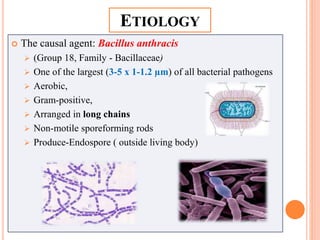
 The causal agent: Bacillus anthracis
 (Group 18, Family - Bacillaceae)
 One of the largest (3-5 x 1-1.2 µm) of all bacterial pathogens
 Aerobic,
 Gram-positive,
 Arranged in long chains
 Non-motile sporeforming rods
 Produce-Endospore ( outside living body)
ETIOLOGY
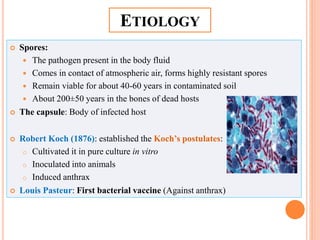
 Spores:
 The pathogen present in the body fluid
 Comes in contact of atmospheric air, forms highly resistant spores
 Remain viable for about 40-60 years in contaminated soil
 About 200±50 years in the bones of dead hosts
 The capsule: Body of infected host
 Robert Koch (1876): established the Koch’s postulates:
o Cultivated it in pure culture in vitro
o Inoculated into animals
o Induced anthrax
 Louis Pasteur: First bacterial vaccine (Against anthrax)
EPIDEMIOLOGY
 In animals
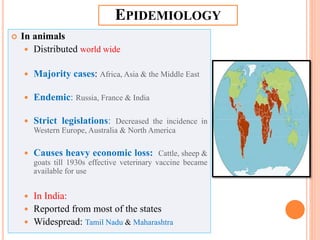
 Distributed world wide
 Majority cases: Africa, Asia & the Middle East
 Endemic: Russia, France & India
 Strict legislations: Decreased the incidence in
Western Europe, Australia & North America
 Causes heavy economic loss: Cattle, sheep &
goats till 1930s effective veterinary vaccine became
available for use
 In India:
 Reported from most of the states
 Widespread: Tamil Nadu & Maharashtra
 In man
 The incidence : 20,000 to 1,00,000 cases/
annum appx.
 Cutaneous anthrax: 95-99% of human cases
globally
 Endemic: Middle-East Asia, Kenya, Gambia,
Zimbabwe, Thailand, Iran, Iraq, Turkey, parts
of USSR & Yugoslavia
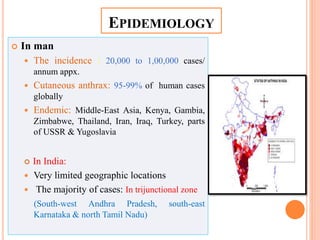
 In India:
 Very limited geographic locations
 The majority of cases: In trijunctional zone
(South-west Andhra Pradesh, south-east
Karnataka & north Tamil Nadu)
EPIDEMIOLOGY
HOST RANGE AND RESERVOIRS
 Herbivores, many wild: Highly susceptible
 Pigs, equines, dogs & camels: Moderately susceptible
 Carnivores & birds: Highly resistant
 Man is moderately resistant
 It has no true reservoir
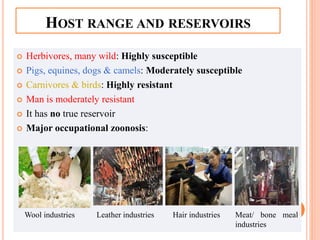
 Major occupational zoonosis:
Wool industries Hair industries Meat/ bone meal
industries
Leather industries
SOURCES AND TRANSMISSION
 In animals:
 In herbivores
 Ingestion: Contaminated fodder/improperly processed
feed
 Inhalation: Spores (particularly during wallowing)
 In carnivores and omnivores
 Ingestion: Infected carcass/contaminated meat
 Direct contact: Body secretions/ tissues of a
diseased/dead animal contaminated fomites like soil, water,
organic fertilizers, hairs, wool, hide etc.
 In animals:
 The indirect contact:
 Animal husbandry/agricultural operations,
 Accidental inoculation of pathogen into skin,
 Surgical operations (bleeding, dehorning, castration)
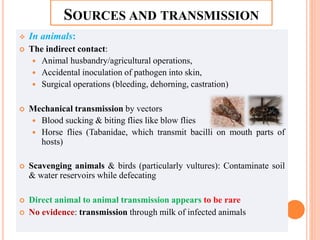
 Mechanical transmission by vectors
 Blood sucking & biting flies like blow flies
 Horse flies (Tabanidae, which transmit bacilli on mouth parts of
hosts)
 Scavenging animals & birds (particularly vultures): Contaminate soil
& water reservoirs while defecating
 Direct animal to animal transmission appears to be rare
 No evidence: transmission through milk of infected animals
SOURCES AND TRANSMISSION
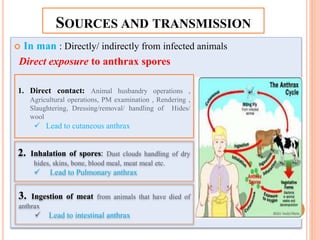
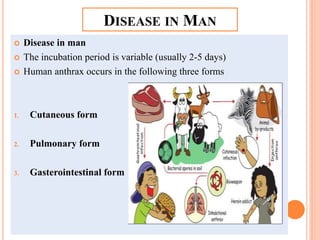
 In man : Directly/ indirectly from infected animals
Direct exposure to anthrax spores
SOURCES AND TRANSMISSION
1. Direct contact: Animal husbandry operations ,
Agricultural operations, PM examination , Rendering ,
Slaughtering, Dressing/removal/ handling of Hides/
wool
 Lead to cutaneous anthrax
2. Inhalation of spores: Dust clouds handling of dry
hides, skins, bone, blood meal, meat meal etc.
 Lead to Pulmonary anthrax
3. Ingestion of meat from animals that have died of
anthrax
 Lead to intestinal anthrax
In-Direct exposure to anthrax spores
SOURCES AND TRANSMISSION
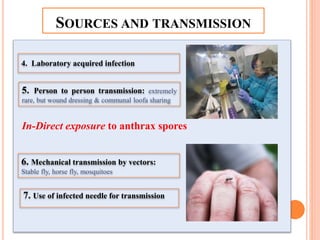
4. Laboratory acquired infection
5. Person to person transmission: extremely
rare, but wound dressing & communal loofa sharing
6. Mechanical transmission by vectors:
Stable fly, horse fly, mosquitoes
7. Use of infected needle for transmission
DISEASE IN ANIMALS
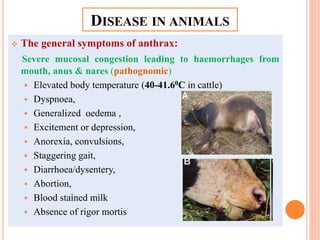
 The general symptoms of anthrax:
Severe mucosal congestion leading to haemorrhages from
mouth, anus & nares (pathognomic)
 Elevated body temperature (40-41.60C in cattle)
 Dyspnoea,
 Generalized oedema ,
 Excitement or depression,
 Anorexia, convulsions,
 Staggering gait,
 Diarrhoea/dysentery,
 Abortion,
 Blood stained milk
 Absence of rigor mortis
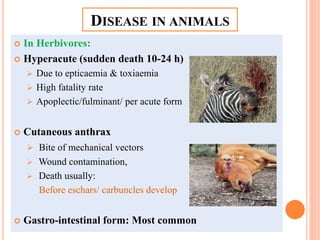
 In Herbivores:
 Hyperacute (sudden death 10-24 h)
 Due to epticaemia & toxiaemia
 High fatality rate
 Apoplectic/fulminant/ per acute form
 Cutaneous anthrax
 Bite of mechanical vectors
 Wound contamination,
 Death usually:
Before eschars/ carbuncles develop
 Gastro-intestinal form: Most common
DISEASE IN ANIMALS
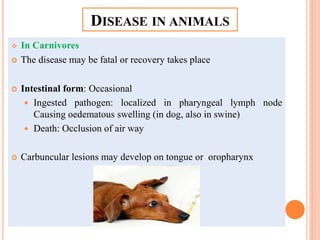
 In Carnivores
 The disease may be fatal or recovery takes place
 Intestinal form: Occasional
 Ingested pathogen: localized in pharyngeal lymph node
Causing oedematous swelling (in dog, also in swine)
 Death: Occlusion of air way
 Carbuncular lesions may develop on tongue or oropharynx
DISEASE IN ANIMALS
 Disease in man
 The incubation period is variable (usually 2-5 days)
 Human anthrax occurs in the following three forms
1. Cutaneous form
2. Pulmonary form
3. Gasterointestinal form
DISEASE IN MAN
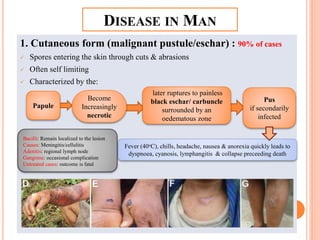
1. Cutaneous form (malignant pustule/eschar) : 90% of cases
 Spores entering the skin through cuts & abrasions
 Often self limiting
 Characterized by the:
DISEASE IN MAN
Papule
Become
Increasingly
necrotic
later ruptures to painless
black eschar/ carbuncle
surrounded by an
oedematous zone
Pus
if secondarily
infected
Fever (40oC), chills, headache, nausea & anorexia quickly leads to
dyspnoea, cyanosis, lymphangitis & collapse preceeding death
Bacilli: Remain localized to the lesion
Causes: Meningitis/cellulitis
Adenitis: regional lymph node
Gangrene: occasional complication
Untreated cases: outcome is fatal
DISEASE IN MAN
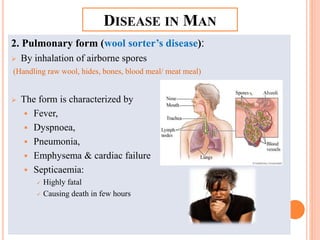
2. Pulmonary form (wool sorter’s disease):
 By inhalation of airborne spores
(Handling raw wool, hides, bones, blood meal/ meat meal)
 The form is characterized by
 Fever,
 Dyspnoea,
 Pneumonia,
 Emphysema & cardiac failure
 Septicaemia:
 Highly fatal
 Causing death in few hours
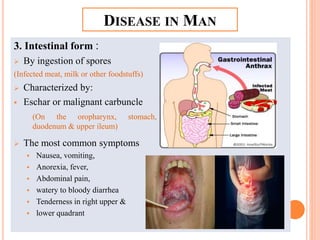
3. Intestinal form :
 By ingestion of spores
(Infected meat, milk or other foodstuffs)
 Characterized by:
 Eschar or malignant carbuncle
 The most common symptoms
 Nausea, vomiting,
 Anorexia, fever,
 Abdominal pain,
 watery to bloody diarrhea
 Tenderness in right upper &
 lower quadrant
DISEASE IN MAN
(On the oropharynx, stomach,
duodenum & upper ileum)
DIAGNOSIS
In animals :
1. Based on history & clinical sign:
(Sudden death, Bleeding from natural orifices, the carcass is never opened to avoid)
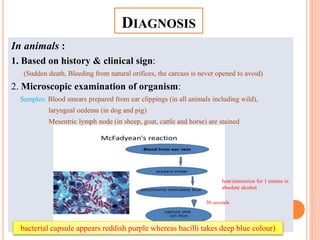
2. Microscopic examination of organism:
Samples: Blood smears prepared from ear clippings (in all animals including wild),
laryngeal oedema (in dog and pig)
Mesentric lymph node (in sheep, goat, cattle and horse) are stained
heat/immersion for 1 minute in
absolute alcohol
30 seconds
bacterial capsule appears reddish purple whereas bacilli takes deep blue colour)
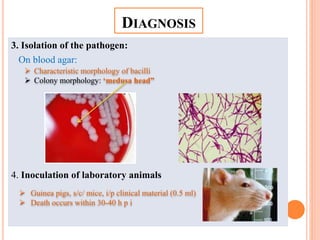
3. Isolation of the pathogen:
On blood agar:
4. Inoculation of laboratory animals
DIAGNOSIS
 Guinea pigs, s/c/ mice, i/p clinical material (0.5 ml)
 Death occurs within 30-40 h p i
 Characteristic morphology of bacilli
 Colony morphology: ‘medusa head”
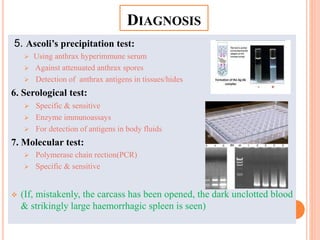
5. Ascoli’s precipitation test:
 Using anthrax hyperimmune serum
 Against attenuated anthrax spores
 Detection of anthrax antigens in tissues/hides
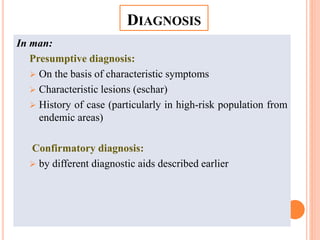
6. Serological test:
 Specific & sensitive
 Enzyme immunoassays
 For detection of antigens in body fluids
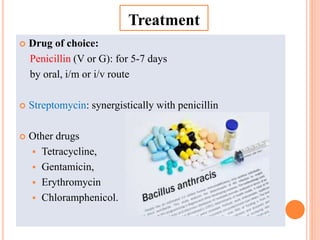
7. Molecular test:
 Polymerase chain rection(PCR)
 Specific & sensitive
 (If, mistakenly, the carcass has been opened, the dark unclotted blood
& strikingly large haemorrhagic spleen is seen)
DIAGNOSIS
In man:
Presumptive diagnosis:
 On the basis of characteristic symptoms
 Characteristic lesions (eschar)
 History of case (particularly in high-risk population from
endemic areas)
Confirmatory diagnosis:
 by different diagnostic aids described earlier
DIAGNOSIS
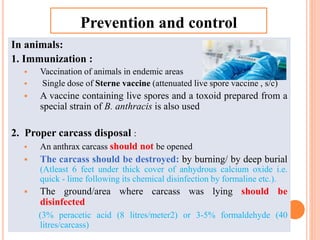
 Drug of choice:
Penicillin (V or G): for 5-7 days
by oral, i/m or i/v route
 Streptomycin: synergistically with penicillin
 Other drugs
 Tetracycline,
 Gentamicin,
 Erythromycin
 Chloramphenicol.
Treatment
In animals:
1. Immunization :
 Vaccination of animals in endemic areas
 Single dose of Sterne vaccine (attenuated live spore vaccine , s/c)
 A vaccine containing live spores and a toxoid prepared from a
special strain of B. anthracis is also used
2. Proper carcass disposal :
 An anthrax carcass should not be opened
 The carcass should be destroyed: by burning/ by deep burial
(Atleast 6 feet under thick cover of anhydrous calcium oxide i.e.
quick - lime following its chemical disinfection by formaline etc.).
 The ground/area where carcass was lying should be
disinfected
(3% peracetic acid (8 litres/meter2) or 3-5% formaldehyde (40
litres/carcass)
Prevention and control
3. Care in handling livestock (diseased/from endemic areas) :
 Early diagnosis & prompt chemotherapy of sick animals
 Slaughter of an suspected animal: Should not be allowed
 Animals from endemic area: Quarantined
 Before slaughter/ admixing with new animals
 Wound dressing : with sterilized equipments & clean hands
 Persons with cutaneous lesions: not allow to handle livestock and
their feed/fodder
4. Management :
 Notify disease to surveillance, monitoring & controlling agencies
 Avoid feeding contaminated feeds
 Avoid having livestock grazing on contaminated areas i.e.
streams, low lying pasture lands
 Insect control measures to bring down vector population in endemic
areas
Prevention and control
I n man:
1. Immunization :
 It is impracticable to vaccinate human beings in endemic
areas
 Occupational contact with livestock/ livestock products
may be vaccinated
(Sterne, Wright alum treated, cell free or formaline treated
vaccines, or purified toxoid)
2. Animal industry hygiene and management
 Control the disease in animal population
 Careful handling of animal product/byproduct
 Disinfection of factory premises: vapourized formaldehyde
may be used for along with measures to control dust
3. Medical care and management
Prevention and control

Anthrax.ppt

  • 1.
  • 2.
  • 3.
    ETIOLOGY  The causalagent: Bacillus anthracis  (Group 18, Family - Bacillaceae)  One of the largest (3-5 x 1-1.2 µm) of all bacterial pathogens  Aerobic,  Gram-positive,  Arranged in long chains  Non-motile sporeforming rods  Produce-Endospore ( outside living body)
  • 4.
    ETIOLOGY  Spores:  Thepathogen present in the body fluid  Comes in contact of atmospheric air, forms highly resistant spores  Remain viable for about 40-60 years in contaminated soil  About 200±50 years in the bones of dead hosts  The capsule: Body of infected host  Robert Koch (1876): established the Koch’s postulates: o Cultivated it in pure culture in vitro o Inoculated into animals o Induced anthrax  Louis Pasteur: First bacterial vaccine (Against anthrax)
  • 5.
    EPIDEMIOLOGY  In animals Distributed world wide  Majority cases: Africa, Asia & the Middle East  Endemic: Russia, France & India  Strict legislations: Decreased the incidence in Western Europe, Australia & North America  Causes heavy economic loss: Cattle, sheep & goats till 1930s effective veterinary vaccine became available for use  In India:  Reported from most of the states  Widespread: Tamil Nadu & Maharashtra
  • 6.
     In man The incidence : 20,000 to 1,00,000 cases/ annum appx.  Cutaneous anthrax: 95-99% of human cases globally  Endemic: Middle-East Asia, Kenya, Gambia, Zimbabwe, Thailand, Iran, Iraq, Turkey, parts of USSR & Yugoslavia  In India:  Very limited geographic locations  The majority of cases: In trijunctional zone (South-west Andhra Pradesh, south-east Karnataka & north Tamil Nadu) EPIDEMIOLOGY
  • 7.
    HOST RANGE ANDRESERVOIRS  Herbivores, many wild: Highly susceptible  Pigs, equines, dogs & camels: Moderately susceptible  Carnivores & birds: Highly resistant  Man is moderately resistant  It has no true reservoir  Major occupational zoonosis: Wool industries Hair industries Meat/ bone meal industries Leather industries
  • 8.
    SOURCES AND TRANSMISSION In animals:  In herbivores  Ingestion: Contaminated fodder/improperly processed feed  Inhalation: Spores (particularly during wallowing)  In carnivores and omnivores  Ingestion: Infected carcass/contaminated meat  Direct contact: Body secretions/ tissues of a diseased/dead animal contaminated fomites like soil, water, organic fertilizers, hairs, wool, hide etc.
  • 9.
     In animals: The indirect contact:  Animal husbandry/agricultural operations,  Accidental inoculation of pathogen into skin,  Surgical operations (bleeding, dehorning, castration)  Mechanical transmission by vectors  Blood sucking & biting flies like blow flies  Horse flies (Tabanidae, which transmit bacilli on mouth parts of hosts)  Scavenging animals & birds (particularly vultures): Contaminate soil & water reservoirs while defecating  Direct animal to animal transmission appears to be rare  No evidence: transmission through milk of infected animals SOURCES AND TRANSMISSION
  • 10.
     In man: Directly/ indirectly from infected animals Direct exposure to anthrax spores SOURCES AND TRANSMISSION 1. Direct contact: Animal husbandry operations , Agricultural operations, PM examination , Rendering , Slaughtering, Dressing/removal/ handling of Hides/ wool  Lead to cutaneous anthrax 2. Inhalation of spores: Dust clouds handling of dry hides, skins, bone, blood meal, meat meal etc.  Lead to Pulmonary anthrax 3. Ingestion of meat from animals that have died of anthrax  Lead to intestinal anthrax
  • 11.
    In-Direct exposure toanthrax spores SOURCES AND TRANSMISSION 4. Laboratory acquired infection 5. Person to person transmission: extremely rare, but wound dressing & communal loofa sharing 6. Mechanical transmission by vectors: Stable fly, horse fly, mosquitoes 7. Use of infected needle for transmission
  • 12.
    DISEASE IN ANIMALS The general symptoms of anthrax: Severe mucosal congestion leading to haemorrhages from mouth, anus & nares (pathognomic)  Elevated body temperature (40-41.60C in cattle)  Dyspnoea,  Generalized oedema ,  Excitement or depression,  Anorexia, convulsions,  Staggering gait,  Diarrhoea/dysentery,  Abortion,  Blood stained milk  Absence of rigor mortis
  • 13.
     In Herbivores: Hyperacute (sudden death 10-24 h)  Due to epticaemia & toxiaemia  High fatality rate  Apoplectic/fulminant/ per acute form  Cutaneous anthrax  Bite of mechanical vectors  Wound contamination,  Death usually: Before eschars/ carbuncles develop  Gastro-intestinal form: Most common DISEASE IN ANIMALS
  • 14.
     In Carnivores The disease may be fatal or recovery takes place  Intestinal form: Occasional  Ingested pathogen: localized in pharyngeal lymph node Causing oedematous swelling (in dog, also in swine)  Death: Occlusion of air way  Carbuncular lesions may develop on tongue or oropharynx DISEASE IN ANIMALS
  • 15.
     Disease inman  The incubation period is variable (usually 2-5 days)  Human anthrax occurs in the following three forms 1. Cutaneous form 2. Pulmonary form 3. Gasterointestinal form DISEASE IN MAN
  • 16.
    1. Cutaneous form(malignant pustule/eschar) : 90% of cases  Spores entering the skin through cuts & abrasions  Often self limiting  Characterized by the: DISEASE IN MAN Papule Become Increasingly necrotic later ruptures to painless black eschar/ carbuncle surrounded by an oedematous zone Pus if secondarily infected Fever (40oC), chills, headache, nausea & anorexia quickly leads to dyspnoea, cyanosis, lymphangitis & collapse preceeding death Bacilli: Remain localized to the lesion Causes: Meningitis/cellulitis Adenitis: regional lymph node Gangrene: occasional complication Untreated cases: outcome is fatal
  • 17.
    DISEASE IN MAN 2.Pulmonary form (wool sorter’s disease):  By inhalation of airborne spores (Handling raw wool, hides, bones, blood meal/ meat meal)  The form is characterized by  Fever,  Dyspnoea,  Pneumonia,  Emphysema & cardiac failure  Septicaemia:  Highly fatal  Causing death in few hours
  • 18.
    3. Intestinal form:  By ingestion of spores (Infected meat, milk or other foodstuffs)  Characterized by:  Eschar or malignant carbuncle  The most common symptoms  Nausea, vomiting,  Anorexia, fever,  Abdominal pain,  watery to bloody diarrhea  Tenderness in right upper &  lower quadrant DISEASE IN MAN (On the oropharynx, stomach, duodenum & upper ileum)
  • 19.
    DIAGNOSIS In animals : 1.Based on history & clinical sign: (Sudden death, Bleeding from natural orifices, the carcass is never opened to avoid) 2. Microscopic examination of organism: Samples: Blood smears prepared from ear clippings (in all animals including wild), laryngeal oedema (in dog and pig) Mesentric lymph node (in sheep, goat, cattle and horse) are stained heat/immersion for 1 minute in absolute alcohol 30 seconds bacterial capsule appears reddish purple whereas bacilli takes deep blue colour)
  • 20.
    3. Isolation ofthe pathogen: On blood agar: 4. Inoculation of laboratory animals DIAGNOSIS  Guinea pigs, s/c/ mice, i/p clinical material (0.5 ml)  Death occurs within 30-40 h p i  Characteristic morphology of bacilli  Colony morphology: ‘medusa head”
  • 21.
    5. Ascoli’s precipitationtest:  Using anthrax hyperimmune serum  Against attenuated anthrax spores  Detection of anthrax antigens in tissues/hides 6. Serological test:  Specific & sensitive  Enzyme immunoassays  For detection of antigens in body fluids 7. Molecular test:  Polymerase chain rection(PCR)  Specific & sensitive  (If, mistakenly, the carcass has been opened, the dark unclotted blood & strikingly large haemorrhagic spleen is seen) DIAGNOSIS
  • 22.
    In man: Presumptive diagnosis: On the basis of characteristic symptoms  Characteristic lesions (eschar)  History of case (particularly in high-risk population from endemic areas) Confirmatory diagnosis:  by different diagnostic aids described earlier DIAGNOSIS
  • 23.
     Drug ofchoice: Penicillin (V or G): for 5-7 days by oral, i/m or i/v route  Streptomycin: synergistically with penicillin  Other drugs  Tetracycline,  Gentamicin,  Erythromycin  Chloramphenicol. Treatment
  • 24.
    In animals: 1. Immunization:  Vaccination of animals in endemic areas  Single dose of Sterne vaccine (attenuated live spore vaccine , s/c)  A vaccine containing live spores and a toxoid prepared from a special strain of B. anthracis is also used 2. Proper carcass disposal :  An anthrax carcass should not be opened  The carcass should be destroyed: by burning/ by deep burial (Atleast 6 feet under thick cover of anhydrous calcium oxide i.e. quick - lime following its chemical disinfection by formaline etc.).  The ground/area where carcass was lying should be disinfected (3% peracetic acid (8 litres/meter2) or 3-5% formaldehyde (40 litres/carcass) Prevention and control
  • 25.
    3. Care inhandling livestock (diseased/from endemic areas) :  Early diagnosis & prompt chemotherapy of sick animals  Slaughter of an suspected animal: Should not be allowed  Animals from endemic area: Quarantined  Before slaughter/ admixing with new animals  Wound dressing : with sterilized equipments & clean hands  Persons with cutaneous lesions: not allow to handle livestock and their feed/fodder 4. Management :  Notify disease to surveillance, monitoring & controlling agencies  Avoid feeding contaminated feeds  Avoid having livestock grazing on contaminated areas i.e. streams, low lying pasture lands  Insect control measures to bring down vector population in endemic areas Prevention and control
  • 26.
    I n man: 1.Immunization :  It is impracticable to vaccinate human beings in endemic areas  Occupational contact with livestock/ livestock products may be vaccinated (Sterne, Wright alum treated, cell free or formaline treated vaccines, or purified toxoid) 2. Animal industry hygiene and management  Control the disease in animal population  Careful handling of animal product/byproduct  Disinfection of factory premises: vapourized formaldehyde may be used for along with measures to control dust 3. Medical care and management Prevention and control

Editor's Notes

  • #8 Herbivores (cattle, sheep, goat and buffalo),
  • #9 In animals: In herbivores Ingestion of contaminated fodder/improperly processed feed (meat meal, bone meal, meat scraps), by inhalation of spores (particularly during wallowing) which may be dispersed in the environment by fomites or the wind. In carnivores and omnivores, the disease results from ingestion of infected carcass/contaminated meat. The disease also spreads through direct contact of susceptible host with body secretions and tissues of a diseased/dead animal or with contaminated fomites like soil, water, organic fertilizers, hairs, wool, hide etc. The indirect contact occurs under various conditions like regular animal husbandry/agricultural operations, accidental inoculation of pathogen into skin, surgical operations (bleeding, dehorning, castration) and mechanical transmission by vectors. The contamination of fodder occurs by means of flooding of pasture land/hay with contaminated water, by body secretions of infected animals/carcasses or by mechanical vectors.