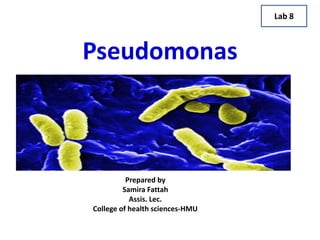
Pseudomonas
Lab 8
Prepared by
Samira Fattah
Assis. Lec.
College of health sciences-HMU
• Medically important Pseudomonas:
P. aeruginosa.
• present in small numbers in the normal intestine
flora and on the skin.
• Commonly present in moist environments in
hospitals.
• It is primarily a nosocomial pathogen.
General character
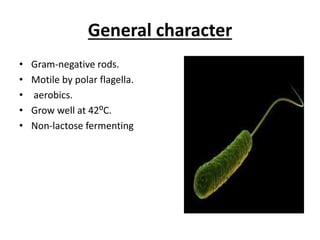
• Gram-negative rods.
• Motile by polar flagella.
• aerobics.
• Grow well at 42⁰C.
• Non-lactose fermenting
Pigment production
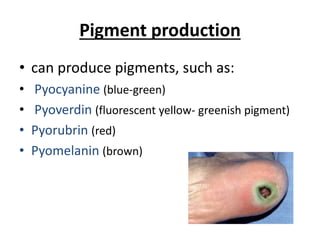
• can produce pigments, such as:
• Pyocyanine (blue-green)
• Pyoverdin (fluorescent yellow- greenish pigment)
• Pyorubrin (red)
• Pyomelanin (brown)
Laboratory diagnosis
Specimen:
• Wound discharge
• sputum
• Blood
• Urine
• CSF
Microscopy
-Gram stain
Gram negative rod
undistinguished from
enerobacteriaceae.
On Culture media
Culture character
• Form smooth and round colonies.
• Fluorescent greenish colour.
• production of fruity odor (grape-like) .
• Inability to ferment lactose.
On nutrient agar
• Colonies are smooth, large, translucent
• Greenish blue diffusible pigment
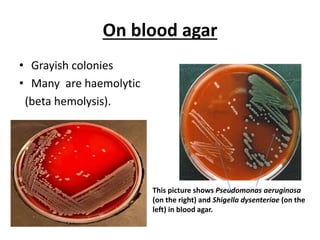
On blood agar
• Grayish colonies
• Many are haemolytic
(beta hemolysis).
This picture shows Pseudomonas aeruginosa
(on the right) and Shigella dysenteriae (on the
left) in blood agar.
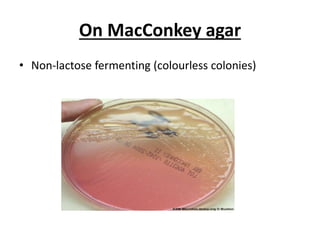
On MacConkey agar
• Non-lactose fermenting (colourless colonies)
On EMB
• Non lactose fermenting
Pigment production on Cetrimide agar
• is a type of agar used for the selective isolation of
the gram-negative bacterium, Pseudomonas aeruginosa.
• As the name suggests, it contains cetrimide, which is the
selective agent against alternate microbial flora.
• Cetrimide also enhances the production
of Pseudomonas pigments such as pyocyanin and fluorescein,
which show a characteristic blue-green and yellow-green
colour, respectively.
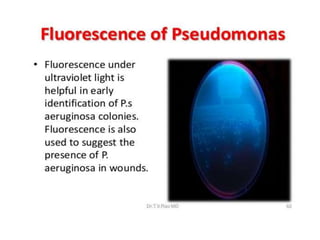
Pseudomonas aeruginosa fluorescence under UV illumination
Oxidase test
• Oxidase positive
Catalase test
• Catalase positive
API20E test

Pseudomonas