P: 555.123.4568 F: 555.123.4567
123 West Main Street, New York,
NY 10001
www.rightcare.com|
Anthrax
P: 555.123.4568 F: 555.123.4567
123 West Main Street, New York,
NY 10001
www.rightcare.com|
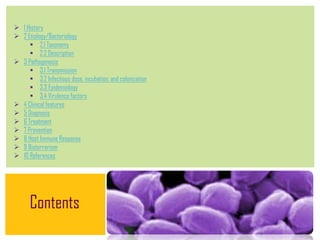
Contents
 1 History
 2 Etiology/Bacteriology
 2.1 Taxonomy
 2.2 Description
 3 Pathogenesis
 3.1 Transmission
 3.2 Infectious dose, incubation, and colonization
 3.3 Epidemiology
 3.4 Virulence factors
 4 Clinical features
 5 Diagnosis
 6 Treatment
 7 Prevention
 8 Host Immune Response
 9 Bioterrorism
 10 References
P: 555.123.4568 F: 555.123.4567
123 West Main Street, New York,
NY 10001
www.rightcare.com|
Introduction
 Anthrax is a zoonotic disease (could be transferred from animals to
humans) caused by the spore-producing bacterium Bacillus anthracis.
 Bacillus anthracis bacterial spores are soil-borne.
 Because of their long lifespan, spores are present globally and remain at
the burial sites of animals killed by anthrax for many decades
 People can get anthrax if they are exposed to the spores.
 Is anthrax contagious?
Anthrax is not contagious, which
means it does not spread from
person to person the way the flu
can spread between family
members or classmates.
Variations in endospore
morphology: (1, 4) central
endospore; (2, 3, 5) terminal
endospore; (6) lateral
endospore
P: 555.123.4568 F: 555.123.4567
123 West Main Street, New York,
NY 10001
www.rightcare.com|
Characteristics
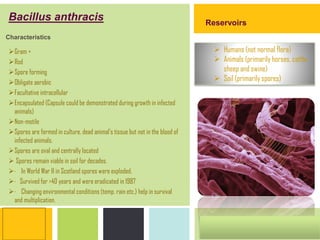
Gram +
Rod
Spore forming
Obligate aerobic
Facultative intracellular
Encapsulated (Capsule could be demonstrated during growth in infected
animals)
Non-motile
Spores are formed in culture, dead animal's tissue but not in the blood of
infected animals.
Spores are oval and centrally located
 Spores remain viable in soil for decades.
· In World War II in Scotland spores were exploded.
· Survived for >40 years and were eradicated in 1987
· Changing environmental conditions (temp. rain etc.) help in survival
and multiplication.
Bacillus anthracis Reservoirs
 Humans (not normal flora)
 Animals (primarily horses, cattle,
sheep and swine)
 Soil (primarily spores)
P: 555.123.4568 F: 555.123.4567
123 West Main Street, New York,
NY 10001
www.rightcare.com|
Anthrax has been described since antiquity. Stories of anthrax
plague appear in the Bible and the ancient Greeks described the
cutaneous infection as coal-like (anthrakites) in appearance. The
Roman poet Virgil also discussed the disease in domestic
animals. Anthrax continued to affect domestic animals and
humans in the Middle Ages and was referred as "woolsorters'
disease" in England due to mill workers contracting the disease
from sheep wool. Anthrax cases in the 20th century decreased
significantly due to vaccination of animals
The discovery of Bacillus anthracis is credited to Pollender,
Rayer and Davaine. Robert Koch proved that the anthrax bacillus
caused the disease. Koch did this by removing anthrax bacilli
from the spleens of mice that had died from the disease and
injected the blood into healthy mice, which killed the previously
healthy mice. This illustrated the disease could be passed by
blood from infected animals. He also created pure cultures of the
bacilli and showed that this also caused disease. These
experimnts served as the prototype for Koch's postulates.
History Taxonomy
 Domain: Bacteria
 Phylum: Firmicutes
 Class: Bacilli
 Order: Bacillales
 Family: Bacillaceae
 Genus: Bacillus
 Species: anthracis
P: 555.123.4568 F: 555.123.4567
123 West Main Street, New York,
NY 10001
www.rightcare.com|
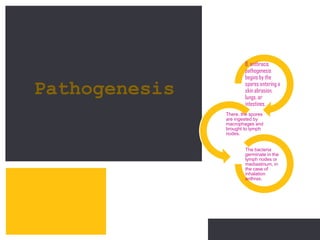
B. anthracis
pathogenesis
begins by the
spores entering a
skin abrasion,
lungs, or
intestines.
There, the spores
are ingested by
macrophages and
brought to lymph
nodes.
The bacteria
germinate in the
lymph nodes or
mediastinum, in
the case of
inhalation
anthrax.
Pathogenesis
P: 555.123.4568 F: 555.123.4567
123 West Main Street, New York,
NY 10001
www.rightcare.com|
 The most common way a human
can contract anthrax is being in
contact with infected animal
products
 Herbivore grazing animals can
commonly contract anthrax
because anthracis lives in the
soil
 A person may get anthrax by
inhaling the spores from animal
products, such as wool, have an
open abrasion on the skin be
exposed to the spores, or eating
undercooked meat from an
animal that was infected
 Anthrax cannot be spread
person-to-person.
Transmission
P: 555.123.4568 F: 555.123.4567
123 West Main Street, New York,
NY 10001
www.rightcare.com|
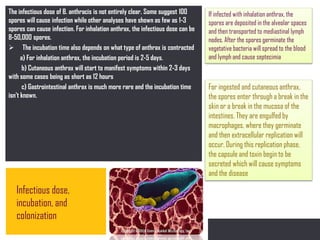
The infectious dose of B. anthracis is not entirely clear. Some suggest 100
spores will cause infection while other analyses have shown as few as 1-3
spores can cause infection. For inhalation anthrax, the infectious dose can be
8-50,000 spores.
 The incubation time also depends on what type of anthrax is contracted
a) For inhalation anthrax, the incubation period is 2-5 days.
b) Cutaneous anthrax will start to manifest symptoms within 2-3 days
with some cases being as short as 12 hours
c) Gastrointestinal anthrax is much more rare and the incubation time
isn't known.
Infectious dose,
incubation, and
colonization
If infected with inhalation anthrax, the
spores are deposited in the alveolar spaces
and then transported to mediastinal lymph
nodes. After the spores germinate the
vegetative bacteria will spread to the blood
and lymph and cause septecimia
For ingested and cutaneous anthrax,
the spores enter through a break in the
skin or a break in the mucosa of the
intestines. They are engulfed by
macrophages, where they germinate
and then extracellular replication will
occur. During this replication phase,
the capsule and toxin begin to be
secreted which will cause symptoms
and the disease
P: 555.123.4568 F: 555.123.4567
123 West Main Street, New York,
NY 10001
www.rightcare.com|
 Most inhalation anthrax cases have occured in the
factory setting when workers are exposed to
contaminated animal products, like wool.
 Inhalation anthrax is very rare in the United States due
to vast vaccination of domesticated livestock.
 Gastrointestinal anthrax is the rarest form of anthrax,
and in the United States there has only been two reported
cases. In 2010, the Philippines had a 400 person outbreak
of gastrointestinal anthrax from eating meat from a dead
infected caribou
 The largest epidemic to date happened in Zimbabwae
between 1979-1985 when 10,000 people contracted
cutaneous anthrax.
Epidemiology
P: 555.123.4568 F: 555.123.4567
123 West Main Street, New York,
NY 10001
www.rightcare.com|
 Bacillus anthracis has two components to
its virulence
 The toxin it secrets as well as its
capsule. The capsule is composed of D-
glutamyl polypeptide
 Plasmid pXO2 is involved in the formation
of the capsule
 The capsule prevents host phagocytosis
when B. anthracis is in its vegetative
form.
 Plasmid pXO1 is responsible for the toxin
released
 The toxin has three proteins: the edema
factor, lethal factor, and protective
antigen.
Virulence factors
P: 555.123.4568 F: 555.123.4567
123 West Main Street, New York,
NY 10001
www.rightcare.com|
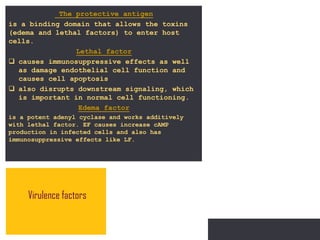
The protective antigen
is a binding domain that allows the toxins
(edema and lethal factors) to enter host
cells.
Lethal factor
 causes immunosuppressive effects as well
as damage endothelial cell function and
causes cell apoptosis
 also disrupts downstream signaling, which
is important in normal cell functioning.
Edema factor
is a potent adenyl cyclase and works additively
with lethal factor. EF causes increase cAMP
production in infected cells and also has
immunosuppressive effects like LF.
Virulence factors
P: 555.123.4568 F: 555.123.4567
123 West Main Street, New York,
NY 10001
www.rightcare.com|
Symptoms
The symptoms of anthrax
depend on the type of
infection and can take
anywhere from 1 day to
more than 2 months to
appear
 small blisters or
bumps
 (ulcer) with a black
center
 Swelling of
abdomen(stomach)
 Diarrhea or bloody diarrhea
Bloody discharge from
body orifices
P: 555.123.4568 F: 555.123.4567
123 West Main Street, New York,
NY 10001
www.rightcare.com|
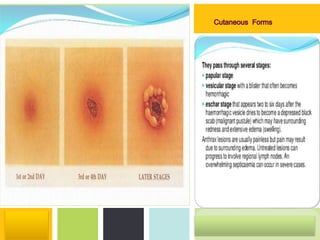
Symptoms:
 A raised, itchy bump resembling an insect bite
that quickly develops into a painless sore with a
black center
 Swelling in the sore and nearby lymph glands
Types of Anthrax
Treatment:
Cutaneous anthrax is treated with antibiotics, most
often doxycycline or ciprofloxacin
http://www.nytimes.com/health/guides/disease/cutane
ous-anthrax/overview.html
A skin lesion caused by
anthrax
P: 555.123.4568 F: 555.123.4567
123 West Main Street, New York,
NY 10001
www.rightcare.com|
P: 555.123.4568 F: 555.123.4567
123 West Main Street, New York,
NY 10001
www.rightcare.com|
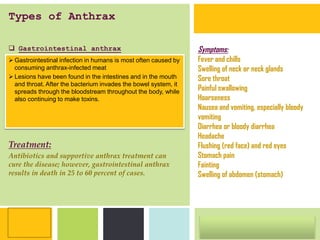
 Gastrointestinal anthrax
 Gastrointestinal infection in humans is most often caused by
consuming anthrax-infected meat
 Lesions have been found in the intestines and in the mouth
and throat. After the bacterium invades the bowel system, it
spreads through the bloodstream throughout the body, while
also continuing to make toxins.
Treatment:
Antibiotics and supportive anthrax treatment can
cure the disease; however, gastrointestinal anthrax
results in death in 25 to 60 percent of cases.
Types of Anthrax
Symptoms:
Fever and chills
Swelling of neck or neck glands
Sore throat
Painful swallowing
Hoarseness
Nausea and vomiting, especially bloody
vomiting
Diarrhea or bloody diarrhea
Headache
Flushing (red face) and red eyes
Stomach pain
Fainting
Swelling of abdomen (stomach)
P: 555.123.4568 F: 555.123.4567
123 West Main Street, New York,
NY 10001
www.rightcare.com|
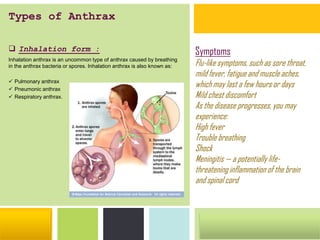
 Inhalation form :
Inhalation anthrax is an uncommon type of anthrax caused by breathing
in the anthrax bacteria or spores. Inhalation anthrax is also known as:
 Pulmonary anthrax
 Pneumonic anthrax
 Respiratory anthrax.
Types of Anthrax
Symptoms
Flu-like symptoms, such as sore throat,
mild fever, fatigue and muscle aches,
which may last a few hours or days
Mild chest discomfort
As the disease progresses, you may
experience:
High fever
Trouble breathing
Shock
Meningitis — a potentially life-
threatening inflammation of the brain
and spinal cord
P: 555.123.4568 F: 555.123.4567
123 West Main Street, New York,
NY 10001
www.rightcare.com|
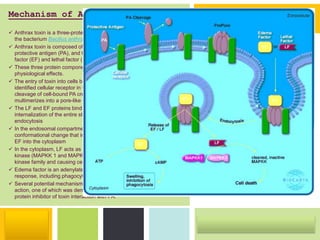
Mechanism of Anthrax Toxins:
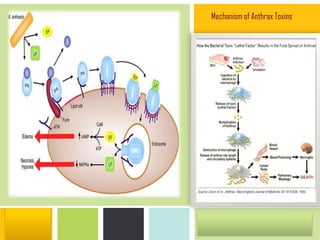
 Anthrax toxin is a three-protein exotoxin secreted by virulent strains of
the bacterium Bacillus anthracis
 Anthrax toxin is composed of a cell-binding protein, known as
protective antigen (PA), and two enzyme components, called edema
factor (EF) and lethal factor (LF).
 These three protein components act together to impart their
physiological effects.
 The entry of toxin into cells begins with the recognition of a recently
identified cellular receptor in the plasma membrane by PA. Proteolytic
cleavage of cell-bound PA creates a smaller fragment that then
multimerizes into a pore-like structure in the plasma membrane.
 The LF and EF proteins bind to the PA pre-pore, followed by
internalization of the entire structure through receptor-mediated
endocytosis
 In the endosomal compartment, the acidic pH causes a
conformational change that inserts PA fragments and releases LF and
EF into the cytoplasm
 In the cytoplasm, LF acts as a protease that cleaves MAP kinase
kinase (MAPKK 1 and MAPKK 2), inhibiting pathways that rely on this
kinase family and causing cell death
 Edema factor is an adenylate cyclase that inhibits the immune
response, including phagocytosis by macrophages.
 Several potential mechanisms could be used to block anthrax toxin
action, one of which was demonstrated by the design of a multivalent
protein inhibitor of toxin interaction with PA.
P: 555.123.4568 F: 555.123.4567
123 West Main Street, New York,
NY 10001
www.rightcare.com|
Mechanism of Anthrax Toxins
P: 555.123.4568 F: 555.123.4567
123 West Main Street, New York,
NY 10001
www.rightcare.com|
I. Cultural Characteristics:
•Blood Agar and Nutrient Agar are commonly used to
cultivate the bacilli. Plates are incubated aerobically at
37 oC
Diagnosis
On blood agar plates
•Colonies have irregular borders and are non-hemolytic.
On nutrient agar
•They are described as "Medusa head" or "Comet tail".
P: 555.123.4568 F: 555.123.4567
123 West Main Street, New York,
NY 10001
www.rightcare.com|
Cutaneous
Anthrax
• Swab samples
from cutaneous
lesions
Pulmonary
Anthrax
• Sputum and blood
Gastrointestinal
Anthrax
• . Gastric aspirate,
feces and blood
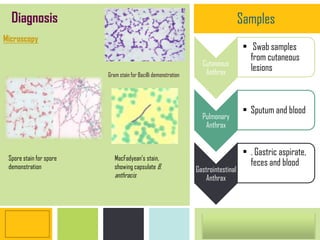
Microscopy
Diagnosis Samples
Gram stain for Bacilli demonstration
MacFadyean's stain,
showing capsulate B.
anthracis
Spore stain for spore
demonstration
P: 555.123.4568 F: 555.123.4567
123 West Main Street, New York,
NY 10001
www.rightcare.com|
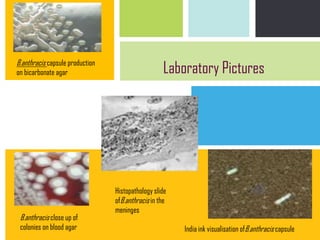
Laboratory PicturesB.anthracis capsule production
on bicarbonate agar
B.anthracis close up of
colonies on blood agar India ink visualisation ofB.anthracis capsule
Histopathology slide
ofB.anthracis in the
meninges
P: 555.123.4568 F: 555.123.4567
123 West Main Street, New York,
NY 10001
www.rightcare.com|
Treatment
 If anthrax is confirmed, antibiotics
should be administered.
 The CDC recommends
ciprofloxacin and doxycycline
 f anthrax meningitis is suspected,
doxycycline shouldn't be used
because it does not penetrate the
central nervous system very well.
 Pregnant or breastfeeding women
can use amoxicillin.
 For inhalation anthrax, it is
recommended to use multi-drug
therapy, such as vancomycin, with
the chosen antibiotic
P: 555.123.4568 F: 555.123.4567
123 West Main Street, New York,
NY 10001
www.rightcare.com|
Prevention
P: 555.123.4568 F: 555.123.4567
123 West Main Street, New York,
NY 10001
www.rightcare.com|
 http://microbewiki.kenyon.edu/index.php/Anthrax
 https://sites.google.com/site/allmicrobiologysite/medic
al-microbiology-ii/summary-of-bacterial-
pathogens/bacillus-anthracis
 http://www.cdc.gov/anthrax/
 http://www.hpa.org.uk/webw/HPAweb&Page&HPAwebAut
oListName/Page/1204619483853
References

Anthrax

  • 1.
    P: 555.123.4568 F:555.123.4567 123 West Main Street, New York, NY 10001 www.rightcare.com| Anthrax
  • 2.
    P: 555.123.4568 F:555.123.4567 123 West Main Street, New York, NY 10001 www.rightcare.com| Contents  1 History  2 Etiology/Bacteriology  2.1 Taxonomy  2.2 Description  3 Pathogenesis  3.1 Transmission  3.2 Infectious dose, incubation, and colonization  3.3 Epidemiology  3.4 Virulence factors  4 Clinical features  5 Diagnosis  6 Treatment  7 Prevention  8 Host Immune Response  9 Bioterrorism  10 References
  • 3.
    P: 555.123.4568 F:555.123.4567 123 West Main Street, New York, NY 10001 www.rightcare.com| Introduction  Anthrax is a zoonotic disease (could be transferred from animals to humans) caused by the spore-producing bacterium Bacillus anthracis.  Bacillus anthracis bacterial spores are soil-borne.  Because of their long lifespan, spores are present globally and remain at the burial sites of animals killed by anthrax for many decades  People can get anthrax if they are exposed to the spores.  Is anthrax contagious? Anthrax is not contagious, which means it does not spread from person to person the way the flu can spread between family members or classmates. Variations in endospore morphology: (1, 4) central endospore; (2, 3, 5) terminal endospore; (6) lateral endospore
  • 4.
    P: 555.123.4568 F:555.123.4567 123 West Main Street, New York, NY 10001 www.rightcare.com| Characteristics Gram + Rod Spore forming Obligate aerobic Facultative intracellular Encapsulated (Capsule could be demonstrated during growth in infected animals) Non-motile Spores are formed in culture, dead animal's tissue but not in the blood of infected animals. Spores are oval and centrally located  Spores remain viable in soil for decades. · In World War II in Scotland spores were exploded. · Survived for >40 years and were eradicated in 1987 · Changing environmental conditions (temp. rain etc.) help in survival and multiplication. Bacillus anthracis Reservoirs  Humans (not normal flora)  Animals (primarily horses, cattle, sheep and swine)  Soil (primarily spores)
  • 5.
    P: 555.123.4568 F:555.123.4567 123 West Main Street, New York, NY 10001 www.rightcare.com| Anthrax has been described since antiquity. Stories of anthrax plague appear in the Bible and the ancient Greeks described the cutaneous infection as coal-like (anthrakites) in appearance. The Roman poet Virgil also discussed the disease in domestic animals. Anthrax continued to affect domestic animals and humans in the Middle Ages and was referred as "woolsorters' disease" in England due to mill workers contracting the disease from sheep wool. Anthrax cases in the 20th century decreased significantly due to vaccination of animals The discovery of Bacillus anthracis is credited to Pollender, Rayer and Davaine. Robert Koch proved that the anthrax bacillus caused the disease. Koch did this by removing anthrax bacilli from the spleens of mice that had died from the disease and injected the blood into healthy mice, which killed the previously healthy mice. This illustrated the disease could be passed by blood from infected animals. He also created pure cultures of the bacilli and showed that this also caused disease. These experimnts served as the prototype for Koch's postulates. History Taxonomy  Domain: Bacteria  Phylum: Firmicutes  Class: Bacilli  Order: Bacillales  Family: Bacillaceae  Genus: Bacillus  Species: anthracis
  • 6.
    P: 555.123.4568 F:555.123.4567 123 West Main Street, New York, NY 10001 www.rightcare.com| B. anthracis pathogenesis begins by the spores entering a skin abrasion, lungs, or intestines. There, the spores are ingested by macrophages and brought to lymph nodes. The bacteria germinate in the lymph nodes or mediastinum, in the case of inhalation anthrax. Pathogenesis
  • 7.
    P: 555.123.4568 F:555.123.4567 123 West Main Street, New York, NY 10001 www.rightcare.com|  The most common way a human can contract anthrax is being in contact with infected animal products  Herbivore grazing animals can commonly contract anthrax because anthracis lives in the soil  A person may get anthrax by inhaling the spores from animal products, such as wool, have an open abrasion on the skin be exposed to the spores, or eating undercooked meat from an animal that was infected  Anthrax cannot be spread person-to-person. Transmission
  • 8.
    P: 555.123.4568 F:555.123.4567 123 West Main Street, New York, NY 10001 www.rightcare.com| The infectious dose of B. anthracis is not entirely clear. Some suggest 100 spores will cause infection while other analyses have shown as few as 1-3 spores can cause infection. For inhalation anthrax, the infectious dose can be 8-50,000 spores.  The incubation time also depends on what type of anthrax is contracted a) For inhalation anthrax, the incubation period is 2-5 days. b) Cutaneous anthrax will start to manifest symptoms within 2-3 days with some cases being as short as 12 hours c) Gastrointestinal anthrax is much more rare and the incubation time isn't known. Infectious dose, incubation, and colonization If infected with inhalation anthrax, the spores are deposited in the alveolar spaces and then transported to mediastinal lymph nodes. After the spores germinate the vegetative bacteria will spread to the blood and lymph and cause septecimia For ingested and cutaneous anthrax, the spores enter through a break in the skin or a break in the mucosa of the intestines. They are engulfed by macrophages, where they germinate and then extracellular replication will occur. During this replication phase, the capsule and toxin begin to be secreted which will cause symptoms and the disease
  • 9.
    P: 555.123.4568 F:555.123.4567 123 West Main Street, New York, NY 10001 www.rightcare.com|  Most inhalation anthrax cases have occured in the factory setting when workers are exposed to contaminated animal products, like wool.  Inhalation anthrax is very rare in the United States due to vast vaccination of domesticated livestock.  Gastrointestinal anthrax is the rarest form of anthrax, and in the United States there has only been two reported cases. In 2010, the Philippines had a 400 person outbreak of gastrointestinal anthrax from eating meat from a dead infected caribou  The largest epidemic to date happened in Zimbabwae between 1979-1985 when 10,000 people contracted cutaneous anthrax. Epidemiology
  • 10.
    P: 555.123.4568 F:555.123.4567 123 West Main Street, New York, NY 10001 www.rightcare.com|  Bacillus anthracis has two components to its virulence  The toxin it secrets as well as its capsule. The capsule is composed of D- glutamyl polypeptide  Plasmid pXO2 is involved in the formation of the capsule  The capsule prevents host phagocytosis when B. anthracis is in its vegetative form.  Plasmid pXO1 is responsible for the toxin released  The toxin has three proteins: the edema factor, lethal factor, and protective antigen. Virulence factors
  • 11.
    P: 555.123.4568 F:555.123.4567 123 West Main Street, New York, NY 10001 www.rightcare.com| The protective antigen is a binding domain that allows the toxins (edema and lethal factors) to enter host cells. Lethal factor  causes immunosuppressive effects as well as damage endothelial cell function and causes cell apoptosis  also disrupts downstream signaling, which is important in normal cell functioning. Edema factor is a potent adenyl cyclase and works additively with lethal factor. EF causes increase cAMP production in infected cells and also has immunosuppressive effects like LF. Virulence factors
  • 12.
    P: 555.123.4568 F:555.123.4567 123 West Main Street, New York, NY 10001 www.rightcare.com| Symptoms The symptoms of anthrax depend on the type of infection and can take anywhere from 1 day to more than 2 months to appear  small blisters or bumps  (ulcer) with a black center  Swelling of abdomen(stomach)  Diarrhea or bloody diarrhea Bloody discharge from body orifices
  • 13.
    P: 555.123.4568 F:555.123.4567 123 West Main Street, New York, NY 10001 www.rightcare.com| Symptoms:  A raised, itchy bump resembling an insect bite that quickly develops into a painless sore with a black center  Swelling in the sore and nearby lymph glands Types of Anthrax Treatment: Cutaneous anthrax is treated with antibiotics, most often doxycycline or ciprofloxacin http://www.nytimes.com/health/guides/disease/cutane ous-anthrax/overview.html A skin lesion caused by anthrax
  • 14.
    P: 555.123.4568 F:555.123.4567 123 West Main Street, New York, NY 10001 www.rightcare.com|
  • 15.
    P: 555.123.4568 F:555.123.4567 123 West Main Street, New York, NY 10001 www.rightcare.com|  Gastrointestinal anthrax  Gastrointestinal infection in humans is most often caused by consuming anthrax-infected meat  Lesions have been found in the intestines and in the mouth and throat. After the bacterium invades the bowel system, it spreads through the bloodstream throughout the body, while also continuing to make toxins. Treatment: Antibiotics and supportive anthrax treatment can cure the disease; however, gastrointestinal anthrax results in death in 25 to 60 percent of cases. Types of Anthrax Symptoms: Fever and chills Swelling of neck or neck glands Sore throat Painful swallowing Hoarseness Nausea and vomiting, especially bloody vomiting Diarrhea or bloody diarrhea Headache Flushing (red face) and red eyes Stomach pain Fainting Swelling of abdomen (stomach)
  • 16.
    P: 555.123.4568 F:555.123.4567 123 West Main Street, New York, NY 10001 www.rightcare.com|  Inhalation form : Inhalation anthrax is an uncommon type of anthrax caused by breathing in the anthrax bacteria or spores. Inhalation anthrax is also known as:  Pulmonary anthrax  Pneumonic anthrax  Respiratory anthrax. Types of Anthrax Symptoms Flu-like symptoms, such as sore throat, mild fever, fatigue and muscle aches, which may last a few hours or days Mild chest discomfort As the disease progresses, you may experience: High fever Trouble breathing Shock Meningitis — a potentially life- threatening inflammation of the brain and spinal cord
  • 17.
    P: 555.123.4568 F:555.123.4567 123 West Main Street, New York, NY 10001 www.rightcare.com| Mechanism of Anthrax Toxins:  Anthrax toxin is a three-protein exotoxin secreted by virulent strains of the bacterium Bacillus anthracis  Anthrax toxin is composed of a cell-binding protein, known as protective antigen (PA), and two enzyme components, called edema factor (EF) and lethal factor (LF).  These three protein components act together to impart their physiological effects.  The entry of toxin into cells begins with the recognition of a recently identified cellular receptor in the plasma membrane by PA. Proteolytic cleavage of cell-bound PA creates a smaller fragment that then multimerizes into a pore-like structure in the plasma membrane.  The LF and EF proteins bind to the PA pre-pore, followed by internalization of the entire structure through receptor-mediated endocytosis  In the endosomal compartment, the acidic pH causes a conformational change that inserts PA fragments and releases LF and EF into the cytoplasm  In the cytoplasm, LF acts as a protease that cleaves MAP kinase kinase (MAPKK 1 and MAPKK 2), inhibiting pathways that rely on this kinase family and causing cell death  Edema factor is an adenylate cyclase that inhibits the immune response, including phagocytosis by macrophages.  Several potential mechanisms could be used to block anthrax toxin action, one of which was demonstrated by the design of a multivalent protein inhibitor of toxin interaction with PA.
  • 18.
    P: 555.123.4568 F:555.123.4567 123 West Main Street, New York, NY 10001 www.rightcare.com| Mechanism of Anthrax Toxins
  • 19.
    P: 555.123.4568 F:555.123.4567 123 West Main Street, New York, NY 10001 www.rightcare.com| I. Cultural Characteristics: •Blood Agar and Nutrient Agar are commonly used to cultivate the bacilli. Plates are incubated aerobically at 37 oC Diagnosis On blood agar plates •Colonies have irregular borders and are non-hemolytic. On nutrient agar •They are described as "Medusa head" or "Comet tail".
  • 20.
    P: 555.123.4568 F:555.123.4567 123 West Main Street, New York, NY 10001 www.rightcare.com| Cutaneous Anthrax • Swab samples from cutaneous lesions Pulmonary Anthrax • Sputum and blood Gastrointestinal Anthrax • . Gastric aspirate, feces and blood Microscopy Diagnosis Samples Gram stain for Bacilli demonstration MacFadyean's stain, showing capsulate B. anthracis Spore stain for spore demonstration
  • 21.
    P: 555.123.4568 F:555.123.4567 123 West Main Street, New York, NY 10001 www.rightcare.com| Laboratory PicturesB.anthracis capsule production on bicarbonate agar B.anthracis close up of colonies on blood agar India ink visualisation ofB.anthracis capsule Histopathology slide ofB.anthracis in the meninges
  • 22.
    P: 555.123.4568 F:555.123.4567 123 West Main Street, New York, NY 10001 www.rightcare.com| Treatment  If anthrax is confirmed, antibiotics should be administered.  The CDC recommends ciprofloxacin and doxycycline  f anthrax meningitis is suspected, doxycycline shouldn't be used because it does not penetrate the central nervous system very well.  Pregnant or breastfeeding women can use amoxicillin.  For inhalation anthrax, it is recommended to use multi-drug therapy, such as vancomycin, with the chosen antibiotic
  • 23.
    P: 555.123.4568 F:555.123.4567 123 West Main Street, New York, NY 10001 www.rightcare.com| Prevention
  • 24.
    P: 555.123.4568 F:555.123.4567 123 West Main Street, New York, NY 10001 www.rightcare.com|  http://microbewiki.kenyon.edu/index.php/Anthrax  https://sites.google.com/site/allmicrobiologysite/medic al-microbiology-ii/summary-of-bacterial- pathogens/bacillus-anthracis  http://www.cdc.gov/anthrax/  http://www.hpa.org.uk/webw/HPAweb&Page&HPAwebAut oListName/Page/1204619483853 References