By;
Randa Abdalla
Contents:
 Introduction
 History
 Epidemiology
 Causative organism
 Transmission
 Clinical manifestation
 Management
 Prevention and control
Introduction
 Malignant pustule, Malignant oedema, Woolsorter
disease,Ragpicker disease.
 From the Greek word anthrakos for coal
 Caused by spores
 Primarily a disease of domesticated & wild animals
 Herbivores such as sheep, cows, horses, goats.
 Anthrax zones
 Soil rich in organic matter (pH < 6.0)
History of Anthrax (Early history)
 Although anthrax dates back more than 3,000 years,
it was not recognized as a disease until the 18th
century.
 1500 B.C - A “plague of boils” in Egypt affected the
Pharaoh’s cattle. ‘Boils’ are symptomatic of anthrax.
 1600s - The “Black Bane” thought to be anthrax, in
Europe kills over 60,000 cattle.
 1700s - There are some accounts of human cases.
History (1800s)
 Early 1800s - The first human cases of cutaneous anthrax
in the US and UK were reported in men who contracted the
disease after having been in contact with infected
livestock.
 The disease was called Wool Sorter’s disease or Rag
Picker’s disease because it affected workers in those
trades.
 1868 - Anthrax was observed under a microscope.
 1876 - German bacteriologist Robert Koch confirmed
bacterial origin of anthrax.
History (Early 1900s)
 1915 - German agents injected horses, mules, and cattle
with anthrax . This was the first recorded use of anthrax
as a biological weapon.
 1937 - Japan started a biological warfare program in
Manchuria, including tests involving anthrax.
 1942 - UK demonstrated experiments using anthrax at
Gruinard Island off the coast of Scotland.
 1943 - United States began developing anthrax weapons.
 1945 - In Iran an anthrax outbreak killed more than 1
million sheep.
History (Late 1900s)
 1950s and 60s - U.S. biological warfare program continues
after WWII at Fort Detrick, Maryland
 1969 - President Nixon ended United States' offensive
biological weapons program, but defensive work still
continues.
 1970 - Anthrax vaccine for humans was approved by U.S.
FDA.
 1978-80 - The world's largest outbreak of human anthrax
via insect vectors or contaminated meat struck Zimbabwe,
Africa where more than 10,000 cases were recorded and
over 180 people died.
 1979 - In Soviet Union, aerosolized anthrax spores were
released accidentally at a military facility, affecting 94 and
killing 64 people.
History (Recent years)
 1991 - About 150,000 U.S. troops were vaccinated for
anthrax in preparation for Gulf War.
 1990-93 - The cult group, Aum Shinrikyo, released
anthrax spores in Tokyo, fortunately no one was injured.
On February 27, 2004, the leader of this group was given
a sentence of death at a district court in Tokyo.
 1995 - Iraq produced 8,500 liters of concentrated anthrax
as part of the biological weapon program under Saddam
Hussein’s administration.
 2001 - Letters containing anthrax spores were mailed to
many places in the US such as NBC, New York Times,
and Media in Miami. In Florida, a man died after inhaling
anthrax at the office.
Outbreaks in Thailand
 This picture is 9 days
after the onset of
symptoms of oral-
pharyngeal anthrax.
 1982 - In rural Northern
Thailand, an outbreak of 52
cases of cutaneous anthrax
and 24 cases of oral-
pharyngeal anthrax occurred.
 Oral-pharyngeal anthrax: an
unusual manifestation of
human
infection with B. anthracis.
 1987 - 14 cases of both oral-
pharyngeal and abdominal
anthrax occurred.
 Caused by the consumption of
contaminated water and
buffalo meat.
Natural Outbreaks in North Dakota
 The highest occurrence of
Anthrax outbreaks in the US
 1989-1999 - 26 cases of
infected livestock were
reported.
 2000 - 33 cases were reported
during July-September.
 Total of 180 animals (beef
cattle, horses, and bison) died
and one person was infected
with cutaneous anthrax.
Epidemiology
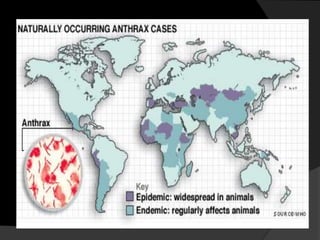
 Distribution worldwide
 Not common in West. Common in Africa ( Zimbabwe),
S.E. Asia, China, South America, Turkey, Pakistan, India
 Human to human or animal to animal transmission is rare (
not contagious)
 Grazing animals become infected through ingestion of
spores in the soil ( Carcasses become the source)
Causative organism
 - Etiologic agent: Bacillus anthracis Cohn 1875.
 - Large (8 x 1.2 mm) Gram positive, nonmotile,
weakly hæmolytic; central spores, straight ends,
encapsulated in vivo, produces long chains.
 - Pathogenic to herbivores, man, lab animals.
 - Habitat: Parasitic; persists in “cursed” fields.
 - Sporulation only in aerobic conditions.
 - Capsule antigen: poly D-glutamic acid g-peptide
 - Immunogenic protein toxin, edematizing, lethal.
Bacillus anthracis: culture
(blue)
(red)
STAGES OF INFECTION
 Encounter: organism and body surfaces
 Adhesion: generalized and receptor-specific
 Initial multiplication  in situ colonization
 Invasión  breaching of anatomic barriers
 Lymphatic stage  invasion of bloodstream
 Generalized infection, metastases.
Transmission
Transmission:
 Contact with tissues of animals (cattle, sheep, goats,
horses, pigs and others) dying of the disease.
 Biting flies that have partially fed on such animals.
 Contact with contaminated hair, wool, hides or
products made from them (e.g. drums, brushes, rugs).
 Contact with soil associated with infected animals or
with contaminated bone meal used in gardening.
Transmission cont.
 Inhalation anthrax results from inhalation of
spores in risky industrial processes—such as
tanning hides and processing wool or bone—
with aerosols of B. anthracis spores in an
enclosed, poorly-ventilated area.
 Intestinal and oropharyngeal anthrax may arise
from ingestion of contaminated undercooked
meat; there is no evidence that milk from
infected animals transmits anthrax.
Transmission cont.
 The disease spreads among grazing animals
through contaminated soil and feed; and
among omnivorous and carnivorous animals
through contaminated meat, bone meal or
other feeds derived from infected carcases.
 Accidental infections may occur among
laboratory workers.
Transmission cont.
 Anthrax is not transmitted person to person.
 Articles and soil contaminated with spores in
endemic areas may remain infective for
many years.
Clinical manifestations
Clinical manifestations:
 Anthrax is an illness with acute onset.
 characterised by several distinct clinical forms including:
1. a skin lesion
2. a respiratory illness
3. abdominal distress
 Ninety percent of cases are cutaneous anthrax
Cutaneous Anthrax
• Mainly in professionals( Veterinarian, butcher, Zoo
keeper
• Spores infect skin- a characteristic gelatinous edema
develops at the site (Papule- Vesicle-Malignant Pustule-
Necrotic ulcer)
• 80-90% heal spontaneously ( 2-6wks)
• 0-20% progressive disease – develop septicemia
• 95-99% of all human anthrax occur as cutaneous
anthrax
Site of Malignant pustule
 Head: usually no complication
 Face: severe, superinfection; gangrene near eye
 Neck, breast or chest wall: massive edema, over thorax and
sometimes involving scrotum
 Shoulders, arms: may be multiple, small lesions
 Forearms, fingers: atypical on palms
 General symptoms, fever, chills, depend on site.
 Weakness, hypotension are danger signs.
Notice the edema and typical lesions
Intestinal Anthrax
• Due to in ingestion of infected carcasses
• Mucosal lesion to the lymphatic system
• Rare in developed countries
• Extremely high mortality rate
Intestinal Anthrax
 Nausea, anorexia, vomiting, fever
 Progresses to severe abdominal pain and
bloody emesis and diarrhea
 Ascites may develop on day 2 - 4
 Death 2 to 5 days after onset of symptoms
 Very difficult to diagnose
Cecal Lesion
from eating undercooked Carabao... (AFIP)
PULMONARY ANTHRAX
• Require very high infective dose ( > 10,000 spores)
• Acquired through inhalation of spores ( Bioterrorism -
aerosol)
• Present with symptoms of severe respiratory infection( High
fever & Chest pain)
• Haemorrhagic mediastinitis
• Progress to septicemia very rapidly
• 10 7 to 10 9 bacilli/ ml of blood at the time of death
• Mortality rate is very high > 95%
Anthrax Meningitis
 Usually a complication of anthrax septicemia.
 Subarachnoid haemorrhage is a common
feature
 Very often fatal
Anthrax meningitis:
Subarachnoid Haemorrhage
(AFIP)
Anthrax - Disease in
animals
 Fulminating, acute, subacute or chronic.
 Apoplectic death: “fall” - animals found dead.
 Acute: excitable, then depressed, cardiac and
respiratory distress, trembling, staggering, convulsions.
 Edematous lesions, blood exudes, incoagulable.
 Death in 1-2 days, or 4-5.
 Chronic infection in more resistant animals: pigs.
Diagnosis:
 Clinical; symptoms and signs.
 Incubation period—From 1 to 7 days,
although incubation periods up to 60 days
are possible
 Laboratory confirmation requires at least
one of the following:
1. isolation of Bacillus anthracis from a clinical
specimen
2. demonstration of B. anthracis in a clinical
specimen by immunofluorescence
3. significant antibody titres developing in an
appropriate clinical case.
Management
Management:
 Investigation
Obtain a history of travel and contact with imported
animal
 Restriction
Standard infection control precautions apply for all
direct clinical care. Although a cutaneous lesion
will be sterile after 24 hours’ treatment, dressings
soiled with discharges from lesions should be
burned and reusable surgical equipment
sterilised.
Treatment
 The case should be under the care of an infectious
diseases physician.
 Penicillin is the drug of choice for cutaneous
anthrax and is given for 5–7 days.
 Tetracyclines, erythromycin and chloramphenicol
are also effective.
 The U.S. military recommends parenteral
ciprofloxacin or doxycycline for inhalation anthrax
though the duration of treatment is not well defined.
 Counselling
Advise the case and their caregivers of the
nature of the infection and its mode of
transmission.
 Management of contacts
Vaccination
 Cell-free filtrate
 At risk groups
 Veterinarians
 Lab workers
 Livestock handlers
 Military personnel
 Immunization series
 Five IM injections over 18-week period
 Annual booster
9/19/2015
Methods of control—
 A. Preventive measures:
Immunize high-risk persons , Educate employees ,
Control dust, wash, disinfect or sterilize, immunize and
annually reimmunize all domestic animals at risk….etc.
 B. Control of patient, contacts and the immediate
environment
Report to local health authority, Isolation,
Concurrent disinfection, Investigation of contacts,
Specific treatment….etc.
 C. Epidemic measures
 D. Disaster implications
 E. International measures; Sterilize imported
bone meal before use as animal feed. Disinfect
wool, hair and other products when indicated and
feasible.
Prevention
 Control in animals. Annual vaccination protects.
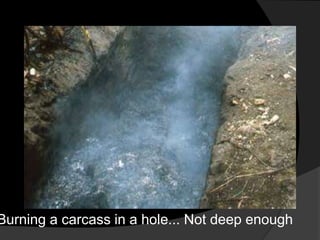
 Disposal of animal carcasses: disinfect with oil,
burn, bury deep, covered with quicklime.
 Spores will NOT form inside the carcass, and
putrefaction kills the Bacillus. Flies feeding on
incoagulable blood may be a problem.
An anthrax death. Notice flies
feeding on blood and secretions
Burning a carcass in a hole... Not deep enough
Question
The most common naturally occurring form of
anthrax is:
a. Cutaneous
b. Gastrointestinal
c. Inhalational
d. Ocular
e. Mediastinal
Question
After low-level germination at the site of entry
to the body, anthrax may be taken up by:
a. Basophils
b. Eosinophils
c. Lymphocytes
d. Macrophages
e. Neutrophils
Thank
you…

Anthrax

  • 1.
  • 2.
    Contents:  Introduction  History Epidemiology  Causative organism  Transmission  Clinical manifestation  Management  Prevention and control
  • 3.
    Introduction  Malignant pustule,Malignant oedema, Woolsorter disease,Ragpicker disease.  From the Greek word anthrakos for coal  Caused by spores  Primarily a disease of domesticated & wild animals  Herbivores such as sheep, cows, horses, goats.  Anthrax zones  Soil rich in organic matter (pH < 6.0)
  • 4.
    History of Anthrax(Early history)  Although anthrax dates back more than 3,000 years, it was not recognized as a disease until the 18th century.  1500 B.C - A “plague of boils” in Egypt affected the Pharaoh’s cattle. ‘Boils’ are symptomatic of anthrax.  1600s - The “Black Bane” thought to be anthrax, in Europe kills over 60,000 cattle.  1700s - There are some accounts of human cases.
  • 5.
    History (1800s)  Early1800s - The first human cases of cutaneous anthrax in the US and UK were reported in men who contracted the disease after having been in contact with infected livestock.  The disease was called Wool Sorter’s disease or Rag Picker’s disease because it affected workers in those trades.  1868 - Anthrax was observed under a microscope.  1876 - German bacteriologist Robert Koch confirmed bacterial origin of anthrax.
  • 6.
    History (Early 1900s) 1915 - German agents injected horses, mules, and cattle with anthrax . This was the first recorded use of anthrax as a biological weapon.  1937 - Japan started a biological warfare program in Manchuria, including tests involving anthrax.  1942 - UK demonstrated experiments using anthrax at Gruinard Island off the coast of Scotland.  1943 - United States began developing anthrax weapons.  1945 - In Iran an anthrax outbreak killed more than 1 million sheep.
  • 7.
    History (Late 1900s) 1950s and 60s - U.S. biological warfare program continues after WWII at Fort Detrick, Maryland  1969 - President Nixon ended United States' offensive biological weapons program, but defensive work still continues.  1970 - Anthrax vaccine for humans was approved by U.S. FDA.  1978-80 - The world's largest outbreak of human anthrax via insect vectors or contaminated meat struck Zimbabwe, Africa where more than 10,000 cases were recorded and over 180 people died.  1979 - In Soviet Union, aerosolized anthrax spores were released accidentally at a military facility, affecting 94 and killing 64 people.
  • 8.
    History (Recent years) 1991 - About 150,000 U.S. troops were vaccinated for anthrax in preparation for Gulf War.  1990-93 - The cult group, Aum Shinrikyo, released anthrax spores in Tokyo, fortunately no one was injured. On February 27, 2004, the leader of this group was given a sentence of death at a district court in Tokyo.  1995 - Iraq produced 8,500 liters of concentrated anthrax as part of the biological weapon program under Saddam Hussein’s administration.  2001 - Letters containing anthrax spores were mailed to many places in the US such as NBC, New York Times, and Media in Miami. In Florida, a man died after inhaling anthrax at the office.
  • 9.
    Outbreaks in Thailand This picture is 9 days after the onset of symptoms of oral- pharyngeal anthrax.  1982 - In rural Northern Thailand, an outbreak of 52 cases of cutaneous anthrax and 24 cases of oral- pharyngeal anthrax occurred.  Oral-pharyngeal anthrax: an unusual manifestation of human infection with B. anthracis.  1987 - 14 cases of both oral- pharyngeal and abdominal anthrax occurred.  Caused by the consumption of contaminated water and buffalo meat.
  • 10.
    Natural Outbreaks inNorth Dakota  The highest occurrence of Anthrax outbreaks in the US  1989-1999 - 26 cases of infected livestock were reported.  2000 - 33 cases were reported during July-September.  Total of 180 animals (beef cattle, horses, and bison) died and one person was infected with cutaneous anthrax.
  • 11.
    Epidemiology  Distribution worldwide Not common in West. Common in Africa ( Zimbabwe), S.E. Asia, China, South America, Turkey, Pakistan, India  Human to human or animal to animal transmission is rare ( not contagious)  Grazing animals become infected through ingestion of spores in the soil ( Carcasses become the source)
  • 13.
    Causative organism  -Etiologic agent: Bacillus anthracis Cohn 1875.  - Large (8 x 1.2 mm) Gram positive, nonmotile, weakly hæmolytic; central spores, straight ends, encapsulated in vivo, produces long chains.  - Pathogenic to herbivores, man, lab animals.
  • 14.
     - Habitat:Parasitic; persists in “cursed” fields.  - Sporulation only in aerobic conditions.  - Capsule antigen: poly D-glutamic acid g-peptide  - Immunogenic protein toxin, edematizing, lethal.
  • 15.
  • 16.
  • 17.
    STAGES OF INFECTION Encounter: organism and body surfaces  Adhesion: generalized and receptor-specific  Initial multiplication  in situ colonization  Invasión  breaching of anatomic barriers  Lymphatic stage  invasion of bloodstream  Generalized infection, metastases.
  • 18.
  • 19.
    Transmission:  Contact withtissues of animals (cattle, sheep, goats, horses, pigs and others) dying of the disease.  Biting flies that have partially fed on such animals.  Contact with contaminated hair, wool, hides or products made from them (e.g. drums, brushes, rugs).  Contact with soil associated with infected animals or with contaminated bone meal used in gardening.
  • 20.
    Transmission cont.  Inhalationanthrax results from inhalation of spores in risky industrial processes—such as tanning hides and processing wool or bone— with aerosols of B. anthracis spores in an enclosed, poorly-ventilated area.  Intestinal and oropharyngeal anthrax may arise from ingestion of contaminated undercooked meat; there is no evidence that milk from infected animals transmits anthrax.
  • 21.
    Transmission cont.  Thedisease spreads among grazing animals through contaminated soil and feed; and among omnivorous and carnivorous animals through contaminated meat, bone meal or other feeds derived from infected carcases.  Accidental infections may occur among laboratory workers.
  • 22.
    Transmission cont.  Anthraxis not transmitted person to person.  Articles and soil contaminated with spores in endemic areas may remain infective for many years.
  • 23.
  • 24.
    Clinical manifestations:  Anthraxis an illness with acute onset.  characterised by several distinct clinical forms including: 1. a skin lesion 2. a respiratory illness 3. abdominal distress  Ninety percent of cases are cutaneous anthrax
  • 25.
    Cutaneous Anthrax • Mainlyin professionals( Veterinarian, butcher, Zoo keeper • Spores infect skin- a characteristic gelatinous edema develops at the site (Papule- Vesicle-Malignant Pustule- Necrotic ulcer) • 80-90% heal spontaneously ( 2-6wks) • 0-20% progressive disease – develop septicemia • 95-99% of all human anthrax occur as cutaneous anthrax
  • 26.
    Site of Malignantpustule  Head: usually no complication  Face: severe, superinfection; gangrene near eye  Neck, breast or chest wall: massive edema, over thorax and sometimes involving scrotum  Shoulders, arms: may be multiple, small lesions  Forearms, fingers: atypical on palms  General symptoms, fever, chills, depend on site.  Weakness, hypotension are danger signs.
  • 28.
    Notice the edemaand typical lesions
  • 30.
    Intestinal Anthrax • Dueto in ingestion of infected carcasses • Mucosal lesion to the lymphatic system • Rare in developed countries • Extremely high mortality rate
  • 31.
    Intestinal Anthrax  Nausea,anorexia, vomiting, fever  Progresses to severe abdominal pain and bloody emesis and diarrhea  Ascites may develop on day 2 - 4  Death 2 to 5 days after onset of symptoms  Very difficult to diagnose
  • 32.
    Cecal Lesion from eatingundercooked Carabao... (AFIP)
  • 33.
    PULMONARY ANTHRAX • Requirevery high infective dose ( > 10,000 spores) • Acquired through inhalation of spores ( Bioterrorism - aerosol) • Present with symptoms of severe respiratory infection( High fever & Chest pain) • Haemorrhagic mediastinitis • Progress to septicemia very rapidly • 10 7 to 10 9 bacilli/ ml of blood at the time of death • Mortality rate is very high > 95%
  • 36.
    Anthrax Meningitis  Usuallya complication of anthrax septicemia.  Subarachnoid haemorrhage is a common feature  Very often fatal
  • 37.
  • 38.
    Anthrax - Diseasein animals  Fulminating, acute, subacute or chronic.  Apoplectic death: “fall” - animals found dead.  Acute: excitable, then depressed, cardiac and respiratory distress, trembling, staggering, convulsions.  Edematous lesions, blood exudes, incoagulable.  Death in 1-2 days, or 4-5.  Chronic infection in more resistant animals: pigs.
  • 39.
    Diagnosis:  Clinical; symptomsand signs.  Incubation period—From 1 to 7 days, although incubation periods up to 60 days are possible
  • 40.
     Laboratory confirmationrequires at least one of the following: 1. isolation of Bacillus anthracis from a clinical specimen 2. demonstration of B. anthracis in a clinical specimen by immunofluorescence 3. significant antibody titres developing in an appropriate clinical case.
  • 41.
  • 42.
    Management:  Investigation Obtain ahistory of travel and contact with imported animal  Restriction Standard infection control precautions apply for all direct clinical care. Although a cutaneous lesion will be sterile after 24 hours’ treatment, dressings soiled with discharges from lesions should be burned and reusable surgical equipment sterilised.
  • 43.
    Treatment  The caseshould be under the care of an infectious diseases physician.  Penicillin is the drug of choice for cutaneous anthrax and is given for 5–7 days.  Tetracyclines, erythromycin and chloramphenicol are also effective.  The U.S. military recommends parenteral ciprofloxacin or doxycycline for inhalation anthrax though the duration of treatment is not well defined.
  • 44.
     Counselling Advise thecase and their caregivers of the nature of the infection and its mode of transmission.  Management of contacts
  • 45.
    Vaccination  Cell-free filtrate At risk groups  Veterinarians  Lab workers  Livestock handlers  Military personnel  Immunization series  Five IM injections over 18-week period  Annual booster 9/19/2015
  • 46.
    Methods of control— A. Preventive measures: Immunize high-risk persons , Educate employees , Control dust, wash, disinfect or sterilize, immunize and annually reimmunize all domestic animals at risk….etc.  B. Control of patient, contacts and the immediate environment Report to local health authority, Isolation, Concurrent disinfection, Investigation of contacts, Specific treatment….etc.
  • 47.
     C. Epidemicmeasures  D. Disaster implications  E. International measures; Sterilize imported bone meal before use as animal feed. Disinfect wool, hair and other products when indicated and feasible.
  • 48.
    Prevention  Control inanimals. Annual vaccination protects.  Disposal of animal carcasses: disinfect with oil, burn, bury deep, covered with quicklime.  Spores will NOT form inside the carcass, and putrefaction kills the Bacillus. Flies feeding on incoagulable blood may be a problem.
  • 49.
    An anthrax death.Notice flies feeding on blood and secretions
  • 50.
    Burning a carcassin a hole... Not deep enough
  • 51.
    Question The most commonnaturally occurring form of anthrax is: a. Cutaneous b. Gastrointestinal c. Inhalational d. Ocular e. Mediastinal
  • 52.
    Question After low-level germinationat the site of entry to the body, anthrax may be taken up by: a. Basophils b. Eosinophils c. Lymphocytes d. Macrophages e. Neutrophils
  • 54.