Diagnosis of


                                    deepababin@gmail.com
Typhoid Fever
A Clinical Problem Based Learning
               Deepa Babin
                                        1
Case study
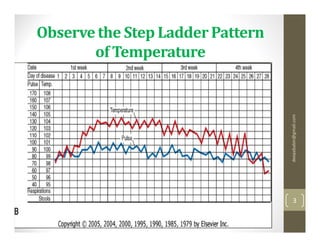
• A 20 years old male medical student presented with fever
  since one week. The temperature chart shows step ladder
  pattern of fever. On clinical examination patient is having
  mild hepatomegaly.


                                                                  deepababin@gmail.com
• 1. What can be your provisional diagnosis?
• 2. What are the microbiological investigations for diagnosing
  this condition?
• 3. What is the importance of Antibiotic sensitivity in this
  condition?
• 4. How you will prevent this infection?
                                                                      2
Observe the Step Ladder Pattern
       of Temperature


                                  deepababin@gmail.com
                                      3
Answer

• It can be case of Enteric fever
Microbiological diagnosis
• Specimens: Blood , Bone marrow ,Blood clot, Stool and


                                                          deepababin@gmail.com
  Urine can be cultured
• The best isolation rates from blood have
  been seen in the first week of illness, with
  faeces in the second week and with urine
  the third week of illness.                   4
Blood Cultures in Typhoid Fevers
• Bacteremia occurs
  early in the disease
• Blood Cultures are
  positive in
1st week in 90%
2nd week in 75%
3rd week in 60%
4th week and later in
  25%
Isolation of the organism
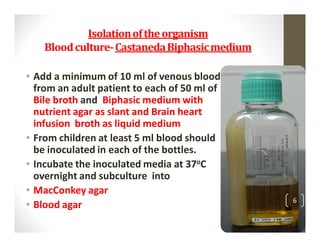
    Blood culture- Castaneda Biphasic medium

• Add a minimum of 10 ml of venous blood
  from an adult patient to each of 50 ml of
  Bile broth and Biphasic medium with
  nutrient agar as slant and Brain heart


                                               deepababin@gmail.com
  infusion broth as liquid medium
• From children at least 5 ml blood should
  be inoculated in each of the bottles.
• Incubate the inoculated media at 37oC
  overnight and subculture into
• MacConkey agar
                                                   6
• Blood agar
Further Incubation up to 7 days

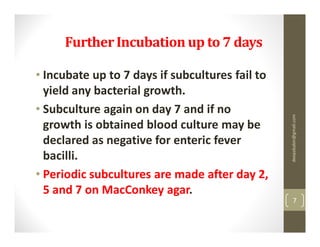
• Incubate up to 7 days if subcultures fail to
  yield any bacterial growth.
• Subculture again on day 7 and if no


                                                 deepababin@gmail.com
  growth is obtained blood culture may be
  declared as negative for enteric fever
  bacilli.
• Periodic subcultures are made after day 2,
  5 and 7 on MacConkey agar.
                                                     7
Clot culture
• The clot culture has following advantages over
  blood culture namely
• Serum is available for antibody titration.
• The clot can be put in blood culture bottles and


                                                        deepababin@gmail.com
  can be broken either mechanically or by adding
  streptokinase, if available.
Urine culture
• Urine culture is positive in a quarter to one third
  of cases, but there seems to be no regular
                                                            8
  excretion pattern in the urine
Clot culture
• Clot cultures are more
  productive in yielding
  better results in
  isolation.


                            deepababin@gmail.com
• A blood after clotting,
  the clot is lysed with
  Streptokinase ,but
  expensive to perform in
  developing countries.
                                9
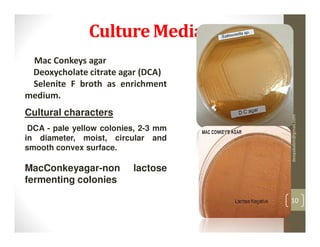
Culture Medias
 Mac Conkeys agar
 Deoxycholate citrate agar (DCA)
 Selenite F broth as enrichment
medium.
Cultural characters


                                      deepababin@gmail.com
 DCA - pale yellow colonies, 2-3 mm
in diameter, moist, circular and
smooth convex surface.

MacConkeyagar-non         lactose
fermenting colonies

                                      10
Salmonella on Mac Conkey's agar


                                  deepababin@gmail.com
                                  11
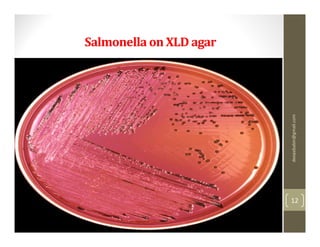
Salmonella on XLD agar


                         deepababin@gmail.com
                         12
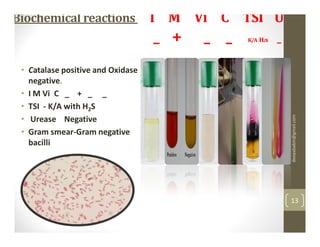
Biochemical reactions              I M Vi C TSI U
                                   _ +   _ _   K/A H2s   _

 • Catalase positive and Oxidase
   negative.
 • I M Vi C _ + _ _
 • TSI - K/A with H2S


                                                             deepababin@gmail.com
 • Urease Negative
 • Gram smear-Gram negative
   bacilli


                                                             13
Slide agglutination
• On the basis of biochemical reactions, the
  organism has been identified as Salmonella; its
  identity can be confirmed with slide agglutination
  test, using polyvalent 'O' and polyvalent 'H'
  antisera against salmonellae.


                                                       deepababin@gmail.com
• For identification monovalent 'O' specific
  antiserum for S.typhi is factor 9.
• To perform this test 1 drop each of normal saline
  is placed at two different sites on a clean glass
  slide.
                                                       14
Slide agglutination tests
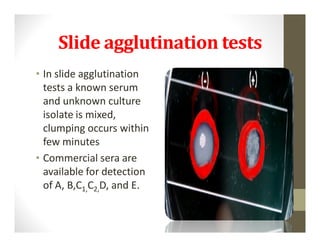
• In slide agglutination
  tests a known serum
  and unknown culture
  isolate is mixed,
  clumping occurs within
  few minutes
• Commercial sera are
  available for detection
  of A, B,C1,C2,D, and E.
Slide agglutination

• A loopful of biochemically suspect colony of
  Salmonella is emulsified in both. One of these is
  kept as central and another is tested first with
  polyvalent 'O' antiserum against Salmonella.


                                                      deepababin@gmail.com
• If this gives visible agglutination within 2
  minutes, the process is repeated with
  polyvalent 'H' antiserum and then with factor 9
  antiserum

                                                      16
Other methods of Diagnosis of Typhoid
               fever
• WIDAL TEST
• Serum agglutinins raise abruptly during the 2nd or 3rd
  week.The widal test detects antibodies against O,
  H,AH,BH antigens
• Two serum specimens obtained at intervals of 7 – 10


                                                                      deepababin@gmail.com
  days to read the raise of antibodies.
• Serial dilutions on unknown sera are tested against the
  antigens for respective Salmonella
• False positives and False negative limits the utility of the test
  O > 1 in 160
  H > 1 in 320
Typhidot
Detects specific IgM and IgG antibodies to S. typhi                   17
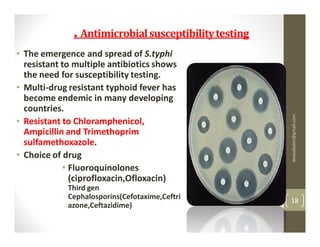
. Antimicrobial susceptibility testing
• The emergence and spread of S.typhi
  resistant to multiple antibiotics shows
  the need for susceptibility testing.
• Multi-drug resistant typhoid fever has
  become endemic in many developing
  countries.


                                                       deepababin@gmail.com
• Resistant to Chloramphenicol,
  Ampicillin and Trimethoprim
  sulfamethoxazole.
• Choice of drug
            • Fluoroquinolones
              (ciprofloxacin,Ofloxacin)
             Third gen
             Cephalosporins(Cefotaxime,Ceftri          18
             azone,Ceftazidime)
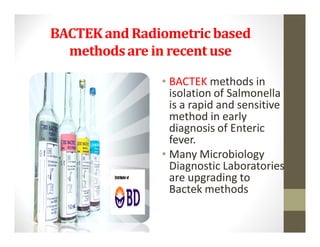
BACTEK and Radiometric based
  methods are in recent use

               • BACTEK methods in
                 isolation of Salmonella
                 is a rapid and sensitive
                 method in early
                 diagnosis of Enteric
                 fever.
               • Many Microbiology
                 Diagnostic Laboratories
                 are upgrading to
                 Bactek methods
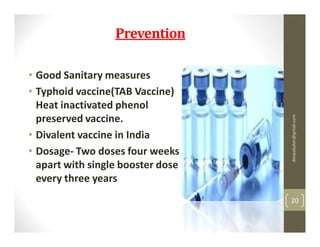
Prevention

• Good Sanitary measures
• Typhoid vaccine(TAB Vaccine)
  Heat inactivated phenol
  preserved vaccine.


                                   deepababin@gmail.com
• Divalent vaccine in India
• Dosage- Two doses four weeks
  apart with single booster dose
  every three years
                                   20
• Programme created for Medical and
Paramedical students for orientation on


                                          deepababin@gmail.com
          Clinical Based Learning
                  • Email
       • deepababin@gmail.com


                                          21

Typhoid fever deepa babin

  • 1.
    Diagnosis of deepababin@gmail.com Typhoid Fever A Clinical Problem Based Learning Deepa Babin 1
  • 2.
    Case study • A20 years old male medical student presented with fever since one week. The temperature chart shows step ladder pattern of fever. On clinical examination patient is having mild hepatomegaly. deepababin@gmail.com • 1. What can be your provisional diagnosis? • 2. What are the microbiological investigations for diagnosing this condition? • 3. What is the importance of Antibiotic sensitivity in this condition? • 4. How you will prevent this infection? 2
  • 3.
    Observe the StepLadder Pattern of Temperature deepababin@gmail.com 3
  • 4.
    Answer • It canbe case of Enteric fever Microbiological diagnosis • Specimens: Blood , Bone marrow ,Blood clot, Stool and deepababin@gmail.com Urine can be cultured • The best isolation rates from blood have been seen in the first week of illness, with faeces in the second week and with urine the third week of illness. 4
  • 5.
    Blood Cultures inTyphoid Fevers • Bacteremia occurs early in the disease • Blood Cultures are positive in 1st week in 90% 2nd week in 75% 3rd week in 60% 4th week and later in 25%
  • 6.
    Isolation of theorganism Blood culture- Castaneda Biphasic medium • Add a minimum of 10 ml of venous blood from an adult patient to each of 50 ml of Bile broth and Biphasic medium with nutrient agar as slant and Brain heart deepababin@gmail.com infusion broth as liquid medium • From children at least 5 ml blood should be inoculated in each of the bottles. • Incubate the inoculated media at 37oC overnight and subculture into • MacConkey agar 6 • Blood agar
  • 7.
    Further Incubation upto 7 days • Incubate up to 7 days if subcultures fail to yield any bacterial growth. • Subculture again on day 7 and if no deepababin@gmail.com growth is obtained blood culture may be declared as negative for enteric fever bacilli. • Periodic subcultures are made after day 2, 5 and 7 on MacConkey agar. 7
  • 8.
    Clot culture • Theclot culture has following advantages over blood culture namely • Serum is available for antibody titration. • The clot can be put in blood culture bottles and deepababin@gmail.com can be broken either mechanically or by adding streptokinase, if available. Urine culture • Urine culture is positive in a quarter to one third of cases, but there seems to be no regular 8 excretion pattern in the urine
  • 9.
    Clot culture • Clotcultures are more productive in yielding better results in isolation. deepababin@gmail.com • A blood after clotting, the clot is lysed with Streptokinase ,but expensive to perform in developing countries. 9
  • 10.
    Culture Medias MacConkeys agar Deoxycholate citrate agar (DCA) Selenite F broth as enrichment medium. Cultural characters deepababin@gmail.com DCA - pale yellow colonies, 2-3 mm in diameter, moist, circular and smooth convex surface. MacConkeyagar-non lactose fermenting colonies 10
  • 11.
    Salmonella on MacConkey's agar deepababin@gmail.com 11
  • 12.
    Salmonella on XLDagar deepababin@gmail.com 12
  • 13.
    Biochemical reactions I M Vi C TSI U _ + _ _ K/A H2s _ • Catalase positive and Oxidase negative. • I M Vi C _ + _ _ • TSI - K/A with H2S deepababin@gmail.com • Urease Negative • Gram smear-Gram negative bacilli 13
  • 14.
    Slide agglutination • Onthe basis of biochemical reactions, the organism has been identified as Salmonella; its identity can be confirmed with slide agglutination test, using polyvalent 'O' and polyvalent 'H' antisera against salmonellae. deepababin@gmail.com • For identification monovalent 'O' specific antiserum for S.typhi is factor 9. • To perform this test 1 drop each of normal saline is placed at two different sites on a clean glass slide. 14
  • 15.
    Slide agglutination tests •In slide agglutination tests a known serum and unknown culture isolate is mixed, clumping occurs within few minutes • Commercial sera are available for detection of A, B,C1,C2,D, and E.
  • 16.
    Slide agglutination • Aloopful of biochemically suspect colony of Salmonella is emulsified in both. One of these is kept as central and another is tested first with polyvalent 'O' antiserum against Salmonella. deepababin@gmail.com • If this gives visible agglutination within 2 minutes, the process is repeated with polyvalent 'H' antiserum and then with factor 9 antiserum 16
  • 17.
    Other methods ofDiagnosis of Typhoid fever • WIDAL TEST • Serum agglutinins raise abruptly during the 2nd or 3rd week.The widal test detects antibodies against O, H,AH,BH antigens • Two serum specimens obtained at intervals of 7 – 10 deepababin@gmail.com days to read the raise of antibodies. • Serial dilutions on unknown sera are tested against the antigens for respective Salmonella • False positives and False negative limits the utility of the test O > 1 in 160 H > 1 in 320 Typhidot Detects specific IgM and IgG antibodies to S. typhi 17
  • 18.
    . Antimicrobial susceptibilitytesting • The emergence and spread of S.typhi resistant to multiple antibiotics shows the need for susceptibility testing. • Multi-drug resistant typhoid fever has become endemic in many developing countries. deepababin@gmail.com • Resistant to Chloramphenicol, Ampicillin and Trimethoprim sulfamethoxazole. • Choice of drug • Fluoroquinolones (ciprofloxacin,Ofloxacin) Third gen Cephalosporins(Cefotaxime,Ceftri 18 azone,Ceftazidime)
  • 19.
    BACTEK and Radiometricbased methods are in recent use • BACTEK methods in isolation of Salmonella is a rapid and sensitive method in early diagnosis of Enteric fever. • Many Microbiology Diagnostic Laboratories are upgrading to Bactek methods
  • 20.
    Prevention • Good Sanitarymeasures • Typhoid vaccine(TAB Vaccine) Heat inactivated phenol preserved vaccine. deepababin@gmail.com • Divalent vaccine in India • Dosage- Two doses four weeks apart with single booster dose every three years 20
  • 21.
    • Programme createdfor Medical and Paramedical students for orientation on deepababin@gmail.com Clinical Based Learning • Email • deepababin@gmail.com 21