K. Karthik,
1689
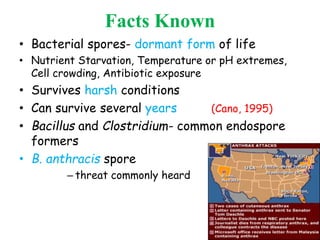
Facts Known
• Bacterial spores- dormant form of life
• Nutrient Starvation, Temperature or pH extremes,
Cell crowding, Antibiotic exposure
• Survives harsh conditions
• Can survive several years (Cano, 1995)
• Bacillus and Clostridium- common endospore
formers
• B. anthracis spore
– threat commonly heard
Spore
• Self assembling and protective property
• Spores can survive in desiccated state
• Resist high temperatures and toxic chemicals
(Nicholson et al., 1995)
• Coat Consist of proteins- proteomeric
subunits arranged
• Bacillus and Clostridium- 2 major endospore
formers
• Bacillus- grow aerobically (Ricca et al., 2003)
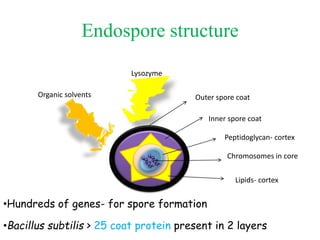
Outer spore coat
Endospore structure
Chromosomes in core
Peptidoglycan- cortex
Lipids- cortex
Inner spore coat
Organic solvents
Lysozyme
•Hundreds of genes- for spore formation
•Bacillus subtilis > 25 coat protein present in 2 layers
Spore display
Spore coat
• Outer- electron dense- 5 principal polypeptides,
CotA (65 kDa), CotB (59 kDa), CotG (24 kDa),
CotC (11 kDa) and CotF (8 kDa)
(Martins et al., 2002)
• CotA- multi-copper oxidase (Zilhao et al., 2004)
• CotG and CotC- unusual amino acid sequences:
12–13 amino acids rich in lysines and tyrosines
(Hullo et al., 2001)
• Spore coat- flexible- contract and expand
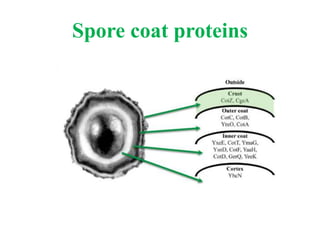
Spore coat proteins
Advantages
• Robustness – easy storage (storage
studies- recombinant protein spores also
stable)
• Ease of production
• Safe and easy genetic manipulation –
Bacillus subtilis, B. clausii, B. coagulans, B.
cereus, and B. natto (Ricca et al., 2003)
Carrier proteins
• Cot B and Cot C- primary targets
• Cot B- located in surface
• Cot C- found in abundance
• Both are essential for spore formation
and germination
(Ricca et al., 2003)
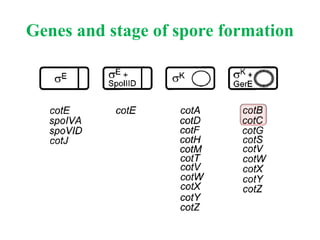
Genes and stage of spore formation
Applications of spore display
• Identification of new antibiotics
• Identification of antigens
• Delivery of vaccines and drugs
• Identifying new Receptors
• Selection of DNA-Binding Proteins
• Drug discovery (Pan et al., 2012)
Spore as Vaccine vehicle
• Non-toxic 459 amino acid C-terminal
fragment of the tetanus toxin (TTFC)-
encoded by the tetC gene of Clostridium
tetani
• 103 amino acid B subunit of the heat labile
toxin of enterotoxigenic strains of
Escherichia coli (LTB) -eltB gene
(Douce et al., 1997)
cotb
• Accessible to CotB-specific antibodies- Present in
outer coat
• CotB gene under control of σK and the DNA-binding
protein GerE
• CotB- in mother spore, assemble around forming
spore
Strategies:
1. Use of the cotB gene and its promoter for the
construction of translational fusions
2. Chromosomal integration of the cotB-tetC and cotB-
eltB gene fusions into the coding sequence of the
non-essential gene amyE (Duc et al., 2003)
CotB
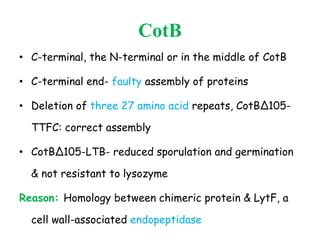
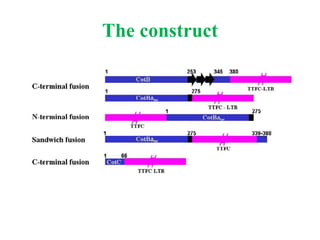
• C-terminal, the N-terminal or in the middle of CotB
• C-terminal end- faulty assembly of proteins
• Deletion of three 27 amino acid repeats, CotBΔ105-
TTFC: correct assembly
• CotBΔ105-LTB- reduced sporulation and germination
& not resistant to lysozyme
Reason: Homology between chimeric protein & LytF, a
cell wall-associated endopeptidase
The construct
Payers patches
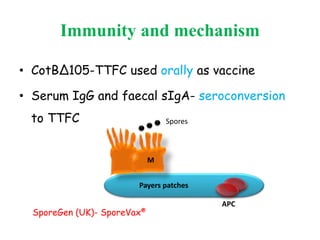
Immunity and mechanism
• CotBΔ105-TTFC used orally as vaccine
• Serum IgG and faecal sIgA- seroconversion
to TTFC
M
APC
Spores
SporeGen (UK)- SporeVax®
Ways to improve spore display
• Late sporulation-specific autoinduction system
• Improving expression system
• Folding of proteins should be evaluated
• Target protein- protease resistant
• Engineered protein- improve the efficiency of
display
(Pan et al., 2012)
As adjuvant
• Vaccines need adjuvant that can enhance broad
polyvalent adaptive immune responses
• Synthetic molecular adjuvants based on TLR agonists
• Single synthetic agonists- less immune response
• More PRR (pattern recognition receptor) activator-
good immune response
• CotM and CotP- similar to α-crystalline family of HSP-
stimulate DC activation (Barnes et al., 2007)
Studies with TT
• B. subtilis- non pathogenic –no mechanism to immune
system- may evoke immunity
• Spores+ TT s/c- BALB/c mice - 11 days post
immunization- > antibodies against TT than only TT
• There is dose dependent increase in antibody to
spores
• Chances of antispore antibodies- less
• i/n- IgA antibody-secreting cells seen in NALT
Special about spore
• Spores through i/n- also induce systemic immunity
• Spores induce both self and non self T cell
response
• Spore present antigen to both MHC I and MHC II
• Cross priming of exogenous antigen through
prolonged stimulation of CD86 and CD40L
(Barnes et al., 2007)
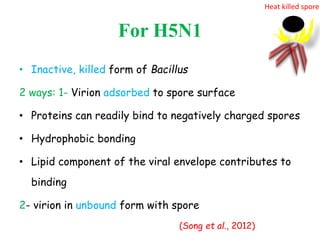
For H5N1
• Inactive, killed form of Bacillus
2 ways: 1- Virion adsorbed to spore surface
• Proteins can readily bind to negatively charged spores
• Hydrophobic bonding
• Lipid component of the viral envelope contributes to
binding
2- virion in unbound form with spore
(Song et al., 2012)
Heat killed spore
• i/n administration of spore+ H5N1 = good mucosal
immunity
• Both bound and unbound- same response in immunity
(Song et al., 2012) (contradictory Souza et al., 2014)
Reason- spore elicit innate immunity
• Spores stimulate maturation of DCs
• Recruit NK cells to lungs
• Induce expression of the NK-B pathway
• TLR interaction with more than one spore ligand
(Souza et al., 2014)
Are spores Useless
• No, spores act both as vaccine vehicle and
adjuvant (Iwanicki et al., 2014)
• As vehicle it is similar to liposomes,
ISCOMs and emulsions
Advantage:
• Easy production and stability
• Heat killed spore- as efficient as live
spore
Studies with spores
• Recombinant HIV gag p24 protein
• Ovalbumin (Barnes et al., 2007)
• Clostridium perfringens alpha toxin
(Hoang et al., 2008)
• Adjuvant effect with co administered DNA
vaccine
• Mycobacterium tuberculosis
• Rabies (Nascimento et al., 2012)
• Enterovirus 71 (Cao et al., 2013)
Biosensors
• Analytical device, used for the
detection of an analyte, that combines a
biological component with a
physicochemical detector
• Inner spore coat- small acid soluble
proteins SASPs- protect nucleic acids
Germination
• Requires signals: single amino acids, sugars or
purine nucleosides, combinations of nutrients
• Asparagine, glucose, fructose and K+ - spore
germination in B. subtilis
• Signals- species and strain specific
• Receptors present in inner membrane eg: GRs
of B. subtilis GerA (Rotman, 2001)
During germination
• Loss of refractivity
• Release of Ca2+ DPA
• Partial dehydration
• Cortex degradation- reactivation of enzymes-
synthesis of ATP from 3-PGA (3-posphoglyceric
acid)
• SASP degraded- release DNA
(Setlow, 2007)
Advantages of spore biosensor
• Long shelf life at room temperature
• Germination within minutes of sensing
germinants- real time response for detection
of analyte
• Production is a low priced process and its
immobilization –effortless
(Kumar et al., 2013)
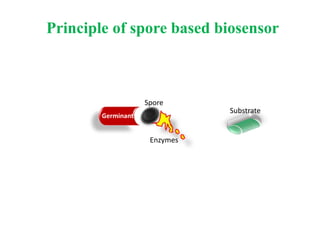
Spore
Germinant
Enzymes
Substrate
Principle of spore based biosensor
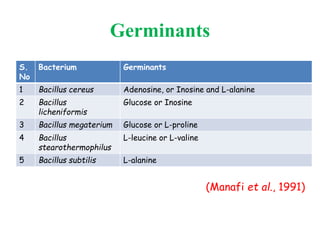
Germinants
S.
No
Bacterium Germinants
1 Bacillus cereus Adenosine, or Inosine and L-alanine
2 Bacillus
licheniformis
Glucose or Inosine
3 Bacillus megaterium Glucose or L-proline
4 Bacillus
stearothermophilus
L-leucine or L-valine
5 Bacillus subtilis L-alanine
(Manafi et al., 1991)
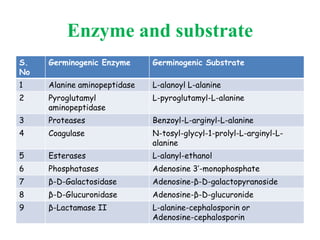
Enzyme and substrate
S.
No
Germinogenic Enzyme Germinogenic Substrate
1 Alanine aminopeptidase L-alanoyl L-alanine
2 Pyroglutamyl
aminopeptidase
L-pyroglutamyl-L-alanine
3 Proteases Benzoyl-L-arginyl-L-alanine
4 Coagulase N-tosyl-glycyl-1-prolyl-L-arginyl-L-
alanine
5 Esterases L-alanyl-ethanol
6 Phosphatases Adenosine 3’-monophosphate
7 β-D-Galactosidase Adenosine-β-D-galactopyranoside
8 β-D-Glucuronidase Adenosine-β-D-glucuronide
9 β-Lactamase II L-alanine-cephalosporin or
Adenosine-cephalosporin
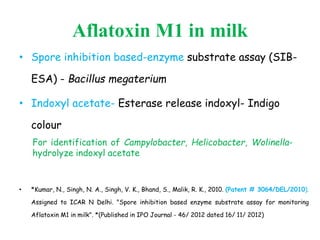
Aflatoxin M1 in milk
• Spore inhibition based-enzyme substrate assay (SIB-
ESA) - Bacillus megaterium
• Indoxyl acetate- Esterase release indoxyl- Indigo
colour
• *Kumar, N., Singh, N. A., Singh, V. K., Bhand, S., Malik, R. K., 2010. (Patent # 3064/DEL/2010).
Assigned to ICAR N Delhi. "Spore inhibition based enzyme substrate assay for monitoring
Aflatoxin M1 in milk". *(Published in IPO Journal - 46/ 2012 dated 16/ 11/ 2012)
For identification of Campylobacter, Helicobacter, Wolinella-
hydrolyze indoxyl acetate
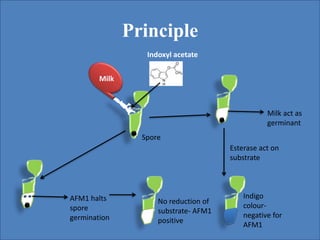
Principle
Milk
Indoxyl acetate
Milk act as
germinant
AFM1 halts
spore
germination
Esterase act on
substrate
Indigo
colour-
negative for
AFM1
No reduction of
substrate- AFM1
positive
Spore
Beta lactam in milk
• B. cereus and B. licheniformis – produce β-
lactamase enzyme in presence of β-lactam
• Amount of enzyme produced = concentration of
inducer (β-lactam)
• Starch iodine- colour indicator
• Penicilloic acid - contain a non-acylated amino group
which is capable of reducing iodine to iodide
(Patent Reg No. 115/DEL/2009)
Similarly….
• Antibiotic residues in milk- Bacillus
Stearothermophilus
• Microbial contaminants in milk-
detecting E. coli, S. aureus and Listeria
monocytogenes
• Substrate: diacetate fluorescein (DAF)
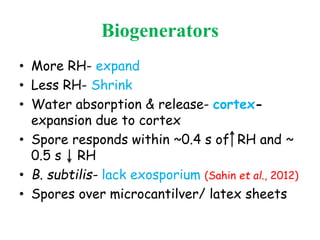
Biogenerators
• More RH- expand
• Less RH- Shrink
• Water absorption & release- cortex-
expansion due to cortex
• Spore responds within ~0.4 s of RH and ~
0.5 s RH
• B. subtilis- lack exosporium (Sahin et al., 2012)
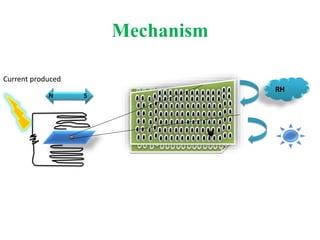
• Spores over microcantilver/ latex sheets
Mechanism
RH
N S
Current produced
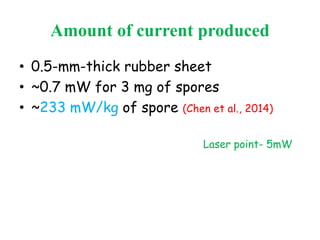
Amount of current produced
• 0.5-mm-thick rubber sheet
• ~0.7 mW for 3 mg of spores
• ~233 mW/kg of spore (Chen et al., 2014)
Laser point- 5mW
Self healing concretes
• Bacterial spores + organic compounds packed with
concrete
• Spores remain dormant-till cracks form
• Water seeps into crack- spores activated- feed on
calcium lactate
• Calcium lactate+ oxygen
• Conversion of calcium lactate to calcium carbonate
(Calcite) (Wang et al., 2014)
Other uses
• Cancer treatment- Clostridium
• Probiotic
• Crude oil extraction
Conclusion
• Spores has multiple applications
• Studies required for its adjuvant properties
and as a vaccine vehicle
• Spore based biosensor shows promising
results
• Biogenerators & self cure concretes- needs
special attention
Spores- Life in dormant stage
Thank you

Bacterial spore

  • 1.
  • 2.
    Facts Known • Bacterialspores- dormant form of life • Nutrient Starvation, Temperature or pH extremes, Cell crowding, Antibiotic exposure • Survives harsh conditions • Can survive several years (Cano, 1995) • Bacillus and Clostridium- common endospore formers • B. anthracis spore – threat commonly heard
  • 3.
    Spore • Self assemblingand protective property • Spores can survive in desiccated state • Resist high temperatures and toxic chemicals (Nicholson et al., 1995) • Coat Consist of proteins- proteomeric subunits arranged • Bacillus and Clostridium- 2 major endospore formers • Bacillus- grow aerobically (Ricca et al., 2003)
  • 4.
    Outer spore coat Endosporestructure Chromosomes in core Peptidoglycan- cortex Lipids- cortex Inner spore coat Organic solvents Lysozyme •Hundreds of genes- for spore formation •Bacillus subtilis > 25 coat protein present in 2 layers
  • 5.
  • 6.
    Spore coat • Outer-electron dense- 5 principal polypeptides, CotA (65 kDa), CotB (59 kDa), CotG (24 kDa), CotC (11 kDa) and CotF (8 kDa) (Martins et al., 2002) • CotA- multi-copper oxidase (Zilhao et al., 2004) • CotG and CotC- unusual amino acid sequences: 12–13 amino acids rich in lysines and tyrosines (Hullo et al., 2001) • Spore coat- flexible- contract and expand
  • 7.
  • 8.
    Advantages • Robustness –easy storage (storage studies- recombinant protein spores also stable) • Ease of production • Safe and easy genetic manipulation – Bacillus subtilis, B. clausii, B. coagulans, B. cereus, and B. natto (Ricca et al., 2003)
  • 9.
    Carrier proteins • CotB and Cot C- primary targets • Cot B- located in surface • Cot C- found in abundance • Both are essential for spore formation and germination (Ricca et al., 2003)
  • 10.
    Genes and stageof spore formation
  • 11.
    Applications of sporedisplay • Identification of new antibiotics • Identification of antigens • Delivery of vaccines and drugs • Identifying new Receptors • Selection of DNA-Binding Proteins • Drug discovery (Pan et al., 2012)
  • 12.
    Spore as Vaccinevehicle • Non-toxic 459 amino acid C-terminal fragment of the tetanus toxin (TTFC)- encoded by the tetC gene of Clostridium tetani • 103 amino acid B subunit of the heat labile toxin of enterotoxigenic strains of Escherichia coli (LTB) -eltB gene (Douce et al., 1997)
  • 13.
    cotb • Accessible toCotB-specific antibodies- Present in outer coat • CotB gene under control of σK and the DNA-binding protein GerE • CotB- in mother spore, assemble around forming spore Strategies: 1. Use of the cotB gene and its promoter for the construction of translational fusions 2. Chromosomal integration of the cotB-tetC and cotB- eltB gene fusions into the coding sequence of the non-essential gene amyE (Duc et al., 2003)
  • 14.
    CotB • C-terminal, theN-terminal or in the middle of CotB • C-terminal end- faulty assembly of proteins • Deletion of three 27 amino acid repeats, CotBΔ105- TTFC: correct assembly • CotBΔ105-LTB- reduced sporulation and germination & not resistant to lysozyme Reason: Homology between chimeric protein & LytF, a cell wall-associated endopeptidase
  • 15.
  • 16.
    Payers patches Immunity andmechanism • CotBΔ105-TTFC used orally as vaccine • Serum IgG and faecal sIgA- seroconversion to TTFC M APC Spores SporeGen (UK)- SporeVax®
  • 17.
    Ways to improvespore display • Late sporulation-specific autoinduction system • Improving expression system • Folding of proteins should be evaluated • Target protein- protease resistant • Engineered protein- improve the efficiency of display (Pan et al., 2012)
  • 18.
    As adjuvant • Vaccinesneed adjuvant that can enhance broad polyvalent adaptive immune responses • Synthetic molecular adjuvants based on TLR agonists • Single synthetic agonists- less immune response • More PRR (pattern recognition receptor) activator- good immune response • CotM and CotP- similar to α-crystalline family of HSP- stimulate DC activation (Barnes et al., 2007)
  • 19.
    Studies with TT •B. subtilis- non pathogenic –no mechanism to immune system- may evoke immunity • Spores+ TT s/c- BALB/c mice - 11 days post immunization- > antibodies against TT than only TT • There is dose dependent increase in antibody to spores • Chances of antispore antibodies- less • i/n- IgA antibody-secreting cells seen in NALT
  • 20.
    Special about spore •Spores through i/n- also induce systemic immunity • Spores induce both self and non self T cell response • Spore present antigen to both MHC I and MHC II • Cross priming of exogenous antigen through prolonged stimulation of CD86 and CD40L (Barnes et al., 2007)
  • 21.
    For H5N1 • Inactive,killed form of Bacillus 2 ways: 1- Virion adsorbed to spore surface • Proteins can readily bind to negatively charged spores • Hydrophobic bonding • Lipid component of the viral envelope contributes to binding 2- virion in unbound form with spore (Song et al., 2012) Heat killed spore
  • 22.
    • i/n administrationof spore+ H5N1 = good mucosal immunity • Both bound and unbound- same response in immunity (Song et al., 2012) (contradictory Souza et al., 2014) Reason- spore elicit innate immunity • Spores stimulate maturation of DCs • Recruit NK cells to lungs • Induce expression of the NK-B pathway • TLR interaction with more than one spore ligand (Souza et al., 2014)
  • 23.
    Are spores Useless •No, spores act both as vaccine vehicle and adjuvant (Iwanicki et al., 2014) • As vehicle it is similar to liposomes, ISCOMs and emulsions Advantage: • Easy production and stability • Heat killed spore- as efficient as live spore
  • 24.
    Studies with spores •Recombinant HIV gag p24 protein • Ovalbumin (Barnes et al., 2007) • Clostridium perfringens alpha toxin (Hoang et al., 2008) • Adjuvant effect with co administered DNA vaccine • Mycobacterium tuberculosis • Rabies (Nascimento et al., 2012) • Enterovirus 71 (Cao et al., 2013)
  • 25.
    Biosensors • Analytical device,used for the detection of an analyte, that combines a biological component with a physicochemical detector • Inner spore coat- small acid soluble proteins SASPs- protect nucleic acids
  • 26.
    Germination • Requires signals:single amino acids, sugars or purine nucleosides, combinations of nutrients • Asparagine, glucose, fructose and K+ - spore germination in B. subtilis • Signals- species and strain specific • Receptors present in inner membrane eg: GRs of B. subtilis GerA (Rotman, 2001)
  • 27.
    During germination • Lossof refractivity • Release of Ca2+ DPA • Partial dehydration • Cortex degradation- reactivation of enzymes- synthesis of ATP from 3-PGA (3-posphoglyceric acid) • SASP degraded- release DNA (Setlow, 2007)
  • 28.
    Advantages of sporebiosensor • Long shelf life at room temperature • Germination within minutes of sensing germinants- real time response for detection of analyte • Production is a low priced process and its immobilization –effortless (Kumar et al., 2013)
  • 29.
  • 30.
    Germinants S. No Bacterium Germinants 1 Bacilluscereus Adenosine, or Inosine and L-alanine 2 Bacillus licheniformis Glucose or Inosine 3 Bacillus megaterium Glucose or L-proline 4 Bacillus stearothermophilus L-leucine or L-valine 5 Bacillus subtilis L-alanine (Manafi et al., 1991)
  • 31.
    Enzyme and substrate S. No GerminogenicEnzyme Germinogenic Substrate 1 Alanine aminopeptidase L-alanoyl L-alanine 2 Pyroglutamyl aminopeptidase L-pyroglutamyl-L-alanine 3 Proteases Benzoyl-L-arginyl-L-alanine 4 Coagulase N-tosyl-glycyl-1-prolyl-L-arginyl-L- alanine 5 Esterases L-alanyl-ethanol 6 Phosphatases Adenosine 3’-monophosphate 7 β-D-Galactosidase Adenosine-β-D-galactopyranoside 8 β-D-Glucuronidase Adenosine-β-D-glucuronide 9 β-Lactamase II L-alanine-cephalosporin or Adenosine-cephalosporin
  • 32.
    Aflatoxin M1 inmilk • Spore inhibition based-enzyme substrate assay (SIB- ESA) - Bacillus megaterium • Indoxyl acetate- Esterase release indoxyl- Indigo colour • *Kumar, N., Singh, N. A., Singh, V. K., Bhand, S., Malik, R. K., 2010. (Patent # 3064/DEL/2010). Assigned to ICAR N Delhi. "Spore inhibition based enzyme substrate assay for monitoring Aflatoxin M1 in milk". *(Published in IPO Journal - 46/ 2012 dated 16/ 11/ 2012) For identification of Campylobacter, Helicobacter, Wolinella- hydrolyze indoxyl acetate
  • 33.
    Principle Milk Indoxyl acetate Milk actas germinant AFM1 halts spore germination Esterase act on substrate Indigo colour- negative for AFM1 No reduction of substrate- AFM1 positive Spore
  • 34.
    Beta lactam inmilk • B. cereus and B. licheniformis – produce β- lactamase enzyme in presence of β-lactam • Amount of enzyme produced = concentration of inducer (β-lactam) • Starch iodine- colour indicator • Penicilloic acid - contain a non-acylated amino group which is capable of reducing iodine to iodide (Patent Reg No. 115/DEL/2009)
  • 35.
    Similarly…. • Antibiotic residuesin milk- Bacillus Stearothermophilus • Microbial contaminants in milk- detecting E. coli, S. aureus and Listeria monocytogenes • Substrate: diacetate fluorescein (DAF)
  • 37.
    Biogenerators • More RH-expand • Less RH- Shrink • Water absorption & release- cortex- expansion due to cortex • Spore responds within ~0.4 s of RH and ~ 0.5 s RH • B. subtilis- lack exosporium (Sahin et al., 2012) • Spores over microcantilver/ latex sheets
  • 38.
  • 39.
    Amount of currentproduced • 0.5-mm-thick rubber sheet • ~0.7 mW for 3 mg of spores • ~233 mW/kg of spore (Chen et al., 2014) Laser point- 5mW
  • 40.
    Self healing concretes •Bacterial spores + organic compounds packed with concrete • Spores remain dormant-till cracks form • Water seeps into crack- spores activated- feed on calcium lactate • Calcium lactate+ oxygen • Conversion of calcium lactate to calcium carbonate (Calcite) (Wang et al., 2014)
  • 41.
    Other uses • Cancertreatment- Clostridium • Probiotic • Crude oil extraction
  • 42.
    Conclusion • Spores hasmultiple applications • Studies required for its adjuvant properties and as a vaccine vehicle • Spore based biosensor shows promising results • Biogenerators & self cure concretes- needs special attention Spores- Life in dormant stage
  • 43.